If you’re writing an olden days blog you run out of material. Only so much happened from when I was born till I met Aitch, which is the timeline of this blog – my Born, Bachelorhood and Beer blog. So there’s recycling. Here’s a post I wrote in 2014, twice updated and embellished:
~~oo0oo~~
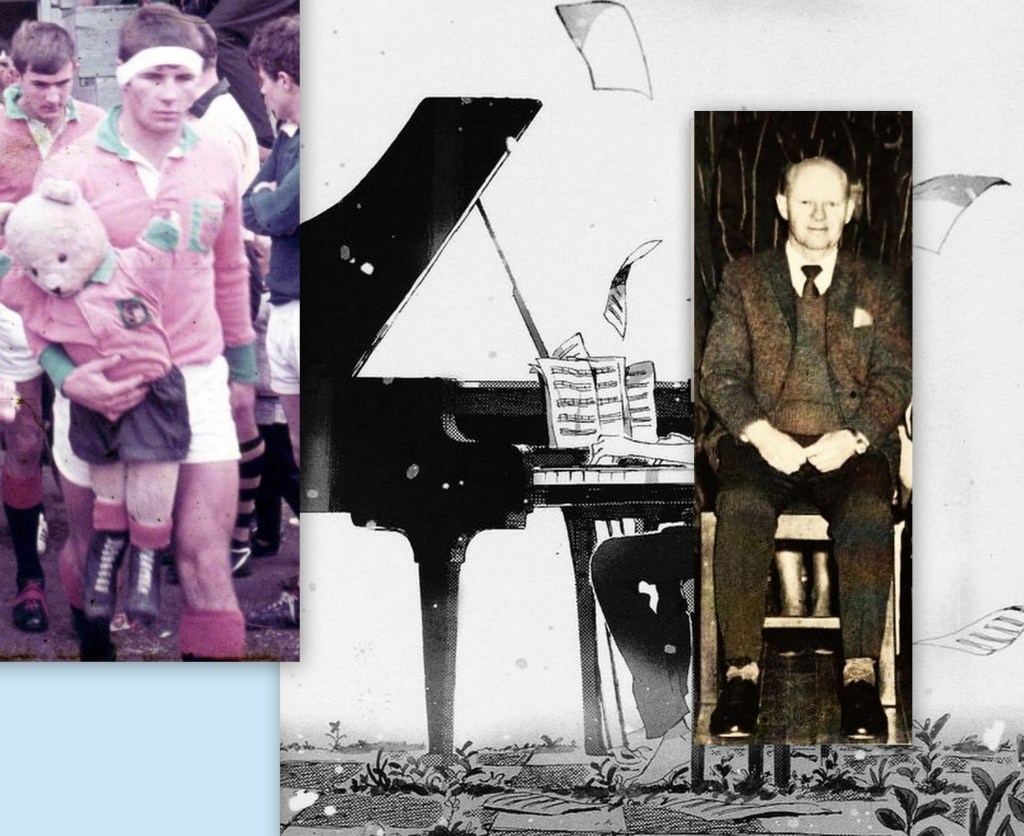
In high school we had an older mate who was in the Free State koor. He was famous in Harrismith for that. You could say he enjoyed Harrismith-wide fame. His nickname was Spreeu but we called him Sparrow. Everyone knew Sparrow – Chris Bester – and everyone knew Sparrow was one of ‘Die Kanaries – Die Vrystaatse Jeugkoor.’ Fame! Travel! Bright lights! Girls threw their broekies at the Kanaries! OK, maybe not.
One day a buzz went round school that Septimus – apparently he was the seventh child – Smuts, Free State Inspector of Music was there – here! in Harrismith, city of song and laughter – to do auditions for new members for this famous koor.
We were there! Me and Gabba. Neither known for having the faintest interest in warbling before (my membership of the laerskool koor a distant memory – I was over the trauma). Nor any other form of culture come to think of it, other than the fine art of rugby. Gabba was a famous – beroemde, kranige – rugby player, having been chosen for Oos Vrystaat Craven Week in Std 8, Std 9, Std 9 & Std 10. Strong as an ox, great sense of humour, good heart.
People were amazed: “What are YOU ous doing here?” they asked as we waited in the queue. We just smiled. We’d already missed biology and PT.
Septimus was a dapper little rockspider full of confidence. He gave Gabba exactly three seconds and sent him packing. Gave me ten times longer and said ‘Nice enough, but no range.’ So back to class we went, crestfallen look on our dials, mournfully telling our mates and the teacher that we COULD NOT understand how we’d been rejected and there must have been some kind of mistake. Tender-rigging, maybe? Maybe our voices were taken out of context?
– Gabba in choirboy mode – Seppie at the piano –
The maths teacher Ou Oosie raised his eyebrows and rolled his eyes, but they were a bit hidden behind his thick black plastic bril. But we stuck to our story: It had been a longtime deep desire of ours to sing for our province and the rejection cut us deep. And maybe the keuringsproses was rigged.
It became my & Gabba’s standing joke over the decades that followed. Every time we met we’d have a lekker laugh. Then he’d update me on our hoerskool athletics records: his for shotput and mine for the 100m sprint. Mine was eventually beaten about twenty years later. Gabba said ‘hier’t n nuwe oukie gekom wat soos die wind gehol het.’ His shotput record probably still stands, as far as I know. It was a mighty heave. I choon you, verily, on that day in 1972, he stooted that gewig moertoe.
We may have scored E’s and F’s on most of these, but on 7.2.1.8 Intelligence and Dedication we surely got an A? Also, if we’d known that Septimus the choirmaster had ‘n besondere liefde vir die gedrae polifonie van Palestrina se koorkompetisies,’ we’d have practiced that shit.
~~oo0oo~~
spreeu – starling, but mistranslated and verengels as ‘sparrow’
verengels – anglicised; corrupted
Die Kanaries – ve canaries
Vrystaatse Jeugkoor – Free State Youth Choir; it must be confessed we would mock it as the Yech Choir
broekies – panties; maybe bloomers
beroemde, kranige – famous, outstanding
Oos Vrystaat – Eastern Free State; our neck of the woods
bril – spectacles; eyeglasses
hier’t n nuwe oukie gekom wat soos die wind gehol het – a new guy arrived in the dorp who ran like the wind
keuringsproses – like ‘Harrismith’s Got Talent’ – y’know, judges; impartial??
stoot a gewig – shotput
moertoe – a long way
‘n besondere liefde vir die gedrae polifonie van Palestrina se koorkompetisies – fuck knows
~~oo0oo~~
Here’s Sep and one of his choirs with which he gained moderate regional fame. Of course he dipped out on international acclaim by not signing up me and Gabba as a duet.
~~oo0oo~~
For those sad mense who doubt Gabba’s dramatic talents and aspirations, I give you evidence:
Some 50 years on, R.I.P Gabba! You’ve moved on to that Great Shotput Circle in the Sky. Choirs up there will welcome you, I’m sure.
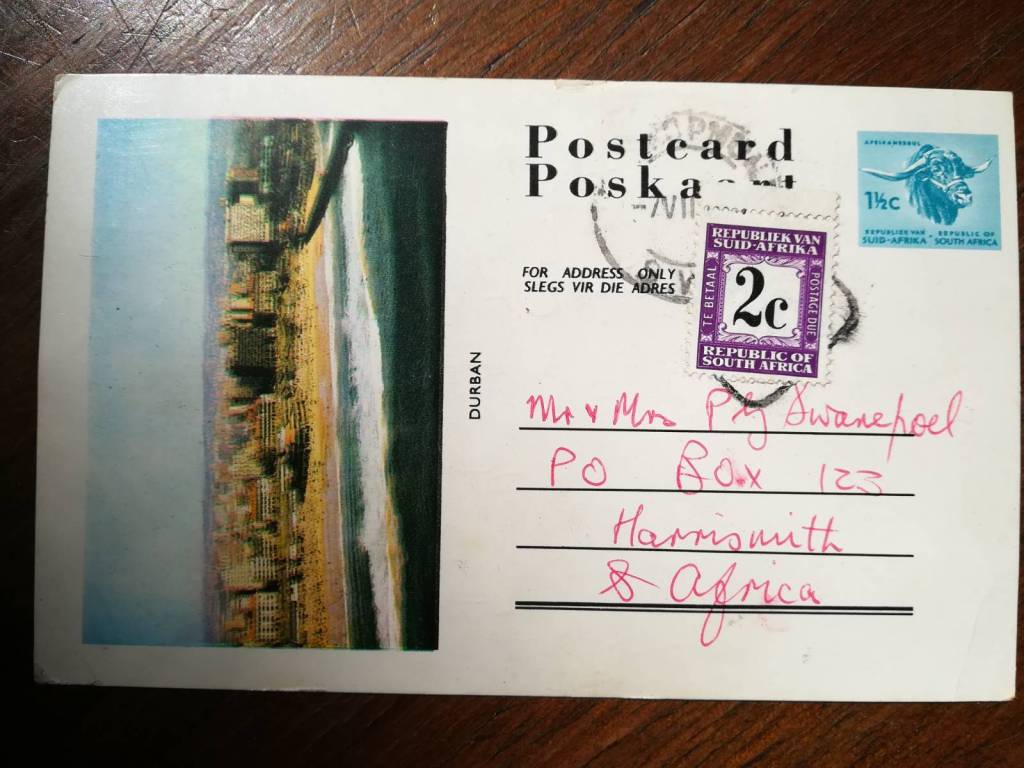
Sheila sent me a surprise postcard. So I have re-posted this 2015 blogpost about a Magical 1969 Tour, and attached the postcard at the end. Enjoy the Olden Daze!
~~oo0oo~~
The Kestell bus was like a half-loaf, but still the metropolis of Kestell – which we regarded as a sparsely-populated Afrikaans suburb of Harrismith – couldn’t roust enough boys to fill it, so they decided to invite some Harrismithians along to add wit, charm and Engels to the proceedings. Or anyway bulk.
So one fine winters day Johan Steyl announced in the assembly hall that Kestell was inviting fine, talented, well-behaved Harrismith boys to join their ‘seunstoer’ to South West Africa. It would be for fifteen days in the July holidays, and the cost would be twenty five South African 1969 Ronts.
Leon ‘Fluffy’ Crawley, Harry ‘Pikkie’ Loots, Pierre du Plessis, Tuffy Joubert and I said YES! and then our parents said yes and forked over the cash, so we were off! Now Sheila’s postcard reminds me that Jan van Wyk – who would be chosen head boy in matric the next year – also went along.
– an actual pic by Fluffy, care of mother Polly’s Kodak! –
It was boys-only, a seunstoer, but Mnr Braam Venter of Kestell took his young daughter along. She was about Std 4, we were Std 7 to 9. She was very popular and soon became like the tour mascot, second only to Wagter the tour dog – who was actually a found holey corobrick with a dog collar through one of its three holes and string for a leash.
The short bus had a longitudinal seating arrangement. The rows ran the length of the bus so you sat facing each other, sideways to your direction of travel.
We all bundled in and set off. After a few hours we had the first roadside stop. Mnr Venter lined us all up outside the bus and said ‘Right, introduce yourselves,’ as the Kestell ous didn’t know us – and we didn’t know them. Down the row came the names, van Tonder, van Wyk, van Niekerk, van Staden, van Aswegen, vanne Merwe, van Dit, van WhatWhat, Aasvoel, Kleine Asenvogel, Marble Hol. Fluffy standing next to me murmured ‘Steve McQueen,’ but when his turn came he let out with a clear ‘Leon Crawley,’ so I said ‘Steve McQueen’ out loud. Without a blink the naming continued before I could say ‘Uh, just kidding,’ so I became ‘Ou Steve‘ for the duration.
– Augrabies Falls – by Leon Fluffy Crawley –
Our first stop was Kimberley, where we camped in the caravan park and had some fun; then on to the Augrabies Falls on the Gariep (Orange) River, stopping at the roaring dunes near Hotazel in the Kalahari en-route. On from there to the borderpost at Onseepkans.
~~oo0oo~~
When we entered South West Africa we headed straight for a pub. The first pub we found. Us fourteen to sixteen year-olds. That’s cos we knew something.
We went to the Fish River Canyon. Like all canyons, it is billed as the biggest, longest, deepest, whatever, in the (insert your province, your country, or ‘world’ here). We stood on the rim and gazed down. Then Harry Loots and I couldn’t stand it; so – against orders – we zipped down the pathway, slipping and sliding down as fast as we could on the loose surface. Before we got to the bottom we decided we’d get into big kak if we took too long, so we reluctantly stopped and returned to the top, a lot more slowly.
– Steve Reed’s pic from 1993 when he did the full hike –
We camped next to the Vingerklip, or Mukorob, or Finger of God, near Karasburg, a sandstone rock formation in the Namib desert, while it still stood. It fell down nineteen years later on 8 December 1988, so that was obviously not our fault, nê. About 30m high from the vlaktes at the base, the little neck it balanced on was only about 3m by 1,5m, making it rather precarious.
– vingerklip as we left it – promise ! –
Later we camped near Windhoek where Dad had arranged that I got fetched by some of his relatives I had never met, to overnight at their home. Third or fourth cousins, I suppose. In the car on the way to their home they had lots of questions, but before I had finished my second sentence the younger son blurted out “Jis! Jy kan hoor jy’s ’n rooinek!” (Boy, You can hear you’re English-speaking!) and my bubble burst. All of my short life I had laboured under the mistaken and vain impression that I was completely fluent in Afrikaans. Hey! No-one had told me otherwise.
~~oo0oo~~
– a Welwitschia plant in the Namib desert – pic by photographer Crawley (Fluffy) with Polly’s Kodak camera –
On to the Brandberg, where a long walk would take you to some rock paintings. I chose not to make the walk. Pikkie did, and remembered: ‘the terrain was barren, hot as hell, and rock strewn. The rocks had a rich red-brown colour, and I thought it was amazing that the local indigenous people had painted a white lady, which according to legend was the Queen of Sheba, who they would probably never have seen! Some people wanted to pour water on the paintings but I think Braam stopped them and of course today I realise that he was a hundred per cent right in not letting us do it. If we all poured water on it it would have been washed away by now!’
– new Okakuejo gate –
We got to Etosha National Park after dark so the Okakuejo gate was closed. We didn’t pitch our tents that night to save time, simply bedding down outside ready to drive in first thing the next morning. On spotting us the next morning the game ranger said ‘Net hier het ‘n leeu eergistraand ‘n bok neergetrek.‘
– Namutoni camp, as we saw it! Fluffy’s pic again –
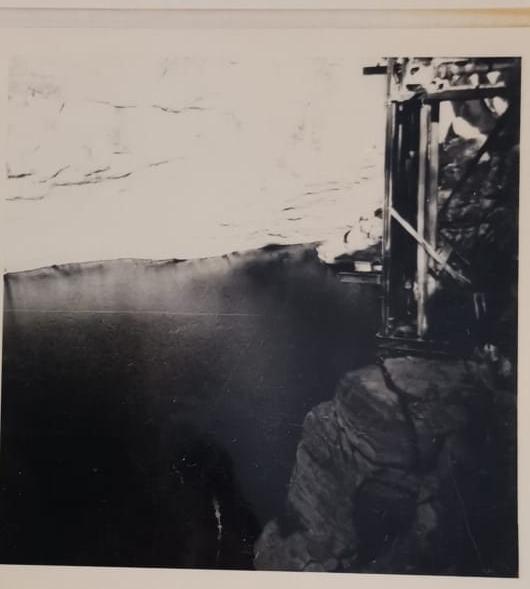
On our way back, we passed Lake Otjikoto, the ‘bottomless lake’:
– cichlid fish, Tilapia guinasana –– that’s us at the ‘bottomless’ lake – Fluffy the photographer – with his Ma Polly’s Kodak –
The Hoba meteorite next. Weighing about 60 tons, made of iron and nickel, it is still the largest single intact iron meteorite known, and also the most massive naturally-occurring piece of ferronickel known on Earth’s surface. Don’t worry, it’s estimated to have fallen 80 000 years ago.
– this pic from July 1967 –– 1969 – Fluffy’s authentic Kodak pic of the meteorite –
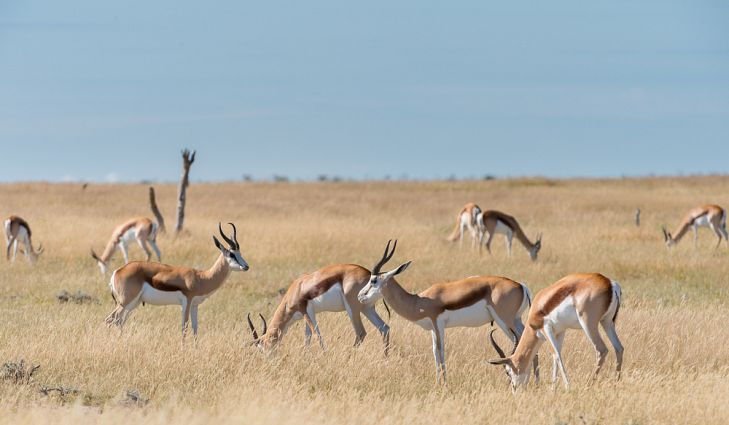
On the way out of SWA we reached the South East corner of the country, heading for the border with the Kalahari Gemsbok Park, when we spotted something tangled up in the roadside fences. Turned out to be a few springbok, some dead, some still alive but badly injured. As we spotted them one of the farm boys yelled out, ‘Ek debs die balsak!‘ He cut off the scrotum, pulled it over the base of a glass cooldrink bottle. What? we asked. Once it dried he would break the glass and he’d have an ashtray, he explained. Oh.
The alive ones were dispatched and all were taken to the nearby farmer who gave us one for our trouble. It seems some hunters are indiscriminate and less than accurate and the buck panic before the onslaught and run into the fences.
– looking at them I would never have guessed they had potential ashtrays a-hanging ! –
That night we made a huge bonfire on the dry bed of the Nossob river or one of its tributaries and braai’d the springbok meat. It was freezing in July so we placed our sleeping bags around the fire and moved closer to the bed of coals all night long. Every time we woke we inched closer.
A wonderful star-filled night sky above us.
~~oo0oo~~
edit: Updated since Fluffy found his 1969 pictures of SWA. Taken with Ma Polly’s Kodak camera. So now our story has real pics, not just internet pics. – Harry says: Even reading it a second time brings back great memories! Fluffy asks: Can you guys remember the freshly baked brown bread we bought from a plaas winkel… Twee Rivieren… On our way back… Pretty expensive if I remember well – 17 cents . .
That was an unforgettable fifteen days! We’re so lucky to have enjoyed such an adventure. We still talk about it. For many years after – fifty-plus years – I kept the oxwagon axle hub I had found in the veld and written everyone’s name on.
*put pic of hub here*
Pikkie tried to get us to go again in 2019 – fifty years later! Inertia, work, family and all the usual shit put paid to that great idea. No longer could we just say, “Ag pleez Daddy!” and go without a backward glance, as we did in 1969! Adulthood sucks.
~~oo0oo~~
seunstoer – boys tour;
Wagter – Rover in England; Fido in America;
nê – y’understand? capiche?
“Jis! Jy kan hoor jy’s ’n rooinek!” – Your Afrikaans Are Atrocious; or Boy, You can hear you’re English-speaking!
Ek debs die balsak! – ‘Dibs on the ballbag!’ or ‘I lay claim to the antelope scrotum’;
Net hier het ‘n leeu eergistraand ‘n bok neergetrek – Right here where you’re camping a lion killed an antelope the night before last; ‘Be Nervous’ was the message;
– another view of Otjikoto ‘bottomless’ Lake – about 100m deep vertically, but then leading off horizontally into caves beyond that – Fluffy pic– a hillock covered with rocks – who are walking on boulders – near Augrabies Falls – authentic Fluffy pic
~~oo0oo~~
The 2021 surprise from Sheila: A postcard I wrote on 7 July 1969 while on tour:
Can’t say I remember ‘Sorris Sorris.’ I see it’s just north of the Brandberg, so maybe we camped there?
Fine, thank you. I’m tucked up in bed already, waiting for the sister to bring my pain muti and eyedrops. They put a drop in my left eye and five minutes later another drop. Same eye. Only my left eye.
It’s 6pm. Early to bed, my Ma in frail care.
Do you sleep well?
Like a log. I’m warm and comfortable. And Kosie! I’ve been having the most wonderful dreams lately. Nice, happy dreams. I wake up smiling.
That’s so nice! Can you remember what they’re about, or are they too racy to repeat in polite company?
Laughs!!
No, they’re about the farm. The wonderful farm, the beautiful view, the walks with my Dad. It’s all underwater now, of course.
The farm Nuwejaarsvlei on the Nuwejaarspruit. Now submerged beneath the waters of Sterkfontein Dam. About ’15 miles’ from Harrismith towards Oliviershoek Pass and ‘on the Witsieshoek road.’
I was eight years old when we left the farm.
That was 1936.
~~~oo0oo~~~
muti – medicine;
Kosie – my nickname; Ma pronounces it the Afrikaans way, Kuwa-see; unlike Annie and her friends who all called me Koosie, rhyming with pussy or wussy; True fact; Accounts for a lot?
Nuwejaarsvlei – New Year Marsh or wetland
Nuwejaarspruit – New Year creek or stream
Sterkfontein – strong fountain
Oliviershoek – the place of the Oliviers, a surname
Witsieshoek – the place of the Basotho chief Witsie who lived there from 1839 to 1856.
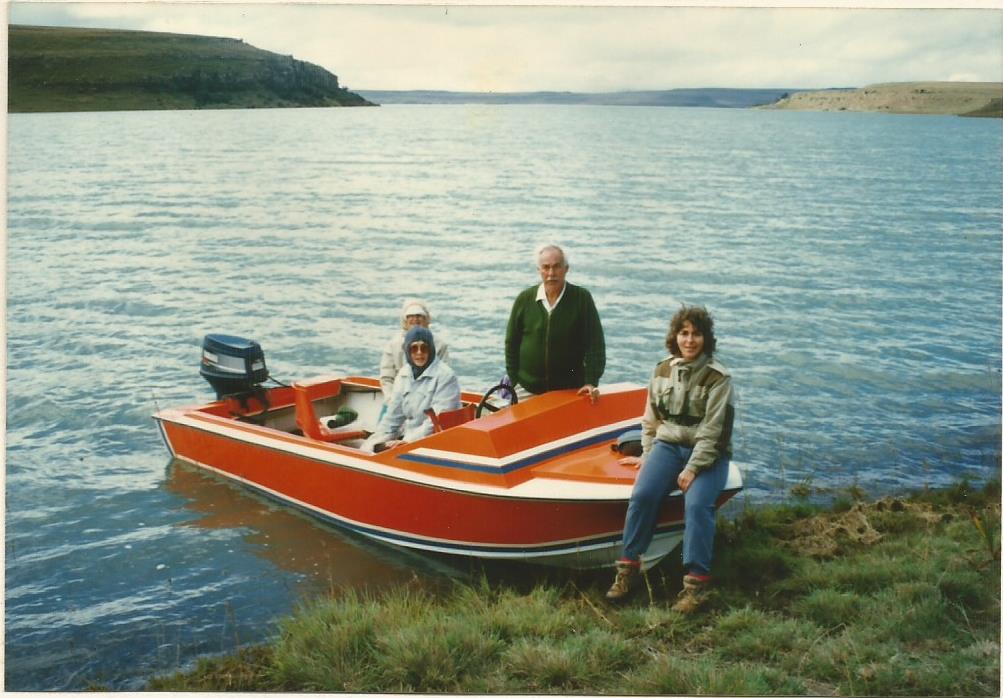
The pic shows Mom floating on the water above her old farm in 1990. Its somewhere in the background in this pic:
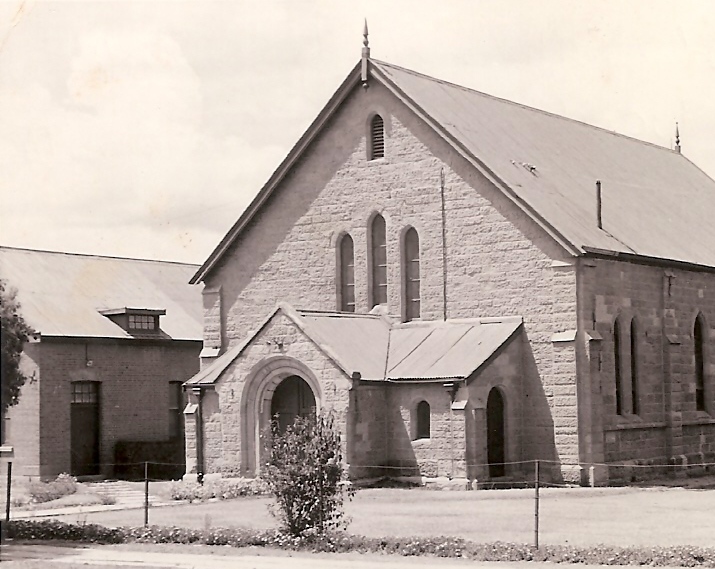
We good people of the Harrismith Methodist Church would never have taken Mrs Brunsdon to court for her singing! Sure, her singing was awful, but church would have been duller and there would have been less giggling and less to skinder about without her. She would bellow off-key and at her own pace, sniffing loudly from time to time, dabbing with a well-used hankie, and gazing all round the church mid-hymn; sometimes through her glasses, sometimes over her glasses; sometimes turning right round to see who was behind her. The sniffs would put her behind, so soon she’d be a few words and then a few lines behind but no way she would play catch-up. She got her money’s worth, singing every single word. In fact, our Mom Mary Methodist, the organist, would wait for her, as would we all.
Not so the Methodists in Lumberton, North Carolina USA. They were considerably displeased when William Linkhaw sang hymns very loudly and very poorly. Deviating from the correct notes, he continued singing well after the congregation reached the end of each verse. On one occasion, the pastor simply read the hymn aloud, refusing to sing it because of the disruption that would inevitably occur. The presiding elder refused to preach in the church at all. Upon the entreaties of a prominent church member, Linkhaw once stayed quiet after a particularly solemn sermon. But he steadfastly rejected the repeated pleas of his fellow congregants to remain silent altogether, responding that “he would worship his God, and that as a part of his worship it was his duty to sing.”
In their defence it must be noted that some of the better congregants of Lumberton Methodist – like us in Harrismith – found Linkhaw’s singing hilarious, but the bitter lot won out and decided to show him! They had the law hand down a misdemeanor indictment against Linkhaw, charging that he had disturbed the congregation. Obviously the LumberMeths had never heard Jesus’ clear instructions in his sermon that we ‘Turn The Other Tympanum.’ Or if they had, they were ignoring Him! No wonder Ghandi reputedly said, ‘I like your Christ, I do not like your Christians. Your Christians are so unlike your Christ.’ And if Ghandi didn’t say that, he should have, as ‘good Christians’ were mismanaging both his countries at the time: India and South Africa.
The Lumberton Methodist case went to trial in August 1872. Several witnesses, including the church’s pastor, testified that Linkhaw’s singing disturbed the church service. One witness, being asked to describe the way in which Linkhaw sang, gave an imitation of it, singing a hymn in Linkhaw’s style. He provoked what the court described as “a burst of prolonged and irresistible laughter, convulsing alike the spectators, the Bar, the jury and the Court.” Witness testimony also showed, however, that Linkhaw was a devout and spiritual man, and the prosecution admitted that he was not deliberately attempting to disrupt worship. Linkhaw asked the court to instruct the jury that it could not find him guilty unless it found intent to disturb the service. He was right, but the judge rejected his request, ruling instead that the jury only needed to determine whether Linkhaw’s singing actually disrupted the service. The jury found Linkhaw guilty, and the judge fined him one penny.
Well!
William was not gonna take this lying down. He appealed the judgment to the North Carolina Supreme Court; the case was heard in 1873 and the court unanimously set aside the verdict. It accepted the jury’s ruling that Linkhaw had indeed caused a substantial disturbance. It also agreed that intent can generally be presumed when the defendant could have anticipated his actions. However, the court observed that the prosecution had expressly admitted that Linkhaw had no malicious intent. The justices therefore held that the presumption, being contradicted by uncontested evidence, did not apply. The court issued a writ of venire de novo, nullifying the jury’s verdict. Linkhaw was free to bellow afresh.
Well!
We of the Harrismith Methodist Church liked our Mrs Brunsdon, and we did not take her to court. We instead thought like the 1873 Supreme Court that since she was attempting in good faith to worship, and she had a good heart, and she made great marmalade, she could not be subjected to criminal penalties. And we also thought thus:
Although the proof sure did show /
Ms Brunsdon's voice was awful /
Us judges found no valid ground /
For holding it unlawful /
and
While LumberMeths grumbled /
And acted all nefarious /
Us Harrismithstians benevolently /
Thought it all hilarious /
and
If all things bright and beautiful / The Lord God made them all /
Then sniffs and squawks discordant /
Are welcome in the hall /
and
Old Brunsdon raised the rafters /
Some congregants did cringe /
But she was screeching to her Lord /  So we laughed, we did not whinge /
I’ll stop now.
OK, one more:
Some thought that they could bellow/
In holy tones so fine /
But'oo's to know what the Mighty One/
Regards as a voice divine? /
I mean, how do we know the Good Lord likes it when he hears the famous Three Fat Blokes Shouting (some call them The Three Tenors)? And I bet He gets tired of hearing Jingled Bowels after a few weeks of it, starting in October every year, ffs!
The first poem paraphrased and Harrismith’d from The Green Bag – self-described as “A Useless, but Entertaining Magazine For Lawyers.” Second and other limericks sommer made up as a tribute to Dorothy Brunsdon, good soul.
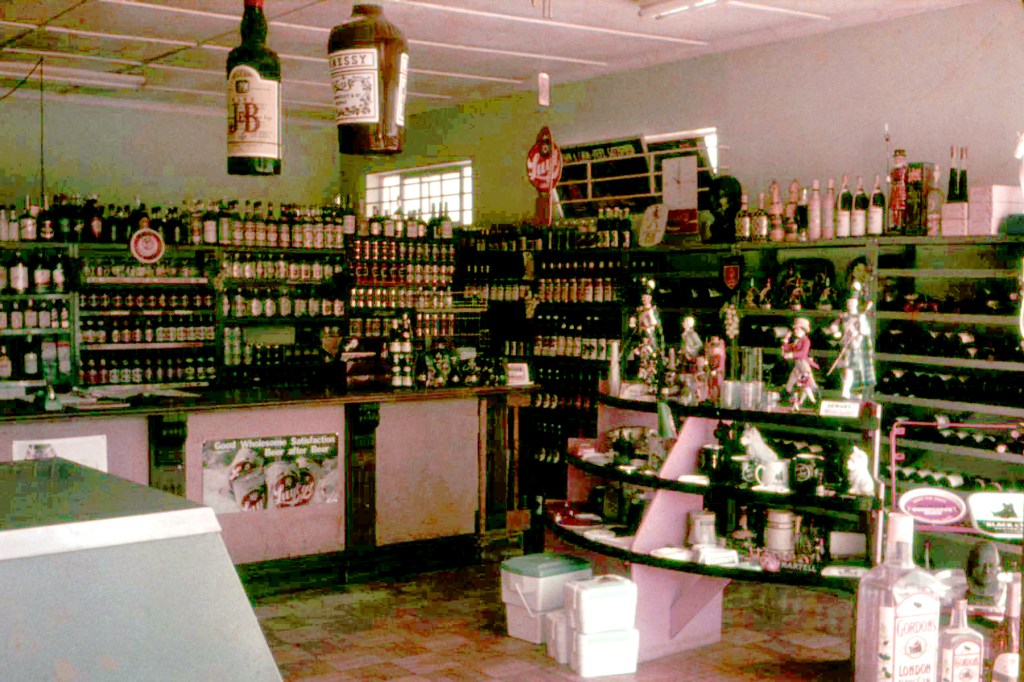
Ina Prinsloo came into the bottle store one day many years ago to get stuff for a party. Said Ina, “Don’t tell Egbert. I’m arranging a surprise party for him.”
She bought plenty of grog.
Later Egbert came in. Tongue-in-cheek he said: “I don’t like this Harrismith tradition on your birthday. People fall all over you, make a fuss of you, and you have to buy them food and drink!”
He also bought plenty of grog.
Dear old honest Mom was torn as she accepted the second Prinsloo grog payment of the day: I didn’t know what to say . .
~~oo0oo~~
I didn’t know this: Mom met Ina when she first started nursing at the Boksburg-Benoni hospital – her very first hospital. Egbert was a houseman there and that’s where he and Ina met. Years later Egbert joined a general practice in Harrismith. They stayed and raised their kids Adri, Yalta and Willem, and became a big, active and well loved part of the town.
In February 2021, out of the blue, Leo Caskie Wade wrote:
Good morning Rob.
I thought the Caskies in SA were something of the past.
I am 81 years old and my Caskie connections were from Harrismith years ago.
Should you feel inclined I would like to hear from you.
Regards - Leo wade
Rob Caskie replied: Good morning, Leo, Thank you for your email which arrived as a great surprise. Yes, indeed, our family also stems from the Caskie family in Harrismith. Our cousin Sheila Swanepoel knows far more about the family and early Harrismith days than I do. Neither I nor my brother have children, so this line of the Caskie family unfortunately dies with us. Our father, Alexander Maynard Caskie (Taffy) died on 6 March 1989, aged 61. His brothers and both parents passed on early in our father’s life.
Enter Sheila, she with the family info: Hello Leo, What a delightful surprise to make contact with another Caskie.
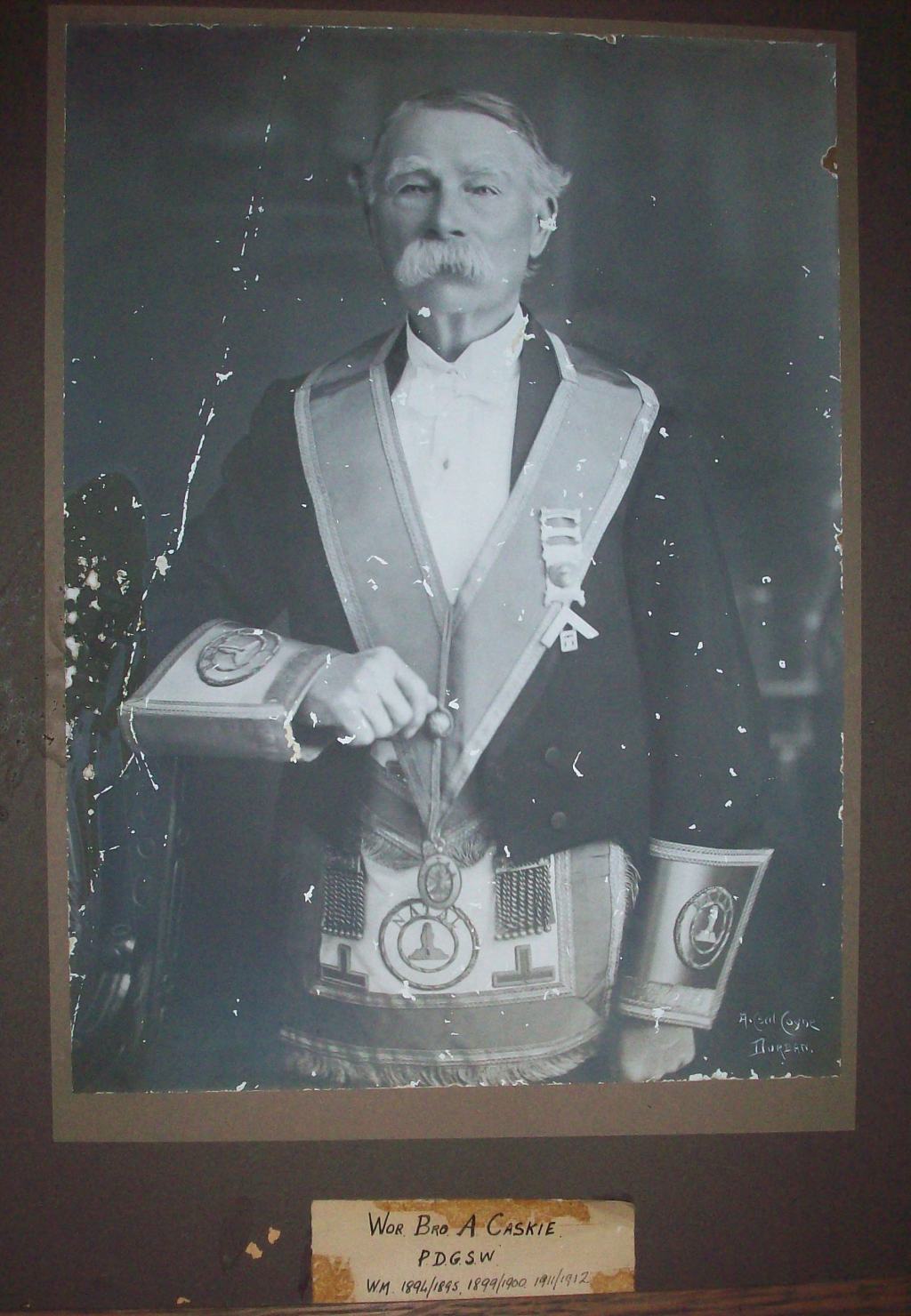
Alexander (Alec) Caskie was born in Scotland in 1839. He married Mary Craig, and they came to Harrismith from Pietermaritzburg. He was my great-great grandfather and Rob’s great grandfather.
They had two sons and two daughters: 1. Robert (Bob) married Doreen (Doe) and Rob is his grandson; 2. James (Jim) married Ethel and they had four kids; 3. Mary who is my great grandmother – she married John Francis Adam Bland II. She was my Mum’s beloved Granny Bland, who died in Harrismith in 1959, so she had me as a great-grandkid till I was three; 4. Jessie who married a Mr Tapling and then a Mr Tarling – she had no children.
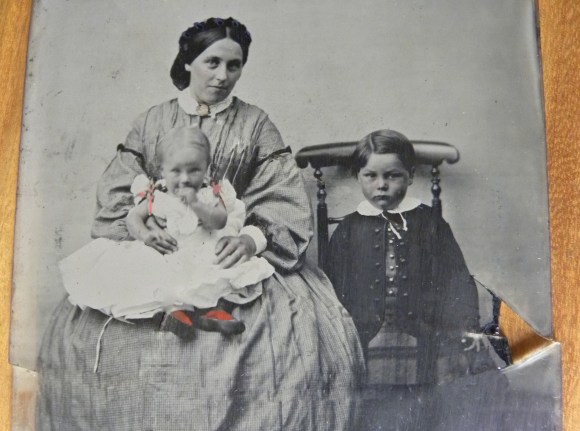
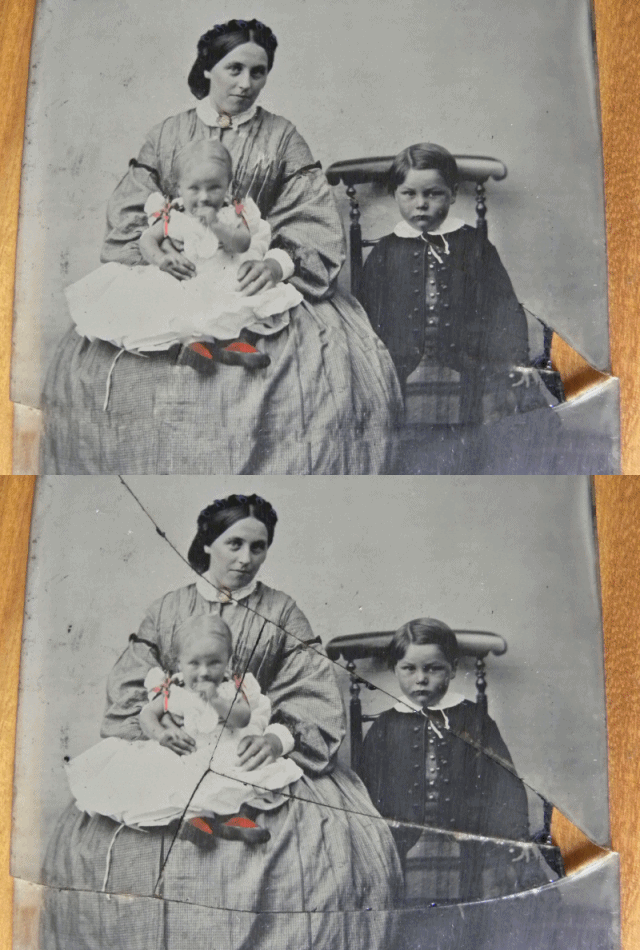
– Sheila has this old cracked daguerreotype ** of Great-Great Gran Mary Craig Caskie with Great Gran Mary Caskie Bland on her lap –
My Mum Mary – grandaughter of young Mary on the lap above – is 92 (2020), still alive and well, and now living in Pietermaritzburg. She remembers all the Harrismith Caskies very well. She and Taffy (Rob’s father) were both born in 1928 and were great mates when they were little.
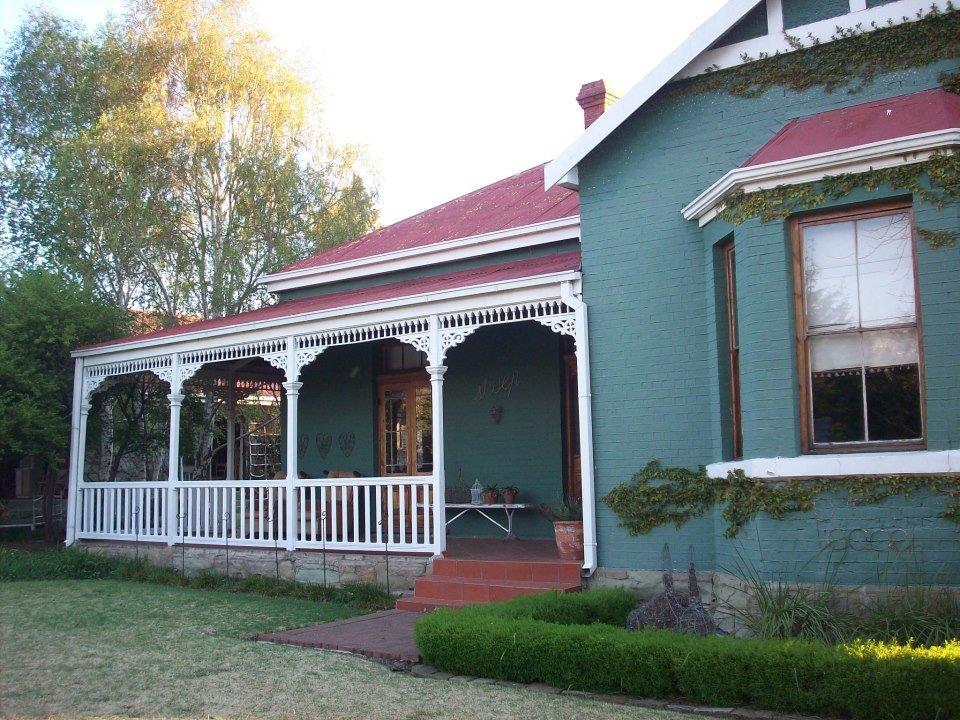
There are three Caskie homes in HS – all beautifully restored, all in Stuart Street. We grew up in this one on the east end from 1960 to 1973. It had been owned by the original Alec Caskie. The others were on the west end of town.
– 95 Stuart Street –– view from that front stoep – or veranda –Caskie Corner, opposite the Town HallMrs Caskie switches on Harrismith’s first electric street light!
It turns out Leo Caskie Wade is the grandson of Janet Caskie, who came to Harrismith from Australia, and Harrismith’s well-known doctor Leo Hoenigsberger, who our gran Annie insisted on calling Dr ‘Henningsberg’. A great friend of her Dad, our great grandfather, Stewart Bain, he was the family GP as well as the Harrismith government doctor, or ‘district surgeon’.
One day, driving back to town from his duties at the prison, he missed the bridge and his car landed in ‘the spruit with the name.’ The Kak Spruit. Only his pride was injured. In the meantime, back in town, the hostess of the weekly bridge evening was getting a bit perturbed as Dr H hadn’t arrived yet and they couldn’t start playing bridge without him. She ‘phoned the Hoenigsberger home and was told by Dr H’s young son Max:“No, I don’t think my father will be coming tonight. He’s had enough bridge for one day.”
After decades of hearing this story from mother Mary, here’s Leo Caskie Wade to add some more detail:
“Leo Hoenigsberger, methodical, careful and pedantic as he was, was rushing in his huge German Sperber motorcar over the narrow bridge that led to the Harrismith Hospital. It was an emergency. He crashed over the side into the river and was admitted to his own hospital.
“Now fast forward to the mid-1970’s. I am at university in Durban; I am asked to take an Italian female exchange student to digs where she would stay over the week-end on her way to Rhodes University. I dropped her at the gate to return later to take her out. When I arrived she was not ready yet, and in chatting to the elderly German landlady I discovered she was my grandfather Dr Leo Hoenigsberger’s theatre nurse! She had nursed him after the said crash. She wanted to know all about the Harrismith family etc. What a coincidence!”
~~oo0oo~~
** The ‘Two Marys‘ photo: To make the image, a daguerreotypist would polish a sheet of silver-plated copper to a mirror finish, treat it with fumes that made its surface light sensitive, expose it in a camera for as long as was judged to be necessary, which could be as little as a few seconds for brightly sunlit subjects or much longer with less intense lighting; make the resulting latent image on it visible by fuming it with mercury vapour; remove its sensitivity to light by liquid chemical treatment, rinse and dry it, then seal the easily marred result behind glass in a protective enclosure. (thanks, wikipedia). Later, the daguerreotypist would go mad from the mercury fumes, of course.
~~~oo0oo~~~
– Sheila’s ‘Two Marys’ daguerreotype: As is, and ‘digitally doctored’ –
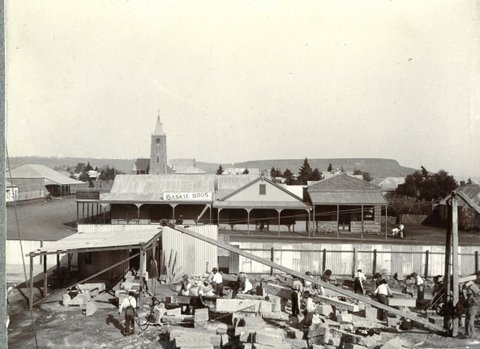
Mary Caskie Bland’s Stuart Street home:
– Granny Bland’s house 13 Stuart Street –
~~oo0oo~~
Sheils found this handwritten note – most likely written by Alec Caskie himself – among her gran Annie’s effects. Annie was his granddaughter:
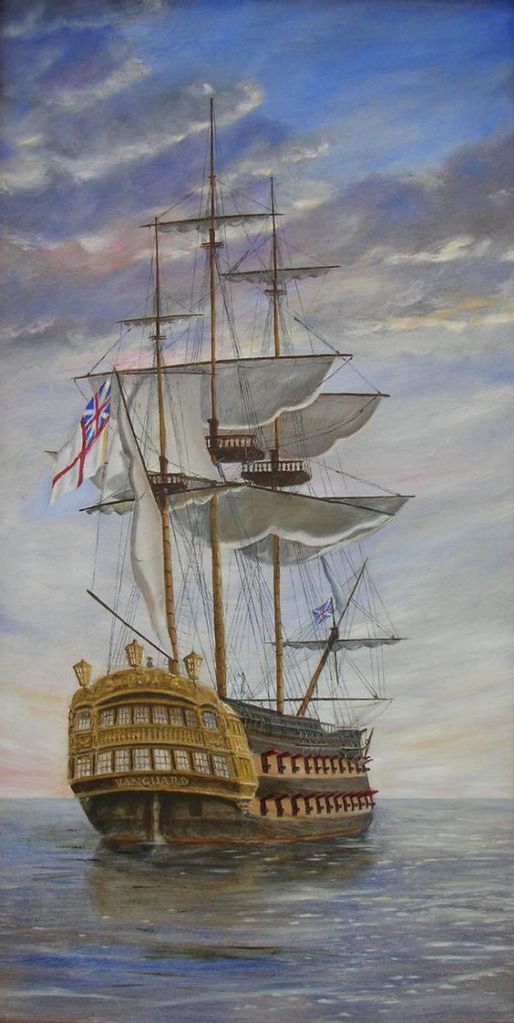
– H.M.S. Vanguard – In 1862 it left Liverpool, reaching Australia on 3 June, probably via SA –
Born at Kilmarnock Dec 1839. Brought up in Stewarton where his father’s folks lived for several centuries. Was sent to the parish school under Mr Sinclair Sincular ?. Graduated in the big college of the worlds.
” survived 4yrs to the (WHOLE LINE MISSING) ” in __ of the large __ __ __ questions involved __ __(HM ??) Paul to release political prisoners. ” Am a JP for many years.” A freemason for 40 years, passed through the chair three times and am affiliated with several other Lodges. Belong to all the churches and a number of _____. I have served on the village management for 35 years barring 2 years I was out. I have been several times mayor retiring for good in March 1921. I have served on the Hospital board; learning / licensing? board; on the Library committee; the (?Ways – maybe ‘Ways and Means’) Board. The Literary Society. Have (?passed) the (?port) on many occasions. __ under Dr. and I. __. Married Mary Craig daughter of Robb Craig, High Street (?Stewarton__). Sailed on the Vanguard from Glasgow to South Africa – 1862 – 69 days passage. Was (?pro cantor) and organist Rev Campbell _____ Church for Maritzburg, where I have lived for about 10 years. Came to Harrismith in 1873 where I have lived since.
(Those of you who can read old bullets’ 19th century spidery inkwell-and-quill handwriting, please click on the pic bottom right below and do some deciphering and add it in the comments!).
~~~oo0oo~~~
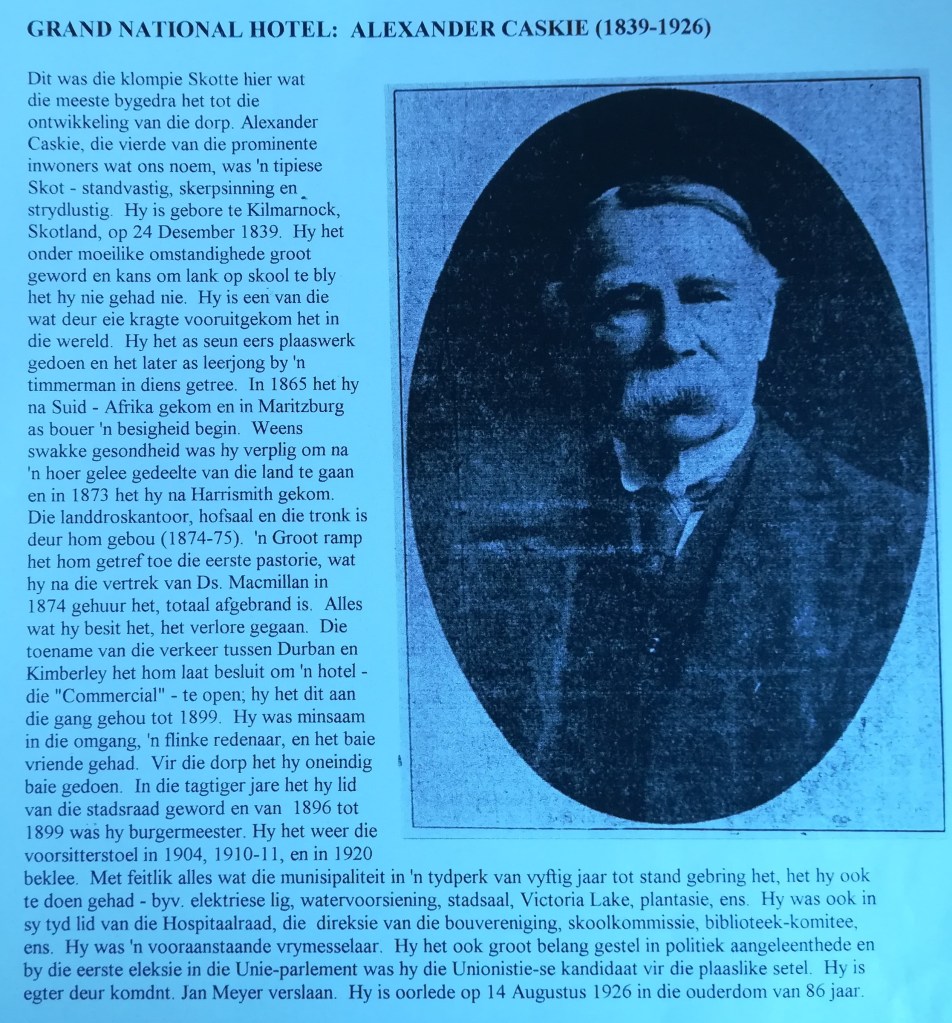
. . and a pleasantly flattering bio in Afrikaans (by historian FA Steytler’s Die Geskiedenis van Harrismith, 1932) which I translate here:
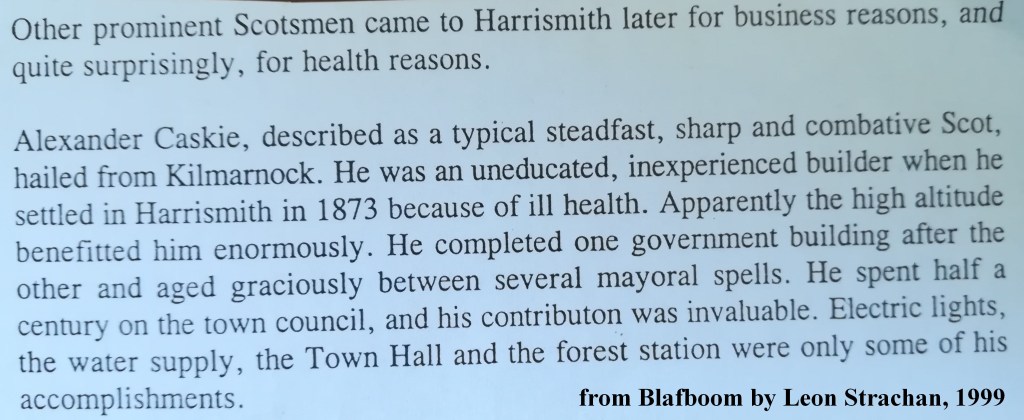
Grew up in difficult circumstances; not much schooling; worked on a farm as a boy; then apprenticed to a lumberjack (or timber merchant?); Came to PMB and started as a builder; poor health saw him seek ‘higher altitude’ and move to Harrismith for the climate in 1873; seemed to suit him! He built the landdroskantoor, the hofsaal (magistrates court and offices), and the town gaol; Disaster struck in 1874 when the house he was renting (the Ou Pastorie of Ds Macmillan) burnt down; he lost all he possessed; he then decided to take advantage of the increased traffic between Durban’s harbour and Kimberley’s diamond fields and open a hotel – the Commercial (later called the Grand National), which he ran as hotelier till 1899; He was described as pleasant in company, a keen debater, with many friends; He did an incredible amount for the town. Town Councillor; Mayor 1896 to 1899, 1904, 1910-1911 and 1920. For fifty years he was involved in almost everything the municipality established or started: eg. electric light, water supply, town hall, Victoria Lake in the park, the pine plantation on the slopes of Platberg, etc. A member of the Hospital Board, a director of the Building Society, the School Commission, Library Committee, etc. A prominent Freemason; Active in politics: he stood for the Unionist Party for the Harrismith seat in the Union Parliament, but lost the election to Kommandant Jan Meyer. Died 14 August 1926, aged 86.
~~~oo0oo~~~
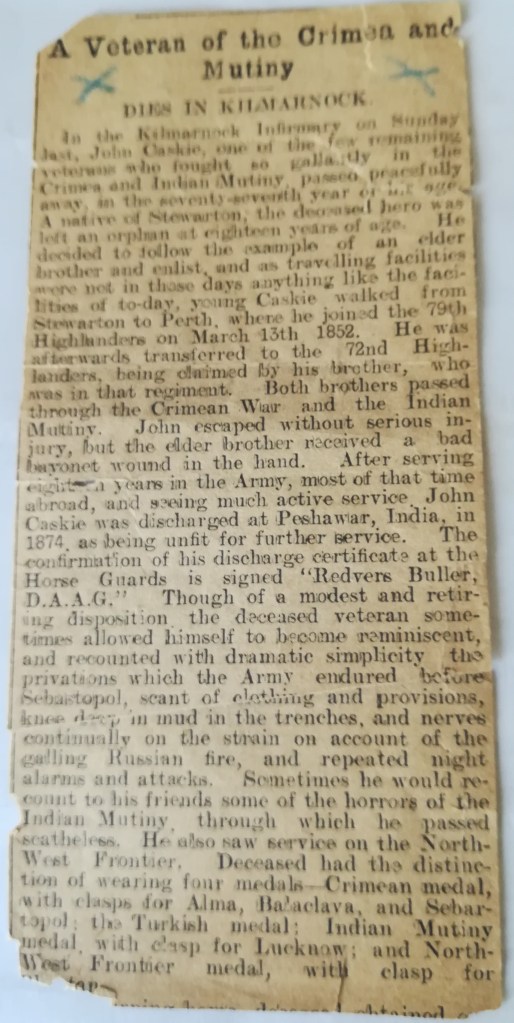
Sheila also has an undated newspaper article about the death of one John Caskie in Kilmarnock, Scotland – brother? cousin? He served in the 72nd Highlanders and saw action in the Crimean War (1855) and the Indian Mutiny. John was likely a relative, as Annie Bland kept this article amongst her papers.
~~oo0oo~~
Potted Caskie history (like all my history ‘lessons’: pinch o’ salt): The Caskies originated in the Galloway – Dumfries region of Scotland. The name is the anglicization of the pre-10th century Gaelic ‘MacAscaidh’ which derives from the Old Norse personal name ‘Asketill’, and translates as ‘The cauldron of the gods.’ How’s that!? Some of me was brewed in a cauldron!
The first recorded spelling of the family name is that of Thom McKasky, 1494, Edinburgh, during the reign of King James IV of Scotland. Surnames became necessary when governments introduced personal taxation, so no wonder the Scots kept spellin’ them differint! The Stewarton region seems to be known for Ayrshire cattle, body snatching, variable spelling and being a good place to leave, but of course – I may be wrong.
~~oo0oo~~
Sheila made a Caskie Family Tree. Anyone with more info, please add / amend (as I have) so it can be improved / updated! Simply do it in the comments here, or email admin@sheila.co.za
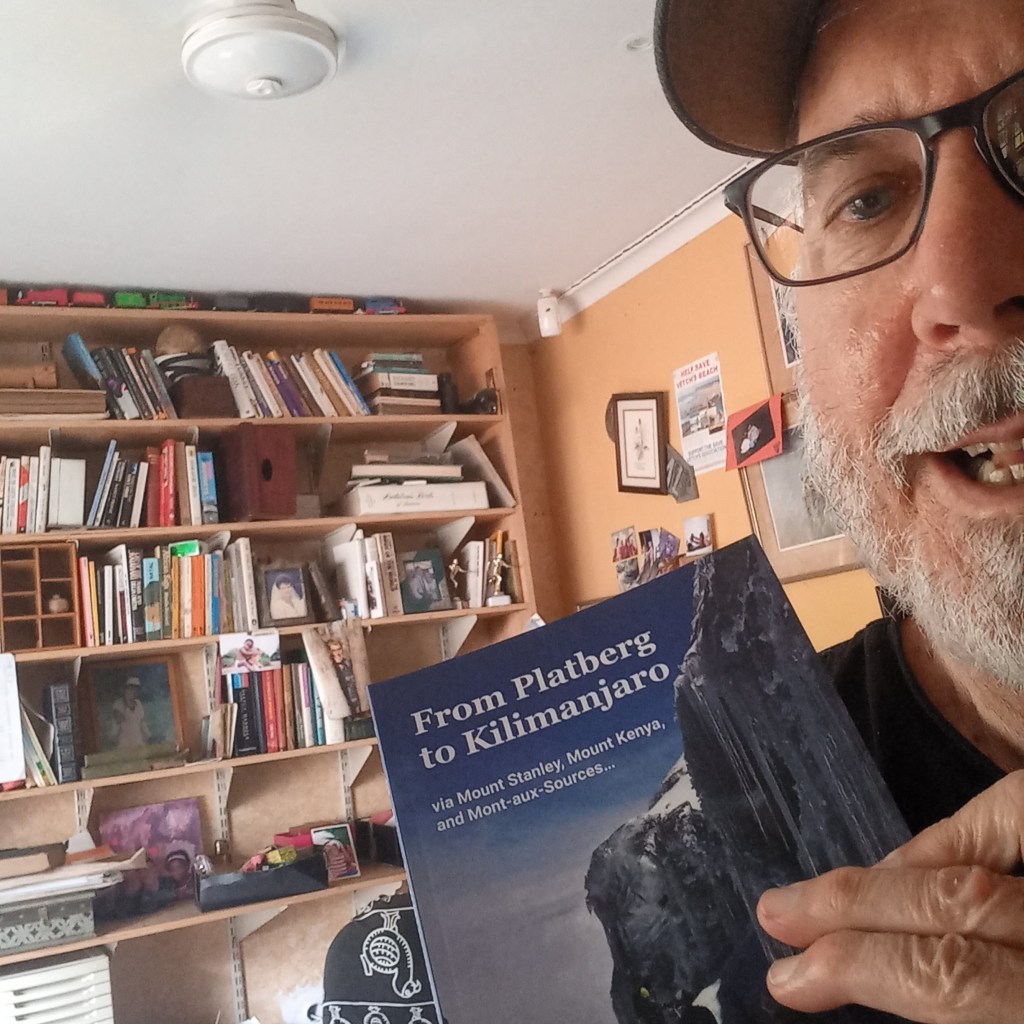
OK, the author has a new book out, his first. School friend Harry ‘Pikkie’ Loots is Harrismith’s latest published author, following in the footsteps of FA Steytler, EB Hawkins, Anita van Wyk Henning, Petronella van Heerden, Xander Strachan and Leon Strachan. There must be more?
So far he has it as an eBook – you can get it now already.
Real paper hard copies to follow. I had the privilege and fun as one of his proof-readers, of reading it as he wrote and re-wrote.
UPDATE 10 Feb 2021: It’s he-ere! In my hand!
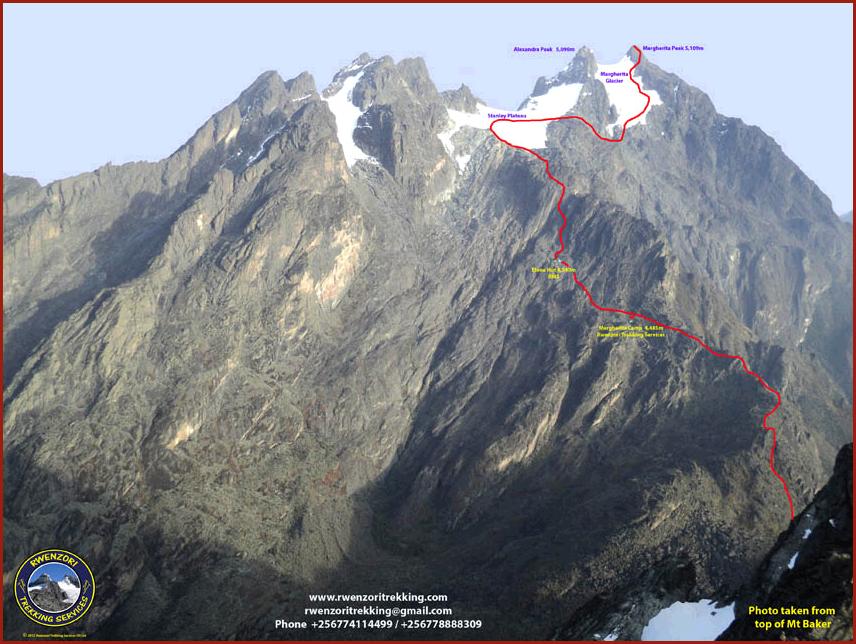
Now you gotta realise, Harry is a mountaineer and trekker. These are phlegmatic buggers; unflappable; understated. So when he says ‘we walked and then crossed some ice and then we got here’:
– 5109m above seal level – the Drakensberg’s highest peak is 3482m –
. . with lovely pictures and fascinating stories along the way . . you must know what he doesn’t show you. And this is only the third highest peak he climbs in Africa! There’s more!
Those of us who climbed Mt aux Sources should also remember how we drove to within an hour or two’s walk – stroll actually – from the chain ladder. To get to these higher mountains there’s days of trekking before you reach the point in the picture. And there’s way less oxygen!
I can’t wait to hold a copy in my hand . . Goddit now. Here’s the back cover blurb: ( – get it on takealot.com – )



















 Vrystaat Confessions