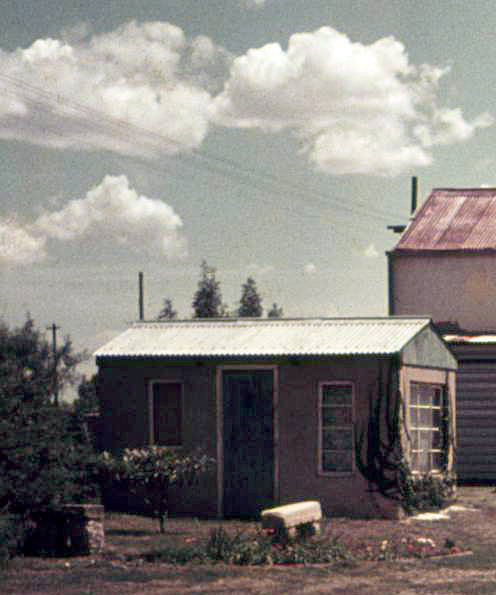
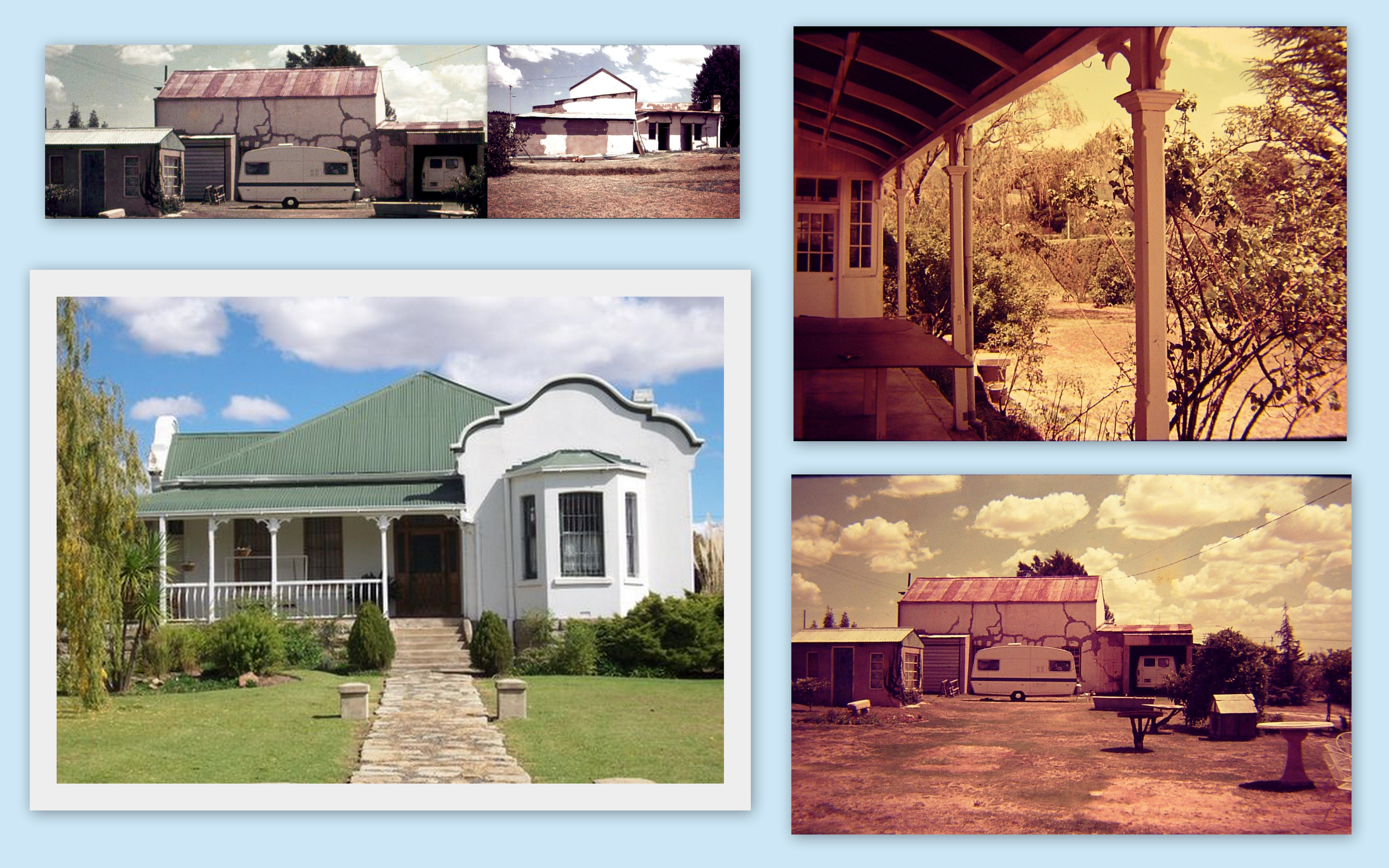
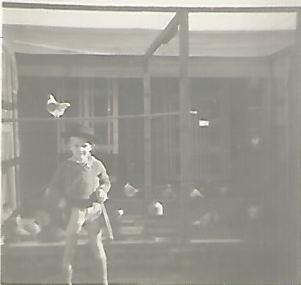
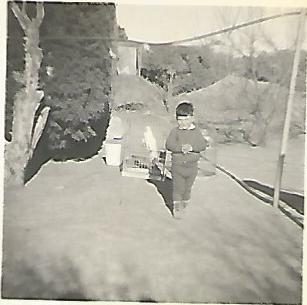
95 Stuart Street was home from 1961 to 1973. To learn more about Stuart Street as a street, go to deoudehuizeyard! where Sandra has done a great job using old and new images of the long east-west street we grew up in.
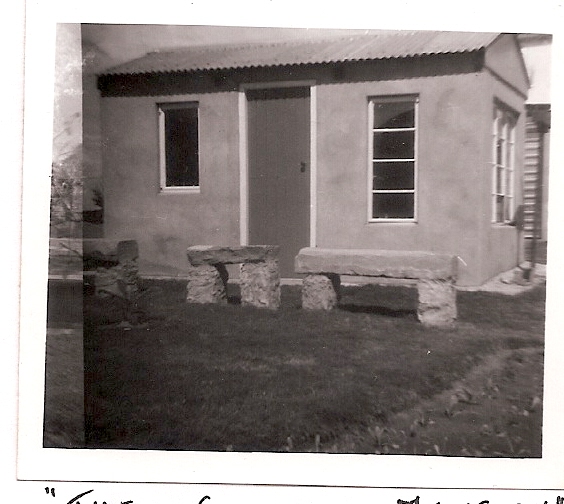
– Mom with Barbara. Koos in rugby kit – probably 1967 –– the country mansion and stonehenge –
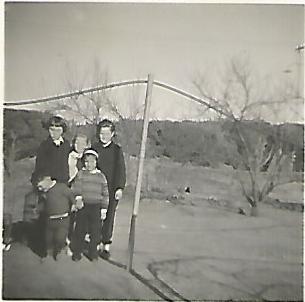
Some stiff poses in the garden in 1970 with Jock the Staffie:
Inside, in the dining room and the lounge:
Twelve years at 95 Stuart Street. Funny how that felt like forever! Ah youth!
~~~oo0oo~~~
Married, we stayed in our first home for around fifteen years, 7 River Drive Westville. From early-1989 to Dec-2003. That time appeared to go much faster!
. . and have now been in our second home, 10 Elston Place Westville, the longest of all – since late 2005:
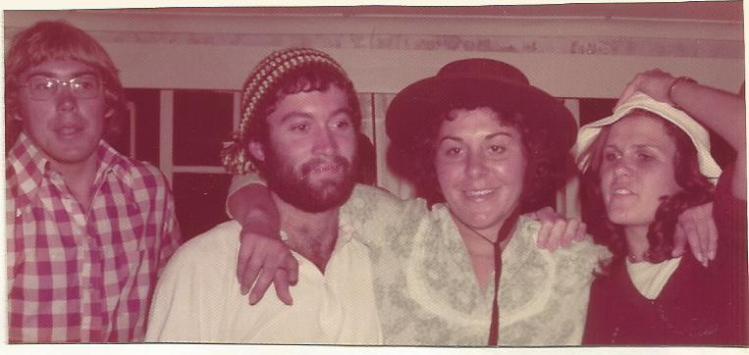
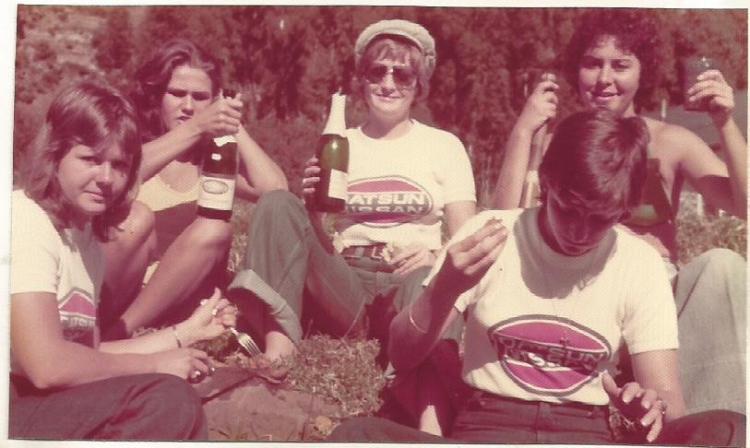
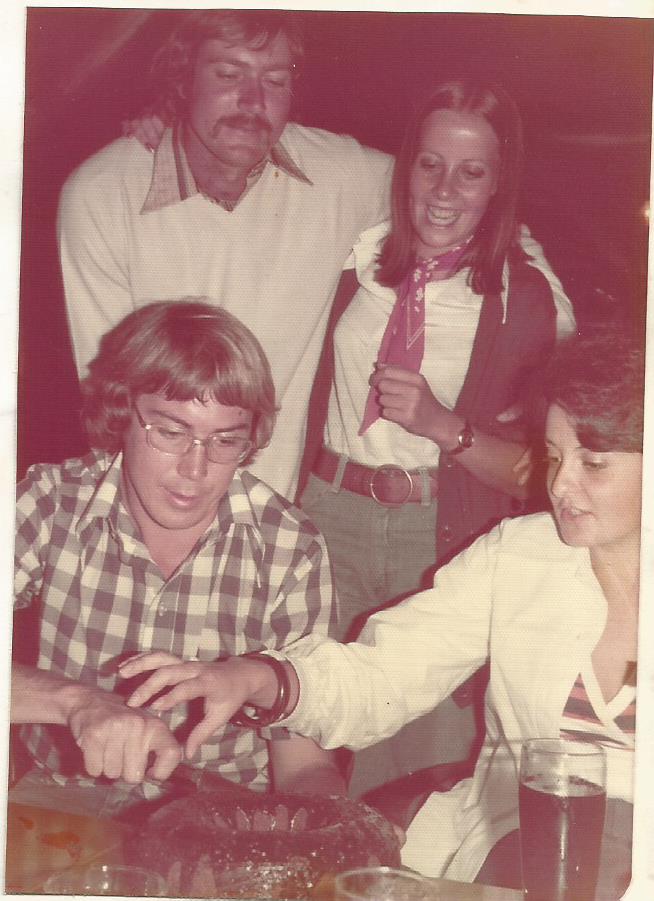
Sheila saw to it I had a party! As so often, Sheila saved the day. Back in 1976 before there were rules and the rinderpest was still contagious.
– those TC wimmin could really get things going –
Des Glutz threw open his palatial bachelor home, Kenroy, on the banks of the mighty Vulgar River to an invasion of students from Johannesburg and Pietermaritzburg. That’s because as a lonely horny bachelor Free State farmer he had his eye on some of those student teachers from Teachers Training College in PMB!
“Kindness of his heart” you thought? Ha! You know nothing about horny bachelor Free State farmers! Anyway, he owed me for managing his farm brilliantly when he went to Zimbabwe. Probly doubled his profit that year.
Sheila invited everybody – and everybody arrived!
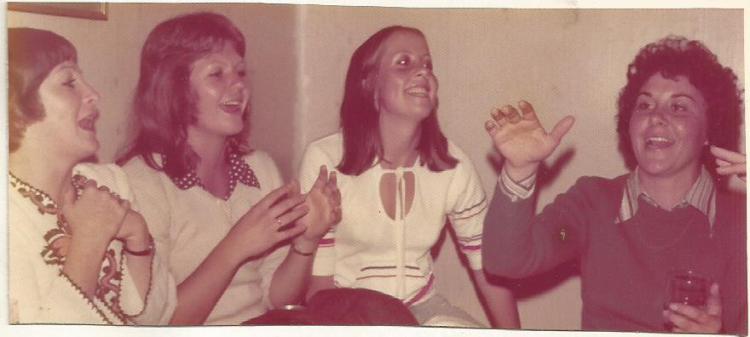
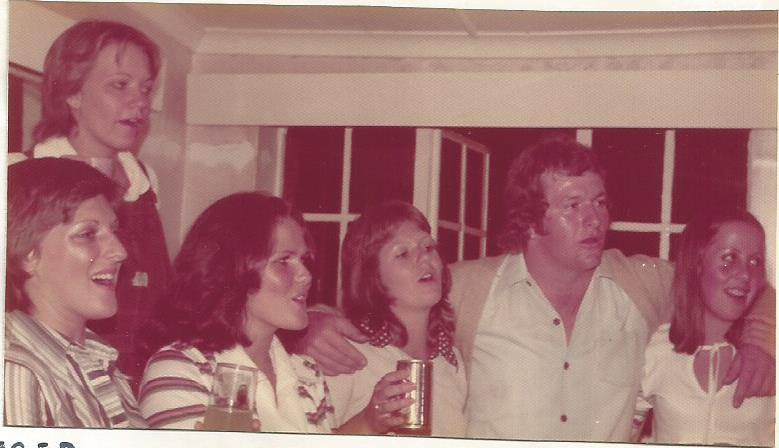
Eskom had not yet bedeviled Kenroy, so paraffin lamps, gaslamps and candles gave light. So you didnt flick a light switch, hoping it would work, no. You lit a lamp knowing it would work cos Gilbert will have reliably topped up the paraffin. Des might have done that, you thought!? Ha! You know nothing about lonely horny freestate farmers with butlers. Music pomped out from car batteries. There was singing and much laughter. Except when Noreen, Jo and Ski danced their Broadway routine The Gaslamp Revue with Redge Jelliman holding the silver tray footlight staring in open-mouthed wonder at their skill. And of course, their legsnboobs – another lonely horny bachelor Free State farmer, y’know. Awe-struck silence reigned. For minutes.
– Noreen and Jo in the Gaslamp Revue, using available props –– Reg dreaming bachelor harem dreams – Noreen Mandy Jill Liz –
There was also Liz and Mops and Jenny, Georgie, Mandy, Gill and Jill; Hell, we bachelors were in awe at almost being outnumbered – a rare event. We were so excited we got pissed and fell down. Timothy Paget Venning got so excited he walked all the way round the house smashing Des’ window panes to let in the night.
– someone baked a cake – lots of advice on how to cut it –
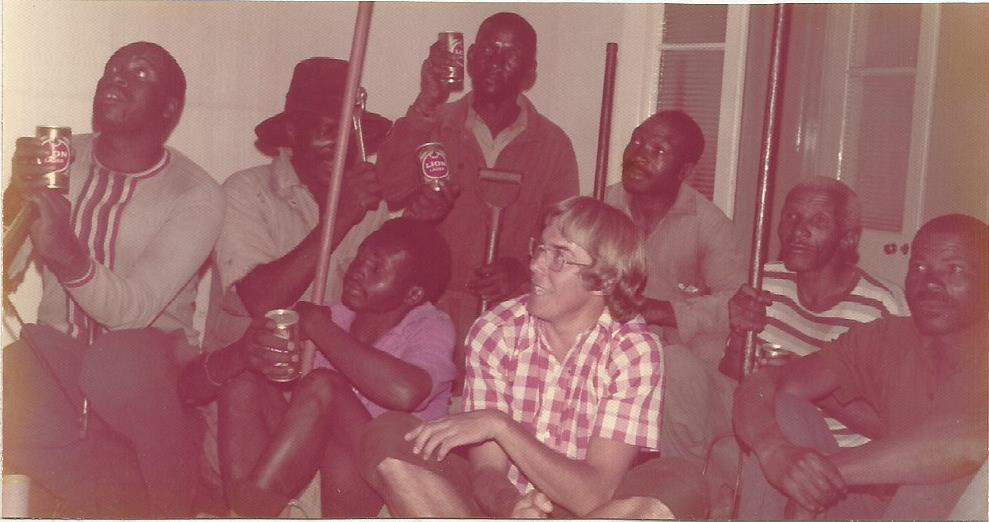
Poor ole Gilbert, Des’ personal butler, valet and chef – seen here in purple – and his men bore the brunt of the extra work!
He cooked and cooked, including a big leg of lamb which didn’t make the main table, getting scoffed on the quiet by ravenous would-be teachers under the kitchen table. Pity the poor kids who would have to grow up being taught all the wrong things by this lot in Natal in the eighties.
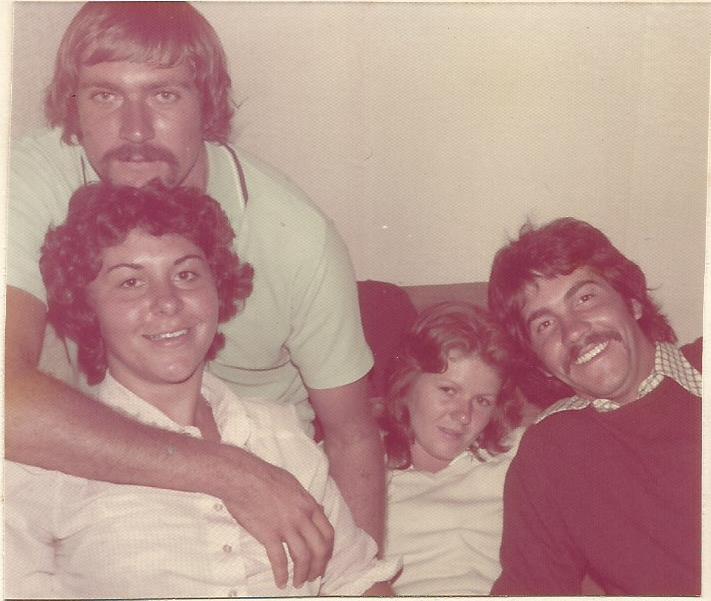
– Sir Reginald dreaming he has died and gone to heaven – with Noreen, Mops, Mandy, Jill and Liz –
These would-be teachers and pillars of society were wild n topless:
– if the bachelors had been there, we’d have politely averted our eyes. Right!! –
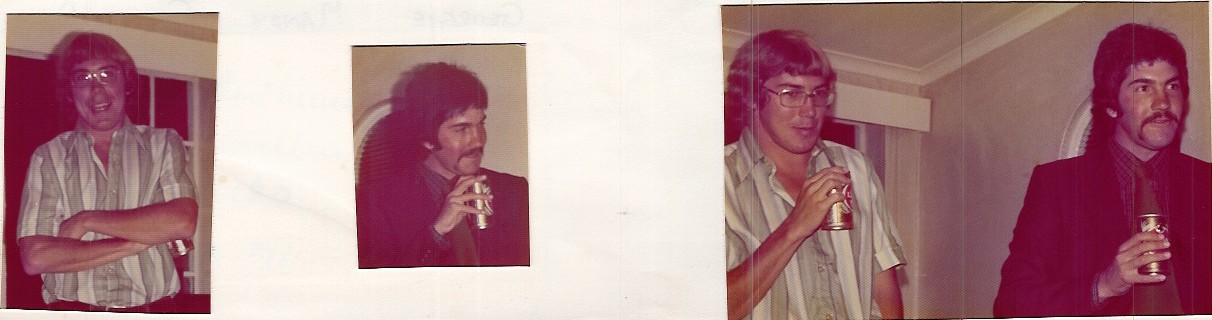
Tabbo wore his tie so he could make a speech into his beer can microphone:
Funny how Glutz doesn’t feature in any pics! Where was he? We know he wasn’t in his bedroom cos the TC girls raided it and were in awe at the impressive collection of bedroom toys and exotic rubber and latex items in his bedside drawer. No stopping those TC girls!
Ah! Here’s Glutz – Sheila and Liz presenting Des a thank-you gift for hooligan-hosting:
– Sheila & Liz thank Des for hosting – Des tries to hide the liquid gift – in vain –
The morning after dawned bright. Too bright for some . . .
– hair of the dog in the morning –
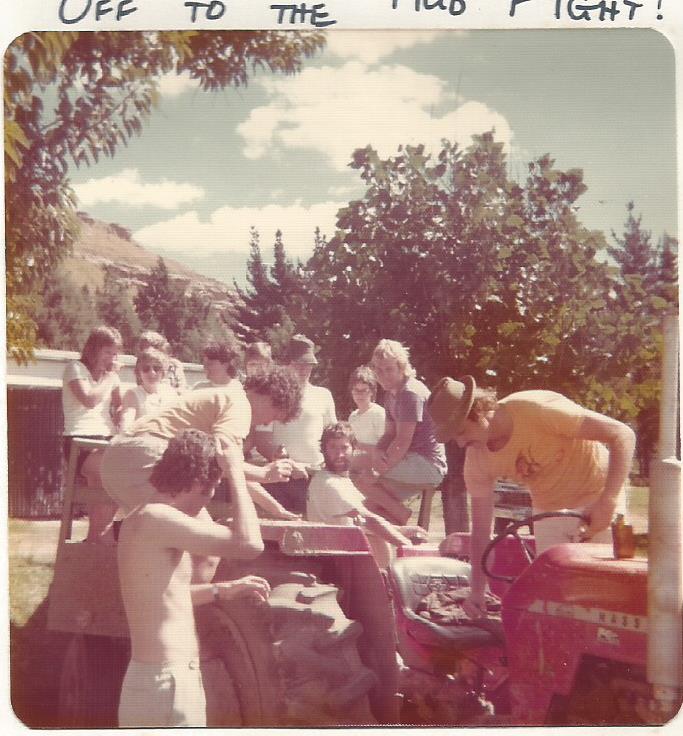
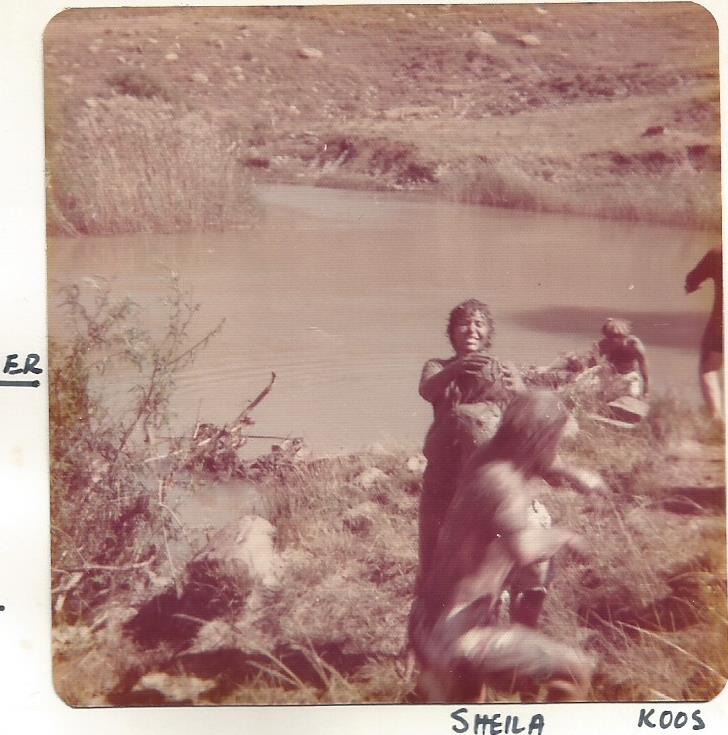
A mudfight! said some bright spark – Sheila, no doubt – so Des arranged transport to the mighty Vulgar river.
– fasten seatbelts while I check the airbags, says Farmer Glutz, Kenroy’s Safety Orifice – Occifer – Officer – Simpson scratches his head –– the mighty Vulgar River and its mud – roomerazzit it has beauty-enhancing properties – seems to be working –
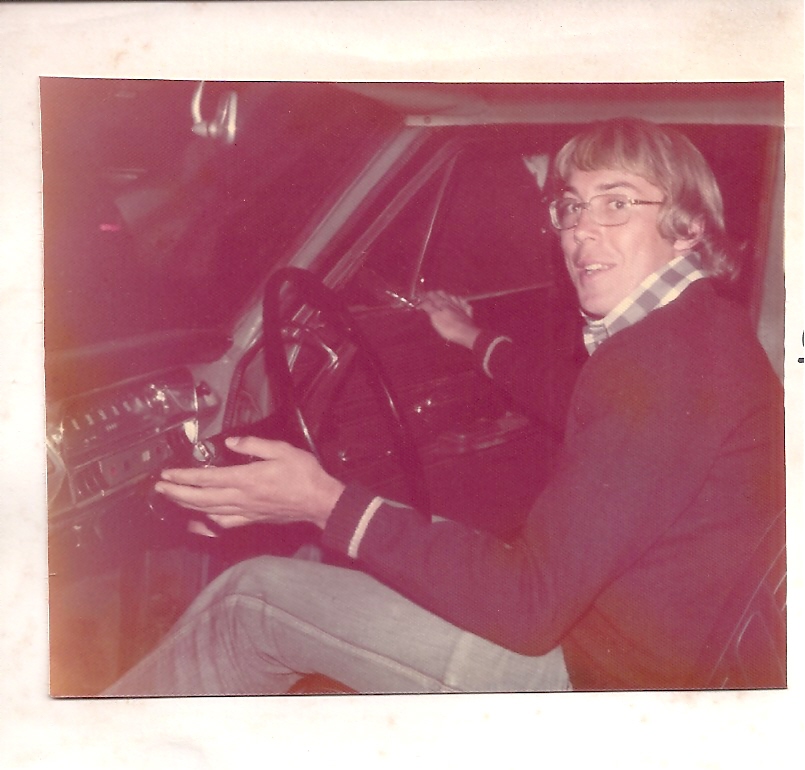
After the weekend I roared back to Jo’burg in my brand-new 1965 two-shades-of-grey-and-grey Opel Rekord Concorde deluxe sedan, four-door, grey bench-seated, 1700cc straight-four, three-on-the column, chick-magnet automobile. My first car! Watch out Doornfontein!
– 21st birthday present! A 1965 Opel Concorde DeLuxe 1700 in sophisticated tones of grey and grey. Note my reflection in the gleaming bonnet! –
Thanks Mom & Dad! And thanks for the party, Sheils and Des! Before we left, Mom tickled the ivories while the TC gang belted out some songs:
~~oo0oo~~
The old man organised the numberplate OHS 5678 for me. The man at the Harrismith licencing office said “Oom, are you sure you want an easy-to-remember number for your son? Don’t you want one that’s hard to remember?”
I thought of Abe Sparks as the “Lord Mayor of Swinburne.”
Ever since he went to Texas he wore a stetson, cowboy boots and a string tie with a polished stone clasp. He was a larger than life character, colourful. He and Lulu were always very friendly to me. He drove an old Rolls Royce which I believe he bought from fellow eccentric farmer Petronella van Heerden. Which he converted it into a pickup truck, a bakkie. It looked something like the silver one in the pic. I think a darker colour, though, like the one below. (Oops, this Roller was actually a 1929 Cadillac which Dr Petronella had bought in Cape town! – I should always check my dodgy history with Harrismith’s historian Leon Strachan. He knows things).
I have a clear childhood memory of it parked in Stuart Street near the corner of Retief Street, opposite the Post Office. Near Havenga’s. Near Basil’s Cafe. Near the corner Kovisco Butchery. Opposite Herano Hof. Opposite that Co-Op building. You know where I mean. Uncle Abe staring down at me with a big smile: ‘How are you Koosie?’
Abe owned the Swinburne Hotel which became the Montrose Motel, later bought by Jock Grant; scene of an interestingbrandy-filled nightmany years later.
He and Lulu would throw big parties and the story goes . . yes, the old story goes – Rural Legend Alert! – that one night they decided to cook the mushrooms they had gathered in the veld / garden / woods that day. To be safe they fed some to the dog and asked the kitchen staff to keep an eye on it for the next hour or so. They continued partying up a storm with the grog flowing, then ate supper and carried on jolling until one of the staff came in to say “Baas die hond is dood”.
Panic ensued. They all bundled into cars and rushed off to the Harrismith Hospital twelve miles away, driving fast and furious and well-oiled on the national Durban-Joburg highway, to have their stomachs pumped out – no doubt by one of their mates, whichever doc was on call. Then returning much later to the farm looking chastened, wan and sober.
Next morning Abe asked to see the dog and was shown where it lay dead and mangled. It had been run over by a passing car.
I imagine a pinch of salt was added to the wild mushrooms.
~~oo0oo~~
Baas, die hond is dood – Boss, the dog is dead
~~oo0oo~~
Leon Strachan, Harrismith’s finest author (nine books or more), gentleman, publisher, historian, military buff, farmer, jam bottler, businessman, tour guide and all-round mensch has a much better grip on Abe’s life in Swinburne. His farm Nesshurst is in the same area as many of Abe’s sixteen farms over the years. He tells of pub tales, a Swinburne cricket team made up of eleven Sparkses (one was even selected to play for South Africa!), brandy taken internally and externally, and how the sheer size of Louis Bischoff’s schlong displayed for all to see on the pub counter was one of the few things that ever rendered Abe speechless.
Blafboom 1991, Leon Strachan – ISBN – 1-919740-21-1
~~oo0oo~~
I found a lot of pics of Rolls Royce pickup conversions, but so far none of a Cadillac conversion. So that’s a 1929 sedan in the feature pic.
This guy Nudie reminded me of Uncle Abe: Abe would have wanted his car!
Dad tells me Abe bought the Rolls Royce* from fellow Harrismith farmer and characterNell van Heerden. *Caddy
An old-car-nut Aussie confirms another version of the old sheep farmers / Rollers rural legend thus:‘I can see why the conversion was done. When the Silver Shadow was introduced, it was unpopular with graziers: it could fit only two sheep on the back seat; the Silver Cloud could hold three.’
Stewart Bain was born in Wick, Scotland on 9 September 1854. He and his brother James came to South Africa in 1878, to Durban. They soon got a job building bridges for the railway line extension up the Drakensberg from Ladysmith to Harrismith. How, one wonders, did two herring fishermen convince people they could build bridges? And so they reached the metropolis of Harrismith in the Oranje Vrijstaat, an independent sovereign state at the time. Britain had recognised the independence of the Orange River Sovereignty – before that it had been the Orange River Colony ORC – after losing the first Anglo-Boer War at Majuba. The Vrijstaat officially became independent on 23 February 1854, seven months before Stewart was born, with the signing of the Orange River Convention. This history is important in view of Britain’s and many of Harrismith’s inhabitants’ conduct in the Anglo-Boer War of 1899-1902.
– sandstone bridge across the Wilge River at Swinburne –
So they built bridges. I am not sure, but I fondly imagine they built the beautiful sandstone bridge across the Wilge River at Swinburne, where I launched two separate canoe ‘expeditions’ with good friends Fluffy Crawley and Claudio Bellato many decades later.
Settling down in Harrismith after their bridge-building days, Stewart bought the Railway Hotel and changed its name to the Royal – we believe with official ‘royal” permission – while brother James built the Central Hotel uptown, on the central market square.
It appears here as if some people (!) carried on referring to the Vrijstaat as the ORC, even though it was actually the sovereign nation Oranje Vrijstaat by then!?
Stewart married Janet Burley in Community of Property in Durban, I’m not sure whether that was before moving to Harrismith or after. Janet was born in Hanley, Staffordshire, England in 1859 of David Burley and Caroline Vaughan. They had __ children between 18 __ and 18__ . . . the fifth child in 1893 being our grandma Annie. Annie married Frank Bland and had two daughters, Pat and Mom Mary, Mom Mary remembered the hotel as having two big (‘huge’ says Mom, but she was little back then!) statues at the front door: A lion rampant with a human face, fighting; an antelope rampant on the other side of the door – she thinks a hartebees or a sable or something. Both were rearing up on their hind legs.
Stewart became Mayor of the town and ‘reigned with the gold chain’ for years, becoming known – by some – as ‘The Grand Old Man of Harrismith.’ To their grandkids they were always ‘Oupa’ and ‘Ouma’ Bain;
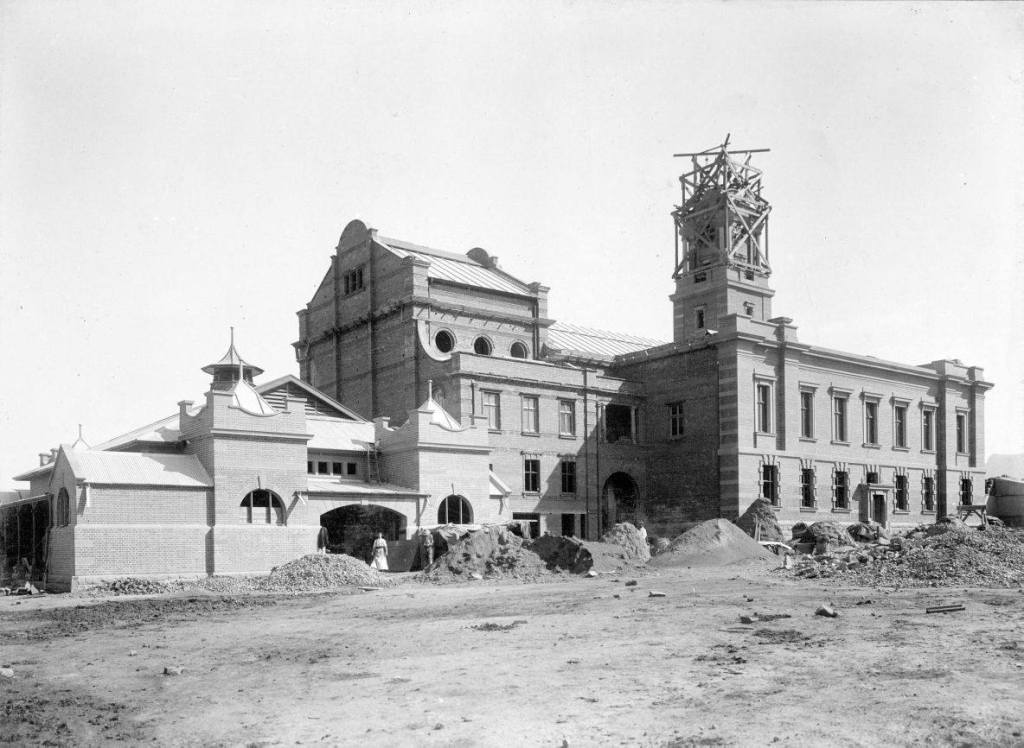
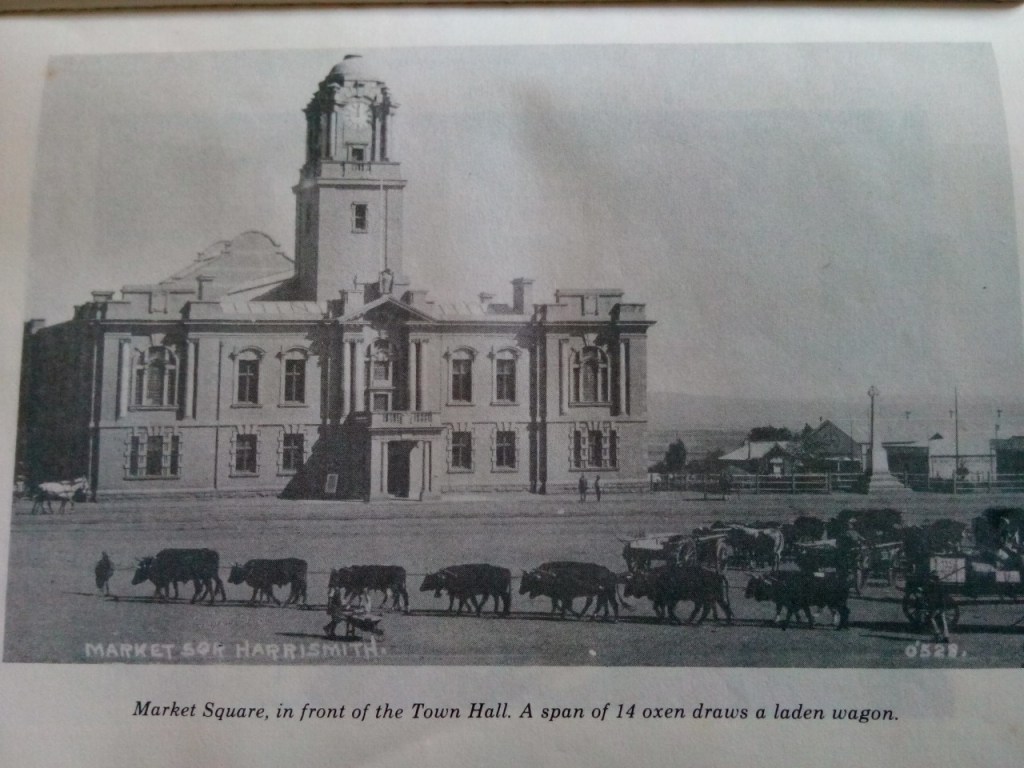
He pushed for the building of a very smart town hall. Some thought it was way too fancy – and too big – and too expensive – and called it ‘Bain’s Folly.’ Did Stewart have the tender? Was he an early tenderpreneur? Was it an inside job? *
Here’s a reason someone gave for the “need” for such a grend gebou: ‘The erection of the new Town Hall, officially opened in September 1908, was largely the result of support the troops had given for theatrical performances and concerts in the former building which had proven unsuitable.’ – (found that here: http://samilitaryhistory.org/vol082sw.html)
– building operations – lots of imported stuff –– ta da! – a palace fit for a dorp –
Here’s a lovely 3min slide show of the building of Bain’s Folly – completed in 1908 – by Hennie & Sandra Cronje of deoudehuizeyard.com and thanks to Biebie de Vos, Harrismith’s archive and treasures man. Thank goodness for all the stuff that Biebie ** has saved and rescued!
Here’s that impressive building in a dorp on the vlaktes!
– the market at the rear of the building soon after completion – 1908 –
Opskops probably had to be arranged to justify the place, and the occupying British force that remained after the illegal and unjust invasion that was the Anglo-Boer War which saw so many war crimes committed by the British, benefited hugely, their officers dancing nights away with the local lasses.
Janet died on 15 January 1924; Her daughters Jessie & Annie (who was then aged thirty) were with her when she collapsed. They summoned Dr Hoenigsburger (Hoenigsburg?), but Ouma died within minutes. The Harrismith Chronicle article reads in part: ‘Ex-Mayoress’s Death. Sudden demise of Mrs S Bain. The news which stunned the town on Tuesday morning of the painfully sudden death of Mrs Stewart Bain, evoked a feeling of deepest sympathy from all who knew the deceased lady, not only in Harrismith and the district but in places far remote.’
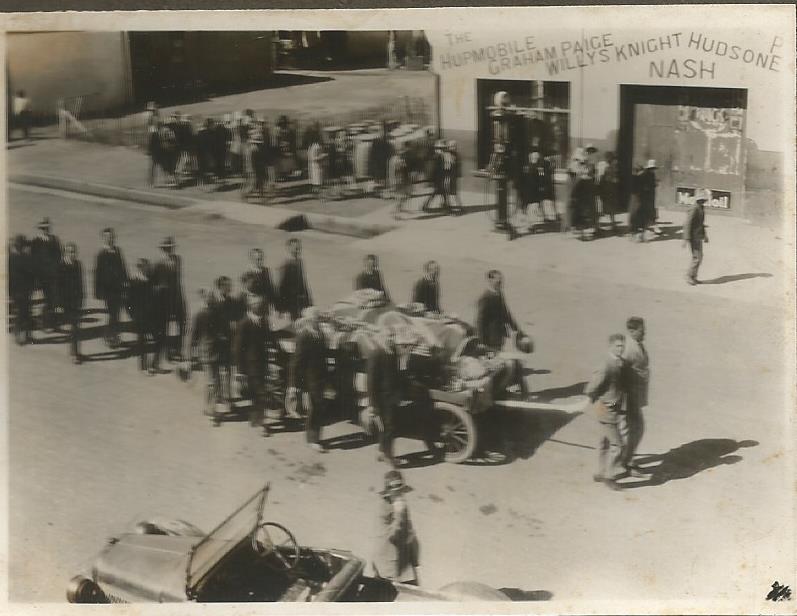
When the dust settled on the town hall, the townsfolk must have quite liked the result, as when Stewart Bain died in September 1939, the town pulled out all the stops for his funeral; These pictures were taken from the balcony of his Royal Hotel, with ‘his’ Town Hall visible in the background, and ‘his’ mountain behind that. Most Harrismithers and Harrismithians regard Platberg as ‘theirs.’
– Oupa Bain’s funeral procession – who paid?! –
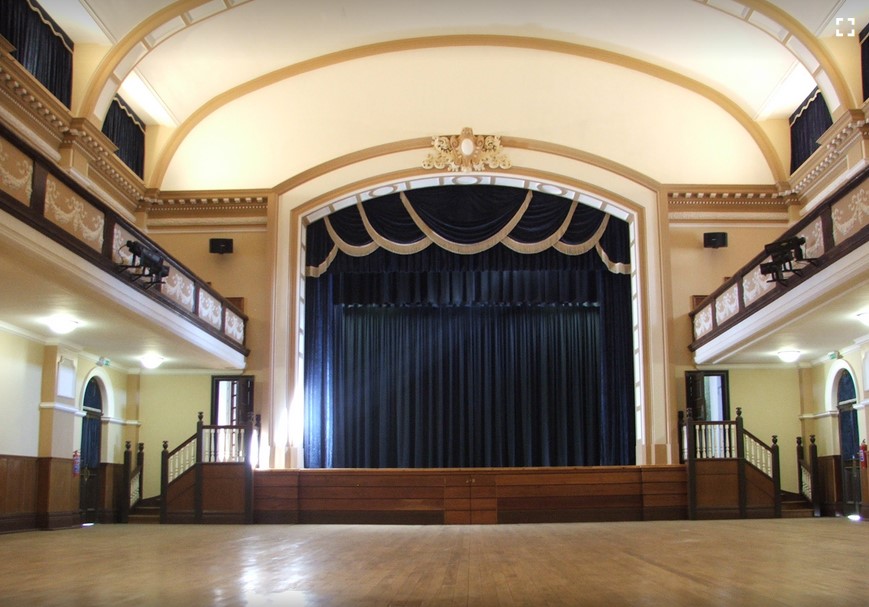
At one notable local event ca.1949 in this huge hall – an Al Debbo concert! – Stewart’s grand-daughter Mary met her future husband. Maybe that was the Lord Mayor Hizzonner’s intention in building this impressive edifice all along? In 1951 they got married there. Years later Stewart’s great grandaughter Barbara also got married in ‘his’ town hall.
~~~oo0oo~~~
Found this pic of the town hall in Wick and wondered if Stewart got the idea of a bigger, better town hall for his new town from his old town?
– built in 1828 –
~~~oo0oo~~~
Snippet: Old Mrs Batty was Stewart Bain’s housekeeper at the Royal Hotel. Mum’s cheeky cousin, Janet Bell – later enhanced to Hastings-Bell – asked Mrs Batty one day, “Why do you say ‘somethink and nothink?” Back came the reply, “Cos I aren’t eddacated.” Mrs Batty lived around the corner from the Royal, on the same block, in a little house right on the pavement.
~~~oo0oo~~~
I thought I remembered that, despite every dorp in South Africa seeming to boast a ‘Royal Hotel’ – from whence ‘hier sirrie manne innie Royal Hotel’ – the Harrismith Royal Hotel was one of only two in South Africa that could officially call itself ‘Royal’. Sister Sheila, family Keeper-of-the-Archives, has hereby confirmed that I have a flawless memory. Well, something along those lines:
– evidence – or “evidence” – of our close link to royalty –
~~~oo0oo~~~
Couldn’t resist this close-up so enthusiasts can read which cars were around in 1939:
~~~oo0oo~~~
Postscript:
A young post office worker left his little 1935 Morris in that garage in the care of the owner Cathy Reynolds (nee Bain), while he went off to war, ca 1941; When he returned around 1946 it was waiting for him. He then met Mary, second daughter of Annie Bland, nee Annie Watson Bain, Stewart’s fifth child. Their first date was in the Town Hall. Best and luckiest thing that ever happened to him. They got married in the Town Hall in 1951. He was Pieter G Swanepoel, originally from Pietermaritzburg, and my Dad.
So two women, a Central Bain and a Royal Bain, ran garages in Harrismith.
* Shades of our Moses Mabida stadium in Durban for the 2010 FIFA soccer world cup – ‘Do we need such a big, fancy stadium!?’ I called it the Moses MaFIFA stadium. Call it FIFA Folly, Corruption it almost certainly is. Americans call it a boondoggle.
opskops – parties, shindigs, events, pissups, balls, dances, concerts; involve alcohol; kick up your heels
grend gebou – grand building
~~oo0oo~~
Phone call to Mom May 2025, Talk turned to the Bains, her Oupa Bain and his Royal Hotel. He was Stewart Bain, Mayor of Harrismith.
The Bain sons went to Hilton. At least two – Ginger and Stewart – came home to work for Oupa, their Dad, and play sport. Never studied after school.
Dick the Waiter
Ginger played polo and rugby. Stewart (Smollie) worked in the bar. Smollie was thin and stooped, walked with a shuffle. Getting in and out of his wife Marie’s car was a struggle. Something about his legs couldn’t bend. Like ‘welded straight.’ Arthritis maybe?
The chef’s name was Kaiser Adam. He wore a white uniform and a tall white hat. The two waiters were Dick and Shabalala – ‘smartly dressed waiters.’ Kaiser and Dick were Indians from Durban. They must have had a lonely life living in Harrismith, unable to go anywhere really. They lived on the large hotel grounds with their families. Shabalala was a local Sotho man. Dick, with his jet black hair and little moustache, was said by local wags to look just like Rhett Butler from the movie Gone With The Wind! …
Koos (me): This is weird, and maybe I’m constructing the memory from tales told at home, but I have a clear memory of sitting at a table in the dining room; being handed a paper menu; then a tiny bit of fish arriving on a large plate followed by a piece of meat and two veg on a large plate, followed by a tiny bit of pudding in a bowl. I do remember the dining room and the big fireplace and the staircase. The bar leading off the front stoep I remember from later years, once we started looking for beer after dark.
Big sis Barbara remembers visting the Royal when her good friend and cousin Glenda Taylor used to visit Smollie and Marie Bain.
Katrina (nee Miller) Duncan, from near Oban in Scotland, stumbled across my other blog here and made contact with us. She sounds delightful, but so she would – she’s family!
– pick one –
She has been researching the Bain family tree and she and my sister Sheila have worked out that we share a Great-Great-Great Grandfather, one Donald Bain, born in Wick on the 14th of April 1777. He married Katherine Bremner and they lived in Sarclet, just south of Wick way up in north-east Scotland. And then I spose they had children and then those had children, and – you know how it goes.
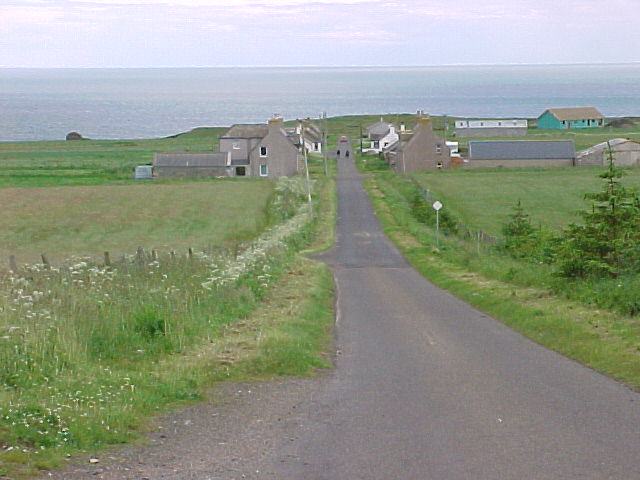
– Sarclet coast –– Sarclet village –
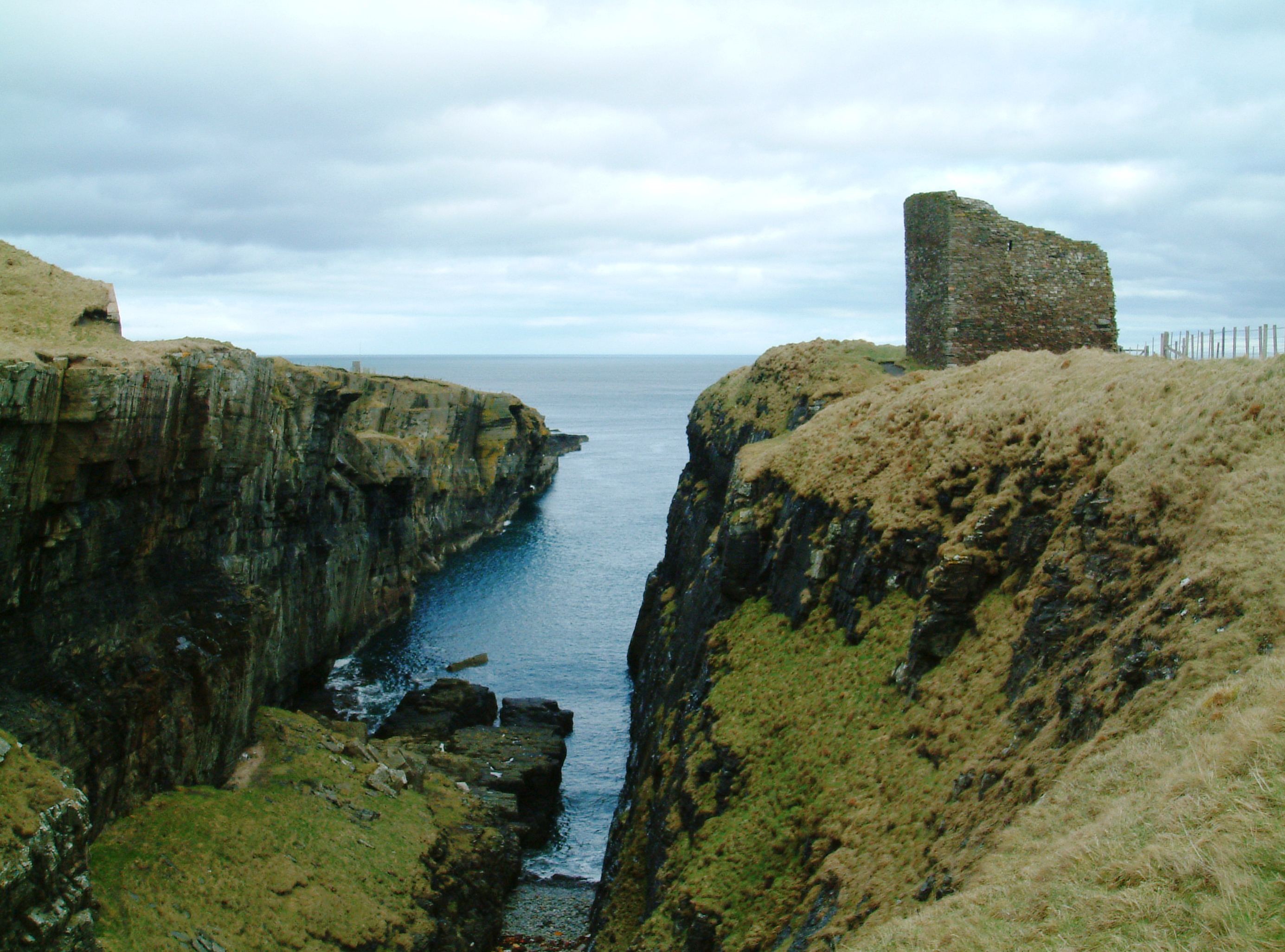
I reckon if you dipped your toe in that Wick water you’d know why some Bains moved to Africa! Also, they may have been dodging giving the castle a much-needed revamp . . .
– Wick Castle –
Stewart Bain was born in 1819 in Caithness, to Donald (42) and Katherine (41). On the 7th of February 1845 Stewart married Christina Watson in his hometown. They had four children during their marriage.
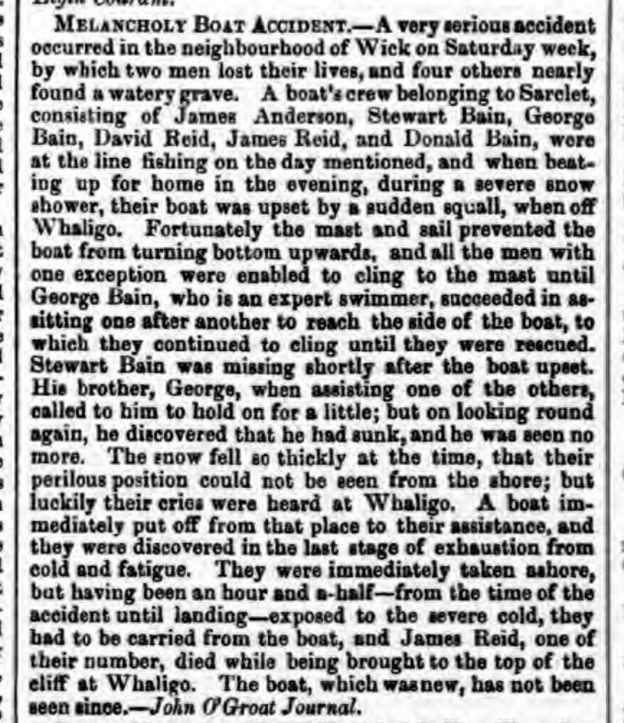
In 1853 Donald’s sons George and Stewart were out fishing when their boat was swamped and Stewart drowned in the freezing winter sea. He died as a young father aged 34 on 19 February 1853, and was buried in Thrumster, Caithness.
Katrina found an 1853 newspaper article about the tragedy.
It seems Stewart’s father Donald also died that year. The next year, 1854, his brother George and wife Annie (nee Watson) had a son. They named him Stewart.
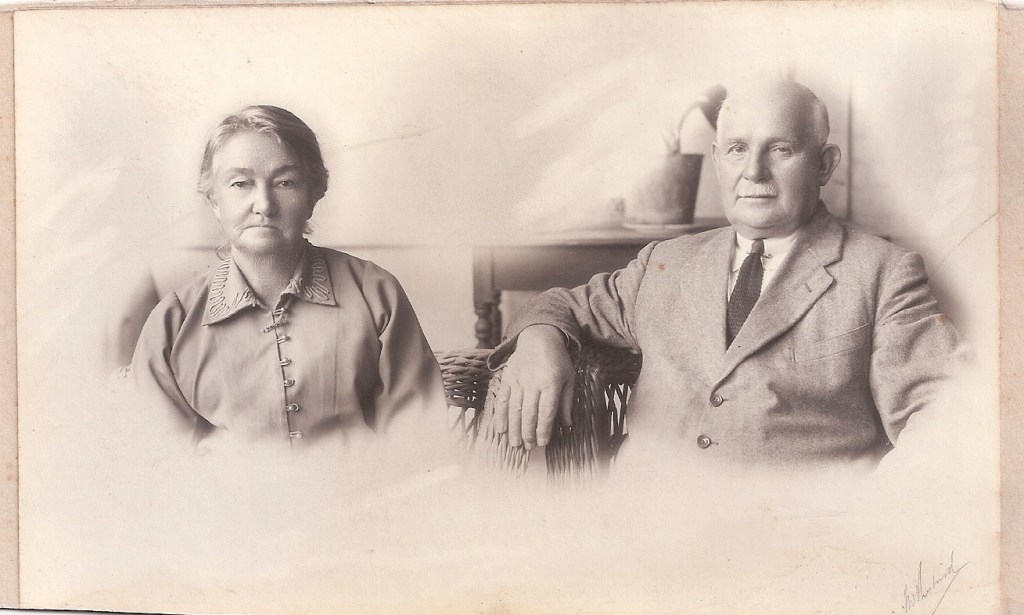
This Stewart is the Stewart Bain who came to Harrismith, Orange Free State – the sovereign country Oranje Vrijstaat – in South Africa with his brother James in 1878 and married Janet Burley. They had seven kids: The seven ‘Royal Bains’ of Harrismith, named after their hotel, The Royal Hotel in Station Road. This ‘title’ was to distinguish them from the ‘Central Bains’, not to claim royalty! My grandmother was the fifth of these seven ‘Royal Bains’ – Annie Watson Bain. She got her paternal grandmother’s surname as her second name.
Stewart and Janet raised their ‘Royal Bain’ brood in this cottage adjacent to their hotel in Station Road, down near the railway line:
James Bain, Stewart’s brother and owner of the Central Hotel, called his rather larger home ‘Caithness’. It was in Stuart Street near their hotel in the centre of town. There they raised their brood – eight ‘Central Bains.’ One of them was also named Annie Watson Bain. Her story ended tragically early, in World War 1 in France. Thanks to Katrina we know more about it.
– Caithness, Harrismith –
On Katrina’s ancestry web page “Miller Family Tree” the names Annie, Jessie, Stewart, Katherine, Donald etc have been used for generations.
The Scottish Tartan register confirms that there is no ancient Clan Bain tartan. This one – ‘The Bains of Caithness’ – was designed in 1993 for Robert Bain of Caithness.
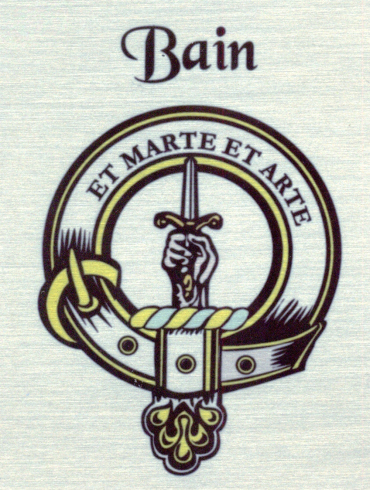
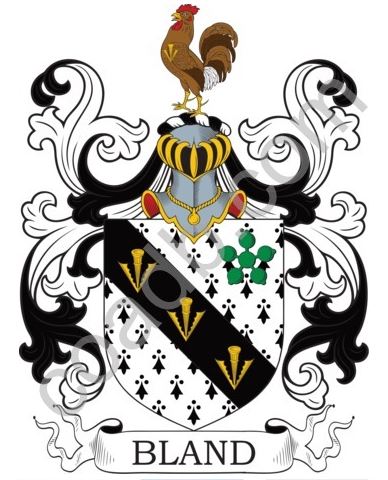
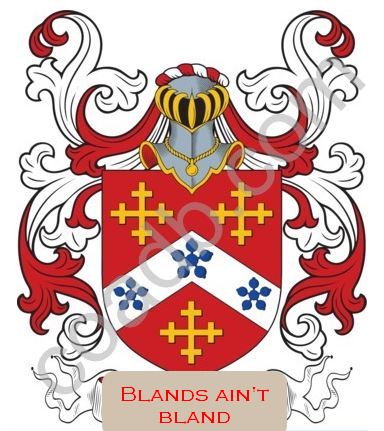
There are a few coats of arms; I chose two examples.
Jock Grant was a Harrismith legend. “A legend in his own lunchtime” as they say.
Fresh out of Scotland he joined the golf club and announced to the usual crowd leaning up against the bar in his broad accent that he was taking Afrikaans lessons.
“Jock”, said Jannie du Plessis, “We think you should first take English lessons!”
He started a plumbing business, married lovely local lass Brenda Longbottom and ended up owning the quarry, becoming famous for his loud booms which would rattle the windows of the town at noon, as he dynamited rock on 80th hill on the western edge of town.
Then he owned Swinburne. Well, the Montrose Motel, anyway. Not much left now:
The entrance was around the corner on the left and as you walked in there was a pianola in the hallway.
———
Ian Fyvie has a story about when Jock went over to visit his family in Scotland. On his return they were playing golf and Ian asked him if he had enjoyed the visit. Jock’s reply was very non-committal and unenthusiastic. Ian said “But you must have enjoyed some part of the trip! What was the highlight of the whole holiday?”
“When I came over 42nd hill and saw the lights of Harrismith!”
—————————————————————
Nick Leslie tells of going for a walk in the veld with Jock and Brenda. Climbing through a barbed wire fence Brenda got her slacks caught. Jock said “Well your name’s not Longbottom for nothing!”
————————————————————–
Dad tells of Jock’s big talk which was most unlike most of their Harrismith friends’ more modest approach. Jock could swagger. He arrived at a party (always there were parties!) smoking his big cigars and between puffs boasted “He wanted *puff* six million *puff* but I said I’ll offer you five million and not a penny more *puff*”. When he left that night Hector Fyvie said in his quiet way “There goes Jock Maximilian”.
————————————
Jock brought his nephew Morris Crombie out from Scotland to join him in his plumbing business. Morris was invited to join Round Table and at his first meeting stood up to announce himself. In his broad Scots accent the lanky Scotsman intoned: “I’m Mawriss Crawmbie – Ploomer” and probably didn’t understand why the whole room collapsed with laughter.
———————
Mom was dancing with Jock at yet another party on Swiss Valley, the Venning’s farm. “Och, its smoky in here, I’m going oot fir a breath a fresh air” said Jock. Mom thought that was rich as he’d been smoking his cigars like a chimney, causing the haze indoors. He was soon back, muttering “I toook one deep breath ootside and I came running back in!” (He was referring, of course, to the famously strong smell of pigshit from the piggery).
Whenever any new guests on the farm referred to the smell the Venning they mentioned it to would look mystified, sniff around cautiously and then pronounce seriously “I smell money”.
This post needs work by someone who knows what they’re on about. This is almost as confusing as the Bible’s begats. Advice: If your name is John, name your son Basil. Or Cyril. Or Percy. Anyway, here goes with what I’ve got:
Our distant cousin Hugh Bland has been doing some wonderful detective work sniffing out the Bland family history. He’s of the Blands that trekked north, to the lowveld and on to Southern Rhodesia (if it was called that yet?), leaving their cousins behind on a farm at Oliviershoek on the Natal-Free State boundary. Maybe on a farm called Oliviershoek.
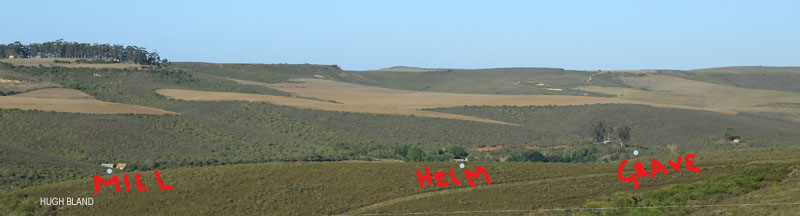
Today Hugh found the grave of Josiah Benjamin Adam Bland.
Josiah Benjamin Adam Bland was born in 1799 in England. His parents were Reverend John Francis Bland (born 1764 Fordham, Cambridgeshire died 1807) and Elizabeth Adams (born Dunfermline, Scotland. He arrived at the Cape in 1825 on the good ship Nautilus, under the care of the ship’s captain, a Mr Tripe. The voyage cost his family £42.
He got a job on a wine farm, in the Drakenstein area of Stellenbosch, met his future wife Cecelia there (du Plessis?), married her, packed their belongings in a Cape cart and trekked to Mossel Bay. They found land on the Gourits river and settled there. Their first son, John Francis Adam, was born in 1836, followed by eight more children. John the eldest then married Petronella Johanna ‘Nellie’ de Villiers and had a son, John Francis Adam II. He and Nellie left for inland while the baby JFA the second was just a few months old. They headed for Colesberg, Bloemfontein, Winburg and on to Harrismith, where they settled ‘in a house not far from the centre of town’ – 13 Stuart Street, maybe?
Back in Mossel Bay, Josiah Benjamin Adam Bland (JBA) became mayor and the main street was called Bland Street. Maybe it still is? He died in 1861. His grave is now hidden in thick bush on a farm in the Wydersrivier district near Riversdal.
When Hugh Bland visited die Kaap ca.2010 the farmer very kindly took him to the gravesite. Hugh says you can still read the inscription on the gravestone – it’s indistinct, but there’s no doubt that it’s JBA’s grave. He says it was “quite a moment” for him – JBA was buried there 156 yrs ago and Hugh wondered when a Bland last stood at that grave.
Hugh put two proteas – which it looks like he skoffel’d out nearby? – on the grave; then laid his shadow down next to his great-great-great grandfather and took this pic:
– Hugh Bland’s shadow next to Josiah Benjamin Adam Bland’s grave – left – Mossel Bay – right – Blands Drift on the Gourits River –
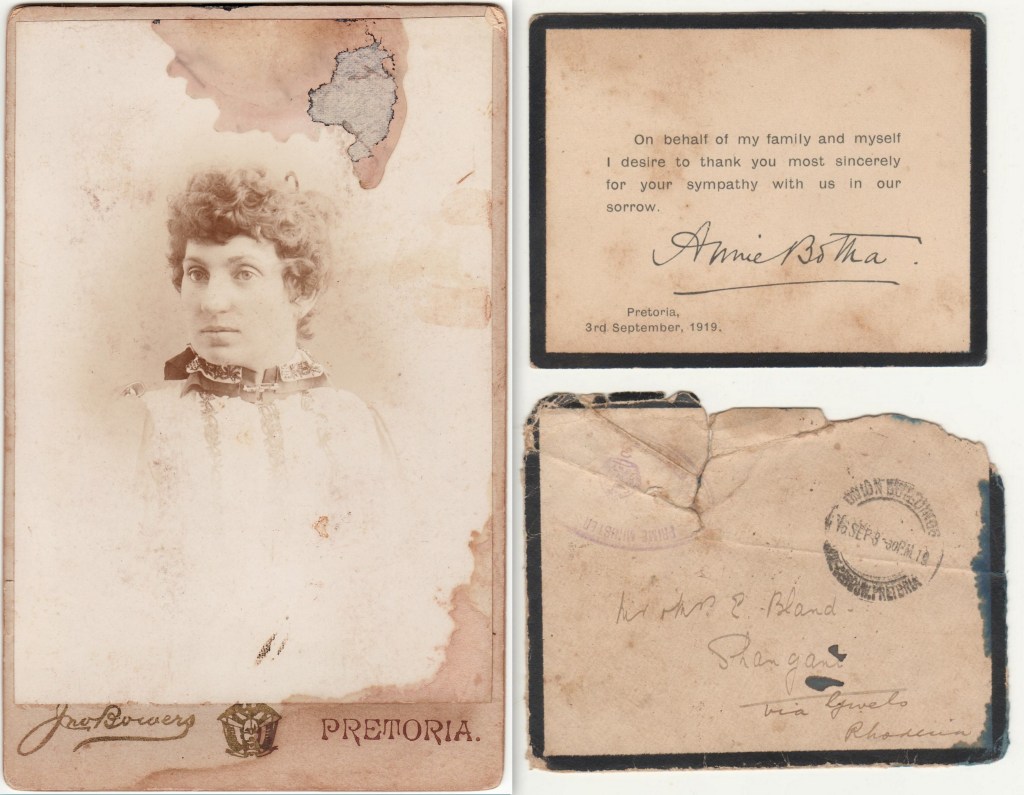
Valuable memorabilia from Hugh:
Prime Minister’s wife’s letter to the Rhodesian Blands
~~oo0oo~~
The Harrismith Branch of the Blands:
Josiah Benjamin Adam Bland had a daughter, Annie Emmett Bland, who married Louis Botha, Boer war general who became the first President of the Union of South Africa in 1910.
He also had a son John Francis Adam Bland (JFA), born in 1836.
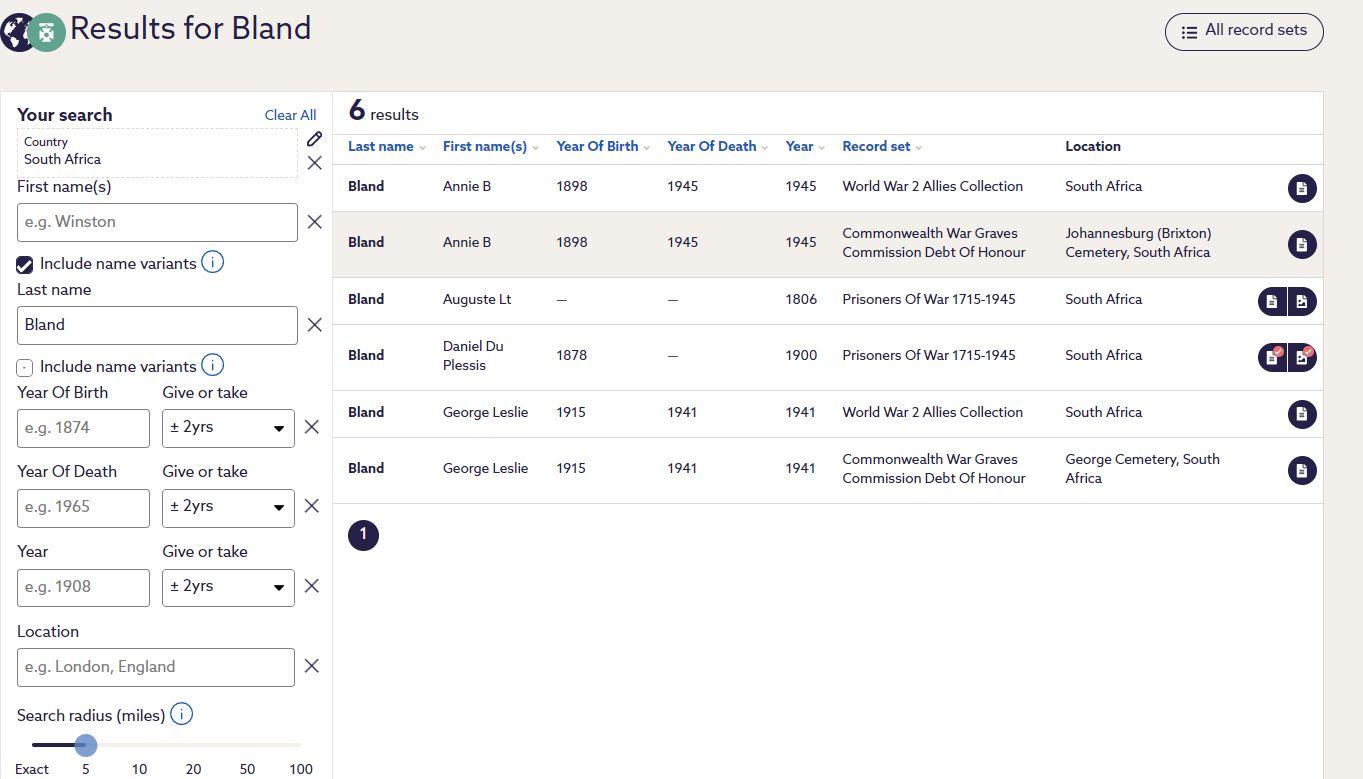
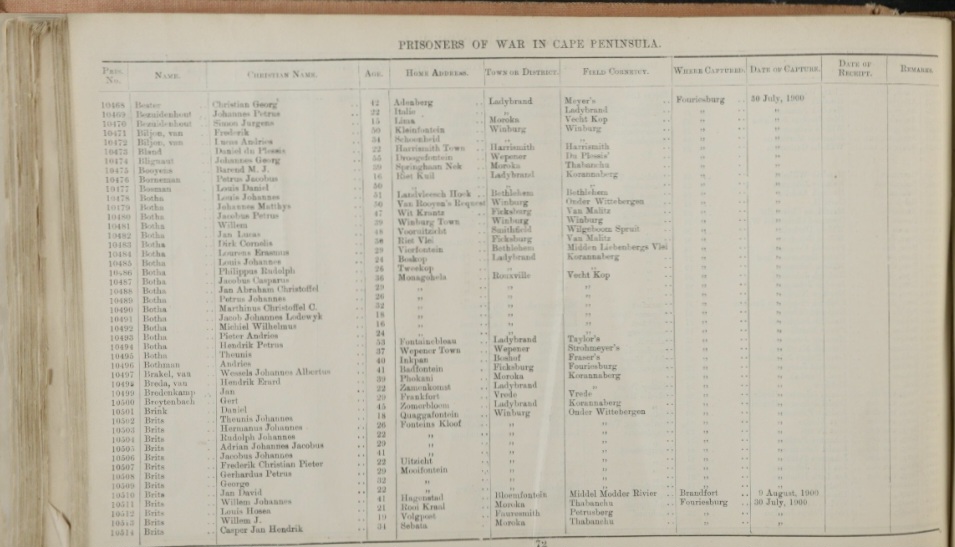
This JFA I later trekked inland ca.1861 to Harrismith in the Orange River Colony with a small baby – John Francis Adam Bland the Second – JFA II. This started ‘our branch’ of the Blands, The Vrystaat Blands. One of them – I must try and find out who – would end up as a prisoner of war in Ceylon for doing the right thing and fighting for his new homeland against the invading, thieving, plundering British in the Boer war of 1899-1902.
John Francis Adam Bland II married Mary Caskie, who became the beloved Granny Bland of Harrismith. They had five sons of whom our grandfather Frank was the oldest, again: John Francis Adam; JFA III.
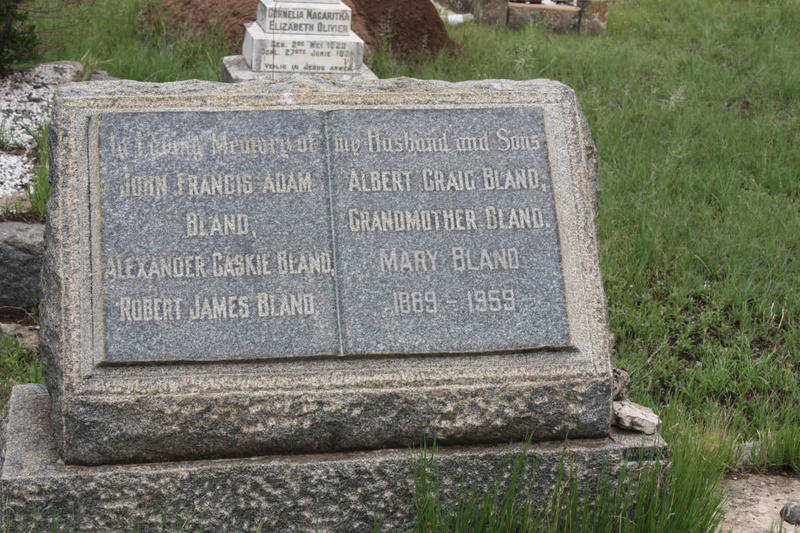
Hugh found out that JFA the First died on 10 September 1891 aged 55, and is buried in the lost, dusty, verlate metropolis of Senekal, Vrystaat. In Harrismith Granny Bland buried her husband JFA II and four of her five boys, including JFA III. As Sheila said, ‘What a tragic life.’ Poor Granny Bland! She loved her namesake grandaughter Mary, our Mom, and she lived long enough to know us, her great grandkids before she died in 1959. So in that she was Lucky Granny Bland! We knew Bunty, the only child who outlived her, very well. He died in 1974 and joined his father JFA II, his mother, and his four brothers in the propvol family grave in Harrismith.
JFA III married Annie Watson Bain – our lovely granny Annie Bland. Known as just Annie. They farmed racehorses and clean fingernails on the farm Nuwejaarsvlei on the Nuwejaarspruit outside Harrismith on the road to Witsieshoek, towards the Drakensberg. He died in 1943 while my Mom Mary was still at school. Pat was nursing in the Boksburg-Benoni hospital. Pat also died at age 49 in 1974. Mom Mary then looked after Annie until she died aged ninety in 1983. Mom Mary is still alive and well. She turned ninety in September 2018 (update, 95 in 2023). Nuwejaarsvlei was later submerged under Tugela river water pumped up the Drakensberg to fill the new Sterkfontein dam. Drowning vleis is environmental destruction, BTW!!! Grrrr!
(I’m hoping sister Sheila will fact-check me here! Also that cousin Hugh will tell us what happened to the misguided Bland branch that didn’t stay in the Vrystaat, but got lost and ended up in Zimbabwe. They lived near Oliviershoek for a while before trekking on. Hugh tells tales of transport riding, ox wagons, meeting Percy Fitzpatrick, farming in Rhodesia and other exaggerations . . . you know how historians are).
~~oo0oo~~
Must add:
A Bland grave pic – Harrismith cemetery
Annie’s oldest daughter Pat Bland – married Bill Cowie, and had two daughters Frankie & Gemma; Bill worked in Blyvooruitsig on the gold mine; We visited them once, and would see them on their way to their wonderful Wild Coast fishing trips. They called Blyvooruitsig ‘Blayfore or Blayfaw,‘ and pronounced Gert as though it didn’t have an ‘r.’
Mary Bland second and youngest daughter – married Pieter Swanepoel in Harrismith in 1951.
~~oo0oo~~
Bland might sound bland, but hey, the surname is thought to derive from Old English (ge)bland meaning ‘storm’, or ‘commotion.’ Don’t use dictionaries that say, ‘dull, flavorless, or just plain ‘blah.’ Rather use the Merriam-Webster that says it means ‘smooth and soothing in manner or quality;’ or use vocabulary.com that says it means ‘alluring;’ or try ‘flattering’ from the Bland Family History on ancestry.com; That’s better. A new motto for the coat of arms, maybe? Blands ain’t bland.
~~oo0oo~~
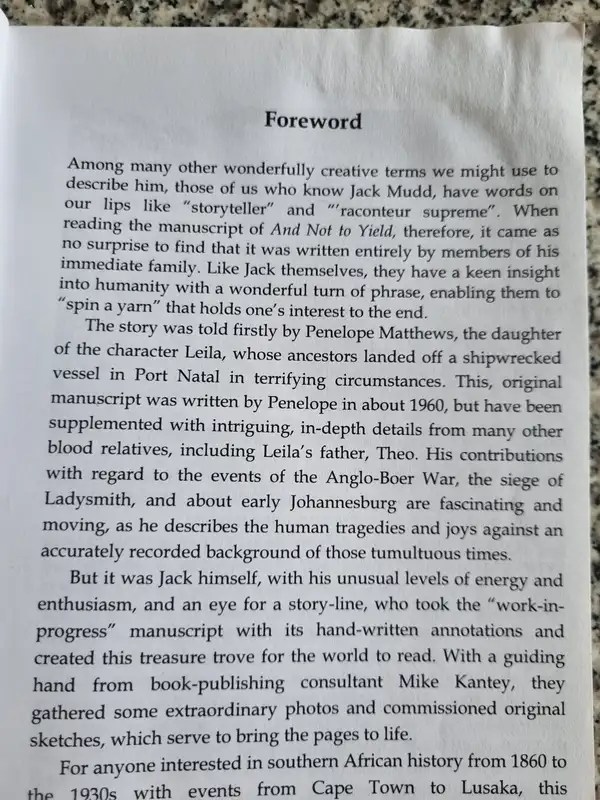
Some of the information on Josiah Benjamin Adam Bland first coming to the Cape I got from Sheila’s book And Not To Yield about Susan Bland. Susan was born in Harrismith, had a brother Willie, married a Theo Allison and lived seven miles outside Harrismith – west, I think, near Sarclet? – farming ostriches for a while.
And Not To Yield by Penelope Matthews, Watermark Press – ISBN 978-0-620-58162-2
~~oo0oo~~
Mom’s more contemporary assessment of her Bland, the Eastern Vrystaat Nuwejaarsvlei branch of the Bland Clan:
She didn’t know her dear Dad Frank’s father – he died rather young. He farmed on Nuwejaarsvlei and sent his son Frank to Michaelhouse. After high school Frank went straight back to the farm, he didn’t do any further studying or training. Mom thinks her grandfather must have had some money, as he built his wife a rather lovely house in town while still on the farm – 11 or 9 Stuart Street. After Frank lost the farm (maybe because as Annie once told me reproachfully when she saw me covered in mud one Christmas morning at 95 Stuart Street, “You know, I never once saw Frank with dirty fingernails!” I loved and admired my gran Annie but I just knew that day that what me and Sheila and Jemma had done in getting covered in mud at the Kakspruit down Hector Street past the du Plessis’ house that Christmas morning was not a bad thing. We washed off in the horse trough and made it to church that morning, I’m sure looking like spotless sweet little angels. JC and FC both would have nodded approvingly, methinks. I’m sure we got presents later that day, so there’s some proof that the Religion of Father Christmas is an understanding, forgiving one.
Frank lost the farm – too many racehorses and too few sheep? – and he and Annie, older sis Pat and Mom moved to town into Granny Bland’s home. Frank bought a filling station in Warden Street in town. When he died – early like his father before him – Annie surprised traditionally-minded people in town by carrying on with the Central Service Station. It was near the corner of Retief Street; later she moved it half a block nearer to the Town Hall, to Caskie Corner, probably the prime spot in town, on the corner of Southey Street. In time she rented spaces to the Flamingo Restaurant and Platberg Bottle Store. Between the Flamingo and the VC Cafe in Southey Street was the ramp up to her workshop, where At Truscott fixed cars for her.
Granny Bland was a Caskie. Maybe she owned Caskie Corner? I asked Mom Mary and she thinks her gran Mary Caskie Bland may well have. And that would be how Annie could move her Caltex filling station and garage to the best corner in town from half a block down Warden Street – and later how Mom Mary could move the bottle store next door to it from round the corner in Southey Street.
When I was around six years old Sheila came marching up to me and demanded: –
“Do you know what Dad’s name is?”
Well, of course I did! I was the older brother.
It’s “Dad”
“No man, his real name!”
What did she mean? Oh, of course – I’d heard Mom call him that lots of times.
“Peter”
“No. It’s PIETER GERHARDUS!!”
What rubbish! I’d never heard such foul language! And this from my MUCH younger sister! She was a whole year younger’n me. Which was like: All of living memory!
Amazingly, investigation and enquiry proved her right!
Ernie van Biljon wouldn’t take no for an answer, so I got to go to America as a Rotary exchange student back in 1973.
You persevered where others lost interest.
What a lovely man. He should have lived to a hundred.
Rotary held their interview and selection sessions at Greystones outside Estcourt (where I had attended a Veld & Vlei leadership course earlier that year):
Which three countries would you like to go to, they asked? America, America, and America I replied – and I want to go to a small town, not a big city.
Well, they selected me anyway, but decided, “OK, smartass,” and dispatched me to Apache, Oklahoma, USA, population 1500.
“There are two strict rules” they told us sternly: “No Falling In Love; and Strictly No Driving while you’re there.”
Of course not . . .
Well, I got none out of two right but it was just infatuation; and the owner of the Chev Camaro covered for me in Apache; and the owner of the VW Beetle covered for me in Canada. Turned out I double-failed at both the Two Commandments. I broke them and I was useless at them.
Thank you, Ernie! It was a life-changing, unforgettable year!
Ernie was a great character, full of smiles and laughs. Mother Mary (96 in 2025 when she told me the story) tells how he was worried about his smoking; and how everyone, including “The Englishman,” as he sometimes called Margie, his lovely wife, wanted him to quit. “But I don’t know what to do with my hands!” he complained. Well, Mary had an answer for that: “I’ll show you what to do with your hands,” she said, “Here, put them together like this,” Ernie dutifully followed her instructions. Then put them between your legs like this, she said, putting her hands between her legs. With his mischievous grin Ernie said, “OK,” and made to also place his hands between Mary’s legs, causing great hilarity all round and distracting everyone so he could carry on smoking unchallenged.
I suffered severe stress in the army in 1979. Once.
My two-tone 1965 Opel Rekord 4-door bench seat, column-shift sedan in sophisticated shades of grey: dark grey body, pale grey roof, grey upholstery; got indisposed while parked under the bluegum trees outside the Medics base camp on Roberts Heights – then Voortrekkerhoogte, now Thaba Tshwane. She wouldn’t start.
This was serious! We had a weekend pass and there was a party on in the City of Sin & Laughter, aka the metropolis of Harrismith, as everyone knows.
Not a problem, said KO (surname). We were all KO’s: candidate officers. He kindly offered to tow me to Harrismith behind his V6 Cortina bakkie. A short piece of nylon rope was found and we set off. I immediately thought Uh Oh!! as we hared off, accelerating furiously. Soon we reached what felt like 100 miles an hour. Slow down! I screamed silently. We hadn’t arranged any signals or communication, so I simply gripped the steering wheel and concentrated. If cellphones had been invented I’d have sms’d him: WTF RU MAD? Then I’d have worried about him reading his sms while driving at that speed.
I sat tensely, staring at the rear of the bakkie a mere six imperial feet from my bonnet. I couldn’t even see the towrope as we roared along. We’re going East so fast we hasten the setting of the sun.
Then it started to rain! Then twilight fell. Then it got dark, with the rain falling ever harder as my wipers feebly swished back, and then later on, forth. With the motor not turning, the battery got flatter and flatter and the wipers got slower and slower. Blowing the hooter and flashing my lights just made things worse – the wipers stopped if anything else was switched on. Upfront in the bakkie the music was so loud and the chit-chat so intense they didn’t even notice us. Or pretended not to?
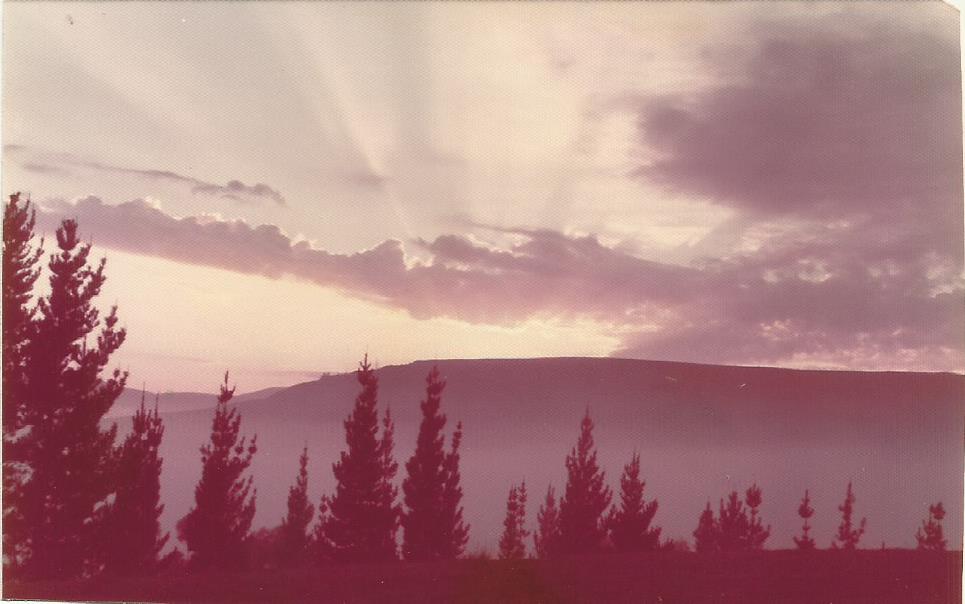
There was nothing for it but to hang in there for hours. Worst journey of my life. My chin got closer and closer to the windscreen and my knuckles got whiter. Still the KO kept the bakkie floored! He had to get to Durbs where a girlfriend was waiting. My neck was tense and I don’t think I blinked once, staring at the top edge of the bakkie tailgate. My right thigh ached as it poised ready to brake – delicately! – at any moment.
An eternity later we pulled up in Harrismith, unhitched the towrope and off he went, on to Durban. ‘Hey, thanks!’ I said. ‘Appreciate it!’
Fu-u-uck-uck-uck!!! I had never felt such relief. The beer soon relieved the stress though. And soon the testosterone was saying ‘It was nothing.’