Jim Stainton was aghast! He had just invited me along to a rock concert in Oklahoma City and I had immediately accepted. My motto in Apache was I only say YES to all invitations to travel. Only got a year, gotta go everywhere! His follow-up questions had forced me to admit my ignorance.
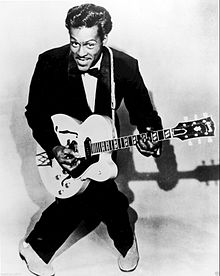
Don’t say that! Don’t say you don’t know who Chuck Berry is!
Hey! I was a seventeen-year-old Vrystater. I was lucky enough to know a lot about modern music, but turns out there was this gap in the fifties when I was one month and twenty days old and Maybellene hit the charts!
But I was willing to learn, I had a ball at that concert with Jim, and I have been a Chuck Berry fan ever since!
What I didn’t tell Jim is I had even less heard of Bo Diddley! He featured with Chuck and they rocked up a storm. ‘My ding-a-ling’ was really big just then! (ok, that didn’t sound just right, but anyway . . . knowaddimean . . )
He played all his hits with huge energy, holding the big stadium in the palm of his hand. He played ‘Johnny B. Goode’, ‘Maybelline’, ‘Nadine’, ‘No Particular Place to Go’, ‘Reelin’ and Rockin’’ ‘Roll Over Beethoven’, ‘Surfin’ U.S.A’, ‘Sweet Little Sixteen’ etc. etc And ‘My ding-a-ling’.
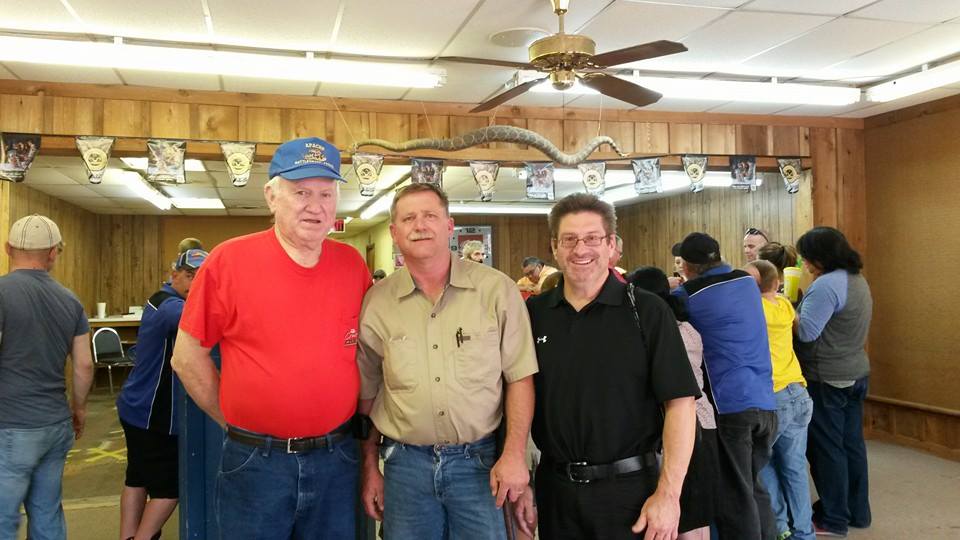
That was 1973. I recently found a 2014 pic of Jim on the internets. That’s him in the red T:
Some Chuck Berry:
– “People don’t want to see seventeen pieces in neckties. They wanna see some jeans, some gettin’ down and some wigglin’.”
– “I love poetry. I love rhyming. Do you know, there are poets who don’t rhyme? Shakespeare don’ rhyme most of the time and that’s why I don’ like him.”
– “It amazes me when I hear people say ‘I want to go out and find out who I am’. I always knew who I was. I was going to be famous if it killed me.”
– “I would sing the blues if I had the blues.”
————-
Bo
In 1963, Bo Diddley starred in a UK concert tour with the Everly Brothers and Little Richard. The supporting act was a little up-and-coming outfit called The Rolling Stones.
~~oo0oo~~
footnote: I asked a friend last year to bring some Chuck Berry to a gathering on my patio. I decided to catch up before so I looked him up on wikipedia – to learn he had died a few days before at the ripe ole age of 90. R.I.P Chuck Berry.
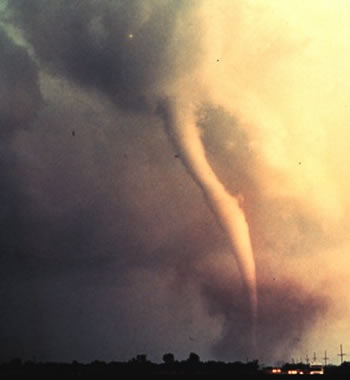
In Apache Oklahoma in 1973 I lived with the charismatic funeral home owner, fire chief, ambulance driver, hearse driver and tornado alert man, Robert L Crews III. In the funeral home. While I was there we sounded the siren for tornadoes twice and watched them approach. Once we even went down into the basement as it came so close. But both times it went back up into the clouds – didn’t touch ground.
Here’s the view on one of those days:
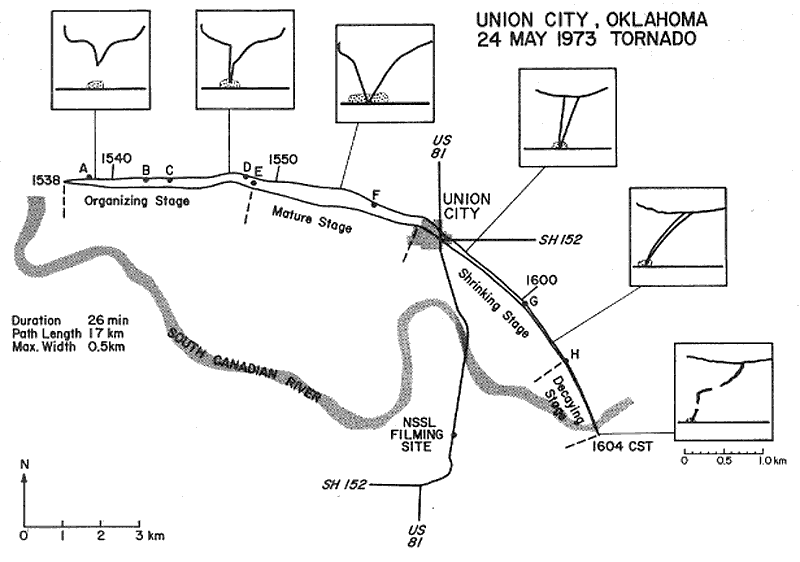
In May we heard of the Union City disaster. We drove there to look-see. The image that stuck the most in my mind was the main street with many buildings completely gone. One shop had some shelves still standing – with product on the shelves – but the roof and walls were gone.
I found this recently: Union City Tornado Makes History
NSSL revisits its past as it celebrates 40 years with NOAA – by Rachel Shortt
On May 24, 1973, a tornado rated F4 struck the Union City area and was the first tornado widely documented by science as part of storm chasing field research. NSSL out of Norman, Oklahoma placed numerous storm chasers around it to capture the life cycle on film.
As the devastating tornado tore through the small town of Union City, no one knew the tremendous impact it would have on the development of weather radar. Researchers from the NOAA National Severe Storms Laboratory now look back on that day as a significant event in the history of severe weather research and forecasting.
And I was (sorta) there!
=======ooo000ooo=======
For a human interest story, see this article written in 1993, on the 20th anniversary of the tornado:
The tornado that people in Union City talk about the most twisted in from the northwest twenty years ago this week, killing two people and demolishing half the downtown buildings. It blew the cross atop St. Joseph’s Roman Catholic Church into a field six miles away.
Another tornado destroyed the same church in 1896, and another flattened fifteen farmhouses in 1927. Yet another reduced two barns on the edge of Union City to kindling and seemed hell-bent on roaring toward town until it hit the South Canadian River nearby, spun away to the east and died out.
Here in the heart of “Tornado Alley” almost everybody knows that a new tornado will eventually show up on the western horizon. But they also agree on this: There is not much use in being obsessed about it.
“You can’t let it rule your life,” said Leo Radtke, who in 1973 watched from the storm cellar as the house where he was born, as well as his new Chevrolet El Camino, was swept away. “If it hits, it hits, and you just start over again, which is what I did. It’s part of living in this country.”
Where the Winds Collide – ‘This country’ is a swath of the Great Plains stretching diagonally from the Texas Panhandle to southern Iowa where warm, moist winds from the Gulf of Mexico frequently collide with cold, dry winds from the west at this time of year, combining to produce more tornadoes here than in any comparably sized place on earth.
And while most of the attention is understandably focused on communities when they are actually hit, a more typical tableau of life in Tornado Alley is found in places like Union City, a town of about 1,000 people in central Oklahoma, 23 miles west of Oklahoma City. Here and in thousands of communities like it, tornadoes exist not as a present danger but as a grim memory and a future threat.
Early warning? – There have been major advances in the radar equipment that helps meteorologists to detect a tornado while it is forming and to warn of its approach. Because of those advances and improved communications through radio and television, there has been a steady decline in the average number of fatalities caused by tornadoes every year — from 311 people in the 1920’s to 138 in the 1950’s to 56 in the most recent 10-year period, according to the National Severe Storms Forecast Center in Kansas City, Missouri.
But the average warning time is still only 19 minutes, and many tornadoes cannot be detected at all until they hit the ground, meaning that the first warning is an old-fashioned one: a human being sees it and yells. And even when people know it is coming, a tornado remains one of the most destructive hazards of nature, a vortex of winds swirling at up to 300 miles an hour and often churning up everything in its path, making any effort to protect property generally futile. ‘There’s Nothing You Can Do’
“If your home is in the way, you’ve had it — there’s nothing you can do,” said Leo Demmer, 64, who has seen five tornadoes in his lifetime but escaped the path of all of them.
Mr. Demmer, a wheat farmer and cattle rancher, quickly added that he was talking more about property than people, who will almost always be safe if they manage to get underground, perhaps to the kind of storm cellar that sheltered Auntie Em and Uncle Henry when the tornado struck Kansas in the “Wizard of Oz.”
Mr. Demmer should know. As he spoke he was adding two and a half tons of concrete to help anchor his own storm cellar, made of two steel cargo containers sunk into his back yard. “It was frightening, it was beautiful, and here it was coming right at us,” Mr. Demmer said of the 1973 tornado. He snapped a few pictures, then headed for the cellar.
It was 20 years ago, but people who describe the tornado can make it sound as if it hit last week. Several recalled that in the hours and even minutes before the tornado struck, at 4:55 in the afternoon, it seemed like the balmiest of spring days.
A Scrapbook of Memories – “It was just real pretty out,” recalled Odessa Bromlow, the owner of the T&B Country Market, which at the time was a cafe. “I had just been to the beauty shop, and it was time for a shift change — then poof. The wind just started howling.” As she spoke, she flipped through a scrapbook she had put together full of headlines from the Oklahoma City papers. “Union City Devastated,” said one. “Twister Leaves Trail of Ruin,” read another. A Union City woman died because she could not get the door to her storm cellar open. The other victim was a man named Corp Sanders who had insisted on watching the tornado from a chair on his porch, even as the police officer screamed at him to run for cover.
Most People Stay – But while almost everybody here seems to have vivid memories of the tornado and the daze that settled over the town after it struck, most of those whose property was damaged eventually rebuilt and stayed put. Several people, asked what it was like to live in a place where each spring brought the threat of tornadoes, quickly said it was far preferable to living on either coast of the United States. On the east coast were hurricanes and on the west were earthquakes, they said, both of which can yield a far broader trail of destruction than a tornado.
“As terrible as it was, I’d rather deal with a tornado than an earthquake any day,” said Georgia Rother, the town clerk and treasurer. “With a tornado, at least you can see it coming. You can try to run away from it. With a quake, there’s no place to hide.” Others pointed out that even in Tornado Alley, the chances of getting killed or having a home destroyed by a tornado are very low — about as low as the chance of hitting the jackpot in a state lottery.
Early warning 2 – Many towns, including Union City, have installed emergency warning sirens on their streets — but only after experiencing the terror of a tornado when they did not have such devices.
Earlier this year Catoosa, a suburb of Tulsa, tabled as too expensive a motion to buy used warning sirens from a nearby town that was installing a more modern system. Then, in late April, a tornado struck, killing seven people and causing millions of dollars in damage. This week the neighboring town donated the used sirens to Catoosa.
For those who get their warnings by television, though, some experts fear an altogether different problem: too many warnings. Television stations throughout Kansas and Oklahoma have become ferociously competitive over the years. “Some of them will interrupt programs with a tornado alert at the slightest provocation,” said Frederick P. Ostby, the director of the National Severe Storms Forecast Center. “It’s getting to the point where people feel they can’t see any television program in its entirety during tornado season. People are getting angry about it.”
Mobile homes and fatalism – Here in Union City, when people think about tornadoes at all, it is usually with fatalism. That was especially true in a mobile-home development on the south side of town. At one trailer some old tires and cement blocks were placed on the roof to give the unit a bit more heft if a storm hit. “But I don’t suppose it will make much of a difference,” said Beverly Brookshire, a 48-year-old waitress who lives in the trailer. “If it’s our time, it’s going to hit. I just pray, ‘Lord, don’t let it be our time.’ ” Mobile homes can be unsafe in even the weakest of tornadoes. “There’s kind of a folklore out there that tornadoes actually seek out trailer parks,” said Frederick J. Gadomski, a meteorologist at Pennsylvania State University. “But it’s not that at all. It’s really that because of poor construction, they’re simply more vulnerable.”
On Tabbo’s Warden farm ‘Rust.’ Mine host Tabbo is second from right, yet another ale in hand.
– Tony Porrell, Koos Swanepoel, Nev Shave, Charlie Deane, Dirk Odendaal, Ian Fyvie, Rob Spilsbury – Nick Leslie, Doug Wright, John Venning, Mike Curnow, Tabs Fyvie and Guy Kirk – – front: Gillon Thake – son of Doug Wright’s sister, Yomi Thake –
None of those guineas were killed by me (second from left) with my old man’s cheap Russian Baikal shotgun, R139 from Musgraves in Bloem, even though the barrel was smoking. A marksman I am not! I was ‘Rust’-y. The fowls of the air are safe when I’m aiming at them.
Kai Reitz once tried to cure my handicap of not being able to hit a cow’s arse with a banjo. On his farm, The Bend on the Tugela river outside Bergville, he gently lobbed up big sandclods in a ploughed field and I filled the air surrounding them with birdshot. Then they plonked to earth. Thud! Unharmed.
It was for naught – he had to give up.
With the last two shells Kai took the shotgun. I hurled two empty shell cases as hard as I could. Blap! Blap! he hit both of them. Bang went the gun and bang went my chance of using faulty Russian alignment as an excuse.
Bloody guineas better watch out, I’ll bring my mate Kai next time!
~~~~~ooo000ooo~~~~~
As always, Sheila has the details:
This was taken on 1 September 1974, at a shoot at the Fyvies’ farm ‘Rust’ near Warden. According to my 1974 diary, we had had a wonderful party at Nick & Anne Leslie’s farm ‘Heritage’ the night before – “Had delicious supper. Danced. Sat & chatted” – most of us spent the night there, then moved over to Rust the next day, where the guys “shot about 60 fowls.”
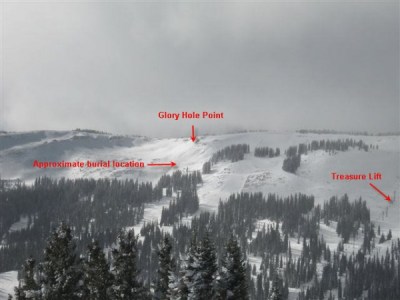
I was going to ski – we would have called it snow ski! – for the first time in my life. Wolf Creek Pass in the San Juan mountains in Colorado. We’d be catching a bus from Oklahoma, driving there and staying at the lodge. Jim Patterson was taking me on a host-Dad and Son special treat. It was 1973, and in the previous summer he and Katie had taken friend Dottie Moffett and I on a steam train ride nearby – the Durango to Silverton narrow gauge railroad.
My pic of the Animas River out the train window:
That was a glorious summer. But now we were going in winter:
As the day approached we watched the snow reports with bated breath. Nothing. No snow. The day before we were to leave the bad news came: Trip cancelled.
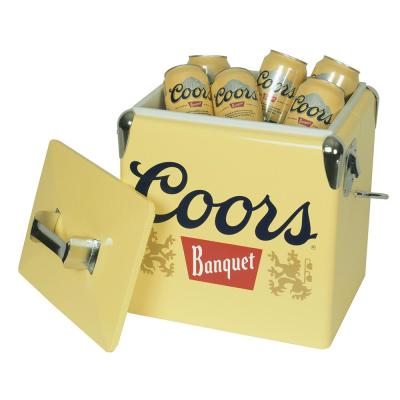
True to form Jim looked on the bright side – he always did! – and invited me to join him in drowning our sorrows as he opened up the big heb cooler full of Coors beer he had packed for the trip! Jim always put a good spin on everything!
I would have to wait fifteen years till 1988 before my first snow skiing – in Austria.
~~~oo0oo~~~
Also, another new sport I had started but wouldn’t really get into for another nine years, took place on the Colorado rivers next to that railway line: White-water kayaking:
When I got to Apache Oklahoma in 1973 I had already finished high school. Not much academic enthusiasm or effort had gone into my matric and I was keen to put minimal effort into this second matric, or ‘senior year’, at Apache High. In my mind I had been sent to America to socialise and be an ambassador, ‘period’.
So I carefully selected my subjects – I had to take American history – I was OK with that. I learnt about George Washington. I had to take English (compulsory for all foreigners). I added typing, ag shop (agricultural workshop – farming, welding, etc making me a member of the FFA – Future Farmers of America), annual staff (making the school annual, acting as a journalist, and selling ads in town – a hoot! Actually, they chose me, you couldn’t just elect to do it. I was lucky). I’m sure there was a sixth. Yes, Oklahoman history, I think. My mind wasn’t really on these details. No wait, it was Phys Ed.
Here’s me focusing on my typing. I’m with fellow annual staffers Robbie Swanda and David Lodes slaving over our hot typewriters. I reached a blistering 19 words a minute with ten mistakes.
Typing – roaring along at 19wpm with 10 mistakes
Robbie Swanda & David Lodes, fellow typists and Annual Staff members bashing out the Apache 1973 school annual
When I told host Dad Jim Patterson my subjects he grimaced. Then he grinned and said – “Peter, are you sure they didn’t offer Basket Weavin’!”
Jim was a great teacher. He taught me all about ‘counting fence posts’. He would pack a sixpack of Coors into a coolerbox full of ice and we would drive around the district in his old red Ford F150 pickup along the farm roads with Jim recounting all the tales of who lived where, what they farmed and some history of the area. We were ‘counting fence posts’.
Here’s Jim waking up on the back of that pickup one camping trip:
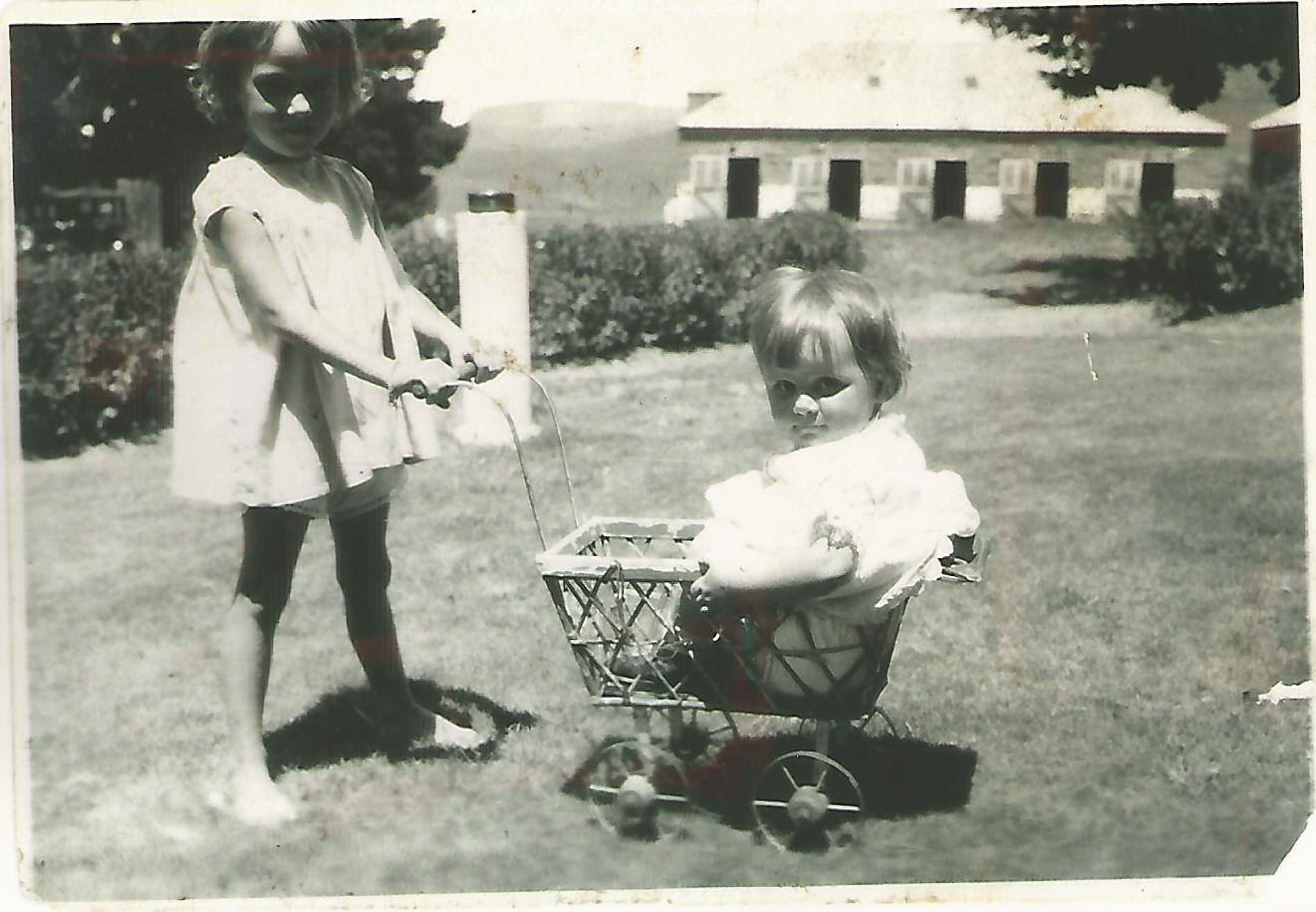
This was taken on my grandparents’ Frank and Annie Bland’s farm, Nuwejaarsvlei in the Harrismith district, eighteen miles out on the road to Witsieshoek. The farm is now under Sterkfontein Dam. The solid sandstone stables (‘five loose boxes’) were more stable (!) than the house, which was a long thin prefabricated structure bought from the British army on Kings Hill when they finally left town in 1913, eleven years after the end of the Boer War. Grandpa Frank bred and raced race horses. For a while . . .
Frank had the prefab carted out to the farm, then cut off a portion of the long house so they only lived in four rooms: A lounge, a kitchen and two bedrooms. They bathed in a zinc bath in the kitchen while Frank showered with cold water in a reed enclosure outside. In all seasons. In the Eastern Freestate. At five thousand feet above sea level. Near the Drakensberg escarpment Brrr! Bath water was heated in paraffin tins on the coal stove. Lighting was by lamplight. The toilet was a long-drop outside, positioned under trees along a path of white-washed stones leading from the kitchen door. Past Frank’s shower.
Here’s older sis Pat pushing Mother Mary in their dolls pram in the farmyard. See the stable sandstone stables in the background.
Frank started to build a big stone house from sandstone quarried on the farm. Built on a slope, it was level with the ground at the back, but ended in a high drop in front, which never did get the grand steps that were to lead up to the big veranda. The walls went up and the kids would roam around the big house, four bedrooms, big rooms, big kitchen but Mom says, “No bathroom.” Frank believed in an outside bathroom.
The roof never went on. The builder wanted many sheep (Mom thinks 200!) to do the roof and Frank balked at that / couldn’t afford it.
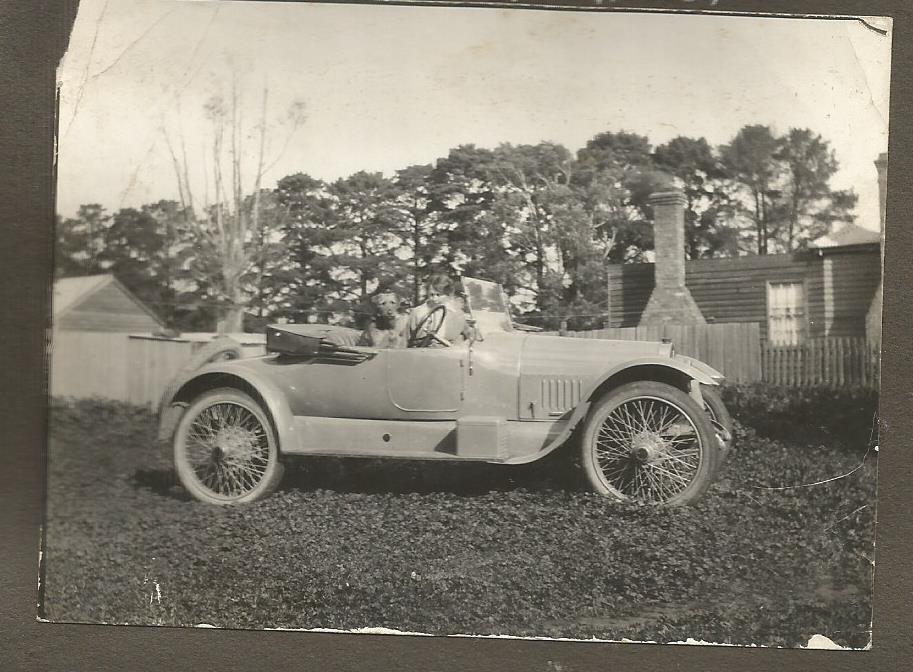
Other buildings on the farm were a workshop, Frank’s office and a garage for his yellow ‘Erskine’ tourer. Mom remembers: “It had open sides; when it rained you stopped, hopped out and quickly put up the side flaps.”
– an Erskine Tourer –
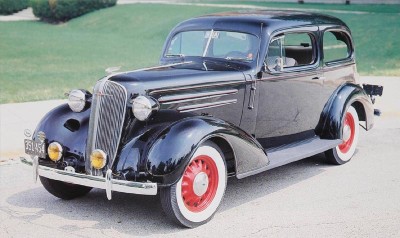
Later Frank bought a 1936 Chev Standard – perhaps like this one, but ‘light brown’:
Mom Mary remembers cousin Janet leaving the door open after she and older sister Pat had jumped out just before Frank drove into the garage. The door, she says, was “damaged forever.”
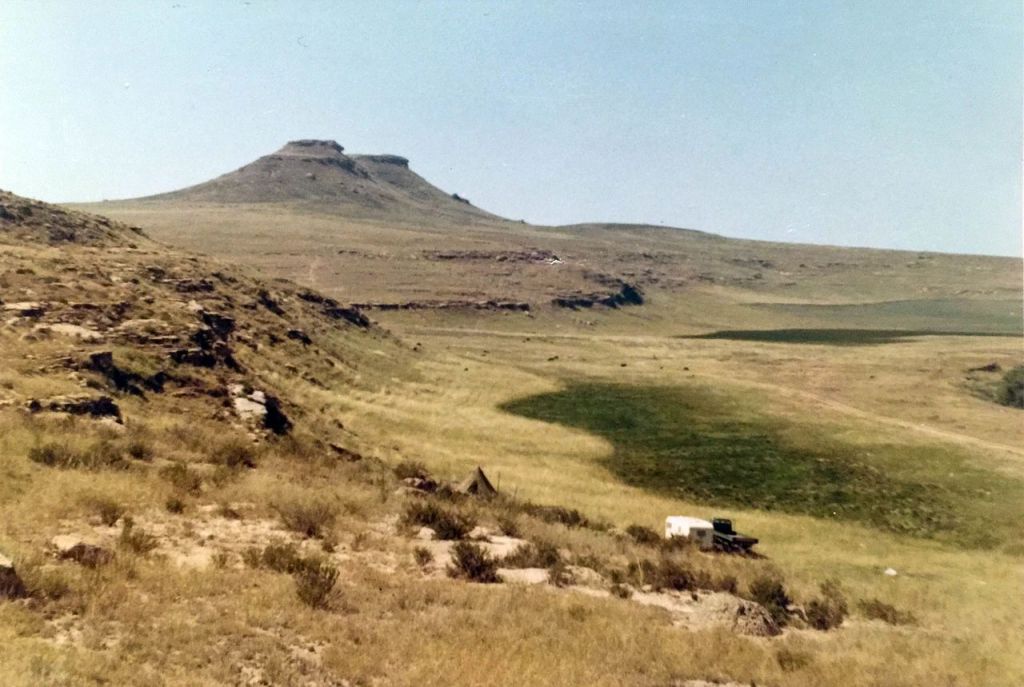
The Nuwejaarspruit runs from Nuwejaarsvlei down to the Wilge river downstream of Harrismith and then into the Vaal Dam. Sterkfontein dam was built on the spruit and drowned the farm under Tugela river water pumped up from KwaZulu Natal. You would now have to scuba dive in the clear water to see the farmhouse. This picture is taken from roughly above the farm looking back towards Harrismith’s long Platberg mountain with Baker’s Kop on the left:
They called the hills on the farm ‘Sugar Loaf’ and ‘Horseshoe’. Mom loved her walks with her Dad Frank and fondly remembers them ninety (gasp!) years later.
I wish we had more pictures of the farm. Here are the only ones I have found so far of areas near the farm before it was flooded:
Annie also always drove. Frank said she always drove too fast. Years later the younger crowd John Taylor and Mike Malcolm-Smith said she always drove too slow, and that she should speed up – “to the speed limit”!!
Annie & dog in a _____
Then the farming ended. The Blands moved into town – the metropolis of Harrismith – ca.1939 to start a petrol station and garage, having lost the farms. In September 1943 Frank had a colosistectomy for gallstones’ performed by his friend and GP Dr Frank Reitz. Mom went to visit him in hospital on her fifteenth birthday, 18 September. He died two months later, aged fifty. The next year, when Annie needed an op, she sent Mary off by train with Granny Bland to Durban to stay with Mrs Jim Caskie – ‘a huge fat lady’ – in the Echoes Hotel.
While in Durban they saw a 1943 Irving Berlin movie “This Is The Army.”
Luckily Annie came through the ordeal intact. She would live for many a year yet. About forty nine of them.
~~oo0oo~~
Nearby farm neighbours on Kindrochart were the Shannons, George and Belle, with son Jack, a few years older than Pat and Mary. The Shannons also bred racehorses and achieved forever fame when they won the Gold Cup with their horse Rinmaher.
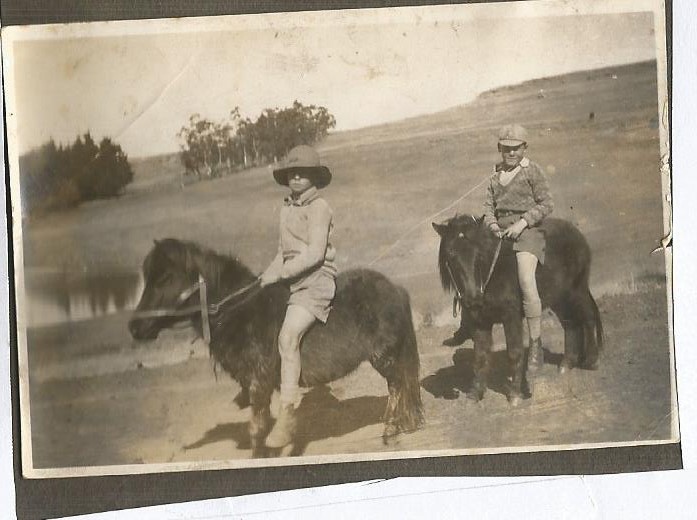
When Jack had outgrown his Shetland Pony named ____, his parents suggested to him that he give it to the Bland girls on Nuwejaarsvlei. He looked dubious but his parents encouraged him.
“Will you do that?” they prodded him.
“Yes, but not with pleasure” said Jack.
Recently Sheila found a pic of Jack – probably on that very pony!
Jack and Peter Bell
Peter Bell (or Hastings-Bell) became a pilot in the Rhodesian airforce and tragically went missing in action in WW2.
~~oo0oo~~
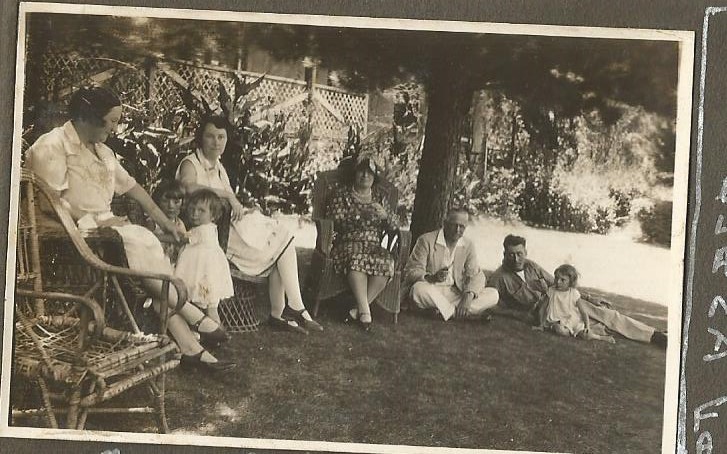
Jessie & Annie sitting with Janet & Mary between them – (then two unnamed guests) – Frank lying on the lawn with Pat
~~oo0oo~~
Decades later, here’s Mary in 1990 cruising above Nuwejaarsvlei in a boat the ole man built, with her old family home somewhere underwater below her:
~~oo0oo~~
More decades later and I phoned Mary (now aged 92). She said she’d had a lovely night’s sleep and . . . see here.
The Erskine was an American Automobile built by The Studebaker Corp. in South Bend, Indiana from 1926 to 1930.
In 1971 I decided I wanted to do the Dusi. Charlie Ryder (who gave me his boat, a fibreglass Limfy K1 with nylon deck and his left-feather paddle) told me it was tough, I’d better train.
So I did. Every morning a few of us (Louis Wessels, Tuffy, Leon Crawley, who else?) got up at 5am, cycled a mile to the boys hostel and then ran the X-country course. About 3km up a hill past the jail, across, down through a donga/stream bed and back. Probably a 20 minute run. After school I would cycle to the mighty Vulgar River and paddle Charles’ boat (which I left “hidden” under a willow tree) for about a km or two. The cycle back home was uphill.
I’m not even sure I told anyone I was I was aiming to paddle the Dusi! I must have, surely? They knew about the boat anyway.
I have never been as fit in my life, before or since. Running I felt like I could fly. I would run hard, then even harder and still think “I could just carry on like this!”
Today I re-read Graeme Pope-Ellis’ book. The part about his training in 1971.
He ran at 4.30 am for two to two-and-a-half hours; He ran hard. In the afternoon he paddled for two to two-and-a-half hours; He paddled hard. Plus he did half an hour of hard, targeted gym work.
My total training was an hour a day and only parts of the running was done hard. The cycling and paddling were leisurely. To this day, I chant, No pain; No pain!
I didn’t have a clue what “train hard” meant! Talk about chalk and cheese! Quite an eye-opener.
I didn’t do that race in 1972. My boat was stolen shortly before – around New Year. I hitch-hiked to the race and followed it down through the Dusi and Umgeni valleys (with friend Jean Roux), sleeping in the open and bumming rides with paddlers’ seconds. Graeme won the race. His first win. He went on to win it 15 times.
Later I got to know Graeme and many of the guys who dedicated their lives to winning the Dusi. They trained like demons. Some of them did beat Graeme. Occasionally. But usually Graeme did the winning.
Me, I became a tripper! One of the trips was with Graeme and other fast paddlers who geared down and bumbled down the Colorado River through the Grand Canyon in leisurely fashion. My style!
~~~oo0oo~~~
In my first Dusi in 1983 I politely waited for the okes in a hurry to move on over the flat water in Alexander Park and when I go to the weir I paused to tie a shoelace. Jerome Truran (world-class whitewater paddler) was spectating that year. He spotted me and said “Hey Swanie, you do realise this is a race, right?”
Mrs Hawkins circa 1944 with her horse Pie. Mrs Hawkins was the mother of the five spinster Hawkins sisters who lived at Watersmeet at the bottom end of Harrismith. There were also 2 brothers. Only really old Harrismith people will remember this wonderful family. Blanche wrote the “History of Harrismith”. The other sisters had names like Mab, Mary (known as Bloody Bill who nursed “up north” in the Second World War) Vi and Flo. What wonderful names!
a willow tree in picture, Platberg in the background –
Watersmeet was a plot on the west end of town, covered in willow trees, where the sparkling Platberg water of the Kak Spruit – after flowing through SA’s second-oldest golf course – flows into the Wilge River on its way to the Vaal River and then the Orange River and then finally the Atlantic Ocean.
Barbara wrote:
I always thought there were 6 sisters that spoilt you and I rotten at “Watersmeet”. Those were really the good ‘ol days. I loved aunty Vi and was rather scared of some of them, but they were all fantastic ladies. The horse’s name was Robin Pie and the old lady was Mrs. Eliza Hawkins.
Jill Taylor (grand-daughter of Eliza?) wrote:
Just the 5 aunts – how does Sheila know so much about them?! Flo, Blanche, Mary (Bill), Mab and Vi in age order and then Frank and Len were the two brothers. They were all characters!
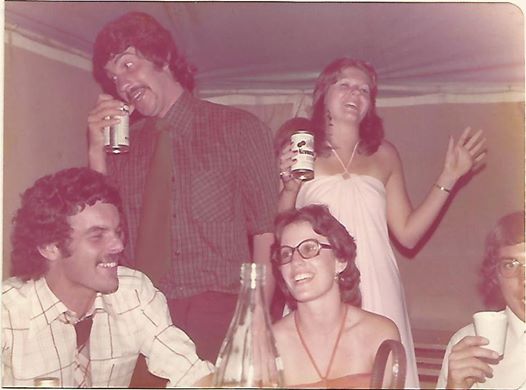
After NTC Rag Ball in 976, we left Pietermaritzburg’s notorious Hotel Insomnia and drove home in Tabs’ red Datsun fastback, famed for having being called a Ferrari by one of the automotively-challenged TC girls, and a Datsun Triple Ess Ess Ess by Geoff Leslie. We had spent a few short hours in the Hotel Insomnia after the ball was over. I seem to recall about a dozen people in a double bed.
Braithwaite was behind the wheel. He had held back slightly as he still had to drive on from Harrismith to Nelspruit where he was needed to dry-clean some Lowvelders’ underpants. Tabs was in the passenger seat, me on the back seat.
me & Liz Howe, Sheila & Hilton – Tabs in full voice with John Venning –
Under the flat raking solar panel-like back window of that red fastback was most of a case of beer, baking in the sun. After a short hung-over silence Tabs turned to me and asked “How hot are those beers?”
I said “Shall we share one and see?”
He said “Let’s open two and share them and see.”
We happened to finish the case before we got to HY. Thank goodness for Hilton’s driving! It’s a lot easier to divide by two than by three after a few ales.
Tabs & Jilly Shipman sing – Dave Simpson, Lettuce and me sit -all at a very clever stage of these academic proceedings –
In Harrismith Vrystaat in the sixties you could hear, if you listened carefully, the sound of lions roaring in the evenings and the early mornings. This is true. If you listened you’d hear the uuuuunh uuuuunh uh uh uh uh of a male lion. Here’s how that came about:
The Man
On 1st June 1955 Mr CJ (Bossie) Boshoff was appointed as parkkurator of the now well-established President Brand Park by the Harrismith Municipality. It seems to have been a happy choice, as his entertaining letter about the history of the zoo he established attests. It was written in November 2005, fifty years after he started his new job. He moved to Harrismith to take up the post, which included accommodation in the form of a house in the park he’d be in charge of. This sounds good, but the house was ‘in a state’ due to the previous tenant living in it with etlike groot honde, so the house needed major cleaning and opknap. So much so that Bossie had to stay in the Royal Hotel for a while till the house was livable.
parkkurator – curator of the HS park
etlike groot honde – a few big dogs
opknap – renovate
The Thought
According to Bossie there was a runaway fire on Municipal property in 1958, and after the municipality had been paid insurance money for the damage, Bossie laid his eyes on a pile of fire-damaged treated fence posts, now written off, and he thought: As ek van hierdie pale in in die hande kon kry dan kan ek n kampie in die park aanle waarin n paar wildsbokkies kon loop wat ‘n aantrekking vir die publiek sou wees.
Once he was given the nod by the town council, he chose an area about one hectare in size just above the Victoria lake, and put a fence round it using those burnt poles, then put a road round the fence so people would be able to see his planned wild animals from their cars once he managed to bekom some wildsbokkies.
If I can get my hands on those I could make a fenced paddock and keep a few antelope to attract the (paying) public!
The Animals
According to Bossie, his first inmate was a mak ribbok ooi – a tame mountain reedbuck ewe (‘rooiribbok’) donated by councillor Mike van Deventer. However, as human memories go, according to The Harrismith Chronicle of January 1956 the first inmate was a blesbok ram donated by Hendricus Truter of ‘Sandhurst’. So it seems Bossie’s zoo had an earlier start then he remembers! Such are fifty year old memories!
More animals were offered ‘if they could be caught’ like two fallow deer by Lieb Swiegers. ‘Mes‘ Snyman would be asked to do the catching. After that the park was given a tame aap mannetjie – a male monkey, likely a vervet.
Then the floodgates opened and all sorts of pets were donated to hierdie toevlugsoord! The first of these was a female baboon named Annemarie, so now Bossie needed better cages. Luckily, he says, the town councillor in charge of the park, Pye von During, owned a grofsmit behind the Kerkenberg kerk, and willingly welded iron cages for Bossie.
hierdie toevlugsoord – this sanctuary or refuge!
grofsmit – blacksmith; or engineering works
Bossie’s next tenant was a blesbok ram who he thought was behaving a bit oddly – nie lekker op sy pote nie. On enquiry he discovered it was onder sterk brandewyn kalmering.
Not steady on its feet – it had been given a strong brandy tranquiliser to relocate it!
Then he got a tipiese raasbek boerbok – a typical ‘loudmouth’ goat!
Next he was offered a lioness from one of the Retiefs from Bergville (hy dink dit was Thys). The asking price was fifteen pounds Sterling, and as with all finances, he would need council’s permission and a formal decision to be taken. He went instead to Soekie Helman, as he knew Soekie’s “voice was loud in the council at that time.” He’d got to know Soekie when he stayed in his hotel. Soekie’s decision: “Buy the thing and we’ll argue later.” They did. Bossie soon noticed this five month-old pet was gentle for a while and then would ‘suddenly get serious,’ so he realised a strong cage was needed fast. Two high brick walls were built at right angles, a roof on top and a semicircular front made by councillor and blacksmith Pye von During of strong iron bars was installed from the end of one wall to the other with a sliding door. Inside, a brick shelter was built in the back corner. The roof of that shelter became the lions resting and outlook spot. This was the concrete stage where the male lion we heard in our youth would lie and roar his frustration over the hills of Harrismith.
At this stage Bossie asks impishly: Sien u nou in watter rigting die onskuldige wildskampie besig is om te beweeg?
can you spot where this ‘innocent little animal enclosure’ idea is going?
Now there was a lion cage, and next thing Henrie Retief (Thys se broer) phoned from Bloemfontein to say he had bought a male lion which he was donating to what was now undeniably a zoo (not just a wildskampie) on condition that if ‘something happened to the animal one day’ he would get the pelt! The lion-lioness introduction was – according to Bossie – ‘Love at first sight’!
A lady ‘anderkant Warden’ gave them three small jackals which Bossie fetched and built an enclosure for. The increased enclosures within the overall 1ha camp now necessitated footpaths winding about between them, as most visitors were now on foot, no longer just driving around the perimeter.
Tannie Marie Rodgers donated a spoilt hans – hand-reared – duiker ram which head-butted visitors, his sharp horns sometimes hurting folks. Bossie solved this by putting .303 shell casings on his horns to blunt them!
The male lion grew up and his roars could be hear all over town, ‘to the top of 42nd Hill,’ says Bossie, and certainly at 95 Stuart Street where we lived. The lioness fell pregnant but died in childbirth. The male watched them closely as they removed her body. She was soon replaced by another from Bloem, who was placed in a separate cage for two months so they could grow accustomed to one another, but – alas! says Bossie – when they introduced them the male killed her with one bite! (this happens; and we don’t learn!) Later they got new lions: A male and two females. Bossie said they had to ‘wegmaak’ the original male – kill? sell? Did ou Henrie get his pelt? Wait – The Chronicle of December 1959 says there was talk that ‘a local farmer’ would take the lion in exchange for two blesboks which would be swopped for three lions from Bloem! How common must captive lions have been? The three new lions cost them two blesbok ewes in an exchange! These were donated by Kerneels Retief who hand-caught them himself on his farm Nagwag from his moving bakkie at 45mph to Bossie’s amazement. So, Kerneels probably took the lion, then?
More on pricing game: The zoo later got two wild dogs and a warthog from South West Africa in 1959, swopped for two mahems – crested cranes. In 1965 the Natal Parks Board donated six impala and two warthogs. I wonder which of the warthogs became ‘Justin’ the famous one the Methodist minister Justin Michell would feed and talk to on Sundays after his sermon?
In January 1964 three lion cubs were born. One was killed the same night, the others were removed and raised by Mrs JH Olivier. In 1966 the Chronicle told of two five month-old cubs for sale. These cubs had ‘been involved in a hectic incident’ a while before when two African attendants were tasked to remove them from their mother and she attacked them! Workman’s Compensation, anyone? And was the story suppressed when it happened?
Two porcupines arrived at the zoo, and soon made a nuisance of themselves, chewing the fence posts. One night Bossie’s assistant Machiel Eksteen saw one in the road outside the zoo, caught it with a hessian sack and put it back in the dark enclosure. Only to find three porcupines there in the morning!
Mrs Lindstrom (‘Redge se vrou‘) promised Bossie a python from Pongola and duly delivered it in a hessian sack, saying it was 3m long. Bossie put it in the storeroom on top of the ‘mieliedrom‘. The next morning Tobie (‘the feeder’) said the sack was empty! Of course Tobie was told he was talking nonsense, but he wasn’t. A big search was instigated, the Voortrekkers were even called in but the snake ‘is missing to this day.’ Bossie says, ‘Just as well, as I don’t think he’d have adapted to Harrismith’s cold!’ Um, that doesn’t make things better, Bossie! Another escapee was a civet cat, one of a pair from Ladysmith. But it was found.
Then came their ‘biggest challenge’: A lady phoned. She was oom Kaalkop vd Merwe’s skoondogter (daughter-in-law). Kaalkop was the MP for Heilbron. Did Bossie want two Russian brown bears? They were her children’s pets but had grown too big and they were going for thirty pounds Sterling the pair. The ever-resourceful Bossie got to work: He went to business owners in town and said ‘You owe me one pound.’ Bossie says he badgered ‘Jan van Sandwyk of Harrismith Motors, Rheine Lawrence of the chemist, Redge Lindstrom of the tyres, Jannie du Plessis of the tractors, etc etc’! and by that same afternoon he had his 30 pounds and bought the bears, which, he says, made Bloemfontein zoo, ‘yellow with jealousy!’ Here, he says was a postage stamp-sized zoo in a small dorp that was now known nationwide! Again with the willing help of Pye von during, he made the cage of iron, with a concrete waterhole and some tree stumps, just what zoos of the time thought bears needed.
In 1963 a concerned resident wrote to the Chronicle about the poor condition of some of the animals. Mayor Boet Human and councillor Pye von During were interviewed and basically said ‘all is well.’
Bird Aviary
A large aviary was built. People donated peacocks, guineafowl, fantail pigeons, a tame crow, ‘mahem’ crowned cranes and an ostrich. And tortoises. It became ‘a certain status’ to donate an animal to the zoo, says Bossie – and he ‘appreciated that enormously.’
How to Feed this Menagerie!?
Suddenly food was an issue! How to feed the growing menagerie? They started charging adults a sixpenny entrance fee. Kids were free but had to be accompanied by an adult. Most of the meat for the lions was supplied by generous farmers. He mentions oom Frikkie (probably Varkie?) Badenhorst whose dairy had no use for bull calves and donated these. Mostly it was on a ‘yours if you fetch it’ basis, so Bossie would have to travel all over the district to keep his lions in meat. Farmers would donate their horses once they got too old to ride. The fact that many of these had names, and that they were still ‘on the hoof’ and looking at him when Bossie arrived didn’t make matters any easier for him.
One such was Ou Klinker, a Clydesdale used in the town’s forestry department. Piet Rodgers, the forester, told Bossie he could fetch Ou Klinker – but only when Piet wasn’t there! Bossie says usually when the shot was fired the horse’s legs would just fold and they would drop on the spot, but not old Klinker! When the shot went off he rose ‘like a loaf of bread and fell as stiff as a pole, says Bossie. And then he says ‘dit was baie vleis!’
that Clydesdale was a lot of meat!
The local police also phoned whenever they came across road kill, and the health inspector Fritz Doman would tell him whenever he condemned a pig with measles at the abbatoir. One guy even offered a dog on a chain. But surely Bossie didn’t . . Oh, yes he did! But the lions ‘het nie baie van die vleis gehou nie,’ says Bossie. They did like the pork, however.
didn’t much like the dog meat
Meat Storage
To keep surplus meat cool, Bossie built an old-time ‘evaporation fridge’ of bricks and clinker in chicken mesh, kept wet so the evaporation cooled the interior. It worked ‘uitstekend’ (very well).
The Wheels of Change
Bossie took a job in East London, and without its champion this wonderful eccentric project was in a precarious position. A new town clerk De la Rey arrived and decided Harrismith was too small ‘n dorpie to afford a zoo (wasn’t that exactly the fun thing?) – he must have been a beancounter! According to Bossie the animals were ‘sold to circuses, given away – and Harrismith is the poorer for it.’
Most of this source material comes from Harrismith historian Biebie de Vos. Thank you Biebie! Without you, Harrismith would have been the poorer for it! Much would have been lost if Biebie hadnt saved it.
More Research Needed
But here we need to find out what really happened with the sale? Can Mariette Mandy help? Did the Chronicle report on this? Where’s de la Rey? Where did Patrick Shannon, who ended up with the cheetah, fit into the tale of the Harrismith zoo? I heard he bought it lock, stock n barrel and then sold what he could, kept what he wanted and turned the rest loose! I know that I saw Justin the warthog floating pote in die lug * all bloated up, stone dead and smelly in the Wilge river when I was out canoeing one afternoon (1970 or 1971 if my memory is right, so we can check that timing).
legs sticking up vertically out of the water as I paddled past
~~oo0oo~~
I’d love to get some pics of the zoo from a distance or from outside, plus any of the animals. Who knows the general layout? I can draw a rough plan as I know where warthog corner was, where the lion cage was, and where the entrance gate was; plus the aviaries (and am I right there were vultures?). But other than that I’m a bit vague. Someone will know!
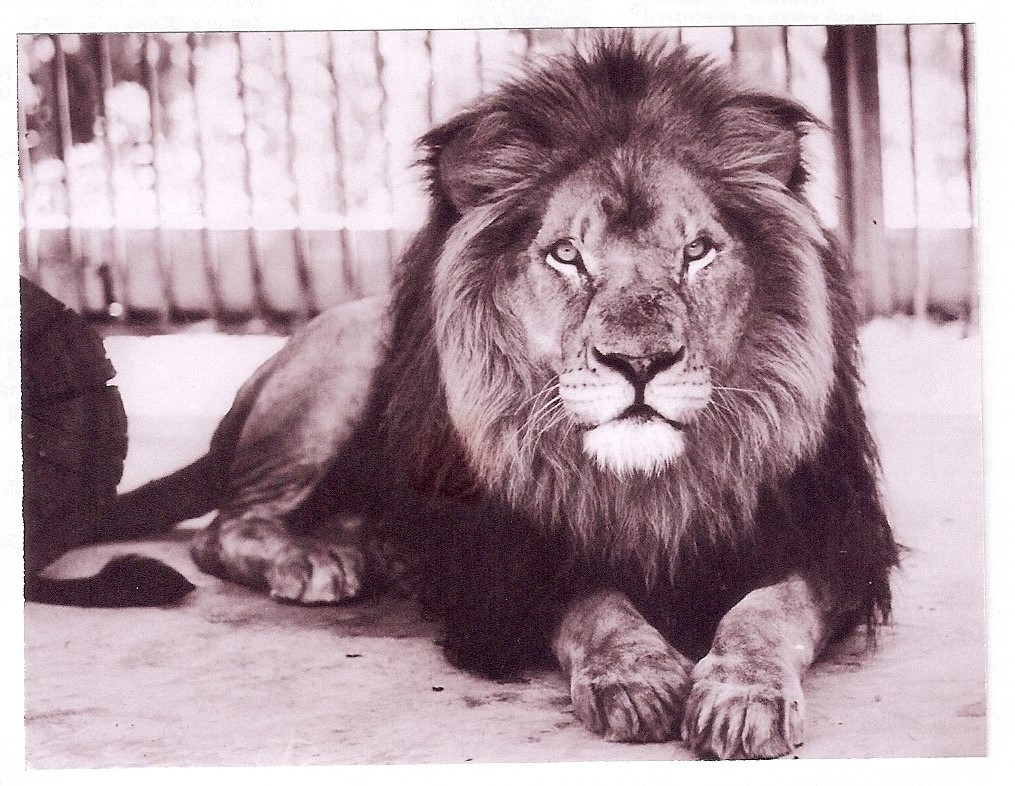
Biebie’s pic of our Harrismith lion. What a magnificent specimen!
~~oo0oo~~
Footnote: Mom remembers a Mr Patterson running the zoo. His one daughter Mary married tall Jack Hunt; the Hunts ran the dry cleaners and were Steve and Jenny de Villiers’ loving grandparents. Another daughter Margaret, married Frank Mandy, Syd’s father.















 Vrystaat Confessions