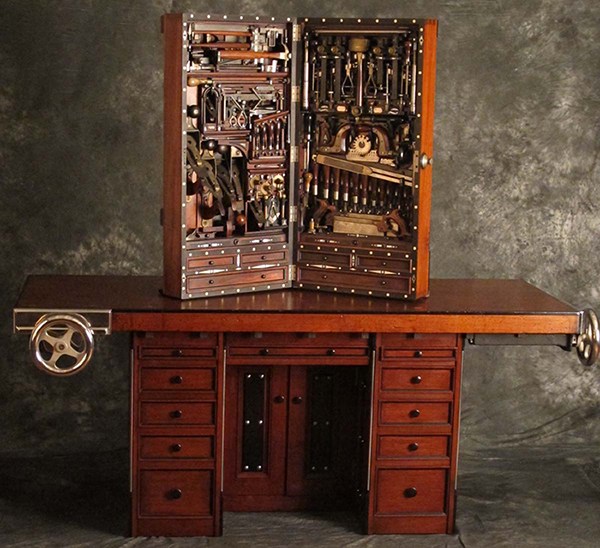
The Studley Tool Chest: Made out of mahogany, rosewood, walnut, ebony, and mother of pearl.
Henry O. Studley (1838–1925) was a carpenter, organ and piano maker, who worked for the Smith Organ Co. and later for the Poole Piano Company of Quincy, Massachusetts. He is best known for creating the famous Studley Tool Chest, a wall hanging tool chest that cunningly holds 218 tools in a space that takes up about a metre by half a metre of wall space when closed.
~~~~~ooo000ooo~~~~~
I wrote about this in Feb 2014. I got responses:
Steve Reed wrote: In his entire married life, Henry Studley only came inside the house at mealtimes and to sleep. Otherwise he was out in the shed. Must have had a bag of a wife.
~~~~~ooo000ooo~~~~~
Me: Or just his pri-horities right ?
Talking about living in the shed: Did I tell you my ole man bought himself a new lathe? Brand-new wood lathe with a 1m gap between the headstock and the tailstock. The headstock can swivel so he can turn bigger bowls – and turn them sitting down. Says he can’t die now for at least three years to justify the purchase and to finish the chisel handles and tables he has in mind . . . ninety one and counting . . .
Went to visit the other day. Their tenants have left and I found the ole man in the second house on top of a stepladder, muttering that they’d left their curtains up. Bitched good-humouredly when I took over and removed the rest of the curtains: ‘What do you think? I’m too old to climb a stepladder?’ Uh, yes, Dad.
Now he wants to buy a new kombi – with the old lady’s money! Goat . . .
~~~~~ooo000ooo~~~~~
Peter Brauer wrote: I’m with your old man on this one. Want a job done properly… do it yourself
~~~~~ooo000ooo~~~~~
Me: Want a job done properly, procrastinate till it no longer needs doing . . most peaceful*, cost-effective method I’ve found.
*under the new regime. Under the old regime this method was NOT peaceful . .
~~~~~ooo000ooo~~~~~
Brauer: I don’t know what procrastinate means, but stuff it, I’ll find out tomorrow.
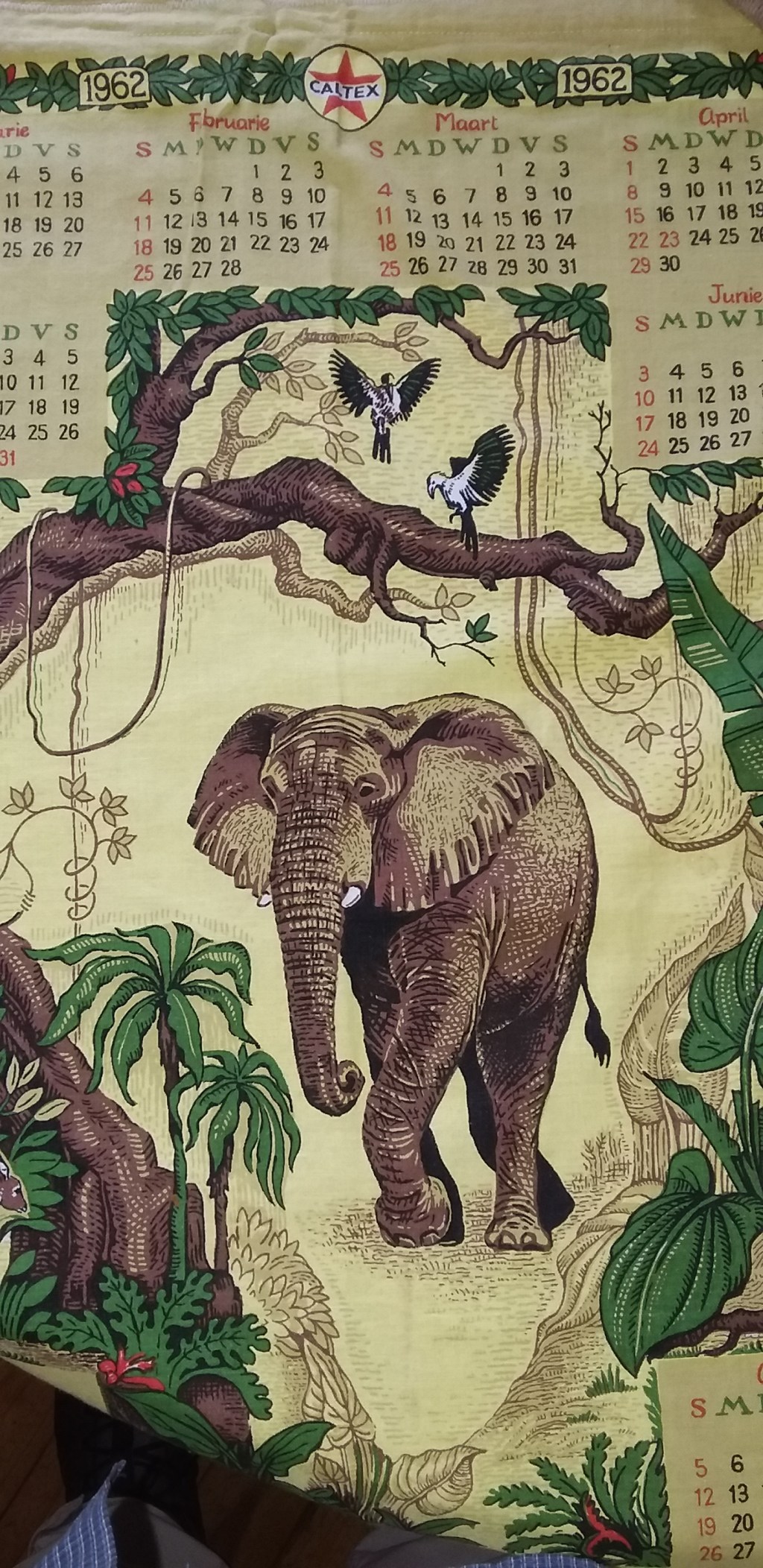
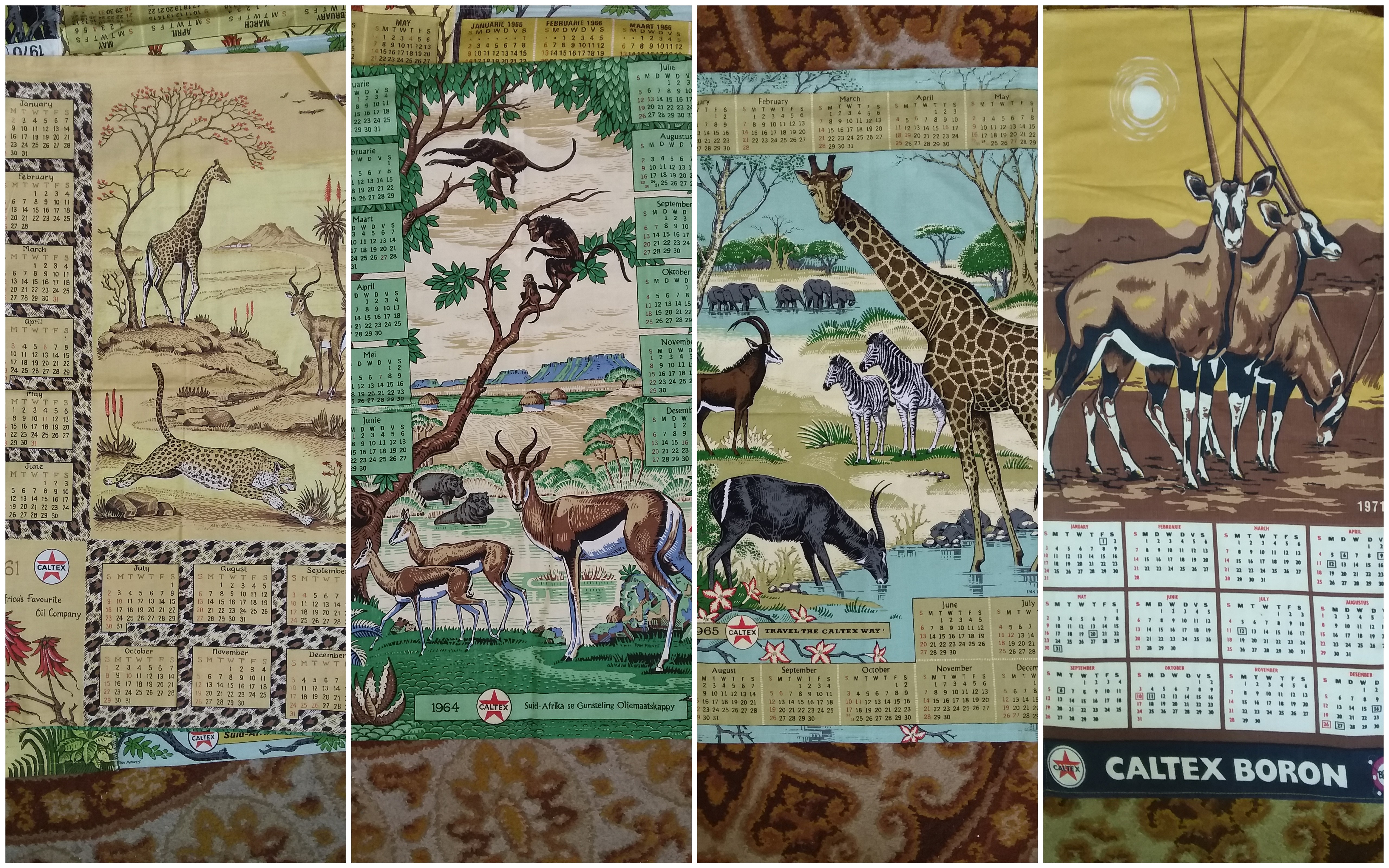
Annie had a Caltex garage; Dad worked for Annie; Louis Schoeman traveled for Caltex. Between 1962 and 1971 Caltex gave cloth wildlife calenders as their gift to their filling station owners.
Dad (now 96) says Louis would ‘forget’ to hand them out and he would insist on seeing what was in his boot. And there, ‘along with the sheep shit’ were the calenders! An inveterate collector, Dad would get ‘his’ share! Right! That’s why he has quite a few duplicates!
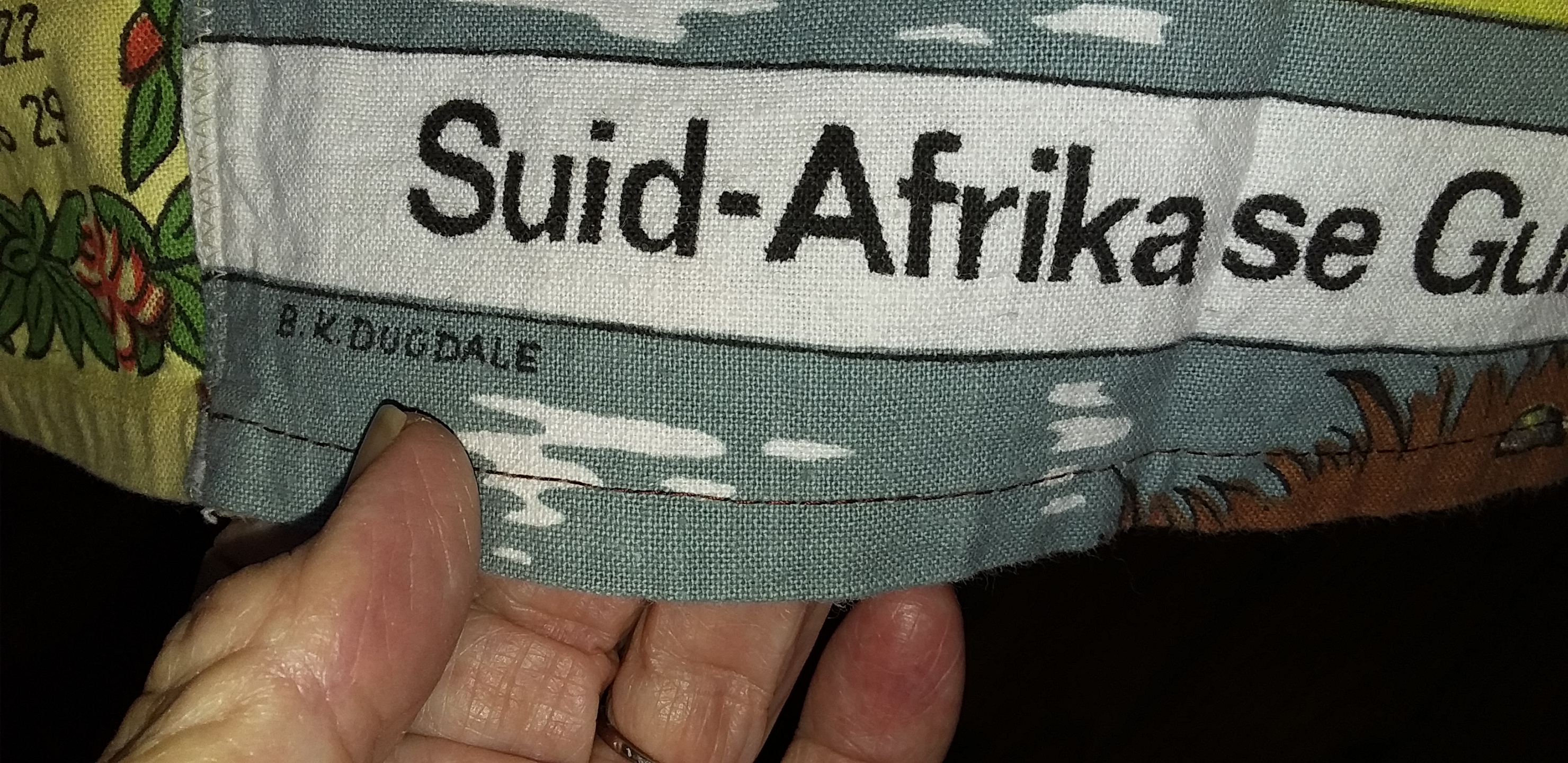
– I could find nothing on the internet about BK Dugdale – Mom’s hand here in pic –
Some have been sewn together to make table cloths. He still has plans for them, can’t get rid of them. He knows someone who will make them into cushion covers. Then he’ll get some cushions . .
~~~oo0oo~~~
He’s had it done: The calendars are now table cloths and cushion covers and he’s very proud of them. Can’t understand why his eldest daughter didn’t rave about them! She doesn’t like them, I dunno why; I like them. Nice and colourful.
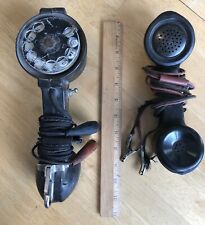
Dad was a Post Office technician. Back before we were born. He applied for telephones, which was more technical, but was given electrician. He did his apprenticeship ca.1938 and was soon put on telephones, given a truck and sent off to Ixopo where he was assigned a ‘line boy.’ Actually an adult to do lots of the hard work for you. His lineman’s name in Ixopo was Freddie.
– here’s his truck, his dog and his shadow –– testing, testing – an American lineman– testing, testing, a South African lineman from HeritagePortal.co.za –
Himeville fell within his area and he got to know the lady in charge of the General Post Office there – Miss Viven Wise. Miss Viven D Wise, actually, which got the young techies snorting as “VD” was rude. She spoke of the Sani Pass up into Basutoland and how beautiful and rugged it was, so when out that way one day Dad decided to see if he could get there. He soon came across a stream he had to ford, so out jumped Freddie to pack stones in the stream so the truck could get across. Soon another stream and the same procedure. After the fourth stream he decided this is going to take too long and turned back.
He also tells of putting in new telephone lines. From one farm to the next the line would go as the crow flies, over hills and through valleys. They’d be allocated long gum poles treated with creosote and they’d take them as close as they could in the truck, but to some places they had to be carried on their shoulders. Heavy and the creosote burning their shoulders, they’d lug them over the veld, dig the holes and plant them. I’m guessing Freddie did his fair share of the heavy lifting.
– linesman handsets –
In 1973 I had another Dad, also a lineman. Rotarian Don Lehnertz worked for the electrical utility in Apache Oklahoma. Wish I’d noted which company. He and Jackie very kindly hosted me as an exchange student for three months of that year.
Interesting that the famous song Wichita Lineman was written about a lineman up a pole in Washita County Oklahoma just west of my town Apache in Caddo County: (wikipedia) Webb’s inspiration for the lyric came while driving through rural southwestern Oklahoma. At that time, many telephone companies were county-owned utilities, and their linemen were county employees. Heading westward on a straight road into the setting sun, Webb drove past a seemingly endless line of telephone poles, each looking exactly the same as the last. Then he noticed, in the distance, the silhouette of a solitary lineman atop a pole. He described it as “the picture of loneliness.”
Back in Harrismith, before too long, Dad got rescued from the Post Office by his beloved Mother-in-Law. Who gave him a job.
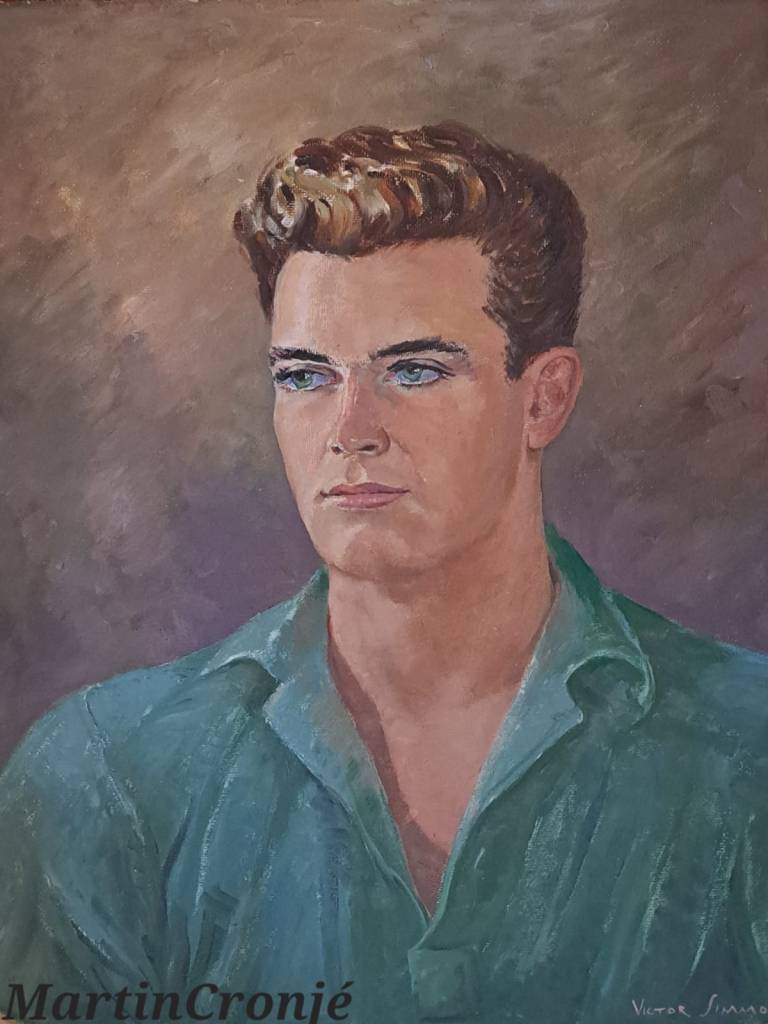
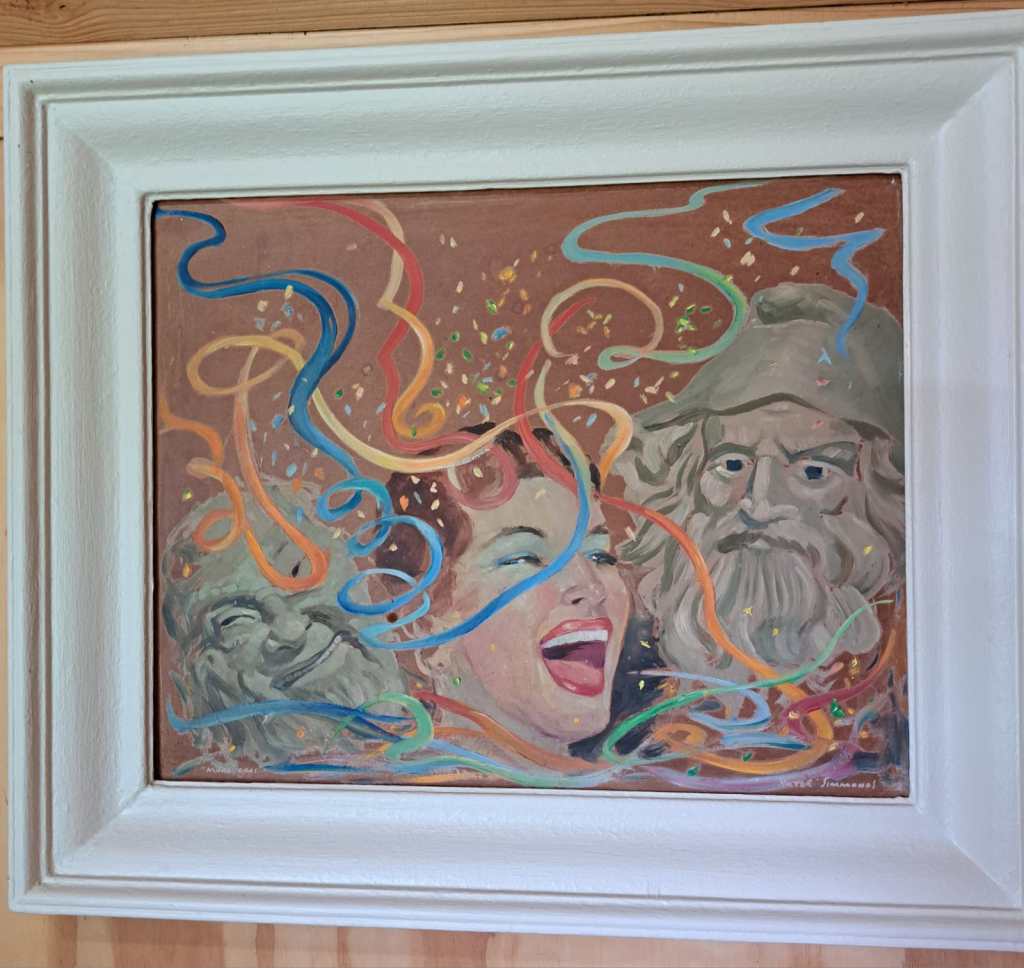
Dad: “Victor Simmonds was a lovely chap and a very good artist. He was a little man, grey, a lot older than me. What? How old? Well, I was probably 35 then and he was grey. He was probably 50. He lodged with Ruth Wright (Ruth Dominy by then) on the plot next door to ours, Glen Khyber. I doubt if he paid them any rent, they were probably just helping him out. He moved to the hotel in Royal Natal National Park where they allowed him to sell his art to the guests and that probably paid his rent.
“He was a hopeless alcoholic, unfortunately. He used to come to me begging for a bottle of brandy late at night, his clothes torn from coming straight across to Birdhaven from Glen Khyber, through the barbed wire fences. (Mom and Dad owned a bottle store, liquor store, in town) I said ‘Fuck off, Victor, I won’t do that to you,’ and sent him away. I wish I had bought one of his paintings. Sheila found these four paintings he gave me for nothing. He said he did these as a young student. As I took them he said, ‘Wait, let me sign them for you.’”
– maybe a self portrait? – – nude with amphora? – – semi-nude with two amphorae? – – maybe the Kak Spruit at or near Glen Khyber? – possibly –
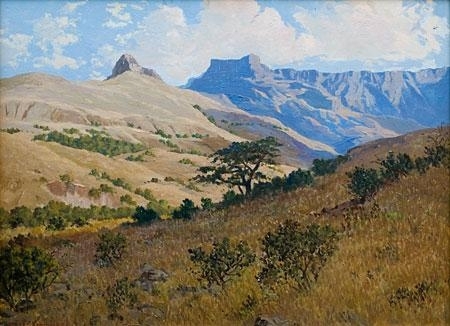
So I went looking and found a lot of his work available on the internet. Once again Dad’s memory proved sound. Victor was born in 1909, thus thirteen years older than Dad:
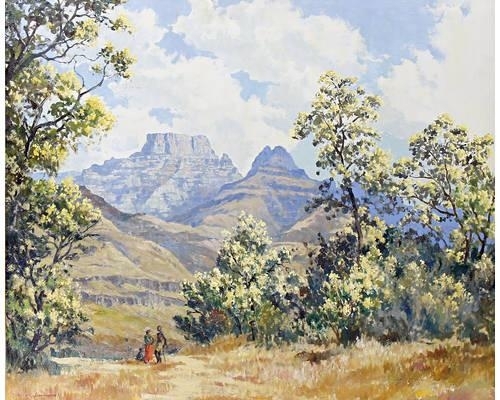
Victor Simmonds’ work has been offered at auction multiple times, with realized prices ranging from $126 to $256, depending on the size and medium of the artwork. Since 2012 the record price for this artist at auction is $256 for South African landscape with two women carrying wood, sold at Bonhams Oxford in 2012. Also see here and here and here
– South African Landscape With Two Women Carrying Wood –– shrubs beside a cascading stream –
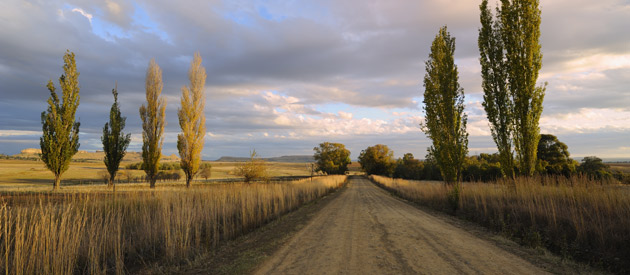
I knew this scene! I recognised it immediately! To me this looks like the stream above the Mahai campsite in Royal Natal National Park – So I went looking and at lovecamping.co.za I found this:
– spot on!! – an image locked in my brain for maybe fifty years! –– sunset, poplar trees, a river – the Wilge near Walton farm? – (or – see below . . )
A number of his paintings are available for sale. I’d love to see his ‘The Gorge, Royal Natal National Park, Showing the Inner Buttress and Devils Tooth’ but I’d have to subscribe for one day at 30 euros! That one was apparently painted in 1980, so he kept going for at least 23 years after he stayed in our neck of the woods. That would have made Victor around 70 and his liver a resilient organ.
– more Victor Simmonds Drakensberg scenes – ca.1946 – click to enlarge –
~~oo0oo~~
Now its 2024 and look who has popped up onto my vrystaat confessions: All my life I’d heard Mom speak of Corry Cronje and Len Cronje, and Corry’s daughter Liz found my scribblings. Or rather, Liz wrote a delightful nostalgic personal memoir about the Cronjes of Witsieshoek, (post it online Liz and I’ll link to it!). Anthony Maeder sent it to me and put me in touch with her. We got talking and got onto the topic of this talented artist who spent time on a neighbouring plot to the one we grew up on, and on a neighbouring farm to the one Liz grew up on.
Brothers Corry and Len lived in Witsieshoek on neighbouring farms, Patricksdale and Mountainview respectively. Victor Simmonds stayed with Len and his wife Lettie on Mountainview for quite a while and painted on both farms and the surrounding area. Liz Finnie Cronje is Corry’s daughter and when I told Mom she immediately said, “Oh Corry’s wife Rosalie was a big friend of Annie’s (her mom). They would have long chats at Annie’s Caltex garage when the Cronje’s came to town.”
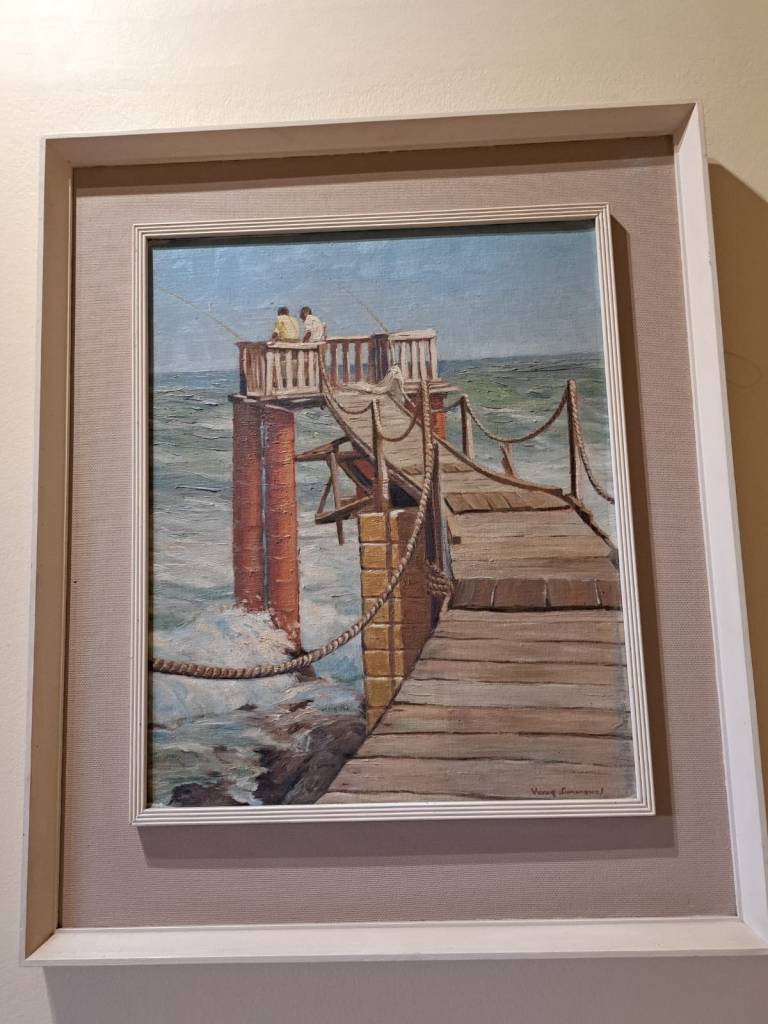
Len and Lettie’s daughter Josie Cronje Batchelor has a number of Victor Simmonds’ paintings and she has OK’d my posting them here. Wonderful! One more place where his talent can be appreciated.
– View from Mountainview across Patricksdale to the ‘Berg –
Click to enlarge – Left: Pier – Right: The poplars in Autumn –
This next one has to be on its own. Here’s why: Josie Bachelor, nee Cronje of Mountainview wrote: This is my favourite. The Gold Lamé in the background was my mom’s evening dress. The vase and porcelain horse also Mom’s. Mom did the arrangement. The table belonged to Vic.
Knowing a picture’s background and place and story makes it so much more interesting and valuable, doesn’t it?
~~oo0oo~~
Two more! With a note from Liz: I think I missed out on two more paintings. Both on Mountainview of the original Randall Bros. store in Witzieshoek taken over by Arthur Gray late 19th century I think. The chief (forget his name – ed. maybe Ntsane 1898 – 1918) asked if Arthur could open a shop in Witzieshoek as his people had difficulty getting to the shop during very rainy weather owing to the full Elands River. When my grandparents, Kerneels and Edie Cronje returned after the Boer War they renovated the shop and turned it into a cottage where all but the eldest Cronje (Andries) was born beginning about 1906 when my Dad, Corry was born.
One of Annie’s forecourt attendants at the Central Service Station on the corner of Warden street and Southey street – the ‘Caltex garage’ as we knew it – was called Johannes. Because he looked so different from the other petrol attendants, we learnt his surname. He was Johannes Culling.
Today I found out a bit more:
The Boer War started in 1899 and ended in 1902, but a lot of British soldiers stayed on in the garrison stationed at Harrismith until 1913, when they finally left. One of these was Sergeant Culling, stationed on Kings Hill, east of town. He, in fact stayed on even longer, as he married a local lady and went to live with her in the ‘location’ as the townships under apartheid were known. Our location was called ‘Skoonplaas’ (but see below), when it was south of Queens Hill on the far (left) bank of the Wilge river.
Dad knows of three children: Johannes, Henry and a daughter. They could not have had an easy life in the Free State of yore and Dad tells of problems: ‘run-ins with the police due to drinking and fighting.’
That’s all I know . . .
Now there’s more! A visit to this post by someone with way more knowledge than me. Rev. Mbuyisazwe Tshabalala commented in November 2024:
“The township was called Skomplaas, not Skoonplaas. It is a combination of two Afrikaans words, “kom” and “plaas”. This is where people were dumped when their ancestral land became farms (plase) They came from the farms Hulle KOM van die PLAAS. I SPENT THE FIRST 21 years of my life in this township. The Cullings are now our In-laws. My brother’s son is married to one of the great grand children of Sgt CULLING.”
I replied: Hi Rev Tshabalala
Thank you for visiting my tiny little post about the Cullings. So much history gets lost unless we write down what we know.
I have added your comment to the post to clarify things.
Kind regards
Peter Swanepoel (I was in Harrismith from 1955 to 1972; My Mom was there from 1928 to about 1999; My Gran Annie Bland of the Central Service Station from 1893 to 1983).
My father used to buy his suits at Du Toit’s. I bought one there a few years ago.
We are also related to the Waterman’s. I notice that there were two British soldiers named Waterman who were garrisoned at Kings Hill during the Anglo-Boer War. One of them married an African woman. My father’s younger brother married his granddaughter, Miss Goqo.
~~oo0oo~~
Fascinating, all this hidden history, buried in people’s brains and often not seeing the light of day.
Later the township was moved – further from town and out of sight, as was usually done under apartheid – up to the top of 42nd Hill to the west of Harrismith, where it was known as Phomolong.
Koos Mof van Wyk was a bachelor who lived with his Ma out on the Kestell road. One evening he drove home and a Joburg driver drove right up his bum as he slowed suddenly on the main road in order to turn in at his gate.
The Joburg oke was angry, ‘Waddefok maak jy dat jy sommer so skielik stilhou innie mirrel vannie pad!?’
Koos Mof was astounded. Waddefok maak JY!? he yelled.
Almal weet dis my hek hierie en ek draai altyd hier in. Ek is Koos Mof en ek BLY HIER!
~~~~~ooo000ooo~~~~~
Joburg driver: How can you just stop in the middle of the highway!?
Koos Mof: What do you mean!? Everyone knows this is my gate and I always turn in here! I LIVE HERE!
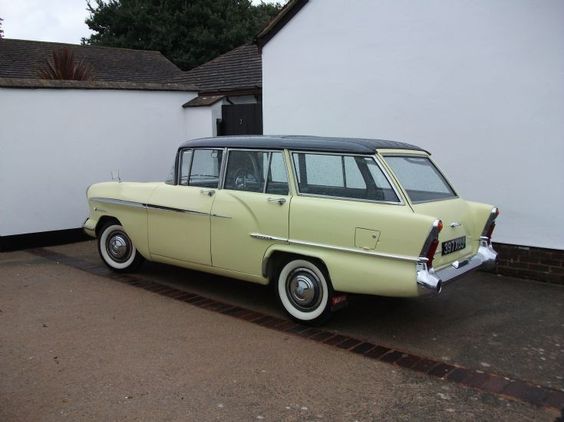
Sometime back in the fifties Mom’s uncle and the family lawyer Bunty Bland needed to go up to Rhodesia – ‘up north’ – to sort out the sale of his sister’s property. His Rhodesian brother-in-law drove down to Harrismith to fetch him. As ever, the finer details of my story should be checked out . . . pinch of salt. The car is probably right, the country – now Zimbabwe – is certainly right, and two of the people – Dad and Bunty – are right, that’s all I know. At first Dad said they drove up in Bunty’s Rover, but I couldn’t find a Rover station wagon. Seems they left ‘that sort of thing’ to Land Rover. I found this Vauxhall Victor station wagon and then Dad remembered it was the bro-in-law’s car and yes, it was a Vauxhall! Memories! Dodgy things.
The reason they took young Pieter Swanepoel, husband of favourite niece Mary, along was to share the driving. He says he ended up driving all the way there and back.
With him he had his new Eumig 8mm cine camera! He took footage of the ruins of the magnificent Great Zimbabwe. Bunty features in his trademark ‘fairisle’ sleeveless jersey . .
Other footage featured the Vauxhall, Bunty again and some fountains . .
Back in 1963 we joined the du Plessis on a one-week beach and fishing holiday on the Natal north coast – Chaka’s Rock! They were beach regulars, this was one of our two beach holidays that I can remember. (flash: there were three!). Louis Brocket wrote in to remind us that, as Lynn’s boyfriend, he was also there for his first “vakansie-by-die-see“.
Sheila writes: “Found a postcard which Mary Methodist sent to her Mom Annie Bland (1½ cent stamp – remember the brown Afrikaner bull?). Mary wrote ‘We’re enjoying the swimming immensely. Coughs no worse in spite of it. We’re sleeping well and eating very well. The coast is beautiful. This is a picture of the pool where we swim.’ I think the three little Swanies all had whooping cough. Must have been fun for the du Plessis family who shared our holiday!”
It was amazing! The cottage on a hill above the beach, the rocks and seaside cliffs, narrow walkways along the cliffs that the waves would drench at high tide; magic swimming pools set in the rocks. The men were there to fish:
We baljaar’d on the beach and sometimes even ventured into the shallows – just up to safe vrystaat depth. A swimmer I was not, and I still vividly remember a near-death experience I had in the rock pool: a near-metre-high wave knocked me out of Mom’s arms and I was washed away out of her safe grasp! I must have been torn away by up to half a metre from her outstretched hands; little asthmatic me on my own in the vast Indian Ocean for what must have been a long one and a half seconds, four long metres away from dry land! Traumatised. To this day I am wary of the big-dam-that-you-can’t-see-the-other-side-of, and when I have to navigate across any stretches of salty water I use a minimum of a Boeing 707, but preferably a 747.
Well, after all! This was the most threatening Free State water I was used to braving before I met the Indian Ocean: Oh, and also the horse trough.
– and even then I’d lift my broek just in case –
The view from the cottage looking down the asthmatic flight of stairs:
In this next 8mm cine footage, you can see the violent waves inside the rock pools that threatened my frail existence:
vakansie by die see – beach or seaside holiday for naive inland creatures
baljaar – frolic
safe vrystaat depth – about ankle deep; not adult ankle. My ankle
postscript: I tried to keep up the luxury cottage theme but Barbara talked about the big spiders on the walls and yesterday even Dad, who was talking about Joe Geyser, mentioned ‘that ramshackle cottage we stayed in at Chaka’s Rock.’
Dad was saying Joe hardly ever caught a fish. He would be so busy with his pipe, relighting it, refilling it, winding the reel with one hand while fiddling with his pipe with the other. My theory is the fish could smell the tobacco and turned their nose up at his bait. Dad reckons tobacco was never a health hazard to old Joe. Although he was never without his pipe, it was mainly preparation and cleaning, and the amount of actual puffing he did was minimal.
Once he caught a wahoo and brought it back to Harrismith. Griet took one look at it as he walked into her kitchen and bade him sally forth. Some wives had agency. So Joe brought it to Dad and they cut it up and cooked it in our kitchen.
~~oo0oo~~
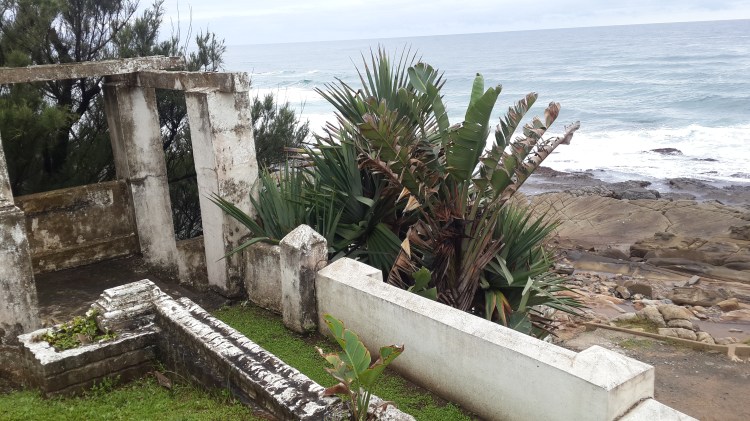
I went back in 2016 and the beach and rocks and the pools still look familiar.
But don’t look back! The green hillslopes have been concreted. When we humans see beautiful sub-tropical coastal forest we say, ‘Stunning! Let’s pour concrete on it!’
Dad remembers the gymkhanas he took part in and so enjoyed in the late 1930’s and mid-to-late 1940’s.
They were held in Harrismith, Eeram, Verkykerskop, Mont Pelaan and Aberfeldy; and on the farms Appin near Swinburne, Primrose near van Reenen, and Maraishoek.
The entry fee was one pound per event – and he remembers prize money being less than the entry fee!
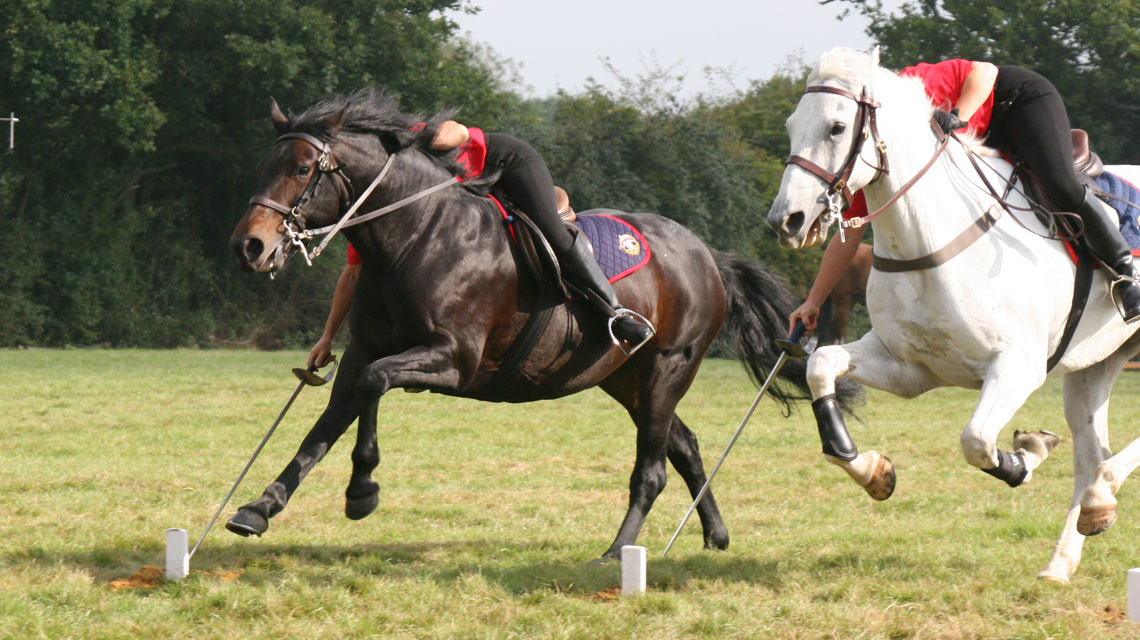
Events included Tent pegging; Sword and ring; Sword; Lance & ring; Potato & bucket.
Races were the bending race, we’ll need to ask him what that was; and the owners race, where the owner him or herself had to ride, no hiring a jockey!
Regular participants he recalls are Manie Parkhurst Wessels; Bertie van Niekerk; Kerneels Retief; Richard Goble; John Goble; Kehlaan Odendaal; his son Adriaan and his daughter Laura; Laurie Campher; Hans Spies and his kids Hansie, Pieter and Anna (Anna later married Jannie Campher, who helped Frank Bland with his farming for a while before going on to become a very successful farmer on his own account).
Dad says he was the only non-farmer riding! Kerneels was usually his partner.
Tent pegging ** these are all internet pics ** If anyone has some real Harrismith district gymkhana pics I’d sure love to display them – with full acknowledgment of course.
~~~oo0oo~~~
Ah, trust Leon Strachan, Harrismith’s Helpful Historian to have something – and its a good ‘un:
– SA Champions from Harrismith – photo from Leon Strachan –
Overflowing ashtrays. That’s one of my clearest memories of the old Moth Hall down near the railroad track, and I was pleased when Etienne Joubert also mentioned them; proving once again that some of my memories are real. Even if some feel surreal! Ja, the smell of old ashtrays and stale beer in the morning… Us kids roped in to clear up the mess after the oldies night of revelry. We loved it. We looked. We learned.
We always called it The Moth Hall, and for a while it was where Dad was probably drinking. But it was more correctly called Platberg Shellhole of the M.O.T.Hs – The Memorable Order of Tin Hats. And there was an older shellhole before that one – an older ‘Moth Hall’. It was down near the railway line; down near the Royal Hotel.
This was where old servicemen would lie to each other and themselves in song:
“Old Soldiers Never Die;
Never Die, Never Die;
Old Soldiers Never Die;
They Just Fade Away.”
Back then they were all survivors of WW1 and WW2. Only later did they take in ever-more members from ever-more wars. And there’s an endless supply of those; the armaments industry sees to that.
The things I remember about the old shellhole was playing in the dark next to and behind the building – big adventure; And seeing 16mm movies, with big reels whirring in the dark; some were sponsored by Caltex and other companies; I remember Hatari! about yanks in darkest Africa, catching animals for zoos; It starred John Wayne, but who was he to us, back then?
. . and Northern Safari, about a 4X4 safari in the Australian outback with a very annoying theme song “We’re Going NORTH on a Northern Safari! We’re Going NORTH on a Northern Safari! We’re Going NORTH on a Northern Safari!” ad nauseum. We loved it!
What the folks would remember, if the truth be told, would be booze and sing-alongs and booze and skits and booze and plays; these were the order of the day. * click on the pic * if you want to read some names.
Seated on the left next to Mary Swanepoel and Trudi Else in full voice, is Harold Taylor, veteran of WW1. Under those voluminous trousers is one wooden leg. The other is buried at Delville Wood. He would take his turn standing next to the piano singing:
Mary & Trudy
Etienne Joubert remembers:
The old MOTH hall was not opposite the Royal Hotel but in the vicinity. In fact it was next to Llewellyn & Eugene Georgiou’s home. It was near the railway line below the G’s house.
I remember Ray Taylor who had some shrapnel in his head, not Harold with a wooden leg; also Uncle Jack Hunt; Arthur Gray & of course your folks. I also remember playing in the dark outside. I remember my first sip of beer which I did not like; but I overcame this in years to come to absolutely love it!
I remember the song A Long Way To Tipperary; The piano was very rickety, as was the wooden floor, which squeaked with the slightest step. On the walls were very big portraits of Winston Churchill & Jan Smuts; Dan Pienaar was also there, but smaller; and a pin-up of Jayne Mansfield. This pin up made it to the “new” Moth Hall.
One thing I did not like was helping my Old Man clean the Shellhole on a Saturday morning; the smell of stale beer & cigarette smoke remains very vivid in my memory.
– royalty-free pic dreamstime –
=======ooo000ooo=======
Still nostalgic?
and here’s Vera Lynn, 101 yrs old and still going (Nov 2018). In 2009, at the age of 92, Lynn became the oldest living artist to make it to number 1 in the British album chart.
The ole man acting Paganini:
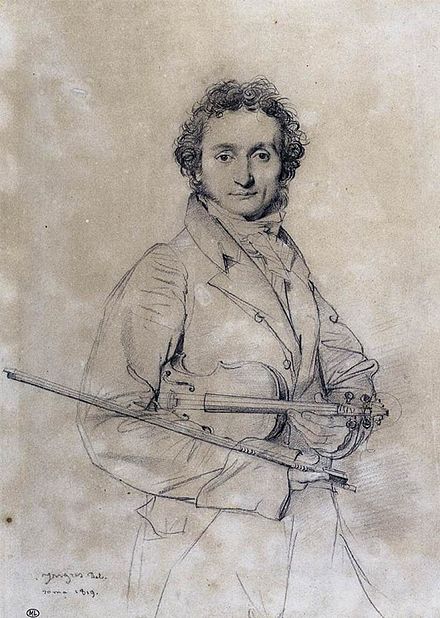
The real Niccolo Paganini – and probly why the ole man wanted to be him:
When he was eighteen the young virtuoso escaped his father’s control, following his elder brother to the Tuscan city of Lucca. “Freed from parental control, Paganini embarked on a life of famous excess. As he later put it, ‘When at last I was my own master I drew in the pleasures of life in deep draughts.’ He would spend the next twenty-seven years in Italy, filling his life with music, love affairs, and gambling, interrupted by long periods of utter exhaustion.”


















 Vrystaat Confessions