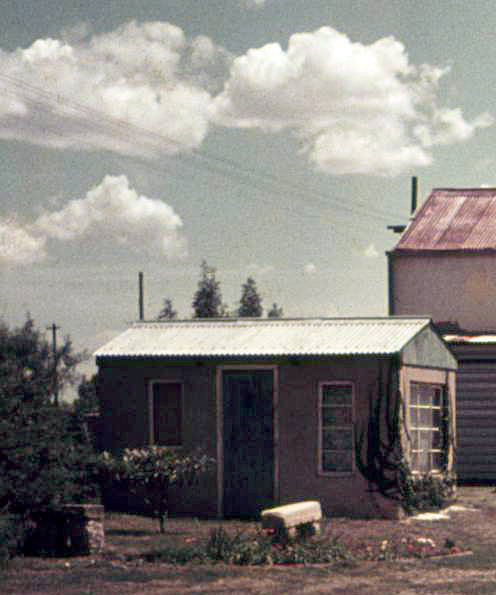
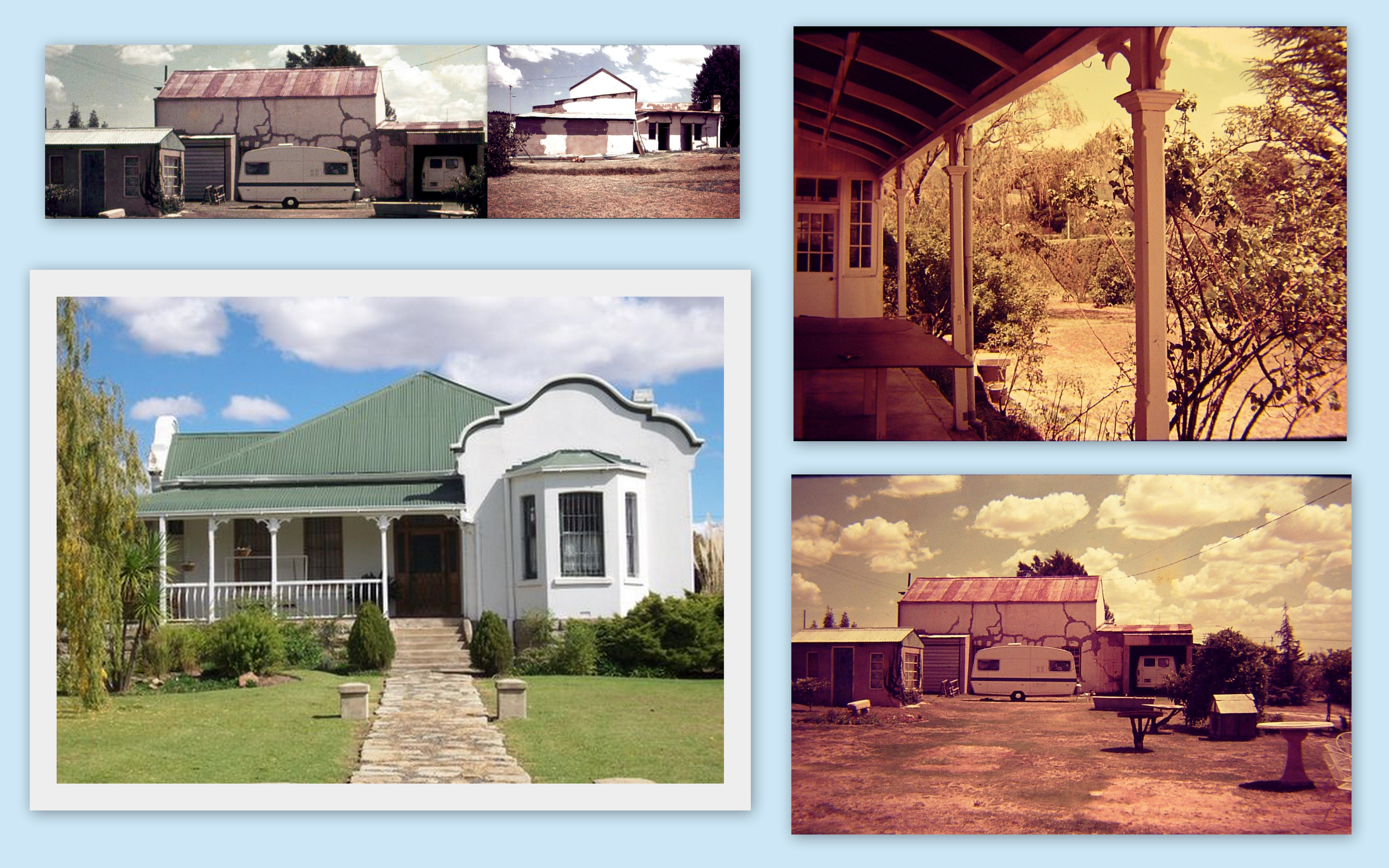
95 Stuart Street was home from 1961 to 1973. To learn more about Stuart Street as a street, go to deoudehuizeyard! where Sandra has done a great job using old and new images of the long east-west street we grew up in.
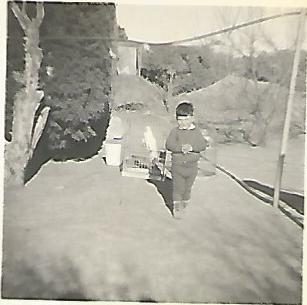
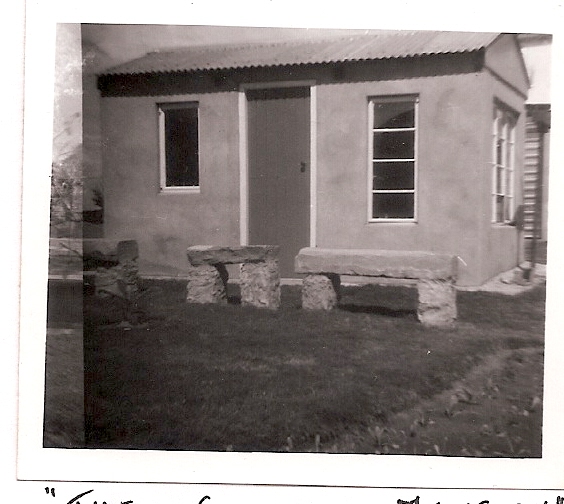
– Mom with Barbara. Koos in rugby kit – probably 1967 –– the country mansion and stonehenge –
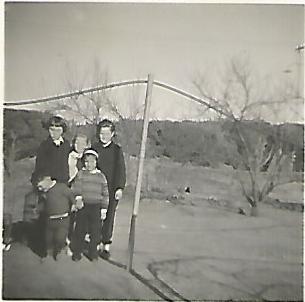
Some stiff poses in the garden in 1970 with Jock the Staffie:
Inside, in the dining room and the lounge:
Twelve years at 95 Stuart Street. Funny how that felt like forever! Ah youth!
~~~oo0oo~~~
Married, we stayed in our first home for around fifteen years, 7 River Drive Westville. From early-1989 to Dec-2003. That time appeared to go much faster!
. . and have now been in our second home, 10 Elston Place Westville, the longest of all – since late 2005:
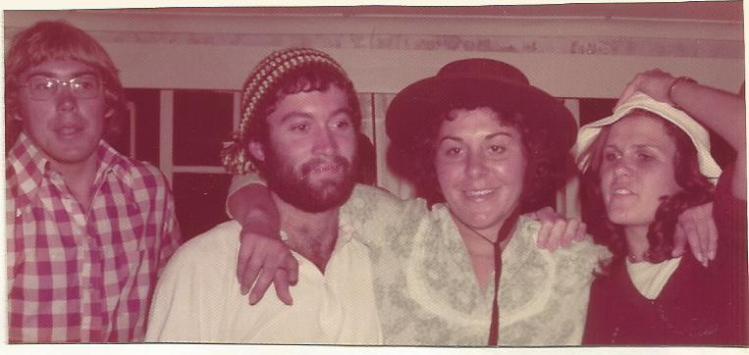
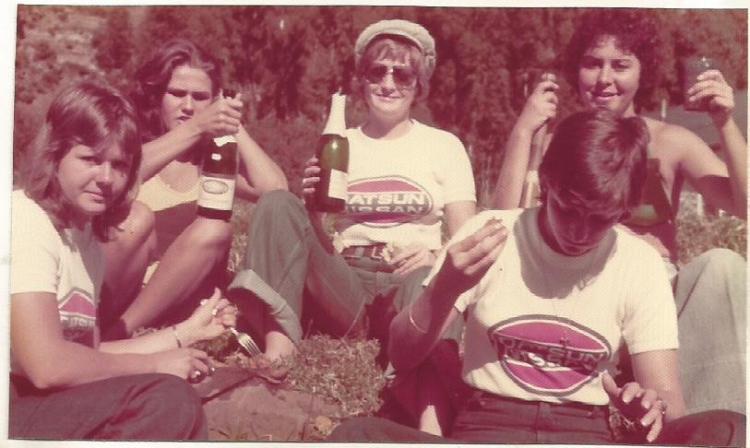
Sheila saw to it I had a party! As so often, Sheila saved the day. Back in 1976 before there were rules and the rinderpest was still contagious.
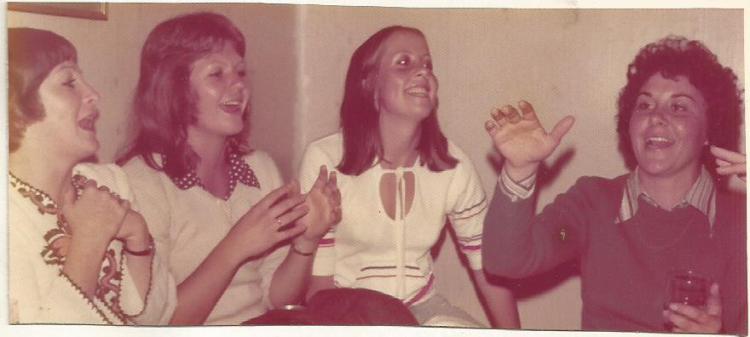
– those TC wimmin could really get things going –
Des Glutz threw open his palatial bachelor home, Kenroy, on the banks of the mighty Vulgar River to an invasion of students from Johannesburg and Pietermaritzburg. That’s because as a lonely horny bachelor Free State farmer he had his eye on some of those student teachers from Teachers Training College in PMB!
“Kindness of his heart” you thought? Ha! You know nothing about horny bachelor Free State farmers! Anyway, he owed me for managing his farm brilliantly when he went to Zimbabwe. Probly doubled his profit that year.
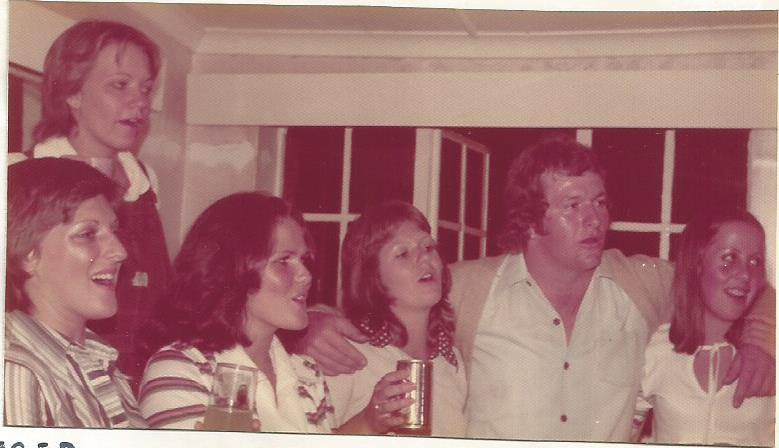
Sheila invited everybody – and everybody arrived!
Eskom had not yet bedeviled Kenroy, so paraffin lamps, gaslamps and candles gave light. So you didnt flick a light switch, hoping it would work, no. You lit a lamp knowing it would work cos Gilbert will have reliably topped up the paraffin. Des might have done that, you thought!? Ha! You know nothing about lonely horny freestate farmers with butlers. Music pomped out from car batteries. There was singing and much laughter. Except when Noreen, Jo and Ski danced their Broadway routine The Gaslamp Revue with Redge Jelliman holding the silver tray footlight staring in open-mouthed wonder at their skill. And of course, their legsnboobs – another lonely horny bachelor Free State farmer, y’know. Awe-struck silence reigned. For minutes.
– Noreen and Jo in the Gaslamp Revue, using available props –– Reg dreaming bachelor harem dreams – Noreen Mandy Jill Liz –
There was also Liz and Mops and Jenny, Georgie, Mandy, Gill and Jill; Hell, we bachelors were in awe at almost being outnumbered – a rare event. We were so excited we got pissed and fell down. Timothy Paget Venning got so excited he walked all the way round the house smashing Des’ window panes to let in the night.
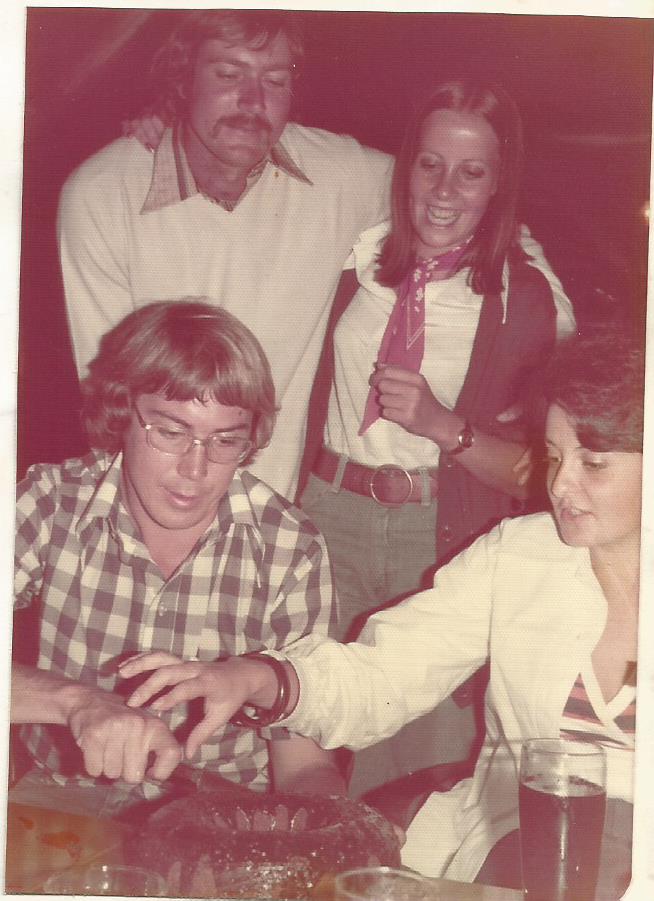
– someone baked a cake – lots of advice on how to cut it –
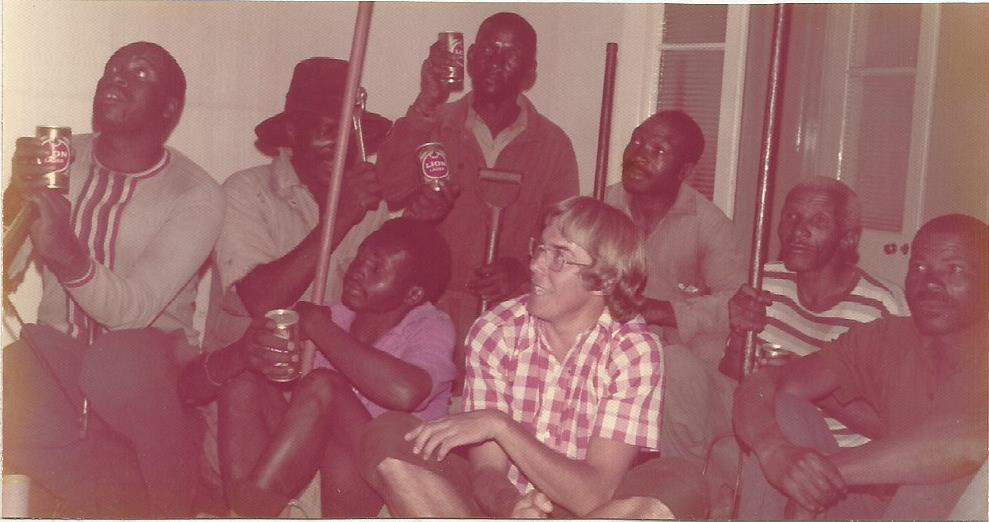
Poor ole Gilbert, Des’ personal butler, valet and chef – seen here in purple – and his men bore the brunt of the extra work!
He cooked and cooked, including a big leg of lamb which didn’t make the main table, getting scoffed on the quiet by ravenous would-be teachers under the kitchen table. Pity the poor kids who would have to grow up being taught all the wrong things by this lot in Natal in the eighties.
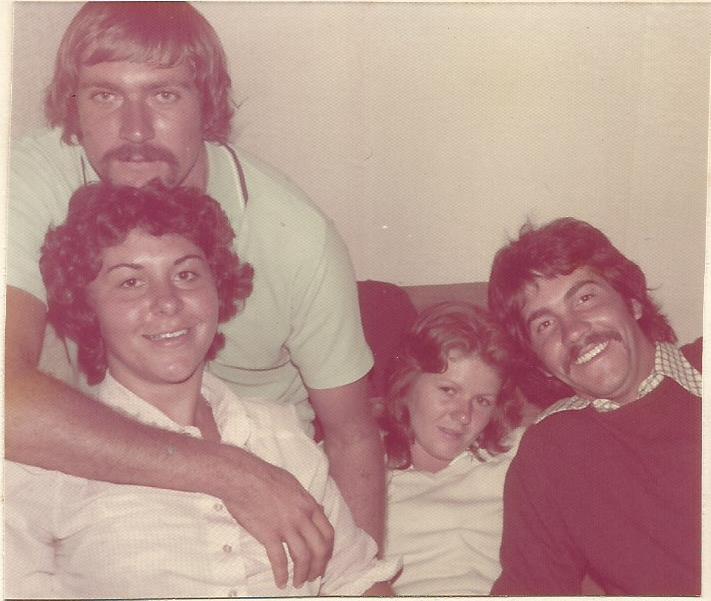
– Sir Reginald dreaming he has died and gone to heaven – with Noreen, Mops, Mandy, Jill and Liz –
These would-be teachers and pillars of society were wild n topless:
– if the bachelors had been there, we’d have politely averted our eyes. Right!! –
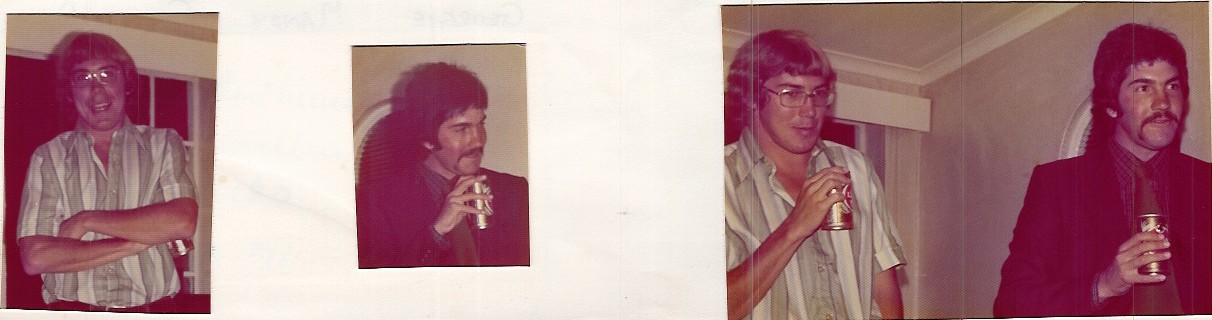
Tabbo wore his tie so he could make a speech into his beer can microphone:
Funny how Glutz doesn’t feature in any pics! Where was he? We know he wasn’t in his bedroom cos the TC girls raided it and were in awe at the impressive collection of bedroom toys and exotic rubber and latex items in his bedside drawer. No stopping those TC girls!
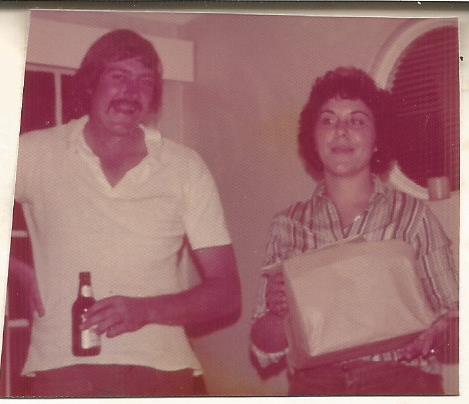
Ah! Here’s Glutz – Sheila and Liz presenting Des a thank-you gift for hooligan-hosting:
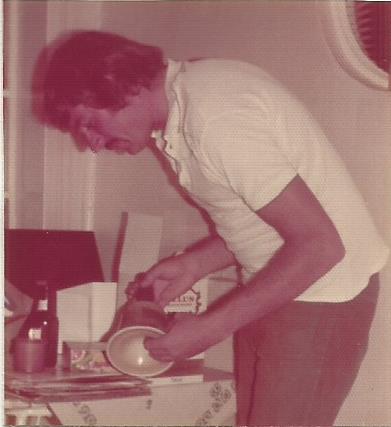
– Sheila & Liz thank Des for hosting – Des tries to hide the liquid gift – in vain –
The morning after dawned bright. Too bright for some . . .
– hair of the dog in the morning –
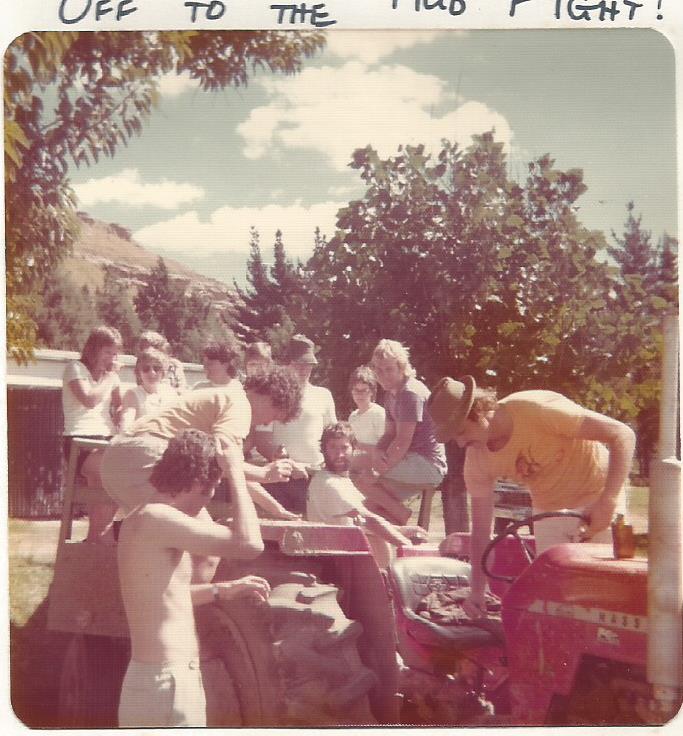
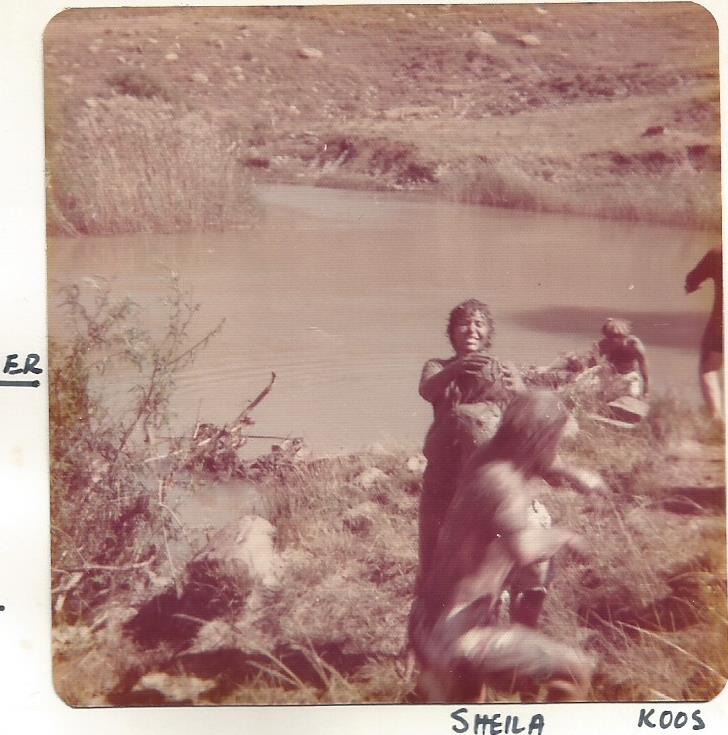
A mudfight! said some bright spark – Sheila, no doubt – so Des arranged transport to the mighty Vulgar river.
– fasten seatbelts while I check the airbags, says Farmer Glutz, Kenroy’s Safety Orifice – Occifer – Officer – Simpson scratches his head –– the mighty Vulgar River and its mud – roomerazzit it has beauty-enhancing properties – seems to be working –
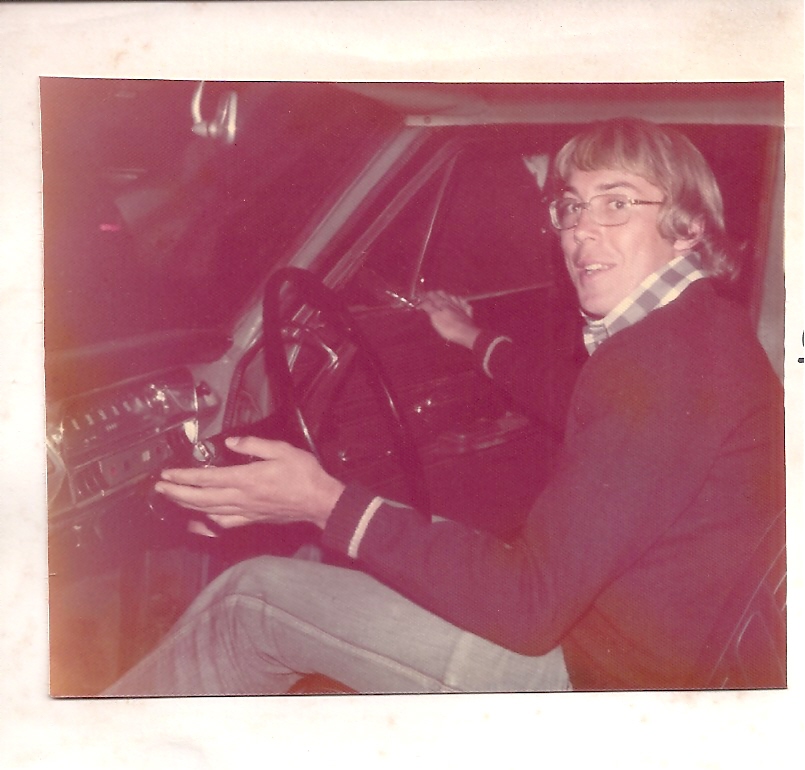
After the weekend I roared back to Jo’burg in my brand-new 1965 two-shades-of-grey-and-grey Opel Rekord Concorde deluxe sedan, four-door, grey bench-seated, 1700cc straight-four, three-on-the column, chick-magnet automobile. My first car! Watch out Doornfontein!
– 21st birthday present! A 1965 Opel Concorde DeLuxe 1700 in sophisticated tones of grey and grey. Note my reflection in the gleaming bonnet! –
Thanks Mom & Dad! And thanks for the party, Sheils and Des! Before we left, Mom tickled the ivories while the TC gang belted out some songs:
~~oo0oo~~
The old man organised the numberplate OHS 5678 for me. The man at the Harrismith licencing office said “Oom, are you sure you want an easy-to-remember number for your son? Don’t you want one that’s hard to remember?”
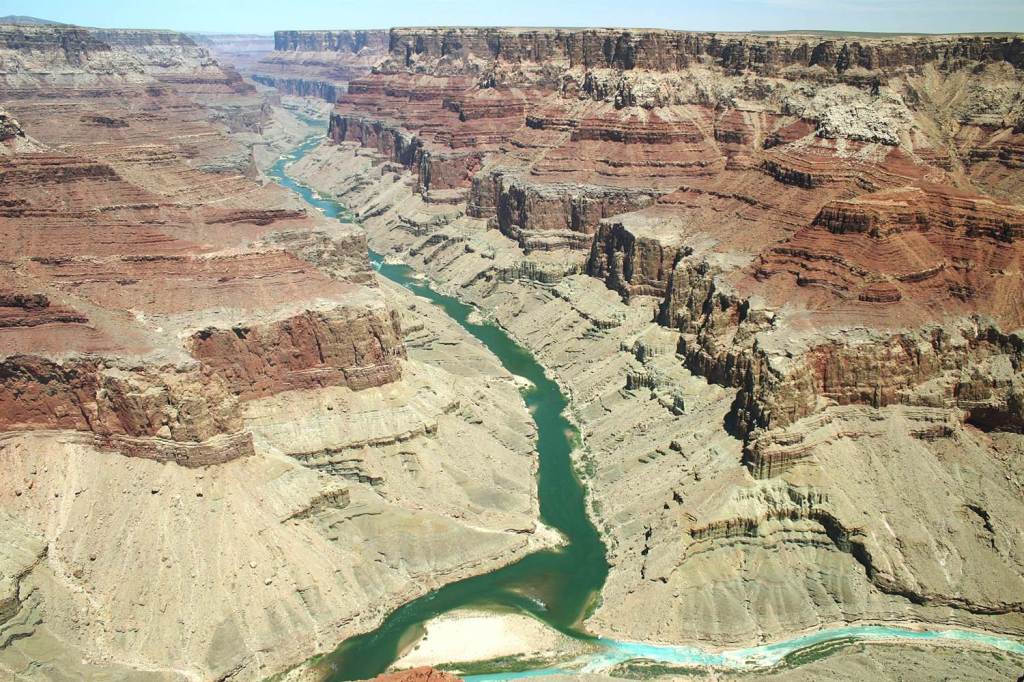
As the Colorado River coming down from the high Rockies in Colorado state carves a deep canyon through the Arizona desert, it is met by the Little Colorado, coming from dryer country in Eastern Arizona and Western New Mexico – bottom right in the picture.
Approaching the confluence, the Little Colorado River carves an extremely steep and narrow gorge into the Colorado Plateau, eventually achieving a maximum depth of about 980m. The depth of the canyon is such that numerous springs restore a perennial river flow.
It joins the Colorado deep inside the Grand Canyon, miles from any major settlement. The confluence marks the end of Marble Canyon and the beginning of Upper Granite Gorge.
It’s a remote and peaceful place which can only be reached by river craft or by a long steep hike into the canyon.
Some developers thought it would be a good idea to put 3km of cable cars or ‘aerial trams’ and walkways down from the South Rim to the confluence, aiming to transport ten thousand paying guests a day down to this special place which they could then reach without effort, scoff fast food at a McD or KFC joint and zoom up out again. They planned the hideous Grand Canyon Escalade:
They planned to ruin a special place. Luckily Canoe & Kayak Magazine reports the Navajo Nation Council voted 16-2 against the development proposal on 31st October 2017. The proposal by developers Confluence Partners from Scottsdale, Arizona, also included a 420-acre commercial and lodging “village” on the rim, huge restrooms, an RV park, gas station, helipad, restaurants, retail shops, motel, luxury hotel, the ‘Navajoland Discovery Center’ and additional infrastructure.
Under the proposal, the tribe would be on the hook for an initial $65 million investment for roads, water and powerlines and communications, while providing a non-revocable 20-year operating license including a non-compete clause. In return, the Navajos would receive just 8 percent of the revenue. A “totally one-sided” and “rip-off” proposal, it met with a cold reception since project lobbying began seven years ago. Even after lengthy debate during the council’s special session led to significant amendments, overwhelming opposition to the project remained, prompting council delegates to pound a stake through its heart.
“We never said we were against economic development but, please, not in our sacred space,” activist Renae Yellowhorse from Save the Confluence said afterward. “We’re going to always be here to defend our Mother, to defend our sacred sites.”
Greedy developers, including some Navajo leaders, aim to try again, so vigilance is called for. Bottom line: There is no need for casual in-and-out tourists to ruin a special area when they can see pictures, videos and even 360º videos – even live footage – without crowding and ruining the place. We must be careful not to turn genuine natural areas into theme parks! We cannot re-create these places. They are not movie sets, they are real, often sensitive, ecosystems.
~~oo0oo~~
When we got there in 1984 the rivers were running strongly, the Colorado at 50 000cfs, clear from deep in Lake Powell, and the Little Colorado running rich red-brown (“colorado”) from a flash flood upstream. Here you can see the waters starting to mix. From here on we had brown water all the way to Lake Mead.
 And Colorado River water should be brown: Colorado means “ruddy, reddish.” Literally “colored.” Past participle of colorar “to color, dye, paint.” From Latin colorare.
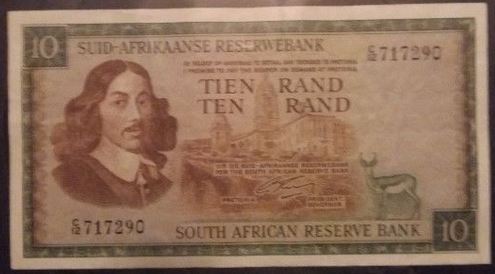
When we were young we heard that Jock Grant used to give Ian R10 to spend.
We were horrified.
The other day Tom asked for money. I offered him R10.
He was horrified.
===========ooo000ooo==============
Especially horrifying to note that when I was born there were coins in denominations of ¼, ½ and 1 penny, and 3 and 6 pence! Yes, there was a farthing, a ha’penny, a penny, a tickey and sixpence! Basically what Tom in his new South African English would term worth ‘fokol’!
Here’s a farthing (1/4 penny) from when I was cute:
Shit I’m old! I think you could buy a Wilsons toffee from Harrismith Mayor Nick Duursema’s VC Cafe for this coin.
There was also a one shilling coin, a 2 shilling coin (some called it a ‘florin’) and 2½ shillings (‘half a crown’, is that right?).
All the coins had the British monarch on the obverse (George VI until 1952 and later Queen Lizzie Two Second), with the titles in Latin, while the reverse had the denomination and “South Africa / Suid Afrika”. The other 11 languages? Forget it! Latin yes, isiZulu, hell no!
Recently Tom and I were looking at a collection of coins Aitch had collected and kept in a plastic screw-top jar from her Prof Chris Barnard days that originally held an artificial heart valve. I said, ‘Hey Tom, the 1931 tickey is worth a lot of money’. That piqued his interest and he had a good look, but no luck, the biggest value tickey we had was worth about R6.
Great friend Larry Wingert is out from the USA and we hop on a flight to Maun in Botswana. It’s 1985 and we’re bachelors on the loose with time and money!
– 1985 Maun – pics by Lee Ouzman, who arrived about then – and stayed –
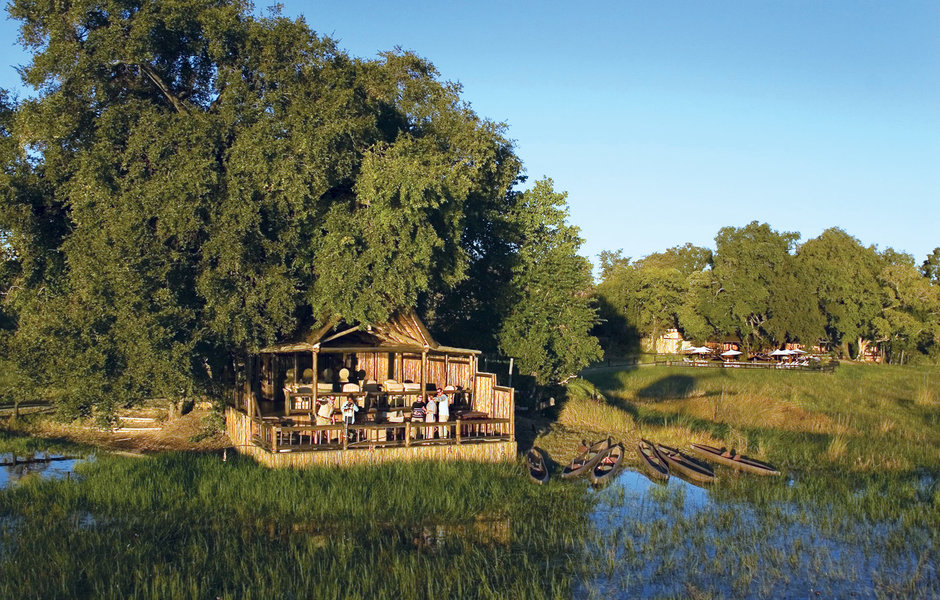
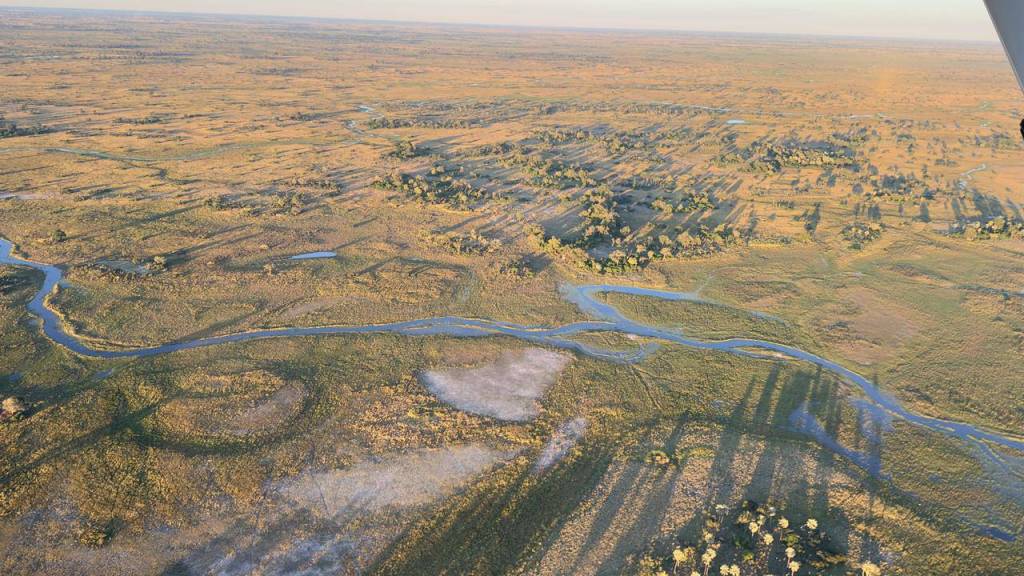
From Maun we fly into the Okavango Delta (Tjou / Chau Island camp) in a Cessna 206. After many beers and wines a resident auntie starts looking enticing at around midnight but the moment passes.
– internet pics of where I think Tjou Island was – names change – I’m hoping to get pics from Larry –– Chau Island in 2025 –
The next morning a pair of tropical boubou fly into the open-air pub under a tree right above where we’re sitting and belt out a startling loud duet. Stunning! That’s a lifer!
– pic from afrol.com – see story on tropical boubou calls –
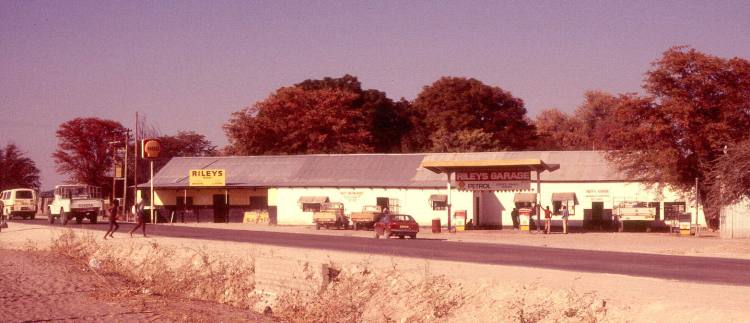
After a short mokoro ride around some islands with a walk on one of them, it’s back to the plane and a short flip back to Maun where we all squeeze into an old Land Rover, fill up at Riley’s Garage . .
– 1985 Rileys Garage by Lee Ouzman –
. . and head off for Moremi, stopping just outside Maun to buy some meat hanging from a thorn tree. Goat? Supper. Our outfit is called Afro Ventures.
We’re a Motley Crew from all over. We get to know two Aussie ladies, a Kiwi lady, a Pom fella – 6 foot 7 inches of Ralph; AND the gorgeous Zimbabwean Angel Breasts (Engelbrecht her actual surname)! Unfortunately, she’s the Long Pom’s girlfriend (*sigh*). Weird how the only first name I can think of now is Ralph, the undeserving Pom.
Our long-haired laid-back hippy Saffer – no, he was probably a Zim, see his letter – safari guide Steve at the wheel is super-cool, a great guide. So off we go, heading north-east, eight people in a Series 2 Landie – “The Tightest-Squeeze-Four-By-Four-By-Far”.
Long Legs in a Landie to the rescue!
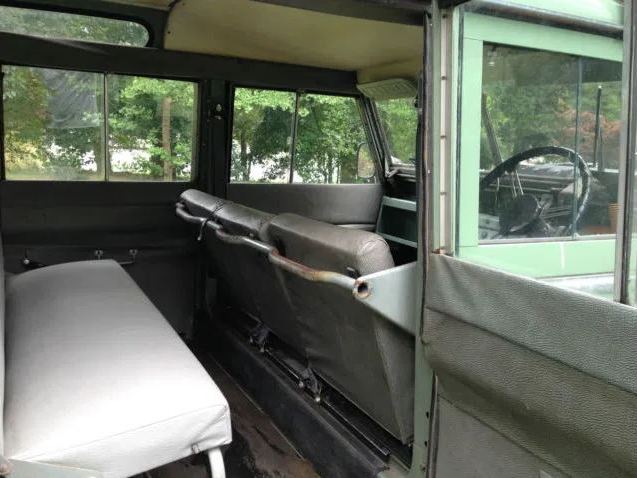
Anyone who has driven in an old Landie will know there’s lots of room inside – except for your shoulders and your knees. Besides that – roomy. Land Rover’s theory is that three people can fit on the front seat, three on the middle seat and two on those postage stamp seats in back. Right! See that metal bar that your knees keep bumping against? That’s what Land Rover used as their prototype airbag. It didn’t work so they only kept it for the next fifty years, then changed it. They made it more safety-conscious 2.0 in the late nineties by using milder steel.
– promotional pic extolling landrover luxury –
Previously a critic of Landrover design, in a flash I’m a keen supporter! Unable to endure the cramped space on the middle seat, the lengthy six foot seven inches of Pom gets out at the very first stop and sits on the spare wheel on the roofrack. I sit with my thigh firmly against Angel Breasts’ thigh (*sigh*).
More clever Landrover design features:
Stretched Ralph stays up there for the rest of the week – whenever we’re driving, he sits on the roofrack! When we stop he has to pick the insects out of his teeth, like a radiator. I’m in seventh heaven. Mine and Angel Breasts’ thighs were made for each other.
– she was like this . . . the landrover wasn’t –
Birding: Problem Solved!
I’m mad keen on birding but I don’t know how these guys feel about it. What if they get pissed off? What if they only want to stop for large furry creatures? After all, five of the seven of us are fureigners, un-African. But the problem gets solved like this: The first time we get stuck in the deep sand, a little white-browed scrub robin comes to the rescue! He hops out onto the road in full view, cocks his tail and charms them. From then on I have six spotters who don’t let anything feathered flit past without demanding,“What’s that, Pete? What’s that? And that one?” I become the birding guide! Steve is happy – it’s not his forte, but he’s keen to learn.
– thanks fella! – see wilkinsonsworld.com –
Moremi – and True Love
At Khwai River camp a splendid, enchanted evening vision befalls me – my best wild life sighting of the whole trip: I’m walking in the early evening to supper and bump into Angel Breasts outside her bungalow – she’s in her bra n panties in the moonlight. Bachelor dreams. Oops, she says and runs inside. Don’t worry, I’ve averted my eyes, I lie (*sigh*). That’s another lifer!
Chobe
At Savuti camp the eles have wrecked the water tank.
At Nogatsaa camp a truck stops outside the ranger’s hut, a dead buffalo on the back. The ranger’s wife comes to the truck and is given a hindquarter. Meat rations. They also drop the skin there and advise us to carry a torch if we shower at night as lions are sure to come when they smell the skin.
– internet pic of nogatsaa waterhole –
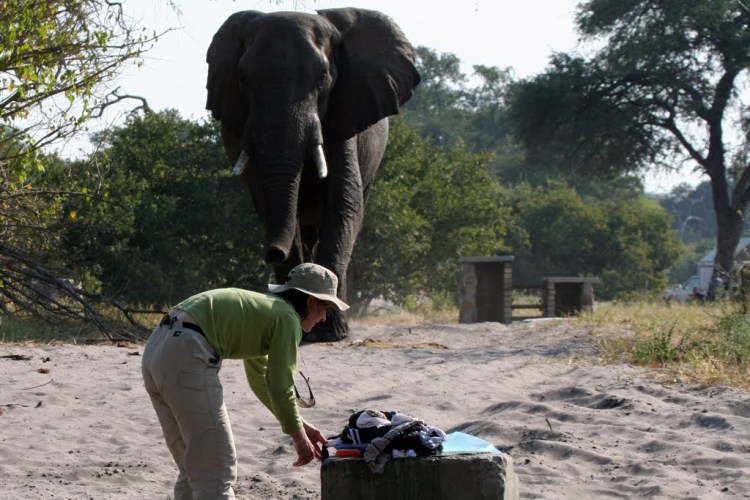
Another Lifer! Later I head for the tiny little shower building – a single shower – to shower while it’s still light. Lion discretion being the better part of valour, I’m not lyin’! A sudden cacophony makes me look out of the broken shower window: The lady-in-residence is chasing an ele away from her hut by banging her pots & pans together! We travel thousands of k’s to see elephant and she says Footsack Wena! Tsamaya! The ele duly footsacks away from that awful noise, looking back as he shuffles off like OK, OK! Jeesh!
While looking out, I spot what I think could be a honeyguide in a tree, so I have to rush back to our puptent wrapped in a towel with one eye on the ele to fetch my binocs. It is a Greater Honeyguide, the one with the lovely Latin name Indicator indicator, and that’s another liferfor me! Moral of the story: Always carry your binocs no matter where you go! He obligingly confirms the sighting by saying:
– Greater Honeyguide, Indicator indicator- also from xeno-canto.org –
That night the elephants graze and browse quietly right next to our puptent, tummies rumbling. Peeping out of the door through the mozzie netting I look at their tree stump legs, can’t even see up high enough to see their heads. Gentle giants.
As we approached the Chobe river the landscape looked like Hiroshima! Elephant damage of the trees was quite unbelievable. That did NOT look like good reserve management! Botswana doesn’t believe in culling, but it sure looks like they should! Too many elephants are spoiling the broth.
The Chobe river, however, was unbelievable. Despite the devastation on its banks – especially after the dry country we’d been in – it was truly magnificent. What a river! What wildlife sightings, the river being the main surface water for miles.
Zimbabwe
On to Zimbabwe, the mighty Zambesi river and Victoria Falls. We stayed at AZambezi Lodge. Here we bid a sad goodbye to our perfect safari companions. Me still deeply in love. Angel Breasts holding the Long Pom’s hand, totally unaware of my devotion (*thigh*).
At the end, our new friend and safari guide Steve gave me and Larry a letter. We read it on the flight out of Vic Falls..
– lovely note –
~~oo0oo~~
Hopeful note: Larry had a camera on the trip, I didn’t, so I have asked him (hello Larry) to scratch around for his colour slides in his attic, his basement, or his secret wall storage space in Akron Ohio. He will one day. As a dedicated procrastinator he is bent on never putting off till tomorrow what he can put off till Wednesday week. Meantime, thanks to Rob & Jane Wilkinson of wilkinsonsworld.com, xeno-canto.org and others on the interwebs for these borrowed pics and sounds!
Edit: There’s hope! Larry wrote 16 December 2017: P.S. I will renew my efforts to locate some photos of our Botswana trip. If you saw the interior of my house, you’d understand the challenge. . . . OK, but if you saw the exterior of his house you’d fall in love with it:
– Bachelor pad, 40 North Portage Path, Akron Ohio –
Terrible note: Update November 2019: Larry has since had a bad fire in the basement of his lovely home. Much of his stuff was ruined by the fire and the smoke, and then the firemen’s water ruined the rest! He may not repair his home! This is so sad! Dammit! Pictures suddenly aren’t important any more.
Update 2020: He sold his home, but thankfully, he got a more convenient place to live, less maintenance, less upstairs and downstairs. And the old home was saved – have a look, beautifully restored.
~~oo0oo~~
Saffer – Suffefrickin; South African
Zim – a Zimbabwean
lifer – first time you’ve seen that bird ever – or anyway in lingerie
Footsack Wena!Tsamaya! – Go away! Be off with you! Eff Oh!
pamberi ‘n chimurenga – forward the liberation struggle! in Shona
I played football in Apache Oklahoma in 1973 for the Apache Warriors.
– Apache Football Team 1973 – I was No. 47 – and surplus to requirements –
The coaches did their best to bring this African up to speed on the rules and objectives of gridiron. We played two pre-season warm-up games followed by five league games. And lost all seven encounters!
Myself I was kinda lost on the field, what without me specs! So here’s me: Myopically peering between the bars of the unfamiliar helmet at the glare of the night-time spotlights! Hello-o! Occasionally forgetting that I could be tackled even if the ball was way on the other side of the field! They decided to play me more on the defense squad, less on offense, which makes sense when you don’t know what you’re doing. Then for some reason, I was also on the punt-receiving squad.
At that point I thought: Five more weeks in America, five more games in the season, football practice four days a week, game nights on Fridays. I wanted out! There was so much I still wanted to do in Oklahoma and in preparing for the trip home. I went up to Coach with trepidation and told him I wanted to quit football. Well, he wasn’t pleased, but he was gracious.
We were a small team and he needed every available man, how would they manage without me?
By winning every single one of the last remaining five games, that’s how!!
Our coach Rick Hulett won the Most Improved Coach Award and the team ended up with one of their best seasons for years!
I like to think the turnaround was in some small way helped by the way I cheered my former team-mates on from the sideline at the remaining Friday night games! But I suspect it was the fire in the belly of my teammates determined to succeed without me!
– much improved since I quit! –
These news cuttings are all post-me!! –
One of the games I cheered was against Mountain View. We beat them 23-7, the third winning game since I quit. That weekend Jenny Carter from Bromley in Zimbabwe, the Rotary exchange student from Mountain View was staying with us at the Swandas. We gave her a hard time at the Friday night game, and Sunday morning for breakfast we framed the Saturday news report of the game and put it on her place at the table!
edit:
I see Apache football has had some great results recently!
The second game after I left was against Cyril, rated 17th in OK and expected to whip us handily; but we beat them! I traveled to Cyril to cheer!
There’s a Crocodile River in Gauteng, so the river near Nelspruit that flows east into Mocambique and forms the southern boundary of the Kruger National Park has to be called the “Lowveld Croc”.
A wonderful canoe (kayak really) race is held annually on this river. The presence of hippopotamuses in the river adds a risk and a thrill to the two-day race. Race organisers engage with local farmers and wildlife people and trip the river in the weeks before the race in order to identify possible hippo hotspots which are then compulsory portages on race days. Sometimes a helicopter is used to do a scouting flight on race day morning, and volunteer paddlers also scout the route by starting ahead of the competing racers.
The year I did the race (1983) I remember the route as from above Montrose falls to Mbombela town (formerly Nelspruit). We portaged around the falls.
The hippo were in the last pool before the finish in Nelspruit, so the race was ended a few km short at the last accessible spot before the hippo pool. I see they now start higher up and end the race above Montrose falls.
~~~oo0oo~~~
Here’s video of the 1989 race. The second day here was our first day. We portaged around the Montrose Falls and paddled to Nelspruit (today’s Mbombelo). Actually, just short of town, as hippos in a pool at the usual finish dictated we end a couple km early.
~~~oo0oo~~~
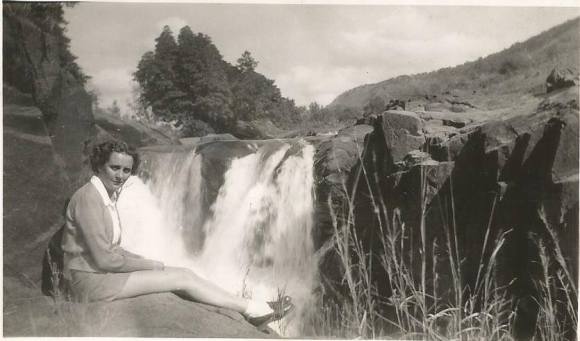
Back in 1951 Mom and Dad had stopped here on honeymoon, on their way to Lourenco Marques:
The original source of info for this post was on https://deoudehuize.blogspot.co.za/ – do go and look, they are doing wonderful heritage conservation things in Harrismith! And they have a cool old car!
Maximilian John Ludwick Weston was a South African aeronautical engineer, pioneer aviator, farmer and soldier – and mystery man. He was probably born on 17 June 1873 in an ox wagon at Fort Marshall south of Vryheid in British Natal (though he invented an entirely different place of birth when it suited him). He married Elizabet Maria Jacoba ‘Lily’ Weston (nee Roux) a direct descendant of Adam Tas. The couple had three children: Kathleen, Anna and Max.
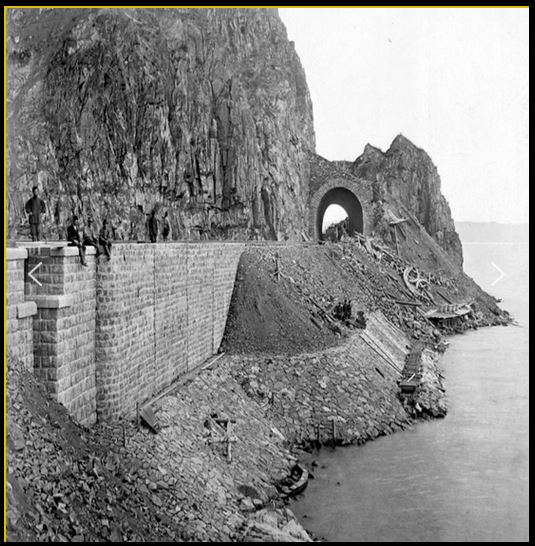
Weston’s early years are . . . interesting. And he may have invented a LOT of his life stories. But some things are verifiable – more or less, and they certainly are interesting! Read more detail here about his time building the railway line around Lake Baikal in Russia!
– was Weston here ca. 1903? –
Weston began the construction of his own aeroplane in 1907 at Brandfort in the Free State. This was the first South African-built aeroplane. He lacked an engine with enough power so he dismantled the aircraft and shipped it to France. In France he fitted a 50hp Gnome rotary engine and flew it successfully in 1910. On 16 June 1911 John made the first flight in Kimberley establishing a South African non-stop flight record of eight-and-a-half minutes in his Weston-Farman biplane.
At the outbreak of World War I Weston was appointed ground officer in charge of landing strips in South West Africa. He prepared an airfield with hangars and workshops at Walvis Bay.
For services rendered to the Greek Ministry of Marine he was made an Honorary Vice-Admiral in the Royal Hellenic Navy. Thus he was often glorified by the title of Admiral. Isn’t that delicious? The land-locked Free State had an Admiral! He appeared to relish the joke and later named his farm “Admiralty Estate”!
In 1918, John Weston took his family on an amazing adventure in this motorhome, a converted Commer truck. From about 1920 for twelve years, he and his family traveled the world.
The ‘Weston Caravan’, as it was called, was an extraordinary example of his tenacity and ingenuity. It doesn’t look like much from the outside and if the truth be told, the interior is enough to give anyone claustrophobia, yet this neat and compact arrangement of luggage and folding beds served them well. According to Weston, the living compartment could be removed from the chassis proper in a mere 10 minutes in order to float it across rivers, while the chassis could drive and/or get pulled across!
This ingenious ‘seven-by-fourteen-foot mansion’ ferried the pioneering Weston family on an overland trip from Cape to Cairo, and on to England, ‘to take the children to school!’
The purpose of Weston’s project was not simply to satisfy his lust for travel but was also an expression of his idealism. “To travel from land to land, to mix with the people of all nations…, to speak to them and hear their views, to study their institutions and their customs, that is his aim”.
It was also a bold experiment in the education of his children: he wanted them to see the world, to be freed from the narrowness and prejudices of those who grow up among never-changing surroundings, who know nothing of life beyond the pale of their dorp or city, the beauties and the grandeur of the earth, or of the nations and races who people it, and adorn (or mar) it with their works. He is preparing them to be citizens of Planet Earth”
On their trip from Cape Town to London they ‘had run-ins with elephants, occasionally had to float their vehicle across rivers on logs, and on occasions entire villages of more than a hundred natives had to dig them out of mud and thick sand and pull them up river banks.’ Weston said, “It can be stated without reservation that the indigenous people encountered on the African continent were all friendly and helpful“.
There were no fuel stations dotted along the route and no easy access to fuel, water or spares shops. Even the kids became handy mechanics. In the Southern Sudan they suffered misfortune when the rains broke later than usual. Weston broke a bone in his foot and the two daughters were also laid up with injuries.
On their trips Weston used to fly the South African blue ensign from a long bamboo pole on “Suid-Afrika” as he called the truck. On the side was painted a disc with the inscription ROUND THE WORLD circling the following:
On his return to South Africa in 1933, Weston bought a farm near the present Sterkfontein dam in the Harrismith district (or was it nearer Bergville?) and called it “Admiralty Estate”. He hoped to keep his kids with him for ever, but would not give them any certainty as to their future on the farm. The youngest two ended up reluctantly leaving to start their own lives, at which he disowned them and never spoke to them again.
One Friday night 21 July 1950 Weston and his wife were in the dining-room when they were attacked by three masked men. Mrs Weston regained conscious three days later in the Harrismith hospital, but John went on his last mission at the age of 78 on 24 July. It was his wish that his funeral should be quiet and simple. His body was cremated and no last word spoken. Lily recovered from the attack although certain permanent injuries persisted. She passed away on 14th April 1967 at the age of 91.
~~~~oo0oo~~~~
Read a fuller story of this amazing man’s astonishing life here. And especially here. where a sleuth has done a fascinating job of trying to unravel the true story of ‘John Weston’! Was he a spy? What was his real name? Where was he born? He wasn’t an admiral; He certainly was no farmer; He had no visible means of support yet often had plenty of money. He would disappear overseas for quite long spells quite frequently, sometimes buying aircraft and shipping them back to South Africa. He DID help build a Russian railway line. He said he personally met Churchill, Roosevelt, Stalin and other notables.
Major D.P. Tidy in a tribute to pioneer SA airmen, wrote about Weston’s oldest child, daughter Anna. he wrote
(Weston) was elected an Associate of the Institution of Electrical Engineers on 5 February 1903 and a Member of the Society of Arts in the same year, in which he also published a slim philosophical handbook in November.
In 1981, his intrepid elder daughter Anna Walker flew with me in a Transall C160Z to the presentation ceremony of the Compton Paterson biplane replica in Kimberley. She gave me a copy of the little book, and was bright and lively at 05h00 when I picked her up from her house in Rosettenville, Johannesburg. She continued thus for the duration of the journey via Waterkloof, Durban, East London, Port Elizabeth, and Cape Town, keeping me enthralled with stories of travels with her father. She has decided views on the origins of the disastrous fire that caused the loss of Weston’s aircraft, and of the identity of those who instigated the murder of her father in the 1950s.
In the little book of her father’s that she gave me he wrote ‘Never allow human conventionality to interfere with the dictates of your conscience; in other words do right and fear not.’ This could be the essence of the thinking of both father and daughter. She was born Anna MacDougal Weston on 6 February 1908, after he had married Miss Lily Roux on 10 August 1906.
Settled at Brandfort in the Orange Free State, he had a well-equipped workshop there in 1909. He himself stated that he built his first aircraft in 1907/1908, presumably on the farm Kalkdam, near Bultfontein.
TV, harbinger of kommunisme, arrived in South Africa in 1976. This in spite of the Nationalist Party’s Posts and Telecommunications Minister Albert Hertzog’s determination not to telecommunicate.
Hertzog had vowed that television would come to South Africa over his dead body, denouncing it as ‘a miniature bioscope over which parents would have no control.’ He also argued that ‘imported fillums showing race mixing and advertising would make non-white Africans (or ‘plurals’) dissatisfied with their lot.’ Their God-ordained lot. This new medium was the ‘devil’s own box, for disseminating kommunisme and immorality.’ This, naturally, made people curious. Hetzog was better at marketing than at telecommunications.
The influential Dutch Reformed Church, the National Party at prayer, saw the new medium as ‘degenerate and immoral.’ This, naturally, made people curious. The church was better at marketing than at afskrik. No doubt they had to send a few dominees oorsee to check and make sure it was as bad as vey fought. Dominees can be like that.
Prime Minister Hendrik Verwoerd was also full of wisdom, comparing television to atomic bombs and poison gas, which ‘are modern fings, but that does not mean they are desirable. The goverrinmint has to watch for any dangers to the people, both spiritual and physical.’ That was onse Hennerik, now reduced to a street name.
Very prescient of them all: I mean do we have free speech and human rights now? See! They TOLD you! Not to even mention the scourge of ree-hality TV.
But there was no holding back ve small bioscope. TV came to South Africa irregardless. Stepping over ou Hertzog’s dead body, one must suppose?
Only . . not to Clarens!
Citizens of Clarens had to listen enviously to Bethlehem se mense when they spoke of staring at the test pattern or watching The World At War.Then came The Dingleys and The Villagers, as well as comedy series Biltong and Potroast’s SA vs British comedians shootout, and variety program The Knicky Knacky Knoo Show. Also The Sweeney in Afrikaans, called Blitspatrollie. Things were now getting Crucial in Clarens! The frustrasie mounted.
– Holy, biblical Mt Horeb –
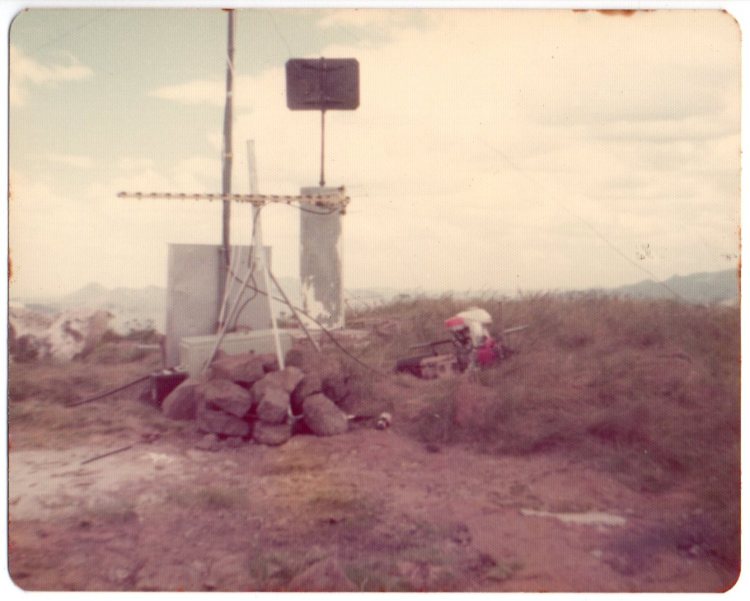
Then: A breakthrough! Someone discovered there was TV reception on the top of Mount Horeb which looms above the dorp! Mount Horeb, where Moses got the Ten Commandments, was about to beam down much breaking of the seventh and tenth commandments – the ones about adultery and coveting your neighbour’s wife’s ass. Yes, Mount Horeb is near Clarens, as is Bethlehem and the River Jordan. They wrote a book about it.
What was needed was a ‘repeater.’ A what? A repeater. Say that again . . You get an aerial to catch the signal, then a repeater, then another aerial aimed down at the dorp and voila (or ‘daar’s hy’): you have TV.
Steve Reed, son of hizzonner, the incumbent Lord Mayor of Clarens at that historic time, writes of the ‘many trips up Mount Horeb: At one stage we enlisted the TV expert from the Bethlehem TV shop – Haas Das. Two-way radios were used to speak to the manne down in the dorp, hunched over the test TV set’:
“Hoe lyk die picture nou? – Over”
“Nee man dis net sneeu. – Over”
“En nou? – Over”
“Dis nog steeds net sneeu. – Over”
“Daar’s hy! Wag! Agge nee, weer net sneeu. – Over”
Ens, ens . . en so voorts = etc. Over.
So that was done, and TV arrived in Clarens to groot vreugde and tidings of great joy. The mense didn’t know it at the time, but they had embarked on learning to speak Engels.
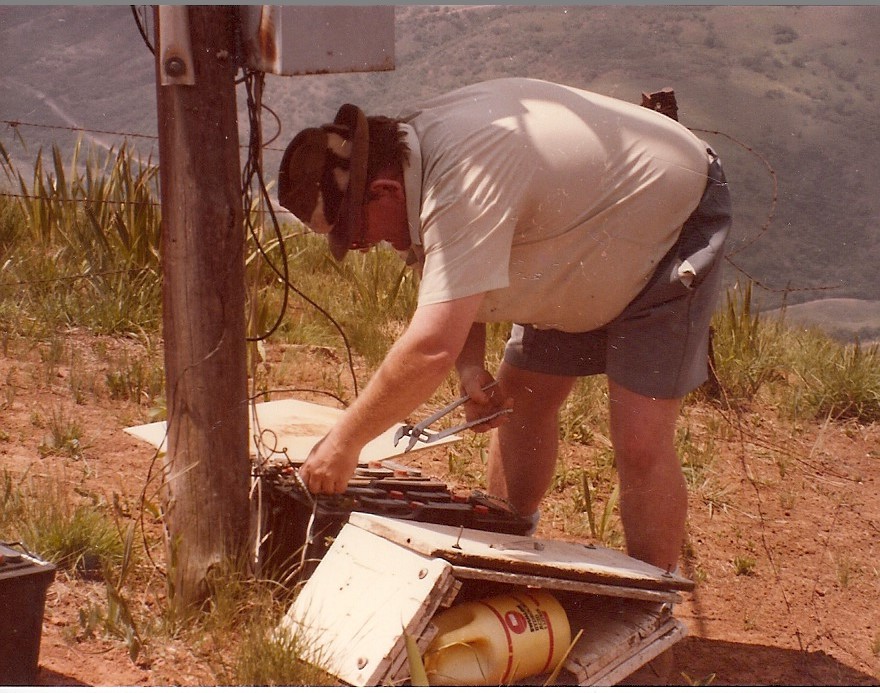
And then it died. Wat de hel gaan aan? Telephone lines buzzed heen en weer. The battery’s flat. What battery? Ja, it has a battery to drive the repeater. The what? The repeater. Wat!?O bliksem. So a roster had to be drawn up for the dorpsmense – The Villagers, see? – to take turns driving and walking up Mount Horeb to change the battery and bring the flat one down to charge it. Daily. Every day. (Moses se Moses, he only went up Mount Horeb once).
– the summit of Mt Horeb – trying a petrol generator here –— Here’s a different home-made repeater aerial; Same battery-changing chore — This one at Hella Hella outside Richmond in KZN —
Then there was Peace on Earth and Goodwill toward Men. Except if men forgot their roster slot. Then there was hell to pay. Later a wind charger was installed so they didn’t have to change the batteries every day. The irrelentless march of progress, voorspoed.
~~oo0oo~~
harbinger – anything that foreshadows a future event; omen; sign; ek het vir julle gese
kommunisme – communism; a vague concept, undefined, but BAD; don’t ask
fillums – motion pictures
devil’s own box – duiwel se eier doos
afskrik – dissuade; ‘don’t look!’ which made people look
goverrinmint – guvmint; Pik Botha discovered the ‘R’ in guvmint, his only achievement as Minister of Foreign Affairs. Although he was minister of foreign affairs for ages, he was actually better at Local Affairs, taking gewillige meisies to farms for frolics around ve braai
gewillige meisies – willing lasses; paid?
Bethelehem se mense – Bethlehem’s TV-enabled people; The Villagers
frustrasie – frustration, impotence, FOMO
dorp – village
daar’s hy – there it is, Suzelle; voila; see ou Jaap’s “away you go” below
manne – the boys
“Hoe lyk die picture nou? – Over” – What’s the picture look like? Over
“Nee man dis net sneeu – Over” – No man, its just snow – Over
“En nou? – Over” – And now? Over
“Daar’s hy! Wag! Ag, nee, weer net sneeu. – Over” – Shit! Over
Ens ens... – etc etc
groot vreugde – tidings of great joy
Wat de hel gaan aan? – WTF; Tell Me Whatsa Happening?
O bliksem – Oh shit
se Moses – like . . . “that was nothing!”
~~~oo0oo~~~
I wanted to know more about how they did this, so I asked –
and got a reply from ou Jaap:
Yes this is no secret, in fact we at the SABC / Sentech, encouraged the use of TV repeaters for the smaller communities, and at one stage there were more privately owned “self- help” TV stations than those we ran for the SABC.
The right way to do this was to purchase a transposer, a combined TV receiver and transmitter that will receive a TV signal on one channel, then re-broadcast the signal on another channel. This could be UHF-UHF or VHF-VHF or VHF-UHF. Then you need a receive antenna and transmit antenna. Install on a high structure, such as a grain silo or mountain top. This transposers was in the order of 1-10 Watts output. This then would receive the distant TV signal from the TX station through a front-end amplifier on one channel before feeding into the transposer, and transmitting it on another channel.
The cheap and dirty, crude way was to get hold of a VCR with AV out, a TV tuner with a AV output, or even a modified TV set. The AV output would then be taken to a TV modulator, which you can buy off the shelf, and then tune it to a suitable channel, and then put the RF into a amplifier that could be home-built or even a commercial distribution (set-back amplifier ) connect it to the antenna and away you go. Equipment could be bought from your local TV spares/ equipment dealer, Ellies Electronics, Space TV, or even your local co-op store. Drawback was that only one channel, normally TV3 (SABC3) could be re-broadcasted like this, any other additional channels would have to have identical set-ups.
According to the law, such self-help stations had to be licensed by the SABC, but many of them did not bother to do so. Obviously the home-brewed equipment was very prone to causing interference as the amplifiers they used was not channelized, with no filtering whatsoever.
In all instances the equipment had to be placed so that the clearest possible signal could be received and the maintenance of such repeaters was obviously the responsibility of that community.
Stephen Charles Reed was the laat lammetjie son of Vincent and Doreen Reed. Vin and Dor. Butch was the big black Labrador in residence.
Vincent was hizzonner, the Lord Mayor of Clarens, so although Stevie was by a long shot not their first son he was the First Son of Clarens. I moved in high circles.
In the holidays I would ring up Oom Lappies Labuschagne at the Harrismith sentrale. I’d say Clarens asseblief; He’d say ‘seker‘ and patch me through to the Clarens telephone exchange – their ‘sentrale‘. The operator lady would answer with a chirpy “Clarr-RINSE”!
Three Four Please. Seemed somehow wrong that their number was 34. I mean, Vincent was the Mayor. Surely it should have been One Please?
Anyway, Three Four Please.
“No, Stevie’s not there, he’s at the Goldblatts, I’ll put you through”.
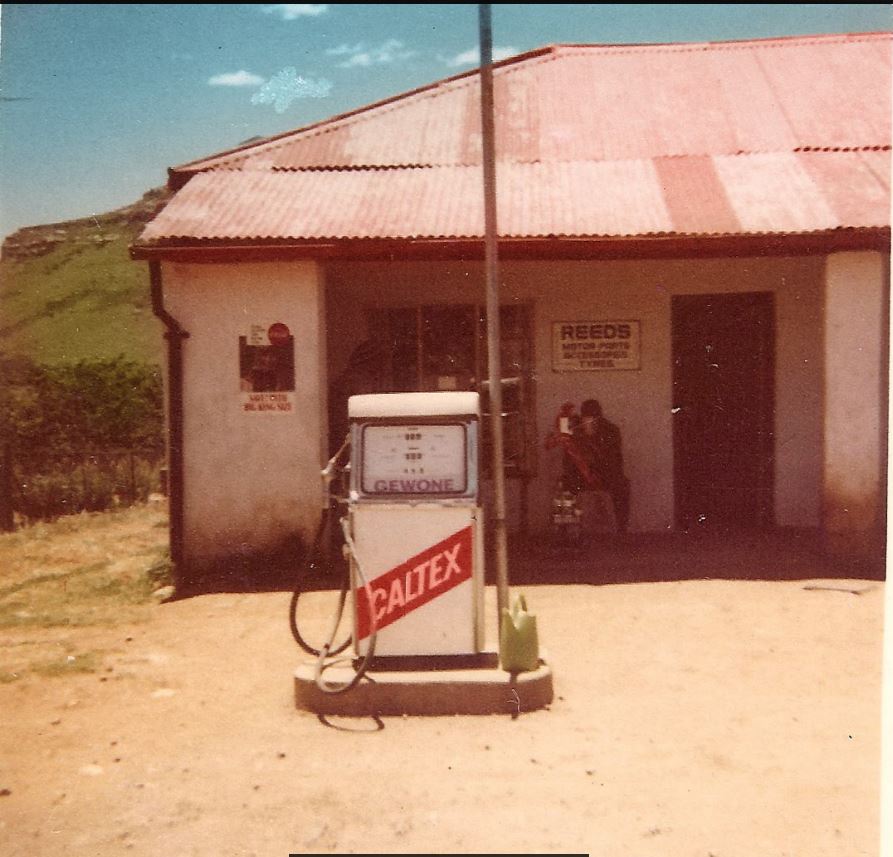
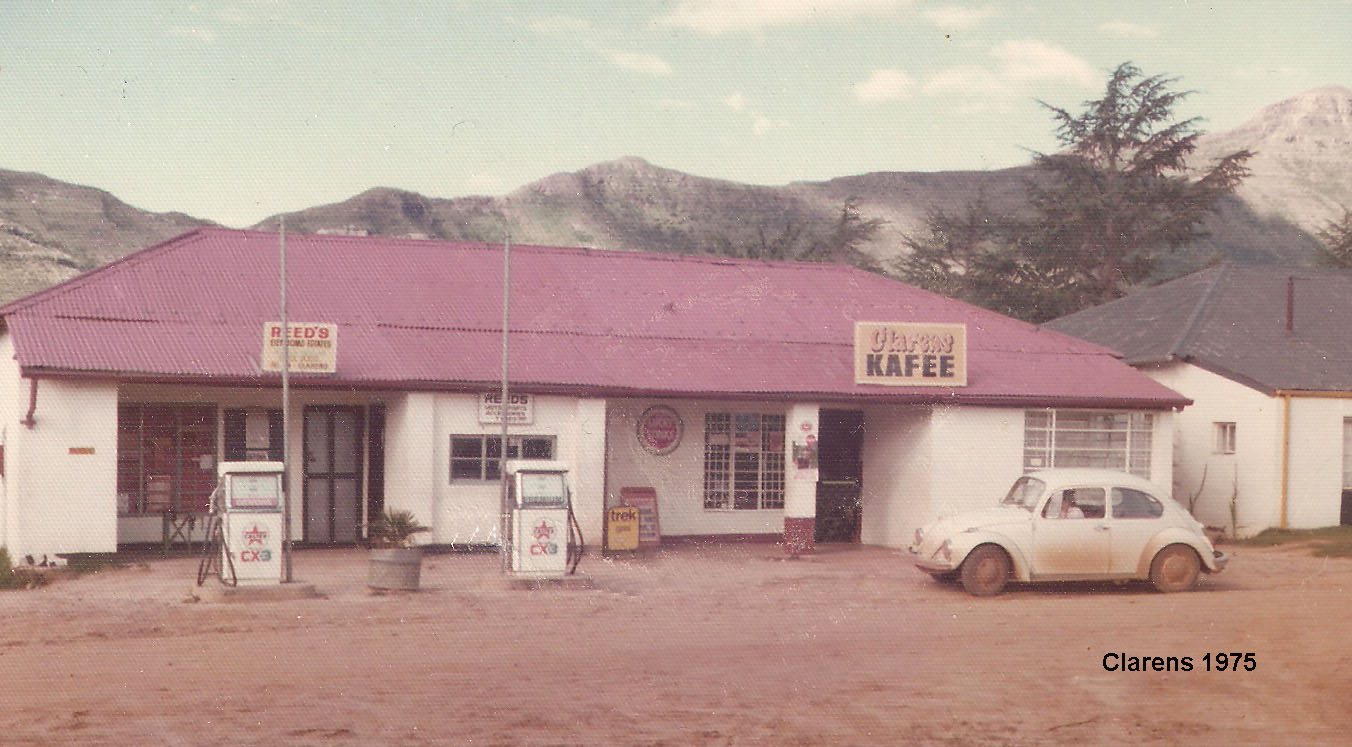
Old Clarens, before the rush. Here’s the Reed’s store and filling station.
~~oo0oo~~
laat lammetjie – afterthought child, unplanned, not to be confused with unwanted
Can’t remember Steve, did your family own the garage? I remember your dad being the mayor though. And I remember the craziest dog I had ever seen called Dennis – a cross between a Labrador and a dachshund or something! I also remember the “centrale” telephone exchange lady, who kept interrupting every three minutes to tell you how long you have been talking, and one day I got irritated, and said something like “aw shut up!” and she scolded me for being so rude! I was mortified!
You should see Clarens now! Although I haven’t been back, it’s the central art and antiques weekend getaway in the country. Quite the arty place, with hotels, B&Bs and coffee shops by the dozen.
~~oo0oo~~
I wrote:
AND – they have a brewery! One of my favourite newer tales of Clarens involves young Rod Stedall. He and Karen bought a stand, built a lovely sandstone cottage, made a good income from it for years, had some lovely holidays there and then sold it for a handsome profit. Boom! I stood and watched as all this happened, thinking “That’s a great idea, I should do something about that,” and doing buggerall.
Rod then bought a house in the bustling metropolis of Memel, thinking that would be the next big Vrystaat thing thanks to their huge vlei and great birdlife. I thought “That’s a great idea, I should do something about that!” Yeah, right.
OK, Memel didn’t happen in Rod’s time here (he offered to sell me the Memel house when he was leaving for Noo Zealand), but guess what: SANRAL are talking of bypassing Harrismith and running the new N3 past Memel. Boom time! It would be a bust for Harrismith, though, so I’m more likely to buy a house there.
~~oo0oo~~
Terry Brauer wrote:
Clarens is one of my favourite getaways in SA. Who’d have thought, Mr Reed?! We stayed in that wonderful home with the Stedalls. Had we not owned San Lameer we’d have considered buying it. Fabulous place. Fabulous hosts.
Pete, join the Brauer Investment Club. Fail. Epic fail every time.
~~oo0oo~~
A brief history: Clarens, South Africa, was established in 1912CE and named after the town of Clarens in Switzerland, established around 200CE, where exiled Paul Kruger, who some think a hero of South African independence from Britain, died in 1904 after fleeing there. He fled there – yes, fled, like ‘ran away’, a coward – after calling my great-great uncle a coward! Koos De la Rey didn’t want the war with Engeland, but when it came he bravely fought the whole war against the thieving, war-crime British to the bitter end. Sabre-rattling Kruger ran away! The swine!
A company wanting to establish a village in the area bought two farms: Leliehoek from Hermanus Steyn in 1910/11 and Naauwpoort from Piet de Villiers, situated near the Titanic rock. The two farms were divided into erven, and these were offered for sale at fifty pounds sterling apiece. And voila! – French for ‘Daar’s Hy!’ -the metropolis of Clarens, Oranje Vrijstaat was born / gestig.



























 Vrystaat Confessions