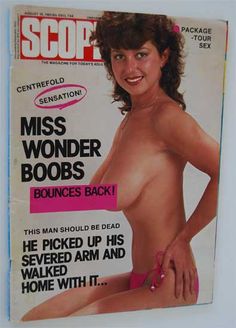
Scope magazine wasn’t always South Africa’s Playboy. Even though it was given a nice niche by the banning of Playboy and Hustler, it seemed to struggle with the intriguing question: ‘What Do Men Really Want?’
Once they got so desperate and misguided they even tried this:
– early attempt at finding popular pin-up icons –
These turned out to be not so much icons as aikonas (to gratefully steal a pun from Pieter-Dirk Uys). Sales plummeted . .
Then they hit on them at last! They had been staring at them all along:
Sales soared! In 1973 they could push their price up . . . to twenty cents! Never again would sweaty, fully-clothed, flat-chested models grace the cover of Scope Magazine!
~~~oo0oo~~~
aikona – isiZulu for ‘no way!’
failed cover – Charles Mason and Tank Rogers, winners of the 1967 Duzi Canoe Marathon!
In tiny cages. Cocky the African Grey Parrot and Jacko the Australian Sulphur-crested Cockatoo. We grew up with them and didn’t think anything of parrots in cages. Poor things.
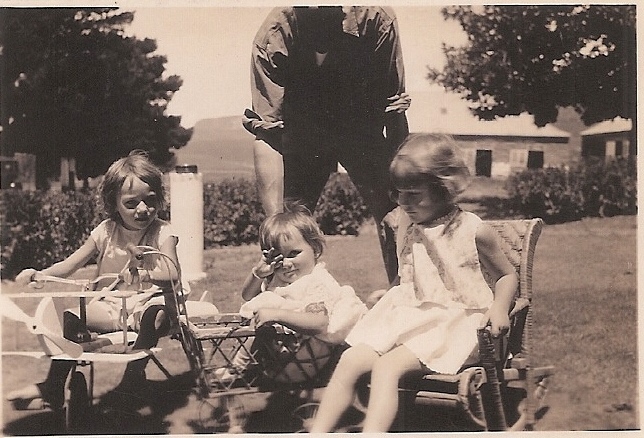
– their cages behind Francois –– Jacko on Jabula – our pedal-car was ‘Happy’ –
But when you see a free-flying one and realise Jacko never flew five metres, never mind five kilometres, it makes ya think. Friend Steve Reed ‘shot’ this one in his neighbour’s tree in Brisbane, and put it on his blog.
Also left-handed, I see – as was Jacko. Cocky was right-handed.
– free-flying in Brisbane –
I commented on Steve’s blog: So amazing to me that this can be a bird that flies free and visits you! We had one in a cage, poor thing. My old man got him from an old lady in Pietermaritzburg in KwaZulu Natal who had had it for – you know – forty years, and then he had it for – you know – forty years. These numbers don’t get reduced. They grow. And we grew up with Jacko. Who suddenly laid an egg and became ‘she,’ but kept her name Jacko. Poor thing.
~~~oo0oo~~~
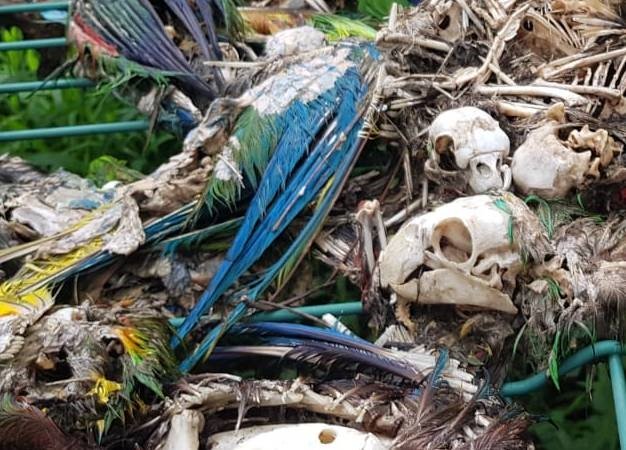
And what happened to them? “Given away” yet again. To a ‘Mnr Boshoff’ in Krugersdorp or Klerksdorp, who ‘trained’ parrots and put on shows where he would demonstrate how Jacko could ‘dance’ and Cocky could ‘talk.’ He was very well-known and that made it a good thing. Except well-known and ‘respected’ bird-cage people aren’t always what they say they are. Here’s what a raid on a parrot breeder found when the South African vice-president of the parrot breeders association’s aviaries in Randburg were raided this week: 150 dead parrots and the live birds in cages in shocking condition! Strange how almost all people who keep wild animals say how they LOVE them, but as far as I’m concerned it’s all Dancing Bears – they’re kept for money, fame, personal ego, etc. For their humans, not for the animals themselves.
~~oo0oo~~
Here they are flocking in the wild:
– thanks kidcyber.com.au –
Mea culpa: While raising kids we let them keep things in cages too! Only fair to admit that! A gerbil, a hamster, a snake.
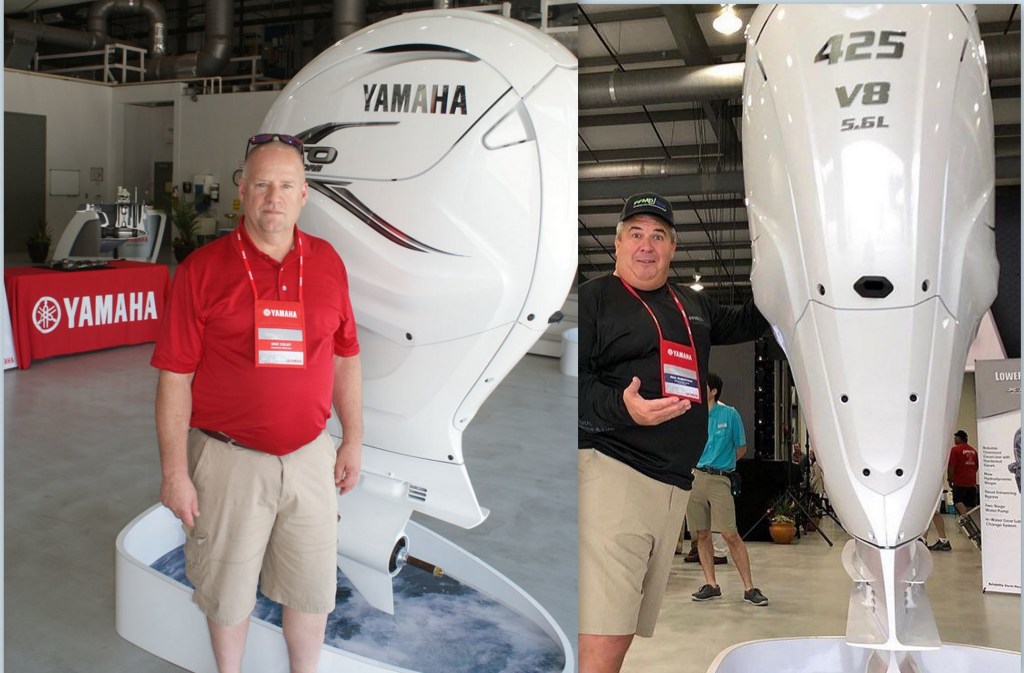
Greg Bennett told me about his latest Yamaha outboard motor over coffee the other morning – a 425hp V8 5.6litre beast. “Stands taller than me with my hand stretched skywards” he said.
– big mama –
This reminded me of the time we went out to Hazelmere to test his then-biggest outboard motor: I think it was 225hp.
I was slalom skiing behind the beast when I felt a twinge in my hamstring and immediately let go, faithful to my exercise mantra of No Pain, No Pain.
Greg whipped the boat around and roared up to me. “What’s up, Swanie?”, bellowed his big boet Roland.
I think I pulled a muscle, I said.
Roley roared with laughter. “NO! Swanie, can’t be! You couldn’t have pulled a muscle. You must have pulled a fat!” Rude bastid.
Two Springbok paddlers were watching me intently as I nimbly maneuvered my boat through the water. As I got to the gate that they were judging, I ducked into an eddy and rested on my paddle, getting my breath back and having a chuckle at how clumsily I had bashed through the last gate.
And this is where it turns nasty. Instead of shouting admiration at my skill and encouragement for me to ‘Keep It Up!’ or “Well Done!” or something, they bellowed, while hosing themselves rudely: ‘Don’t worry Swanie, we’re not using a stopwatch, we’re using a calendar.”
Put me off my stroke. Kirby and Stewart carry the heavy responsibility of probably ruining a promising international slalom paddling career.
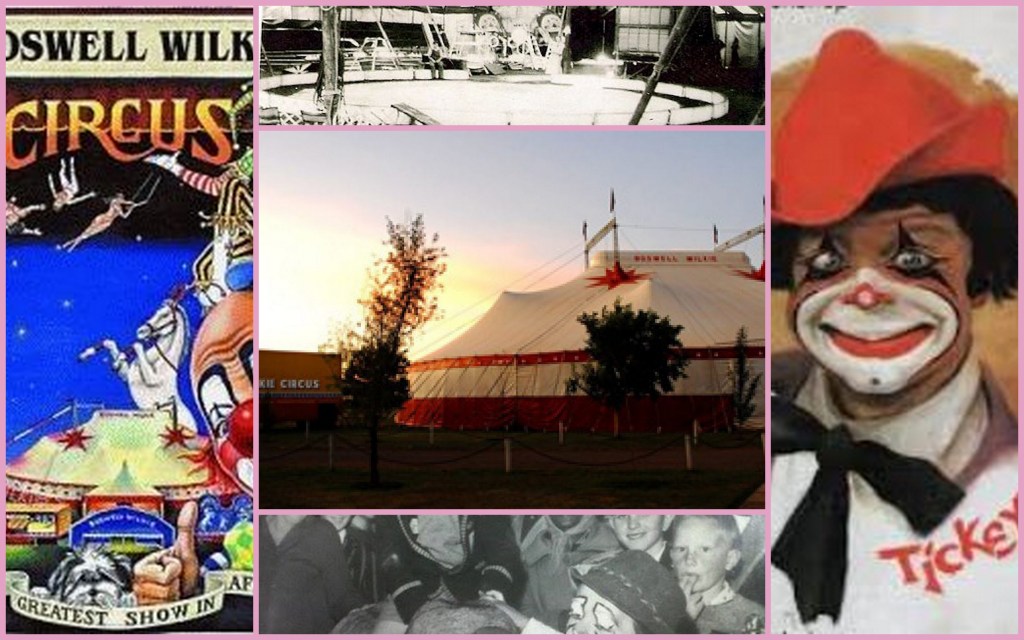
The old man inviting me to go someplace! How’s that!? I hopped into the old faded-blue VW Kombi OHS 153 with alacrity. This sounded interesting. We never went to the railway station. We’d go near there to the old MOTH hall and occasionally to the circus field when the Boswell & Wilkie’s Big Top was pitched there! But never to the station itself.
‘We’re fetching a family from Italy. The father is coming to work at the Standard Woollen Mills and they can’t speak English,’ says the old man. He picked up Italian in Italy around 1943 to 1945, first wending his way up the Adriatic coast in the Italian campaign and then later on involved in the post-war stuff armies do after the end of WW2, y’know, loafing, eating, drinking, before flying home, having traveled the length of Italy south to north and into Austria.
He kept up the language over the years mainly by fraternising with Boswell-Wilkie** circus folk when they hit the Vrystaat vlaktes on the circus train and pitched the Big Top next to the railway line on the west edge of our famous dorp.
This exciting station trip was in 1965 or thereabouts. So we got to the stasie, the train rolled in, and there hanging out of a window was a family of four: Luigi, Luigina and two sons about my age, fresh from Italy out. They were probably staring at my bare feet. But I’m just guessing.
– we met Claudio with some fanfare – maybe not this much –
I carried one suitcase to the kombi and then from the kombi into the Royal Hotel, where my great-uncle Smollie Bain was the barman. His Dad owned the hotel and I think he stayed there all his life.
– the Royal – here’s where we took Claudio to stay – it was shortly after this photo was taken –
Soon Claudio and Ennio were in school, Claudio a standard below me in sister Sheila’s class, and Ennio a standard or two lower. They got a house in Wilge Park and so started many happy visits and sumptuous Luigina meals with the Bellatos – I can still picture her kitchen so clearly. And sundry happy adventures with Claudio.
~~~oo0oo~~~
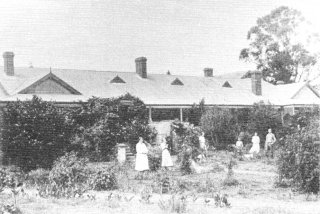
The only time before this anything Italian might have rolled up at Harrismith stasie might have been these Italian things ca. 1914.
~~~oo0oo~~~
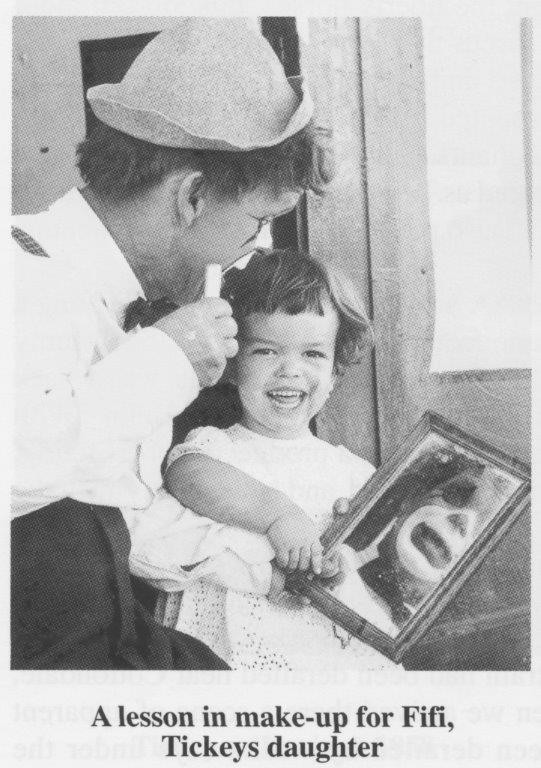
** Boswell-Wilkie Circus: Every few years for a while we would suddenly have clowns, lion-tamers and acrobats in our home! They all looked very ordinary, frankly, in their normal kit; except Tickey the clown. He and his daughter were instantly recognisable even without make-up because of their small stature and strong faces.
~~~oo0oo~~~
Ah! Claudio read it and responded with compliments and corrections:
‘Excellent Koos. The year was 1967 – 24 March. Otherwise pretty accurate. A good read and great memories. ** laughing emoji – thumbs-up emoji ** Well done.’
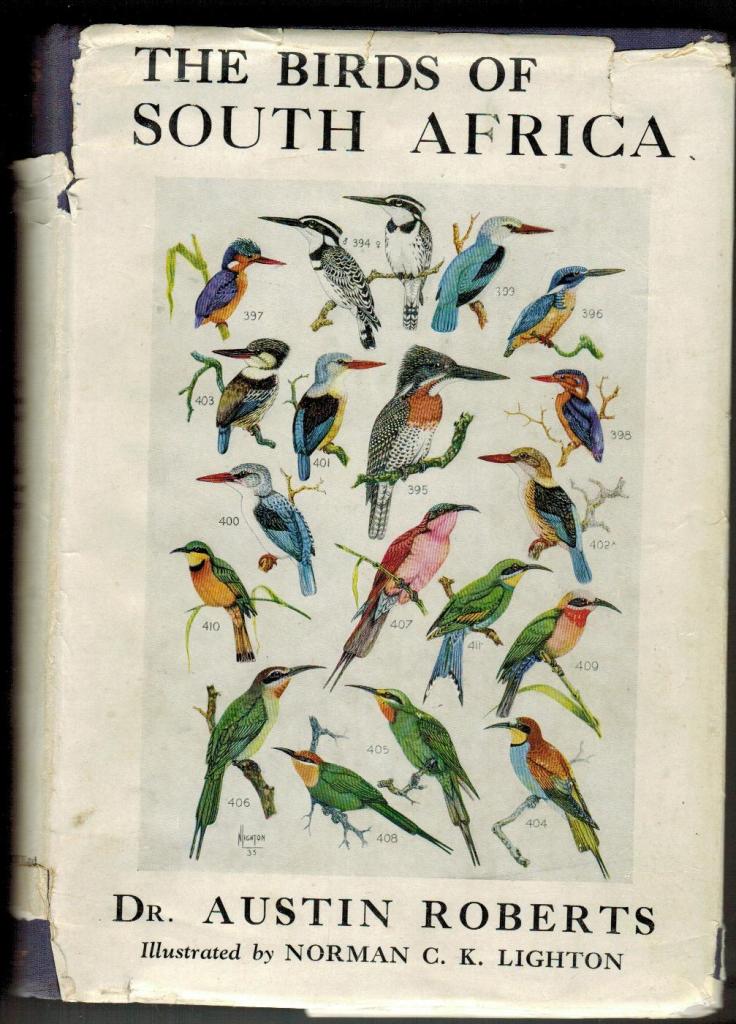
We grew up with Roberts Bird Book in the house. First edition, but about the sixth impression. It still had its dust jacket with the kingfishers and bee-eaters beautifully depicted on it. Mom and Dad still have it – I took this pic at their home in Pietermaritzburg. We also had a newer McLachlan & Liversidge edition of ‘Roberts.’
Here’s the plate I turned to in eager anticipation after hearing a wonderful and startling nocturnal call while camping in the dennebos with Stephen Charles Reed:
~~~oo0oo~~~
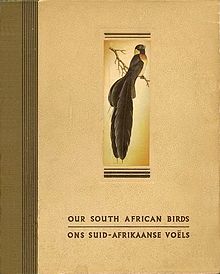
Another bird book on the shelf at 95 Stuart Street. This one you collected cigarette cards. Keep smoking till you have the complete set!
ROBERTS, Austin | Our South African Birds Johannesburg and Cape Town, United Tobaccos Cos, Westminster Tobacco, Policansky Bros 1941; hbk, 25×21 cm, 106pp, colour illus with 150 cigarette cards and five colour frontisp.
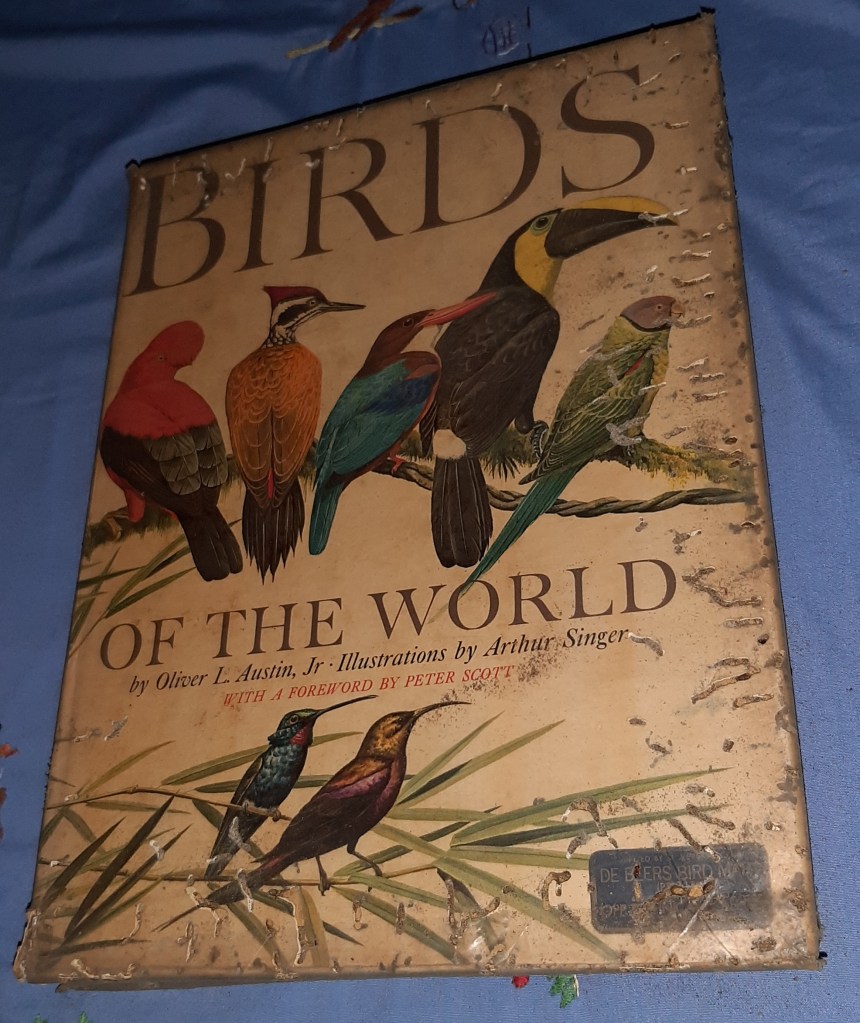
~~~oo0oo~~~ Later this beauty arrived. Published in 1961 we got it some years later:
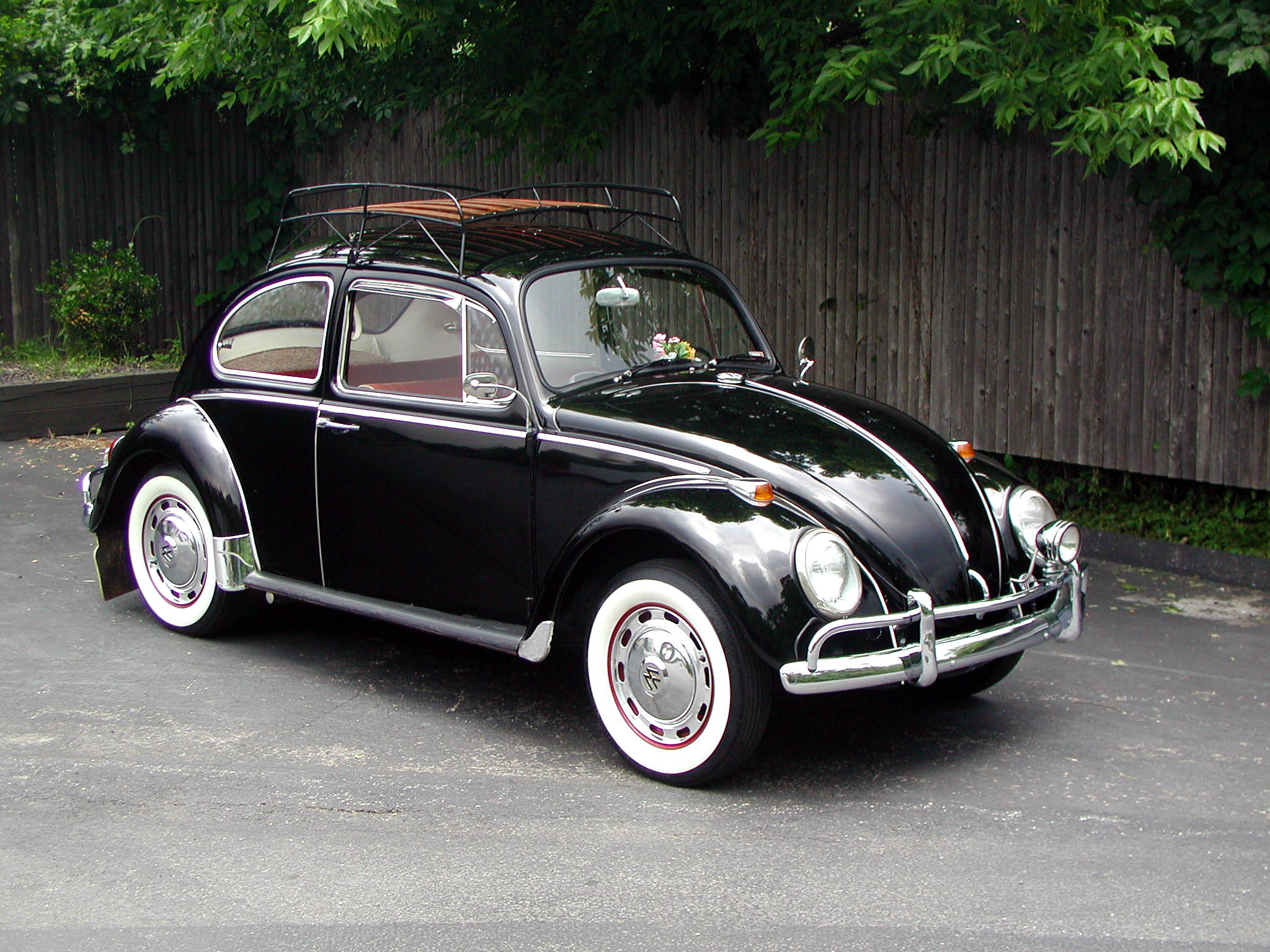
My gran Annie’s Caltex garage in Harrismith had a filling station, a restaurant on the forecourt, a workshop behind – and the VW agency. My gran Annie sold VW Beetles!
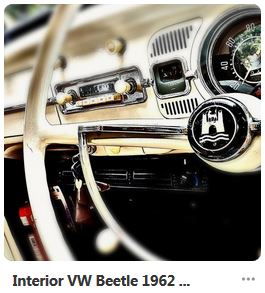
– Platberg bottle store, Annie’s garage, Flamingo Cafe & OHS 155 – the little light-blue beetle – ca.1959 model –– interior of a ca.1959 VW Beetle –
toy models
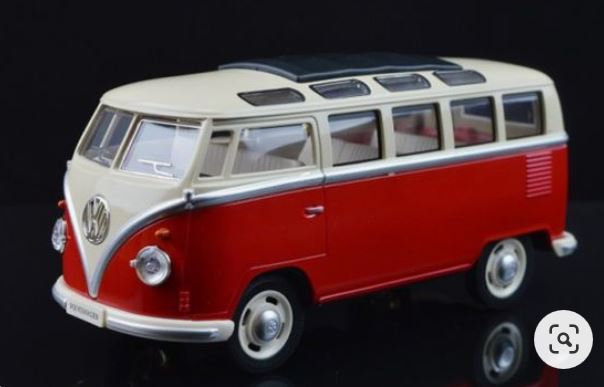
One of the perks of Annie having a VW dealership was Volkswagen’s toy models of their cars & kombis. They were fascinating! They had moving doors, flaps, engine covers, side loading locker in kombi pickups; some had a clear sunroof that clipped off. Something like these:
At one time – I don’t think I’m imagining this – the VW Beetle cost less than R1 per cc: The 1200cc engine model cost R1199. Let’s check: A VW Bug in the USA was around $1563; A US dollar cost us 72 SA cents – Yep, about right.
A long concrete ramp lead up into the workshop behind the Flamingo Cafe. At Truscott was the mechanic – I remember him as small, bald and kind. I remember the big jacks that lifted the cars; the lights they shone into the engine bay – an incandescent bulb in a cage to protect it, with a 220V cable dangling behind it; There was a high ‘shelf’ overhead – above the wall of the ‘office’ inside the big shed-like workshop on which lots of tyres were stacked; The wooden workbenches were full of interesting vices and spare parts and grease.
One of Annie’s forecourt attendants was Joseph Culling. He was a son of Sgt Culling, who was demobbed in 1913, when the British finally left Harrismith after the Anglo-Boer War. He had been stationed on Kings Hill and unlike most of his fellows, he stayed behind and married a local Harrismith lady. In the apartheid classification of the day that immediately – and magically!? – made his children ‘coloureds.’ I remember him with the leather coin dispenser satchel on his hip, the strap holding it slung around his neck and shoulder, wearing a Caltex cap.
~~~oo0oo~~~
Back in the sixties, many of us, of course, also had an inordinate fondness for the beatles . .
‘Mom! Dad’s in pain,’ said Mary, out of breath. She’d run up to the Caltex garage in Warden Street. Annie drove her back and took her husband Frank Bland to Frank Reitz, his friend, rugby team-mate and physician/surgeon. Gallstones, a gallbladder op was needed, came the verdict from our highly-regarded England and Germany trained surgeon.
Mom was fifteen, ‘about to write my JC‘ – std eight, grade ten – it was 1943. Frank did the op and sent Frank home to convalesce at 9 Stuart Street, his mother Granny Bland’s home, his pain considerably eased; but he was weak, recovering slowly.
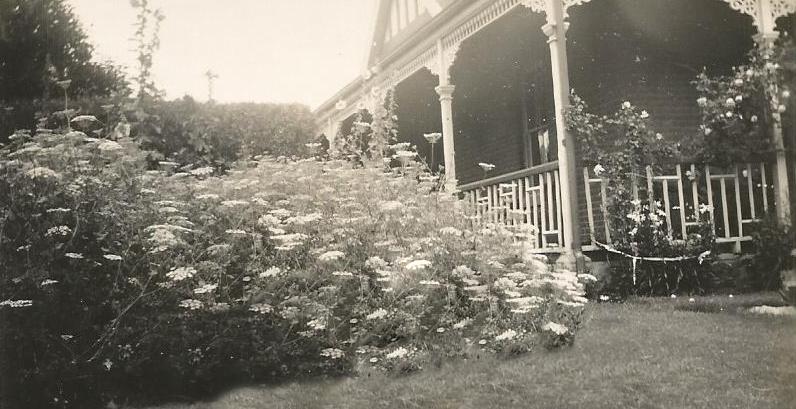
One Saturday morning he walked out to the wisteria-covered outside toilet, about twenty metres off the back veranda. Granny Bland watched him walking back, hand on hip as she always stood and wearing an apron, as she always did.
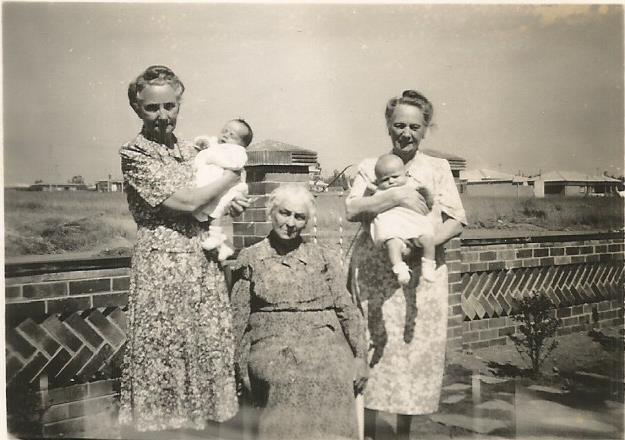
– Annie, Granny Bland, Jessie –
She spoke to him and he didn’t answer her. That was unusual. When he got to her he collapsed and she caught him in her arms before he could bang his head. They had no phone; it was a Saturday, Annie was at work, eldest daughter Pat was away nursing in Boksburg-Benoni. This time Mary didn’t run to the garage, they must have sent someone else.
‘Poor Dr Reitz,‘ says Mom, ever empathetic. She knows he would have hated it that Frank didn’t recover fully. She speculates that a bloodclot to the brain did him in. The funeral was soon after. Annie told Pat not to come down, and she and Mom stayed at home. After the funeral people came around to tea and to pay their respects. Annie didn’t do funerals.
~~oo0oo~~
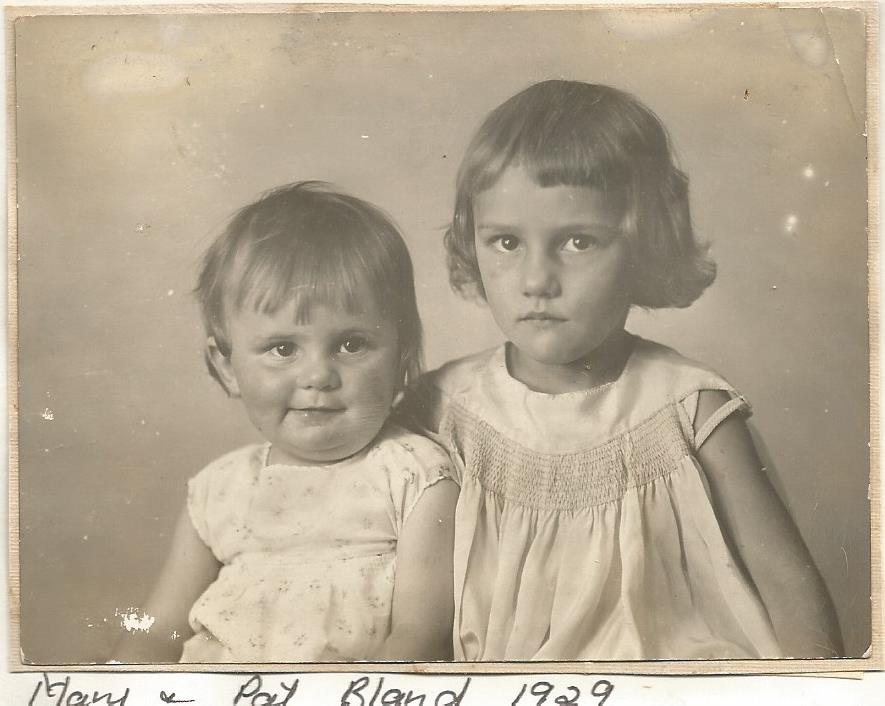
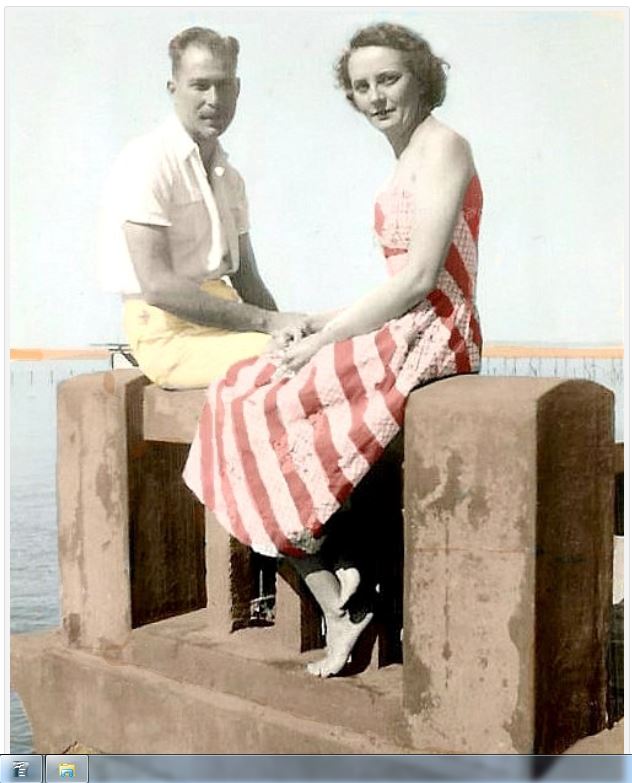
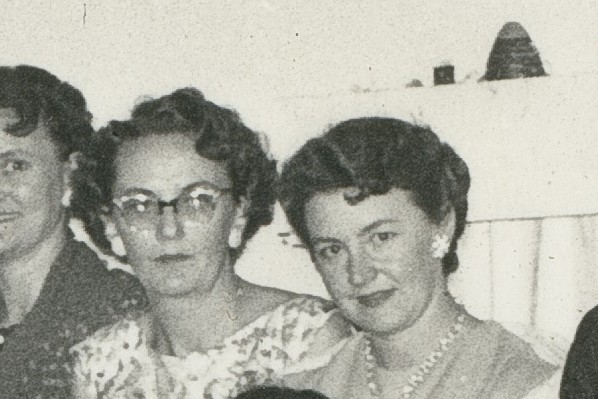
The only picture of Frank Bland that I have doesn’t quite include all of him. It does have his daughters Pat and Mary, and older niece Janet Bell.
– I’ve just noticed Pat is on an aeroplane! –
Soon after, Mom’s dear friend Dottie Farquhar’s father died. Then Jessie’s husband __ Bell died. Jessie was Annie’s older sister and they lived in Dundee down in KwaZulu Natal where he was a dentist. Maybe the only dentist? Jessie then also came to stay with Granny Bland. Three widowed ladies.
Granny Bland had lost her husband John Francis Adam Bland II, and now she’d lost her son, John Francis Adam Bland III. Only one of her five sons survived her.
~~oo0oo~~
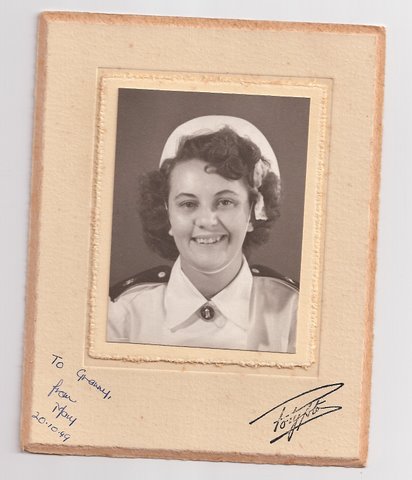
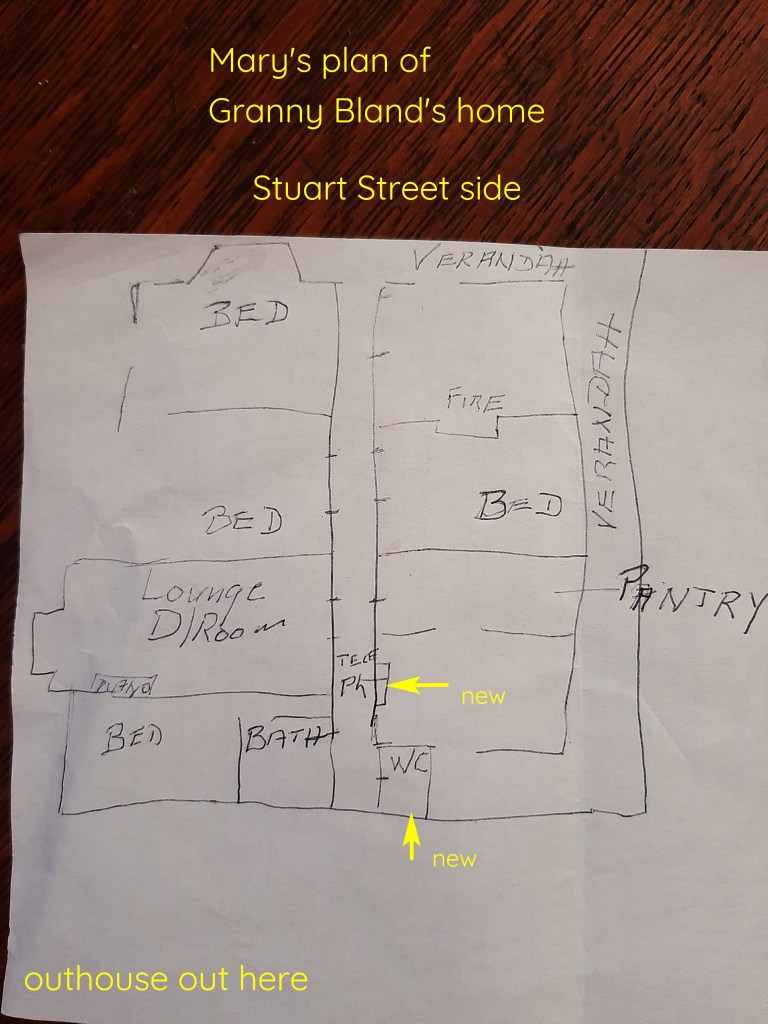
When Mary aged eighteen came home on her first leave from the Boksburg-Benoni hospital where she’d also started her nursing, a phone had been installed in the house! Where? I asked. She showed me:
















































 Vrystaat Confessions