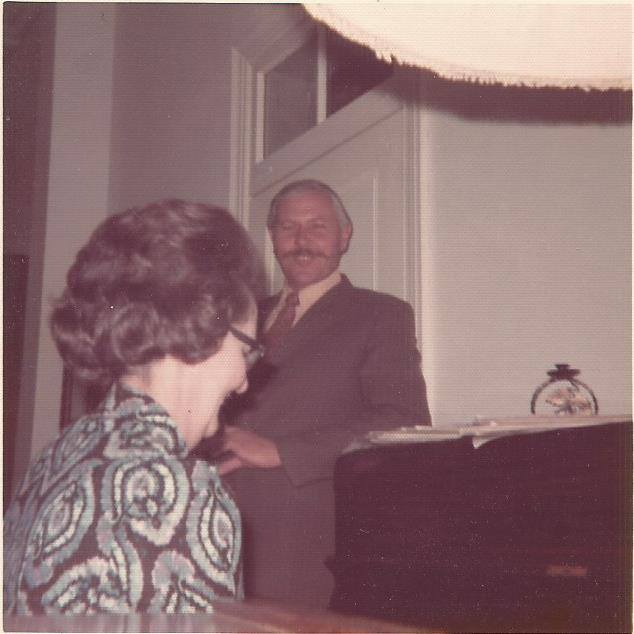
Mother Mary would play the Bentley upright piano in our lounge. My childhood was filled with sublime music emanating from down the passage. My memory bank is filled with wonderful sounds that bring back mostly happy memories! At 91 she now plays her popular pieces from memory. Her classical pieces she would read the music – she can’t see well enough to do that anymore. Sister Sheila has recorded many of her popular songs, but we have few of her classics. A great pity. SO: I have invited some lesser (! – I am slightly biased) pianists to play in her stead. Thanks to them and to youtube we can hear the music again!
After Maritzburg College, Dad joined the General Post Office as an apprentice electrician. He recalls leaving school on 1st April 1938. Here’s a spirit level he was issued that day:
– Spirit level – Wilson Lovatt & sons Wolverhampton –
While he was still apprenticing, he tried to enlist to join the WW2 war effort, but was sent back. He was sent to the Himeville/Underberg area with a GPO truck and a sidekick called Freddie to do his bidding. Later he was transferred to Harrismith – which fell under Natal for the GPO although it was actually in the Orange Free State – from where he again made his way to Durban to try and enlist, and was again sent home, finally being allowed to join after Oupa reluctantly signed his papers. He left for ‘up north’ in 1941.
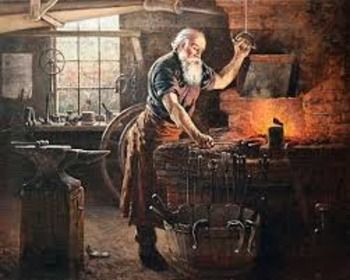
While in Harrismith ca.1940, he met old Mr Buckle the Blacksmith down in McKechnie street, near the railway station. He was from England.
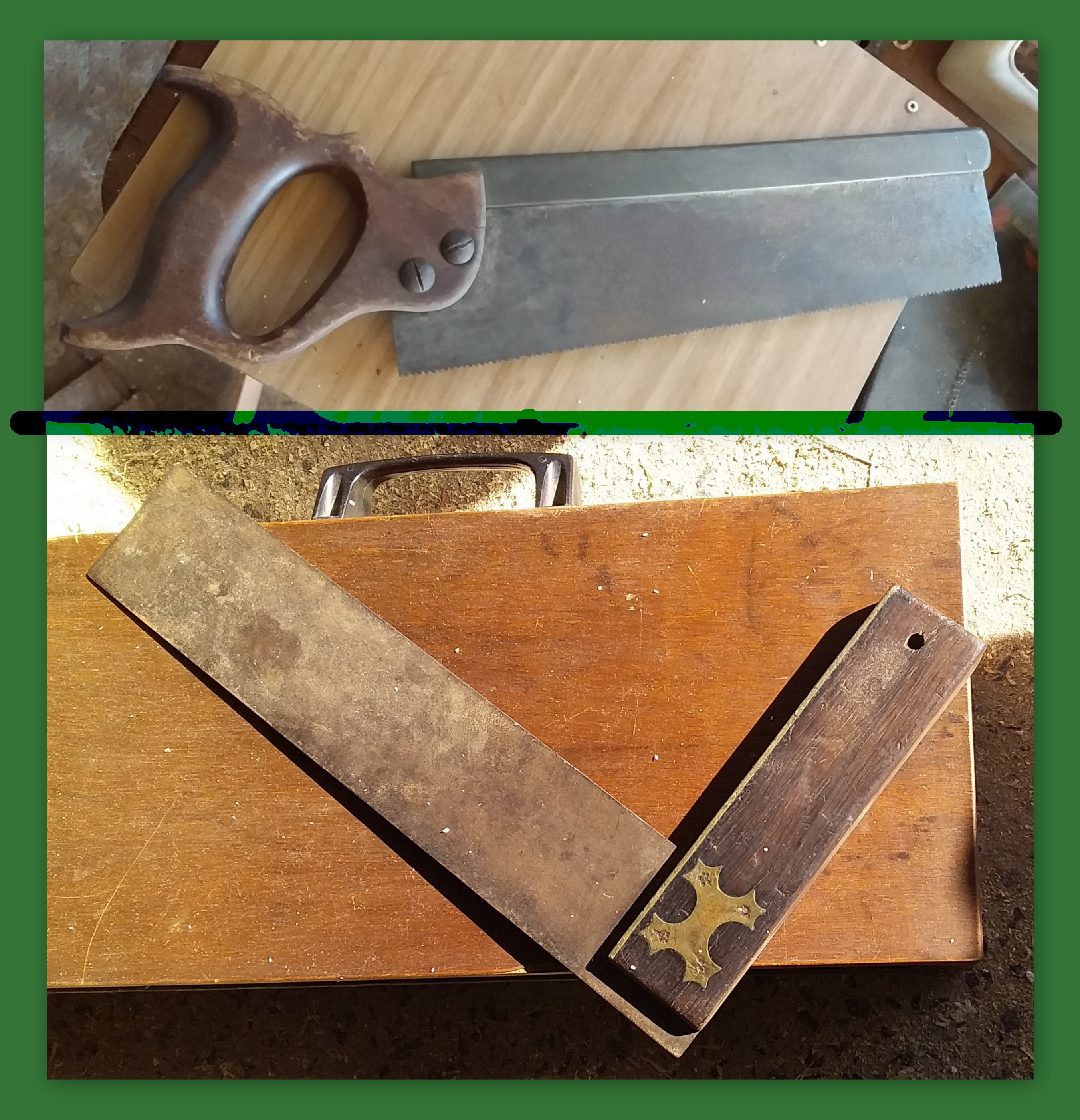
He ended up with a few tools from old man Buckle: a back saw and a set square with a beautiful brass inlay and brass leading edge.
After boarding at the Royal Hotel, whicvh had stables, Dad moved to a plot outside town – townlands – west of town on the Wilge River, downstream of town. There he bought horses, schooled them and sold them for a profit. I assumed he’d had them shod by Buckle but he corrected me. Buckle was a blacksmith, upholsterer, wheelwright, wainwright and wagon-maker. He didn’t shoe horses. That was up to Charlie Rustov, Harrismith’s only farrier.
From his plot on townlands out west of town** he would ride out to Boschetto Agricultural College for Ladies on the slopes of Platberg, the mountain that dominates the town. Boschetto was where the girls were. They were the main buyers of his ponies. The first time he went there, he met the formidable Miss Norah Miller, the founder and principal. Luckily for him she needed a few pictures on her office wall. He was able to help and so became a firm favourite of hers from the outset.
While he was telling the story Mom remembered a story about Norah: She knocked on someone’s door. Whoever answered went back and was asked ‘Who was there?’ They said, I don’t know, but she’s got one eye, one leg and a hell of a cough! Norah had one lens of her glasses frosted out, she wore a leg brace (probably childhood polio?) and smoked like a chimney. When her leg brace buckled, Dr Frank Reitz made her a new one. A better one. He would have loved that challenge. He was a hands-on fixer.
~~o0o~~
Harrismith author Leon Strachan found some fascinating info on Norah Miller’s leg – it was not polio. His source, Isobel Kemp (Dr Frank Reitz’s receptionist for thirty years. Isobel knew everything): It was probably osteoporosis resulting in a hip fracture in 1928, only six years after she established her college. Usually this would have resulted in incapacity and excruciating pain, but Norah was in luck: she was in the right place at the right time, and knew just the right man, bold innovator and pioneering surgeon Frank Reitz, trained at Guys Hospital in London (where he received a surprise visit from older brother Denys Reitz), then did surgery specialisation in Germany.
He operated and joined the femur using an ordinary screw to hold the femur ends together! This technique would only become common decades later, in the fifties. Thirty years later she was still walking – with difficulty, but still mobile, and in charge of her college. When Cedara took over Boschetto she moved there, where she died in 1959, aged 79.
~~o0o~~
Aug 2021: Ole man phoned me. He found some (one? more? maybe the one I photographed above?) old ‘tri-squares’ with handles made of ebony with brass inlay. Do I want them? I bought them in the late 40s and Buckle was already an old man, maybe eighty. So they are probably 100yrs old. Hell yes, I’d like to have them!
~~o0o~~
** Old man bought his first townlands from old Englishman Bill Mundy. On the right bank of the Wilge river downstream from town; out on the road that turns south towards Swallow Bridge after leaving the west edge of town below 42nd Hill.
I know little about my ancestors, so when a friendly Essex wideboy who is into genealogy liked one of my posts and spoke about an ancestor’s challenge, I thought I’d attempt a more modest challenge: Learn about family whose names are very familiar to me, yet I know very little about them.
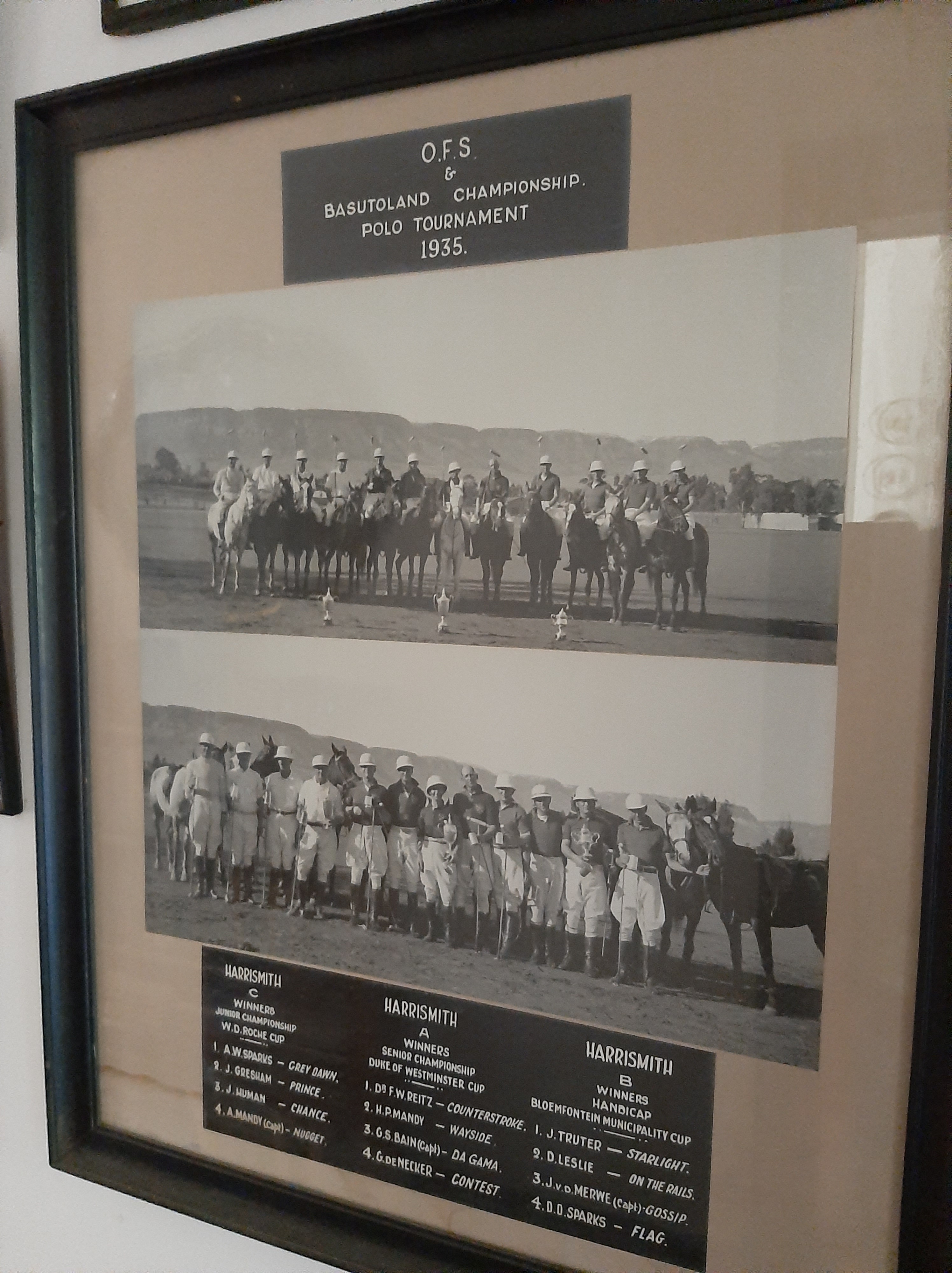
Another prompt came from Texas, when old mate Free State Texan JP du Plessis asked, ‘Is GS Bain your great uncle?’ when he spotted him in a polo team with Dr Frank W Reitz.
Yes indeed, I said and so I’ll start with Ginger Bain, who I have written a little bit about before – about how his rugby genes were passed on to his great-great-grand-nephew. I notice he rode ‘Da Gama,’ captained the side and, the tournament being in Harrismith, Free State, they naturally won the ‘Duke of Westminster Cup.’ Right. Who’s the Duke of Westminster?
And did they use only one horse in those days? By the time I watched polo in Harrismith thirty years later, I thought each player had four horses at his disposal? Ah, I see the rules say at least two, up to four – ‘or even more.’ A lot of polo rules seem to be ‘by agreement.’
Ginger Bain was the first-born son of Stewart Bain and Janet Burley, who owned the Royal Hotel in Harrismith. Stewart had come to South Africa from Wick, a tiny fishing village in NE Scotland. Accompanied by his brother James, they ended up building bridges for the new rail line extension from Ladysmith to Harrismith. I speculate how that may have come about here.
If it wasn’t for Arthur Kennedy the ladies of Harrismith would have had a more boring Republic Day in 1961. They would only have seen kids waving flags and men on horseback. Thanks to Arthur there was also a strapping male physique in a tight-fitting white leotard with a bulge in the broek. No ways the komitee vir die viering van hierdie groot dag would have arranged that. That needed Arthur Kennedy.
Here’s footage of the goings-on down at the pawiljoen in the President Brand Park that day. Preserved thanks to the old man Pieter Swanepoel filming it back then with his 8mm Eumig cine camera, and preserved thanks to his daughter Sheila recently having it digitised:
~~~oo0oo~~~
wappering – waving, fluttering
broek – trousers; leotard
komitee vir die viering van hierdie groot dag – prize committee to be on; demonstrated status and power; you got to have input into the celebrations of the day South Africa left the British Commonwealth – uiteindelik! You did not, on said committee, suggest that all South Africans be allowed to be present; if you had those kind of thoughts you would not be on the said komitee
uiteindelik! – at last! Free At Last! Thank Goddlemydee Free At Last!Oh, no that was Martin Luther King Jr
A lovely post on Women in Ornithology by ornithology historian Bob Montgomerie led me to thinking about Women in – well, My Working Life.
First there was Mom. Mary Methodist. In the Platberg Bottle Store. And Annemarie Maeder, also in the bottle store with Mom. Mom ran the shop, ran the home, played the church organ, was a member of the church Women’s Auxiliary and the MOTHs MOTHWAs. Always involved and ready to help. Annemarie, too, ran her home with husband and three kids.
In the background, too, was our ‘panel of Moms’ – Moms of all your friends. Prominent ones were Jean Coleman, Joan du Plessis, Joyce Joubert, Polly Crawley, Harriet vdMerwe, Emma Morton and others.
Next were women in Apache Oklahoma – all working, all capable: Carol Crews, Joyce Swanda, Katie Patterson, Jackie Lehnertz, Virginia Darnell, Odie Mindemann, Pug Hrbacek, Janie Payne, Peggy Manar . .
When I started my first own practice in 1981 up on the seventh floor of Eagle Building in Murchies Passage between Smith and West Streets in Durban, there was Merle Oosthuizen. I walked in as owner and boss and was lucky enough to have Merle recommended to me as a ‘receptionist.’ Well, ‘receptionist’ indeed. Where’s the appointment book? she asked. Appointment book? I said. The receipt book? Receipt book? She soon twigged my capabilities and knowledge and quietly took over, becoming the Practice Manager and the Me Manager.
Where are you staying? she asked the first day, when she learned I’d just come out of the army. Oh, in a residential hotel, I said. She nodded, satisfied. Some weeks later I breezily told her I’d rented a flat. Do you have a bed? A bed? Bedclothes? Bedclothes? Um . .
Of course she could spot easily how this child masquerading as a man hadn’t a clue. She bought all the above and more for me; and she had all the stuff you need to live a bachelor existence delivered to the flat by the bed and furniture sales people. My first duvet, a kettle, a toaster. Even a fridge.
She was so organised I could say casually to anyone who asked: ‘Oh, I have it all under control. No worries,’ as she organised my practice and my life.
She ruined me. Ever since then I have had capable practice managers run my practice and my life – and I have consequently learnt very little myself. I simply do as I’m told. Later on, twenty six years with Aitch just re-inforced that pattern at home, too.
My usual response to their pointed suggestions along the lines of roer jou gat is, ‘Um, Yes of course, I was just about to do that . . ‘
Uncle Cappy was a mentor to his three sons and to many others around him. He was a huge influence in my life. He taught me how to play cricket, how to rough-and-tumble, how to BE THERE for your family; how to do the right thing. And – big lesson in HS where the opposite was revered – that you did not have to be skynheilig to be good.
As Mobiloil’s representative in the district he had new cars every now and then, which were cause for great excitement. His winged green Zephyr 6 Mark III (made 1962-1966), then his stompgat gold Zephyr 6 Mk IV are the ones I remember best.
– Cappy Joubert’s Zephyrs – internet pics
His job with Mobil took him all over the countryside, visiting farmers and the depots, so he knew the back roads around Harrismith – and sometimes he’d take us along.
He was always available to help: With sport, with Sunday school, with church, with lifts to sporting events, being Father Christmas, arranging picnics, organising games at the picnics, umpiring cricket, playing cricket, coaching cricket;
I was raised by my Mom and her Mom Annie, so was in danger of being pieperig, as they were gentle, quiet ladies. Thank goodness for frequent visits to the Jouberts, with rugged Uncle Cappy, three tough boys and – the toughest of them all – Aunty Joyce! Cappy would show you exactly how to hold a cricket bat; he would warn the boys and if they didn’t listen, physically wrestle them to the ground and donner them. I remember Etienne wrestling back, squirming, protesting and not giving up, and Cappy holding him in a vice grip on the grass until he conceded! When Etienne went one step too far for Joyce in trading chirps and talkback, Joyce would finally get to the point where she’d lean forward from the waist and jeer, ‘Etienne Joubert met ‘n bek soos ‘n skȇr!’ LIVELY action at the Jouberts!
Typical older brother, Etienne would try and get youngest of us all, Deon to do stuff, pushing the little one into taking the risk for our reward. Once when Deon refused, he said, “Chicken!” and Deon instantly and heatedly responded “I aren’t a blerrie chicken cos I aren’t got fevvers!”
Full of jokes and ‘streke,’ I wouldn’t be surprised if it was Aunty Joyce with her Cape accent – she pronounced the Afrikaans ‘so’ as sue, not sewah as we did – that put Tuffy up to this prank.
~~~oo0oo~~~
I wrote to his eldest son Etienne one fine morning, soon after Uncle Cappy had died peacefully in his sleep on his ninetieth birthday:
Et
I was lying in bed this morning listening to the birds and de-fragmenting the hard drive in my head when this popped up on some old grey cells:
Knyptang innie broeksakDinamiet innie gatsakVOORWAARTS die Ossewa Brandwag!
Also then, of course you have to remember his song on a moonlit night:
O, die maan skyn so helder . .
. . op my POEPHOL !
He was a huge influence in my life. A very good ‘normalising’ influence to go along with the more conventional, narrow influences!
I’m sure you can remember much more.
~~~oo0oo~~~
Koos,
Yes, he did rather have many funny little sayings.
Hou die blink kant bo was another favourite.
The ‘knyptang’ one he’d say aloud in the yard so that Eben Louw could hear.
“C’mon guys, let’s play the game.” That would be when us children were arguing.
He based a lot of his life’s philosophy on Cricket & the fairness & unfairness thereof.
When he drove me to Pretoria to start in the bank he reminded me:
Never over dress or under dress.Do not drink on your own.A gentleman leaves the club before seven.
I miss him often in sticky situations.
Have a great day Koos.
Etienne
~~~oo0oo~~~
Uncle Cappy widened our horizons where school and others tried to narrow them down. He showed us how you can be thoroughly decent and also naughty! So many skynheilige people who weren’t a patch on him would NEVER swear in front of us boys, but Cappy did – with a twinkle in his eyes. Now, mind, he never swore in front of us in front of Auntie Joyce! That’s for sure! That mischief was for boys-only gatherings.
~~~oo0oo~~~
As he was Mobil and Annie – my gran – was Caltex, those were the ONLY fuels we would even THINK of using in our cars. Our non-existent cars. We would NEVER use Shell or BP!
So when one day we were in his car at the fuel depot and we saw a Caltex tanker filling up from the BP tank we were MORTIFIED!! What!!?
Cappy calmly set our minds at rest, ‘All fuels are basically the same,’ he said – to our loyal mystification. ‘It’s the additives we add afterwards that make them different,’ he explained.
We were half-mollified.
~~~oo0oo~~~
   'You never forget the people
who were kind to you in childhood'
- PD James, English detective novelist
skynheilig – pseudo-holy; fake
stompgat – short tail
pieperig – a softie
Etienne Joubert met ‘n bek soos ‘n skȇr! – ‘Etienne bigmouth’
streke – waggery; jokes; pranks
knyptang, etc – the Ossewa Brandwag was a racist, anti-semitic, anti-British and pro-German organisation in South Africa during World War II. Justifiably angry at what Britain had done to them in the Anglo-Boer war, they over-reacted churlishly. Cappy had volunteered for the war and gone off to battle; on his return his church spurned him for wearing his uniform, so he joined the Methodists – the Methodists’ gain.
O, die maan skyn so helder – romantic: the moon shines so brightly
. . . op my POEPHOL ! – on my arsehole ! The sting in the tail of his mischievous ‘romantic’ song!
Hou die blink kant bo – keep smiling; look on the bright side
Des is a mensch. He’s a gentleman and he has good intentions.
He’s in a serious marriage and under strict starter’s orders. The thing is Des has a bit of a dodgy handbrake. Even when pulled up tight it can occasionally slip and he can lurch forward a few steps and then all hell can break loose and you don’t know if he’ll be able to stop.
So Hector Fyvie being a legend and him being a nephew, Des got written permission to go to Uncle Hec’s funeral and straight back. Promise.
It was a lovely funeral and lots of people were there celebrating the life of a very special man. Now it was time to go home, and Des was definitely going to leave as he had clearly undertaken to do. Honour bright. And he would have . .
But there were Vennings and Fyvies and Leslies and other people there and a strong case was put forward for Des to stay for the wake. The after-gathering was naturally well-catered with sustenance and libations – Aunt Stella, Gail, Ian, Skig and Tabbo always do things right. Still, Des refused to relax and partake, which made the exhortations stronger. With friends like this . . .
He raised himself up, closed his eyes and tilted his chin up in that way he does and made a small speech, one of many we have heard from Des:
“You guys”, he said. “Jy weet: Een is genoeg, Twee is te veel and Drie is te min”and he agreed to have Just One. Just. The. One.
So we knew he was staying for the duration.
– unlike the hooligans, Des kept his jacket on, ready to depart in the getaway car at any moment –
Een is genoeg, Twee is te veel and Drie is te min – “One martini is all right. Two are too many, and Three are not enough” – James Thurber
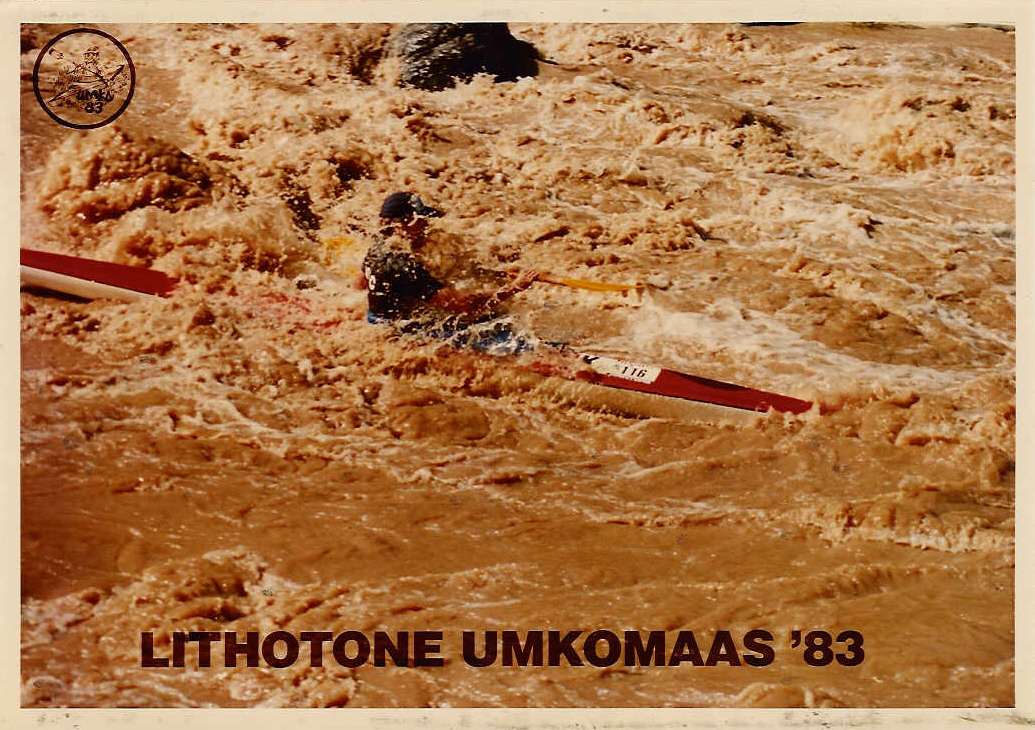
There he goes, no lifejacket, as was the way those days.
. . another guy might be wearing full lifejacket and helmet but he’d be disqualified: wasn’t wearing his club colours! Such was ‘safety’ and ‘decorum’ back when ships were made of wood and men were made of iron!
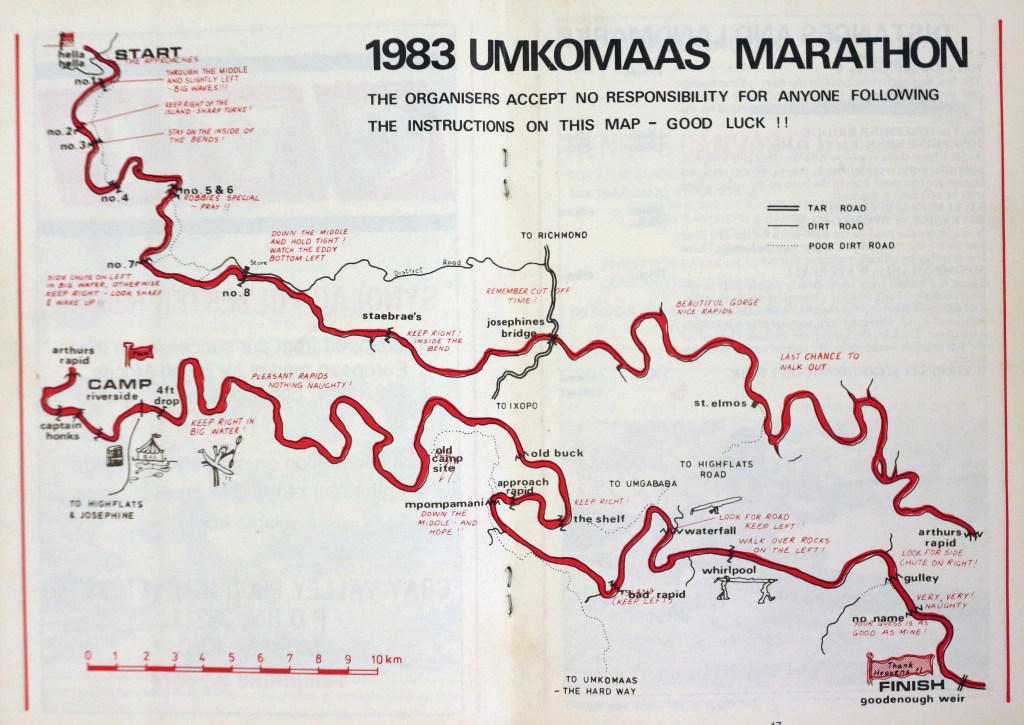
map 4
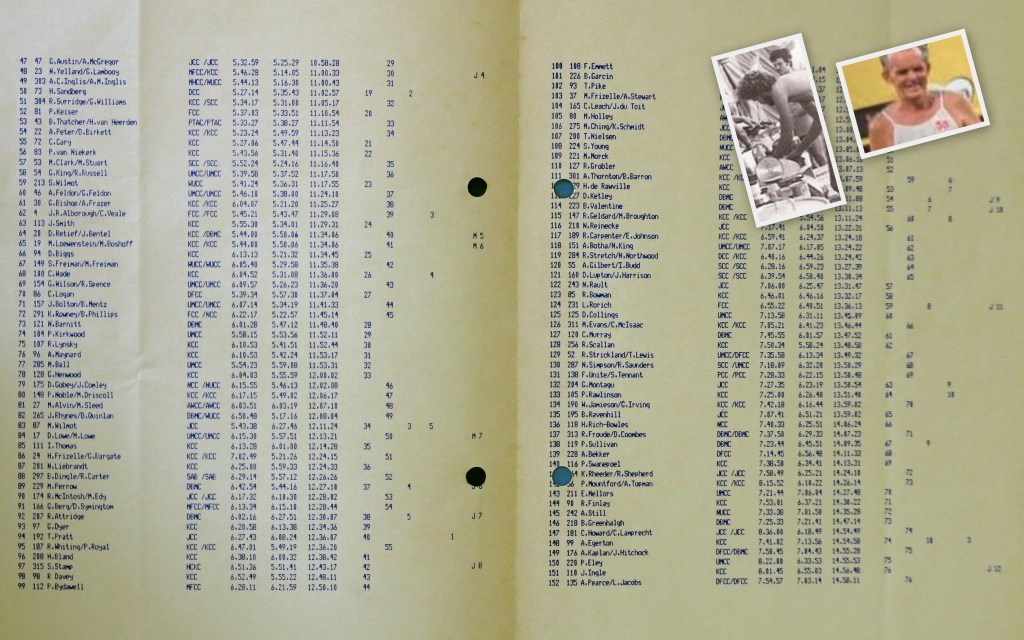
I roared in 140th – looks like 152 finishers, but maybe there was another whole page? Can’t tell – the first page is also missing so we can’t see who won. I know Chris Greeff won the singles. I spent a long time training him in the bar till late at night when the GO TO BED!!s built to a crescendo and we politely thanked Jesus, downed a last beer – and did as we were told. This was Jesus, or Dave Williams, of course, the saintly Umko barman.
– 1983 Umko results with pics of Jesus – when he shaved they started calling him John Cleese –
Hang on, the other page was given the wrong year. Here it is: 1983 results: 162 finishers out of 263 starters. Pope won with Tim Cornish. Chris was 6th and first single.
1983
Notables who finished behind me were Pete the Pom Mountford, Richard Finlay and Toekoe Egerton. They should pull finger.
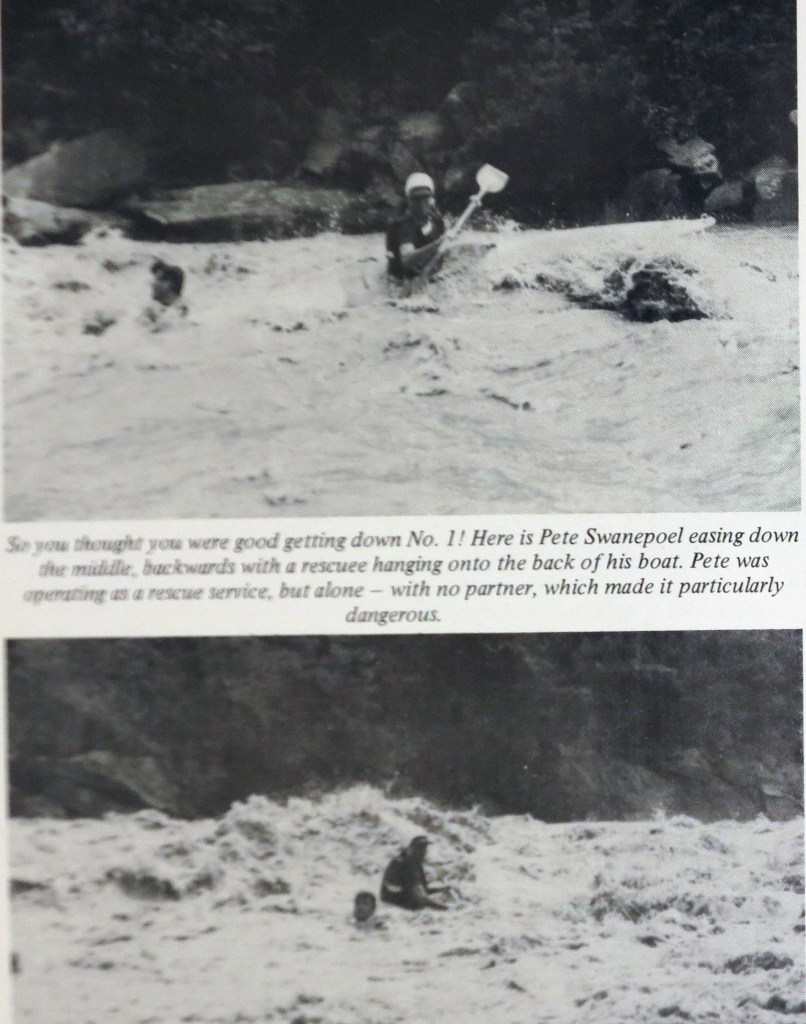
That was my only Umko marathon. For a few years after that I would sweep or pick out human flotsam and fiberglass jetsam at No.1 rapid, staying with Barry and Lyn Porter on their game farm afterwards.
The trouble with universal conscription is you get some very unlikely fellas donning uniforms. You look at them and you think, soldiers they aint, and you begin to worry about the term ‘military efficiency.’ Later, you learn the term ‘oxymoron.’
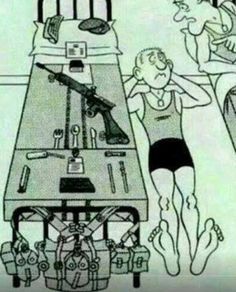
So there we were ensconced on a farm outside Potchefstroom among raw rockspider seventeen year-olds, fresh out of high school from all over South Africa. We heard it had been a reform school for delinquents before we got there and then recently turned into a military camp. Into a SAMS base in fact: South African Medical Services. “Loopspruit” or “Klipdrif” they called it. We’d been sent there for “army basics.” Basic training.
We were old. Around twenty three or four, having delayed the joys of military life by studying to become optometrists. In hindsight, maybe we shoulda done the army first!? Maybe we could now see too clearly? Time would tell . .
Our barracks were ex-classrooms. Ours an old science lab. It still had the thick polished wooden workbench tops, the thick ceramic washbasins with fancy thin high bronze taps, and fitted bunsen burner attachments. Expensive-looking, so a reform school for blanke delinquents, no doubt.
And best of all – our lab had shiny vinyl tile floors! Other classrooms were older, with wooden floors. That flooring was to become our biggest asset . .
One young dutchman was big as an ox, quiet as a mouse. He sat listening to us twenty four year-old oumanne praating Engels in fascination. In many pockets of the old South Africa you could grow up hearing very little Engels.
Suddenly one day our man became famous! He burst into song, singing three lines: ‘Are you lonesome tonight? Are your brastrap too tight? That’s why you’re lonesome tonight!‘
He sounded unlike Elvis:
We hosed ourselves and gave him a new name: Jelly Tots. He didn’t really like it, but his surname was Lotzoff, and we would see him and say ‘Lots and Lotzoff – JELLY TOTS!’ He learnt new words from us – and taught us a new phrase too: When frustrated, he didn’t say “fuck’s sake”, he said “fuck’s fakes” so that became our phrase too.
Another character was as small as Lotzoff was big. He looked twelve years old and was a compact, muscular, good looking, perky, cute little bugger. He had a smattering of Engels and preferred to use it. Some of the others refused to even try – Stoere Boere. His name? GT Jones! Pointless giving someone with so apt and memorable a name a nickname. GT Jones!
We were in the medics and we had to know all about ambulances. GT Jones called them ‘ambuminces.’And so was born a new name for one of the meals in the mess. On ground beef days we would refer to the stuff plopped onto our plates by the bored chefs as ambumince – which led in turn, naturally, to gruesome speculation on its origin!
Among the older, optometrist inmates: Graham Lewis – A companion worth his weight in gold. Never fazed, always cheerful. Keenly aware of the hilarity of this fake existence we were leading. He’d been assigned to D Company. We were in A or C Company and we were chuffed when he got transferred to our (better, natch) company. We were good company and so was he! D Company’s barracks was one of the old residences. Wooden floors. A nightmare to clean. They would regularly get bollocksed for dirty floors after hours of scrubbing them, while we got praise for our vinyl floors after all we had done was sweep them. Typical army illogical unfairness. They would lose weekend passes and we would win bonus weekend passes based on the luck of the floors we’d been allocated! Once while we were away on a weekend pass . . .
Basics was, uh, basic. Get up in the morning, bugger around with your clothes and other domestic stuff like making your bed; Assemble in straight stripes; March; March; Trudge; Omkeer! Eat; March; March; Trudge; MakeeriePAS! Holy shit . . .
Dhhave Cooper was another worth his weight in gold. Always smiling, always upbeat.
Les Chrich, Les Davies, Les Miller, Okkie Oosthuizen, Rod Stedall, who else? Magic comrades all. They made our time together memorable and less stressful, full of laughter.
~~~oo0oo~~~
Loopspruit – walking creek; running stream;
Klipdrif – stony shallow river crossing or drift;
oumanne praating Engels – old men (24yrs) speaking English
flyswatter – qualified hygiene and health inspector
casevac – casualty evacuation; carrying a ‘wounded’ fella away on a stretcher, the heavy bliksem
bliksem – ou; prostate ‘soldier’
wat sal gebeur – what could happen, pasop!
pasop! – watch it, nê!
~~oo0oo~~
– still to come –
Weeding duty – When even corporals and sergeants couldn’t think of anything mindless for us to do, they used us as cheap labour, sending us out the gate into the fields to pull weeds. What a plesh. Doing very little while talking shit with your mates is what I may have been born for. I’m a natural.
Guard duty – Wear your grootjas, it’s cold; dire threats of wat sal gebeur if you’re caught not looking sharp on duty;
What could gebeur – One poor flyswatter gets DB – the dreaded Detention Barracks – for forging the sarge’s signature. The wily sarge use different colour ink on different days, so altho the forgery was good, he knew it wasn’t his John Hancock. Military efficiency?
Big Day casevac demo – One day some unknown Oom with lots of ornate decorations on his shoulders and a different cap arrived in a helicopter to check us out. From the way our resident belangrike Ooms were flinging salutes at him we knew he must be baie belangrik. Actually we knew he was coming, as the last two weeks teaching us to shoot and stitch wounds had suddenly become unimportant, and teaching us to behave, march, salute had become frantically important. / race / stretchers -to Puma helicopter. We win!
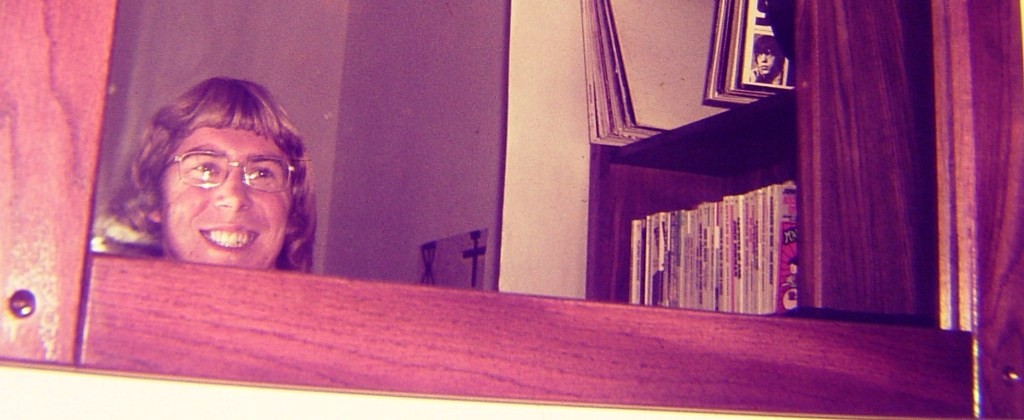
Found some old pics from Apache Oklahoma back in 1973.
Dragging Main in a Ford Mustang with my Olympus camera – and taking original 1973 selfies!
Next, a self portrait at the Swandas home – my last hosts in Oklahoma.
Their farm outside Apache was called ‘The Swandarosa’ – kidding!! Not really – that was Robbie Swanda’s joke. But can you hear the theme tune?
– Bonanza – and the Ponderosa Ranch –
~~~oo0oo~~~
Well, can you believe this!? I was narrowly beaten to the prize of taking the world’s first-ever selfie! In fact the first photographic portrait ever taken might have been a ‘selfie.’
Taken in 1839 by an amateur chemist and photography enthusiast from Philadelphia named Robert Cornelius. Setting up his camera at the back of the family store in Philadelphia, Cornelius took the image by removing the lens cap and then running into frame where he sat for a minute before covering up the lens again.
~~~oo0oo~~~
And hey! Cornelius himself was also a johnny-come-lately! Selfies were started way earlier . .