1976 Duzi – In 1976 I dusted off my old repaired Limfy and entered the race, ready to finally ‘Do the Dusi.’
(BTW: ‘The Duzi’ or ‘Dusi’ is the Duzi Canoe Marathon, a 120km downstream river race from Pietermaritzburg to the sea in Durban, in KwaZulu Natal, South Africa. Next year should see the 70th annual running of this crazy biathlon, COVID-permitting).
Like I had asked Charlie Ryder about six years earlier, Louis van Reenen, a fellow student in Doornfontein, asked me, ‘What’s that?’ when I said I was going to ‘Do the Dusi,’ so he was ripe for convincing. Or brainwashing? He decided to join me. I was happy, as he had a car! I headed off to Harrismith for the December holidays, leaving him with wise counsel: Buy a boat and paddle in it a bit.’
A month later in January, he arrived in Harrismith in his light blue VW Beetle with a new roofrack and a brand new boat – a red Hai white-water boat with a ‘closed’ (smaller) cockpit. He had bought it from Neville Truran at his Kensington shop, and had paddled it once or twice on Emmerentia Dam. In those days that could sort-of qualify you for Dusi!
We now had to tackle the dilemma we had left unspoken: Two of us, two boats and one car. Who would paddle, who would drive as the ‘second’ or supporter, taking food and kit to the overnight stops? So we tossed a coin. I lost. DAMN!
We headed for Alexandra Park in PMB with the red Hai on the roofrack. A great pity for me, as I had done a lot of canoeing, also in flood-level rivers, and had broken two boats in half and repaired one. But – a coin toss is a coin toss. And it was his car!
For Louis, the coin toss won him a first-ever trip down a river. And what a river! Here’s how two-times Duzi winner Charles Mason described it. I have paraphrased excerpts from his memoirs Bakgat:
Charles: The 1976 Duzi was arguably the fullest level ever. The record 420 starters on the first day on the uMsunduzi River were greeted with a very full river, resulting in many casualties.
I helped Louis get onto the water at Alexandra Park and he was relaxed. Although it was moving, the water looked similar to Emmerentia dam as it was flat, so he should be fine, right?
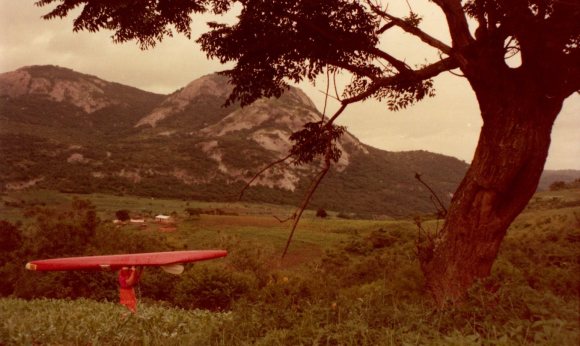
– Louis’ red Hai in the foreground –
That night at the first overnight stop at Dusi Bridge, Louis’ eyes were a lot bigger. He told of big water, scary rapids and numerous swims. I had pitched my little orange puptent and made him supper. He slept with his rear end out of the tent, ready to sprint off yet again – the dreaded ‘Dusi Guts’ diarrhoea had got him!
Charles again: That night the Kingfisher marquee was abuzz with speculation regarding the river conditions for the next two days on the much larger Umgeni.Our first day’s paddle on the much smaller and narrower Duzi River had been enjoyable and exhilarating. I remember being told many years before that the word ‘uMsunduzi’ is isiZulu for ‘the one that pushes and travels very fast when in flood.’ It had really been pushing that day.I was relaxing in a corner of the Kingfisher marquee, listening to the excited banter and anxious anticipation of the largely novice competitors in the tent, regarding the prospects for the next day’s paddle. Few of them had experienced such conditions previously.
Blissfully unaware, utter novices Louis and I were in my little orange pup tent nearby.
Charles: Around 9pm race organiser and ‘Duzi Boss’ Ernie Pearce came to see me:- Ernie said: “I have just had a visit from the engineer at Nagle Dam. He came to warn us that they have opened all the sluices of the dam to reduce water levels in preparation for a massive plug of flood water making it’s way down the Umgeni. The river will be in full flood below the dam by tomorrow morning!” Very early the next morning, I went to inspect the river downstream for Ernie and then reported back to anxiously-waiting paddlers and officials: “The Umgeni is pumping – it’s bloody big – and I am wearing a life jacket!” Life jackets were optional in those days and in any event, very few paddlers possessed them. I overheard one paddler remarking, “That’s enough for me.” He left to tie his boat onto his car. A few others followed suit. The second and third days were big and exciting.
Louis van Reenen, Duzi novice, first time ever on a river, carried on bravely. Paddling some, swimming some, and portaging – a lot! A lot of portaging was done by a lot of paddlers to avoid the big water.
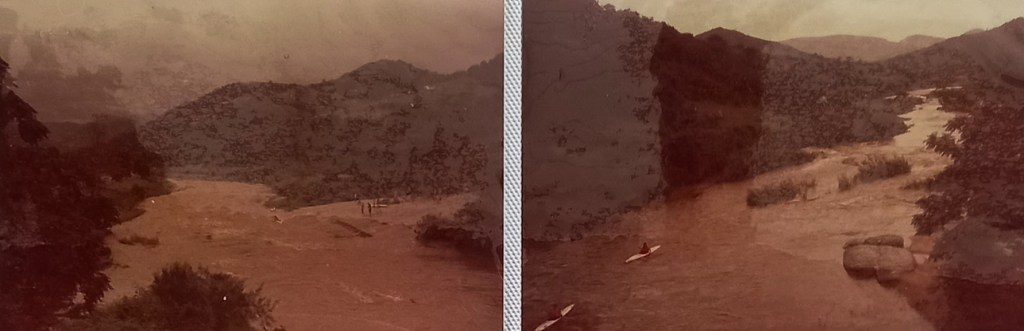
New watercourses and new islands opened up:
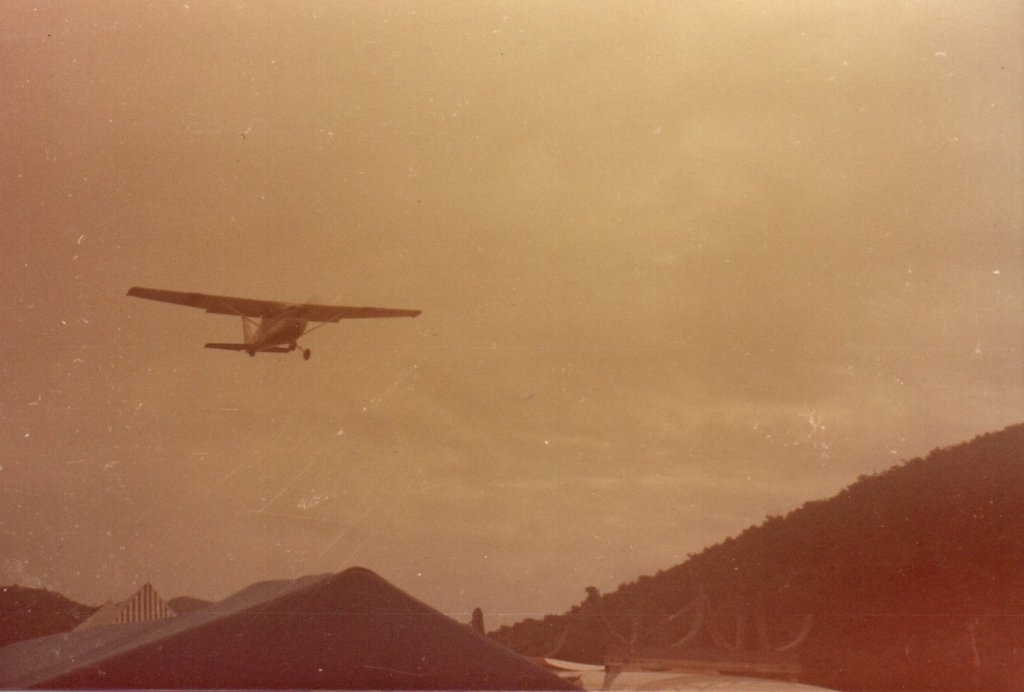
The weather cleared up enough for the welcome newspaper drop by Frank Smith in his light plane at the second overnight stop at diptank:
Us seconds and supporters were kept busy rescuing cars stuck in the mud, including our own Volksie. We’d all be stopped in a long line; We’d get out, walk to the front, push the front car, push the next car, and so on.
Never-Say-Die Louis got to Durban, to the Blue Lagoon, to the salty water of a high-tide Indian Ocean. Hours before him Graeme Pope-Ellis had equalled the best, winning his fifth Duzi, paddling with Pete Peacock.
That night we slept right there at Blue Lagoon, at the finish. Here’s a satisfied and relieved Louis with his Hai and his paddle, and me at the driver’s door of the pale blue Volksie:
Seven years later I FINALLY got round to doing my first Duzi. Sitting in my boat at Alexandra Park in Pietermaritzburg waiting for the starter’s gun, I thought I saw a familiar face and paddled over. Louis! It IS you! He had come back seven years later to do his second Duzi! Never-say-Die!
That 1983 Duzi was the opposite of his first. A low river, lots of portaging because of NO water, not because of high water!
The Harrismith Chronicle started publishing in 1903. Annie was ten years old, still living in the cottage behind the Royal Hotel. Eighty years later the paper celebrated. That milestone edition included our dear old Annie’s obituary. The Chronicle had reached eighty; Annie had reached ninety. Lovingly cared for from when her husband Frank died in 1943 right to the end forty years later, by her daughter Mary, our loving Mom.
Now in 2020 comes more sad news. After 117 years, the old Chronic has folded. Maybe it won’t be the end? Maybe someone can revive it in digital form, online? Sure hope so.
~~oo0oo~~
On the 23 March 2021 came a glimmer of hope:
Dandre Kleyn commented on my post The Chronic: Terminal?
Interesting post and very nice to read. So, good news, the Harrismith Chronicle is being revived! The 1st new issue is hitting the shelves 25 March 2021. New ownership and a new newspaper coming to you.
2024: It seems the Chronic is alive and well on facebook, whatsapp and maybe also on harrismithgazette.co.za
So I retired from golf. Hung up my plus fours, put my spectacles back on. They’re minus four. Optometrists will understand. The reason I retired was I had reached a pinnacle. I had tired of listening to golfers’ bulldust, cos although I was a golfer, I wasn’t one of the boring tedious kind who play every week and sometimes more often. No, I would play occasionally and then very well. Usually with borrowed clubs and the shoes I was wearing. None of this changing shoes n shit. My forte was the so-called halfway house and the pub afterwards.
After listening for years and decades and it seems centuries to the blah blah from one Brauer about scratch something and then a pearler and it faded, bounced once and rolled onto the green and blah blah I decided something had to be done. He had to be silenced.
I challenged him to a showdown. Winner takes all. Sudden death. Strict rules (listed below for evidence). Being generous and not wanting any arguments or excuses I decided we’d play on his home ground, a course he’d played hundreds, if not thousands of times and knew like the back of his head. San Lameer, aka Dutchman’s Paradise. Often spoken of as a ‘challenging course.’ I used to yawn when they said that, but I’d cover my mouth politely with the back of my hand, which I knew well.
– oof!! –
So the day dawns, the first tee looms and the first hole ends. Brauer shot 3 or 4 and I got about fifteen. Unfortunately he insisted we ‘putt out’ which is a very boring aspect of golf. I mean, once you’re on that smooth patch, pick up your ball and go to the next hole, no? The putting is embarrassing, looking for all the world like an ancient Pommy playing croquet instead of what I like. What I like is taking wild swings with a long shaft with a big knob on the end of it, as the actress said to the bishop. The second hole Brauer shot 3 or 4 and I carded an improved fourteen. On the third hole Brauer shot 3 or 4 (see what I mean about blah blah boring, right?) and I loomed ominously with a massively sharper eleven. I will confess that we’re not counting the moooligans I got from the hoooligan, and there might have been a few ladies tees, but read the rules.
Come the fourth hole. A short hole. Not really my kind of hole as my vast improvement so far had come about cos of my technique, which was to hit the ball harder, followed by much harder. So I chose one of the skewer implements and wound up, warming up while Brauer very boringly hit a somnolent gentle shot which landed on the smooth area near the flag. He grinned. Fatal mistake. I decided to tee the ball up much higher than usual and take a running attack approach. Unfortunately my foot slipped and I smashed the heavy end of the implement into the ground, knocking out some lawn which hit the ball and sent it off at 45 degrees, but fast. I picked myself off the ground in time to see it hit a tree and head for the same smooth area where Brauer’s ball was smugly and boringly lurking. It crept onto the smooth and stopped. He was very lucky. He almost lost there and then – read the rules.
So we’re both there for one. Legitimately. No free tee shot, no moooligans. Dead square, as though I was a scratch golfer, which I always felt like. Brauer asked me to smash my ball first, making out like he was being a gentleman, but it was my right. It was my turn. Read the other rules. The Royal and Ancient ones. I chose a smaller klap this time with a flatter heavy end and strode determinedly to where my ball was cowering, grinning at me from ear to ear, rubber bands showing. I was on a roll! It is true that I rolled, losing my footing and mishitting my planned shot which therefore ended up down the hole at the bottom of the flag pole.
Brauer’s grin faded. His cocky demeanour melted. His windgat attitude dried up. His shoulders drooped. His tension rose. His moustache bristled. Picking myself up and dusting myself off, I grinned. Ha! Golf is a gentleman’s game so I shouted outed out HAHA!! HA!
Talk about pressure! He started acting like a typical golfer, lining up the ball, walking to the flag, walking to the far opposite side, squatting, standing, all that kak, you know how they are. Finally he stepped up to the ball only to step away again and repeat the 5km walk and pantomime. Then he took a deep breath, stepped up to his ball, bent over looking like an old toppie playing croquet, and paused. Yip, he did. Then stepped away again and walked round and round, brushing away imaginary specks of grass, eyeing with one eye, eyeing the another eye. I wondered if he was going to use a third eye when he finally, FINALLY, committed and poked at that ball like a wimp.
So whatta you think? Of course he missed the bladdy hole. He took so long the bladdy ball had probably forgotten how to roll.
Ever the gentleman, I keep my whooping and hollering and Nyah! Nyahs!! to an acceptable level and repaired the divots I made with my pole and grasshopper shoes and hands when I did flik-flaks and put the flag back with which I had done a loud victory lap shouting Ha HA!! Ha HA!!
I walked straight back to the clubhouse. I had won! He wanted to play on! What for!? End of tournament. Read the rules.
So I retired from golf.
Rules for the Great Face-Off:
Handicaps count. Mine is 36, yours is scratch, I’m being ellen the generous.
If my drive fails to reach the ladies tee, I can have a free repeat, this time from the ladies tee.
Obviously ‘fresh airs’ don’t count! How do you know what I was thinking?
If I win anything, anything at all, I have won the day. If I win longest drive (no matter in which direction), I have won. Closest to the pin (regardless of how I got there), I have won. Ens. Never mind winning an actual hole – then obviously I have won, I said beforehand. Presciently.
No correspondence will be entered into. No whinging unless I lose.
These rules may be amended on the course if needs be. By me.
~~oo0oo~~
Postscript: I could never understand how they could write books on something as simple as golf, which can be described in one sentence; but I am thinking of writing a book on this little joust. I feel it will serve a good purpose in helping people retire from golf.
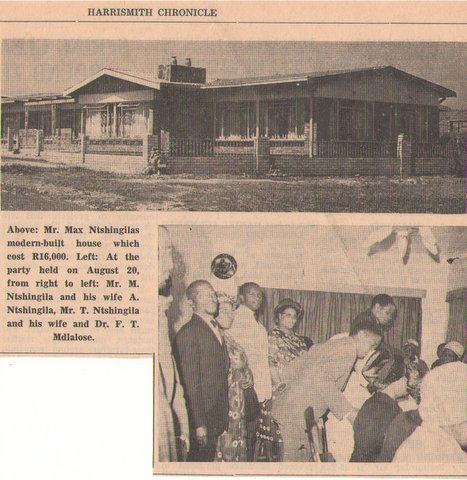
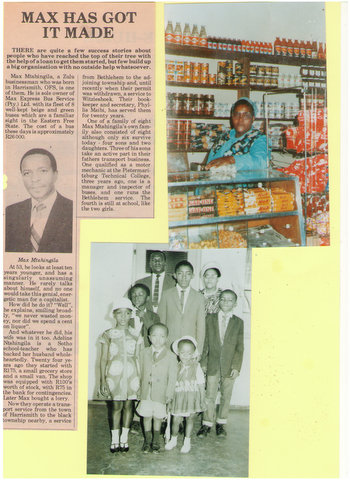
I saw Mr Thandinkosi Ntshingila for an eye test recently. He was born in 1940. I told him I knew a Mr Max Ntshingila in Harrismith many moons ago, who owned a fleet of buses.
He said “Hayibo! That’s my Dad!!”
He grew up in Harrismith! Strictly speaking Max was his uncle, but his Dad died when he was very young and his uncle Max took him in and raised him as his own in Phomolong.
He told me that besides the buses – remember “Max Express” buses? yellow and green, I seem to remember – Max owned two shops, plus a petrol station in Swaziland.
Max died in 1978 aged 60 (so the news cuttings below are ca.1971). His empire collapsed when he died, as his kids “were spoilt” and “none of them could manage anything”, according to Thandinkosi. And although he was like a son, not when it came to inheritance.
Max sent Thandinkosi to college and he ended up in Durban working for Engen or Sapref or one of those fuel refinery places. Retired now, he plays the horses for fun and I see him at the tote on the roof of our centre occasionally.
– a Biscayne like Max Ntshingila’s –
I had wondered vaguely all these years about something, and I never expected to get the answer. But Thandinkosi had the answer for me: That creamy-gold coloured yank tank Max drove was a 1963 Chev Biscayne. I just LOVE it that I finally did find out! Never thought I would or could.
Thandinkosi still goes to Harrismith regularly to look after the house in Phomolong where he was raised. One of his nieces lives in it.
Leon Strachan sent me some pictures and newspaper cuttings. Note how Dr Frank Mdlalose, who we only got to know of post-1994, when he became KwaZulu Natal’s first Premier, was a house guest of the Ntshingila’s in Harrismith.
– snarky apartheid headline, methinks –
~~oo0oo~~
Update: Today – 12 December 2019 – I saw Mr Thandinkosi Ntshingila again. I phoned him to come in so I could give him copies of these pictures. He’ll be 80 next year. I hoped he was one of the kids in the photo, but he wasn’t. Not one of the people in the photo are still alive, he tells me. They all died quite young. He’s the only survivor of that household. He was chuffed and moved to receive these mementos, and says he’s going to frame the family photo!
– Mr Thandinkosi Ntshingila studies the photos –
~~oo0oo~~
Dr Frank Mdlalose died in March 2021 of COVID-19. His wikipedia entry tells a lovely story: Representing the students at the segregated medical school in Durban, established by Jan Smuts for Black and Indian students, he attended the only conference of the Association of Medical Students of South Africa attended by students from one of the Afrikaans-medium medical schools. They had hitherto refused to attend if Black students were present. One of the Afrikaner students said, as the conference finished, “I thank the Chair for having organised this conference. This is the first time I have met a black man with an intelligence equal to, or superior to, my own.” To which Frank responded, “I, too, thank the Chair for having organised this conference. This is the first time I have met an Afrikaner with an intelligence equal to, or superior to, my own.”
I’m reading Tramp Royal again! So here’s a re-post from 2016:
I lapped up the famous Trader Horn books ‘The Ivory Coast in the Earlies’ and ‘Harold the Webbed.’ I’m still looking for their third book ‘The Waters of Africa.’ ‘Their’ being his and the special and talented lady whose sudden insight made it happen when she befriended a tramp on her stoep in Parktown Johannesburg back in the mid-1920’s – Ethelreda Lewis.
If ever the philosophy of ‘Be Kind Always’ paid off, it was in this tale of a friendship that developed after the reflexive dismissal of a tramp at the door of a middle-class Parktown home was changed to a sudden, instinctive ‘Wait. Maybe I will buy something from you . . ‘ and – even better – ‘Would you like some tea . . ?’
– Ethelreda Lewis on the Parktown porch where they wrote the books –
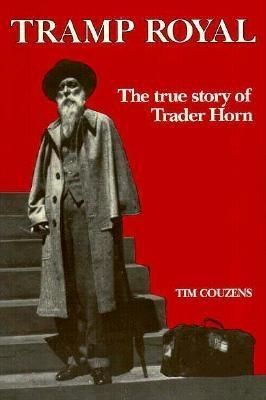
After reading Trader Horn I was then even more enamoured of Tim Couzens’ book ‘Tramp Royal – The true story of Trader Horn’, as it validated the Trader Horn legend – Alfred Aloysius ‘Wish’ Smith was real and he had got around!!
Couzens died in October this year, tragically – he fell in his own home. I thought OH NO!! when I read it. He was a gem, almost a Trader Horn himself – what a waste! Too soon! He did the MOST amazing sleuth job of tracking down all Trader Horn’s jaunts n joints across the world and revealing that – despite the skepticism that had followed the incredible fame and Hollywood movie that had followed the success of Aloysius ‘Wish’ Smith’s – now famous as Trader Horn – first book in 1930, MOST of what the old tramp, scamp, rogue and adventurer had claimed to do he had, in fact, done! Tramp Royal is a wonderful vindication, and a moving, fascinating and captivating read.
One (small) reason I LOVED the trader Horn books, besides the original title:
Trader Horn; Being the Life and Works of Aloysius Horn, an “Old Visiter” … the works written by himself at the age of seventy-three and the life, with such of his philosophy as is the gift of age and experience, taken down and here edited by Ethelreda Lewis; With a foreword by John Galsworthy
(phew!) . . . . . was the number of places A. Aloysius Smith – ‘Trader Horn’ (or Zambesi Jack or Limpopo Jack or Uncle Pat – he had aliases!) had been to that I have also been to:
Joburg, his least favourite city in the world. He was in a doss house in Main Street in 1925, I was in Eloff Street in 1974. Parktown, where Ethelreda Lewis ‘discovered’ him. He would have died on Main Street, unknown and in penury, had it not been for her sudden decision to listen to him tell a story. ‘Wish’ came to love Joburg, as did I. In Parktown, he and Ethelreda spoke in her home in Loch Street in 1926, I was in nearby Hillside Road in 1977;
Hwange in Zimbabwe, or Wankie in Rhodesia as it was then; – BTW, I believe you pronounce Hwange ‘Wangie’;
Harrismith, where he went with Kitchener’s Cattle Thieves to steal Boer cattle and horses in the scorched earth tactics of the wicked, looting, war-criminal Brits in the Anglo-Boer War of 1899-1902; He showed his humanity by describing the Boer women’s sadness, and states – I hope its true – that they always left ‘one milk cow behind for the kids; and we called it Pansy.’ And Harrismith is where I was born and raised;
The west coast of Madagascar where our yachting trip to the island of Nose Iranja off the west coast of Madagascar took us quite close to his ‘Chesterfield Islands’;
The east coast of Africa, although he spoke of Zanzibar and we visited Mombasa – which he probably visited too, as he sailed up and down the coast;
Oklahoma, where like me, he befriended and was befriended by, the local American Indians – his mostly Pawnees and Osages, mine mostly Apaches, Kiowas and Cherokees; THEY called themselves American Indians, not Native Americans, and some indeed belonged to the American Indian Movement, famous for their brave resistance in 1973;
Georgia, where he behaved abominably and which I used as a base to go kayaking in Tennessee. I went to shoot rapids; he may have ridden to shoot people! He drank in a doctor’s house and I drank in a dentist’s house;
The Devonshire Hotel in Braamfontein, where both of us got raucously pickled;
The Seaman’s Institute in Durban where he holiday’d happily for two pounds a month while waiting for his book to be published, spurning the fancier beachfront hotels; His editor needed a break from him and sent him off by train on the 2nd April 1926 to avoid the Jo’burg winter. My only connection here is drinking in the notorious nearby Smuggler’s Inn. If Smuggies had been around back then, Wish Smith would have gone there!
Kent, where he died in 1931; I visited friends in Paddock Wood on honeymoon in 1988.
‘Wish’ himself would be saying, ‘What, you haven’t been to Lancashire!?’ My reply would be, ‘I haven’t. But my far bigger regret is I have not cruised on ‘your’ Ogooue River in West Africa.’
– Seamen’s Institute & Rest – “All Nations” –– Smugglers Inn –Durban where Aloysius might have stayed – left: The Seamen’s Institute & Rest – “All Nations” – right: Smuggies –
I would love to see his river – the Ogowe or Ogooue River in Gabon. Everything I’ve seen on youtube verifies Aloysius’ lyrical descriptions. Here’s an example (I suggest you turn the sound down and start from 2:40);
– Ogooue river – there’s an art to navigating the channels here –– Samba falls upstream on the Ngounie river from Trader Horn’s trading post –
I also loved the unexpected success of the first book. Written by an unknown tramp living in a doss house in Main Street Joburg, the publishers Jonathan Cape advanced fifty pounds which Mrs Lewis gratefully accepted. Other publishers had turned it down, after all. Then the Literary Guild in America – a kind of book club – offered five thousand dollars! They expected to print a few thousand, and also offered the rights to a new publisher called Simon & Schuster, who hesitated then went ahead, receiving advance orders for 637 copies.
– the tramp in new clothes! –
Then it started selling! 1523 copies one week, then 759, then 1330 and then 4070 in the first week of July 1927. Then 1600 copies one morning! Then 6000 in a week. They now expected to sell 20 000 copies!
Up to November that year sales averaged 10 000 a month, thus doubling their best guess. They had already run ten reprints, the last reprint alone being 25 000 copies. 30 000 were sold in December alone up to Christmas day. The story grows from there – more sales, trips by the bearded author to the UK and the USA, bookstore appearances, talk of a movie. The trip continued until he had gone right around the world, drinking, smoking and entertaining the crowds with his tales and his exaggerations and his willingness to go along with any hype and fanfare. On the way he would shun the best hotels if he could, even though money was now no problem; as he preferred to frequent lower-class establishments – usually with some cash in his sock or sewn into a pocket.
At his first big public appearance at 3.30 pm on Wednesday 28th March he spoke to a packed house in the 1,500 seater New York City Town Hall off Times Square:
Well known English/American writer of sea stories William McFee was to have made an introductory address but ‘the old man walked on the stage (probably well fortified with strong liquor), acknowledged tremendous applause with a wave of his wide hat and a bow and commenced talking in a rambling informal style before McFee could say a word. He started by quoting advice given to new traders: “The Lord take care of you, an’ the Divil takes care of the last man.” He spoke of the skills of medicine men, rolled up his trouser leg above his knee to show the audience his scar, and threatened to take off his shirt in front of the whole Town Hall to show where a lion had carried him off and was shot only just in time. When the aged adventurer paused to take a rest in the middle of his lecture, McFee delivered his introduction.’
His fame grew and he reveled in it.
Then suddenly, people started thinking old ‘Wish’ Smith’s whole story was a yarn, nothing but the inventions of a feeble mind, and wrote him off as yet another con artist – there were so many of those! It was the age of ballyhoo, of PT Barnum and fooling the public with bearded ladies, confidence tricksters and hype. Some critics grew nasty, depicting Ethelreda – without whom none of this would even have happened, and without whose kindness and perseverance Aloysius would have died in obscurity, never seeing his family in England again – as abusing ‘Wish’ for her own gain. The truth really was that she – in effect – saved his life; she certainly returned him to his family; and she enabled the kind of rollicking final few years his dreams were made of! He had people to listen to him; he had money to throw around! What a better way to go than dying anonymously in a doss house in Main Street Joburg!
The hype died, cynicism (a nasty kind, not healthy cynicism) set in and old ‘Wish’ Smith – Trader Horn – died in relative obscurity with his family in Kent. It may all have been a hoax . . .
So was he real, or was it all a hoax? To know more, read Tim Couzens’ book – it’s a gem! It’s fascinating and uplifting and – oh, hell, I’ll tell you – Trader Horn, as Wish Smith in Africa, Uncle Pat in America, and by other names, was real! Very VERY real. The journalists who slated Trader Horn and Ethelreda Lewis did so at their desks, joining a false bandwagon. Tim Couzens actually travelled the world, visiting the spots Aloysius Smith said he’d been – and he had indeed been there!
Here’s a silent movie of the old rascal on a Joburg street corner soon after he’d been kitted out in new clothes when the first cheque for his book came in.
Here’s the back page from the movie program. The movie, of course, was Hollywood – WAY different to the true story! An interesting facet was for once they didn’t film it all in a Hollywood studio; they actually packed tons of equipment and vehicles and sailed to Kenya and then on to Uganda to film it ‘in loco’ – just – ahem! – on the wrong side of Africa to where it had happened!
It was a landmark film of sorts that chalked up several firsts. It was the first fictional feature-length adventure shot on location in Africa (yeah, East Africa while Aloysius’ adventures were in West Africa!). It was the first sound-era ‘White Jungle Girl’ adventure – many more would follow. It’s an old movie, sure, it is of its time; to me as a Trader Horn fan, the worst thing about it is: it isn’t the true story! Nevertheless, some rate it as ‘surprisingly engaging and worth checking out’ now that it’s been reissued on DVD. (NB: See the badly-made 1931 movie, not the worse-ly-made 1973 remake).
~~oo0oo~~
Trader Horn wrote glowingly of a real lady he met on his river: an American missionary, Mrs Hasking. She died on the river, and Trader Horn took her body down river to be buried. I found out more about his Mrs Hasking here.
~~oo0oo~~
Here‘s a much better, two-post review of the Trader Horn phenomenon – and Tim Couzens’ book – by fellow ‘tramp philosopher’ Ian Cutler. Do read it!
~~oo0oo~~
On 27 October 2016 I wrote to Ian Cutler:
Sad sad news today: Tim Couzens the master tramp sleuth has moved off to join his Tramp Royal in the afterlife.
At 72 he was about the same age as the old rogue at his death.
Regards, Peter Swanepoel
Sad news indeed Peter. Thanks for letting me know.Ian
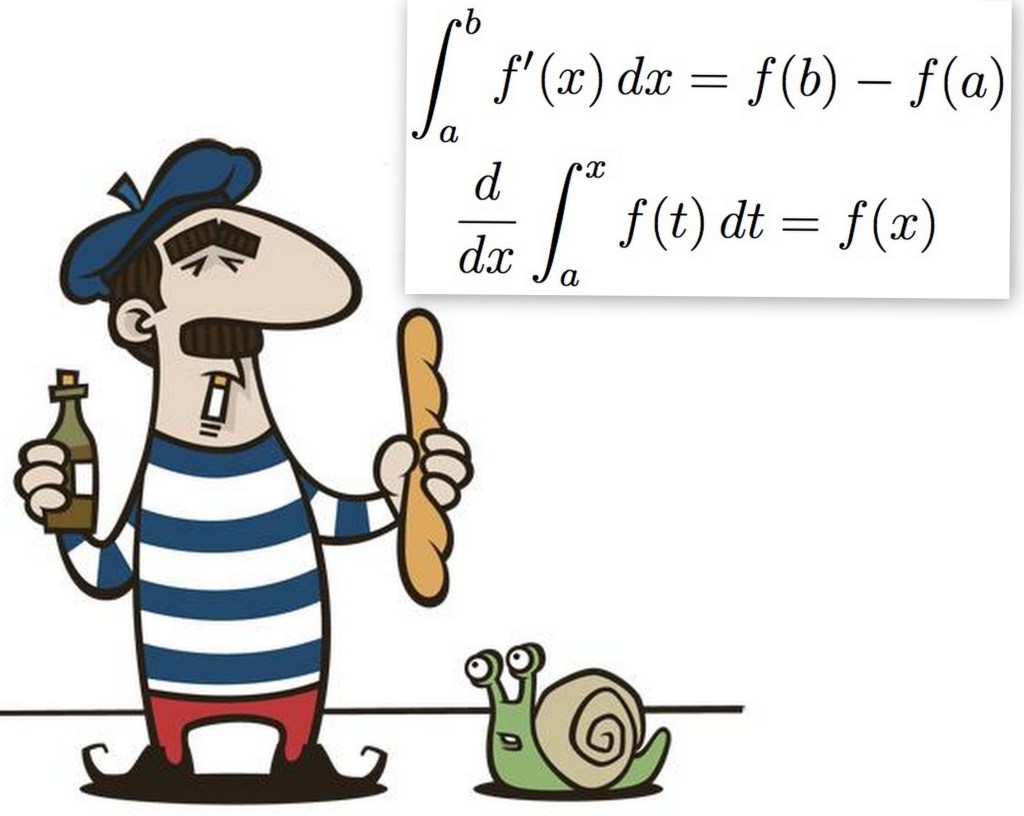
So we were drinking beer on Tabbo’s farm when a younger chap arrived and was introduced to us as the young Frenchman whose parents wanted him to experience agriculture before he started to study it at university. Tabbo had gladly agreed to host a frog for a weekend so he could learn agriculture on a farm in Africa in English before going back to learn it in French at a university in France. Ours not to reason why . .
– the agriculture oke with the greenest fingers I know
I’m Tabbo; I’m Koos; we said. Hervé, he said. Ah, hello Hervé! Non non! Hervé.
Ah! Hervé, we said, copying his pronunciation carefully. Non! Hervé. OK, Hervé. Non! Non! Hervé!Hervé!
Um, yes, hello Hervé, welcome to the Vrystaat. Hervé! he muttered.
And that set the tone for the visit of eighteen year old Hervé, le frog, to the Vrystaat vlaktes.
We piled into Tabs’ pickup and drove around the farm, Tabbo pointing out a cow chewing the cud, a sheep walking and a mielie growing. He showed little interest. The only animation was whenever we mentioned his name. He would immediately say Non, Non. Hervé! So we stopped using his name. Also, we didn’t tell him ‘agriculture’ wasn’t pronounced ‘agriculsh-her.’
Back to the lovely sandstone homestead at Gailian and lunch, where he refused a beer, muttering something that sounded like muffy arse. We were to hear muffy arse A LOT.
Lunch arrived, a delicious roast something expertly produced by Julia and ____ in the large and splendid Gailian kitchen, origin of many a magnificent meal. Non, Non. Muffy arse, came the response after he’d peered at the meat on his plate intently, nose 20mm from it. He ate the potatoes.
I’ve never met such such an impossible eighteen year old! Obnoxious, opinionated, impossible to please. We didn’t slap him.
In the afternoon Tabbo drove him around some more. We – yes, even I was lecturing agriculsh-her! – helpfully pointed out the grass, and the clouds, which would hopefully bring rain and grow that same grass; which animals would eat and convert into delicious roasts so that he could mutter muffy arse. We generally gave him a thorough education in agriculture which we were sure would put him ahead of his fellow amphibious classmates when he went back across the pond to study utilisées pour l’agriculture at l’école agricole. And I’m sure le frog would have had a lot to correct there. Pardon my French.
That evening we were back into the beer and offered him one. Non, Non. Muffy arse, the response we’d grown used to. We went through all the grog in the Fyvie’s very well stocked pub and at last we got a oui !
I forget if it was Ricard or Benedictine or Cointreau, but it was definitely Made In France and I think that was all le frog was interested in. By the look on his face as he took his first sip, he hadn’t actually tasted it before, but we were beyond caring any more. He was impossible to please and we were now just keeping him quiet, happy that a sixpack of beer divided more easily into two than into three.
– Gailian’s well-stocked pub on a less surreal evening – just drunkards –
After a while the silly little frog whipped out a tiny little French-English dictionary out of his pocket and pointed to the word méfiance and muttered urgently muffy arse. So THAT was muffy arse! méfiance!
The translation: MISTRUST!
We hosed ourselves, which miffed le frog. He got all miffy arsed.
We were not sad to see him go. Still, being polite we asked him if he thought he’d learnt enough to help him when he went back to study his agriculture? Non, Non. he said indignantly. Not agriculsh-her! He was going to l’université to study mathematique!
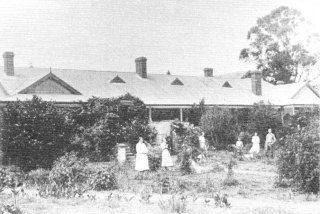
I was Born up Shit Creek without a Paddle. Quite literally. OK, my actual birth, per se, was in Duggie Dugmore’s maternity home, less than half a kilometer away on Kings Hill. See pic above – the old British officers mess (or the doctor’s residence?) became the maternity home. But mere days after I was born – as soon as I could be wrapped in swaddling clothes – I was taken home to my manger on a plot on the banks of Shit Creek (more accurately Kakspruit) in the shadow of Platberg mountain. And it was twelve years or so before I owned my first paddle. So this is a true story.
– ruins of our house on the plot – trees in in the middle ground are on the banks of Shit Creek – – inset: me on the lawn thinking, ‘where’s me paddle?’ –
I paddled my own canoe about twelve years later after we lost the plot. OK, sold the plot, moved into town and bought a red and blue canoe with paddle. The first place we paddled it was in a little inlet off the Wilge river above the Sunnymede weir, some distance upstream of town. Right here:
– younger sis Sheila operates the paddle I was born without –– same little inlet – Mother Mary and Sheila on land, me airborne, Barbara sitting on water –
Before this, I had paddled a home-made canoe made of a folded corrugated zinc roofing sheet, the ends nailed onto a four-by-four and sealed with pitch. Made by good school friend Gerie Hansen and his younger boet Nikolai – or maybe his older boet Hein; or by their carpenter father Jes? We paddled it, wobbling unsteadily, on their tiny little pond in the deep shade of wattle trees above their house up against the northern cliff of Kings Hill, halfway between the plot on the banks of the Kakspruit and our new house in town.
School friend Piet Steyl wrote of the wonderful days he also spent in the company of Gerie Hansen – who died tragically early, adding to the feeling that the good die young. Piet told of fun days spent paddling that zinc canoe, gooi’ing kleilat, shooting the windbuks and smoking tea leaves next to that same little pond. We both remembered Gerie winning a caption contest in Scope magazine and getting reprimanded for humourously suggesting Japanese quality was perhaps dodgy back then. Irony was, the Hansens actually owned one of the first Japanese bakkies seen in town – a little HINO.
Gerie used to say ‘He No Go So Good!’ and Piet says when it finally gave up the ghost he said, ‘He No Go No More!’
~~oo0oo~~
Shit Creek – actually the Kak Spruit; a tributary of the Wilge River which originates on Platberg mountain, flows down past our old plot and then westward through the golf course on the northern edge of town, then turns south and flows into the mighty Wilge below the old park weir on the right bank; Sensitive Harrismith people refer to it as ‘die spruit met die naam;’ Bah humbug.
die spruit met die naam – ‘the creek with the name’ – that’s a kak description – too coy! It’s Kakspruit – one word; always will be; Shit Creek.
gooi’ing kleilat – lethal weapon; a lump of clay on the end of a whippy stick or lath; spoken about way more than practiced, in my experience; and about 10% accuracy when you do get it going; Here’s a kid loading one:
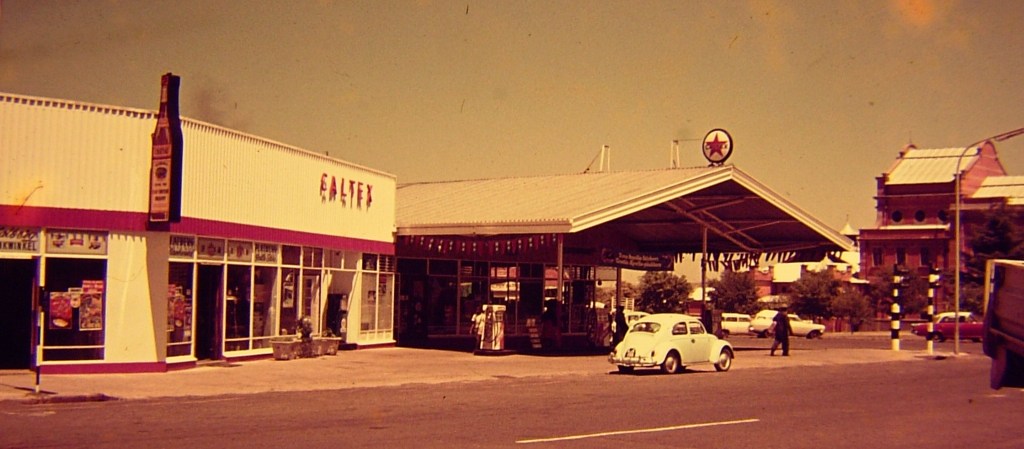
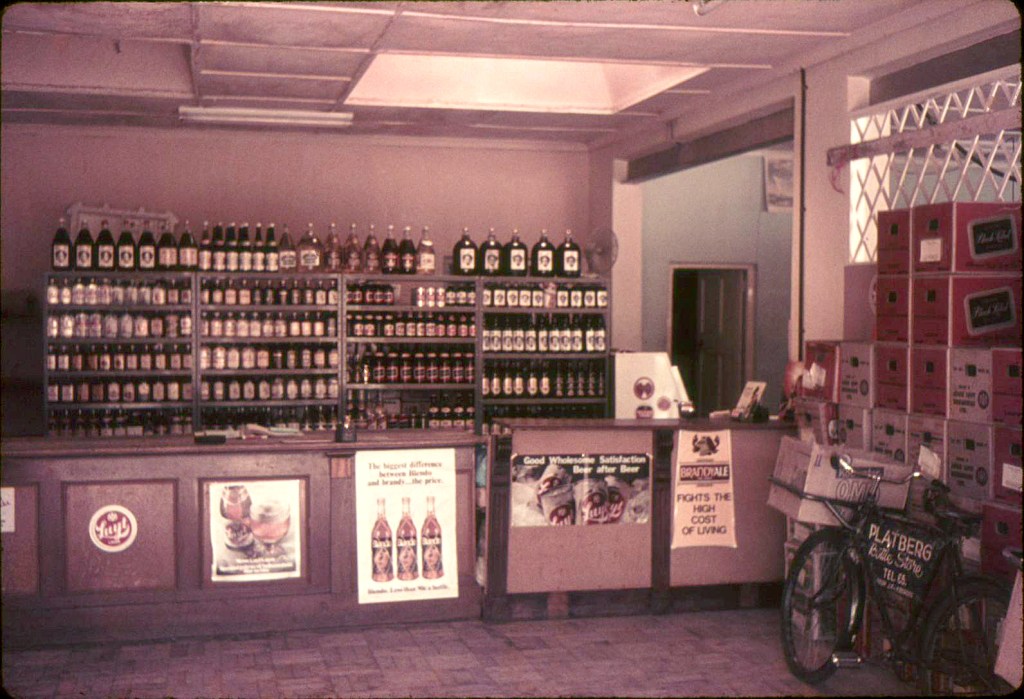
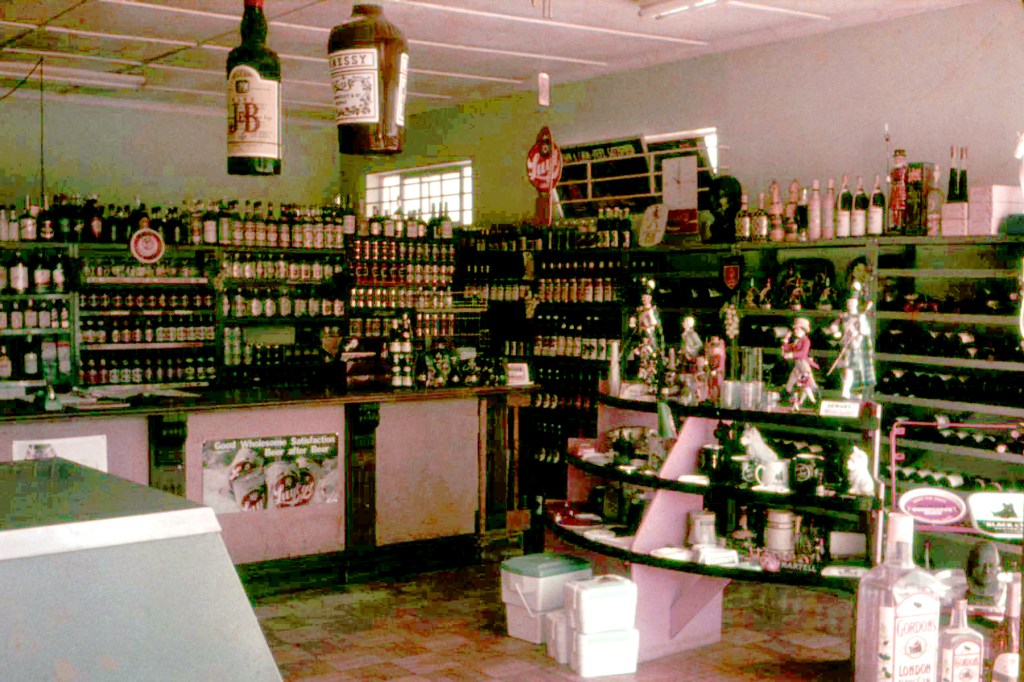
OK, not really; more a reverie on drink – a nostalgic lookback on a bottle store. Platberg Bottle Store / Drankwinkel in Harrismith, the Vrystaat. The Swanepoel family business. We all worked here at times. You could say we were raised on grog.
– the dark side –– the pale side –
We were talking about the trinkets, decor and marketing stuff. Like those big blow-up bottles hanging from the ceiling. Turns out big sister Barbara kept some of them from way back when:
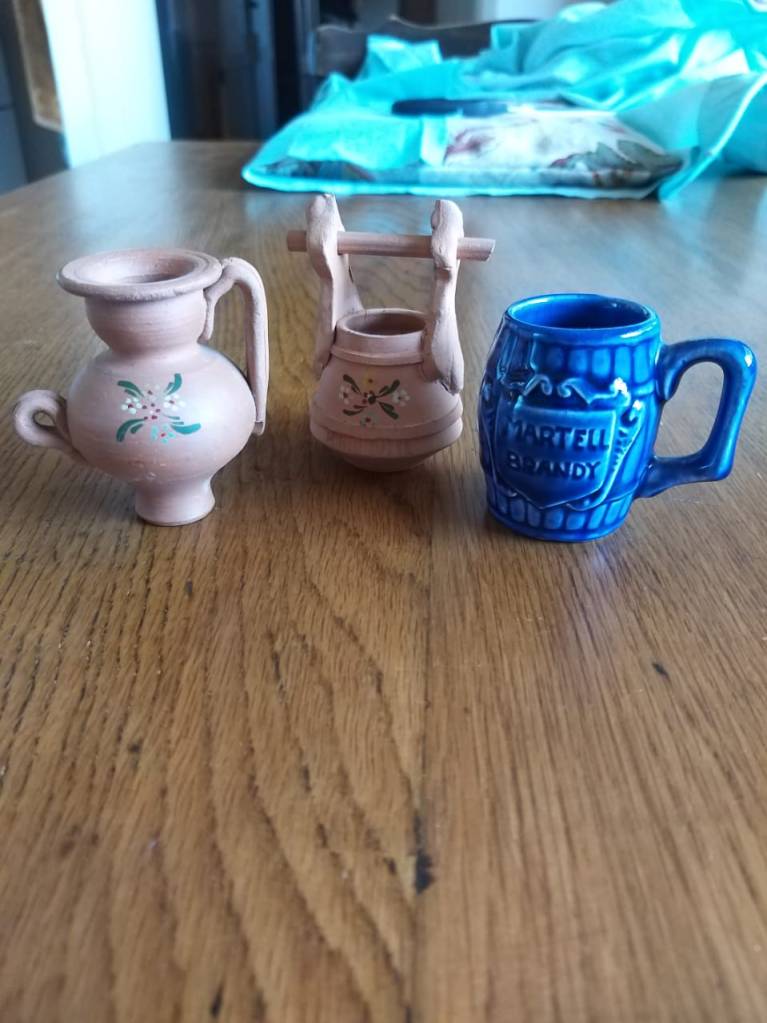
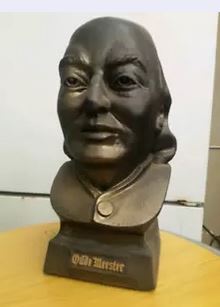
Younger sister Sheila has some whisky jugs; and I found an old familiar brandy-making figure online: the Oude Meester bust. We fondly remember Jan Jan die Oudemeester Man! Jan Robertson, the rep who would visit us to sell his popular product.
..
This is where the big blow-up bottles were displayed, along with the striding statue of Johnny Walker whisky; Dewars White Label whisky’s Scottish soldier ‘drum major;’ Black & White whisky with their black and white Scotty dogs; Beefeater Gin’s ‘beefeater’ in his red uniform, etc. Spot them below. All were shouting a loud Drink More! and in small print; um, drink responsibly.
BrandyAle had people’s best interests at heart when they told you how drinking BrandyAle would “Fight the High Cost of Living.”
Methodists are pretty strongly anti-alcohol, so I believe it is testimony to Mother Mary’s organ-playing skills (and her much-loved status among all who know her) that we could run a bottle store six days a week and still be Methodists on the Sabbath! (Kidding! It was the collection plate. Kidding!).
A famous thought experiment. Who would you choose? Besides the world-famous people – of whom I’d definitely choose Charles Darwin and Albert Schweitzer, maybe Rachel Carson, maybe Noam Chomsky, maybe some of the early Southern African explorers like Francois Levaillant or Adulphe Delegorgue, certainly Aloysius Smith (Trader Horn), and maybe his wonderful biographer Tim Couzens – I’ve not given this any time yet. So many to consider. More locally and more personally, I’d really like to have lunch with these three luminaries from my little home town Harrismith, Free State, South Africa:
Stewart Bain; my wonderful gran Annie’s Dad, Scottish immigrant, fisherman, railroad bridge-builder, hotelier, who became mayor of Harrismith and the prime mover behind the building of a town hall fit for a city in a Free State dorp; ‘Oupa’ Bain he was called by family, and The Grand Old Man of Harrismith by some towards the end of his life, maybe only at his (lavish) funeral?
Dr Anna Petronella ‘Nell’ van Heerden; pioneer general medical practitioner in Harrismith, Pioneer gynaecologist in Cape Town; then pioneer cattle farmer in Harrismith; lesbian cattle farmer in Harrismith, Vrystaat in the fifties and sixties – courage and self-confidence.
Dr Francis William ‘Frank’ Reitz; son of a state president; brother of the famous Deneys Reitz of Anglo-Boer War and WW1 fame; qualified at Guys in England, then specialised in surgery in Germany; practiced as a general medical practitioner in Harrismith Vrystaat.
Be amazing if they all told the truth, the whole truth and nothing but the truth. Which they would, surely, now that no-one can do anything to them!? I have a theory that once we’re sitting on a cloud we won’t be bothered by earthly bulldust in the faintest.
Great Granpa Stewart Bain, it would be fascinating to know how much corruption there may have been in the building of the town hall – were there any rigged tenders, Great Grandad? Who benefited? How long did the building take? How involved was he, onsite? What was the ribbon-cutting day like? Who opposed this lavish project (some called it Bain’s Folly)? Did he acknowledge them and their concerns? And I’d ask about his special daughter Annie.
Dr Nell van Heerden, it would be fascinating to find about being a female pioneer. To know about her relationships; about her live-in companion Freddie Heseltine; about farming amongst toxic, confident, powerful masculinity; attending cattle auctions; her relationship with her staff; what protected her? Was it her National Party connections that made her immune from slander and attack? Was she immune? About her geological digs in the ‘holy land.’
My own personal GP, Dr Frank Reitz, it would be fascinating to hear about 1920’s to 1960’s surgery and chloroform anaesthesia; about other Harrismith and district characters; about pioneering surgical techniques; about the successes and some failures on the operating table and the making of prostheses and new equipment; About sport in the early days – rugby and polo especially. Personally, I would wonder if you remember – among your many patients – putting a bamboo hoop over a young boy’s face, covered with a cloth, sprinkling chloroform on it and saying, “OK, Kosie, now count backwards from ten.” I loved arithmetical challenges like that! I could do it! But I don’t think I got down to six. And do you remember digging a spiderbite out of my knee? What stories did your famous Dad, President Francis William, and your older brother Deneys tell you? What did he tell you about the Boer War when he visited you at Guy’s in London?
Of Charles Darwin I would ask way more about his wonderful voyage, and also lots about his amazing, stunning insight into how the fact of evolution happens; but all his other lunch guests would ask him that, so I’d mainly be interested in his five years circumnavigating the globe aboard the Beagle; imagine living on board a small wooden ship for over 1700 days – two months short of five years – living cheek-by-jowl with a fervently religious captain with a hot temper whose quarrels ‘bordered on insanity.’ I’d also want to know about his inner struggle with ‘coming out’ with this powerful scientific insight in the face of self-righteous religious ‘knowledge.’ Which was actually intense blustering ignorance. But only if he was comfortable to talk about it – he was a sensitive man who – I think – suffered his debilitating mystery illnesses mainly due to that stress.
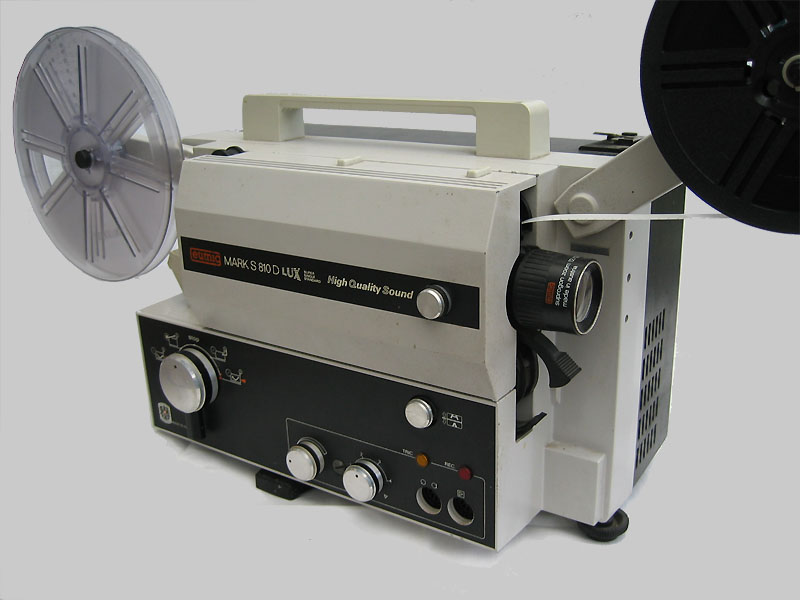
The old man bought an 8mm cine film Eumig camera and Eumig projector very like these. Made in Austria. This was ca.1963, I’d guess. It once did a bit of – potentially – famous footage!
eumig 8mm cine cameraSuper 8 Sound Projector Eumig Mark S810
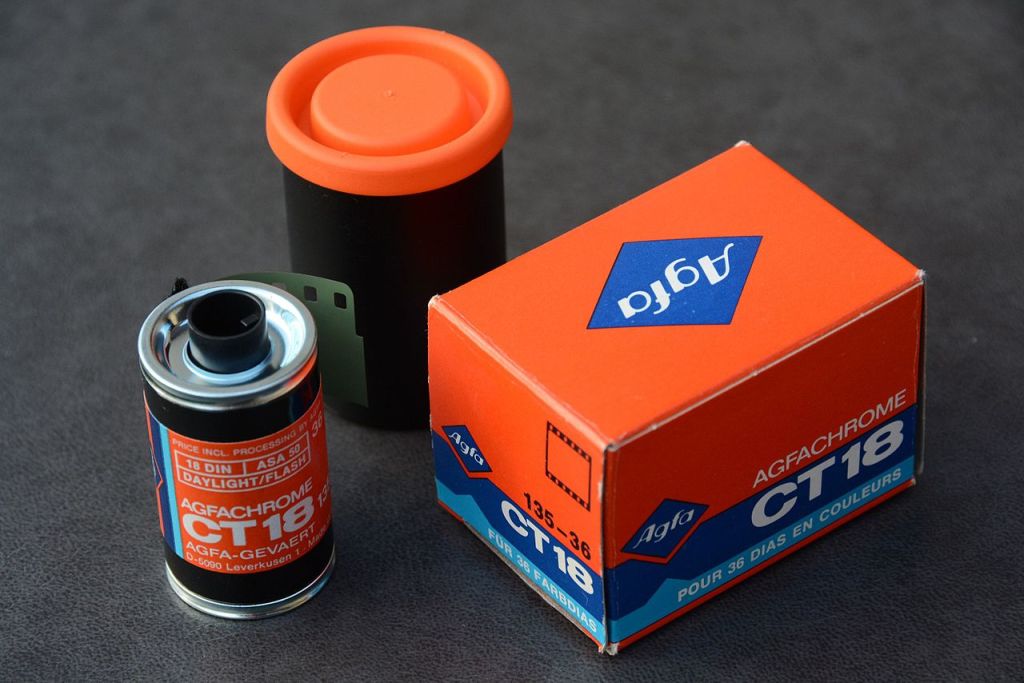
Later he bought a Canon SLR camera with a 50mm lens like this, and a 300mm telephoto lens. An FT QL exactly like this one. He used Agfa slide film. Had to be Agfa, not Kodak! Agfa ‘had better greens and blues.’
Once I heard Dad had been present when I won a 100m race at the town’s President Brand Park athletic track. I didn’t know he was there – found out later that he had been taking photos. At the finish, in my lunge for the tape, I fell and somersaulted, skidding on my back on the cinder track. I tied for first place. Never did see a photo of that finish – !? Had two roasties on my back for a while.
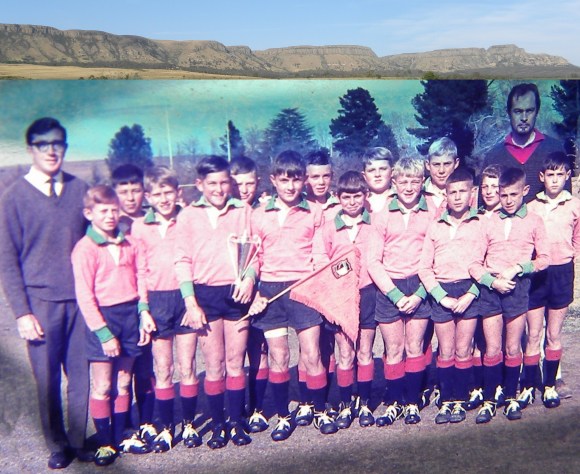
Once – 1967 – he took a photo of the all-winning U/13 rugby team holding a trophy. I must try and find out what the trophy was for. So I do have one photo a father took of his son’s school sporting career!
~~~oo0oo~~~
fillums – films, movies, videos, moving pictures; usually not talkies
stills – pictures on paper, photos; often in ‘albums’
EUMIG was an Austrian company producing audio and video equipment that existed from 1919. The name is an acronym for Elektrizitäts und Metallwaren Industrie Gesellschaft – “Electricity and Metalwarendustry Company” –
In 1982 EUMIG went bankrupt – punishment for choosing such a boringname?
Eumig’s patent for the macro system in lenses was sold to the Japanese company Canon.


















 Vrystaat Confessions