Category: 8_Nostalgia

Looking back with fondness on those things we couldn’t wait to get rid of, or away from, back then . .

  • Trader Horn and Me

    Trader Horn and Me

    I’m reading Tramp Royal again! So here’s a re-post from 2016:

    I lapped up the famous Trader Horn books ‘The Ivory Coast in the Earlies’ and ‘Harold the Webbed.’ I’m still looking for their third book ‘The Waters of Africa.’ ‘Their’ being his and the special and talented lady whose sudden insight made it happen when she befriended a tramp on her stoep in Parktown Johannesburg back in the mid-1920’s – Ethelreda Lewis.

    If ever the philosophy of ‘Be Kind Always’ paid off, it was in this tale of a friendship that developed after the reflexive dismissal of a tramp at the door of a middle-class Parktown home was changed to a sudden, instinctive ‘Wait. Maybe I will buy something from you . . ‘ and – even better – ‘Would you like some tea . . ?’

    – Ethelreda Lewis on the Parktown porch where they wrote the books –

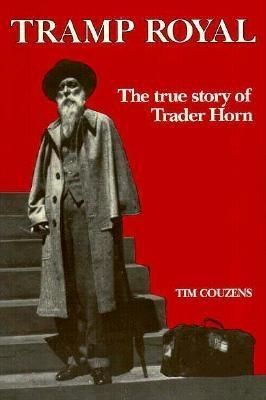
    After reading Trader Horn I was then even more enamoured of Tim Couzens’ book ‘Tramp Royal – The true story of Trader Horn’, as it validated the Trader Horn legend – Alfred Aloysius ‘Wish’ Smith was real and he had got around!!

    Couzens died in October this year, tragically – he fell in his own home. I thought OH NO!! when I read it. He was a gem, almost a Trader Horn himself – what a waste! Too soon! He did the MOST amazing sleuth job of tracking down all Trader Horn’s jaunts n joints across the world and revealing that – despite the skepticism that had followed the incredible fame and Hollywood movie that had followed the success of Aloysius ‘Wish’ Smith’s – now famous as Trader Horn – first book in 1930, MOST of what the old tramp, scamp, rogue and adventurer had claimed to do he had, in fact, done! Tramp Royal is a wonderful vindication, and a moving, fascinating and captivating read.

    One (small) reason I LOVED the trader Horn books, besides the original title:

    Trader Horn; Being the Life and Works of Aloysius Horn, an “Old Visiter” … the works written by himself at the age of seventy-three and the life, with such of his philosophy as is the gift of age and experience, taken down and here edited by Ethelreda Lewis; With a foreword by John Galsworthy

    (phew!) . . . . . was the number of places A. Aloysius Smith – ‘Trader Horn’ (or Zambesi Jack or Limpopo Jack or Uncle Pat – he had aliases!) had been to that I have also been to:

    • Joburg, his least favourite city in the world. He was in a doss house in Main Street in 1925, I was in Eloff Street in 1974. Parktown, where Ethelreda Lewis ‘discovered’ him. He would have died on Main Street, unknown and in penury, had it not been for her sudden decision to listen to him tell a story. ‘Wish’ came to love Joburg, as did I. In Parktown, he and Ethelreda spoke in her home in Loch Street in 1926, I was in nearby Hillside Road in 1977;
    • Hwange in Zimbabwe, or Wankie in Rhodesia as it was then; – BTW, I believe you pronounce Hwange ‘Wangie’;
    • Harrismith, where he went with Kitchener’s Cattle Thieves to steal Boer cattle and horses in the scorched earth tactics of the wicked, looting, war-criminal Brits in the Anglo-Boer War of 1899-1902; He showed his humanity by describing the Boer women’s sadness, and states – I hope its true – that they always left ‘one milk cow behind for the kids; and we called it Pansy.’ And Harrismith is where I was born and raised;
    • The west coast of Madagascar where our yachting trip to the island of Nose Iranja off the west coast of Madagascar took us quite close to his ‘Chesterfield Islands’;
    • The east coast of Africa, although he spoke of Zanzibar and we visited Mombasa – which he probably visited too, as he sailed up and down the coast;
    • Oklahoma, where like me, he befriended and was befriended by, the local American Indians – his mostly Pawnees and Osages, mine mostly Apaches, Kiowas and Cherokees; THEY called themselves American Indians, not Native Americans, and some indeed belonged to the American Indian Movement, famous for their brave resistance in 1973;
    • Georgia, where he behaved abominably and which I used as a base to go kayaking in Tennessee. I went to shoot rapids; he may have ridden to shoot people! He drank in a doctor’s house and I drank in a dentist’s house;
    • The Devonshire Hotel in Braamfontein, where both of us got raucously pickled;
    • The Seaman’s Institute in Durban where he holiday’d happily for two pounds a month while waiting for his book to be published, spurning the fancier beachfront hotels; His editor needed a break from him and sent him off by train on the 2nd April 1926 to avoid the Jo’burg winter. My only connection here is drinking in the notorious nearby Smuggler’s Inn. If Smuggies had been around back then, Wish Smith would have gone there!
    • Kent, where he died in 1931; I visited friends in Paddock Wood on honeymoon in 1988.
    • Wish’ himself would be saying, ‘What, you haven’t been to Lancashire!?’ My reply would be, ‘I haven’t. But my far bigger regret is I have not cruised on ‘your’ Ogooue River in West Africa.’
    trader-horn_3

    I would love to see his river – the Ogowe or Ogooue River in Gabon. Everything I’ve seen on youtube verifies Aloysius’ lyrical descriptions. Here’s an example (I suggest you turn the sound down and start from 2:40);

    – Ogooue river – there’s an art to navigating the channels here –
    – Samba falls upstream on the Ngounie river from Trader Horn’s trading post –

    I also loved the unexpected success of the first book. Written by an unknown tramp living in a doss house in Main Street Joburg, the publishers Jonathan Cape advanced fifty pounds which Mrs Lewis gratefully accepted. Other publishers had turned it down, after all. Then the Literary Guild in America – a kind of book club – offered five thousand dollars! They expected to print a few thousand, and also offered the rights to a new publisher called Simon & Schuster, who hesitated then went ahead, receiving advance orders for 637 copies.

    – the tramp in new clothes! –

    Then it started selling! 1523 copies one week, then 759, then 1330 and then 4070 in the first week of July 1927. Then 1600 copies one morning! Then 6000 in a week. They now expected to sell 20 000 copies!

    Up to November that year sales averaged 10 000 a month, thus doubling their best guess. They had already run ten reprints, the last reprint alone being 25 000 copies. 30 000 were sold in December alone up to Christmas day. The story grows from there – more sales, trips by the bearded author to the UK and the USA, bookstore appearances, talk of a movie. The trip continued until he had gone right around the world, drinking, smoking and entertaining the crowds with his tales and his exaggerations and his willingness to go along with any hype and fanfare. On the way he would shun the best hotels if he could, even though money was now no problem; as he preferred to frequent lower-class establishments – usually with some cash in his sock or sewn into a pocket.

    At his first big public appearance at 3.30 pm on Wednesday 28th March he spoke to a packed house in the 1,500 seater New York City Town Hall off Times Square:

    Well known English/American writer of sea stories William McFee was to have made an introductory address but ‘the old man walked on the stage (probably well fortified with strong liquor), acknowledged tremendous applause with a wave of his wide hat and a bow and commenced talking in a rambling informal style before McFee could say a word. He started by quoting advice given to new traders: “The Lord take care of you, an’ the Divil takes care of the last man.” He spoke of the skills of medicine men, rolled up his trouser leg above his knee to show the audience his scar, and threatened to take off his shirt in front of the whole Town Hall to show where a lion had carried him off and was shot only just in time. When the aged adventurer paused to take a rest in the middle of his lecture, McFee delivered his introduction.’

    His fame grew and he reveled in it.

    Then suddenly, people started thinking old ‘Wish’ Smith’s whole story was a yarn, nothing but the inventions of a feeble mind, and wrote him off as yet another con artist – there were so many of those! It was the age of ballyhoo, of PT Barnum and fooling the public with bearded ladies, confidence tricksters and hype. Some critics grew nasty, depicting Ethelreda – without whom none of this would even have happened, and without whose kindness and perseverance Aloysius would have died in obscurity, never seeing his family in England again – as abusing ‘Wish’ for her own gain. The truth really was that she – in effect – saved his life; she certainly returned him to his family; and she enabled the kind of rollicking final few years his dreams were made of! He had people to listen to him; he had money to throw around! What a better way to go than dying anonymously in a doss house in Main Street Joburg!

    The hype died, cynicism (a nasty kind, not healthy cynicism) set in and old ‘Wish’ Smith – Trader Horn – died in relative obscurity with his family in Kent. It may all have been a hoax . . .

    So was he real, or was it all a hoax? To know more, read Tim Couzens’ book – it’s a gem! It’s fascinating and uplifting and – oh, hell, I’ll tell you – Trader Horn, as Wish Smith in Africa, Uncle Pat in America, and by other names, was real! Very VERY real. The journalists who slated Trader Horn and Ethelreda Lewis did so at their desks, joining a false bandwagon. Tim Couzens actually travelled the world, visiting the spots Aloysius Smith said he’d been – and he had indeed been there!

    Here’s a silent movie of the old rascal on a Joburg street corner soon after he’d been kitted out in new clothes when the first cheque for his book came in.

    ~~oo0oo~~

    Here’s the full program for the 1931 movie.

    Here’s the back page from the movie program. The movie, of course, was Hollywood – WAY different to the true story! An interesting facet was for once they didn’t film it all in a Hollywood studio; they actually packed tons of equipment and vehicles and sailed to Kenya and then on to Uganda to film it ‘in loco’ – just – ahem! – on the wrong side of Africa to where it had happened!

    It was a landmark film of sorts that chalked up several firsts. It was the first fictional feature-length adventure shot on location in Africa (yeah, East Africa while Aloysius’ adventures were in West Africa!). It was the first sound-era ‘White Jungle Girl’ adventure – many more would follow. It’s an old movie, sure, it is of its time; to me as a Trader Horn fan, the worst thing about it is: it isn’t the true story! Nevertheless, some rate it as ‘surprisingly engaging and worth checking out’ now that it’s been reissued on DVD. (NB: See the badly-made 1931 movie, not the worse-ly-made 1973 remake).

    ~~oo0oo~~

    Trader Horn wrote glowingly of a real lady he met on his river: an American missionary, Mrs Hasking. She died on the river, and Trader Horn took her body down river to be buried. I found out more about his Mrs Hasking here.

    ~~oo0oo~~

    Here‘s a much better, two-post review of the Trader Horn phenomenon – and Tim Couzens’ book – by fellow ‘tramp philosopher’ Ian Cutler. Do read it!

    ~~oo0oo~~

    On 27 October 2016 I wrote to Ian Cutler:

    Sad sad news today: Tim Couzens the master tramp sleuth has moved off to join his Tramp Royal in the afterlife. 
    At 72 he was about the same age as the old rogue at his death.
    Regards, Peter Swanepoel
    Sad news indeed Peter. Thanks for letting me know.
    Ian

    ~~oo0oo~~
  • Up the Creek

    Up the Creek

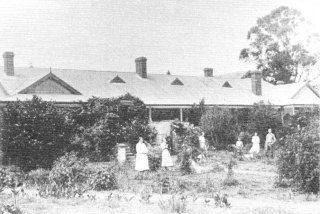
    I was Born up Shit Creek without a Paddle. Quite literally. OK, my actual birth, per se, was in Duggie Dugmore’s maternity home, less than half a kilometer away on Kings Hill. See pic above – the old British officers mess (or the doctor’s residence?) became the maternity home. But mere days after I was born – as soon as I could be wrapped in swaddling clothes – I was taken home to my manger on a plot on the banks of Shit Creek (more accurately Kakspruit) in the shadow of Platberg mountain. And it was twelve years or so before I owned my first paddle. So this is a true story. Some will express some scepticism, but I really was Born up Shit Creek without a Paddle.

    – ruins of our house on the plot – trees in in the middle ground are on the banks of Shit Creek –
    – inset: me on the lawn thinking, ‘where’s me paddle?’ –

    I paddled my own canoe about twelve years later after we lost the plot. OK, sold the plot, moved into town and bought a red and blue canoe with paddle. The first place we paddled it was in a little inlet off the Wilge river above the Sunnymede weir, some distance upstream of town. Right here:

    – younger sis Sheila operates the paddle I was born without –
    Sunnymede on the Wilge River upstream from Harrismith FS ca1965
    – same little inlet – Mother Mary and Sheila on land, me airborne, Barbara sitting on water –

    Before this, I had paddled a home-made canoe made of a folded corrugated zinc roofing sheet, the ends nailed onto a four-by-four and sealed with pitch. Made by good school friend Gerie Hansen and his younger boet Nikolai – or maybe his older boet Hein; or by their carpenter father Jes? We paddled it, wobbling unsteadily, on their tiny little pond in the deep shade of wattle trees above their house up against the northern cliff of Kings Hill, halfway between the plot on the banks of the Kakspruit and our new house in town.

    Then Charlie Ryder came to town, and one thing led to another . . . also, eventually I got myself a Lekker Canadian Paddle.

    ~~oo0oo~~

    School friend Piet Steyl wrote of the wonderful days he also spent in the company of Gerie Hansen – who died tragically early, adding to the feeling that the good die young. Piet told of fun days spent paddling that zinc canoe, gooi’ing kleilat, shooting the windbuks and smoking tea leaves next to that same little pond. We both remembered Gerie winning a caption contest in Scope magazine and getting reprimanded for humourously suggesting Japanese quality was perhaps dodgy back then. Irony was, the Hansens actually owned one of the first Japanese bakkies seen in town – a little HINO.

    Gerie used to say ‘He No Go So Good!’ and Piet says when it finally gave up the ghost he said, ‘He No Go No More!’

    ~~oo0oo~~
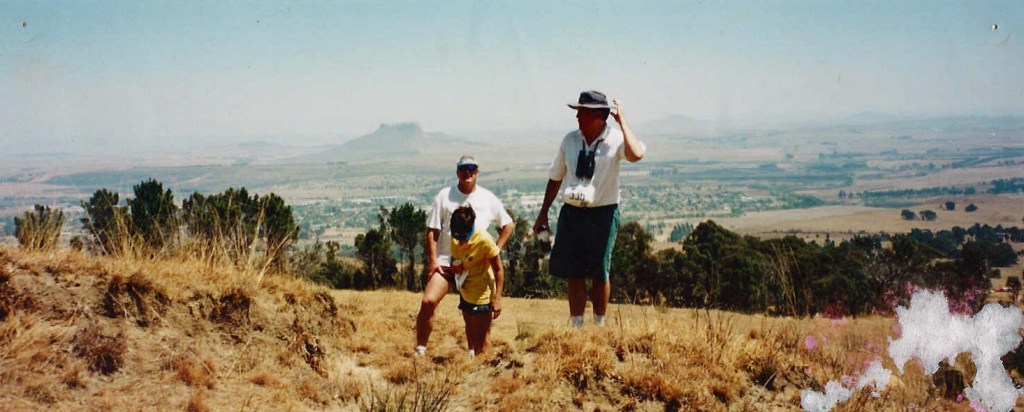
    Shit Creek – actually the Kak Spruit; a tributary of the Wilge River which originates on Platberg mountain, flows down past our old plot and then westward through the golf course on the northern edge of town, then turns south and flows into the mighty Wilge below the old park weir on the right bank; Sensitive Harrismith people refer to it as ‘die spruit met die naam;’ Bah humbug.

    ~~oo0oo~~
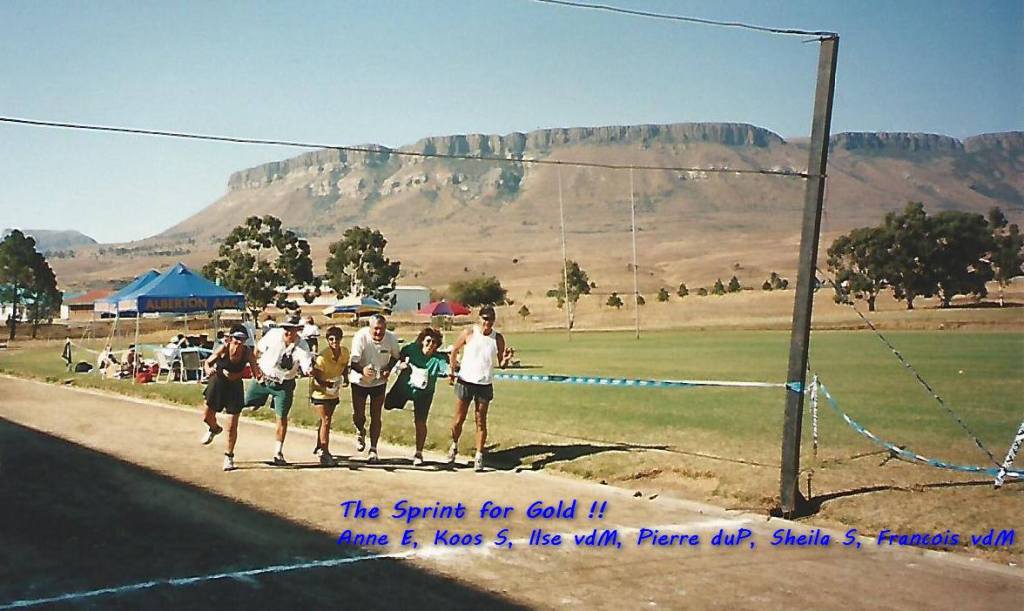
    die spruit met die naam – ‘the creek with the name’ – that’s a kak description – too coy! It’s Kakspruit – one word; always will be; Shit Creek. Two words in Engels.

    gooi’ing kleilat – lethal weapon; a lump of clay on the end of a whippy stick or lath; spoken about way more than practiced, in my experience; and about 10% accuracy when you do get it going; Here’s a kid loading one:

    windbuks – air rifle; pellet gun.

    ~~oo0oo~~

  • Drunken Revelry

    Drunken Revelry

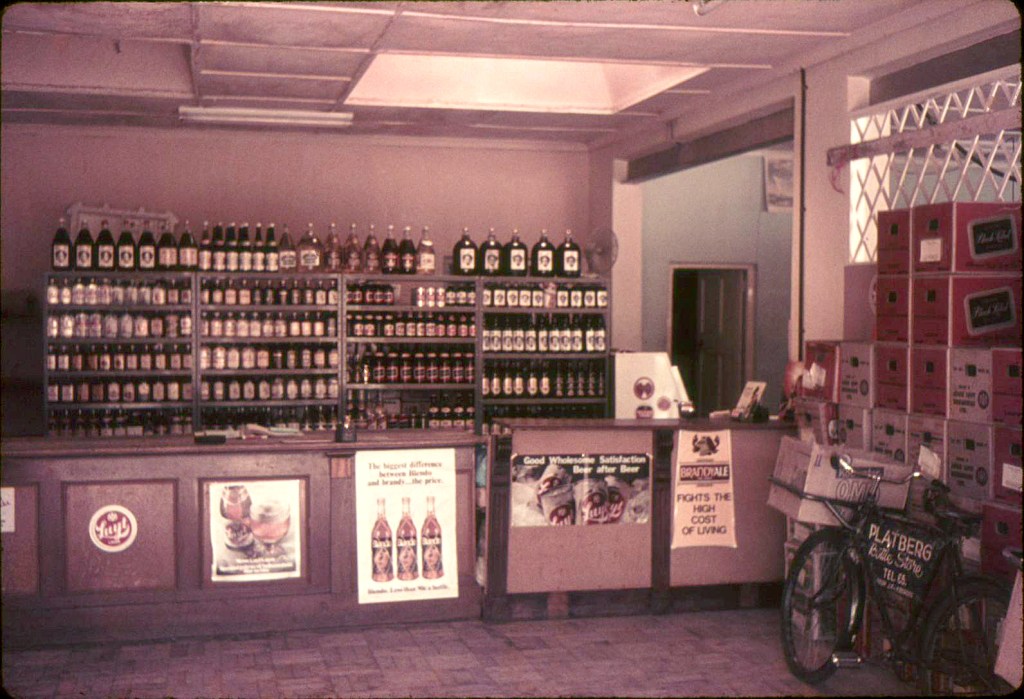
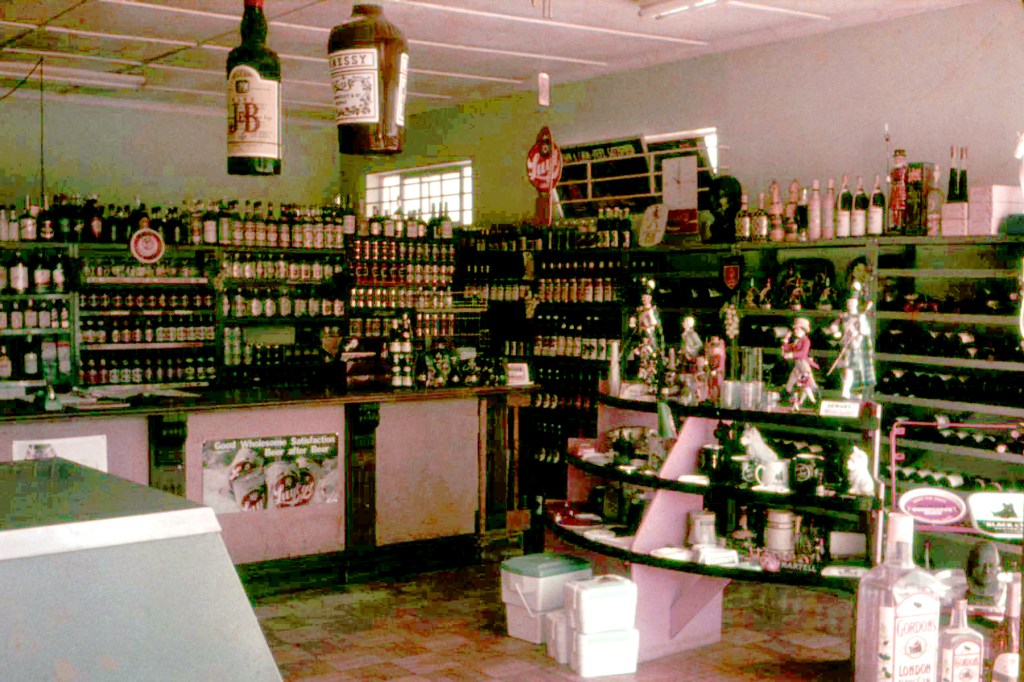
    OK, not really; more a reverie on drink – a nostalgic lookback on a bottle store. Platberg Bottle Store / Drankwinkel in Harrismith, the Vrystaat. The Swanepoel family business. We all worked here at times. You could say we were raised on grog.

    We were talking about the trinkets, decor and marketing stuff. Like those big blow-up bottles hanging from the ceiling. Turns out big sister Barbara kept some of them from way back when:

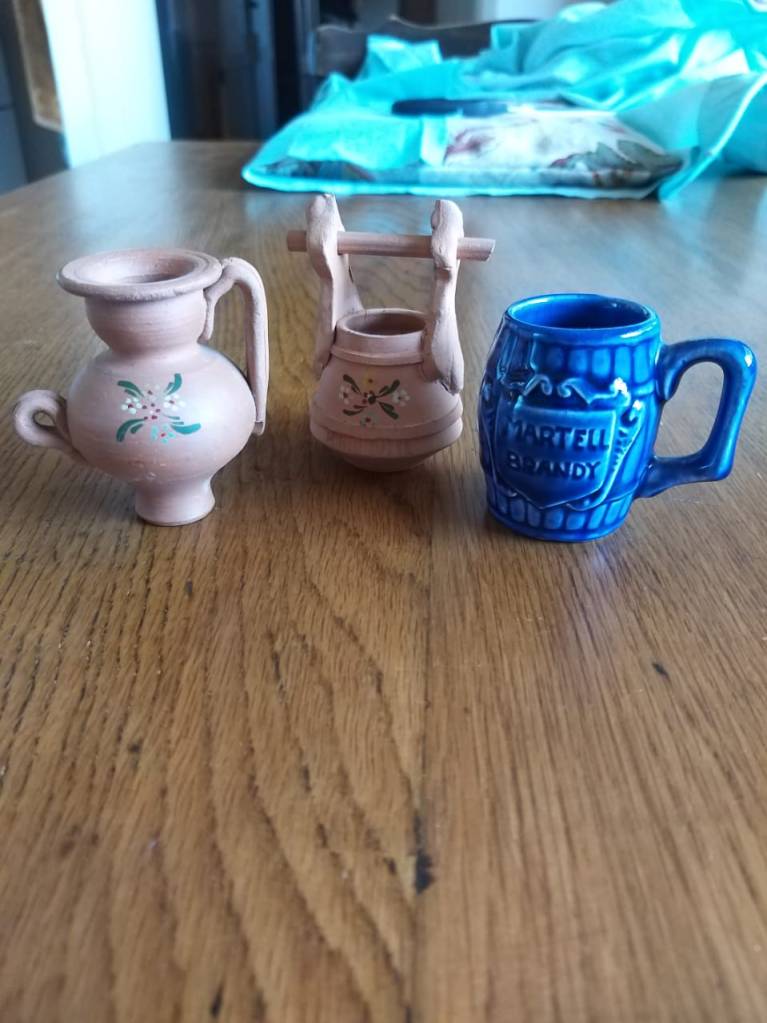
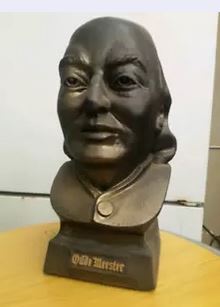
    Younger sister Sheila has some whisky jugs; and I found an old familiar brandy-making figure online: the Oude Meester bust. We fondly remember Jan Jan die Oudemeester Man! Jan Robertson, the rep who would visit us to sell his popular product.

    ..

    This is where the big blow-up bottles were displayed, along with the striding statue of Johnny Walker whisky; Dewars White Label whisky’s Scottish soldier ‘drum major;’ Black & White whisky with their black and white Scotty dogs; Beefeater Gin’s ‘beefeater’ in his red uniform, etc. Spot them below. All were shouting a loud Drink More! and in small print; um, drink responsibly.

    BrandyAle had people’s best interests at heart when they told you how drinking BrandyAle would “Fight the High Cost of Living.”

    Methodists are pretty strongly anti-alcohol, so I believe it is testimony to Mother Mary’s organ-playing skills (and her much-loved status among all who know her) that we could run a bottle store six days a week and still be Methodists on the Sabbath! (Kidding! It was the collection plate. Kidding!).

    ~~oo0oo~~

  • Lunch for Two

    Lunch for Two

    Have lunch with anyone of your choice.

    A famous thought experiment. Who would you choose? Besides the world-famous people – of whom I’d definitely choose Charles Darwin and Albert Schweitzer, maybe Rachel Carson, maybe Noam Chomsky, maybe some of the early Southern African explorers like Francois Levaillant or Adulphe Delegorgue, certainly Aloysius Smith (Trader Horn), and maybe his wonderful biographer Tim Couzens – I’ve not given this any time yet. So many to consider. More locally and more personally, I’d really like to have lunch with these three luminaries from my little home town Harrismith, Free State, South Africa:

    Stewart Bain; my wonderful gran Annie’s Dad, Scottish immigrant, fisherman, railroad bridge-builder, hotelier, who became mayor of Harrismith and the prime mover behind the building of a town hall fit for a city in a Free State dorp; ‘Oupa’ Bain he was called by family, and The Grand Old Man of Harrismith by some towards the end of his life, maybe only at his (lavish) funeral?

    Dr Anna Petronella ‘Nell’ van Heerden; pioneer general medical practitioner in Harrismith, Pioneer gynaecologist in Cape Town; then pioneer cattle farmer in Harrismith; lesbian cattle farmer in Harrismith, Vrystaat in the fifties and sixties – courage and self-confidence.

    Dr Francis William ‘Frank’ Reitz; son of a state president; brother of the famous Deneys Reitz of Anglo-Boer War and WW1 fame; qualified at Guys in England, then specialised in surgery in Germany; practiced as a general medical practitioner in Harrismith Vrystaat.

    Be amazing if they all told the truth, the whole truth and nothing but the truth. Which they would, surely, now that no-one can do anything to them!? I have a theory that once we’re sitting on a cloud we won’t be bothered by earthly bulldust in the faintest.

    Great Granpa Stewart Bain, it would be fascinating to know how much corruption there may have been in the building of the town hall – were there any rigged tenders, Great Grandad? Who benefited? How long did the building take? How involved was he, onsite? What was the ribbon-cutting day like? Who opposed this lavish project (some called it Bain’s Folly)? Did he acknowledge them and their concerns? And I’d ask about his special daughter Annie.

    Dr Nell van Heerden, it would be fascinating to find about being a female pioneer. To know about her relationships; about her live-in companion Freddie Heseltine; about farming amongst toxic, confident, powerful masculinity; attending cattle auctions; her relationship with her staff; what protected her? Was it her National Party connections that made her immune from slander and attack? Was she immune? About her geological digs in the ‘holy land.’

    My own personal GP, Dr Frank Reitz, it would be fascinating to hear about 1920’s to 1960’s surgery and chloroform anaesthesia; about other Harrismith and district characters; about pioneering surgical techniques; about the successes and some failures on the operating table and the making of prostheses and new equipment; About sport in the early days – rugby and polo especially. Personally, I would wonder if you remember – among your many patients – putting a bamboo hoop over a young boy’s face, covered with a cloth, sprinkling chloroform on it and saying, “OK, Kosie, now count backwards from ten.” I loved arithmetical challenges like that! I could do it! But I don’t think I got down to six. And do you remember digging a spiderbite out of my knee? What stories did your famous Dad, President Francis William, and your older brother Deneys tell you? What did he tell you about the Boer War when he visited you at Guy’s in London?

    Of Charles Darwin I would ask way more about his wonderful voyage, and also lots about his amazing, stunning insight into how the fact of evolution happens; but all his other lunch guests would ask him that, so I’d mainly be interested in his five years circumnavigating the globe aboard the Beagle; imagine living on board a small wooden ship for over 1700 days – two months short of five years – living cheek-by-jowl with a fervently religious captain with a hot temper whose quarrels ‘bordered on insanity.’ I’d also want to know about his inner struggle with ‘coming out’ with this powerful scientific insight in the face of self-righteous religious ‘knowledge.’ Which was actually intense blustering ignorance. But only if he was comfortable to talk about it – he was a sensitive man who – I think – suffered his debilitating mystery illnesses mainly due to that stress.

    ~~oo0oo~~

  • Ancient Fillums & Stills

    Ancient Fillums & Stills

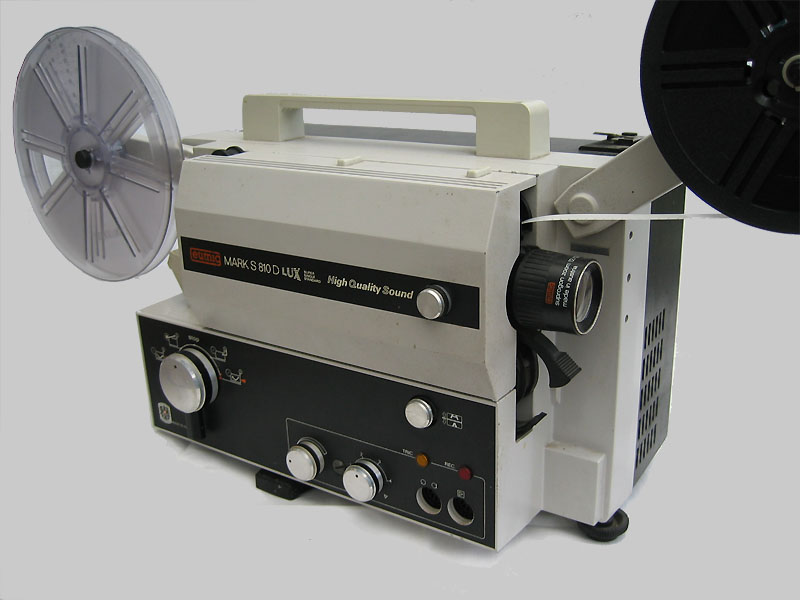
    The old man bought an 8mm cine film Eumig camera and Eumig projector very like these. Made in Austria. This was ca.1963, I’d guess. It once did a bit of – potentially – famous footage!

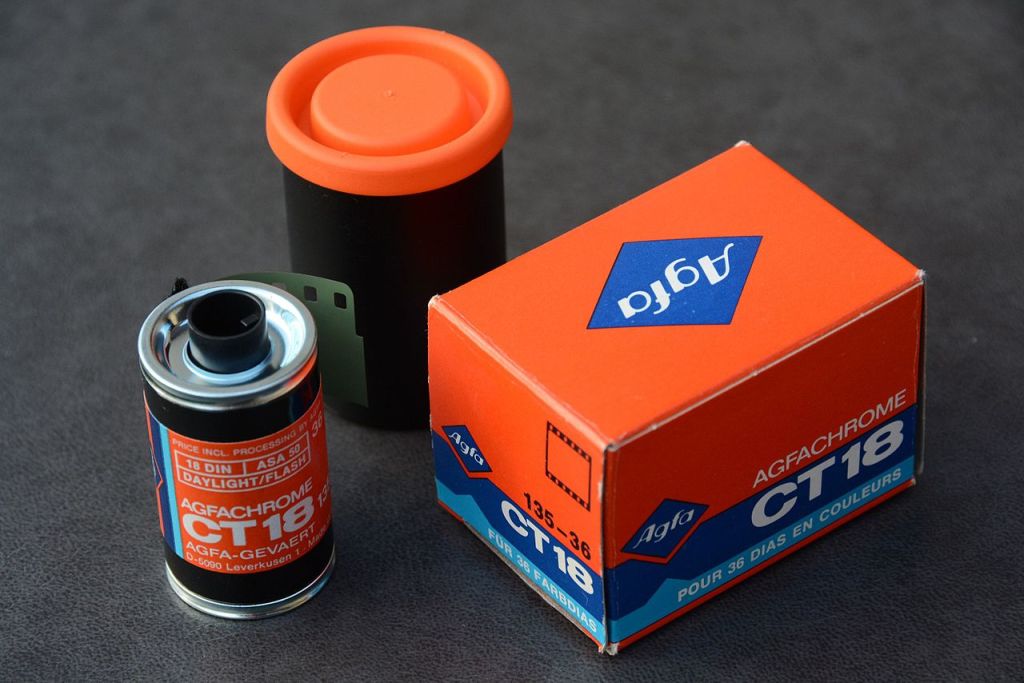
    Later he bought a Canon SLR camera with a 50mm lens like this, and a 300mm telephoto lens. An FT QL exactly like this one. He used Agfa slide film. Had to be Agfa, not Kodak! Agfa ‘had better greens and blues.’

    Once I heard Dad had been present when I won a 100m race at the town’s President Brand Park athletic track. I didn’t know he was there – found out later that he had been taking photos. At the finish, in my lunge for the tape, I fell and somersaulted, skidding on my back on the cinder track. I tied for first place. Never did see a photo of that finish – !? Had two roasties on my back for a while.

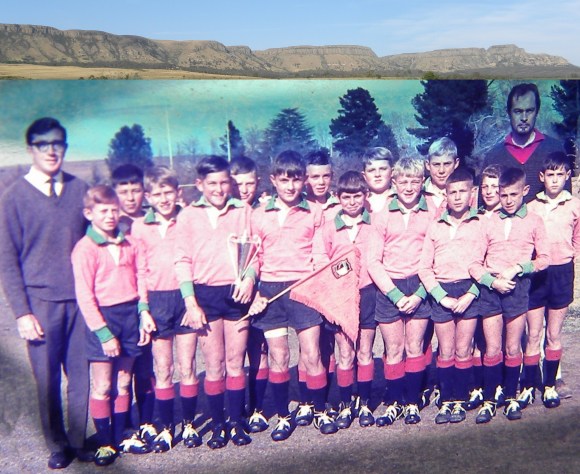
    Once – 1967 – he took a photo of the all-winning U/13 rugby team holding a trophy. I must try and find out what the trophy was for. So I do have one photo a father took of his son’s school sporting career!

    ~~~oo0oo~~~

    fillums – films, movies, videos, moving pictures; usually not talkies

    stills – pictures on paper, photos; often in ‘albums’

    We saw other ancient movies too – those were 16mm.

    ~~oo0oo~~
    EUMIG was an Austrian company producing audio and video equipment that existed from 1919. The name is an acronym for Elektrizitäts und Metallwaren Industrie Gesellschaft – “Electricity and Metalwarendustry Company” –

    In 1982 EUMIG went bankrupt – punishment for choosing such a boringname?

    Eumig’s patent for the macro system in lenses was sold to the Japanese company Canon.

  • Smitten, Forgotten

    Smitten, Forgotten

    We went to a dance in Red River. Beer. Music. I danced with a tiny little girl. I was smitten, she was a gorgeous freestyle hippy, having fun and dancing with gay abandon. How old ARE you? she asked when I told her I was repeating matric for the third time. Well, she had asked what I was doing and I’d said Senior in High School. Again.

    Eighteen, I said.

    I don’t believe it, she said.

    And you? I asked – I was suddenly getting good at this wooing stuff. Makin’ small talk, I was.

    Twenty seven, she said. What? No way! I do not believe that, says me.

    She whipped out her drivers licence: 1946. She was 27. I didn’t even know you got people that old.

    I was still smitten.

    Come round to our place in Arroyo Hondo tomorrow, she invited. It’s an adobe house right on the road to Taos, you can’t miss it, she invited.

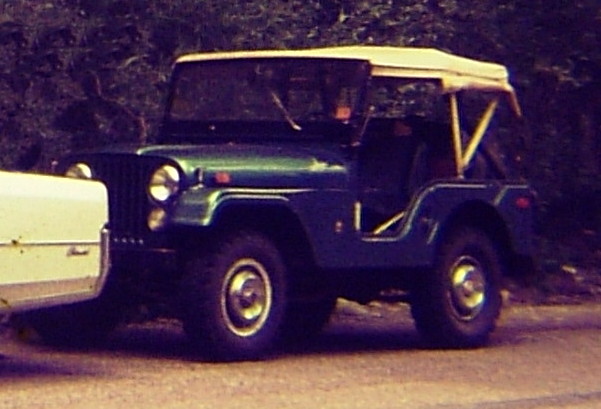
    We were there like a shot the next day! Me and Jeff in his blue Willys Jeep. Talk about me being young: Jeff was fourteen. We’d only got back to Granma’s cottage in the wee hours, so it was after midday that summer day when we found the house that looked about as my new focus of fascination had described it.

    Sitting on the mud wall of the porch watching the daily non-stop broadcast of the Nixon Watergate hearings on a small black and white TV was a fella with long hair and a scraggly beard, with a fag hanging from his lips. He was filing away at a flywheel. We learnt a few minutes later that it was a Chevy flywheel and he needed it for his old Ford. Or a Ford flywheel and he needed it for his old Chevy. It was too big, so he was filing away one tooth at a time. When it fitted he was going to move on.

    But first we said Hi! Is ___ (I really should remember her name for a love story like this, should I not!?) around?

    Ah, she went thataway about eleven this mornin,’ he said, flicking his head over his shoulder indicating the road South to Taos. ‘Said she wanted to catch a concert in Cali.’

    California!? Where . . ?

    ‘Some rock concert.’

    How . . ?

    ‘She threw her thumb out and somebody gave her a ride.’

    Heartbroken, we drifted back to Red River. Took me ages to recover. About as long as the romance had lasted. Hours.

    But hey! it’s 47yrs later and I can still remember how she felt and smelt dancing, and what the top of her head looked like, so there was true love involved too.

    ~~~oo0oo~~~

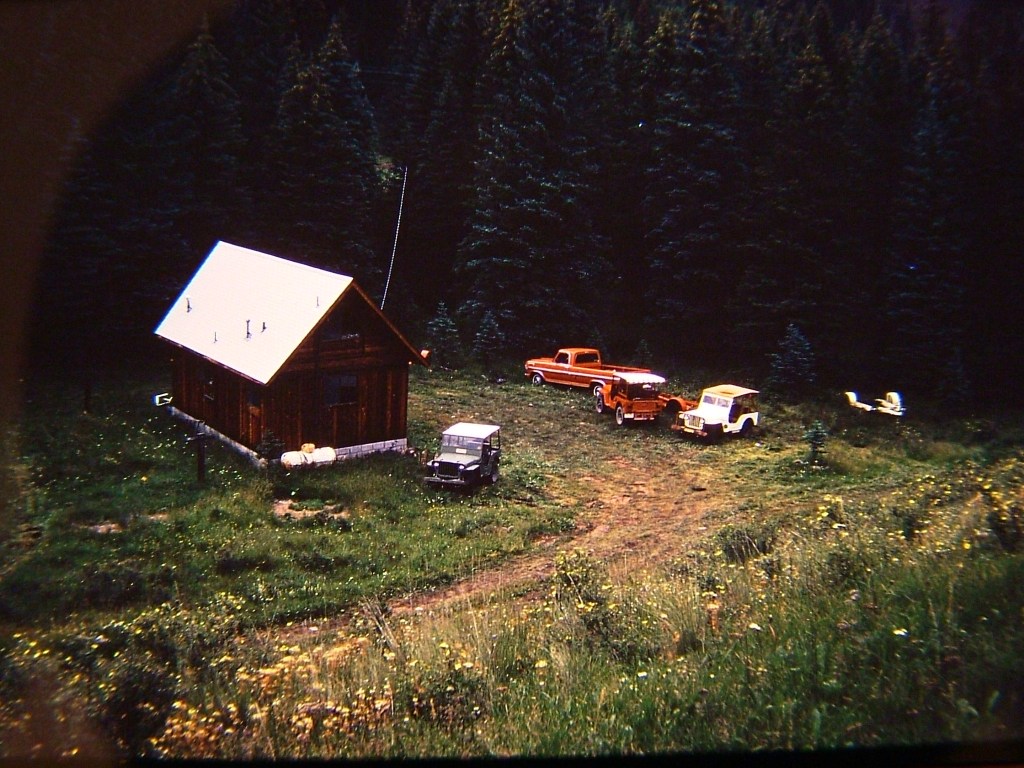
    – Granma Merrill’s Cottage outside Red River –
    – Red River – Arroyo Hondo – Taos – New Mexico –

    ~~~oo0oo~~~

  • Harrismith Mountain Race

    Harrismith Mountain Race

    Mountain-Race site - Copy
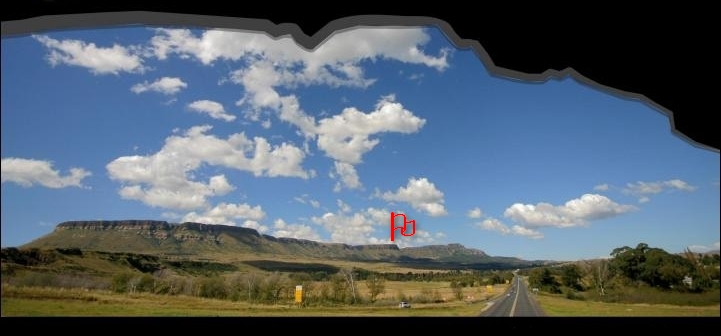
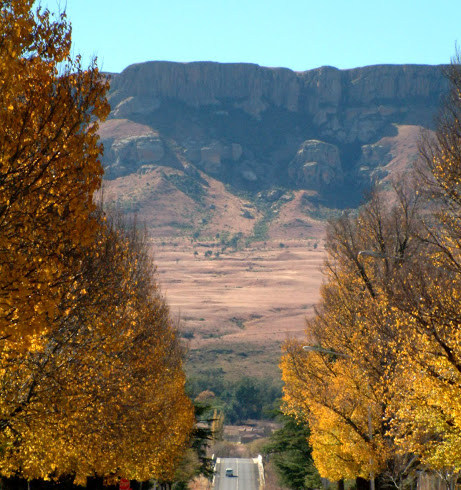
    Way back in 1922 a Pom army major sat in the gentleman’s club in Harrismith and spoke condescendingly about our mountain, Platberg, as “that little hill”. What was ‘e on about? It rises 7800 ft above sea level and he was from a tiny chilly island whose ‘ighest point is a mere 3209 ft above sea level! Being a Pom he was no doubt gin-fuelled at the time. Anyway, this ended up in a challenge to see if he could reach the top in under an hour, which led to me having to run up it years later. Because it’s there, see.

    mountain race harrismith_crop
    – at this point I wished I had done some training! –

    I had often run the short cross-country course and twice the longer course, which followed the mountain race route except for the actual, y’know, ‘mountain’ part. I had also often climbed the mountain, but strolling and packing lunch. When I finally decided I really needed to cross the actual mountain race proper off my list of “should do’s” I was larger, slower and should have been wiser.

    Here’s some 8mm cine camera footage taken by Dad Pieter Swanepoel of Platberg Bottle Store of the start and finish in front of the Post Office – 1960’s I guess:

    The race used to be from town to the top of the mountain, along the top for a mile or so and back down. Sensible. That’s how I ran it in 1979. The medal then had a handy bottle opener attached!

    HS Mtn Race badges, medal
    – mountain Race badges and medals – these are the legitimate four – where I actually finished in the allotted time! –

    I recently found some old papers which told me I once ran the race in 79 minutes, and in 85 minutes another year.

    We also walked the race for fun a couple times:

    The 12km distance was enough. But no, some fools decided that wasn’t long enough! Apparently a cross-country route needed to be 15km to be “official”, so they added three kilometres of perfectly senseless lost-fart meanderings around the streets of our dorp causing fatigue before I even started the climb when I ran with Jon and Dizzi Taylor one year. At least I did get to see old friend Steve de Villiers who enquired after my sanity as I shuffled past his home on the backstreets of the dorp.

    The finish at the Groen Pawiljoen grounds
    – run to A then to B and back (who added three km of tar road!?) –

    Oh by the way, Major Belcher did get to the top in under an hour, winning the bet.

    Here’s more about Platberg.

    ~~~oo0oo~~~

    Some history from friend Ettienne Joubert, who has also trotted the course:

    The Harrismith Mountain Race held annually since 1922, was described as the ‘toughest in the world’ by Wally Hayward, who won five Comrades marathons, the London to Brighton Marathon and the Bath to London 100-miler! (I once spent a wonderful day with Wally).

    It originated when, in 1922, a British soldier, Maj A E Belcher, returned to Harrismith where he had been stationed near 42nd Hill during the war. He was referring to Platberg as ‘that small hill of yours’, one Friday evening [lots of silly things are done on Friday evenings] and one of the locals (a certain Van Reenen – or maybe the chemist Scruby) immediately bet him that he could not reach the top (591 metres – just under 2000ft – above the town) in less than an hour.

    The major accepted the challenge and set off from the corner of Stuart & Bester streets outside the old Harrismith Club near where the Athertons ran The Harrismith Chronicle the very next day. He reached the summit with eight minutes to spare.

    During a later visit to the town, Major Belcher (now a schoolteacher in Dundee, Natal) found out that his record still stood so he took it upon himself to donate a trophy to the Harrismith Club to be awarded to the first club member to break his record to the top.  In 1929 the Club management, as the organizers of the race, decided to open the race up to the residents of Harrismith and a Mr Swanepoel won the race to the top of the mountain in 32 minutes. (The last record time I have is 22 minutes and 9 seconds – from town to the top of the mountain! Amazingly quick).

    The race route has changed over time – starting in Piet Retief Street outside the post office and police station for some years. Nowadays it starts at the town’s sports grounds, passing the jail, then through the terrain where the concentration camp (second site) once stood, up the steep slopes of Platberg to the top via One Man’s Pass, close to where a fort was built during the Anglo-Boer War. After traversing a short distance along the top, the descent is made via Zig-Zag Pass, and the race is completed back at the ‘Groen Pawiljoen’ sports grounds.

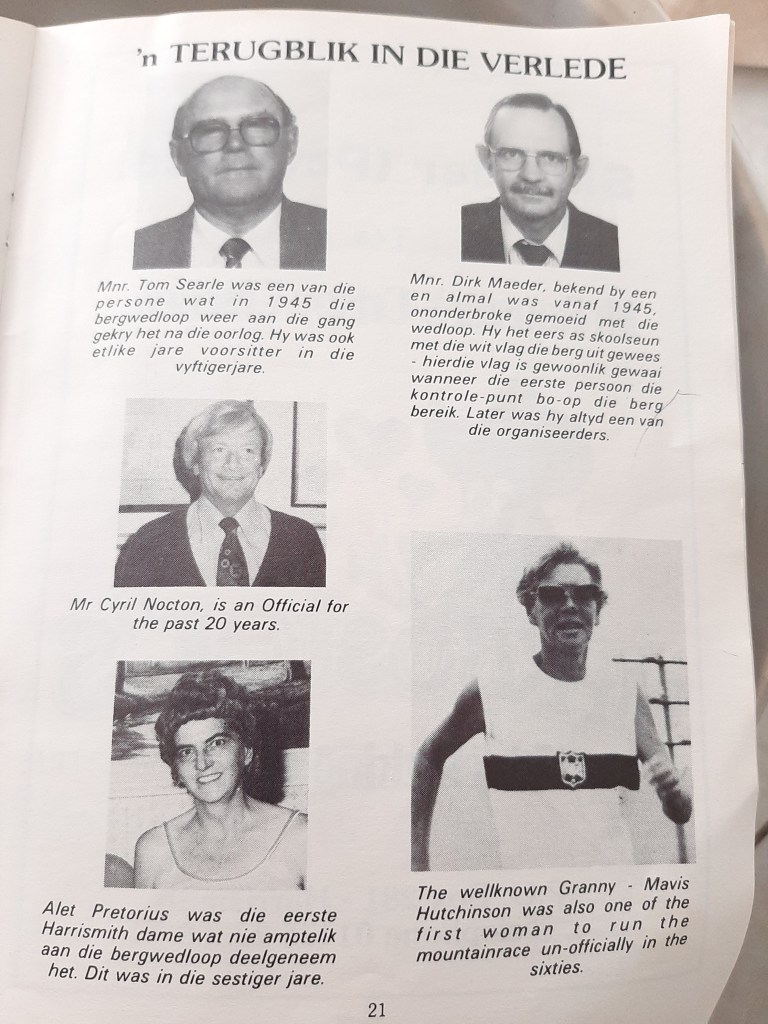
    Our friends Steph and JP de Witt’s Mom, Alet de Witt became the first lady to complete the race. She ran in the year her husband, JN ‘Koos’ de Witt died tragically suddenly in January 1967. She then donated a trophy for the winner of the newly allowed (!) women’s category, which was awarded for the first time only in 1986.

    Later the apartheid ‘whites-only’ ruling was dropped and as soon as McDermott* stopped winning, the race was won by black athletes, including Harrismith locals; starting with Michael Miya who holds the record for the newer, longer 15km course at 1hr 03mins 08secs.

    *McDermott won sixteen times consecutively from 1982 to 1997 and in 1985 established the “short course 12.3km” record at 50mins 30secs.

    ~~~oo0oo~~~

  • Knife Fight

    Knife Fight

    . . at the OHS corral – (they made a movie about this* )

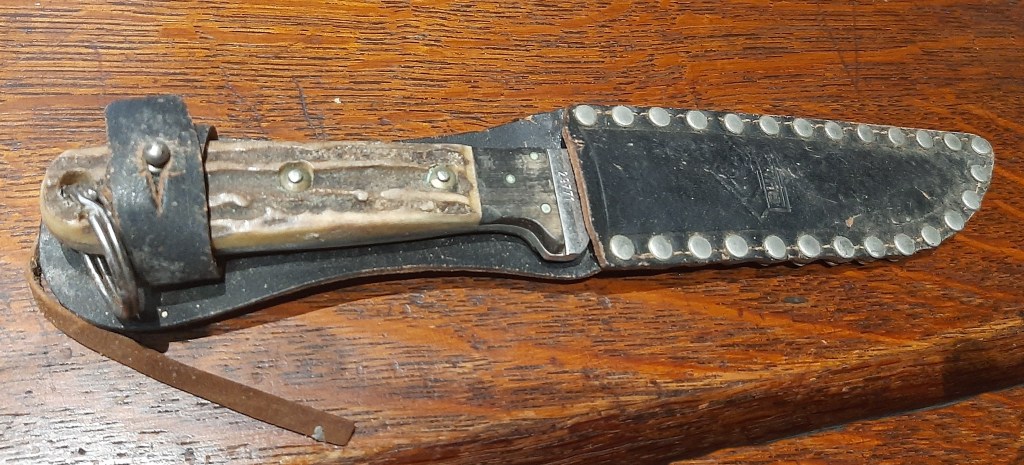
    The ole man bequeathed me a knife quite recently. Well, in the last ten or fifteen years or so. He told a story in a very rare letter to his darling son, written on the back of a Maxprop invoice and folded into the special PUMA green and yellow case:

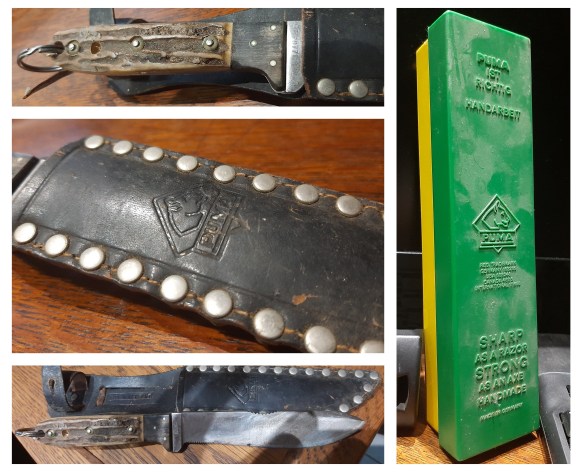
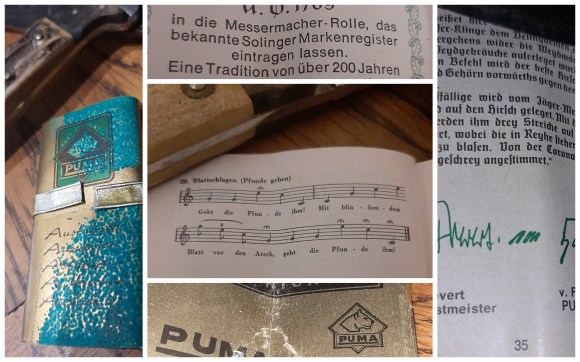
    – PUMA knife – model 3585 – serial no. 29771 –

    Let me tell you about this knife,‘ he writes. ‘I first saw it in Rosenthals, a big safari shop in Windhoek more than 30 years ago.‘ This on one of his family holidays he took in the family car. Without the family.

    When friends of ours, the Maeders, went to Germany on holiday, he asked them to get the knife for him ‘in Austria, where it is made, by one man, whose name appears in the brochure‘ – a small 50-page brochure that comes with each knife.

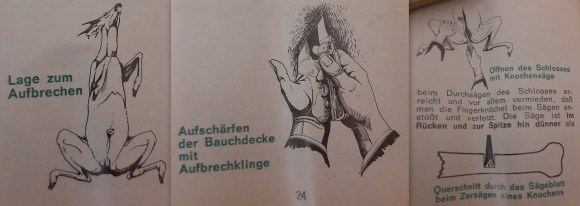
    – PUMA knife model 3585 – with skinning tips – can also sagen through knochens

    I think that middle picture shows you how not to cut a friend’s finger off – see later…

    The letter continues: ‘Anyway, the knife arrives by post in Harrismith. Uproar!! Urgent meeting: Me, the police and the postmaster – in his office. I had imported a dangerous weapon – the blade was more than 4″ long – illegal!

    The postmaster unlocks his safe in the presence of all concerned, removes the knife, makes a tracing of the blade. This is to be sent to the SA Police in Pretoria. Meantime, the dangerous weapon goes back into the safe.

    I told them not to be bloody silly; I could walk over to the OK Bazaars right now and buy a butchers knife with a 12″ blade!

    After all the dust had settled and all charges had been paid, the knife cost me R64.00.’

    The ‘over the counter’ price at Rosenthals in Windhoek – which he refused to pay, knowing he could save money by ‘getting it direct’ – had been R63.00!

    And I’m always trying to get a better price, to save money! Love Dad

    – PUMA knife – 50-page brochure – even a song! – ‘beating of the blade’ –
    PUMA knife 3585 details – made by senior forester Frevert, I think –

    I read the fifty-page brochure in my Austrian cousin’s accent. I sought they were probably sinking: ‘Ve know vot to do wis zis sing, but it might be sold to a blutty savitch! Better ve write some instructions… ‘

    ~o0o~

    Writing this cutlery story reminded me that as a kid way back in the sixties, I took over my Dad’s much bigger dagger; also with a bone handle and a leather sheath. I probably would have benefited from an instruction booklet …

    One day the duP’s came to visit and Pierre and I were playing with it, stabbing it into the hard Vrystaat ground on our lawn on the aviary side of the house, seeing how deeply we could bury the blade. I plunged it down with all my might, not seeing Pierre was still tamping down the ground and lawn from his attempt! I just about cut his finger off! Typically, stoic Pierre said Shh! and kept it quiet, so as not to attract the attention of the supervising adults nearby, who were tending noukeurig to their dop and tjop and the fire n stuff. He walked off, dripping blood, to our kitchen to show his Ma Joan, who cleaned and bandaged it without fuss! I must ask him for a pic of the scar, sixty years on.

    ~o0o~

    tending noukeurig – supervising the kids – not – while the Moms were doing the actual work in the kitchen.

    ~o0o~

    *

  • Food Glorious Food

    Food Glorious Food

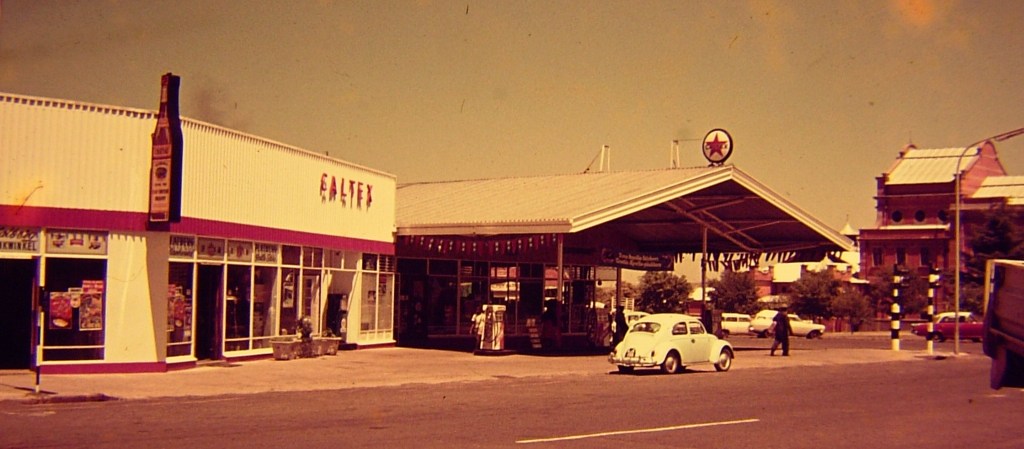
    We used to buy our groceries from Freddies Cash Store, straight across the road from our bottle store, seen in the picture. Freddies was owned and run by Grace Schimper (round as a beachball, thick glasses) and her sister Edna Bisset. Grace unmarried, Edna divorced with two special kids a bit older than us – Petra and Ray.

    Joan and/or Vera Simpson delivered milk in big tin cans on the back of a grey Morris Minor pickup by ; they were unmarried, lived on their dairy farm, Joan slept on the open veranda year-round. Later in glass bottles with tinfoil tops – who delivered those?

    – something like this –

    Our meat we would buy from Paul Raath, then from Louis Schoeman, ex-dashing, polo-playing bachelor – ‘Thought he was the Prince Imperial,’ says Mary, my Ma! Now he was the father of five wonderful kids, the older ones our age, and good friends of ours. Dad says Louis once snorted to him, speaking of his lovely wife Cathy, ‘Hmph! All that woman wants is babies, babies!’ I think he was probably just bragging!

    Food was also available at the big Ross general dealer store – a forerunner of the supermarket? – where friendly Charlie Ronalds was the grocer. Later Harrismith got Sonop, our first ‘supermarket.’ Sheila speaks fondly of enjoying milkshakes there; I don’t remember that at all, don’t think I ever even saw their sit-down section.

    ~~~oo0oo~~~

    I thought of this old-time food shopping while reading an article on supermarkets in The Atlantic. How supermarkets have changed the way we shop for food. I thought this passage was very good:

    At the very least, you have to marvel: How did we take something built to satisfy the simplest human need and make it so utterly baroque? The supermarket does not “curate.” It is a defiantly encyclopedic catalog of our needs and desires, each and every one of which it attempts to satisfy. With nothing but a can opener, you can get a “turkey dinner in gravy,” “chicken shrimp and crab stew,” “saucy seafood bake,” “chicken and turkey casserole,” “prime filets with salmon and beef,” “bisque with tuna and chicken,” “ocean whitefish dinner with garden greens in sauce,” or a “natural flaked skipjack tuna entrée in a delicate broth.” And that’s just in the cat-food aisle.

    ~~~oo0oo~~~

  • Above and Beyond

    Above and Beyond

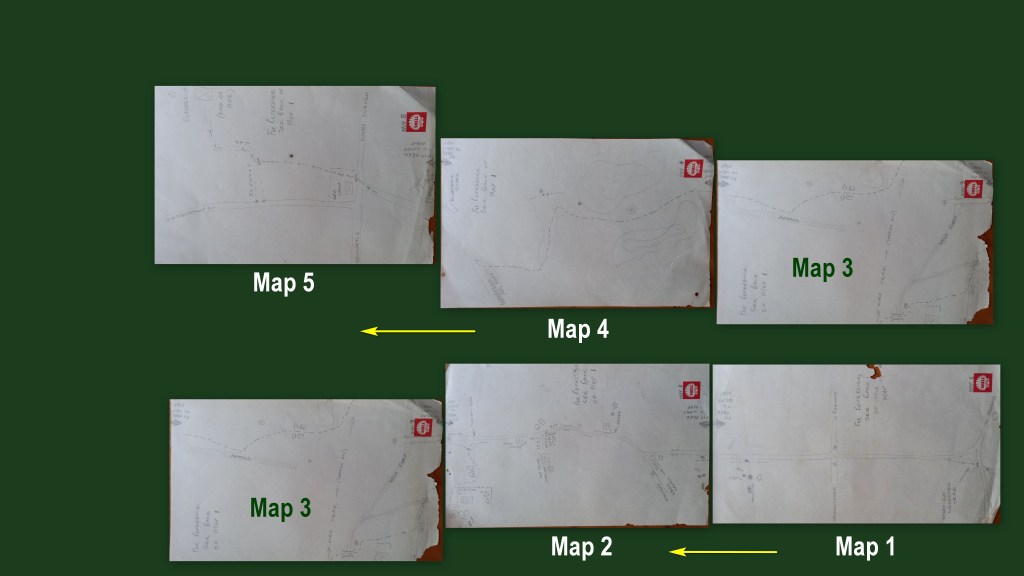
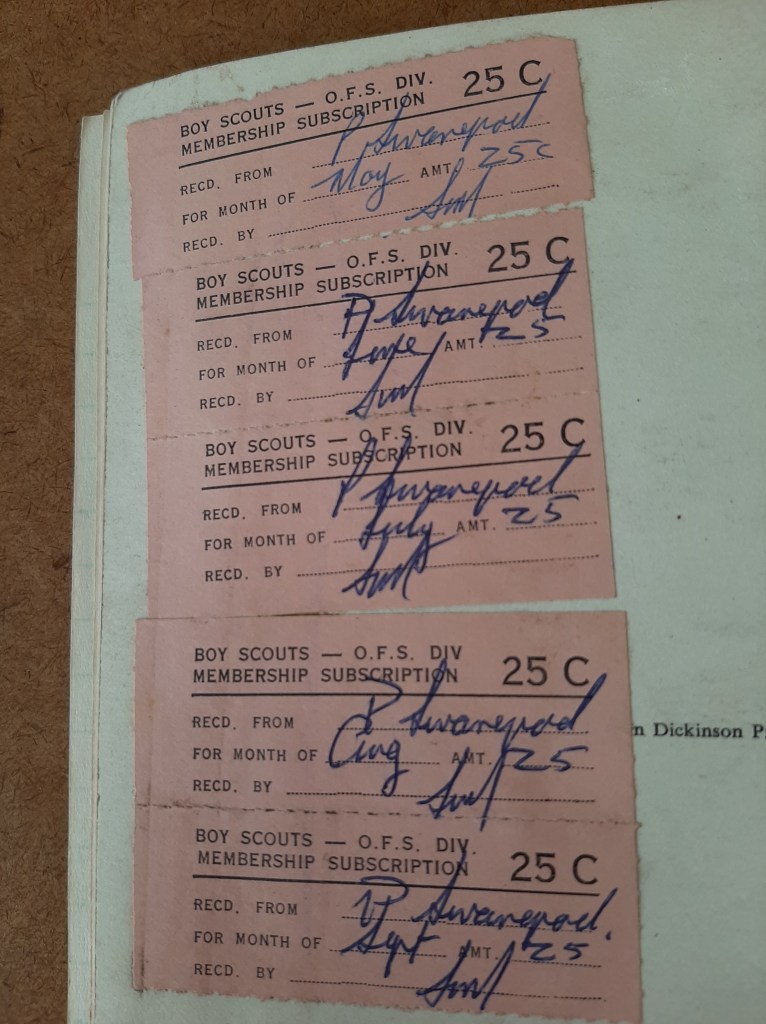
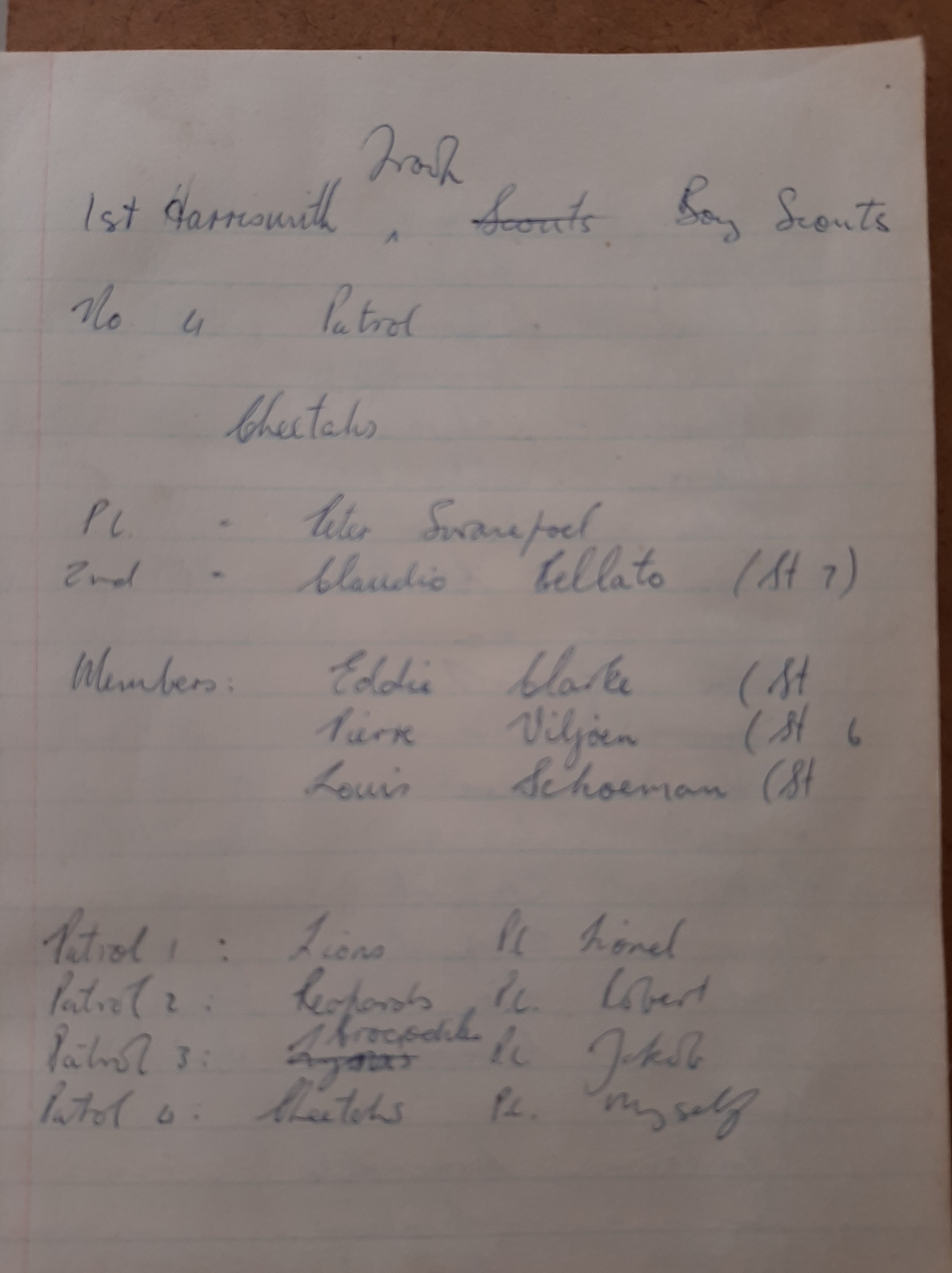
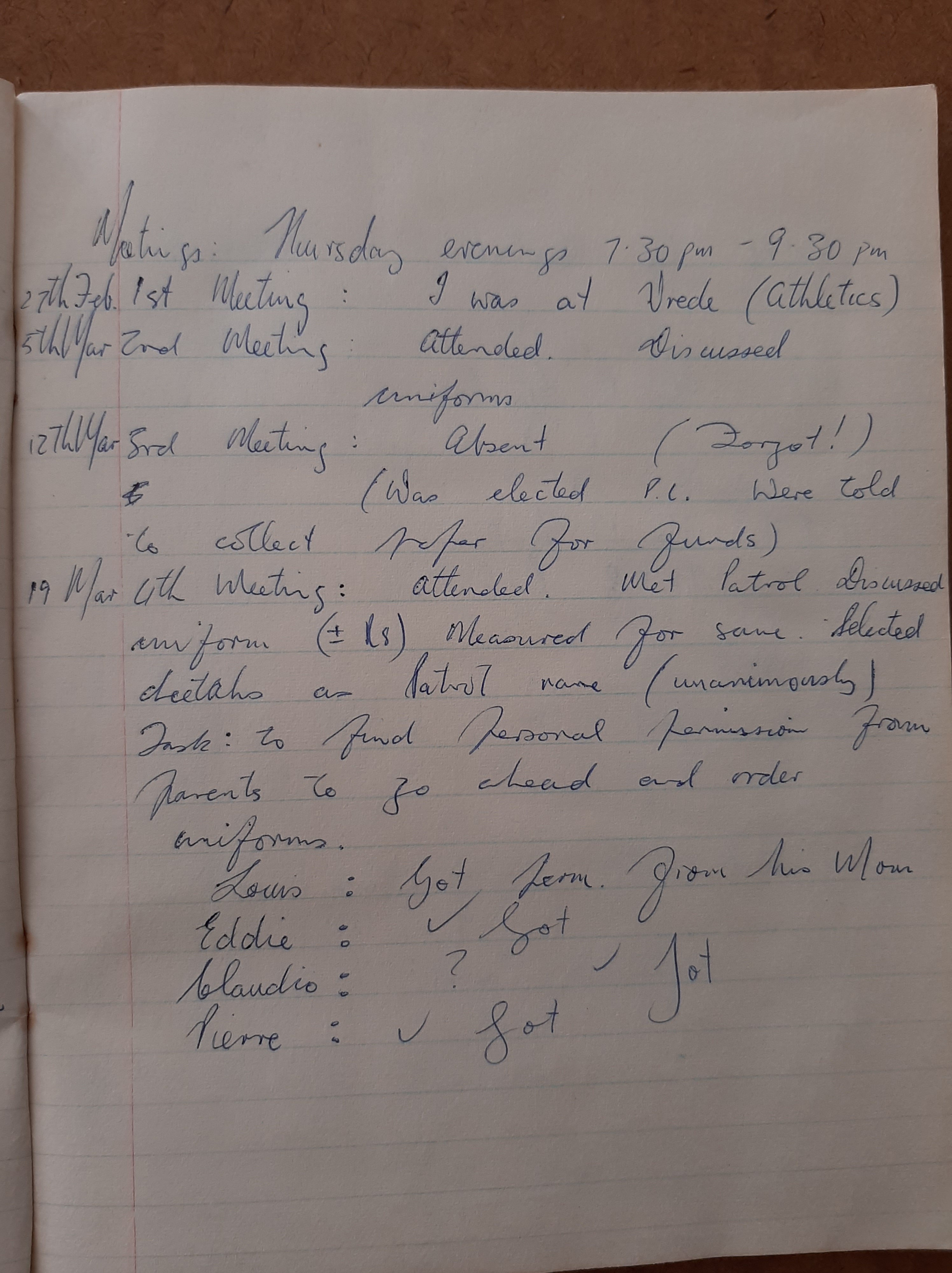
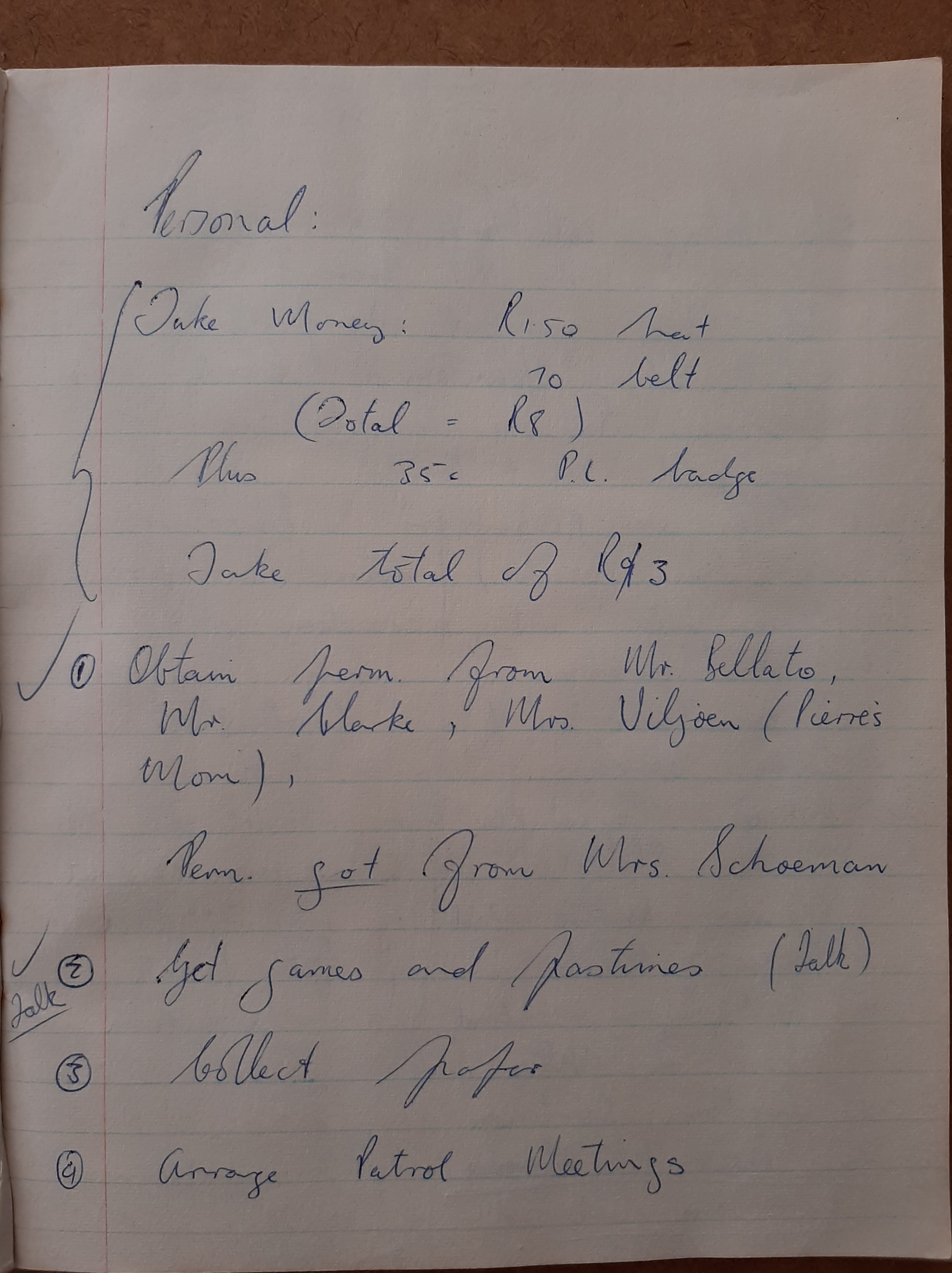
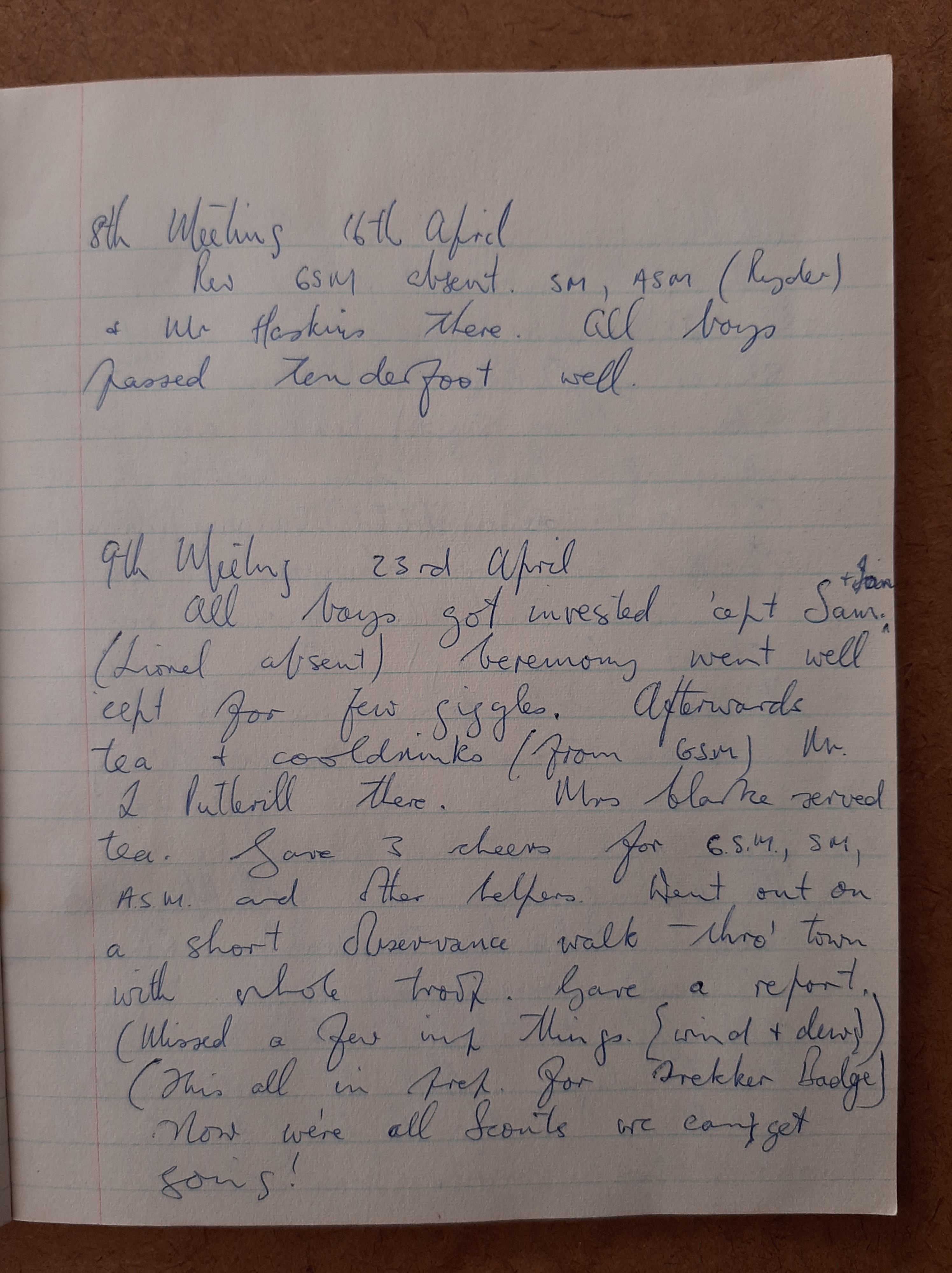
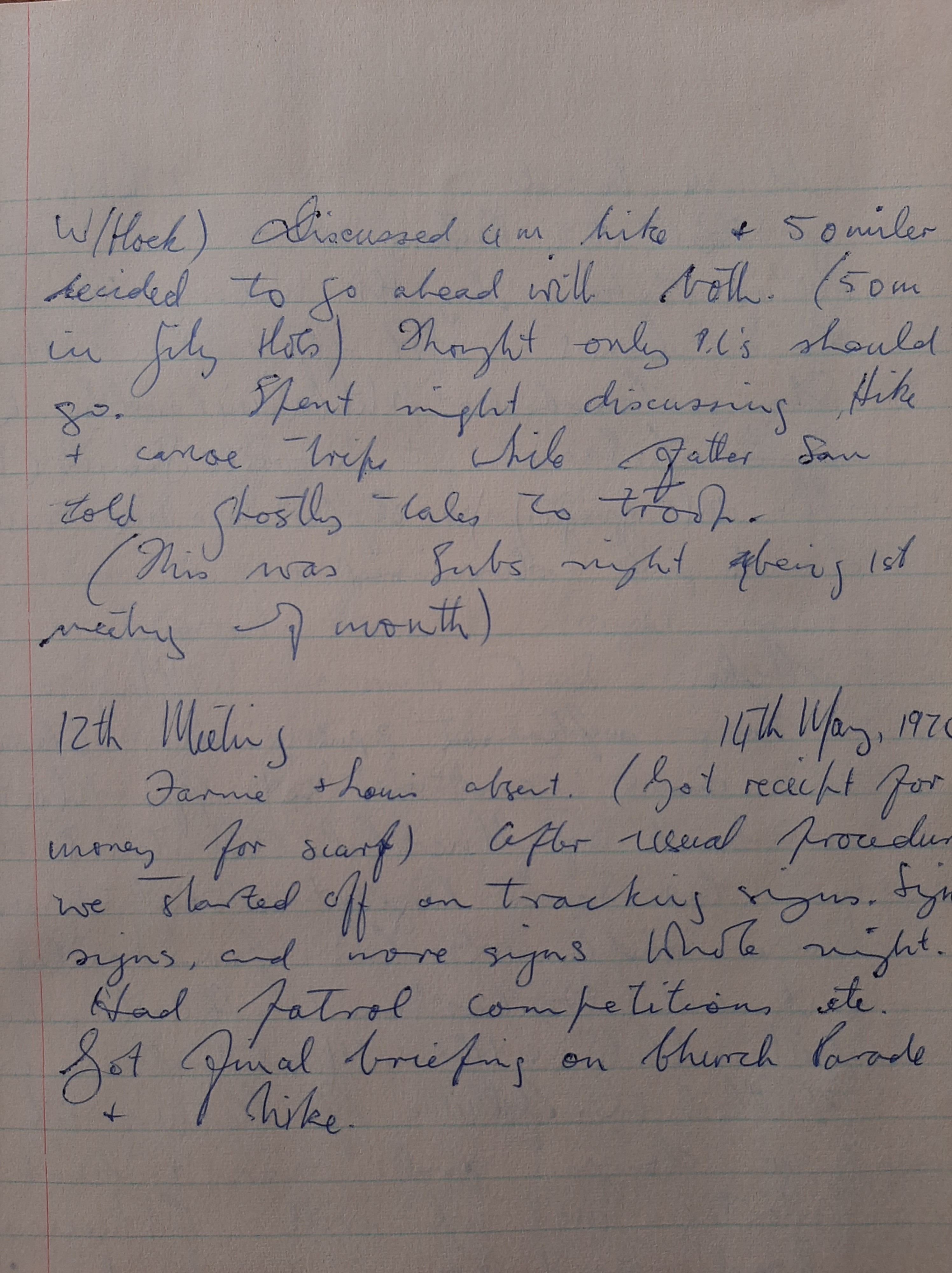
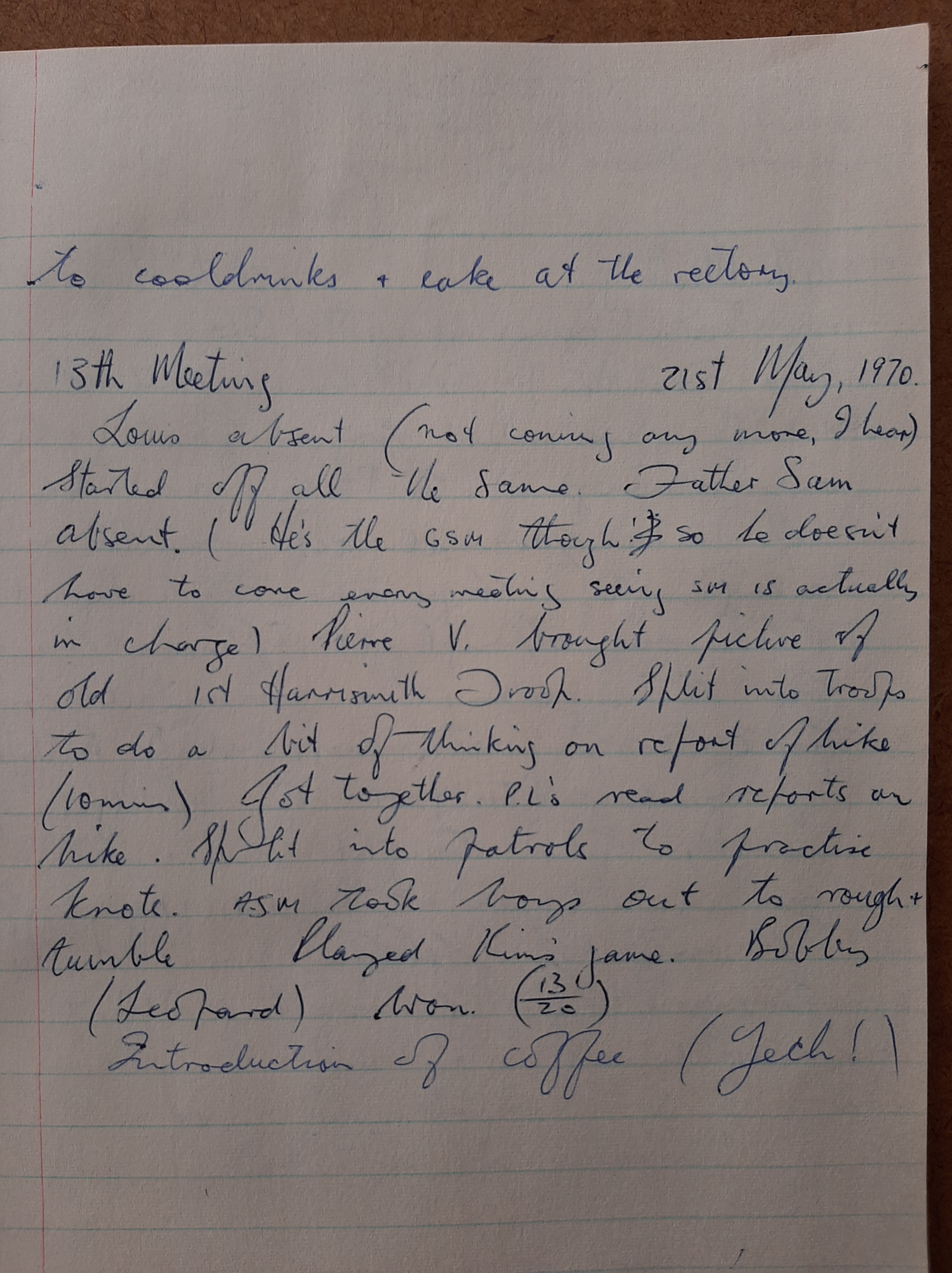
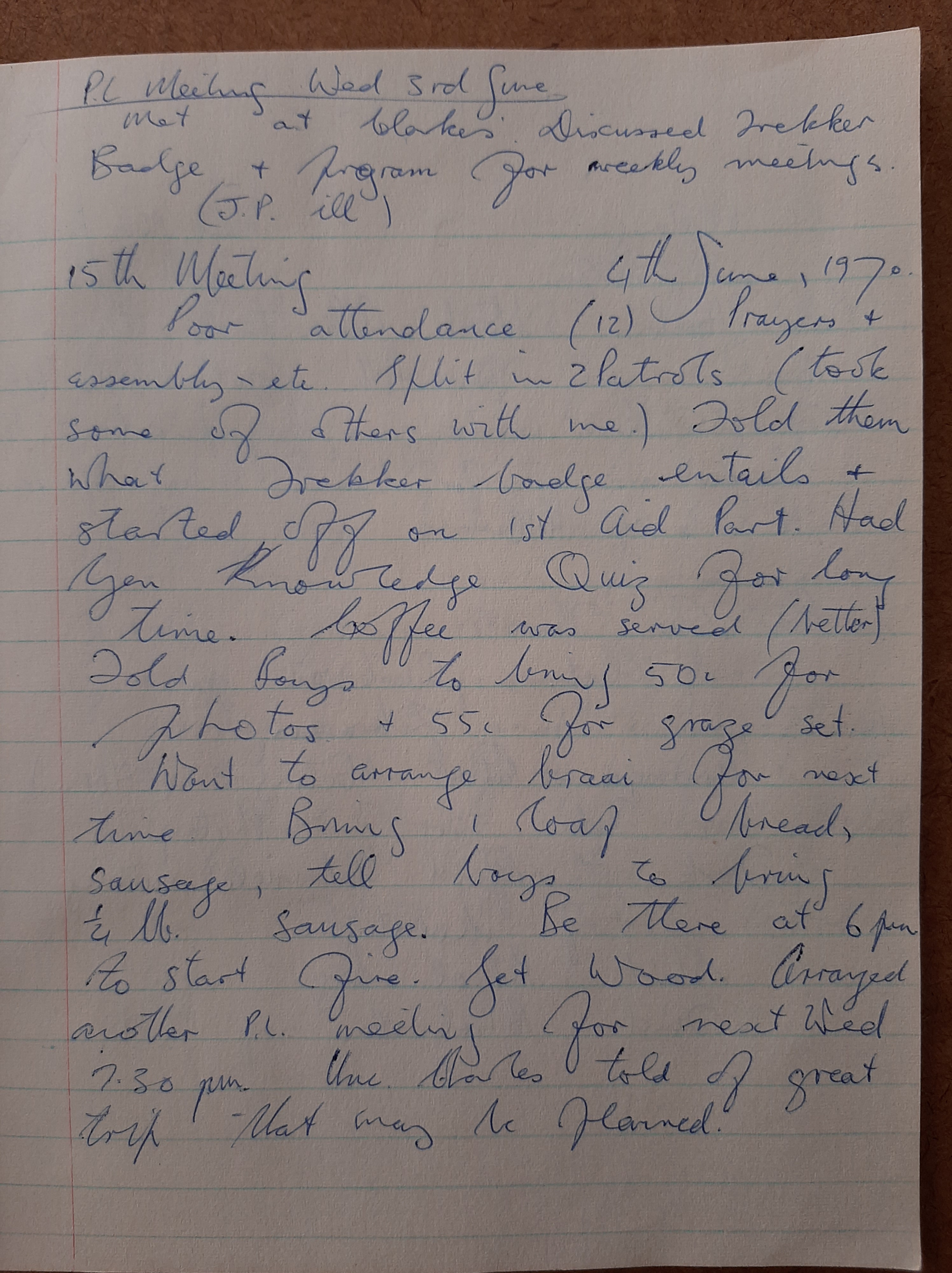
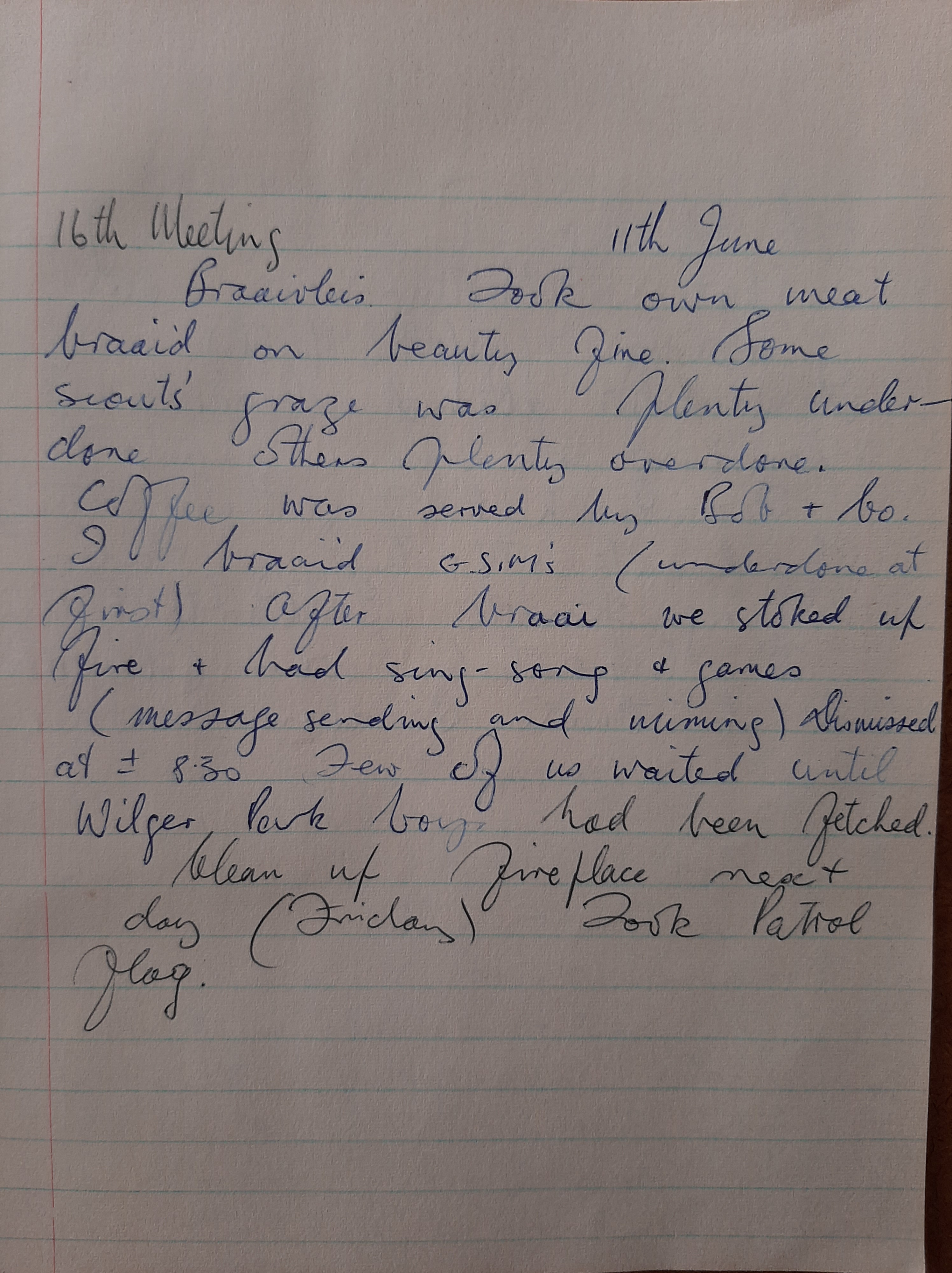
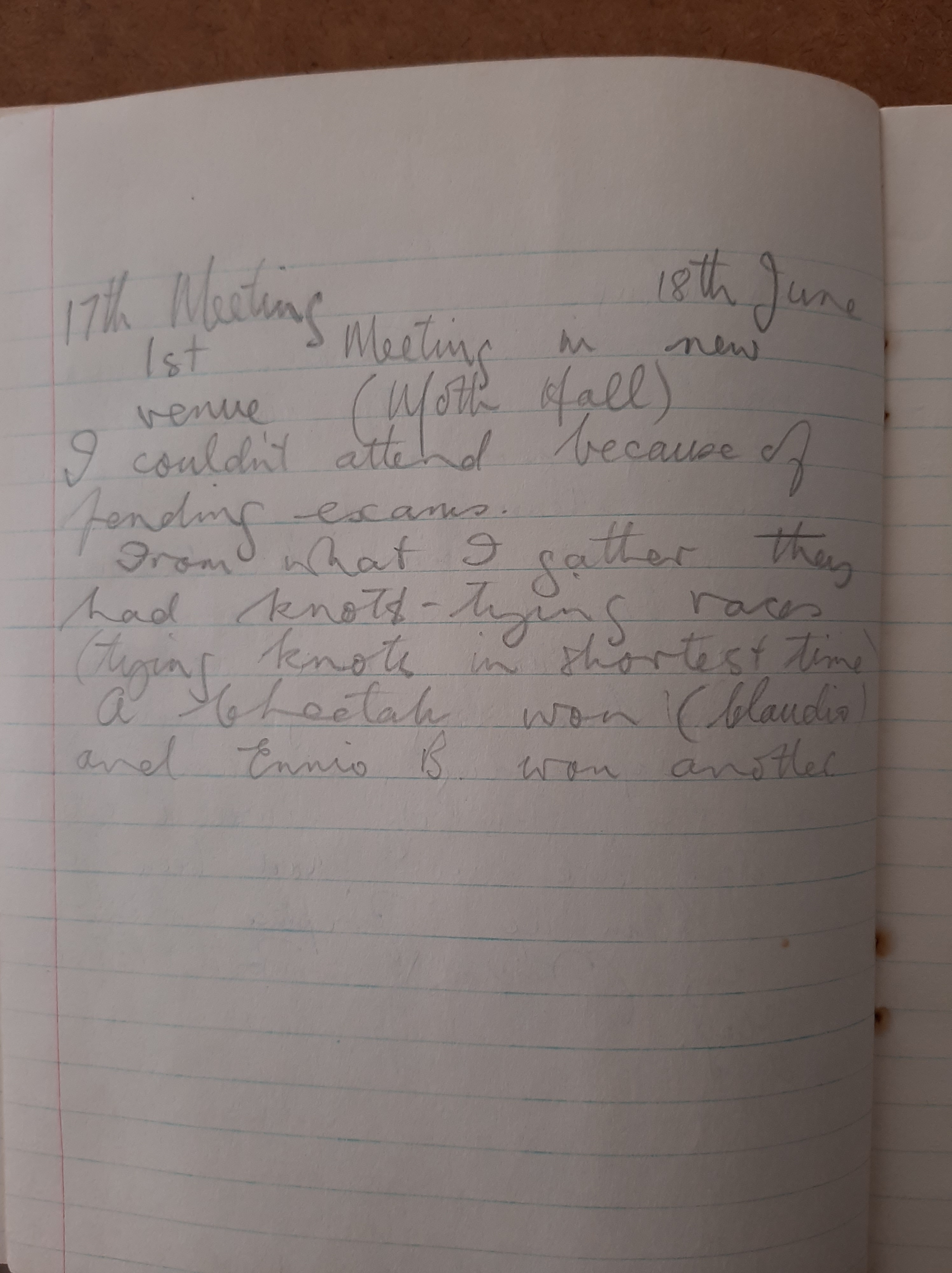
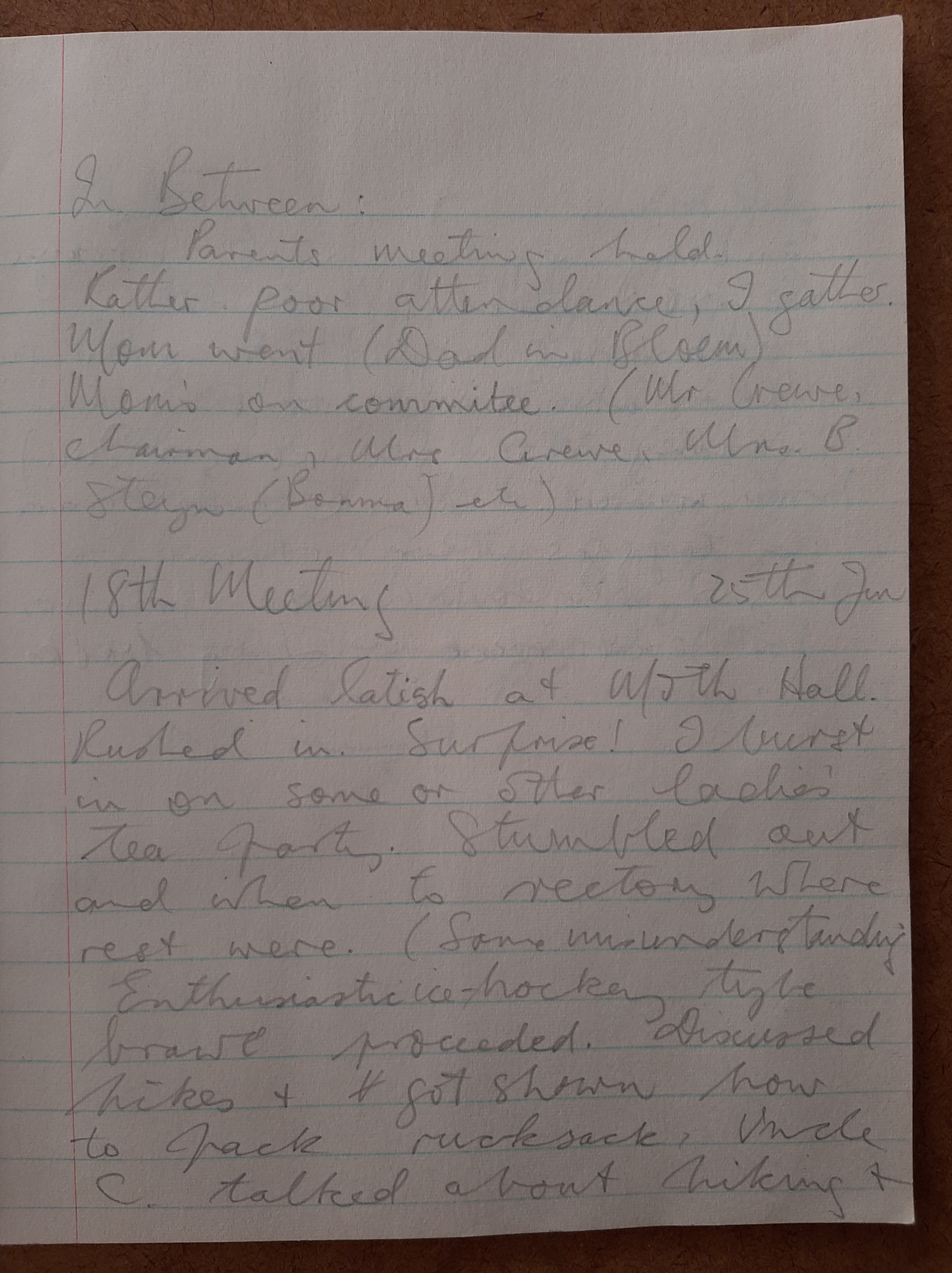
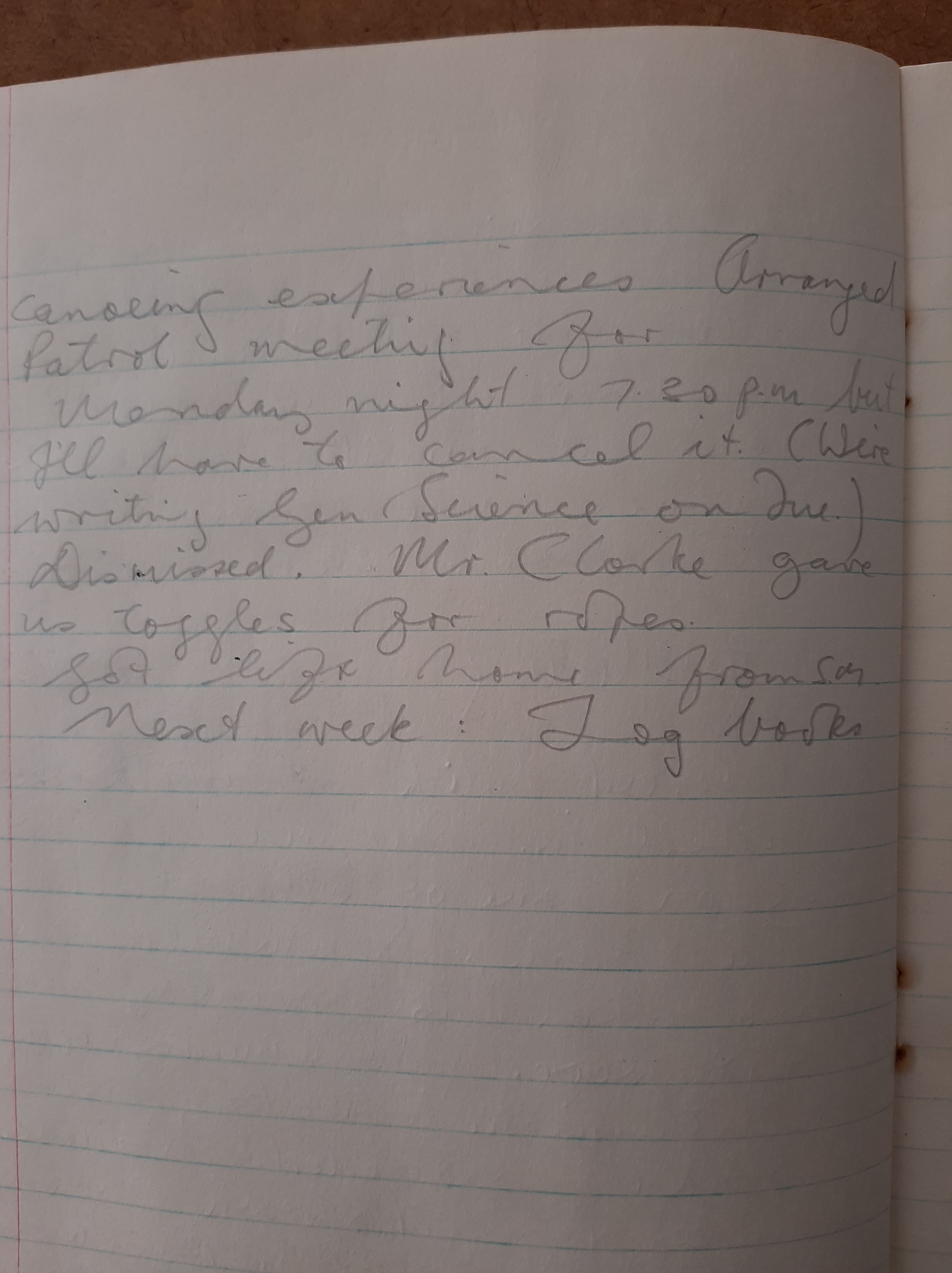
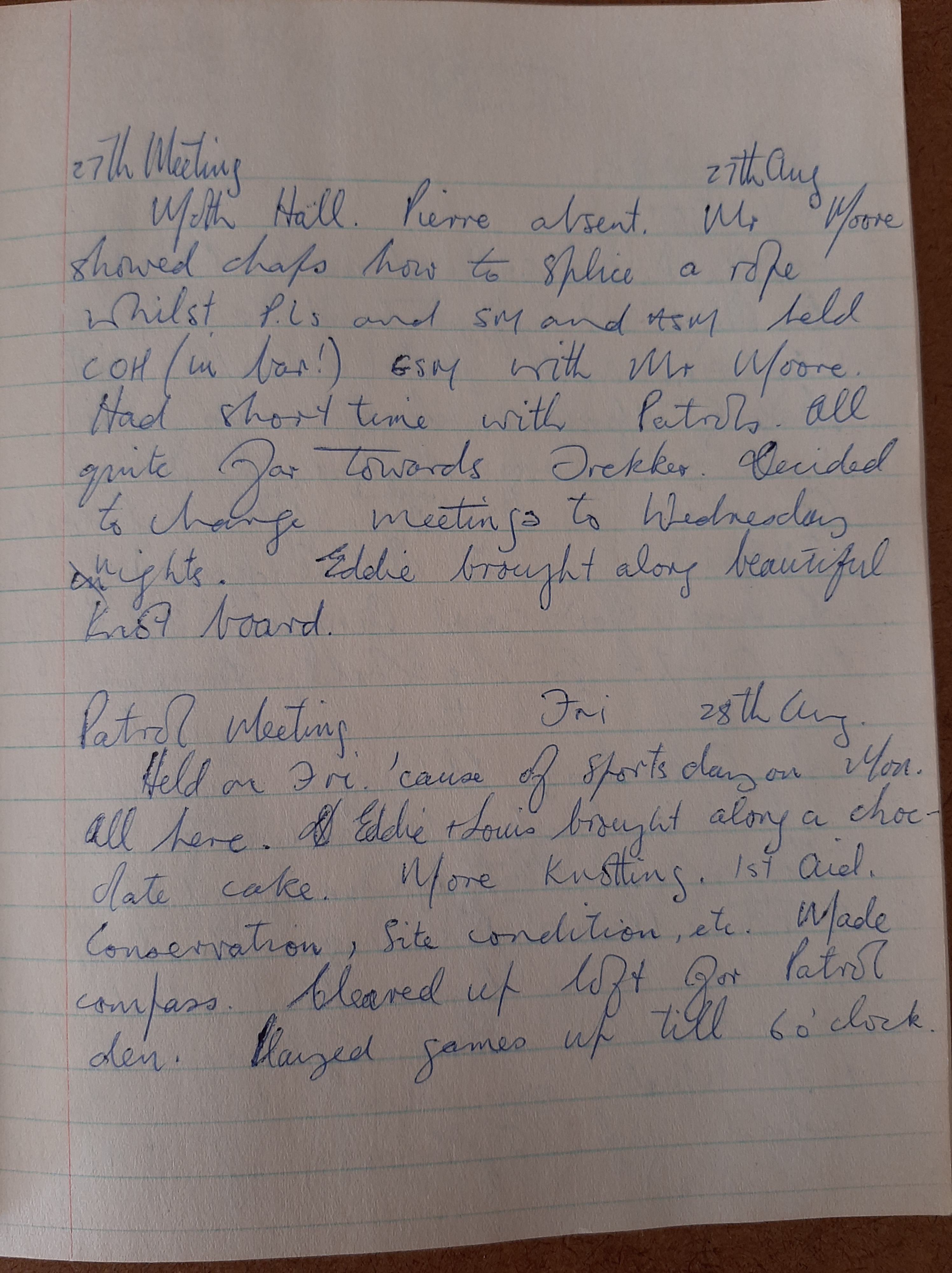
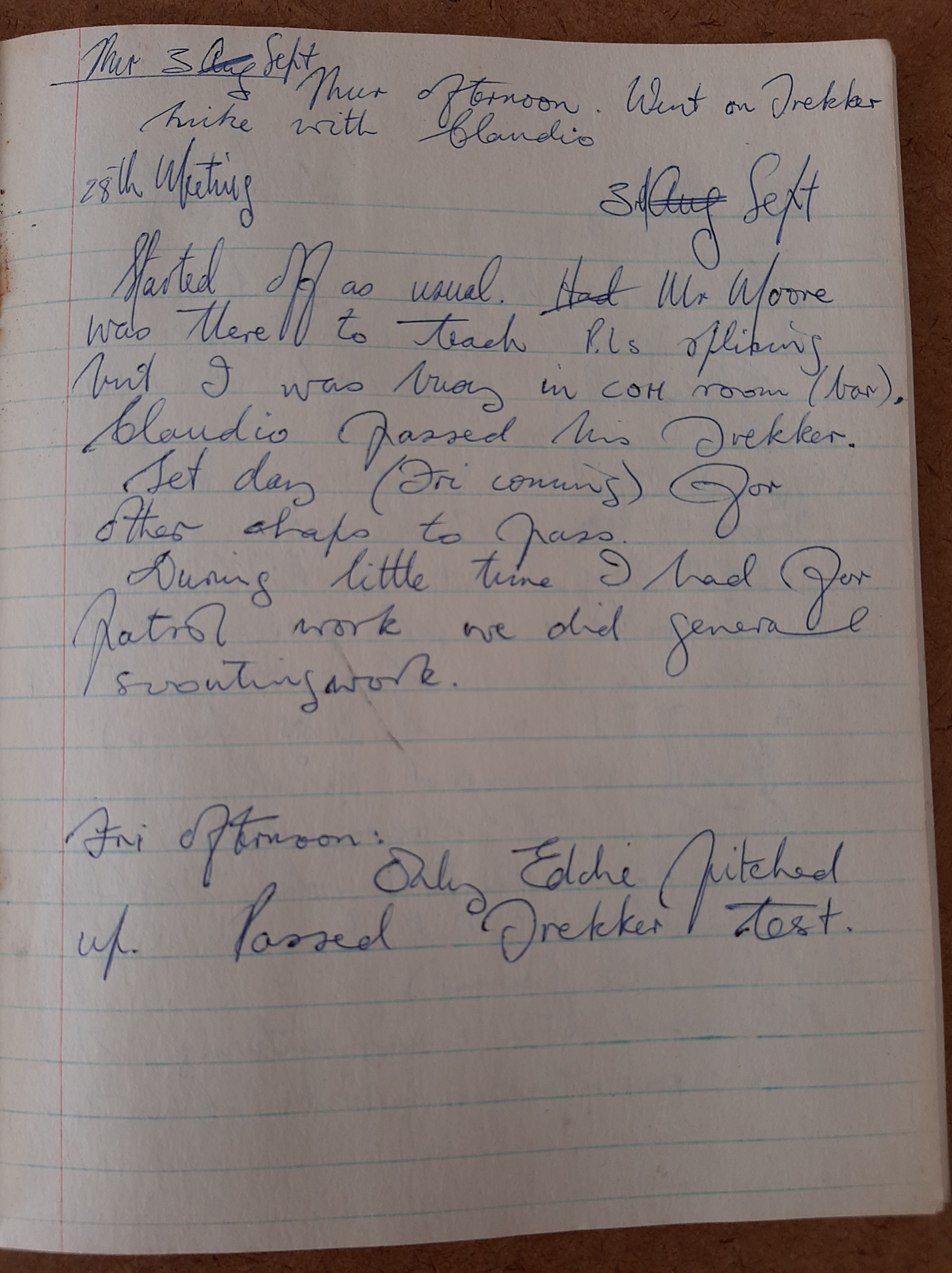
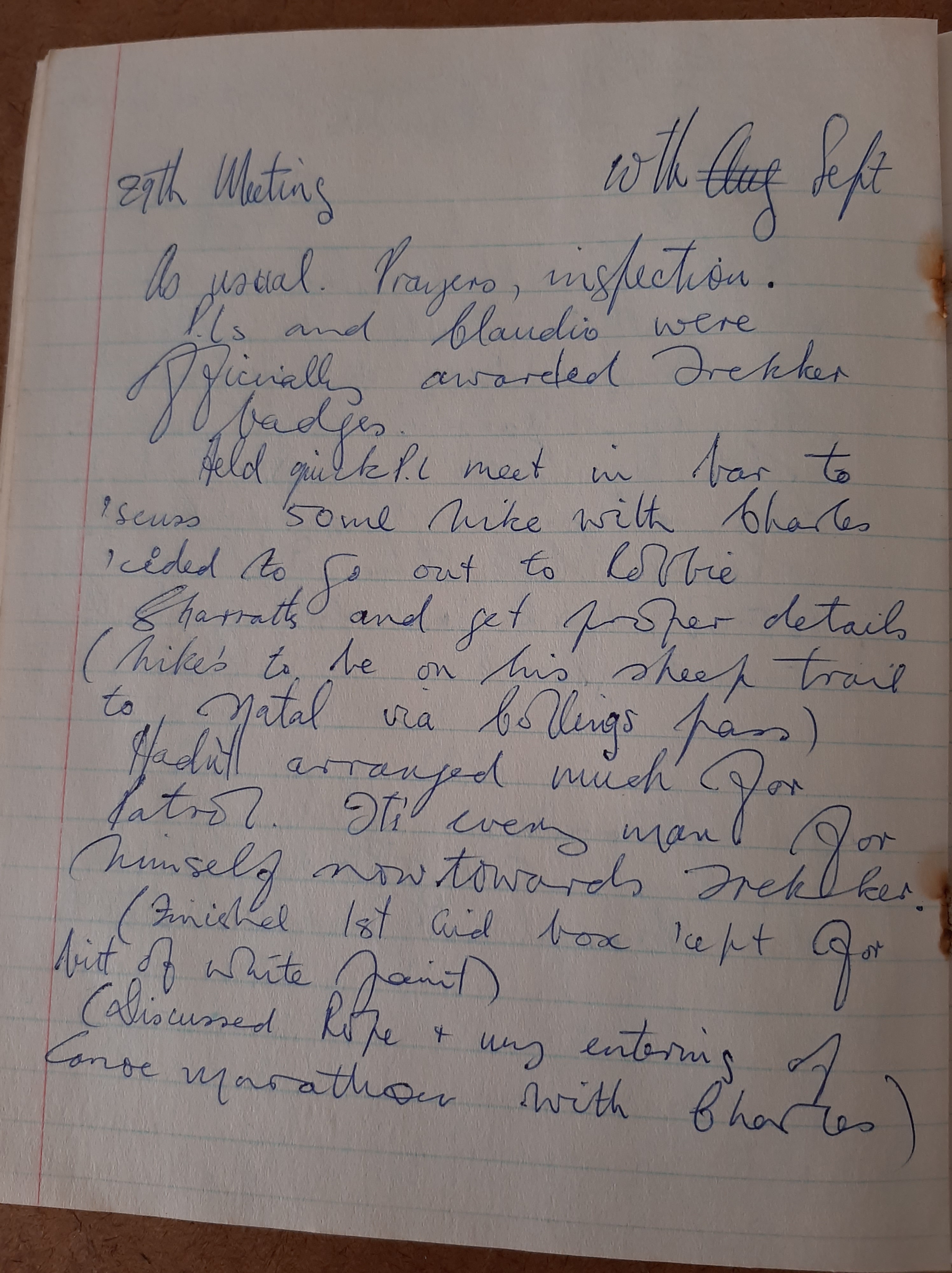
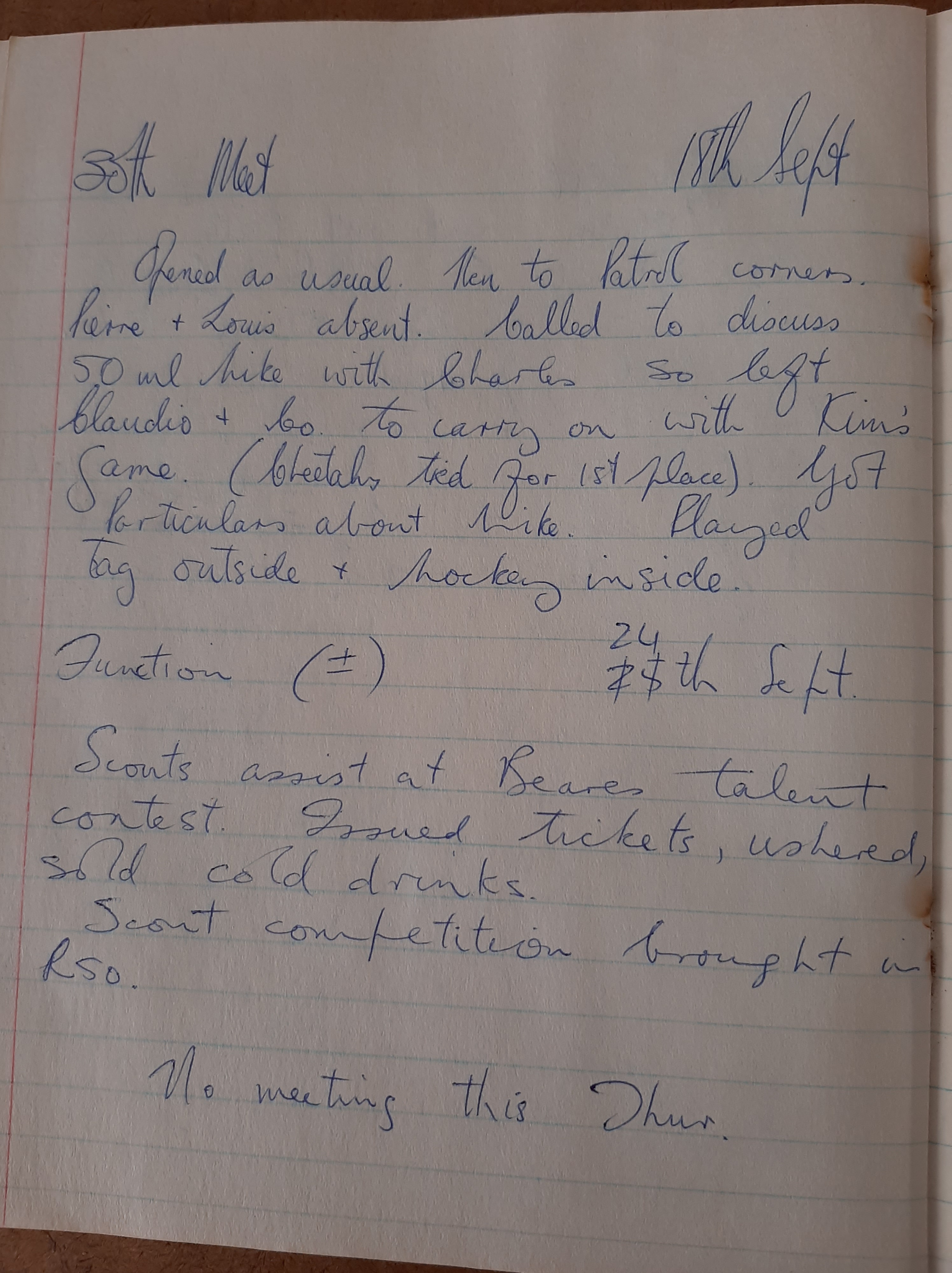
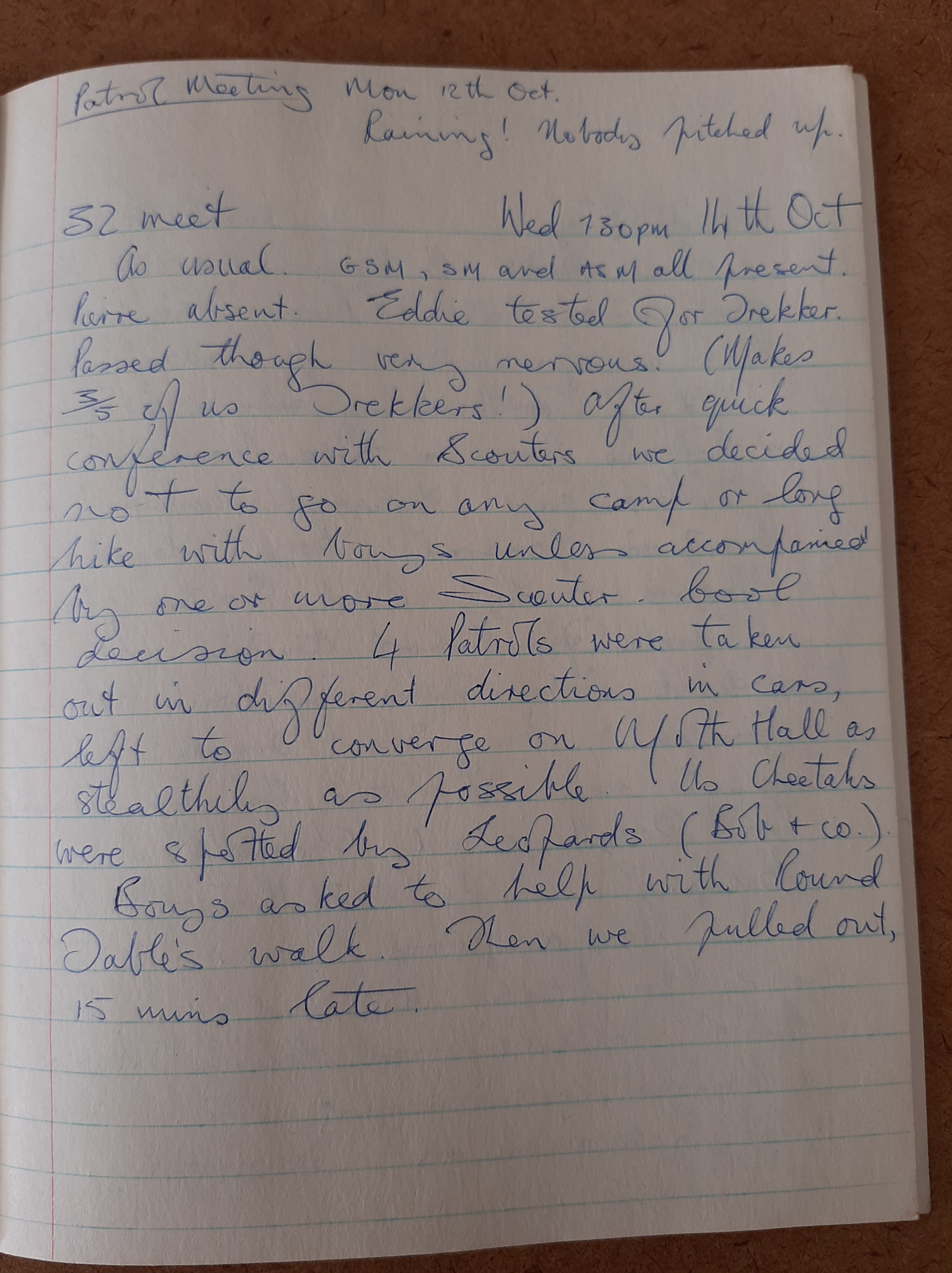
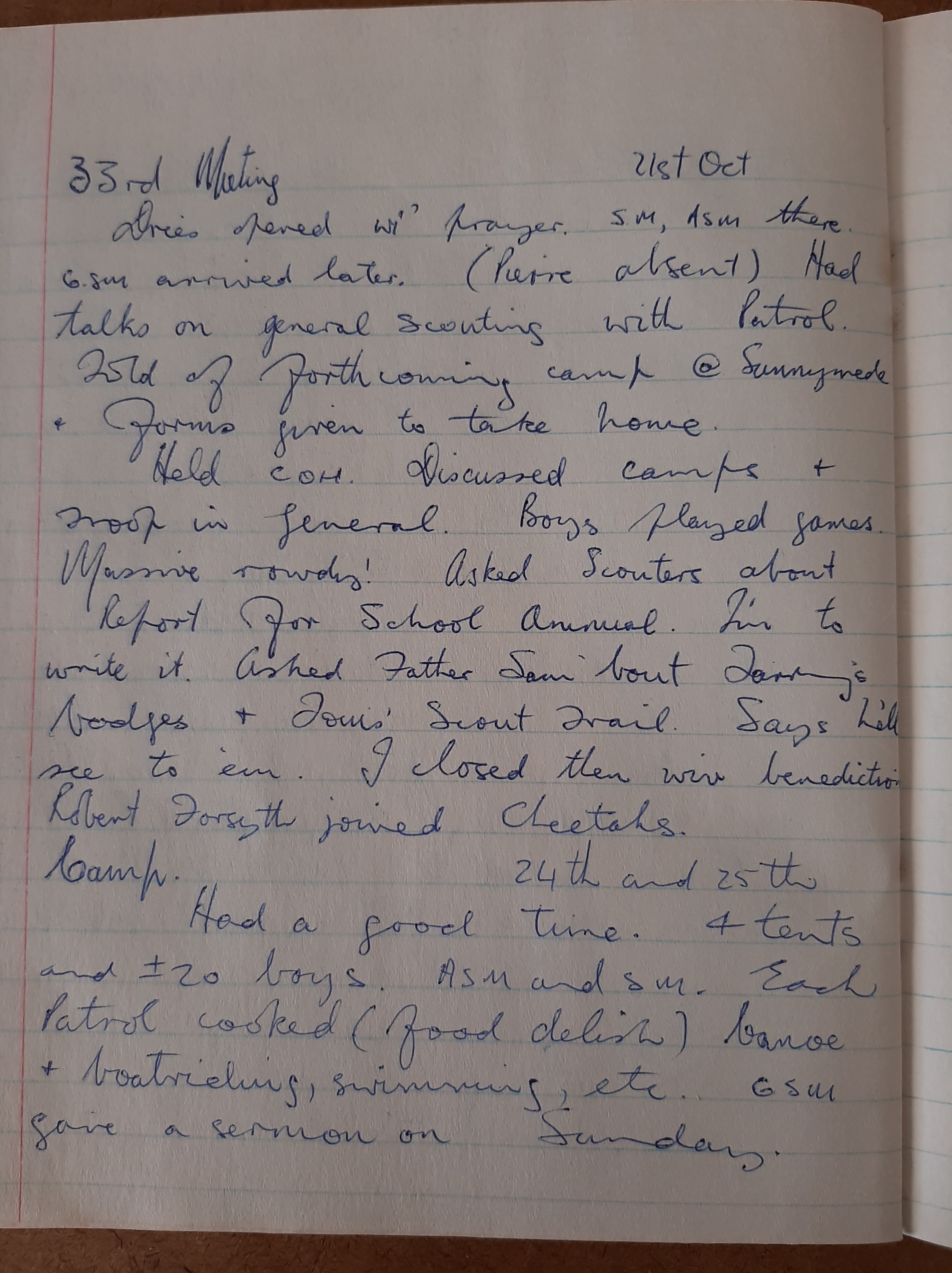
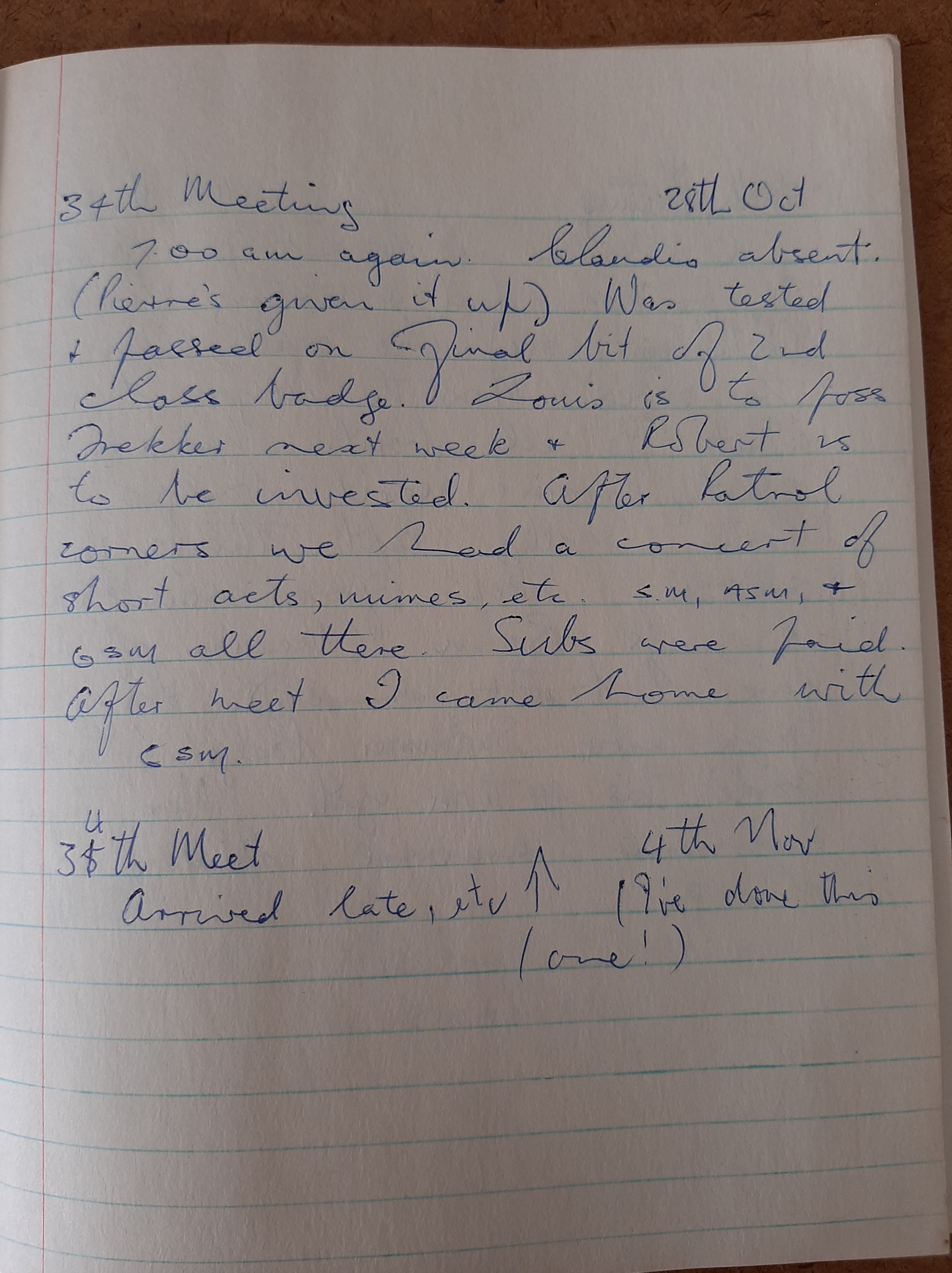
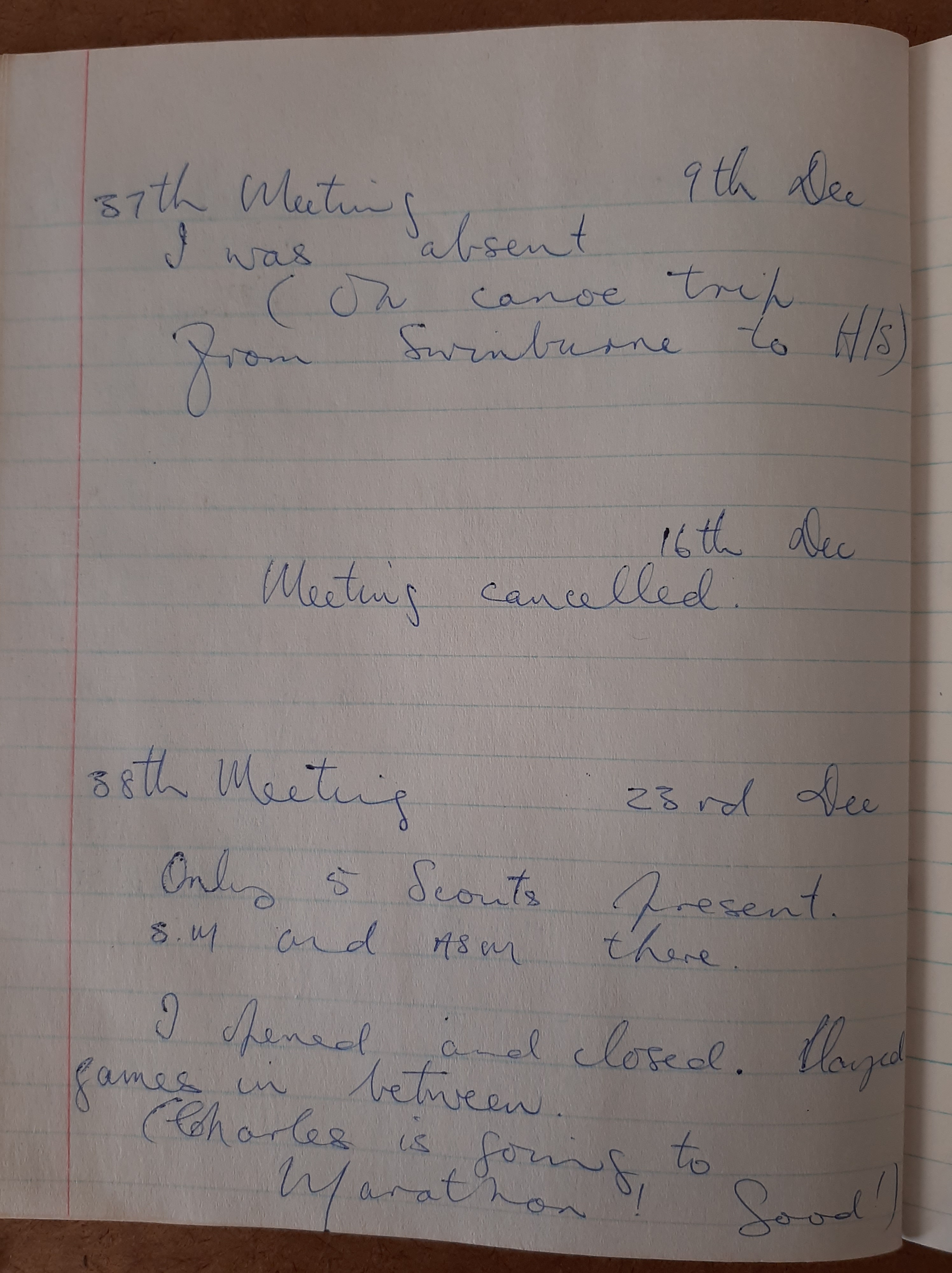
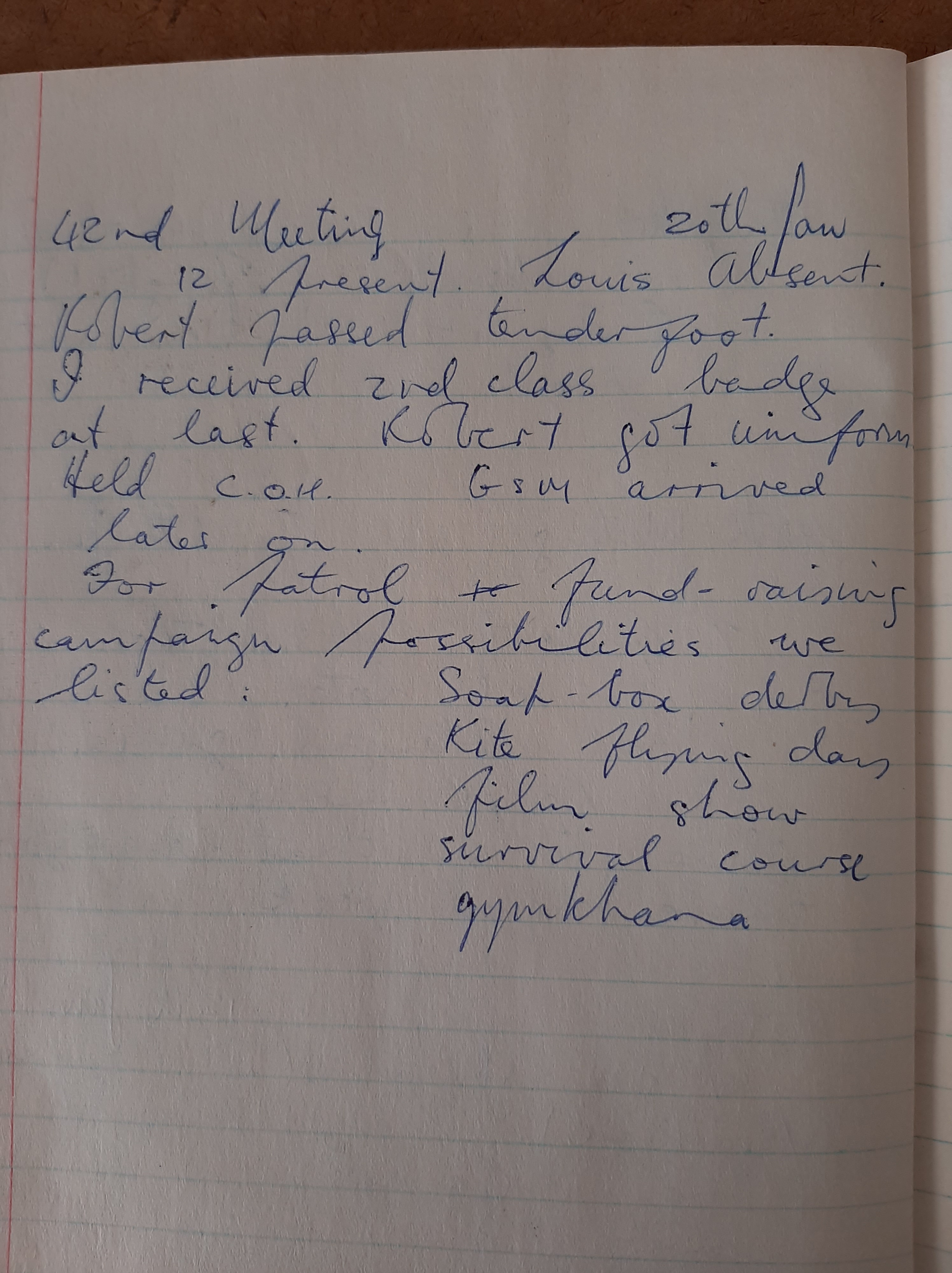
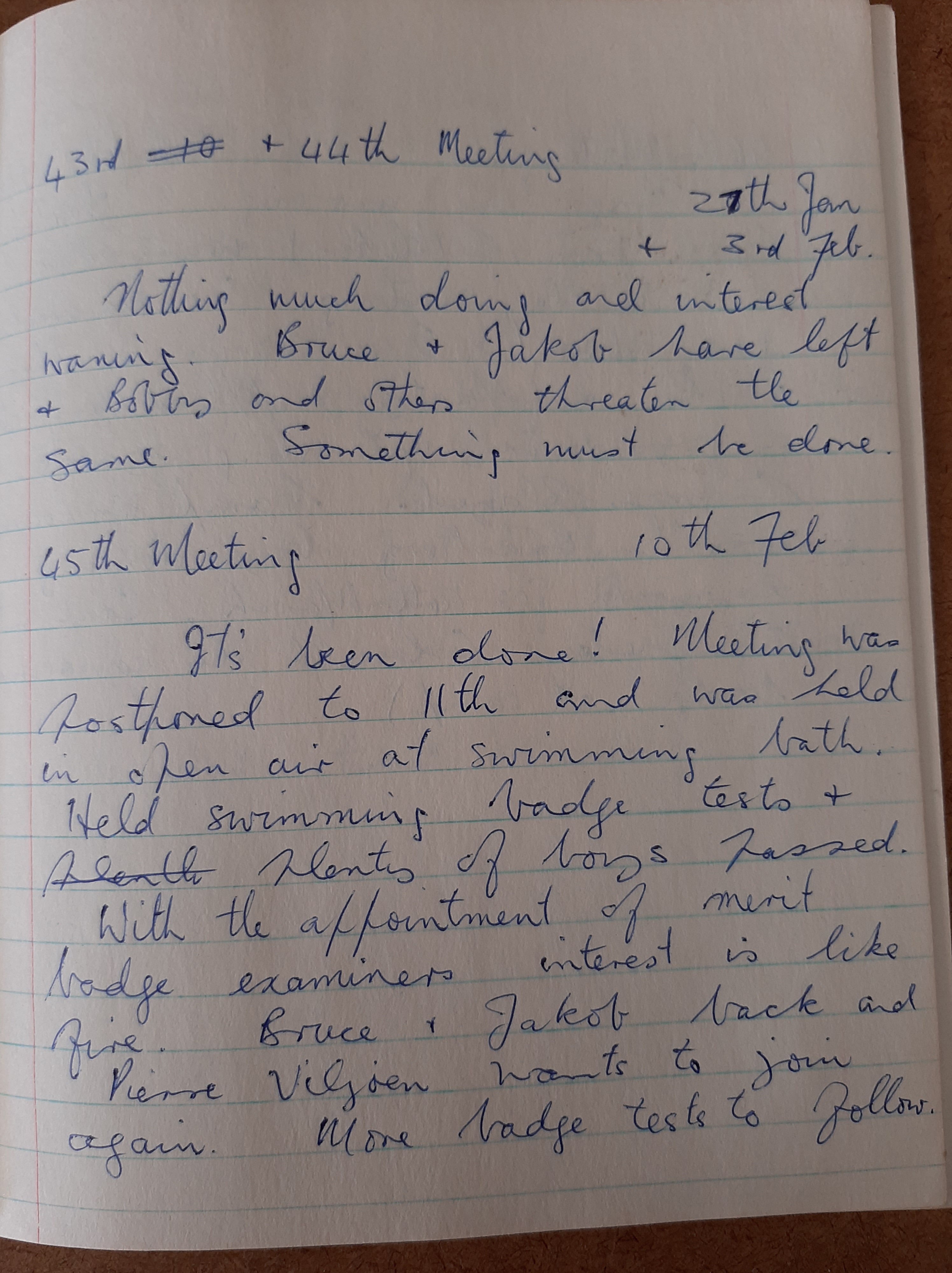
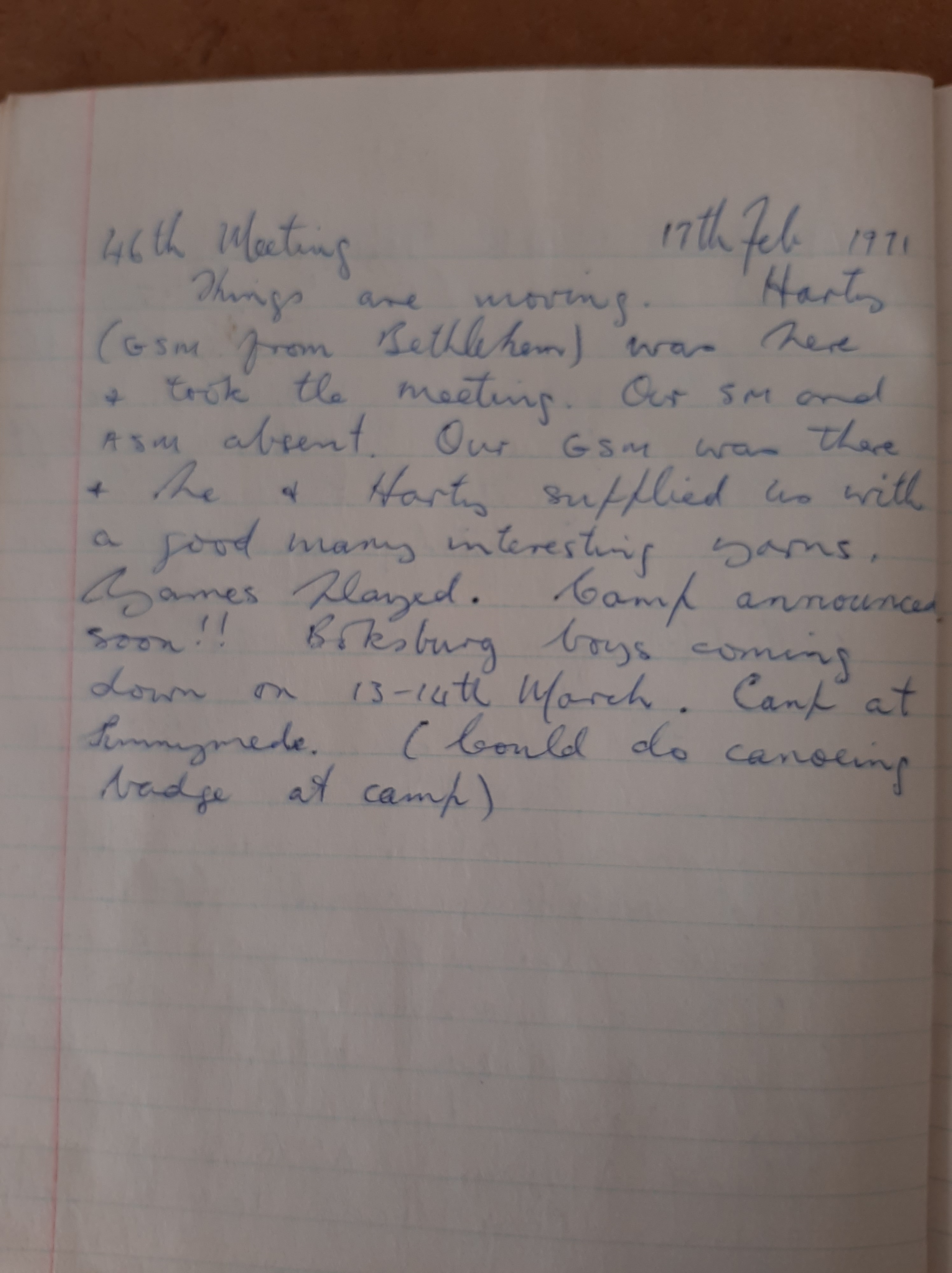
    I have written about our lonely little, short-lived Boy Scout troop in the Vrystaat and how wonderful it was, how much we learned and how much fun we had, but as I find more and more material in my Big Garage Cleanup, here’s the thing that strikes me most: How incredibly dedicated our troop leaders were and how selflessly they gave of their time and resources. Take this one incident, a memorable hike to test our map-reading and navigating skills:

    Father Sam van Muschenbroek was our Scout leader (what’s that called? Scoutmaster?). One fine Friday evening we met at his house at 6:30pm, got into his car and he drove us off on an adventure to test oir navigation map-reading and compass skills.

    He stopped for petrol and while his car was being filled he blindfolded us – me and Greg Seibert, Rotary exchange student and American Boy Scout, as we were not to know where our hike started, nor did we know the end-point yet. All of that we were to work out from maps and compass readings.

    Greg wrote: ‘We were hopelessly lost after a few tricky turns by Father Sam. After a bit of rough and out-of-the-way driving, we arrived‘ at our rough campsite at 7:50pm. We cooked for Father Sam, his son Sam and ourselves. On the menu: spaghetti followed by a can of pears. Finished eating at 9:35pm, wherupon the Sams drove off into the dark veld without lights (‘tricky, tricky’ wrote Greg).

    All this in his own time and on – I would guess – not a huge salary as a rooinek dominee of a tiny little Anglican parish in a vrystaat dorp! I salute people like Father Sam, Dick Clarke, municipal electrician, and Charlie Ryder, private electrician! They selflessly enriched and enhanced our growing up in Harrismith, going out of their way to ensure we had adventures and fun and did good stuff. Many, many men, far richer and much more influential than these three, did WAY less for the kids in their town.

    ~~oo0oo~~

    OK: So what happened?

    The next morning we rose at 6:20am – Greg sure watched the clock, he even said we fell asleep at 10:45pm the night before! He took a picture of this sunrise on Saturday 29 April 1972, and I made a fire and attempted and failed to bake some bread over the coals.

    Then at 7:20am ‘PAUL GOT UP!’ Who the hell was Paul? I have zero recollection of ‘Paul,’ yet here he was in Greg’s contemperaneously-scribbled diary, on our walk. Which I recall so clearly! (?)

    We ate coffee, dried fruit, biltong and biscuits. The wind was whistling, and it musta blown page 3 away, so on page 4 the weather was still cold but warming. Still very windy from the WNW. At point C on the map we were obviously following, ‘we were only 25 yards off of our calculations!’ We calculated and read the compass and left for point D at 10:15am.

    Point E at 11:30am after detouring around a vlei and throwing my pack across a stream (!). Point F was some half-dead trees and some ruins and we rested there for ten minutes to 12:20pm.

    Point G was a willow tree, a stone pillar and a little dam. We found it after a longish detour to find a place where we could cross the stream which was 4ft deep and 20ft wide. Greg sure provided detail! There we had lunch and a rest till 1:30pm. No mention of what we had for lunch but my guess would be coffee, dried fruit, biltong and biscuits. We ate in the shade while the mysterious Paul slept in the sun. Point H was an empty house and barn down a farm road. After a tricky crossing of a stream we were looking for a windmill. A glint of sun reflected off it revealed it and we headed up a rough hill, stopping halfway up for a rest and a drink. We reached the windmill, point I at 4:15pm and ate an apple.

    When we weren’t sure of our position, we would seat mystery fella Paul under a tree and Greg and I would go and check and then come back, so the mystery Paul wouldn’t get too tired, I suppose?

    We were now headed for a Mr Blom’s farm. On the way we got our first glimpse of Platberg in the distance, so that was heartening. We reached Mr Blom’s house at 4:45pm and he invited us in for tea! We chatted till ‘about 5:30pm’ – HA! Greg was less accurate over tea! – when it started to rain.

    We moved to camp, Mr Blom having kindly given us milk, apples, grapes and water! We cooked and ate supper at 9:30pm – spaghetti! But also beef stroganoff and oxtail soup. Paul went to sleep at 9pm! So, hike scribe Greg notes, ‘Pete and I gorged ourselves on the beef strog.’

    ‘We finally climbed in at 9:45pm. We we asleep . . ‘

    It ends like that. Greg musta bin sleepy when he wrote it.

    ~~oo0oo~~

    Greg called the adventure Operation Headache – and it occurs to me: Father Sam must have spent hours beforehand setting up the course! Taking compass readings, probably meeting Mnr Blom and getting his co-operation, probably other farmers whose land we crossed, too. What an absolute star! We loved those three days and spoke about the hike in years – and decades – to follow.

    As proof that We Wuz There, we got Mr Blom’s signature:

    Greg’s notes in his unmistakable spidery handwriting:

    . . . and I found half of page 3: It said we stopped at a spring and drank. We saw ‘several freshwater crabs, insect larvae and a frog.’

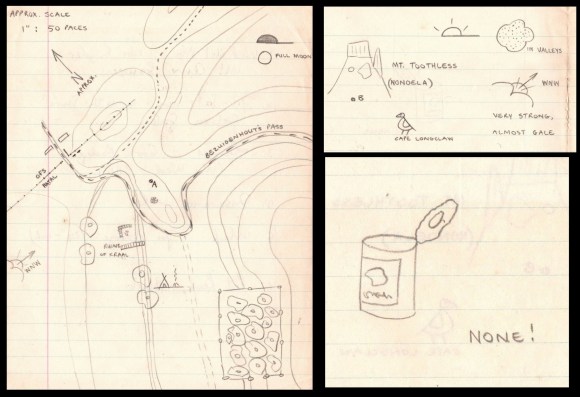
    A map I drew of our first campsite:

    – Campsite sketch – see the WNW wind howling –

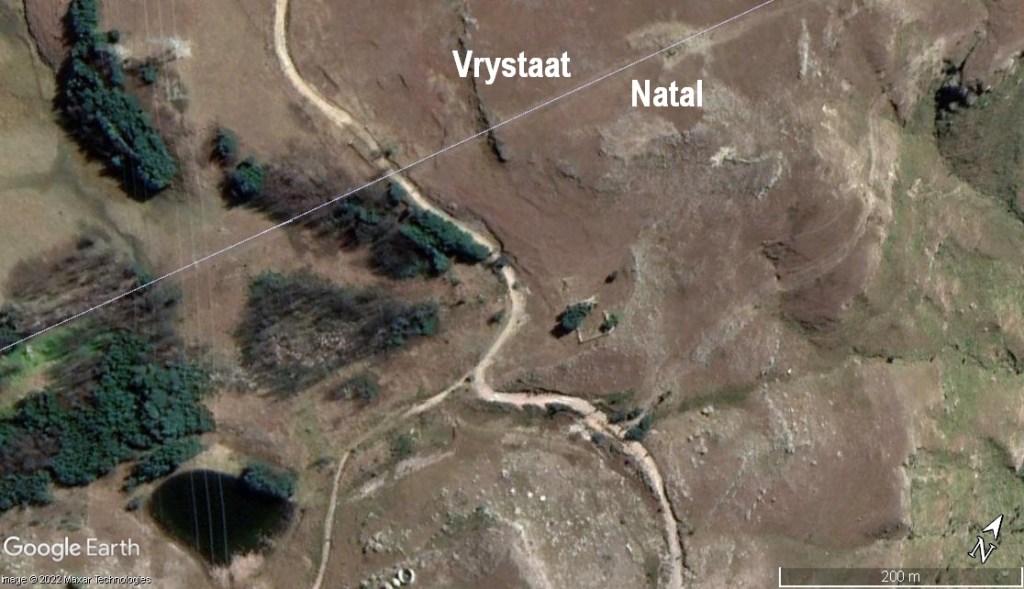
    Accuracy check: What does a satellite pic of the area look like fifty years later? Hmmm . . . good thing I wrote ‘approx’ on my map where I pointed NORTH! And that wind was SW wasn’t it?

    Greg Seibert and I lost touch for decades. When we reconnected we decided two things: He would visit South Africa and we’d go to a game reserve and talk shit for hours; And he’d share his pictures from 1972 with me. Well, neither happened. Greg died suddenly and Dammit DAMMIT!! Later, I met his brother Jeff and took him to Hluhluwe-Mfolosi game reserve.

    ~~oo0oo~~~

    Here’s another map, another hike. Our 50 miler hike near Normandien Pass, again with Greg, iirc.

    Drawings on a hike – in the Drakensberg on the Vrystaat / Natal border again – our usual place – the Drakensberg. This further east.

    ~~oo0oo~~

    iirc – if I recall correctly