The Class of ’77 had a wee gathering at Zena’s place in Feb 2020. The lies we told!! ‘You’re looking younger’n evah DAHling!’ Yeah, right!
Actually, none of that. A lot of truth was spoken. Which led to a lot of laughter.
Zena laid on a wonderful spread and we sat around a colourful table on her Sandton patio.
– Zena and Ray & Di Schoeman – Terry seated – Brauer, who didn’t read the dress code so came in a corona virus T-shirt – yours truly seated –
Schoeman smuggled in some gin n meths in an expensive bottle; Zena provided wine and buckets she said were gin glasses – old soaks have all sorts of tricks! Brauer provided beer; I just drank.
The afternoon whizzed past and all too soon we had to shuffle off to take our other meds.
We should do this every forty three years.
~~~oo0oo~~~
Is a gathering of presbyopes a parliament of presbyopes? I think we were more a chuckle of presbyopes. While searching I did find these: an unhappiness of husbands . . a tedium of golfers . . and – not being one – I made up a yawn of grandparents.
~~~oo0oo~~~
PS: Soon after this came lockdown and our little group of six turned into a wonderfully convivial whatsapp cartel, sharing advice, support and look sharp! in equal measure.
~~~oo0oo~~~
The Origin Story:
From: Pete S Sent: Wednesday, 20 November 2019 To: Zena Jacobson; Subject: Jacqui
Hi Zeens
I think that’s Jacqui’s correct surname. She was ___ way back in Harrismith in 1972!! She’s having what sounds like an adaptation problem with new multifocals. Thanks so much for agreeing to check her over. Cheers – Pete
PS: I will definitely commit to making a trip behind the boerewors curtain. I have abandoned the kids a couple of times this year and the house didn’t burn down, so I think I must keep on doing it more and more.
Zena: Can’t think of anything nicer than an afternoon with old friends. They are so few and far between these days.
Pete S: Thanks again. Brauer thinks a get-together is “a good eye dear”
On Thursday 21 November 2019, Zena Jacobson wrote: Great. Tell me when you want to cross the boerewors curtain and I will arrange a get together.
Pete S: In the new year. We need to get Terry into the loop. She’s Brauer’s memory glands.
Zena Jacobson wrote: Yes. I’ll set up a WhatsApp group for us, and we can chat together.
Pete S: Excellent. Brauer can sponsor the event. He must be flush with cash as he has just revamped his practice with bells and whistles and open windows, no vertical blinds.
..
And lo! It came to pass.
How fortuitous, as we formed a lovely support group through lockdown.
..
As a check on my powers of prediction: My house did not burn down, but you will remember I was distracted for a while in Zena’s garden on an over-long phone call: Jessie had fallen down after trying to drink as much alcohol as her more experienced friend. Did she inherit my genes or summing, dammit?!
Terry saved the situation with a sensible suggestion later that night when we were back in the gramadoelas: Send her to hospital.
Alcohol poisoning. They put her on a drip.
* sigh * If only she’d inherited my fine singing voice instead.
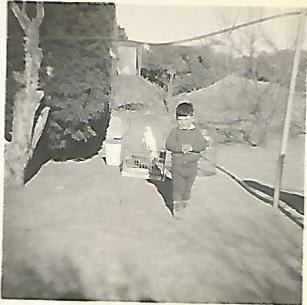
In tiny cages. Cocky the African Grey Parrot and Jacko the Australian Sulphur-crested Cockatoo. We grew up with them and didn’t think anything of parrots in cages. Poor things.
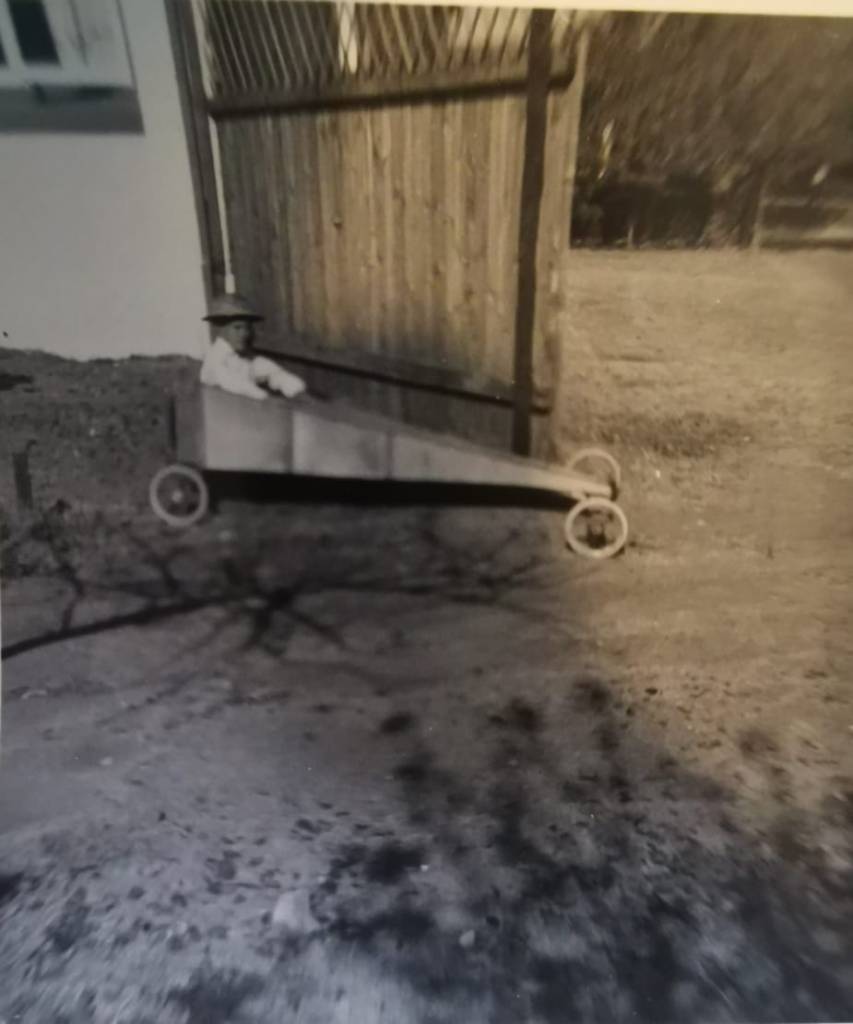
– their cages behind Francois –– Jacko on Jabula – our pedal-car was ‘Happy’ –
But when you see a free-flying one and realise Jacko never flew five metres, never mind five kilometres, it makes ya think. Friend Steve Reed ‘shot’ this one in his neighbour’s tree in Brisbane, and put it on his blog.
Also left-handed, I see – as was Jacko. Cocky was right-handed.
– free-flying in Brisbane –
I commented on Steve’s blog: So amazing to me that this can be a bird that flies free and visits you! We had one in a cage, poor thing. My old man got him from an old lady in Pietermaritzburg in KwaZulu Natal who had had it for – you know – forty years, and then he had it for – you know – forty years. These numbers don’t get reduced. They grow. And we grew up with Jacko. Who suddenly laid an egg and became ‘she,’ but kept her name Jacko. Poor thing.
~~~oo0oo~~~
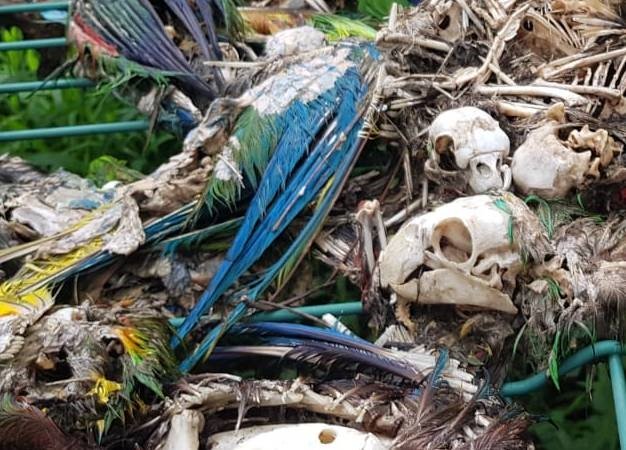
And what happened to them? “Given away” yet again. To a ‘Mnr Boshoff’ in Krugersdorp or Klerksdorp, who ‘trained’ parrots and put on shows where he would demonstrate how Jacko could ‘dance’ and Cocky could ‘talk.’ He was very well-known and that made it a good thing. Except well-known and ‘respected’ bird-cage people aren’t always what they say they are. Here’s what a raid on a parrot breeder found when the South African vice-president of the parrot breeders association’s aviaries in Randburg were raided this week: 150 dead parrots and the live birds in cages in shocking condition! Strange how almost all people who keep wild animals say how they LOVE them, but as far as I’m concerned it’s all Dancing Bears – they’re kept for money, fame, personal ego, etc. For their humans, not for the animals themselves.
~~oo0oo~~
Here they are flocking in the wild:
– thanks kidcyber.com.au –
Mea culpa: While raising kids we let them keep things in cages too! Only fair to admit that! A gerbil, a hamster, a snake.
Let’s paint the ’42nd’ up on 42nd Hill! Yeah! We’ll shoot up there with some whitewash and paint it quickly.
We Boy Scouts needed a PROJECT – a ‘good deed’ – and this seemed a good one. Everyone would notice and be impressed by the shiny white freshly-whitewashed stones spelling out ’42nd’ compared to the dull look it had as the whitewash faded.
This was ca.1970 and the symbol had been put up there by some Pommies of something called 42nd whatever, way back just after the Anglo-Boer War – about seventy years earlier. We would get it looking like new.
I mean, how hard could it be . . . ?
– there it is, the ’42’- looking dull –
Well . . .
When we got there we parked on the top of the ridge – none of those towers and pylons were there back then – and walked down to the white stones. That ’42nd’ was A LOT bigger than we had imagined. Our big whitewash buckets and wide brushes looked tiny now. We would have painted for hours and run out of whitewash before we even finished the ‘n’ – the smallest of the symbols.
We had a good look around at the unusual – to us, we had never been up in Phomolong before – view of Harrismith and the mountain, climbed back to our Scoutmaster Father Sam van Muschenbroek’s car on the ridge and snuck back to town, tails between our legs! What’s that about biting off and chewing?
– view from Queens Hill back when the stones were being laid – 42nd Hill in the background –
~~oo0oo~~
So who put all those stones spelling a huge ’42nd’ there?
From ca.1900, Harrismith was to serve as the base for all military operations conducted by the 8th Division until the end of hostilities. The bulk of the Division were posted at Harrismith. The force under command of Lt Gen Sir H M L Rundle, comprised:
The 16th Infantry Brigade (under command of Maj Gen B B D Campbell) consisting of 2nd Bn Grenadier Guards, 2nd Bn Scots Guards, 2nd Bn East Yorkshire Regt, the 1st Bn Leicester Regt, and the 21st Bearer Company, 21st Field Hospital;
The 17th Infantry Brigade (under Maj Gen J E Boyes) consisting of 1st Bn Worcestershire Regt, 2nd Bn Royal West Kent Regt, 1st Bn South Staffordshire Regt, the 2nd Bn Manchester Regt, and the 22nd Bearer Company, 22nd Field Hospital;
The 1st Brigade Imperial Yeomanry consisting of the 1st, 4th and 11th battalions; 5th Company, The Royal Engineers; 2nd, 77th and 79th Batteries, Royal Field Artillery; 23rd Field Hospital, Royal Army Medical Corps.
So we still don’t know what the 42nd was? No wonder we didn’t paint it.
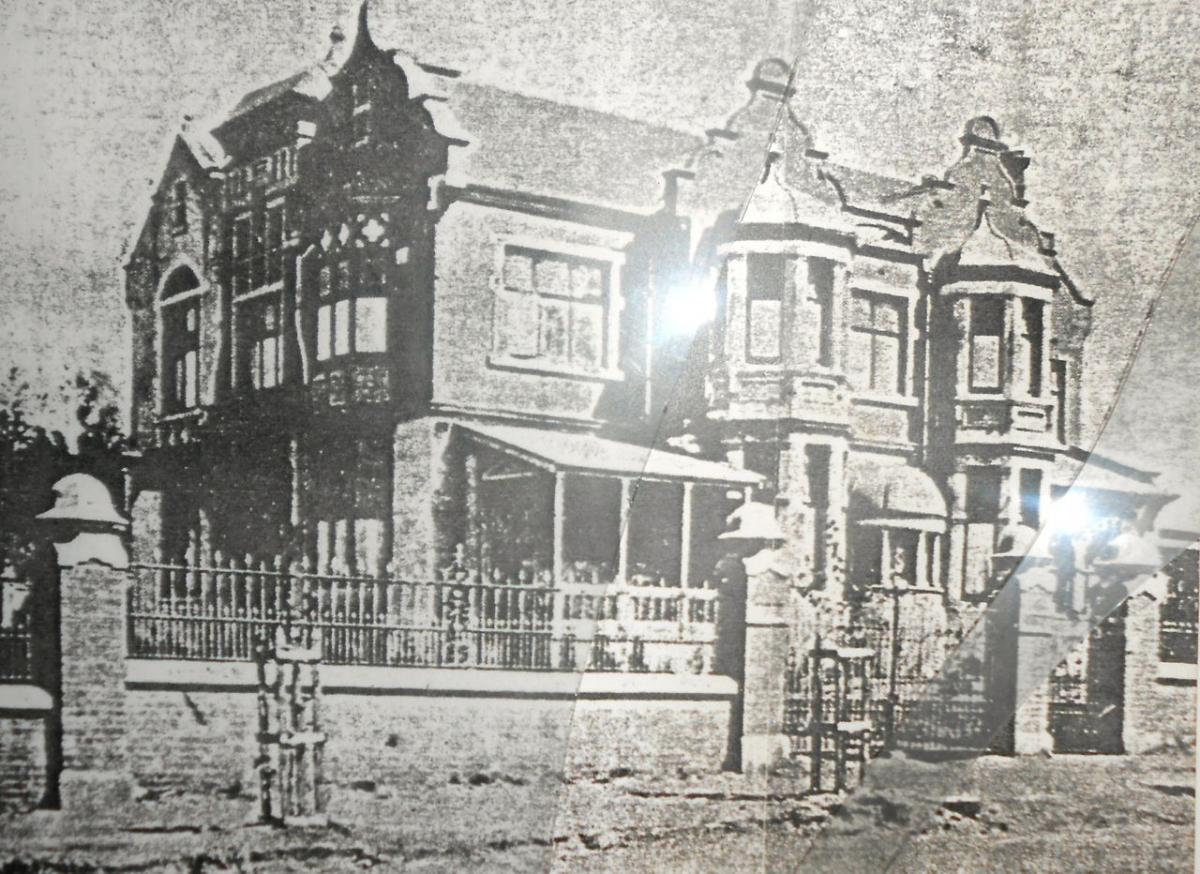
General Rundle used the de Beer home as his headquarters. Mom Mary Bland’s best friend Joey de Beer grew up here:
– the de Beer home with its lovely stoep – or veranda – or porch –
By the end of 1902 the regiments comprising the 8th Division had departed, and the 4th King’s Royal Rifles, involved in garrisoning blockhouses from January 1902 until the end of the war, departed in June 1904. In 1904 a census revealed that there was a white population of 4 345 resident at Harrismith of which the soldiers numbered 1 921. In the next decade, Harrismith was occupied by the 2nd Hampshires, the 2nd Yorkshires, the 4th Royal Garrison, the 3rd Dragoons and the 1st Wiltshires.
So I haven’t yet found anything that says ’42nd’ but I did find that the ‘Royal Highlanders’ encamped at 42nd Hill.
More copied snippets: Official withdrawal came at the outbreak of the First World War (WWI) in 1914 (Breytenbach 1978, Pakenham 1997, Dreyer 2007). The remnants of their camps can still be seen at King’s Hill, Queen’s Hill and 42nd Hill. The badges of the 80th Regiment of Foot (Staffordshire Volunteers), the Gloucestershire Regiment and 3rd Dragoon Guards are still recognisable against the hill to the north west of town. Regular maintenance by the Harrismith Heritage Foundation, the MOTHS Military Veteran Society and, until their disbandment, the Harrismith Commando, watched over the stone-built and whitewashed badges against the hill (Dreyer 2013).
Ah! So we should probably have asked the MOTHs or the Commando before we went a-painting anyway!
~~~oo0oo~~~
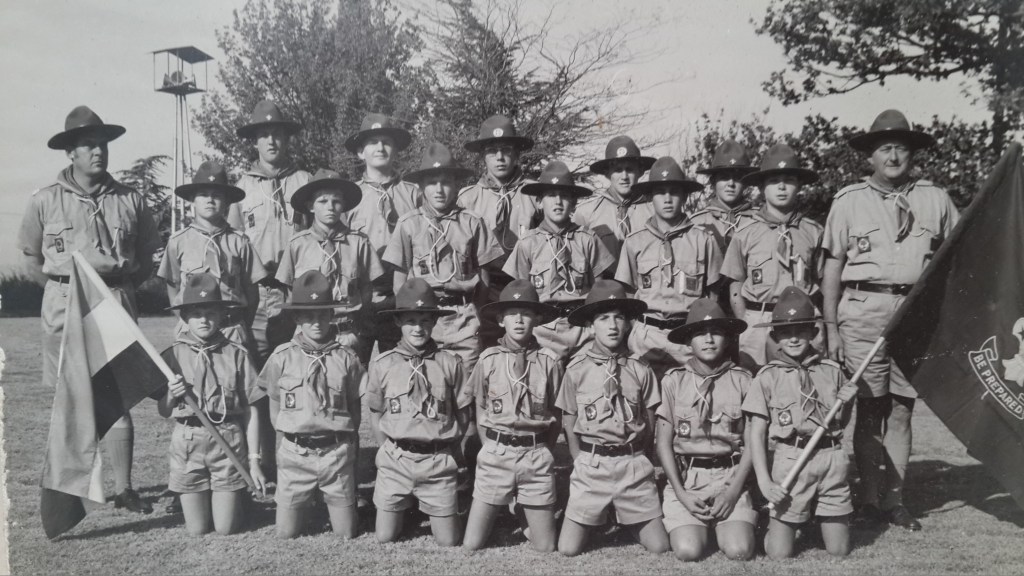
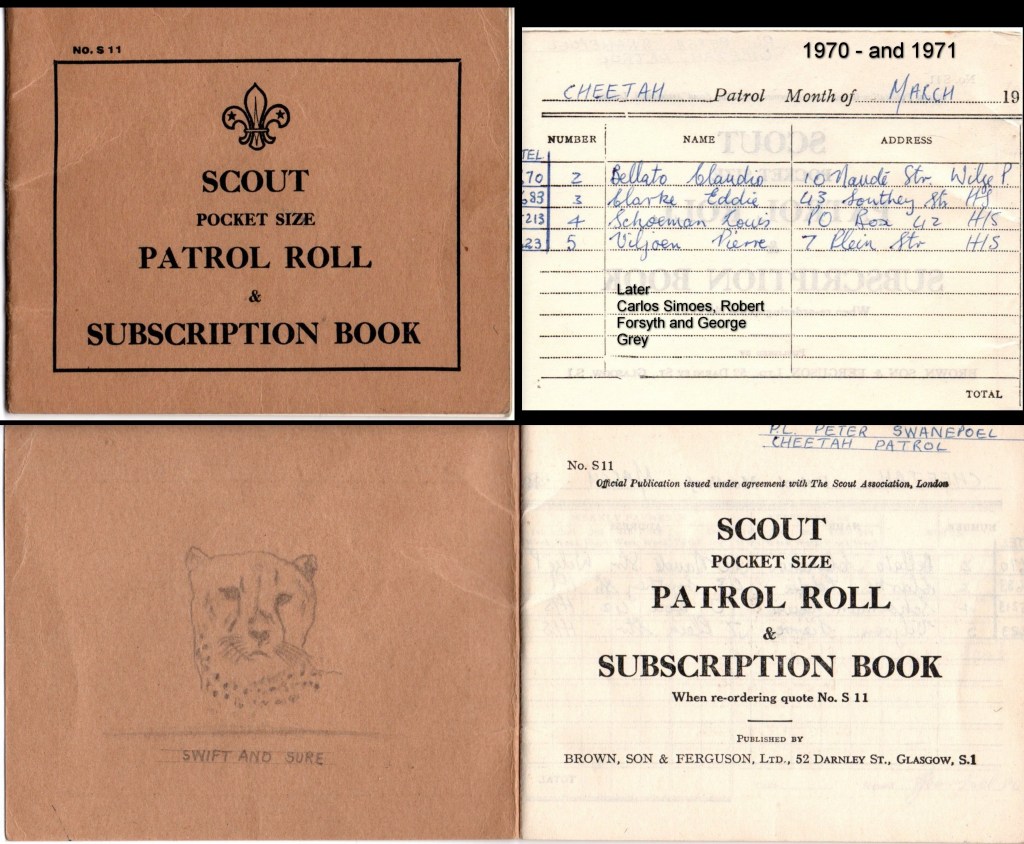
Boy Scouts was great – a real breath of fresh air to our dorp. Learnt a lot, did a lot, loved being Patrol Leader to ‘my boys:’
– Harrismith Boy Scouts Patrol Leader Booklet –– must write in the boys’ names – Father Sam v Muschenbroek and Dick Clarke, bless ’em
Loved going on camps and hikes, earning badges, drawing maps, navigating by maps and compass . .
– Boy Scout Nondela Campsite sketch –
I did all sorts of badges – master pet with Jock the staffie; canoeing, cooking, map reading, hiking, swimming, raft-building, tower-building, tying knots I still use today – everything, and was well onto my way to being a 1st-Class Scout; Went to camp in Bloem, after which ‘Haithi’ wrote and said your 1st Class will be soon; Father Sam drove us blindfolded, dropped us off (it was near Nondela) and we plotted our way back in high winds to a microwave tower near Bobbejaankop east of town; Was invited to the Chief Scout’s hike in the Valley of Desolation outside Graaff Reinet starting Sunday 24th September 1972;
– Mom Mary comments on me and Jock –
We met at the Anglican church, at the MOTH hall, and in our loft.
The favourite, most talked-about thing, the biggest challenge was: The BIG Hike
I drew five maps for this route near Normandien pass. Or really one map, on five pages of SHELL notepad! What I’d forgotten is how much Father Sam and Charlie Ryder drove us around! Probably at their own expense? Eg. We drove out to Robbie Sharratt’s farm one week night and got back at 9:30pm just for Robbie to explain the route we’d be taking on our 50-miler hike!
– from Wally Sharratts down Normandien pass and along the escarpment flank to van Reenen –
Then I went to Veld and Vlei in the 1972 July holidays, matric exams followed and suddenly Scouts in Harrismith folded, after a brief but glorious reign. Very sad, great pity but we just didn’t have the numbers.
I pulled out of the Chief Scout’s hike – I had REALLY looked forward to seeing that valley. I had read much about it. One day . .
~~~oo0oo~~~
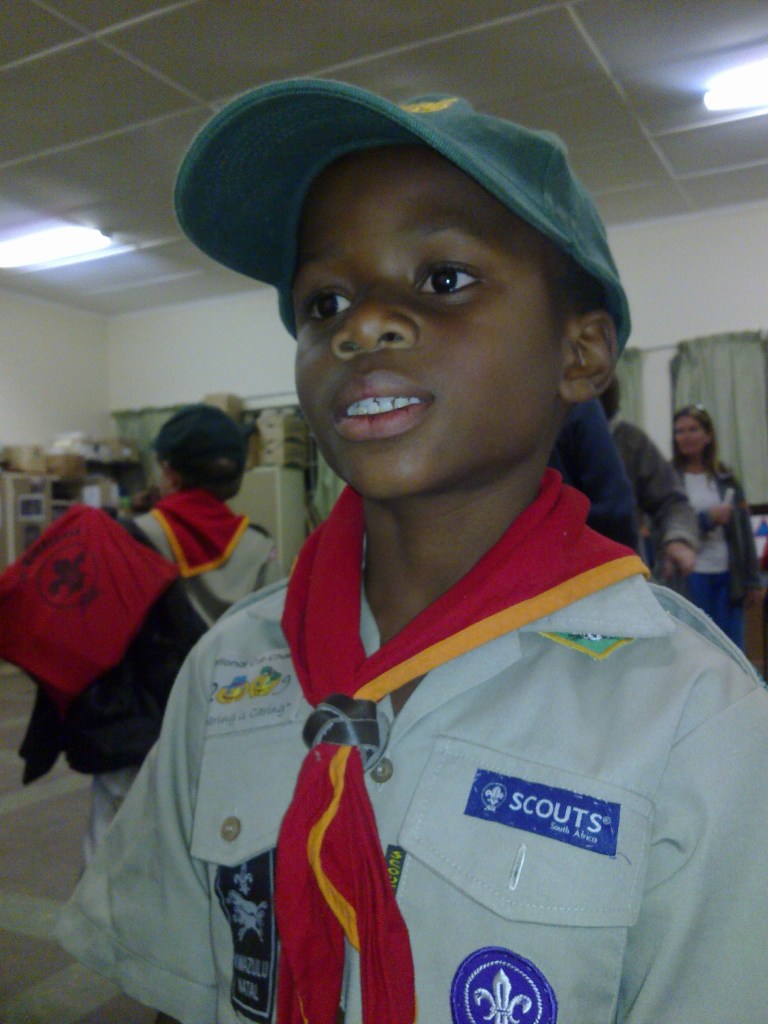
Decades later my boykie followed in my footsteps . .
– Tommy Swanepoel, cub scout – Wandsbeck pack in Westville KZN –
… and their humour. Met up with Sam, an excellent Scotsman who came in for some glasses today. We were chatting about some of the female news anchors you see on TV. One of them, Virginia Trioli, we agreed is opinionated, superior, demanding and – from all accounts – a piece of work.
He
sums her up:
“Ya woodn’t want ta be coming hoome to her wi’ only a half week’s pay packet.”
Later, I am handing him over to Ioannis who has the job of telling him how much his new multifocal glasses are going to cost (cringe) with some light banter … Sam replies:
“Well I am a Scotsman ye know. Every penny a prisoner.”
I
packed up – had not heard that one before.
Probably
comes up a lot in the local pub.
~~oo0oo~~
Me: So right! Gotta love the Scots!! 😉 – I must remember those pearls!
My gran Annie’s father came to Harrismith straight from the freezing far north of Scotland – a fishing village called Sarclet, south of Wick – but she sadly became heeltemal Engels – the queen, the empire, and all that.
The
only Scottish she ever spoke to me was her oft-repeated tale of once
on the golf course, waiting to tee off. The oke in front of them
sliced off into the bush and said,
‘Och, its gone off in the boooshes,’ to which Annie quipped,
‘That’s betterrr than doon in the wutterrr,’ – upon which she says he spun around and said,
‘Begorrah’ (or whatever a Scotsman would say on an occasion like this), ‘Yer one of oos!’
‘Aye,’ said Annie semi-truthfully.
~~oo0oo~~
Which
takes me to her THIRD language: Afrikaans.
Of her ninety years on Earth, Annie spent about eighty seven in Harrismith in ve Vrystaat. She was born there, she went to school there (more than half her schooling) and she sold Caltex petrol to her Vrystaat customers there.
The only few years she was away from Harrismith she spent ‘down in George.’ She went to stay with her sister Jessie Bell when Jessie’s daughter Leslie died.
When she got there there was great excitement as they just knew she’d be very useful in dealing with the kleurlinjeez, who spoke their own Afrikaans and hardly any Engels.
‘Annie speaks Afrikaans, she’ll be able to speak to them and understand them,’ was the buzz.
So the first day the gardener needs instructions and Annie confidently demonstrates her skill to the assembled rooineks:
‘Tata lo potgieter and water lo flowers’ she told the poor man who must have scratched his head at the Zulu-Engels mix in which the only word approximating Off-The-Krans was ‘potgieter’ instead of ‘gieter’ for watering can.
~~o00o~~
One more Harrismith Scots joke I’ve told you before, but I’ll add it to this collection: Jock Grant arrives from Scotland full of bravado, bulldust, enterprise and vigour.
He’s a plumber – a plooomerr – but soon he’s bought the stone quarry, bought the Montrose Motel in Swinburne, bought the Shell garage, bought a big white Mk 10 Jag and smokes fat cigars.
In the pub at the golf club he removes the cigar from his lips, waves it around and tells the guys he’s started Afrikaans lessons – he’s going to learn to speak Afrikaans.
Jannie du Plessis looked concerned. ‘Jock,’ he says, ‘We think you should rather learn to speak English first.’
~~oo0oo~~
heeltemal – completely
kleurlinjeez – a vague racial classification in apartheid times – and still in use today! Not black, not white, therefore ‘coloured’; actual word: kleurlinge
rooineks – people congenitally unable to speak Afrikaans, try as they might; actually, try as they don’t
Here’s my reliable report from the front line. The heliograph was a bit shaky in the stiff breeze, but I wrote down what I think happened:
A well-drilled, orderly troop of Queen and Empire Poms marched up Platberg. And when they were up they were up **
– when I say ‘marched’ I mean they Four-Wheel-Drove –
They reconnoitered the surrounding area looking for Boer commandos, ready to report any sightings to some grand old Duke, or Lord, or someone. Ridiculously dressed in anti-camouflage bright red tunics, or similar, they stuck out like sore thumbs; But at least they were together and obeying the orders of Field Marshall Lello RSVP. This would not last very long.
Once on top the cohesion started to wobble and soon a small breakaway happened. Some of the troops began behaving like Boers, thinking they could just go home when they felt like it. Five of them headed off down One Man’s Pass, misled by a trooper who said he had local knowledge, had run up this pass in the past four times and ‘it wasn’t far.’
It was far and it was steep and soon more than just cohesion was wobbling.
The remains of the patrol, now only nineteen strong, headed East back to Flat Rock Pass – or Donkey Pass – where a further split took place with trooper Soutar suddenly developing a deep longing for his ancestral home, Howick. I know, who would want to go to Howick?
Down to fifteen, the remainder headed for the Akkerbos for lunch and booze, where another defection saw four more wander off the beaten track and puncture the one wheel of their Ford Platberg Cape Cart. Field Marshall Lello RSVP set off to rescue them, dispatching sergeant Garth, corporal Nigel and Generaal Leon to rescue the original five deserters. Who of course, didn’t need rescuing as they had the whole thing under control and knew exactly where they were as they had a knowledgeable local guide with them. (Right!)
Back at the Oak Forest – where the princesses Elizabeth and Margaret had been kerfuffling in the bushes with equerry Group Captain Peter Townsend back in 1947 when most of us were busy being born – a laager had been formed and tables laden with provisions, especially booze.
A re-grouping took place and the size of the force stabilised at fifteen, with no wounds or injuries other than some grazes and some wobbly legs and some mild miffedness. (Justified, BTW). The disorderly conduct and the booze, together with the coating of dust and black soot on all the troops made the patrol look less and less like a plundering invading force from a small island, and more and more like good, patriotic, camouflaged local defenders.
Back down at the bottom of the mountain, the numbers swelled to nineteen and confidence grew to such an extent that a decision was made by the now almost completely Boer commando, to attack the blerrie Breetish in their blockhouse situated on the banks of that sparkling brook called the Kak Spruit. A clever encircling movement was made and we attacked the crows nest from above, putting the occupants to flight. Bladdy Poms!
– if you look carefully you can see the pockmarks of our accurate rifle shots*** all over –
So ended another successful campaign by us Boer guerillas. Generaal Leon could heave a sigh of relief and return to his farm after successfully converting a motley band of misled ‘joiners’ and getting them to support the right side at last.
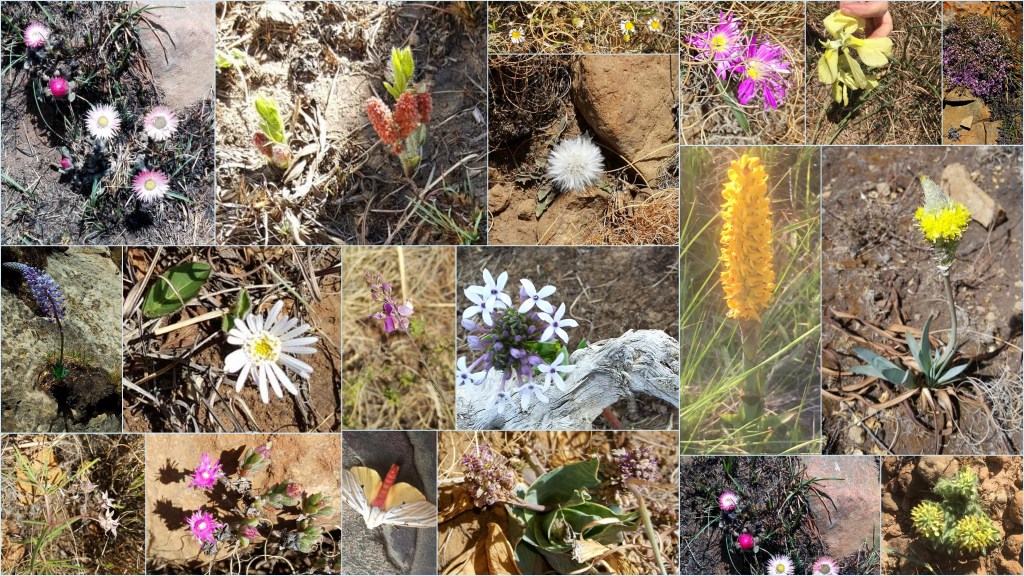
– some Eastern Free State wildflowers –
~~oo0oo~~
PS: I forgot to mention – During the whole campaign there was a westerly breeze which caused some heliograph wobble.
*** Have you ever seen an old sandstone structure without ‘Boer War bullet holes?’ Me, I think those holes are where the iron calipers used to lift the heavy blocks gripped them. Amiright?
Durban ca 1980 – I’ve been sent here by the army; I know very little about this Last Outpost of the British Empire, but my friend, fellow Free Stater Steve Reed, has been here almost a year, so he knows everything. And he knows some girls.
The papers announced that some comet was due to approach Earth and – we extrapolated – threaten our way of life, our partying, our poison of choice – and perhaps even kill us. Or annoy us anyway.
We determined to protect ourselves and our favourite planet from this unwelcome alien intruder. Steve hired a beach cottage at Blythedale Beach on the Natal north coast and, as I know a lot more about warding off comets than I do about girls, I was happy to tag along with Stefaans and a bunch of his female friends and admirers. Supplied with adequate stocks of various powerful potions and elixirs to be taken internally, we sallied forth. We also bought tinfoil.
In the self-catering kitchen we found plenty with which to arm and armour ourselves: Colanders, coriander, and pots and pans made good headgear. Braai forks, spatulas, braai tongs and wooden spoons made anti-galactic weapons. We warmed up our IQ’s by imbibing aplenty and so started a rip-roaring single-handed – the other hand was holding cheap and blithe spirits – Defend the Planet Party; which same ended successfully in the wee hours on the beach when a mysterious pale, then ever-brighter, light appeared on the eastern horizon, over the sparkling Indian Ocean.
Was it perhaps Comet Aarseth-Brewington? Well, if it was, we made it saweth its arseth by our brewing and distillington.
Actually, it was more likely Comet Tuttle. There it is, below! It came back in 2007 but it knew better than to approach too close:
– 37 million km is the closest it dared come this time –
Of course it was really the Sun, come to burn a hole in our hangovers.
Only later, after recovering from my overindulgence did I realise another of the planned missions had once again been a complete failure: Snaring any girls. As so often, the booze had won and I’d dipped out. And they were kif . .
We were in second year and had just moved out of downtown Joburg and Eloff Street to the salubrious semi-suburban delightful area of Doornfontein which was once Joburg’s premier suburb where all the gold mining magnates and Randlords lived and built their mansions.
– that was a while ago, ’tis true –
So some final year students asked us to help them in their research for their – whatever.
They needed volunteers to see if blood alcohol levels affected your esotropia. We gave it a moment’s thought and thought that sounded like a HELLUVA good idea as it involved free drink and would provide valuable data and it involved free drink. We volunteered. None of asked ‘what’s esotropia?’ a number of said “Free Drink!?”
It was very formal. We had to – No, you can’t have a drink yet; Hey! Step away from the drinks table, we need baseline levels before you . . you have? Well, how many? SO many? Well, quick, come, let’s measure you before – Hey! Not another one . .
Well, give them their due, they tried their best and we did our best and it was a WONDERFUL evening filled with laughter and witty repartee and I don’t know if they got any data but we did get the promised drinks and they didn’t need to return any unopened bottles to the grog shop, which I’m sure saved them a lot of bother..
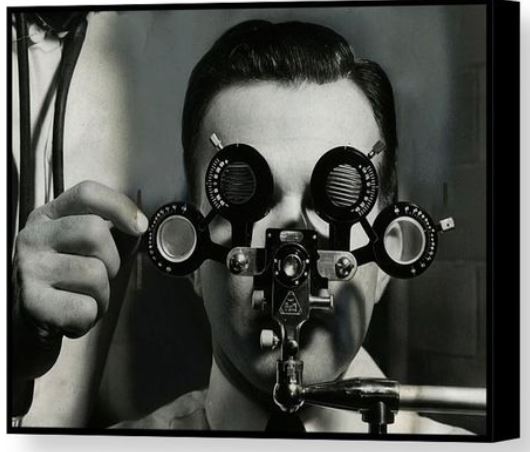
Quite a lot was learned, too. Like if you give a person who has had one too many even a little bit of vertical prism he will push the phoropter away and make barfing noises and run out of the clinic. That might come in handy to future researchers, and I give it here free for anyone to use.
– look at her – she’s obviously had a few –
~~~oo0oo~~~
In final year, Brauer, Zena Jacobson and I did some more serious research, popping contact lenses into people’s eyes and then forgetting about them. My eyes and Pierre Leibbrandt’s eyes, as two f the guinea pigs I ca remember. Silicon extended wear we called it. I think our verdict was “Not Yet.”
We’re all exhorted to Sieze the Day! Carpe diem, said Horace. Grab Opportunities as they arise! Well, some people do just that.
I was reading about Andrew Geddes Bain, geologist, road engineer, palaeontologist and explorer in the Cape up to 1864, and his son Thomas Charles Bain, road engineer in the Cape up to 1888, when it suddenly struck me!
First, let’s see what these two very capable men achieved: Andrew Geddes Bain was in charge of the building of eight mountain passes, including the famous Bain’s Kloof Pass, which opened up the route to the interior from Cape Town. And he (and his wife) had about thirteen children. His son Thomas Charles Bain saw to the building of nineteen passes! His crowning glory was the Swartberg Pass that connects Oudtshoorn in the Little Karoo with Prince Albert beyond the Swartberg mountains in the open plains of the Great Karoo. And he (and his wife) also had about thirteen children.
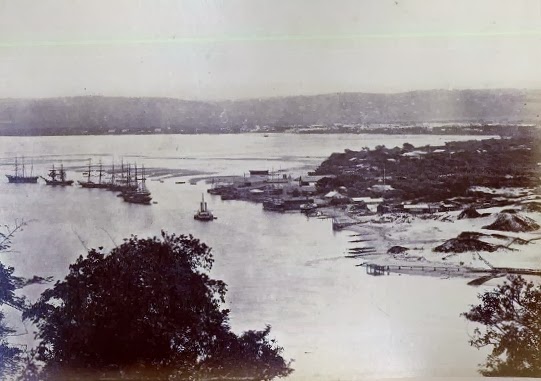
And I suddenly knew exactly what happened when my Great-Grandfather Stewart Bain and his brother James Bain got off the ship in Durban in 1880. They were fishermen from the tiny fishing village of Wick, in the far north-eastern corner of Scotland, used to being ‘knee-high in brine, mud, and herring refuse.’ * They left Wick and gave up fishing some time after an uncle Stewart had drowned in a fierce storm while out fishing off Wick in one of those little boats. They got onto bigger boats and headed for warmer climes in the colonies: Durban, Natal.
– Durban harbour ca.1880 looking inland from the Bluff, showing the Point at right –
When they arrived in Durban people asked them: ‘Bain? Are you the famous Bain road builders? We need road builders here. Can you build bridges too?’
And I know just what the brothers Bain said. ‘Roads? Och aye, we can build roads. And bridges? We can build them with one hand tied behind our back.’ You know, the old, ‘You’re payin’ how much to do that? Well, you’re in luck. I Happen to be Very Good at it . . . ‘
– some nice bridges there – this one in Swinburne –
And so they built the railway bridges between Ladysmith and Harrismith, utilising their herring netting experience, learning as they went, ‘upskilling’ – thus goes this theory of mine – no doubt with the help of African labourers who had done this before.
And thereby they helped the railroad reach that wonderful picturesque town in the shadow of Platberg, so that I could be born. This subterfuge and venture made them enough money to buy the Railway Hotel (Stewart; he re-named it the Royal cos every Saffrican town has to have one), and build the Central Hotel (James); Then they could marry, have children – only about nine and eight apiece, though – and become leading citizens of their adopted dorp in Die Oranje Vrijstaat Republiek, a sovereign non-British country.
Then: One of Stewart ‘Oupa’ and Janet ‘Ouma’ Bain’s nine ‘Royal Bain’ children Annie, had two daughters; and one of those – Mary – had me! And here I am.
~~oo0oo~~
Think I’m being unkind to Wick, village of my ancestors? Read what Robert Louis Stevenson wrote about Wick to his mother when he stayed there in 1868:
‘Certainly Wick in itself possesses no beauty: bare, grey shores, grim grey houses, grim grey sea; not even the gleam of red tiles; not even the greenness of a tree. The southerly heights, when I came here, were black with people, fishers waiting on wind and night. Now all the boats have beaten out of the bay, and the Wick men stay indoors or wrangle on the quays with dissatisfied fish-curers, knee-high in brine, mud, and herring refuse. The day when the boats put out to go home to the Hebrides, the girl here told me there was ‘a black wind’; and on going out, I found the epithet as justifiable as it was picturesque. A cold, BLACK southerly wind, with occasional rising showers of rain; it was a fine sight to see the boats beat out a-teeth of it. In Wick I have never heard any one greet his neighbour with the usual ‘Fine day’ or ‘Good morning.’ Both come shaking their heads, and both say, ‘Breezy, breezy!’ And such is the atrocious quality of the climate, that the remark is almost invariably justified by the fact. The streets are full of the Highland fishers, lubberly, stupid, inconceivably lazy and heavy to move. You bruise against them, tumble over them, elbow them against the wall — all to no purpose; they will not budge; and you are forced to leave the pavement every step.’
~~oo0oo~~
Now read a sterling and spirited defence of our ancestral Scottish dorp by Janis Paterson – a feisty distant cousin, and also a descendant of the Bains of Wick; who read my post and reached for her quill (I have paraphrased somewhat):
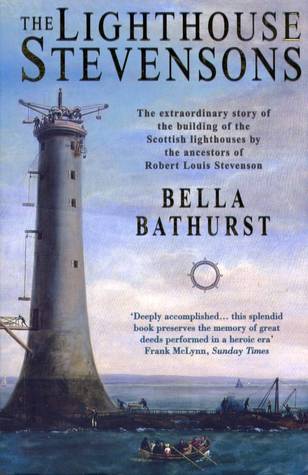
Ya boo sucks to RLS! Robert Louis Stevenson was a sickly child. His father and his uncles were engineers who built lighthouses all over Scotland. Robert was sent to Wick, likely to get involved in building a breakwater there with his Uncle. But he was more interested in writing stories and was just not cut out for this sort of work. I believe he was also ill while in Wick. The first attempt at building the breakwater was washed away during a storm and also the second attempt. The work was then abandoned. I therefore propose that Robert just didn’t want to be in Wick, was ill, fed up with the weather and just wanted to get away to concentrate on his writing. The Stevenson family must have been excellent engineers, as all the lighthouses are still standing. Did Robert also feel that he was a failure as an apprentice engineer?
Stick it to him, Janis! How dare he call Wick fishy? Or smelly!? Or breezy!? Even if it was! Just cos a dorp is fishy smelly and breezy doesn’t mean strangers can call it fishy smelly and breezy!
Janis adds ‘Read this book review:’ ‘ . .fourteen lighthouses dotting the Scottish coast were all built by the same Stevenson family that produced Robert Louis Stevenson, Scotland’s most famous novelist. Who, unlike the rest of his strong-willed, determined family, was certainly not up to the astonishing rigours of lighthouse building.’
Janis was right! 😉 All HE could do was scribble. Like me. But better.
Lots of confusion about the Baines, Baynes and Bains, so Prof Emeritus at UNISA Jane Carruthers set about unravelling eleven of them here in an article titled, The Bane(s) of South African Historians: https://www.theheritageportal.co.za/article/banes-south-african-historians?utm_source=substack&utm_medium=email – Road-builders, hoteliers, preachers, artists and one good trade unionist who fought for the poor honest working people and so gets the appellation “notorious!” Also, a Donald Bain of fighting for a Bushman Homeland Fame was born of a father who, like our Oupa Bain, was from Wick, so possibly related and may also have smelt of herring when he first got to South Africa.
~~oo0oo~~
On our big Karoo / Garden Route tour in 2023 Jess and I stopped at a monument to the original road-building Bains who I say inspired our newly-arrived, soon-to-be Vrystaat Bains to do likewise.
~~oo0oo~~
Later I found this on the Ladysmith to Harrismith extension of the rail line. Maybe the Bain bros got a piece of this action?
LADYSMITH – VAN REENEN – HARRISMITH
After the survey for the rail link from Ladysmith to Van Reenen was finalised, the route was pegged out in June 1889. A junction was formed a mile north of Ladysmith Station, recorded as 190¼ miles from Durban and 3350ft asl, and appropriately named Orange Free State Junction. However, terminating the line at Van Reenen was not considered very remunerative, and tapping into the OFS’s rich agricultural eastern region would make the undertaking more profitable. Negotiations with the OFS Volksraad resulted in the Natal Railway Administration being granted the sole right to build, equip and operate the extension from Van Reenen to Harrismith. Representatives of both Governments met in Harrismith on 25 February 1890 to work out the agreement’s details. In terms of the agreement signed on 24 June 1890, the railway was to be completed within three years of the turning of the first sod. Significantly, while profits would be equally shared between the two Governments, all operating losses would be borne by Natal alone. The Free State could, at any time, after giving six months’ notice, take over the railway at the cost of its original construction and any other capital expenditure.
Contracts for the earthworks and masonry culverts from Van Reenen to Harrismith were awarded on 22 January 1891†. The route generally followed the course of the Wilge River, graded at 1 in 80 with 600ft minimum radius curves. The energetic approach of the work crews completed the extension four months ahead of schedule. The extension from Van Reenen to Harrismith was taken into use on 13 July 1892. Initially, there was only one station, Albertina, later renamed Swinburne, between Van Reenen and Harrismith.
Distance from Durban, elevation in feet
Van Reenen 226 5520·49 Staging Station at the Natal/OFS border
Albertina 234¼ 5408·46 Passing Station
Harrismith 249½ 5322·30 Temporary Terminus
† The section from Van Reenen to Harrismith was built and operated by the NGR under an agreement signed on 24 June 1890 between the Orange Free State Volksraad and the Natal Colonial Government. The Orange Free State Volksraad authorised the Natal Railway Administration to construct, maintain and work, at its own risk, the line from Van Reenen to Harrismith. The working of the line was taken over by the CENTRAL SOUTH AFRICAN RAILWAYS (CSAR) in November 1903. No construction maintenance was allowed under capital expenditure (Under Law 29 of 1890, a sum of £260 000 was authorised for the construction of this section).
This ‘Bain’s Railway Map, c. 1903’ must surely be one of the famous Bains?
Talking about the magic photo of the Soap Box Derby on 42nd Hill with Fluffy’s Dad Charlie in it, I got into an extended email conversation with my good mate from Mrs Putterill’s nursery school and Methodist Sunday school in the late 1950’s all the way to matric 1972, Leon Crawley:
– Charlie Crawley (left kart) and Michael Hastings (crouching); Dr Frank Reitz, looking like Kai, the starter. It looks like his car in the background ‘vimba’-ing the JHB traffic – this is the N3! – (see his car at the bottom) – Note how – just like in F1 – the wheels were standardised – Note also why Charlie bollemakiesie’d – his pedals were too close, raising his centre of gravity – Check the huge gearing advantage of the fella on the right – he must have won? –
Fluff: Amazing the dress code!!!
Me: Yes, from kaalvoet kid to full jacket & tie. And three ‘hoeds’. And a cop. Even the most casual of the ‘racing drivers’ has long pants on. I see your Dad clearly, is that Michael Hastings next to him crouched over the reins with his chin between his knees?
Fluff: Yep, Michael Hastings; I sent the photo to Mom to see if she can identify any others on it. My Dad crashed his kart and came a whopper, apparently had no skin left. He was the moer in when we had our races on the old road, because of the accident he was in. He still owes me a hiding with the kweper lat (quince switch). I bet he is waiting for me in Heaven! But we will just chat about it!!
– Fluffy in the later Crawley go-kart – with new improved streamlining – obviously wind tunnel tested – how’s the hoed!? – doubt if it was wind tunnel tested –
Me: By the time we raced down that hill the trees were tall next to the road, and it had become the ‘old road’, a new one having been built above it. Traffic volumes had increased and we could no longer just stop the N3 and all the Jo’burg – Durban traffic!
= = = = = Canoe trip from Swinburne = = = = =
– we started under this old road bridge in Swinburne –
Me: So we did the full Swinburne to Harrismith in a day? I remember being picked up at the bridge – I think the same bridge you once caught a huge barbel under – correct? You may remember I went again a few years later with Claudio Bellato. The river was up and we both lost our glasses, spent a wet night sharing one sleeping bag, which was only half wet, the other one was sopping; then wrecked the canoe, which I had borrowed from the Voortrekkers, on a tree block in a rapid on Walton farm. Charlie Ryder fetched us and we got the wrecked boat out two weeks later. Claudio lives in Durban and I see him from time to time. He still introduces me as “Meet my friend Peter. I slept with him.”
Fluff: Your Dad picked us up in Town, but we did not sleep over en route. The river was terribly low and we did a lot of foot work crossing or bypassing the rapids. We made the trip in one day. I can remember the trip you had with Claudio, jeez terrible to sleep wet, and that with a man. You fixed up the canoe in the backyard if I can recall. That fish: It was a huge barbel from the bridge and that with a split rod, Dad used for bass!! Haha early one morning standing on the bridge, it was still too dark to go down to the river.
– we finished under the old Hamilton bridge – the ‘ysterbrug’ – in Harrismith –
= = = = = The Voortrekker Camp = = = = =
Me: I joined up briefly, thanks to you. Or to your description of the upcoming camp on Bok or Boy Venter’s farm! I remember the camp in the wattles, a campfire, canvas tents with wooden pegs – and not much else.
Fluff: I remember the Voortrekkers and I think our membership lasted until after the camp. A huge bonfire, that night; Boy Venter. That was about it.
= = = The 1969 South West Africa Trip . . That Kestell Trip = = =
Fluff: We have good memories of the SWA Trek and I still have some photo’s as well.
Strangely
not of the group or individuals!! I will scan at some stage and put
them in mail.
The welwitchia plant; Namutoni in Etosha; the Finger of God; the ‘bottomless’ lake Otjikoto with schools of small fish – apparently the Germans dumped their weaponry in these lakes, close to Tsumeb. Did we go to a disco in Tsumeb?
Do you remember the beers we ordered, but we were under age but we reckoned there was no age limit buying booze?! You were on the bell and it got stuck and the barman kakked us out and chased us out of the hotel!!!
The visit to the karakul farm, the meerkats!! Eish the price of that lovely freshly baked brown bread near Twee Rivieren….17 cents OMW – the price of brown bead was about 6 cents back home!!!
Lovely memories; Braam Venter was the guy from Kestell…and who were the brothers who played cowboy and crooks with .303 rifles on horseback!?
I can recall yourself, Pierre, Tuffy, myself who else was in the party from Harrismith?
Swakopmund’s Dune 7 with that huge Chevy bonnet that did not work!!
~~~~~ooo000ooo~~~~~
Me: Was the hiding “on the cards” when he died? Heart attack, was it? How old was he? That was such a damned shame. I can actually still feel (feel, not remember) how I felt standing in the kitchen at 95 Stuart Street when I first heard uncle Charlie had died. And here’s my old man turned ninety one after sixty two years of smoking and all that dop – cane spirits – in the Club and Moth Hall!! Each old toppie I see – and my work consists of seeing old toppies! – has a theory of why he has lived so long but I can tell you right now there’s one main factor: LUCK. For every “formula” they have for their longevity I know someone who did just that but died young. About the dop my old man used to say, “Ah, but remember he drank cane and WATER. It was the mixers other ous drank that stuffed them up (!!)”. That was his theory and you can say what you like, he’s sticking to it! You know you’re not drinking for the taste when your dop is cane and water!
I’d love to see the SWA photos. I didn’t take any. I still have the ossewawiel (axle centre – what’s it called?) that I got there. It had everyone’s names on it, but they’ve faded now as it has spent a few decades outside propping up my offroad trailer’s disselboom.
From HY I can only add Pikkie Loots and Marble Hall’s names. From Kestell I remember ‘Aasvoel’ and ‘Kleine Aischenvogel’. And my name was Steve McQueen thanks to you suggesting it then not using it at the last minute!
I don’t remember a disco but I do recall the beers at Karasburg and the oke storming in to ask Waddefokgaanieraan? Wie’s Julle? Waar’s Julle Onderwyser? Also the springbokke caught in the fence and the shout Ek Debs Die Balsak! from a savvy farm kid. I’d never heard of turning a balsak into an ashtray till that day! And the huge bonfire in the riverbed and sleeping out in the open and shifting closer to the embers as the fire died down. COLD nights! Also slept on the ground outside Etosha gates.
I’ll have to cc Pierre & Tuffy on this one!
I don’t recall cowboys & crooks and 303’s.
~~~oo0oo~~~
I got one letter from Fluffy in 1973 while I was in Oklahoma: Something along the lines of ‘Horrible inflation’ – it was the time of the fuel crisis – ‘a pint of milk has gone up to 6c a litre, and SCOPE magazine is now 20c!!’ Well, we were to learn a lot more about inflation and our Rand’s depreciation in the decades that followed!
~~~oo0oo~~~
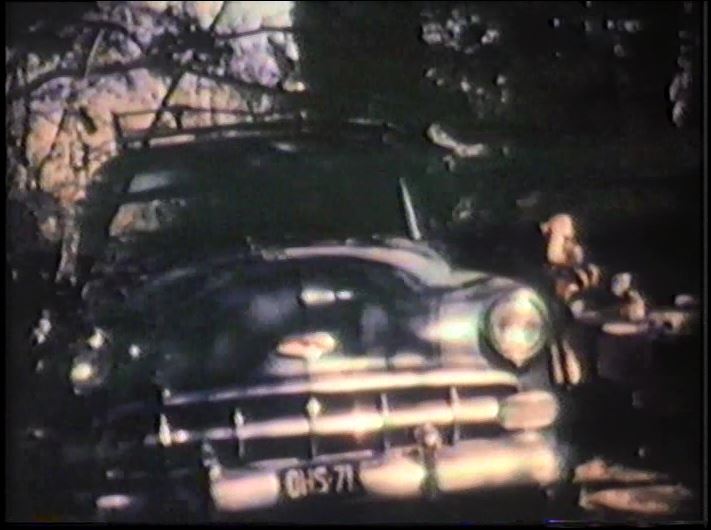
Here’s Dr. Frank Reitz’s car OHS 71 on the banks of the Tugela River on The Bend, his farm outside Bergville. Pretty sure this is the car in the 42nd Hill soapbox derby picture.
Fluffy Crawley and I probably met at the Methodist Church Sunday School as toddlers, making us fellow-Methylated Spirits. We definitely both went to Kathy Putterill’s pre-school and then from Sub A to matric in school and Sunday school together. A fine human being.
~~~oo0oo~~~
kaalvoet – barefoot
hoeds – hats
the moer in – not happy
Voortrekkers – youth group for volk and fatherland – somewhat like Scouts, but less knots and more nots
A visit to Tuffy, then stationed on the Bluff in Durban with Recce Battalion was a happy reunion. There he was in uniform and me with long hair, his student mate from Harrismith. He introduced me to his sergeant ‘Vingers’ Kruger and all his comrades and announced we’d be partying tonight.
We started off at the famous / notorious Smugglers Inn off Point Road and had a good few there, warming up to a fun night on the tiles. On our way out, en route to a nice place one of the guys knew where ladies would remove their tops with sufficient encouragement, we heard shouting – screaming really – in the alley next to the entrance to Smuggies: ‘You’re married to my sister and here I catch you fucking a man!’ We didn’t wait to hear the fellow’s explanation for his errant behaviour – the other side of the story, y’know, in fairness – but there were some smacking sounds.
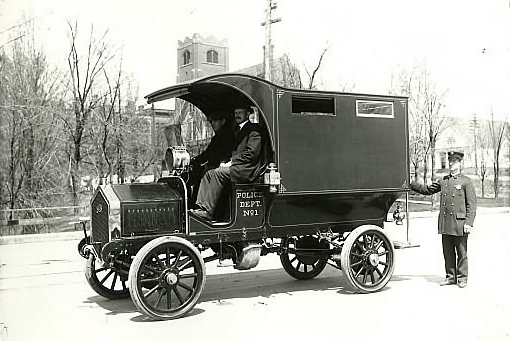
Later outside another nightclub a few insults thrown around started a fight between some of the short-haired soldiers and a group of longer-haired ‘civvies’. In the interests of transparency, one of our boys had started it. It soon developed into a brawl and the cops were there in a flash. They took no nonsense and a number of prisoners, throwing anyone near the fighting indiscriminately into the back of the black maria. Which was grey, not black. I tried to explain how very innocent I was, having hung back and danced around the edges of the fight, but was told to fokkin keep quiet and shoved into the van.
like this, just newer; and grey; with mesh windows
As we huddled uncomfortably and with foreboding with some of the okes who minutes before had been throwing punches at us – OK, for me, potentially anyway – I saw through the mesh window Sersant Vingers having a quiet word with the cop in charge. Probably something about fellows-in-uniform, our obvious innocence, how little we’d had to drink, how the blackguards had attacked us, look at their hairstyles and other good, if biased, points. The cop in charge nodded and approached the door of our van. As Vingers pointed out his men – we all looked the same in civilian clothes – the cop brusquely shouted ‘You, you and you! OUT!’ Thankfully Vingers included me among ‘his’ men. Any friend of Tuffy’s was a friend of Vingers’.
Once Vingers had counted his men he trooped us back into the club with a grin for a victory drink, with lots of congratulatory slaps raining down on his back. ‘Justice’ had been served.
























 Vrystaat Confessions