Dad was a Post Office technician. Back before we were born. He applied for telephones, which was more technical, but was given electrician. He did his apprenticeship ca.1938 and was soon put on telephones, given a truck and sent off to Ixopo where he was assigned a ‘line boy.’ Actually an adult to do lots of the hard work for you. His lineman’s name in Ixopo was Freddie.
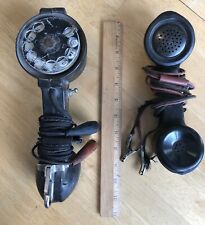
– here’s his truck, his dog and his shadow –– testing, testing – an American lineman– testing, testing, a South African lineman from HeritagePortal.co.za –
Himeville fell within his area and he got to know the lady in charge of the General Post Office there – Miss Viven Wise. Miss Viven D Wise, actually, which got the young techies snorting as “VD” was rude. She spoke of the Sani Pass up into Basutoland and how beautiful and rugged it was, so when out that way one day Dad decided to see if he could get there. He soon came across a stream he had to ford, so out jumped Freddie to pack stones in the stream so the truck could get across. Soon another stream and the same procedure. After the fourth stream he decided this is going to take too long and turned back.
He also tells of putting in new telephone lines. From one farm to the next the line would go as the crow flies, over hills and through valleys. They’d be allocated long gum poles treated with creosote and they’d take them as close as they could in the truck, but to some places they had to be carried on their shoulders. Heavy and the creosote burning their shoulders, they’d lug them over the veld, dig the holes and plant them. I’m guessing Freddie did his fair share of the heavy lifting.
– linesman handsets –
In 1973 I had another Dad, also a lineman. Rotarian Don Lehnertz worked for the electrical utility in Apache Oklahoma. Wish I’d noted which company. He and Jackie very kindly hosted me as an exchange student for three months of that year.
Interesting that the famous song Wichita Lineman was written about a lineman up a pole in Washita County Oklahoma just west of my town Apache in Caddo County: (wikipedia) Webb’s inspiration for the lyric came while driving through rural southwestern Oklahoma. At that time, many telephone companies were county-owned utilities, and their linemen were county employees. Heading westward on a straight road into the setting sun, Webb drove past a seemingly endless line of telephone poles, each looking exactly the same as the last. Then he noticed, in the distance, the silhouette of a solitary lineman atop a pole. He described it as “the picture of loneliness.”
Back in Harrismith, before too long, Dad got rescued from the Post Office by his beloved Mother-in-Law. Who gave him a job.
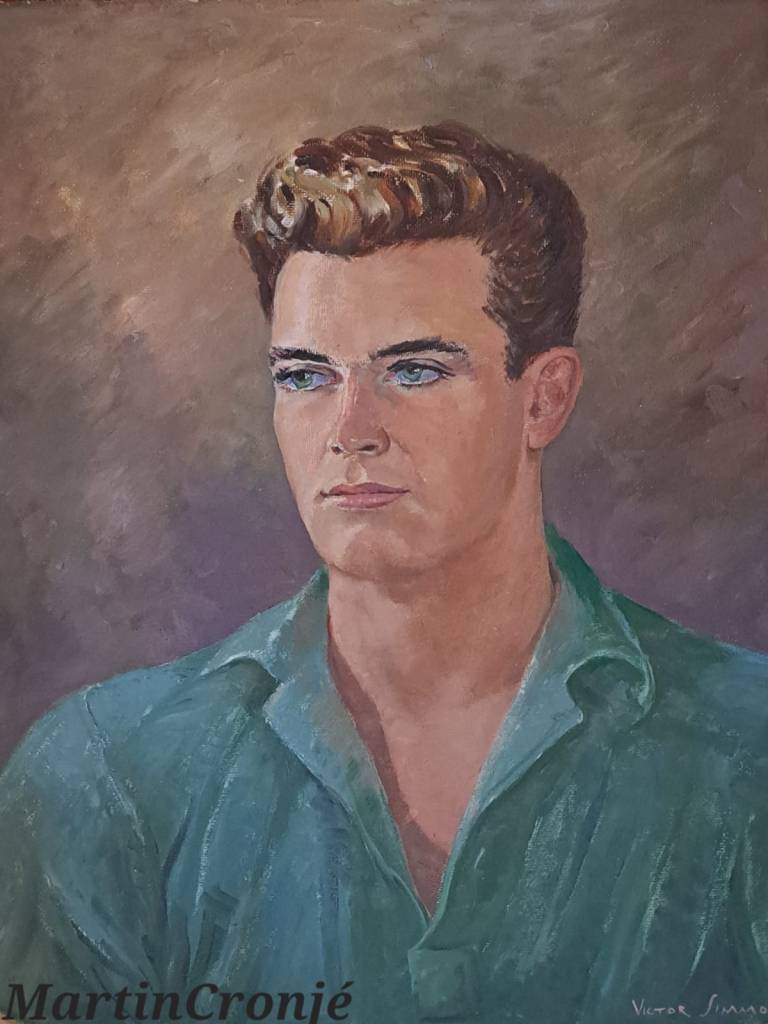
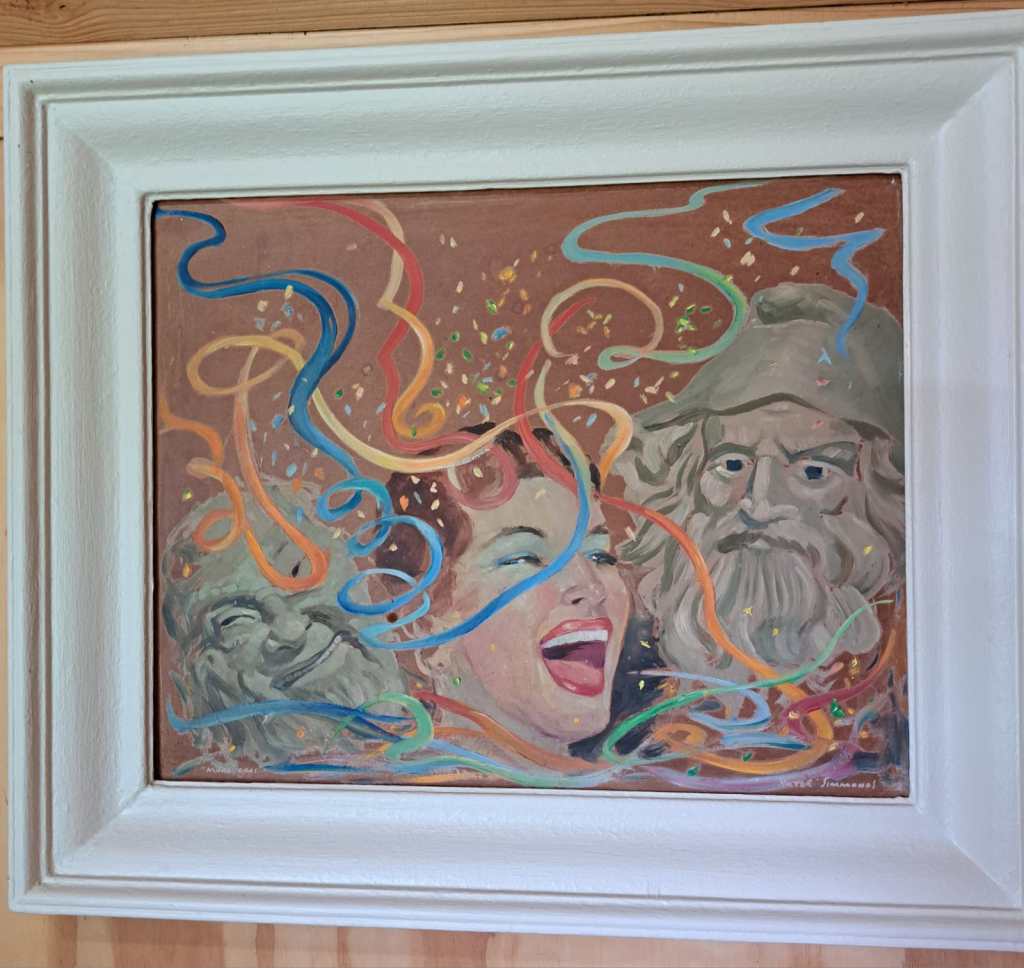
Dad: “Victor Simmonds was a lovely chap and a very good artist. He was a little man, grey, a lot older than me. What? How old? Well, I was probably 35 then and he was grey. He was probably 50. He lodged with Ruth Wright (Ruth Dominy by then) on the plot next door to ours, Glen Khyber. I doubt if he paid them any rent, they were probably just helping him out. He moved to the hotel in Royal Natal National Park where they allowed him to sell his art to the guests and that probably paid his rent.
“He was a hopeless alcoholic, unfortunately. He used to come to me begging for a bottle of brandy late at night, his clothes torn from coming straight across to Birdhaven from Glen Khyber, through the barbed wire fences. (Mom and Dad owned a bottle store, liquor store, in town) I said ‘Fuck off, Victor, I won’t do that to you,’ and sent him away. I wish I had bought one of his paintings. Sheila found these four paintings he gave me for nothing. He said he did these as a young student. As I took them he said, ‘Wait, let me sign them for you.’”
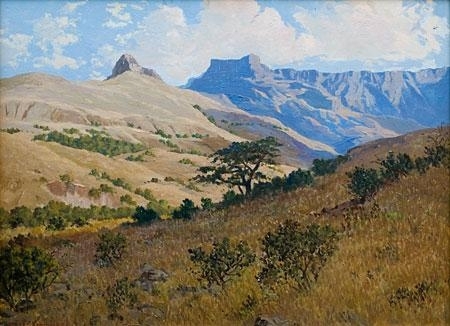
– maybe a self portrait? – – nude with amphora? – – semi-nude with two amphorae? – – maybe the Kak Spruit at or near Glen Khyber? – possibly –
So I went looking and found a lot of his work available on the internet. Once again Dad’s memory proved sound. Victor was born in 1909, thus thirteen years older than Dad:
Victor Simmonds’ work has been offered at auction multiple times, with realized prices ranging from $126 to $256, depending on the size and medium of the artwork. Since 2012 the record price for this artist at auction is $256 for South African landscape with two women carrying wood, sold at Bonhams Oxford in 2012. Also see here and here and here
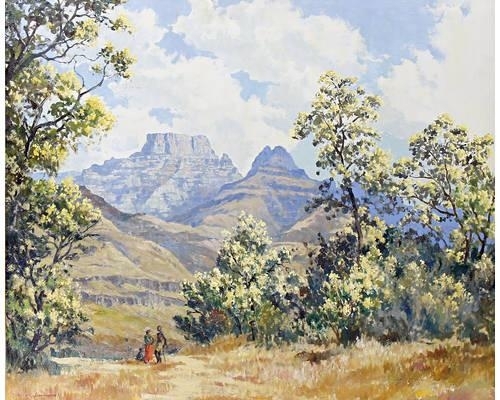
– South African Landscape With Two Women Carrying Wood –– shrubs beside a cascading stream –
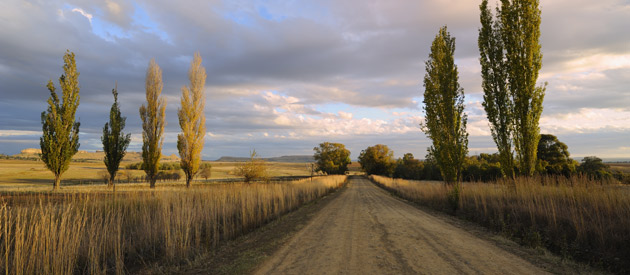
I knew this scene! I recognised it immediately! To me this looks like the stream above the Mahai campsite in Royal Natal National Park – So I went looking and at lovecamping.co.za I found this:
– spot on!! – an image locked in my brain for maybe fifty years! –– sunset, poplar trees, a river – the Wilge near Walton farm? – (or – see below . . )
A number of his paintings are available for sale. I’d love to see his ‘The Gorge, Royal Natal National Park, Showing the Inner Buttress and Devils Tooth’ but I’d have to subscribe for one day at 30 euros! That one was apparently painted in 1980, so he kept going for at least 23 years after he stayed in our neck of the woods. That would have made Victor around 70 and his liver a resilient organ.
– more Victor Simmonds Drakensberg scenes – ca.1946 – click to enlarge –
~~oo0oo~~
Now its 2024 and look who has popped up onto my vrystaat confessions: All my life I’d heard Mom speak of Corry Cronje and Len Cronje, and Corry’s daughter Liz found my scribblings. Or rather, Liz wrote a delightful nostalgic personal memoir about the Cronjes of Witsieshoek, (post it online Liz and I’ll link to it!). Anthony Maeder sent it to me and put me in touch with her. We got talking and got onto the topic of this talented artist who spent time on a neighbouring plot to the one we grew up on, and on a neighbouring farm to the one Liz grew up on.
Brothers Corry and Len lived in Witsieshoek on neighbouring farms, Patricksdale and Mountainview respectively. Victor Simmonds stayed with Len and his wife Lettie on Mountainview for quite a while and painted on both farms and the surrounding area. Liz Finnie Cronje is Corry’s daughter and when I told Mom she immediately said, “Oh Corry’s wife Rosalie was a big friend of Annie’s (her mom). They would have long chats at Annie’s Caltex garage when the Cronje’s came to town.”
Len and Lettie’s daughter Josie Cronje Batchelor has a number of Victor Simmonds’ paintings and she has OK’d my posting them here. Wonderful! One more place where his talent can be appreciated.
– View from Mountainview across Patricksdale to the ‘Berg –
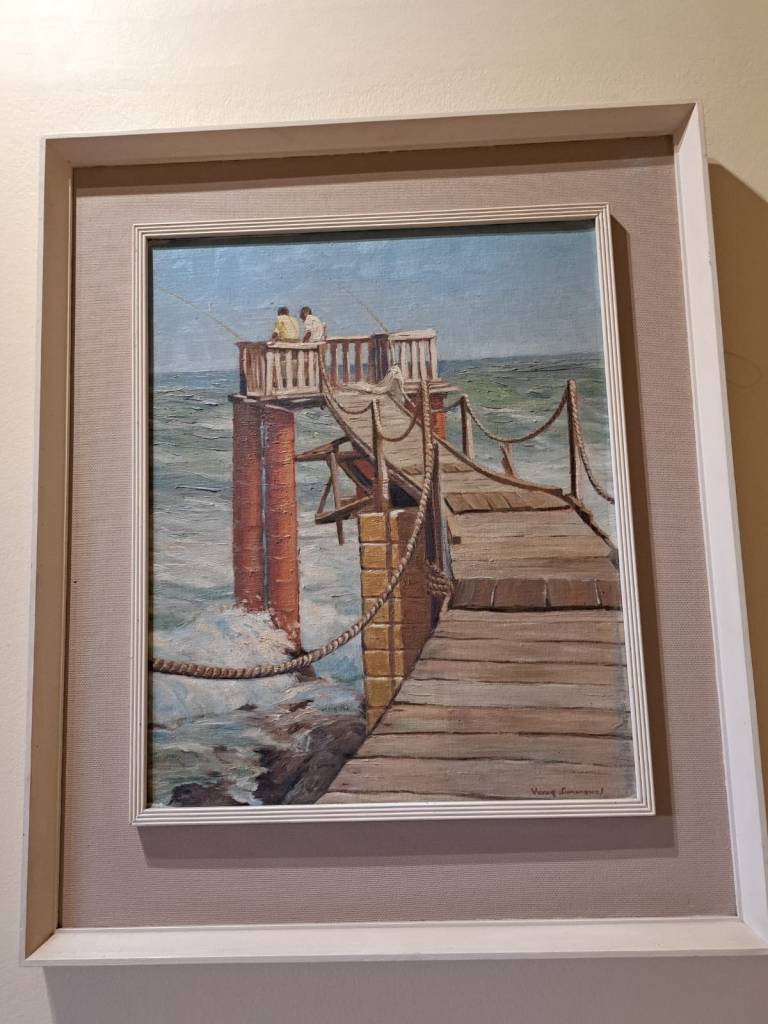
Click to enlarge – Left: Pier – Right: The poplars in Autumn –
This next one has to be on its own. Here’s why: Josie Bachelor, nee Cronje of Mountainview wrote: This is my favourite. The Gold Lamé in the background was my mom’s evening dress. The vase and porcelain horse also Mom’s. Mom did the arrangement. The table belonged to Vic.
Knowing a picture’s background and place and story makes it so much more interesting and valuable, doesn’t it?
~~oo0oo~~
Two more! With a note from Liz: I think I missed out on two more paintings. Both on Mountainview of the original Randall Bros. store in Witzieshoek taken over by Arthur Gray late 19th century I think. The chief (forget his name – ed. maybe Ntsane 1898 – 1918) asked if Arthur could open a shop in Witzieshoek as his people had difficulty getting to the shop during very rainy weather owing to the full Elands River. When my grandparents, Kerneels and Edie Cronje returned after the Boer War they renovated the shop and turned it into a cottage where all but the eldest Cronje (Andries) was born beginning about 1906 when my Dad, Corry was born.
One of Annie’s forecourt attendants at the Central Service Station on the corner of Warden street and Southey street – the ‘Caltex garage’ as we knew it – was called Johannes. Because he looked so different from the other petrol attendants, we learnt his surname. He was Johannes Culling.
Today I found out a bit more:
The Boer War started in 1899 and ended in 1902, but a lot of British soldiers stayed on in the garrison stationed at Harrismith until 1913, when they finally left. One of these was Sergeant Culling, stationed on Kings Hill, east of town. He, in fact stayed on even longer, as he married a local lady and went to live with her in the ‘location’ as the townships under apartheid were known. Our location was called ‘Skoonplaas’ (but see below), when it was south of Queens Hill on the far (left) bank of the Wilge river.
Dad knows of three children: Johannes, Henry and a daughter. They could not have had an easy life in the Free State of yore and Dad tells of problems: ‘run-ins with the police due to drinking and fighting.’
That’s all I know . . .
Now there’s more! A visit to this post by someone with way more knowledge than me. Rev. Mbuyisazwe Tshabalala commented in November 2024:
“The township was called Skomplaas, not Skoonplaas. It is a combination of two Afrikaans words, “kom” and “plaas”. This is where people were dumped when their ancestral land became farms (plase) They came from the farms Hulle KOM van die PLAAS. I SPENT THE FIRST 21 years of my life in this township. The Cullings are now our In-laws. My brother’s son is married to one of the great grand children of Sgt CULLING.”
I replied: Hi Rev Tshabalala
Thank you for visiting my tiny little post about the Cullings. So much history gets lost unless we write down what we know.
I have added your comment to the post to clarify things.
Kind regards
Peter Swanepoel (I was in Harrismith from 1955 to 1972; My Mom was there from 1928 to about 1999; My Gran Annie Bland of the Central Service Station from 1893 to 1983).
My father used to buy his suits at Du Toit’s. I bought one there a few years ago.
We are also related to the Waterman’s. I notice that there were two British soldiers named Waterman who were garrisoned at Kings Hill during the Anglo-Boer War. One of them married an African woman. My father’s younger brother married his granddaughter, Miss Goqo.
~~oo0oo~~
Fascinating, all this hidden history, buried in people’s brains and often not seeing the light of day.
Later the township was moved – further from town and out of sight, as was usually done under apartheid – up to the top of 42nd Hill to the west of Harrismith, where it was known as Phomolong.
Koos Mof van Wyk was a bachelor who lived with his Ma out on the Kestell road. One evening he drove home and a Joburg driver drove right up his bum as he slowed suddenly on the main road in order to turn in at his gate.
The Joburg oke was angry, ‘Waddefok maak jy dat jy sommer so skielik stilhou innie mirrel vannie pad!?’
Koos Mof was astounded. Waddefok maak JY!? he yelled.
Almal weet dis my hek hierie en ek draai altyd hier in. Ek is Koos Mof en ek BLY HIER!
~~~~~ooo000ooo~~~~~
Joburg driver: How can you just stop in the middle of the highway!?
Koos Mof: What do you mean!? Everyone knows this is my gate and I always turn in here! I LIVE HERE!
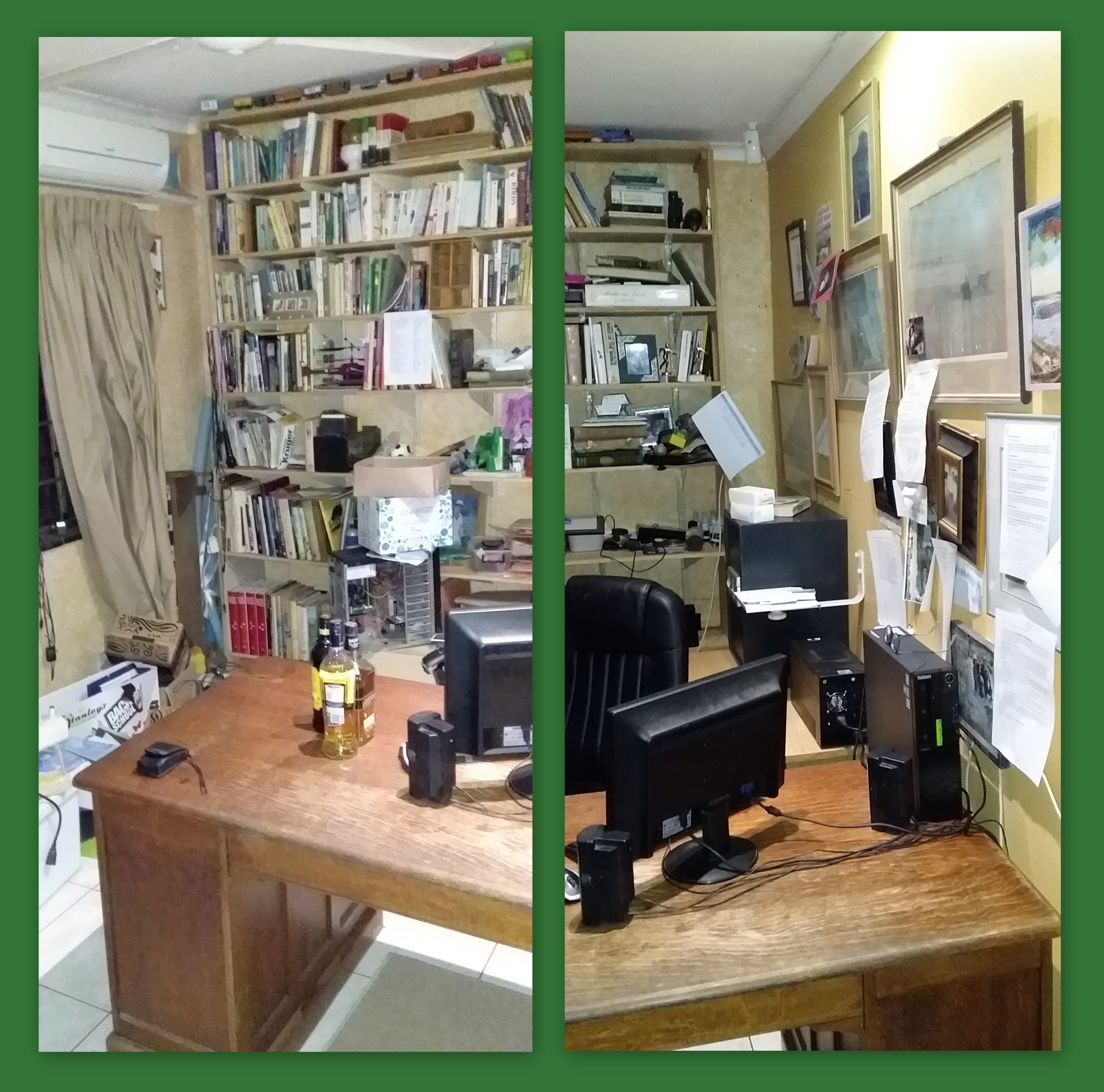
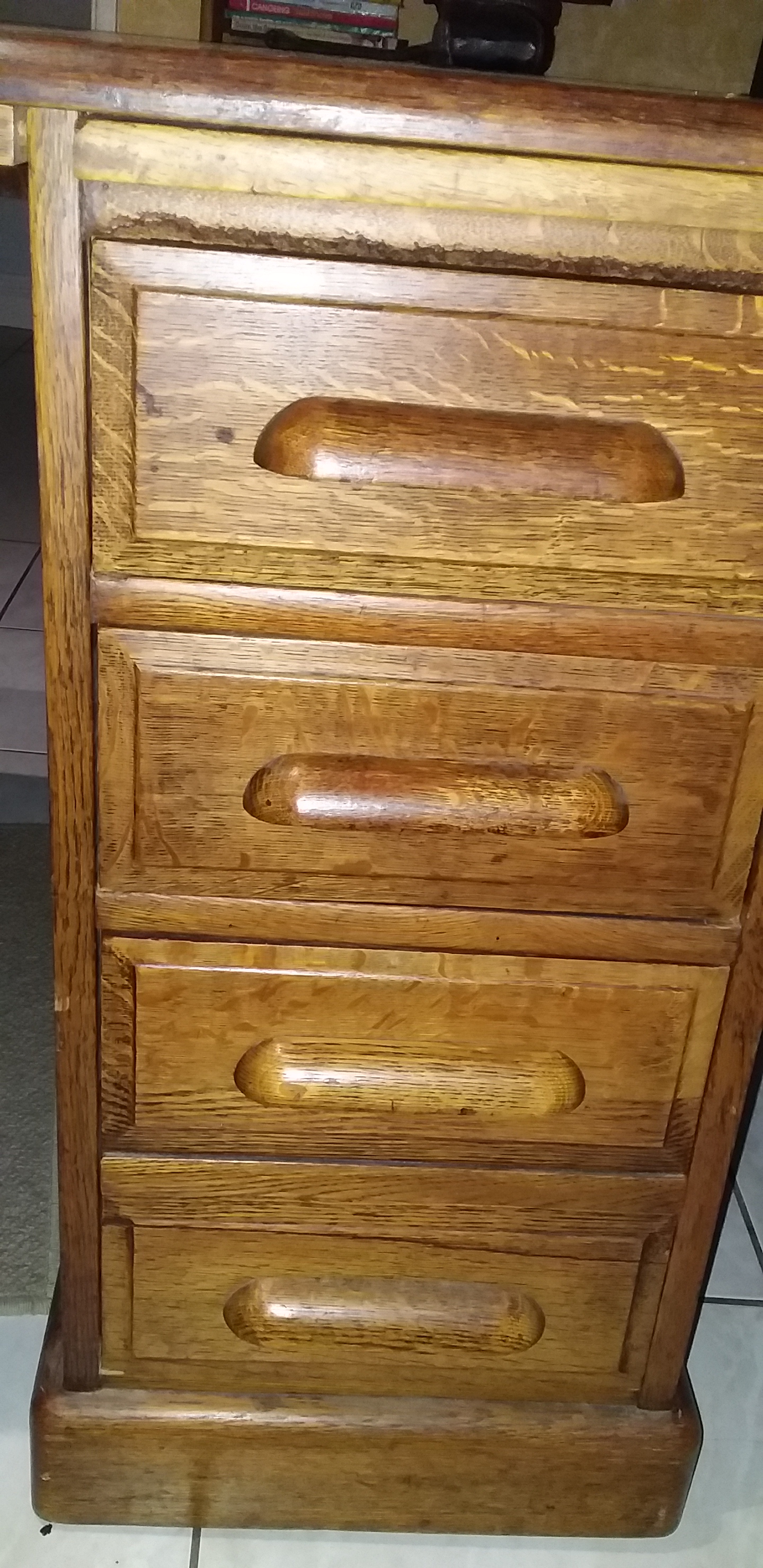
Long, long ago Annie said to me I should get her beloved husband Frank’s oak desk. I hope I said something suitably appreciative. In the meantime, the desk would stay with her daughter Mary. Mom.
We never knew Frank. He died when Mom was just fifteen, still in school. ‘In JC,’ she says.
Annie had five grandkids and I suppose her reasoning was the only grandson should get the Oke Desk? A lot of mysterious value was attached to having a penis in ye olden days. OK, so not that much has changed, really, has it? Everyone knows you need a penis, say, to drive a train. Yet of the many train drivers whose eyes I tested the ladies were by far the most alert, interesting and interested. When next I go on Shosholoza I’m gonna ask for a lady driver.
I digress.
So now Mom was in Azalea Gardens, and soon the house in Ivy Road would be sold, so it was time to fetch the desk. My inheritance! So I dismantled it, loaded it on the back of and inside of my Ford bakkie double-cab and re-assembled it in my lovely & tidy home office.
It looks good.
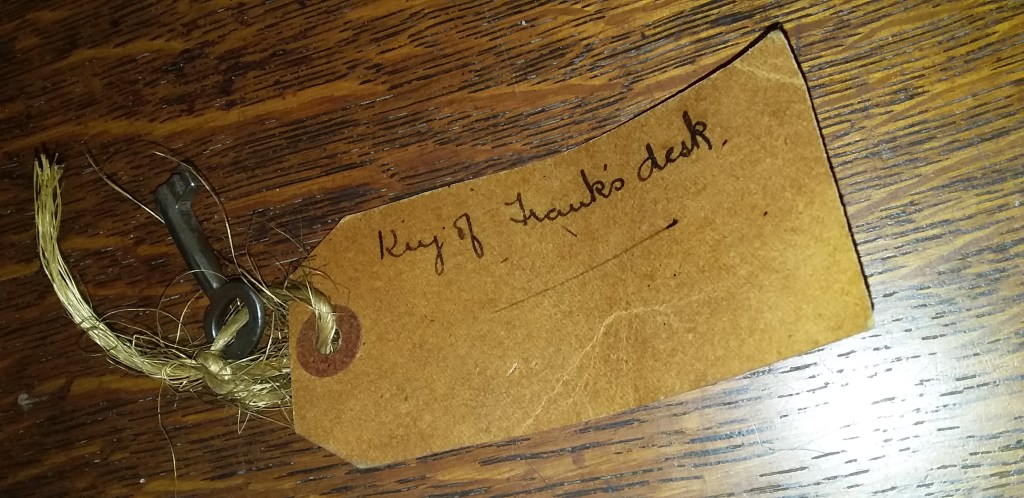
Very importantly, the key is in the top drawer, attached by string to a faded cardboard label ticket. Written in Annie’s handwriting: “Key of Frank’s Desk.” Interesting, as there’s no lock or keyhole in the desk, nor any of its drawers!
One day I looked in a mirror and was shocked to realise that wragtig the old oak desk was once again in the possession of an old oke!
~~o0o~~
‘Fraid it wasnt in my care for long, Annie! Only a few years later it moved on. It’s in sister Sheila’s care now, as I’ve sold my home. Once again I took it apart – 14 separate pieces – and schlepped it in my same Ford bakkie to Sheila’s place. I took care to make sure she got the key, too.
Harrismith had a very successful sportscar designer! Sheila reminded me in a social media post. He was a big mate of Polly du Plessis. They called each other Sissel Pud (du Plessis backwards) and Tweedie (de Wit backwards, sort of). Verster was captain of the rugby team and Mary Bland’s boyfriend. He dopped a few years and was in JC when she wrote matric. A real gentleman, says Mary. When she left to go nursing he said, ‘My fear is that we don’t meet again – worse, that we’re living in the same city and we don’t even know it.’ Sensitive soul.
Here’s the story of Verster de Wit – or the parts I could fish out:
Two Stellenbosch university pals wanted to make a great sportscar. They were Bob van Niekerk and Willie Meissner. In 1958 Meissner went to England and saw a new technology called fibreglass. He wrote a letter to Bob van Niekerk asking him to come to England to study fibreglass crafting. Bob hopped onto a Union Castle ship and joined his mate. In those days that was called ‘instant response’: The letter took a week; the response took a week; the ship took a month; Bang! Two months later there his mate was, ready to help.
Bob recalls: ‘We had full confidence in our ability to produce the mechanicals and a good chassis, but needed someone to put a ‘face’ on it – a good looking design. As luck would have it, Willie knew a lady Joan, nee Peters, who was married to a stylist working at Rootes who would hopefully stop us from producing a mediocre, unattractive body.’
Mary & Polly in Harrismith schooldays
His name was Verster de Wit, an ex-Harrismith boykie and good friend and schoolmate of our Polly du Plessis and Mary Bland-Swanepoel.
Verster soon had Bob and Willie building quarter-scale models with plasticene during the week in their one-roomed flat in Earls Court while he was off working in Coventry on the Sunbeam Alpine. Fridays, Verster would come down to London to inspect the work they had done. When they got to scale model number 13, it suddenly all came together, and ‘a unanimous decision was made to progress to full-scale.’
– Bob van Niekerk racing a Dart –– a 1962 GSM Dart –
‘We rented a garage in Gleneldin Mews in Streatham and built the mock-up using wooden formers and plaster of paris. The first body came out of the mold in April 1957 and was sold for 75 pounds, which helped to pay for my trip back to Cape Town where Willie had started the Glassport Motor Company (GSM).’
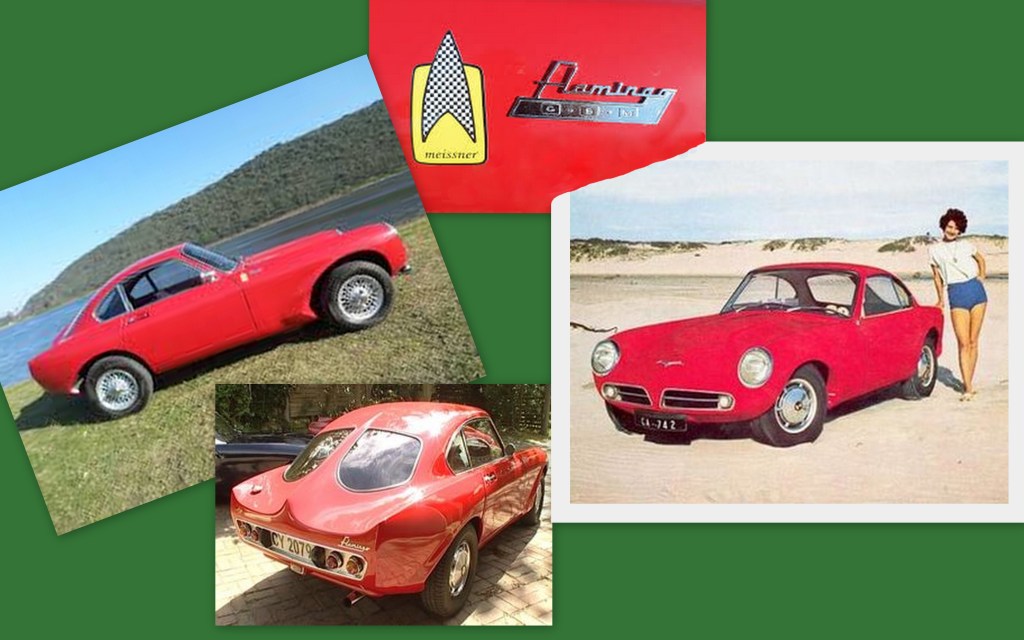
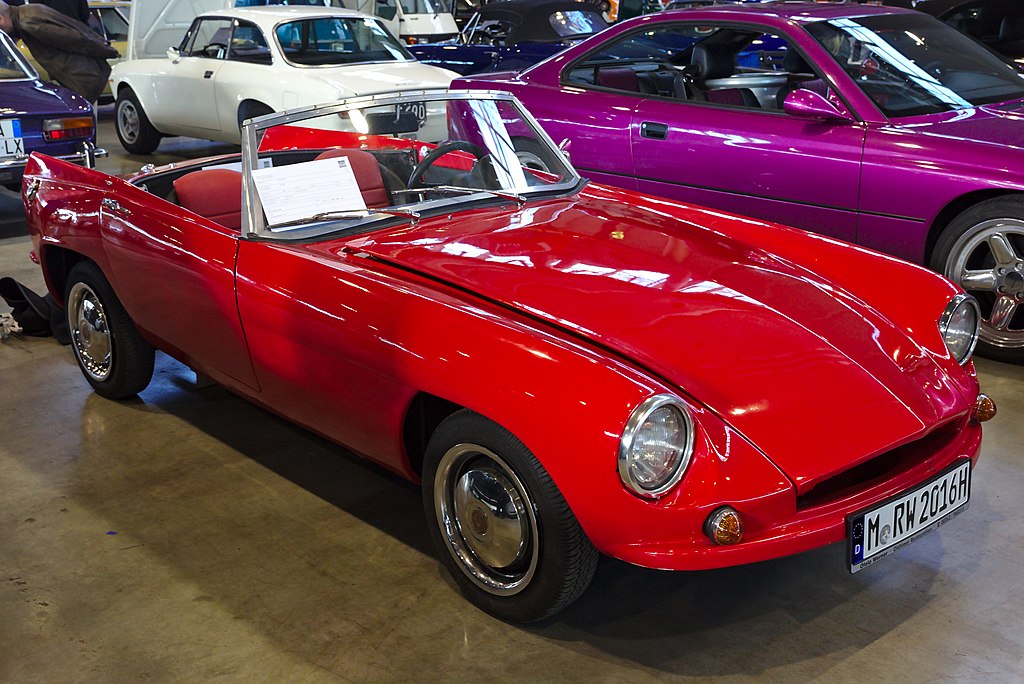
They considered what to name their cars: Cheetah, Mamba, Simba, Zebra, Kudu, Lynx or Tyger? Eventually they called the open top the GSM Dart and the hardtop the GSM Flamingo. On returning to South Africa, they built four prototypes in 1957, and the first production car rolled off the line in early 1958. In total, 116 GSM Darts and 128 GSM Flamingos were produced from 1958 to 1964. The GSM club tracked down many of them, and they reckoned there were probably a few more than that.
The GSM cars were astonishingly quick and agile and won a lot of races. In their first nine hour in Johannesburg, a Dart beat Sarel vd Merwe in his Porsche into second place; then followed an MG, another Porsche, a Volvo and an Alfa Romeo!
But perhaps the best story was after they had sold 41 cars by 1959, for racing and road use in Cape Town, they decided they could also be sold in England and Bob set sail with a complete body and chassis kit on the Union Castle liner.
In England Bob was introduced to Mr John P Scott at Windsor Garage, West Malling in Kent. Scott agreed to give him a place to build a car and fund all the parts on condition that Bob built the car in 10 days! AND that he entered it in a race at Brands Hatch! AND that he won the race! What a tall – almost impossible – order!
Bob accepted the challenge and worked day and night to complete the Dart by the Friday before the race. On the Saturday, April 18, 1960 Bob found himself in the middle of the grid on an unfamiliar circuit in a brand new and untested car. He steadily worked his way up into first place and won the race! He actually did it! Setting a Brands Hatch lap record that stood for seven years! A delighted Mr Scott then established a GSM production facility in a 5000 square foot factory behind the Windsor Garage to produce the first batch of cars. They couldn’t call them Dart in England, so they used ‘Delta’. Records are vague – it seems somewhere between 35 and 76 GSM Deltas were made in Kent.
The little cars developed a legendary winning reputation in the UK, Europe and SA. To show they weren’t only about racing, the beautiful Flamingo was marketed as the road-going version:
– stunning, nê? Designed by Mom’s old boyfriend! –
In 1964 they ran out of money.
~o0o~
Aftermath with Verster de Wit: 1976
A GSM club was formed in JHB and they tracked down Verster at his home in Kosmos on the Hartebeespoort Dam. He and his new wife Eva hauled out a suitcase full of his photos and sketches of his design days in England and in SA. They regaled the club members with tales of the hours of dedication and hard work Verster had put into his automotive design career. Another well-known design he had also been involved with – in addition to the Sunbeam Alpine – was the Humber Super Snipe.
In the 1980s the design got another lease of life when Jeff Levy got Verster to help him make a series of accurate replicas known as Levy Darts.
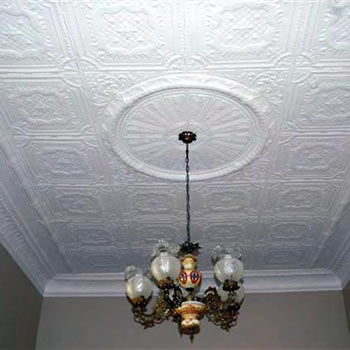
A. Ross & Co. General Dealers in Harrismith had gone phut, sold out to OK Bazaars. Their big old building was being gutted. Dad enquired about the ‘pressed steel’ ceilings* and was told ‘You can have the ceilings gratis if you strip them and remove them within a week.’
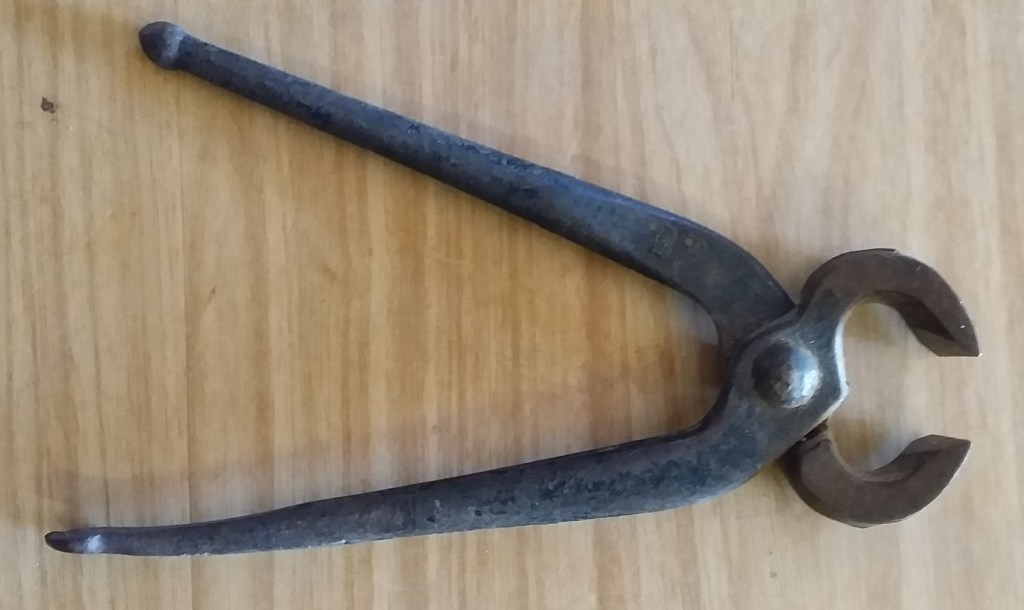
He bought six ‘nail puller pliers’ like these, and ‘did it himself’ (SA-style):
. . by hiring six men (not that he used a decent word like men), having them take down the panels, scrape them down, scrub them with wire brushes and seal them with clear varnish; then they painted them with a mix of glossy and matt white paint to get a lovely finish: not shiny, not dull.
He put them up in our huge lounge, our long passage and our spacious dining room of the old house at 95 Stuart Street.
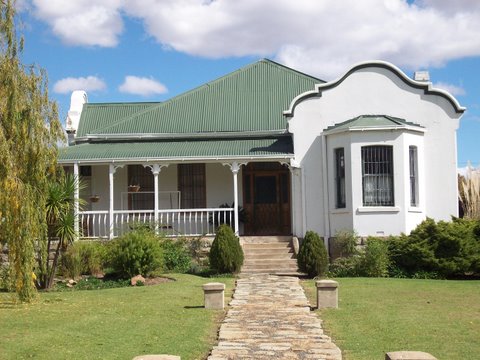
Old family home 95 Stuart Street Harrismith
He sold the excess panels to someone in JHB who paid and fetched.
Dad says while he was fitting them, Ouma paid us a visit from PMB. She would sit up with him as he worked till late at night. When it got late she would encourage him to stop: ‘Kom my seun, nou moet jy gaan rus. Gaan slaap nou.’
I’ve no pics of the ceilings . . . The feature pic and these are from the ‘net. They give a good idea of the look. Wait! See below . .
When I was taking pictures of his old tools I lined up these pliers and he said ‘Oh, those aren’t old. I bought them.’ Yeah, I laughed; Like fifty years ago! He saw the humour in that.
~~oo0oo~~
Sheila found pics of the lounge ceiling – a lovely pic of a gathering of friends on the occasion of Mom’s 45th birthday!
– members of the choir gather together –
~~~~oo0oo~~~~
*Tin ceilings were introduced to North America as an affordable alternative to the exquisite plasterwork used in wealthy European homes. They gained popularity in the late 1800s as Americans sought sophisticated interior design. Durable, lightweight and fireproof, tin ceilings were appealing to home and business owners alike as a functionally attractive design element that was readily available.
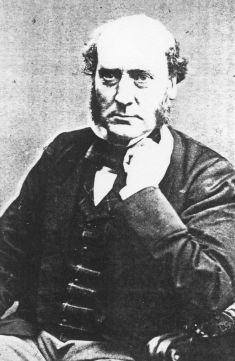
Important chaps like this one harumphed . .
. . that it was morally wrong and deceptive to imitate another material and blamed the degradation of society (on) the “art of shamming” rather than honesty in architecture. Oh well . . we weren’t going to invite him for tea to 95 Stuart street anyway.
Despite these old farts, tin ceilings were also popular in South Africa and in Australia where they were commonly known as pressed metal ceilings or Wunderlich ceilings;
Friend Charles got marooned on a Seychellois island from drinking too much. Drink – hard liquor imbibed on dry land – made them forget about their yacht and it broke anchor and drifted off without them. They were marooned like My Man Friday. And his mate, the colonial. He’s writing a book about his adventures, of which more later, when he has published and become famous. On this lonely island he met ‘an Empire Games javelin champion.’
I went looking for who that might be. I didn’t find a javelin gold medalist, but I found:
Henry Beltsazer “Harry” Hart – a South African athlete born in Harrismith, Orange River Colony on the 2nd of September 1905.
At the 1930 Empire Games in Canada he won the gold medals in the discus and shot put competitions, and bronze in the javelin throw. He finished fifth in the 120 yards hurdles.
In 1932 he went to the Olympics in Los Angeles, USA and finished tenth in shot put, twelfth in the discus and eleventh in the decathlon.
At the 1934 Empire Games in London (originally awarded to Johannesburg, but changed to London due to concerns regarding the treatment of black and Asian athletes by South African officials and fans) he won his second brace of Empire gold medals in the discus throw and shot put competitions. In the javelin throw contest he won silver.
Hart was the owner of the Royal Hotel in Reitz, Orange Free State, South Africa. He was friends with Hollywood actors Douglas Fairbanks, Errol Flynn, Clark Gable, US swimmer and Tarzan actor Johnny Weissmuller and CR ‘Blackie’ Swart – at that time a cowboy actor, later the first state president of South Africa. His study at the Reitz Royal Hotel – not really ‘Royal’ – displayed hundreds of photographs of himself in the company of these famous stars, as well as with US swimmer and actress Esther Williams, and Irish actress Maureen O’Sullivan – she played Jane in six Tarzan movies.
Henry Harry Hart himself was apparently offered the part of Tarzan but refused as he had to return home to his farm to practice for the Empire Games. Hmm – I can just hear him: ‘Hollywood? Reitz? Ag, fanks, I’ll take Reitz, OK?’
Read the comments below to see more, as two of Harry’s descendants found this post.
– the Reitz Royal Hotel – ask to see the pub and Harry’s study –
So Johnny Weissmuller got lucky. Here he is with Maureen O’Sullivan, shouting AAH ee YA ee YAAAH!! She’s a good actress: She’s not blocking her ears.
The SA team to Canada in 1930. Where’s Harry?
– kneeling left holding a guitar – see the comments –
Mary Craig married Alex Caskie; they had a daughter
Mary Caskie, who married John Francis Adam Bland; their eldest son was
Frank, who married Annie Watson Bain; their second daughter was
Mary Frances, who married PG Swanepoel; their eldest daughter was
Barbara Mary, who married Jeff Tarr; their eldest daughter was
Linda Mary, who married Dawie Pieterse; their eldest daughter was
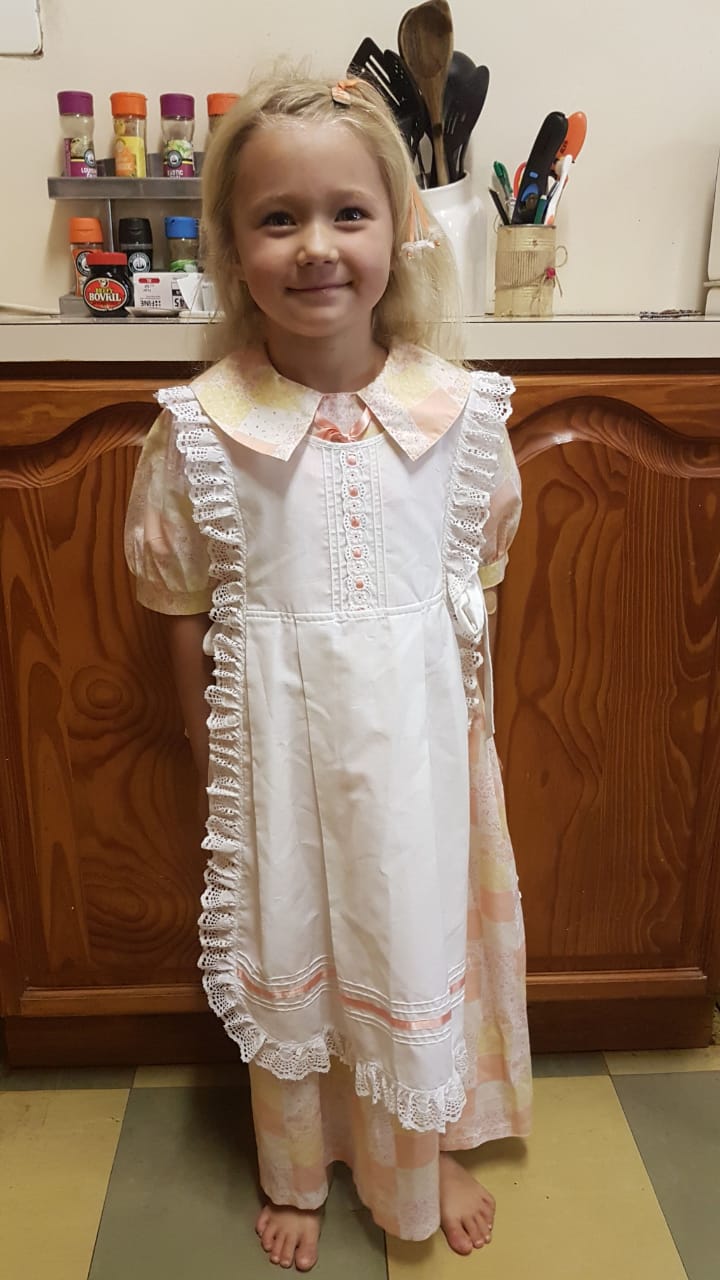
Mary-Kate, boss of the house, turning six this year!
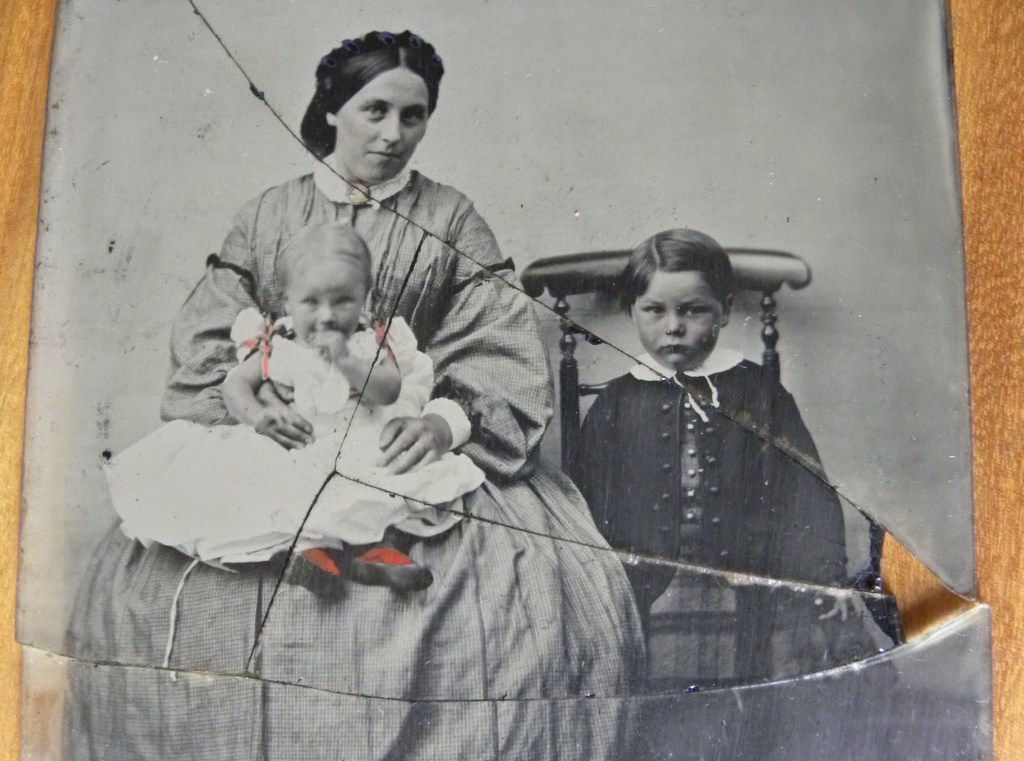
– Sheila has this old daguerrotype of Great-Great Gran Mary Craig and Great Gran Mary Caskie and a suspicious chap –
In this day of easy instant photography I find it fascinating to read how this image was made:
To make the image, a daguerrotypist would – 1. polish a sheet of silver-platedcopper to a mirror finish; 2. treat it with fumes that made its surface light sensitive; 3. expose it in a camera for as long as was judged to be necessary, which could be as little as a few seconds for brightly sunlit subjects or much longer with less intense lighting; 4. make the resulting latent image on it visible by fuming it with mercury vapor; 5. remove its sensitivity to light by liquid chemical treatment, 6. rinse and dry it; 7. seal the easily marred result behind glass in a protective enclosure.
The image is on a mirror-like silver surface, normally kept under glass, and will appear either positive or negative, depending on the angle at which it is viewed, how it is lit and whether a light or dark background is being reflected in the metal. The darkest areas of the image are simply bare silver; lighter areas have a microscopically fine light-scattering texture. The surface is very delicate, and even the lightest wiping can permanently scuff it. Some tarnish around the edges is normal. (thanks wikipedia)
~~oo0oo~~
Nowadays a few quick sweeps of free software Faststone and I can hide most of the cracks of the broken glass:
I asked Leanne Hilkovitz Williamson about Poccolan / Robinson’s Bush and this brought a flood of memories:
She takes up the story:
I was born on the farm De Nook which belonged to my grandfather Elias Hilkovitz and was inherited by my father Leo Hilkovitz after the 2nd World War probably round about 1945, two years before I was born.
Dad built Little Switzerland Hotel on the farm and we made pathways through the forest called Robinson’s Bush for guests to hike to various spots: The Wishing Well, Protea Plateau, etc. I named most of the spots, and one that meandered in and out of the forest edge I named Hilky’s Way after my grandfather who was affectionately known as Hilky.
We sold the hotel when I was in my early twenties but the various owners over the years have kept the use of the forest and the guests continue to enjoy its wonderful beauty – it is wonderfully exhilarating to either clamber down Breakneck Pass from the Wishing Well or climb up to it from the road below. The path twists and turns in amongst indigenous trees, true and mock yellowwoods, and lianas and ferns along the side of a stream full of huge beautiful boulders in all shades of grey & lichen & dappled shade. So one experiences the mountain air, the refreshing sound of the steam and always the melodious bird song. I particularly loved calling up the Mocking Chats and Natal Robins that mimic other birds and have a whole repartee of calls, copying them and they’d call back. A wonderful game that Dad taught me.
According to my father, Robinson’s Bush is the biggest natural forest in the Drakensberg. I wouldn’t take that as gospel. I’ve come to be a bit circumspect about those sorts of claims that locals all over the world tend to lay claim to!
Robinson’s Bush abuts on De Nook and we treated it as part of our farm. Dad looked after it although it is part of government nature conservation; at one stage in my late teenage years there were two nature conservation officers who lived in a hut on the edge of the forest and tended it but that did not last.
I was there for my 70th birthday in 2017 with my two sons and their families and we climbed up Breakneck Pass through the forest and I showed it to my granddaughters and taught them the things my Dad had taught me.
Some of my earliest memories are of picnics in the forest on the side of the stream with our neighbours Udo and Margo Zunkle of Cathkin Hotel fame when they lived on Windmill farm. Udo would put small pieces of raw steak on the river rocks and we’d be fascinated by the crabs that came from all sides to feast on it.
~~~oo0oo~~~
Leanne again later:
Hi Again
I put together a Power Point family history together for the family and we had an evening when Ishowed it to them. It started with the great grandparents on both sides and their cars and the farm in the very early days and the beginnings of the hotel and its growth as I grew up & went to HS Volkschool & then boarding school, varsity, etc. and then our children growing up and then finally the grandchildren from babies to present. I can never leave the farm & the berg for long & return there often – even if it is just up and down in a day – and I climb a mountain, drink in the soul food and return home refreshed, invigorated and together. The families also love it and visit but we have never all been there together at the same time & so took advantage of my 70th to ask this favour. So we stayed in the timeshare from 24-28 Dec & had a wonderful Christmas & my birthday on 27th. We had a wonderful time and I was able to share some of my favourite places & stories with them just this once as you know how short attention spans are when kids are having fun. Didn’t want to bore them!
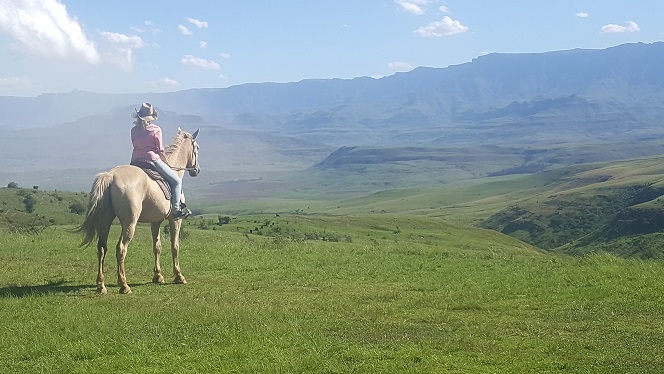
Pic of me on my birthday in my most favourite place in all the world.
~~~oo0oo~~~
Famous shenanigans: South Africa’s most notorious bank robber, Trust Bank robber Derek Whitehead, was arrested at Little Switzerland in 1971 at 3am on Friday morning the 14th of May. They had arrived at 4.30pm the previous day. A team of CID detectives from Johannesburg, the Orange Free State and Natal were involved in the swoop. After the arrest, the Whiteheads were taken to Bloemfontein for questioning
~~~oo0oo~~~
Drunken shenanigans: Omigoodness; You don’t want to know . .
~~~oo0oo~~~
Genealogy: Our Bruno the doberman was a Hilkovitz! Dad Pieter Swanepoel told me Leo came to town one day, called in at the Caltex garage and said ‘Come and look!’ On the back of his bakkie he had a bunch of little black pups in a box. Dobermans.
Dad chose one – he says he gave Leo a pocket of potatoes! – and we grew up with ‘Bruno’ – I only now found out he was a citizen of Little Switzerland! He grew up to be a handsome lad!