Tag: Sheila Swanepoel

  • 1963 World Premiere of the 1964 film ZULU

    1963 World Premiere of the 1964 film ZULU

    The film ZULU starring Stanley Baker, Michael Caine and Jack Hawkins was one of the biggest box-office hits of all time in England. It ‘premiered’ in 1964 and for the next twelve years it remained in constant cinema circulation before making its first appearance on television. It has since become a Bank holiday television perennial, and remains beloved by the British public. Some pommies watch it every Christmas, year after year. You know, Tell me lies, Tell me sweet little lie-ies.
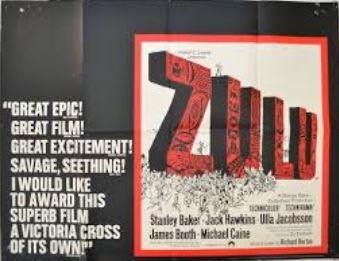
    Zulu film poster

    The film premiered on 22 January 1964, 85 years to the day after the 1879 event it commemorates – the snotklap of Isandlwana (ignored) and the defence of Rorke’s Drift (faked into a glorious victory).

    Very few people know though, that it had its REAL, ACTUAL WORLD PREMIERE in our lounge at 95 Stuart Street, Harrismith, Vrystaat in late 1963. Count yourself as one of a very tiny privileged minority who’s “in the know”!

    True! If an amateur snippet can count as a premiere. Say it can!

    Here’s what happened:

    Back in late 1963 my old man showed us a movie he and Mom had filmed with his state-of-the-art 8mm cine Eumig camera.

    Whirr whirrr whirr – those of you who watched them will remember the noise of the projector. Also maybe Thuk! Oh shit! Eina! as the film broke and had to be re-threaded in the projector and a finger touched its super-hot bulb. .

    rorkes drift_not_behind-the-scenes-zulu-1964

    ..

    He and Mom had been to Royal Natal National Park about 50 miles from Harrismith down Oliviershoek Pass to film the filming of the film ZULU.

    What I remember seeing in our film was a lot of standing around, some dust and a lot of be-feathered (dead ostriches) and be-leathered (dead leopards) Zulu warriors charging at some umLungus in funny red coats, falling down in a cloud of dust and then getting up laughing, walking back and doing it all over again. And again, And a building burning.

    Mom remembers being asked to stop filming, and then once the knobs saw it was just a tiny 8mm camera, being asked to stay politely out of the way. They continued filming the filming.

    ~~oo0oo~~

    snotklap – defeat, but humiliating, embarrassing, obvious, best not spoken of; usually hugely altered in the telling (y’know, ‘there were millions of them and the two of us only had pea-shooters’)

    umlungus – pale people; forked tongues

    ~~oo0oo~~
    salt cerebos

    Thanks to the huge success of the film – which was longer than the seven or so minutes we saw in our lounge – the Battle of Rorke’s Drift has entered British folklore. Of course its main success was due to its ignoring the massive same-day British defeat at Isandlwana and portraying the defence of a hospital as a massive victory, and not mentioning the war crimes that the Poms committed.

    New Film about The Film (maybe . . )

    Now a New Film is being shot this year (2019/2020) by Henry Coleman which might just include some of the ole man’s 8mm footage! See all about that here.

    Remember always, though, to take the British ‘jingo’ version of the battle with a very large pinch of cerebos salt.

    ~~oo0oo~~

    The background story of the film Zulu, 54 years on

    Firstly, a bit of the Real History. The lesson here is always to be skeptical of ‘official’ histories.

    On 22 January 1879, at a remote mission station in Natal, South Africa, 157 men, mainly British soldiers (the number is usually downplayed, sometimes “under 100”) held off wave after wave of attacks by “some 3,000 to 4,000 Zulu warriors” (the number is certainly exaggerated – your son’s rugby opposition was always MUCH bigger than your boys, right?). Remember who wrote about the battle – jingoist reporters for jingoist newspapers in a little country that thought it was a mighty empire. A defeat couldn’t be tolerated. The toffs had to be placated, not least the Queen who had a medal named after her.

    Although the Zulus had some old-fashioned muskets and a few modern rifles, most of their warriors were only armed with spears, with hide shields for protection. The Battle of Rorke’s Drift lasted 10 hours (often stated as ‘over 12’), from late afternoon till just before dawn the following morning. By the end of the fighting, around 365 men lay dead. Fifteen (or maybe seventeen) British inside the barricaded buildings they had defended, and around 350 Zulu soldiers outside them. Plus many wounded Zulu men, most of whom were murdered after the battle!

    The defences are almost always characterised as ‘biscuit boxes and bags’ and paintings show the British defenders hugely exposed and vulnerable. A photo taken soon after the battle looks very different to those descriptions and paintings. I haven’t seen a painting showing soldiers firing through holes in a stone wall. Is there one?

    Rorke's Drift building
    – Rorke’s Drift battle site soon after –

    Historically the battle was a minor incident, which had little influence on the course of the Anglo-Zulu War. It might have – should have – remained a footnote in the history books or an anecdote told at regimental dinners had it not been for:

    • 1. The fact that there had been a truly epic defeat at Isandlwana earlier the same day. This defence of a hospital half-heartedly attacked by men ignoring their leaders order to go home after Isandlwana, needed to be a cover-up; Needed to be hailed as a victory – and then an epic victory. In truth it was actually simply a non-defeat. It bears repeating: The mighty British army was EPICALLY DEFEATED by the Zulu army earlier that day and the British press did NOT like having to admit that. Refused to admit that. Possibly to reinforce the cover-up, the bloke in charge – LORD Chelmsford – wasn’t blamed. Was he even reprimanded for his epic mismanagement and lack of leadership?
    • 2. The crazy number of Victoria Crosses and other awards that were dished out for this ordinary defensive battle – mainly as propaganda figleaves because of the prior resounding defeat earlier that day. Not all those possibly deserving some recognition got VC’s; and some who definitely should not have, did get VC’s. In fact the truth of the battle was far more sordid than the glorious accounts a desperate British government and press wanted to portray. This made-up story and image of valour and nobility in the Anglo-Zulu war of 1879 turned to shame when documents were uncovered which show that Rorke’s Drift was the scene of an atrocity – a war crime, in today’s language – which Britain covered up. In the hours after the battle senior officers and enlisted men of a force sent to relieve the garrison killed hundreds of wounded Zulu prisoners. Some were bayoneted, some hanged and others buried alive in mass graves. More Zulus are estimated to have died in this criminal slaughter than in true combat, but the executions were hushed up to preserve Rorke’s Drift’s image as a bloody but clean fight between two forces which saluted each other’s courage. The Zulu salute in the film was FAKE. Made-up. Never happened. A blatant lie.
    • 3. And then, and especially, this battle became super-famous because many years later a film – ZULU – depicted the defence as a heroic victory. It wrote a story dramatically depicting British heroism, including nothing of the massive defeat earlier the same day, and none of the war crimes committed the next day. It dramatised a new story and has kept it in the public mind ever since. This film of falsities elevated a fake narrative and burnt the lies into the memories of a nation.

    ~~oo0oo~~

    A better depiction of why Rorkes Drift was exaggerated is told here:

    Oops, BBC won’t embed the video but you can find it. Also look for better, more honest accounts on history sites. You may have to search. Myths can get embedded. If what you’re reading says ‘Glorious’ keep looking.

    ~~~oo0oo~~~

    The Film:

    The story behind the film’s making. Most of this account taken from talks by Sheldon Hall, Sr Lecturer, Stage and Screen Studies Sheffield Hallam University.

    The filmmakers

    The principal artists responsible for Zulu were hardly Establishment figures. Screenwriter John Prebble was a former Communist Party member who had volunteered to fight in the Spanish Civil War. His co-writer, the American director Cy Endfield, had fled Hollywood in the early 1950s after he was named as a Communist during the McCarthyite witch-hunts. Endfield’s production partner and the film’s main star was Stanley Baker, a life-long supporter of the Labour Party.

    All three were committed to progressive causes, but their motives in making Zulu were not political. It is not an anti-imperial diatribe any more than it is a celebration of colonial conquest. Its main purpose was frankly commercial, but Baker also saw the story as a chance to pay tribute to his Welsh homeland. This certainly explains the strong emphasis on the Welshness of the private soldiers – one of the many fictionalised elements of Zulu that have created a myth around the battle.

    Filming under Apartheid

    Update hot off the press: More drama in 2025! A sort of “cease and desist” letter in my comments from Stanley Baker’s eldest son! See below . .

    The producers had to keep their political views in check when they made the decision to shoot the film in South Africa, then in the grip of Apartheid. There were strict, legally enforced guidelines regarding the degree of freedom permitted to the cast and crew. It was impressed upon the 60-odd British visitors that sexual relations with people of other races would result in possible imprisonment, deportation or worse. Warned that miscegenation was a flogging offence, Baker is reported to have asked – in glorious Pom tradition – if he could have the lashes while ‘doing it’. The authorities were not amused.

    The main filming location was at the foot of the spectacular Drakensberg Mountains in the Royal Natal National Park, a popular tourist spot distant from any large township. But a number of incidents brought home the realities of the oppressive regime. Chatting to John Marcus, one of several professional black stuntmen employed on the film, assistant editor Jennifer Bates invited him for a drink in the bar/canteen that had been built on site for the crew. Marcus pointed out that he was forbidden by law to mix socially with whites and could not enter.

    In his autobiography, Michael Caine recalls an incident in which a black labourer was reprimanded by an Afrikaans foreman with a punch in the face. Baker sacked the foreman on the spot and made clear that such behaviour would not be tolerated. Caine swore never to make another film in South Africa while Apartheid was in force, and kept to his word.

    Introducing Michael Caine

    Keeping watch over the tightly budgeted film was production supervisor Colin Lesslie. “I am very glad to be able to tell you,” he wrote at one point to the Embassy Pictures’ chief in London, “that in my opinion and from the little he has done so far, Michael Caine as ‘Bromhead’ is very good indeed. When he was cast for the part I couldn’t see it but I think (and hope) I was wrong.” This must have been a common reaction.

    Not quite an unknown, the 30-year-old Caine was already making a name for himself on television but was becoming type-cast in working-class Cockney parts. Casting him as a blue-blooded officer in his first major film role represented a considerable risk, but it was one that paid off.

    Thousands of ’em?

    The soldiers were played by real soldiers – eighty national servicemen borrowed from the South African National Defence Force. And most of the Zulus were real Zulus. A mere 240 Zulu extras were employed for the battle scenes, bussed in from their tribal homes over a hundred miles away. Around 1,000 additional tribesmen were filmed by the second unit in Zululand, but most of these scenes hit the cutting-room floor.

    Living in remote rural areas, few if any Zulus had visited a cinema and television would not reach Natal until thirteen years later. The crew rigged up a projector and outdoor screen, and the Zulus’ first sight of a motion picture was a Western. From then on, the “warriors” had a better idea of what they were being asked to do. Responsible for training and rehearsing them were stunt arrangers John Sullivan and Joe Powell. “The Zulus were initially suspicious of us in case we were taking the mickey,” says Powell, now 91. “After a couple of days they realised we weren’t and got into it. After that you couldn’t hold them back.”

    Contrary to stories, the Zulus were not paid with gifts of cattle or wristwatches but received wages in Rand. The main corps was paid the equivalent of nine shillings per day each, additional extras eight shillings, and the female dancers slightly less again. Associate producer Basil Keys remarked: “There is no equality of pay for women in the Zulu nation!”

    Buthelezi’s tribute

    For the opening sequence depicting a mass Zulu wedding, 600 additional background artists were brought in, including nightclub performers from Johannesburg, to play the principal dancers. During breaks in filming, they twisted and jived to modern pop records played over Tannoys, with director Cy Endfield among the crew members joining them.

    The small but key role of King Cetshwayo was given to his direct descendant, the present-day Prince Mangosuthu Buthelezi. The wedding dance was choreographed by Buthelezi’s mother, a tribal historian, and supervised by stuntman Simon Sabela, who later became South Africa’s first black film director.

    History and politics

    Like all films, Zulu is of its time and captures the mood of its time more profoundly than is often realised. A conservative view would see it as a hymn to gung-ho heroism, to flag-waving patriotism and the glory days of the British Empire. In fact, by 1964 the sun was already setting on the empire and undoubtedly Zulu stirred a lot of nostalgia for it. For some, that explains its appeal.

    But look again. The knowledge that colonialism was in its dying fall is there in the film. The script is filled with a sense that the soldiers are in a place they don’t belong and don’t want to be. The indigenous people are not disorganised savages but a disciplined army. And the young lieutenant, played by Caine, who had earlier dismissed the enemy as “fuzzies” and the levies on his own side as “cowardly blacks”, now declares himself ashamed at the “butcher’s yard” he has brought about.

    A modern awareness of racial representation means that Zulu has undoubtedly “dated”. If the film were to be remade today, as internet rumours continually suggest, it would certainly be done differently. But the absence of individuated black characters doesn’t make it racist. Though told from the British point of view, it shows that viewpoint change from dismissive contempt and naked fear to respect and even admiration. The famous (and entirely fictional) salute the departing Zulu army pays to the garrison survivors is returned with their – and our – gaze of awe and wonder.

    Adapted from an article in Cinema Retro No 28 (c) Sheldon Hall 2014

    Sheldon Hall is a Senior Lecturer in Stage and Screen Studies at Sheffield Hallam University. See an expanded second edition of his book ‘Zulu: With Some Guts Behind It – The Making of the Epic Movie’ – Tomahawk Press.

    Some interesting facts about the movie:

    1. It was not shot at Rorke’s Drift

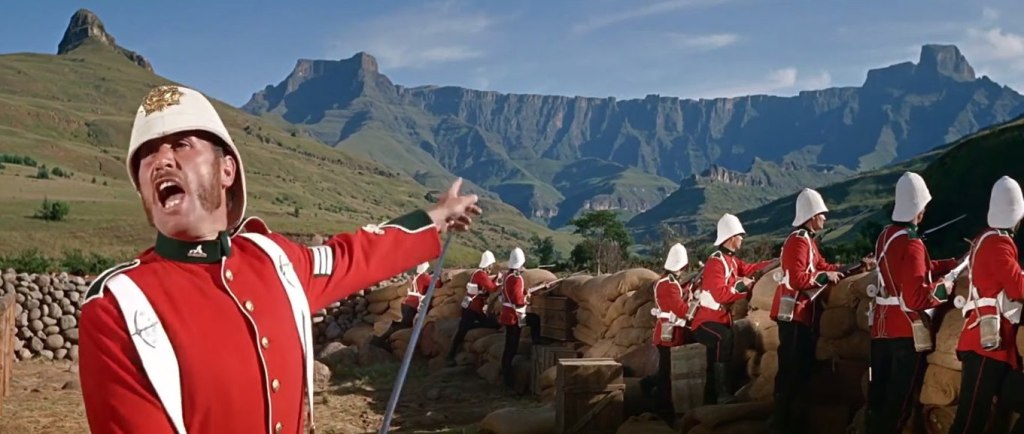
    Cy Endfield’s epic military marathon about the Battle of Rorke’s Drift was actually shot 90 miles south-west of Rorke’s Drift in the Royal Natal National Park in the KwaZulu Natal province of South Africa. It had the far more mountainous and picturesque Drakensberg Amphitheatre as backdrop, rather than the low hills like the Oscarberg at the real site of the battle.

    Below see the movie backdrop, the Drakensberg Amphitheatre (left) – and the real backdrop, the Oscarberg (right):
    2. Many of the Zulu extras had never seen a motion picture

    Many of the Zulus who were hired as extras for the film had never seen a motion picture prior to filming and were unsure what to expect. With this in mind, director Cy Endfield and Stanley Baker, who played Lieutenant John Chard, set up a projector in order for them to watch a western, starring Gene Autry. Then the Zulus probably said “Ah, so its all bulldust?” and acted accordingly. 

    3. The real Lieutenant Gonville Bromhead was extremely deaf…

    Played expertly by Michael Caine, this snobbish character was described by Lieutenant Henry Curling, who fought alongside Bromhead at Rorke’s Drift, as “a stupid old fellow, as deaf as a post.” Major Francis Clery, who spent time with Bromhead after Rorke’s Drift, described him as “a capital fellow at everything except soldiering”, while his commanding officer said in private that Bromhead was “hopeless.” Still, political face-saving at the time saw Bromhead awarded the Victoria Cross. 

    4. Michael Caine initially auditioned for the role of Private Henry Hook

    This was Michael Caine’s first major film role and, although he eventually put in an exceptional performance as Lieutenant Gonville Bromhead, he was crippled by nerves and beaten to the role he initially auditioned for, that of Private Henry Hook, by James Booth. Interestingly, Caine was also unable to ride a horse so a member of the filming crew took his place in the scene where he crosses the stream on horseback at the beginning of the film. This explains why the camera pans down on to the horse.

    5. Private Henry Hook was badly portrayed in the film

    In the film, Private Henry Hook (James Booth) is placed under arrest for insubordination. He is seen lounging around in the shade and trying to pilfer free booze as his comrades prepare for battle in the stifling heat. In reality, Private Hook was an exemplary soldier and teetotal, who was also awarded the Victoria Cross for his gallantry. Hook’s daughter walked out of the film’s premiere in disgust at this inaccurate portrayal.

    6. Eleven British soldiers were given a Victoria Cross; Twelve had been nominated

    Colour Sergeant Frank Bourne (played by Nigel Green in the film), requested a commission rather than the Victoria Cross. He was duly granted this wish and went on to become a Lieutenant Colonel. When he died in 1945, he was the last surviving British soldier from the battle.

    7. Mangosuthu Buthelezi played his great grandfather Zulu King Cetshwayo kaMpande in the movie

    Mangosuthu Buthelezi was the chieftain of the Buthelezi clan of the amaZulu when he played the role of Zulu King Cetshwayo kaMpande in 1964. Buthelezi went on to found the Inkatha Freedom Party and was the leader of the former KwaZulu bantustan. He has also held positions in the new, legitimate SA government and parliament. In fact, the Zulus “won back” the whole of the Zulu kingdom in South Africa’s first legitimate elections in 1994.

    Now Buthelezi himself has a very interesting grandchild! She sings.

    ~~oo0oo~~

    Thuk! Oh shit! Eina! – gosh;

    umLungus – paleface; speak with forked tongue; in Africa as well as America;

    ~~oo0oo~~

    I’ll add a link to the 8mm movie footage the old man took on the film set in the ‘berg as soon as I can. A new movie about the making of the film is in the offing and we have offered this seven minutes of behind-the-scenes footage to Henry Coleman the film-maker. As we have undertaken not to use the footage till after his premiere, we have forfeited a chance to repeat our 1963 scoop!! Darn!

    Here’s his trailer on Vimeo.

    2025: I have finally added our 8mm home movie, as Coleman’s movie seems to be stuck, and Baker is mumbling.

    And oops, it’s underwhelming!

    – my folks’ amateur clip on-set of the filming of Zulu in 1963 –

    ~~oo0oo~~

    2025 and no sign of Coleman’s movie yet. Recently I received a sort of “cease and desist” in this post’s comments from An Important Figure! See below:

    ~~oo0oo~~

    Please be on notice that Henry Coleman no longer has the permission of the family of Stanley Baker to produce his proposed documentary Zulu and the Zulus nor to use the 16mm behind the scenes film print he holds, which is the property of Diamond Films.

    ~~oo0oo~~

    Upon the downfall of his government the year after the great defeat at Isandlwana, and soon after the death of the Prince Imperial Louis-Napoleon, British Prime Minister Benjamin Disraeli asked In parliament – showing that he and his generals had not bothered to do their homework and learn about these African people – “Who are these Zulus? Who are these remarkable people who defeat our generals, convert our bishops and who on this day have put an end to a great dynasty?”.

  • Uh, Correction, Mrs Bedford!

    Uh, Correction, Mrs Bedford!

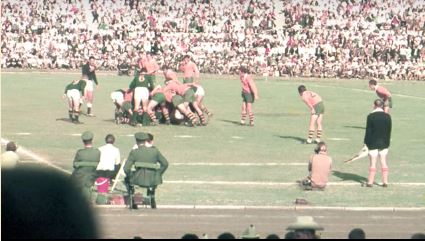
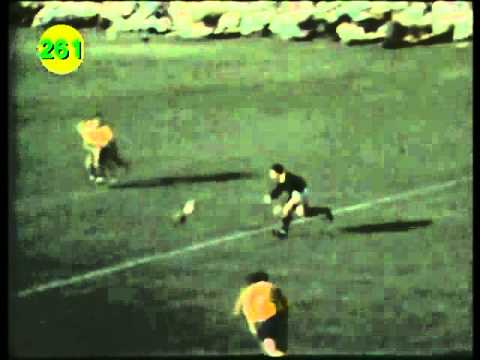
    In 1969 a bunch of us were taken to Durban to watch a rugby test match – Springboks against the Australian Wallabies. “Our” Tommy Bedford was captain of the ‘Boks. We didn’t know it, but it was to be one of his last games.

    Schoolboy “seats” were flat on your bum on the grass in front of the main stand at Kings Park. Looking around we spotted old Ella Bedford – “Mis Betfit” as her pupils called her – Harrismith’s English-as-second-language teacher. Also: Springbok captain’s Mom! Hence our feeling like special guests! She was up in the stands directly behind us. Sitting next to her was a really spunky blonde so we whistled and hooted and waved until she returned the wave.

    Tommy Bedford Springbok
    jane-bedford-portrait

    Back at school the next week ‘Mis Betfit’ told us how her daughter-in-law had turned to her and said: “Ooh look, those boys are waving at me!” And she replied (and some of you will hear her tone of voice in your mind’s ear): “No they’re not! They’re my boys. They’re waving at me!”

    We just smiled, thinking ‘So, Mis Betfit isn’t always right’. Here’s Jane. We did NOT mistake her for Mis Betfit.

    .

    “corrections of corrections of corrections”

    Mrs Bedford taught English to people not exactly enamoured of the language. Apparently anything you got wrong had to be fixed below your work under the heading “corrections”. Anything you got wrong in your corrections had to be fixed under the heading “corrections of corrections”. Mistakes in those would be “corrections of corrections of corrections”. And so on, ad infinitum! She never gave up. You WOULD get it all right eventually!

    Stop Press! Today I saw an actual bona-fide example of this! Schoolmate Gerda has kept this for nigh-on fifty years! (this is in 2020)

    – genuine rare Harrismith Africana ! – or is it Engels-cana? –

    ~~~oo0oo~~~

    Tommy’s last game for the Boks came in 1971 against the French – again in Durban.

    ~~~oo0oo~~~

    Two or three years later:

    In matric the 1972 rugby season started and I suddenly thought: ‘Why’m I playing rugby? I’m playing because people think I have to play rugby! I don’t.’

    So I didn’t.

    It caused a mild little stir, especially for ou Vis, mnr Alberts in the primary school. He came up from the laerskool specially to politely voice his dismay. Nee man, jy moet ons tweede Tommy Bedford wees! he protested. That was optimistic. I had played some good rugby when I shot up and became the tallest in the team, not because of any real talent for the game – as I went on to prove.

    ~~~oo0oo~~~

    ou Vis – nickname meaning old fish – dunno why

    Nee man, jy moet ons tweede Tommy Bedford wees! – Don’t give up rugby. You should become our ‘second Tommy Bedford’ – Not.

    ~~oo0oo~~~

    Meantime Jane Bedford has become famous in her own right in the African art world, and in olde Durban colonial circles. Sister Sheila and Jane have become good friends.

    ~~oo0oo~~

    Two more pupils who remember Miss Betfit with, um, fondness are Etienne and Leon

    Leon:

    Out of the blue Miss Bedford would streak down one of the isles with astounding acceleration, grab an inattentive victim’s arm and bang his/her elbow mercilessly on the well marked desk. It used to be bloody sore, especially if you were inattentive often…

    Or, if you dared to fish a crib note out of your case while she was on about something, she would storm down the isle, grab your boeksak and scatter the contents gleefully all over the length of the isle ― the rest of the class never failed to find it absolutely hilarious. And the contents of your partitioned fake leather case could be embarrassing on occasion.

    On one occasion she flew down our isle red with indignation. I sat immobilised with trepidation (this doesn’t sound right) *ed: do some corrections* as she came right towards me. I was daydreaming, so I clutched my elbows as tight as I could… but this time my elbow was spared ― it was Gabba on the other side of the isle who was caught fiddling in his case. She viciously shook his case as she walked back. Books, blikkie, pencils, notes, everything scattered indecently all over the place. Much funnier than usual (hey it was Gabba FGS, the longstanding Eastern Free State rugby captain) I roared with laughter and relief.

    Five minutes later the bell rang, I dived down to stuff a prescribed book into my case, but no case. I looked up in bewilderment, to see Gabba walking off with his unaffected case and that evil half-moon grin.

    Etienne:

    I only had trouble with Missus Bedford right at the beginning of standard six when I saw that it was serious that you’d come back at three. I went back at three once and then made a conscious decision not to mess around with the English teacher & she never terrified me after that. In fact she was my favourite teacher in complete contrast to Eben Louw who really gunned for me. He & my old man had political issues.

    Seeing the pic of her brought a tear to my eye & I remembered Fran Hurter as well. I went to see Fran Hurter in her Riversdale old age home before she passed on.

    Yep I’m too nostalgic at this ripe age, Cheers & tears, Etienne

    ~~oo0oo~~

    Leon again:

    you were wise beyond your years regarding Ella Bedford. I spent half my flippen school-life doing corrections in the afternoons.

    Still, I agree, she had a much bigger influence than most teachers. Definitely not academically though, I still cannot speak the lingo (isles versus aisles), but in life skills, I think.

    Work-ethic (surely more could have rubbed off), never giving up on the Moore-cousins, but especially never getting personal. The latter really got me.

  • Uncle Boet in Malmesbury

    Uncle Boet in Malmesbury

    * random oldie reposted * updated *

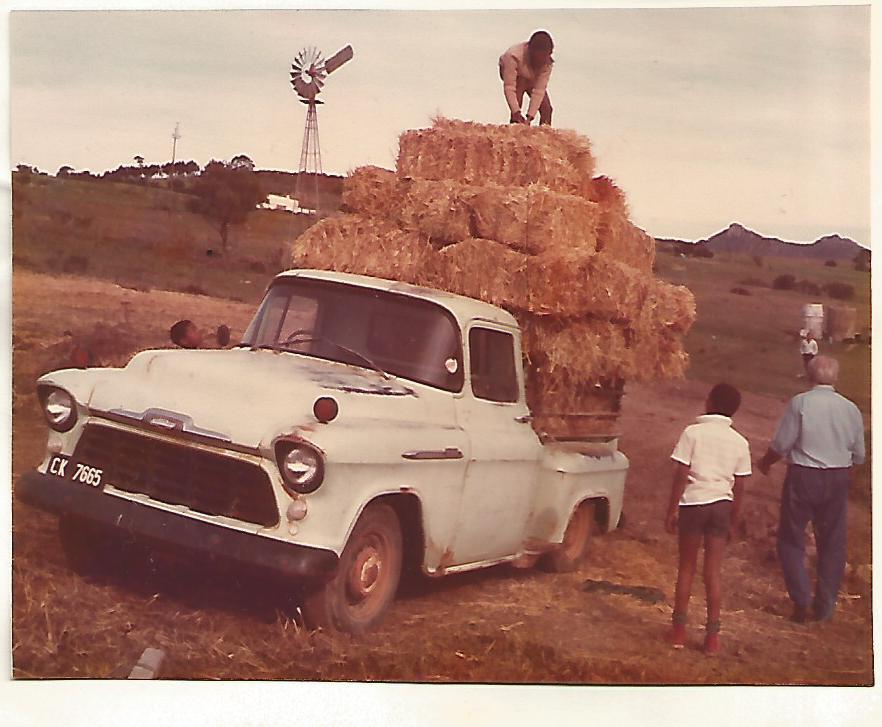
    1983 Uncle Boet's truck 20004After the 1983 Berg River Canoe Marathon ended in Velddrif, we stopped in at Boet & Anna Swanepoel’s smallholding outside Malmesbury, about 50km north of Cape Town. Boet was Dad’s older brother. Mom and Sheila had seconded me on the race, driving my Cortina to each of the three overnight stops.

    I’d forgotten this visit, remembering only an earlier 1977 visit with Larry Wingert, but Sheila had pictures! And there I am, sticking up above Uncle Boet’s head, watching the activity from a safe distance, hands in pockets. Probably too tired and cold to help after the four-day freeze I had just endured? Or lazy? I do know my hands would not have appreciated hoisting hay bales after 240km of holding a wet paddle!

    We won’t mention child labour, nor overloading, nor our way of saying “I loaded the Chev with hay” rather than “I had the Chev loaded with hay”, OK?

    =======ooo000ooo=======

    The bakkie: My research suggests this was a 1955 Chev 3200 ‘Task Force’ 3/4 tonner.  Probly with a bit more than that onboard!


  • Cosmos Niks

    Cosmos Niks

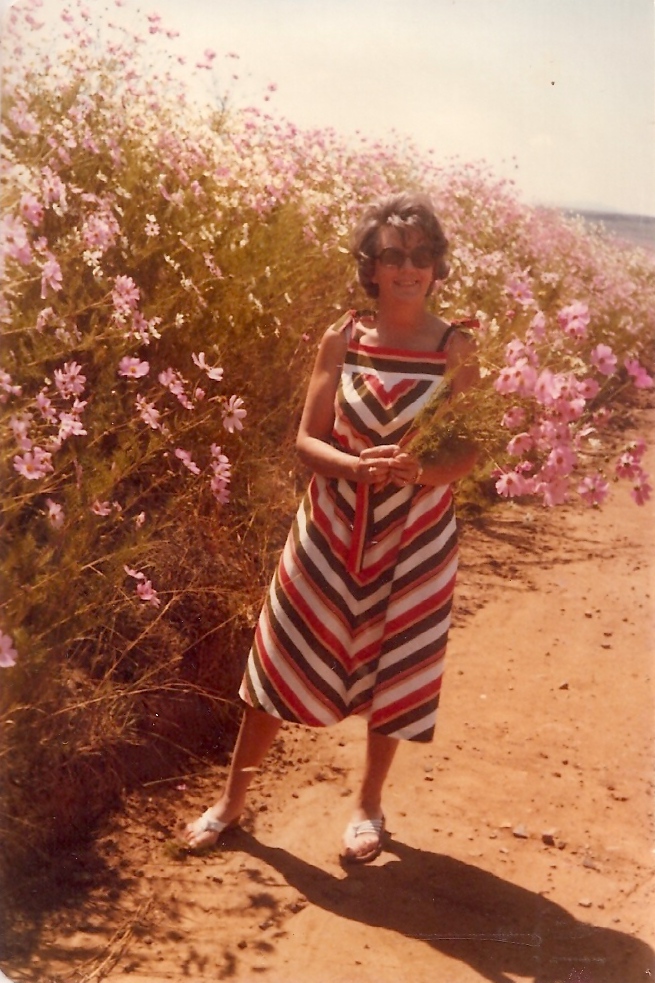
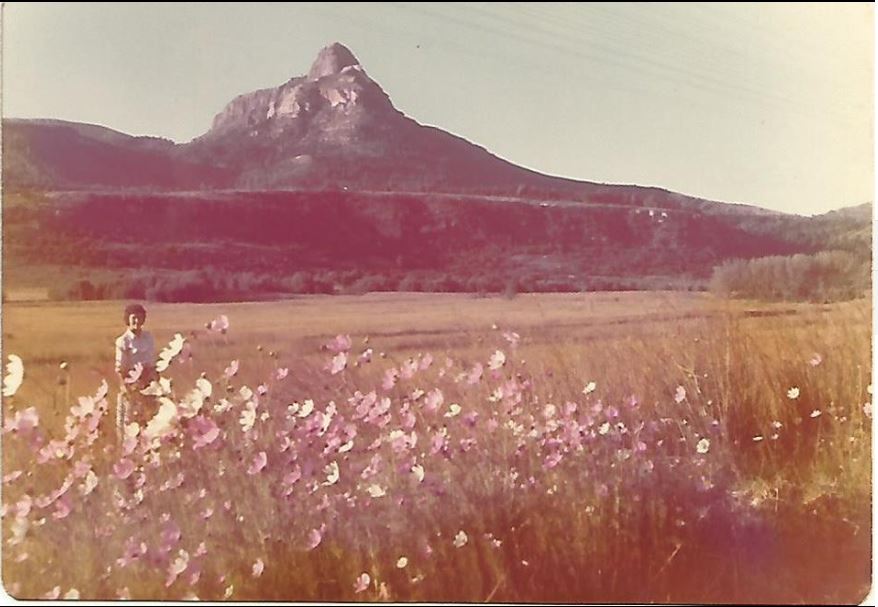
    Mom Mary in the cosmos outside Witsieshoek back ca. 1970:

    Mary Cosmos Witsieshoek2.jpg

    Sheila years later at the foot of the eastern tip of Platberg – some call it Bobbejaankop:

    Sheila cosmos Platberg.JPG

    Sheila sent a 2018 pic of Brenda Sharratt in the cosmos behind Platberg:

    Brenda_Sharratt_cosmos_Platberg[1].jpg

    Apparently cosmos got here in horsefeed imported from Argentina during the Boer War for the Poms’ horses. Hopefully only the seed, as the greenery must have tasted foul! It has a pungent smell.

    ~~oo0oo~~

    wikipedia: Cosmos is native to scrub and meadowland in Mexico where most of the species occur, as well as the USA, Central America and South America as far south as Paraguay. One mainly Mexican species, Cosmos bipinnatus, is naturalized and widespread over the high eastern plains of South Africa. It has also spread to the West Indies, Italy, Australia and Asia.

    ~~oo0oo~~

    cosmos niks – free! literally ‘costs nothing, right?’

    Cosmos
    – pic from Getaway mag –

  • Strictly Come Langarm

    Strictly Come Langarm

    We had a few gatherings in the long, wide and high Gailian lounge / dining room / bar with the smooth parquet floor. For a while this lounge was shenanigan-central for the Harrismith Jet Set. While the Stella cats were away the lightly inebriated mice came out to play.

    Luckily Hec & Stella Fyvie would regularly gallivant off to Kruger Park and other places in their yellow and white kombi. ‘Don’t worry,’ Tabs would say, ‘We’ll look after the place; Enjoy yourselves.’

    I would nod.

    One such evening* is engraved in the memory bank. ‘Twas a dark and starlit night after we had sat all afternoon seeing to it that the sun set properly, and fine-chooning ourselves to a well-honed pitch, like a master-crafted musical instrument. A lute, perhaps. A flute, perhaps. By carefully choosing our poison by percentage alcohol multiplied by millilitres consumed we had manipulated our PE Factor** to a wonderfully advanced state where we were erudite, witty, charming, sparkling company – and wonderful dancers.

    Especially wonderful dancers.

    The theme for the evening was high-speed langarm, and we whizzed around the lounge to loud classical waltzes at ever-increasing speeds on that slick polished parquet wooden floor till centrifugal force spun us out onto the veranda, onto the lawn and across it to the swimming hole in the dark, thutty metres away; back over the lawn and round the dance floor again. To tremendous applause. I personally did a few laps with Lettuce Leaf which were wondrous in nature. Strauss would have been proud of his waltz that night. Jet-fuelled ballroom dancing par excellence.

    – an actual daguerrotype taken that evening – me and lettuce leaf are second from left –

    Some people didn’t get the langarm memo though, and arrived in punk outfits. No names, no packdrill, but Des had a safety pin through his earlobe and Timothy Leary one through his foreskin and these two pins were joined in holy matrimony by a chain. Never before have two ballroom dancers been so synchronised, Des leading and Tim not daring not to follow. After that performance they even named a band N Sync.

    Before the sun rose there was snoring and long after the sun rose there was still snoring and that is how Aunt Stella found us when she returned unexpectedly to find Des and other bodies in her double bed. On seeing his Aunt Stell, Des spun onto his tummy, burying his face into the pillow. Des has always believed if you hide your head in the sand maybe the problem will go away.

    But this time he shouldn’t have: Written in bright red lipstick on his back was “FUCK! PUNK! PUNK!!”

    ~~~oo0oo~~~

    *This tale might be an amalgam of a few blurry evenings, skilfully blended and spiked;

    **PE Factor – Personality Enhancement Factor; Found to various degrees in all bottles of hooch;

    langarm – two or more perpetrators remain attached by various body parts and run around more or less in time to music they normally would not listen to, while pumping the outermost arms up and down; unlikely to work sober.

    ~~~oo0oo~~~

    This critical observer might have been watching us at Gailian that night, although he was actually talking about the 1815 season in Brussels:

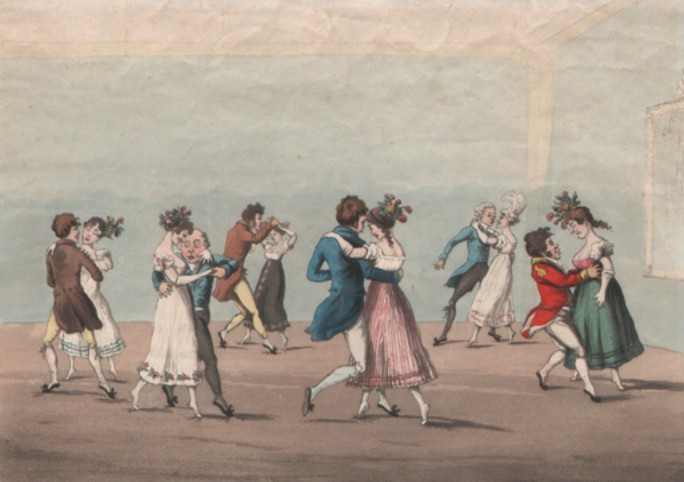
    Whenever they get together the severest etiquette is present. The women on entering always salute on each side of the cheek; they then set down as stiff as waxworks. They begin a ball with a perfect froideur, then they go on with their dangerous ‘waltz’ (in which all the Englishwomen join!) and finish with the gallopade, * a completely indecent and violent romp. – Rev. George Griffin Stonestreet

    • Gallopade: A lively French country dance of the nineteenth century, a forerunner of the polka, combining a glissade with a chassé on alternate feet, usually in a fast 2/4 time. Sounds about right, huh? I think that’s what we were doing. Indecent and violent romps bedondered.

    ~~~oo0oo~~~

    Recently Des went viral – no, no, in a good way. Thanks to great backing from sister Val, he put what he learnt at Gailian to good use. Roomerazzit he got extra points for his broek and his dancing shoes:

    Des & Val Strictly Come Dancing Shoes

    ~~~oo0oo~~~

    bedonderd – exceedingly

    broek – ballroom trousers

  • Round The Bend

    Round The Bend

    Mandy’s reply on the 21st post reminded me of The Bend – that sacred pilgrimage site we would repair to as part of growing up and learning wisdom and wonder. Also drinking, puking and dancing. Especially drinking. It was like Mecca.

    We searched the whole of Joburg all term long for girls and women and couldn’t find any, but on The Bend there was always a goodly gang of inebriated bright young future leaders and fine examples to our youth, dancing, hosing themselves and matching us drink-for-drink.

    Some of the drinking was very formal, with strict protocol, enforced by some kop-toe okes who had already been to the weermag and wanted to show us lightweight long-hairs what DUSSIPLIN was all about. Louis was very disciplined under General Field Marshall Reitz as was I under Brigadier Field Marshall Stanley-Clarke:

    Late at night important stuff would happen. This time it was inventory control. It became vitally urgent that we help Kai clean out old Dr Reitz’s expired medicines. Mainly by swallowing them. The muscle relaxants caused great hilarity as we pondered what effect they might have on our sphincters. Yussis you’d think with a resident pharmacist we’d be told the possible side-effects, but all we were told – or all we listened to – was “Fire it, Mole!” and down they went, chased by alcohol to enhance the effects. Highly irre-me-sponsible, but all done for research purposes.

    The Bend Old Drugs

    • Dr Prof Stephen Charles dispenses –

    The research was inconclusive. We fell asleep before any fireworks happened.

    In those days we all shared one cellphone, which you didn’t have to carry in your pocket. It was already there when you got there, nailed to the wall so it couldn’t get lost and so everyone could overhear what you were saying. There it is:

    Bloody bottle shrunk!

    • I forget what this was, but it was important and Stephen Charles was giving it his rapt attention –

    Sometimes farming interfered with the serious part of the weekend and then we would be of great help to Kai. We’re taking his mielies to market here. Don’t know what he would have done without us. Airbags and seatbelts were not highly essential in those daze, as we were usually well internally fortified, and as our driver had his foot flat we knew we’d get there quickly. So it was alright.

    Taking mielies to the koperasie silo. No airbags.

    • Taking mielies to the koperasie silo. No airbags –

    Back: Me; Kevin Stanley-Clarke (now a Kiwi); Glen Barker (now an Oz). Front: Pierre du Plessis; Steve Reed (a Kiwi in Oz); Lettuce Wood-Marshall (a Chinese or an Oz?); Dave Simpson;

    glossary:

    kop-toe okes – taking themselves seriously; which made them more hilarious

    weermag – ‘again might’, as in ‘we might have to go there again’; involuntarily

    mielies – maize, corn; sometimes schlongs

    schlong – your mielie

    koperasie – co-operative: socialist gathering of capitalist farmers

    In JHB, a mate swears he heard me giving directions to the farm. I’m sure he’s mistaken, but Trevor John says: Swannie, I will never forget your directions to a farm in Harrysmith – 2 quarts of beer to the right turnoff; one pint to the next turnoff; and a small shot for the next left to the gate .

  • 21st on Kenroy

    21st on Kenroy

    Sheila saw to it I had a party! As so often, Sheila saved the day. Back in 1976 before there were rules and the rinderpest was still contagious.

    Des Glutz threw open his palatial bachelor home, Kenroy, on the banks of the mighty Vulgar River to an invasion of students from Johannesburg and Pietermaritzburg. That’s because as a lonely horny bachelor Free State farmer he had his eye on some of those student teachers from Teachers Training College in PMB!

    “Kindness of his heart” you thought? Ha! You know nothing about horny bachelor Free State farmers! Anyway, he owed me for managing his farm brilliantly when he went to Zimbabwe. Probly doubled his profit that year.

    Sheila invited everybody – and everybody arrived!

    Eskom had not yet bedeviled Kenroy, so paraffin lamps, gaslamps and candles gave light. So you didnt flick a light switch, hoping it would work, no. You lit a lamp knowing it would work cos Gilbert will have reliably topped up the paraffin. Des might have done that, you thought!? Ha! You know nothing about lonely horny freestate farmers with butlers. Music pomped out from car batteries. There was singing and much laughter. Except when Noreen, Jo and Ski danced their Broadway routine The Gaslamp Revue with Redge Jelliman holding the silver tray footlight staring in open-mouthed wonder at their skill. And of course, their legsnboobs – another lonely horny bachelor Free State farmer, y’know. Awe-struck silence reigned. For minutes.

    21st Kenroy_party_22
    – Noreen and Jo in the Gaslamp Revue, using available props –
    – Reg dreaming bachelor harem dreams – Noreen Mandy Jill Liz –

    There was also Liz and Mops and Jenny, Georgie, Mandy, Gill and Jill; Hell, we bachelors were in awe at almost being outnumbered – a rare event. We were so excited we got pissed and fell down. Timothy Paget Venning got so excited he walked all the way round the house smashing Des’ window panes to let in the night.

    Poor ole Gilbert, Des’ personal butler, valet and chef – seen here in purple – and his men bore the brunt of the extra work!

    He cooked and cooked, including a big leg of lamb which didn’t make the main table, getting scoffed on the quiet by ravenous would-be teachers under the kitchen table. Pity the poor kids who would have to grow up being taught all the wrong things by this lot in Natal in the eighties.

    21st Kenroy_party_10
    – Sir Reginald dreaming he has died and gone to heaven – with Noreen, Mops, Mandy, Jill and Liz –

    These would-be teachers and pillars of society were wild n topless:

    Koos' 21st.jpg_cr
    – if the bachelors had been there, we’d have politely averted our eyes. Right!! –

    Tabbo wore his tie so he could make a speech into his beer can microphone:

    Koos' 21st Tabs Koos

    Funny how Glutz doesn’t feature in any pics! Where was he? We know he wasn’t in his bedroom cos the TC girls raided it and were in awe at the impressive collection of bedroom toys and exotic rubber and latex items in his bedside drawer. No stopping those TC girls!

    Ah! Here’s Glutz – Sheila and Liz presenting Des a thank-you gift for hooligan-hosting:

    The morning after dawned bright. Too bright for some . . .

    21st Kenroy_sunrise

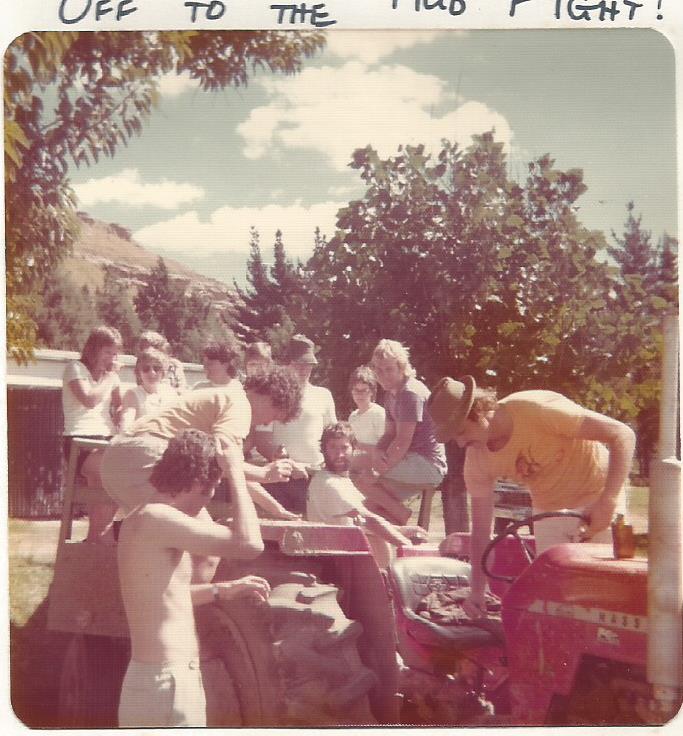
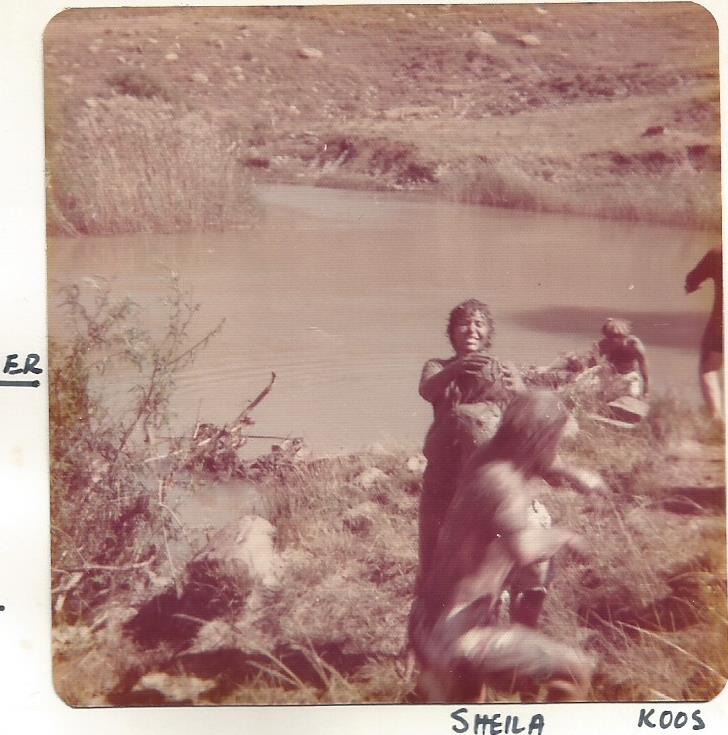
    A mudfight! said some bright spark – Sheila, no doubt – so Des arranged transport to the mighty Vulgar river.

    21st Kenroy_Wilger river_2
    – fasten seatbelts while I check the airbags, says Farmer Glutz, Kenroy’s Safety Orifice – Occifer – Officer – Simpson scratches his head –

    After the weekend I roared back to Jo’burg in my brand-new 1965 two-shades-of-grey-and-grey Opel Rekord Concorde deluxe sedan, four-door, grey bench-seated, 1700cc straight-four, three-on-the column, chick-magnet automobile. My first car! Watch out Doornfontein!

    koos-opel-1976
    – 21st birthday present! A 1965 Opel Concorde DeLuxe 1700 in sophisticated tones of grey and grey. Note my reflection in the gleaming bonnet! –

    Thanks Mom & Dad! And thanks for the party, Sheils and Des! Before we left, Mom tickled the ivories while the TC gang belted out some songs:

    ~~oo0oo~~

    The old man organised the numberplate OHS 5678 for me. The man at the Harrismith licencing office said “Oom, are you sure you want an easy-to-remember number for your son? Don’t you want one that’s hard to remember?”

    ~~oo0oo~~

  • Harrismith’s Mountain Goat

    Harrismith’s Mountain Goat

    The people of Harrismith dubbed Michael McDermott ‘The Mountain Goat’. The mountain being Platberg.

    Or so running e-zine ‘Modern Athlete’ says of SIXTEEN-times winner of our Mountain Race. Apparently we used to write supportive messages for him along the route of the Harrismith Mountain Race, much like supporters do in the Tour De France. Race organisers would set him up in our local hotel with the room number that corresponded with the win he was going for. Michael became a hugely popular and inspirational figure thanks to his sixteen-consecutive-year winning streak in our rugged annual race.

    They go on: Michael’s love affair with Harrismith’s imposing Platberg began in 1978, when he was just 13. “I was alone at home and ran 5km to the Harrismith Harriers clubhouse because I wanted to run that day, but no-one was there, so I ran back home. Then they called me up to ask where I was and came to fetch me. So before the race, I already run 10km,” says Michael, who ran the race and finished 32nd. “Nobody believed I had completed the race, though, because I was so small!” he laughs.

    In 1980, he finished eighth and qualified for a gold medal, but had to receive it unofficially, behind the tent, as he was still below the minimum 16-year age limit for the race. A year later and now ‘legal,’ he finished fifth, and then in 1982 he posted the first of his sixteen consecutive wins, an amazing record putting him right up there in the crazy stakes with uber-talented athletes Michael McLeod of England (won the Saltwell 10km sixteen years in a row), and Jim Pearson of America (won the Birch Bay marathon sixteen times).

    Michael held the record for the short 12.3km course at 50mins 30secs in 1985 and the long 15km course at 1hr 05mins 05secs as the first winner over the new distance in 1996. It came to an end when he ‘stepped skew’ and tore ligaments in his ankle while well in the lead on his way to a 17th straight win in 1998. Michael Miya took over and won the race in a new record time of 1hr 04mins 06secs and became the first black South African winner. While McDermott was really disappointed, it was also “a relief as there wasn’t that pressure to win after that.”

    SPRINGBOK

    Michael earned Springbok colours in 1988 for cross-country, and was invited to run a number of international mountain running events in the early 1990s. He won the Swiss Alpine Marathon three times, shattering the course record in 1993. He also represented South Africa seven times in the World Mountain Trophy, from 1993 to 1999, with a best placing of fifth in 1993 in France. http://www.modernathlete.co.za

    Also see *my potted history of the race*


    This post opened a flood of ancient memories!

    Thanks Koos – very interesting.

    In “our day” Johnny Halberstadt was the King – wonder where he is today? (Koos: In America: Just sold his sports shop in Colorado).

    I strolled the race two or three times in the 1990s – never finished in the allotted time, but always walked away with a medal, ’cause I knew Jacqui Wessels (du Toit) who handed out the medals!

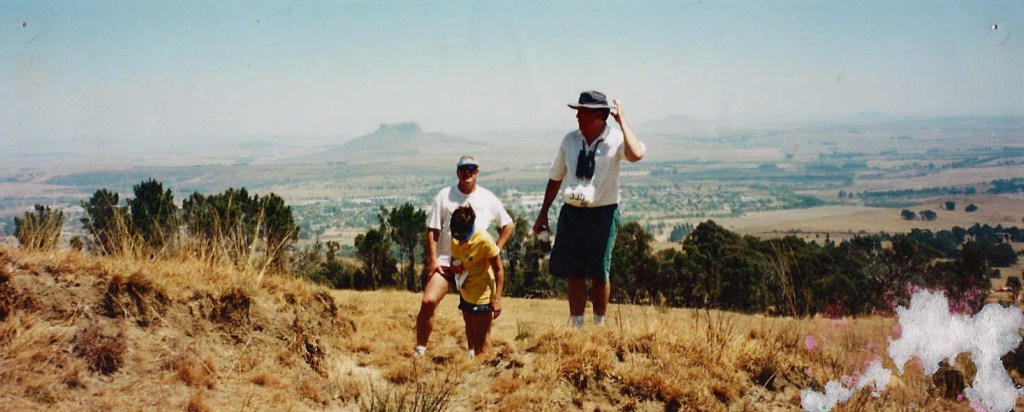
    Remember the year we did it after “peaking” at Pierre’s home the night before – about 3am. You remarked as you crossed the Start Line (not the Finishing Line) – “I think I’m under-trained”. The hangovers were monumental. As we strolled past the adoring, cheering spectators, one guy was heard to remark “Daai mal ou het sy verkyker om sy nek!” That was you! (Koos: Actually, it was Wimpie Lombard and he said “wadafokmaakjymedarieverkykers?” You’ve forgotten: Afrikaans is always one word).

    The year Karin Goss and I did it, (circa 1998) we were so last that even the Coke truck had packed up and left by the time we strolled into Die Groen Paviljoen! We were so busy ‘phoning the whole world from the summit that we forgot to be competitive. Jacqui insisted on giving us medals, but drew the line at Gold – we had to be content with Bronze. Don’t know why she was so strict – there were a few Golds lying in the bottom of the box.

    Was Alet de Witt the first lady to compete?

    Love – stroller Sheila Swanepoel

    ———————————————————————————————————————–

    Jacquie replied: Sheila, I think you forgot that when we allowed you to go through the finish banner after cut-off time, there was a breathalyser test for the finishers. This you seemed to have forgotten! Legal limits are 0,24 milligrams per 1000 millilitres. Finishers (at sunset) with this reading all get GOLD.

    Unfortunately your readings were 0.60 . . . hence the Bronze medal. 😉

    All the best (hope you enter the Mountain Race again this Year).

    Kind Regards – actual finisher Jacquie Du Toit, ex-Mountain Race high-up official

    ——————————————————————————————————————-

    Kar Goss got excited: Hey Sheils
     
    I think we must do it once more!! Seriously!
     
    What comes after bronze?? And is there a medi-vac chopper available?
     
    Thanks for the interesting article Koos!
     
    Happy Women’s Day everyone.
     
    Love- (Sheila-like stroller) Kar Goss xx
    —————————————————————————————————-

    JP de Witt reminisced: Sheila, As far I can remember my Mom Alet and Mavis Hutchison did the race around 1969 / 1970. Koos Keyser won it five times 1964-68. Wally Hayward (five-times Comrades winner) won in 1952.

    actual finisher JP de Witt

    ————————————————————————————–

    Pikkie Loots committed: Sheila, For what it’s worth – I’m seriously considering doing it this year… if anyone wants to join me, perhaps we can motivate each other 🙂 **(Hushed silence from the sundry assorted 60-somethings – *sound of crickets*)**

    And yes, there is a ‘medi-vac’ chopper 🙂 I was running the race in about 1985-ish, when a runner from Welkom dislodged a rock on One-Man’s Pass. The rock fell onto his thigh, cutting and damaging the muscle. Tony Perry, a fellow runner from Newcastle, and I were immediately behind and below the unfortunate gent. With the help of two of his team mates we carried him to the top. Another of his team mates went ahead to tell Doc Mike van Niekerk that we needed a casualty to be taken off the mountain. By the time we got to the top, both Mike and the chopper were ready….

    Tony and I missed out on our silver medals by about 10 minutes (silver time was 1 hour 40 minutes). I moved to Cape Town and never ran another mountain race! So I still only have a bronze. [PS! Mike asked the committee to award Tony and I silver medals, but they must have had a shortage that year 🙂 ]

    Footnote: Michael McDermott was at school when he joined our running club in Newcastle, in about 1979… there were a few ‘windhonde’ in the club at the time, but pretty soon he was chasing and beating most of them on the shorter runs. There were a few Harrismitters I saw regularly at races: Pieter Oosthuyzen and Koos Rautenbach, I especially remember, as I often chatted to them at races.

    Has anyone from Harrismith ever won this besides Volschenk? and btw, I thought it was Koos Keyser who was the big hero winner of our school days? (Koos Swanepoel – not Keyser: True that. Koos Keyser won five times in a row).

    PS: Note I said ‘doing’ the mountain race… no commitment to running it at this stage, but that may change on the day 🙂

    Love to you all – actual finisher Pikkie Loots

    —————————————————-

    Pikkie, you must shine up! The year I strolled it with Sheila, Pierre and Ilse we got silver medals. OK, to be fully honest we gave those back to Jacquie and settled for (unearned) bronzes, but we DID briefly hold silver. So shine up, mate. Try harder.

    Koos

    (and just for the record, I do have four legitimate finishes from pre-rinderpest days – once, I got a medal with a handy bottle opener attached). I ran without binoculars in those days.

    HS Mtn Race badges, medal

    ~~~oo0oo~~~

  • Martha and My Man Friday

    Martha and My Man Friday

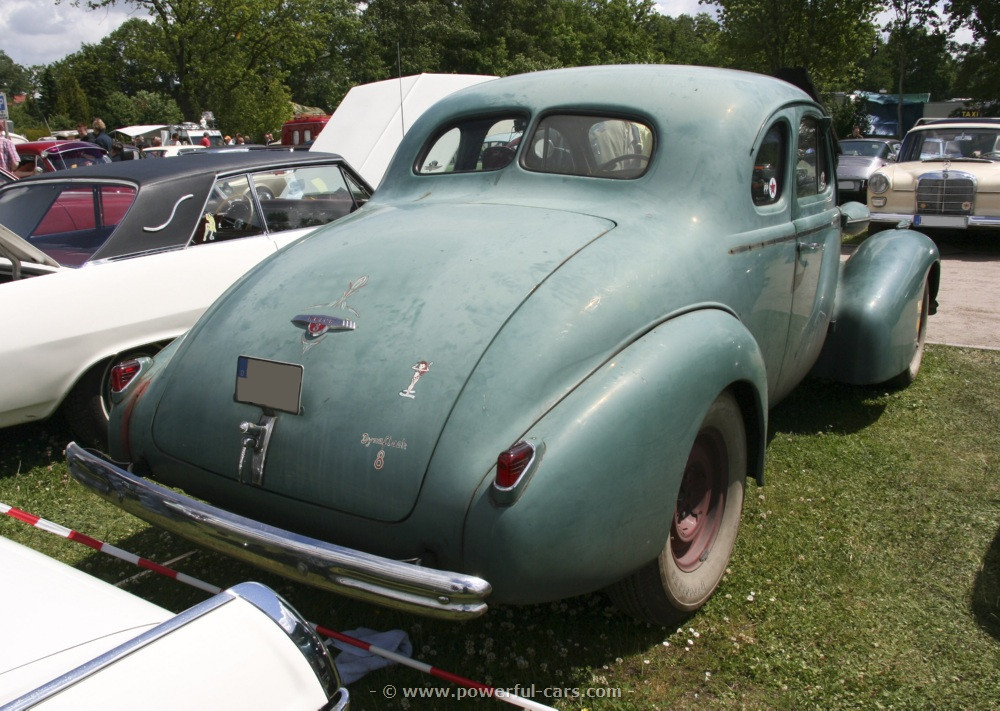
    This beautiful 1938 Buick Coupe was a regular sight on the streets of Harrismith back in the Sixties.

    Martha McDonald and her friend Carrie Friday used to cruise the streets going nowhere. Mom Mary called them Martha and My Man Friday after Robinson Crusoe. She says Roy Cartwright coined the nickname. Roy ran the Tattersalls horse racing gambling joint in town and was full of wit.

    Years later Sheila found out that Pietermaritzburg car enthusiast and restorer Ty Terblanche had found it, bought it and restored it to its former glory. Well done Ty! What a beaut!

    1938 Buick coupe2
    – here’s the actual Buick we frew wif a stone decades ago! Martha and My Man Friday cruised around the metropolis of Harrismith ca. 1960’s –

    With childish logic and mischief we’d occasionally throw it wif a stone (as we’d mockingly say). Always missed, mind you.

    The redoubtable Martha McDonald, asked one day if she had any children replied in the negative, adding loftily “My husband is too much of a gentleman.”

    ~~~oo0oo~~~

    Here’s a better angle to showcase those beautiful lines:

    Buick 1938

    From the front it’s much like other cars of its era, but from the side and half-back you can see why it gets so many oohs and aahs!

    Buick sports coupe 66s 1938

    edit March 2019: I read in ‘Blafboom’, Leon Strachan’s first book about Harrismith, that Martha had actually bought this gorgeous 1938 Buick Century Sports Coupe 66S from Nic Wessels; and that she lived in Murray Street.

    for images, my thanks to conceptcarz.com and powerful-cars.com

    ~~~oo0oo~~~

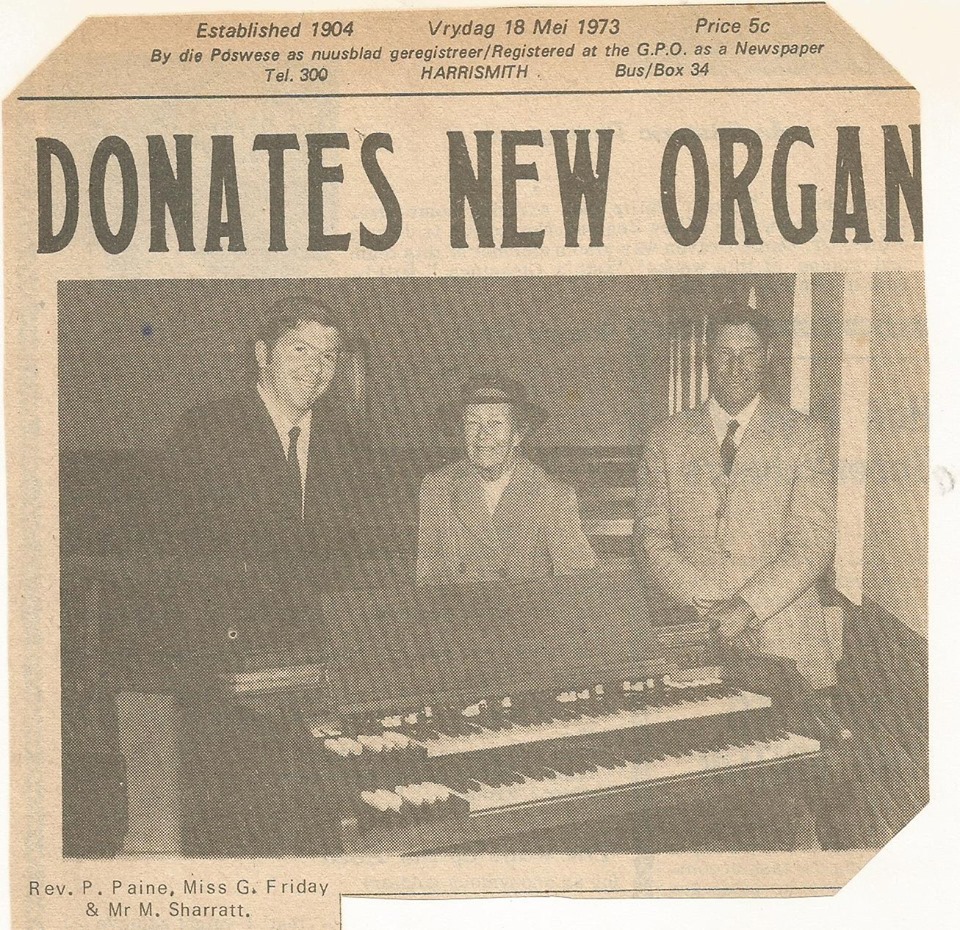
    Later, Carrie Friday became an organ donor:

    – the Methodists get a new organ for Mary Methodist to thump out her hymns on –

    This year when Mom Mary put on a pirates eye patch to play the piano as she sometimes gets double vision ‘and I can’t play if there are two keyboards,’ I reminded her ‘But you used to play a double keyboard, Mom!’ She couldn’t remember that, so I must show her this picture of the My Man Friday organ.

    – Sheila video’d Mom wearing a pirate patch –

    ~~~oo0oo~~~

  • Berg River Freeze

    Berg River Freeze

    “Please tell him not to. He’ll never make it.”

    That’s what Jacques de Rauville told my business partner when he heard I was going to do the 1983 Berg River Canoe Marathon. He had come across me one evening on the Bay and I’d asked which way to go, it being my first time out there and the lights and the reflections were confusing. “Follow me” said Jacques, and off he went, but within 50m I was 49m behind him. He waited and told me “Left at the third green buoy” or whatever he said. When he passed me again on his way back and I obviously hadn’t made enough headway, he thought whatever he thought that made him tell his optometrist Mike Lello: “Tell Pete Swanie not to attempt the Berg.”

    Jacques was probably right, but he was a bit of a fusspot as far as preparations go. I thought. Luckily for me friend and all-round good bugger Chris Logan was also dubious about my fitness, so he took me for a marathon training session on the ‘Toti lagoon one day which got my mind around sitting on a hard seat for hours on end, numbing both my bum and my brain.

    Chris was a great taskmaster. We stopped only once – for lunch (chocolate and a coke, it was early Noakes, not Banting Noakes. Also, according to Noakes, It’s not your muscles that limit you; it’s your brain. See, Noakes said my muscles were fine). So Chris selflessly sacrificed a day of his training intensity to stay with and encourage this TapTap Makathini mud-paddler. Before Chris, my training method entailed using the first half of a race for training, then hanging on grimly for the second half, going slower and slower till the finish. Between races, I would focus on recovery, mainly using the tried-and-tested cold beer and couch methodology.

    We set off for Cape Town in my white 2,0l GL Cortina, me and Bernie Garcin the paddlers and sister Sheila and mom Mary to drive the car while we paddled. I was feeling invincible from my full day of training.

    The night before the first day of the race in Paarl, the race organisers pointed out a shed where we could sleep. Cold hard concrete floor. Winter in the Cape. Luckily I had been warned and had brought along a brand-new inflatable mattress and an electric tyre pump that plugged into my white 2,0l Cortina GL’s cigarette lighter socket. So I plugged in and went for a few beers.

    *BANG* I heard in the background as we stood around talking shit and comparing paddling styles and training methods. I wondered vaguely what that was. The bang, as well as ‘training methods.’ A few more beers later we retired to sleep and I thought, “So that’s what that bang was” – a huge rip in my now-useless brand-new no-longer-inflatable mattress, and the little pump still purring and pumping air uselessly into the atmosphere. So I slept on the concrete, good practice for a chill that was going to enter my bones and then my marrow over the next four days.

    The first day was long, cold, windy and miserable, but the second day on the ’83 Berg made it seem like a balmy breeze. That second day was one of the longest days of my life! As the vrou cries it was the shortest day – those Cape nutters call 49km of ice a short day – but a howling gale and horizontal freezing rain driving right into your teeth made it last forever. Icy waves continuously sloshing over the cockpit rim onto your splashcover. It was the day Gerrie died – Gerrie Rossouw, the first paddler ever to drown on an official race day. I saw him, right near the back of the field where I was and looking even colder than me. He wasn’t wearing a life jacket. It wasn’t macho to wear a life jacket and I admit that I wore my T-shirt over mine to make it less conspicuous and I told myself I was wearing it mainly as a windbreaker. Fools that we were. Kids: Never paddle without a life jacket.

    Later in amongst a grove of flooded trees I saw Gerrie’s boat nose-down with the rudder waving in the wind, caught in the underwater branches, and I wondered where he was, as both banks were far away and not easy to reach being tree-lined and the trees underwater. Very worrying, but no way I could do anything heroic in that freezing strong current. I needed to stay afloat, so I paddled on to hear that night that he was missing. His body was only found two days later.

    Mom and Sheila second us in the mud

    That night a bunch of paddlers pulled out. Fuck this, they said with infinite good sense. Standing in the rain with water pouring down his impressive moustache my mate Greg Jamfomf Bennett made a pact with the elements: He would paddle the next day IF – and only if – the day dawned bright, sunny and windless. He was actually saying Fuck this I’m going home to Durban where ‘winter’ is just an amusing joke, not a serious thing like it is here. He and Allie were then rescued and taken out of the rain to a farmer’s luxury home where about six of them were each given their own room and bathroom! Bloody unfair luxury! This then gave them an advantage and allowed them to narrowly beat me in the race! By just a few hours. Per day.

    1983 Berg Canoe (1)
    – me and my lady benefactor –

    After devouring a whole chicken each, washed down with KWV wine and sherry supplied by the sponsors, us poor nogschleppers climbed up into the loft on the riverbank and slept on the hard floor. Here I have to confess Greyling Viljoen also slept in the loft and he won the race – which weakens my tale of hardship somewhat.

    We braced ourselves for the third – and longest – day . . . which turned into the easiest day as the wind had died and the sun shone brightly on us. ‘The clouds dissolved and the sky turned blue’ – thanks to Jamfomf’s arrangement with the weather gods I spose? So the long day became a really pleasant day which seemed half as long under blue skies – even though it was 70km compared to that LO-ONG 49km second day.

    Before the start Capies were seen writhing on the ground, gasping, unable to breathe. They usually breathe by simply facing into the wind and don’t have diaphragm muscles. So a windless day is an unknown phenomenon to those weirdos. At the start, about ten Kingfisher paddlers bunched together in our black T-shirts: Allie Peter, Jacques de Rauville, Herve de Rauville, Bernie Garcin, Dave Gillmer, who else? Greg Bennett was also there, to his own amazement. I hopped on to their wave and within 50m I was 49m behind. I watched the flock of black T-shirts disappear into the distance. I was used to that. Anyway, I have my own race tactics.

    By the fourth day I was getting fit. I was building up a head of steam and could have become a threat to the leaders. Or at least to the black T-shirt armada. I could now paddle for quite a while without resting on my paddle and admiring the scenery. I paddled with – OK, behind, on her wave – a lady paddler for a while, focused for once. Busting for a leak, I didn’t want to lose the tug, so eventually let go and relieved myself in my boat. Aah! Bliss! But never again! I had to stop to empty the boat before the finish anyway (the smell! Must be the KWV sherry), so no point in not stopping to have a leak. I caught up to her again and finished with her, as can be seen in the pic.

    Not that there will be a next time! Charlie’s Rule of Certifiability states quite clearly “Doing the Berg More Than Once Is Certifiable.” And while Charles Mason may have done fifty Umkos he has done only one Berg. Being a lot more sensible, I have done only one of each.

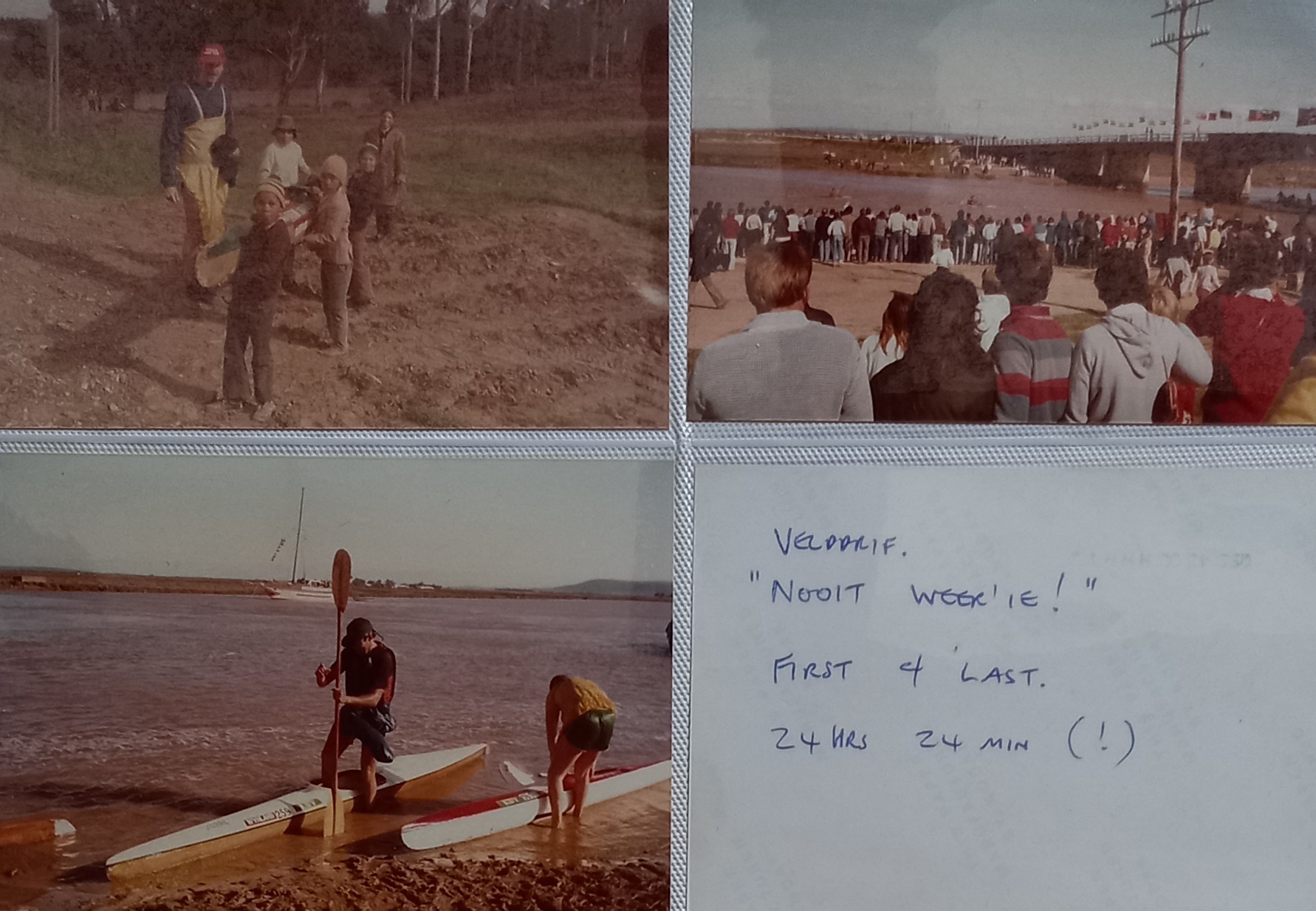
    Greyling Viljoen won the race in 16hrs 7mins; I took 24hrs 24mins and probably 24 seconds; 225 maniacs finished the race; I was cold deep into my spinal bone marrow.

    The freezing finish at Velddrif at last!

    – at this stage when asked, you say, ‘Fine. It was nothing. No problems’ –

    The Velddrift Hotel bed that night was bliss with all my clothes on and the bedclothes from both beds piled on top of me. In Cape Town the next day I bought clothes I couldn’t wear again until I went skiing in Austria years later. Brrrr!! Yussis! Nooit! The Berg joins quite high up on my list of ‘Stupid Things I’ve Done’. Top of which is the Comrades Marathon Which is also the only ‘Stupid Thing I’ve Done and Not Even Finished.’

    ~~oo0oo~~

    Some interesting stats and numbers for the Berg River Canoe Marathon

    241km from Paarl to Velddrif. Four days of approx 62, 46, 74 and 60km.
    46 300 – The estimated number of paddle strokes required to complete the Berg

    I thought ours was a really high-water Berg. At 19cumecs it was the 7th highest of the 21 Bergs up to then. But since then the river has often been higher and 1983 is now only the 21st highest of 55 races. The very first race in 1962 was a staggering 342 cumecs! Liewe bliksem! The lowest in 1978 was a mere 1.44 cumecs. You could almost say fokol.

    Only twice – in 1965 and 1967 – was the overall winning time more than 21 hours (I took 24hrs, but that’s OK, I didn’t win). The fastest overall time: 13hrs 20mins. Giel doesn’t make mistakes, so I must have the 1983 time wrong.

    Five paddlers have completed 40 or more Bergs. Giel van Deventer – Berg Historian, who compiled these facts – has finished the race 45 times! In the book on the Umko canoe marathon I wrote in a draft which I sent to him “the Berg, over 200km long” and he hastened to write to me saying “Pete, it’s 241km long, don’t get it wrong.” I changed it to 241km. (note: Giel went on to do 50 Bergs, then sadly drowned in the Breede river race. Thank goodness though, he did travel to Natal to do ONE UMKO! ).

    One of the toughest years was 1971. Only 49% of starters finished – the lowest percentage so far. The oldest finisher of the Berg, Jannie Malherbe was 74 when he did that crazy thing in 2014. He made our Ian Myers in 1983 seem like a spring chicken.

    1 401 – The number of paddlers who have completed one Berg only. Us sensible ous.
    2 939 – The number of paddlers who came back for at least one more – maniacs!

    Andy Birkett won the Berg in 2016. He makes no bones about the fact that the grueling race takes its toll, even on well conditioned paddlers. “Flip, it was tough!” he recalls. “It was cold, putting on beanies and two or three hallies and long pants when you are busy paddling. But that is all part of it.” He speaks of how one needs to discreetly tuck in behind the experienced local elite racers, particularly on the earlier sections of the course where local knowledge through the tree blocks and small channels is important.

    ~~oo0oo~~

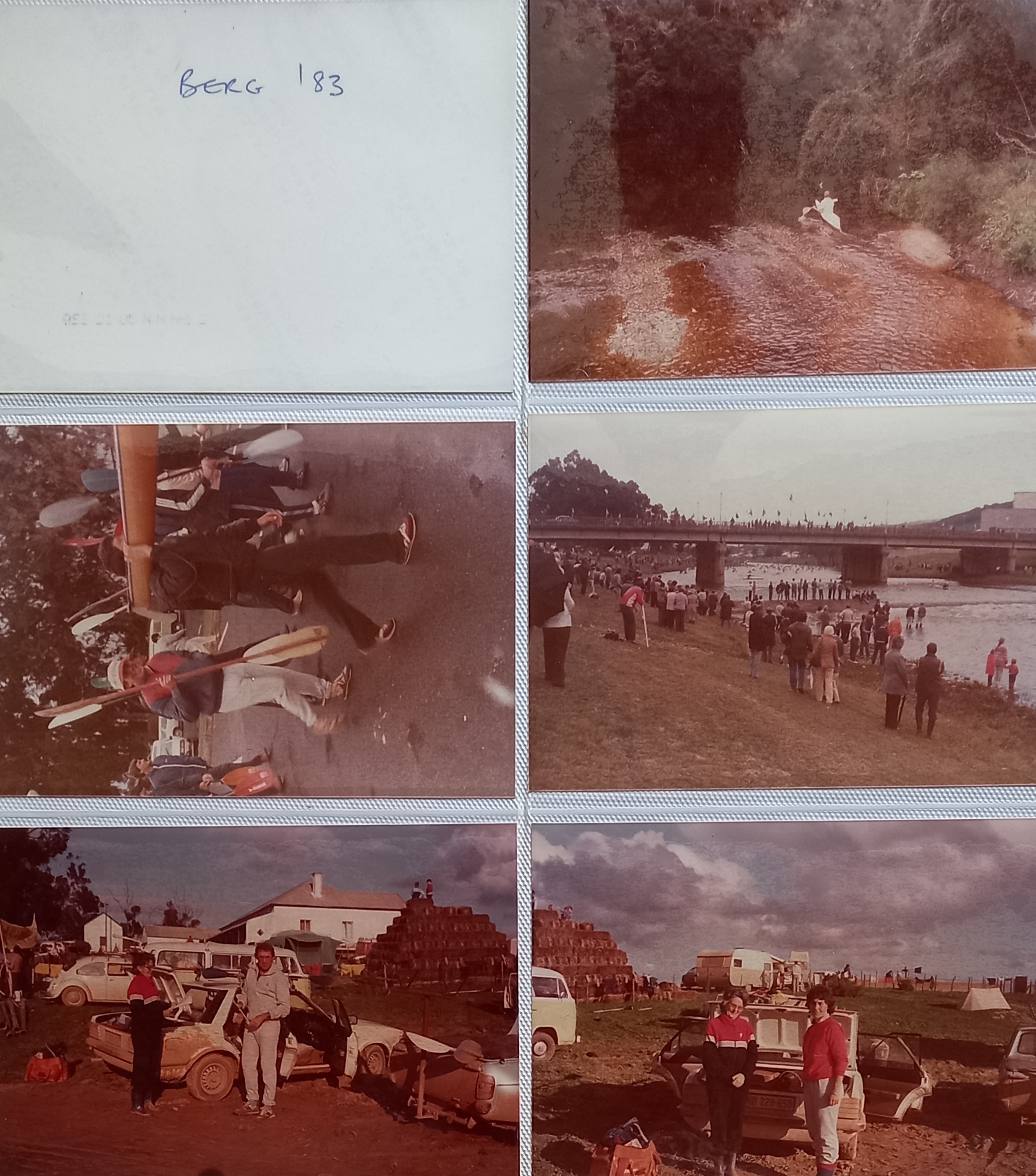
    Photo albums are history, so here’s a digital copy of my now discarded hard copy. Thanks to sister Sheila for the pics.

    ~~~oo0oo~~~