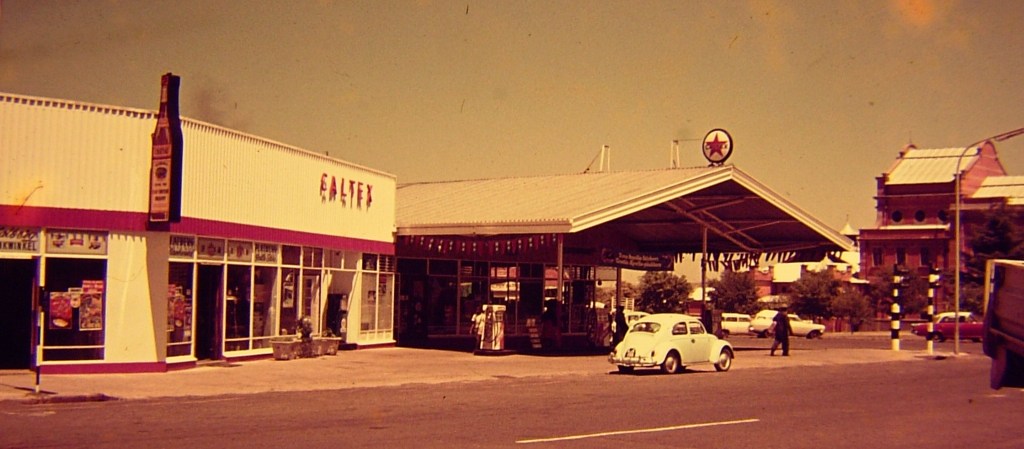
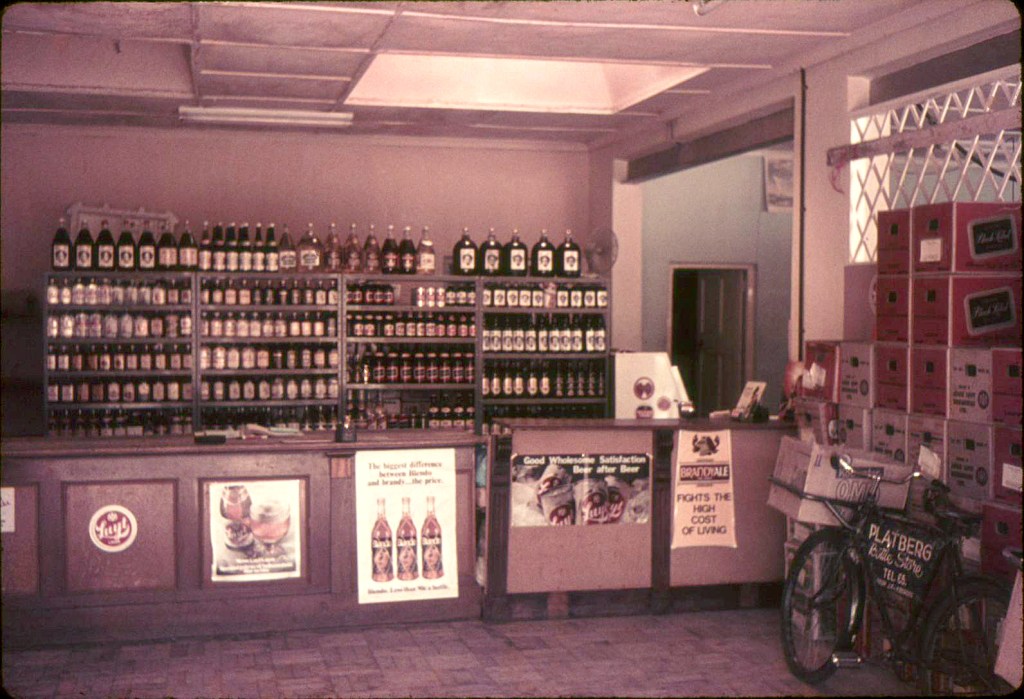
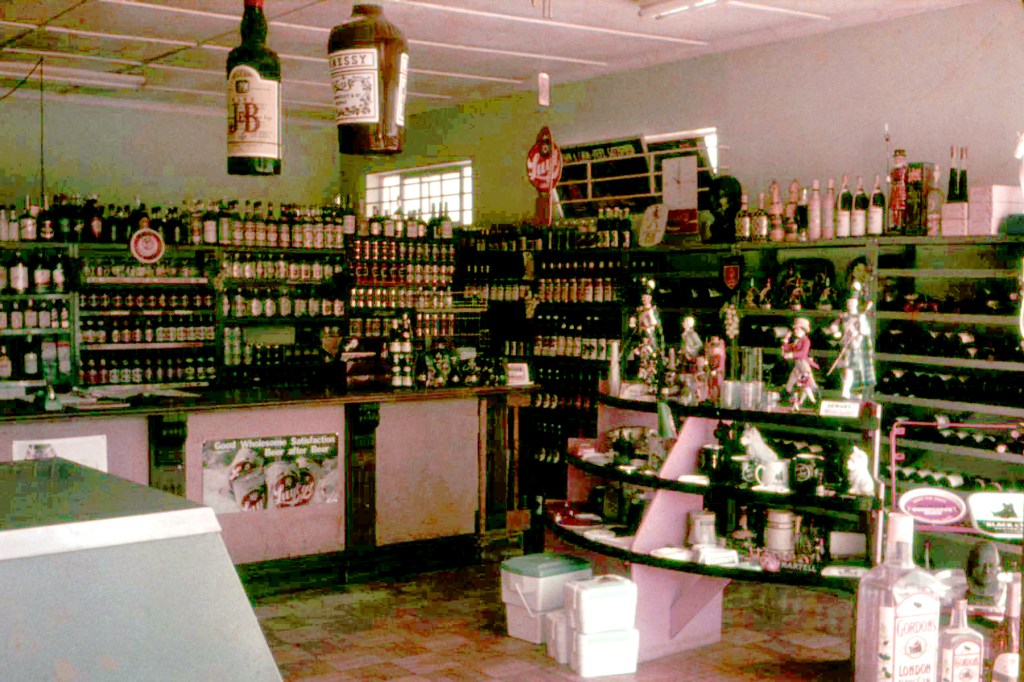
OK, not really; more a reverie on drink – a nostalgic lookback on a bottle store. Platberg Bottle Store / Drankwinkel in Harrismith, the Vrystaat. The Swanepoel family business. We all worked here at times. You could say we were raised on grog.
– the dark side –– the pale side –
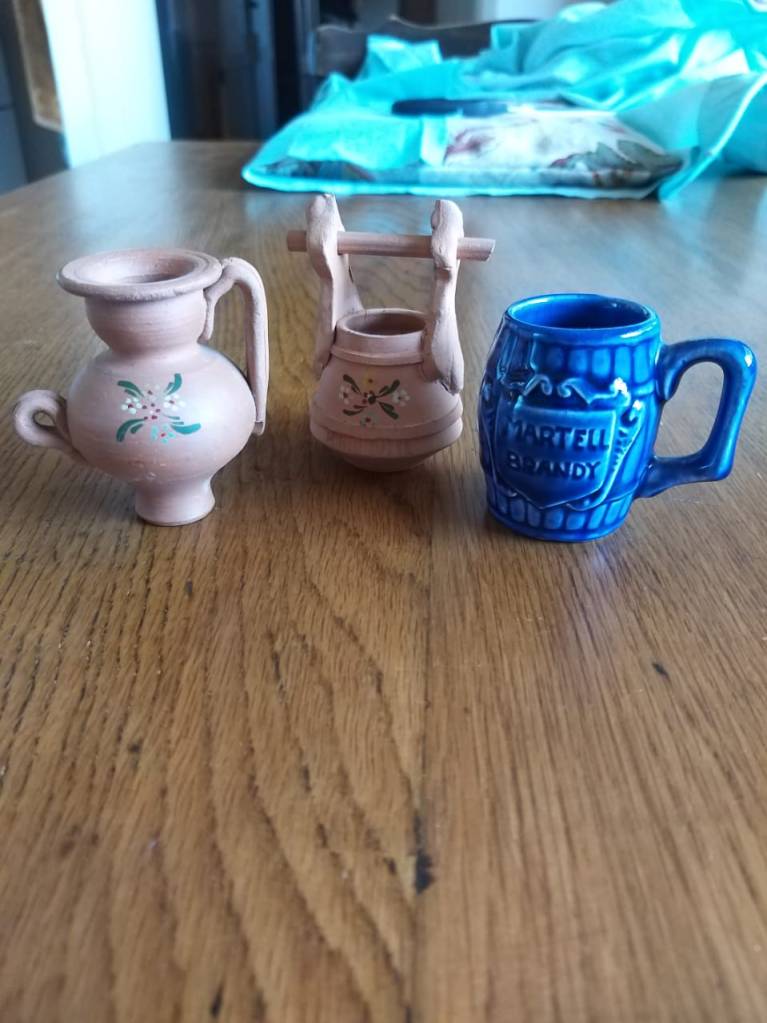
We were talking about the trinkets, decor and marketing stuff. Like those big blow-up bottles hanging from the ceiling. Turns out big sister Barbara kept some of them from way back when:
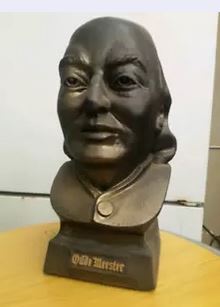
Younger sister Sheila has some whisky jugs; and I found an old familiar brandy-making figure online: the Oude Meester bust. We fondly remember Jan Jan die Oudemeester Man! Jan Robertson, the rep who would visit us to sell his popular product.
..
This is where the big blow-up bottles were displayed, along with the striding statue of Johnny Walker whisky; Dewars White Label whisky’s Scottish soldier ‘drum major;’ Black & White whisky with their black and white Scotty dogs; Beefeater Gin’s ‘beefeater’ in his red uniform, etc. Spot them below. All were shouting a loud Drink More! and in small print; um, drink responsibly.
BrandyAle had people’s best interests at heart when they told you how drinking BrandyAle would “Fight the High Cost of Living.”
Methodists are pretty strongly anti-alcohol, so I believe it is testimony to Mother Mary’s organ-playing skills (and her much-loved status among all who know her) that we could run a bottle store six days a week and still be Methodists on the Sabbath! (Kidding! It was the collection plate. Kidding!).
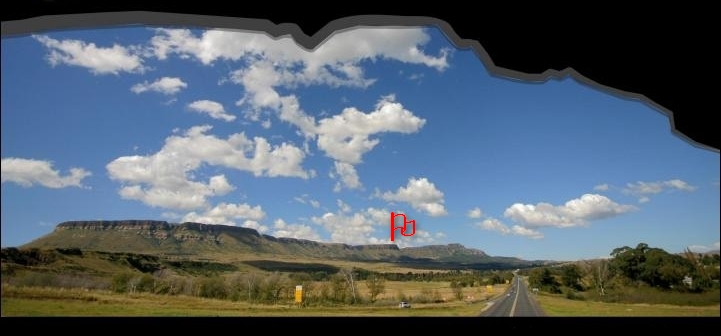
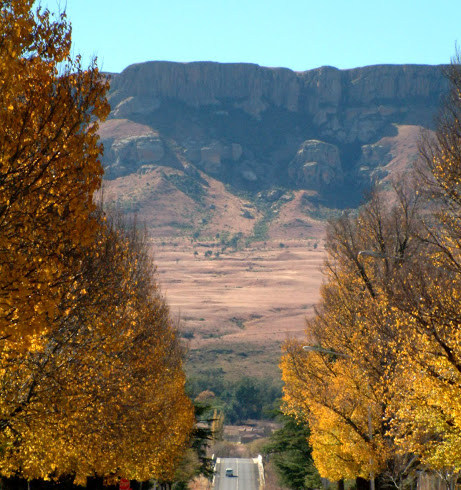
Way back in 1922 a Pom army major sat in the gentleman’s club in Harrismith and spoke condescendingly about our mountain, Platberg, as “that little hill”. What was ‘e on about? It rises 7800 ft above sea level and he was from a tiny chilly island whose ‘ighest point is a mere 3209 ft above sea level! Being a Pom he was no doubt gin-fuelled at the time. Anyway, this ended up in a challenge to see if he could reach the top in under an hour, which led to me having to run up it years later. Because it’s there, see.
– at this point I wished I had done some training! –
I had often run the short cross-country course and twice the longer course, which followed the mountain race route except for the actual, y’know, ‘mountain’ part. I had also often climbed the mountain, but strolling and packing lunch. When I finally decided I really needed to cross the actual mountain race proper off my list of “should do’s” I was larger, slower and should have been wiser.
Here’s some 8mm cine camera footage taken by Dad Pieter Swanepoel of Platberg Bottle Store of the start and finish in front of the Post Office – 1960’s I guess:
The race used to be from town to the top of the mountain, along the top for a mile or so and back down. Sensible. That’s how I ran it in 1979. The medal then had a handy bottle opener attached!
– mountain Race badges and medals – these are the legitimate four – where I actually finished in the allotted time! –
I recently found some old papers which told me I once ran the race in 79 minutes, and in 85 minutes another year.
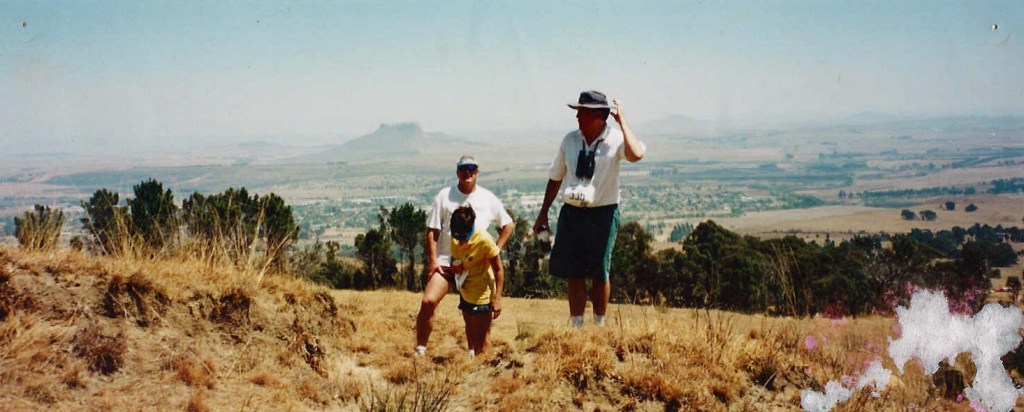
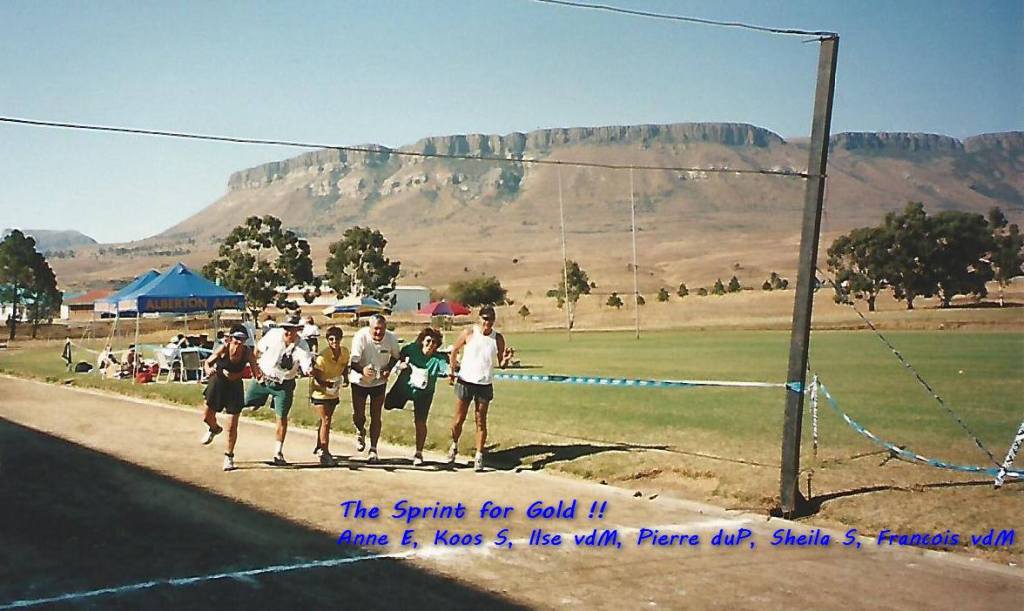
We also walked the race for fun a couple times:
– strolling the ‘race’ –– we staged a hectic sprint for the finish – long after everyone legit had gone home! –– Jacqui Wessels du Toit gave us medals nonetheless –
The 12km distance was enough. But no, some fools decided that wasn’t long enough! Apparently a cross-country route needed to be 15km to be “official”, so they added three kilometres of perfectly senseless lost-fart meanderings around the streets of our dorp causing fatigue before I even started the climb when I ran with Jon and Dizzi Taylor one year. At least I did get to see old friend Steve de Villiers who enquired after my sanity as I shuffled past his home on the backstreets of the dorp.
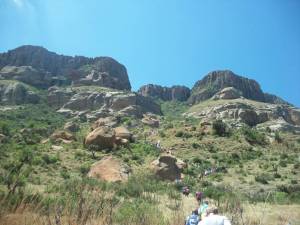
– foot of One Man’s Pass –hands n knees– ‘One Man’ rock at the top of the pass – looking back at The City of Sin and Laughter –– the best part: On top, heading for Zig-Zag pass – – run to A then to B and back (who added three km of tar road!?) –
Oh by the way, Major Belcher did get to the top in under an hour, winning the bet.
Some history from friend Ettienne Joubert, who has also trotted the course:
The Harrismith Mountain Race held annually since 1922, was described as the ‘toughest in the world’ by Wally Hayward, who won five Comrades marathons, the London to Brighton Marathon and the Bath to London 100-miler! (I once spent a wonderful day with Wally).
It originated when, in 1922, a British soldier, Maj A E Belcher, returned to Harrismith where he had been stationed near 42nd Hill during the war. He was referring to Platberg as ‘that small hill of yours’, one Friday evening [lots of silly things are done on Friday evenings] and one of the locals (a certain Van Reenen – or maybe the chemist Scruby) immediately bet him that he could not reach the top (591 metres – just under 2000ft – above the town) in less than an hour.
The major accepted the challenge and set off from the corner of Stuart & Bester streets outside the old Harrismith Club near where the Athertons ran The Harrismith Chronicle the very next day. He reached the summit with eight minutes to spare.
During a later visit to the town, Major Belcher (now a schoolteacher in Dundee, Natal) found out that his record still stood so he took it upon himself to donate a trophy to the Harrismith Club to be awarded to the first club member to break his record to the top. In 1929 the Club management, as the organizers of the race, decided to open the race up to the residents of Harrismith and a Mr Swanepoel won the race to the top of the mountain in 32 minutes. (The last record time I have is 22 minutes and 9 seconds – from town to the top of the mountain! Amazingly quick).
The race route has changed over time – starting in Piet Retief Street outside the post office and police station for some years. Nowadays it starts at the town’s sports grounds, passing the jail, then through the terrain where the concentration camp (second site) once stood, up the steep slopes of Platberg to the top via One Man’s Pass, close to where a fort was built during the Anglo-Boer War. After traversing a short distance along the top, the descent is made via Zig-Zag Pass, and the race is completed back at the ‘Groen Pawiljoen’ sports grounds.
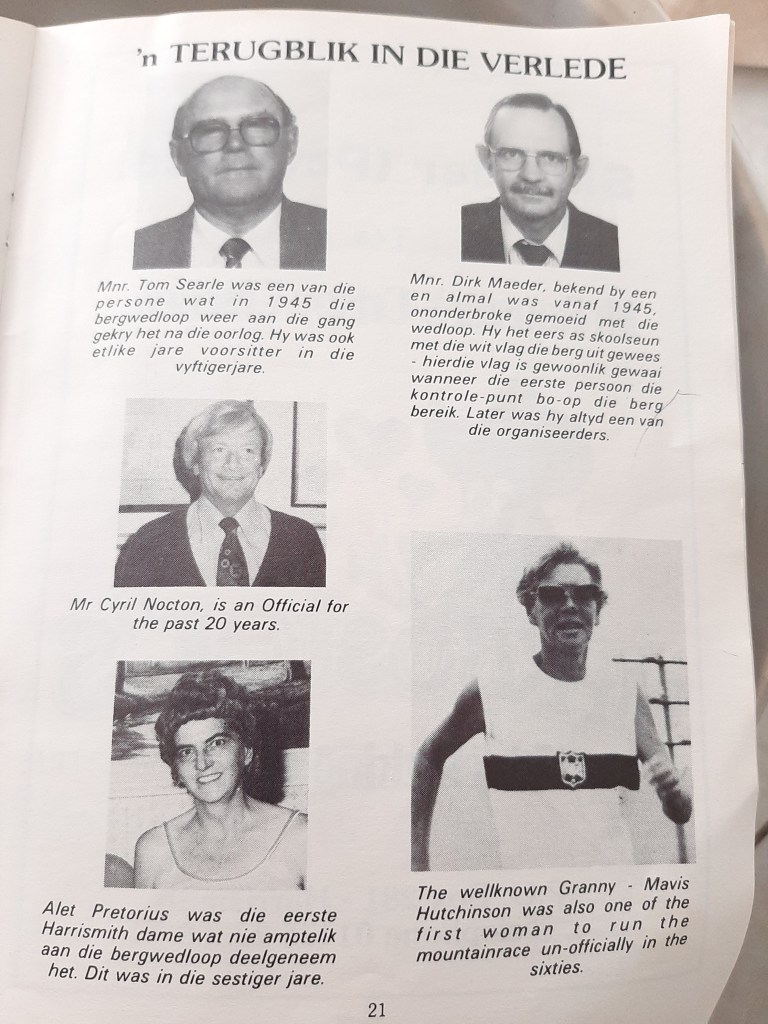
Our friends Steph and JP de Witt’s Mom, Alet de Witt became the first lady to complete the race. She ran in the year her husband, JN ‘Koos’ de Witt died tragically suddenly in January 1967. She then donated a trophy for the winner of the newly allowed (!) women’s category, which was awarded for the first time only in 1986.
Later the apartheid ‘whites-only’ ruling was dropped and as soon as McDermott* stopped winning, the race was won by black athletes, including Harrismith locals; starting with Michael Miya who holds the record for the newer, longer 15km course at 1hr 03mins 08secs.
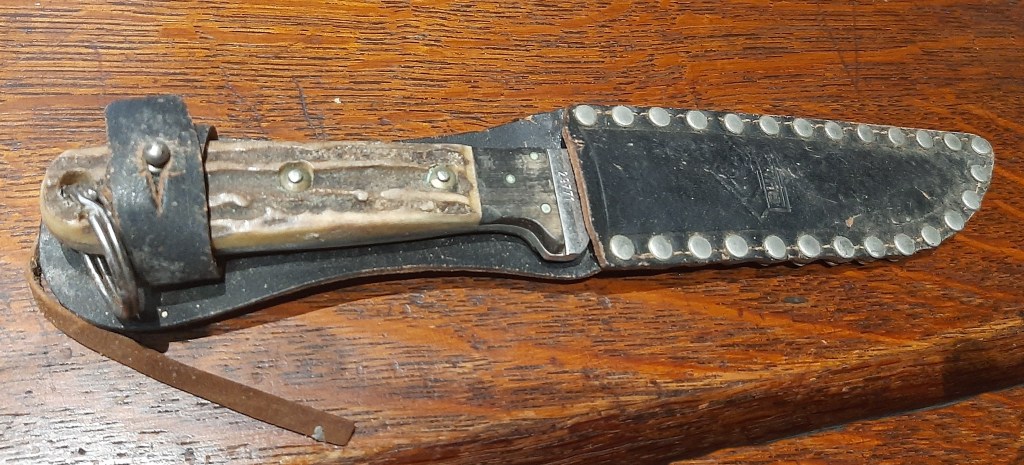
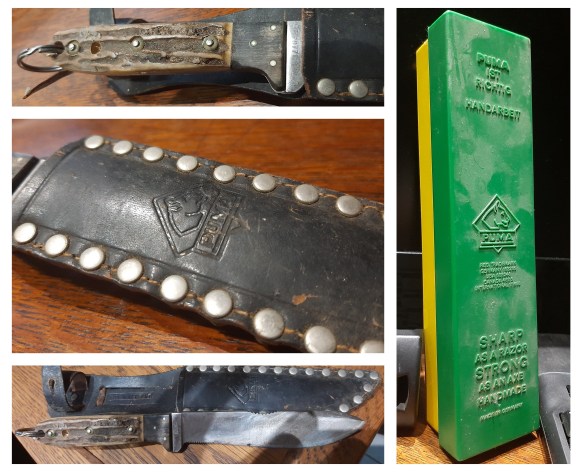
The ole man gave me a knife quite recently. Well, in the last ten or fifteen years or so. He told a story in a rare letter to his darling son, written on the back of a Maxprop invoice and folded into the special PUMA green and yellow case:
– PUMA knife – model 3585 – serial no. 29771 –
Let me tell you about this knife, he writes. I first saw it in Rosenthals, a big safari shop in Windhoek more than 30 years ago. This on one of his family holidays he took in the family car. Without the family.
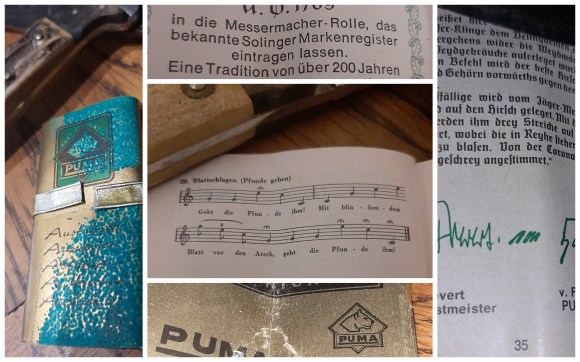
When friends of ours, the Maeders, went to Germany on holiday, he asked them to get the knife for him in Austria, where it is made, by one man, whose name appears in the brochure – a small 50-page brochure that comes with each knife.
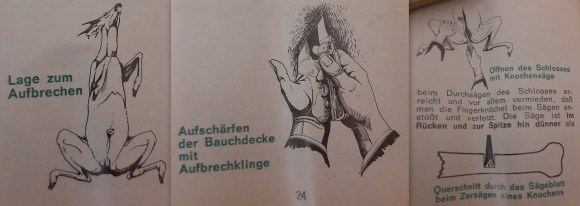
– PUMA knife model 3585 – with skinning tips – can also sagen through knochens –
The letter continues: Anyway, the knife arrives by post in Harrismith. Uproar!! Urgent meeting: Me, the police and the postmaster – in his office. I had imported a dangerous weapon – the blade was more than 4″ long – illegal!
The postmaster unlocks his safe in the presence of all concerned, removes the knife, makes a tracing of the blade. This is to be sent to the SA Police in Pretoria. Meantime, the dangerous weapon goes back into the safe.
I told them not to be bloody silly; I could walk over to the OK Bazaars right now and buy a butchers knife with a 12″ blade!
After all the dust had settled and all charges paid, the knife cost me R64.00
The ‘over the counter’ price at Rosenthals in Windhoek – which he refused to pay, knowing he could save money by ‘getting it direct’ – had been R63.00!
And I’m always trying to get a better price, to save money! Love Dad
– PUMA knife – 50-page brochure – even a song! – ‘beating of the blade’ –PUMA knife 3585 details – made by senior forester Frevert, I think –
~~~oo0oo~~~
As a kid way back in the sixties, I took over my Dad’s much bigger dagger; also with a bone handle. One day the duP’s came to visit and Pierre and I were playing with it, stabbing it into the hard Vrystaat ground on our side lawn on the aviary side of the house, seeing how deeply we could bury the blade. I plunged it down with all my might, not seeing Pierre was still tamping down the ground and lawn from his attempt! I just about cut his finger off! Typically, stoic Pierre said Shh! and kept it quiet, going straight off to show his Ma Joan, who cleaned and bandaged it!
Donald Coleman was my good mate and older mentor and side-kick in Harrismith up to around 1964. He died in a car crash, alone in the car, around 1975. I have no detail of what exactly happened.
In around 2011 or 2012 I found a letter on the floor of my garage at 10 Elston Place.
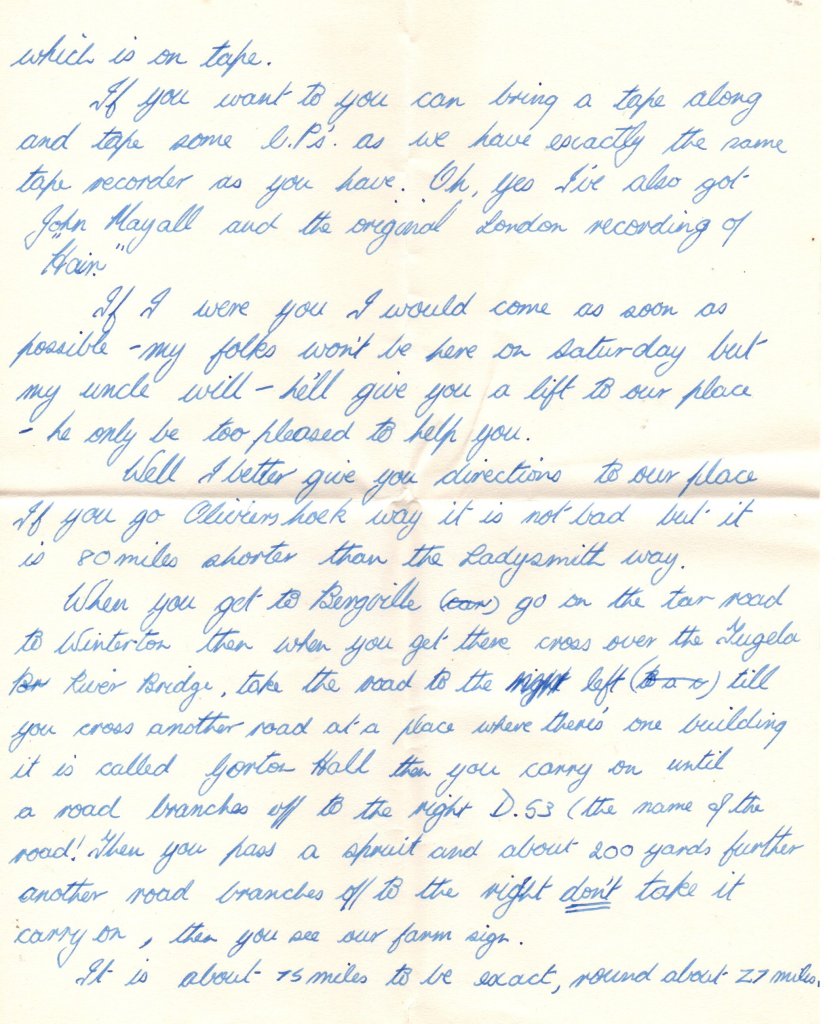
It was from “your mate Donald” and consisted of one page. Probably page 2 of a 2-page letter, plus a scrap of envelope addressed to: poel rrismith e Free State
A franked 2½c stamp in good condition is still on the scrap of envelope, but the date part of the franking was missing.
I was gobsmacked! HOW did it get here? I have lived a year in Harrismith after it was written, a year in America, four years in Jo’burg, a year in Potchefstroom, years ‘in the wild’ in Durban as a bachelor, then my first own home for fifteen years and NOW, after being in my second home for six years, a letter falls out onto my very untidy garage floor!
I’d love to know how it happened! I suspected it fell out of the old Cape Colony post office stinkwood desk Dad gave me, as I had moved it to give it back to him before it fell to pieces.
The letter, in neat, flowing cursive writing in blue ink, said (I have copied the line breaks as they were on his page):
This is slightly exaggerated but between points
0 and 1 it is 50 miles and between 1 and 2 it is 13 miles and between
3 and 4 it is 14 miles. Even if you go at 10 m.p.h all the
way you will make it in a day. Well don’t take
too much equipment etc because you’ll shit yourselves
coming. Don’t forget to take hats and plenty of patching
equipment. If something goes wrong and you reach
Bergville or Winterton after dark just ‘phone us our
number is Winterton 2412. Well I hope I’ve got everything down here, any-
way I still hope to run the Mountain Race
with you. I’m going to try harder this year. It’s a pity I won’t be seeing you fellows
because I’ve got some jokes to tell you. From your mate Donald
Not a single correction or spelling mistake (oh, one tiny one changing your to you).
So it seems he had sent a map as well as the (presumed) 1st page of the letter. Obviously we were planning to ride our bikes to Winterton!
I gave the page and the half-envelope to Donald’s mother Jean.
~~~oo0oo~~~
I must ask Dad about the old stinkwood desk. Was it a Harrismith find? From when? That could explain how the letter got in there, I spose. A sudden suspicion: Did my folks open it and not pass it on!? Very unlikely.
UPDATE: I searched the old desk again and found the rest of the envelope! It was franked on 30 March 1971. I was in Std 9, and Donald would have completed his time at Estcourt High School.
I asked the old man. He said he had bought the desk at Cannon and Finlay auctioneers in PMB some time well AFTER 1971. So I suppose the letter was put into a ‘new’ desk. Which raises the unlikely ‘they knew about it but chose not to tell me’ possibility again.
So the mystery remains. Well, I am SO glad I found it anyway. And glad I could share it with Donald’s family.
~~~oo0oo~~~
UPDATE 11 July 2020 – Another find! I found ANOTHER 3-page letter from Donald while clearing out old boxes in the garage, something I’ve been meaning to do for ages!
I was gobsmacked. If you’d asked me if I’d ever received a letter from Donald I would said No, I very much doubt it. Here it is:
I immediately started writing to his little boet Eddie, now in Japan, and while writing it the penny dropped: These three pages are from the same letter. This map is the map he refers to in that “one pager” I found eight or nine years ago.
Now I can rest content! I found a treasured memory from my past from a friend who was really really big in my life for the first nine years of my life and I’m glad to find out we kept in touch later on.
If I had ever got their farm, which Donald christened The Craggs, this would have been the view:
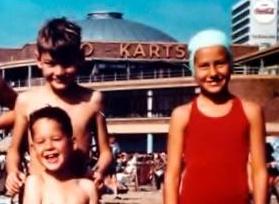
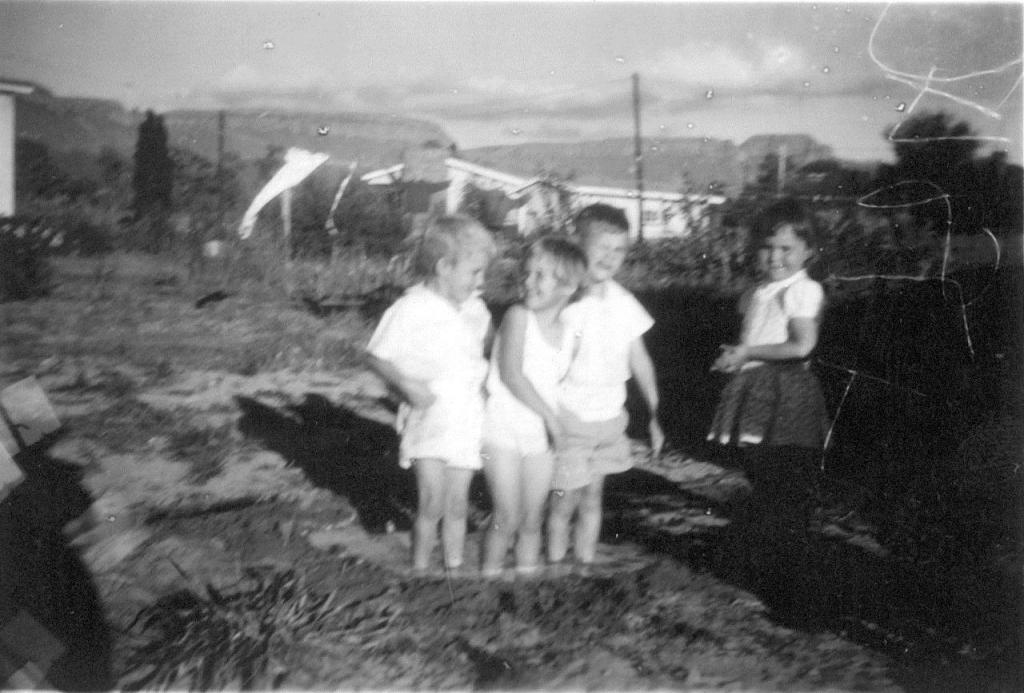
Here’s older boet Donald with sister Anne and lil boet Eddie on a visit to Durbs beach by die see, way back when they were still in Harrismith; and a pic of four of us in Harrismith:
Koos, Anne, Donald & Sheila
~~~oo0oo~~~
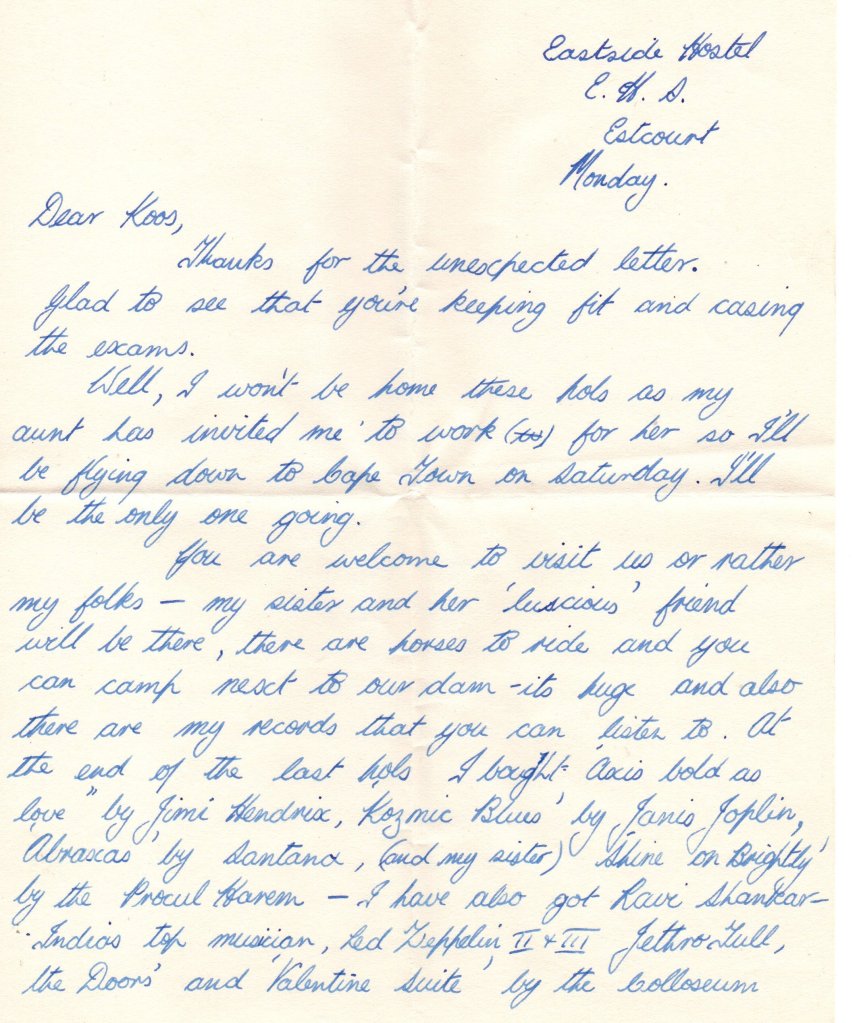
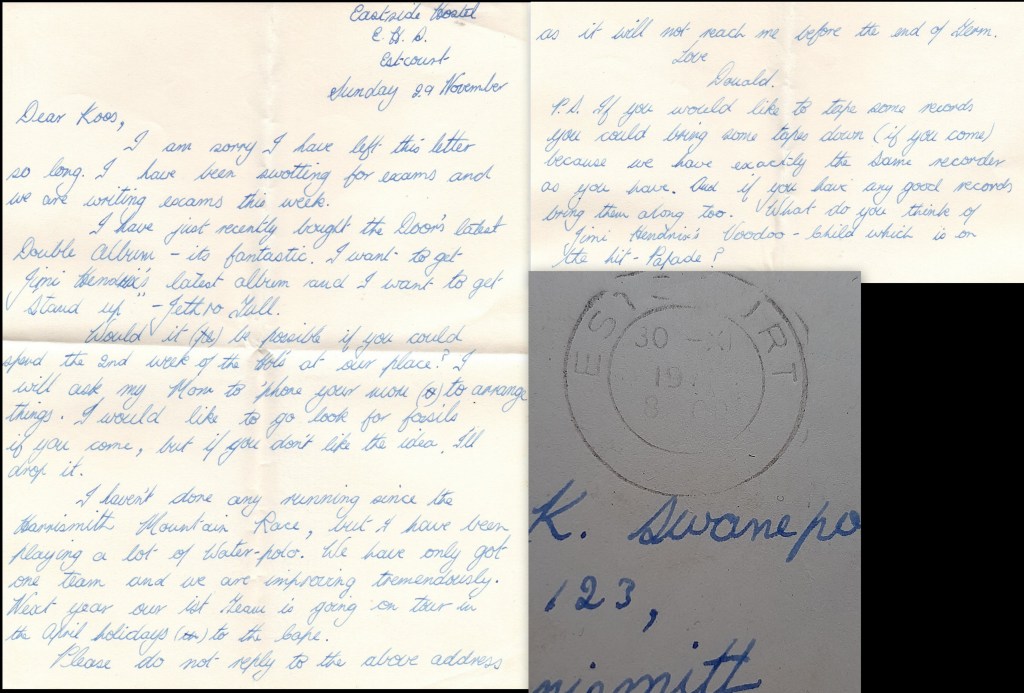
14 July 2020 – And now another letter DOES pop up: Dated 29 November no year, and the envelope franked 30 November 197_ (probly also 1971 – he gives his address as Eastside Hostel again, but says he’ll be going home soon).
– letter from Donald in November –
Here he says he hasn’t done any running ‘since the mountain race’ – so that means he came to do the Harrismith Mountain race in 1971? I can’t remember that.
~~~oo0oo~~~
I wrote to Sheila Friday, February 01, 2013 Long ago!! What did Jean (Donald’s Mom) say about the letter? Did she recognise Donald’s handwriting?
She replied: Hi Koos
Jean and Anne loved the letter – I could see they wanted the original, so they made me a copy for you and I left the original with them. They recognised the handwriting immediately – said he always had a very neat writing. He died in 1975 and is buried at their Winterton property – I think Ken is buried next to or near him. Love SS
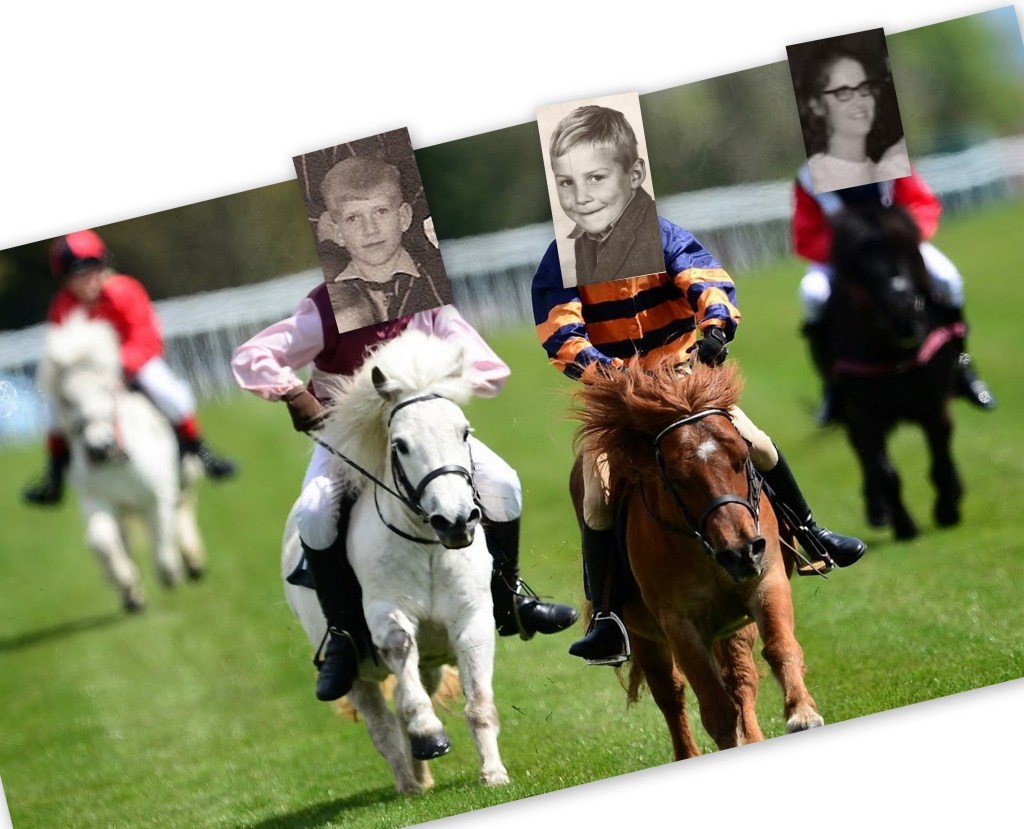
Wild-haired Kathy Putterill ran a nursery school in her home. Their house was on a long thin plot on two levels. The lower level had Shetland ponies on it. And I think she had dogs. I seem to remember small dogs.
That’s about all I remember. They had a funny car. Right? And Kathy enjoyed a smoke and a drink?
Their house (her husband was Leonard, Len Putterill) was where Warden Street T-boned into Murray Street. Below them Murray Street got steep as it rolled down, kinking left just before it crossed McKechnie Street and ducked through the subway under the railway line. Their house is gone now.
Leon Fluffy Crawley and Noeline Bester remembered the ponies! They say Fridays was horseriding. Noeline says it was the highlight of the week and the only reason she hung in there! Fluffy tells how his gardener used to accompany him to school on his go-cart all the way up from Garvock Street – going home would have been easy: downhill!
Fluffy remembers Kathy smoking, and says sometimes you’d get there in the morning and have to wait outside while Kathy got ready – late start!
– It’s Friday! Here’s us three on Kathy Putterill’s Shetland ponies. The brown horse is winning. They always do – if you must gamble, always put a tenner on the brown horse –
Harrismith History – Free State Fables – Rural Legends . . well told.
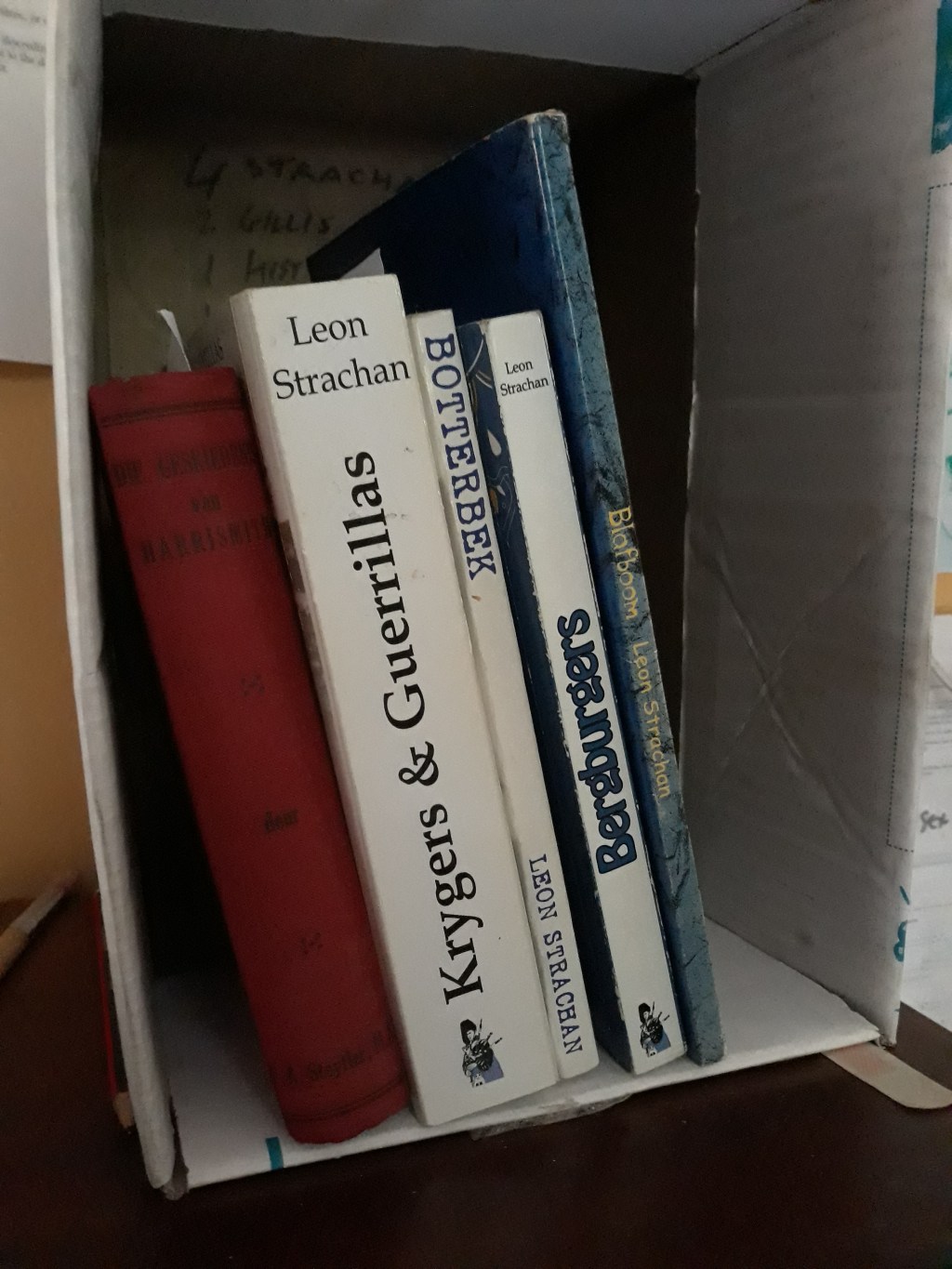
Harrismith has had a few published authors over the 171 years of the town’s existence. One day I’ll make a list. The best by far is Leon Strachan – imho of course! I have four of his books and am searching locally for the others.
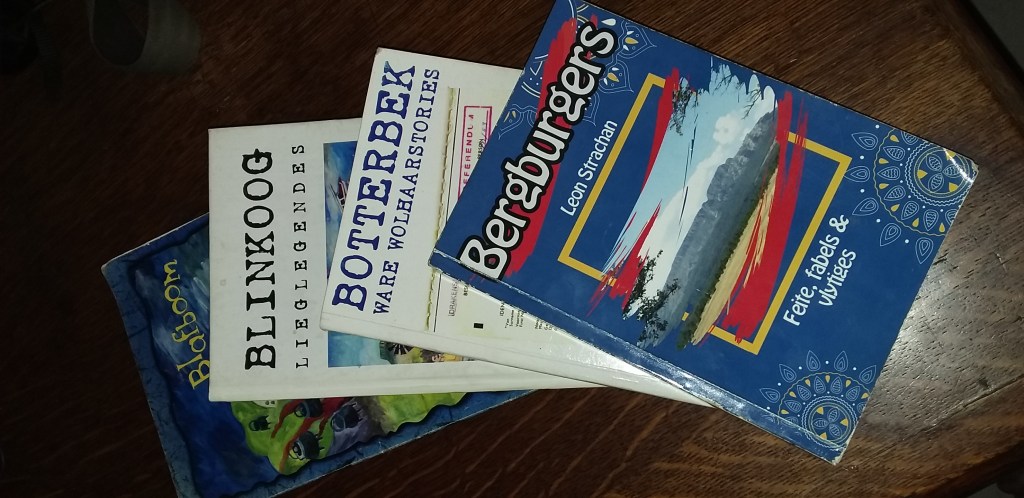
– Leon Strachan’s four books on Harrismith characters’ achievements, foibles, shenanigans, pecadilloes and kakaanjaag –
In 1999 Leon wrote Blafboom, tales of Harrismith characters bravely told even when some may not have wanted them told! Admittedly some are told anonymously, but those in the know would know exactly who he was writing about . . and shudder. Some, I must confess, left me in the dark, but with a burning curiosity: One day I’d love to ply him with whisky – he drinks scotch, as like me, he has Scottish ancestry – and get him to tell me who the culprits, the instigators and the victims were! Known characters include ‘the man who swapped his wife for a bicycle;’ Petronella van Heerden, pioneer, leader, doctor and farmer; Caveman Spies, famous local mischievous strongman; He also tells the story of some Byrne settlers who moved to Harrismith from Natal – a step up.
Blinkoog followed in 2002. My mother Mary Bland grew up on Nuwejaarsvlei on the Nuwejaarspruit. Their neighbours were Badenhorsts on Stratherick, and Odendaals on Sterkfontein and Eskol. She told the story of how freewheeling downhill was known as ‘using Casper’s petrol’ – ‘ons ry nou op Casper se petrol’ she would say, smiling. He was known as Suinige Casper (Frugal Casper Badenhorst would be one way of explaining his nickname). Today the beautiful and precious wetlands and streams and valleys of Nuwejaarsvlei and neighbours are irreplaceably lost, drowned under Sterkfontein dam. Sacrificed to feed the industrial monster of Gauteng / iGoli / Joburg. Dead water waiting to be flushed downstream and then flushed down a toilet, where before an amazing ecosystem existed. You’ll notice I love wetlands . .
Botterbek in 2004 – I’d love to know the true identity (identities?) of ‘Botterbek,’ Leon’s narrator! More whisky! Characters who feature here include the very well known Kethlaan Odendaal, Jan Schambreel and jackal hunter Frans Olivier. Jurie Wessels’ remarkable ‘Harrismith Harem‘ is featured and explained in Strachan’s characteristic way: he seeks to understand the people involved; and while he will tell you the scandal and the rumours, he won’t simply leave accusations hanging without investigating them. And so it turns out the impressive building was really meant to be the most impressive home in the district for his wife. And it would have been had the 1914 rebellion – Die Rebellie – not intervened . .
Bergburgers: his fourth book published in 2017 tells of Platberg, the beloved mountain that looms over the town and is visible for miles around; the book’s title alludes to the fact that the citizens of the town – past and present – all consider Platberg ‘theirs.’ Ours. The annual foot race up and down the mountain, started by an insult and a challenge; the geology of the mountain and how it formed over the millennia; Leon corrects the injustice done to the families living in the Lost Valley by telling their real story – a fascinating tale of quietly capable people living their own lives, yet interacting regularly with neighbours and townsfolk, not at all totally isolated, as rumours eagerly repeated would have it; old Professor Bloch the violin teacher who lived down the road from us in Stuart Street; old archeological and fossil findings by Arthur Putterill – one of them maybe the same as the one my mate Donald Coleman found? and two boats built in our district, far from the coast, that sailed the high seas – one in 1886 to England and one in 1986 to the Caribbean;
Some of his stories are in the fine English he was taught by Mrs Ella Bedford, mother of Springbok rugby captain Tommy Bedford, but for most of them you have to be able to read Afrikaans.
~~~~oo0oo~~~~
I know of three heftier tomes he has written:
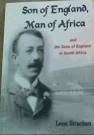
Leon’s Grandad’s Story
– Charles Davie –
Probably all in suiwer Engels (I don’t have a copy, so guessing), Son of England, Man of Africa (2009 is the story of a Harrismithian who led the South African chapter of The Sons of England – Leon Strachan’s grandfather Charles Davie. Leon tells the little-known inside story of a secretive organisation for the first time. He then takes a look at other similar societies which took a leaf out of the SOE book. The SOE’s aim of uniting men who were loyal to England and wanted to remain ‘English,’ – sometimes more ‘English’ than their fellow countrymen ‘back home!’ – was based on the Freemasons; SOE was more influenced by the ‘correct’ political and religious powers of the day; plus they were more into charity work. The Afrikaner Broederbond, the Hebrew Order of David and the Caledonians based their organisations to some extent on the principles of the SOE. Ah, well, nothing exceeds like success . . and there was a time when little ‘England’ was the centre of the known Universe. Leon and I both had grandparents who lived secure in that knowledge!
~~~~oo0oo~~~~
Then Matters Military:
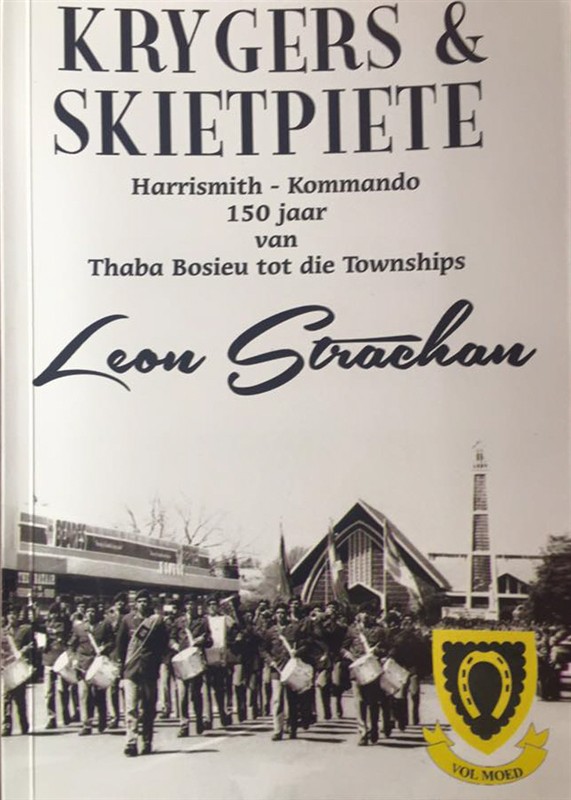
Krygers en Skietpiete (2011): The 150 year history of the Harrismith Kommando, excluding the Boer War, which tale is told in his next volume. From Thabo Bosigo, through the ‘skietpiet’ period; to duty on South Africa’s borders; to deployment against fellow-citizens (though this was denied – ‘they’ were not citizens of South Africa, remember?!) in South Africa’s ‘townships’ – towns in which indigenous African people had to live by law. Leaders and interesting characters; the influence of political developments; incidents, good and bad.
– image from Leon Strachan facebook page –
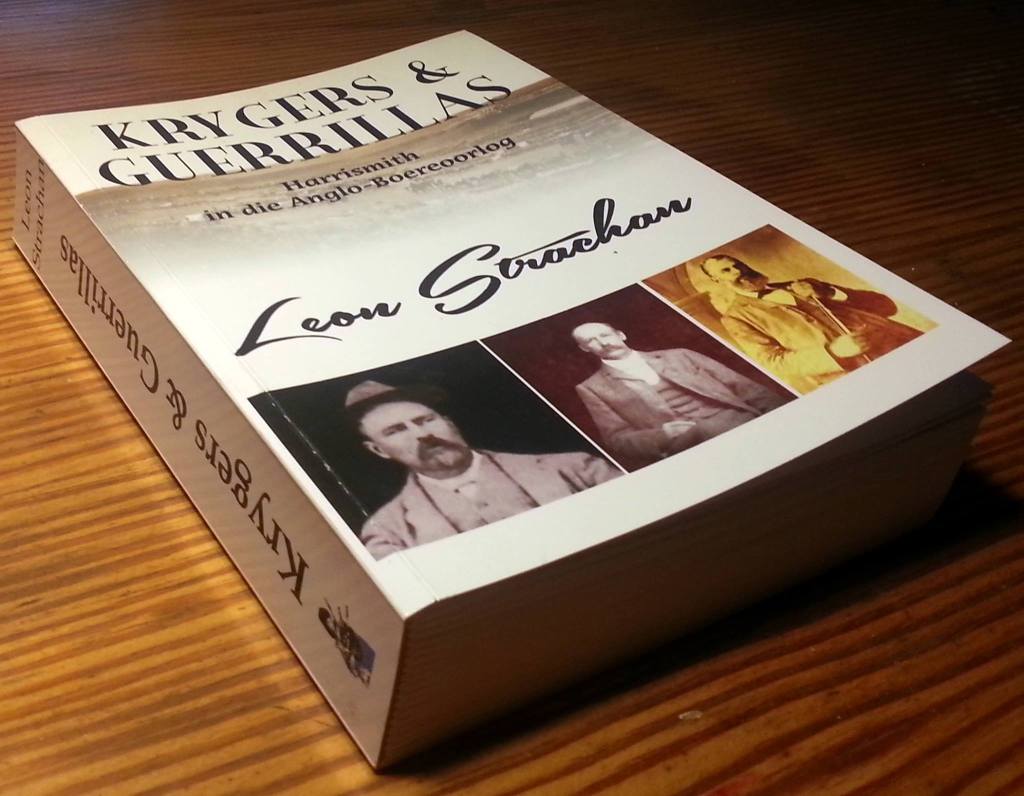
Krygers en Guerrillas (2015). Experience the Anglo-Boer War as it was experienced by people in the Harrismith district, daily as the war unfolded; sometimes far and away and only read about, sometimes in their midst. See why the defenders, invaded by a foreign power, called it the Tweede Vryheids Oorlog – they were fighting for their freedom. Good tales and shocking deeds, including war crimes; the whole war time is unfolded from beginning to end. Comprehensive, the data includes names, casualties, Boer deaths, Brit deaths, prisoners, concentration camp deaths; ‘hensoppers,’ Boers who surrendered; ‘joiners,’ Boers who joined the British invaders; and ‘verraaiers’ who were outright treacherous. Boer Jews and Boer Irishmen and men of other nations who joined the Boers to help them against the invasion by the world’s biggest war machine, deployed by the world’s biggest looting and plundering machine. The war is presented from a local ‘on the ground’ perspective as well as a wide-angle perspective, showing how national and international decisions affected the people doing the actual fighting, suffering and dying.
~~oo0oo~~
A keen horseman, Leon has led 22 annual rides down into and through the Lost Valley.
The first recorded polo game in South Africa took place in October 1874 at the King Williams Town Parade Ground between the Gordon Highlanders and the Cape Mounted Rifles.
The Military Ninth Division played during the 1880s at Harrismith, Orange Free State.
Polo was played in Cape Town in 1885 at a club formed by army officers, and in Natal by the officers stationed at Fort Napier, in Pietermaritzburg; a year later, they formed the Garrison Polo Club.
Play in Transvaal began in Johannesburg in 1894, when the owner of the Goldfields Hotel founded a polo club. The game was dominated by the military, but civilian clubs like this did sprout up in several places.
~~oo0oo~~
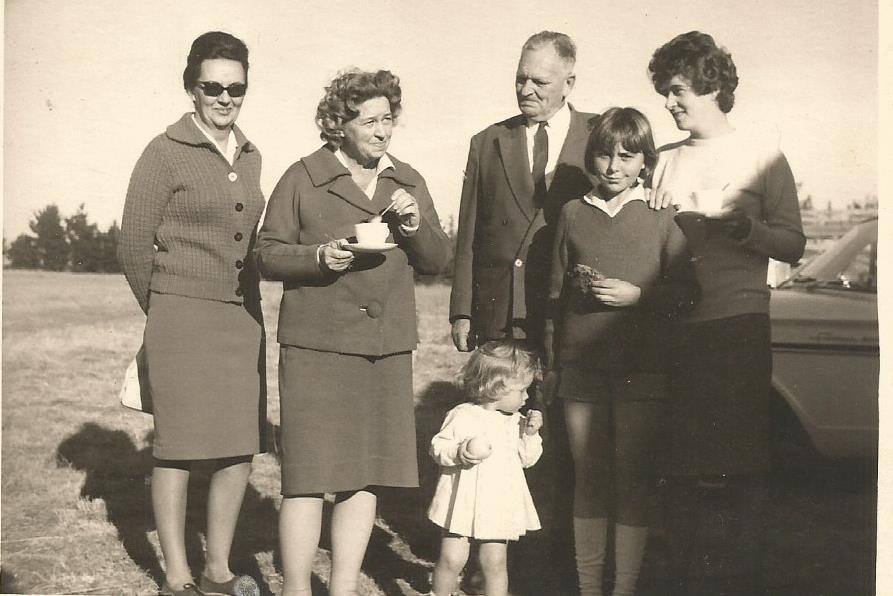
Someone must have the history of Harrismith polo. I hope. The first polo field I remember was in the sixties on the far side of the railway tracks; you drove under the subway to get there. Across the road was the sportsfields: a hockey field and then the cricket oval. Legend has it that Jimmy Horsley once hit a famous six across the hockey field, across the road and onto the polo clubhouse roof!
During a recent visit to Harrismith I spotted this on good friend Bess Reitz’s passage wall: Her Dad and Ginger Bain in the winning team!
– tea at the old polo field in the sixties – – note the Ford Fairlane!! –– poms in Africa –
I was born in Harrismith in 1955, as was Mom Mary in 1928, and her Mom Annie in 1893. Annie thought “the queen” of that little island above and left of France was also the queen of South Africa (and for much of her life she was right!).
I attended the plaaslike schools in Harrismith till 1972. A year in the USA in 1973 as a Rotary exchange student in Apache Oklahoma. Studied optometry in Joburg 1974 – 1977. Worked in Hillbrow and Welkom in 1978. Army (Potch and Roberts Heights, now Thaba Tshwane – in between it was Voortrekkerhoogte) in 1979 and in Durban (Hotel Command and Addington Hospital) in 1980.
I stayed in Durban, paddled a few rivers, and then got married in 1988. About then this blog’s era ends and my Life With Aitch started. Post-marriage tales and child-rearing catastrophes are told in Bewilderbeast Droppings.
‘Strue!! – These random, un-chronological and personal memories are true of course. But if you know anything about human memory you’ll know that with one man’s memory comes: Pinch of Salt. Names have been left unchanged to embarrass the friends who led me (happily!) astray. Add your memories – and corrections – and corrections of corrections! – in the comments if you were there.
~~~oo0oo~~~
Note: I go back to my posts to add / amend as I remember things and as people mention things, so the posts evolve. I know (and respect) that some bloggers don’t change once they’ve posted, or add a clear note when they do. That’s good, but as this is a personal blog with the aim of one day editing them all into a hazy memoir, this way works for me. So go’n re-look at some posts you’ve enjoyed before and see how I’ve improved over time (!). It’s just as my friend Greg says: ‘The older we get, the better we were.’
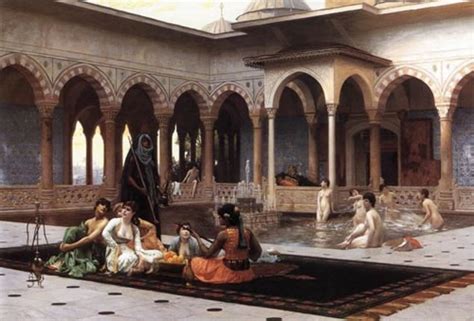
You know that mansion Mal Jurie is building on his farm? It’s a harem!
A what?
A HAREM! A place where you keep lots of ladies in rooms and they lie around swimming and eating grapes and looking beautiful. When they do have clothes on its not clothes like your mother wears. He says he’s going to bring French dancers to his harem from the Moulin Rouge in Paris! A lot of French ladies in Harrismith in the Vrystaat!
Ag Man, You Lie!
No, I swear. He told me himself!
– a typical scene just outside Harrismith, Vrystaat –
This is how an Urban Legend – in this case really a Rural Legend; or, as Harrismith author and historian Leon Strachan calls them, a ‘Lieglegende’ – got started.
First of all, it’s true. Jurie Wessels DID say that. His neighbour wasn’t lying.
But what Jurie was really saying was, ‘Leave Me Alone!’ ‘Los My Uit!’ ‘Mind your own Business.’ ‘Stop prying.’
Jurie was a successful farmer, an intelligent, interesting and interested man, married to an outgoing and attractive woman, and he was building her a home unlike any other in the district. His problem – his sin – the reason he was called Mal Jurie – was that he was an introverted and eccentric character. He didn’t ‘play by the rules.’ And for that you get punished in most communities, maybe more so in small communities. And Harrismith would have been no exception.
For starters, Jurie had brought his lovely engaging wife from far away. People didn’t know her mother and her grandmother. She was actively involved in the community, well liked, and often entertained; but still . . she was from far away. And also, often Jurie wasn’t at her gatherings, preferring to keep to himself, even when she entertained at home.
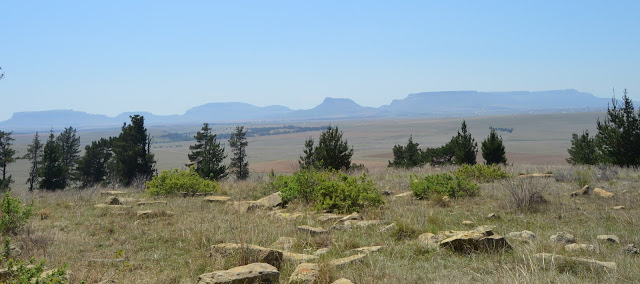
So when Jurie got Italian stone masons to start building a large sandstone structure on the edge of a hill above his more ordinary homestead, overlooking the Wilge river valley west of the dorp, the people started wondering . . and talking.
– the view towards Harrismith – The Lakes range, Loskop in the middle, Platberg right –
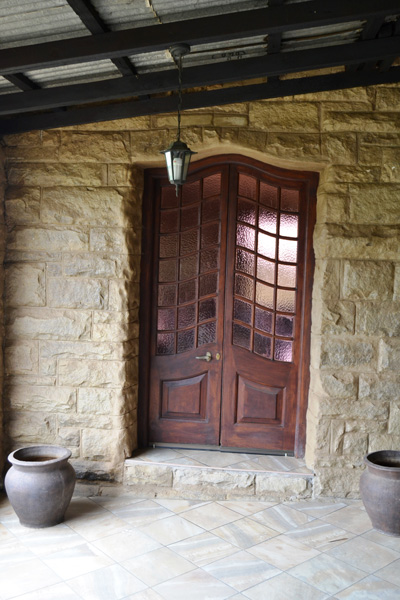
But it was when a consignment of beautiful and really big wooden windows and doors arrived from Italy at the Harrismith spoorwegstasie that the rumours started building and gathering momentum. From ITALY? Nothing from ITALY arrived at the Harrismith stasie! Where was Italy, anyway? This was weird! Just what WAS Mal Jurie up to? Here was evidence, not just skinner, that Mal Jurie was mal.
Well, he was actually building a beautiful home, but he didn’t want people sticking their nose in his business. People always asked too many questions! So when his neighbour asked, he deliberately gave what he probably thought would be an obvious exaggeration. And it might have been taken as just that, had his reclusive behaviour not made him ‘suspect’ – ‘different.’ And so the rumour – the legend – grew wings and became ‘the truth.’
My mother Mary grew up with one of his sons, Hugo. Hugo was a popular, good-looking and talented Harrismithian who would go on to qualify as a medical doctor, then come back to farm and practice medicine as a GP on the family farm. He and Mom matriculated in the same class of 1945. They both loved music and singing, were talented musicians, and both did well in their exams. Here’s Mom on the piano and Hugo enjoying her playing and getting ready to sing at Mom’s 45th birthday party in 1973.
..
And here’s one of his sons, Max Wessels, who played rugby with me in primary school. Max extreme right front row, dark hair, shortish then – me extreme right back row, blonde, tallish then.
The beautiful new home never got finished. Jurie joined the 1914 rebellie– a rebellion against the British-dominated South African government. He was angry – mad as hell – as were many others, that this blerrie government was joining the blerrie British to fight World War 1! Hadn’t the blerrie Engelse just been killing them a mere twelve years before? Hadn’t the British locked up our women and children in concentration camps, starving them and killing them off through disease and malnutrition!? Why the hell was South Africa fighting WITH those invaders who had ruined our country just a short decade ago, burning our houses and killing our livestock?
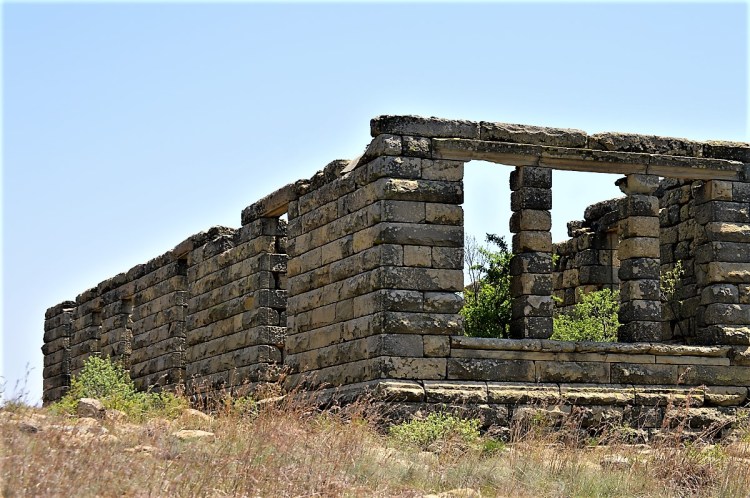
So with Jurie te velde, building on his lovely home ceased. Today the impressive ruins – not ruins: the unfinished start – of the home Jurie wanted to build for his wife still stand:
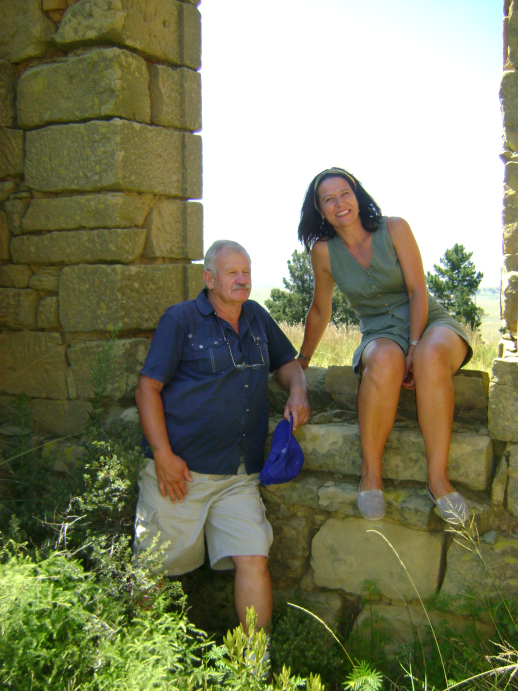
– here you can estimate the scale of the building – BIG windows – – another look at the scale of the place – Leon Strachan with Jurie’s grandaughter Mia Prinsloo –
~~~oo0oo~~~
Many thanks to Harrismith historian Leon Strachan for keeping Harrismith’s history alive – and for the photos. For more and better info, read his book Blinkoog. He wrote four: Blafboom; Blinkoog; Botterbek and Bergburghers.
See this lovely blogpost by former Harrismithian Sandra Cronje, where she wrote a longer, better story with Leon’s research and input.
In October 1902, just four months after the end of the Anglo-Boer War, Sir Percy Fitzpatrick bought the farm Dreyersgeluk near Verkykerskop in the Harrismith district from the insolvent estate of Petrus Dreyer, poor bugger. Fitzpatrick then got Herbert Baker to design a fine sandstone homestead, and to assist him in building it in 1903 – ‘but without full professional services’ (Keath 1992:104-105).
Baker, who became Sir Herbert in 1926, was an English architect who worked in South Africa from 1892 to 1913. His first job was for Cecil Rhodes on Groote Schuur; over the next twenty years he dominated the architectural scene in South Africa, designing the Union Buildings in Pretoria in 1910.
– Fitzpatrick changed the farm’s name to Buckland Downs –
James Percy Fitzpatrick was born in 1862 in King William’s Town, the son of Irish immigrants from Tipperary.
Active in politics and very pro-England, Fitz agitated for war against the boers. Calling for an invasion of the sovereign state he was living in! He was convicted of treason against the Transvaal state in 1896. Nasty! Being on the winning side, though, meant he was knighted in 1902. All is forgotten if you win, and what happened gets re-written.
As an author, his most famous work was ‘Jock of the Bushveld’. Written in 1907 while staying at Buckland Downs, it told about his life as a transport rider in the lowveld goldfields of the old Zuid Afrikaanse Republiek. The Jock stories began as bedtime stories told to his children. Apparently urged to publish them by his friend, famous author Rudyard Kipling, the stories became one of South Africa’s most famous books of all time.
Around 1910 Fitzpatrick ordered a large number of different varieties of oak trees from England and planted them in the shape of the Union Jack on about 35ha of land on Buckland Downs. Despite these two obvious anti-local actions, Sir Percy said “I would rather be a meerkat in Africa, than a millionaire in England.” Of course, he meant that only as long as Africa was under British rule.
Fitzpatrick’s daughter Cecily (1899-1992) later stayed on the farm with her husband Jack Niven. In the 1940’s the famous ornithologist Austin Roberts (1883-1948) used to visit them on Buckland Downs. Patrick Niven tells how Roberts involved the family during a 1942 visit in a collecting expedition to the nearby Spitzkop for specimens of swifts – probably at a nesting site?
Cecily became very involved in birds – her name is reflected in the List of Members of the Southern African Ornithological Society (SAOS) for April 1935, the receipt for her subscription is signed by Austin Roberts himself – honorary secretary at the time. In 1948 she established a Committee for Bird Protection as a subsection of the Wild Life Protection Society. In 1957 Cecily was the driving force behind the first Pan African Ornithological Congress which took place in Livingstone, Zambia. In 1960 she established an Institute for African Ornithology – now fondly known as the ‘Fitzstitute’ – dedicated to the memory of her father, Sir Percy FitzPatrick, through a £15,000 endowment (around ten million Rand in 2007 money) from the FitzPatrick Memorial Trust.
~~~oo0oo~~~
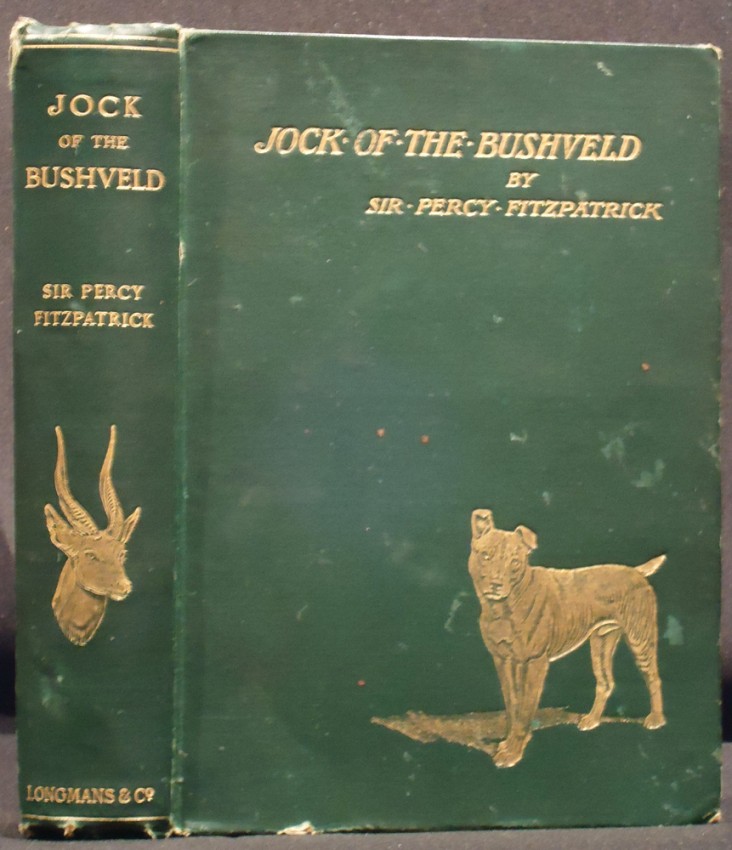
A first edition copy of Jock is going for $7500 in 2019. And then THE first edition is for sale by Clarke’s Bookstore. I wonder how much that will fetch? Here’s the inscription Percy himself inscribed in it:
Illustrated by E.Caldwell
DESCRIPTION:
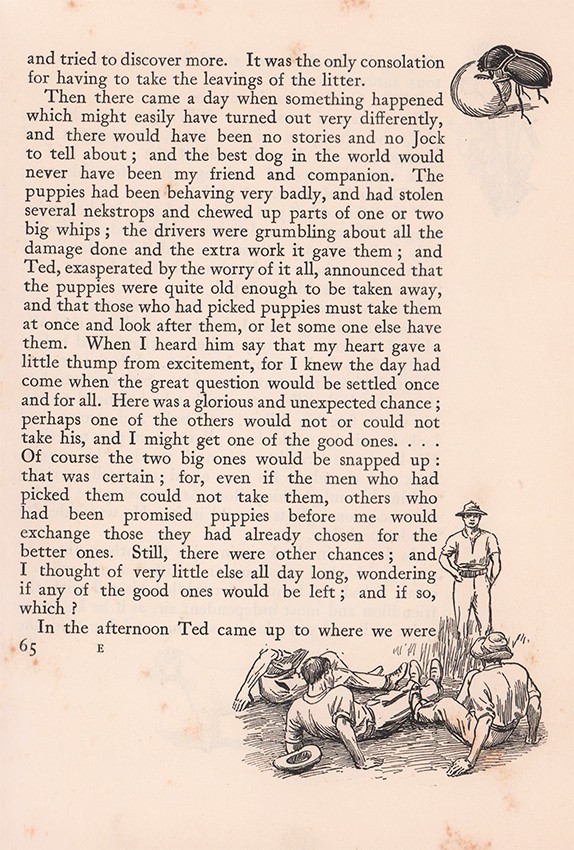
First edition, First impression. 475 pages, colour frontispiece, plates and marginal illustrations, dark green cloth with gilt titling and gilt vignette of Jock on the upper cover, light foxing throughout mainly in the text and on the page edges, with the drawings of a dung beetle pushing his load with his front legs rather than his back legs on pages 65, 337 and 457 and Snowball the horse being dragged out of the river on page 316 – these drawings were changed in later impressions. The spine is starting to fray at the top and the bottom, the bottom edge of the upper cover and the corners are slightly scuffed, housed in a specially made oatmeal textured cloth solander box with a dark green title label gilt on the spine, a very good copy of the first edition. Overall Condition: A Very Good Copy
5000 copies of the first impression were printed at a total cost to Longmans of £416. 7s. 11d.
Signed on the title page by J Percy Fitzpatrick. His full name was Sir James Percy Fitzpatrick.
Inscription on the front paste-down end paper reads: This – the first copy of “Jock”- “belongs to the Likkle People” and the mere narrator desires to acknowledge that fact in proper form. J Percy Fitzpatrick, Hohenheim October 1907
The dedications page reads: It was the youngest of the High Authorities who gravely informed the Inquiring Stranger that “Jock belongs to the Likkle People!” That being so, it is clearly the duty, no less than the privilege, of the mere Narrator to dedicate the Story of Jock to those Keenest and Kindest of critics, Best of Friends, and Most Delightful of Comrades, The Likkle People.
Fitzpatrick’s adventures – centred on his dog Jock, a Staffordshire Bull Terrier cross – when he was pioneering in the Bushveld, are vividly described in this South African classic. He used to recount them in the early 1900’s to his four children, Nugent, Alan, Oliver, and Cecily, to whom the book was dedicated – the likkle people.
Rudyard Kipling, an intimate friend, at some time took part in these story-telling evenings, and he it was who persuaded Fitzpatrick to put the stories together in book form. Having done this, Fitzpatrick searched for a suitable artist to illustrate the book and eventually came across Edmund Caldwell in London and brought him to South Africa to visit the Bushveld and make the drawings on the spot.
The book, which appeared in 1907 for the first time, was an immediate and overwhelming success, being reprinted four times in that year.
Extracted from his South African Memories pages 24 -25: Of course to those who have read Jock of the Bushveld he needs no introduction. Jock and Jess and Jim will always live in the memories of the Likkle People whom he was addressing and whom in every generation of young South Africans he will continue to address. The Likkle People have always loved Jock and his companions because they know what was being told to them was true and that it was all about their own wonderful country.



























 Vrystaat Confessions