Harrismith is still a lekker dorp thanks to some hard-drinking maniacs that hang out there, bitter-einders clinging to life behind the boerewors curtain.
See this report – reproduced below – of a highly important, highly competitive Boer War re-enactment golf – or moer-en-soek – tournament last year.
~~~~oo0oo~~~~
Conquering
of the Boers
Her
Majesty The Queen
Buckingham
Palace
London, England
4th
June 2018
Our
dearest and beloved Queen,
After
the marriage of Prince Harry to Ms Megan Markle, I wish to convey
further good news to you, and to the rest of your Royal family.
As
your military attaché in Africa, it gives me great pleasure to
advise that the Boers have been conquered at the battle of
Harrismith which took place on the 2nd & 3rd June 2018. The
white flag of surrender was raised by General Hamman, at 13h00 on
this historical day for your universal British Empire.
During
my lengthy military career I have never witnessed a display of such
loyalty and courage, as shown by your troops in this bloody battle.
Your forces received only a few minor scratches and bruises, while
the Boer field hospital has called for additional nursing staff,
surgeons and even psychiatrists to treat their mentally scarred
soldiers. There were no fatalities.
Your
Majesty will also be most pleased to hear that during the cease-fire
period, as declared by Chief Justice Lord George Galloway, the
British and Boer troops were treated to an elaborate Royal Banquet.
At this very grand occasion, the soldiers from both sides mingled
and socialized well. In some cases, too well! This developing
inter-continental relationship seems to be getting stronger, despite
the humiliating defeat dealt out to the Boers.
On
a personal note, please pass on my fondest greetings to my old friend
Prince Phillip. I trust he is enjoying his retirement.
I
await your instructions regarding any further military operations
required .
Your
loyal Military Attaché,
Field Marshall Mark Russell VC
– The Field Marshal tall, left of middle – Venning in jacket and tie next to his ossewa – – Jelliman in the mid-background, most of his hair on his upper lip –
After the 2017 tournament Field Marshall Russell VC’s report to Her Majesty, Mev Queen had been far more tragic . . . and despondent.
~~~~~ooo000ooo~~~~~
lekker – romantic
bitter-einders – to the bitter end; lager, ale, bitters
boerewors – sausage; and like laws, you may not want to know how it’s made – based on a quote by: John Godfrey Saxe American poet
moer-en-soek – golf as prescribed by the Royal and Ancient, which only frowned on women membership for the first 260 years, kindly allowing them in after that cooling-down period
boere musiek – noise emitted by farm implements called ‘constant screamers’ and ‘pull pianos’
volkspele – dance in which you can grip your meisie in a dominee-approved manner
I put my head down, leaned forward and reached for a flat blade-full of Umgeni water and pulled it back to behind my hip. This was not a characteristic action. I was not used to putting effort into my paddling, but this was serious: I had team-mates, and we were in a race. This was the Kingfisher Canoe Club 12-hour enduro. I think we were raising funds for the new clubhouse, and I was in a KCC team, maybe the F-Team or the Z-Team.
When I got back from my blistering lap under the big concrete Athlone bridge pier in the Umgeni river at Blue Lagoon, my team-mates assured me it was the slowest lap in the history of canoeing, a record unlikely ever to be broken and they had all grown a beard, shaved it off and grown another while waiting for me. Rude bastids.
Thanks guys. It was nothing.
Roly Bennett took over from me (yes, we were a crack squad) and fell out three times before he got out from under the shadow of the Athlone bridge.
He then stood on his long knobbly legs in the mud of the shallow water and filled the boat halfway with water, reckoning this gave him some stability. Being a yachtsman he knew all about lead in your keel. He got back in and paddled off with half a millimetre of freeboard, gunwales awash half the time;
When Roly – eventually – got back my team-mates assured me:
A. That my record had been shattered and I was now only the second-most useless member of our crack squad;
* alternative ending (I can’t remember which is true): *
B. That despite Roly being handicapped by a pathetic tap-tapping paddling action, an absence of calves and a half-sunken ship, my record still stood.
We’re all exhorted to Sieze the Day! Carpe diem, said Horace. Grab Opportunities as they arise! Well, some people do just that.
I was reading about Andrew Geddes Bain, geologist, road engineer, palaeontologist and explorer in the Cape up to 1864, and his son Thomas Charles Bain, road engineer in the Cape up to 1888, when it suddenly struck me!
First, let’s see what these two very capable men achieved: Andrew Geddes Bain was in charge of the building of eight mountain passes, including the famous Bain’s Kloof Pass, which opened up the route to the interior from Cape Town. And he (and his wife) had about thirteen children. His son Thomas Charles Bain saw to the building of nineteen passes! His crowning glory was the Swartberg Pass that connects Oudtshoorn in the Little Karoo with Prince Albert beyond the Swartberg mountains in the open plains of the Great Karoo. And he (and his wife) also had about thirteen children.
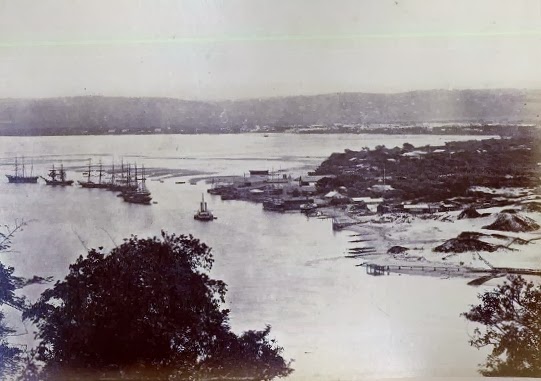
And I suddenly knew exactly what happened when my Great-Grandfather Stewart Bain and his brother James Bain got off the ship in Durban in 1880. They were fishermen from the tiny fishing village of Wick, in the far north-eastern corner of Scotland, used to being ‘knee-high in brine, mud, and herring refuse.’ * They left Wick and gave up fishing some time after an uncle Stewart had drowned in a fierce storm while out fishing off Wick in one of those little boats. They got onto bigger boats and headed for warmer climes in the colonies: Durban, Natal.
– Durban harbour ca.1880 looking inland from the Bluff, showing the Point at right –
When they arrived in Durban people asked them: ‘Bain? Are you the famous Bain road builders? We need road builders here. Can you build bridges too?’
And I know just what the brothers Bain said. ‘Roads? Och aye, we can build roads. And bridges? We can build them with one hand tied behind our back.’ You know, the old, ‘You’re payin’ how much to do that? Well, you’re in luck. I Happen to be Very Good at it . . . ‘
– some nice bridges there – this one in Swinburne –
And so they built the railway bridges between Ladysmith and Harrismith, utilising their herring netting experience, learning as they went, ‘upskilling’ – thus goes this theory of mine – no doubt with the help of African labourers who had done this before.
And thereby they helped the railroad reach that wonderful picturesque town in the shadow of Platberg, so that I could be born. This subterfuge and venture made them enough money to buy the Railway Hotel (Stewart; he re-named it the Royal cos every Saffrican town has to have one), and build the Central Hotel (James); Then they could marry, have children – only about nine and eight apiece, though – and become leading citizens of their adopted dorp in Die Oranje Vrijstaat Republiek, a sovereign non-British country.
Then: One of Stewart ‘Oupa’ and Janet ‘Ouma’ Bain’s nine ‘Royal Bain’ children Annie, had two daughters; and one of those – Mary – had me! And here I am.
~~oo0oo~~
Think I’m being unkind to Wick, village of my ancestors? Read what Robert Louis Stevenson wrote about Wick to his mother when he stayed there in 1868:
‘Certainly Wick in itself possesses no beauty: bare, grey shores, grim grey houses, grim grey sea; not even the gleam of red tiles; not even the greenness of a tree. The southerly heights, when I came here, were black with people, fishers waiting on wind and night. Now all the boats have beaten out of the bay, and the Wick men stay indoors or wrangle on the quays with dissatisfied fish-curers, knee-high in brine, mud, and herring refuse. The day when the boats put out to go home to the Hebrides, the girl here told me there was ‘a black wind’; and on going out, I found the epithet as justifiable as it was picturesque. A cold, BLACK southerly wind, with occasional rising showers of rain; it was a fine sight to see the boats beat out a-teeth of it. In Wick I have never heard any one greet his neighbour with the usual ‘Fine day’ or ‘Good morning.’ Both come shaking their heads, and both say, ‘Breezy, breezy!’ And such is the atrocious quality of the climate, that the remark is almost invariably justified by the fact. The streets are full of the Highland fishers, lubberly, stupid, inconceivably lazy and heavy to move. You bruise against them, tumble over them, elbow them against the wall — all to no purpose; they will not budge; and you are forced to leave the pavement every step.’
~~oo0oo~~
Now read a sterling and spirited defence of our ancestral Scottish dorp by Janis Paterson – a feisty distant cousin, and also a descendant of the Bains of Wick; who read my post and reached for her quill (I have paraphrased somewhat):
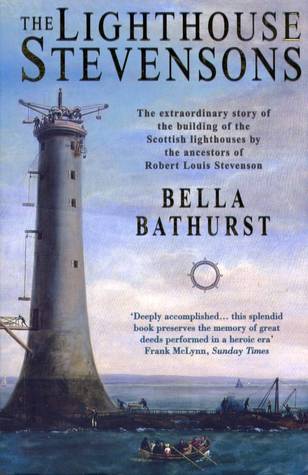
Ya boo sucks to RLS! Robert Louis Stevenson was a sickly child. His father and his uncles were engineers who built lighthouses all over Scotland. Robert was sent to Wick, likely to get involved in building a breakwater there with his Uncle. But he was more interested in writing stories and was just not cut out for this sort of work. I believe he was also ill while in Wick. The first attempt at building the breakwater was washed away during a storm and also the second attempt. The work was then abandoned. I therefore propose that Robert just didn’t want to be in Wick, was ill, fed up with the weather and just wanted to get away to concentrate on his writing. The Stevenson family must have been excellent engineers, as all the lighthouses are still standing. Did Robert also feel that he was a failure as an apprentice engineer?
Stick it to him, Janis! How dare he call Wick fishy? Or smelly!? Or breezy!? Even if it was! Just cos a dorp is fishy smelly and breezy doesn’t mean strangers can call it fishy smelly and breezy!
Janis adds ‘Read this book review:’ ‘ . .fourteen lighthouses dotting the Scottish coast were all built by the same Stevenson family that produced Robert Louis Stevenson, Scotland’s most famous novelist. Who, unlike the rest of his strong-willed, determined family, was certainly not up to the astonishing rigours of lighthouse building.’
Janis was right! 😉 All HE could do was scribble. Like me. But better.
Lots of confusion about the Baines, Baynes and Bains, so Prof Emeritus at UNISA Jane Carruthers set about unravelling eleven of them here in an article titled, The Bane(s) of South African Historians: https://www.theheritageportal.co.za/article/banes-south-african-historians?utm_source=substack&utm_medium=email – Road-builders, hoteliers, preachers, artists and one good trade unionist who fought for the poor honest working people and so gets the appellation “notorious!” Also, a Donald Bain of fighting for a Bushman Homeland Fame was born of a father who, like our Oupa Bain, was from Wick, so possibly related and may also have smelt of herring when he first got to South Africa.
~~oo0oo~~
On our big Karoo / Garden Route tour in 2023 Jess and I stopped at a monument to the original road-building Bains who I say inspired our newly-arrived, soon-to-be Vrystaat Bains to do likewise.
~~oo0oo~~
Later I found this on the Ladysmith to Harrismith extension of the rail line. Maybe the Bain bros got a piece of this action?
LADYSMITH – VAN REENEN – HARRISMITH
After the survey for the rail link from Ladysmith to Van Reenen was finalised, the route was pegged out in June 1889. A junction was formed a mile north of Ladysmith Station, recorded as 190¼ miles from Durban and 3350ft asl, and appropriately named Orange Free State Junction. However, terminating the line at Van Reenen was not considered very remunerative, and tapping into the OFS’s rich agricultural eastern region would make the undertaking more profitable. Negotiations with the OFS Volksraad resulted in the Natal Railway Administration being granted the sole right to build, equip and operate the extension from Van Reenen to Harrismith. Representatives of both Governments met in Harrismith on 25 February 1890 to work out the agreement’s details. In terms of the agreement signed on 24 June 1890, the railway was to be completed within three years of the turning of the first sod. Significantly, while profits would be equally shared between the two Governments, all operating losses would be borne by Natal alone. The Free State could, at any time, after giving six months’ notice, take over the railway at the cost of its original construction and any other capital expenditure.
Contracts for the earthworks and masonry culverts from Van Reenen to Harrismith were awarded on 22 January 1891†. The route generally followed the course of the Wilge River, graded at 1 in 80 with 600ft minimum radius curves. The energetic approach of the work crews completed the extension four months ahead of schedule. The extension from Van Reenen to Harrismith was taken into use on 13 July 1892. Initially, there was only one station, Albertina, later renamed Swinburne, between Van Reenen and Harrismith.
Distance from Durban, elevation in feet
Van Reenen 226 5520·49 Staging Station at the Natal/OFS border
Albertina 234¼ 5408·46 Passing Station
Harrismith 249½ 5322·30 Temporary Terminus
† The section from Van Reenen to Harrismith was built and operated by the NGR under an agreement signed on 24 June 1890 between the Orange Free State Volksraad and the Natal Colonial Government. The Orange Free State Volksraad authorised the Natal Railway Administration to construct, maintain and work, at its own risk, the line from Van Reenen to Harrismith. The working of the line was taken over by the CENTRAL SOUTH AFRICAN RAILWAYS (CSAR) in November 1903. No construction maintenance was allowed under capital expenditure (Under Law 29 of 1890, a sum of £260 000 was authorised for the construction of this section).
This ‘Bain’s Railway Map, c. 1903’ must surely be one of the famous Bains?
Dad was a Post Office technician. Back before we were born. He applied for telephones, which was more technical, but was given electrician. He did his apprenticeship ca.1938 and was soon put on telephones, given a truck and sent off to Ixopo where he was assigned a ‘line boy.’ Actually an adult to do lots of the hard work for you. His lineman’s name in Ixopo was Freddie.
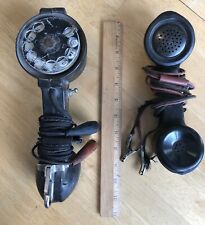
– here’s his truck, his dog and his shadow –– testing, testing – an American lineman– testing, testing, a South African lineman from HeritagePortal.co.za –
Himeville fell within his area and he got to know the lady in charge of the General Post Office there – Miss Viven Wise. Miss Viven D Wise, actually, which got the young techies snorting as “VD” was rude. She spoke of the Sani Pass up into Basutoland and how beautiful and rugged it was, so when out that way one day Dad decided to see if he could get there. He soon came across a stream he had to ford, so out jumped Freddie to pack stones in the stream so the truck could get across. Soon another stream and the same procedure. After the fourth stream he decided this is going to take too long and turned back.
He also tells of putting in new telephone lines. From one farm to the next the line would go as the crow flies, over hills and through valleys. They’d be allocated long gum poles treated with creosote and they’d take them as close as they could in the truck, but to some places they had to be carried on their shoulders. Heavy and the creosote burning their shoulders, they’d lug them over the veld, dig the holes and plant them. I’m guessing Freddie did his fair share of the heavy lifting.
– linesman handsets –
In 1973 I had another Dad, also a lineman. Rotarian Don Lehnertz worked for the electrical utility in Apache Oklahoma. Wish I’d noted which company. He and Jackie very kindly hosted me as an exchange student for three months of that year.
Interesting that the famous song Wichita Lineman was written about a lineman up a pole in Washita County Oklahoma just west of my town Apache in Caddo County: (wikipedia) Webb’s inspiration for the lyric came while driving through rural southwestern Oklahoma. At that time, many telephone companies were county-owned utilities, and their linemen were county employees. Heading westward on a straight road into the setting sun, Webb drove past a seemingly endless line of telephone poles, each looking exactly the same as the last. Then he noticed, in the distance, the silhouette of a solitary lineman atop a pole. He described it as “the picture of loneliness.”
Back in Harrismith, before too long, Dad got rescued from the Post Office by his beloved Mother-in-Law. Who gave him a job.
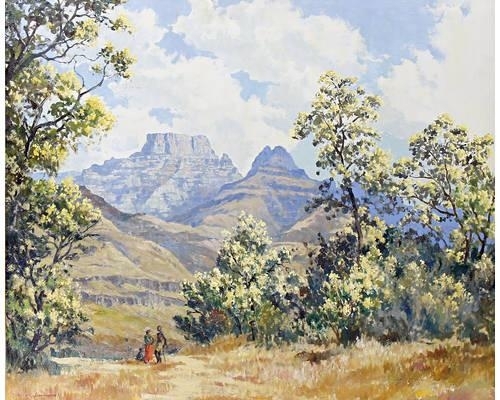
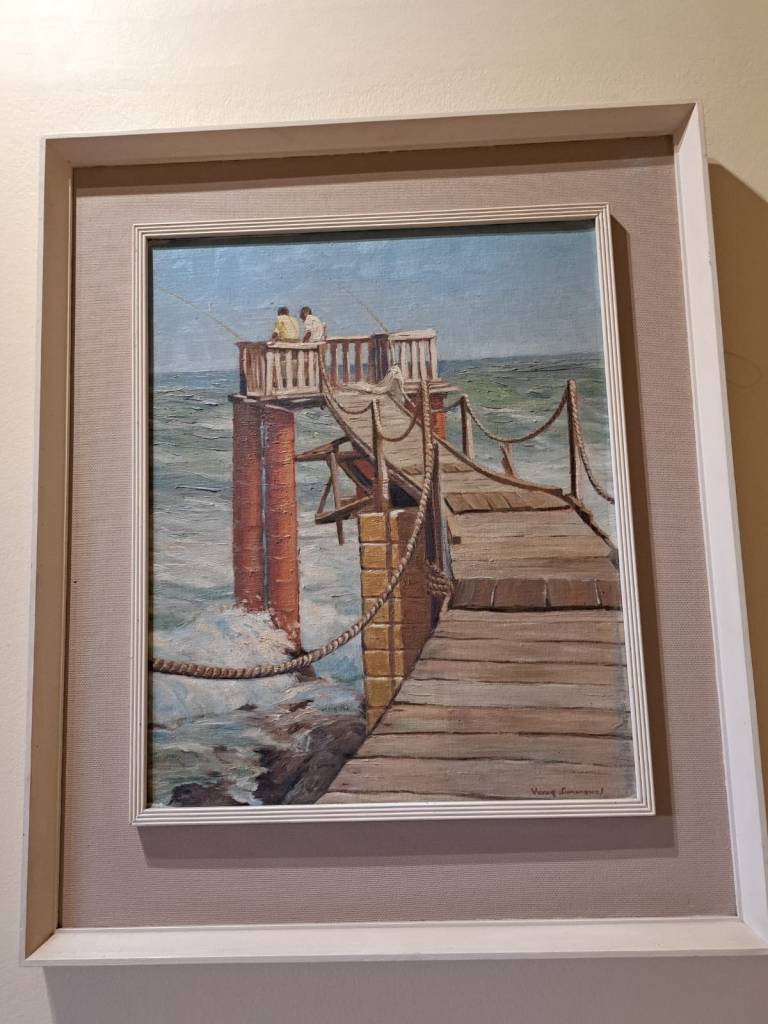
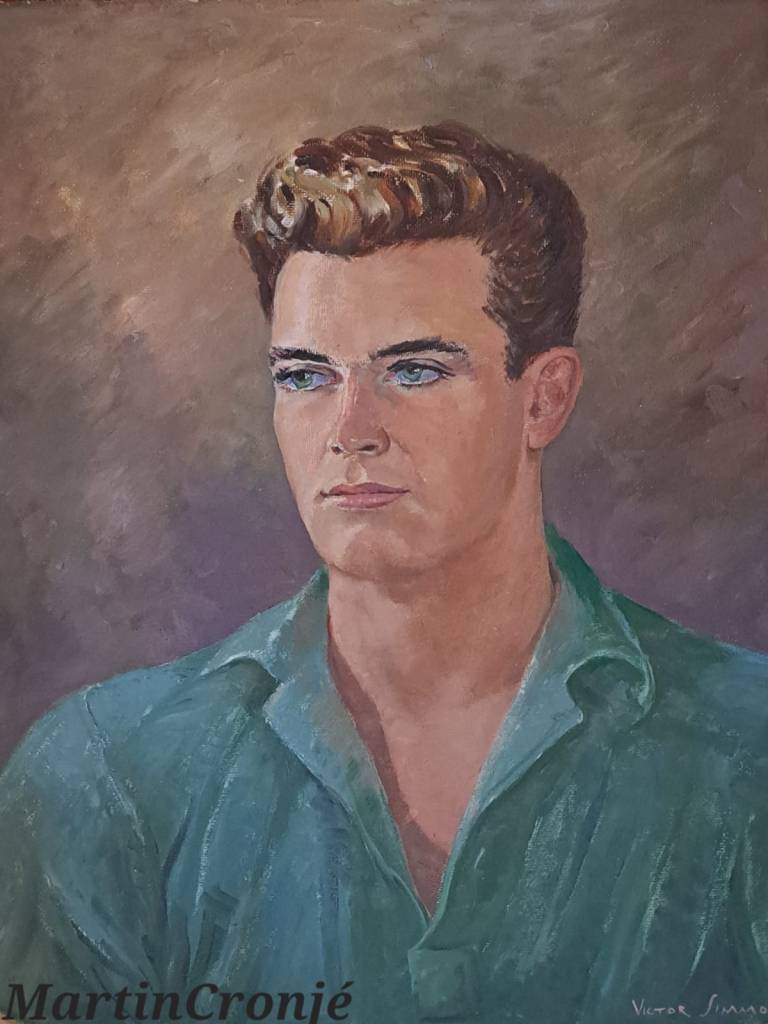
Dad: “Victor Simmonds was a lovely chap and a very good artist. He was a little man, grey, a lot older than me. What? How old? Well, I was probably 35 then and he was grey. He was probably 50. He lodged with Ruth Wright (Ruth Dominy by then) on the plot next door to ours, Glen Khyber. I doubt if he paid them any rent, they were probably just helping him out. He moved to the hotel in Royal Natal National Park where they allowed him to sell his art to the guests and that probably paid his rent.
“He was a hopeless alcoholic, unfortunately. He used to come to me begging for a bottle of brandy late at night, his clothes torn from coming straight across to Birdhaven from Glen Khyber, through the barbed wire fences. (Mom and Dad owned a bottle store, liquor store, in town) I said ‘Fuck off, Victor, I won’t do that to you,’ and sent him away. I wish I had bought one of his paintings. Sheila found these four paintings he gave me for nothing. He said he did these as a young student. As I took them he said, ‘Wait, let me sign them for you.’”
– maybe a self portrait? – – nude with amphora? – – semi-nude with two amphorae? – – maybe the Kak Spruit at or near Glen Khyber? – possibly –
So I went looking and found a lot of his work available on the internet. Once again Dad’s memory proved sound. Victor was born in 1909, thus thirteen years older than Dad:
Victor Simmonds’ work has been offered at auction multiple times, with realized prices ranging from $126 to $256, depending on the size and medium of the artwork. Since 2012 the record price for this artist at auction is $256 for South African landscape with two women carrying wood, sold at Bonhams Oxford in 2012. Also see here and here and here
– South African Landscape With Two Women Carrying Wood –– shrubs beside a cascading stream –
I knew this scene! I recognised it immediately! To me this looks like the stream above the Mahai campsite in Royal Natal National Park – So I went looking and at lovecamping.co.za I found this:
– spot on!! – an image locked in my brain for maybe fifty years! –– sunset, poplar trees, a river – the Wilge near Walton farm? – (or – see below . . )
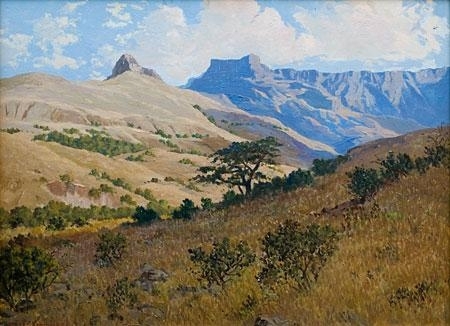
A number of his paintings are available for sale. I’d love to see his ‘The Gorge, Royal Natal National Park, Showing the Inner Buttress and Devils Tooth’ but I’d have to subscribe for one day at 30 euros! That one was apparently painted in 1980, so he kept going for at least 23 years after he stayed in our neck of the woods. That would have made Victor around 70 and his liver a resilient organ.
– more Victor Simmonds Drakensberg scenes – ca.1946 – click to enlarge –
~~oo0oo~~
Now its 2024 and look who has popped up onto my vrystaat confessions: All my life I’d heard Mom speak of Corry Cronje and Len Cronje, and Corry’s daughter Liz found my scribblings. Or rather, Liz wrote a delightful nostalgic personal memoir about the Cronjes of Witsieshoek, (post it online Liz and I’ll link to it!). Anthony Maeder sent it to me and put me in touch with her. We got talking and got onto the topic of this talented artist who spent time on a neighbouring plot to the one we grew up on, and on a neighbouring farm to the one Liz grew up on.
Brothers Corry and Len lived in Witsieshoek on neighbouring farms, Patricksdale and Mountainview respectively. Victor Simmonds stayed with Len and his wife Lettie on Mountainview for quite a while and painted on both farms and the surrounding area. Liz Finnie Cronje is Corry’s daughter and when I told Mom she immediately said, “Oh Corry’s wife Rosalie was a big friend of Annie’s (her mom). They would have long chats at Annie’s Caltex garage when the Cronje’s came to town.”
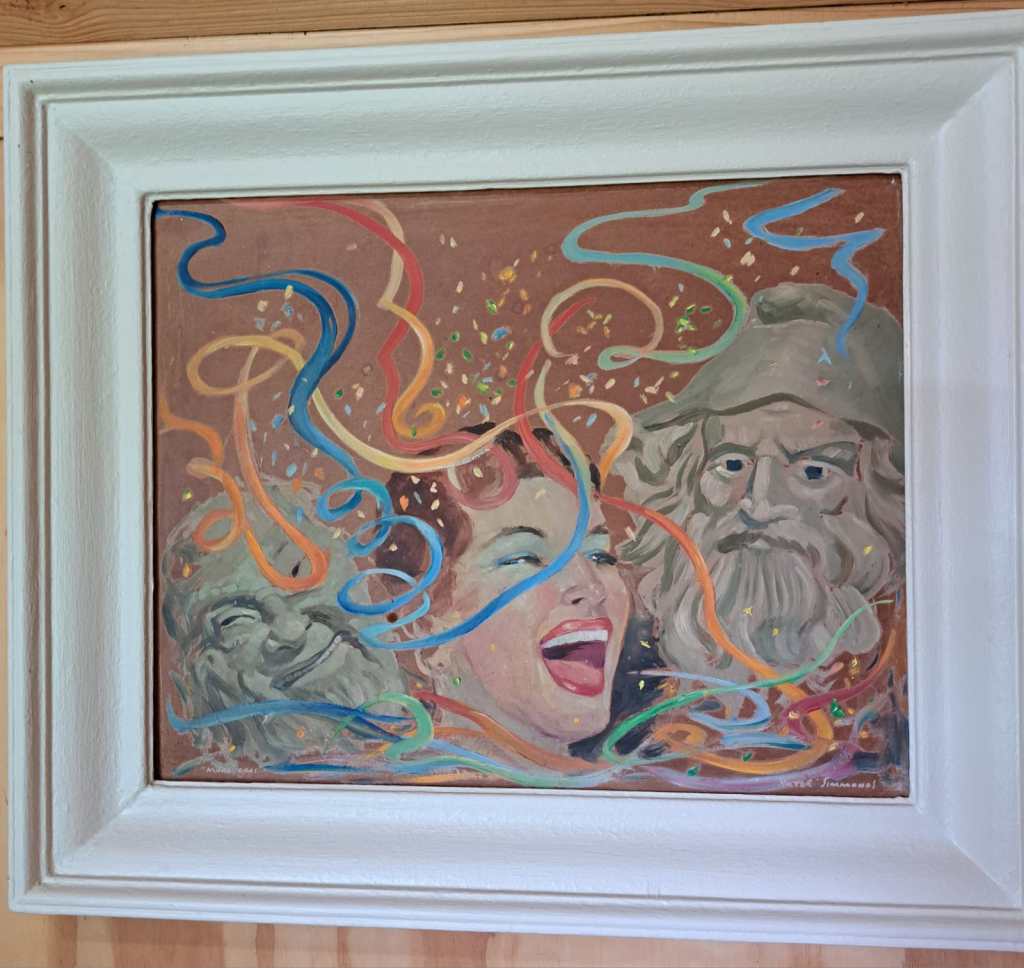
Len and Lettie’s daughter Josie Cronje Batchelor has a number of Victor Simmonds’ paintings and she has OK’d my posting them here. Wonderful! One more place where his talent can be appreciated.
– View from Mountainview across Patricksdale to the ‘Berg –
Click to enlarge – Left: Pier – Right: The poplars in Autumn –
This next one has to be on its own. Here’s why: Josie Bachelor, nee Cronje of Mountainview wrote: This is my favourite. The Gold Lamé in the background was my mom’s evening dress. The vase and porcelain horse also Mom’s. Mom did the arrangement. The table belonged to Vic.
Knowing a picture’s background and place and story makes it so much more interesting and valuable, doesn’t it?
~~oo0oo~~
Two more! With a note from Liz: I think I missed out on two more paintings. Both on Mountainview of the original Randall Bros. store in Witzieshoek taken over by Arthur Gray late 19th century I think. The chief (forget his name – ed. maybe Ntsane 1898 – 1918) asked if Arthur could open a shop in Witzieshoek as his people had difficulty getting to the shop during very rainy weather owing to the full Elands River. When my grandparents, Kerneels and Edie Cronje returned after the Boer War they renovated the shop and turned it into a cottage where all but the eldest Cronje (Andries) was born beginning about 1906 when my Dad, Corry was born.
I asked Leanne Hilkovitz Williamson about Poccolan / Robinson’s Bush and this brought a flood of memories:
She takes up the story:
I was born on the farm De Nook which belonged to my grandfather Elias Hilkovitz and was inherited by my father Leo Hilkovitz after the 2nd World War probably round about 1945, two years before I was born.
Dad built Little Switzerland Hotel on the farm and we made pathways through the forest called Robinson’s Bush for guests to hike to various spots: The Wishing Well, Protea Plateau, etc. I named most of the spots, and one that meandered in and out of the forest edge I named Hilky’s Way after my grandfather who was affectionately known as Hilky.
We sold the hotel when I was in my early twenties but the various owners over the years have kept the use of the forest and the guests continue to enjoy its wonderful beauty – it is wonderfully exhilarating to either clamber down Breakneck Pass from the Wishing Well or climb up to it from the road below. The path twists and turns in amongst indigenous trees, true and mock yellowwoods, and lianas and ferns along the side of a stream full of huge beautiful boulders in all shades of grey & lichen & dappled shade. So one experiences the mountain air, the refreshing sound of the steam and always the melodious bird song. I particularly loved calling up the Mocking Chats and Natal Robins that mimic other birds and have a whole repartee of calls, copying them and they’d call back. A wonderful game that Dad taught me.
According to my father, Robinson’s Bush is the biggest natural forest in the Drakensberg. I wouldn’t take that as gospel. I’ve come to be a bit circumspect about those sorts of claims that locals all over the world tend to lay claim to!
Robinson’s Bush abuts on De Nook and we treated it as part of our farm. Dad looked after it although it is part of government nature conservation; at one stage in my late teenage years there were two nature conservation officers who lived in a hut on the edge of the forest and tended it but that did not last.
I was there for my 70th birthday in 2017 with my two sons and their families and we climbed up Breakneck Pass through the forest and I showed it to my granddaughters and taught them the things my Dad had taught me.
Some of my earliest memories are of picnics in the forest on the side of the stream with our neighbours Udo and Margo Zunkle of Cathkin Hotel fame when they lived on Windmill farm. Udo would put small pieces of raw steak on the river rocks and we’d be fascinated by the crabs that came from all sides to feast on it.
~~~oo0oo~~~
Leanne again later:
Hi Again
I put together a Power Point family history together for the family and we had an evening when Ishowed it to them. It started with the great grandparents on both sides and their cars and the farm in the very early days and the beginnings of the hotel and its growth as I grew up & went to HS Volkschool & then boarding school, varsity, etc. and then our children growing up and then finally the grandchildren from babies to present. I can never leave the farm & the berg for long & return there often – even if it is just up and down in a day – and I climb a mountain, drink in the soul food and return home refreshed, invigorated and together. The families also love it and visit but we have never all been there together at the same time & so took advantage of my 70th to ask this favour. So we stayed in the timeshare from 24-28 Dec & had a wonderful Christmas & my birthday on 27th. We had a wonderful time and I was able to share some of my favourite places & stories with them just this once as you know how short attention spans are when kids are having fun. Didn’t want to bore them!
Pic of me on my birthday in my most favourite place in all the world.
~~~oo0oo~~~
Famous shenanigans: South Africa’s most notorious bank robber, Trust Bank robber Derek Whitehead, was arrested at Little Switzerland in 1971 at 3am on Friday morning the 14th of May. They had arrived at 4.30pm the previous day. A team of CID detectives from Johannesburg, the Orange Free State and Natal were involved in the swoop. After the arrest, the Whiteheads were taken to Bloemfontein for questioning
~~~oo0oo~~~
Drunken shenanigans: Omigoodness; You don’t want to know . .
~~~oo0oo~~~
Genealogy: Our Bruno the doberman was a Hilkovitz! Dad Pieter Swanepoel told me Leo came to town one day, called in at the Caltex garage and said ‘Come and look!’ On the back of his bakkie he had a bunch of little black pups in a box. Dobermans.
Dad chose one – he says he gave Leo a pocket of potatoes! – and we grew up with ‘Bruno’ – I only now found out he was a citizen of Little Switzerland! He grew up to be a handsome lad!
First run in 1921 – or in 1926 ? – over 3200m for a stake of 2000 pounds sterling, the Gold Cup is Africa’s premier marathon for long-distance runners. It boasts a proud history and captures the public imagination. The race starts at the 400m mark in the short Greyville straight; there’s much jockeying for position as the runners pass the winning post for the first time before turning sharply right and heading towards the Drill Hall; normally many runners are under pressure before they turn into the home straight; the race is known to suffer no fools when it comes to fitness and stamina, and it takes a special type of horse and jockey to win the event.
And away they go!
Usually the final big race meeting of the South African racing season, the Gold Cup is often decisive in determining the Equus Award winners for the season. Initially a Grade 1 race, the Gold Cup was downgraded to Grade 2 in 2016 and to Grade 3 in 2017. Nevertheless, it is still the most important horse-racing marathon in the country.
– 1985 – Occult wins –
The distance and unforgiving conditions that prevail as the field go past the Greyville winning post twice, are great levelers and a look at the list of champions beaten in the Gold Cup is a long one, with less-fancied runners carrying less weight often winning.
Sun Lad won the first running in 1926. He raced in the silks of leading owner-breeder Sir Abe Bailey. The Gold Cup was one of just two wins for Sun Lad that season. He is frankly unlikely to be regarded as one of the race’s better winners.
The first horse to win the Gold Cup on two occasions was Humidor, who was victorious in 1933 and 1935.
And so to us:
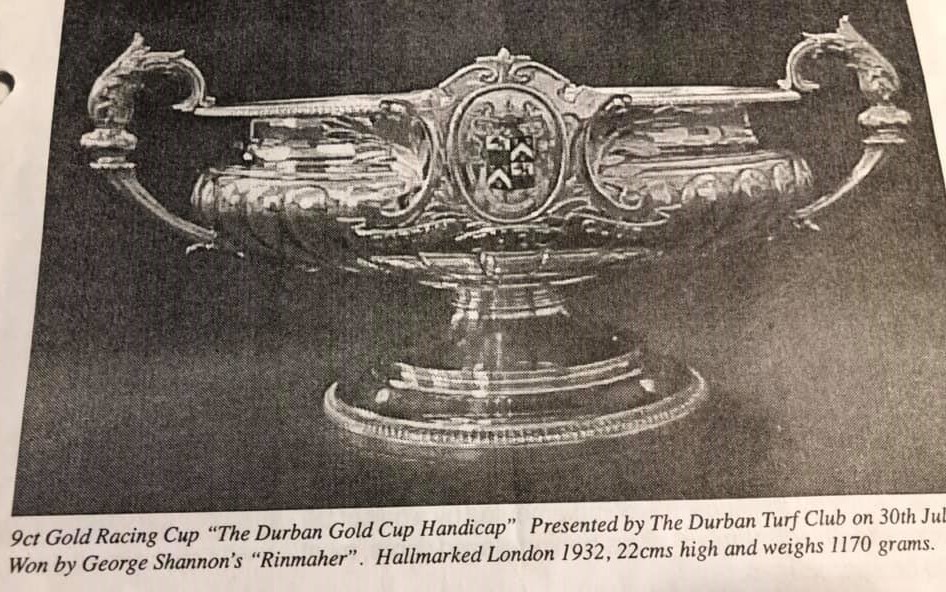
Harrismith’s winner was the horse Rinmaher (pronounced ‘Rinmahar’) owned by the George Shannons of Kindrochart. What year? Probably 1932 or 1934?
Mom and Dad both tell the story of raucous parties on the Shannon farm where at a suitably ‘sensible’ stage the Gold Cup would be taken off the mantelpiece, filled with champagne or whatever hooch was going, and passed around to the ritual comments from the more sober of “Here we go! We’re drinking moths and mosquitoes again!” At least it had lovely handles to give an imbiber a good grip!
– Jack Shannon on his Shetland pony ‘Suzanne’ on Kindrochart – with Peter Bell –
~~~oo0oo~~~
Later: Sheila rousted Colleen Walker, granddaughter of George Shannon, who straightened me out on some Gold Cup details. She even had an earlier pic of Jack and Suzanne the Shetland. More questions: Is that Kindrochart? Is that George?
~~~oo0oo~~~
May 2020 – Mom sent a message that I must phone her! She wants to tell me the full story of the brothers Shannon. Phone Me Soon does not mean that her cellphone will be on, or charged, or answered; so it was a full two days later I got hold of her;
And away they go! She took a deep breath and set off:
Jim and George Shannon left Ireland on a ship bound for South Africa. Somewhere on the journey they had a fight and fell out; They never spoke to each other again!
They reached Harrismith where they both became ‘rough riders’ – breaking in horses for the British army – I guess also for anyone else who wanted horses broken in and/or trained? Somehow and sometime, they both ended up as farmers, George on Kindrochart and Jim on Glen Gariff.
George married Mrs Belle Stephens who came complete with two daughters Betty and Bobby. Then they had a son Jack – some called him Jock – who also featured in our lives as a friendly, lean, handsome, side-burned, smiling, pipe-smoking, pickup-driving, genial figure in khaki. We loved Uncle Jack! He married Joan from Joburg – Mom Mary and her older sister Pat went to the wedding. Later Bobby married a mine manager and some people thought that was very important. Betty never married, stayed on Kindrochart, worked in town and became a beloved young-in-spirit ‘auntie’ of ours, always a smile and always a tease and some fun. We called her Betty Brooks.
Meantime Jim on Glengariff married Amy, and they had three kids, one of whom they named George, despite the feud ongoing! Maybe there was a prior ancestor George? Other kids were Marshal (died young, not sure what of) and Sylvia. George married Betty McGore and they had sons Jim and Patrick who we knew in Harrismith in the sixties. Handsome lads, Patrick maybe too handsome for his own good!
– Jack and Joan years later –
When the second of the original Jim and George died (I think it was Jim), Jack contacted young George, son of Jim, and said ‘We’re having a party. You and Betty should be there.’ And so a reconciliation took place and they normalised family relations. Up until then, their mothers Belle and Amy had been forbidden to talk to each other! She remembers that after a good few drinks and a meal and another good few drinks, the Gold Cup was taken down off the Kindrochart mantelpiece, filled with wine and passed around! George offered his wife Betty first sip and after a gulp she exclaimed ‘George! It’s full of moths and mosquitoes!’
~~~oo0oo~~~
No doubt there’ll be other versions of this tale – and much more detail. But this is how 91yr-old Mother Mary fondly remembers the story of these good friends from days of yore.
~~~oo0oo~~~
Elizabeth de Kock spotted this post and wrote:
This was so interesting for me to read. My grandfather, William Stocks, was a neighbouring farmer. We spent many holidays on their farm called Lust. We visited Aunty Betty often and enjoyed sitting on the big swing overlooking the dam. She gave us the use of a little grey pony (very naughty) to ride during our holidays. As children we got our blankets from her shop in Harrismith. The shop was an experience in itself. I’m 69 years old now and still have very fond memories of Aunty Betty.
I replied: Hi Liz – Thanks so much for commenting! Lovely memories! Betty was a lovely lady.
I’ll ask my mother Mary Bland Swanepoel (93) what she remembers about the Stocks family. I know I have heard her talk about the Stocks but can’t remember any detail.
Kind regards – BTW, I’m 66, my sister Barbara will 69 in January – maybe you remember her?
I phoned my Mom Mary Bland. She was tickled pink to reminisce about her friend! Here’s her tale:
She nursed with Margaret Stocks at the Harrismith hospital and they were great friends. She says Margaret wasfive years older and much bolder and naughtier than she was!
She once visited her on their farm at Lust. Margaret’s brother was there. Later, that brother was killed in a plane accident in the airforce. His plane wing clipped a sand dune. When she heard about it, Mary phoned Margaret to say, If you like, you can join me to mourn your brother. Margaret said, No thanks, we may as well stay here on the farm and be miserable together.
Margaret married John Reed, a farmer. A few years later, Mary took her two year old daughter Barbara and visited Margaret on the Reed’s farm near Belfast in the Transvaal. (I wasn’t born yet, so this was probably early 1955). One day he was lying in the bath and Barbara wanted to go and see him. Margaret said ‘No my girl, you’ll have to wait another twenty years for that!’ Once in Harrismith, Margaret called out the houseman on duty for her patient. When he didn’t arrive, she sent her junior nurse (who she called ‘Ginger Biscuit’) to call him. The nurse found the houseman in bed with the matron. He had to leave town.
Those were Mary’s memories of Margaret Stocks!
Liz Kibblewhite wrote again:
I was brought up on a gold mine just outside Krugersdorp and went to Lust during school holidays. If I remember correctly, Jury Swart was a neighbouring farmer to my grandfather William Stocks.
The last time I saw Aunty Betty was in 1975 with my future husband, spending the night with her reminiscing. We were on our way to Durban and I wanted to show him the beautiful Orange Free State Drakensberg and particularly Kerkenberg and the old farm before we returned to the UK.
Margaret had a twin sister Edna. My mother Joan was their younger sister.
I have been living in England for 46 years now and am proud to have passed a bit of my South African even to my grand children who live in France – they love bobotie and say muti for medicine.
There was David, Margaret and Edna, Joan (my mother), and Neil. Margaret and John (Umpie) lived in Pretoria after he left farming. Margaret died about 8/9 years ago and John before that.
Mary isn’t getting mixed up: Neil flew in Italy during WW2 and was decorated. DFC. The squadron was called 13th Hellenic Squadron. He also flew in Korea and after that a test pilot in SA.
I always wondered how his crash happened.
He was buried on the farm.
~~oo0oo~~
Ah, that’s lovely that you visited Betty before leaving South Africa!
I said to Mary: Margaret had a twin. “Edna” she said immediately. And she had a younger sister. she thought a while . . “Joan” “Their brother was Neil” she said. “He was younger than the twins.” Mary says, “When I first started dating, Margaret – never slow with her opinions! – huffed: “These people that just say yes to the first person that comes along!” Well, this time Margaret was mistaken, as Mary married her date, and seventy years later they’re still married.
Six foot four inch Pete Stoute was running the Comrades Marathon, that foolish 89km exercise in torture held annually in KwaZuluNatal, when suddenly he heard a shout from around knee-level: “Yiss, Stoute, hoezit?”
He looked around, nothing. He looked down: There was Skim, short and round as a beachball, choofing alongside. Skim du Preez, kranige scrumhalf of the great Optometry rugby team of 1975.
Skim! What the hell are YOU doing here! he exclaimed. No, Stoute, I thought I must do this thing, seeing I’m a boykie from Dundee, said Skim. – Dundee pronounced “DinDear,” the Afrikaans way – it means ‘steenkool.’ Stoute pronounced ‘stotah,’ the Afrikaans way – it means naughty.
They chatted a few minutes and then Skim said, Oh Well, Be Seeing You and ran off into the distance!! Left the long-legged Stoute in his dust!
~~~oo0oo~~~
As often, one of my dodgy history lessons: Dundee, pronounced DinDear, is the famous site where British army troops, tired of being shot through their red coats and their white helmets, finally wore khaki uniforms for the first time in battle. I wonder if their commander Major-General Sir William Penn Symons KCB still wore his red coat that day, though? He got shot in the stomach and died three days later as a prisoner of war in Dundee.
These Boers would know: The caption says they were ‘watching the fight’ that day! Like a movie!
The British claimed a ‘tactical victory’ in the battle. Here’s the actual scorecard – a lesson whenever you read battle reports. To the Poms, this (as they were informed by their jingo press) amounted to a tactical victory:
British casualties and losses – 41 killed, 185 wounded, 220 captured or missing; Boer casualties and losses – 23 killed, 66 wounded, 20 missing. So – Total count 446 down vs 109 down, but “we won.”
And so the dispatch goes back to Mrs Queen in Blighty (perhaps sent by jingo war correspondent Winston Churchill?): “We won a tactical victory, Ya Majesty.” Maybe he at least added “Um, send reinforcements” – ?
Always remember that one thing all military outfits do without fail . . is lie.
~~~oo0oo~~~
stoute – the Afrikaans pronunciation “stotah” as in kabouter; it means ‘naughty.’
kabouter – Snow White and the seven kabouters
choofing – running like a gazelle
kranige – capable; brave; gallant; dashing
scrumhalf – not only a scrumhalf – see the comments
No – yes
DinDear – Dundee; coal-mining village; not in Scotland
steenkool – coal; or stone coal; you can’t say just ‘kool’ cos that would mean cabbage
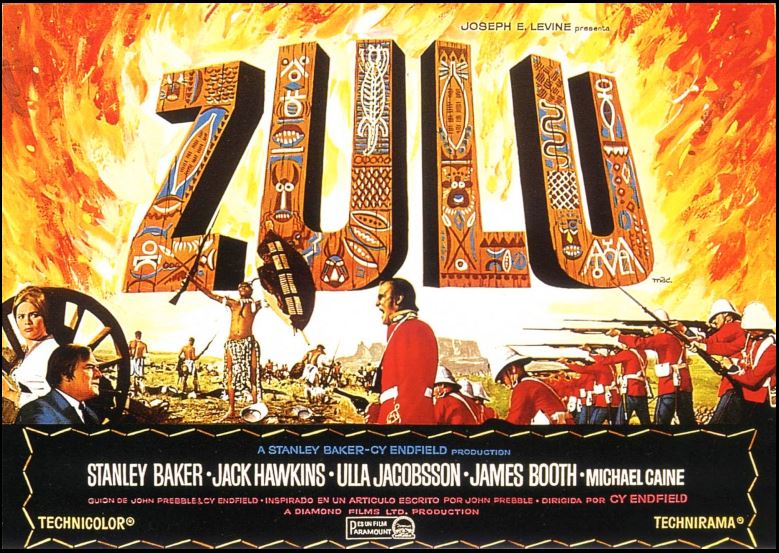
Released in 1964, ‘Zulu’ has become one of most iconic British films ever – directed by Cy Endfield, and starring Stanley Baker, Jack Hawkins and Michael Caine. I joked here that we had held the World Premiere of this famous film in our lounge in Harrismith! Hey! Sorta true!
Now, fifty five years later, a new film, ‘Zulu and the Zulus’ is planned. Scheduled to be a ninety minute feature length documentary to be shot in England and in KwaZuluNatal, South Africa, the film will tell about the making of the classic war film ‘Zulu’, and – un-colonially – also tell the stories of the Zulu people involved in the making of that famous film.
Here’s a trailer of the planned movie:
– ‘Zulu and the Zulus’ promo trailer –
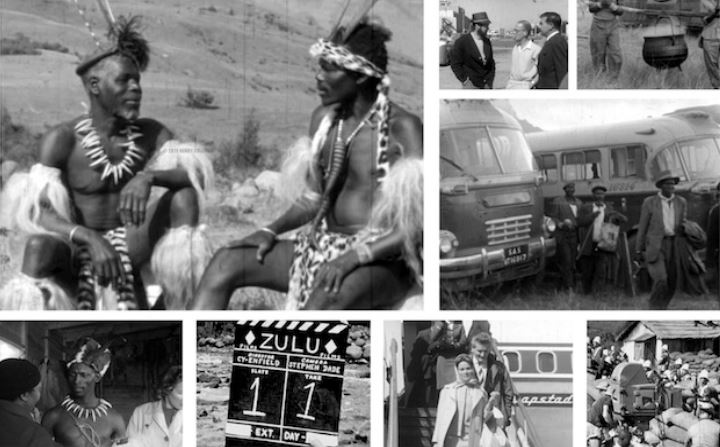
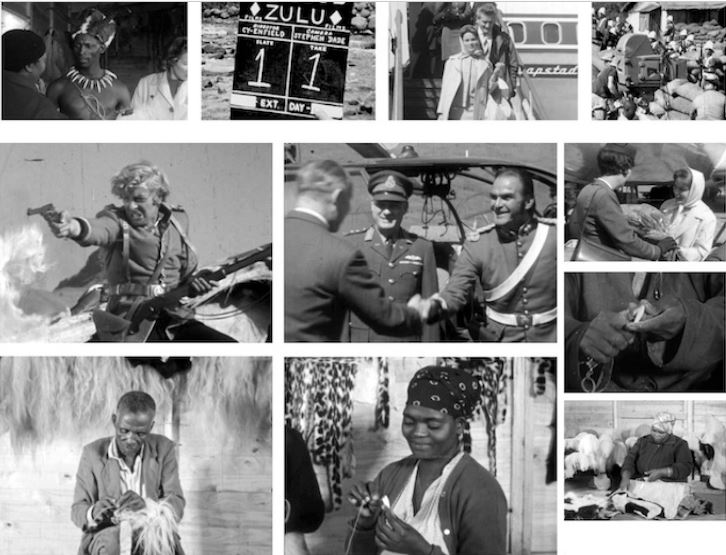
Director Henry Coleman is sole owner of the only print of the making of ‘Zulu’. Shot in Natal in 1963, it contains 26 minutes of unique black & white behind-the-scenes footage showing cast and crew at work and play while making one of the most iconic and loved war films of all time.
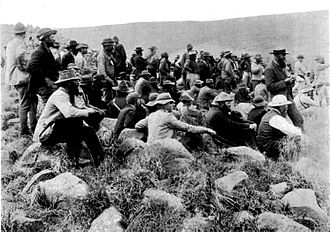
Coleman and Producer Mark Tinkler, will take this Behind the Scenes footage back to KwaZulu Natal, screen it for the Zulu people and talk to them about this historic and well-loved film – Zulus who appeared in the original film as extras. Many rural Zulu people have no access to cinemas, and no electricity in their villages, and so would have not seen the film. The production team will travel out to the remote parts of KwaZulu and screen the film either in huts or on a portable screen outdoors using a generator, DVD player and screen, film the audience watching the film, interview them and draw out their stories on the making of the film in 1963. Some of them saw the film and rushes at special screenings organised by star & Producer Stanley Baker – as seen in this rare still of film extras watching themselves in the rushes:
But many of them have never seen it since, or indeed ever. ‘Zulu and the Zulus’ will examine the making of film to the Zulus, visiting the locations in Natal where the film was shot, a Then and Now sequence. They will also visit the original battle site at Rorkes Drift. It will be a fascinating journey.
It will be a very visual experience, with Zulu warriors watching themselves and their parents playing their ancestors. Chief Mangosuthu Buthelezi, who became a minister in the first legitimate government of South Africa upon liberation in 1994, appeared in ‘Zulu’ as his Great Grandfather, King Cetshwayo ka Mpande. He has agreed to participate in this project and has given us his full support. At the heart of ‘Zulu and the Zulus’ is 26 minutes of never-seen-before ‘making of’ footage. This original 16mm silent footage has been painstakingly restored in a top post-production house in London, and this unique footage not only features the film’s ‘famous’ cast and crew on set, it also includes the building of key sets in KwaZuluNatal as well as costume design, creation and fitting, stunt work, battle scenes and much more. But more importantly, it is an historical record detailing the extent of contribution from the local community in bringing the famous film ‘Zulu’ to life.
We have also found, and gained exclusive access to, another 40 minutes of colour home movie footage shot on set, giving us a unique insight into the production of Zulu.
Seven minutes of these forty minutes of ‘home movie’ footage were taken by Dad with his new Eumig 8mm cine camera when he and Mom went to the set in the Royal Natal National Park back in 1963. Sister Sheila had the film digitised, but I won’t be showing it here as Henry Coleman has asked to use it for his movie. Hopefully some of it will make it onto the big screen!
More from Henry: ‘Zulu and the Zulus’ will tell the behind the scenes story of the classic British Movie ‘ZULU’. We will be interviewing European cast and crew and for the first time, hear the tribal ZULU actors, stuntmen & crew stories from behind the scenes. We hear tales of the making of the film, what it meant to the Zulus, then and now, and the film’s legacy to Zulus today. Everyone knows the film, it’s iconic set pieces, and the lead European actors… but no-one has ever spoken to the hundreds of Zulu warriors who took part in the film, the Zulus of the title. This is a unique opportunity to get the Zulu peoples’ point of view on a classic film named after them, but whose voices we’ve never heard before – there will be stories we’ve never even imagined, illustrated, intercut with the rare footage of the making of Zulu.
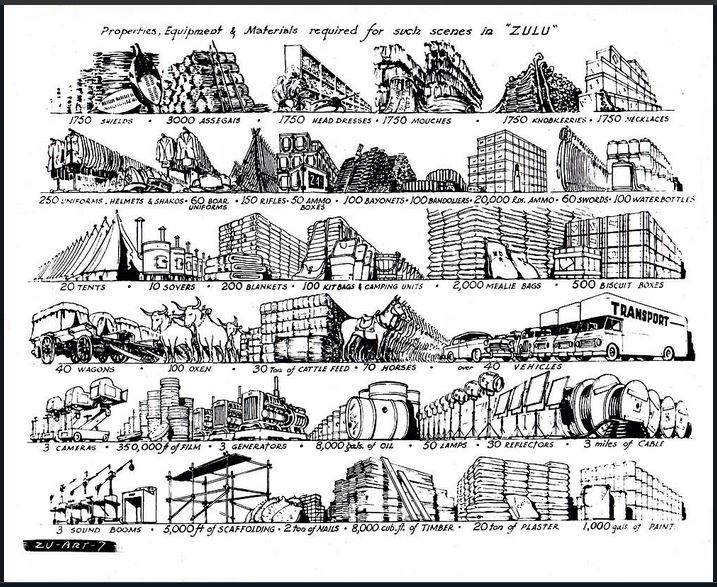
An illustration of props, equipment and ‘stuff’ used on the remote location of the set of Zulu in 1963 (from Henry Coleman’s Zulu and the Zulus twitter feed), giving an indication of the challenging logistics:
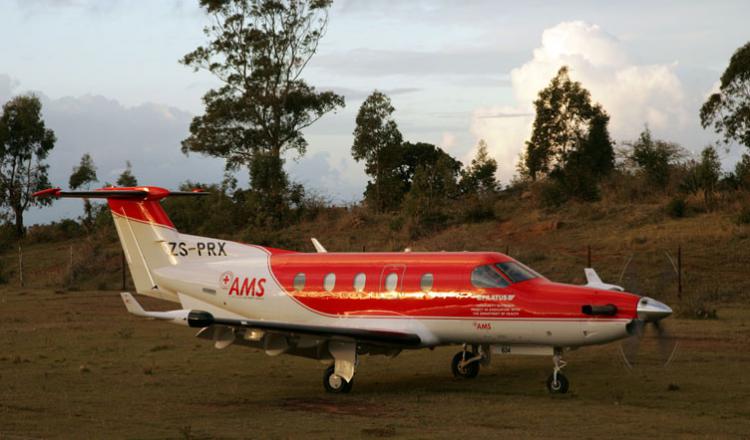
Scottish doctors. A delightful lot. The female of the species that is; I prefer them female. The guys with their kilts, beards and medical sporrans full of scalpels and aspirins, not so much. I mean, how do they scrub up with all those areas to disinfect? No thank you, give me the ladies. A few years before I had fallen deeply in love with a Scottish doctor (see Scotland the Brave) and now I was told as I got onto the Pilatus ‘flying doctor’ aircraft something like the one above, probly a PC-6 or 7 STOL craft, to fly to Charles Johnson Hospital in rural Nquthu, that a Scottish doctor – actually medical student, same as my topless surfing ‘doctor’ in Durbs – would be shadowing me to learn about eyes. I was the volunteer optometrist on this ‘flying doctor’ trip.
Before we landed outside Nquthu, we flew low over a small ragged-looking airstrip with an old Dakota parked near a big double-story homestead. Our pilot told of a famous inyanga or sangoma who got so well known and in such demand that he had to travel all over. Like house calls. Eventually road travel was no longer feasible, so he got a Dakota and a pilot to extend his reach. I’ve searched for him now, but can’t find anything about him on the ‘net! I’ll keep searching, his sounds like a fascinating story. Meantime, I’ll fantasize:
As I was settling in and unpacking my equipment in the Charles Johnson hospital outpatients department . . .
. . a whirlwind blew in! My Scottish doctor student! She was six foot tall, her smile was six foot wide and she demanded in a broad Scottish accent: “Teach me about eyes!” She was like this:
What a lovely day. We tested plenty eyes, talked non-stop, had lunch together and once again I fell in love with a Scottish doctor! Sadly she decreed dreadlocks would not suit me. To this day I think she was mistaken. They could have provided much-needed cover-up in the middle at the back.
–oo0oo–
The pic is not my second Scottish doc, just as the numbis in the last post weren’t that Scottish doc’s. It’s of a Scottish student who reminds me of my doc who, like her, was born in Edinburgh of Nigerian parents.
sangoma – a practitioner of ngoma, a philosophy based on a belief in the amadlozi – the ancestral spirits;
inyanga – concerned mainly with medicines made from plants and animals;
numbis – breasts
–oo0oo–
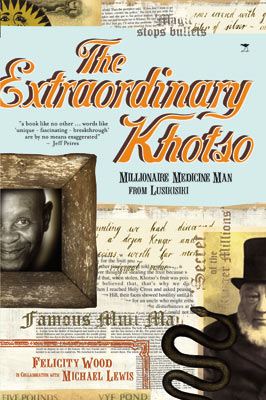
While I search for ‘my’ sangoma, read about this one that Hugh Raw reminded me about; from the fascinating village of Lusikisiki, home of the Shy Stallion Shebeen, which serves good cold beer in quart bottles:
–oo0oo–
So pleased to confirm again that I ain’t imagining this shit! My mind is strong, my memory faultless, my exaggerations few and low-key. Hugh Bland, photographic historian, river paddling mate and fifth cousin, tells me thus: Your info on the Nyanga at Nqutu is correct, but I can’t add any more info than you have. His house or mansion is on the right about two kms outside Nqutu coming from Dundee. See?
So, who’s Charles Johnson?
Charles F. Marquart Johnson was a transport rider who became a teacher who became a priest who became a bush dentist. Opportunist, perhaps? After the the Anglo-Zulu wars he decided to stay on in Zululand, having apparently been asked by one of the chieftains, Hlubi, to be a teacher. He became a priest, then archdeacon of the area. With the nearest medical facility being at Dundee, a difficult 52 km journey away, he also involved his mission station at Masotsheni in helping the local people with their medical problems. He was, by Anthony & Margaret Barker‘s account – they ran the hospital for years – a formidable holy tooth puller. Headache? Here, lemme pull out a tooth. Open Wide . .
Anthony & Margaret Barker
Anthony Barker had a lovely isiZulu nickname: ‘Umhlekehlatini‘ – ‘He laughs in the forest’ – referencing the frequent laughter that emanated from his bushy beard.
The Barker’s mobile clinic 1960
On another eyeball mechanic mission, I flew to Centocow to test eyes, and landed on that airstrip with the spectacular dropoff at the end























 Vrystaat Confessions
