Mom: When the Colemans arrived in Harrismith for Ken to start work in ‘the milk factory’ we met them right away as Dad was a great friend of Ken’s older brother Wally. Wally had been his tutor as an appy electrician in the Pietermaritzburg Post Office back in 1938. I recall visiting Uncle Wally as a kid once – I think in Howick?
– Wally Coleman in the white coat – Dad standing second left – 1938 PMB –
Ken and Jean started building a new house on the corner of Hector street and Berg street, the road that led out of town to our plot less than a kilometre away. While the builders were at it, some leave time came up and Ken took the family away, prompting Dad to opine to Mom, ‘I would never go away while someone was building my house! I would watch their every move.’ Right.
Mom’s not sure, but thinks Donald was already born when they arrived in Harrismith. When Anne was born soon after me, Mary was chosen as her godmother as ‘Jean was a great friend even though she was Anglican.’ Mary Methodist speaking!
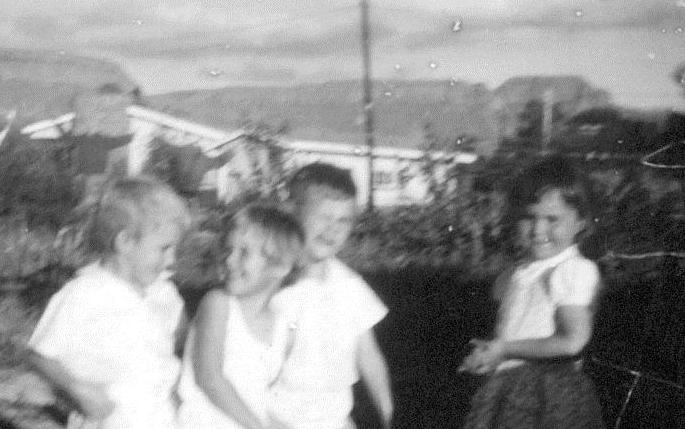
Then Eddie was born and we were like this:
Koos, Anne, Donald & Sheila ca.1959
Donald, Anne and Eddie in front – Durban ca.1965
In 2015 Sheila wrote: Mum says when we still lived on the ‘townlands’ on the way to the waterworks, Jean would often ‘phone and say ‘Have you got a little visitor?’– once again her son Donald had gone missing and she knew exactly where he was – he used to walk all the way to our farm to visit his great mate, Koos. The two were inseparable.
Today in 2020 Mom’s version was slightly different: ‘You used to walk to Donald without telling me. I would phone Jean and ask ‘Is there anything there of mine?’ Maybe the strolling went both ways?
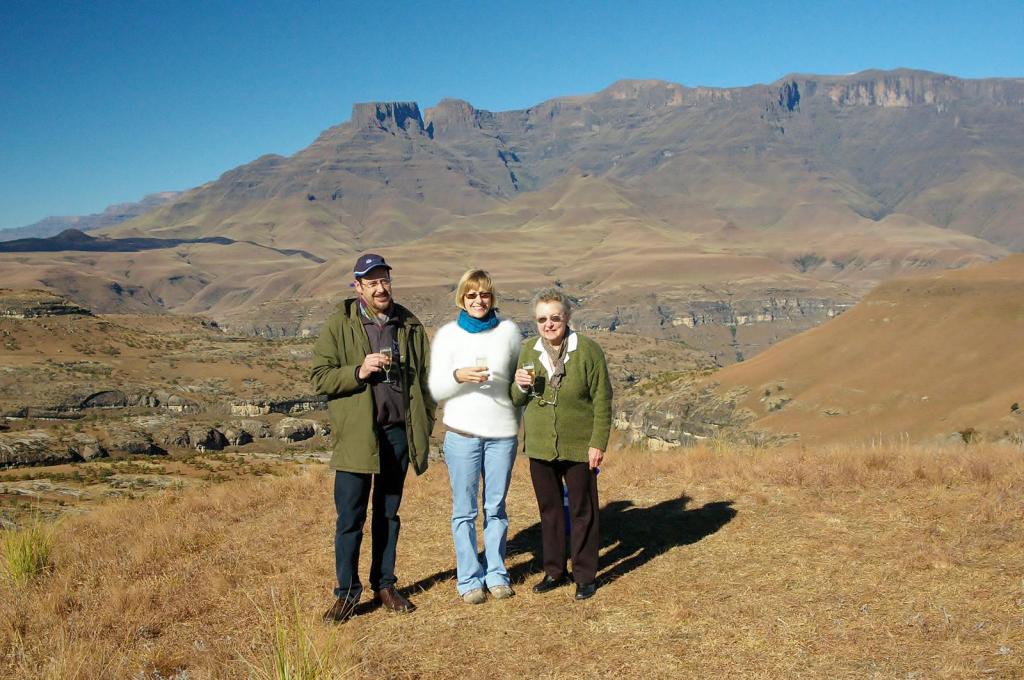
What started this reminiscing was Eddie sending me pics of Jean’s 80th birthday celebration in June 2008, when Anne and Eddie took her on a very special outing:
– Eddie, Anne and Jean with Cathkin Peak and Champagne Castle behind –
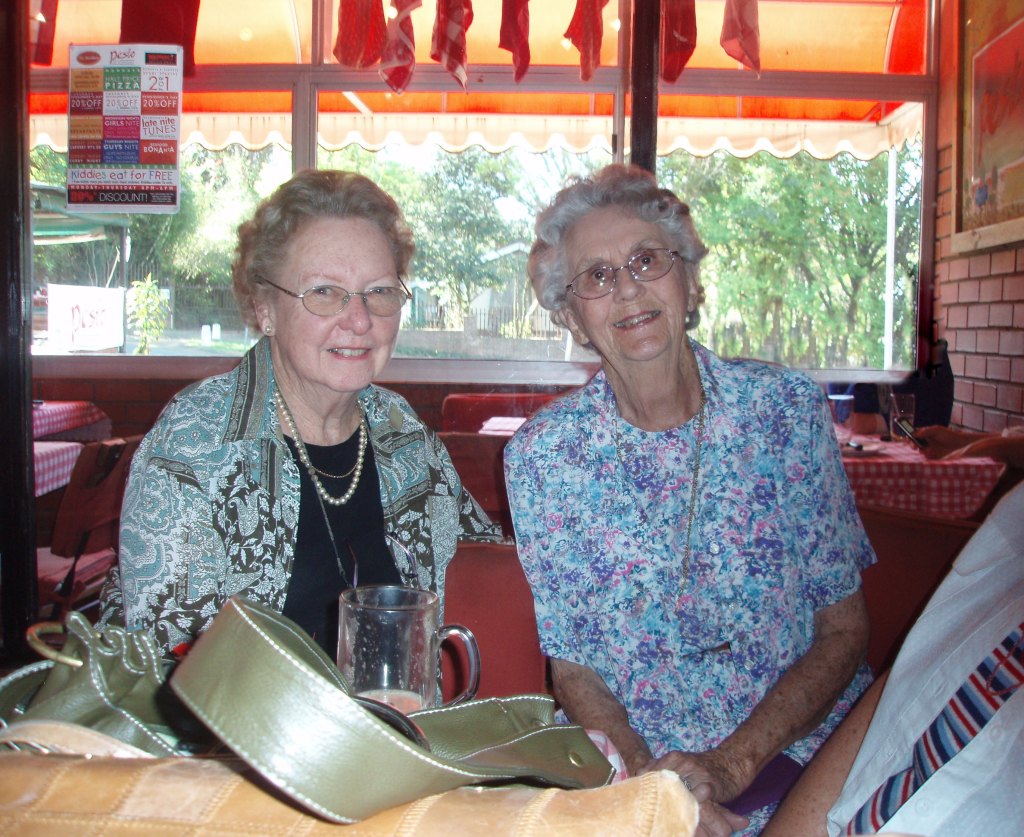
They got together for Mary’s 80th in September 2008
– Mary turns 80 in PMB – 2008 –
For years after the Colemans left Harrismith we heard about their farm outside Winterton. About how Ken built the rondawels and bathroom very rustically. But I never saw Donald again and only lately found out that I had heard from him once!
– view from Craggs outside Winterton – looking at Cathkin and Champagne –– Jean and Ken –
After Maritzburg College, Dad joined the General Post Office as an apprentice electrician. He recalls leaving school on 1st April 1938. Here’s a spirit level he was issued that day:
– Spirit level – Wilson Lovatt & sons Wolverhampton –
While he was still apprenticing, he tried to enlist to join the WW2 war effort, but was sent back. He was sent to the Himeville/Underberg area with a GPO truck and a sidekick called Freddie to do his bidding. Later he was transferred to Harrismith – which fell under Natal for the GPO although it was actually in the Orange Free State – from where he again made his way to Durban to try and enlist, and was again sent home, finally being allowed to join after Oupa reluctantly signed his papers. He left for ‘up north’ in 1941.
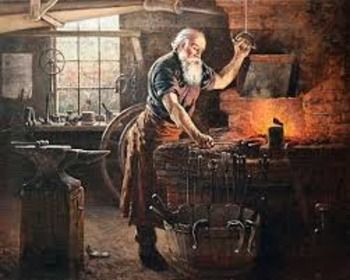
While in Harrismith ca.1940, he met old Mr Buckle the Blacksmith down in McKechnie street, near the railway station. He was from England.
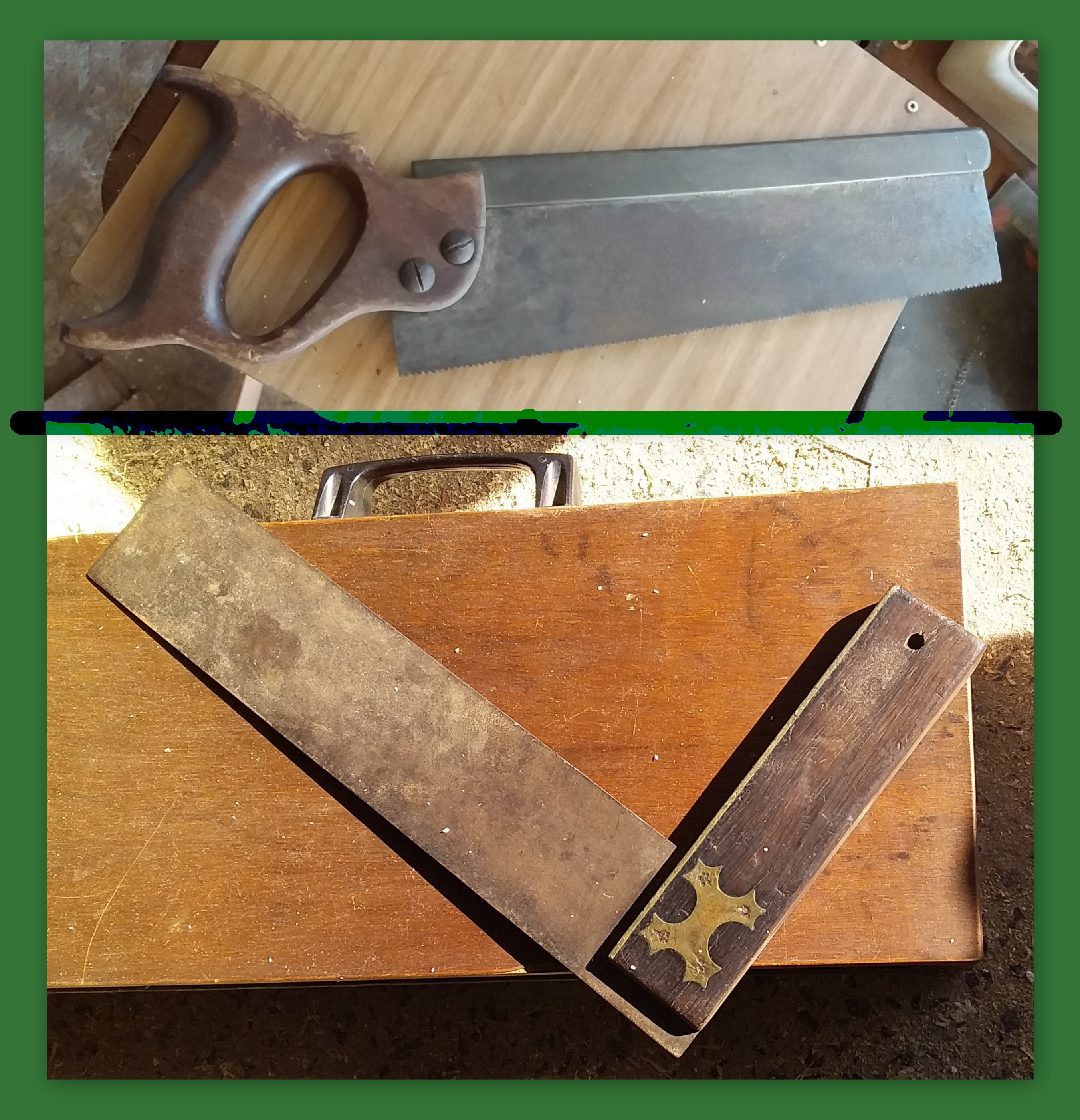
He ended up with a few tools from old man Buckle: a back saw and a set square with a beautiful brass inlay and brass leading edge.
After boarding at the Royal Hotel, whicvh had stables, Dad moved to a plot outside town – townlands – west of town on the Wilge River, downstream of town. There he bought horses, schooled them and sold them for a profit. I assumed he’d had them shod by Buckle but he corrected me. Buckle was a blacksmith, upholsterer, wheelwright and wainwright/wagon-maker. He didn’t shoe horses. That was up to Charlie Rustov, Harrismith’s only farrier.
From his plot on townlands out west of town** he would ride out to Boschetto Agricultural College for Ladies on the slopes of Platberg, the mountain that dominates the town. Boschetto was where the girls were. They were the main buyers of his ponies. The first time he went there, he met the formidable Miss Norah Miller, the founder and principal. Luckily for him she needed a few pictures on her office wall. He was able to help and so became a firm favourite of hers from the outset.
While he was telling the story Mom remembered a story about Norah: She knocked on someone’s door. Whoever answered went back and was asked ‘Who was there?’ They said, I don’t know, but she’s got one eye, one leg and a hell of a cough! Norah had one lens of her glasses frosted out, she wore a leg brace (probably childhood polio?) and smoked like a chimney. When her leg brace buckled, Dr Frank Reitz made her a new one. A better one. He would have loved that challenge. He was a hands-on fixer.
~~~oo0oo~~~
Harrismith author Leon Strachan found some fascinating info on Norah Miller’s leg – it was not polio. His source, Isobel Kemp (Dr Frank Reitz’s receptionist for thirty years. Isobel knew everything): It was probably osteoporosis resulting in a hip fracture in 1928, only six years after she established her college. Usually this would have resulted in incapacity and excruciating pain, but Norah was in luck: she was in the right place at the right time, and knew just the right man, bold innovator and pioneering surgeon Frank Reitz, trained at Guys Hospital in London, then did surgery specialisation in Germany.
He operated and joined the femur using an ordinary screw to hold the femur ends together! This technique would only become common decades later, in the fifties. Thirty years later she was still walking – with difficulty, but still mobile, and in charge of her college. When Cedara took over Boschetto she moved there, where she died in 1959, aged 79.
~~~oo0oo~~~
Aug 2021: Ole man phoned me. He found some (one? more? maybe the one I photographed above?) old ‘tri-squares’ with handles made of ebony with brass inlay. Do I want them? I bought them in the late 40s and Buckle was already an old man, maybe eighty. So they are probably 100yrs old. Hell yes, I’d like to have them!
~~~oo0oo~~~
** Old man bought his first townlands from old Englishman Bill Mundy. On the right bank of the Wilge river downstream from town; out on the road that turns south towards Swallow Bridge after leaving the west edge of town below 42nd Hill.
A lovely post on Women in Ornithology by ornithology historian Bob Montgomerie led me to thinking about Women in – well, My Working Life.
First there was Mom. Mary Methodist. In the Platberg Bottle Store. And Annemarie Maeder, also in the bottle store with Mom. Mom ran the shop, ran the home, played the church organ, was a member of the church Women’s Auxiliary and the MOTHs MOTHWAs. Always involved and ready to help. Annemarie, too, ran her home with husband and three kids.
In the background, too, was our ‘panel of Moms’ – Moms of all your friends. Prominent ones were Jean Coleman, Joan du Plessis, Joyce Joubert, Polly Crawley, Harriet vdMerwe, Emma Morton and others.
Next were women in Apache Oklahoma – all working, all capable: Carol Crews, Joyce Swanda, Katie Patterson, Jackie Lehnertz, Virginia Darnell, Odie Mindemann, Pug Hrbacek, Janie Payne, Peggy Manar . .
When I started my first own practice in 1981 up on the seventh floor of Eagle Building in Murchies Passage between Smith and West Streets in Durban, there was Merle Oosthuizen. I walked in as owner and boss and was lucky enough to have Merle recommended to me as a ‘receptionist.’ Well, ‘receptionist’ indeed. Where’s the appointment book? she asked. Appointment book? I said. The receipt book? Receipt book? She soon twigged my capabilities and knowledge and quietly took over, becoming the Practice Manager and the Me Manager.
Where are you staying? she asked the first day, when she learned I’d just come out of the army. Oh, in a residential hotel, I said. She nodded, satisfied. Some weeks later I breezily told her I’d rented a flat. Do you have a bed? A bed? Bedclothes? Bedclothes? Um . .
Of course she could spot easily how this child masquerading as a man hadn’t a clue. She bought all the above and more for me; and she had all the stuff you need to live a bachelor existence delivered to the flat by the bed and furniture sales people. My first duvet, a kettle, a toaster. Even a fridge.
She was so organised I could say casually to anyone who asked: ‘Oh, I have it all under control. No worries,’ as she organised my practice and my life.
She ruined me. Ever since then I have had capable practice managers run my practice and my life – and I have consequently learnt very little myself. I simply do as I’m told. Later on, twenty six years with Aitch just re-inforced that pattern at home, too.
My usual response to their pointed suggestions along the lines of roer jou gat is, ‘Um, Yes of course, I was just about to do that . . ‘
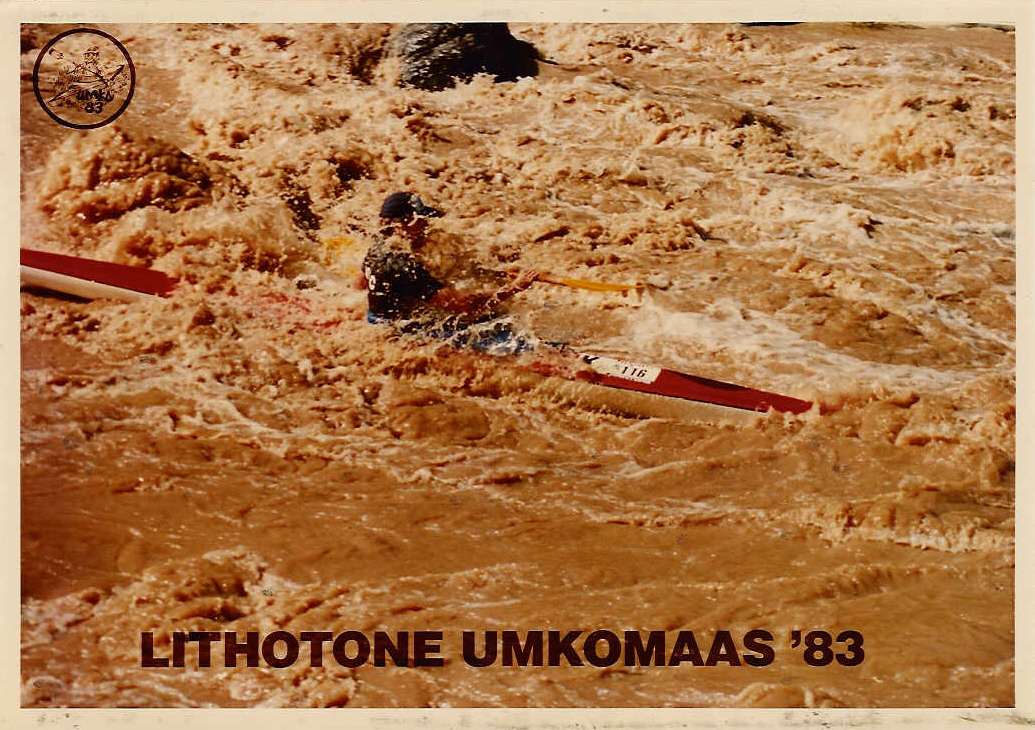
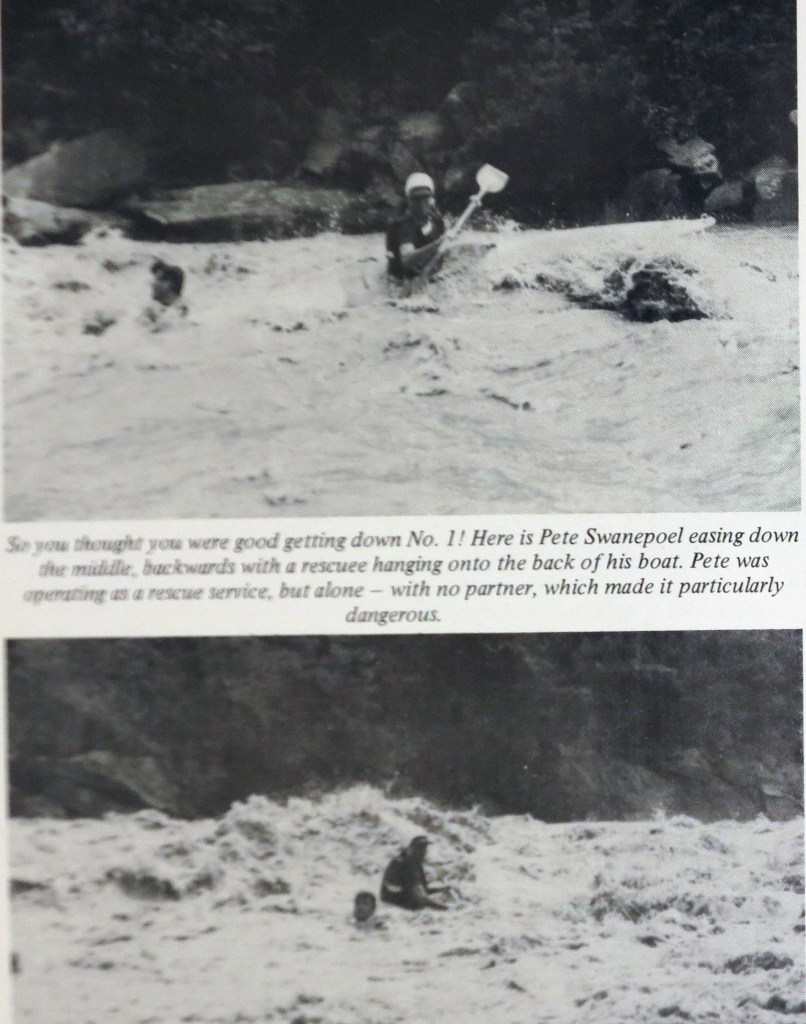
There he goes, no lifejacket, as was the way those days.
. . another guy might be wearing full lifejacket and helmet but he’d be disqualified: wasn’t wearing his club colours! Such was ‘safety’ and ‘decorum’ back when ships were made of wood and men were made of iron!
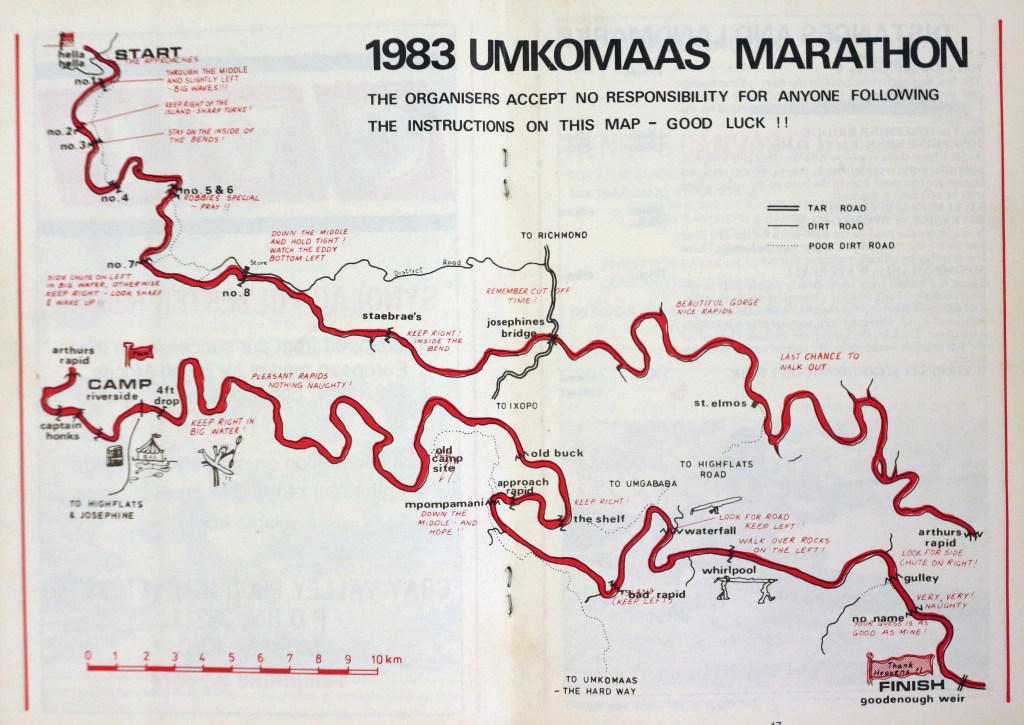
map 4
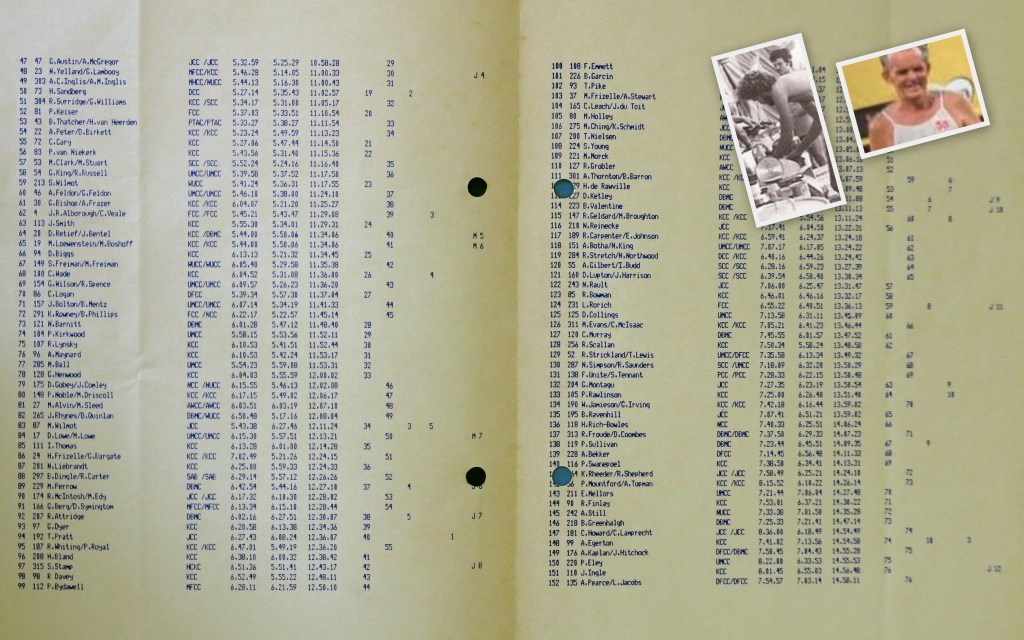
I roared in 140th – looks like 152 finishers, but maybe there was another whole page? Can’t tell – the first page is also missing so we can’t see who won. I know Chris Greeff won the singles. I spent a long time training him in the bar till late at night when the GO TO BED!!s built to a crescendo and we politely thanked Jesus, downed a last beer – and did as we were told. This was Jesus, or Dave Williams, of course, the saintly Umko barman.
– 1983 Umko results with pics of Jesus – when he shaved they started calling him John Cleese –
Hang on, the other page was given the wrong year. Here it is: 1983 results: 162 finishers out of 263 starters. Pope won with Tim Cornish. Chris was 6th and first single.
1983
Notables who finished behind me were Pete the Pom Mountford, Richard Finlay and Toekoe Egerton. They should pull finger.
That was my only Umko marathon. For a few years after that I would sweep or pick out human flotsam and fiberglass jetsam at No.1 rapid, staying with Barry and Lyn Porter on their game farm afterwards.
I was born in Harrismith in 1955, as was Mom Mary in 1928, and her Mom Annie in 1893. Annie thought “the queen” of that little island above and left of France was also the queen of South Africa (and for much of her life she was right!).
I attended the plaaslike schools in Harrismith till 1972. A year in the USA in 1973 as a Rotary exchange student in Apache Oklahoma. Studied optometry in Joburg 1974 – 1977. Worked in Hillbrow and Welkom in 1978. Army (Potch and Roberts Heights, now Thaba Tshwane – in between it was Voortrekkerhoogte) in 1979 and in Durban (Hotel Command and Addington Hospital) in 1980.
I stayed in Durban, paddled a few rivers, and then got married in 1988. About then this blog’s era ends and my Life With Aitch started. Post-marriage tales and child-rearing catastrophes are told in Bewilderbeast Droppings.
‘Strue!! – These random, un-chronological and personal memories are true of course. But if you know anything about human memory you’ll know that with one man’s memory comes: Pinch of Salt. Names have been left unchanged to embarrass the friends who led me (happily!) astray. Add your memories – and corrections – and corrections of corrections! – in the comments if you were there.
~~~oo0oo~~~
Note: I go back to my posts to add / amend as I remember things and as people mention things, so the posts evolve. I know (and respect) that some bloggers don’t change once they’ve posted, or add a clear note when they do. That’s good, but as this is a personal blog with the aim of one day editing them all into a hazy memoir, this way works for me. So go’n re-look at some posts you’ve enjoyed before and see how I’ve improved over time (!). It’s just as my friend Greg says: ‘The older we get, the better we were.’
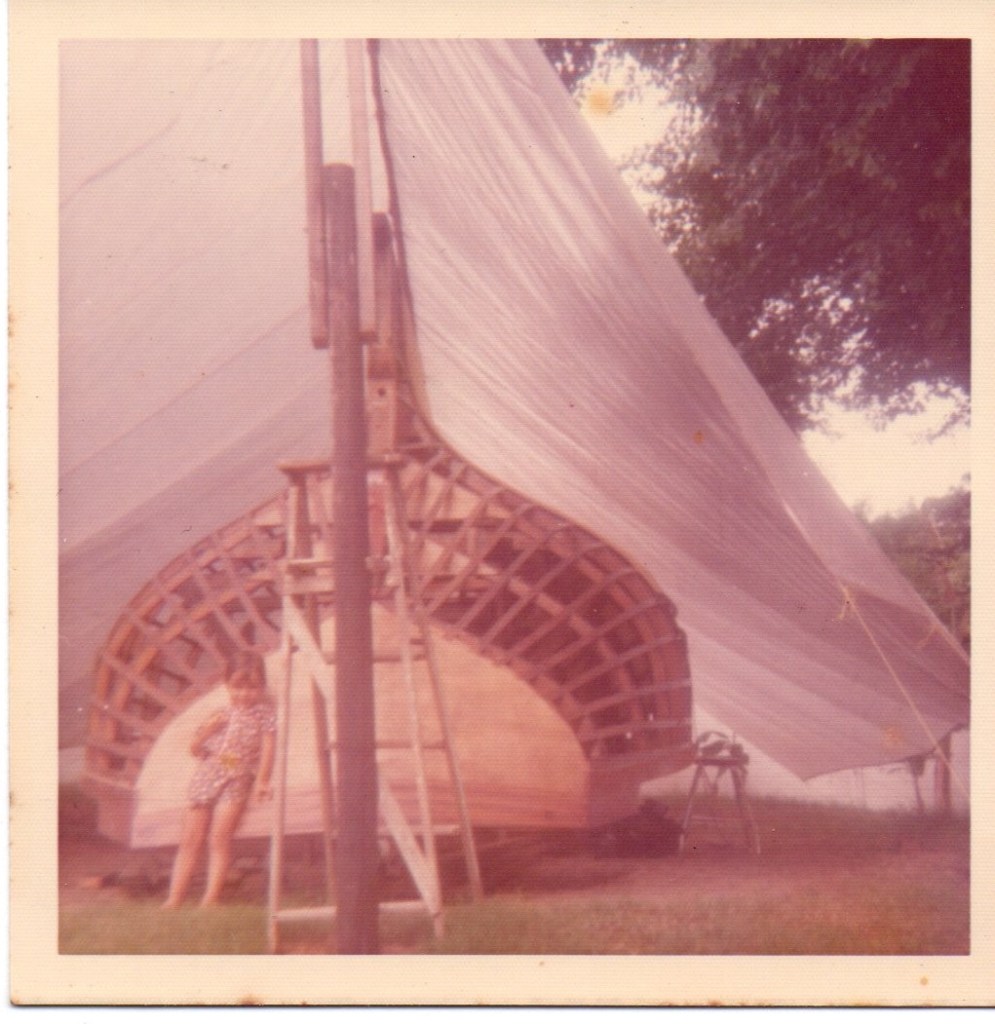
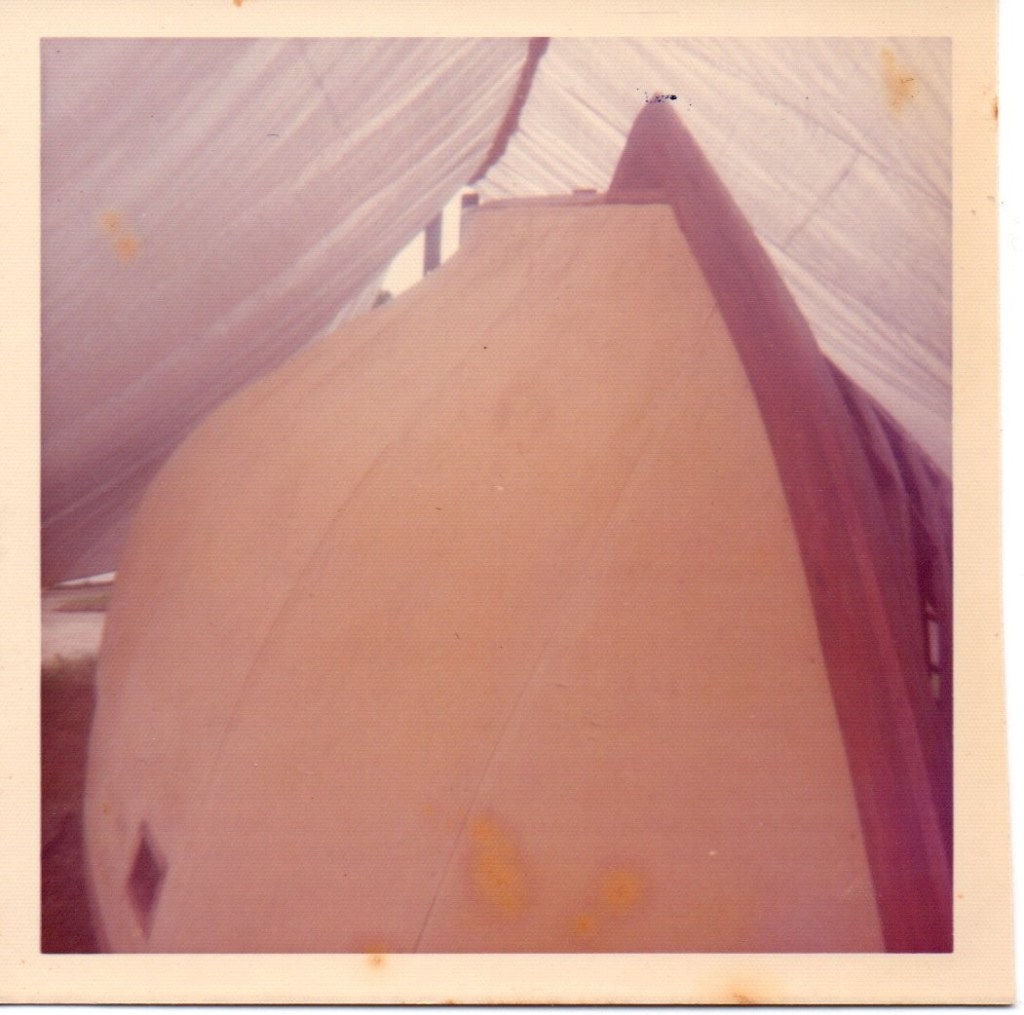
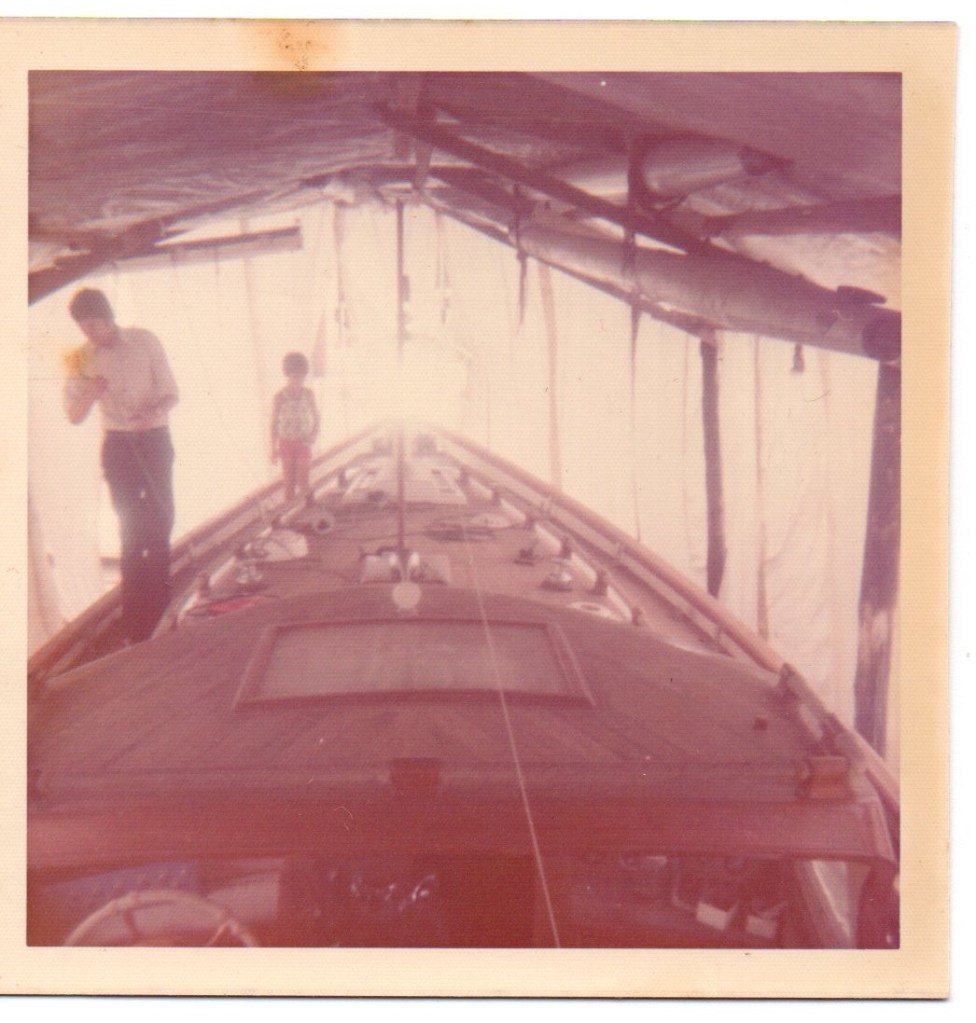
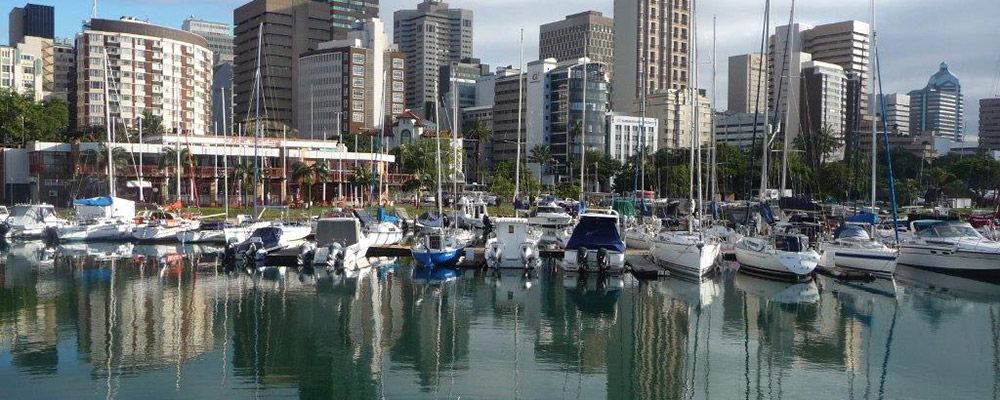
Long before Zimbali became an over-priced gated estate for the rich to hide in, Manfred Bacher, augenoptikermeister from Austria aus, built a yacht in his Umhlanga backyard and called it Zimbali. Or SMS Zimbali, I’d say. He said Zimbali meant ‘forever young,’ which is what he wished for himself and might have been if it wasn’t for the beer and the cigarettes. In isiZulu izimbali means flowers or blossoms, but Manfred always did cruise and sail to the beat of his own drum.
The boat was a beauty. I hope someone has pictures of it. (update: Yes! Steve Reed had these pics). Beautifully finished in carved and highly-polished dark wood. My part in its construction consisted of visiting Umhlanga after work with big buddy Steve Reed, Manfred’s protégé oogkundige. We’d sit in its cabin in the Umhlanga backyard drinking quarts of beer and listen to Manfred wax lyrical. If I remember right, it was built in two locations: it was moved to the Umhlanga new home from somewhere else?
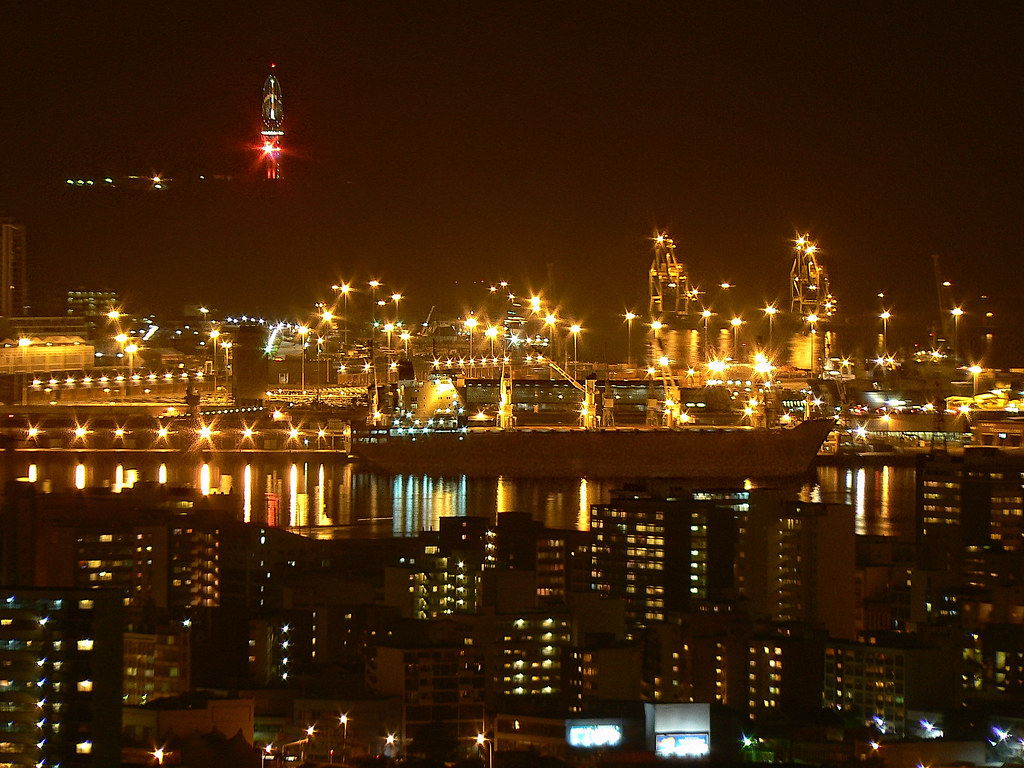
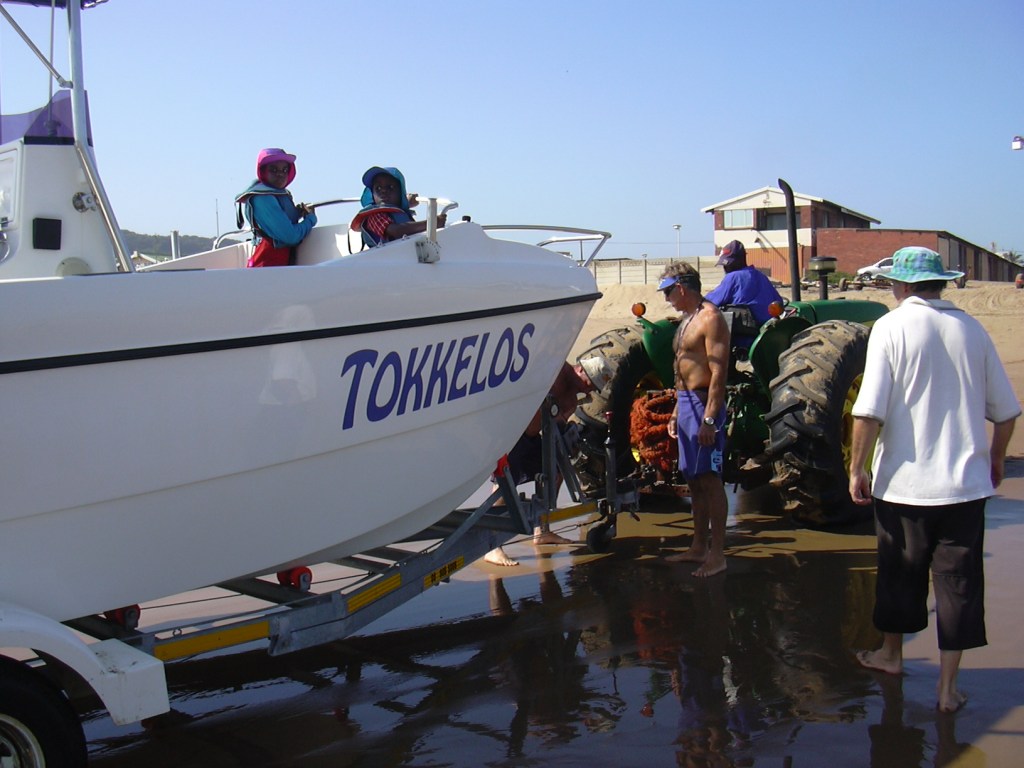
I missed the actual launch day when it was ferried to the harbour and lifted off a trailer and lowered into the salty water, but I then visited it again to sit in the cabin drinking quarts of beer and listen to Manfred wax lyrical while it bobbed up and down and the sheets and cables clanked in the wind. Once after enough beer I climbed right up to the top of the mast and enjoyed the swaying to and fro high above all the other boats in the yacht mole. Wonderful view at night with a million lights reflecting off the oily water. I made it down safely, sanks goodness, as Manfred would have said.
– internet pics – Durban Harbour –
Roomerazzit Zimbali only ever made one trip out of the mouth – never again were the sails hoisted till Manfred sold it. It remained moored as a convenient boys gathering place. Again, some may know better and I’d love to hear.
~~~oo0oo~~~
augenoptikermeister – optician
oogkundige – augenoptikermeister
The kaiserliche und konigliche kriegsmarine, sometimes shortened to k.u.k. kriegsmarine, was the naval force of Austria-Hungary. Ships of the k.u.k. kriegsmarine were designated SMS, for Seiner Majestat Schiff (His Majesty’s Ship).
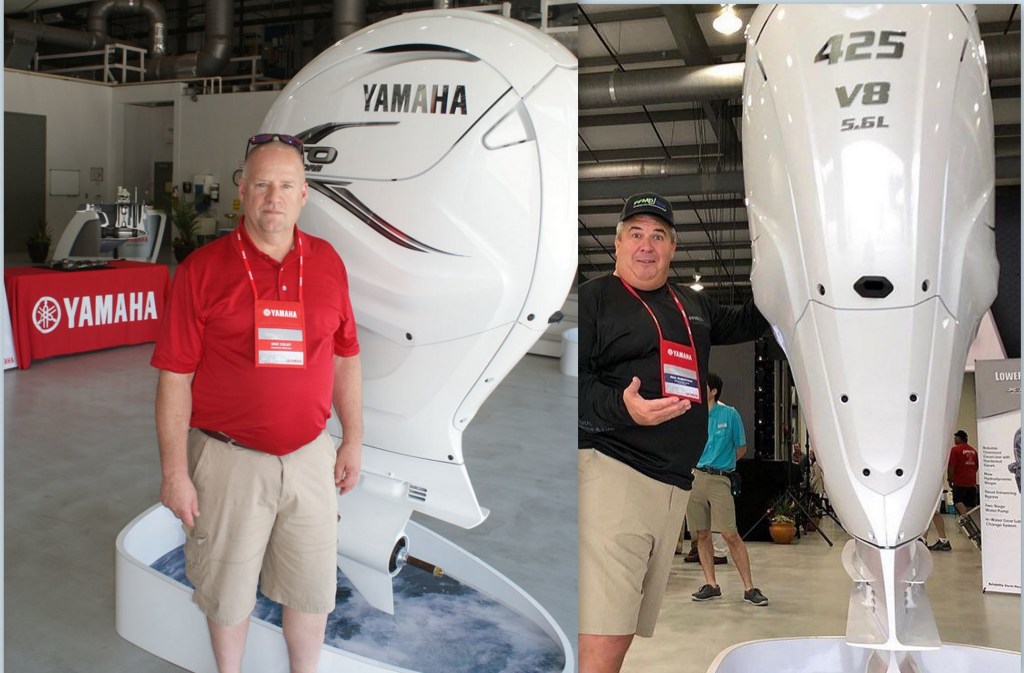
Greg Bennett told me about his latest Yamaha outboard motor over coffee the other morning – a 425hp V8 5.6litre beast. “Stands taller than me with my hand stretched skywards” he said.
– big mama –
This reminded me of the time we went out to Hazelmere to test his then-biggest outboard motor: I think it was 225hp.
I was slalom skiing behind the beast when I felt a twinge in my hamstring and immediately let go, faithful to my exercise mantra of No Pain, No Pain.
Greg whipped the boat around and roared up to me. “What’s up, Swanie?”, bellowed his big boet Roland.
I think I pulled a muscle, I said.
Roley roared with laughter. “NO! Swanie, can’t be! You couldn’t have pulled a muscle. You must have pulled a fat!” Rude bastid.
The Comrades Marathon’s Quadruple Green Number is awarded only to people who are certifiably crazy. The award – and membership of that exclusive club – means you have run the 89km Comrades ultra-marathon at least forty times! Holy shit!!
47 Medals
RaceNo
Name
403
Louis Massyn
916
Barry Holland
45 Medals
RaceNo
Name
183
Dave Rogers
43 Medals
RaceNo
Name
3111
Vic Boston
42 Medals
RaceNo
Name
1
Clive Crawley
1180
Zwelitsha Gono
1702
Dave Lowe
1704
Alan Robb
4192
Wietsche Van Der Westhuizen
7296
Mike Cowling
41 Medals
RaceNo
Name
1550
– – – – – David Williams – – – – –
1689
Tommy Neitski
40 Medals
RaceNo
Name
145
Kenny Craig
1221
Riel Hugo
1691
Johann Van Eeden
2516
Boysie Van Staden
4286
Shaun Wood
Dave ‘Jesus’ Williams is a Kingfisher Canoe Club stalwart who has helped run the Umkomaas canoe marathon for about the same number of years he’s been shuffling the Comrades.
On the Umko, Dave has done it all. Driving trucks, pitching tents, digging toilets, rigging toilets on trucks, buying food, preparing food, serving in the pub, listening to paddlers gaaning aan about how scary THEIR race was; you name it, Jesus has done it. And with aplomb and with a smile. He was there 36ys ago when I did my only Umko and patiently served us rowdy hooligans with beer after beer at the overnight stop until there were only two okes left drinking – me and Chris Greeff. Eventually we got tired of people rudely shouting at us to ‘Shut Up, They Were Trying To Sleep,’ so we staggered off to our sleeping bags on the grass under the big marquee. There was a small difference between me and the man I’d been matching beer for beer till late that night: He was actually leading the race and duly went on to win the singles the next day. I finished in eventually-th place.
– Dave ‘Jesus’ Williams on the right working hard as always –
I last saw Dave Jesus at the 2016 Umko – he was driving the beer truck and selling beer at the prize-giving. We had a good chat. He had given me good stories for the Umko 50yrs book, but now I mainly wanted to know about the Comrades. About HOW MANY? about WHY!? and about ARE YOU MAD?!
He couldn’t really explain, but all he talked about was beating other ous. So even though his finishing time was stretching out compared to his best days, he always had goals and people to beat. At the time, his main “battle” was against Tilda Tearle (she who actually won the damn thing one year). He beats her, then she beats him; how and when, Dave describes in great detail – “I was leading for 30km and then my knee started to hurt and I heard she was catching up to me” etc etc. He remembers every yard, every pace, every change of fortune, good or bad. In Comrades as well as all the other races he does, he always has some or other bet or goal or competition going on with his comrades in running. That’s what keeps him going, I suppose. That, and the insanity.
– later he shaved the beard and became Dave ‘John Cleese’ Williams –
A lovely modest oke. But quite mad – he has also run 100km around a 400m athletics track and has run 100 MILES, too. He also runs a cross country race from Royal Natal National Park up to Witsieshoek, then along the road to the car park then up to the foot of the chain ladder, up the ladder onto the Amphitheatre, down the gulley and back to National Park campsite. About 50 rugged cross-country kilometres with a huge altitude gain that makes the Harrismith mountain race look like a short flat stroll.
Harrismith had the biggest influx of people in its history recently. Well, that would be my guess. I don’t think even the Rhino Rally ever brought in THIS amount of people! I mean those rowwe hard-drinking bliksems fit a maximum of two people on their vehicles . . and often only one cos nobody really understands them.
– here’s a rhino rally – and a wish –
. . . whereas I would guess the teetotal Shembes are unlikely to put less than sixty people in a sixty-seater bus? And there were LOTS of those buses in town. The view is the eastern side of town with the Platberg mountain behind you.
– shembe buses and cars – 95 Stuart Street in the yellow oval – our house 1960 to 1973 –
In a way they were coming home: The founder of the Shembe church, Isaiah Mloyiswa Mdliwamafa Shembe, was born in 1865 at Ntabamhlophe outside Estcourt in the Drakensberg region of Natal. When he was very young his family fled from Shaka during the Mfecane period to the Harrismith district of the Orange Free State, ending up there as tenants on a farm of ‘an Afrikaner family named the Graabes.’
Then the stories start: Like many other people of Harrismith he absorbed the local spirits; and like many ‘prophets’ before him, young Shembe ‘died and was resurrected at the age of three when relatives sacrificed a bull before his body could be interred.’ He was ‘visited by God on many occasions.’ He was ‘taught how to pray by God himself.’
The call of Isaiah Shembe to his life’s vocation can be traced back to an experience at Ntabazwe Mountain in Harrismith. The mountain is also called Platberg in Afrikaans, meaning ‘Flat Mountain;’ and Thabantsho in seSotho, Black Mountain. Earlier he was on a farm (near) Witzieshoek in the Harrismith district; and then he moved to the land on the outskirts of Harrismith, (near) the mountain of Ntabazwe. Here Shembe experienced several revelations as a young boy, and it was through the means of lightning that he ‘received his call.’ As they do.
When he was told to ‘find a place to pray to God’, he tried the Wesleyan Church that was nearby. However they were not right for him: they didn’t know how to baptise properly. Then came the Boer War and, abandoning his wives, he spent some time on the Rand. He joined a Baptist church there. After he returned to Harrismith the leader of his new church came to his place in 1906 to baptise Shembe. Proper baptism under water, not just a drop of water on your forehead, you Wesleyan Methodists!
Shembe went to Natal and started accumulating followers. He would send them ahead to new areas to pronounce his arrival as ‘A Man of Heaven Cometh.’ Marketing. As his success and number of followers grew, so did his power. What you eat, what you think, what you wear, what you do, and that favourite of most religious leaders chosen by God: how men are to rule over their women, was all prescribed by the now Great Man. A lot of what you ‘had to do’ happened to make him rich. Hey! Coincidence!
The legend grew. Shembe must have been highly intelligent and astute, as he told vivid parables, and showed uncanny insights into people’s thoughts. He composed music, writing many moving hymns; he had his sermons reduced to writing and they became scripture, and he provided his followers with a rich liturgical tradition based on modified forms of traditional Zulu dancing. He also often did the dramatic healing trick. You know: Lo! He was lying down; Now he walks!
In 1913 Shembe visited Nhlangakazi Mountain which now became the movement’s holy mountain. Ntabazwe was too far from his followers. At Nhlangakazi he was told by the Holy Spirit to form his own church. This place later became his place of annual pilgrimage every first Sunday of the year. That too, made money.
The Shembe Bible is known as the Book of the Birth of the Prophet Shembe. Their holy writings say, ‘On March 10, 1910 it was the arrival of the Prophet Isaiah Shembe at KwaZulu Natal (Durban) from Ntabazwe (Harrismith), as he was instructed by the Word of God to do so. The Word of God told Shembe that they will meet at KwaZulu (Natal).’ See?
In the 1930s Shembe commissioned his friend and neighbour, the renowned John Dube, to write his biography. The book uShembe, appeared shortly after his death, and contains much of the essential Shembe lore and hagiography, but Dube was an ordained minister and not a Nazarite, so he does not only present Shembe in flattering terms. Shembe’s bona fides as a prophet are questioned, and his undoubted skill at extracting money from his membership is highlighted. Dube alleged that Shembe was overtaxing rentals; that he was conducting baptism for payment – part of his fundraising for the church; that he was extorting money from members as he paid lobola for young girls whom he married; and that he was corrupt and exploitative. – Tch!and Eish! Just what an ambitious prophet / saviour / manifestation of God doesn’t need: an honest biographer! Shembe’s son and heir, Shembe II, Galilee Shembe forbade his followers to read the book. Hey! You know that book my father asked his friend, uMfundisi Dube to write? Don’t Read It!
A factor of the huge success of African Independent Churches like the amaNazaretha has been their emphasis on ‘Africa for Africans. ‘ Often implicit, but explicitly verbalised by Shembe, this has been the main cause for the break-away from the mainline or mission – or European – churches. They wanted their own identity. However, discontent has continued to plague these church formations, even after self-governance and independence. Money and power corrupts, and they have splintered into many different internal groups and factions. Succession wrangles in the Shembe Nazaretha Baptist Church have given birth to the current seven factions, six of them headed by Shembe family members. Various battles have raged since 1935 when the original Shembe, Isaiah, died. The latest succession struggle started in 2011.
So who decides who is divinely anointed to lead the church? Very modernly, it is not God . . not a God . . not a king . . not a council of elders . . not even a new legitimate national democratic government. No! A judge of the courts. The legal system! They’re like, Step aside, this is not a small matter! I have brought my lawyers! The prize is reportedly worth many millions. As with all human endeavours, greed is always a big factor.
So who went to Harrismith this year? Which faction? I don’t know . . we’d have to ask an insider. I just hope they didn’t ascend the mountain. Fragile Platberg does not need 6000 humans on it. The poor grysbok will skrik.
Lucky Dube wrote a song about the Shembe religion –
~~oo0oo~~
update: 2021 and the saga continues. The highest court in the land made a pronouncement in June as to who the legitimate leader of one of the factions was. Now in August another breakaway faction has formed. ‘Don’t you tell me what to do… ‘
Durban ca 1980 – I’ve been sent here by the army; I know very little about this Last Outpost of the British Empire, but my friend, fellow Free Stater Steve Reed, has been here almost a year, so he knows everything. And he knows some girls.
The papers announced that some comet was due to approach Earth and – we extrapolated – threaten our way of life, our partying, our poison of choice – and perhaps even kill us. Or annoy us anyway.
We determined to protect ourselves and our favourite planet from this unwelcome alien intruder. Steve hired a beach cottage at Blythedale Beach on the Natal north coast and, as I know a lot more about warding off comets than I do about girls, I was happy to tag along with Stefaans and a bunch of his female friends and admirers. Supplied with adequate stocks of various powerful potions and elixirs to be taken internally, we sallied forth. We also bought tinfoil.
In the self-catering kitchen we found plenty with which to arm and armour ourselves: Colanders, coriander, and pots and pans made good headgear. Braai forks, spatulas, braai tongs and wooden spoons made anti-galactic weapons. We warmed up our IQ’s by imbibing aplenty and so started a rip-roaring single-handed – the other hand was holding cheap and blithe spirits – Defend the Planet Party; which same ended successfully in the wee hours on the beach when a mysterious pale, then ever-brighter, light appeared on the eastern horizon, over the sparkling Indian Ocean.
Was it perhaps Comet Aarseth-Brewington? Well, if it was, we made it saweth its arseth by our brewing and distillington.
Actually, it was more likely Comet Tuttle. There it is, below! It came back in 2007 but it knew better than to approach too close:
– 37 million km is the closest it dared come this time –
Of course it was really the Sun, come to burn a hole in our hangovers.
Only later, after recovering from my overindulgence did I realise another of the planned missions had once again been a complete failure: Snaring any girls. As so often, the booze had won and I’d dipped out. And they were kif . .



















 Vrystaat Confessions