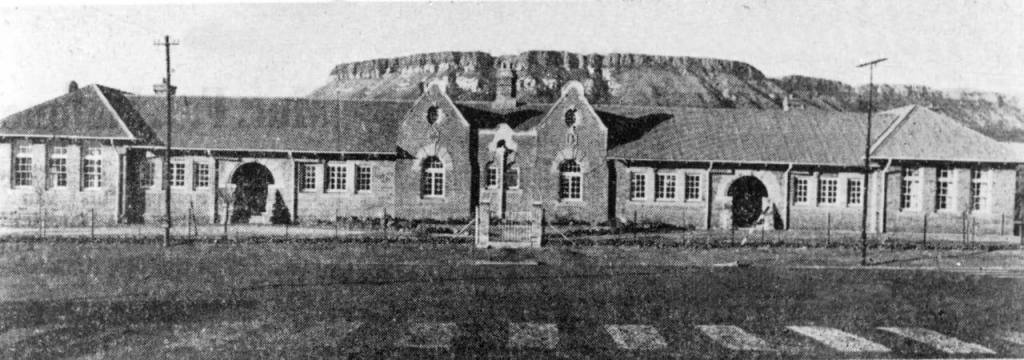
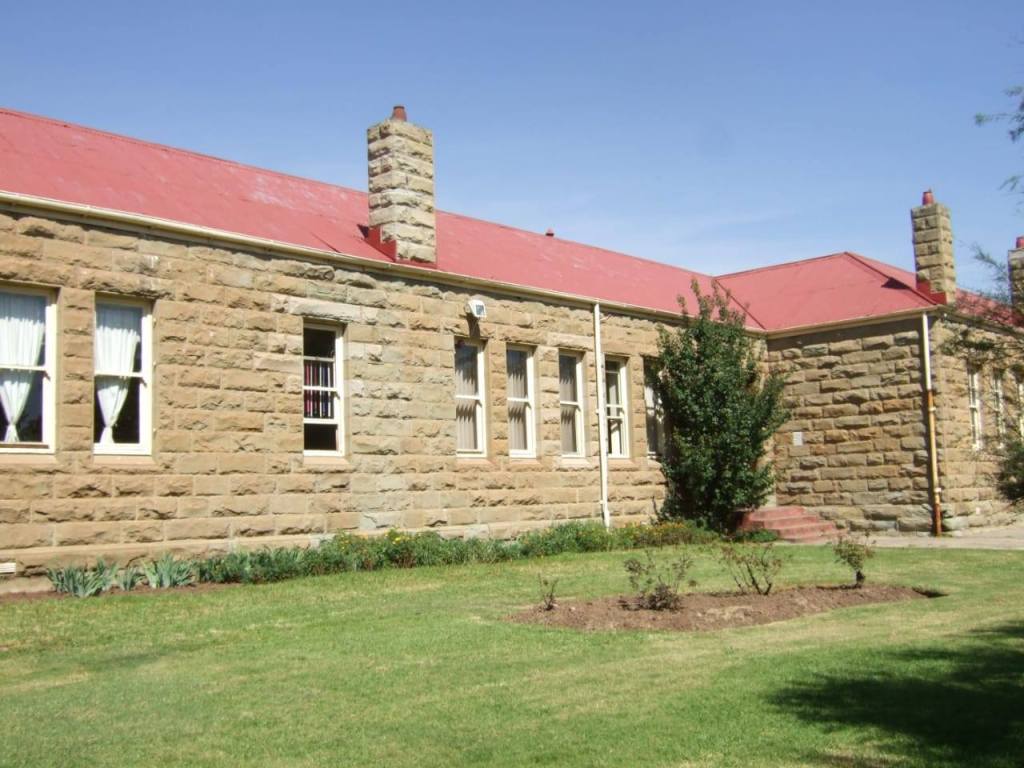
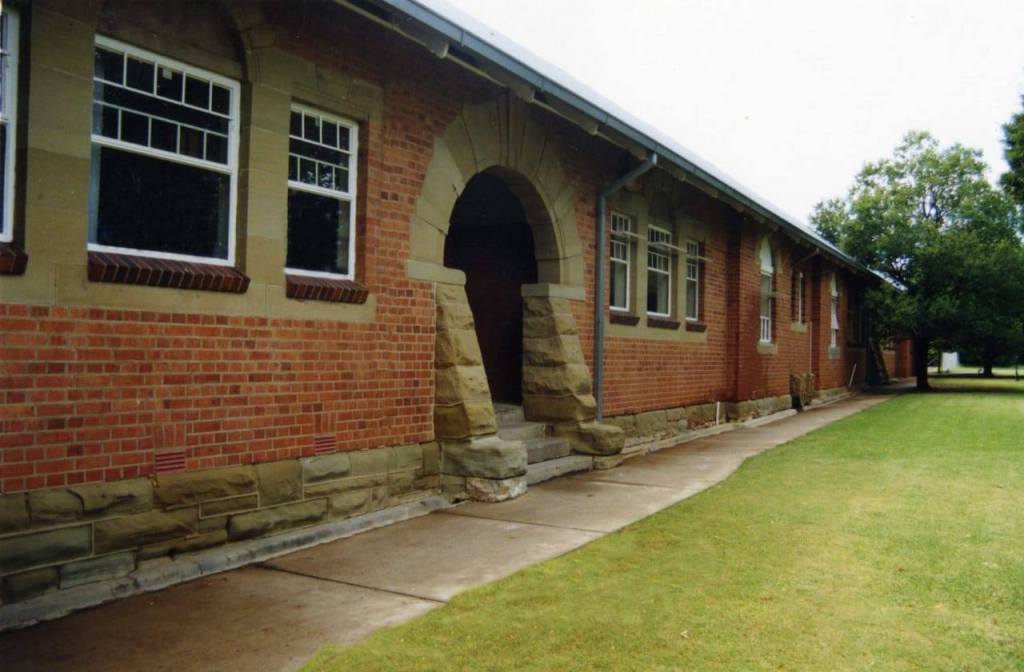
Mom went to this school, as did all three of us kids. Annie, Mom’s Mom, would not have, as it seems it was established in 1915, see below, and Annie was 22yrs old by then.
Before us, Etienne Joubert went, and he remembers:
Playing ‘Hasie’ under the Bluegums near the old Golf club house; Eating ‘Manna’ under the Bluegums; Playing ‘Bok-bok’ behind the bottom class rooms; Playing marbles in the main playground.
Also he remembers the woodwork teacher Giel du Toit – his mother Joyce had a hilarious ‘holy’ nickname for Onse Giel – Heilige Giel, I think it was; and he remembers the smell of the old fashioned wood glue; And the wood vice where ‘we tied a guy’s tie in & walloped his behind. I’ve forgotten his name, but not his face … I can see it now!
He then confesses – I do not remember much about plays & music . . .’ – No worries, sister Barbara does:
– the separate woodwork classroom was to the right, just out of picture – – some of these windows were Ou Eier Meyer and Ou Vis Alberts classrooms –
Sister Barbara was a year or two later – she finished Std 5 in 1965. She definitely remembers about plays and music, you Philistine, Etienne! She remembers that year was the school’s Golden Jubilee year – so established 1915, I guess? – and an exciting concert was planned and held on the 28th and 29th of October 1965, with all the classes in the Kleinspan School and Primary School – Volkskool – participating.
How could she remember in such detail? Well, she had her program carefully stored away in a shoe-box! She remembers the play her class put on: ‘TO BE OR NOT TO BE’ – by B.J.J. (Bruce) Humphries with Pierre du Plessis and Llewellyn Mileham – or was it Kevin Crawley? – as the smart guys, and Timothy Brockett as Mr. van Snoggery-Boggery, the drunk guy – Pierre remembered this name – and herself – Barbara Swanepoel – as the unnamed lady on the railway station platform.
Interludes between plays were filled by music by the ‘Harrismith Volkskool Orkes / Primary School Band.’ Band members were Rina Minny en Estelle Meyer on trekklaviere – pull pianos – piano accordions; Sylvia Doman on piano; Barbara Swanepoel on melodica; Pierre du Plessis on drums; Willie du Plessis on electric guitar; So much of du Plessis!; Theuns Bam en Bertus Hattingh on acoustic guitars; They were called Die Dorps Mense. Years later The Village People modelled a band on this lot. Um, so I believe.
Then came the Primary School Boys Choir – Die Seunskoor. Under the charming direction of Miss L. Fourie and that delectable redhead Miss Ethel Cronje. I was a soprano in this lot, warbling away merrily before my balls dropped. We sang (according to that program which won’t lie) Wiegeliedjie van Mozart; Drummer Boy; and Dominique; I still remember – and can still sing majestically – the second and third of these liedjies. My kids dispute this fact, unreasonably.
– Ethel Cronje looking strict or smug, her boys looking glum – it was her seunskoor, no doubt about that –
Barbara asks: ‘Now wasn’t there a record produced for this choir? I think so – our own famous ‘Platberg Boys Choir.’ Indeed there were two records cut. Vinyl. The Vienna Boys Sausages were nervous. Especially when we launched a smash hit successful sold-out tour of Zululand. If it wasn’t for rugby and puberty, we’d have usurped those Austrian suckers. We’d have parum pu pum pum’d them out of business . .
… and their humour. Met up with Sam, an excellent Scotsman who came in for some glasses today. We were chatting about some of the female news anchors you see on TV. One of them, Virginia Trioli, we agreed is opinionated, superior, demanding and – from all accounts – a piece of work.
He
sums her up:
“Ya woodn’t want ta be coming hoome to her wi’ only a half week’s pay packet.”
Later, I am handing him over to Ioannis who has the job of telling him how much his new multifocal glasses are going to cost (cringe) with some light banter … Sam replies:
“Well I am a Scotsman ye know. Every penny a prisoner.”
I
packed up – had not heard that one before.
Probably
comes up a lot in the local pub.
~~oo0oo~~
Me: So right! Gotta love the Scots!! 😉 – I must remember those pearls!
My gran Annie’s father came to Harrismith straight from the freezing far north of Scotland – a fishing village called Sarclet, south of Wick – but she sadly became heeltemal Engels – the queen, the empire, and all that.
The
only Scottish she ever spoke to me was her oft-repeated tale of once
on the golf course, waiting to tee off. The oke in front of them
sliced off into the bush and said,
‘Och, its gone off in the boooshes,’ to which Annie quipped,
‘That’s betterrr than doon in the wutterrr,’ – upon which she says he spun around and said,
‘Begorrah’ (or whatever a Scotsman would say on an occasion like this), ‘Yer one of oos!’
‘Aye,’ said Annie semi-truthfully.
~~oo0oo~~
Which
takes me to her THIRD language: Afrikaans.
Of her ninety years on Earth, Annie spent about eighty seven in Harrismith in ve Vrystaat. She was born there, she went to school there (more than half her schooling) and she sold Caltex petrol to her Vrystaat customers there.
The only few years she was away from Harrismith she spent ‘down in George.’ She went to stay with her sister Jessie Bell when Jessie’s daughter Leslie died.
When she got there there was great excitement as they just knew she’d be very useful in dealing with the kleurlinjeez, who spoke their own Afrikaans and hardly any Engels.
‘Annie speaks Afrikaans, she’ll be able to speak to them and understand them,’ was the buzz.
So the first day the gardener needs instructions and Annie confidently demonstrates her skill to the assembled rooineks:
‘Tata lo potgieter and water lo flowers’ she told the poor man who must have scratched his head at the Zulu-Engels mix in which the only word approximating Off-The-Krans was ‘potgieter’ instead of ‘gieter’ for watering can.
~~o00o~~
One more Harrismith Scots joke I’ve told you before, but I’ll add it to this collection: Jock Grant arrives from Scotland full of bravado, bulldust, enterprise and vigour.
He’s a plumber – a plooomerr – but soon he’s bought the stone quarry, bought the Montrose Motel in Swinburne, bought the Shell garage, bought a big white Mk 10 Jag and smokes fat cigars.
In the pub at the golf club he removes the cigar from his lips, waves it around and tells the guys he’s started Afrikaans lessons – he’s going to learn to speak Afrikaans.
Jannie du Plessis looked concerned. ‘Jock,’ he says, ‘We think you should rather learn to speak English first.’
~~oo0oo~~
heeltemal – completely
kleurlinjeez – a vague racial classification in apartheid times – and still in use today! Not black, not white, therefore ‘coloured’; actual word: kleurlinge
rooineks – people congenitally unable to speak Afrikaans, try as they might; actually, try as they don’t
You know that mansion Mal Jurie is building on his farm? It’s a harem!
A what?
A HAREM! A place where you keep lots of ladies in rooms and they lie around swimming and eating grapes and looking beautiful. When they do have clothes on its not clothes like your mother wears. He says he’s going to bring French dancers to his harem from the Moulin Rouge in Paris! A lot of French ladies in Harrismith in the Vrystaat!
Ag Man, You Lie!
No, I swear. He told me himself!
– a typical scene just outside Harrismith, Vrystaat –
This is how an Urban Legend – in this case really a Rural Legend; or, as Harrismith author and historian Leon Strachan calls them, a ‘Lieglegende’ – got started.
First of all, it’s true. Jurie Wessels DID say that. His neighbour wasn’t lying.
But what Jurie was really saying was, ‘Leave Me Alone!’ ‘Los My Uit!’ ‘Mind your own Business.’ ‘Stop prying.’
Jurie was a successful farmer, an intelligent, interesting and interested man, married to an outgoing and attractive woman, and he was building her a home unlike any other in the district. His problem – his sin – the reason he was called Mal Jurie – was that he was an introverted and eccentric character. He didn’t ‘play by the rules.’ And for that you get punished in most communities, maybe more so in small communities. And Harrismith would have been no exception.
For starters, Jurie had brought his lovely engaging wife from far away. People didn’t know her mother and her grandmother. She was actively involved in the community, well liked, and often entertained; but still . . she was from far away. And also, often Jurie wasn’t at her gatherings, preferring to keep to himself, even when she entertained at home.
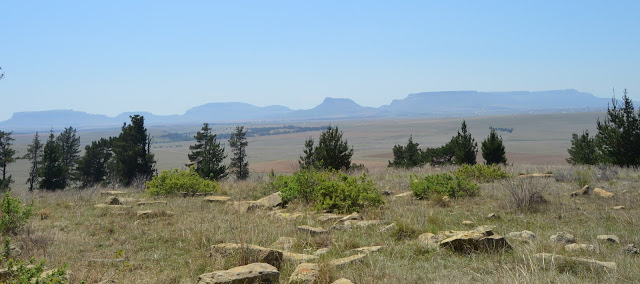
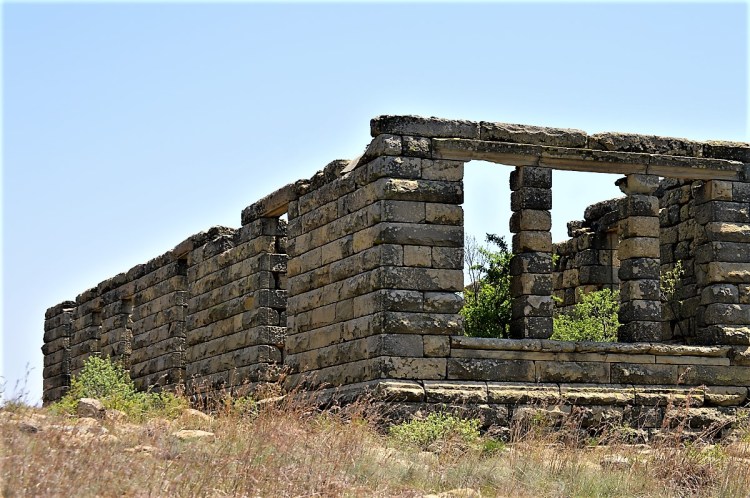
So when Jurie got Italian stone masons to start building a large sandstone structure on the edge of a hill above his more ordinary homestead, overlooking the Wilge river valley west of the dorp, the people started wondering . . and talking.
– the view towards Harrismith – The Lakes range, Loskop in the middle, Platberg right –
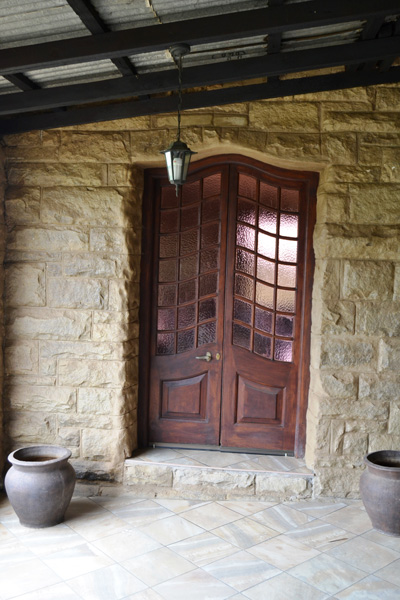
But it was when a consignment of beautiful and really big wooden windows and doors arrived from Italy at the Harrismith spoorwegstasie that the rumours started building and gathering momentum. From ITALY? Nothing from ITALY arrived at the Harrismith stasie! Where was Italy, anyway? This was weird! Just what WAS Mal Jurie up to? Here was evidence, not just skinner, that Mal Jurie was mal.
Well, he was actually building a beautiful home, but he didn’t want people sticking their nose in his business. People always asked too many questions! So when his neighbour asked, he deliberately gave what he probably thought would be an obvious exaggeration. And it might have been taken as just that, had his reclusive behaviour not made him ‘suspect’ – ‘different.’ And so the rumour – the legend – grew wings and became ‘the truth.’
My mother Mary grew up with one of his sons, Hugo. Hugo was a popular, good-looking and talented Harrismithian who would go on to qualify as a medical doctor, then come back to farm and practice medicine as a GP on the family farm. He and Mom matriculated in the same class of 1945. They both loved music and singing, were talented musicians, and both did well in their exams. Here’s Mom on the piano and Hugo enjoying her playing and getting ready to sing at Mom’s 45th birthday party in 1973.
..
And here’s one of his sons, Max Wessels, who played rugby with me in primary school. Max extreme right front row, dark hair, shortish then – me extreme right back row, blonde, tallish then.
The beautiful new home never got finished. Jurie joined the 1914 rebellie– a rebellion against the British-dominated South African government. He was angry – mad as hell – as were many others, that this blerrie government was joining the blerrie British to fight World War 1! Hadn’t the blerrie Engelse just been killing them a mere twelve years before? Hadn’t the British locked up our women and children in concentration camps, starving them and killing them off through disease and malnutrition!? Why the hell was South Africa fighting WITH those invaders who had ruined our country just a short decade ago, burning our houses and killing our livestock?
So with Jurie te velde, building on his lovely home ceased. Today the impressive ruins – not ruins: the unfinished start – of the home Jurie wanted to build for his wife still stand:
– here you can estimate the scale of the building – BIG windows – – another look at the scale of the place – Leon Strachan with Jurie’s grandaughter Mia Prinsloo –
~~~oo0oo~~~
Many thanks to Harrismith historian Leon Strachan for keeping Harrismith’s history alive – and for the photos. For more and better info, read his book Blinkoog. He wrote four: Blafboom; Blinkoog; Botterbek and Bergburghers.
See this lovely blogpost by former Harrismithian Sandra Cronje, where she wrote a longer, better story with Leon’s research and input.
In October 1902, just four months after the end of the Anglo-Boer War, Sir Percy Fitzpatrick bought the farm Dreyersgeluk near Verkykerskop in the Harrismith district from the insolvent estate of Petrus Dreyer, poor bugger. Fitzpatrick then got Herbert Baker to design a fine sandstone homestead, and to assist him in building it in 1903 – ‘but without full professional services’ (Keath 1992:104-105).
Baker, who became Sir Herbert in 1926, was an English architect who worked in South Africa from 1892 to 1913. His first job was for Cecil Rhodes on Groote Schuur; over the next twenty years he dominated the architectural scene in South Africa, designing the Union Buildings in Pretoria in 1910.
– Fitzpatrick changed the farm’s name to Buckland Downs –
James Percy Fitzpatrick was born in 1862 in King William’s Town, the son of Irish immigrants from Tipperary.
Active in politics and very pro-England, Fitz agitated for war against the boers. Calling for an invasion of the sovereign state he was living in! He was convicted of treason against the Transvaal state in 1896. Nasty! Being on the winning side, though, meant he was knighted in 1902. All is forgotten if you win, and what happened gets re-written.
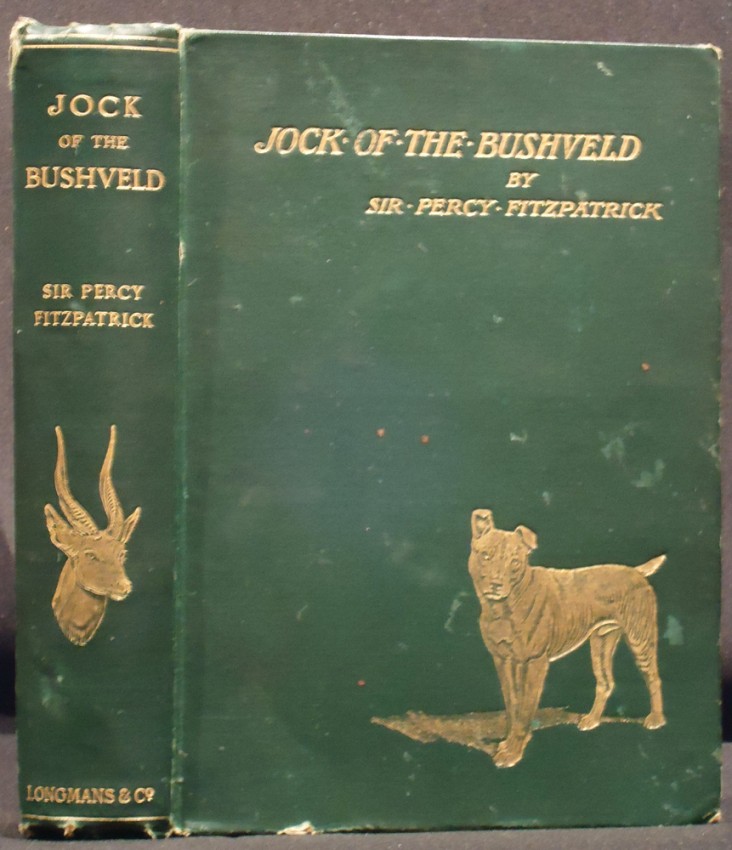
As an author, his most famous work was ‘Jock of the Bushveld’. Written in 1907 while staying at Buckland Downs, it told about his life as a transport rider in the lowveld goldfields of the old Zuid Afrikaanse Republiek. The Jock stories began as bedtime stories told to his children. Apparently urged to publish them by his friend, famous author Rudyard Kipling, the stories became one of South Africa’s most famous books of all time.
Around 1910 Fitzpatrick ordered a large number of different varieties of oak trees from England and planted them in the shape of the Union Jack on about 35ha of land on Buckland Downs. Despite these two obvious anti-local actions, Sir Percy said “I would rather be a meerkat in Africa, than a millionaire in England.” Of course, he meant that only as long as Africa was under British rule.
Fitzpatrick’s daughter Cecily (1899-1992) later stayed on the farm with her husband Jack Niven. In the 1940’s the famous ornithologist Austin Roberts (1883-1948) used to visit them on Buckland Downs. Patrick Niven tells how Roberts involved the family during a 1942 visit in a collecting expedition to the nearby Spitzkop for specimens of swifts – probably at a nesting site?
Cecily became very involved in birds – her name is reflected in the List of Members of the Southern African Ornithological Society (SAOS) for April 1935, the receipt for her subscription is signed by Austin Roberts himself – honorary secretary at the time. In 1948 she established a Committee for Bird Protection as a subsection of the Wild Life Protection Society. In 1957 Cecily was the driving force behind the first Pan African Ornithological Congress which took place in Livingstone, Zambia. In 1960 she established an Institute for African Ornithology – now fondly known as the ‘Fitzstitute’ – dedicated to the memory of her father, Sir Percy FitzPatrick, through a £15,000 endowment (around ten million Rand in 2007 money) from the FitzPatrick Memorial Trust.
~~~oo0oo~~~
A first edition copy of Jock is going for $7500 in 2019. And then THE first edition is for sale by Clarke’s Bookstore. I wonder how much that will fetch? Here’s the inscription Percy himself inscribed in it:
Illustrated by E.Caldwell
DESCRIPTION:
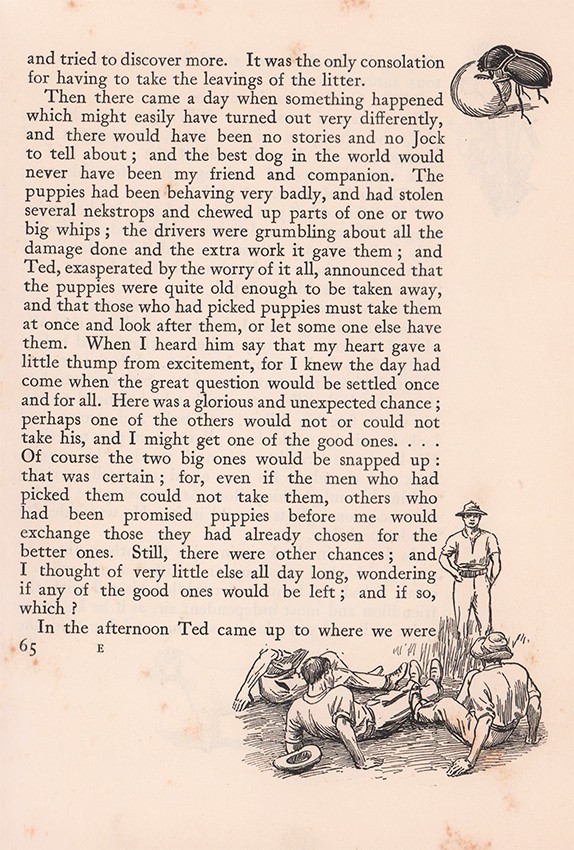
First edition, First impression. 475 pages, colour frontispiece, plates and marginal illustrations, dark green cloth with gilt titling and gilt vignette of Jock on the upper cover, light foxing throughout mainly in the text and on the page edges, with the drawings of a dung beetle pushing his load with his front legs rather than his back legs on pages 65, 337 and 457 and Snowball the horse being dragged out of the river on page 316 – these drawings were changed in later impressions. The spine is starting to fray at the top and the bottom, the bottom edge of the upper cover and the corners are slightly scuffed, housed in a specially made oatmeal textured cloth solander box with a dark green title label gilt on the spine, a very good copy of the first edition. Overall Condition: A Very Good Copy
5000 copies of the first impression were printed at a total cost to Longmans of £416. 7s. 11d.
Signed on the title page by J Percy Fitzpatrick. His full name was Sir James Percy Fitzpatrick.
Inscription on the front paste-down end paper reads: This – the first copy of “Jock”- “belongs to the Likkle People” and the mere narrator desires to acknowledge that fact in proper form. J Percy Fitzpatrick, Hohenheim October 1907
The dedications page reads: It was the youngest of the High Authorities who gravely informed the Inquiring Stranger that “Jock belongs to the Likkle People!” That being so, it is clearly the duty, no less than the privilege, of the mere Narrator to dedicate the Story of Jock to those Keenest and Kindest of critics, Best of Friends, and Most Delightful of Comrades, The Likkle People.
Fitzpatrick’s adventures – centred on his dog Jock, a Staffordshire Bull Terrier cross – when he was pioneering in the Bushveld, are vividly described in this South African classic. He used to recount them in the early 1900’s to his four children, Nugent, Alan, Oliver, and Cecily, to whom the book was dedicated – the likkle people.
Rudyard Kipling, an intimate friend, at some time took part in these story-telling evenings, and he it was who persuaded Fitzpatrick to put the stories together in book form. Having done this, Fitzpatrick searched for a suitable artist to illustrate the book and eventually came across Edmund Caldwell in London and brought him to South Africa to visit the Bushveld and make the drawings on the spot.
The book, which appeared in 1907 for the first time, was an immediate and overwhelming success, being reprinted four times in that year.
Extracted from his South African Memories pages 24 -25: Of course to those who have read Jock of the Bushveld he needs no introduction. Jock and Jess and Jim will always live in the memories of the Likkle People whom he was addressing and whom in every generation of young South Africans he will continue to address. The Likkle People have always loved Jock and his companions because they know what was being told to them was true and that it was all about their own wonderful country.
Sister Sheila has been doing some research on our early ancestors: Some genealogical sleuthing. We all know one should be careful what ye seek – ye may find!
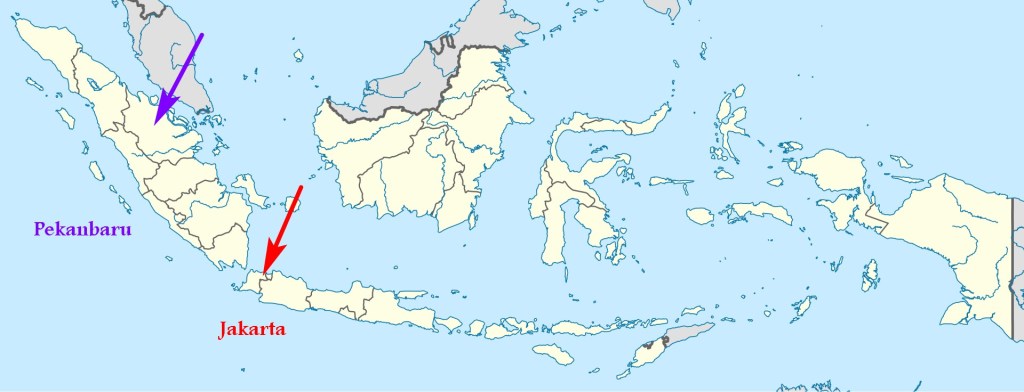
We now have a new colourful ancestor – the Cape’s first ‘Bergie‘ or homeless person. He was probably one of the many unfortunates that the ‘civilised western world’ ‘captured’ and/or ‘owned,’ enslaved or sold, or otherwise dominated. In addition to our ancestors Louis van Bengal, Maria van de Caep and Lijsbet van Abyssiania, there’s now Amsoeboe van Timor: born around 1640 in Pekanbaru in Indonesia.
– indonesia –
Amsoeboe van Timor’s movements from Indonesia to Mauritius (1676) to the Cape of Good Hope (1679) – Amsoeboe, his wife Inabe van Timor, and daughters Iba and Baauw are sent by the ‘Dutch East India Company’ (VOC) from Batavia [Jakarta on the Indonesian island of Java] on the hooker Goudvink to Mauritius – a VOC outpost (buitenpost) governed from the Cape of Good Hope which latter colony is itself governed from Batavia. Their unnamed son, however, remains at Batavia. They are described as a ‘politically exiled, but un‐enslaved,’ family from Timor .
The commander on Mauritius at the time is a ‘reformed privateer’ (! – do pirates ‘reform?’) Hubert Hugo. There, the family is accused in 1677 of conspiring with Company slaves and exiled convicts to overthrow the colony, massacre its officials, and escape. Note how they are ‘un-enslaved,’ yet accused of wanting to escape! Amsoeboe and his family are all separately interrogated in a pre‐trial investigation by Commander Isaac Johannes Lamotius and his council. Also implicated in this conspiracy is a Company soldier Hans Beer, ‘concubine to Iba.’ Two conspirators hang themselves. Behr ‘dies mysteriously during interrogation.’ (I’d call that tortured to death, most likely).
Washing his hands of the pickle by claiming no authority to legally try Amsoeboe and his family, Lamotious (so, like Lamontius Pilate?) sends them to the Cape of Good Hope in 1679. There, the family settle amongst the colony’s free‐population, and – most likely being in abject penury – apparently start a brothel.
Their household ‐ one of the small colony’s two operational brothels – is censured by Commander Simon van der Stel and his council in 1681, authorizing the fiscal to arrest any offenders he finds there. The 1682 census enumerates seven unnamed members for this family ‐ including presumably three daughters of Amsoeboe’s daughter Iba. Amsoeboe is now recorded as Paay [‘Father’] Timorees or Moor ‐ and his wife as Ansela van Timor. After the death of his wife Inabe in 1682, the Orphan Chamber makes an inventory of the impoverished family’s meagre worldly goods.
Iba – now known as Anthonique ‐ joins the Stellenbosch household of freeburgher Jacob Aertsz: Brouwer and his twice‐widowed wife Agnetha Rix. Brouwer assaults his wife regularly and on one occasion also another free‐burgher’s wife. He later viciously assaults Iba (1686) with a broomstick soon after also whipping his slave Tido van Goa. Tido dies from his injuries.
In 1693 Iba jointly baptizes her three daughters, each adopting their own biological father’s name.
Amsoeboe next appears in the records in 1692 as a miller with both daughters in the Cape District alongside free‐burgher Gerrit Theunisz (from Utrecht) ‐ concubine to Iba ‐ which couple is again recorded in 1695.
Death: Amsoeboe van Timor passed away on February 4, 1708. “The body of an old black, known as Paay Moor [Amsoeboe van Timor, exiled from Batavia and Mauritius], found dead in the gardens in a small hut. He was accustomed to beg his food in the town. The Fiscal & surgeon & secretary of justice went to examine it. It is believed that he died of natural disease & great poverty. The body being partly decomposed, (it) was buried on the spot.”
Research on the Mitochondrial DNA (mtDNA) results of the family are fascinating. Mitochondrial DNA is passed only from your mother, unlike your nuclear DNA which you inherit from both parents. Read more at wikitree, but just one finding of the research is that Ansela and Iba could not have been biological sisters (confusion, I thought they were mother and daughter?), as their descendants do not share the same mtDNA haplogroup. One of Ansela’s descendant’s results yielded identical matches to:
1 African American individual
1 individual from the Democratic Republic of Congo
4 Zanzibaris
2 ‘South African Coloureds’
1 ‘South African Indian’
1 ‘South African White’
67 South African Bantu-speakers.
Besides being one of my ancestors, Amsoeboe was also the Cape’s founding father of the Erasmus, Blom & De Jager families – innit lovely to see how apartheid was all built on myth and bullshit!? Isn’t it tragic to see how poor people are targeted?
Me and Stephen Charles Reed, First Son of Clarens Vrystaat, were talking V8’s back in 2012 when he delivered that spot-on description of the sound they make as they roar off, windgat, into the distance.
I replied: Oh, I DO like that description! That’s GOOD! When you hear that grumble at a traffic light you delay your take-off to hear that grumble-rumble-roar-aaargh! . .
– muscle car V8 – thanks daniel simon –
Here’s a better one! I especially like the fact that this V8 is only two litre displacement. A 2l V8! Yay Italy!
Remember the ole man’s V8 bus? Did you drive with me in Hillbrow? Floored it at a few robos. More like a Doories hobo clearing his Old Brown sherry-phlegm throat, but still impressive . . and neat for penniless students to windgat in. We blew a few okes’ doors off in the sprint to the next lights. That was ca.1975. I didn’t own a car yet, even though I was an expert driver, of course.
– in Doories we drove it something like this –
Steve: I had forgotten but it comes back to me. Imported van, was it not? Is it still around? I can quite imagine you driving it around Doories and quietly being a bit of a windgat. Aah, those halcyon days! Now it’s all about boring things like reliability, economy and resale value. Where has all the fun gone? Back to the van. Did your folks do a bit of touring in it? Or a lot? I am sure half the fun with them is kitting it out.
Me: Ja, a 1972-ish Ford Econoline with 302cubic inch V8. Five litre. White. Automatic 3-speed. Imported new, direct from Detroit. They toured a bit, but the vehicle itself was the ole man’s interest. We had old faded-denim blue VW kombis before it and he got a big Toyota Coaster 22-seater after it. All with the seats removed and carpets, beds, stove and fridge fitted.
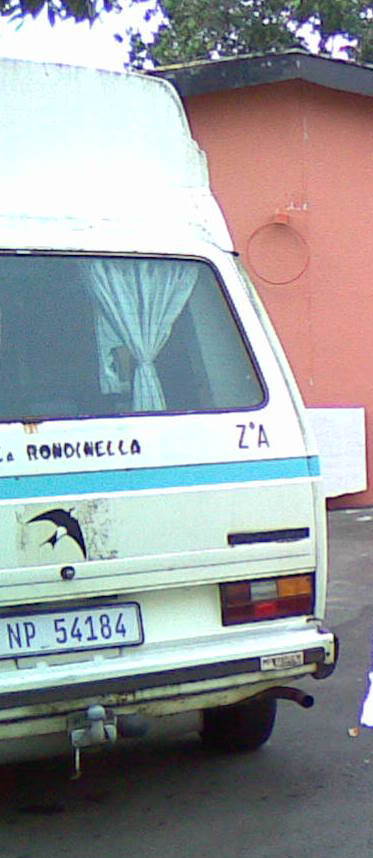
Now he has an ancient Jurgen camper VW kombi with the tortoise-on-the-back look. And tortoise-on-the-back speed.
— Rondinella – ‘Swallow’ in Italian – 400 000km on the clock –
When he was about eighty he took the ole lady in the tortoise to Oranjemund on the Atlantic Ocean on the border with Namibia; then followed the coast southwards down to Cape Town; east up the Garden route, into the old Transkei, into Natal up to Kosi Bay on the Indian Ocean on the border of Mocambique. IOW, the whole blerrie South African coastline. Mom found out on the way that that had been his goal all along!
They broke down late one afternoon in the Transkei between the coast and Umtata. Luckily Sheila had a friend in Umtata, and luckily he is a real mensch, and luckily he roared off in the night to tow them in to his home. Judge / Advocate Pete Rowan.
Now at 89 the ole goat wants to buy another one. In an understatement he says, ‘This one is too rusty, but the 1800 Jetta engine is still FINE.’ He has his eye on a newer one, only 400 000 kms on the clock; Planning vaguely to head off into the wild blue yonder again. Heaven help the ole lady. She gets panic attacks at the thought, but soldiers on, providing the calm, rational common sense to the union as she always has. (They had only been married about 52 years when they toured the coastline). update 2024, now 71yrs married.
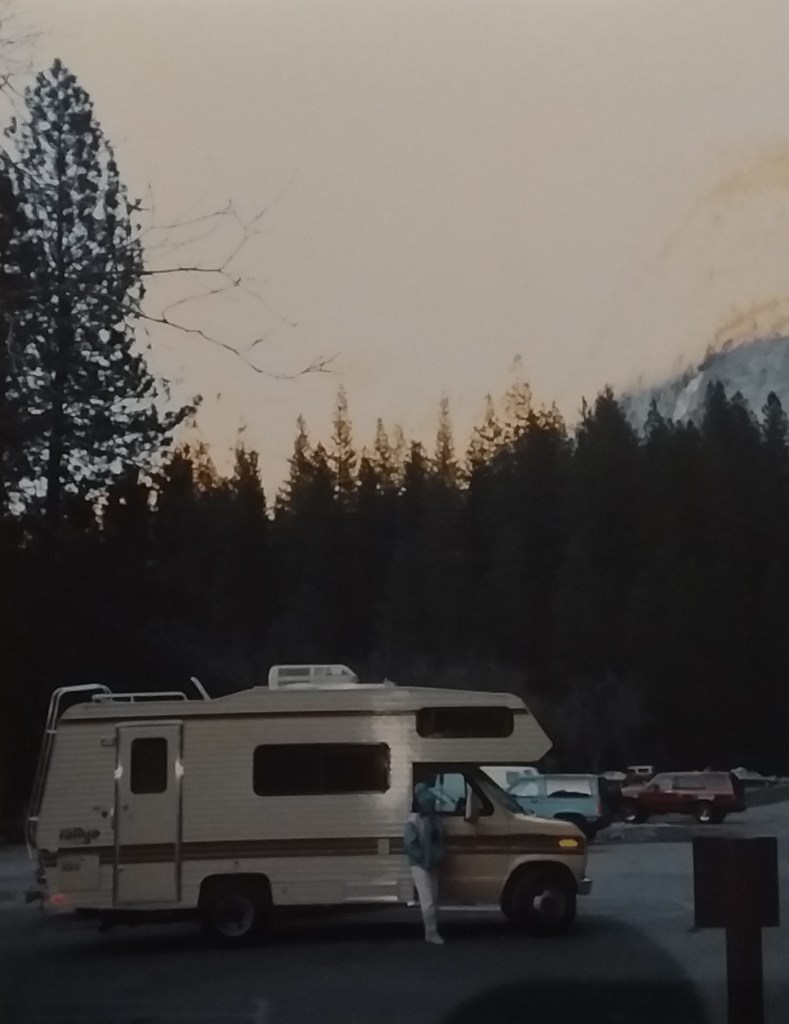
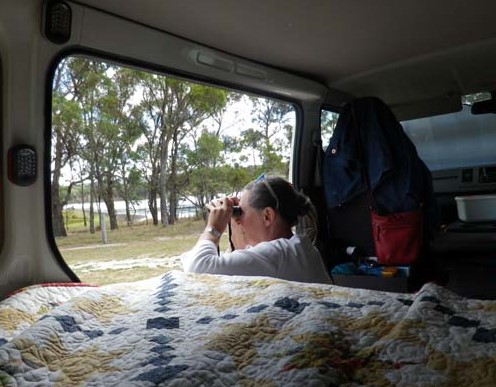
– Aitch on honeymoon with that camper van –
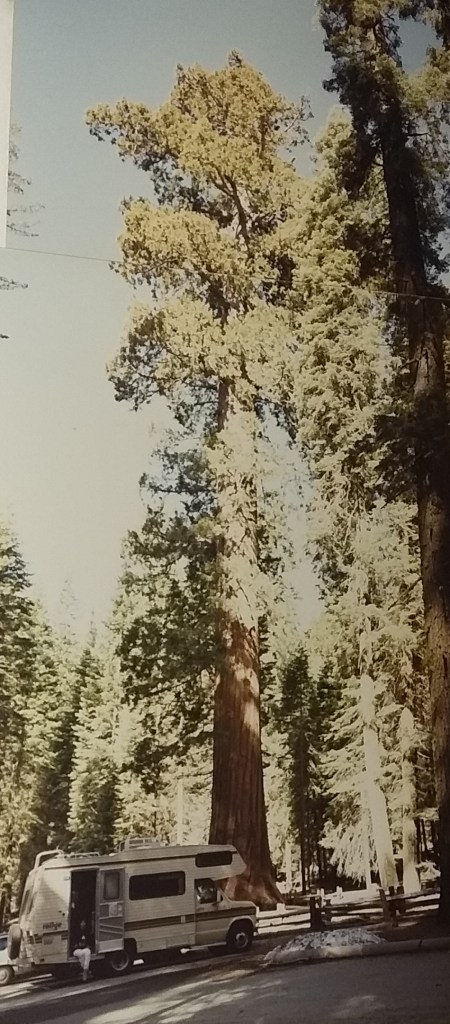
If only he was reasonable, like his son. Aitch and I hired a later-model Ford Econoline camper in San Francisco, California on honeymoon in 1988. We went to Yosemite, Big Sur, Golden Gate bridge and a bit north of that to some redwood trees. Fun way to go. Ideal for Oz, I’d think
Stephen: Wow – fantastic that he has that passion at 89. Of course I imagined your folks much younger. My ole man would have been turning 100 in September 2012!He would have loved all that. My guess is that they kept up too much of a social lifestyle to have money left over for exciting things like camper vans. To be buggering around tinkering with cars and vans at 89 your dad must be blerrie fit. Well done to him. Takes me two days to build up the momentum to clean my car!
Sorry to hear about
your Kombi.
That trip round California including the Big Sur (now Keith Ballin country) sounds amazing. A lot of old-timers (i.e about my age) over here go and ‘do the lap’ round Australia. Would smaak to do it some day but in the meantime need to keep the nose to the grindstone. Which I know is the wrong attitude. Do it now!
– had to add this in – there’s Aitch again –
Me: You are absolutely right: Go now. Work again later. One thing okes agonise over is what vehicle to choose, and I think the actual answer is always ‘The One You Have.’ Just get into it and start driving. As for ‘What to take?’ – very little. Weight is the enemy. There’s very little you might pack that you can’t find along the way. Take less luggage and more money than you think. And your pills, don’t forget your pills.
A thought for both of us: Contact every little dorp optometrist en route and ask them if they need a locum. Tell them you’ll work a day or a week for them and house-sit while they have a holiday. Also always seek out the local birding fundi and ask him or her to take you to the local spots. Save time and see more.
~~oo0oo~~
The story started earlier when I told a tragic tale:
On Wednesday, July 18, 2012, pete swanepoel wrote: My fine VW kombi T5 bus went clunk after I dropped Jess off at school this morning, and suddenly no clutch, no gears, fokol. Absolutely no problem, sir, said Alpine Motors when the AA tow truck dropped me off there, just give us twenty four grand and we’ll have it as good as old. I picked up a lil Suzuki to keep me going meantime. R200 a day while I ponder whether to fix or sell.
Later: The ole kombi lay down with its wheels in the air, and the quote to fix it went up to forty four grand, so I got me a Fraud Ranger last week. 2007 model, a mere 89 000km on the clock. So far I’ve only dinged it the one time. Smashed the rear lights against a pillar in a parking garage.
Steve reed wrote:A three liettah turbot diesel! Now you can pull out tree stumps. Anyway, he said (I paraphrase), dirty VW no longer deserves your patronage, the lying thieves.
Me: Exactly. Just don’t tell anyone the Ford’s front wheels just trundle along for the ride . . . it’s a high-rider, so it masquerades as a Four Four Four as Jessie used to call them.
Steve: It’s when the BACK wheels freewheel that it’s more shameful. Like my corolla. At the local Toyota dealer they had a genuine Glen Barker Toyota circa 1975-ish, mint condition; belonged to a little old dear living locally. Now that was a back wheel driver, I am almost sure. They had it in the showroom as an object of curiosity.
Anyway that noo car: You gonna be pulling something with that – other than chicks? Or putting some sort of enclosure on the back? Forgot what they call it.
Me: Canopy. Maybe I’ll install a double bed mattress and dark curtains. You never know . . . it does exhibit strong chick-pulling tendencies.
Yeah, Glen’s Toyota! Green, it was. A Corona, I think. Definitely rear wheel drive. NX 106. His Dad still has NX 21 from when it was first nailed to their oxwagon when they arrived fresh in Natal to steal it from the Zooloos in the name of the Lawd.
~~oo0oo~~
postscript: Steve did buy a bus! And he did convert it into a camper van! Proud of ya! He and Evil Voomin did a really neat job:
– the full Reed flock doing it in style – looking for flocks in the reeds –
~~oo0oo~~
That car? A 1970 Oldsmobile Cutlass 442. 455 cubic-inch V8. That’s 7.5-liters in today’s money.
windgat – impressive; or show-off
robos – ‘robots;’ traffic lights
Doories – Doornfontein; Johannesburg’s premier sought-after salubrious suburb; a wee bit past its prime maybe; but the first ‘Randlords’ built their mansions here
It is one of the glories of British military history. A garrison of just over 100 men, including sick and wounded, holding out against an army of 3,000 Zulus.
Wave after wave of warriors with spears and rifles crashed against the makeshift defences at Rorke’s Drift, South Africa, and still the redcoats held firm.
After a number of unsuccessful attacks in the 11-hour battle, the Zulus were finally forced to withdraw. Queen Victoria and her empire had reason to celebrate. In a way Britain still does: the 1964 film Zulu, starring Michael Caine as one of the officers at Rorke’s Drift, endures as a television favourite.
More Victoria Crosses (11) were awarded to the troops at Rorke’s Drift than at any other single battle by the British army.
But that image of valour and nobility in the Anglo-Zulu war of 1879 could now turn to shame. Documents have been uncovered which show that Rorke’s Drift was the scene of an atrocity – a war crime, in today’s language – which Britain covered up.
In the hours after the battle senior officers and enlisted men of a force sent to relieve the garrison are said to have killed hundreds of wounded Zulu prisoners. Some were bayoneted, some hanged and others buried alive in mass graves.
More Zulus are estimated to have died in this way than in combat, but the executions were hushed up to preserve Rorke’s Drift’s image as a bloody but clean fight between two forces which saluted the other’s courage.
Damning testimonies from British soldiers are published in a new book, Zulu Victory, written by two retired British officers, Ron Lock and Peter Quantrill, and published in Britain by Greenhill.
The letters and manuscripts, stored and forgotten in British and South African museums and archives, show that the British had no mercy for captured opponents after the Zulus set fire to the garrison’s hospital during the battle, then burst in and speared the patients.
“Altogether we buried 375 dead Zulus, and some wounded were thrown in the grave,” wrote one trooper, William James Clarke. “Seeing the manner in which our wounded had been mutilated after being dragged from the hospital we were very bitter and did not spare wounded Zulus.”
Horace Smith-Dorrien, a lieutenant who later became a general, wrote that a frame to dry ox-hides became an improvised gallows “for hanging Zulus who were supposed to have behaved treacherously” during the battle.
Samuel Pitts, a private, told the newspaper the Western Mail in 1914 that the official enemy death toll was too low. “We reckon we had accounted for 875, but the books will tell you 400 or 500.”
In fact, Lieutenant Colonel John North Crealock’s private journal, discovered in the royal archives at Windsor, reported that “351 dead Zulus were found and 500 wounded”. He did not elaborate on the fate of the wounded and the book’s authors conclude they were probably all killed, since there was no record of taking prisoners or tending wounded.
The garrison’s heroism was no myth, but the Victorians lionised Rorke’s Drift to compensate for the debacle at nearby Isandhlwana, a British camp where 20,000 Zulus killed over 1,000 soldiers on the same day.
Taking no prisoners, they disembowelled many of the British and their colonial and native allies.
A British relief force saw the bodies on its way to Rorke’s Drift, and it was this force which executed the Zulu wounded, not the garrison’s men, who were resting after the battle.
Six months after Rorke’s Drift, the British government said “several” Zulus had been treated, but made no mention of the hundreds of other wounded Zulus.
“The British government and public thought it was better to sweep it under the carpet,” Ron Lock said yesterday.
There is no mention of the atrocity at the museum at Rorke’s Drift, nor monuments marking mass graves.
Mr Lock, a former inspector with the Kenyan mounted police and a battlefield historian, wrote the book with Peter Quantrill, who is retired from the British army’s Gurkha regiment.
Durban ca 1980 – I’ve been sent here by the army; I know very little about this Last Outpost of the British Empire, but my friend, fellow Free Stater Steve Reed, has been here almost a year, so he knows everything. And he knows some girls.
The papers announced that some comet was due to approach Earth and – we extrapolated – threaten our way of life, our partying, our poison of choice – and perhaps even kill us. Or annoy us anyway.
We determined to protect ourselves and our favourite planet from this unwelcome alien intruder. Steve hired a beach cottage at Blythedale Beach on the Natal north coast and, as I know a lot more about warding off comets than I do about girls, I was happy to tag along with Stefaans and a bunch of his female friends and admirers. Supplied with adequate stocks of various powerful potions and elixirs to be taken internally, we sallied forth. We also bought tinfoil.
In the self-catering kitchen we found plenty with which to arm and armour ourselves: Colanders, coriander, and pots and pans made good headgear. Braai forks, spatulas, braai tongs and wooden spoons made anti-galactic weapons. We warmed up our IQ’s by imbibing aplenty and so started a rip-roaring single-handed – the other hand was holding cheap and blithe spirits – Defend the Planet Party; which same ended successfully in the wee hours on the beach when a mysterious pale, then ever-brighter, light appeared on the eastern horizon, over the sparkling Indian Ocean.
Was it perhaps Comet Aarseth-Brewington? Well, if it was, we made it saweth its arseth by our brewing and distillington. Or the musically jolly-sounding Hale-Bopp comet? Which whizzed past on an auspicious day – 1st April – in 1997.
Actually, it was more likely Comet Tuttle. There it is, below! It came back in 2007 but it knew better than to approach too close:
– 37 million km is the closest it dared come this time –
Of course it was really the Sun, come to burn a hole in our hangovers.
Only later, after recovering from my overindulgence did I realise another of the planned missions had once again been a complete failure: Snaring any girls. As so often, the booze had won and I’d dipped out. And they were kif . .
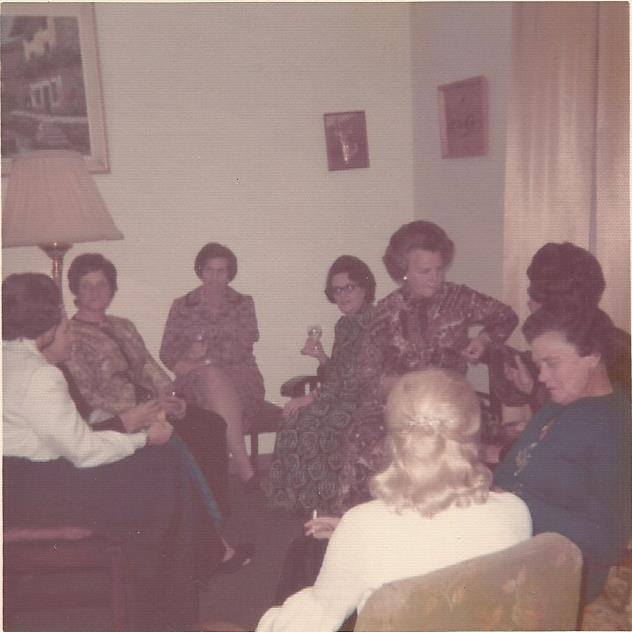
A large gathering of the Goor Koor – that assembly of happy inebriates led and accompanied by virtual-teetotaller Mary Methodist, our Mom, gathered together – assembled, amassed – on the occasion of Mom’s 45th birthday. Usually there were far fewer of them gathered at any one time, an occasional Lubricated Quartet perhaps, but this was a special occasion in the big loungexat 95 Stuart Street!
And Sheila – thanks goodness! – took pictures. She was in matric at the time, I was in Oklahoma, Barbara in Pietermaritzburg.
– Joyce Joubert; Marie Roux peeping out; Isobel Kemp; Stella Fyvie; Mary the birthday girl, wearing specs, grog in hand; Mary Wessels; Martie Dreyer; Baby Mandy; Annemarie van Wyk –
. . and here – precious picture! – Mary at the keyboard and Hugo Wessels right there, ready to belt out a number! Two very talented people, 45 years old, who were in matric together in 1945. And this fun gathering happened 45 years ago, as Mom is now 90! I think all my stats are right . . .
– in earlier years my ear would be near the floor right outside that door behind Hugo – listening in fascination –– Dina de Kock; Hester Schreiber; Koekie de Bruyn; Hugo Wessels; Hannes van Wyk; Jack Kemp; Pierre Roux; Hector Fyvie; Steve Schreiber; Dad; Bennie Dreyer; Joyce Joubert Isobel Kemp; Stella Fyvie: Anna-Marie van Wyk –
Wonderful memories of crawling down the long passage to get nearer to the sound of Mom playing the piano; Also of sundry ‘choir members’ over the years, belting out popular songs with high enthusiasm and various degrees of talent. If spotted by any of the choir it would be ‘Hello Kosie!’ – if spotted by Mom or Dad it would be ‘Get back to bed!’
Also memories of the smell of ash trays! Always plenty of ash trays. Ours were from tyre companies, so they were glass inside miniature Dunlop or Goodyear tyres!
– I couldnt find one overflowing with butts and ash! –
~~~~oo0oo~~~~
Goor Koor – Dire Choir
~~~~oo0oo~~~~
– 45yrs later here’s Mary, still beautifully at it –
Now we know why, when you have had a few too many, your lumpy laughter can be so spectacular . . .
Check out ‘bevshots‘ where some dudes* had a sudden thought – probly while suitably under the affluence of incohol? BevShots® are photographs of alcohol under a microscope. These high-quality photographs of your favorite beers, wines, cocktails, liquers and mixers were taken after they had been crystallized on a slide and shot under a polarized light microscope. As the light refracts through the beverage crystals, the resulting photos have naturally magnificent colors and composition. Just like we had a naturally magnificent complexion, and erudite verbal composition while it was in our veins on its way to our brains where it belongs. Cheers!
These quality scientific macro photographs explain why sometimes when you shoot a cat, it turns out to be a whole Bengal Tiger.
~~oo0oo~~
Thanks @lowqualityfacts@mstdn.social
Improve your vocabulary: Don’t just say ‘vomit,’ be like Shakespeare and use descriptive terms and synonyms: sidewalk pizza; burp cubed; spew; lumpy laughter; technicolor yawn; shoot a cat; chunder; upchuck; barf; vomit; hurl; ralph; brauer; purge; puke; hork; honk; buick; huey; louis; regurgitate; throw up; belch your boerewors; toss your cookies; lose your lunch; toss a pavement pizza; perform peristaltic pyrotechnics; paint the town red . . and yellow-green, orange and pink; calling Ralph on the big white telephone; pray to the porcelain gods; grocery yodel. (Your favourites in the comments, please!)
Scientific puzzle: Why, no matter what you have eaten, are there always bits of carrot in the mix?
Hypothesis: They hide in the appendix, waiting for just the right occasion to hu- hu- hu-ppear?