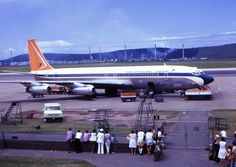
As a 17-yr-old in 1973 I flew from Jo’burg to Rio de Janeiro, then on to New York. This in an SAA Boeing 707 – a narrow-body, four-engined jet airliner built from 1958 to 1979, the first jet to be commercially successful. Dominating passenger air transport in the 1960s and remaining common through the 1970s, the 707 is generally credited with ushering in the jet age’. Wikipedia also says that 10 of them were still flying in 2013! Here’s one:
I flew on via Chicago to Oklahoma City, where I was met by Apache Rotarian Robert L Crews III.
I knew very little about flying and maybe that’s just as well. I now know this:
January 2 – Attempting to land in Edmonton, Canada in blowing snow, a Pacific Western Airlines Boeing 707 carrying 86 head of cattle and a crew of five, crashed and caught fire. The entire crew was killed. The cattle? Who knows.
January 2 – Released from a psychiatric hospital days earlier, 37yr-old Charles Wenige hid in a lavatory aboard a Piedmont Airlines plane after it arrived in Baltimore, Maryland. When all the passengers had disembarked, he emerged and pointed a .45-calibre pistol at a crew member, demanding access to the liquor cabinet and to be flown to Canada. After two hours of negotiations, he agreed to release the stewardesses in exchange for a meeting with a psychiatrist and a priest. An FBI agent advised Wenige to tuck his pistol away in the priest’s presence. When Wenige did that, the agent overpowered and arrested him.
January 4 – As a Pacific Western airliner prepared to take off from Vancouver, Canada with 18 people on board, a passenger, 26yr-old Christopher Nielson, drew a gun and demanded $2 million in cash and to be flown to North Vietnam, threatening to blow up the airliner if his demands were not met. During negotiations he allowed most people to disembark, leaving three crew members aboard the plane with him. Police then stormed the plane and arrested him, finding that he was armed only with two toy guns.
January 5 – The mandatory security screening of all airline passengers began at all airports in the USA.
January 12 – The 197th and final American air-to-air battle of the Vietnam War.
January 15 – President Richard Nixon ordered a halt to all bombing, shelling and mining of North Vietnam.
A Boeing 707 chartered by Nigeria Airways crashed after the right main landing gear collapsed while the plane was landing in high winds in Nigeria. It was the deadliest aviation accident in history at the time.
January 27 – A U.S. Navy plane was shot down over South Vietnam – the last American fixed-wing aircraft lost in the Vietnam War.
January 27 – Frontier Airlines hired the first female pilot for any modern-day U.S. airline, Emily Warner. On the same day, the airline also hired its first African-American pilot, Bob Ashby.
~~oo0oo~~
– Air India !! –
On the way back at the end of that year, I flew in an Air India 747 – my first jumbo jet! – from New York to London. On the plane I read in an abandoned newspaper that Air India had been voted World’s Worst Airline – again.
I have since learned this: ‘The years 1971-1973 were very bad for Indian Airlines. The 1971-1972 Pakistan War didn’t help. The airline reported a 45 million rupee loss in 1973, the carrier’s largest to that point. Exacerbating the aforementioned crises was the continual strike being waged by labor. Management, concerned by growing labor costs and inefficiency, eventually locked out many of its workers, operating only a skeleton schedule with a non-union workforce’.
I notice groping is a problem on Air India and they now keep plastic handcuffs to bopha the culprits. I feel I have to report with some regret that none of those sari-clad hostesses groped 18yr-old me, despite this alluring suggestion:
– my first jumbo jet flight was Dec 1973 –
Here’s Air India in 2025 after the worst crash in a decade. Same old . . .?
~~oo0oo~~
World Trade Centre
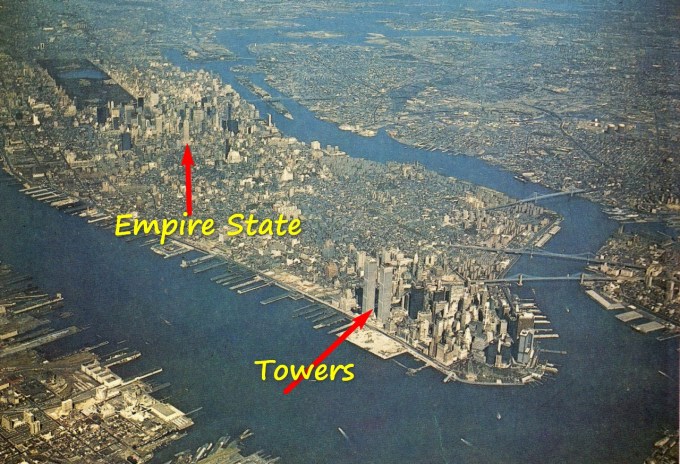
The Twin Towers of the World Trade Centre in Manhattan were opened in April 1973. I didn’t see – or consciously notice – them in December 1973. How unobservant is that!? And I must have seen them – I went up the Empire State building and looked around. Maybe I was staring at Central Park and the river?
Aerial view of Empire State building – by Sam Valadi
–oo0oo–
bopha – isiZulu for bind, tie up (pronounce “bawpah”)
This post needs work by someone who knows what they’re on about. This is almost as confusing as the Bible’s begats. Advice: If your name is John, name your son Basil. Or Cyril. Or Percy. Anyway, here goes with what I’ve got:
Our distant cousin Hugh Bland has been doing some wonderful detective work sniffing out the Bland family history. He’s of the Blands that trekked north, to the lowveld and on to Southern Rhodesia (if it was called that yet?), leaving their cousins behind on a farm at Oliviershoek on the Natal-Free State boundary. Maybe on a farm called Oliviershoek.
Today Hugh found the grave of Josiah Benjamin Adam Bland.
Josiah Benjamin Adam Bland was born in 1799 in England. His parents were Reverend John Francis Bland (born 1764 Fordham, Cambridgeshire died 1807) and Elizabeth Adams (born Dunfermline, Scotland. He arrived at the Cape in 1825 on the good ship Nautilus, under the care of the ship’s captain, a Mr Tripe. The voyage cost his family £42.
He got a job on a wine farm, in the Drakenstein area of Stellenbosch, met his future wife Cecelia there (du Plessis?), married her, packed their belongings in a Cape cart and trekked to Mossel Bay. They found land on the Gourits river and settled there. Their first son, John Francis Adam, was born in 1836, followed by eight more children. John the eldest then married Petronella Johanna ‘Nellie’ de Villiers and had a son, John Francis Adam II. He and Nellie left for inland while the baby JFA the second was just a few months old. They headed for Colesberg, Bloemfontein, Winburg and on to Harrismith, where they settled ‘in a house not far from the centre of town’ – 13 Stuart Street, maybe?
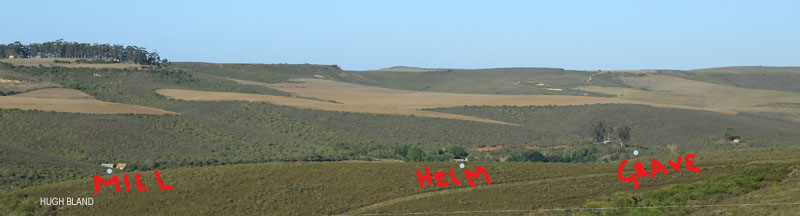
Back in Mossel Bay, Josiah Benjamin Adam Bland (JBA) became mayor and the main street was called Bland Street. Maybe it still is? He died in 1861. His grave is now hidden in thick bush on a farm in the Wydersrivier district near Riversdal.
When Hugh Bland visited die Kaap ca.2010 the farmer very kindly took him to the gravesite. Hugh says you can still read the inscription on the gravestone – it’s indistinct, but there’s no doubt that it’s JBA’s grave. He says it was “quite a moment” for him – JBA was buried there 156 yrs ago and Hugh wondered when a Bland last stood at that grave.
Hugh put two proteas – which it looks like he skoffel’d out nearby? – on the grave; then laid his shadow down next to his great-great-great grandfather and took this pic:
– Hugh Bland’s shadow next to Josiah Benjamin Adam Bland’s grave – left – Mossel Bay – right – Blands Drift on the Gourits River –
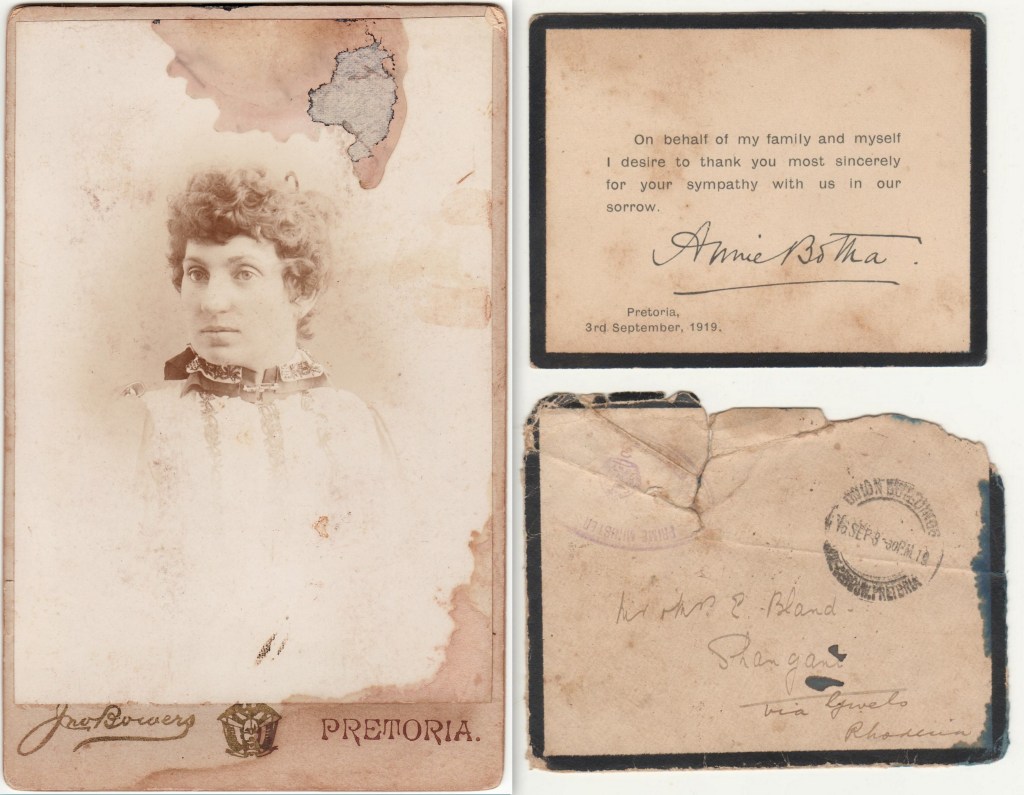
Valuable memorabilia from Hugh:
Prime Minister’s wife’s letter to the Rhodesian Blands
~~oo0oo~~
The Harrismith Branch of the Blands:
Josiah Benjamin Adam Bland had a daughter, Annie Emmett Bland, who married Louis Botha, Boer war general who became the first President of the Union of South Africa in 1910.
He also had a son John Francis Adam Bland (JFA), born in 1836.
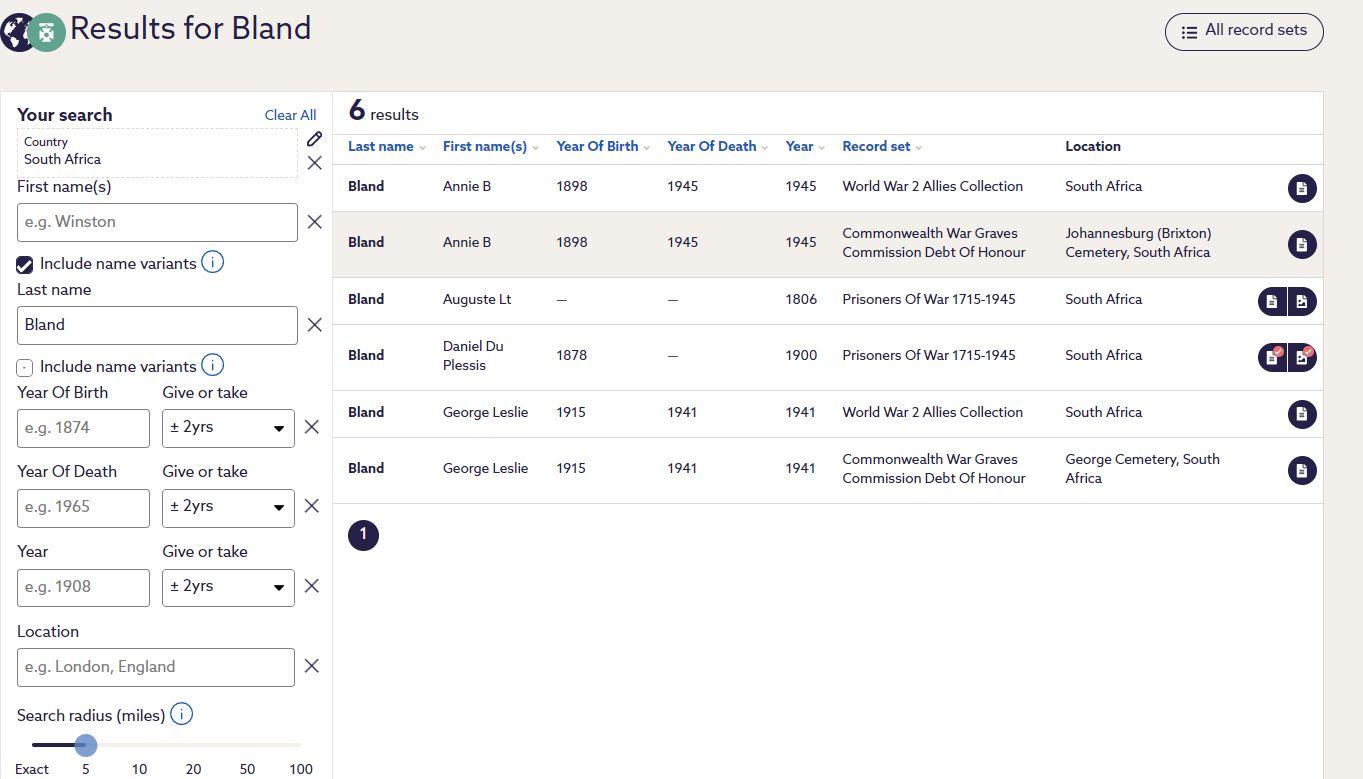
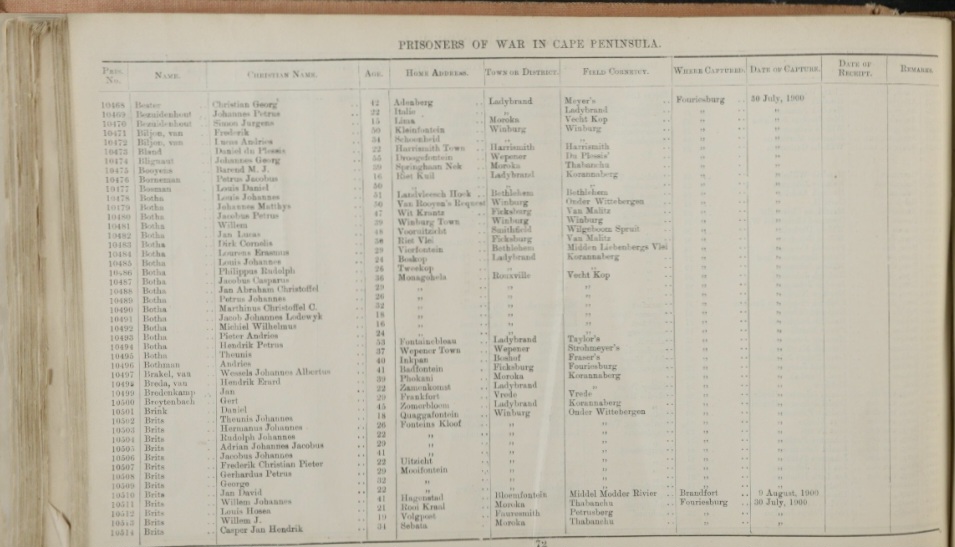
This JFA I later trekked inland ca.1861 to Harrismith in the Orange River Colony with a small baby – John Francis Adam Bland the Second – JFA II. This started ‘our branch’ of the Blands, The Vrystaat Blands. One of them – I must try and find out who – would end up as a prisoner of war in Ceylon for doing the right thing and fighting for his new homeland against the invading, thieving, plundering British in the Boer war of 1899-1902.
John Francis Adam Bland II married Mary Caskie, who became the beloved Granny Bland of Harrismith. They had five sons of whom our grandfather Frank was the oldest, again: John Francis Adam; JFA III.
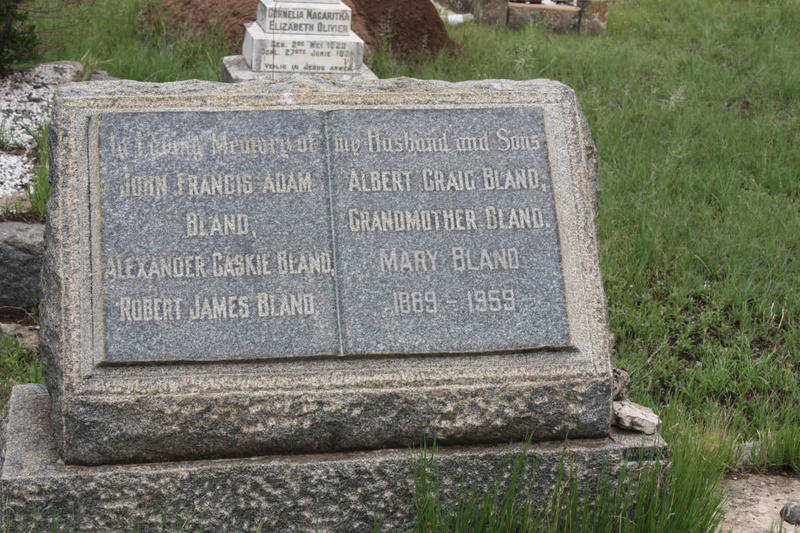
Hugh found out that JFA the First died on 10 September 1891 aged 55, and is buried in the lost, dusty, verlate metropolis of Senekal, Vrystaat. In Harrismith Granny Bland buried her husband JFA II and four of her five boys, including JFA III. As Sheila said, ‘What a tragic life.’ Poor Granny Bland! She loved her namesake grandaughter Mary, our Mom, and she lived long enough to know us, her great grandkids before she died in 1959. So in that she was Lucky Granny Bland! We knew Bunty, the only child who outlived her, very well. He died in 1974 and joined his father JFA II, his mother, and his four brothers in the propvol family grave in Harrismith.
JFA III married Annie Watson Bain – our lovely granny Annie Bland. Known as just Annie. They farmed racehorses and clean fingernails on the farm Nuwejaarsvlei on the Nuwejaarspruit outside Harrismith on the road to Witsieshoek, towards the Drakensberg. He died in 1943 while my Mom Mary was still at school. Pat was nursing in the Boksburg-Benoni hospital. Pat also died at age 49 in 1974. Mom Mary then looked after Annie until she died aged ninety in 1983. Mom Mary is still alive and well. She turned ninety in September 2018 (update, 95 in 2023). Nuwejaarsvlei was later submerged under Tugela river water pumped up the Drakensberg to fill the new Sterkfontein dam. Drowning vleis is environmental destruction, BTW!!! Grrrr!
(I’m hoping sister Sheila will fact-check me here! Also that cousin Hugh will tell us what happened to the misguided Bland branch that didn’t stay in the Vrystaat, but got lost and ended up in Zimbabwe. They lived near Oliviershoek for a while before trekking on. Hugh tells tales of transport riding, ox wagons, meeting Percy Fitzpatrick, farming in Rhodesia and other exaggerations . . . you know how historians are).
~~oo0oo~~
Must add:
A Bland grave pic – Harrismith cemetery
Annie’s oldest daughter Pat Bland – married Bill Cowie, and had two daughters Frankie & Gemma; Bill worked in Blyvooruitsig on the gold mine; We visited them once, and would see them on their way to their wonderful Wild Coast fishing trips. They called Blyvooruitsig ‘Blayfore or Blayfaw,‘ and pronounced Gert as though it didn’t have an ‘r.’
Mary Bland second and youngest daughter – married Pieter Swanepoel in Harrismith in 1951.
~~oo0oo~~
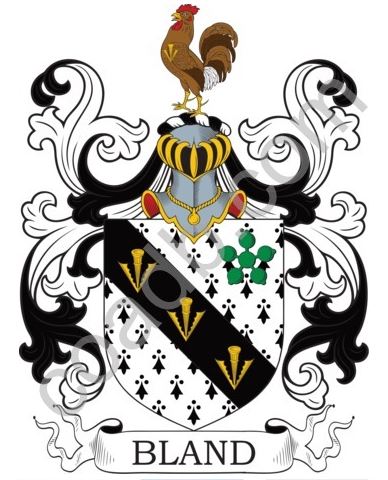
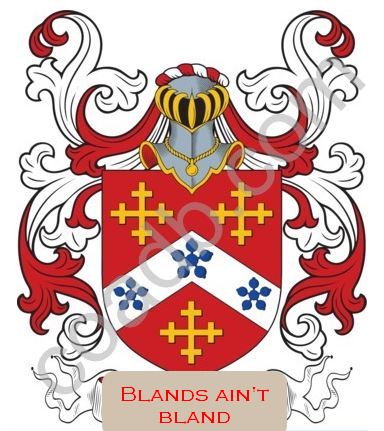
Bland might sound bland, but hey, the surname is thought to derive from Old English (ge)bland meaning ‘storm’, or ‘commotion.’ Don’t use dictionaries that say, ‘dull, flavorless, or just plain ‘blah.’ Rather use the Merriam-Webster that says it means ‘smooth and soothing in manner or quality;’ or use vocabulary.com that says it means ‘alluring;’ or try ‘flattering’ from the Bland Family History on ancestry.com; That’s better. A new motto for the coat of arms, maybe? Blands ain’t bland.
~~oo0oo~~
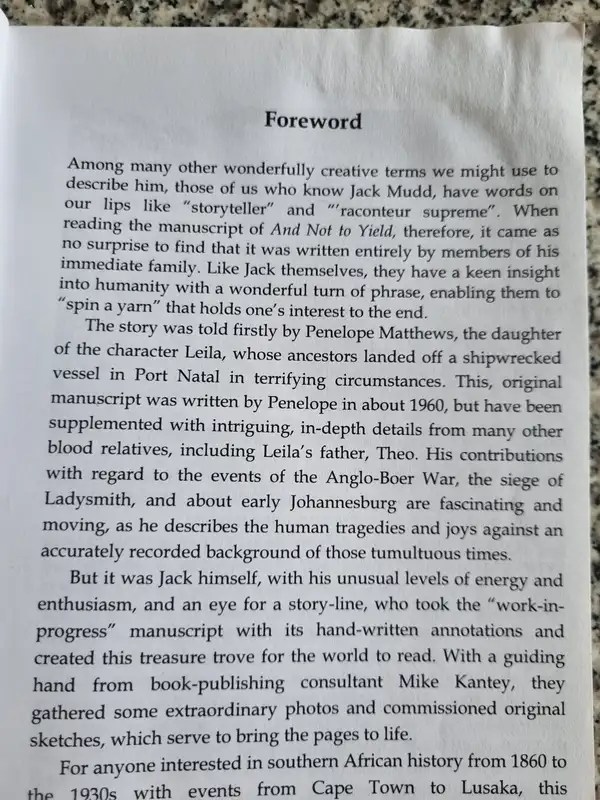
Some of the information on Josiah Benjamin Adam Bland first coming to the Cape I got from Sheila’s book And Not To Yield about Susan Bland. Susan was born in Harrismith, had a brother Willie, married a Theo Allison and lived seven miles outside Harrismith – west, I think, near Sarclet? – farming ostriches for a while.
And Not To Yield by Penelope Matthews, Watermark Press – ISBN 978-0-620-58162-2
~~oo0oo~~
Mom’s more contemporary assessment of her Bland, the Eastern Vrystaat Nuwejaarsvlei branch of the Bland Clan:
She didn’t know her dear Dad Frank’s father – he died rather young. He farmed on Nuwejaarsvlei and sent his son Frank to Michaelhouse. After high school Frank went straight back to the farm, he didn’t do any further studying or training. Mom thinks her grandfather must have had some money, as he built his wife a rather lovely house in town while still on the farm – 11 or 9 Stuart Street. After Frank lost the farm (maybe because as Annie once told me reproachfully when she saw me covered in mud one Christmas morning at 95 Stuart Street, “You know, I never once saw Frank with dirty fingernails!” I loved and admired my gran Annie but I just knew that day that what me and Sheila and Jemma had done in getting covered in mud at the Kakspruit down Hector Street past the du Plessis’ house that Christmas morning was not a bad thing. We washed off in the horse trough and made it to church that morning, I’m sure looking like spotless sweet little angels. JC and FC both would have nodded approvingly, methinks. I’m sure we got presents later that day, so there’s some proof that the Religion of Father Christmas is an understanding, forgiving one.
Frank lost the farm – too many racehorses and too few sheep? – and he and Annie, older sis Pat and Mom moved to town into Granny Bland’s home. Frank bought a filling station in Warden Street in town. When he died – early like his father before him – Annie surprised traditionally-minded people in town by carrying on with the Central Service Station. It was near the corner of Retief Street; later she moved it half a block nearer to the Town Hall, to Caskie Corner, probably the prime spot in town, on the corner of Southey Street. In time she rented spaces to the Flamingo Restaurant and Platberg Bottle Store. Between the Flamingo and the VC Cafe in Southey Street was the ramp up to her workshop, where At Truscott fixed cars for her.
Granny Bland was a Caskie. Maybe she owned Caskie Corner? I asked Mom Mary and she thinks her gran Mary Caskie Bland may well have. And that would be how Annie could move her Caltex filling station and garage to the best corner in town from half a block down Warden Street – and later how Mom Mary could move the bottle store next door to it from round the corner in Southey Street.
Mr Pretorius was a new teacher in Harrismith. This is back in the ‘forties. One Geography lesson he asked a question and the answer he wanted was the town “Heilbron.”
Johnny Priest (chosen perhaps because the teacher knew he wouldn’t know?) answered, “The Free State” at which Mr P lifted his eyes to the heavens, rolled them and sighed sarcastically, “Why don’t you just say, The Union of South Africa?” at which Johnny hastened to say, “I meant the Union of South Africa”.
~~oo0oo~~
High school teachers Mr Coetzee taught Afrikaans and Mrs Coetzee taught English. One day in matric she asked Linden Weakley a question. He was slouched low in his chair with his legs stretched in front of him and crossed, his feet almost under her desk. He was a languid chap, Linden. He answered as he was, not moving. “Uncross your legs” she said. So he did. “I mean GET UP!” she said, more sharply this time.
Once Mom was playing tennis with Linden when their opponent got cramp in a leg. Mom, ever helpful, went to the net to tell him to how to cope and what to do to get rid of it. “Let him keep his cramp” said Linden. “I want to win this match!”.
~~oo0oo~~
Outside toilets
Toilets were outside, well away from the house, usually at the back border of the yard where the alley ran past, so that the ‘Night Car’, or ‘Honey Cart’, could get to them easily. If you had a big yard it could be a long walk. Mrs de Beer used to say theirs was “Halfway to Warden”!
“Oh, the embarrasment”, says Mother Mary, “of meeting the Honey Cart at night when walking home from the bioscope!”
~~oo0oo~~
Jack Shannon was dancing with Brenda Longbottom from across the road at Granny Bland’s once. Watching them, Annie said critically, “He can’t dance for toffee.”
~~oo0oo~~
Mom’s doctor in Harrismith was Dr Hoenigsberger, who was married to Janet Caskie, an Australian cousin of Mom’s Granny Bland. They lived in a big brick house similar to Granny Bland’s, just over the road. He was the government doctor (district surgeon) and part of his job was to attend to the inmates in the Harrismith Gaol. On the way back from there one day in his big _____ automobile, he hit the bridge over the Kakspruit and landed up in the spruit below the bridge. He was taken home, a bit shaken.
Later one of his friend phoned the house and one of his sons (Leo or Max) answered. “Hello, is the doctor in? We want him to come around and play bridge with us” said the voice.
“No, I think he’s had enough bridge for one day,“ answered the son.
~~oo0oo~~
Wealthy Casper Badenhorst was apparently very tight with a dollar. Had plenty, spent little. When Harrismith people free-wheeled downhill in their cars they would say “Ons ry nou op Casper se petrol.“
~~oo0oo~~
After matric Mary went to do nursing at the Boksburg-Benoni hospital. Older sister Pat had gone there three years before, with Janet. Pat was highly regarded by her colleagues and she took Mom to her first ward, ward 10 in the old block to introduce her to the nurse already there, Nurse Groenewald. The ward was on the fourth floor and they got into the old rattle-trap lift but no go – it was out of order. She found out it was often that way.
So they started off up the stairs at speed. Mom got to the top out of breath. She soon got fitter and learnt to run up those steps with ease.
~~oo0oo~~
“Ons ry nou op Casper se petrol” – We’re riding on Casper’s petrol – freewheeling
Tobogganing – We didn’t invent tobogganing in the Vrystaat, but we thought we maybe invented summer tobogganing. We did it on old car bonnets that we found in the dongas east of town between King Street and the new bypass, which wasn’t there yet – just veld. Cardboard boxes worked too, but had a short lifespan. These guys were doing it in 1872 in the snow. OK, we were in the 1960’s – not cardboard on grass, but upside -down car bonnets down dongas.
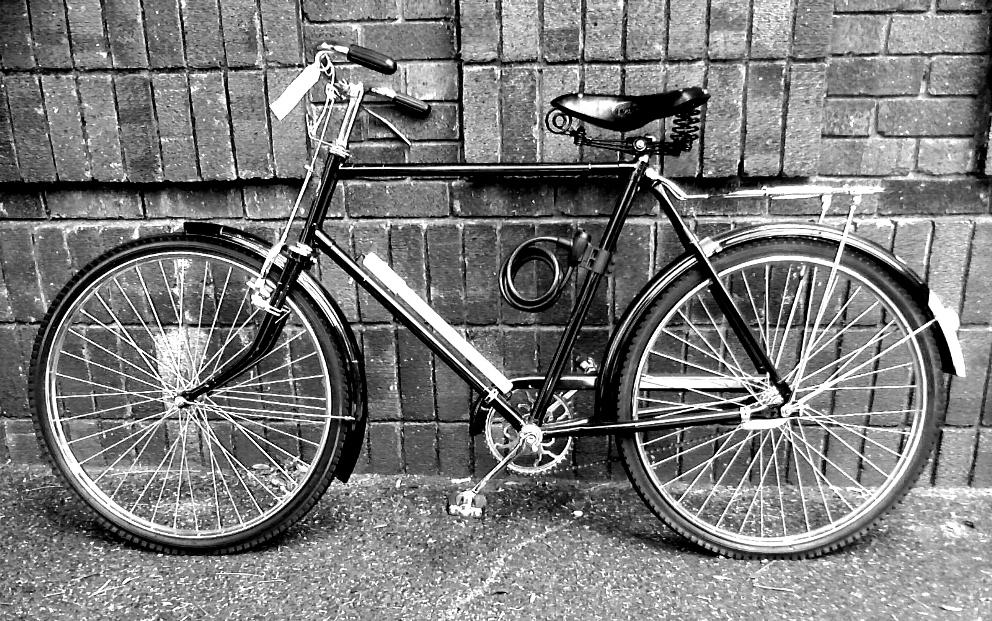
But we did invent Mountain Biking, we were sure. MTB’ing on our dikwiel fietse in and around those same dongas ca 1966 to 1970. Ramping, jumping and gooi’ing squares. Along the dongas and across the dongas. Maybe those fietses weren’t really built for that kind of action (no shocks, flimsy mudguards), as the mudguards caught on the wheels and got scraped up into weird shapes. We find the excessive use of helmets these days puzzling.
History according to wikipedia: The original mountain bikes were modified heavy cruiser bicycles used for freewheeling down mountain trails. The sport became popular in the 1970s in Northern California with riders using older single speed balloon tyre bicycles to ride down rugged hillsides. See! We were first!
Hijacking – The earliest documented instances of maritime hijacking were in the 14th century BC, when the Sea Peoples, a group of ocean raiders, attacked the ships of the Aegean and Mediterranean civilizations. OK, that was before us. Train hijacking? OK, there was this military raid that occurred on April 12, 1862, in Georgia during the American Civil War. Volunteers from the Union Army commandeered a train and took it northward toward Chattanooga Tennessee. If you look closely, one of the raiders does look a bit like a Venning;
Streaking – When and where streaking started is unknown. A 1967 article in the student paper at Carleton College in Minnesota laments that streaking was a tradition during winter when temperatures were well below freezing. OK, so we were in 1969, maybe they beat us. Anyway it seems Lady Godiva beat us all to it: An English noblewoman who, according to a 13th century legend, rode naked – but covered by her long hair – through the streets of Coventry to gain a remission of the oppressive taxation that her husband imposed on his tenants. In later versions of this legend, a man named Tom watched her ride and was struck blind or dead. The name ‘Peeping Tom’ for a voyeur originates here;
Drifting – Although the origin of drifting is not known, Japan was one of the earliest birthplaces of drifting as a sport. It was most popular in the Japan Touring Car Championship races. Kunimitsu Takahashi was the foremost creator of drifting techniques in the 1970s. But first there was us in the late 60’s in a black front-wheel-drive Saab! The venue: the streets of the metropolis of Kestell and the athletic track in Harrismith. Steph at the wheel! Deftly dodging the bluegum tree stompe specifically placed on the track to deter hooligans. In vain.
This church saw some good drifting in its day
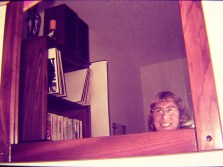
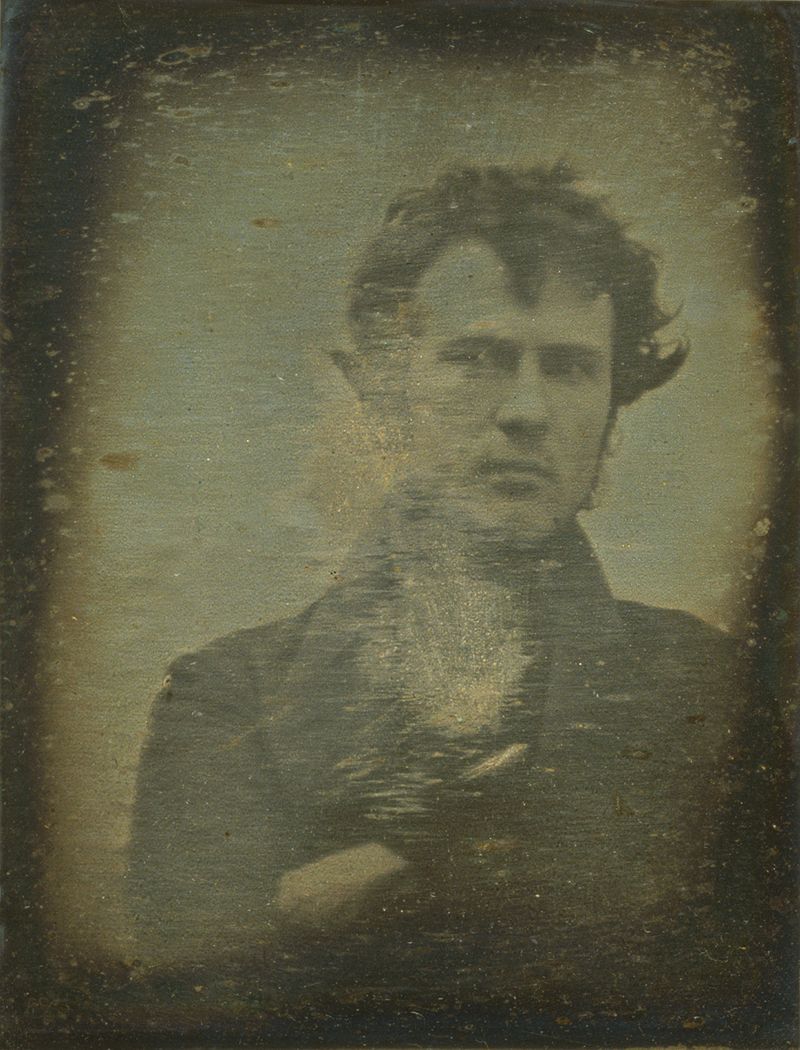
Selfies – I took my selfie in 1973 in Oklahoma, which was WAY before it became popular.
OK, this Robert oke did it in 1839, and this lady had better equipment – in both ways.
.
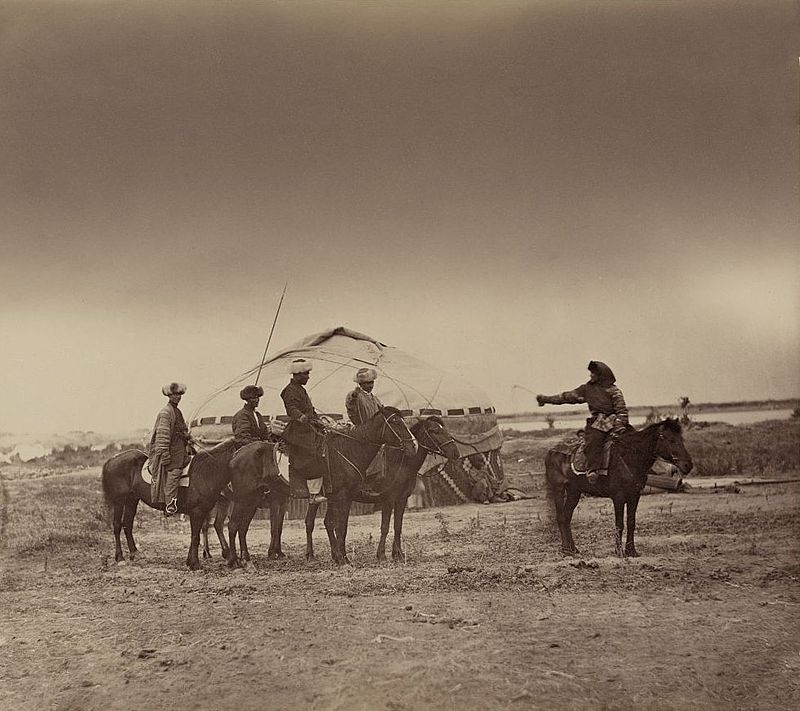
Kidnapping – Tuffy started kidnapping in 1970 but these fellas kidnapped this bride 100yrs earlier in 1870:
*Birthdays: Tuffy started the tradition of birthday kidnapping, grabbing a birthday boy and bundling him into a sleeping bag, tying the top closed. Then driving him somewhere and dumping him to make his own way home. When it was Tuffy’s turn we simply dumped him out of the sleeping bag into the pool at the du Plessis’ place as he happened to be born on the Winter Solstice, 21st June, shortest day of the year. Oh, yes – and the coldest! So he didn’t have a long walk home, lucky fella. Funny thing is, he didn’t thank us . . .
.
Rally Cross – Tim Venning in the blue Triumph 2000 roared around and between the old popular trees and oke trees and other trees on the far side of the Harrismith President Brand park across the Vulgar river. Just when you thought he had to go straight he’d cut left between trees and hare off on another tack. People watching might have dreamt up today’s rally cross.
.
Self-driving cars – Or cars fuelled by one kind of inflammable substance while the drivers were fuelled by another. Old hat. Elon Musk was still growing pimples.
=========ooo000ooo=========
donga – Dry gully or arroyo, formed by the eroding action of running water; fantastic cowboy movie scenery;
gooi’ing squares – slamming on the back brake while throwing the bike on its side, skidding dramatically while looking nonchalant; chicks swooned;
dikwiel fietse – fat- or balloon-tyred bicycles; Chicks swooned over ous who rode them;
1984 was one of the
very few years since 1960 that Colorado river water from the Grand
Canyon actually reached the sea. High snow melt pushed it past the
point where golf courses and old-age homes drain it of all its water
and so – at last! – the waters of the Colorado reached the beautiful
estuary at Baja California and flowed into the Sea of Cortez again!
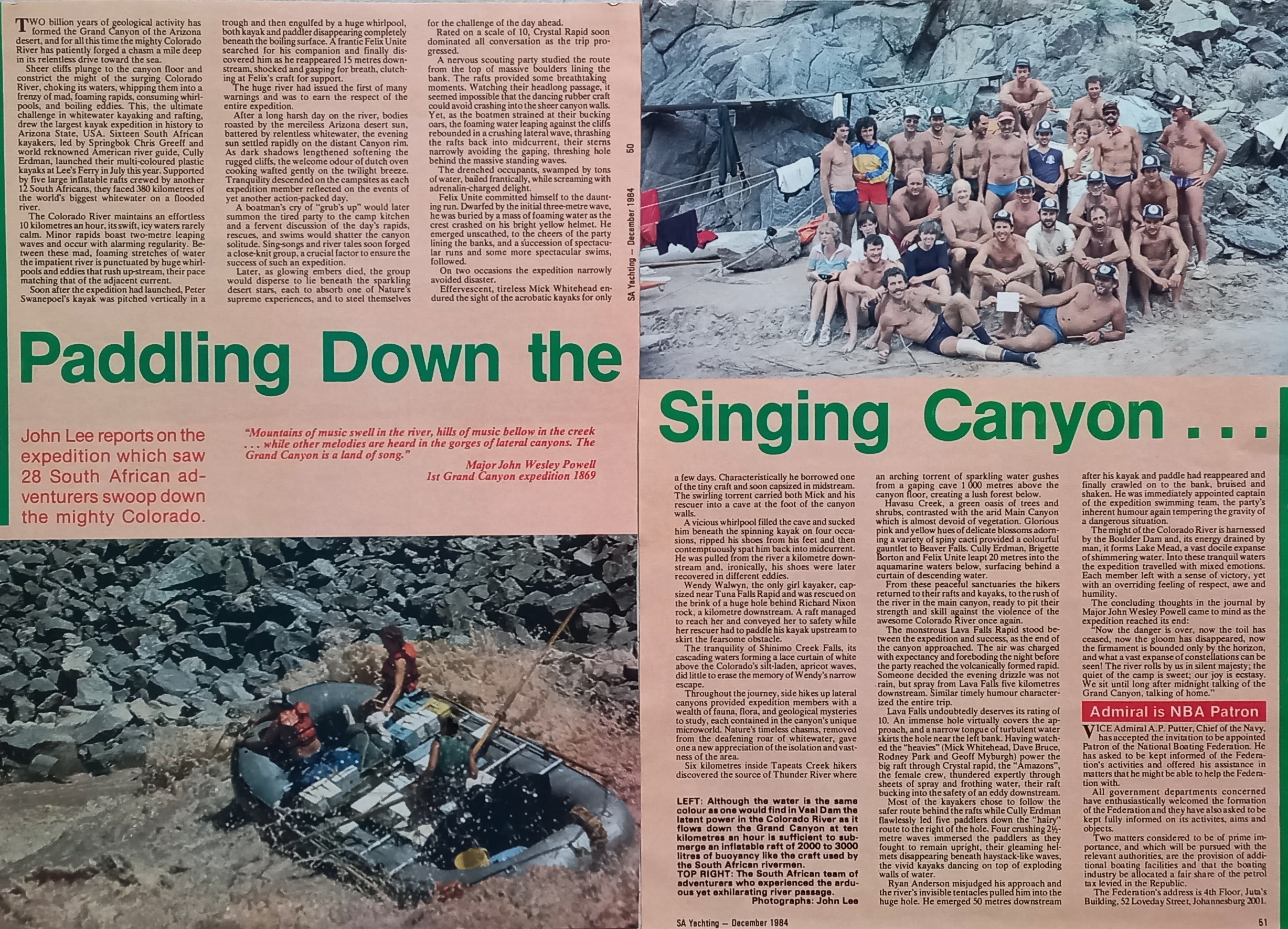
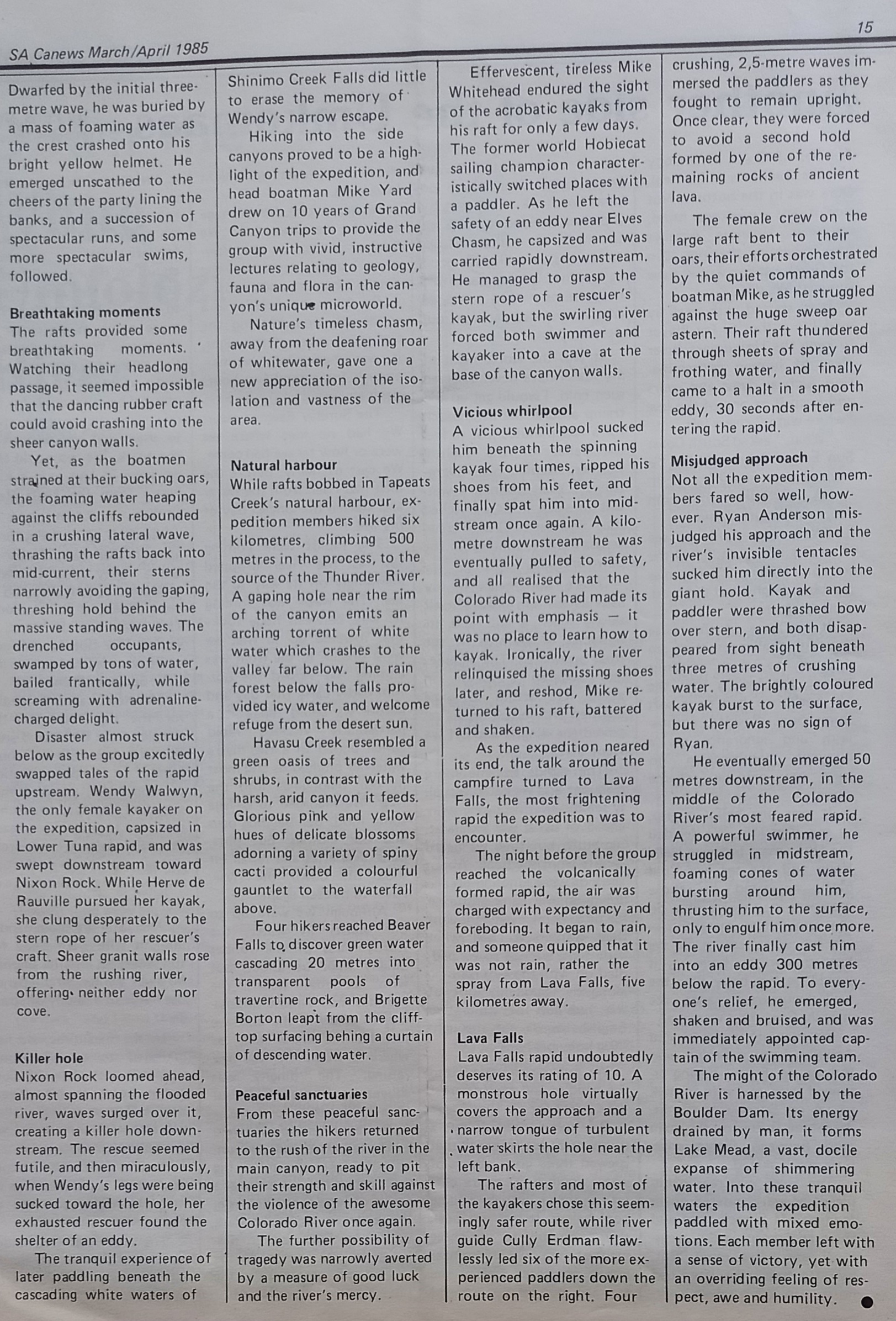
Unknown to many, 1984 was also the ONLY year Mexicans would have been able to taste Mainstay cane spirits, distilled from South African sugar cane, mixed into that Colorado river water. Well, recycled Mainstay and river water, as the Mainstay that reached the sea had first passed through the kidneys of a mad bunch of South Africans that Chris Greeff had assembled to paddle through the famous American Canyon.
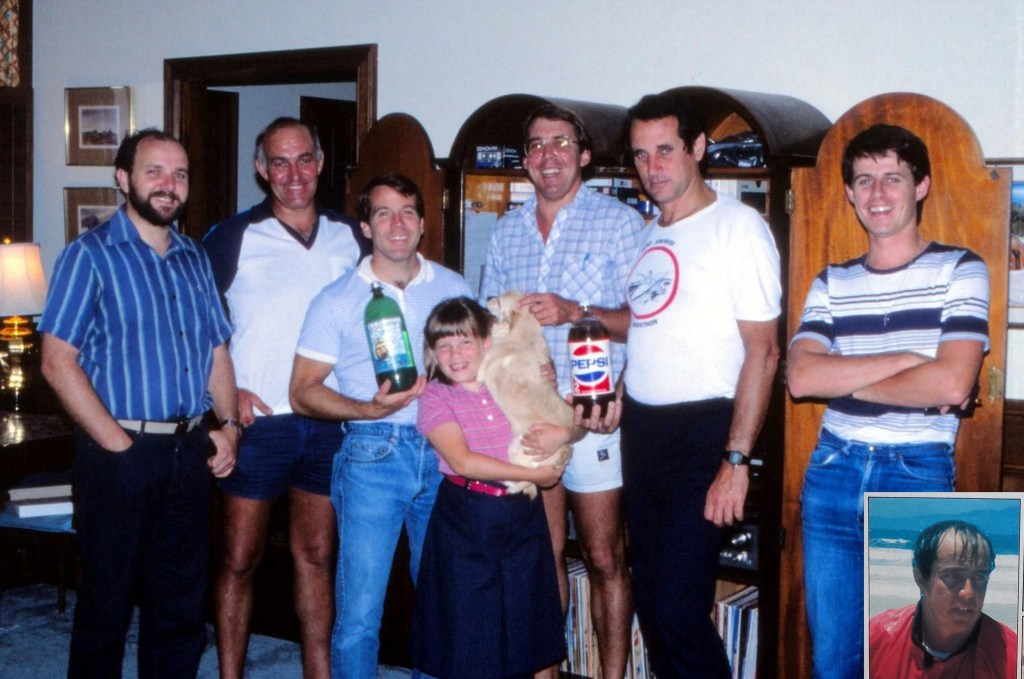
– Dave Jones’ place – Our host in Atlanta – He paddled for the USA – – See the SAA hooch we had decanted into 2litre bottles! –
That’s because we were on the river sponsored by Mainstay Cane Spirits and South African Airways. The ‘Mainstay’ we drank was actually an SAA Boeing 747’s supply of tot bottles of whisky, brandy, gin, vodka, rum – and Mainstay cane spirits. We decanted all the little bottles we could find into two two-litre plastic bottles to help the stewardesses on board with their end-of-Atlantic-crossing stock-take. We had resolved to drink the plane dry, but man, they carry a lot of hooch on those big babies. Maybe in case they end up with all 350 passengers happening to be as thirsty as paddlers are? Here we are in Atlanta with the loot. Note the Mainstay sticker on one bottle held by our host Dave Jones, a paddler himself. Paddled for the USA in K1, C1 and C2 wildwater, US national champ and also coached the USA team. So we were saddled with not one but TWO national paddling champs who are dentists and military men, like beer and do crazy things!
Personally I reckon mixing guns, boats and teeth with beer can only bring trouble . .
– Saffers busy ‘outfitting’ as the Yanks say –
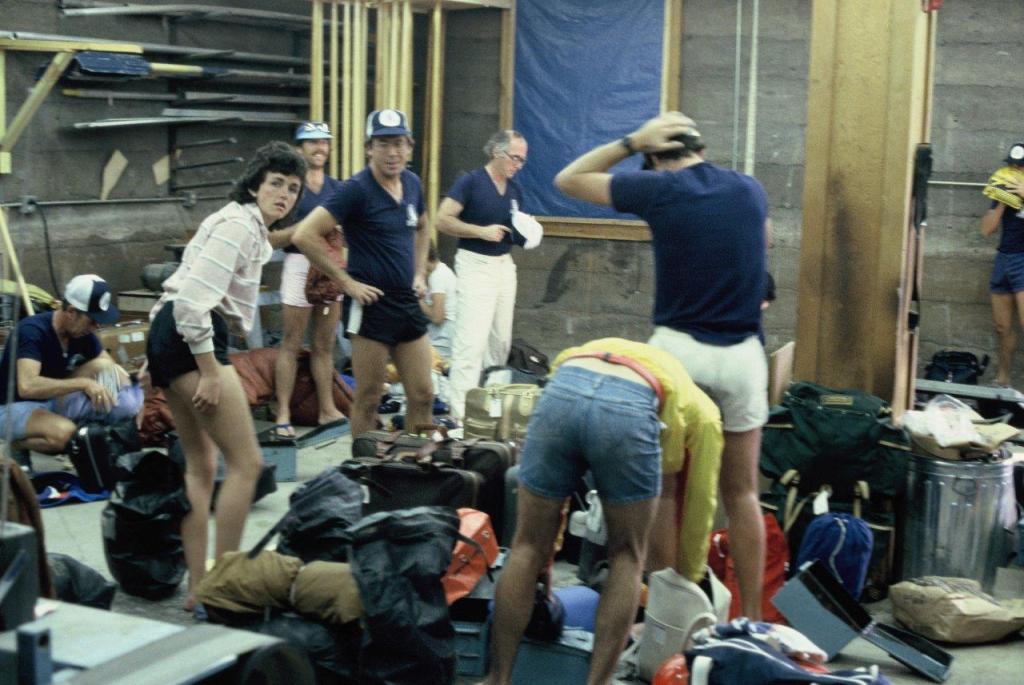
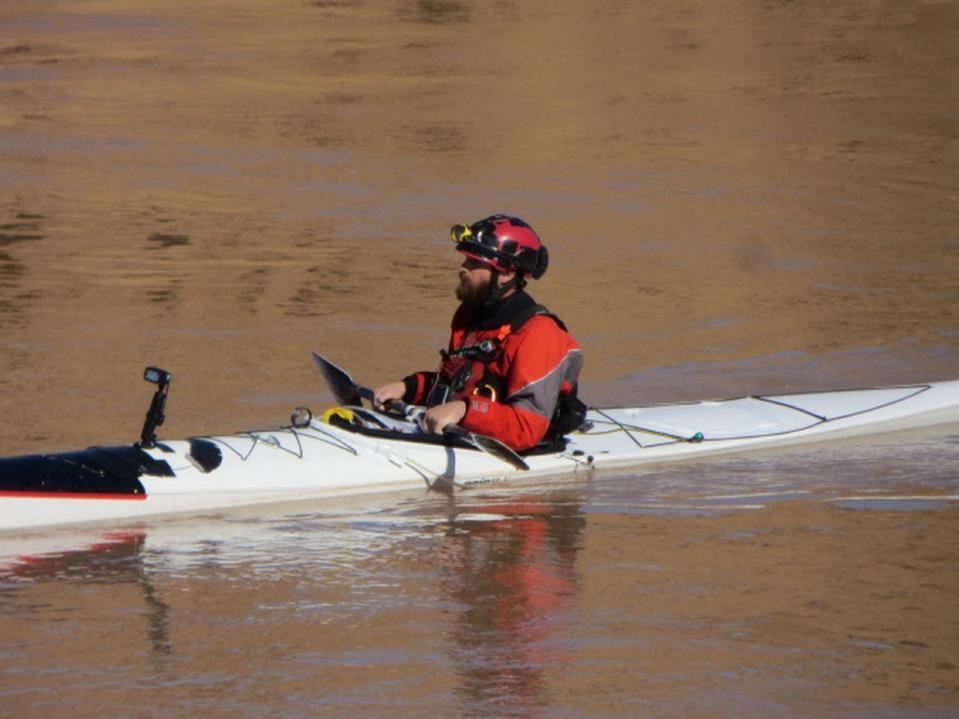
From Atlanta we jetted on to Phoenix Arizona. There we hired another lang slap car and took a slow drive to Flagstaff where we got ‘outfitted’ with kit for the trip. Fifteen canoeists from South Africa joined our guide Cully Erdman and his delightful partner JoJo Suchowiejko on a trip down the Grand Canyon from Lee’s Ferry to the take-out on Lake Mead three hundred miles downstream. We were accompanied by one other paddler, an Argentine José Luis Fonrouge who was ticking off his bucket list, having climbed Everest. Five rubber inflatable rafts crewed by experienced canyon runners carried the food and the ‘Mainstay’ and hundreds of beers, plus a motley assortment of tag-along raft passengers from South Africa. Talking of motley: Us paddlers ranged from capable rough water paddlers to flatwater sprinters to happy trippers to complete novices. Some had Springbok colours, others had a lot of cheek.
Outfitting was also needed for supplies and Greeff put himself in charge of catering for the liquid refreshments. He was good at maths back in Parys se hoerskool so he did some sums: Seventeen kayakers plus some rafters times 12 days times 10 beers each is, lessee . . . OK, and then after breakfast we’ll need . . .
Apparently the yanks thought he’d grossly over-catered and they were worried about how they were going to carry the left-over beer out of the canyon at the end. That’s if the rafts stayed afloat. Well, ons sal sien . .
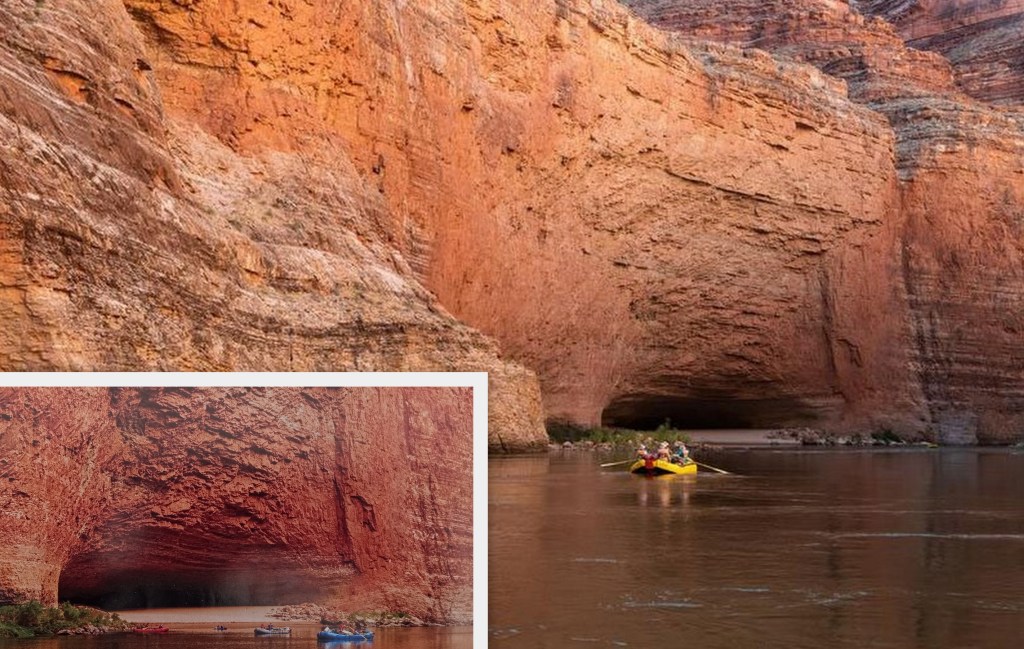
– ‘our’ five rafts with the beer – high water had shrunk this beach, but we stopped to walk up a side canyon –– our river guide Cully Erdman shows us how – he has done it before –– massive Redwall Cavern at mile 33 – pics National Geographic and oars.com – thanks! –– Herve, George & Jojo with her bikini ON –
Some twists in the tale:
My boyhood kayaking heroes had been the van Riet brothers, Willem and Roelof, who won the Dusi three times just as I was first learning about the race ca 1970. As I started to participate in the race in 1972 Graeme Pope-Ellis won the first of his eventual fifteen Dusi wins. Both Willem and Graeme were with us on this trip, along with other paddling legends I had met in my recent entry into the world of canoeing. Having ‘paddled lonely‘ from 1970 to 1982, I was now rubbing shoulders with legends!
– legends of paddling – and me – out of respect for them, I’m wearing longs –
Another twist: In the year I first saw the Colorado river after walking/running down the Bright Angel trail from the South Rim to the Colorado’s swiftly-flowing clear green water, 1973, Willem had launched a boat at Lee’s Ferry, done an eskimo roll and come up with ice in his hair, causing him to postpone his trip. Now he was back, eleven years later – in the summer! And so was I.
The trip was put together by yet another iconic paddler Chris Greeff, winner of more kayak races than I’d had breakfasts. One of the craziest races he won was the Arctic Canoe Race on the border between Finland and Sweden. About 500km of good pool and drop rapids in cold water. When he arrived at the start with his sleek flatwater racing kayak the other paddlers and the officials looked at their wider, slower, more stable canoes and thought ‘Ha! he intends portaging around all the rapids!’ They had heard of the Dusi and how mad South Africans run with kayaks on their heads, so they amended the rules: Every rapid avoided would incur a stiff time penalty. You portage, you pay! Chris grinned and agreed enthusiastically with their ruling: He was no Dusi runner and he had no intention of getting out of his boat!
Later: On the trip, our American kayak and raft guides kept asking us about the sponsors stickers we had attached to kayaks and rafts. SAA they understood, South African Airways; but what was this “Mainstay” stuff? Ooh! You’ll see! was all we’d say. At ___ rapid on Day __ around the camp fire we hauled out our two-litre bottles filled with a suspicious amber liquid. THIS we said, was that famous stuff!
Colorado Toekoe – Pre- and Post a shot of Mainstay –
The first thing about Mainstay, we told them, was its medicinal properties. Toekoe Egerton had turned blue from too much swimming, but after a slug of Mainstay he got his colour back as the ‘before and after’ pictures above clearly show.
As more Mainstay was swallowed, hilarity and a bit of insanity ensued. I have a picture frozen in my mind of Willem sprinting past me, running nimbly across the pontoons of a raft and launching himself in the darkness into the swift current of the Colorado running at 50 000 cfs shouting Yee-ha!! – A bit like this, but at night and in the summer:
– Willem could stay as he was for the rest of his life; But he chose to change to Mainstay – Mainstay –
IQ’s soared:
– George, Allie, Swys & Toekoe, full of Mainstay –– John Lee of Lee’s Ferry – a striking resemblance to our own John Lee – obviously separated at birth –
Besides this fortified and fortifying SAA loot, Greeff had also arranged for beers on the trip. John Lee tells the story:
I recall how our Yankee rafting crew were somewhat taken aback at the rather large drinks order they received prior to the departure from Lees Ferry! Despite the huge stocks, somewhere downstream in the depths of the Grand Canyon, to their utter disbelief, the only liquid left was the raging Colorado River. Stocks had run dry .
There were some thirsty, desperate river runners in camp. We were way upstream from the next available beer at Phantom Ranch’s shop.
Desperate times call for desperate measures …….
Some of us (hello Felix!) resorted to performing like trained seals, executing dashing eskimo rolls for passing J-Rigs, and being rewarded with frosties for our efforts!
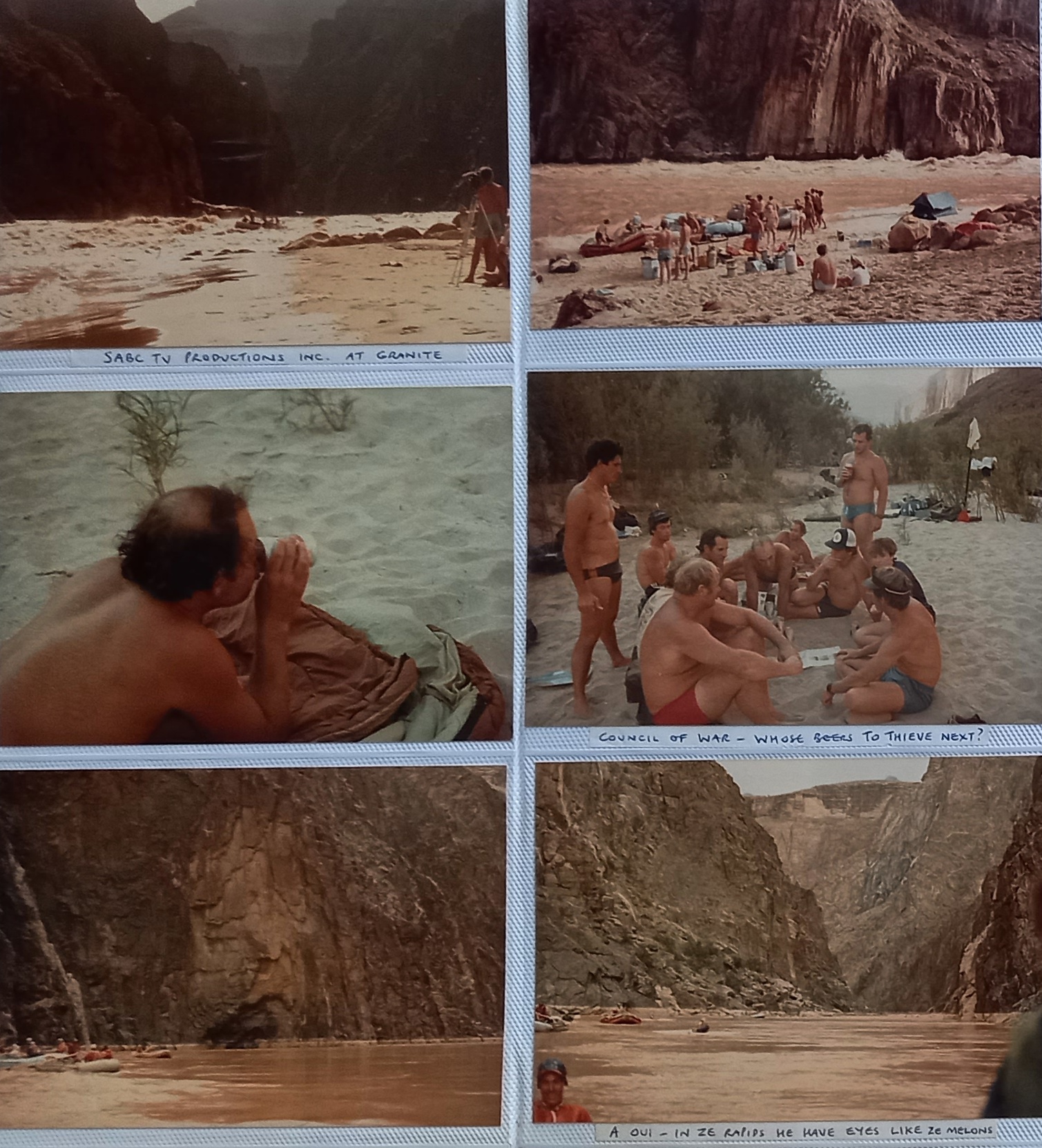
One Captain (PF) Christiaan Lodewikus Greeff called quietly for volunteers, and assembled a raiding party – could also call them ‘SEALs’, one was a parabat – to address the situation. This unbeknown to our unsuspecting, law-abiding river crew.
In the dead of night, wearing beanies, faces blackened, they slid silently into the icy waters of the flooded Colorado River and headed into an upstream eddy towards the distant sounds of happy laughter from a neighbouring campsite.
Reaching tethered rafts, they found the holy Grand Canyon grail . . . multiple nets strung from the rafts, laden with tins of sunset amber liquid.
Their return to our camp was triumphant.
I cannot recall the composition of that courageous group. Suffice it to say, that I am certain that it included one Lieutenant-Colonel A Gordon-Peter (SAB with bar).
The reaction of our guides, later, was somewhat different!
Mules heavily laden with liquor were later cajoled down the treacherous track from Phantom Ranch, and our evenings were once again fueled with fun, laughter and Willie’s moerse yarns!
In closing, who will ever forget that wonderful mirage in the middle of the shimmering Lake Mead – a very naked, very tall and statuesque blonde River Goddess on a drifting raft … … or was it ?
– some of our wonderful American rafters – law-abiding folk – – lawyer lee ponders –
Well, I dunno – but there was at least one naked lady that I do know of: JoJo posed butt naked for a stealthily-taken pic on George’s camera. What a sport, she removed her bikini top and bottom for the gentlemen doing research on just how much trouble George would get into with his wife back home.
Lee plans his arguments for the court cases sure to follow: YaRonna! These were just Merry Pranksters, M’Lord . . .
– Felix – looking semi-naked – caught trout in the Little Colorado –– Foreground and background: Muddy and warm water of the Little Colorado. In the middle: Clear cold Colorado water from deep down in Lake Powell. Ryan practices the roll that didn’t work in Lava Falls a few days later –
At the confluence of the Colorado and the Little Colorado the Little was flooding and massively silt-laden. We stopped on a skinny sandbank and had mud fights and mud rolls. The muddy water from the flooding Little Colorado was so thick that the two trout Felix Unite caught thanked him for rescuing them!
It merged here with the clear water coming out of Lake Powell – seen behind Felix – and from here on we had traditionally red-coloured water – ‘colorado.’
Just downstream of the confluence I got sucked under by a big whirlpool that formed under my boat that I couldn’t escape. As I went down I set up to roll but stayed down until I thought ‘I’m outa here’ as I was now loose in the cockpit and my splashie had leaked. So I bailed. Up on the surface the guys told a more dramatic tale: ‘Swanie! You disappeared for AGES! Then your boat popped up; Then your paddle popped up; And still there was no you! Then at last you popped up!’ So then they started calling me Pete Whirlpool. Lots of that muddy water stayed up my snout and I had a few bad sinus headaches but Wendy – Dave Walker’s connection – very kindly stepped in and saved my butt with strong painkillers and nightly TLC. Back in Durban a month later I was rushed into theatre by another very kind lady, my boss at Addington Hospital, ophthalmology professor Anne Peters. She took me to her ENT friend for an emergency sinus washout! As Saffeffricans say ‘Ah neely dahd!’ Some Little Colorado River mud was washed down Durban’s St Augustine Hospital’s outlet pipes into the Indian Ocean that day. Probly also had a smattering of Mainstay in it.
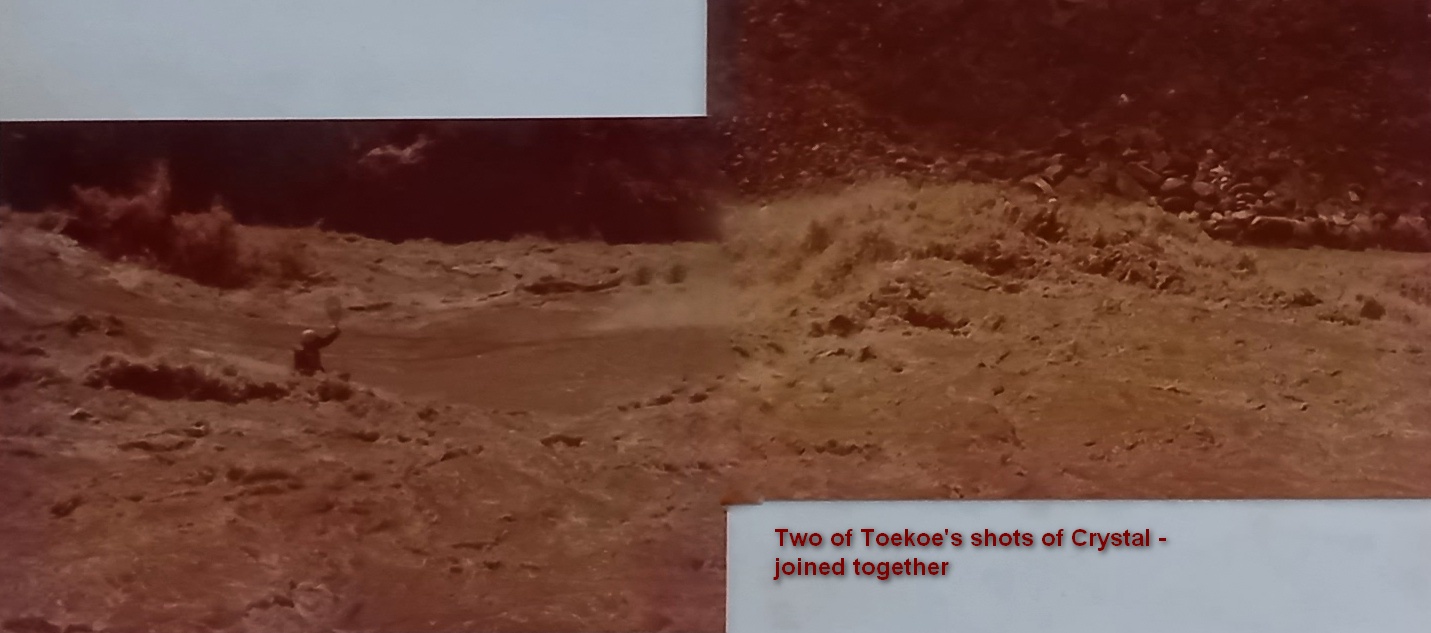
– lunch on a small sandbank – five rafts, seventeen kayaks squeeze on – the water level was up – – seated among legends as I was, I wore my langbroek out of respect – Graeme & Wendy Pope-Ellis; Wendy Walwyn; John Lee; Cully Erdman; Me; Willem van Riet; Jannie Claassens; Herve de Rauville in red cap – – Expedition Leader Greeff bombs through – – Me in Crystal rapid –
Hikes up the side-canyons:
– Thunder River Falls up a side canyon. Canyon lore has it that the ‘river’ flows into a ‘creek’ which flows into the Colorado River –– splendid desert scenery; and always the river’s presence below – – council of elder map readers – see my map at the end of this post –
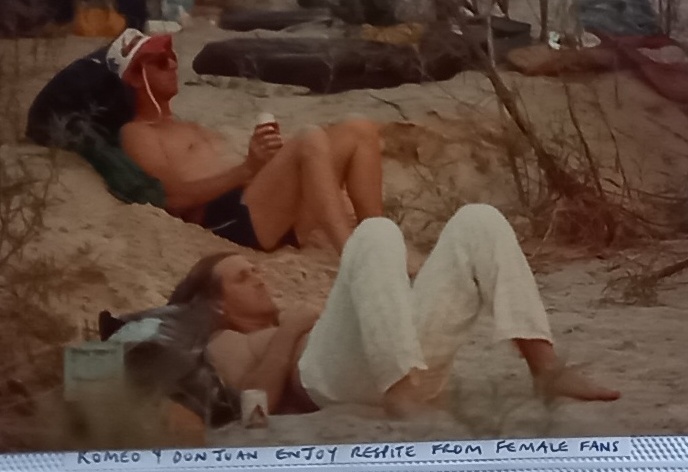
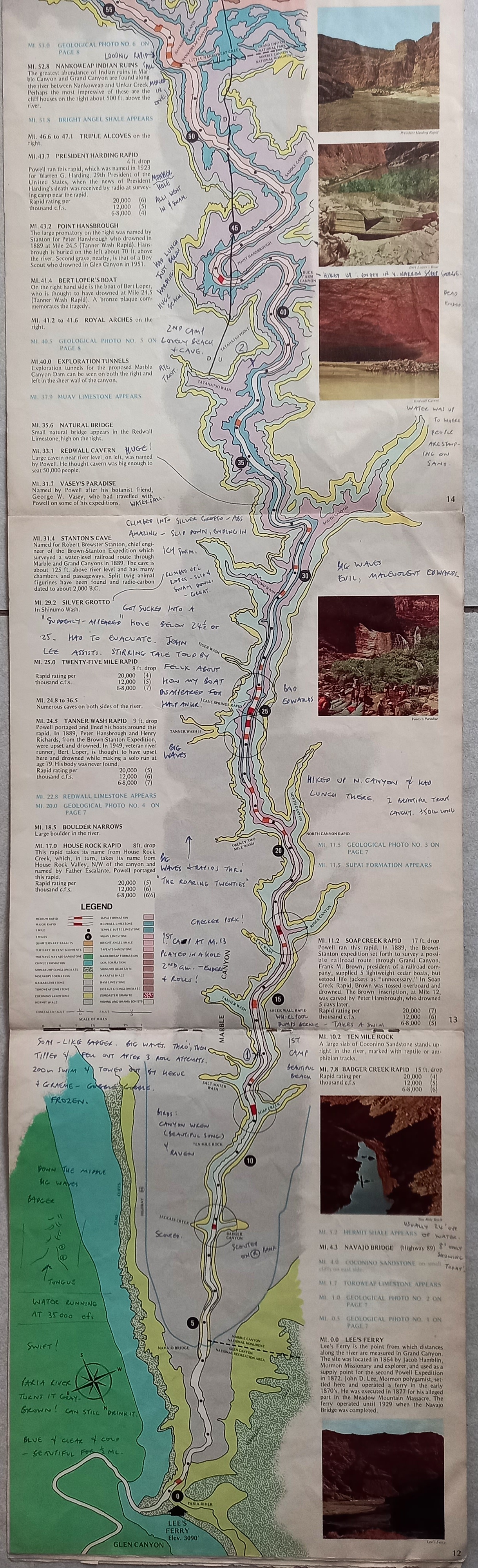
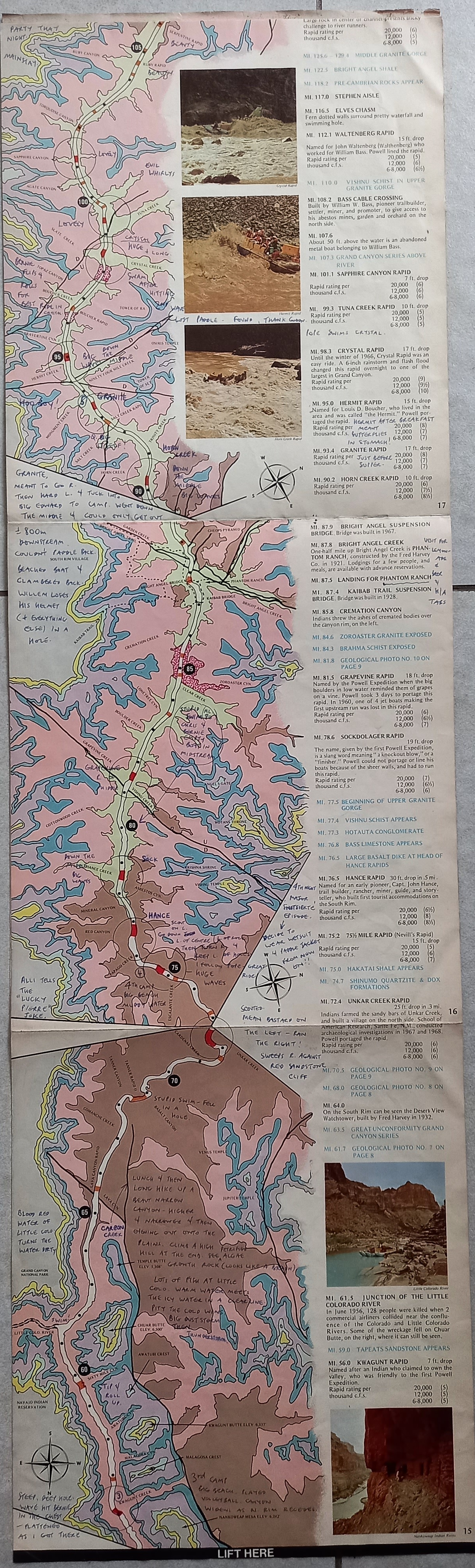
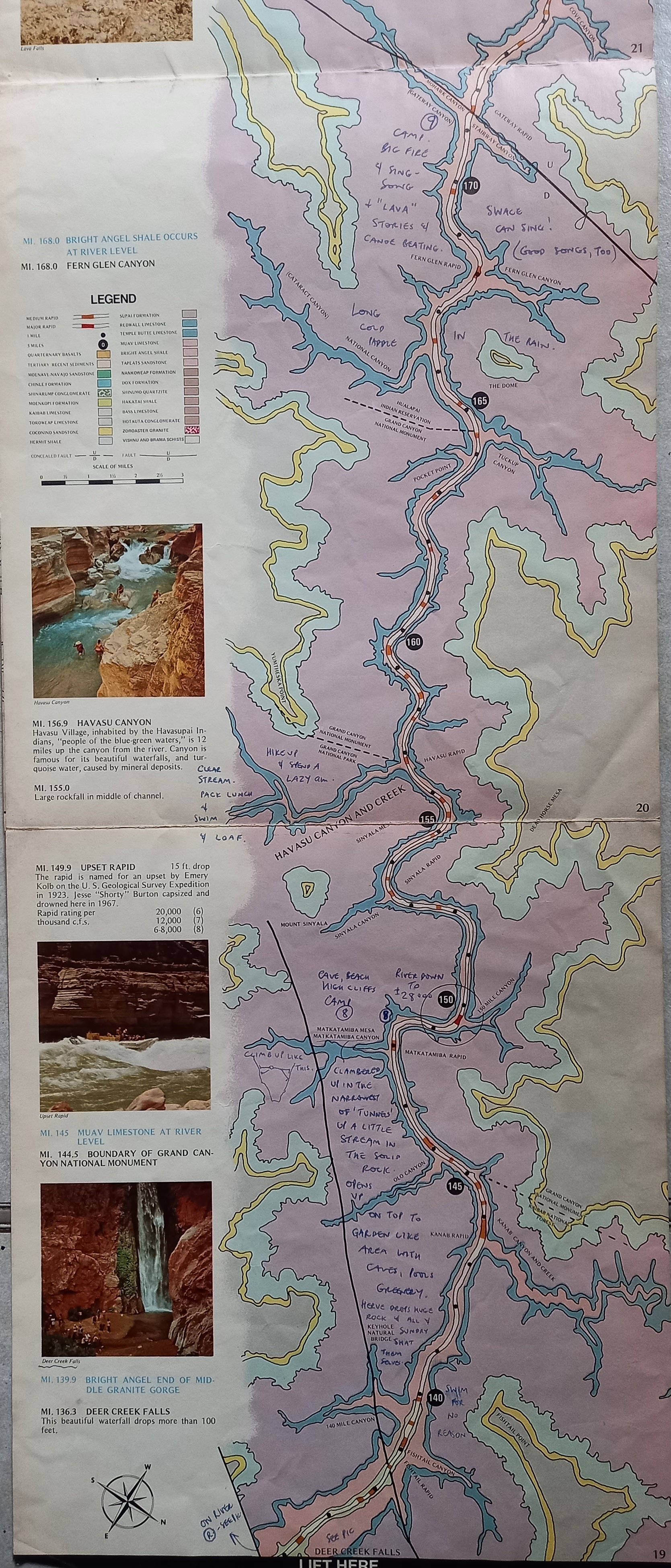
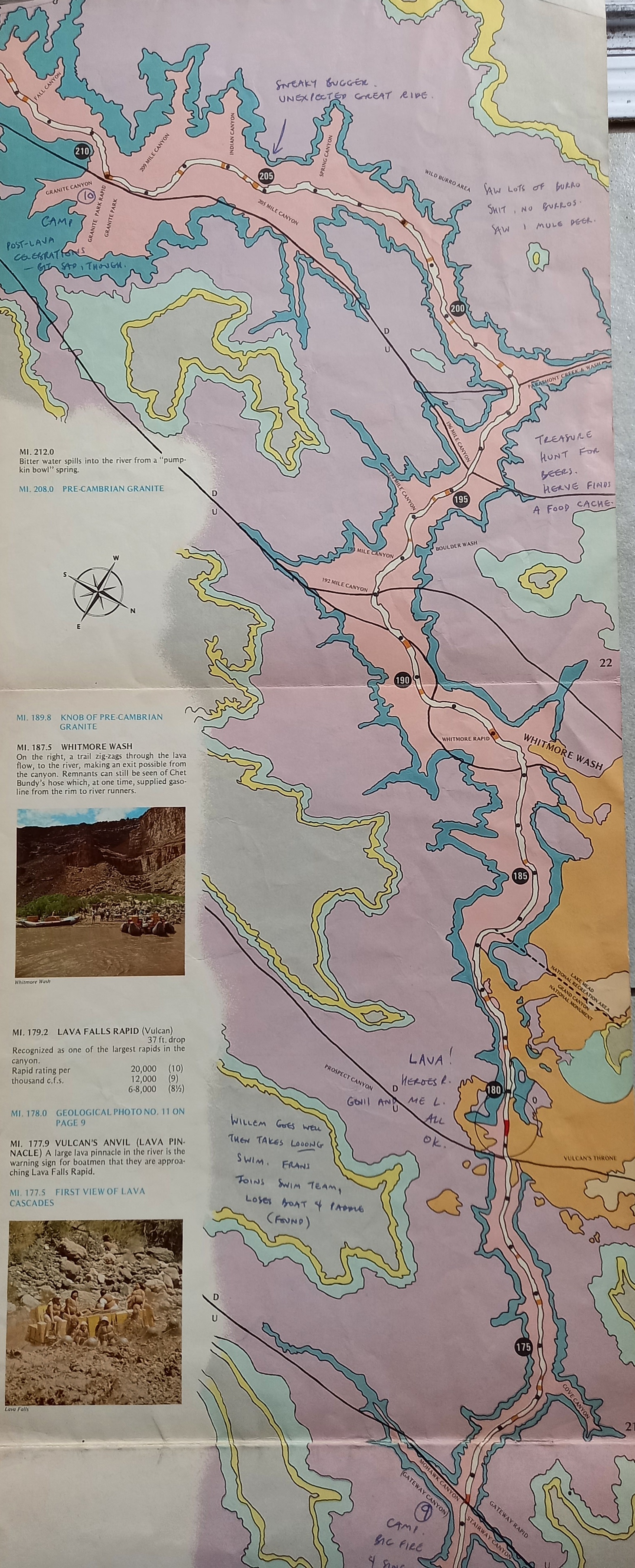
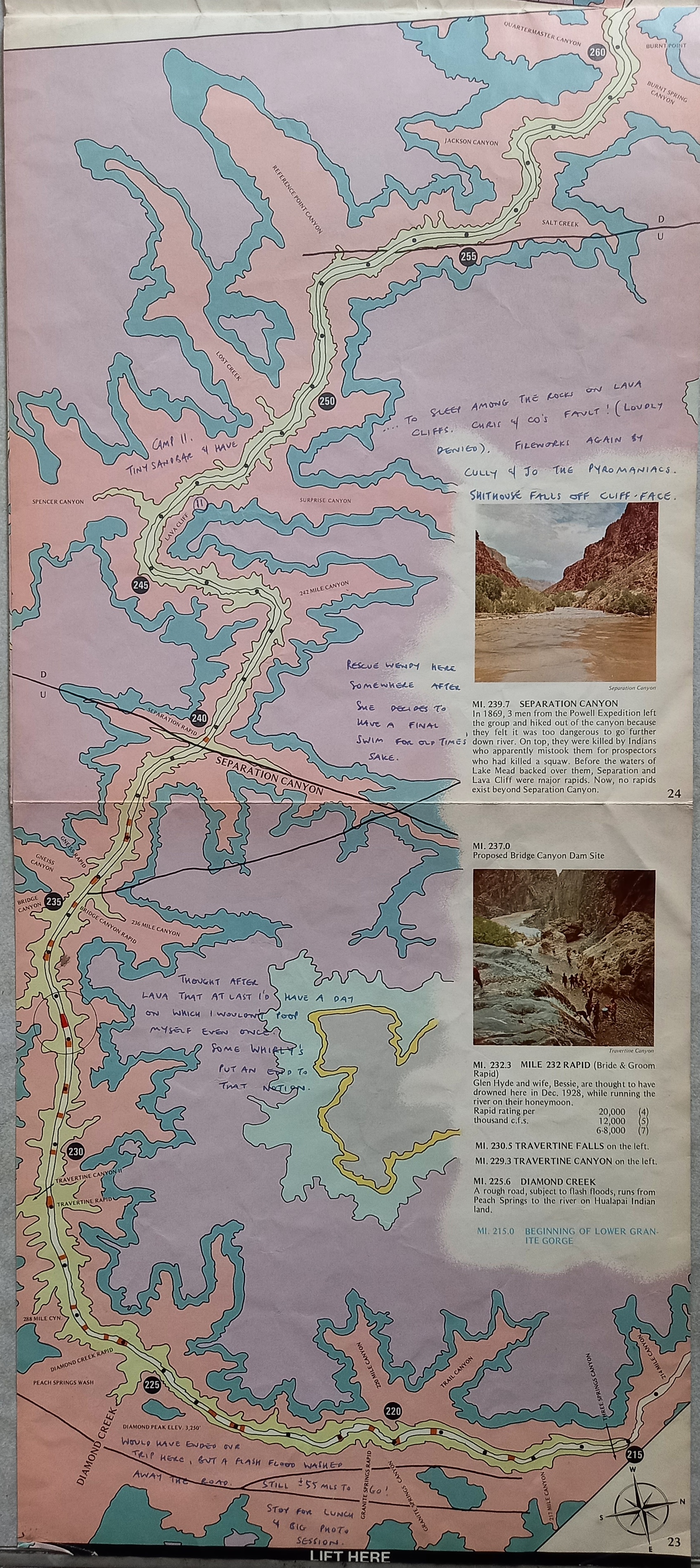
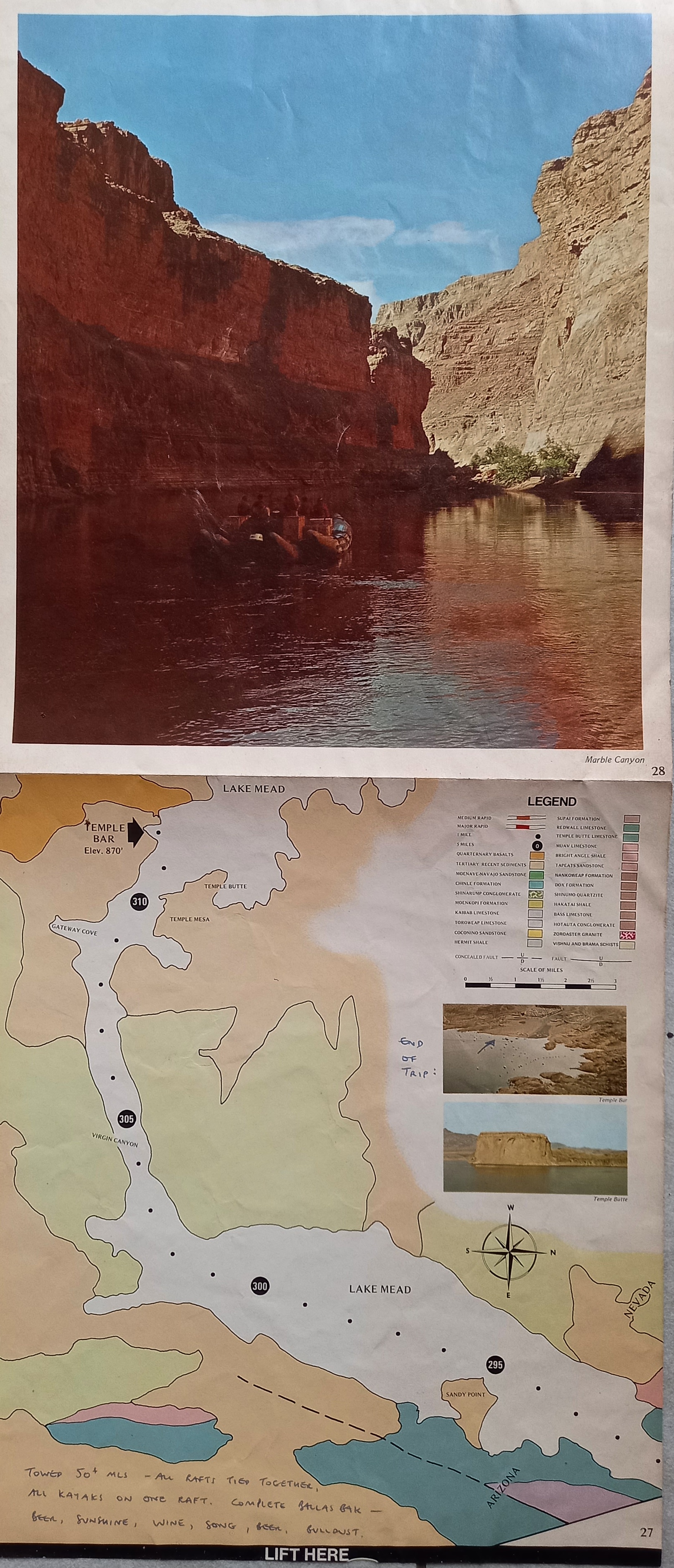
Map reading: I had a lovely large-scale map of the river through the canyon showing all the rapids. We would pore over it, going over the day and plotting our tomorrow. Here Jannie Claassens stands left, Swys du Plessis is prominent in red shorts, I am just visible behind him, Dave Walker wears a cap, Willem van Riet sports a ducktail probly cos of his last swim, Herve de Rauville kneels like a good Catholic, Allie Peter lying down in the background cursing his shoulder, Chris Greeff in the Mainstay cap ponders his next move, Bernie The Jet Garcin has a beer in his hand and a sock in his speedo, Wendy Walwyn is planning her first eskimo roll soon, and Cully Erdman in blue shorts thinks ‘Wwho ARE these okes? and where was that huge rapid Willem is talking about!?’
– internet pic – river at a lower level –– Bernie Garcin – great mate; – – and WHAT a campsite! – nice paddle, too –
Happy daze drifting in the current, lying back gazing up at the cliffs and watching the waterline as century after millenium of geological lines rose up out of the water and each day rose higher and higher above us. Willem the geologist would explain some of it to us. The latest view seems to be that the river is around six million years old, and it has exposed rocks up to two billion years old as it carves downwards, aided also by wind erosion.
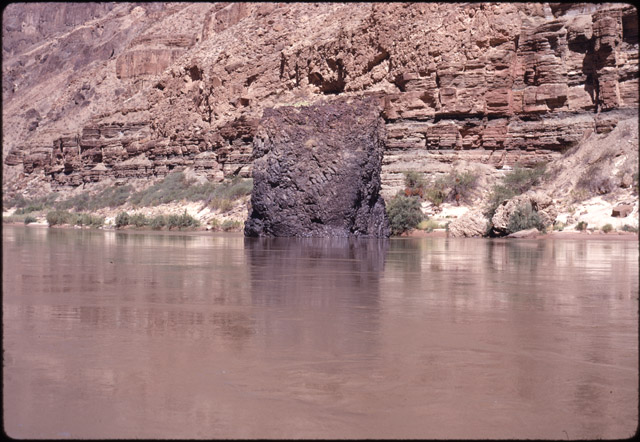
– at 50 000cfs, Vulcan’s Anvil, one mile above Lava, was covered up to where the dark grey meets the brown –
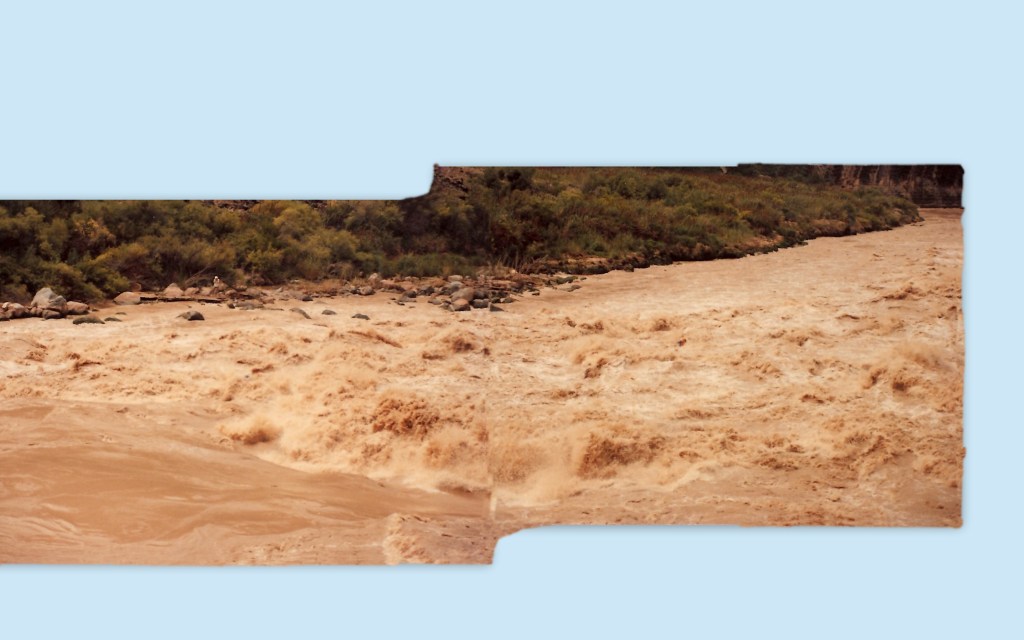
Then every so often you would sit up and listen intently. Then peer ahead with a stretched neck and drift in a quickening current as the roar of the next rapid grew in the canyon air. The river was running at an estimated high of 50 000cfs – that’s about 1650 cumecs, big water. 1984 was a high year. Once you could see where the rapid was, you pulled over and got out to scout it and plot your way through it. It was no use asking Greeff. His stock answer was ‘Down The Middle!’
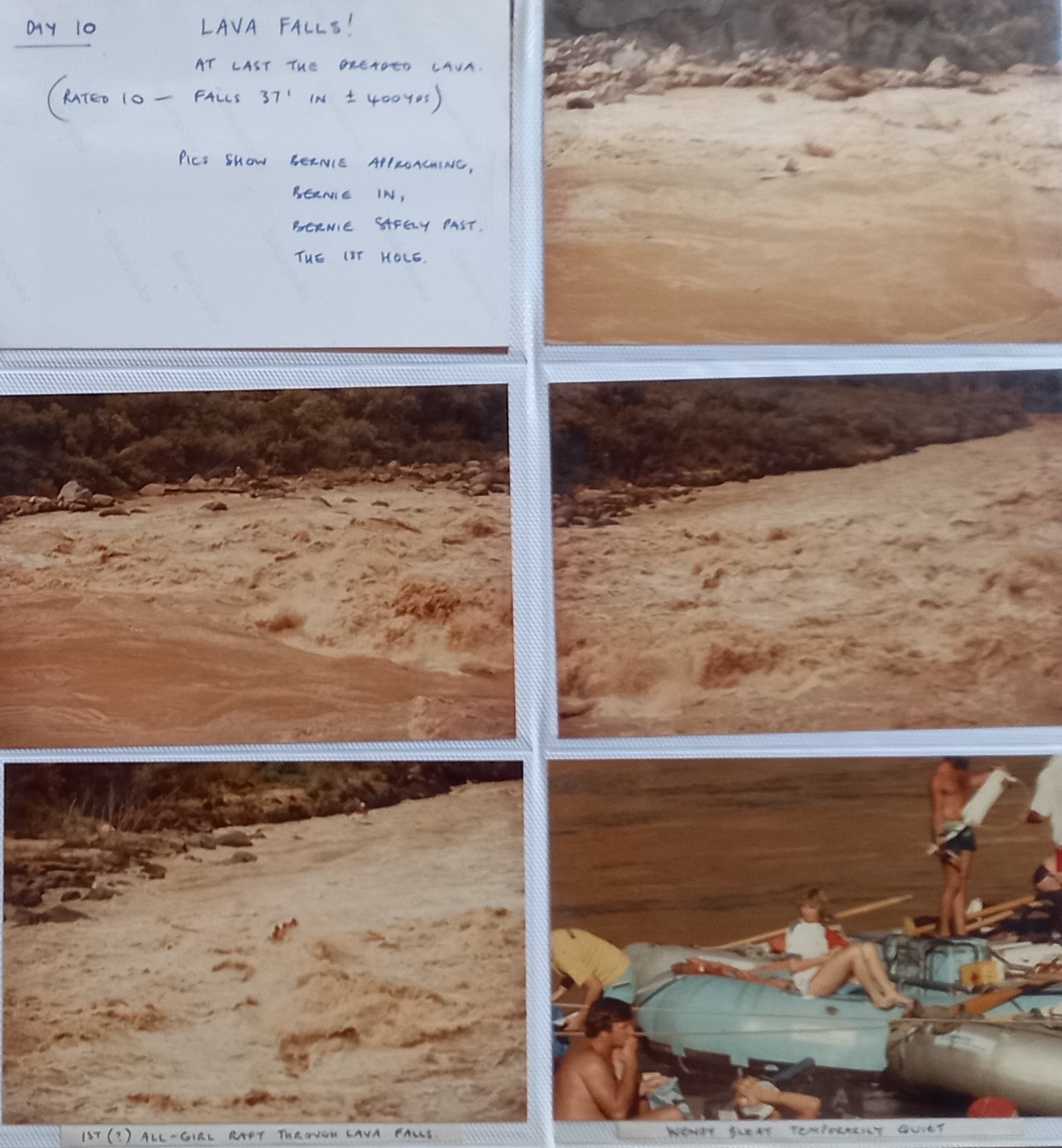
– Lava Falls –
For days before Lava, the bullshit build-up built up: ‘Rain? That’s not rain! That’s the mist from LAVA FALLS!’
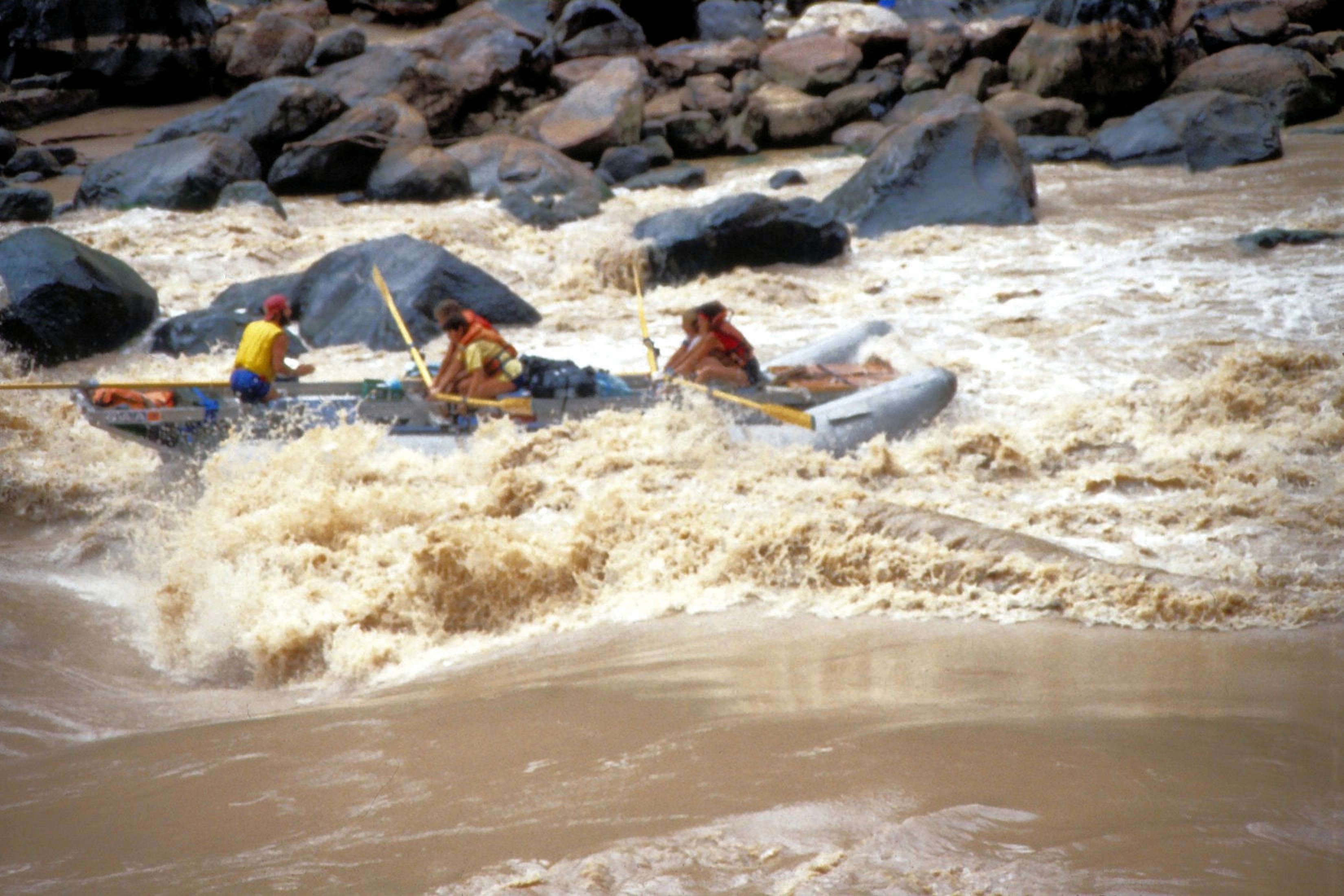
Arriving at Lava we hopped out and checked it out, butterflies no longer flying in formation. After scouting carefully most of us went left; a few went right. One – Ryan – went snorkeling straight into the big hole and got chomped, rinsed and spat out. His blue helmet can be seen in the picture if you have a magnifying glass.
– Lava Falls – there’s a paddler there somewhere –– an all-girl team gets coached down Lava Falls –
And then typical ladies: As we strutted and boasted of derring-do, they quietly commandeered one of the rafts and rowed it ladies-only down Lava! They took one yank with them, just to show him they could . .
– Team Mainstay SAA from South Africa; At the usual take-out before Lake Mead –
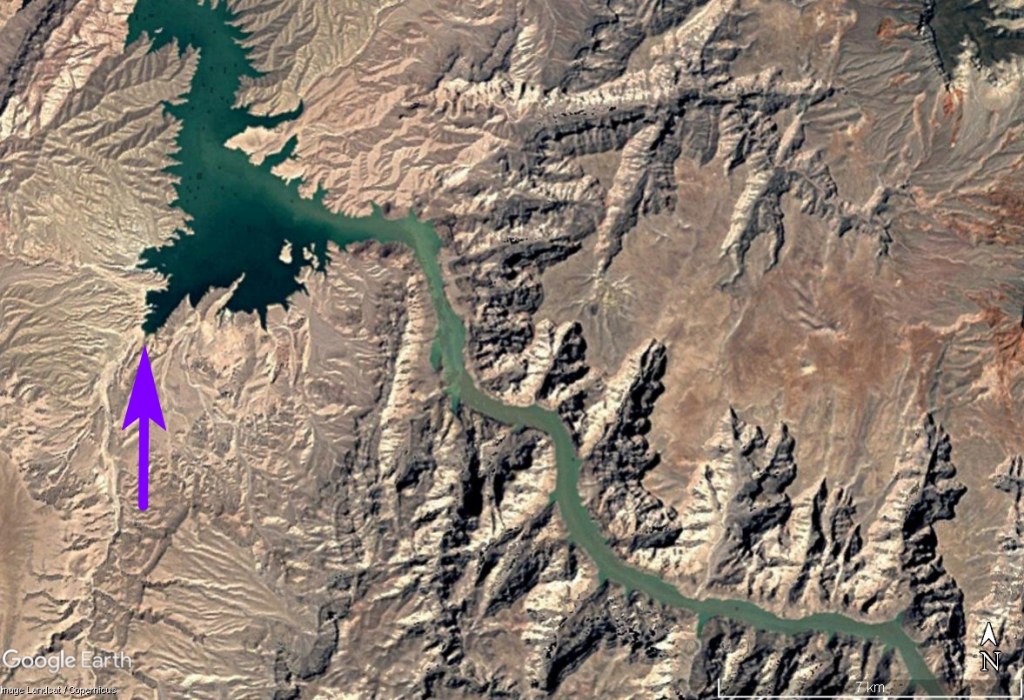
At the usual take-out at Diamond Creek before Lake Mead, we stopped for a rest and some team photos. The high water had washed away the road. We had to keep going. Some miles later we hit the dead waters of Lake Mead. The river ran out of push, tamed by a damn dam. Paddling was over for most of us! We piled our kayaks onto the rafts and lay on them – there were still a few beers that needed polishing. Our five-raft flotilla was tugged out by a motorboat to another take-out point, Pearce Ferry on Lake Mead miles downstream.
– final take-out on the lake at Pearce Ferry – the river bottom right, flowing right to left into the lake –
Downstream? Except of course there was now no longer any ‘stream’ – we were on flat water. Greeff and a few other crazies – including Wendy Walwyn – you know, the types who weren’t issued with handbrakes, brains or limits, paddled the whole flat water way! Holy shit! I drank beer lying on a raft, gazing at the blue Arizona sky.
Too soon, it was over.
~~~oo0oo~~~
Drifting downstream, Dave Walker led the singing:
The canyon burro is a mournful bloke He very seldom gets a poke But when he DOES . . . He . LETS . it soak As he revels in the joys of forni- CA-TION!
and (to the tune of He Ain’t Heavy):
Hy’s nie Swaar nie
Hy’s my Swaer . a . a . aer
~~~oo0oo~~~
We went down the Canyon twice
I always say we did the Canyon twice. Once we would bomb down in our kayaks, crashing through the exhilarating big water; The second time was much hairier, with bigger rapids, higher water and far more danger: That was around the campfire at night when Willem would regale us with tales of his day on the water. ‘Raconteur’ is too mild a word! The word ‘MOERSE’ featured prominently in his epic tales and his long arm would be held high to show you where the crest of the wave sat. And this from a man who bombed ‘blind’ down the Cunene River in 1963.
~~~oo0oo~~~
When? I wanted to know when exactly we were on the water to look up the flow on those days, but no-one knew. Now! Aha! I found an old letter (or Sheila did) written just before we flew to Arizona). I think we paddled – near as dammit – from 18 to 30 July 1984.
– Monday? 16 July in 1984 was a Monday –
Postscript: While we were paddling Chris spoke of attempting to beat the record for the fastest non-stop descent of the Canyon – the 277 mile stretch we had just done from Lee’s Ferry to our eventual take-out at Pearce Ferry.
– The Dory ‘Emerald Mile’ – our 12-day trip in 36 hours non-stop – no thanks –
Only
a handful of boaters have been crazy enough to undertake such a
mission. After all, doing it non-stop means having to shoot Lava
Falls at night! The Riggs brothers made what could be considered the
first speed run in 1951 when they rowed a cataract-style wooden boat
through the canyon in 53 hours; Fletcher Anderson, a pioneering
Southwestern boater, made a 49-hour solo kayak descent in the late
1970s; and then in 1983, just a year before our leisure trip, Kenton
Grua, Rudi Petschek, and Steve Reynolds completed a now-legendary run
on a flood of 70,000 cfs in a wooden dory named the Emerald Mile.
Their record of 36 hours and 38 minutes was the time to beat.
– Ben Orkin – saw little of the canyon –
Nothing came of it – it would have been a very expensive undertaking from South Africa for an obscure record only the small expedition rafting and kayaking fraternity would have known of; and anyway, why do it? But the record is ever-present in some people’s minds. In January 2016 the record was beaten twice. First by ‘Team Beer’: Ben Luck, Matt and Nate Klemas and Ryan Casey in three Piranha Speeders and a Perception Wavehopper, boats much like the ones we used. Then three days later by Ben Orkin, paddling solo in a composite Epic 18X sea kayak, a boat lighter than the models Team Beer had used and with a metre longer waterline. He reduced the time to 34 hours and 2 minutes. The Emerald Mile’s record, which had stood for over three decades, had been broken twice in three days.
I do (sort of) understand the quest for records (sort of), humans always will go for fastest; but for me,
. . floating down in awesome wonder is really the way to do it.
Before the river became crowded and the park service slapped restrictions on trip lengths, private boatmen in the ’70s vied at ‘slow-boating’, or making a trip last as long as possible. The crowning glory of slow-boating has gone down in river history as the Hundred Day Trip. Legendary boatman Regan Dale and his extended family floated away from Lees Ferry and spent a whopping 103 days in the canyon. They hiked every side canyon, spent as long as a week in favorite camps like Nankoweap and Granite Park, baked their own bread and wallowed in the vast silence of stone cathedrals broken only by the rustle of the river. The moon waxed and waned three times while they were there. It was roughly as long as the very first trip down the canyon led by John Wesley Powell in 1869, over a hundred years earlier – and 150 years ago now; and this over 300 miles whereas Powell had done 1000 miles. So the Regan Dale trip really was the slowboating trip supreme. I wonder if there will ever be trips like that again.
Later: A letter from Cully and JoJo – “do come again!” and “boknaai!”
John Lee wrote:
…running Crystal Creek down the left , Lava down the right was all complete childs play when compared to what felix , Cully and Bridgette put me through at Havasu Falls .
The four of us did that looooong hike up that pristine side canyon .
When we reached the aquamarine coloured waters below the falls , the travertine rimmed pools below , I immediately saw the photo-opp.
I had them climb to the rock above the falls from which they launched themselves , simultaneously and spectacularly , into space and fell about forty to fifty foot into the waters below .
Magnificent photos it turned out a long time later …….
It took them about half an hour to talk me , in turn , off that ledge .
That is by far the single most courageous thing I’ve done to date !
My fear of heights is a raging mental all-encompassing melt down …..
Still don’t know how I did it .
Then …..there was the Rattler I very nearly stood on, on the way back …..
Felix Unite wrote:
What memories! For me that GC trip remains one of my life’s highlights/milestones!
Location, action and memories of great friendship and camaraderie – not to mention how much I kakked myself!!!
Thank you all.
~~~oo0oo~~~
Chris Greeff wrote in May 2018:
R.I.P Herve de Rauville, Graeme Pope-Ellis, Swys du Plessis, Johan Claassen and Arthur Egerton ! – Also R.I.P Jose Luis Fonrouge
~~~oo0oo~~~
Our quiet, laid-back fellow kayaker from Argentina
Jose Luis Fonrouge had climbed Mt Everest, we heard. He had done much more:
Fitz Roy: First Alpine Style New Route
By Marcelo Eduardo Espejo
January 16, 1965 two climbers accomplished what is still today considered as one of the most remarkable climbs on the Patagonian spires. Jose Luis Fonrouge and Carlos Comesana reached the summit of Fitz Roy for the second time in history.
They had climbed the virgin super-couloir known as the Supercanaleta. For summit proof, they retrieved a carabiner left there by the 1952’s French expedition and left an Argentinean flag in its place. See route 18 below.
January 14, they went for the Supercanaleta. It took them only three days to summit and climb back in alpine style, fixing 20 pitches on the way. This was a big difference compared to the French expedition, the only ones who had summited Fitzroy before. The French team, led by the European climbing legend Lionel Terray, worked the route for a month and aid-climbed most of the wall to get to the top.
Carlos Comesaña and Jose Fonrouge went on to other amazing climbs – the Poincenot spire, Aconcagua’s South face, Torres del Paine, South face of Cerro Catedral and climbs in the Antarctic Peninsula. In 2001, the saga ended when Jose died in a plane crash.
Journalist and mountaineer Toncek Arko, from Bariloche, said that “Fonrouge animated the last romantic period of Andean Andeanism, when Patagonia was still unexplored and most of the mountains unclimbed.” “Argentina had to wait two decades before other Argentine mountaineers repeated the memorable climbs of José Luis,” said Arko. He recalled that Fonrouge began climbing in Bariloche, when he arrived as part of a group of young backpackers.
Fonrouge also reached the top of Aconcagua (6,989) through the complicated South Wall and in 1971, Fonrouge participated in the second Argentine expedition to Everest.
..
Happiness, always close to danger. At the beginning of the eighties, he saw on television two English climbers descending in a kayak down the Dudkhosi river, which comes down from Everest, and began with this white-water activity, along the Limay, the Traful rivers, El Manso or El Atuel. So at the age of forty he began kayaking, an activity that he developed for seven years and then returned to the mountain, through the production of television programs and documentaries. Together with the journalist Germán Sopeña and the businessman Agostino Rocca, his fellow travelers, he tirelessly toured our Patagonia and the most remote places in the world. This vast trajectory earned him the appointment as director of National Parks, a role he had held for a little more than one month.
His life was always in contact with nature: near the mountain, as a mountaineer, and on his kayak he crossed the most turbulent rivers in the country: “I find parallelism between both activities”, he mentioned on several occasions. “I consider myself a self-taught person,” said Fonrouge, for whom nature was a mystery to be unveiled, which would only be ajar for some and gave them a moment, a state of grace. “That state was given to me when I reached the summit of del Fitz Roy, it is a combination of happiness and extreme danger (…) Yes, I find my balance with the Universe in nature,” he stated years ago in a report. In November 1999 Fonrouge presented his first and only mountain book in Buenos Aires, entitled “Vertical horizons in Patagonia”, in which he recounted his Andean ascents during the fifties and sixties.
..
April 2001 – Shock caused by tragedy: Ten dead in a plane crash: All the passengers lost their lives when the plane in which they were traveling fell over a flooded field, in Roque Pérez, province of Buenos Aires.
The businessman Agostino Rocca, president of the Techint company, the General Secretary of the newspaper La Nación, Germán Sopeña, the director of National Parks José Luis Fonrouge and seven other people died yesterday when the private plane in which they were traveling over a field fell. flooded the town of Roque Pérez. The tragic accident that shocked the entire country occurred at 6.15 am when the Cessna 208 Caravan, registration LV-WSC, with nine passengers and a pilot, crashed on the “El socorro” ranch , in the Tronconi area, about 17 kilometers from Roque Pérez, near Route 205.
..
The death of José Luis Fonrouge, who died in the plane crash registered in Roque Pérez, where his wife and daughter also died, is mourned by the entire mountaineering community of Argentina, which still remembers among the exploits of the mountaineer when in 1965 he reached the summit of Fitz Roy. Born in 1942, Jose Luis Fonrouge was married to María Elena Tezanos Pinto and had three children.
~~~oo0oo~~~
– Jose (foreground) chills after another day paddling with us in 1984 –
In 1968 some climbers shot a movie in Yosemite on climbing El Capitan. They needed another climber. Tompkins suggested Argentine alpinist Jose Luis Fonrouge, who was staying with him and climbing in Yosemite that spring. Although Fonrouge was just twenty-six, three years earlier he’d made the second ascent of Fitz Roy—putting up a new route, alpinestyle, on that fearsome peak. (Fonrouge died in 2001.) When they filmed a screen test of Fonrouge climbing, the rest of the team was unimpressed. “Colliver and McCracken refused to climb with Fonrouge,” says Padula. “They thought he was too cavalier.” “I liked that Fonrouge was from a different place,” adds Tompkins. “It would put some spice into the film. But it didn’t work. He didn’t talk much.” (Sounds like our Jose! Of the few words he spoke in the Canyon, these I remember: He had flipped in Lava and semi-rolled up three times while we watched. I asked him about it and he said, roughly, ‘Every time I looked up it looked crazy, so I thought I’d just stay upside down – it was more peaceful underneath.’)
~~~oo0oo~~~
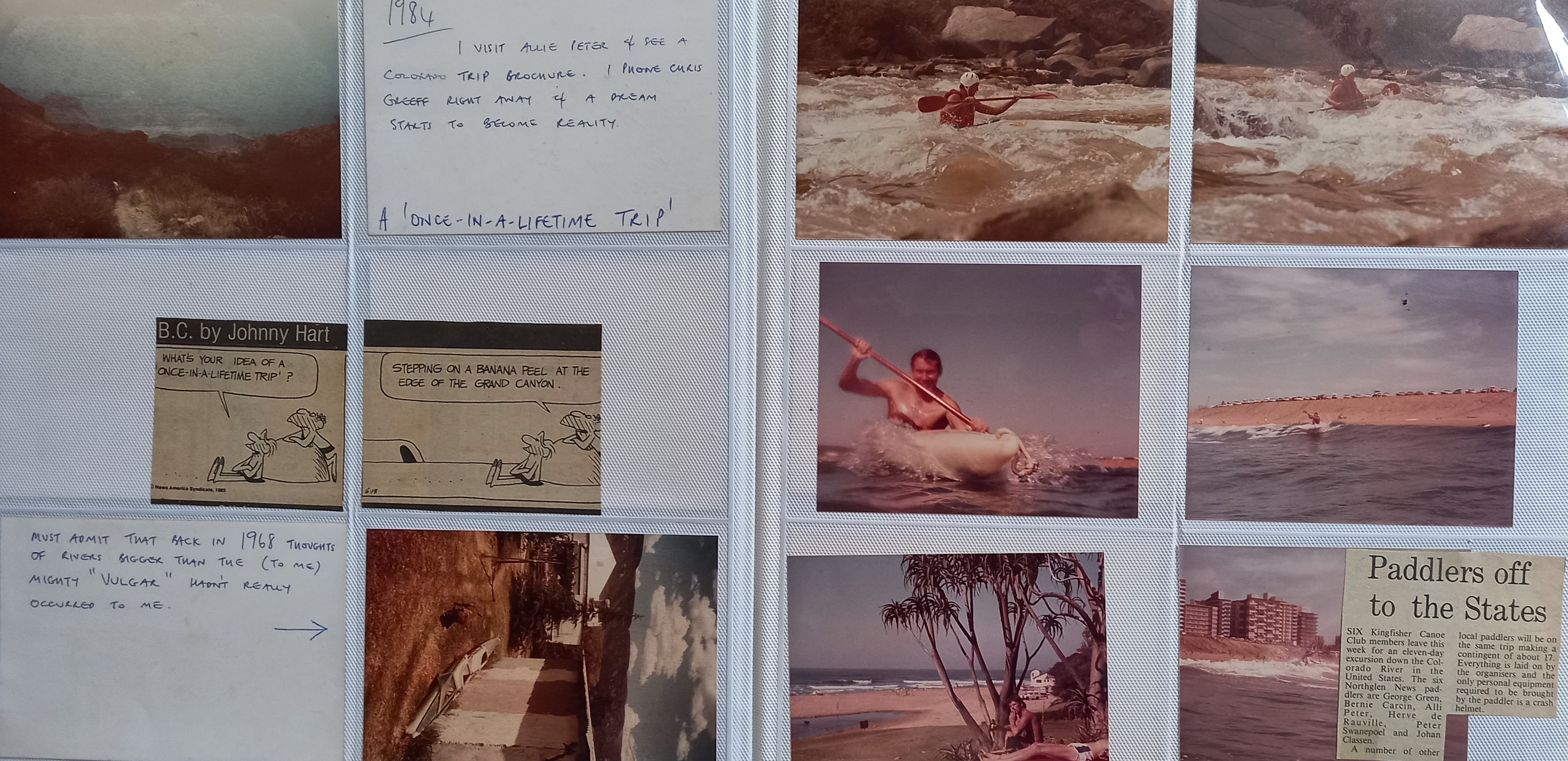
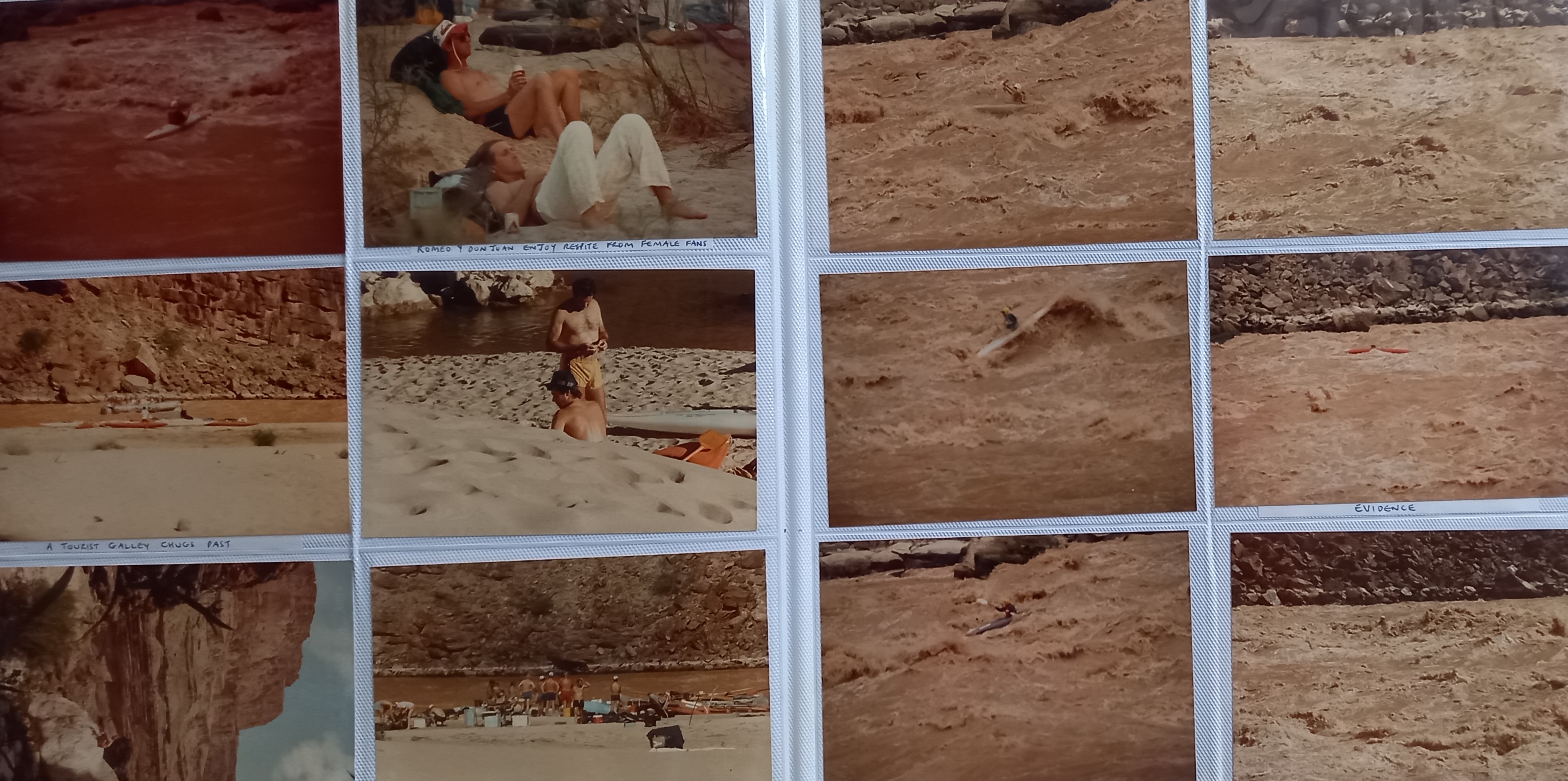
Old-Fashioned Photo Album
Pics from my photo album – copied and now discarded:
That Map
And here’s my famous map that was such a boon on the trip. Fifteen pages each 30cm long, the map was 4,5m long all told. Lots of detail. Which I then added to!
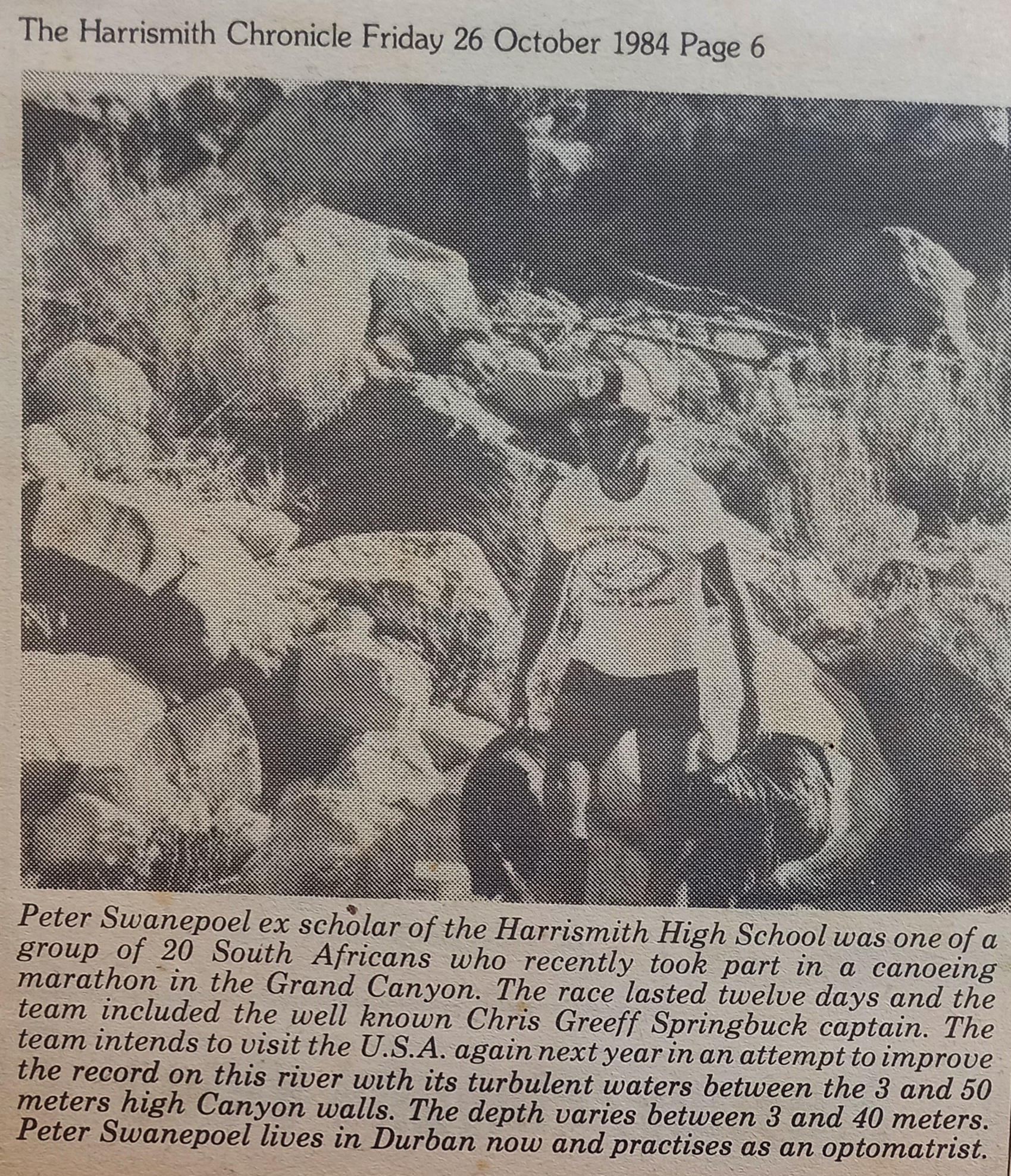
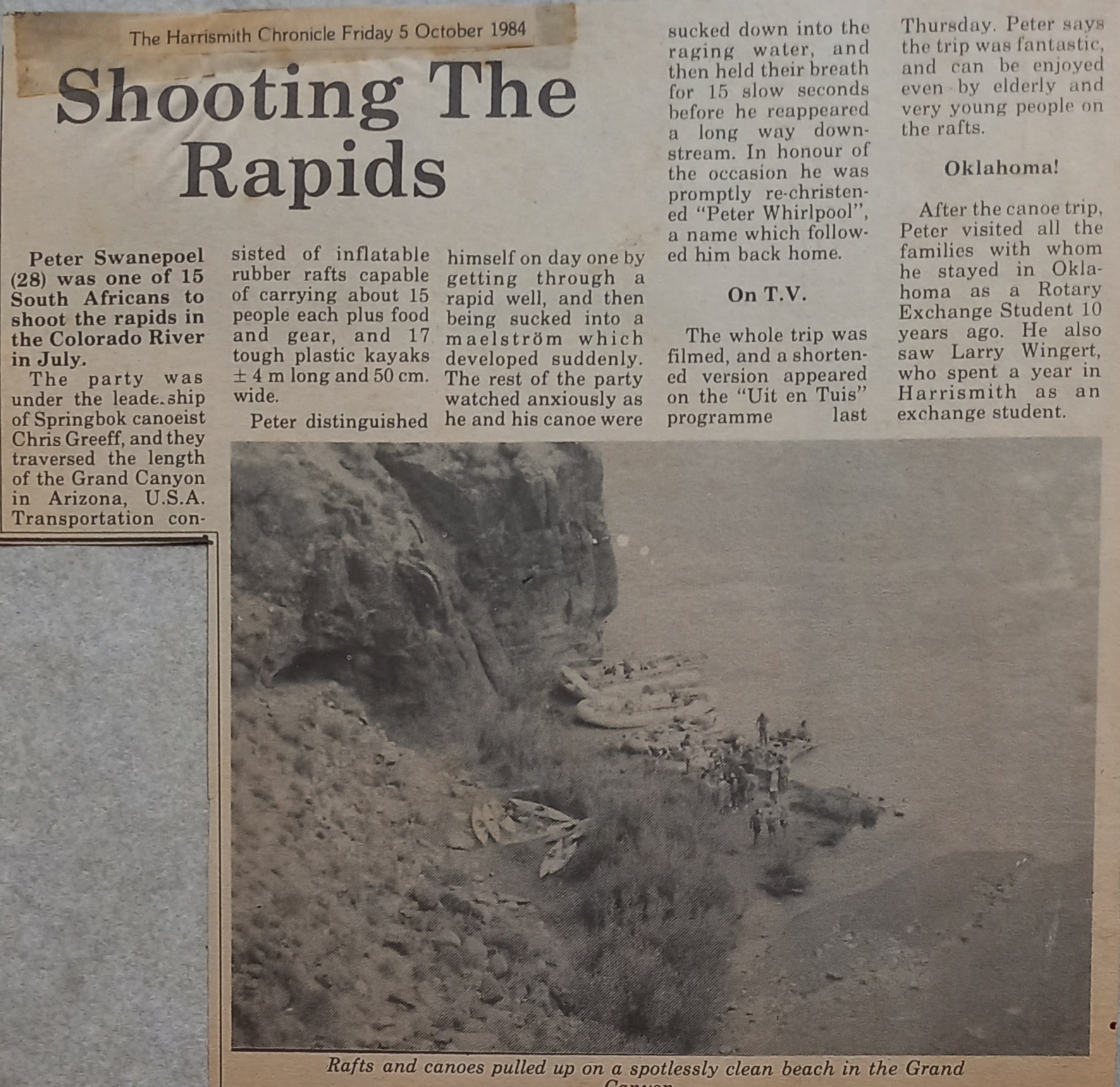
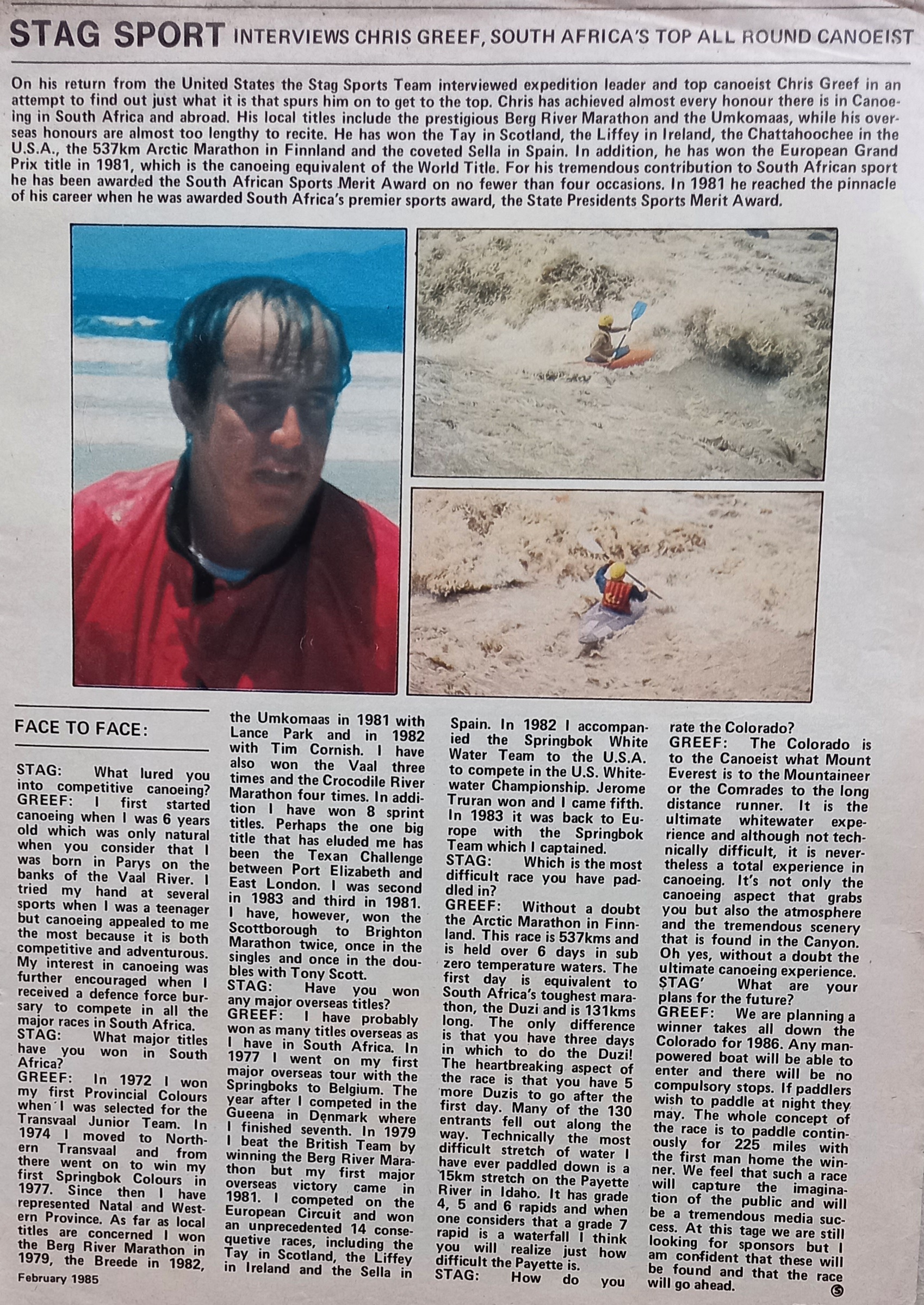
Sundry reports in the SA press afterwards
(all uploaded here as the hardcopies are being tossed)
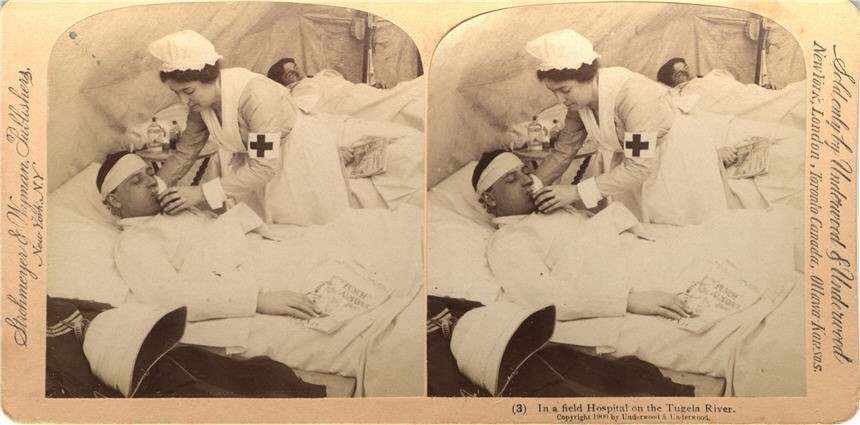
Bouncing around on the back of a Bedford we would roar to a halt in the veld. Well, really the mixed thornveld somewhere north of Pretoria, which should properly be called Tshwane, ancestral home of the Tshwanepoels to which we have land claim rights. But that’s another (important) story. In a cloud of dust. We were a highly mobile, highly efficient ‘Field Hospital.’
. . . Right.
Seeking the shelter of trees so as not to be too visible to the enemy, and to have the shelter of trees, we would leap eagerly to the ground, pitch our big tents and carry in the stretchers, placing them in neat rows one left and one right. Then up would go the drip stands, each with a drip hanging down. Sundry balsaks and trommels would be lined up and unpacked and in no time we’d be ready to receive the wounded, the sick, the lame and the lazy who had been drilled or scared by the kommuniste nearby, us being an advance field hospital. We were much like this:
Well. In theory.
In reality the only thing that happened with any sense of urgency was the roaring to a halt by the Bedfords in a cloud of dust. After that there would be consultation and various opinions about whether the tents should be lined up like this (maybe east-west) or like this (maybe west-east). And how could we put it here? Look at this big stump in the ground here. The neat rows would be more haphazard and boiling water for tea would be accomplished before any drip stands were placed. Lots of hanging back and ‘after you.’ It was like a military operation.
Which is seldom like this:
And more often like this: A strategic planning session in the bush.
– some literal ballas-bakking caught on camera –
The most organised of the troops was our mate Rhynie Fritsch. From Durban, natch. Of the Fritsch Plumbers dynasty. As the lorry stopped he would step off with his blanket over his shoulder and his paperback in his hand and immediately stroll off till just out of sight but still well within earshot for a ballasbak. As the Bedfords started up again after we had struck camp and packed up he would reappear in time to clamber on, miffed that us workers hadn’t kept him any tea. Everyone loved ole Rhynie so you could only admire his gippo’ing.
balsaks – literally scrotums; big all-purpose canvas bags; used as seats, totes, wardrobes, pillows, laundry bags, etc;
trommels – big all-purpose tin trunks; used as seats, bedside tables, cupboards, etc;
kommuniste – vaguely-defined bad ous who refused to believe we were Ve Chosen Race;
ballasbak – ball-baking; testicle-tanning; sitting or lying back in the sun, basking with your crotch exposed to the warm rays. See the picture: The sunglass fella is doing it well, the other two not bad. In the barracks you’d usually be leaning against a wall, hidden from the corporal’s sight. On a camp, though, the corporal might be next to you, doing it better than you; an early form of solar recharging;
gippo’ing – wisely dodging what you were meant to be doing. The opposite of volunteering; Probably slang from the Egypt campaign in WW2?
When I was around six years old Sheila came marching up to me and demanded: –
“Do you know what Dad’s name is?”
Well, of course I did! I was the older brother.
It’s “Dad”
“No man, his real name!”
What did she mean? Oh, of course – I’d heard Mom call him that lots of times.
“Peter”
“No. It’s PIETER GERHARDUS!!”
What rubbish! I’d never heard such foul language! And this from my MUCH younger sister! She was a whole year younger’n me. Which was like: All of living memory!
Amazingly, investigation and enquiry proved her right!
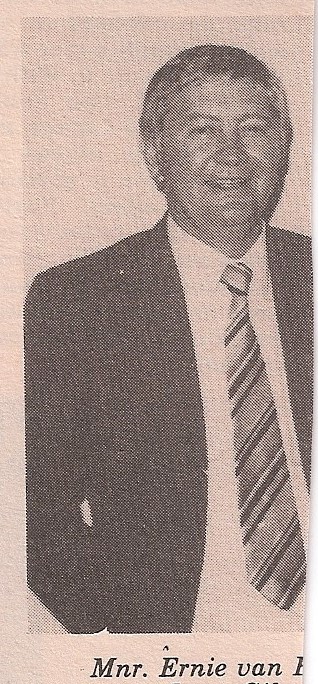
Ernie van Biljon wouldn’t take no for an answer, so I got to go to America as a Rotary exchange student back in 1973.
You persevered where others lost interest.
What a lovely man. He should have lived to a hundred.
Rotary held their interview and selection sessions at Greystones outside Estcourt (where I had attended a Veld & Vlei leadership course earlier that year):
Which three countries would you like to go to, they asked? America, America, and America I replied – and I want to go to a small town, not a big city.
Well, they selected me anyway, but decided, “OK, smartass,” and dispatched me to Apache, Oklahoma, USA, population 1500.
“There are two strict rules” they told us sternly: “No Falling In Love; and Strictly No Driving while you’re there.”
Of course not . . .
Well, I got none out of two right but it was just infatuation; and the owner of the Chev Camaro covered for me in Apache; and the owner of the VW Beetle covered for me in Canada. Turned out I double-failed at both the Two Commandments. I broke them and I was useless at them.
Thank you, Ernie! It was a life-changing, unforgettable year!
Ernie was a great character, full of smiles and laughs. Mother Mary (96 in 2025 when she told me the story) tells how he was worried about his smoking; and how everyone, including “The Englishman,” as he sometimes called Margie, his lovely wife, wanted him to quit. “But I don’t know what to do with my hands!” he complained. Well, Mary had an answer for that: “I’ll show you what to do with your hands,” she said, “Here, put them together like this,” Ernie dutifully followed her instructions. Then put them between your legs like this, she said, putting her hands between her legs. With his mischievous grin Ernie said, “OK,” and made to also place his hands between Mary’s legs, causing great hilarity all round and distracting everyone so he could carry on smoking unchallenged.
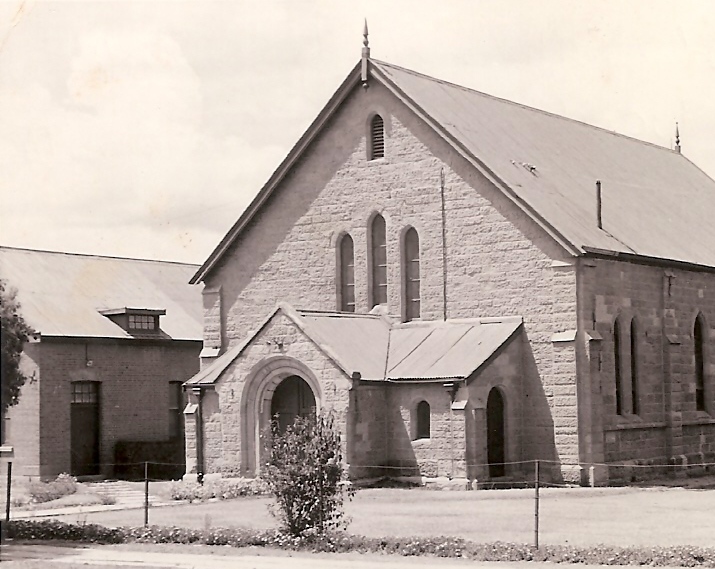
Posed at the seldom-used front door. The side door on the left was where we filed in to get saved.
They demolished the old sandstone church! Demolish and Build! was the fashion. Pity.
Sunday school – Stella Euthemiou was my Sunday School teacher. We would gather in the hall on the left and she would lead us on the path to heaven. Well, try anyway. We would have followed her anywhere!
I suffered severe stress in the army in 1979. Once.
My two-tone 1965 Opel Rekord 4-door bench seat, column-shift sedan in sophisticated shades of grey: dark grey body, pale grey roof, grey upholstery; got indisposed while parked under the bluegum trees outside the Medics base camp on Roberts Heights – then Voortrekkerhoogte, now Thaba Tshwane. She wouldn’t start.
This was serious! We had a weekend pass and there was a party on in the City of Sin & Laughter, aka the metropolis of Harrismith, as everyone knows.
Not a problem, said KO (surname). We were all KO’s: candidate officers. He kindly offered to tow me to Harrismith behind his V6 Cortina bakkie. A short piece of nylon rope was found and we set off. I immediately thought Uh Oh!! as we hared off, accelerating furiously. Soon we reached what felt like 100 miles an hour. Slow down! I screamed silently. We hadn’t arranged any signals or communication, so I simply gripped the steering wheel and concentrated. If cellphones had been invented I’d have sms’d him: WTF RU MAD? Then I’d have worried about him reading his sms while driving at that speed.
I sat tensely, staring at the rear of the bakkie a mere six imperial feet from my bonnet. I couldn’t even see the towrope as we roared along. We’re going East so fast we hasten the setting of the sun.
Then it started to rain! Then twilight fell. Then it got dark, with the rain falling ever harder as my wipers feebly swished back, and then later on, forth. With the motor not turning, the battery got flatter and flatter and the wipers got slower and slower. Blowing the hooter and flashing my lights just made things worse – the wipers stopped if anything else was switched on. Upfront in the bakkie the music was so loud and the chit-chat so intense they didn’t even notice us. Or pretended not to?
There was nothing for it but to hang in there for hours. Worst journey of my life. My chin got closer and closer to the windscreen and my knuckles got whiter. Still the KO kept the bakkie floored! He had to get to Durbs where a girlfriend was waiting. My neck was tense and I don’t think I blinked once, staring at the top edge of the bakkie tailgate. My right thigh ached as it poised ready to brake – delicately! – at any moment.
An eternity later we pulled up in Harrismith, unhitched the towrope and off he went, on to Durban. ‘Hey, thanks!’ I said. ‘Appreciate it!’
Fu-u-uck-uck-uck!!! I had never felt such relief. The beer soon relieved the stress though. And soon the testosterone was saying ‘It was nothing.’





















































 You persevered where others lost interest.


 Vrystaat Confessions