(reposted as I received a surprise visit – see the end of the post)
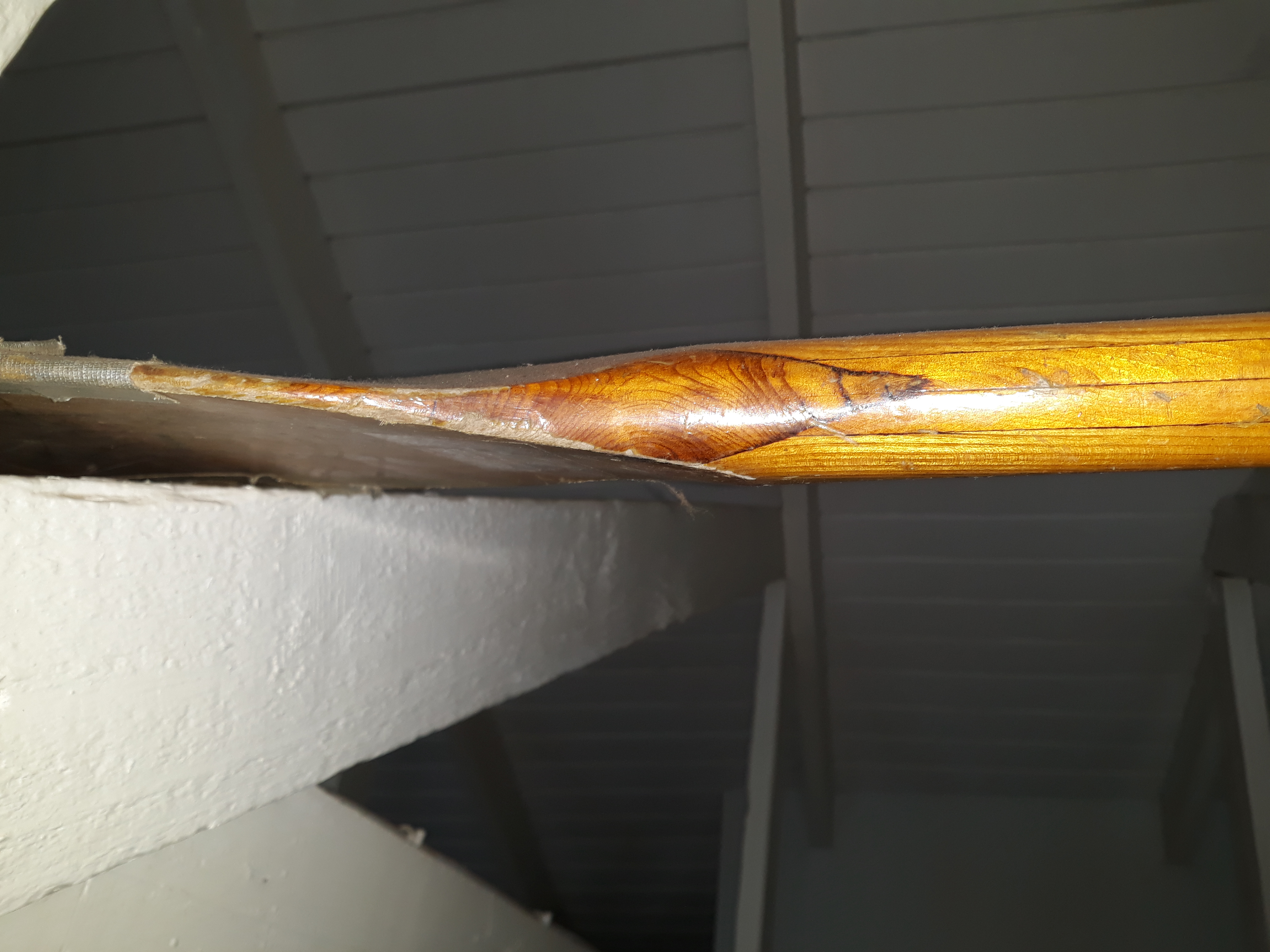
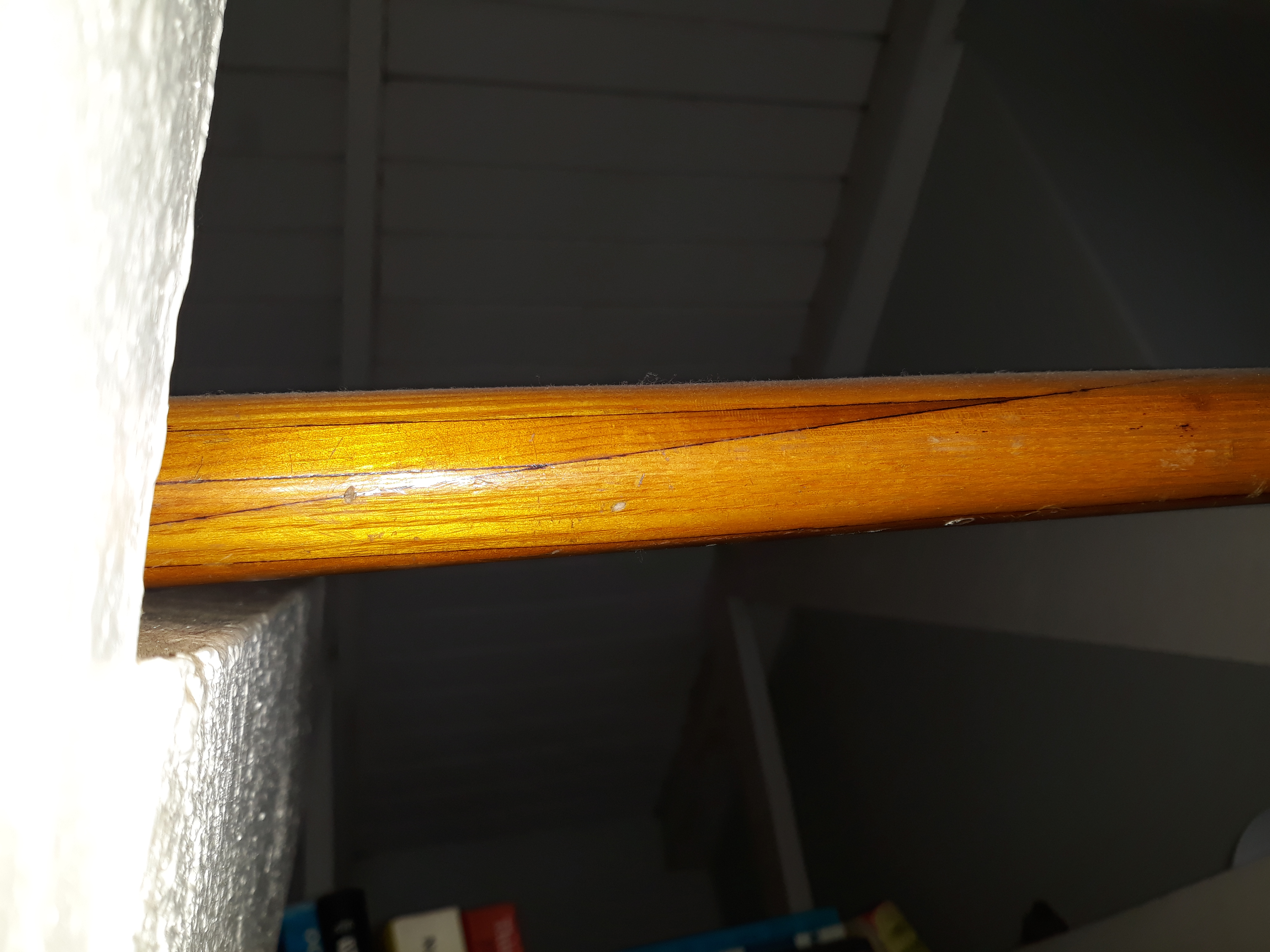
Made of Beech, Birch, Cherry and Maple wood*, it has a hollow laminated oval shaft, the oval at right angles so each hand has its own correct oval. The blade is also laminated, then kevlar-clad and teflon-tipped.
Bruce the Moose Clark of Gauteng and Umko paddling fame was waxing lyrical about Struer sprinting paddles and that got me thinking about my Nimbus river paddle from Port Coquitlam in British Columbia. Not a racing paddle, not a flatwater paddle. A wild rivers work of art for slow-boating. See, I have an arrangement with rivers: I bring a boat to keep afloat, and a paddle to keep upright; All forward motion must be provided by the current.
I ordered two from our trip leader Cully Erdman before we paddled the Colorado in 1984. Being left feather I didn’t want to risk being stuck up a canyon without a paddle. Or with a dreaded right feather paddle.
Dave ‘Lang Dawid’ Walker is also left feather so he used the second paddle for the twelve days. The river was running high, so I didn’t touch a rock the whole 480km way. The only person I heard did touch a rock was Dave in Crystal and the gentleman he is, he immediately came to me to show me the damage: a slight scratch on the kevlar! Chris Greeff, who led the South African trip through the Canyon in Arizona, is also a left feather paddler aus Parys, Vrystaat!
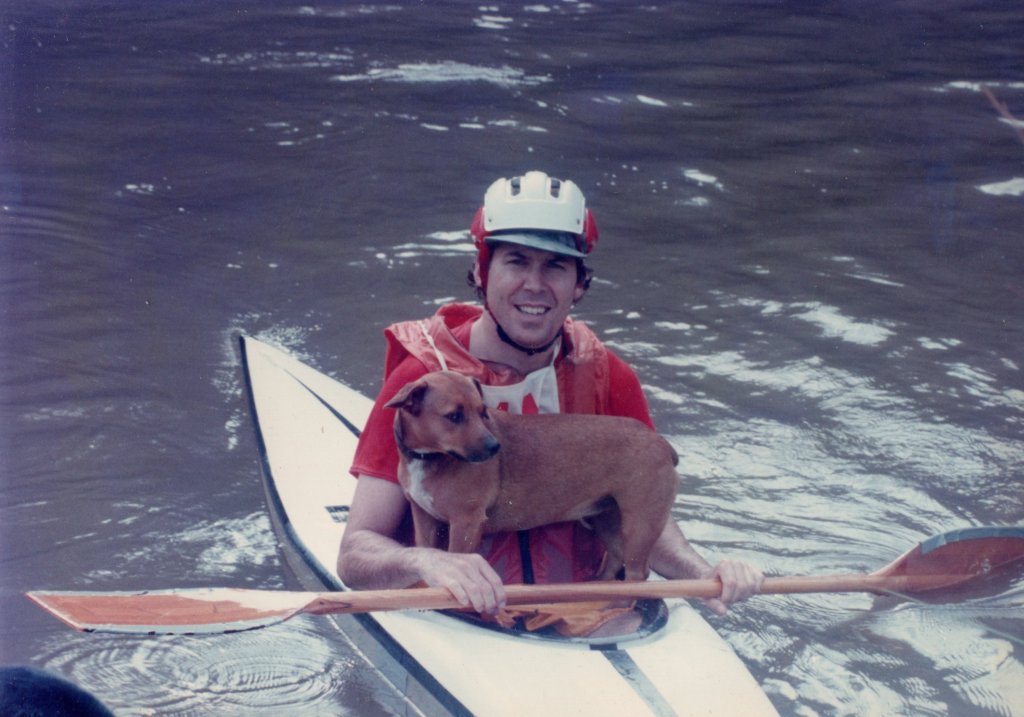
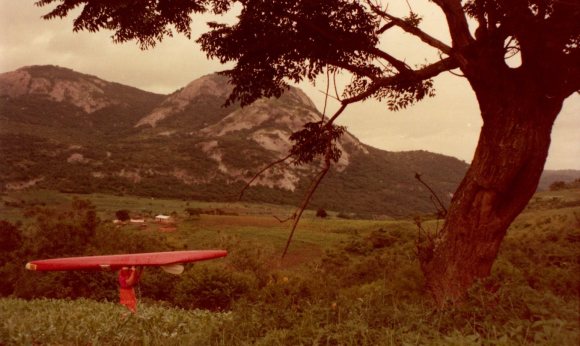
Good friend and tripping companion Bernie Garcin is holding my paddle in the top picture.
Here’s some more paddle porn; Feast your eyes:
~~oo0oo~~
I Meet My Maker!
We paddled thru the Grand Canyon back in 1984; I wrote this post in 2018, and now in 2023, this pleasant surprise: My Paddle Maker!
Since I am the one who designed and build most of the Nimbus wooden paddles in the 1970s and 80s, here the scoop. *The shaft was made of American Ash, the inner laminates are Sitka spruce hollowed a bit more than 3/8 inch. The blades are Sitka spruce, the hardwood edges usually african mahogany. the blades were reinforced with 2 oz. kevlar / epoxy. The tips are urethane, the same material for roller blade wheels. the tips were also cross reinforced with carbon fiber / fiberglass (the black stripes – carbon fiber).
I love rivers and river valleys; water, especially water rushing downhill in the direction I wish to go; big water, we call it; hairy rapids; fun and scary and I enjoy the . . let’s call it excited, tense anticipation. Yeah, fear. My approach to scary rapids is logical / statistical: I know that big water is high perceived danger, but low real danger and that driving to the river is low perceived danger, but high real danger. So I’d reassure myself with that, have a pee, then fasten my splashy and push off into the current. Of course once you’re there on the riverbank, ‘scouting your line’ through the rapid, peer pressure does have a bit to do with it! You going? Yeah? So’m I.
I love little rapids too. As long as the water is flowing I’m happy. If I can do much of the trip with my arms folded and the current schlepping me downstream, I’m in paradise. Still water may run deep, but it’s hard work – no progress unless you’re paddling. And the wind is always agin ya!
Perspiration? Not so much. On many a trip my crazy paddle mates would paddle back upstream to where I was drifting in awesome wonder and ask, ‘What’s Wrong Swanie?’ Nothing was wrong, the day was long. My thought was, What’s the hurry?
In big water my mate ace paddler Chris Greeff would say, ‘If you ain’t scared, you ain’t havin’ fun!’ a quote he got from Cully Erdman. ** Now Chris – he was a very good one. And also a FreeStater who was ‘born to be’ a kayaker. Like me, he grew up on the banks of a Vrystaat river – the lesser Vile (Vaal) as opposed to my mighty Vulgar (Wilge). I used to give him good advice but he’d ignore it and win races. He has no handbrake; He won just about every race you can win except the one South African laymen ask about. And he nearly won that one, despite short and sensibly reluctant legs. These things are hard to verify, but if there was a combination trophy for the highest beer consumption the night before, coupled on the tote with winning the race the next day, I reckon the only other paddler who would maybe come close was Jimmy Potgieter, a decade earlier.
Chris should write a book.
~~oo0oo~~
* I saw this lovely basketball quote –
‘I was born to be a point guard, but not a very good one,’ by Pat Conroy (interesting man)
seen on Dr Mardy’s Quotes
** fear quotes:
Closest I can find are –
‘It ain’t brave if you ain’t scared,’ by Victor J. Banis in Deadly Nightshade.
‘If you ain’t scared you ain’t human,’ by James Dashner in The Maze Runner.
This was the problem: Most of the guys and gals I would do river trips with had a serious deficiency: a lack of some specific paddling strokes one should use on a river trip. They all had the boring stroke where you reach forward, grab a big helping of the river, and pull it back to level with your hip. Over and over. Most of them, however seldom executed my favourite stroke: Place the paddle on your lap, fold your arms, gaze around in awesome wonder, and allow the boat to gently rotate in the current. The Swanie 360° River Revolution, or Swannee River for short.
They were racing snakes. They’d say ‘Let’s Go,’ and then they would actually do that! Isn’t that weird? Then they’d look back, wait till I eventually caught up and ask, ‘What’s Wrong Swanie?’ I was, of course much too polite to reply, ‘Nothing. What’s The Hurry?’ I’m polite that way. What I meant was, ‘I don’t want this day to end.’
And so we would gently bumble downriver. Every few hundred metres they’d wait, or one of them would paddle upstream (more weirdness) back to me and ask ‘What’s Wrong Swanie?’
Strange. Although I must admit, you wouldn’t want me in charge of timing or logistics on a trip!
When the current was swift enough my speed could match theirs. It was the flat water that was tricky. In their defence, they were actually going slowly and enjoying the scenery in awesome wonder too. It’s just that their slowly and mine was out of sync!
~~oo0oo~~
Watch Luca Sestak (then 14yrs-old) show us how to do the Swannee River:
After a long gap from paddling I decided to relaunch my river paddling career, striking fear into the heart of all contenders.
I would need a boat. Being a cheapskate I searched far and wide, high and low and I found one far and low. In PMB dorp. A certain gentleman in fibreglass, Hugh ‘user-friendly’ Raw had one for sale at a bargain price. His glowing description of the craft made me know this was the boat with which to relaunch – OK, launch – my competitive career in river paddling.
At Hugh’s place he showed me the boat and it did indeed look pristine. I went to pick it up and load it on my kombi’s roofrack, but Hugh held me back with a firm, ‘NO. Let me have that done for you!’ Customer service, I thought. User-friendly. So I watched as he got his two biggest workers to load the boat for me, which they did with ease. Big, strapping lads.
On the way back to Durban the kombi seemed to be struggling. I had to gear down on the hills, never had that before. Strong headwind, I thought.
The boat stayed there till Thursday, the big day. The first day of my relaunched paddling life. The dice on the Umgeni river outside my Club, Kingfisher. And then I understood. Getting the boat down off my roofrack took a Herculean effort. When I plopped it into the water the Umgeni rose two inches.
I can say this: Rands-per-Kg – pound-for-pound – I got the best bargain from Hugh ‘user-friendly’ Raw of that century. The 20th, it was.
While I was contemplating thus, and thinking I’m loving being back on the water, what kept me away so long?, Ernie yelled at me through his megaphone and the water exploded around me. What the hell!? All these fools around me suddenly went berserk, water was flying everywhere. It took a few minutes before calm returned and I was sitting bobbing on the disturbed surface. This tranquility was again ruined by Ernie yelling through that same damned megaphone: ‘Swanie what are you waiting for!?’
Jeesh! I headed off after the flotilla disappearing in the distance and after twenty or thirty strokes it suddenly came to back to me in a blinding flash of realisation: I knew why I had stopped paddling. It’s damned hard work.
1976 Duzi – In 1976 I dusted off my old repaired Limfy and entered the race, ready to finally ‘Do the Dusi.’
(BTW: ‘The Duzi’ or ‘Dusi’ is the Duzi Canoe Marathon, a 120km downstream river race from Pietermaritzburg to the sea in Durban, in KwaZulu Natal, South Africa. Next year should see the 70th annual running of this crazy biathlon, COVID-permitting).
Like I had asked Charlie Ryder about six years earlier, Louis van Reenen, a fellow student in Doornfontein, asked me, ‘What’s that?’ when I said I was going to ‘Do the Dusi,’ so he was ripe for convincing. Or brainwashing? He decided to join me. I was happy, as he had a car! I headed off to Harrismith for the December holidays, leaving him with wise counsel: Buy a boat and paddle in it a bit.’
A month later in January, he arrived in Harrismith in his light blue VW Beetle with a new roofrack and a brand new boat – a red Hai white-water boat with a ‘closed’ (smaller) cockpit. He had bought it from Neville Truran at his Kensington shop, and had paddled it once or twice on Emmerentia Dam. In those days that could sort-of qualify you for Dusi!
We now had to tackle the dilemma we had left unspoken: Two of us, two boats and one car. Who would paddle, who would drive as the ‘second’ or supporter, taking food and kit to the overnight stops? So we tossed a coin. I lost. DAMN!
We headed for Alexandra Park in PMB with the red Hai on the roofrack. A great pity for me, as I had done a lot of canoeing, also in flood-level rivers, and had broken two boats in half and repaired one. But – a coin toss is a coin toss. And it was his car!
For Louis, the coin toss won him a first-ever trip down a river. And what a river! Here’s how two-times Duzi winner Charles Mason described it. I have paraphrased excerpts from his memoirs Bakgat:
Charles: The 1976 Duzi was arguably the fullest level ever. The record 420 starters on the first day on the uMsunduzi River were greeted with a very full river, resulting in many casualties.
I helped Louis get onto the water at Alexandra Park and he was relaxed. Although it was moving, the water looked similar to Emmerentia dam as it was flat, so he should be fine, right?
– Louis’ red Hai in the foreground –
That night at the first overnight stop at Dusi Bridge, Louis’ eyes were a lot bigger. He told of big water, scary rapids and numerous swims. I had pitched my little orange puptent and made him supper. He slept with his rear end out of the tent, ready to sprint off yet again – the dreaded ‘Dusi Guts’ diarrhoea had got him!
Charles again: That night the Kingfisher marquee was abuzz with speculation regarding the river conditions for the next two days on the much larger Umgeni.Our first day’s paddle on the much smaller and narrower Duzi River had been enjoyable and exhilarating. I remember being told many years before that the word ‘uMsunduzi’ is isiZulu for ‘the one that pushes and travels very fast when in flood.’ It had really been pushing that day.I was relaxing in a corner of the Kingfisher marquee, listening to the excited banter and anxious anticipation of the largely novice competitors in the tent, regarding the prospects for the next day’s paddle. Few of them had experienced such conditions previously.
Blissfully unaware, utter novices Louis and I were in my little orange pup tent nearby.
Charles: Around 9pm race organiser and ‘Duzi Boss’ Ernie Pearce came to see me:- Ernie said: “I have just had a visit from the engineer at Nagle Dam. He came to warn us that they have opened all the sluices of the dam to reduce water levels in preparation for a massive plug of flood water making it’s way down the Umgeni. The river will be in full flood below the dam by tomorrow morning!” Very early the next morning, I went to inspect the river downstream for Ernie and then reported back to anxiously-waiting paddlers and officials: “The Umgeni is pumping – it’s bloody big – and I am wearing a life jacket!” Life jackets were optional in those days and in any event, very few paddlers possessed them. I overheard one paddler remarking, “That’s enough for me.” He left to tie his boat onto his car. A few others followed suit. The second and third days were big and exciting.
Louis van Reenen, Duzi novice, first time ever on a river, carried on bravely. Paddling some, swimming some, and portaging – a lot! A lot of portaging was done by a lot of paddlers to avoid the big water.
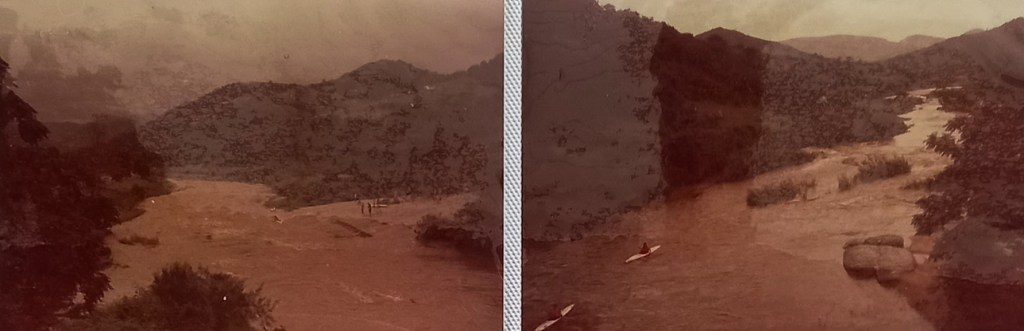
New watercourses and new islands opened up:
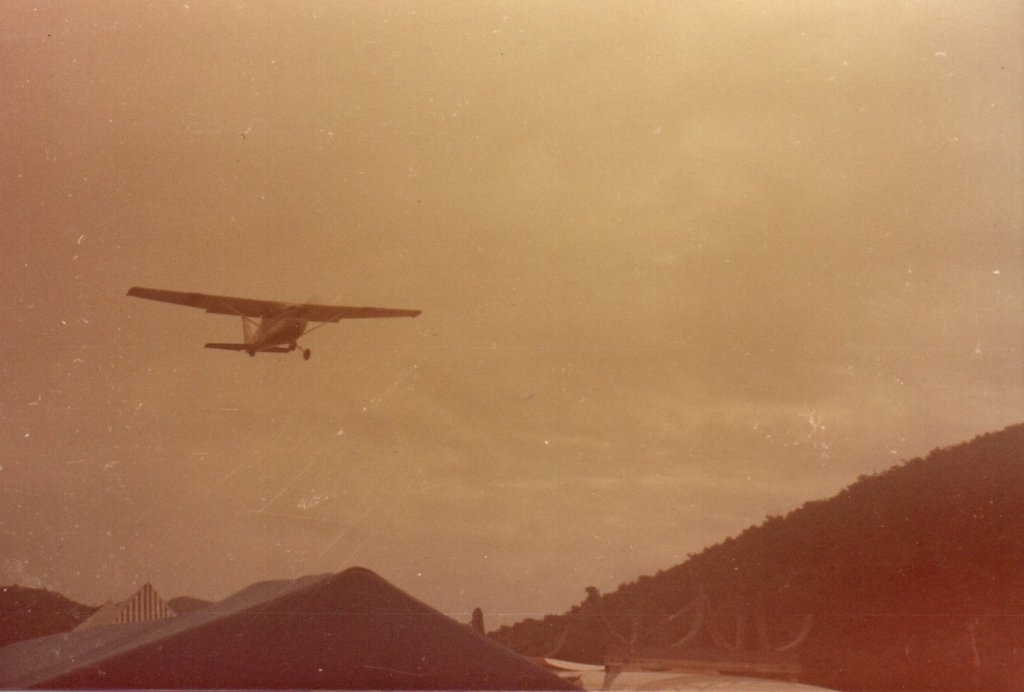
The weather cleared up enough for the welcome newspaper drop by Frank Smith in his light plane at the second overnight stop at diptank:
Us seconds and supporters were kept busy rescuing cars stuck in the mud, including our own Volksie. We’d all be stopped in a long line; We’d get out, walk to the front, push the front car, push the next car, and so on.
Never-Say-Die Louis got to Durban, to the Blue Lagoon, to the salty water of a high-tide Indian Ocean. Hours before him Graeme Pope-Ellis had equalled the best, winning his fifth Duzi, paddling with Pete Peacock.
That night we slept right there at Blue Lagoon, at the finish. Here’s a satisfied and relieved Louis with his Hai and his paddle, and me at the driver’s door of the pale blue Volksie:
Seven years later I FINALLY got round to doing my first Duzi. Sitting in my boat at Alexandra Park in Pietermaritzburg waiting for the starter’s gun, I thought I saw a familiar face and paddled over. Louis! It IS you! He had come back seven years later to do his second Duzi! Never-say-Die!
That 1983 Duzi was the opposite of his first. A low river, lots of portaging because of NO water, not because of high water!
I was born in Harrismith in 1955, as was Mom Mary in 1928, and her Mom Annie in 1893. Annie thought “the queen” of that little island above and left of France was also the queen of South Africa (and for much of her life she was right!).
I attended the plaaslike schools in Harrismith till 1972. A year in the USA in 1973 as a Rotary exchange student in Apache Oklahoma. Studied optometry in Joburg 1974 – 1977. Worked in Hillbrow and Welkom in 1978. Army (Potch and Roberts Heights, now Thaba Tshwane – in between it was Voortrekkerhoogte) in 1979 and in Durban (Hotel Command and Addington Hospital) in 1980.
I stayed in Durban, paddled a few rivers, and then got married in 1988. About then this blog’s era ends and my Life With Aitch started. Post-marriage tales and child-rearing catastrophes are told in Bewilderbeast Droppings.
‘Strue!! – These random, un-chronological and personal memories are true of course. But if you know anything about human memory you’ll know that with one man’s memory comes: Pinch of Salt. Names have been left unchanged to embarrass the friends who led me (happily!) astray. Add your memories – and corrections – and corrections of corrections! – in the comments if you were there.
~~~oo0oo~~~
Note: I go back to my posts to add / amend as I remember things and as people mention things, so the posts evolve. I know (and respect) that some bloggers don’t change once they’ve posted, or add a clear note when they do. That’s good, but as this is a personal blog with the aim of one day editing them all into a hazy memoir, this way works for me. So go’n re-look at some posts you’ve enjoyed before and see how I’ve improved over time (!). It’s just as my friend Greg says: ‘The older we get, the better we were.’
Two Springbok paddlers were watching me intently as I nimbly maneuvered my boat through the water. As I got to the gate that they were judging, I ducked into an eddy and rested on my paddle, getting my breath back and having a chuckle at how clumsily I had bashed through the last gate.
And this is where it turns nasty. Instead of shouting admiration at my skill and encouragement for me to ‘Keep It Up!’ or “Well Done!” or something, they bellowed, while hosing themselves rudely: ‘Don’t worry Swanie, we’re not using a stopwatch, we’re using a calendar.”
Put me off my stroke. Kirby and Stewart carry the heavy responsibility of probably ruining a promising international slalom paddling career.
Fresh from trying to drink an aeroplane dry we sauntered up to the car hire counter in the Atlanta airport and asked the lovely lady for a medium-sized American car. We had decided American cars were so big that a medium would be plenty big enough for the five of us. We got into our car, drove fifty metres – OK, fifty yards in America – and threw a u-turn. We sauntered back up to the car hire counter in the Atlanta airport and asked the lovely lady if we could swap it for a fullsize American car. She said, Sure Thing, I have a Lincoln Continental Town Car (check a review of the Lincoln at the end of this post!), Will that be good? We said if its fullsize and can take roofracks it’ll be good. Oh, No-one Puts Roofracks on a Lincoln Continental Town Car, she said, so we kept quiet. Diplomatically.
– Herve, me, Chris and Jurie with our 1984 Lincoln Town Car –
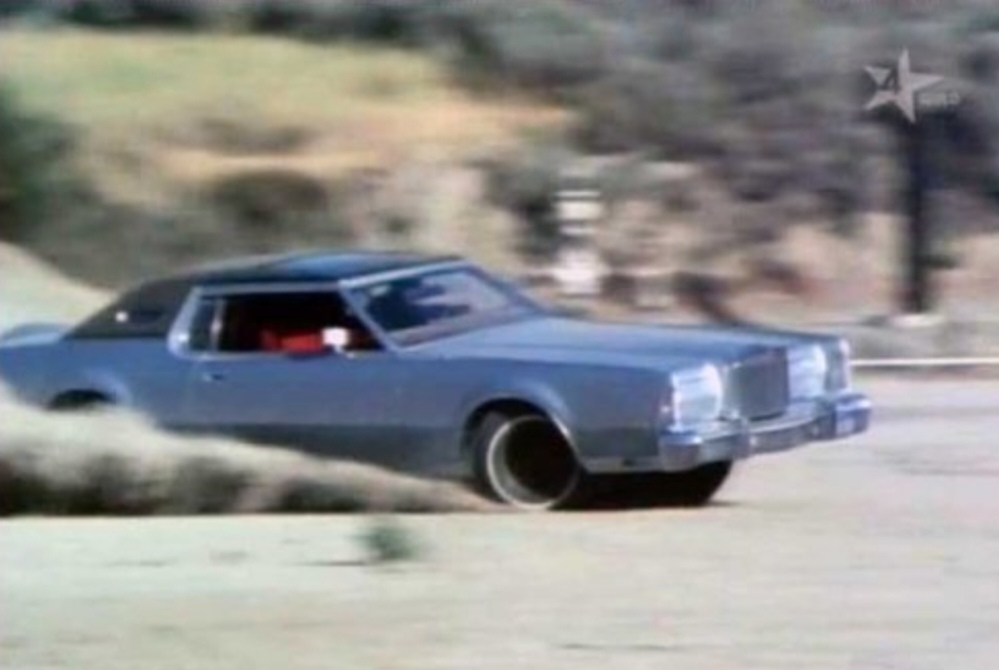
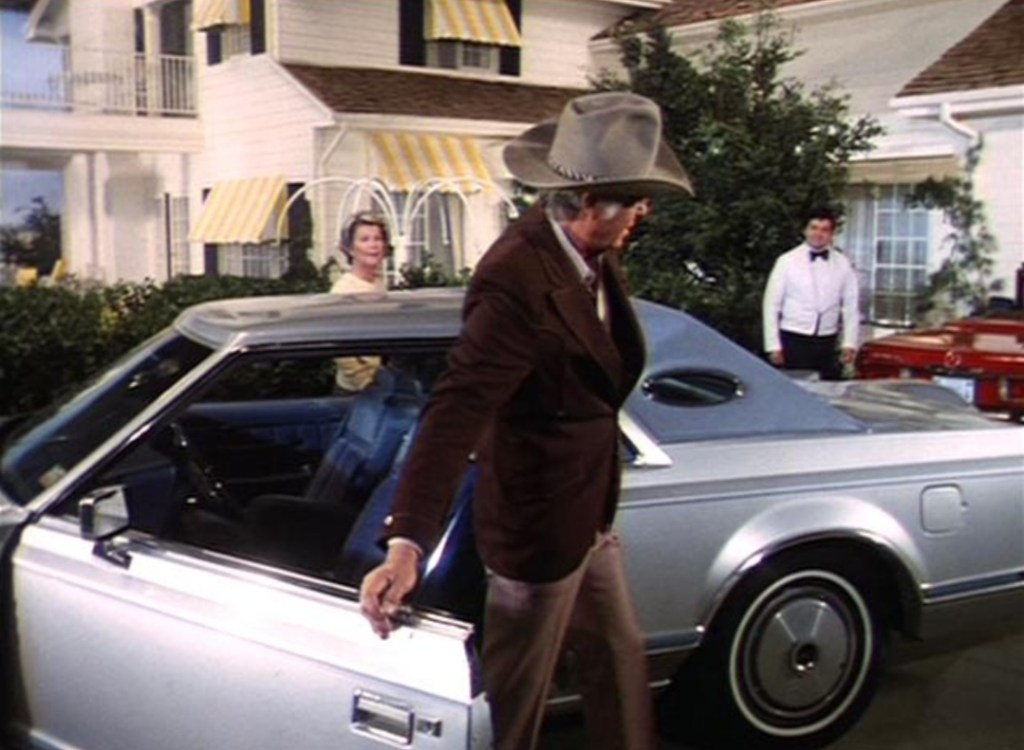
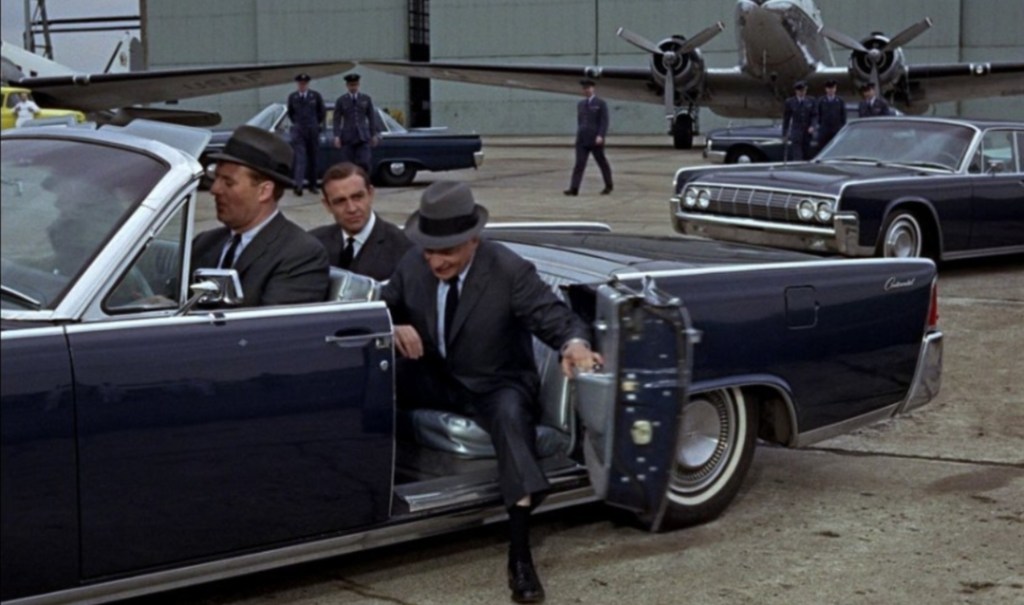
Now this was a car. A Lang en Slap car. This was like the one Fat Frank Cannon drove in the Cannon TV series; Jock Ewing drove in Dallas; Also Frank Sinatra and Jack Kennedy, but theirs were convertibles and we needed a roof.
– me, Herve, Dave, Jurie and Steve and the Lincoln with roofrack – which the rental lady said no-one would do –
Trip lead-stirrer Chris drove us straight to the outfitters to fit a roofrack. He’s a legendary kayaker who has his national colours and has won national and international kayak races. He’s also a military man and a dentist and a fine beer drinker. With roofracks on he drove us to his friend’s home where we to spend the night. Dave Jones is a legendary kayaker who has his national colours and has won national and international kayak races. He’s also a military man and a dentist and a fine beer drinker. True’s Bob, I kid you not – talk about double trouble!
The next morning, after the hospitality of Dave’s home pub, we headed North to the Ocoee River in Tennessee. Which was completely empty. Not low. Empty.
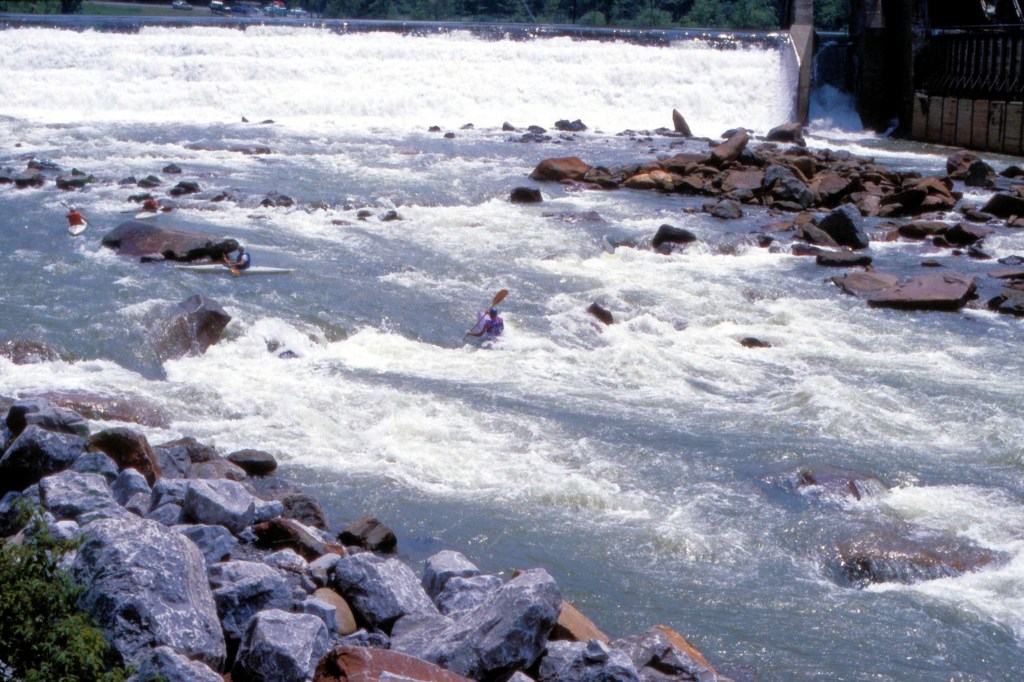
Then they turned on the tap at twelve noon and we could paddle. The full flow of the Ocoee gets diverted to generate power! How criminal is that!? That it even flows occasionally is only thanks to hard lobbying by paddlers and environmentalists. From around 1913 to 1977 the river was mostly bone dry – all the water diverted to generate power. Now sections of it flow again at certain times.
I’m in orange.
Here’s a description of the short stretch of river we paddled:
The Middle Ocoee The Middle Ocoee is the portion of whitewater, on this stretch of water, paddlers and rafting enthusiasts, have been paddling for decades. Beginning at Rogers Branch and just over 5 miles long, this class 3-4 section of whitewater is an adrenaline junkies dream, crammed with waves and holes.
Entrance rapid gives you whitewater from the get-go. As soon as you launch onto the middle Ocoee you are in a class 4 rapid, paddling through waves and dropping ledges. It’s a fun and exciting way to begin your trip. Broken Nose begins with a large S-shaped wave. Swirling water behind it will send you to a series of ledges. This is a great place for pictures, so smile. Next, Slice and Dice: two widely spaced ledges, fun to drop, especially the second ledge. If done correctly, you can get a great surf here “on the fly”. An interesting and humorous set of rock formations highlights the rapid, Moon Chute. After making your way behind the elephant shaped rock, do some 360’s in front of “sweet-cheeks,” then drop through the chute and over the ledge at the bottom. Double Suck, an appropriately named rapid, where a good-sized ledge drops you into two hydraulics. Paddle hard or you might catch another surf here. Double Trouble, which is more ominous in name than in structure, is a set of three large waves, which will have everybody yelling. This is another great photo spot. You won’t find an easier, more fun rapid. Next is Flipper (No, it’s not named after the dolphin). Here, a great ledge drop puts you into a diagonal wave. Hit this wave with a right hand angle and enjoy the ride, or angle left to eddy out. Then enjoy one of the best surfs on the river. Table saw was originally named for a giant saw-blade shaped wave in the middle of it. The rock forming the wave was moved during a flood several years ago, making this one of the most exciting rapids on the Middle Ocoee. The big waves in this one will make the boat buck like a bronco. At Diamond Splitter, point your boat upstream and ferry it between two rocks. Once there get a couple of 360’s in before dropping through the chute and into the hydraulic.
Slingshot is where most of the water in the river is pushed through a narrow space, making a deep channel with a very swift current. To make this one a little more interesting, see how many 360’s you can complete from top to bottom. Cat’s Pajamas start with a couple of good ledges, with nice hydraulics. After those, it will look as though you are paddling toward a big dry rock, but keep going. At the last second, there will be a big splash and you will be pushed clear. Hell’s Hole is the biggest wave on the river. Start this one in the middle of the river, drifting right. Just above the wave, start paddling! When you crest this 7-8 ft. wave, you will drop into a large hydraulic. Stay focused because just downstream are the last two ledges known as
Powerhouse. Drop these ledges just right of center for a great ride. Once through Powerhouse, collect yourself and take out at Caney Creek.
–oo0oo~~
The dry river when they turn off the taps. Very sad:
Lang en Slap – American. We opened the bonnet – the hood – and stared in awe at the space between the grille and the radiator. It looked like we could have fitted all our suitcases in there!
I remember a lovely day, spectacular scenery, an easy river level, quite gentle, good company, lots of laughs, but very little else till near the end when we came to the only rapid we decided not to go ‘down the middle’!
Among us were (as I recall) Doug Retief, Martin Lowenstein, Marlene Boshoff, Pete Zietsman and Bernie Garcin. Around 1983 or 1984 I guess? I wonder who drove our vehicles?
The rapid had a deep slot with the water dropping vertically over a ledge on three sides, a bit like a weir. Did someone call it The Coffin? We decided to take a sneak around it on the right and as I was on river left I started to ferry-glide across but lost my angle and decided ‘Too late, I’ll have to go for it’
I paddled hard and shot down into the slot, shuddered to a halt but then managed to pull away. All turned out alright, but I berated myself for a sloppy ferry-glide! Focus!
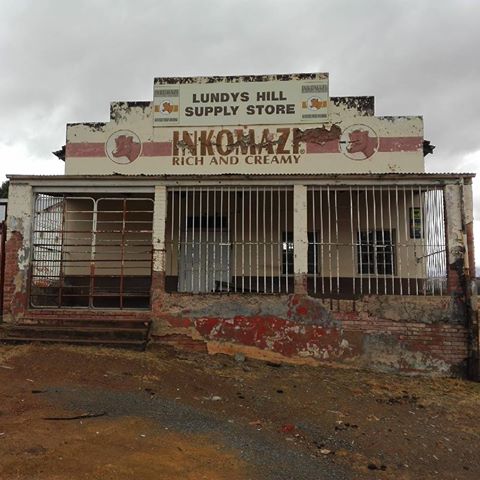
Don’t remember much else except a nice cold drink at this trading store on top of the hill. I wonder if anyone took a camera?
Map from paddler celliers kruger; photos from mapio.net – thanks!
Dukandlovu rustic camp was underutilised. Parks Board wanted to increase its use and were looking for new ideas. It was a walk-in or cycle-in rustic camp and they were reluctant to open it up to drive-in access, so wanted to try other ideas first.
Rustic, but splendid, it’s a four hut, eight bed camp with basic kitchen facilities and cold water showers. The widows are openings with roll-down reed blinds which keep about half the wind and none of the mozzies out. The beds had mattresses, but bring your own bedding.
It was doomed. So few people want to rough it! Not ‘nowadays’ – always. Since humans first walked upright the majority have chosen the cushiest of whatever’s available. ‘I prefer roughing it’ has always been the weirdness of a few.
– our pic – the rest are internet pics –
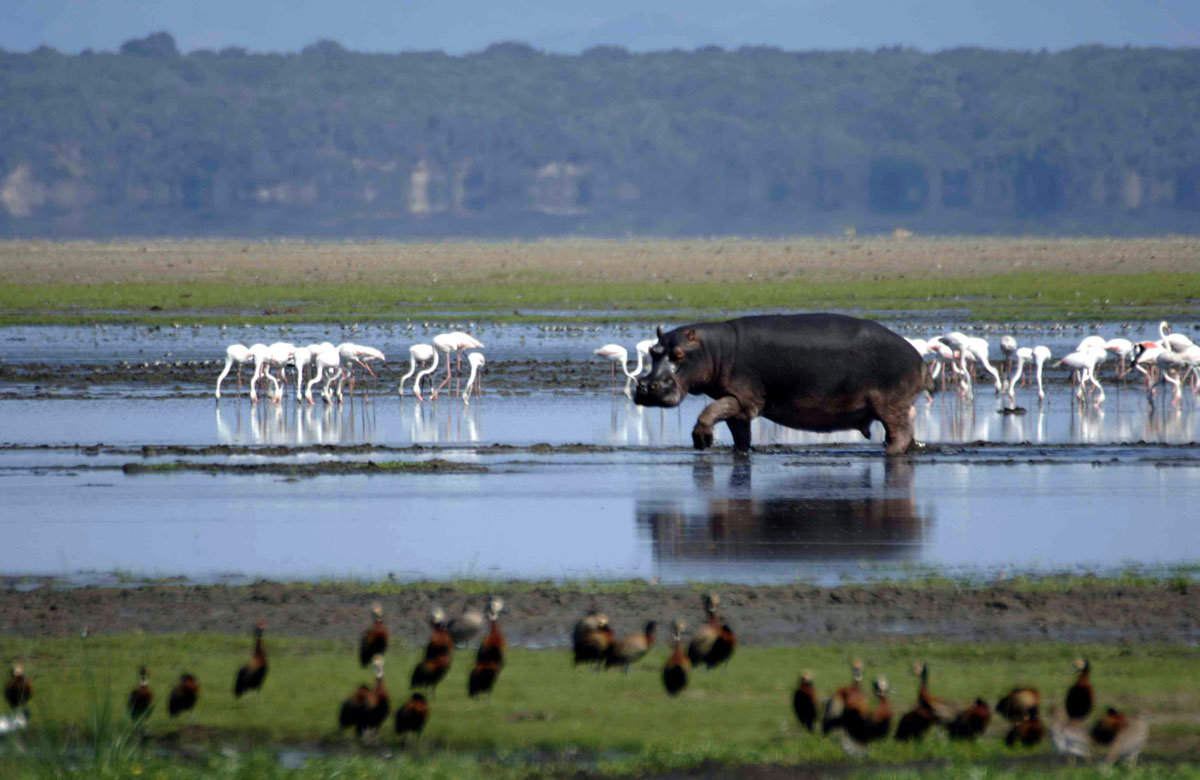
But the rugged few in Parks Board were reluctant to give in too easily, so first they tried us: “Let’s test the feasibility of adding canoeing-in to the access menu!” they said. Robbie Stewart was approached and he took Bernie Garcin and I (and others – who?) to test the waters. Literally. We set off with our plastic kayaks to False Bay, launched them and headed south towards the mouth of the Hluhluwe river on the Western Shores. Right from the outset we could see this wasn’t promising: We touched bottom often. Our draft was mere inches, but the lake was that shallow in places. Great for small worms and other marine creatures and for the wading birds that spear them from above, but not good for paddling. Oh well, we had tried. Not long after this they actually did open it to vehicle access. With a sigh, I’ve no doubt.
After staying a night the rest of the guys went home on the Sunday. I stayed over with Parks Board Rangers Dick Nash and Trevor Strydom. Monday morning I woke, eagerly looking forward to my day of ‘rangering’. What derring-do would we get up to with me as ‘ranger-for-a-day’?
Paperwork at a desk, that’s what. As head ranger, Dick first had a whole bunch of admin to sort out! Not what I’d imagined.
But later we got going on their regular bird count in the wilderness area in the north-east arm of the lake. We set off in their spacious craft with a Hamilton jet propulsion system (an impellor rather than a propellor, it sucks water in the underbelly and spits it out the back). This was fine in clear deep water, but when we nosed up the Mkhuze river we soon sucked up waterweeds and came to a halt. Dick pulled rank and ordered Trevor to jump overboard and remove the weed from under the boat. On the bird count we had seen at least fifty thousand and ten of their distant cousins – crocodiles – so the thought of jumping overboard was not inviting! Anyway, before Trevor could remove his shirt Dick was already under the boat doing it himself. A bit disconcerting when you looked at his hand as he chucked the weed away: He only had two fingers and a thumb. Had a croc taken the other fingers?
Looked like this, but I think this is maybe Kosi?
We got going again in fits and starts and after a few more stops to clear the impeller we turned back to the lake and continued to count birds. And thumb our noses at the crocodiles.
So do go to Dukandlovu, you can drive there now. You wimp.




















 Vrystaat Confessions