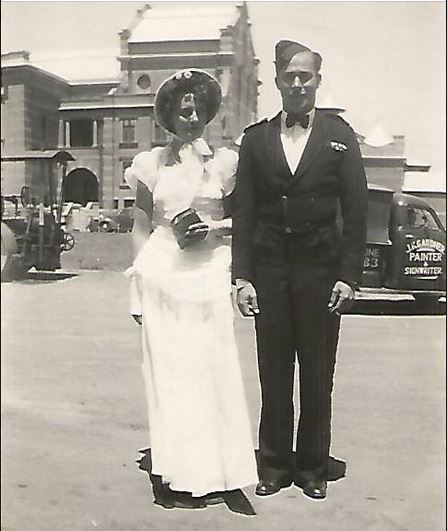
Mary Bland and Sylvia Bain, cousins, decided there was NO WAY they were going to miss the dance in the Harrismith Town Hall. This is quite possibly Mary’s single biggest act of defiance or wilful disobedience in her whole life. See, they were meant to be in Durban then, to start their midwifery course at Addington Childrens Hospital.
But to the dance in the dorp they went. Mary with Pieter, who she later married; and Sylvia with John, who she later married.
The next day they left (by train?) and in Durban they got their new quarters and their new uniform, which they loved: ‘It had a long fishtail headdress down the back almost to our waists. It looked beautiful.’
Also, their new matron was Mary Hawkins and they knew her sisters in Harrismith and in fact, Mary’s Mom Annie had dated her brother ‘Hawks’ Hawkins for quite a long while.
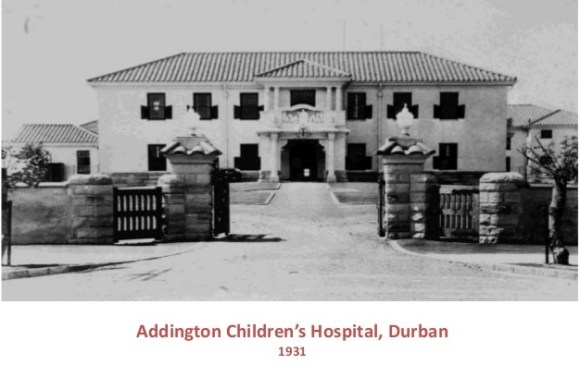
– Addington Childrens Hospital – Maybe by 1949 it looked more like on the right? –
When they were summonsed to Matron Hawkins’ office they waltzed in merrily feeling glam and looking forward to a warm Harrismith welcome; only to be met with a frosty blast and a good dressing-down from Bloody Bill, as Mary Hawkins was known by those who knew her! Or sometimes Bloody Mary. She had been the Matron of all SA nurses in the war, and this was shortly after the war, and she was in no mood for nonsense. They were LATE starting their course and she’d not cut them any slack just cos they were from her home town!
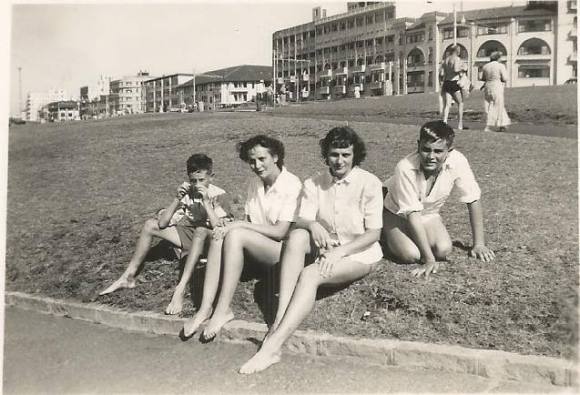
– Mary left and Sylvia, new in Durban – ca.1949 – day off – Mary Bland and Sylvia Bain before they became wilfully disobedient – Hey! At least they did get their certificates in the end! – they thought the training was not as good as at Boksburg-Benoni hospital –
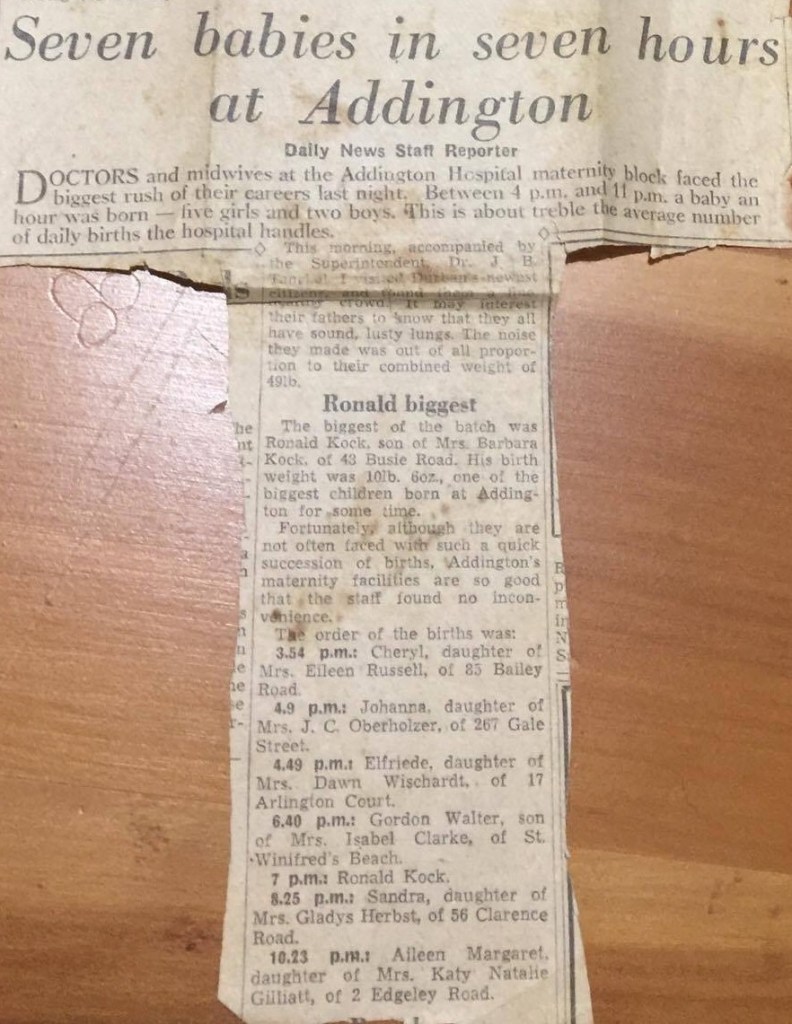
Somewhere there’s a newspaper photo of Mary and Sylvia with a New Year crop of fresh Durban babies. Must find it.
– Ah, here it is – Sheila had it –
~~oo0oo~~
The feature pic shows Mary and Pieter also in 1949, also outside the Town Hall, but another occasion.
~~oo0oo~~
pics from skyscrapercity.com; and kznpr.co.za – thank you. kznpr is Hugh Bland’s site; Here’s the cover of Hugh’s book on the Addington Childrens Hospital:
Hugh Bland and Mary Bland are related if you go way back to Josiah Benjamin Adam Bland and John Francis Adam Bland, so they have both played a part in the Addington Childrens Hospital. Hugh didn’t deliver any babies, though, so his role was way less important than my Ma’s.
Mary Craig married Alex Caskie; they had a daughter
Mary Caskie, who married John Francis Adam Bland; their eldest son was
Frank, who married Annie Watson Bain; their second daughter was
Mary Frances, who married PG Swanepoel; their eldest daughter was
Barbara Mary, who married Jeff Tarr; their eldest daughter was
Linda Mary, who married Dawie Pieterse; their eldest daughter was
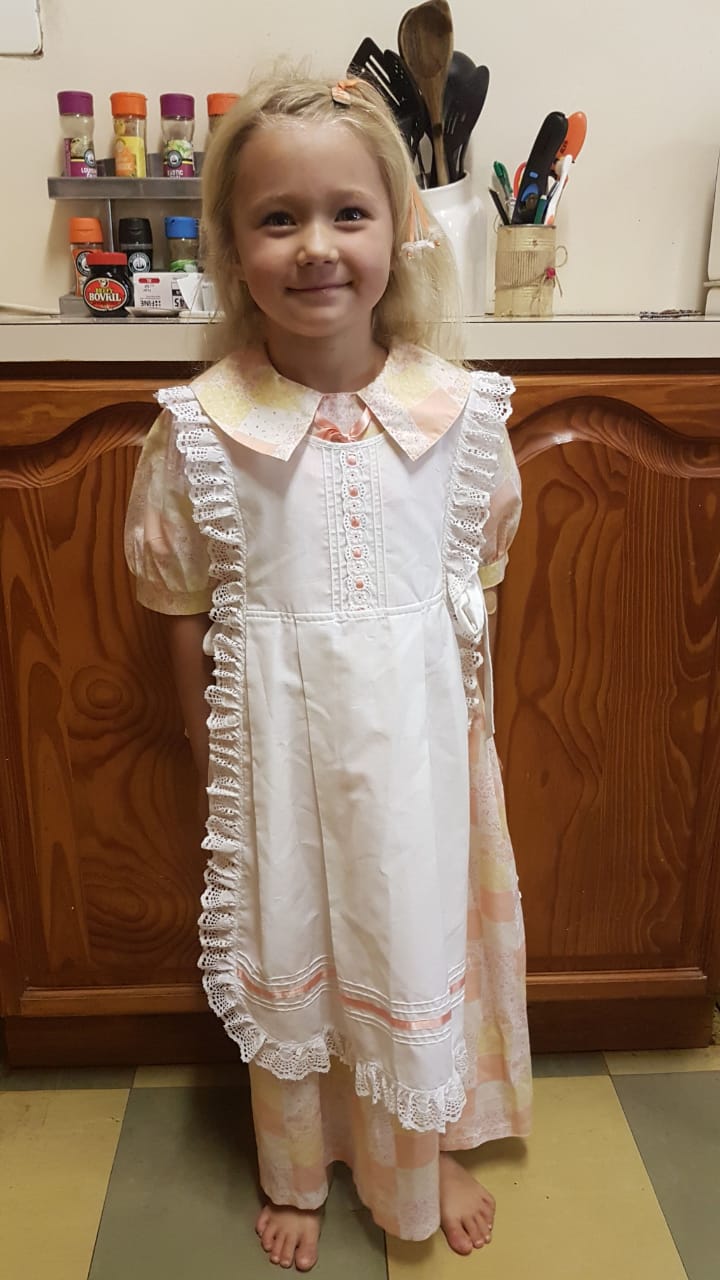
Mary-Kate, boss of the house, turning six this year!
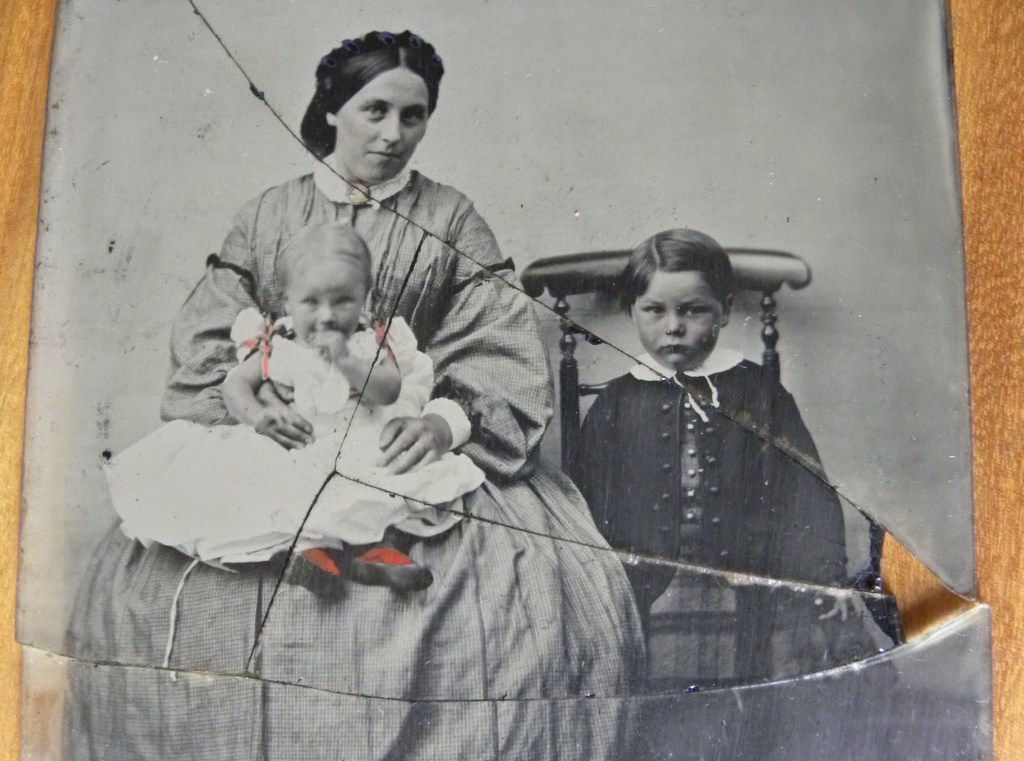
– Sheila has this old daguerrotype of Great-Great Gran Mary Craig and Great Gran Mary Caskie and a suspicious chap –
In this day of easy instant photography I find it fascinating to read how this image was made:
To make the image, a daguerrotypist would – 1. polish a sheet of silver-platedcopper to a mirror finish; 2. treat it with fumes that made its surface light sensitive; 3. expose it in a camera for as long as was judged to be necessary, which could be as little as a few seconds for brightly sunlit subjects or much longer with less intense lighting; 4. make the resulting latent image on it visible by fuming it with mercury vapor; 5. remove its sensitivity to light by liquid chemical treatment, 6. rinse and dry it; 7. seal the easily marred result behind glass in a protective enclosure.
The image is on a mirror-like silver surface, normally kept under glass, and will appear either positive or negative, depending on the angle at which it is viewed, how it is lit and whether a light or dark background is being reflected in the metal. The darkest areas of the image are simply bare silver; lighter areas have a microscopically fine light-scattering texture. The surface is very delicate, and even the lightest wiping can permanently scuff it. Some tarnish around the edges is normal. (thanks wikipedia)
~~oo0oo~~
Nowadays a few quick sweeps of free software Faststone and I can hide most of the cracks of the broken glass:
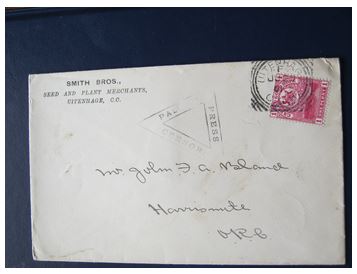
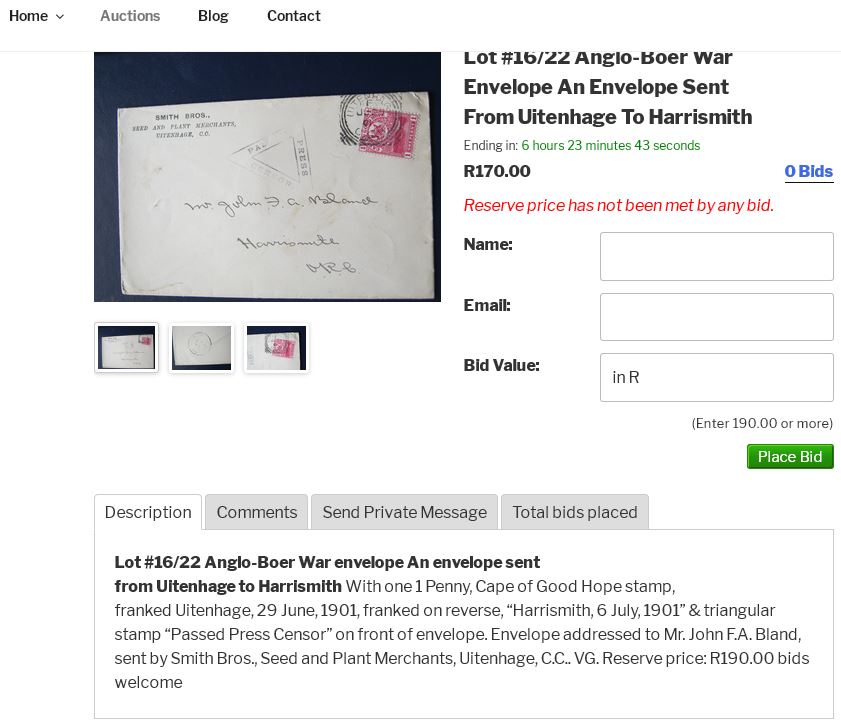
My great grandfather got a letter from a seed and plant merchant in Uitenhage in July 1901. I know cos I found the envelope on an online auction site. It was sent to Harrismith, Orange River Colony (ORC).
It was stamped ‘Passed by the wartime Press Censor’ as the wicked Poms were trying to steal our diamonds and gold at the time and were waging the Anglo-Boer War.
~~oo0oo~~
Sheila responded:
“Yes, I would think it was JFA Bland II who was our Grandad Frank’s father. He came to Harrismith by oxwagon with his father JFA Bland I and they settled near Witzieshoek.
JFA Bland I is buried in Senekal apparently – I made contact with someone in Senekal who offered to go looking for his grave, but she’s never come back to me – so if you ever find yourself in Senekal with nothing to do …….”
This post needs work by someone who knows what they’re on about. This is almost as confusing as the Bible’s begats. Advice: If your name is John, name your son Basil. Or Cyril. Or Percy. Anyway, here goes with what I’ve got:
Our distant cousin Hugh Bland has been doing some wonderful detective work sniffing out the Bland family history. He’s of the Blands that trekked north, to the lowveld and on to Southern Rhodesia (if it was called that yet?), leaving their cousins behind on a farm at Oliviershoek on the Natal-Free State boundary. Maybe on a farm called Oliviershoek.
Today Hugh found the grave of Josiah Benjamin Adam Bland.
Josiah Benjamin Adam Bland was born in 1799 in England. His parents were Reverend John Francis Bland (born 1764 Fordham, Cambridgeshire died 1807) and Elizabeth Adams (born Dunfermline, Scotland. He arrived at the Cape in 1825 on the good ship Nautilus, under the care of the ship’s captain, a Mr Tripe. The voyage cost his family £42.
He got a job on a wine farm, in the Drakenstein area of Stellenbosch, met his future wife Cecelia there (du Plessis?), married her, packed their belongings in a Cape cart and trekked to Mossel Bay. They found land on the Gourits river and settled there. Their first son, John Francis Adam, was born in 1836, followed by eight more children. John the eldest then married Petronella Johanna ‘Nellie’ de Villiers and had a son, John Francis Adam II. He and Nellie left for inland while the baby JFA the second was just a few months old. They headed for Colesberg, Bloemfontein, Winburg and on to Harrismith, where they settled ‘in a house not far from the centre of town’ – 13 Stuart Street, maybe?
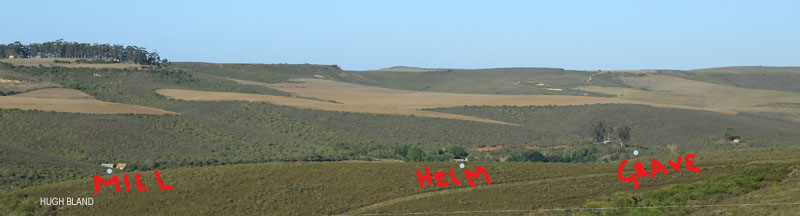
Back in Mossel Bay, Josiah Benjamin Adam Bland (JBA) became mayor and the main street was called Bland Street. Maybe it still is? He died in 1861. His grave is now hidden in thick bush on a farm in the Wydersrivier district near Riversdal.
When Hugh Bland visited die Kaap ca.2010 the farmer very kindly took him to the gravesite. Hugh says you can still read the inscription on the gravestone – it’s indistinct, but there’s no doubt that it’s JBA’s grave. He says it was “quite a moment” for him – JBA was buried there 156 yrs ago and Hugh wondered when a Bland last stood at that grave.
Hugh put two proteas – which it looks like he skoffel’d out nearby? – on the grave; then laid his shadow down next to his great-great-great grandfather and took this pic:
– Hugh Bland’s shadow next to Josiah Benjamin Adam Bland’s grave – left – Mossel Bay – right – Blands Drift on the Gourits River –
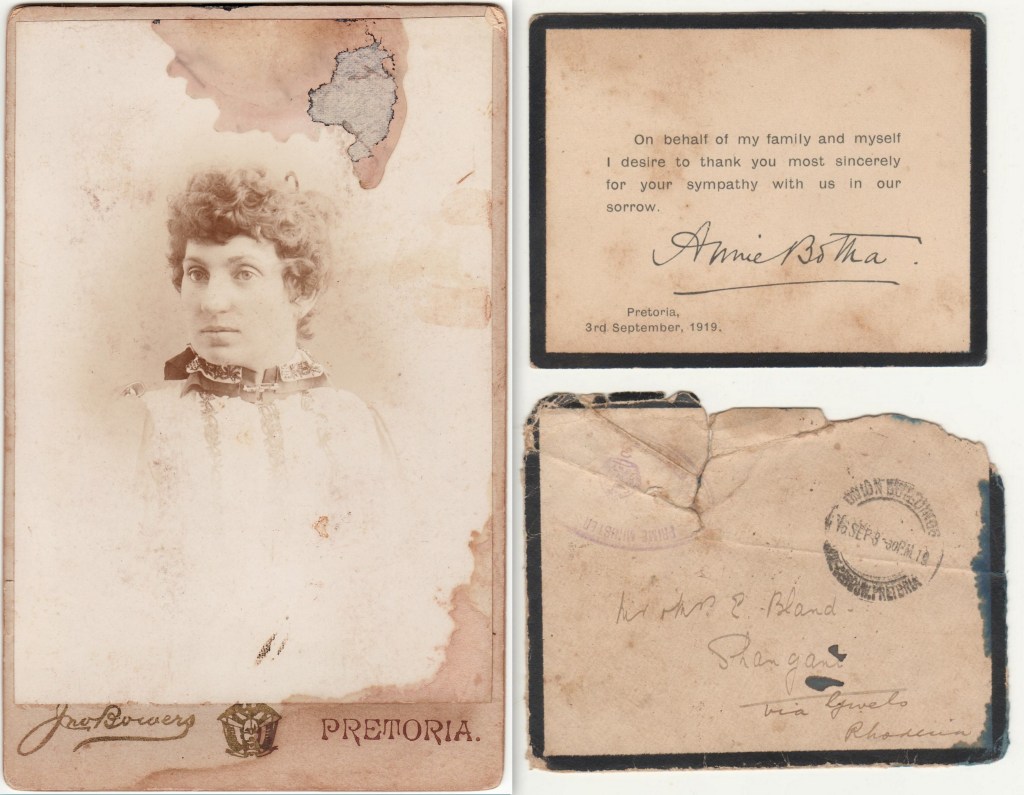
Valuable memorabilia from Hugh:
Prime Minister’s wife’s letter to the Rhodesian Blands
~~oo0oo~~
The Harrismith Branch of the Blands:
Josiah Benjamin Adam Bland had a daughter, Annie Emmett Bland, who married Louis Botha, Boer war general who became the first President of the Union of South Africa in 1910.
He also had a son John Francis Adam Bland (JFA), born in 1836.
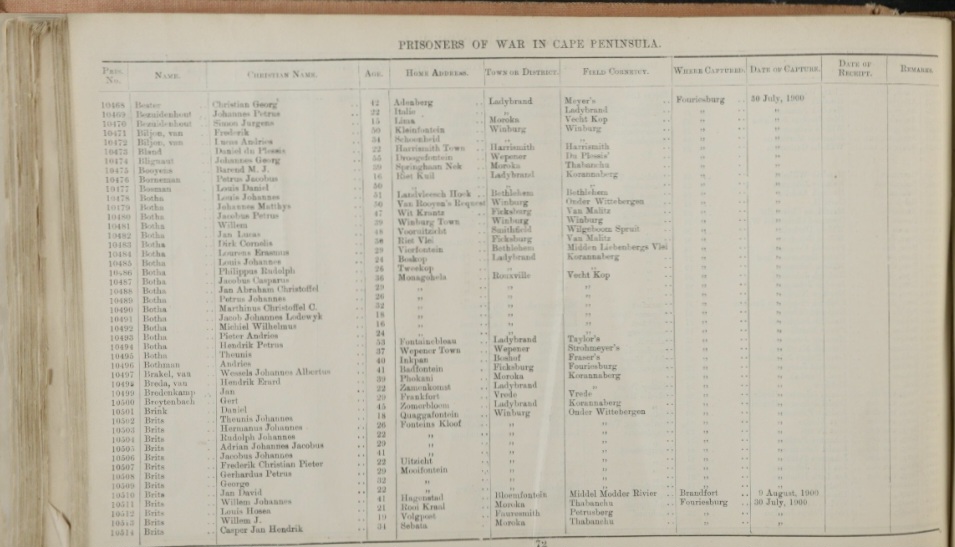
This JFA I later trekked inland ca.1861 to Harrismith in the Orange River Colony with a small baby – John Francis Adam Bland the Second – JFA II. This started ‘our branch’ of the Blands, The Vrystaat Blands. One of them – I must try and find out who – would end up as a prisoner of war in Ceylon for doing the right thing and fighting for his new homeland against the invading, thieving, plundering British in the Boer war of 1899-1902.
John Francis Adam Bland II married Mary Caskie, who became the beloved Granny Bland of Harrismith. They had five sons of whom our grandfather Frank was the oldest, again: John Francis Adam; JFA III.
Hugh found out that JFA the First died on 10 September 1891 aged 55, and is buried in the lost, dusty, verlate metropolis of Senekal, Vrystaat. In Harrismith Granny Bland buried her husband JFA II and four of her five boys, including JFA III. As Sheila said, ‘What a tragic life.’ Poor Granny Bland! She loved her namesake grandaughter Mary, our Mom, and she lived long enough to know us, her great grandkids before she died in 1959. So in that she was Lucky Granny Bland! We knew Bunty, the only child who outlived her, very well. He died in 1974 and joined his father JFA II, his mother, and his four brothers in the propvol family grave in Harrismith.
JFA III married Annie Watson Bain – our lovely granny Annie Bland. Known as just Annie. They farmed racehorses and clean fingernails on the farm Nuwejaarsvlei on the Nuwejaarspruit outside Harrismith on the road to Witsieshoek, towards the Drakensberg. He died in 1943 while my Mom Mary was still at school. Pat was nursing in the Boksburg-Benoni hospital. Pat also died at age 49 in 1974. Mom Mary then looked after Annie until she died aged ninety in 1983. Mom Mary is still alive and well. She turned ninety in September 2018 (update, 95 in 2023). Nuwejaarsvlei was later submerged under Tugela river water pumped up the Drakensberg to fill the new Sterkfontein dam. Drowning vleis is environmental destruction, BTW!!! Grrrr!
(I’m hoping sister Sheila will fact-check me here! Also that cousin Hugh will tell us what happened to the misguided Bland branch that didn’t stay in the Vrystaat, but got lost and ended up in Zimbabwe. They lived near Oliviershoek for a while before trekking on. Hugh tells tales of transport riding, ox wagons, meeting Percy Fitzpatrick, farming in Rhodesia and other exaggerations . . . you know how historians are).
~~oo0oo~~
Must add:
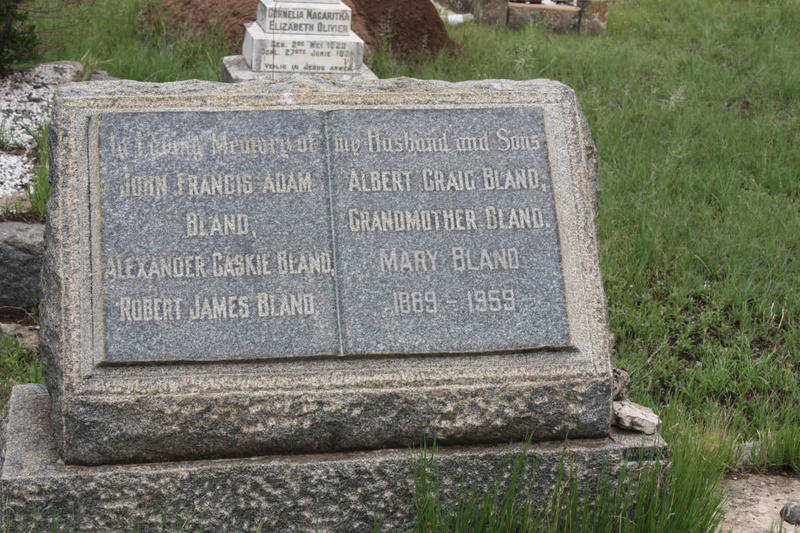
A Bland grave pic – Harrismith cemetery
Annie’s oldest daughter Pat Bland – married Bill Cowie, and had two daughters Frankie & Gemma; Bill worked in Blyvooruitsig on the gold mine; We visited them once, and would see them on their way to their wonderful Wild Coast fishing trips. They called Blyvooruitsig ‘Blayfore or Blayfaw,‘ and pronounced Gert as though it didn’t have an ‘r.’
Mary Bland second and youngest daughter – married Pieter Swanepoel in Harrismith in 1951.
~~oo0oo~~
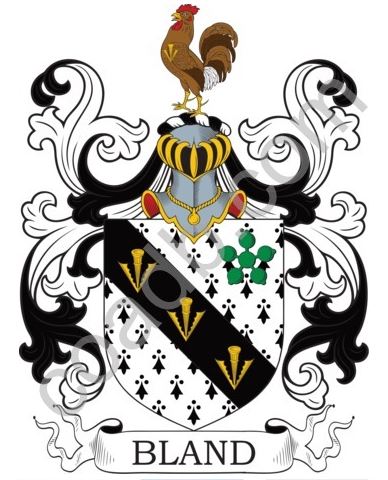
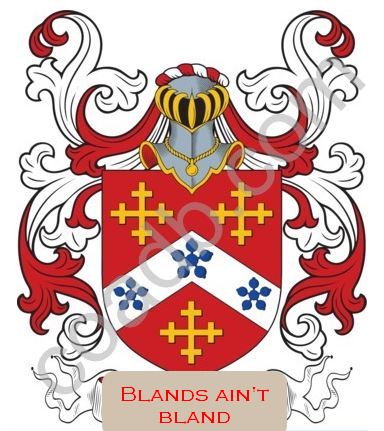
Bland might sound bland, but hey, the surname is thought to derive from Old English (ge)bland meaning ‘storm’, or ‘commotion.’ Don’t use dictionaries that say, ‘dull, flavorless, or just plain ‘blah.’ Rather use the Merriam-Webster that says it means ‘smooth and soothing in manner or quality;’ or use vocabulary.com that says it means ‘alluring;’ or try ‘flattering’ from the Bland Family History on ancestry.com; That’s better. A new motto for the coat of arms, maybe? Blands ain’t bland.
~~oo0oo~~
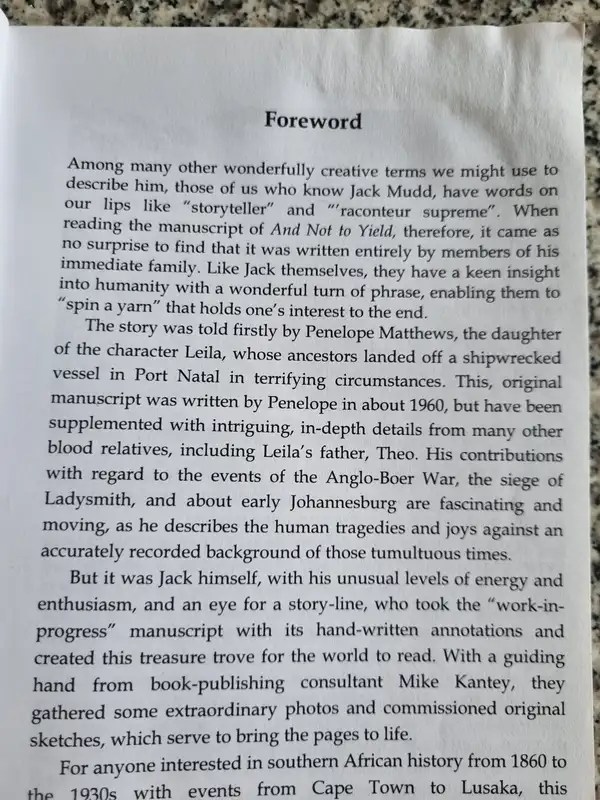
Some of the information on Josiah Benjamin Adam Bland first coming to the Cape I got from Sheila’s book And Not To Yield about Susan Bland. Susan was born in Harrismith, had a brother Willie, married a Theo Allison and lived seven miles outside Harrismith – west, I think, near Sarclet? – farming ostriches for a while.
And Not To Yield by Penelope Matthews, Watermark Press – ISBN 978-0-620-58162-2
~~oo0oo~~
Mom’s more contemporary assessment of her Bland, the Eastern Vrystaat Nuwejaarsvlei branch of the Bland Clan:
She didn’t know her dear Dad Frank’s father – he died rather young. He farmed on Nuwejaarsvlei and sent his son Frank to Michaelhouse. After high school Frank went straight back to the farm, he didn’t do any further studying or training. Mom thinks her grandfather must have had some money, as he built his wife a rather lovely house in town while still on the farm – 11 or 9 Stuart Street. After Frank lost the farm (maybe because as Annie once told me reproachfully when she saw me covered in mud one Christmas morning at 95 Stuart Street, “You know, I never once saw Frank with dirty fingernails!” I loved and admired my gran Annie but I just knew that day that what me and Sheila and Jemma had done in getting covered in mud at the Kakspruit down Hector Street past the du Plessis’ house that Christmas morning was not a bad thing. We washed off in the horse trough and made it to church that morning, I’m sure looking like spotless sweet little angels. JC and FC both would have nodded approvingly, methinks. I’m sure we got presents later that day, so there’s some proof that the Religion of Father Christmas is an understanding, forgiving one.
Frank lost the farm – too many racehorses and too few sheep? – and he and Annie, older sis Pat and Mom moved to town into Granny Bland’s home. Frank bought a filling station in Warden Street in town. When he died – early like his father before him – Annie surprised traditionally-minded people in town by carrying on with the Central Service Station. It was near the corner of Retief Street; later she moved it half a block nearer to the Town Hall, to Caskie Corner, probably the prime spot in town, on the corner of Southey Street. In time she rented spaces to the Flamingo Restaurant and Platberg Bottle Store. Between the Flamingo and the VC Cafe in Southey Street was the ramp up to her workshop, where At Truscott fixed cars for her.
Granny Bland was a Caskie. Maybe she owned Caskie Corner? I asked Mom Mary and she thinks her gran Mary Caskie Bland may well have. And that would be how Annie could move her Caltex filling station and garage to the best corner in town from half a block down Warden Street – and later how Mom Mary could move the bottle store next door to it from round the corner in Southey Street.














 Vrystaat Confessions