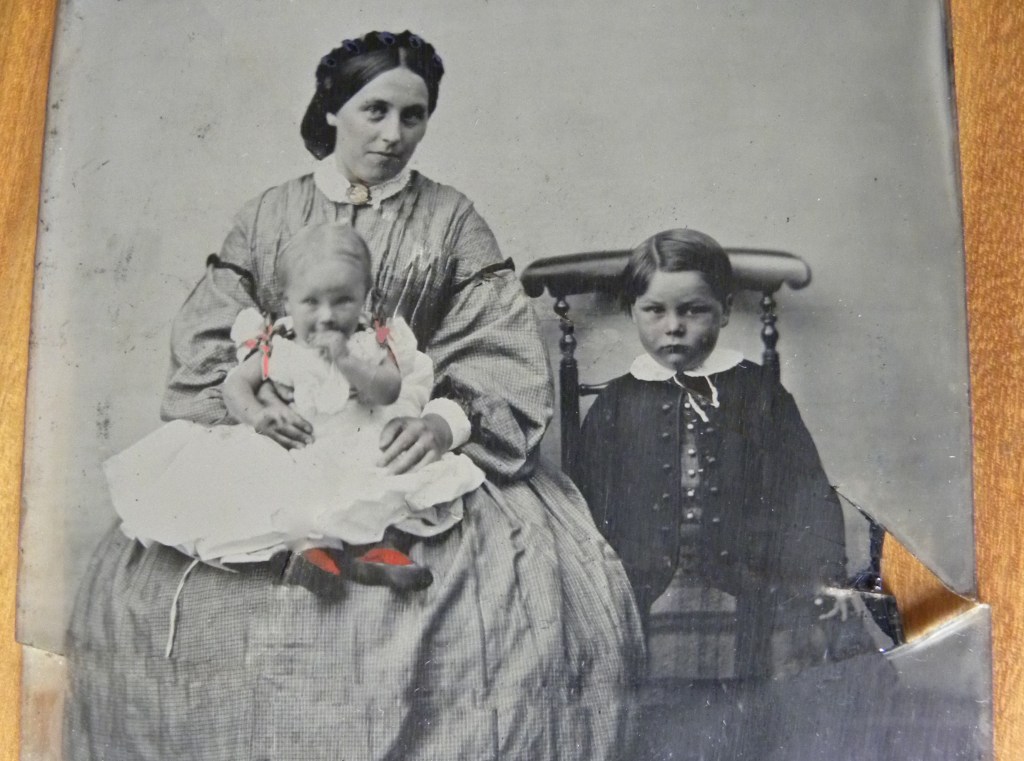
The baby in the feature picture is Mary Caskie, daughter of Alexander Caskie and Mary Craig.
Her father Alexander Caskie became mayor of Harrismith. She married JFA Bland II and gave birth to JFA Bland III.
JFA III Bland, called Frank, married Annie Watson Bain, daughter of Stewart Bain, mayor of Harrismith. So much of mayors, your worships!
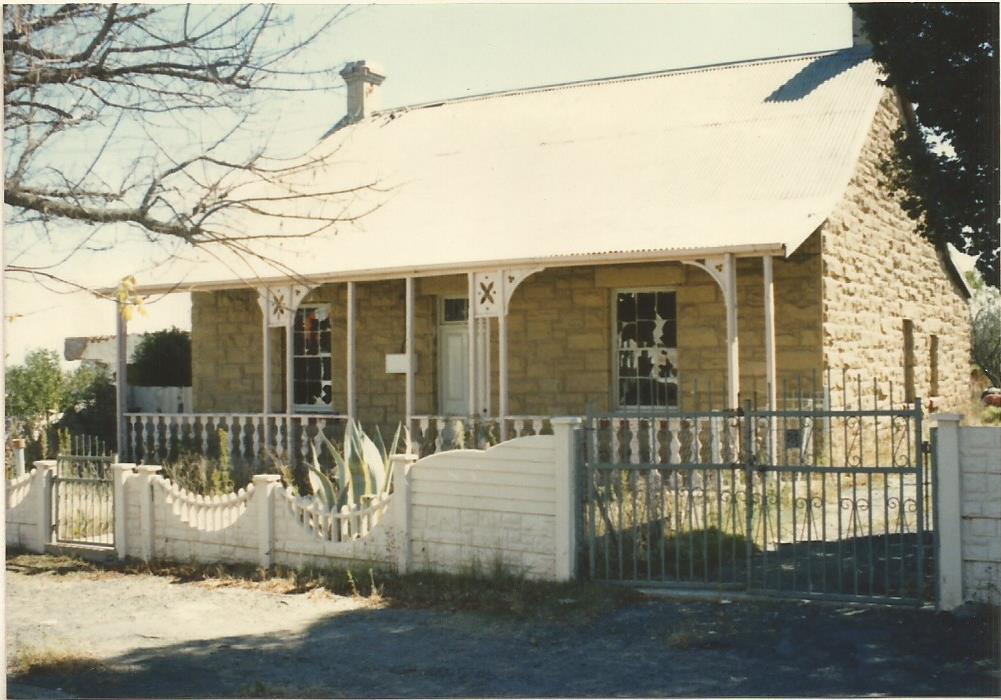
Part of the stone wall which surrounded Granny Bland’s home in Stuart Street, Harrismith; and the oak tree her grand-daughter Pat Bland Cowie planted.
– Granny Bland’s garden wall in 2017 –– Pat Bland planted this oak in her Granny Bland’s garden – 13 Stuart Street Harrismith –
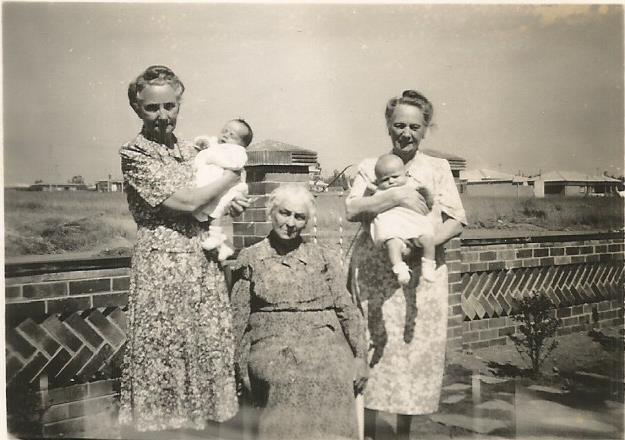
Bain Sisters Annie Bland and Jessie Bell lived with Granny Mary Bland after their husbands died. Annie’s daughter Mary and granddaughter Barbara Mary also lived there for a while. Barbara now has a daughter Linda Mary, who has a daughter Mary-Kate – So much of Marys !
– Annie Bain Bland, Granny Bland, Jessie Bain Bell –
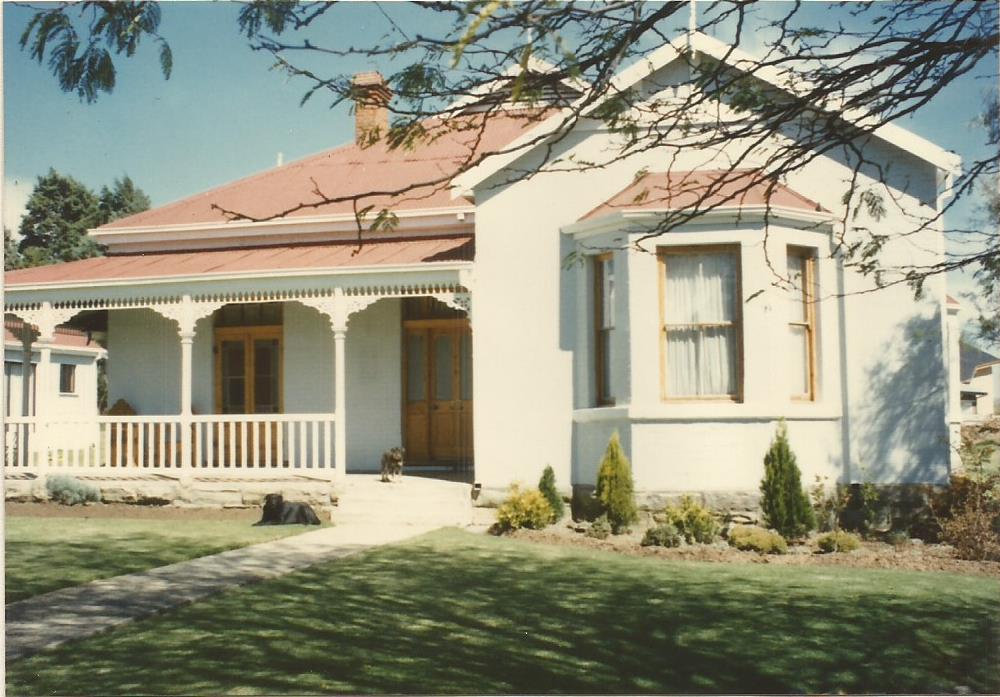
The old home now has an artist family living in it and has been beautifully restored.
Apparently this was Granny Bland’s – we grew up with it in our display cabinet
– Bacchus – the God of Wine, Music and Dance – and 95 Stuart Street –
Granny Bland had a husband and five sons. She buried her husband and three of her sons in the same grave – later she was buried there. Her only surviving son Bunty later joined them all.
Mum says Barnie Neveling had a rather caustic tongue at times – it was he who told Mum that Frank Bland’s brother – either Bobby or Bertie – had “taken his own life” – he was a pharmacist and couldn’t live with his asthma any longer. Granny Bland spoke of it as an accidental overdose. Mum didn’t think it was necessary for Barnie to tell her that.
One of Granny Bland’s other sons, Alex, who was the Royal Hotel barman, played the piano. He cut his finger and it couldn’t straighten properly, so a friend offered to pay for the op to straighten it. Dr Reitz did the op and Alex died on the operating table. One of his favourite pieces was Rachmaninoff’s Prelude – Mum couldn’t remember the key – she sang a bit of it to me – looked it up and I think it was G Minor. Mum says that whenever it was played on the radio, they had to switch the radio off because it made Granny Bland too sad.
This wooden carving was from Granny Bland’s house. We (speculated?) it was carved in Ceylon by a Boer War POW. I wonder if it was actually carved by a Bland (Daniel du Plessis Bland) – the only family member we know was a POW, captured in the Free State, sent to Cape Town, then sent to Ceylon. I’m pretty sure the reverse side was blank, but didn’t take a pic!
– very Roman and Catholic though –– Granny Bland’s hot water jug – then Mary Bland Swanepoel’s –– ‘Ceylon 1902’ – we think this is from a Bland POW – Anglo-Boer War –– Granny Mary Bland’s silver serviette ring – which her granddaughter Mary used for years – I never did understand serviettes once there were shirtsleeves and tablecloths –
~~oo0oo~~
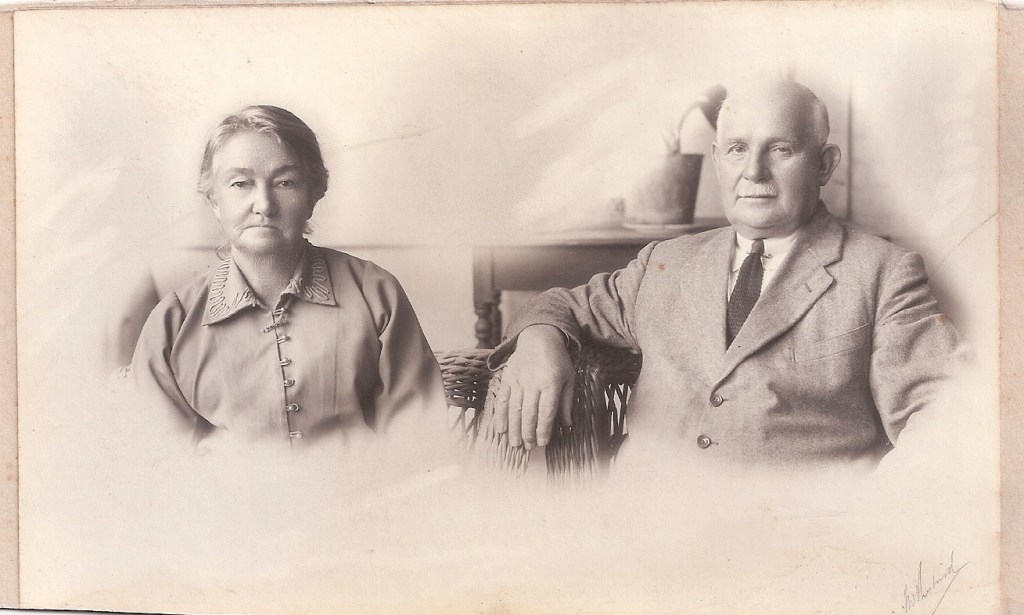
For those interested, here you can see the original broken daguerreotype Sheila had, and how I digitally ‘stitched’ or ‘healed’ it with FastStone Image Viewer (lovely program):
~~oo0oo~~
Update from Sheila on Granny Bland’s five sons:
John Francis Adam Bland III (aka Frank) our grandfather – married Annie Bain – two daughters, Pat – born 1925 died 1974 (married Bill Cowie – two daughters, Frankie and Jema) and Mary born 1928 (married Pieter Swanepoel and had 3 kids, Barbara, Koos – me – and Sheila)
Bunty Bland – married Eve Richter – one son, John (not the golfer) – he married Ethel, and they had a son James and a daughter Janine. John & Ethel divorced. John married a girl about 40 years his junior – I bumped into them in Durban once. Ethel, James and Janine all live in NZ. Janine has two kids, James has never married and has no kids – so out of Granny Bland’s five sons, there is no Bland to carry on the name. Granny Bland buried her husband and four of her five sons – only Bunty outlived her. They are all buried in the same grave in HS.
Albert (Bertie ) Bland never married, pharmacist, committed suicide
Robert Bobbie) Bland never married

Alec Bland - he had a crooked little finger, which he couldn't straighten - he played the piano and this finger bugged him, so Dr Frank Reitz offered to fix it for him - a friend sponsored the op (Mum knows who it was - I've just forgotten his name) and Alec died on the operating table.
‘Mom! Dad’s in pain,’ said Mary, out of breath. She’d run up to the Caltex garage in Warden Street. Annie drove her back and took her husband Frank Bland to Frank Reitz, his friend, rugby team-mate and physician/surgeon. Gallstones, a gallbladder op was needed, came the verdict from our highly-regarded England and Germany trained surgeon.
Mom was fifteen, ‘about to write my JC‘ – std eight, grade ten – it was 1943. Frank did the op and sent Frank home to convalesce at 9 Stuart Street, his mother Granny Bland’s home, his pain considerably eased; but he was weak, recovering slowly.
One Saturday morning he walked out to the wisteria-covered outside toilet, about twenty metres off the back veranda. Granny Bland watched him walking back, hand on hip as she always stood and wearing an apron, as she always did.
– Annie, Granny Bland, Jessie –
She spoke to him and he didn’t answer her. That was unusual. When he got to her he collapsed and she caught him in her arms before he could bang his head. They had no phone; it was a Saturday, Annie was at work, eldest daughter Pat was away nursing in Boksburg-Benoni. This time Mary didn’t run to the garage, they must have sent someone else.
‘Poor Dr Reitz,‘ says Mom, ever empathetic. She knows he would have hated it that Frank didn’t recover fully. She speculates that a bloodclot to the brain did him in. The funeral was soon after. Annie told Pat not to come down, and she and Mom stayed at home. After the funeral people came around to tea and to pay their respects. Annie didn’t do funerals.
~~oo0oo~~
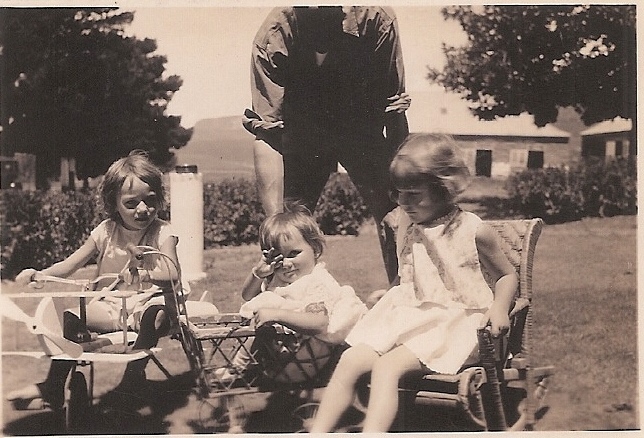
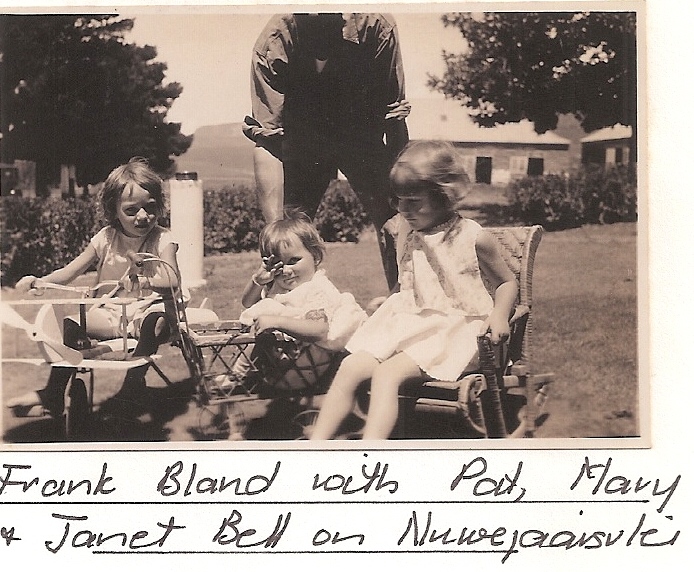
The only picture of Frank Bland that I have doesn’t quite include all of him. It does have his daughters Pat and Mary, and older niece Janet Bell.
– I’ve just noticed Pat is on an aeroplane! –
Soon after, Mom’s dear friend Dottie Farquhar’s father died. Then Jessie’s husband __ Bell died. Jessie was Annie’s older sister and they lived in Dundee down in KwaZulu Natal where he was a dentist. Maybe the only dentist? Jessie then also came to stay with Granny Bland. Three widowed ladies.
Granny Bland had lost her husband John Francis Adam Bland II, and now she’d lost her son, John Francis Adam Bland III. Only one of her five sons survived her.
~~oo0oo~~
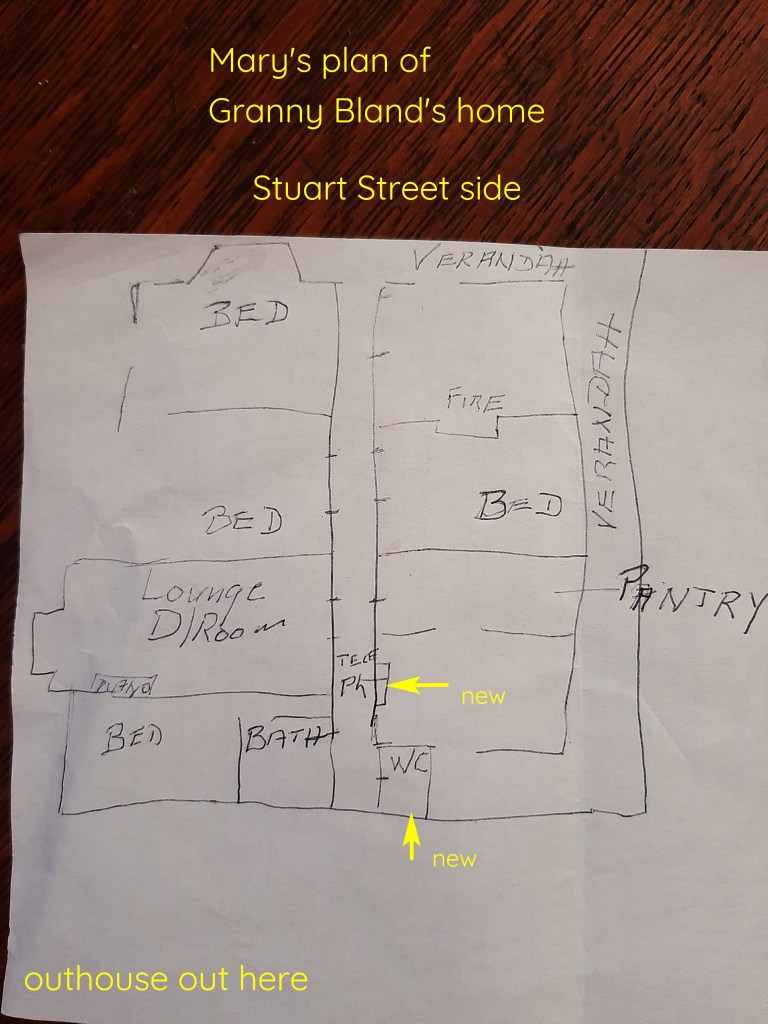
When Mary aged eighteen came home on her first leave from the Boksburg-Benoni hospital where she’d also started her nursing, a phone had been installed in the house! Where? I asked. She showed me:
… and their humour. Met up with Sam, an excellent Scotsman who came in for some glasses today. We were chatting about some of the female news anchors you see on TV. One of them, Virginia Trioli, we agreed is opinionated, superior, demanding and – from all accounts – a piece of work.
He
sums her up:
“Ya woodn’t want ta be coming hoome to her wi’ only a half week’s pay packet.”
Later, I am handing him over to Ioannis who has the job of telling him how much his new multifocal glasses are going to cost (cringe) with some light banter … Sam replies:
“Well I am a Scotsman ye know. Every penny a prisoner.”
I
packed up – had not heard that one before.
Probably
comes up a lot in the local pub.
~~oo0oo~~
Me: So right! Gotta love the Scots!! 😉 – I must remember those pearls!
My gran Annie’s father came to Harrismith straight from the freezing far north of Scotland – a fishing village called Sarclet, south of Wick – but she sadly became heeltemal Engels – the queen, the empire, and all that.
The
only Scottish she ever spoke to me was her oft-repeated tale of once
on the golf course, waiting to tee off. The oke in front of them
sliced off into the bush and said,
‘Och, its gone off in the boooshes,’ to which Annie quipped,
‘That’s betterrr than doon in the wutterrr,’ – upon which she says he spun around and said,
‘Begorrah’ (or whatever a Scotsman would say on an occasion like this), ‘Yer one of oos!’
‘Aye,’ said Annie semi-truthfully.
~~oo0oo~~
Which
takes me to her THIRD language: Afrikaans.
Of her ninety years on Earth, Annie spent about eighty seven in Harrismith in ve Vrystaat. She was born there, she went to school there (more than half her schooling) and she sold Caltex petrol to her Vrystaat customers there.
The only few years she was away from Harrismith she spent ‘down in George.’ She went to stay with her sister Jessie Bell when Jessie’s daughter Leslie died.
When she got there there was great excitement as they just knew she’d be very useful in dealing with the kleurlinjeez, who spoke their own Afrikaans and hardly any Engels.
‘Annie speaks Afrikaans, she’ll be able to speak to them and understand them,’ was the buzz.
So the first day the gardener needs instructions and Annie confidently demonstrates her skill to the assembled rooineks:
‘Tata lo potgieter and water lo flowers’ she told the poor man who must have scratched his head at the Zulu-Engels mix in which the only word approximating Off-The-Krans was ‘potgieter’ instead of ‘gieter’ for watering can.
~~o00o~~
One more Harrismith Scots joke I’ve told you before, but I’ll add it to this collection: Jock Grant arrives from Scotland full of bravado, bulldust, enterprise and vigour.
He’s a plumber – a plooomerr – but soon he’s bought the stone quarry, bought the Montrose Motel in Swinburne, bought the Shell garage, bought a big white Mk 10 Jag and smokes fat cigars.
In the pub at the golf club he removes the cigar from his lips, waves it around and tells the guys he’s started Afrikaans lessons – he’s going to learn to speak Afrikaans.
Jannie du Plessis looked concerned. ‘Jock,’ he says, ‘We think you should rather learn to speak English first.’
~~oo0oo~~
heeltemal – completely
kleurlinjeez – a vague racial classification in apartheid times – and still in use today! Not black, not white, therefore ‘coloured’; actual word: kleurlinge
rooineks – people congenitally unable to speak Afrikaans, try as they might; actually, try as they don’t
Annie was one of the seven Royal Bains in Harrismith. She was born in the cottage behind the hotel where her parents Stewart and Janet raised all the kids.
Her daughter Mary says they were Ginger, Stewart, Carrie, Jessie, Annie, Hector and Bennett. They had eight cousins who were ‘Central Bains’ – children of James Bain who owned the Central Hotel.
Mom Mary says only Hector got off his bum and got a job – he went off to become a bank manager in Ndola, Northern Rhodesia, now Zambia. The rest hung around the hotel and had fun, got married, whatever. Ginger played polo; Carrie got married and left for Australia. Stuart did a bit of work on their farm, Sarclet, not far out of town on the Jo’burg road. None of the other six felt compelled to move on, up or out. After all, the hotel had a bar, and Dad was the Lord Mayor of the metropolis and was known as The Grand Old Man of Harrismith to many townsfolk, and ‘oupa’ to his grandkids; so enjoy! Why leave!?
– His Worship the Lord Mayor of Harrismith, known to his many grandkids as ‘Oupa’ Bain –
When Annie married Frank Bland, she moved out to their farm Nuwejaarsvlei on the Witsieshoek road;
– I have no pictures of Frank! –
When the farm could no longer support the horseracing they moved in with Frank’s mother Granny Mary Bland, nee Caskie, now with two daughters, Pat and Mary. When Frank died aged only 49, Annie and the girls stayed on. They were joined there by her sister Jessie when her husband Arthur Bell died in Dundee, where he had been the dentist; Then later they were joined by now married daughter Mary, husband Pieter Swanepoel, and daughter Barbara when they arrived back from his work in the Post Office in Pietermaritzburg.
Some time after that – maybe when Granny Bland died? – Annie moved into Randolph Stiller’s Central Hotel; She then left Harrismith for the first time in her life and went to stay with sister Jessie down in George for a few years after Jessie’s daughter Leslie had died; When Jessie died, Annie returned to Harrismith and lived in John Annandale’s Grand National Hotel. John said to Mary he was battling to cope with hosting her, so Mary moved her home. Much to Pieter’s delight. NOT.
So within a month Mary moved Annie into the Eliza Liddell old age home. Two years or so later, Mom remembers a night hosting bowling club friends to dinner when the phone rang. It was Sister Hermien Beyers from the home. “Jou Ma is nie lekker nie,” she said. Mom said I’ll be right over and drove straight there, she remembers in her red car wearing a navy blue dress. She sat with her dear Mom Annie holding her hand that night and – experienced nursing sister that she was – knew when Annie breathed her last in the wee hours.
Her visitors the next morning included Mrs Woodcock and Miss Hawkins. Mom regrets not letting Miss Hawkins in to see Annie. She should have, she says. She remembers being fifteen years old and not being allowed to see her Dad lying in Granny Bland’s home and has always been glad that she snuck in when no-one was watching and saw his body on his bed and so knew it really was true.
Part of the stone wall which surrounded Granny Bland‘s home in Stuart Street, Harrismith; and the oak tree her grand-daughter Pat Bland planted.
– Granny Bland’s garden wall –– The oak that Pat planted –
Our great-grandmother ‘Granny Bland’ was a Caskie who married a Bland who begat Frank (JFA) Bland who married Annie Watson Bain. Bain Sisters Annie Bland and Jessie Bell lived there with Granny Bland after their husbands died. Her granddaughter – Annie’s daughter – Mary and great-granddaughter Barbara also lived there for a while, some sixty five years ago. Four generations in one home!
The old home now has an artist family living in it and has been beautifully restored.
Granny Bland’s house Stuart Street – renovated again
Stewart Bain was born in Wick, Scotland on 9 September 1854. He and his brother James came to South Africa in 1878, to Durban. They soon got a job building bridges for the railway line extension up the Drakensberg from Ladysmith to Harrismith. How, one wonders, did two herring fishermen convince people they could build bridges? And so they reached the metropolis of Harrismith in the Oranje Vrijstaat, an independent sovereign state at the time. Britain had recognised the independence of the Orange River Sovereignty – before that it had been the Orange River Colony ORC – after losing the first Anglo-Boer War at Majuba. The Vrijstaat officially became independent on 23 February 1854, seven months before Stewart was born, with the signing of the Orange River Convention. This history is important in view of Britain’s and many of Harrismith’s inhabitants’ conduct in the Anglo-Boer War of 1899-1902.
– sandstone bridge across the Wilge River at Swinburne –
So they built bridges. I am not sure, but I fondly imagine they built the beautiful sandstone bridge across the Wilge River at Swinburne, where I launched two separate canoe ‘expeditions’ with good friends Fluffy Crawley and Claudio Bellato many decades later.
Settling down in Harrismith after their bridge-building days, Stewart bought the Railway Hotel and changed its name to the Royal – we believe with official ‘royal” permission – while brother James built the Central Hotel uptown, on the central market square.
It appears here as if some people (!) carried on referring to the Vrijstaat as the ORC, even though it was actually the sovereign nation Oranje Vrijstaat by then!?
Stewart married Janet Burley in Community of Property in Durban, I’m not sure whether that was before moving to Harrismith or after. Janet was born in Hanley, Staffordshire, England in 1859 of David Burley and Caroline Vaughan. They had __ children between 18 __ and 18__ . . . the fifth child in 1893 being our grandma Annie. Annie married Frank Bland and had two daughters, Pat and Mom Mary, Mom Mary remembered the hotel as having two big (‘huge’ says Mom, but she was little back then!) statues at the front door: A lion rampant with a human face, fighting; an antelope rampant on the other side of the door – she thinks a hartebees or a sable or something. Both were rearing up on their hind legs.
Stewart became Mayor of the town and ‘reigned with the gold chain’ for years, becoming known – by some – as ‘The Grand Old Man of Harrismith.’ To their grandkids they were always ‘Oupa’ and ‘Ouma’ Bain;
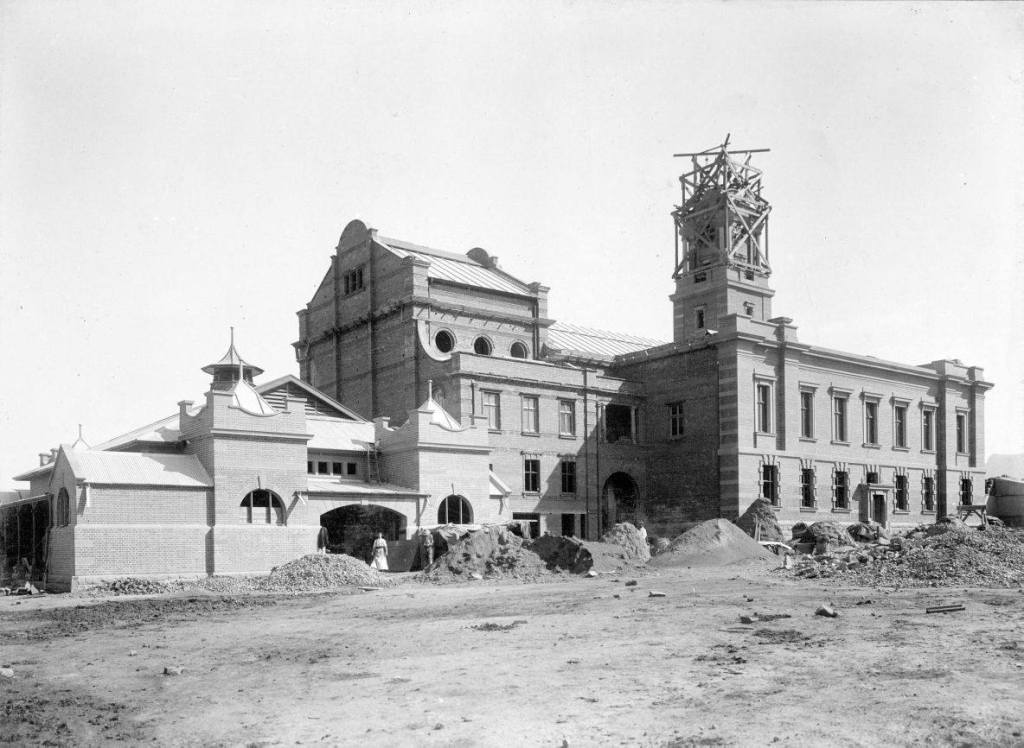
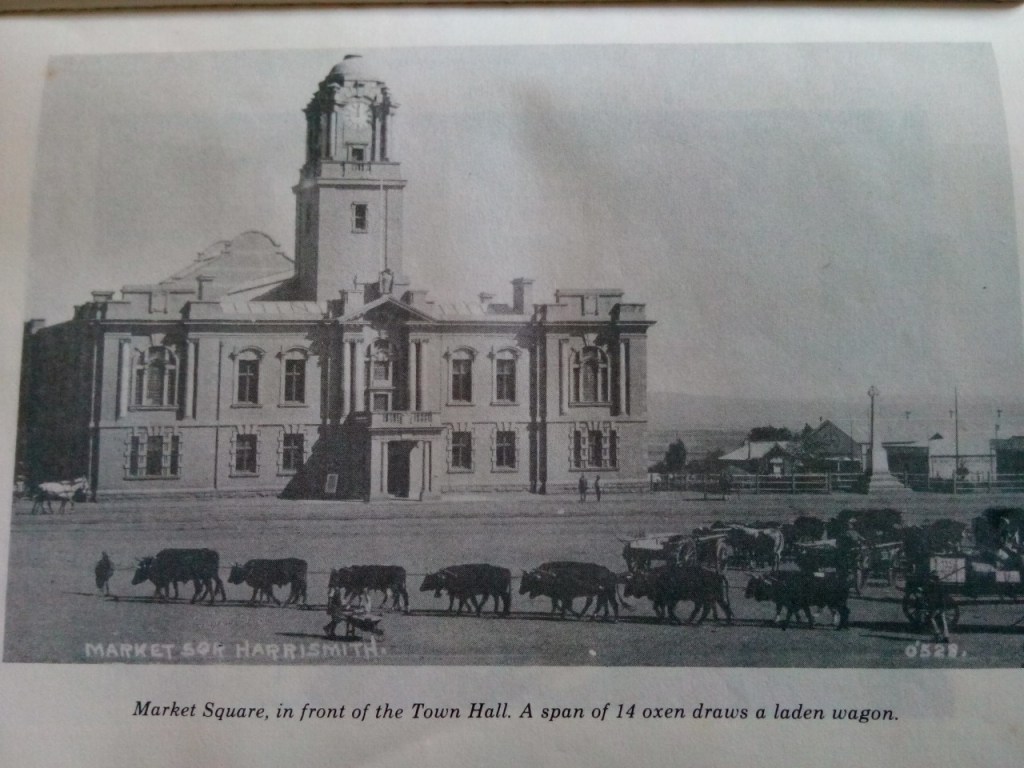
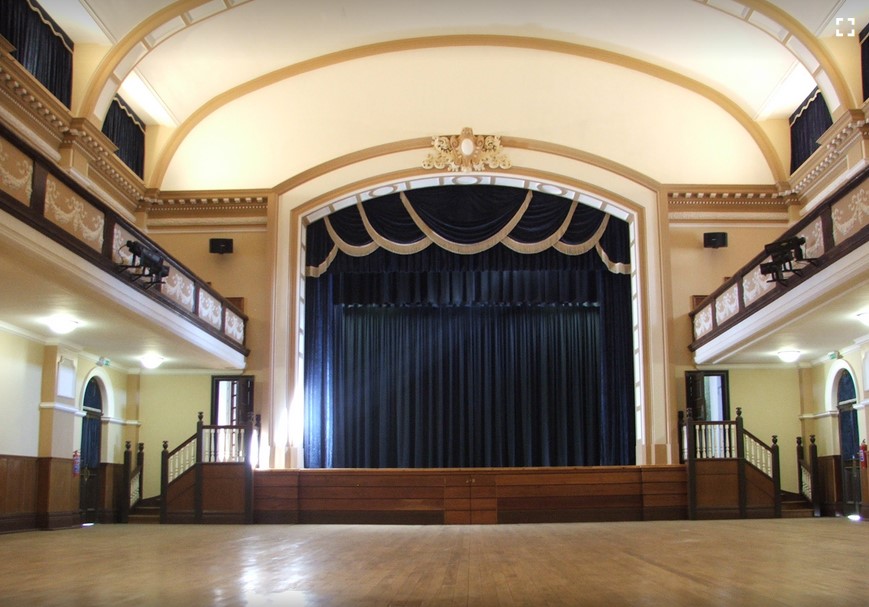
He pushed for the building of a very smart town hall. Some thought it was way too fancy – and too big – and too expensive – and called it ‘Bain’s Folly.’ Did Stewart have the tender? Was he an early tenderpreneur? Was it an inside job? *
Here’s a reason someone gave for the “need” for such a grend gebou: ‘The erection of the new Town Hall, officially opened in September 1908, was largely the result of support the troops had given for theatrical performances and concerts in the former building which had proven unsuitable.’ – (found that here: http://samilitaryhistory.org/vol082sw.html)
– building operations – lots of imported stuff –– ta da! – a palace fit for a dorp –
Here’s a lovely 3min slide show of the building of Bain’s Folly – completed in 1908 – by Hennie & Sandra Cronje of deoudehuizeyard.com and thanks to Biebie de Vos, Harrismith’s archive and treasures man. Thank goodness for all the stuff that Biebie ** has saved and rescued!
Here’s that impressive building in a dorp on the vlaktes!
– the market at the rear of the building soon after completion – 1908 –
Opskops probably had to be arranged to justify the place, and the occupying British force that remained after the illegal and unjust invasion that was the Anglo-Boer War which saw so many war crimes committed by the British, benefited hugely, their officers dancing nights away with the local lasses.
Janet died on 15 January 1924; Her daughters Jessie & Annie (who was then aged thirty) were with her when she collapsed. They summoned Dr Hoenigsburger (Hoenigsburg?), but Ouma died within minutes. The Harrismith Chronicle article reads in part: ‘Ex-Mayoress’s Death. Sudden demise of Mrs S Bain. The news which stunned the town on Tuesday morning of the painfully sudden death of Mrs Stewart Bain, evoked a feeling of deepest sympathy from all who knew the deceased lady, not only in Harrismith and the district but in places far remote.’
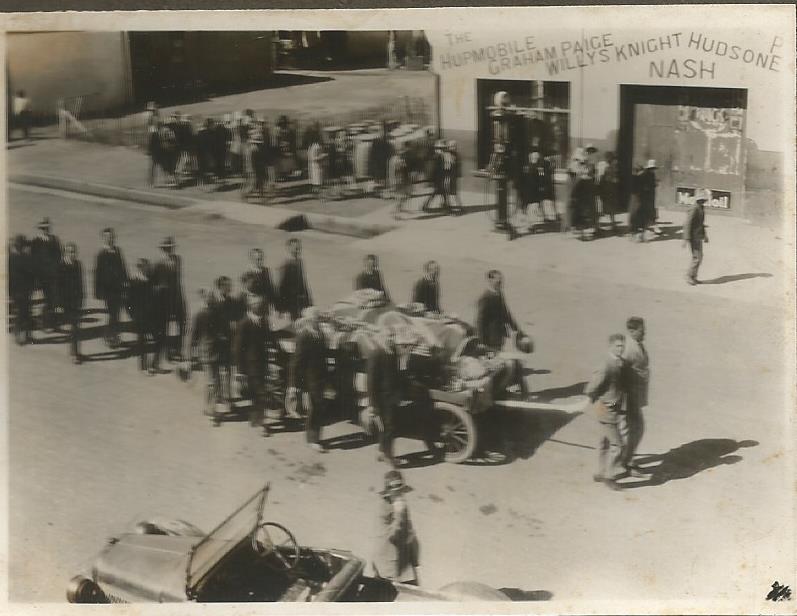
When the dust settled on the town hall, the townsfolk must have quite liked the result, as when Stewart Bain died in September 1939, the town pulled out all the stops for his funeral; These pictures were taken from the balcony of his Royal Hotel, with ‘his’ Town Hall visible in the background, and ‘his’ mountain behind that. Most Harrismithers and Harrismithians regard Platberg as ‘theirs.’
– Oupa Bain’s funeral procession – who paid?! –
At one notable local event ca.1949 in this huge hall – an Al Debbo concert! – Stewart’s grand-daughter Mary met her future husband. Maybe that was the Lord Mayor Hizzonner’s intention in building this impressive edifice all along? In 1951 they got married there. Years later Stewart’s great grandaughter Barbara also got married in ‘his’ town hall.
~~~oo0oo~~~
Found this pic of the town hall in Wick and wondered if Stewart got the idea of a bigger, better town hall for his new town from his old town?
– built in 1828 –
~~~oo0oo~~~
Snippet: Old Mrs Batty was Stewart Bain’s housekeeper at the Royal Hotel. Mum’s cheeky cousin, Janet Bell – later enhanced to Hastings-Bell – asked Mrs Batty one day, “Why do you say ‘somethink and nothink?” Back came the reply, “Cos I aren’t eddacated.” Mrs Batty lived around the corner from the Royal, on the same block, in a little house right on the pavement.
~~~oo0oo~~~
I thought I remembered that, despite every dorp in South Africa seeming to boast a ‘Royal Hotel’ – from whence ‘hier sirrie manne innie Royal Hotel’ – the Harrismith Royal Hotel was one of only two in South Africa that could officially call itself ‘Royal’. Sister Sheila, family Keeper-of-the-Archives, has hereby confirmed that I have a flawless memory. Well, something along those lines:
– evidence – or “evidence” – of our close link to royalty –
~~~oo0oo~~~
Couldn’t resist this close-up so enthusiasts can read which cars were around in 1939:
~~~oo0oo~~~
Postscript:
A young post office worker left his little 1935 Morris in that garage in the care of the owner Cathy Reynolds (nee Bain), while he went off to war, ca 1941; When he returned around 1946 it was waiting for him. He then met Mary, second daughter of Annie Bland, nee Annie Watson Bain, Stewart’s fifth child. Their first date was in the Town Hall. Best and luckiest thing that ever happened to him. They got married in the Town Hall in 1951. He was Pieter G Swanepoel, originally from Pietermaritzburg, and my Dad.
So two women, a Central Bain and a Royal Bain, ran garages in Harrismith.
* Shades of our Moses Mabida stadium in Durban for the 2010 FIFA soccer world cup – ‘Do we need such a big, fancy stadium!?’ I called it the Moses MaFIFA stadium. Call it FIFA Folly, Corruption it almost certainly is. Americans call it a boondoggle.
opskops – parties, shindigs, events, pissups, balls, dances, concerts; involve alcohol; kick up your heels
grend gebou – grand building
~~oo0oo~~
Phone call to Mom May 2025, Talk turned to the Bains, her Oupa Bain and his Royal Hotel. He was Stewart Bain, Mayor of Harrismith.
The Bain sons went to Hilton. At least two – Ginger and Stewart – came home to work for Oupa, their Dad, and play sport. Never studied after school.
Dick the Waiter
Ginger played polo and rugby. Stewart (Smollie) worked in the bar. Smollie was thin and stooped, walked with a shuffle. Getting in and out of his wife Marie’s car was a struggle. Something about his legs couldn’t bend. Like ‘welded straight.’ Arthritis maybe?
The chef’s name was Kaiser Adam. He wore a white uniform and a tall white hat. The two waiters were Dick and Shabalala – ‘smartly dressed waiters.’ Kaiser and Dick were Indians from Durban. They must have had a lonely life living in Harrismith, unable to go anywhere really. They lived on the large hotel grounds with their families. Shabalala was a local Sotho man. Dick, with his jet black hair and little moustache, was said by local wags to look just like Rhett Butler from the movie Gone With The Wind! …
Koos (me): This is weird, and maybe I’m constructing the memory from tales told at home, but I have a clear memory of sitting at a table in the dining room; being handed a paper menu; then a tiny bit of fish arriving on a large plate followed by a piece of meat and two veg on a large plate, followed by a tiny bit of pudding in a bowl. I do remember the dining room and the big fireplace and the staircase. The bar leading off the front stoep I remember from later years, once we started looking for beer after dark.
Big sis Barbara remembers visting the Royal when her good friend and cousin Glenda Taylor used to visit Smollie and Marie Bain.















 Vrystaat Confessions