Writing is like a safari.
You start from where you are,
And you meander and explore.
And you learn as you go.
- Koos
~~oo0oo~~
adapted from a quote by E. L. Doctorow, American novelist
He also said:
“If you do it right, you’re coming up out of yourself in a way that’s not entirely governable by your intellect. That’s why the most important lesson I’ve learned is that:
Planning to write is not writing. Outlining a book is not writing. Researching is not writing. Talking to people about what you’re doing, none of that is writing. Writing is writing.”
Maybe now I’ll write. Except he was talking about writing fiction, and I can’t do that. That’s why I changed his quote, which was about autobiographical writing: I think, ‘You Start From Where You Are.’ Doctorow said, ‘You Start From Nothing.’
If you’re writing an olden days blog you run out of material. Only so much happened from when I was born till I met Aitch, which is the timeline of this blog. My ** Born, Bachelorhood and Beer** blog. So there’s recycling. Here’s a post I wrote in 2016, slightly updated:
…
I used to sing beautifully. The teacher who trained the boys choir in Harrismith Laerskool said so. Well, she might have. She was Mej Cronje, and was half the reason ous would volunteer for the choir. To look at her, gorgeous redhead she was.
I was a sopraan ou and we looked down on the alt ous who, though necessary as backup, weren’t in the same league as us squeakers. One directly behind me used to bellow in my ear: ‘Dek jou hol met bouse off hollie! FaLaLaLa La LaLaLaLa.’
One day this delectable and discerning talent spotter, the red-headed Juffrou Ethel Cronje, chose me to sing a solo in the next konsert. Me, the soloist! Move over, Wessel Zietsman! You too, Mario Lanza.
Fame loomed. It was 1965 and even then, the image of a golden buzzer appeared to me in a vision. This thought crossed my mind: Harrismith’s Got Talent!
Then tragedy struck!
My balls dropped.
They handled it very diplomatically. By ignoring it and cancelling practice. The konsert didn’t materialise. Co-incidence? Surely they didn’t cancel a concert just because one boy suffered testicular descent? And by the time the next konsert came around I hadn’t been banished – just discreetly consigned to the back and asked to turn it down.
* * *
Just in case there are people who think Harrismith se Laerskool se Seunskoor was a Mickey Mouse outfit, lemme tellya: WE TOURED ZULULAND. The Vienna Boys Sausages were probably nervous.
We got into the light blue school bus and drove for hours and hours and reached Empangeni far away, where the school hall was stampvol of people who, starved of culture in deepest Zoolooland, listened in raptures as we warbled Whistle While You Work, High on your Heels is a Lonely Goat Turd, PaRumPaPumPum, Edelweiss, Dominique, Dek jou hol, and some volksliedjies which always raised a little ripple of applause as the gehoor thought “Dankie tog, we know vis one“.
If memory serves (and it does, it does, seldom am I the villain or the scapegoat in my recollections) there was a flood and the road to the coastal village of ReetShits Bye was cut off, sparing them the price of a ticket – though those were probably gratis?
Can’t remember driving back, but we must have.
After that epic and ground-breaking (sod-breaking?) tour, warbling faded in importance and rugby took over.
Mej ; Juffrou – Miss; not yet married to Kiewiet Uys; ladies had to be tagged as ‘available,’ guys not
Harrismith Laerskool – the village school
Harrismith se Laerskool se Seunskoor – very much like the famous Vienna Boys Sausages
sopraan ous – high range warblers; not castrati, but can sound like them
alt ous – the other ous
ous – us men
‘Dek Jou Hol’ – literally, cover your ass; listen to the sopraan-ous, they’re the ones. The highballs are on them.
highballs – slang for alcoholic drink in USA; ‘giraffe walked into a bar, said, ‘The Highballs Are On Me’
seunskoor – boys choir
stampvol – sold out, packed, overflowing; like – viral!
volksliedjies – folk songs; songs of ve Chosen People
gehoor – audience, fans, followers; (yes, it was 1965, but we could hear them clicking ‘like’ and ‘follow’)
dankie tog – fanks heavens, sigh of relief
ReetShits Bye – Richards Bay, then still a small fishing village on the warm Indian Ocean, the bay still a natural estuary, not yet dug out for coal ships to pollute
Pa rum pum pum pum – listen to the sopraan-ous, they’re the ones
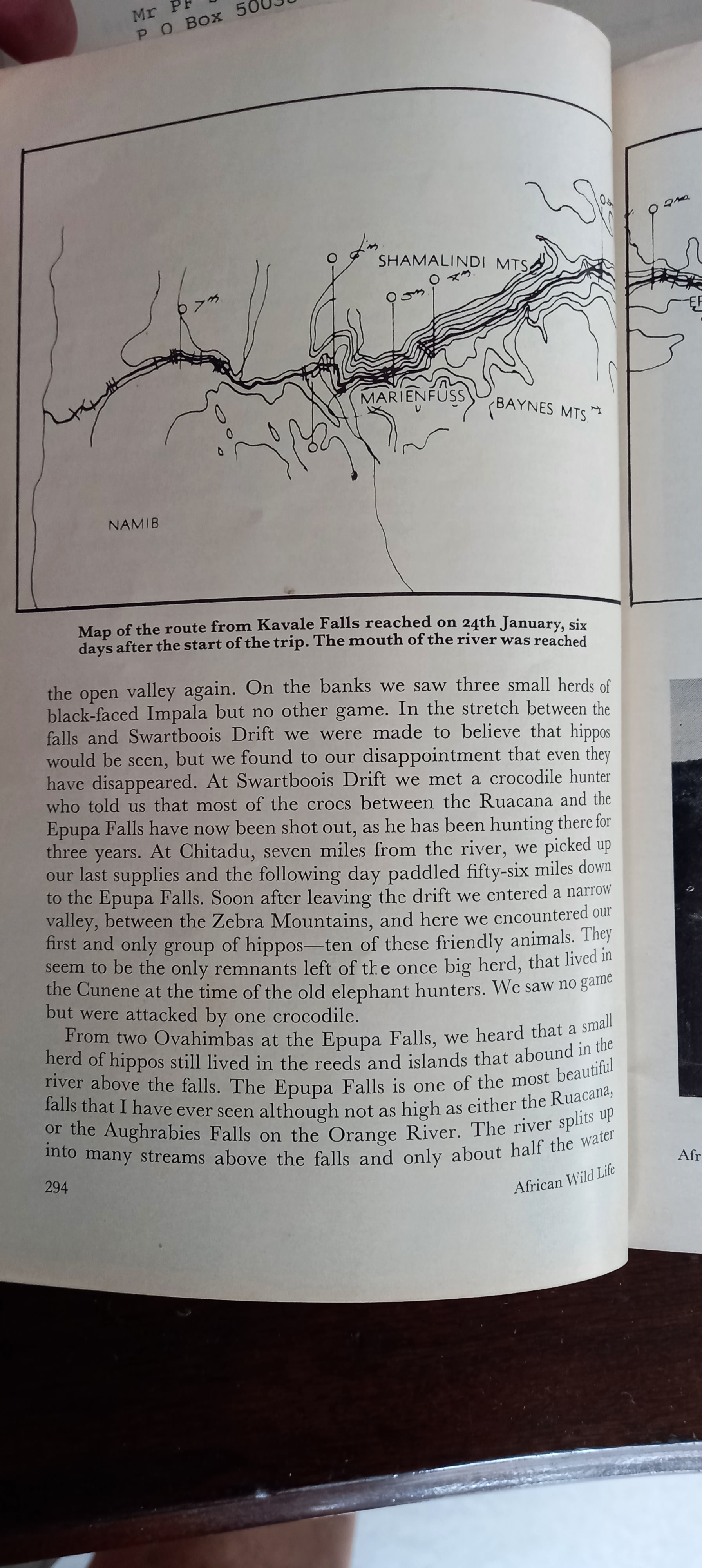
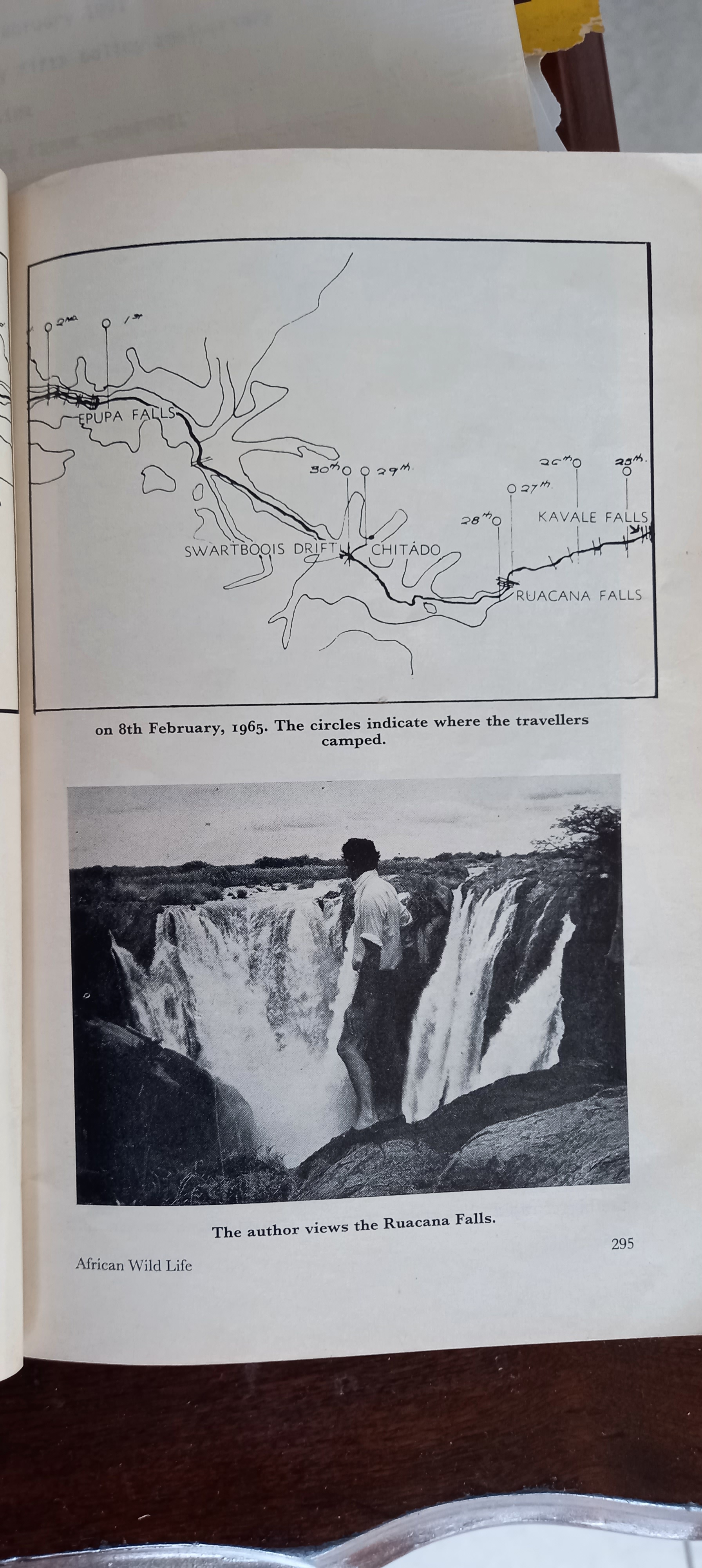
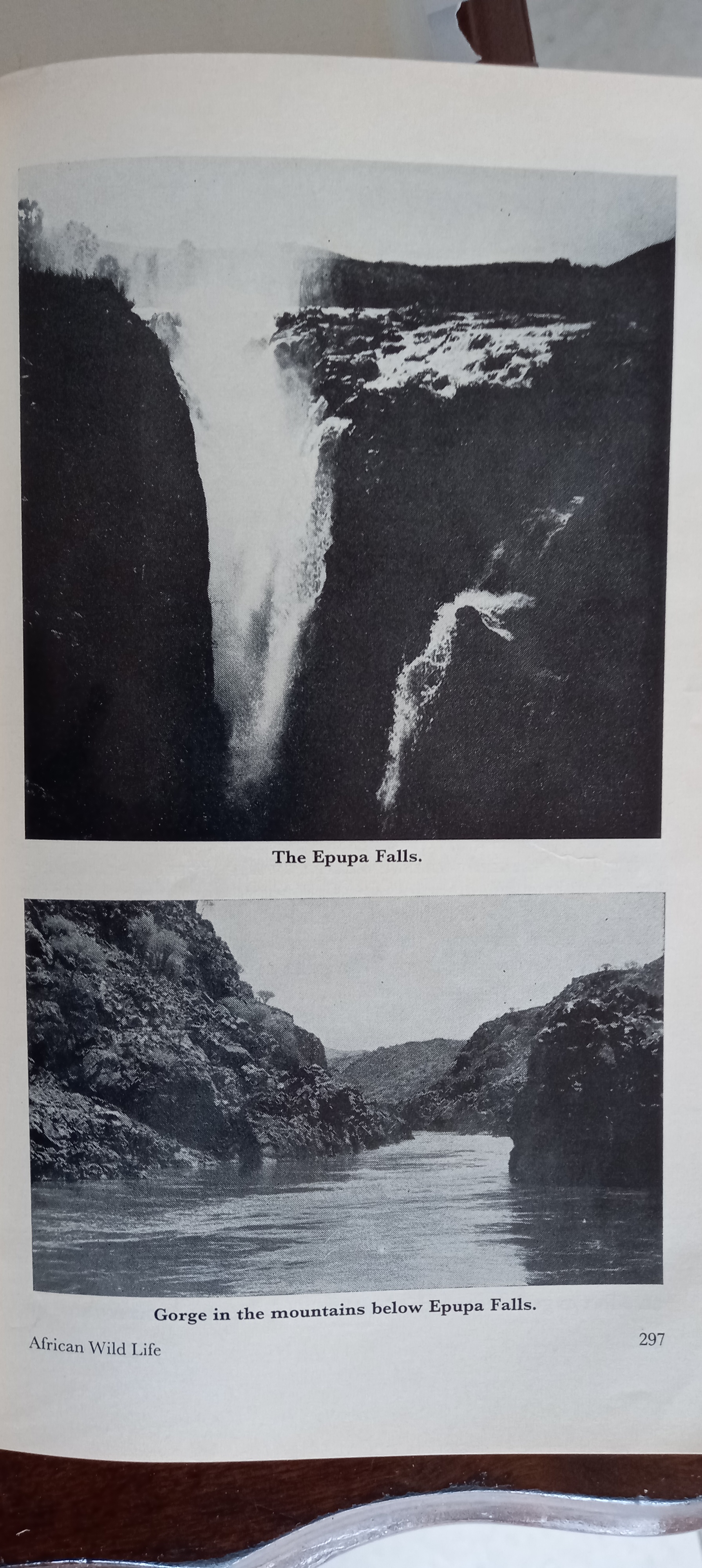
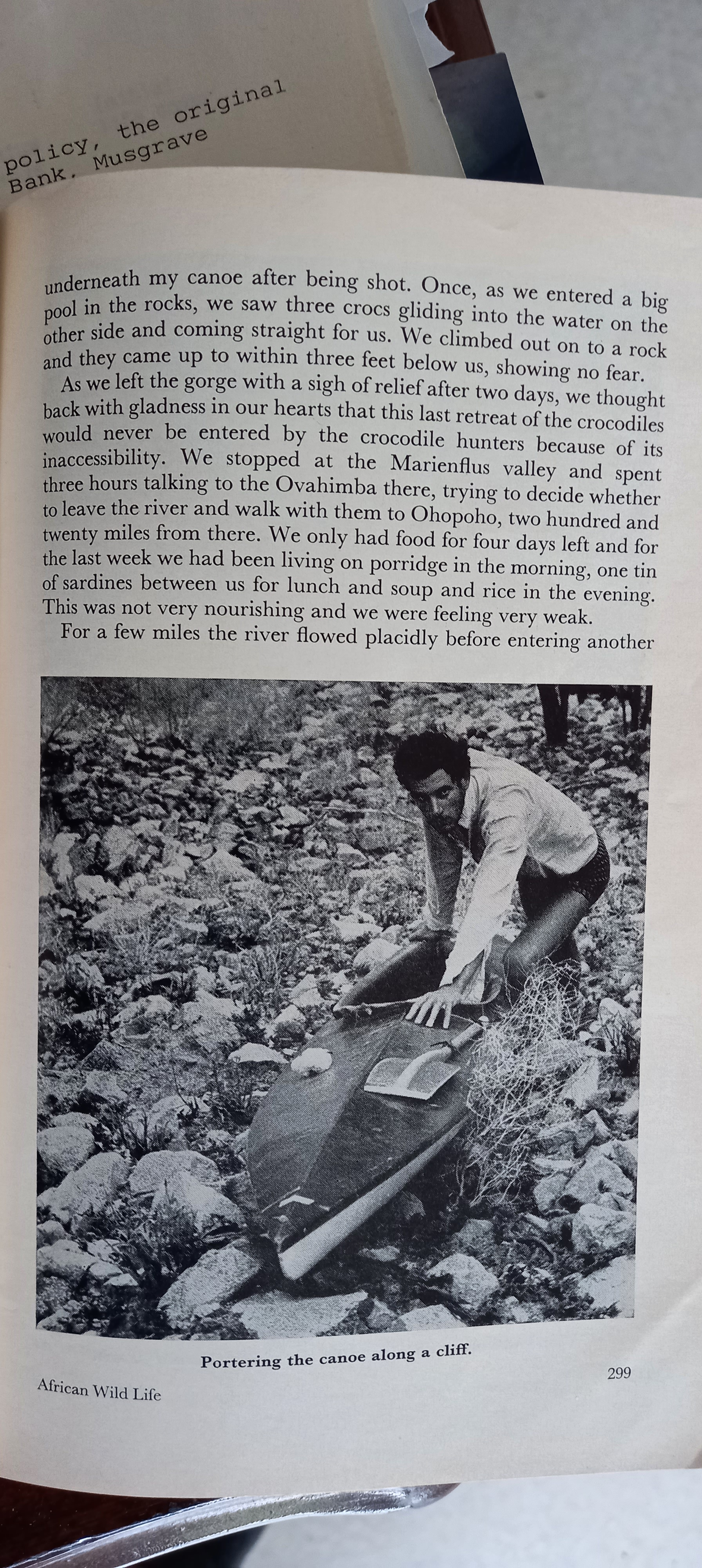
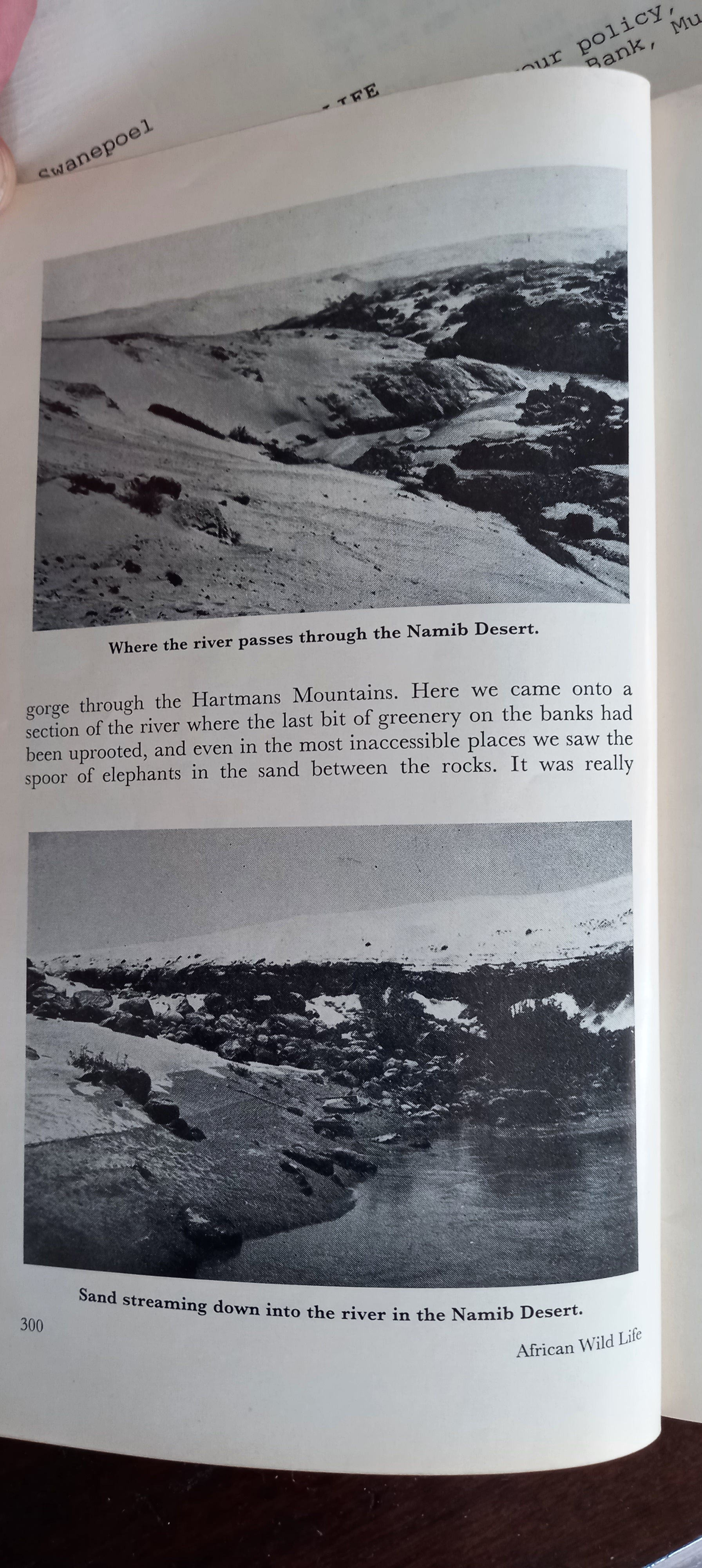
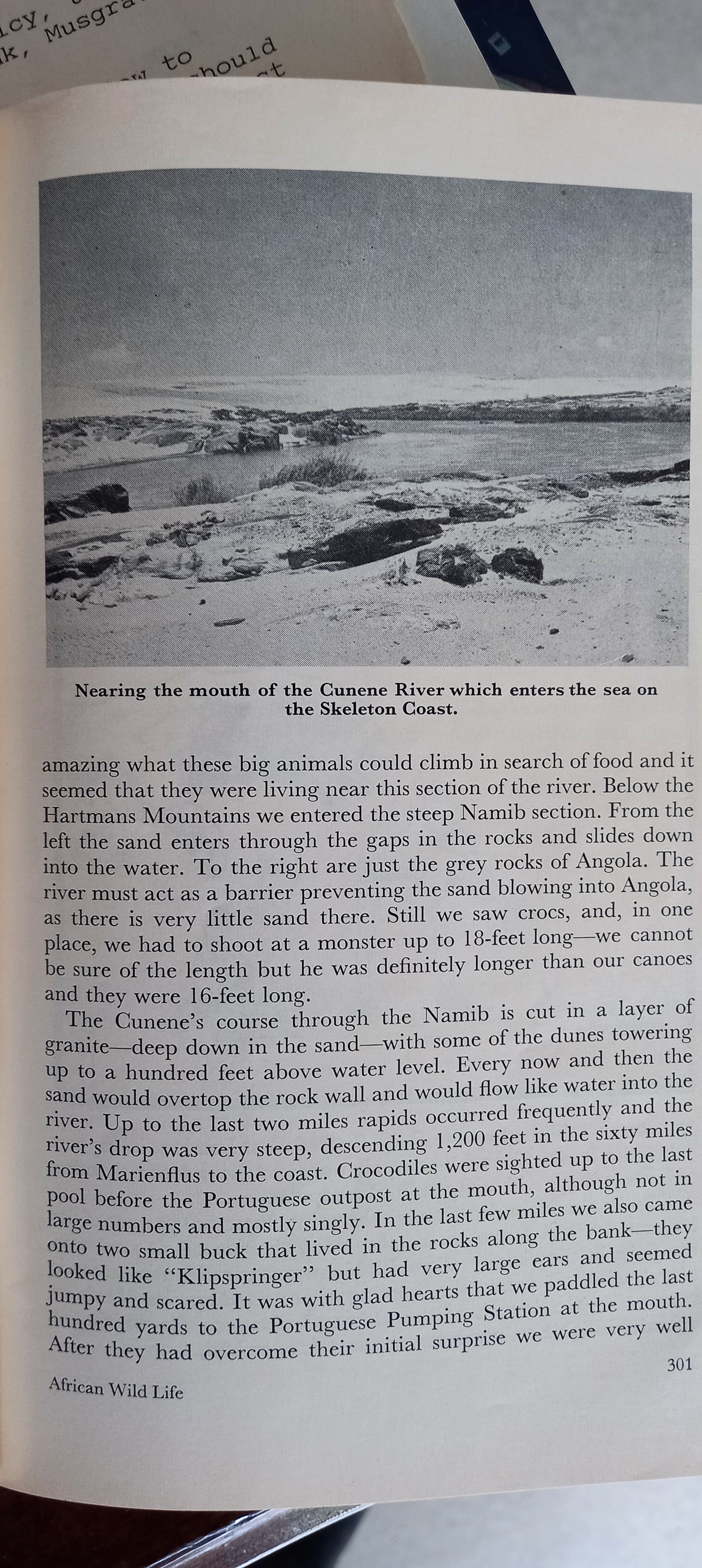
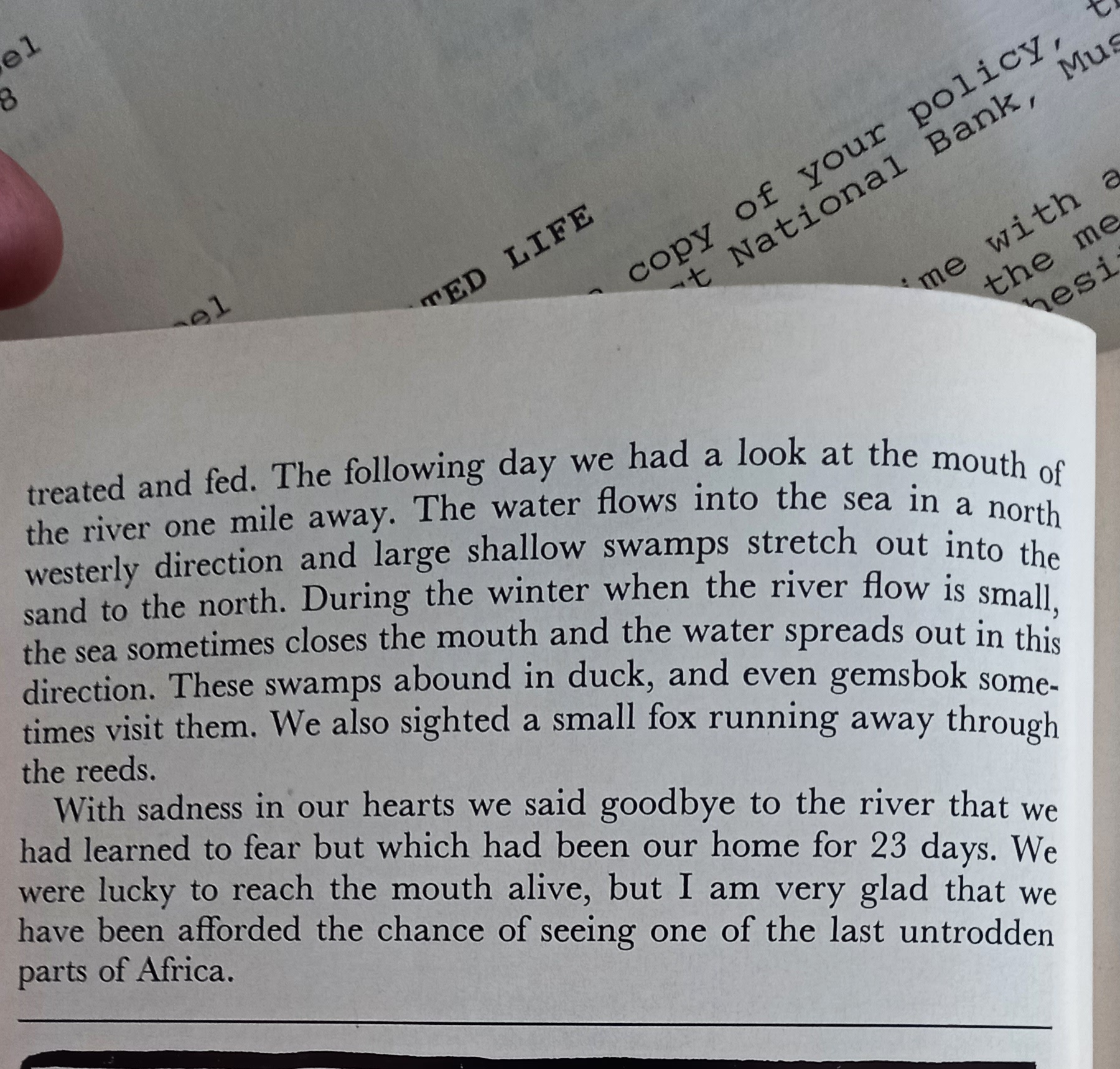
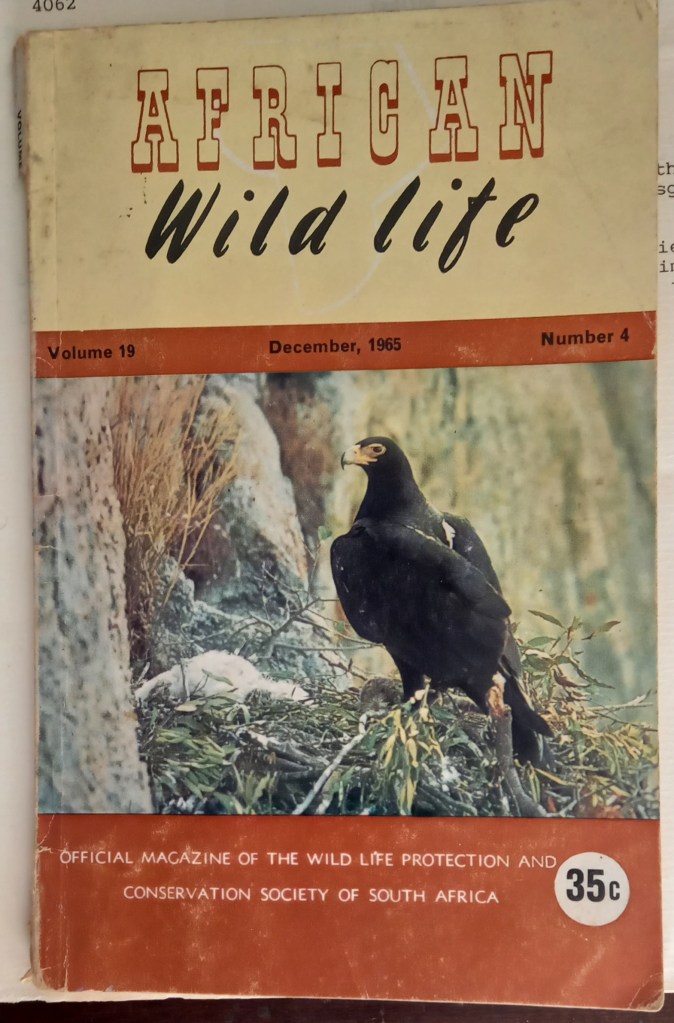
While clearing out my stuff I found a 1965 African Wildlife magazine we used to subscribe to back in Herriesmif in the olde vrystaat. It contained Willem van Riet‘s tale of his and Gordie Rowe’s trip down the Cunene river. A blind (unscouted) trip down the Cunene! Brave fellas – Shades of Powell’s first trip down the Colorado!
I took photos of the pages to quickly save it here. One small difference you’ll notice between the two rivers: No Crocs in the Colorado! and Epupa Falls actually falls, like Lava Falls doesn’t.
~~oo0oo~~
I could tell Willem wrote this account sober. His tales after a few beers are way more dramatic and epic! In fact, moerse dramatic.
In 1984 fifteen South African kayakers drifted 300 miles down a full Colorado river through the Grand Canyon, from Lee’s Ferry to where the current now dies in Lake Mead, arrested since 1936 by the massive concrete Hoover Dam. Our trip was amazing and awe-inspiring but one couldn’t really call it an ‘expedition’ as we were guided by people who had been there before; and we were catered for, and we were just fifteen of about twenty thousand people who trip the canyon each year. Admittedly few do it in kayaks, most going in inflatable rafts. Some still use dories similar to the wooden ones Powell used on the first float down the river.
THE CANYON: Recent studies support the hypothesis that the Colorado River established its course through the area about 5 to 6 million years ago, exposing around two billion years of Earth’s geological history in the various layers as you descend. Current archaeological evidence suggests that humans first reached the Grand Canyon area as far back as 10,500 years ago, and inhabited the area around 4,000 years ago.
In 1540, led by local Hopi guides, Spanish Captain Lopez de Cardenas reached the rim of the Grand Canyon on foot; In 1776 a Spanish priest was taken by a Havasupai trader to his place in Havasupai Canyon, again on foot.
In 1857 a party ventured about 300 miles up the river from the mouth in the Sea of Cortes in a 54ft steamboat to Black Canyon, downstream of the present Lake Mead.
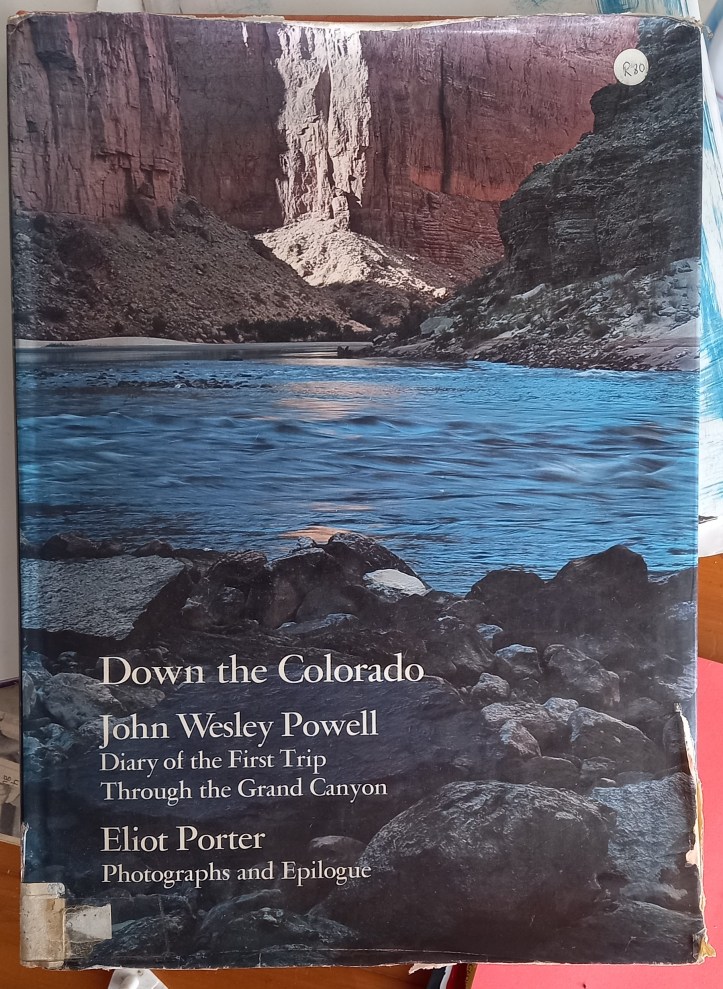
THE FIRST DOWN-RIVER TRIP: The first known trips that floated downstream through the whole of the deep canyonlands were in 1869 and 1871, led by an adventurous one-armed Major with a scientific bent, John Wesley Powell. He kept a diary of his first trip, but no pictures; I have the diary in a beautiful book published a hundred years later:
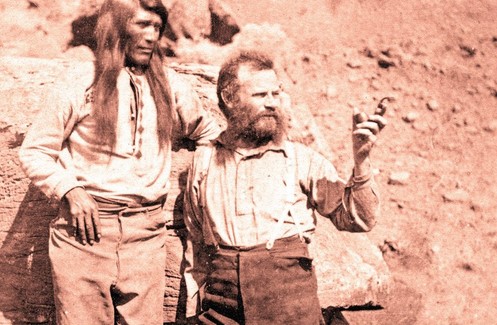
Powell led a party of ten men in four wooden boats 1000 miles down the Green river, into the Colorado river and through both Glen Canyon and the Grand Canyon to below where we finished. As almost always on any continent, local guides – in this case Native Americans – helped them. Most European ‘explorers’ were guided to and through places, local people showing them their countries, more than lone intrepid explorers.
– Map Grand Canyon Powell 1869 – One Trip, One Expedition! –– their boats for the 1871 expedition – similar, but an improved design on those used in 1869 –
This was different. It’s very unlikely any humans had actually floated down this whole course – especially the wildwater sections. Read much more about this amazing 1000 mile river trip – all the way through these amazing river canyons – on the Green River, and then on the Colorado River, through beautiful Glen Canyon (now drowned under Lake Powell) and the awe-inspiring Grand Canyon.
The expedition had little communication with the world outside the valley, leading to rumours they were lost; many reports on the expedition while they were gone were written, mostly made-up to sell newspapers, and some including obituaries. Powell apparently enjoyed reading his own obituary on his way to New York after the trip ended! What actually happened on the three-month trip is in doubt. New diaries have surfaced that show there were probably tensions leading to people abandoning the journey. Powell’s hero status led to most historians glossing over any doubts. Amazing that one hundred and fifty years later we can still uncover new diaries, new information, new sources – including interviews with descendants of other trip members – that add to our knowledge.
NEW BOOK: John Wesley Powell’s 1869 expedition down the Green and Colorado Rivers and through the Grand Canyon continues to be one of the most celebrated adventures in American history, ranking with the Lewis and Clark expedition and the Apollo landings on the moon.
For nearly twenty years author Don Lago has researched the Powell expedition from new angles, traveled to thirteen states, and looked into archives and other sources no one else has searched. He has come up with many important new documents that change and expand our basic understanding of the expedition by looking into Powell’s crew members, some of whom have been almost entirely ignored by Powell historians. Historians tended to assume that Powell’s was the whole story and that his crew members were irrelevant. More seriously, because several crew members made critical comments about Powell and his leadership, historians who admired Powell were eager to ignore and discredit them. Lago offers a feast of new and important material about the river trip, and it will significantly rewrite the story of Powell’s famous expedition. His book is not only a major work on the Powell expedition, but on the history of American exploration of the West.
~~~oo0oo~~~
TAKE A TRIP: Here’s a 23 minute video of a six-day raft trip down the canyon on quite a low river. Turn the sound down – it’s just muzak. The footage gives a good glimpse of the magnificent scenery.
Here’s a short report on an 18-day raft trip through the canyon – interesting how the popularity of this adventure means one has to enter a lottery to get allocated your own private trip down the canyon – getting your turn to go may take many years! Apply now!
Or join one of the sixteen commercial outfits who’ll take you down the river in their craft, as we did. They’ll guide you and feed you and tell you about ‘their’ canyon.
~~~oo0oo~~~
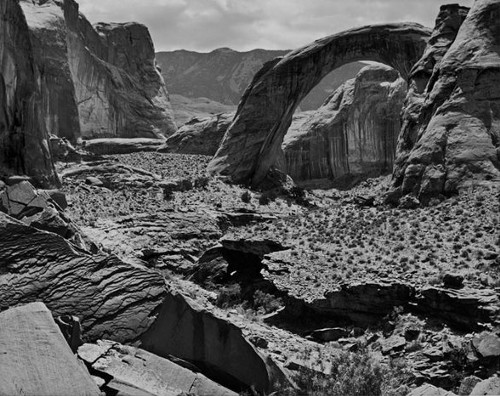
– Rainbow Arch in Glen Canyon – now underwater –
Above the Grand Canyon the Powell party passed through beautiful Glen Canyon. The feature pic above this post and this one here show Glen Canyon, which is now gone – drowned beneath the waters of Lake Powell. An environmental desecration committed so crops could be grown where they shouldn’t be grown, so golf courses could be made where they shouldn’t be, and so lawns could be watered and mowed where there should not be lawns. NO MORE DAMS! Hydro power is very seldom green power.
~~oo0oo~~
Great news in 2021 that four dams on the Klamath river in Oregon and California are going to be removed, allowing the river to flow free again. And slowly – very slowly – the river and its valleys will hopefully recover.
Free Glen Canyon
The Glen Canyon dam should be removed, Lake Powell should go, Glen Canyon should be revealed again in all its splendour. Let’s never give up that fight. Crazy to think Homo sapiens 2021 model feels he “cannot” halve the size of his lawn – which he seldom walks on, and then usually just to burn fossil fuel over, to mow it under the critical eye of his neighbour!) When by simply doing so, he could save a river and its valley! And save money for himself.
Update 2025: The Klamath runs free! It happened! The first descent of the full length of the Klamath was succesfully paddled!
Mom tells me that after I had me tonsils out at about age three, she took me to Kindrochart for some gentle recovery for the poor little tender chap. I clung to her skirts and wouldn’t go to anyone, I wouldn’t even look at, nor speak to, our hosts Mrs Shannon and Betty Stephens. But once, when lovely, friendly Betty – a huge fan of us kids, we called her Betty Brooks – offered to carry me up a hill after I’d run out of poof, I relented / condescended to use her as a pack horse. Mom was leading us up the hill to show me their farm Nuwejaarsvlei, where she was born and lived till she was eight.
Mom also tells that I told on Ma Shannon! I hastened into the house one day to find Mom, ‘Ma! Shannon’s got none clothes on!’ Mom hastened out to see this sight and there was Ma Shannon in full petticoat and underwear, shoes and socks, looking quite respectable, thank you. She was preparing to have the Milraes for tea, and wanted to pull on her dress at the last minute.
Apparently Ma Shannon tried hard to get me to call her Nana, but I’d not call her anything but ‘Shannon.’
On the way back to the big smoke, driving on the gravel road towards Platberg, Mom was telling Betty about a book she was enjoying about a Belgian nun – The Nun’s Story – I had the book in my hands on the back seat and it seems I was disappointed in it, as I piped up, ‘. . and its got none pictures.’
~~oo0oo~~
Pic: Kerkenberg – the old Binghamsberg – from Kindrochart side – from mapio.net
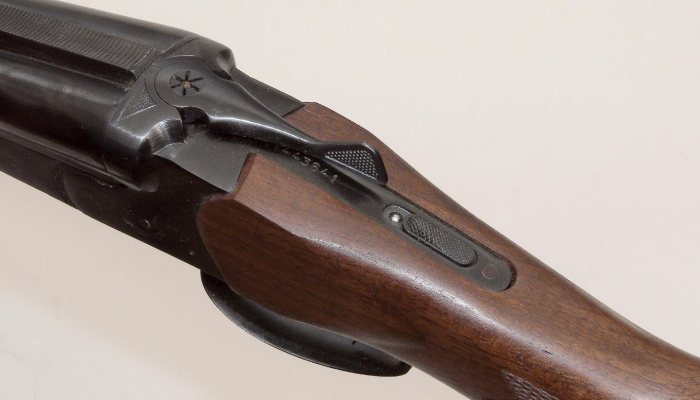
Dad: I bought a Russian 12-gauge shotgun, a Baikal. I paid R139. I got it from Musgrave in Bloemfontein.
Internet comments and reviews are mostly very complimentary about Baikal down-to-earthness, ruggedness and value: The first Baikal shotguns years ago were side-by-sides; They were not very sophisticated; They are more reliable than their price would suggest; You can depend on them; If you’re on a modest budget then a Baikal is a good first buy; etc.
– I used to occasionally use this implement to miss guineafowlca.1977 –– guineafowl shoot on Rust outside Warden ca.1977 – I’m 2nd left – none of those birds were harmed by me in the shooting of this movie –
~~oo0oo~~
Dad: When Harry Mandy went to Japan I asked him to get me a Canon camera and telephoto lens. He got me a FT QL camera bodywith standard 50mm lens, a close-up lens and a 200mm telephoto lens for R140.
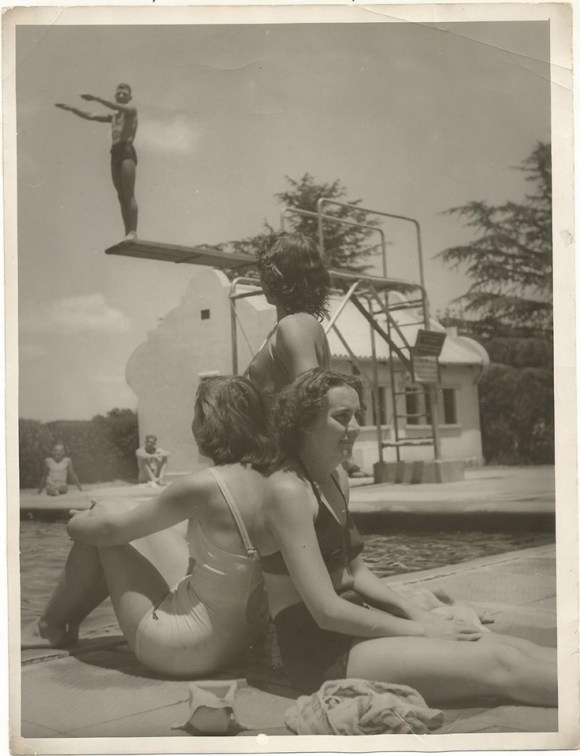
Mom says they loved swimming. All the boys were at the baths – the Harrismith Municipal Swimming Baths about a kilometre away up the hill past the Town Hall.
Some days they’d get ready to go – cozzies and towels over their arms, but Granny Bland would be standing on the stoep with her hand on her hip, looking at the mist on the eastern end of Platberg and announce firmly, ‘No, you can NOT go swimming. You can put that in your pipe and smoke it!’
Listen, if you want to make it to supper you must come quickly but you’ll have to bring lots of money.
His nephew Jack who’s ‘a helluva clever bugger, Jack, he’s on a lot of boards and chairman of this, chairman of that. Wonderful bugger, Jack. He still weighs 78kg same as he weighed when he was a fighter jet pilot’ (Jack must be 78yrs old in the shade, so 1kg per annum).
He brought me some smoked snoek and chips, KILOGRAMS OF IT!
..
He’s on to food – a favourite subject.
..
Oupa worked on the railways.
Working men took a scoff box to work
Guys would take sarmies, meat, tea, etc.
Oupa had a billy can. A blue billy can, the lid was your cup. You know what he used to take in to work for his lunch?
No. What, Dad?
Sugar water
At night he’d drink a big mug of milk and eat bread.
..
Ouma would cook in the kitchen and dish up in the kitchen.
Six plates. Her and Oupa and four big kids.
You got your plate of food. Don’t ask for more, there was no more. But we didn’t need more, it was a great big plate; we never went hungry. We had to do without some stuff, like new clothes or shoes, but we never went hungry. There was always a big sack of peanuts in their shells on the floor of the pantry and you could go in and grab a handful.
..
Oupa and Ouma in PMB
Chickens and muscovy ducks in the backyard.
Ouma made a little pond in the ‘sump,’ the lowest point in the yard in the far corner. She would fill it up with water, about one brick deep, then throw mielies in the water. The ducks like feeding underwater. They bred prolifically and there were always plenty. A big fat roast duck was a huge treat. Only trouble is there was duck shit all over the yard.
Chickens they had to slag. The kids. One would hold the beak and feet, stretch it and one would chop off the head with an axe.
A big game was to then stand it up and let it go and watch it run around, headless.
‘One day Oupa caught us doing it and beat the shit out of us.’
A re-post cos Mom told me some news today (see right at the end):
My first recollections are of life on the plot outside Harrismith, playing with Enoch and Casaya, childhood companions, kids of Lena and Bennett Mazibuko, who looked after us as Mom and Dad worked in town. The plot was in the shadow of Platberg, and was called Birdhaven, as Dad kept big aviaries. I remember Lena as kind and loving – and strict!
I lived there from when I was carried home from the maternity home till when I was about five years old, when we moved into town.
– those pigeon aviaries – and me –
I remember suddenly “knowing” it was lunchtime and looking up at the dirt road above the farmyard that led to town. Sure enough, right about then a cloud of dust would appear and Mom and Dad would arrive for their lunch and siesta, having locked up the Platberg bottle store at 1pm sharp. I could see them coming along the road and then sweeping down the long driveway to park near the rondavel at the back near the kitchen door. They would eat lunch, have a short lie-down and leave in time to re-open at 2pm. I now know the trip was exactly 3km door-to-door, thanks to google maps.
Every day I “just knew” they were coming. I wonder if I actually heard their approach and then “knew”? Or was it an inner clock? Back then they would buzz around in Mom’s Ford Prefect or Dad’s beige Morris Isis. Here’s an old 8mm movie of the old green and black Ford Prefect on the Birdhaven circular driveway – four seconds of action – (most likely older sister Barbara waving out the window):
1. Ruins of our house; 2. Dougie Wright, Gould & Ruth Dominy’s place; 3. Jack Levick’s house; 4. The meandering Kak Spruit. None of those houses on the left were there back then.
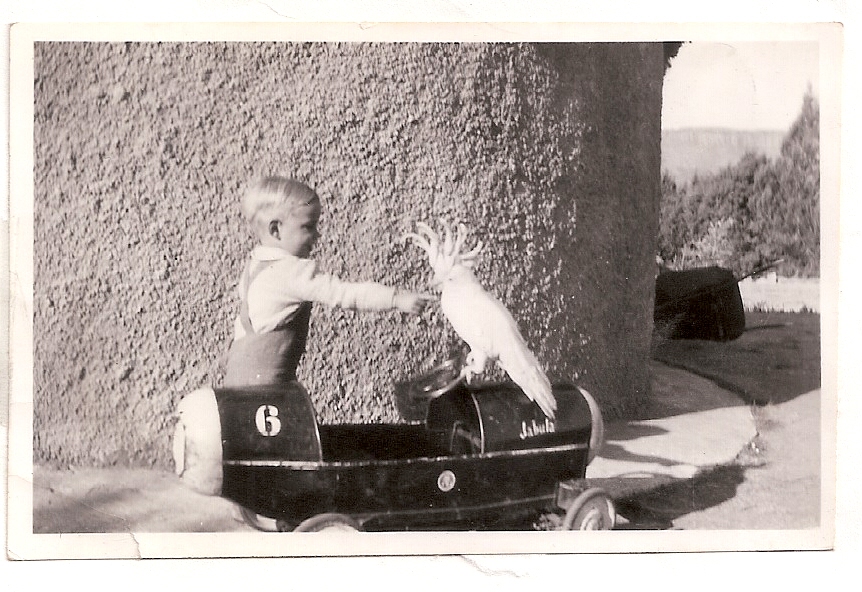
Our nearest neighbour was Jack Levick and he had a pet crow that mimic’d a few words. We had a white Sulphur-crested Cockatoo Jacko that didn’t, and an African Grey parrot Cocky who could mimic a bit more. Helmeted Guineafowl would visit by day, and a tame-ish Spotted Eagle Owl would visit at night.
Our next neighbours, nearer to the mountain, were Ruth and Gould Dominy and Ruth’s son Dougie Wright on Glen Khyber. They were about 500m further down the road towards the mountain, across the Kak Spruit over a little bridge. Doug’s cottage was on the left next to the spruit that came down from Khyber Pass and flowed into the bigger spruit; The big house with its sunny glassed-in stoep was a bit further on the right. Ruth and a flock of small dogs would serve Gould his tea in a teacup the size of a big deep soup bowl. I wonder how many sugars he added?
– Me and Jacko the sulphur-crested cockatoo outside the rondavel –
Judas Thabete lived on the property and looked after the garden. I remember him as old, small and bearded. He lived in a hovel of a hut across a donga and a small ploughed field to the west of our house. He had some sort of cart – animal-drawn? self-drawn? Self-drawn, I think.
– Me and Sheila on the front lawn – 1956 –
Other things I remember are driving out and seeing white storks in the dead bluegum trees outside the gate – those and the eagle owl being the first wild birds I ‘spotted’ in my still-ongoing birding life; The storks brought babies we were told – can’t level with kids. Hope parents are more straight-up with their kids these days. I remember the snake outside the kitchen door;
– Scene of the rinkhals leap – this taken thirty years later, in 1990 –
I don’t remember but have been told, that my mate Donald Coleman, two years older, would walk the kilometre from his home on the edge of town to Birdhaven to visit me. Apparently his Mom Jean would phone my Mom Mary on the party line and ask, “Do you have a little person out there?” if she couldn’t find him. He was a discoverer and a wanderer and a thinker, my mate Donald.
– fun on the lawn – and Bruno the Little Switzerland doberman –
Bruno the doberman came from Little Switzerland on Oliviershoek pass down the Drakensberg into Natal. Leo and Heather Hilcovitz owned and ran it – “very well” according to Dad. Leo came into town once with a few pups in the back of his bakkie. Dobermans. Dad said I Want One! and gave Leo a pocket of potatoes in exchange for our Bruno. He lived to good age and died at 95 Stuart Street after we’d moved to town.
– 1990 – Mom & Dad sit on the ruins of the stoep –
~~~oo0oo~~~
rondavel – circular building with a conical roof, often thatched;
spruit – stream; kak spruit: shit stream; maybe it was used as a sewer downstream in town in earlier days?
stoep – veranda
donga – dry, eroded watercourse; gulch, arroyo; scene of much play in our youth;
Our Ford Prefect was somewhere between a 1938 and a 1948 – the ‘sit up and beg’ look, before sedans went flat. They were powered by a 4 cylinder engine displacing 1172cc, producing 30 hp. The engine had no water pump or oil filter. Drive was through a 3-speed gearbox, synchromesh in 2nd and 3rd. Top speed nearly 60mph. Maybe with a bit of Downhill Assist?
~~oo0oo~~
Today – 25 Sept 2021 – Mom (who turned 93 a week ago today) tells me Kathy Schoeman bought the old Ford Prefect from her and one day they drove to work to see it lying on its roof in the main street outside the town hall! Kathy had rolled it in the most prominent place possible!
18 September 1928 plus ninety three years gets you to today. So if you were born then you’ve had around 33 968 sleeps.
Quite something, Mom! Happy birthday, we feel very lucky to have you with us and be able to listen to your stories, and hear your memories and enjoy your piano playing. Love you lots!
I listen to the Chopin and Mozart etc you used to play and I say to the expert pianists playing: Huh! You shoulda heard my Mom!
She recently said she thinks the best piece she played was the duet with Una Elphick in the town hall of Beethoven’s 5th symphony. ‘You know the one,’ Mom says to me: ‘Da Da Da DUM . . Da Da Da DUM . .’
They practiced separately and when they got together they couldn’t ‘gel,’ it wasn’t working. They tried using a metronome, tick tick you know. No good. Then Una said I’ll count, one two etc. That worked, they clicked and . . ‘best piece we ever played! ‘














 Vrystaat Confessions