Whaddabout?

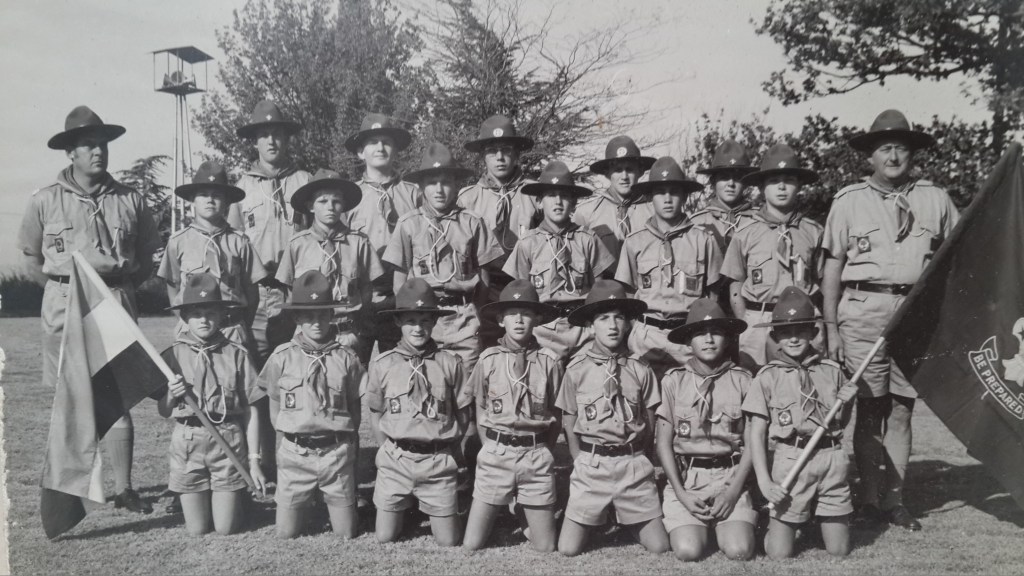
  • Boy Scouts – 1st Harrismith

    Boy Scouts – 1st Harrismith

    Let’s paint the ’42nd’ up on 42nd Hill! Yeah! We’ll shoot up there with some whitewash and paint it quickly.

    We Boy Scouts needed a PROJECT – a ‘good deed’ – and this seemed a good one. Everyone would notice and be impressed by the shiny white freshly-whitewashed stones spelling out ’42nd’ compared to the dull look it had as the whitewash faded.

    This was ca.1970 and the symbol had been put up there by some Pommies of something called 42nd whatever, way back just after the Anglo-Boer War – about seventy years earlier. We would get it looking like new.

    I mean, how hard could it be . . . ?

    – there it is, the ’42’- looking dull –

    Well . . .

    When we got there we parked on the top of the ridge – none of those towers and pylons were there back then – and walked down to the white stones. That ’42nd’ was A LOT bigger than we had imagined. Our big whitewash buckets and wide brushes looked tiny now. We would have painted for hours and run out of whitewash before we even finished the ‘n’ – the smallest of the symbols.

    We had a good look around at the unusual – to us, we had never been up in Phomolong before – view of Harrismith and the mountain, climbed back to our Scoutmaster Father Sam van Muschenbroek’s car on the ridge and snuck back to town, tails between our legs! What’s that about biting off and chewing?

    – view from Queens Hill back when the stones were being laid – 42nd Hill in the background –

    ~~oo0oo~~

    So who put all those stones spelling a huge ’42nd’ there?

    From ca.1900, Harrismith was to serve as the base for all military operations conducted by the 8th Division until the end of hostilities. The bulk of the Division were posted at Harrismith. The force under command of Lt Gen Sir H M L Rundle, comprised:

    The 16th Infantry Brigade (under command of Maj Gen B B D Campbell) consisting of 2nd Bn Grenadier Guards, 2nd Bn Scots Guards, 2nd Bn East Yorkshire Regt, the 1st Bn Leicester Regt, and the 21st Bearer Company, 21st Field Hospital;

    The 17th Infantry Brigade (under Maj Gen J E Boyes) consisting of 1st Bn Worcestershire Regt, 2nd Bn Royal West Kent Regt, 1st Bn South Staffordshire Regt, the 2nd Bn Manchester Regt, and the 22nd Bearer Company, 22nd Field Hospital;

    The 1st Brigade Imperial Yeomanry consisting of the 1st, 4th and 11th battalions; 5th Company, The Royal Engineers; 2nd, 77th and 79th Batteries, Royal Field Artillery; 23rd Field Hospital, Royal Army Medical Corps.

    So we still don’t know what the 42nd was? No wonder we didn’t paint it.

    General Rundle used the de Beer home as his headquarters. Mom Mary Bland’s best friend Joey de Beer grew up here:
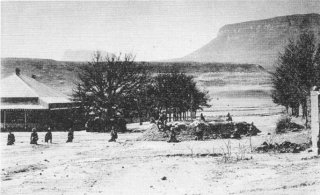
    – the de Beer home with its lovely stoep – or veranda – or porch –

    By the end of 1902 the regiments comprising the 8th Division had departed, and the 4th King’s Royal Rifles, involved in garrisoning blockhouses from January 1902 until the end of the war, departed in June 1904. In 1904 a census revealed that there was a white population of 4 345 resident at Harrismith of which the soldiers numbered 1 921. In the next decade, Harrismith was occupied by the 2nd Hampshires, the 2nd Yorkshires, the 4th Royal Garrison, the 3rd Dragoons and the 1st Wiltshires.

    So I haven’t yet found anything that says ’42nd’ but I did find that the ‘Royal Highlanders’ encamped at 42nd Hill.

    More copied snippets: Official withdrawal came at the outbreak of the First World War (WWI) in 1914 (Breytenbach 1978, Pakenham 1997, Dreyer 2007). The remnants of their camps can still be seen at King’s Hill, Queen’s Hill and 42nd Hill. The badges of the 80th Regiment of Foot (Staffordshire Volunteers), the Gloucestershire Regiment and 3rd Dragoon Guards are still recognisable against the hill to the north west of town. Regular maintenance by the Harrismith Heritage Foundation, the MOTHS Military Veteran Society and, until their disbandment, the Harrismith Commando, watched over the stone-built and whitewashed badges against the hill (Dreyer 2013).

    Ah! So we should probably have asked the MOTHs or the Commando before we went a-painting anyway!

    ~~~oo0oo~~~

    Boy Scouts was great – a real breath of fresh air to our dorp. Learnt a lot, did a lot, loved being Patrol Leader to ‘my boys:’
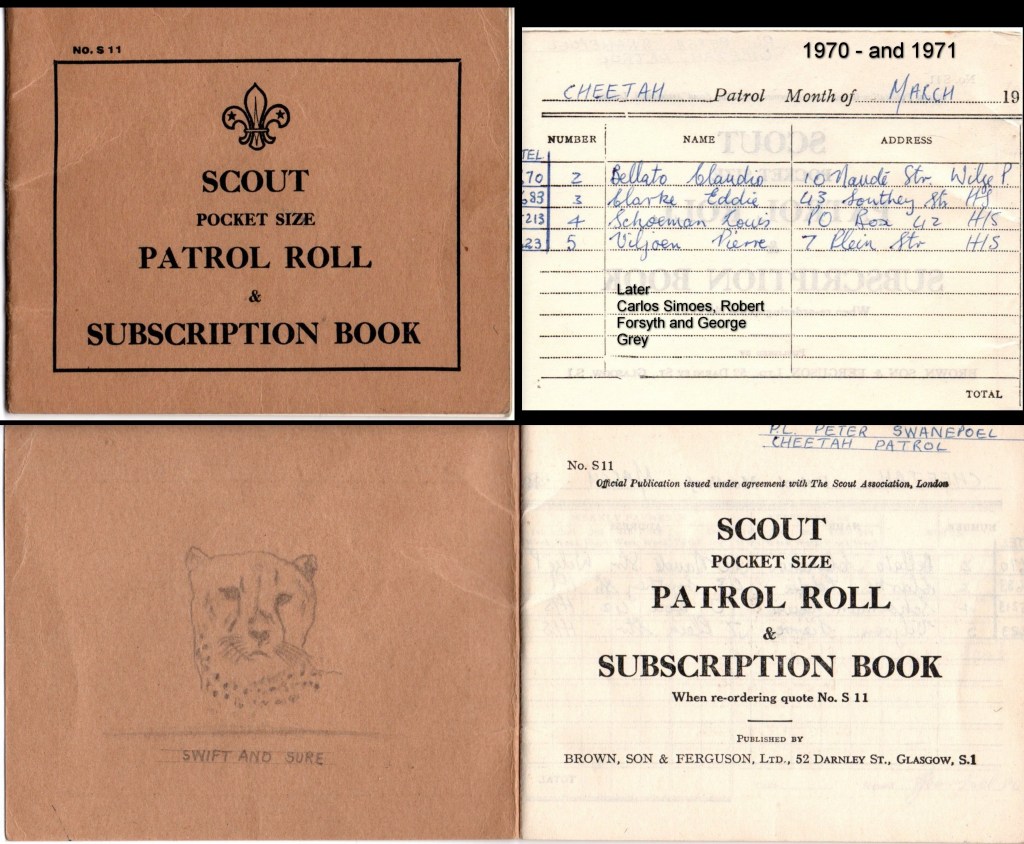
    – Harrismith Boy Scouts Patrol Leader Booklet –
    – must write in the boys’ names – Father Sam v Muschenbroek and Dick Clarke, bless ’em

    Loved going on camps and hikes, earning badges, drawing maps, navigating by maps and compass . .

    – Boy Scout Nondela Campsite sketch –

    I did all sorts of badges – master pet with Jock the staffie; canoeing, cooking, map reading, hiking, swimming, raft-building, tower-building, tying knots I still use today – everything, and was well onto my way to being a 1st-Class Scout; Went to camp in Bloem, after which ‘Haithi’ wrote and said your 1st Class will be soon; Father Sam drove us blindfolded, dropped us off (it was near Nondela) and we plotted our way back in high winds to a microwave tower near Bobbejaankop east of town; Was invited to the Chief Scout’s hike in the Valley of Desolation outside Graaff Reinet starting Sunday 24th September 1972;

    – Mom Mary comments on me and Jock –

    We met at the Anglican church, at the MOTH hall, and in our loft.

    The favourite, most talked-about thing, the biggest challenge was: The BIG Hike

    I drew five maps for this route near Normandien pass. Or really one map, on five pages of SHELL notepad! What I’d forgotten is how much Father Sam and Charlie Ryder drove us around! Probably at their own expense? Eg. We drove out to Robbie Sharratt’s farm one week night and got back at 9:30pm just for Robbie to explain the route we’d be taking on our 50-miler hike!

    – from Wally Sharratts down Normandien pass and along the escarpment flank to van Reenen –

    Then I went to Veld and Vlei in the 1972 July holidays, matric exams followed and suddenly Scouts in Harrismith folded, after a brief but glorious reign. Very sad, great pity but we just didn’t have the numbers.

    I pulled out of the Chief Scout’s hike – I had REALLY looked forward to seeing that valley. I had read much about it. One day . .

    ~~~oo0oo~~~

    Decades later my boykie followed in my footsteps . .
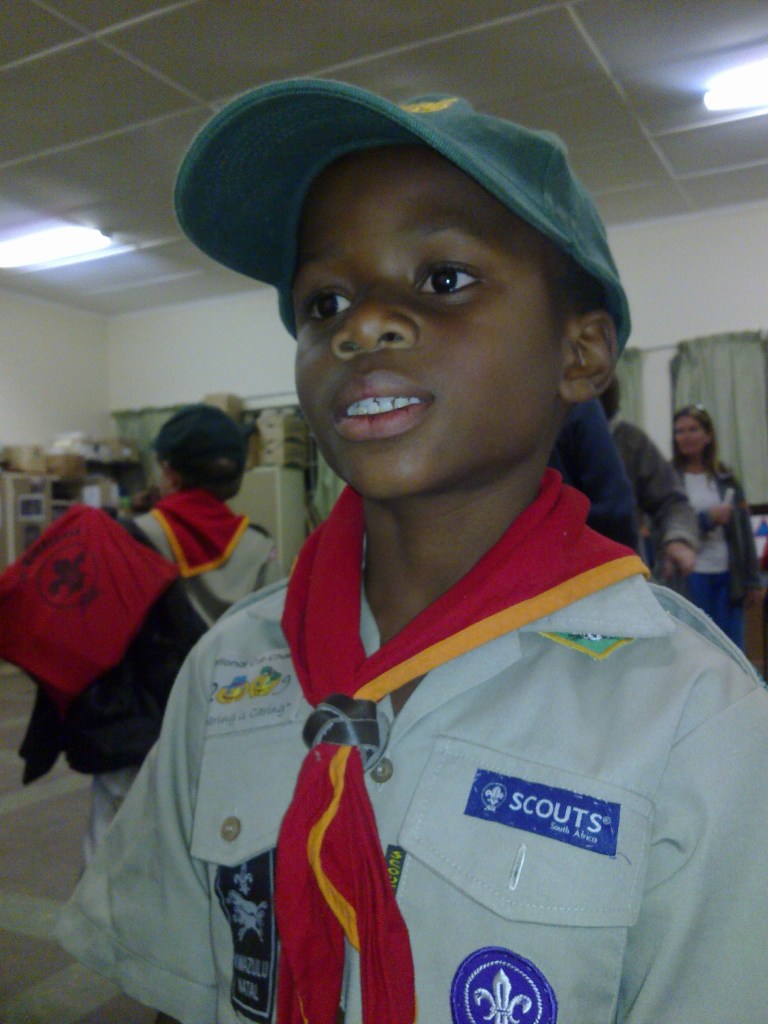
    – Tommy Swanepoel, cub scout – Wandsbeck pack in Westville KZN –

    ~~~oo0oo~~~

  • Volkskool – Primary School

    Volkskool – Primary School

    Mom went to this school, as did all three of us kids. Annie, Mom’s Mom, would not have, as it seems it was established in 1915, see below, and Annie was 22yrs old by then.

    Before us, Etienne Joubert went, and he remembers:

    Playing ‘Hasie’ under the Bluegums near the old Golf club house; Eating ‘Manna’ under the Bluegums; Playing ‘Bok-bok’ behind the bottom class rooms; Playing marbles in the main playground.

    Also he remembers the woodwork teacher Giel du Toit – his mother Joyce had a hilarious ‘holy’ nickname for Onse Giel – Heilige Giel, I think it was; and he remembers the smell of the old fashioned wood glue; And the wood vice where ‘we tied a guy’s tie in & walloped his behind. I’ve forgotten his name, but not his  face … I can see it now!

    He then confesses – I do not remember much about plays & music . . .’ – No worries, sister Barbara does:

    – the separate woodwork classroom was to the right, just out of picture –
    – some of these windows were Ou Eier Meyer and Ou Vis Alberts classrooms –

    Sister Barbara was a year or two later – she finished Std 5 in 1965. She definitely remembers about plays and music, you Philistine, Etienne! She remembers that year was the school’s Golden Jubilee year – so established 1915, I guess? – and an exciting concert was planned and held on the 28th and 29th of October 1965, with all the classes in the Kleinspan School and Primary School – Volkskool – participating.

    How could she remember in such detail? Well, she had her program carefully stored away in a shoe-box! She remembers the play her class put on: ‘TO  BE  OR  NOT  TO  BE’  –  by  B.J.J. (Bruce) Humphries with Pierre du Plessis and Llewellyn Mileham – or was it Kevin Crawley? – as the smart guys, and Timothy Brockett as Mr. van Snoggery-Boggery, the drunk guy – Pierre remembered this name – and herself – Barbara Swanepoel – as the unnamed lady on the railway station platform.

    Interludes between plays were filled by music by the ‘Harrismith Volkskool Orkes / Primary School Band.’ Band members were Rina Minny en Estelle Meyer on trekklaviere – pull pianos – piano accordions; Sylvia Doman on piano; Barbara Swanepoel on melodica; Pierre du Plessis on drums; Willie du Plessis on electric guitar; So much of du Plessis!; Theuns Bam en Bertus Hattingh on acoustic guitars; They were called Die Dorps Mense. Years later The Village People modelled a band on this lot. Um, so I believe.

    Then came the Primary School Boys Choir – Die Seunskoor. Under the charming direction of Miss L. Fourie and that delectable redhead Miss Ethel Cronje. I was a soprano in this lot, warbling away merrily before my balls dropped. We sang (according to that program which won’t lie) Wiegeliedjie van Mozart; Drummer Boy; and Dominique; I still remember – and can still sing majestically – the second and third of these liedjies. My kids dispute this fact, unreasonably.

    – Ethel Cronje looking strict or smug, her boys looking glum – it was her seunskoor, no doubt about that –

    Barbara asks: ‘Now wasn’t there a record produced for this choir? I think so – our own famous ‘Platberg Boys Choir.’ Indeed there were two records cut. Vinyl. The Vienna Boys Sausages were nervous. Especially when we launched a smash hit successful sold-out tour of Zululand. If it wasn’t for rugby and puberty, we’d have usurped those Austrian suckers. We’d have parum pu pum pum’d them out of business . .

    ~~~oo0oo~~~

  • Scottish Pith & Our Annie, Linguist

    Scottish Pith & Our Annie, Linguist

    Steve Reed wrote:

    Gotta love the Scots . .

    … and their humour. Met up with Sam, an excellent Scotsman who came in for some glasses today. We were chatting about some of the female news anchors you see on TV. One of them, Virginia Trioli, we agreed is opinionated, superior, demanding and – from all accounts – a piece of work.

    He sums her up:

    “Ya woodn’t want ta be coming hoome to her wi’ only a half week’s pay packet.”

    Later, I am handing him over to Ioannis who has the job of telling him how much his new multifocal glasses are going to cost (cringe) with some light banter … Sam replies:

    “Well I am a Scotsman ye know. Every penny a prisoner.”

    I packed up – had not heard that one before.

    Probably comes up a lot in the local pub.

    ~~oo0oo~~

    Me: So right! Gotta love the Scots!! 😉 – I must remember those pearls!

    My gran Annie’s father came to Harrismith straight from the freezing far north of Scotland – a fishing village called Sarclet, south of Wick – but she sadly became heeltemal Engels – the queen, the empire, and all that.

    The only Scottish she ever spoke to me was her oft-repeated tale of once on the golf course, waiting to tee off. The oke in front of them sliced off into the bush and said,

    ‘Och, its gone off in the boooshes,’ to which Annie quipped,

    ‘That’s betterrr than doon in the wutterrr,’ – upon which she says he spun around and said,

    ‘Begorrah’ (or whatever a Scotsman would say on an occasion like this), ‘Yer one of oos!’

    ‘Aye,’ said Annie semi-truthfully.

    ~~oo0oo~~

    Which takes me to her THIRD language: Afrikaans.

    Of her ninety years on Earth, Annie spent about eighty seven in Harrismith in ve Vrystaat. She was born there, she went to school there (more than half her schooling) and she sold Caltex petrol to her Vrystaat customers there.

    The only few years she was away from Harrismith she spent ‘down in George.’ She went to stay with her sister Jessie Bell when Jessie’s daughter Leslie died.

    When she got there there was great excitement as they just knew she’d be very useful in dealing with the kleurlinjeez, who spoke their own Afrikaans and hardly any Engels.

    ‘Annie speaks Afrikaans, she’ll be able to speak to them and understand them,’ was the buzz.

    So the first day the gardener needs instructions and Annie confidently demonstrates her skill to the assembled rooineks:

    ‘Tata lo potgieter and water lo flowers’ she told the poor man who must have scratched his head at the Zulu-Engels mix in which the only word approximating Off-The-Krans was ‘potgieter’ instead of ‘gieter’ for watering can.

    ~~o00o~~

    One more Harrismith Scots joke I’ve told you before, but I’ll add it to this collection:
    Jock Grant arrives from Scotland full of bravado, bulldust, enterprise and vigour.

    He’s a plumber – a plooomerr – but soon he’s bought the stone quarry, bought the Montrose Motel in Swinburne, bought the Shell garage, bought a big white Mk 10 Jag and smokes fat cigars.

    In the pub at the golf club he removes the cigar from his lips, waves it around and tells the guys he’s started Afrikaans lessons – he’s going to learn to speak Afrikaans.

    Jannie du Plessis looked concerned. ‘Jock,’ he says, ‘We think you should rather learn to speak English first.’

    ~~oo0oo~~

    heeltemal – completely

    kleurlinjeez – a vague racial classification in apartheid times – and still in use today! Not black, not white, therefore ‘coloured’; actual word: kleurlinge

    rooineks – people congenitally unable to speak Afrikaans, try as they might; actually, try as they don’t

    ~~oo0oo~~

  • A Harem in Harrismith?

    A Harem in Harrismith?

    You know that mansion Mal Jurie is building on his farm? It’s a harem!

    A what?

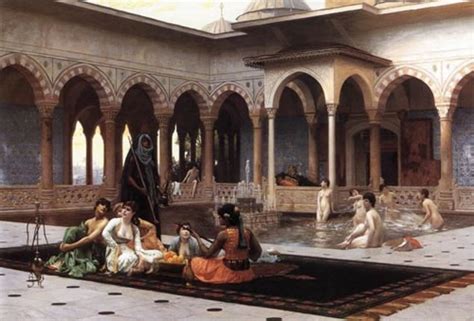
    A HAREM! A place where you keep lots of ladies in rooms and they lie around swimming and eating grapes and looking beautiful. When they do have clothes on its not clothes like your mother wears. He says he’s going to bring French dancers to his harem from the Moulin Rouge in Paris! A lot of French ladies in Harrismith in the Vrystaat!

    Ag Man, You Lie!

    No, I swear. He told me himself!

    – a typical scene just outside Harrismith, Vrystaat –

    This is how an Urban Legend – in this case really a Rural Legend; or, as Harrismith author and historian Leon Strachan calls them, a ‘Lieglegende’ – got started.

    First of all, it’s true. Jurie Wessels DID say that. His neighbour wasn’t lying.

    But what Jurie was really saying was, ‘Leave Me Alone!’ ‘Los My Uit!’ ‘Mind your own Business.’ ‘Stop prying.’

    Jurie was a successful farmer, an intelligent, interesting and interested man, married to an outgoing and attractive woman, and he was building her a home unlike any other in the district. His problem – his sin – the reason he was called Mal Jurie – was that he was an introverted and eccentric character. He didn’t ‘play by the rules.’ And for that you get punished in most communities, maybe more so in small communities. And Harrismith would have been no exception.

    For starters, Jurie had brought his lovely engaging wife from far away. People didn’t know her mother and her grandmother. She was actively involved in the community, well liked, and often entertained; but still . . she was from far away. And also, often Jurie wasn’t at her gatherings, preferring to keep to himself, even when she entertained at home.

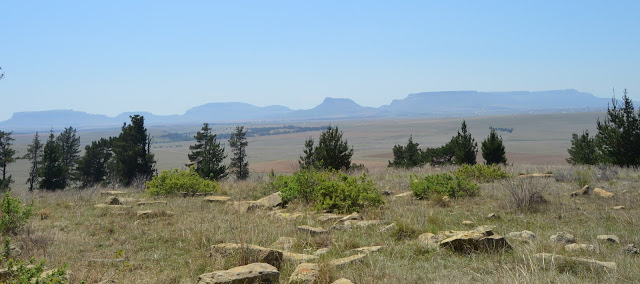
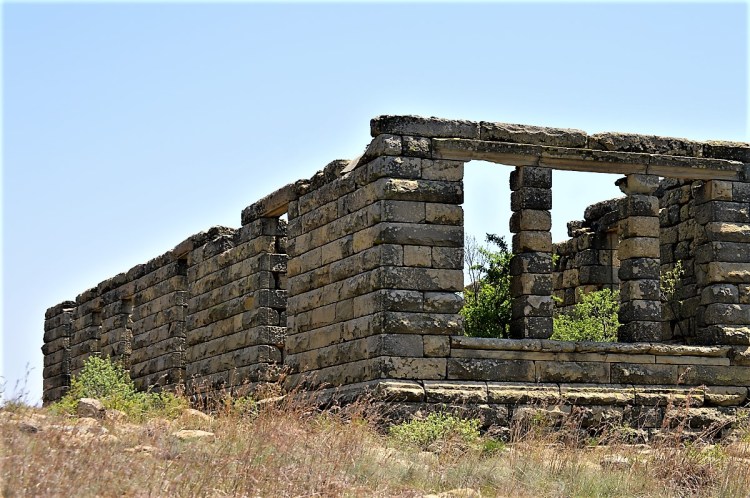
    So when Jurie got Italian stone masons to start building a large sandstone structure on the edge of a hill above his more ordinary homestead, overlooking the Wilge river valley west of the dorp, the people started wondering . . and talking.

    – the view towards Harrismith – The Lakes range, Loskop in the middle, Platberg right –

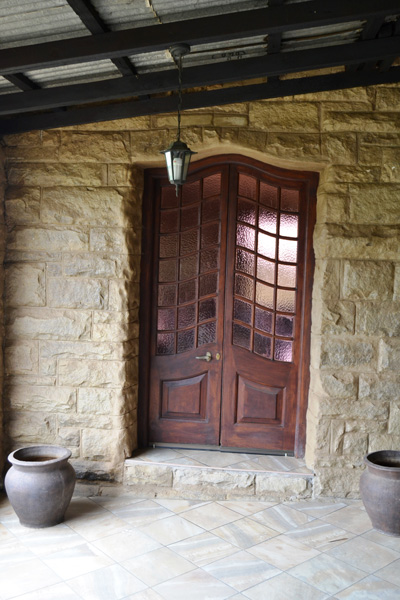
    But it was when a consignment of beautiful and really big wooden windows and doors arrived from Italy at the Harrismith spoorwegstasie that the rumours started building and gathering momentum. From ITALY? Nothing from ITALY arrived at the Harrismith stasie! Where was Italy, anyway? This was weird! Just what WAS Mal Jurie up to? Here was evidence, not just skinner, that Mal Jurie was mal.

    Well, he was actually building a beautiful home, but he didn’t want people sticking their nose in his business. People always asked too many questions! So when his neighbour asked, he deliberately gave what he probably thought would be an obvious exaggeration. And it might have been taken as just that, had his reclusive behaviour not made him ‘suspect’ – ‘different.’ And so the rumour – the legend – grew wings and became ‘the truth.’

    My mother Mary grew up with one of his sons, Hugo. Hugo was a popular, good-looking and talented Harrismithian who would go on to qualify as a medical doctor, then come back to farm and practice medicine as a GP on the family farm. He and Mom matriculated in the same class of 1945. They both loved music and singing, were talented musicians, and both did well in their exams. Here’s Mom on the piano and Hugo enjoying her playing and getting ready to sing at Mom’s 45th birthday party in 1973.

    ..

    And here’s one of his sons, Max Wessels, who played rugby with me in primary school. Max extreme right front row, dark hair, shortish then – me extreme right back row, blonde, tallish then.

    The beautiful new home never got finished. Jurie joined the 1914 rebellie – a rebellion against the British-dominated South African government. He was angry – mad as hell – as were many others, that this blerrie government was joining the blerrie British to fight World War 1! Hadn’t the blerrie Engelse just been killing them a mere twelve years before? Hadn’t the British locked up our women and children in concentration camps, starving them and killing them off through disease and malnutrition!? Why the hell was South Africa fighting WITH those invaders who had ruined our country just a short decade ago, burning our houses and killing our livestock?

    So with Jurie te velde, building on his lovely home ceased. Today the impressive ruins – not ruins: the unfinished start – of the home Jurie wanted to build for his wife still stand:

    – here you can estimate the scale of the building – BIG windows –
    – another look at the scale of the place – Leon Strachan with Jurie’s grandaughter Mia Prinsloo –

    ~~~oo0oo~~~

    Many thanks to Harrismith historian Leon Strachan for keeping Harrismith’s history alive – and for the photos. For more and better info, read his book Blinkoog. He wrote four: Blafboom; Blinkoog; Botterbek and Bergburghers.

    See this lovely blogpost by former Harrismithian Sandra Cronje, where she wrote a longer, better story with Leon’s research and input.

    ~~~oo0oo~~~
    Reminded me somewhat of this song:

  • Buckland Downs to the ‘Fitzstitute’

    Buckland Downs to the ‘Fitzstitute’

    In October 1902, just four months after the end of the Anglo-Boer War, Sir Percy Fitzpatrick bought the farm Dreyersgeluk near Verkykerskop in the Harrismith district from the insolvent estate of Petrus Dreyer, poor bugger. Fitzpatrick then got Herbert Baker to design a fine sandstone homestead, and to assist him in building it in 1903 – ‘but without full professional services’ (Keath 1992:104-105).

    Baker, who became Sir Herbert in 1926, was an English architect who worked in South Africa from 1892 to 1913. His first job was for Cecil Rhodes on Groote Schuur; over the next twenty years he dominated the architectural scene in South Africa, designing the Union Buildings in Pretoria in 1910.

    – Fitzpatrick changed the farm’s name to Buckland Downs –

    James Percy Fitzpatrick was born in 1862 in King William’s Town, the son of Irish immigrants from Tipperary.

    Active in politics and very pro-England, Fitz agitated for war against the boers. Calling for an invasion of the sovereign state he was living in! He was convicted of treason against the Transvaal state in 1896. Nasty! Being on the winning side, though, meant he was knighted in 1902. All is forgotten if you win, and what happened gets re-written.

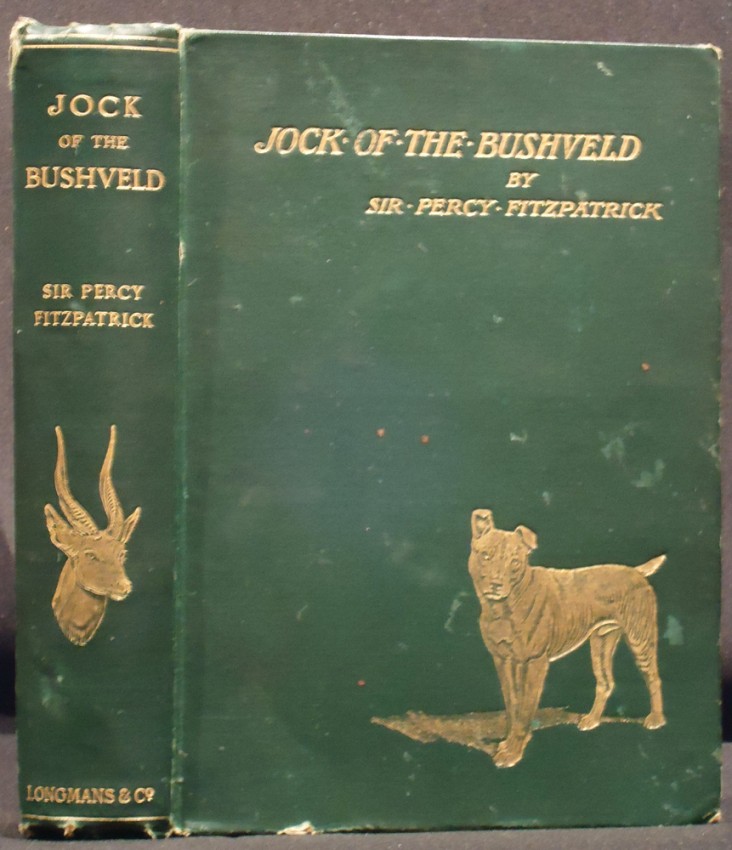
    As an author, his most famous work was ‘Jock of the Bushveld’. Written in 1907 while staying at Buckland Downs, it told about his life as a transport rider in the lowveld goldfields of the old Zuid Afrikaanse Republiek. The Jock stories began as bedtime stories told to his children. Apparently urged to publish them by his friend, famous author Rudyard Kipling, the stories became one of South Africa’s most famous books of all time.

    Around 1910 Fitzpatrick ordered a large number of different varieties of oak trees from England and planted them in the shape of the Union Jack on about 35ha of land on Buckland Downs. Despite these two obvious anti-local actions, Sir Percy said “I would rather be a meerkat in Africa, than a millionaire in England.” Of course, he meant that only as long as Africa was under British rule.

    Fitzpatrick’s daughter Cecily (1899-1992) later stayed on the farm with her husband Jack Niven. In the 1940’s the famous ornithologist Austin Roberts (1883-1948) used to visit them on Buckland Downs. Patrick Niven tells how Roberts involved the family during a 1942 visit in a collecting expedition to the nearby Spitzkop for specimens of swifts – probably at a nesting site?

    Cecily became very involved in birds – her name is reflected in the List of Members of the Southern African Ornithological Society (SAOS) for April 1935, the receipt for her subscription is signed by Austin Roberts himself – honorary secretary at the time. In 1948 she established a Committee for Bird Protection as a subsection of the Wild Life Protection Society. In 1957 Cecily was the driving force behind the first Pan African Ornithological Congress which took place in Livingstone, Zambia. In 1960 she established an Institute for African Ornithology – now fondly known as the ‘Fitzstitute’ – dedicated to the memory of her father, Sir Percy FitzPatrick, through a £15,000 endowment (around ten million Rand in 2007 money) from the FitzPatrick Memorial Trust.

    ~~~oo0oo~~~

    A first edition copy of Jock is going for $7500 in 2019. And then THE first edition is for sale by Clarke’s Bookstore. I wonder how much that will fetch? Here’s the inscription Percy himself inscribed in it:

    Illustrated by E.Caldwell

    DESCRIPTION:

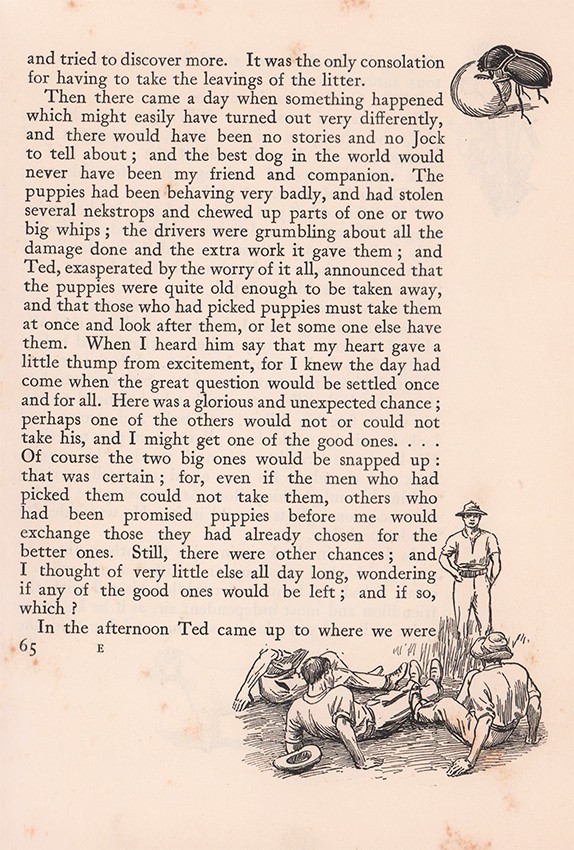
    First edition, First impression. 475 pages, colour frontispiece, plates and marginal illustrations, dark green cloth with gilt titling and gilt vignette of Jock on the upper cover, light foxing throughout mainly in the text and on the page edges, with the drawings of a dung beetle pushing his load with his front legs rather than his back legs on pages 65, 337 and 457 and Snowball the horse being dragged out of the river on page 316 – these drawings were changed in later impressions. The spine is starting to fray at the top and the bottom, the bottom edge of the upper cover and the corners are slightly scuffed, housed in a specially made oatmeal textured cloth solander box with a dark green title label gilt on the spine, a very good copy of the first edition. Overall Condition: A Very Good Copy

    5000 copies of the first impression were printed at a total cost to Longmans of £416. 7s. 11d.

    Signed on the title page by J Percy Fitzpatrick. His full name was Sir James Percy Fitzpatrick.

    Inscription on the front paste-down end paper reads: This – the first copy of “Jock”- “belongs to the Likkle People” and the mere narrator desires to acknowledge that fact in proper form. J Percy Fitzpatrick, Hohenheim October 1907

    The dedications page reads: It was the youngest of the High Authorities who gravely informed the Inquiring Stranger that “Jock belongs to the Likkle People!” That being so, it is clearly the duty, no less than the privilege, of the mere Narrator to dedicate the Story of Jock to those Keenest and Kindest of critics, Best of Friends, and Most Delightful of Comrades, The Likkle People.

    Fitzpatrick’s adventures – centred on his dog Jock, a Staffordshire Bull Terrier cross – when he was pioneering in the Bushveld, are vividly described in this South African classic. He used to recount them in the early 1900’s to his four children, Nugent, Alan, Oliver, and Cecily, to whom the book was dedicated – the likkle people.

    Rudyard Kipling, an intimate friend, at some time took part in these story-telling evenings, and he it was who persuaded Fitzpatrick to put the stories together in book form. Having done this, Fitzpatrick searched for a suitable artist to illustrate the book and eventually came across Edmund Caldwell in London and brought him to South Africa to visit the Bushveld and make the drawings on the spot.

    The book, which appeared in 1907 for the first time, was an immediate and overwhelming success, being reprinted four times in that year.

    Extracted from his South African Memories pages 24 -25: Of course to those who have read Jock of the Bushveld he needs no introduction. Jock and Jess and Jim will always live in the memories of the Likkle People whom he was addressing and whom in every generation of young South Africans he will continue to address. The Likkle People have always loved Jock and his companions because they know what was being told to them was true and that it was all about their own wonderful country.

    ~~~oo0oo~~~
    http://www.krugerpark.co.za/sir-percy-fitzpatrick-kruger-national-park.html

    ~~~oo0oo~~~

    I had a dog called Jock ca.1970. Got him from the Jellimans who farmed very near Buckland Downs.

  • Ancestry

    Ancestry

    Sister Sheila has been doing some research on our early ancestors: Some genealogical sleuthing. We all know one should be careful what ye seek – ye may find!

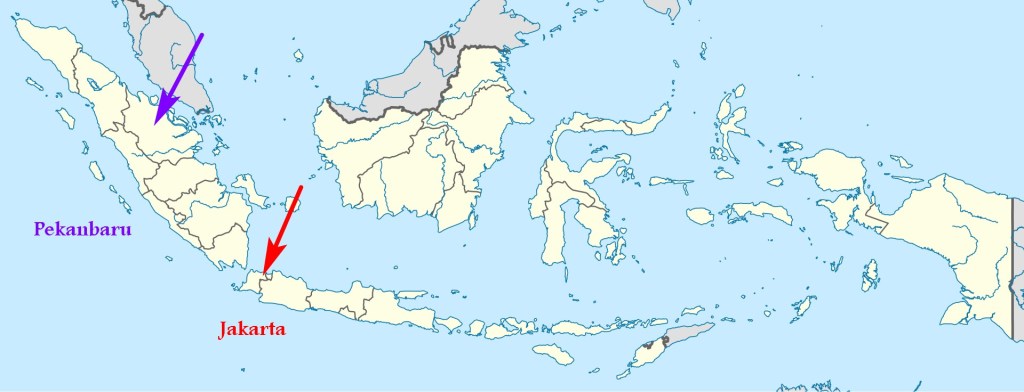
    We now have a new colourful ancestor – the Cape’s first ‘Bergie‘ or homeless person. He was probably one of the many unfortunates that the ‘civilised western world’ ‘captured’ and/or ‘owned,’ enslaved or sold, or otherwise dominated. In addition to our ancestors Louis van Bengal, Maria van de Caep and Lijsbet van Abyssiania, there’s now Amsoeboe van Timor: born around 1640 in Pekanbaru in Indonesia.

    – indonesia –

    Amsoeboe van Timor’s movements from Indonesia to Mauritius (1676) to the Cape of Good Hope (1679) – Amsoeboe, his wife Inabe van Timor, and daughters Iba and Baauw are sent by the ‘Dutch East India Company’ (VOC) from Batavia [Jakarta on the Indonesian island of Java] on the hooker Goudvink to Mauritius – a VOC outpost (buitenpost) governed from the Cape of Good Hope which latter colony is itself governed from Batavia. Their unnamed son, however, remains at Batavia. They are described as a ‘politically exiled, but un‐enslaved,’ family from Timor .

    The commander on Mauritius at the time is a ‘reformed privateer’ (! – do pirates ‘reform?’) Hubert Hugo. There, the family is accused in 1677 of conspiring with Company slaves and exiled convicts to overthrow the colony, massacre its officials, and escape. Note how they are ‘un-enslaved,’ yet accused of wanting to escape! Amsoeboe and his family are all separately interrogated in a pre‐trial investigation by Commander Isaac Johannes Lamotius and his council. Also implicated in this conspiracy is a Company soldier Hans Beer, ‘concubine to Iba.’ Two conspirators hang themselves. Behr ‘dies mysteriously during interrogation.’ (I’d call that tortured to death, most likely).

    Washing his hands of the pickle by claiming no authority to legally try Amsoeboe and his family, Lamotious (so, like Lamontius Pilate?) sends them to the Cape of Good Hope in 1679. There, the family settle amongst the colony’s free‐population, and – most likely being in abject penury – apparently start a brothel.

    Their household ‐ one of the small colony’s two operational brothels – is censured by Commander Simon van der Stel and his council in 1681, authorizing the fiscal to arrest any offenders he finds there. The 1682 census enumerates seven unnamed members for this family ‐ including presumably three daughters of Amsoeboe’s daughter Iba. Amsoeboe is now recorded as Paay [‘Father’] Timorees or Moor ‐ and his wife as Ansela van Timor. After the death of his wife Inabe in 1682, the Orphan Chamber makes an inventory of the impoverished family’s meagre worldly goods.

    Iba – now known as Anthonique ‐ joins the Stellenbosch household of freeburgher Jacob Aertsz: Brouwer and his twice‐widowed wife Agnetha RixBrouwer assaults his wife regularly and on one occasion also another free‐burgher’s wife. He later viciously assaults Iba (1686) with a broomstick soon after also whipping his slave Tido van Goa. Tido dies from his injuries.

    In 1693 Iba jointly baptizes her three daughters, each adopting their own biological father’s name. 

    Amsoeboe next appears in the records in 1692 as a miller with both daughters in the Cape District alongside free‐burgher Gerrit Theunisz (from Utrecht) ‐ concubine to Iba ‐ which couple is again recorded in 1695.

    Death: Amsoeboe van Timor passed away on February 4, 1708. “The body of an old black, known as Paay Moor [Amsoeboe van Timor, exiled from Batavia and Mauritius], found dead in the gardens in a small hut. He was accustomed to beg his food in the town. The Fiscal & surgeon & secretary of justice went to examine it. It is believed that he died of natural disease & great poverty. The body being partly decomposed, (it) was buried on the spot.”

    – caption: ‘Paay Moor” [Amsoeboe van Timor], in front of his small hut

    Research on the Mitochondrial DNA (mtDNA) results of the family are fascinating. Mitochondrial DNA is passed only from your mother, unlike your nuclear DNA which you inherit from both parents. Read more at wikitree, but just one finding of the research is that Ansela and Iba could not have been biological sisters (confusion, I thought they were mother and daughter?), as their descendants do not share the same mtDNA haplogroup. One of Ansela’s descendant’s results yielded identical matches to:

    • 1 African American individual
    • 1 individual from the Democratic Republic of Congo
    • 4 Zanzibaris
    • 2 ‘South African Coloureds’
    • 1 ‘South African Indian’
    • 1 ‘South African White’
    • 67 South African Bantu-speakers.

    Besides being one of my ancestors, Amsoeboe was also the Cape’s founding father of the Erasmus, Blom & De Jager families – innit lovely to see how apartheid was all built on myth and bullshit!? Isn’t it tragic to see how poor people are targeted?

    ~~~oo0oo~~~
    More information on Amsoeboe on this fascinating site by Delia Robertson: The First Fifty Years Project: http://www.e-family.co.za/ffy/RemarkableWriting/UL05PaiTimor.pdf ) [Mansell UphaM] ; Also wikitree ;

  • What’s a Hartebeest?

    What’s a Hartebeest?

    I’ve long been confused about the hartebeest and the tsessebe, which I thought must be closely related.

    This weekend we saw a small herd of blesbok on top of Platberg, and a few hartebeest on the slopes of Platberg in the pine forest, so I thought I must look into this.

    And its quite complicated!

    As always with classification you get ‘lumpers’ who say ‘They’re the same,’ and ‘splitters’ who say ‘No! Look, it’s a different colour.’ I’ve been a lumper by nature meself, needing real DNA differences before I’d want to say something was a completely different species, no matter how different they look. Hunters are often splitters, wanting to say they shot a red bushbuck and a grey bushbuck and a brown bushbuck; or a brindled wildebeest and a Cookson’s wildebeest; or a Burchell’s zebra and a Crawshay’s zebra; and if you have the money they’ll even sell you a ‘Blue,’ a ‘Golden’ and a ‘King’s’ wildebeests – all on the same farm! Then a pure white springbok and a pitch black impala!

    DNA has helped a lot – it’s harder for people to ‘invent’ species now. But even now, debate continues and not everyone agrees on all the ‘sub-species vs separate species’ cases!

    So let’s start with a family of big well-known mammals – the Bovidae, which evolved 20 million years ago, in the early Miocene. Cloven-hoofed, ruminant mammals, including domestic cattle, sheep and goats. A member of this family is called a bovid; the family Bovidae consists of eight major subfamilies with about 143 species.

    The subfamily I’m interested in here, where the hartebeest fits, is called Alcelaphinae, which has four genera:

    • Genus Beatragus
      • Hirola, Beatragus hunteri – very rare, found in Kenya and Ethiopia.
    • Genus Damaliscus
      • Tsessebe, Damaliscus lunatus 
      • Bontebok, Damaliscus pygargus
        • 2 sub-species
    • Genus Alcelaphus
      • Hartebeest, Alcephalus buselaphus 
        • 8 sub-species
    • Genus Connochaetes
      • Black wildebeest, Connochaetes  gnou
      • Blue wildebeest, Connochaetes  taurinus 

    Things that fascinated me in looking this up:

    =The hartebeest has only one species, with eight sub-species (although some splitters will dispute this; some like two species, some like three – adding Liechtenstein’s and Bangweulu Hartebeest as separate species).

    =The Tsessebe is closer to the Blesbok than the Hartebeest. Except there’s no blesbok! Those buck we saw on top of Platberg? They’re Blesbok – a sub-species of the Bontebok.

    Other antelope

    The kudu, nyala, sitatunga, bongo and bushbuck spiral-horned antelope are closer to the cattle, bison and buffalo than they are to other antelope.

    The impala is all on its own. Its closest relative being the rare and shy suni.

    ~~oo0oo~~
    Classifying antelope is not easy, and this with only 143 species. Imagine how hard it is to classify the small mammals:  – about 2200 species of rodents; and about 1200 bats.

    ~~oo0oo~~

    Mankind!

    The northernmost hartebeest – the bubal hartebeest – was found in Morocco and Algeria, north of the Atlas Mountains. The subspecies declined sharply during the course of the 19th century, especially after the French conquest of Algeria, when entire herds were massacred at once by the colonial military. By 1867 it could only be found in the mountain ranges of north-western Africa that are near or within the Sahara desert. In Morocco the last known herd, numbering only 15 animals, was located by a hunter near Outat El Haj in 1917; He shot twelve of them. The last specimen was ‘collected’ in 1920. The bubal hartebeest was finally ‘protected’ under the London Convention of 1933. Too late . . .

    ~~oo0oo~~

    Thanks as always, wikipedia

  • Another Successful Campaign

    Another Successful Campaign

    Here’s my reliable report from the front line. The heliograph was a bit shaky in the stiff breeze, but I wrote down what I think happened:

    A well-drilled, orderly troop of Queen and Empire Poms marched up Platberg. And when they were up they were up **

    – when I say ‘marched’ I mean they Four-Wheel-Drove –

    They reconnoitered the surrounding area looking for Boer commandos, ready to report any sightings to some grand old Duke, or Lord, or someone. Ridiculously dressed in anti-camouflage bright red tunics, or similar, they stuck out like sore thumbs; But at least they were together and obeying the orders of Field Marshall Lello RSVP. This would not last very long.

    Once on top the cohesion started to wobble and soon a small breakaway happened. Some of the troops began behaving like Boers, thinking they could just go home when they felt like it. Five of them headed off down One Man’s Pass, misled by a trooper who said he had local knowledge, had run up this pass in the past four times and ‘it wasn’t far.’

    It was far and it was steep and soon more than just cohesion was wobbling.

    The remains of the patrol, now only nineteen strong, headed East back to Flat Rock Pass – or Donkey Pass – where a further split took place with trooper Soutar suddenly developing a deep longing for his ancestral home, Howick. I know, who would want to go to Howick?

    Down to fifteen, the remainder headed for the Akkerbos for lunch and booze, where another defection saw four more wander off the beaten track and puncture the one wheel of their Ford Platberg Cape Cart. Field Marshall Lello RSVP set off to rescue them, dispatching sergeant Garth, corporal Nigel and Generaal Leon to rescue the original five deserters. Who of course, didn’t need rescuing as they had the whole thing under control and knew exactly where they were as they had a knowledgeable local guide with them. (Right!)

    Back at the Oak Forest – where the princesses Elizabeth and Margaret had been kerfuffling in the bushes with equerry Group Captain Peter Townsend back in 1947 when most of us were busy being born – a laager had been formed and tables laden with provisions, especially booze.

    A re-grouping took place and the size of the force stabilised at fifteen, with no wounds or injuries other than some grazes and some wobbly legs and some mild miffedness. (Justified, BTW). The disorderly conduct and the booze, together with the coating of dust and black soot on all the troops made the patrol look less and less like a plundering invading force from a small island, and more and more like good, patriotic, camouflaged local defenders.

    Back down at the bottom of the mountain, the numbers swelled to nineteen and confidence grew to such an extent that a decision was made by the now almost completely Boer commando, to attack the blerrie Breetish in their blockhouse situated on the banks of that sparkling brook called the Kak Spruit. A clever encircling movement was made and we attacked the crows nest from above, putting the occupants to flight. Bladdy Poms!

    – if you look carefully you can see the pockmarks of our accurate rifle shots*** all over –

    So ended another successful campaign by us Boer guerillas. Generaal Leon could heave a sigh of relief and return to his farm after successfully converting a motley band of misled ‘joiners’ and getting them to support the right side at last.

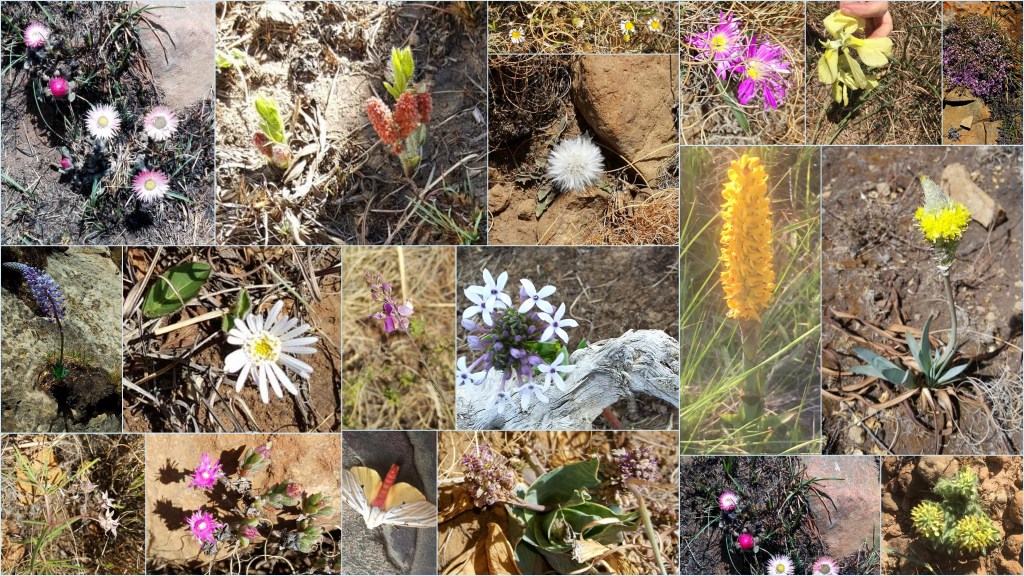
    – some Eastern Free State wildflowers –

    ~~oo0oo~~

    PS: I forgot to mention – During the whole campaign there was a westerly breeze which caused some heliograph wobble.

    Here’s more about Platberg, with some terrific pics.

    ~~oo0oo~~

    ** . . and when they were up they were up . .

    – and when they were up they were up –

    ~~oo0oo~~

    *** Have you ever seen an old sandstone structure without ‘Boer War bullet holes?’ Me, I think those holes are where the iron calipers used to lift the heavy blocks gripped them. Amiright?

  • Ode to a Commode

    I wrote poetry in high school once.

    We were doing Engels and had to read ‘ode to a something’ and so I wrote my Ode to a Commode, which was way better than John Keats’ effort. Hey, I was an immature, scatological teenager easily amused. In some ways . . . .

    I searched for which ode it was and it was ‘Ode on a Grecian Urn’ – ode ON an urn! Now I remember: That’s what set me off giggling. I imagined him sitting on the ‘urn’ see? No? Well, ask a teenager.

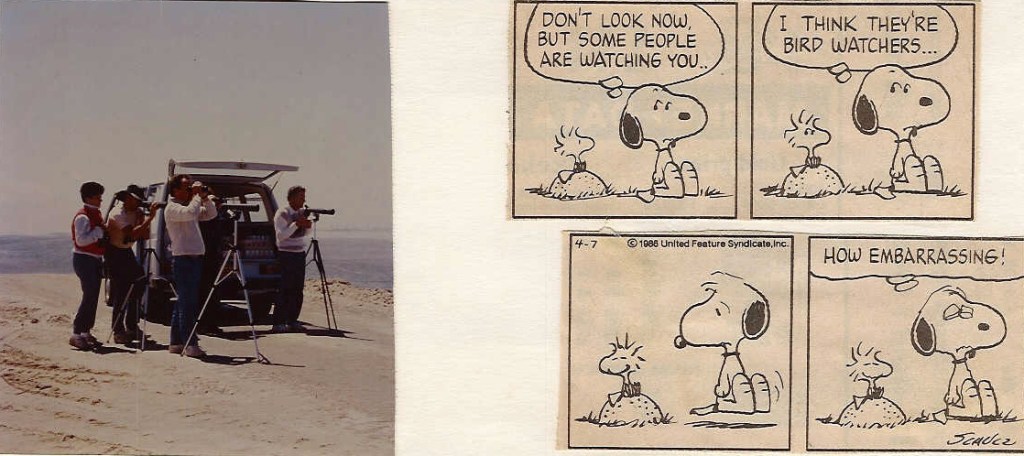
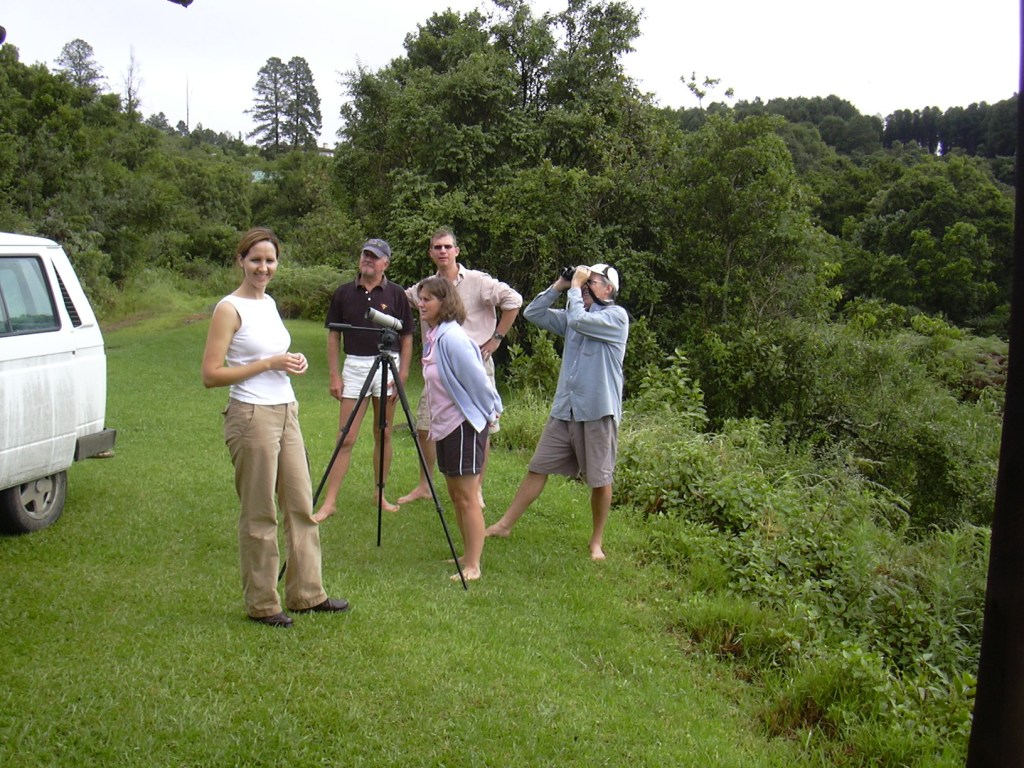
    I was thinking about my telescopes and how much joy I’ve had from them; and decided to write an ode to my ‘scope, which reminded me of the above ancient memory.

    So: ‘Scopes:

    – salt marshes near Walvis Bay, Namibia in 1986 –
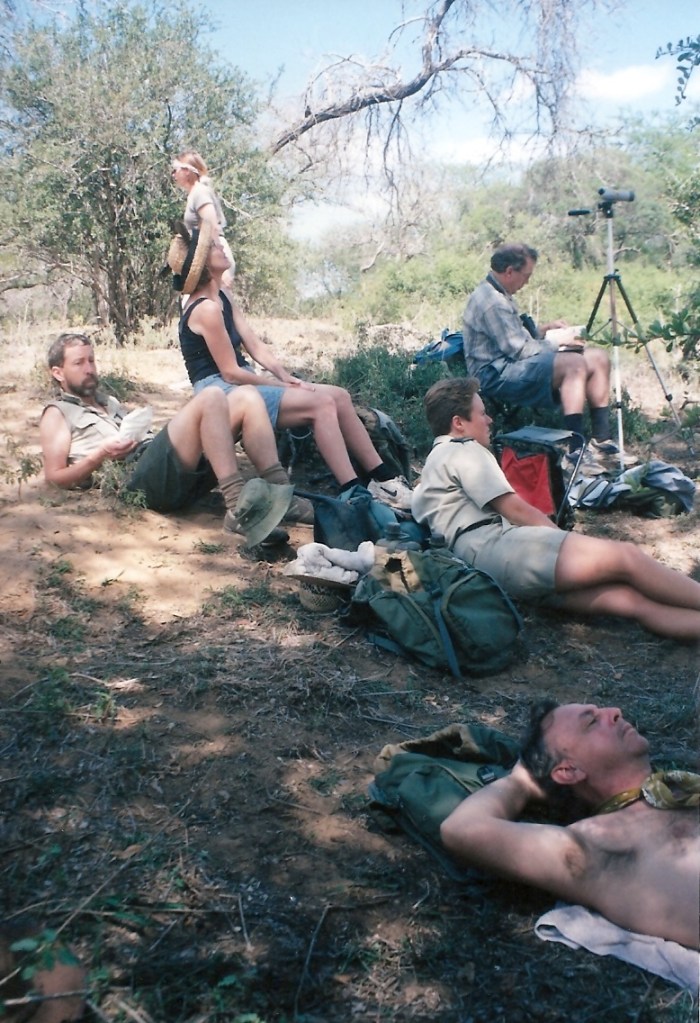
    • top two: Mfolosi wilderness walk; above: Tsavo East, Kenya –
    – showed the crowd a Piet-My-Vrou cuckoo in Mbona, KZN Midlands –
    – see, Jessie? – Super-Jessie peers – resting her Super-vision to amuse Dad –
    – the whole old family with two new additions at Mangeni Falls near Isandlwana –
    – insets: Robbie peering into my scope twice, fifteen years apart –

    With a scope you can delight novices; With binocs it’s often, ‘Where? Which tree? Oh hell, it flucked! It flocked off!’ with a scope you can say ‘Look’ and they say ‘Wow!’ I love that.

  • Quadruply Certifiable

    Quadruply Certifiable

    The Comrades Marathon’s Quadruple Green Number is awarded only to people who are certifiably crazy. The award – and membership of that exclusive club – means you have run the 89km Comrades ultra-marathon at least forty times! Holy shit!!

    47 Medals
    RaceNoName
    403Louis Massyn
    916Barry Holland
    45 Medals
    RaceNoName
    183Dave Rogers
    43 Medals
    RaceNoName
    3111Vic Boston
    42 Medals
    RaceNoName
    1Clive Crawley
    1180Zwelitsha Gono
    1702Dave Lowe
    1704Alan Robb
    4192Wietsche Van Der Westhuizen
    7296Mike Cowling
    41 Medals
    RaceNoName
    1550– – – – – David Williams – – – – –
    1689Tommy Neitski
    40 Medals
    RaceNoName
    145Kenny Craig
    1221Riel Hugo
    1691Johann Van Eeden
    2516Boysie Van Staden
    4286Shaun Wood

    Dave ‘Jesus’ Williams is a Kingfisher Canoe Club stalwart who has helped run the Umkomaas canoe marathon for about the same number of years he’s been shuffling the Comrades.

    On the Umko, Dave has done it all. Driving trucks, pitching tents, digging toilets, rigging toilets on trucks, buying food, preparing food, serving in the pub, listening to paddlers gaaning aan about how scary THEIR race was; you name it, Jesus has done it. And with aplomb and with a smile. He was there 36ys ago when I did my only Umko and patiently served us rowdy hooligans with beer after beer at the overnight stop until there were only two okes left drinking – me and Chris Greeff. Eventually we got tired of people rudely shouting at us to ‘Shut Up, They Were Trying To Sleep,’ so we staggered off to our sleeping bags on the grass under the big marquee. There was a small difference between me and the man I’d been matching beer for beer till late that night: He was actually leading the race and duly went on to win the singles the next day. I finished in eventually-th place.

    – Dave ‘Jesus’ Williams on the right working hard as always –

    I last saw Dave Jesus at the 2016 Umko – he was driving the beer truck and selling beer at the prize-giving. We had a good chat. He had given me good stories for the Umko 50yrs book, but now I mainly wanted to know about the Comrades. About HOW MANY? about WHY!? and about ARE YOU MAD?!

    He couldn’t really explain, but all he talked about was beating other ous. So even though his finishing time was stretching out compared to his best days, he always had goals and people to beat. At the time, his main “battle” was against Tilda Tearle (she who actually won the damn thing one year). He beats her, then she beats him; how and when, Dave describes in great detail – “I was leading for 30km and then my knee started to hurt and I heard she was catching up to me” etc etc. He remembers every yard, every pace, every change of fortune, good or bad. In Comrades as well as all the other races he does, he always has some or other bet or goal or competition going on with his comrades in running. That’s what keeps him going, I suppose. That, and the insanity.

    – later he shaved the beard and became Dave ‘John Cleese’ Williams –

    A lovely modest oke. But quite mad – he has also run 100km around a 400m athletics track and has run 100 MILES, too. He also runs a cross country race from Royal Natal National Park up to Witsieshoek, then along the road to the car park then up to the foot of the chain ladder, up the ladder onto the Amphitheatre, down the gulley and back to National Park campsite. About 50 rugged cross-country kilometres with a huge altitude gain that makes the Harrismith mountain race look like a short flat stroll.

    Certifiable.
    ~~~oo0oo~~~