I asked Leanne Hilkovitz Williamson about Poccolan / Robinson’s Bush and this brought a flood of memories:
She takes up the story:
I was born on the farm De Nook which belonged to my grandfather Elias Hilkovitz and was inherited by my father Leo Hilkovitz after the 2nd World War probably round about 1945, two years before I was born.
Dad built Little Switzerland Hotel on the farm and we made pathways through the forest called Robinson’s Bush for guests to hike to various spots: The Wishing Well, Protea Plateau, etc. I named most of the spots, and one that meandered in and out of the forest edge I named Hilky’s Way after my grandfather who was affectionately known as Hilky.
We sold the hotel when I was in my early twenties but the various owners over the years have kept the use of the forest and the guests continue to enjoy its wonderful beauty – it is wonderfully exhilarating to either clamber down Breakneck Pass from the Wishing Well or climb up to it from the road below. The path twists and turns in amongst indigenous trees, true and mock yellowwoods, and lianas and ferns along the side of a stream full of huge beautiful boulders in all shades of grey & lichen & dappled shade. So one experiences the mountain air, the refreshing sound of the steam and always the melodious bird song. I particularly loved calling up the Mocking Chats and Natal Robins that mimic other birds and have a whole repartee of calls, copying them and they’d call back. A wonderful game that Dad taught me.
According to my father, Robinson’s Bush is the biggest natural forest in the Drakensberg. I wouldn’t take that as gospel. I’ve come to be a bit circumspect about those sorts of claims that locals all over the world tend to lay claim to!
Robinson’s Bush abuts on De Nook and we treated it as part of our farm. Dad looked after it although it is part of government nature conservation; at one stage in my late teenage years there were two nature conservation officers who lived in a hut on the edge of the forest and tended it but that did not last.
I was there for my 70th birthday in 2017 with my two sons and their families and we climbed up Breakneck Pass through the forest and I showed it to my granddaughters and taught them the things my Dad had taught me.
Some of my earliest memories are of picnics in the forest on the side of the stream with our neighbours Udo and Margo Zunkle of Cathkin Hotel fame when they lived on Windmill farm. Udo would put small pieces of raw steak on the river rocks and we’d be fascinated by the crabs that came from all sides to feast on it.
~~~oo0oo~~~
Leanne again later:
Hi Again
I put together a Power Point family history together for the family and we had an evening when Ishowed it to them. It started with the great grandparents on both sides and their cars and the farm in the very early days and the beginnings of the hotel and its growth as I grew up & went to HS Volkschool & then boarding school, varsity, etc. and then our children growing up and then finally the grandchildren from babies to present. I can never leave the farm & the berg for long & return there often – even if it is just up and down in a day – and I climb a mountain, drink in the soul food and return home refreshed, invigorated and together. The families also love it and visit but we have never all been there together at the same time & so took advantage of my 70th to ask this favour. So we stayed in the timeshare from 24-28 Dec & had a wonderful Christmas & my birthday on 27th. We had a wonderful time and I was able to share some of my favourite places & stories with them just this once as you know how short attention spans are when kids are having fun. Didn’t want to bore them!
Pic of me on my birthday in my most favourite place in all the world.
~~~oo0oo~~~
Famous shenanigans: South Africa’s most notorious bank robber, Trust Bank robber Derek Whitehead, was arrested at Little Switzerland in 1971 at 3am on Friday morning the 14th of May. They had arrived at 4.30pm the previous day. A team of CID detectives from Johannesburg, the Orange Free State and Natal were involved in the swoop. After the arrest, the Whiteheads were taken to Bloemfontein for questioning
~~~oo0oo~~~
Drunken shenanigans: Omigoodness; You don’t want to know . .
~~~oo0oo~~~
Genealogy: Our Bruno the doberman was a Hilkovitz! Dad Pieter Swanepoel told me Leo came to town one day, called in at the Caltex garage and said ‘Come and look!’ On the back of his bakkie he had a bunch of little black pups in a box. Dobermans.
Dad chose one – he says he gave Leo a pocket of potatoes! – and we grew up with ‘Bruno’ – I only now found out he was a citizen of Little Switzerland! He grew up to be a handsome lad!
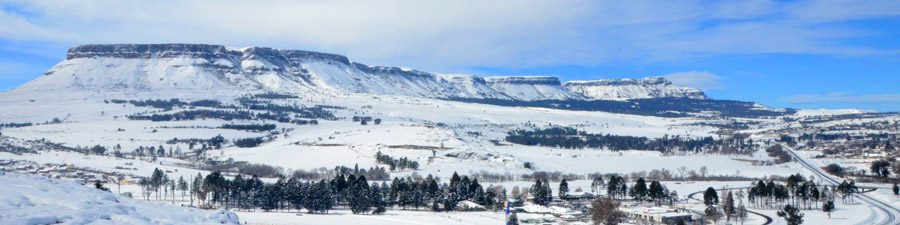
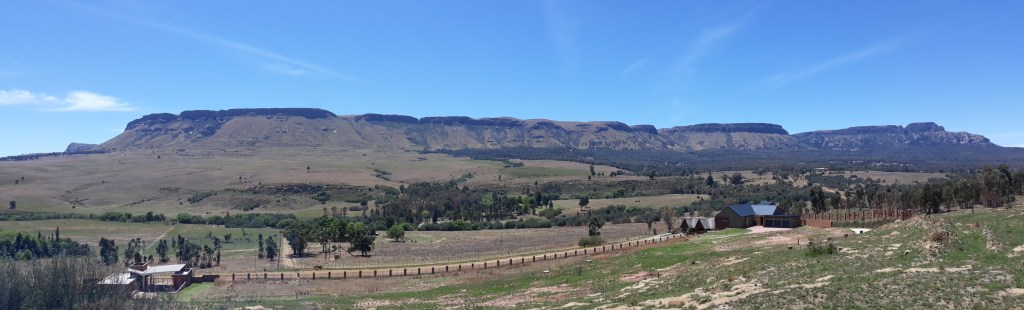
Platberg, overlooking the town of Harrismith in the Free State, is an inselberg that presents a refuge for indigenous plants and animals. And its status is precarious.
– Platberg behind Bakerskop in the foreground –
‘Little is known about the different taxa of Platberg and hence a detailed floristic and ecological survey was undertaken in 2009 by UNISA’s Robert F. Brand, Leslie R. Brown and Pieter J. du Preez to quantify threats to the native flora and to establish whether links exist with higher-altitude Afro-alpine flora occurring on the Drakensberg. Vegetation surveys provide information on the different plant communities and plant species present and form the basis of any management plan for a specific area. No extensive vegetation surveys had been undertaken on Platberg prior to this study; Only limited opportunistic floristic collections were done: Firstly, in the mid-1960s by Mrs. Jacobs. These vouchers were mounted and authenticated in 2006 and are now housed at the Geo Potts Herbarium, Botany Department, University of the Free State;
Secondly, 50 relevés were sampled between 1975 and 1976 by Professor H.J.T. Venter, Department of Genetics and Plant Sciences, University of the Free State.
Mucina & Rutherford 2006 say: ‘Platberg is the single largest and best preserved high-altitude grassland in the Free State. ‘
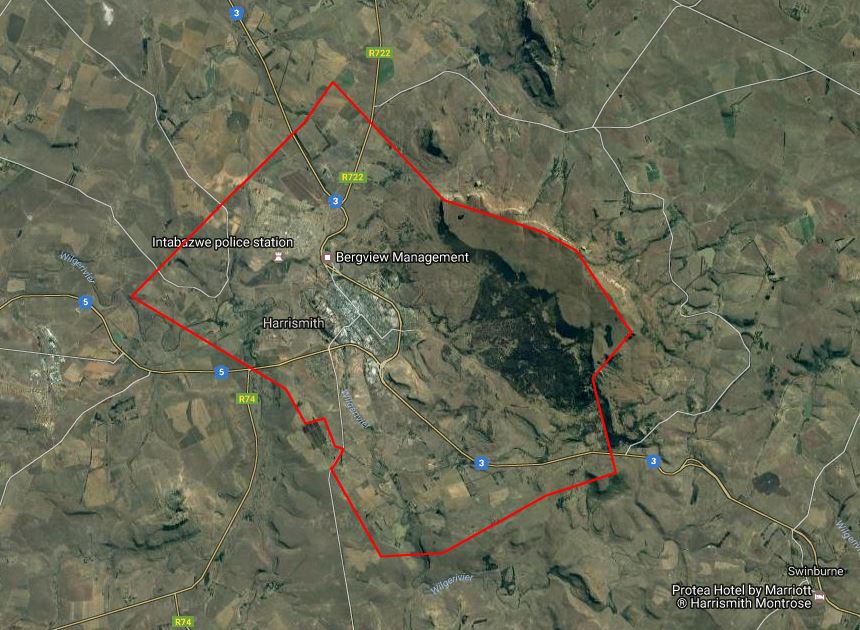
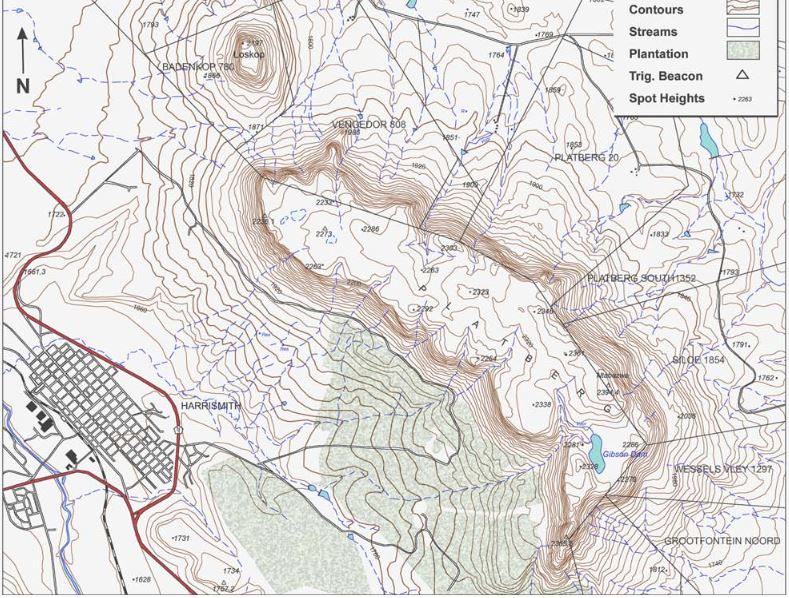
– and I say in 2019: Look how tiny it is! You can hardly see Platberg on this map of all nearby high altitude places. Yet this is our single largest tiny piece of this grassland left!
The authors plead: ‘As an important high-altitude grassland, it is imperative that Platberg be provided with protection legislated on at least a provincial level.’ At present, Platberg is still municipal, with very little protection! – In fact, I think they hire out the grazing for cattle – I hope not, as that really damages the veld and wetlands.
– That tiny island above the ‘th’ in Harrismith = Platberg – – Harrismith townlands –
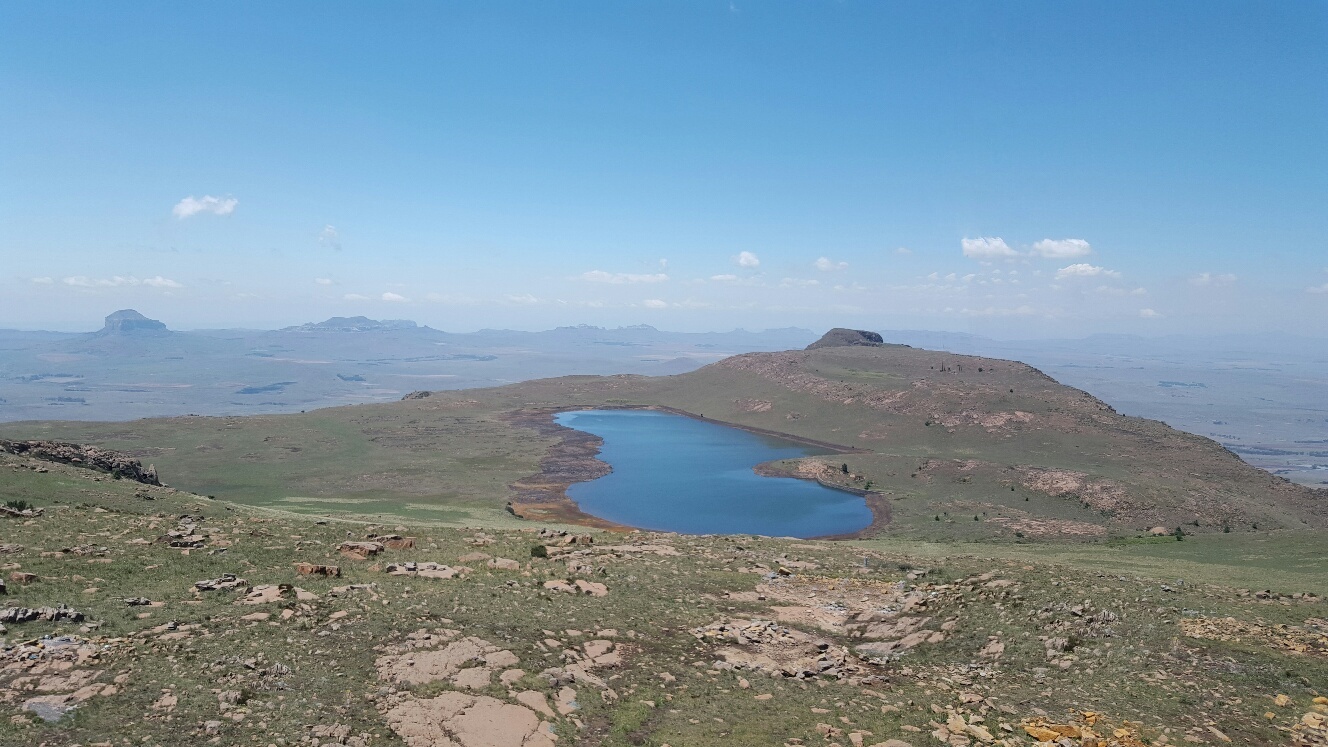
Platberg’s altitude ranges from 1 900m to 2 394m ASL. The surface area covers approximately 3 000ha. The slopes are steep with numerous vegetated gullies and boulder scree slopes below vertical cliffs that are 20m to 45m high. Waterfalls cascade down the southern cliffs after rain. A permanent stream arising from the vleis around, and the vleis drowned by, Gibson Dam on the undulating plateau flows off the escarpment and cascades as a waterfall. From a distance, Platberg appears to have a distinct flat top. However, once on the summit the plateau is found to be undulating, with rolling grass-covered slopes. The vegetation of the plateau is dominated by grassland, with a few rocky ridges, sheet rock and rubble patches, as well as numerous seasonal wetlands and a permanent open playa (pan) – I’ve always called it a tarn – on its far western side. Woody patches of the genera Leucosidea, Buddleja, Kiggelaria, Polygala, Heteromorpha and Rhus shrubs, as well as the indigenous Mountain bamboo Thamnocalamus tessellatus, grow along the base of the cliffs. The shrubland vegetation is concentrated on the cool (town) side of Platberg, on sandstone of the Clarens Formation, in gullies, on scree slopes, mobile boulder beds, and on rocky ridges. Shrubs and trees also occur in a riparian habitat in the south-facing cleft, in which the only road ascends steeply to the summit up Flat Rock Pass. Platberg falls within the Grassland Biome, generally containing short to tall sour grasses. Platberg is a prominent isolated vegetation ‘island’ with affinities to the Drakensberg Grassland Bioregion, embedded in a lower lying matrix of Eastern Free State Sandy Grassland. Platberg also has elements of Fynbos, False Karoo and Succulent Karoo, as well as elements of Temperate and Transitional Forest, specifically Highland Sourveld veld types.
– spot Platberg’s highest point, Ntabazwe 2394m ASL –Looking from highpoint Mtabazwe towards Boobejaanskop eastern tip
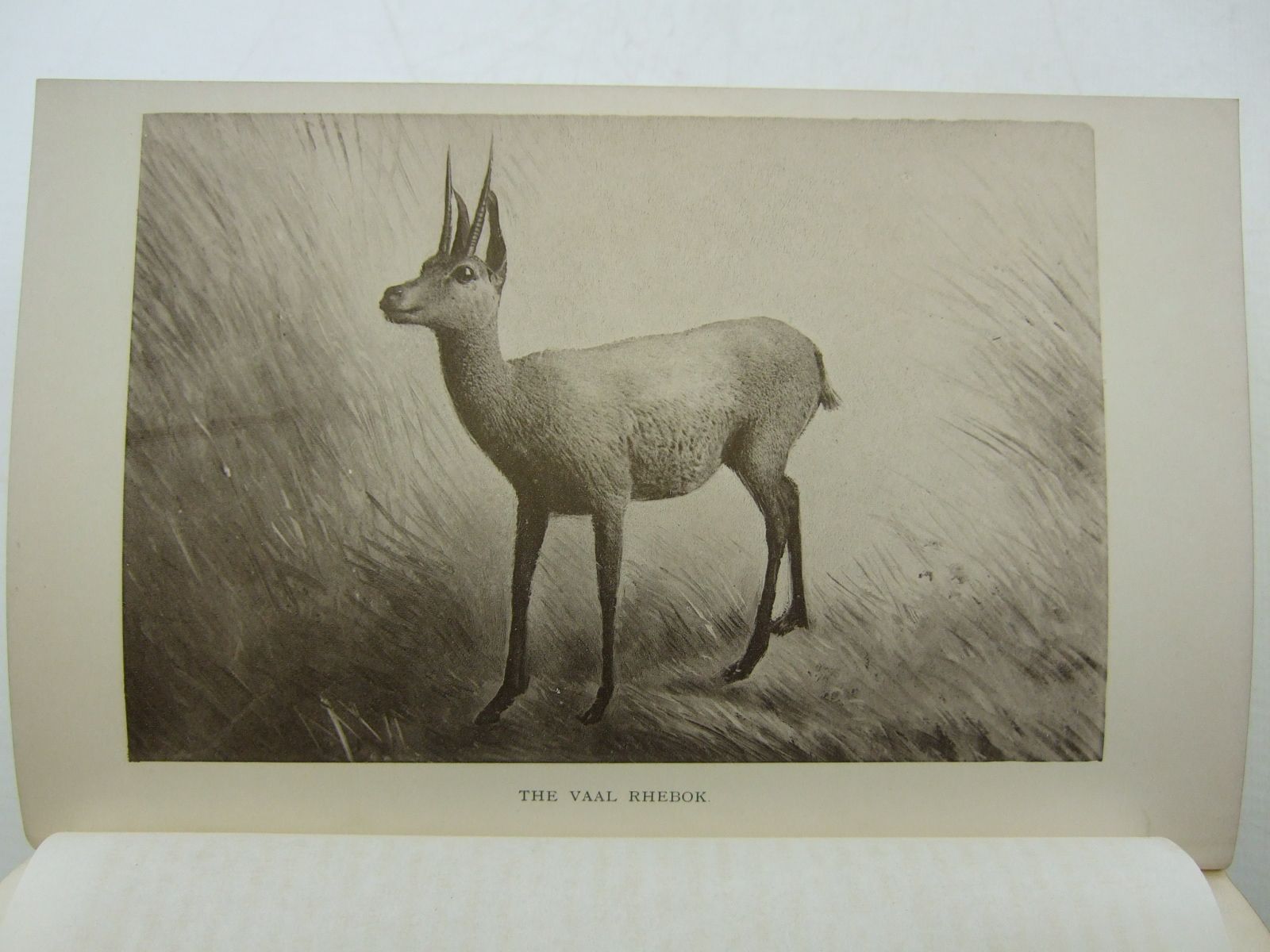
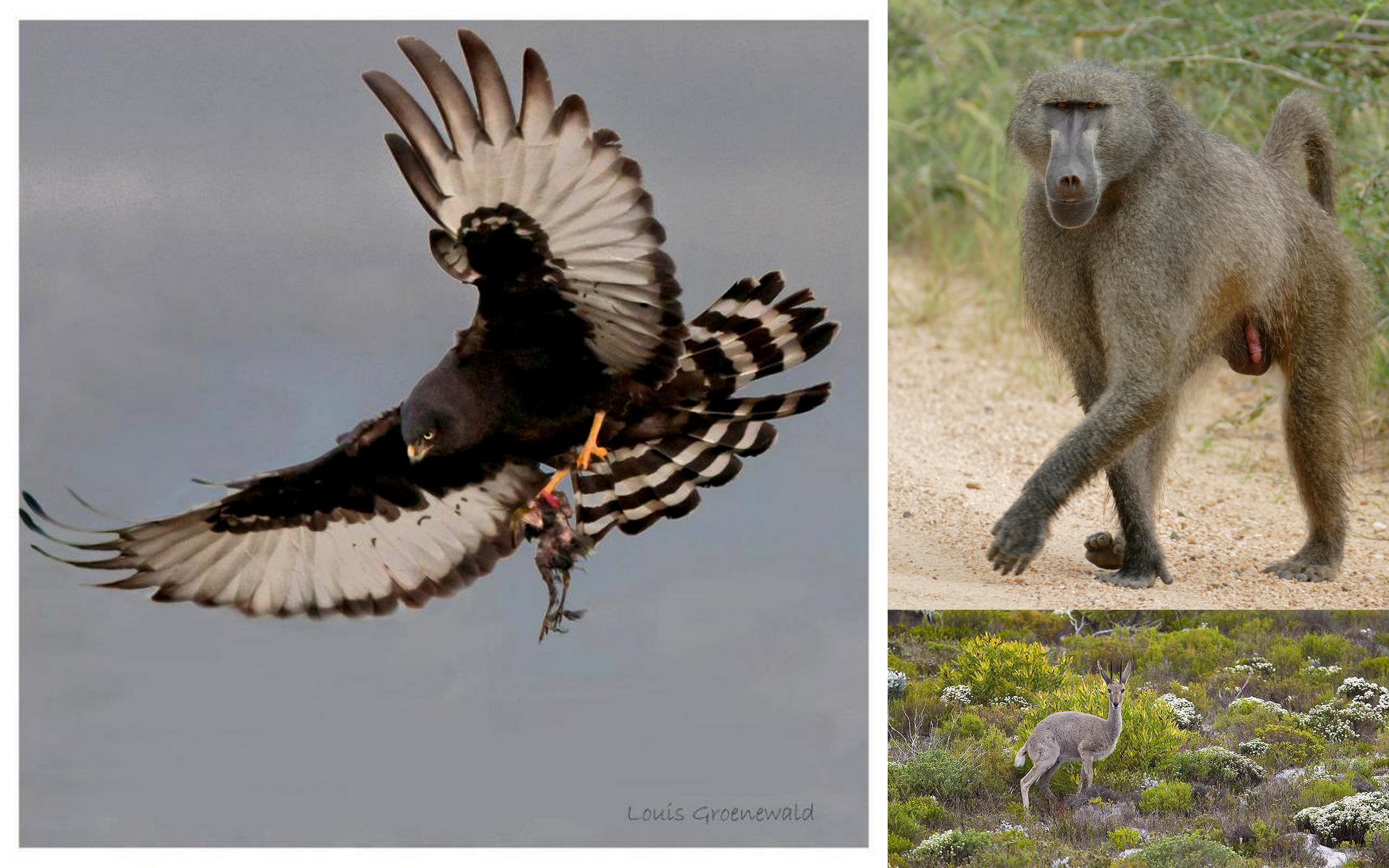
I wonder if there are any grey rhebok left?
Platberg specials– the road up Flat Rock (or Donkey) Pass –
See more of Platberg’s beauty in this amazing post. Damn! Sandra seems to have ended her beautiful blog! Pity!
~~~ooo0oo~~~
inselberg – German for ‘island mountain,’ the word first appeared in English in 1913, apparently because German explorers thought isolated mountains rising from the plains of southern Africa looked like islands in the midst of the ocean. Geologically speaking, an inselberg is a hill of hard volcanic rock that has resisted wind and weather and remained strong and tall as the land around it eroded away. Wikipedia says in South Africa it could also be called a koppie but I think we’d klap anyone who called our Platberg mountain or inselberg a ‘koppie.’
koppie – a smaller thing than Platberg; Just west of Platberg is Loskop; you can call that a koppie, maybe, if you call it a beautiful high koppie with an impressive cliff
relevé – in population ecology, a plot that encloses the minimal area under a species-area curve; right
tarn – tarn is a term derived from tjörn an Old Norse word meaning ‘pond.’ The term’s more specific use as a mountain lake comes from the upland regions of Northern England where tarn is the name given to all ponds. The term retains a broader use since it may refer to any pond or small lake regardless of where it is located or its origin. In the Scandinavian languages the terms tjørn, tärn, tjern, or tjärn are used to refer to small natural lakes that are found closely surrounded with vegetation. Other definitions say a tarn is a post-glacial pond, and Platberg’s is not that, I don’t think. I think it’s fine to keep calling ours the tarn on the western end of Platberg.
~~~oo0oo~~~
Aside: Talking of special high altitude grasslands, who knew of the Korannaberg near the mighty metropolis of Excelsior of dominees-wat-meidenaai fame? It has 767 plant species in its 130km2! It sure looks like a must-visit place! 227 bird species too.
dominees-wat-meidenaai – practicing what you preach against; the old Do as I Say, not as I Do BS that patriarchs try to enforce
Arthur Kennedy arrived in Harrismith like a dwarrelwind. Why we were so lucky as to get Arthur to our town I don’t know, but I think his wife Zita had family here. I think she was related to the Kerkenberg mountain vd Bosch’s.
He brought an exciting new venture to the dorp: A new motel on the N3 on the south-east end of town – at the Jo’burg-Durban-Bloemfontein junction – or the Warden-Swinburne-Kestell junction you could say if you weren’t going to drive far.
The motel – Kennedy Motel – was going to have a ‘flyover’ restaurant suspended over the road so diners could watch the road as they munched their mixed grills. All the Durban-Joburg traffic – the busiest rural freeway in South Africa by far – would have to drive underneath them. But meantime the motel and petrol station had to be built, plus all the rooms – the chalets. A cable car to the top of Platberg was also in the pipeline, according to Arthur. Big plans!
The Kennedy family stayed right on-site in novel half-round semi-portable wooden bungalows above the building site and below the track that was an extension of Vowe Street, below the SE end of Hector Street. Arthur was very hands-on and was deeply involved in everything. He made the cardinal apartheid error of starting to pay his workers more than the “known” Harrismith wage which, according to Steph de Witt, got 5ft 6 inch Arthur a visit from 6ft 4 inch Koos de Witt, Steph’s Dad. Steph says Koos found Arthur in a foundation ditch. He jumped in next to him and “explained” to him in international language how he was not to bend the “local rules” of wage exploitation.
Later he built a triangular house of wood and glass above Vowe Street – a huge novelty for the town. It was next door to the du Plessis home, and Pierre and I hopped the fence and inspected it while under construction. The bathroom had a novelty in it which we hadn’t seen before. We didn’t know it was called a bidet, but we spotted right away what it was for. HaHaHa! Our schoolboy humour kicked in. Arthur’s initials were AW (were they? or did we invent that?) and we proceeded to call him Arse Washer after that bathroom furniture that so tickled our crude funny bones. We weren’t always Methodist-polite, ’tis true.
He even became a town councillor, this foreign rooinek in the vrystaat! If America could have a President Kennedy at that time, why couldn’t we have a possible future mayor Kennedy? Quite a guy was our Arthur!
~~~oo0oo~~~
The Cupboard Snake
For a while the Kennedys lived in the middle of town – in or near the house where Nick Duursema lived, near the circle in Warden street, just down from Arthur Grey’s corner store. That’s where the puff adder landed on top of the bedroom wardrobe.
The first and last puff adder I saw ‘in the wild’ was in Hector Street outside our house in about 1965 when – ware vrystater that she was – Mother Mary ran over the poor thing in the blue VW OHS 155. Doelbewus! Swear! The old man was called out from the pub. He came home, caught it and put it in a box which he gave to Zita Kennedy to give to her brother Tommy van den Bosch. Maybe he’d first stunned it with a blast of cane spirits breath. Probably.
Tommy lived against the slopes of Kerkenberg and wore a cowboy hat and played the guitar. He’d sing you a mournful – or toe-tapping if that was your poison – cowboy song at the drop of a hat. His 10-gallon stetson hat. He collected snakes and took them to the Durban snake park who paid him by the foot. They estimated this puffy at five foot, though of course that length may have grown over time! SSSSS – Snake Stories Seldom Suffer Shrinkage. And: Who knew snakes even had feet?
That night in bed just before lights out Arthur Kennedy asked Zita “What’s that box up on the cupboard?” She hadn’t finished telling him and he was already out in Bester Street opposite the ou groot kerk near the traffic circle in his tiny pie-jarm shorts shouting “Get that thing out of there ! I am NEVER going into that house again until that thing is gone!” and other earnest entreaties.
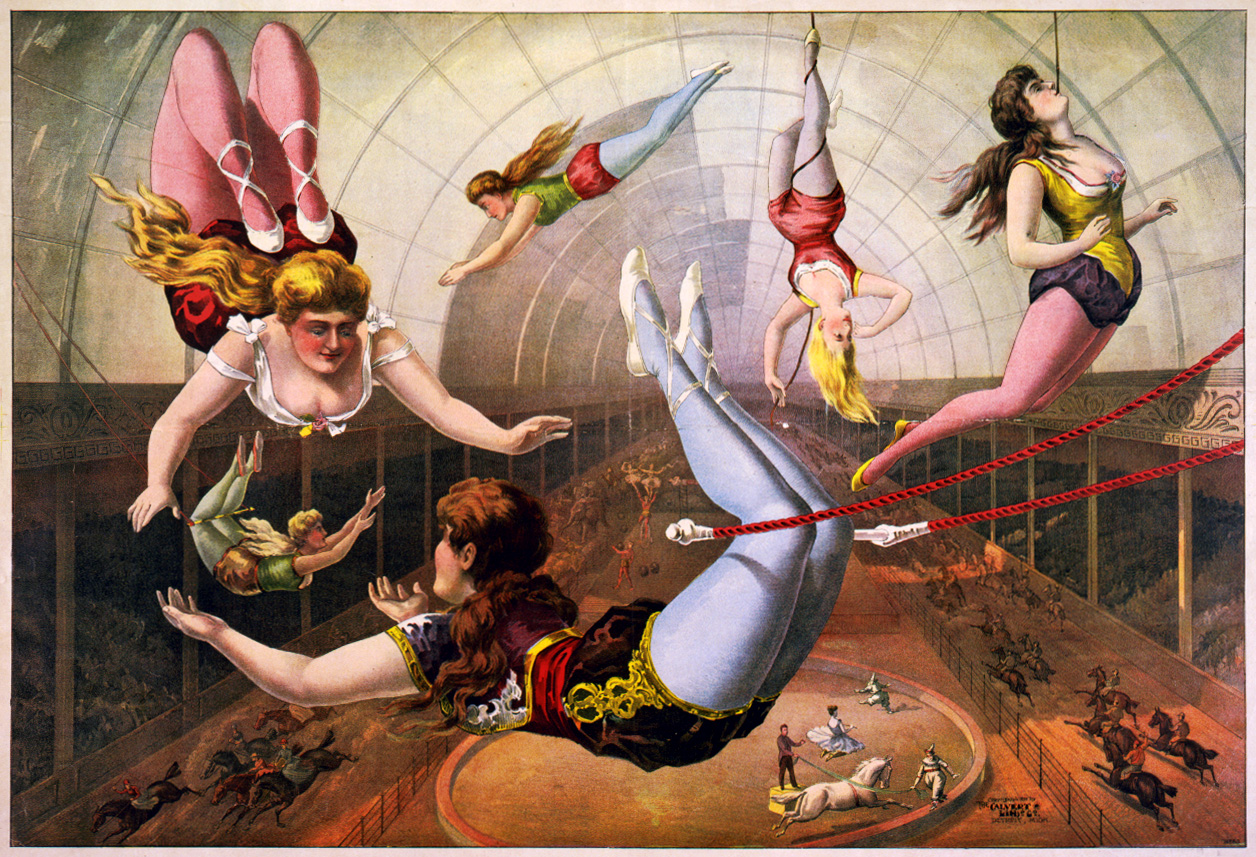
Flying through the air with the greatest of ease – Flew Arthur K on his flying trapeze!
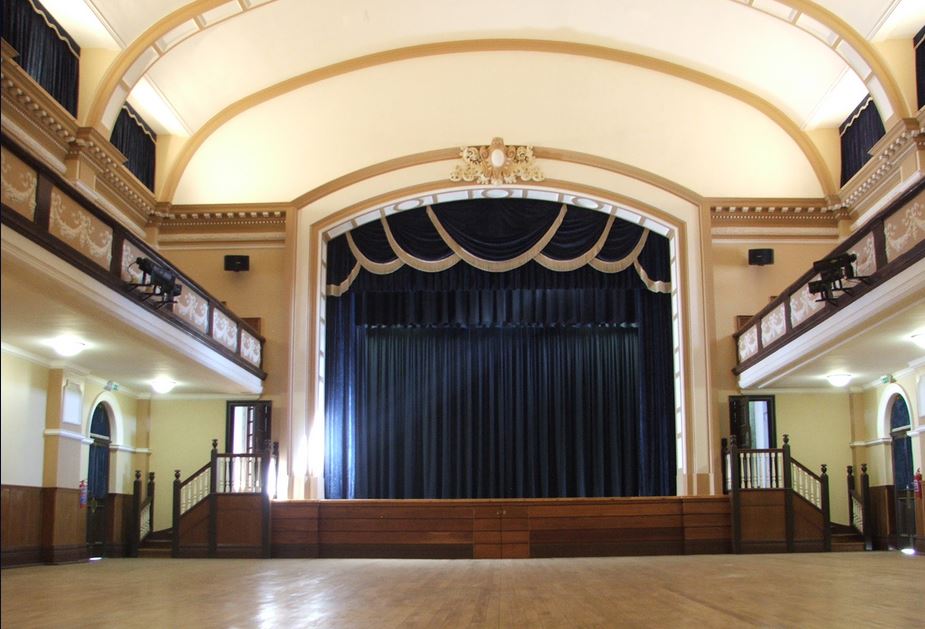
He did! He flew the full length of the stadsaal; again in his tight broeks. So he might have had a fear of snakes, but he was fearless in other ways: Who can forget Arthur Kennedy dressed only in a white Tarzan loincloth, swinging right across the hele stadsaal on a trapeze high above the gob-smacked and ge-be-indrukte Harrismith dorpsmense? And outdoors upside-down high on a thin pole above the skougronde? Fearless aerobatics and acrobatics.
But a snake on his cupboard? That was too much for him!
For a while he made Harrismith seem part of the wider world! It was a bit like this: Flying onderbroeks flashing past your very eyes. In daytime!
Here’s the actual scene of the thrill (the curtains were red back then):
Republic Day 31 May 1961: On the big day celebrating South Africa’s freedom from the tyranny (or oversight?) of Mrs British Queen, Arthur gave a stunning performance on his own equipment down at the President Brand Park in front of a full pawiljoen of ge-be-indrukte Harrismith mense! Dad filmed it:
~~~oo0oo~~~
Arthur ran our mountain race and, further proving his commitment to Harrismith he married a second local girl – much, much younger than him.
~~~oo0oo~~~
dwarrelwind – breath of fresh air; or whirlwind, tornado
doelbewus – with murderous intent; or on purpose; Swear! ‘Strue’s God! Gentle Mary did that. In those days you did. The only thing that made you think maybe you wouldn’t drive over it was the story that it would wind itself around your axle and then climb up into your engine, then climb under your dashboard and THEN . . pik you on the foot! Swear!
pik – snakebite
ware vrystater – genuine free stater; born and bred in the free state, as was her mother before her (who would not have been celebrating the 1961 demotion of QEII from monarch to foreign tannie)
tannie – auntie
ou groot kerk – the old Dutch Reformed Church, the Moederkerk
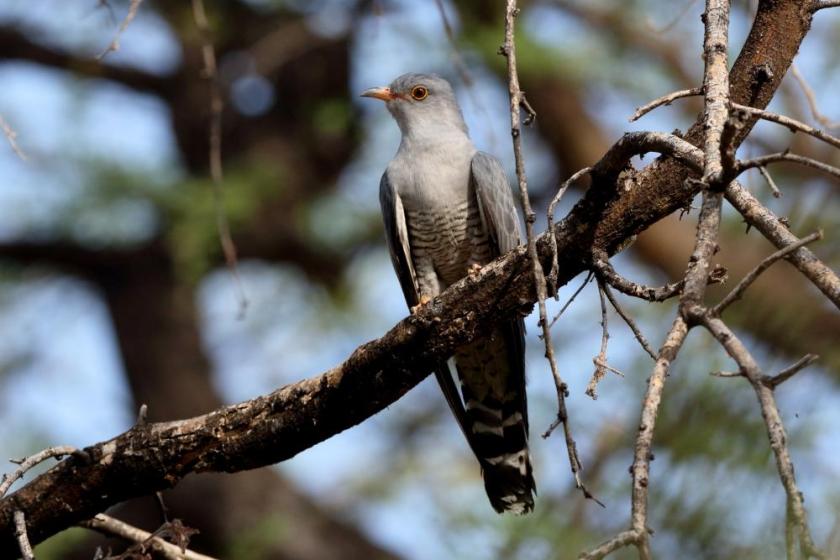
People often rail against cuckoos and use all sorts of pejorative descriptions about them and their ways. Hey! Cuckoos gotta do what cuckoos gotta do. Nature. Survival. Survival of the fittest. Evolution. Life. Bird life.
Consider three things: 1. Cuckoos have no alternative. This is the ONLY way they can breed; 2. Cuckoos eat a whole bunch of caterpillars, even the ones with poisonous hairs and barbs. We need cuckoos. 3. Anthropomorphising animals is never a good idea. Cuckoos aren’t little feathered humans deciding ‘What the hell, I’ll drop the kids off at a neighbour’s house and abandon them there.’ And don’t the lucky among us humans drop off our young at other places for at least part of at least some days?
So I’m always disappointed when people use descriptions like ‘nasty cheat’, ‘treacherous’, ‘deceitful’, etc when describing cuckoos. Many birds like hawks and eagles who do bring up their own young catch and kill other birds – including baby birds taken from their nests – to feed to their young. It’s all just nature, people!
In fact the ‘arms race’ between cuckoos trying to lay their eggs in their hosts’ nests and the hosts trying to thwart the cuckoos makes for fascinating natural history.
And every now and then one might even get to see it happening! I did once and this story of an African Cuckoo coming to a sticky end after trying to enter an Indian Mynah nest reminded me of it.
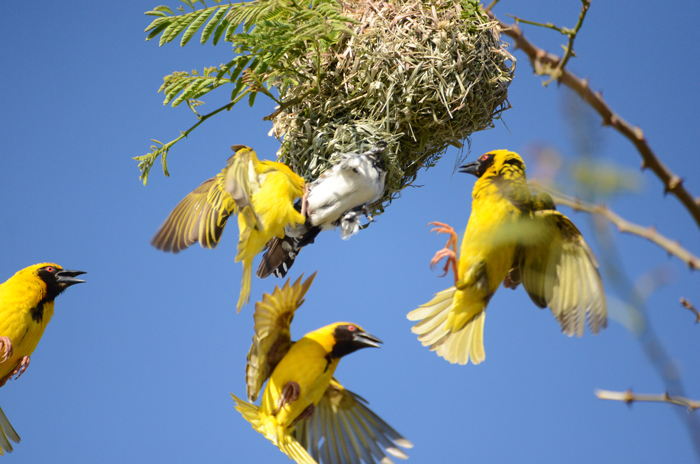
My encounter was on the last day of a Dusi Canoe Marathon back in the nineteen eighties. I was drifting along on the Umgeni River just upstream of the big N2 bridge across the river, wishing the current would do a bit more to get me to the finish at Blue Lagoon, when I heard a ruckus and saw a bunch of weavers chasing and mobbing a bird. As I got closer I saw it was a Diederik Cuckoo pulling its best aerial dogfighting maneuvres to try and escape the mob. Even flying upside down some of the time so its claws could fend off the pecking. To no avail. They beat her down into the reedbed and then down the reeds onto the water. Then I was past the scene of this neighbourhood vigilante action. So I didn’t see the end and don’t know if the Diederik was actually killed, as the Mynahs in North West Province killed the African Cuckoo. Fascinating!
The Umfolosi Wilderness is a special place. Far too small, of course, but its what we have. I read Ian Player’s account of how Magqubu Ntombela taught him about wilderness and Africa and nature. The idea of a wild place where modern man could go to escape the city and re-discover what Africa was like, was born and actioned right here in Mfolosi. Experience it – it’s amazing.
My first trail was ca 1990, when I went with Dusi canoeing buddies Doug Retief, Martin & Marlene Loewenstein and Andre Hawarden. We were joined by a young lass on her own, sent by her father, who added greatly to the scenery:
– Martin peers; I grimace; We’re both thinking of the gorgeous Donna next to me! –
A good sport, she took our gentle teasing well and fended off the horny game ranger with aplomb.
We went in my kombi and some highlights I recall were:
Doug offering “bah-ronies” after lunch one day. We were lying in the shade of a tree after a delicious lunch made by our guides: Thick slices of white bread, buttered and stuffed with generous slices of tomato and onion, salt and black pepper. Washed down with tea freshly brewed over a fire of Thomboti wood. Doug fished around in his rucksack and gave us each a mini Bar One (“bah-ronie”, geddit?). Best tasting chocolate I ever ate, spiced as it was with hunger and exertion.
After the five-night trail we went for a game drive on the way out of the park. Needing a leak after a few bitterly cold brews I left the wheel with the kombi trundling along amiably and walked to the side door of the kombi, ordering Hawarden to take over the driving. Not good at taking orders, he looked at me, waited till I was in mid-stream out of the open sliding door and leant over with his hiking stick and pressed the accelerator. The driverless kombi picked up speed and I watched it start to veer off-road, necessitating a squeezed premature end to my leak and a dive for the wheel. Thanks a lot, Hard One!
‘Pleasure,’ he murmured mildly. Hooligan!
~~oo0oo~~
Thirty years later Andre Hooligan Hawarden wrote:
“Hey, remember that cool walk we did in the game reserve when you had the tape recorder and we attracted the owl? Then next day we lay on the bank of the Umlofosi river and watched the vultures coming down for a lunch time drink and a snooze? That was a wonderful experience. I’ve never forgotten it.”
But to do it I needed a henchman. You can hike alone, but I’d really rather not, so I persuaded Stefaans Reed, The Big Weed, resident son of hizzonner the Worshipful Lord Mayor of Nêrens (aka Clarens) and fellow optometry student in Jo’burg to nogschlep.
We sallied forth, rucksacks on our backs, boerewors and coffee and billy can and sleeping bags inside, up the slopes of Platberg, from Piet Uys Street, up past the Botanic Gardens, von During and Hawkins Dams, into the ‘Government forest.’ The pine plantation. ‘Die dennebos.’ We could discern two types of pines. The type we liked had the long soft needles and made a good bed. We walked next to the concrete furrow that led water down the mountain into town from Gibson Dam up on top. Often broken and dry but sometimes full of clear water, it made finding the way easy.
– the furrow on top –
Halfway up we made camp, clearing a big area of the soft pine needles down to bare earth so we could safely light a fire.
Learning from our primate cousins we piled all those leaves and more into a thick gorilla mattress and lay down on it to gaze at the stars through the treetops. This was 1974, we were eerstejaar studente in the big smog of Doornfontein, Jo’burg. We had learnt to drink more beer, sing bawdy songs, throw a mean dart in a smoke-filled pub, hang out of friends car windows as they drove home thinking ‘Whoa! better get these hooligans home!’ and generally honed our urban skills. Steve had found a few wimmin and I almost had. Now we were honing our rural skills. Wilderness ‘n all.
As we lay in our sleeping bags, burping boerewors and gazing through the pine fronds at the stars, we heard a loud, startling, beautiful sound.
I was wide-eyed wide-awake! WHAT on EARTH was that!? I knew it had to be a night bird, but what? Which one?
In the dark I scribbled down a picture of the sound. This is what it sounded like to me and I wanted to be sure I didn’t forget it:
I didn’t know I was drawing a ‘sonogram’ – I’d never heard of that.
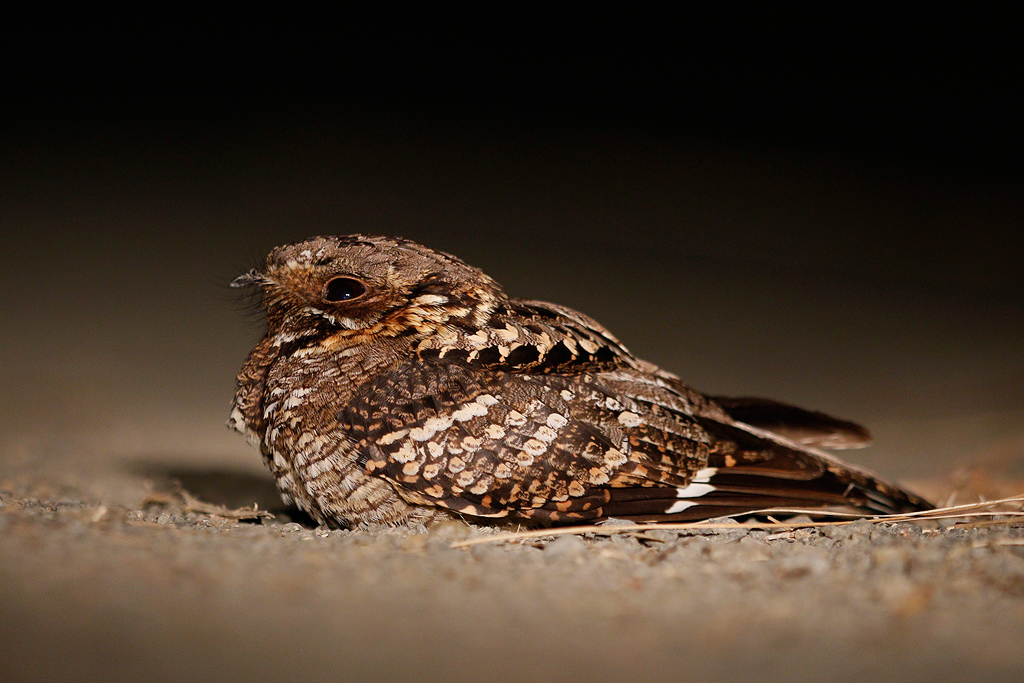
When I got back home I looked through my ‘Birds of South Africa – Austin Roberts’ by G.R. McLachlan and R. Liversidge, 1970 – and found there was a nightjar that said “Good Lord Deliver Us” and I knew that was it. The Fiery-Necked Nightjar – some call it the Litany Bird. I loved it, I love it, I’ll never forget it and it’s still a favourite bird fifty years later.
– they look similar but they sound very different –
– stunning nocturnal aerial insect catcher –
Next morning we hiked on, past the beautiful eastern tip of Platberg – some call it ‘Bobbejaankop’ – and down round Queen’s Hill through some very dense thicket, across the N3 highway, back home and a cold beer. See more pics of Platberg.
– that dense thicket in foreground –
~~~oo0oo~~~
– here’s a real sonogram of the Good Lord Deliver Us bird – top one looks like mine if you squint –
Thanks xeno-canto.org for sharing birdsounds from around the world.
Those pine trees may be Pinus patula – soft leaves, not spiky. Comfy. Still an invasive pest, though.
A ‘litany’ is a tedious recital or repetitive series; ‘a litany of complaints’; ‘a series of invocations and supplications‘;
The Catholics can really rev it up – Lord, have mercy on us. Christ, have mercy on us. Lord, have mercy on us. Christ, hear us. Christ, graciously hear us. God the Father of Heaven, Have mercy on us. God the Son, Redeemer of the world, Have mercy on us. – and this is one-twelfth of the Catholic Litany, there’s eleven-twelfths more! Holy shit!!
If I was God I’d do some smiting.
~~oo0oo~~
Nêrens – nowhere, or Clarens in the Free State, named after Clarens, Switzerland to which that coward Paul Kruger fled cowardly after accusing my brave great-great Oom of cowardice. Ha! Who actually stayed and fought the war, huh?
nogschlep – kom saam; accompany
kom saam – nogschlep
boerewors – raw beef wurst; just add fire
dennebos – pine plantation; plantations are not forests!
Great friend Larry Wingert is out from the USA and we hop on a flight to Maun in Botswana. It’s 1985 and we’re bachelors on the loose with time and money!
– 1985 Maun – pics by Lee Ouzman, who arrived about then – and stayed –
From Maun we fly into the Okavango Delta (Tjou / Chau Island camp) in a Cessna 206. After many beers and wines a resident auntie starts looking enticing at around midnight but the moment passes.
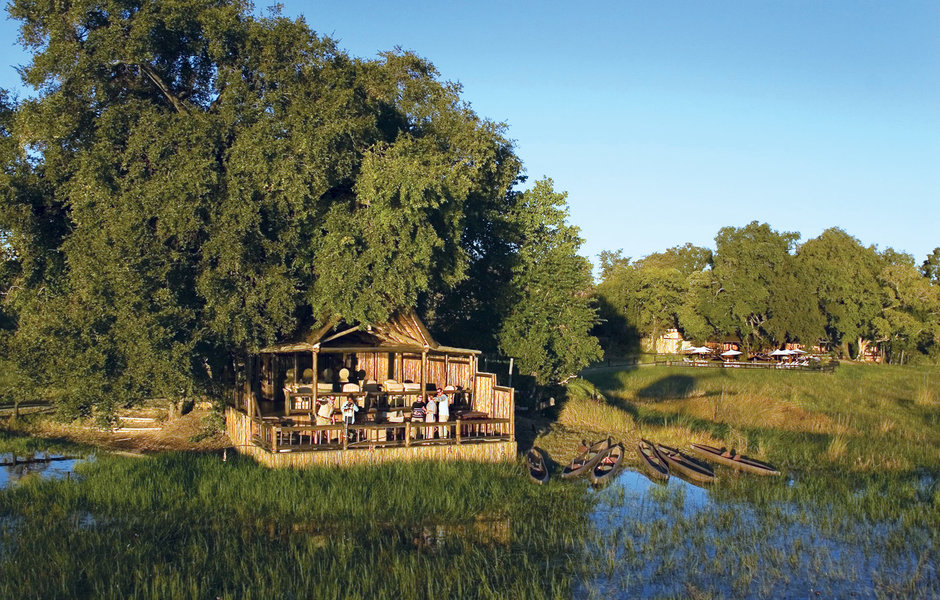
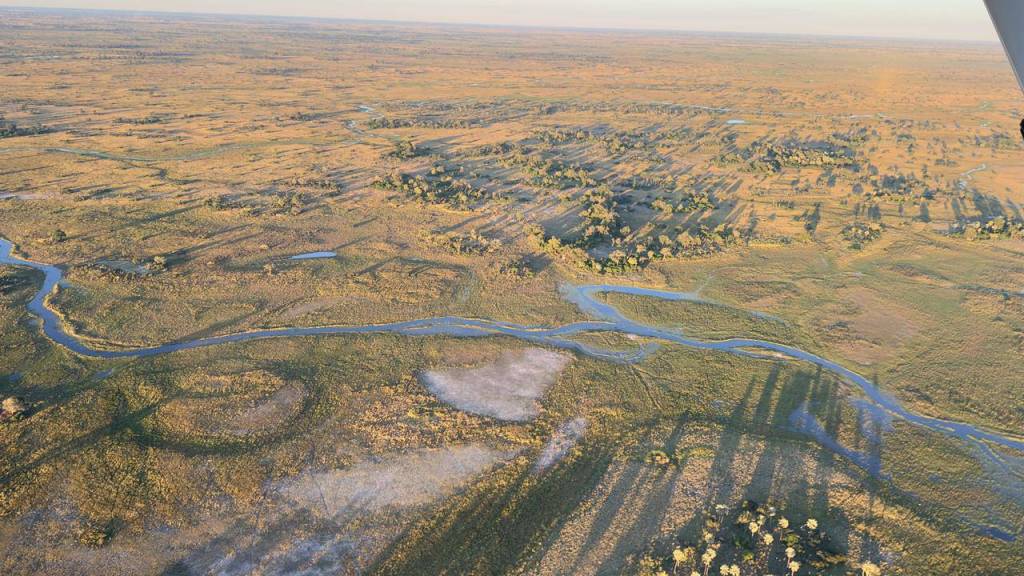
– internet pics of where I think Tjou Island was – names change – I’m hoping to get pics from Larry –– Chau Island in 2025 –
The next morning a pair of tropical boubou fly into the open-air pub under a tree right above where we’re sitting and belt out a startling loud duet. Stunning! That’s a lifer!
– pic from afrol.com – see story on tropical boubou calls –
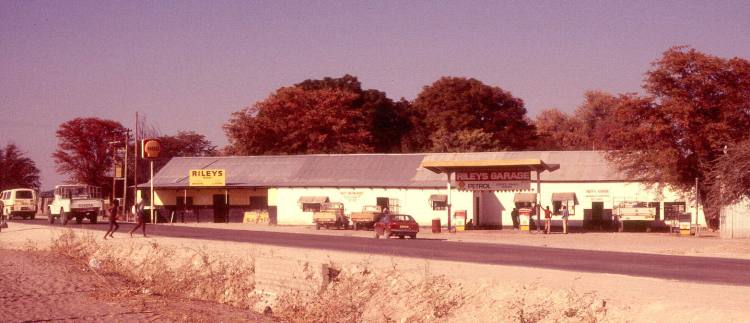
After a short mokoro ride around some islands with a walk on one of them, it’s back to the plane and a short flip back to Maun where we all squeeze into an old Land Rover, fill up at Riley’s Garage . .
– 1985 Rileys Garage by Lee Ouzman –
. . and head off for Moremi, stopping just outside Maun to buy some meat hanging from a thorn tree. Goat? Supper. Our outfit is called Afro Ventures.
We’re a Motley Crew from all over. We get to know two Aussie ladies, a Kiwi lady, a Pom fella – 6 foot 7 inches of Ralph; AND the gorgeous Zimbabwean Angel Breasts (Engelbrecht her actual surname)! Unfortunately, she’s the Long Pom’s girlfriend (*sigh*). Weird how the only first name I can think of now is Ralph, the undeserving Pom.
Our long-haired laid-back hippy Saffer – no, he was probably a Zim, see his letter – safari guide Steve at the wheel is super-cool, a great guide. So off we go, heading north-east, eight people in a Series 2 Landie – “The Tightest-Squeeze-Four-By-Four-By-Far”.
Long Legs in a Landie to the rescue!
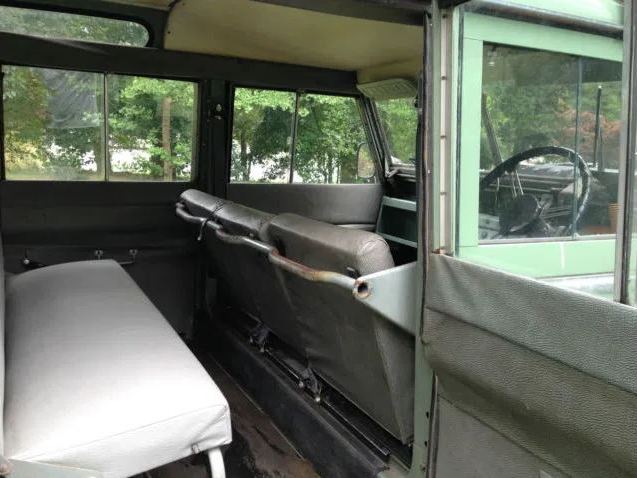
Anyone who has driven in an old Landie will know there’s lots of room inside – except for your shoulders and your knees. Besides that – roomy. Land Rover’s theory is that three people can fit on the front seat, three on the middle seat and two on those postage stamp seats in back. Right! See that metal bar that your knees keep bumping against? That’s what Land Rover used as their prototype airbag. It didn’t work so they only kept it for the next fifty years, then changed it. They made it more safety-conscious 2.0 in the late nineties by using milder steel.
– promotional pic extolling landrover luxury –
Previously a critic of Landrover design, in a flash I’m a keen supporter! Unable to endure the cramped space on the middle seat, the lengthy six foot seven inches of Pom gets out at the very first stop and sits on the spare wheel on the roofrack. I sit with my thigh firmly against Angel Breasts’ thigh (*sigh*).
More clever Landrover design features:
Stretched Ralph stays up there for the rest of the week – whenever we’re driving, he sits on the roofrack! When we stop he has to pick the insects out of his teeth, like a radiator. I’m in seventh heaven. Mine and Angel Breasts’ thighs were made for each other.
– she was like this . . . the landrover wasn’t –
Birding: Problem Solved!
I’m mad keen on birding but I don’t know how these guys feel about it. What if they get pissed off? What if they only want to stop for large furry creatures? After all, five of the seven of us are fureigners, un-African. But the problem gets solved like this: The first time we get stuck in the deep sand, a little white-browed scrub robin comes to the rescue! He hops out onto the road in full view, cocks his tail and charms them. From then on I have six spotters who don’t let anything feathered flit past without demanding,“What’s that, Pete? What’s that? And that one?” I become the birding guide! Steve is happy – it’s not his forte, but he’s keen to learn.
– thanks fella! – see wilkinsonsworld.com –
Moremi – and True Love
At Khwai River camp a splendid, enchanted evening vision befalls me – my best wild life sighting of the whole trip: I’m walking in the early evening to supper and bump into Angel Breasts outside her bungalow – she’s in her bra n panties in the moonlight. Bachelor dreams. Oops, she says and runs inside. Don’t worry, I’ve averted my eyes, I lie (*sigh*). That’s another lifer!
Chobe
At Savuti camp the eles have wrecked the water tank.
At Nogatsaa camp a truck stops outside the ranger’s hut, a dead buffalo on the back. The ranger’s wife comes to the truck and is given a hindquarter. Meat rations. They also drop the skin there and advise us to carry a torch if we shower at night as lions are sure to come when they smell the skin.
– internet pic of nogatsaa waterhole –
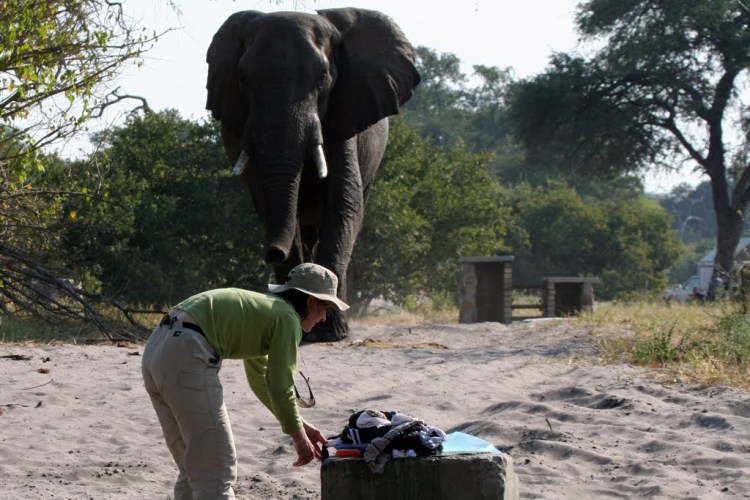
Another Lifer! Later I head for the tiny little shower building – a single shower – to shower while it’s still light. Lion discretion being the better part of valour, I’m not lyin’! A sudden cacophony makes me look out of the broken shower window: The lady-in-residence is chasing an ele away from her hut by banging her pots & pans together! We travel thousands of k’s to see elephant and she says Footsack Wena! Tsamaya! The ele duly footsacks away from that awful noise, looking back as he shuffles off like OK, OK! Jeesh!
While looking out, I spot what I think could be a honeyguide in a tree, so I have to rush back to our puptent wrapped in a towel with one eye on the ele to fetch my binocs. It is a Greater Honeyguide, the one with the lovely Latin name Indicator indicator, and that’s another liferfor me! Moral of the story: Always carry your binocs no matter where you go! He obligingly confirms the sighting by saying:
– Greater Honeyguide, Indicator indicator- also from xeno-canto.org –
That night the elephants graze and browse quietly right next to our puptent, tummies rumbling. Peeping out of the door through the mozzie netting I look at their tree stump legs, can’t even see up high enough to see their heads. Gentle giants.
As we approached the Chobe river the landscape looked like Hiroshima! Elephant damage of the trees was quite unbelievable. That did NOT look like good reserve management! Botswana doesn’t believe in culling, but it sure looks like they should! Too many elephants are spoiling the broth.
The Chobe river, however, was unbelievable. Despite the devastation on its banks – especially after the dry country we’d been in – it was truly magnificent. What a river! What wildlife sightings, the river being the main surface water for miles.
Zimbabwe
On to Zimbabwe, the mighty Zambesi river and Victoria Falls. We stayed at AZambezi Lodge. Here we bid a sad goodbye to our perfect safari companions. Me still deeply in love. Angel Breasts holding the Long Pom’s hand, totally unaware of my devotion (*thigh*).
At the end, our new friend and safari guide Steve gave me and Larry a letter. We read it on the flight out of Vic Falls..
– lovely note –
~~oo0oo~~
Hopeful note: Larry had a camera on the trip, I didn’t, so I have asked him (hello Larry) to scratch around for his colour slides in his attic, his basement, or his secret wall storage space in Akron Ohio. He will one day. As a dedicated procrastinator he is bent on never putting off till tomorrow what he can put off till Wednesday week. Meantime, thanks to Rob & Jane Wilkinson of wilkinsonsworld.com, xeno-canto.org and others on the interwebs for these borrowed pics and sounds!
Edit: There’s hope! Larry wrote 16 December 2017: P.S. I will renew my efforts to locate some photos of our Botswana trip. If you saw the interior of my house, you’d understand the challenge. . . . OK, but if you saw the exterior of his house you’d fall in love with it:
– Bachelor pad, 40 North Portage Path, Akron Ohio –
Terrible note: Update November 2019: Larry has since had a bad fire in the basement of his lovely home. Much of his stuff was ruined by the fire and the smoke, and then the firemen’s water ruined the rest! He may not repair his home! This is so sad! Dammit! Pictures suddenly aren’t important any more.
Update 2020: He sold his home, but thankfully, he got a more convenient place to live, less maintenance, less upstairs and downstairs. And the old home was saved – have a look, beautifully restored.
~~oo0oo~~
Saffer – Suffefrickin; South African
Zim – a Zimbabwean
lifer – first time you’ve seen that bird ever – or anyway in lingerie
Footsack Wena!Tsamaya! – Go away! Be off with you! Eff Oh!
pamberi ‘n chimurenga – forward the liberation struggle! in Shona
1984 was one of the
very few years since 1960 that Colorado river water from the Grand
Canyon actually reached the sea. High snow melt pushed it past the
point where golf courses and old-age homes drain it of all its water
and so – at last! – the waters of the Colorado reached the beautiful
estuary at Baja California and flowed into the Sea of Cortez again!
Unknown to many, 1984 was also the ONLY year Mexicans would have been able to taste Mainstay cane spirits, distilled from South African sugar cane, mixed into that Colorado river water. Well, recycled Mainstay and river water, as the Mainstay that reached the sea had first passed through the kidneys of a mad bunch of South Africans that Chris Greeff had assembled to paddle through the famous American Canyon.
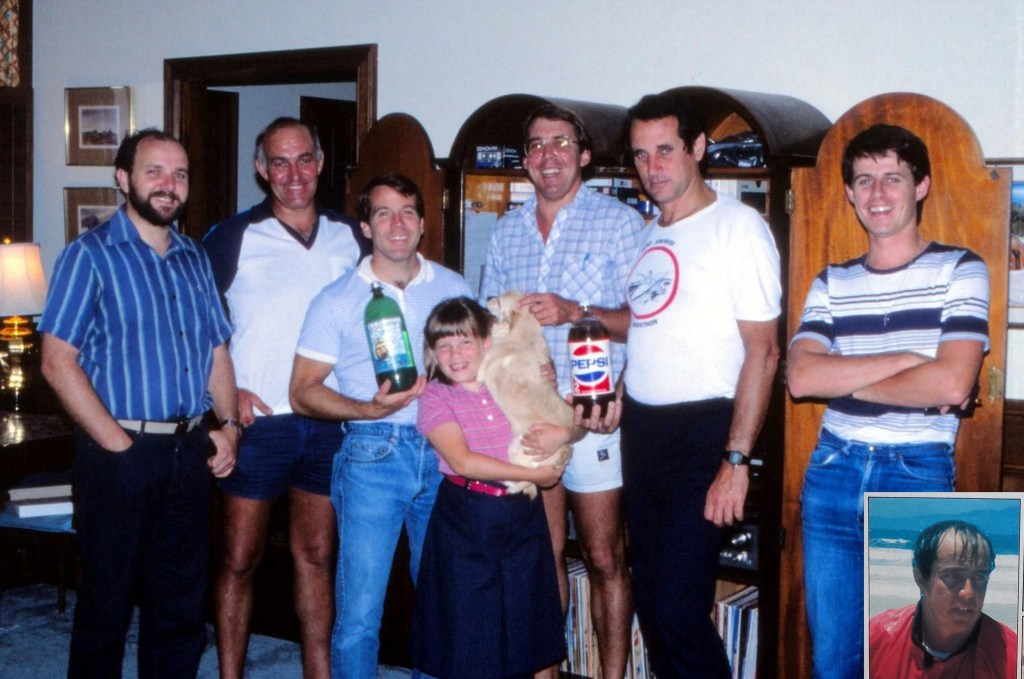
– Dave Jones’ place – Our host in Atlanta – He paddled for the USA – – See the SAA hooch we had decanted into 2litre bottles! –
That’s because we were on the river sponsored by Mainstay Cane Spirits and South African Airways. The ‘Mainstay’ we drank was actually an SAA Boeing 747’s supply of tot bottles of whisky, brandy, gin, vodka, rum – and Mainstay cane spirits. We decanted all the little bottles we could find into two two-litre plastic bottles to help the stewardesses on board with their end-of-Atlantic-crossing stock-take. We had resolved to drink the plane dry, but man, they carry a lot of hooch on those big babies. Maybe in case they end up with all 350 passengers happening to be as thirsty as paddlers are? Here we are in Atlanta with the loot. Note the Mainstay sticker on one bottle held by our host Dave Jones, a paddler himself. Paddled for the USA in K1, C1 and C2 wildwater, US national champ and also coached the USA team. So we were saddled with not one but TWO national paddling champs who are dentists and military men, like beer and do crazy things!
Personally I reckon mixing guns, boats and teeth with beer can only bring trouble . .
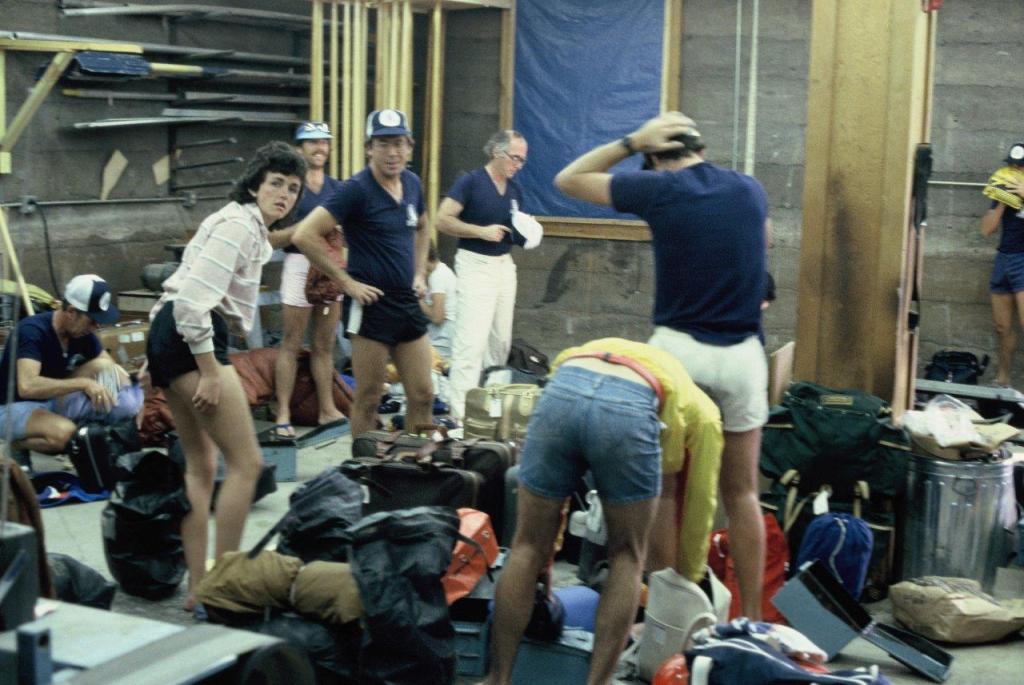
– Saffers busy ‘outfitting’ as the Yanks say –
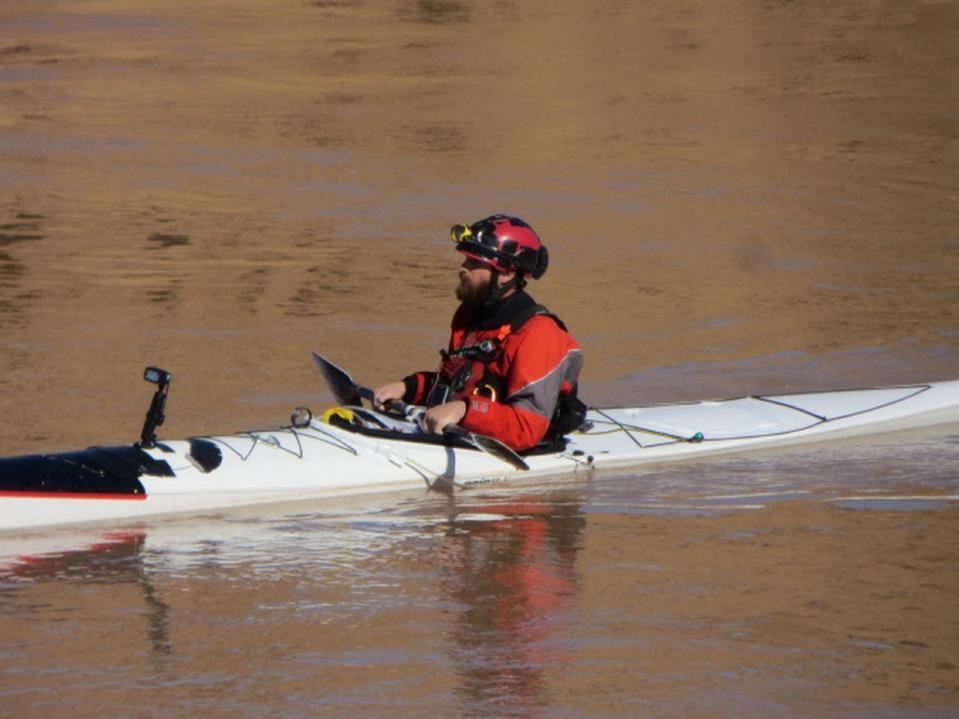
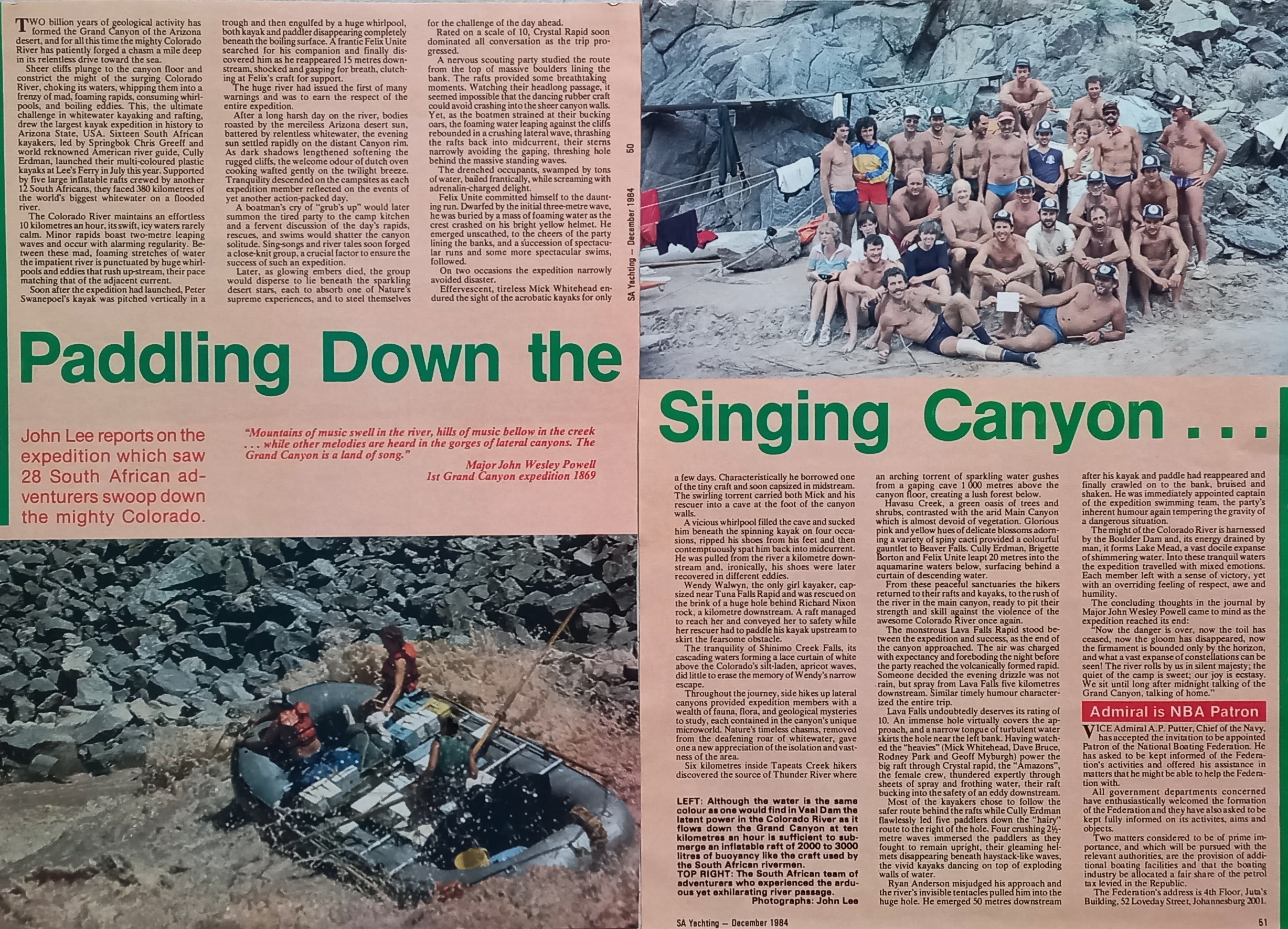
From Atlanta we jetted on to Phoenix Arizona. There we hired another lang slap car and took a slow drive to Flagstaff where we got ‘outfitted’ with kit for the trip. Fifteen canoeists from South Africa joined our guide Cully Erdman and his delightful partner JoJo Suchowiejko on a trip down the Grand Canyon from Lee’s Ferry to the take-out on Lake Mead three hundred miles downstream. We were accompanied by one other paddler, an Argentine José Luis Fonrouge who was ticking off his bucket list, having climbed Everest. Five rubber inflatable rafts crewed by experienced canyon runners carried the food and the ‘Mainstay’ and hundreds of beers, plus a motley assortment of tag-along raft passengers from South Africa. Talking of motley: Us paddlers ranged from capable rough water paddlers to flatwater sprinters to happy trippers to complete novices. Some had Springbok colours, others had a lot of cheek.
Outfitting was also needed for supplies and Greeff put himself in charge of catering for the liquid refreshments. He was good at maths back in Parys se hoerskool so he did some sums: Seventeen kayakers plus some rafters times 12 days times 10 beers each is, lessee . . . OK, and then after breakfast we’ll need . . .
Apparently the yanks thought he’d grossly over-catered and they were worried about how they were going to carry the left-over beer out of the canyon at the end. That’s if the rafts stayed afloat. Well, ons sal sien . .
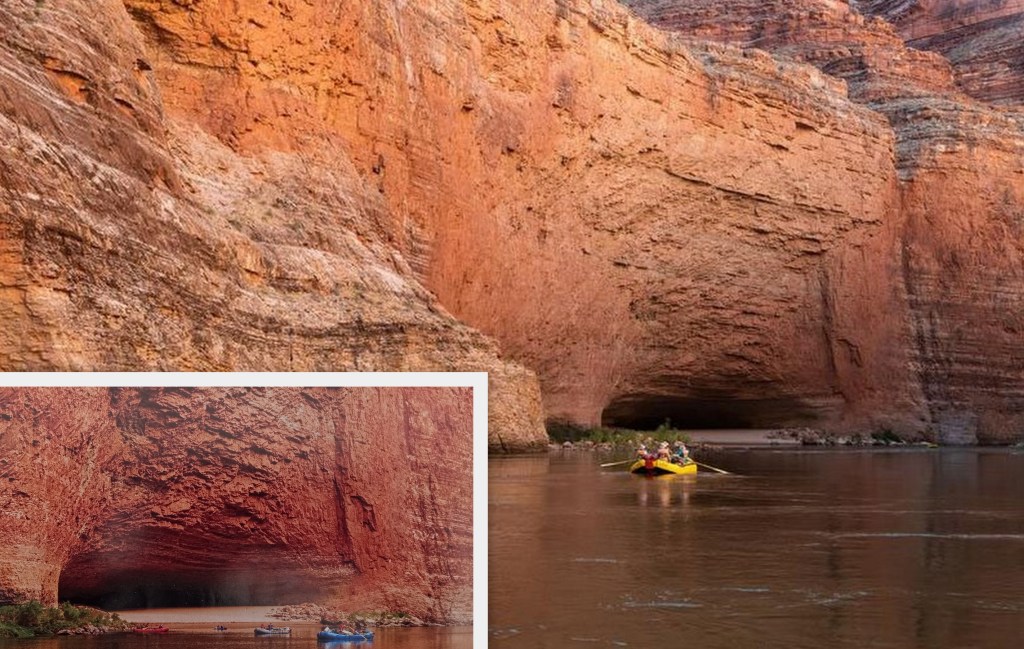
– ‘our’ five rafts with the beer – high water had shrunk this beach, but we stopped to walk up a side canyon –– our river guide Cully Erdman shows us how – he has done it before –– massive Redwall Cavern at mile 33 – pics National Geographic and oars.com – thanks! –– Herve, George & Jojo with her bikini ON –
Some twists in the tale:
My boyhood kayaking heroes had been the van Riet brothers, Willem and Roelof, who won the Dusi three times just as I was first learning about the race ca 1970. As I started to participate in the race in 1972 Graeme Pope-Ellis won the first of his eventual fifteen Dusi wins. Both Willem and Graeme were with us on this trip, along with other paddling legends I had met in my recent entry into the world of canoeing. Having ‘paddled lonely‘ from 1970 to 1982, I was now rubbing shoulders with legends!
– legends of paddling – and me – out of respect for them, I’m wearing longs –
Another twist: In the year I first saw the Colorado river after walking/running down the Bright Angel trail from the South Rim to the Colorado’s swiftly-flowing clear green water, 1973, Willem had launched a boat at Lee’s Ferry, done an eskimo roll and come up with ice in his hair, causing him to postpone his trip. Now he was back, eleven years later – in the summer! And so was I.
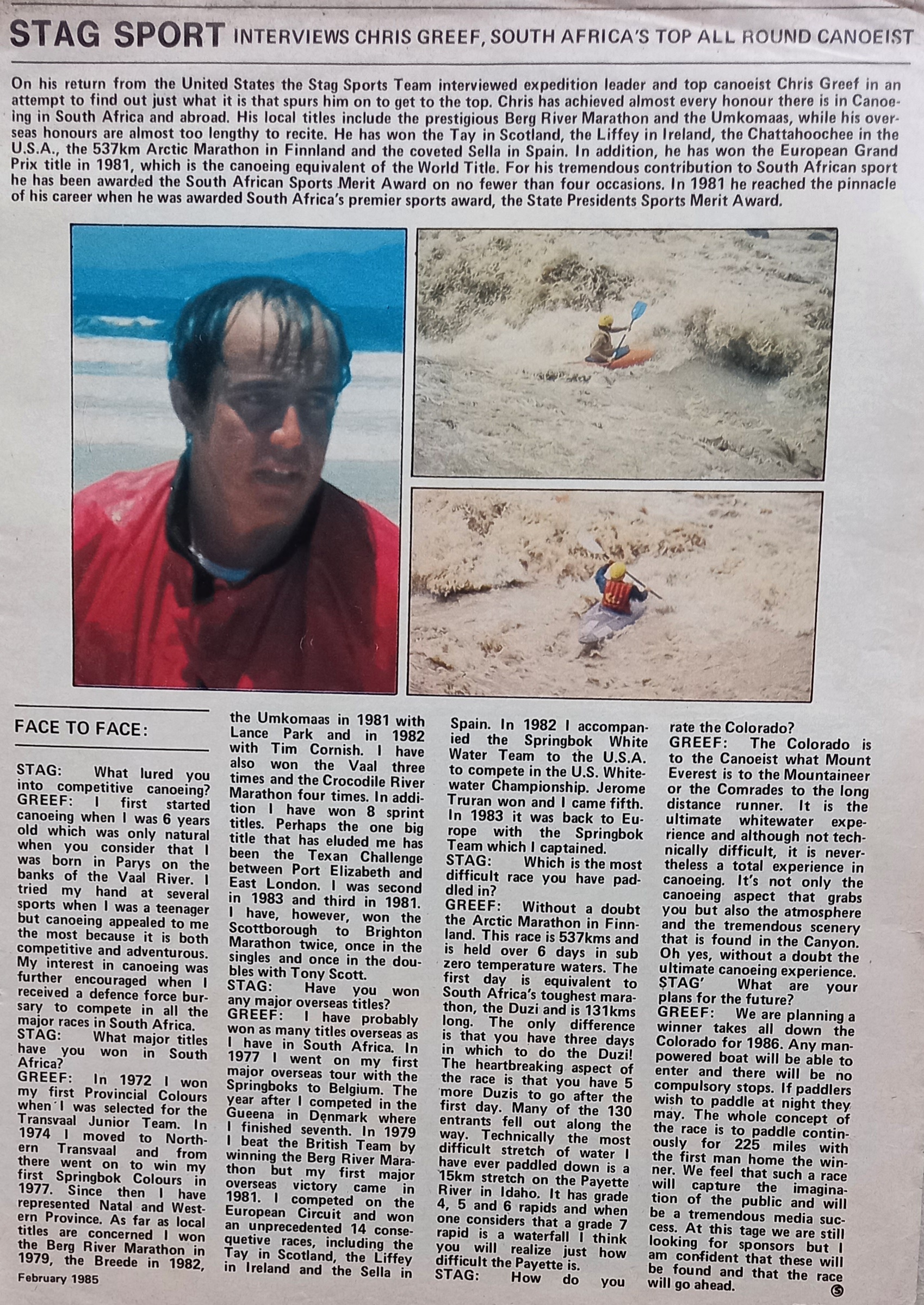
The trip was put together by yet another iconic paddler Chris Greeff, winner of more kayak races than I’d had breakfasts. One of the craziest races he won was the Arctic Canoe Race on the border between Finland and Sweden. About 500km of good pool and drop rapids in cold water. When he arrived at the start with his sleek flatwater racing kayak the other paddlers and the officials looked at their wider, slower, more stable canoes and thought ‘Ha! he intends portaging around all the rapids!’ They had heard of the Dusi and how mad South Africans run with kayaks on their heads, so they amended the rules: Every rapid avoided would incur a stiff time penalty. You portage, you pay! Chris grinned and agreed enthusiastically with their ruling: He was no Dusi runner and he had no intention of getting out of his boat!
Later: On the trip, our American kayak and raft guides kept asking us about the sponsors stickers we had attached to kayaks and rafts. SAA they understood, South African Airways; but what was this “Mainstay” stuff? Ooh! You’ll see! was all we’d say. At ___ rapid on Day __ around the camp fire we hauled out our two-litre bottles filled with a suspicious amber liquid. THIS we said, was that famous stuff!
Colorado Toekoe – Pre- and Post a shot of Mainstay –
The first thing about Mainstay, we told them, was its medicinal properties. Toekoe Egerton had turned blue from too much swimming, but after a slug of Mainstay he got his colour back as the ‘before and after’ pictures above clearly show.
As more Mainstay was swallowed, hilarity and a bit of insanity ensued. I have a picture frozen in my mind of Willem sprinting past me, running nimbly across the pontoons of a raft and launching himself in the darkness into the swift current of the Colorado running at 50 000 cfs shouting Yee-ha!! – A bit like this, but at night and in the summer:
– Willem could stay as he was for the rest of his life; But he chose to change to Mainstay – Mainstay –
IQ’s soared:
– George, Allie, Swys & Toekoe, full of Mainstay –– John Lee of Lee’s Ferry – a striking resemblance to our own John Lee – obviously separated at birth –
Besides this fortified and fortifying SAA loot, Greeff had also arranged for beers on the trip. John Lee tells the story:
I recall how our Yankee rafting crew were somewhat taken aback at the rather large drinks order they received prior to the departure from Lees Ferry! Despite the huge stocks, somewhere downstream in the depths of the Grand Canyon, to their utter disbelief, the only liquid left was the raging Colorado River. Stocks had run dry .
There were some thirsty, desperate river runners in camp. We were way upstream from the next available beer at Phantom Ranch’s shop.
Desperate times call for desperate measures …….
Some of us (hello Felix!) resorted to performing like trained seals, executing dashing eskimo rolls for passing J-Rigs, and being rewarded with frosties for our efforts!
One Captain (PF) Christiaan Lodewikus Greeff called quietly for volunteers, and assembled a raiding party – could also call them ‘SEALs’, one was a parabat – to address the situation. This unbeknown to our unsuspecting, law-abiding river crew.
In the dead of night, wearing beanies, faces blackened, they slid silently into the icy waters of the flooded Colorado River and headed into an upstream eddy towards the distant sounds of happy laughter from a neighbouring campsite.
Reaching tethered rafts, they found the holy Grand Canyon grail . . . multiple nets strung from the rafts, laden with tins of sunset amber liquid.
Their return to our camp was triumphant.
I cannot recall the composition of that courageous group. Suffice it to say, that I am certain that it included one Lieutenant-Colonel A Gordon-Peter (SAB with bar).
The reaction of our guides, later, was somewhat different!
Mules heavily laden with liquor were later cajoled down the treacherous track from Phantom Ranch, and our evenings were once again fueled with fun, laughter and Willie’s moerse yarns!
In closing, who will ever forget that wonderful mirage in the middle of the shimmering Lake Mead – a very naked, very tall and statuesque blonde River Goddess on a drifting raft … … or was it ?
– some of our wonderful American rafters – law-abiding folk – – lawyer lee ponders –
Well, I dunno – but there was at least one naked lady that I do know of: JoJo posed butt naked for a stealthily-taken pic on George’s camera. What a sport, she removed her bikini top and bottom for the gentlemen doing research on just how much trouble George would get into with his wife back home.
Lee plans his arguments for the court cases sure to follow: YaRonna! These were just Merry Pranksters, M’Lord . . .
– Felix – looking semi-naked – caught trout in the Little Colorado –– Foreground and background: Muddy and warm water of the Little Colorado. In the middle: Clear cold Colorado water from deep down in Lake Powell. Ryan practices the roll that didn’t work in Lava Falls a few days later –
At the confluence of the Colorado and the Little Colorado the Little was flooding and massively silt-laden. We stopped on a skinny sandbank and had mud fights and mud rolls. The muddy water from the flooding Little Colorado was so thick that the two trout Felix Unite caught thanked him for rescuing them!
It merged here with the clear water coming out of Lake Powell – seen behind Felix – and from here on we had traditionally red-coloured water – ‘colorado.’
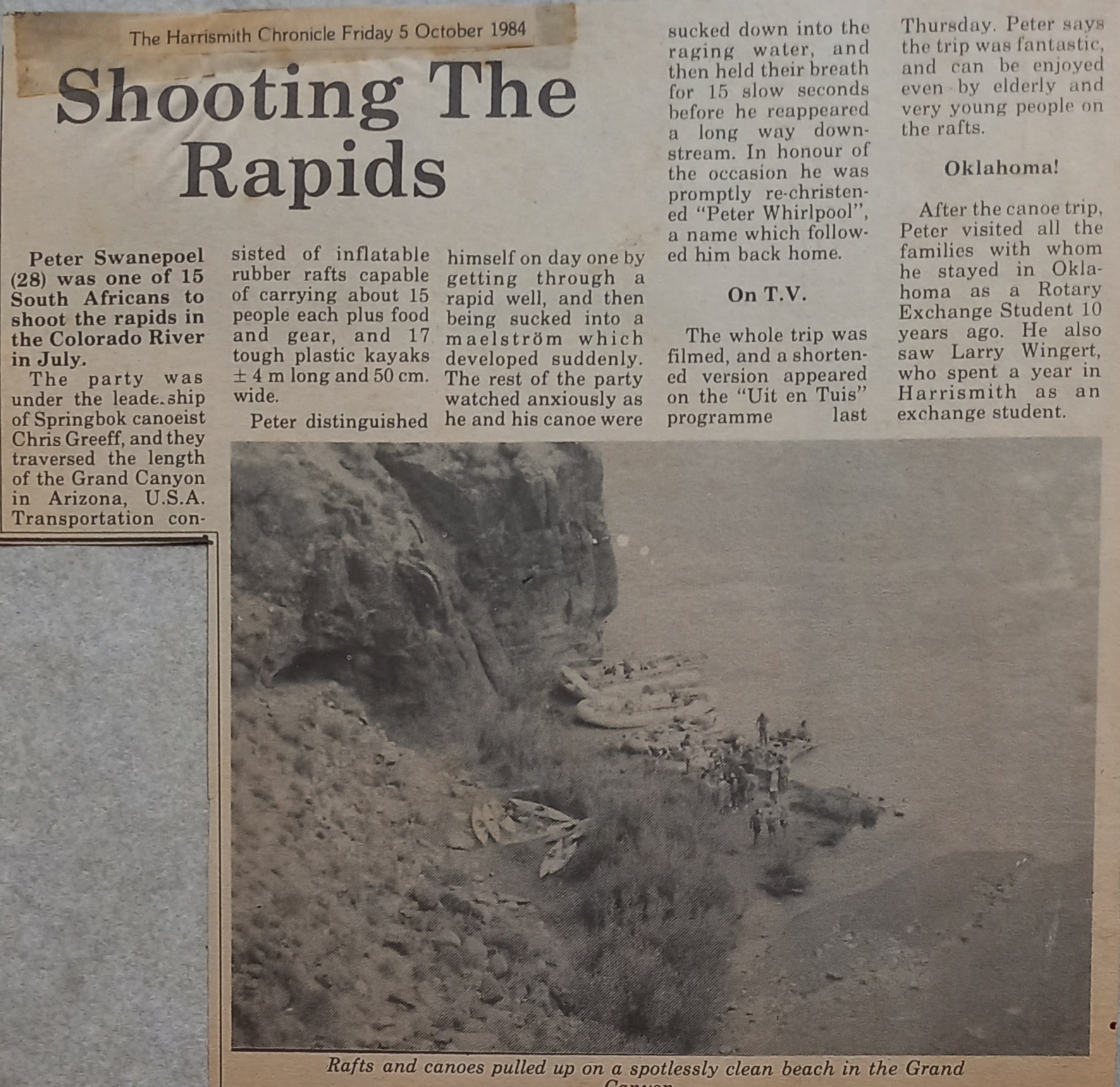
Just downstream of the confluence I got sucked under by a big whirlpool that formed under my boat that I couldn’t escape. As I went down I set up to roll but stayed down until I thought ‘I’m outa here’ as I was now loose in the cockpit and my splashie had leaked. So I bailed. Up on the surface the guys told a more dramatic tale: ‘Swanie! You disappeared for AGES! Then your boat popped up; Then your paddle popped up; And still there was no you! Then at last you popped up!’ So then they started calling me Pete Whirlpool. Lots of that muddy water stayed up my snout and I had a few bad sinus headaches but Wendy – Dave Walker’s connection – very kindly stepped in and saved my butt with strong painkillers and nightly TLC. Back in Durban a month later I was rushed into theatre by another very kind lady, my boss at Addington Hospital, ophthalmology professor Anne Peters. She took me to her ENT friend for an emergency sinus washout! As Saffeffricans say ‘Ah neely dahd!’ Some Little Colorado River mud was washed down Durban’s St Augustine Hospital’s outlet pipes into the Indian Ocean that day. Probly also had a smattering of Mainstay in it.
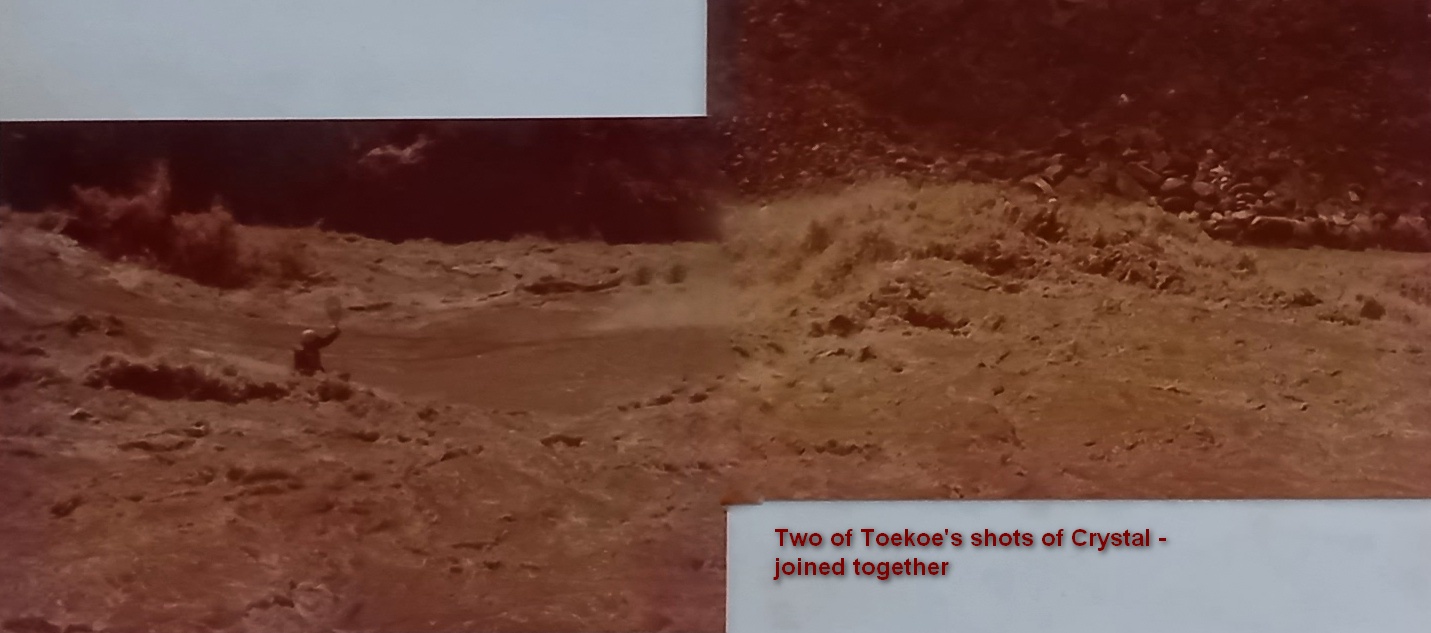
– lunch on a small sandbank – five rafts, seventeen kayaks squeeze on – the water level was up – – seated among legends as I was, I wore my langbroek out of respect – Graeme & Wendy Pope-Ellis; Wendy Walwyn; John Lee; Cully Erdman; Me; Willem van Riet; Jannie Claassens; Herve de Rauville in red cap – – Expedition Leader Greeff bombs through – – Me in Crystal rapid –
Hikes up the side-canyons:
– Thunder River Falls up a side canyon. Canyon lore has it that the ‘river’ flows into a ‘creek’ which flows into the Colorado River –– splendid desert scenery; and always the river’s presence below – – council of elder map readers – see my map at the end of this post –
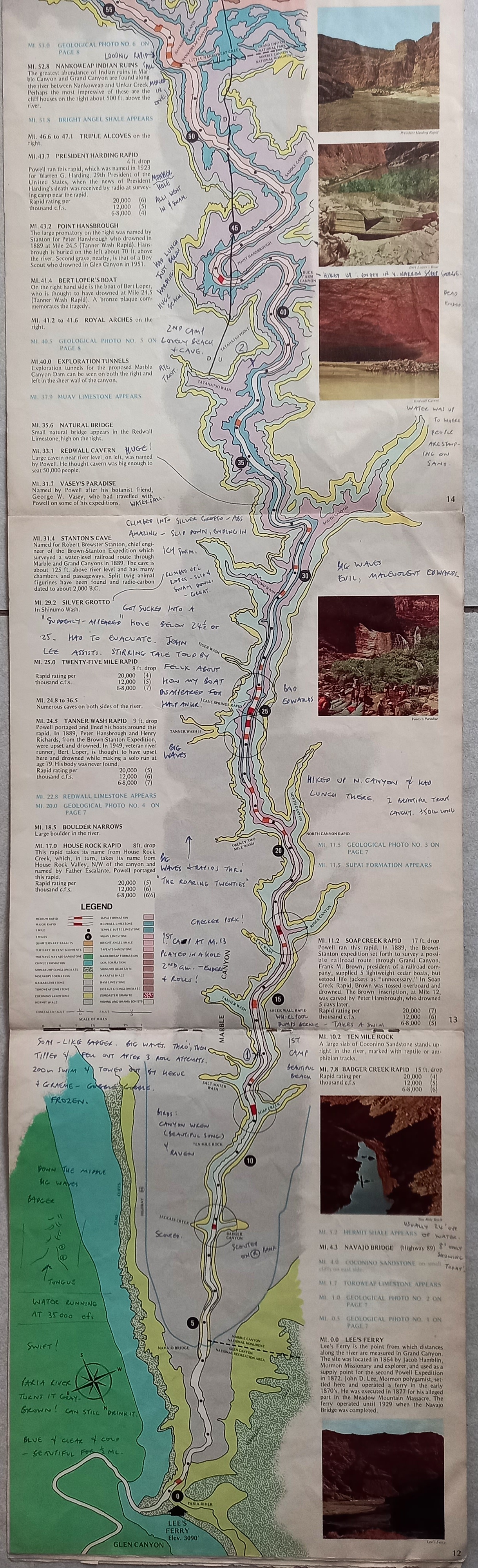
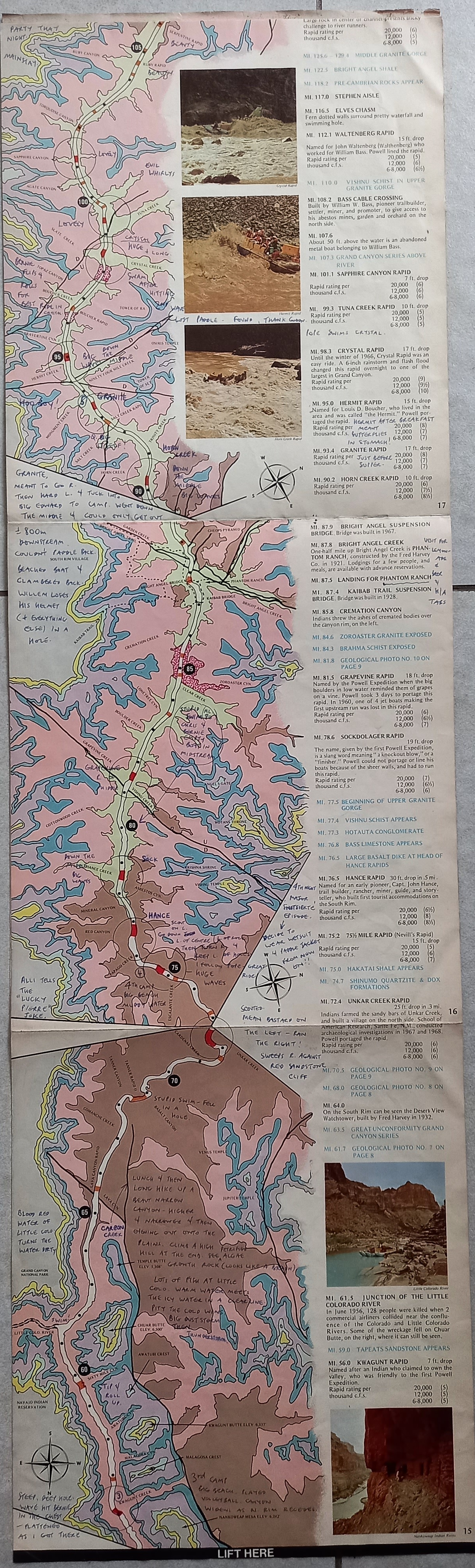
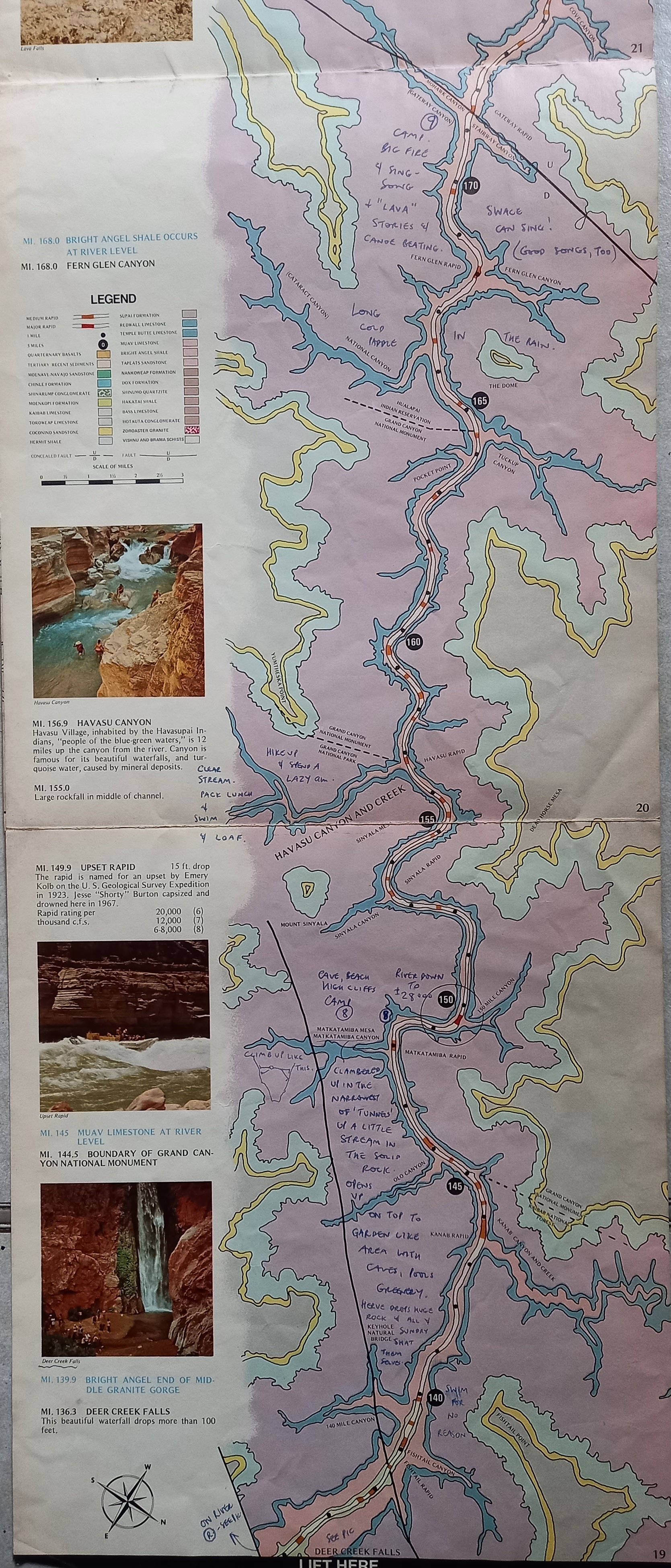
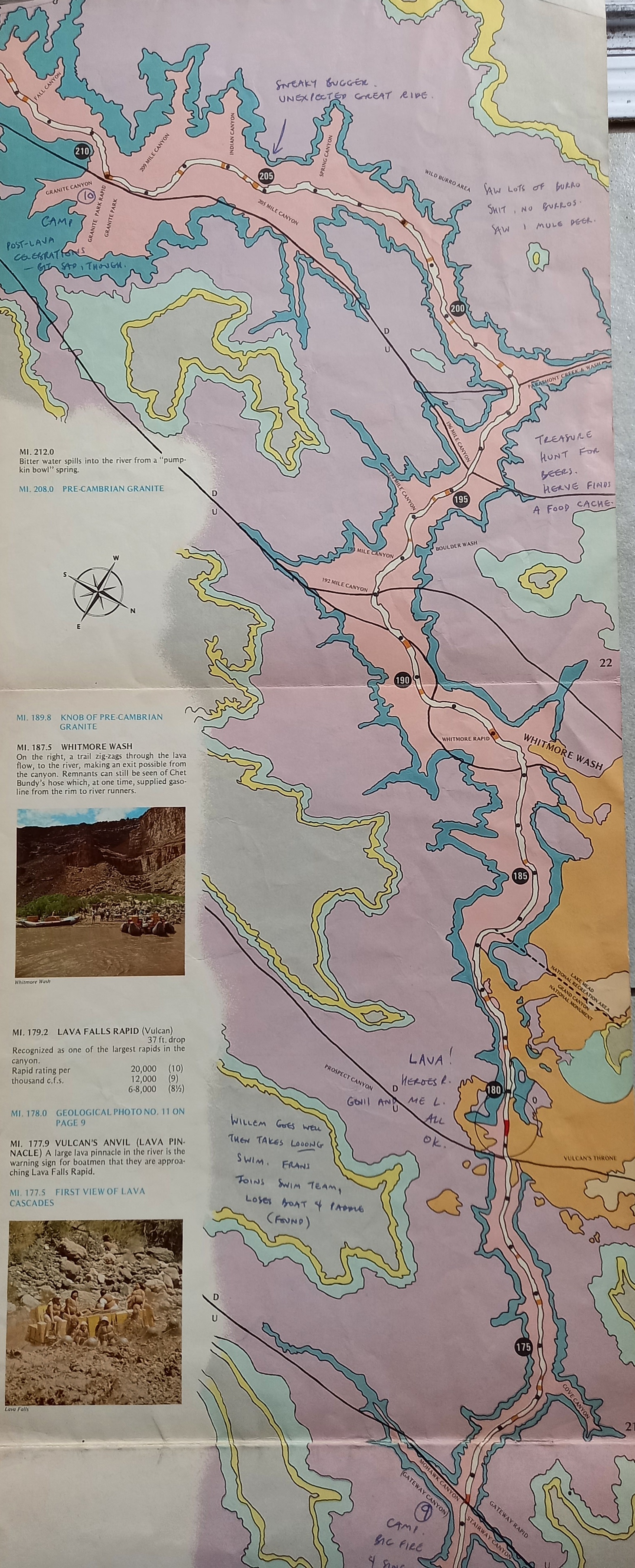
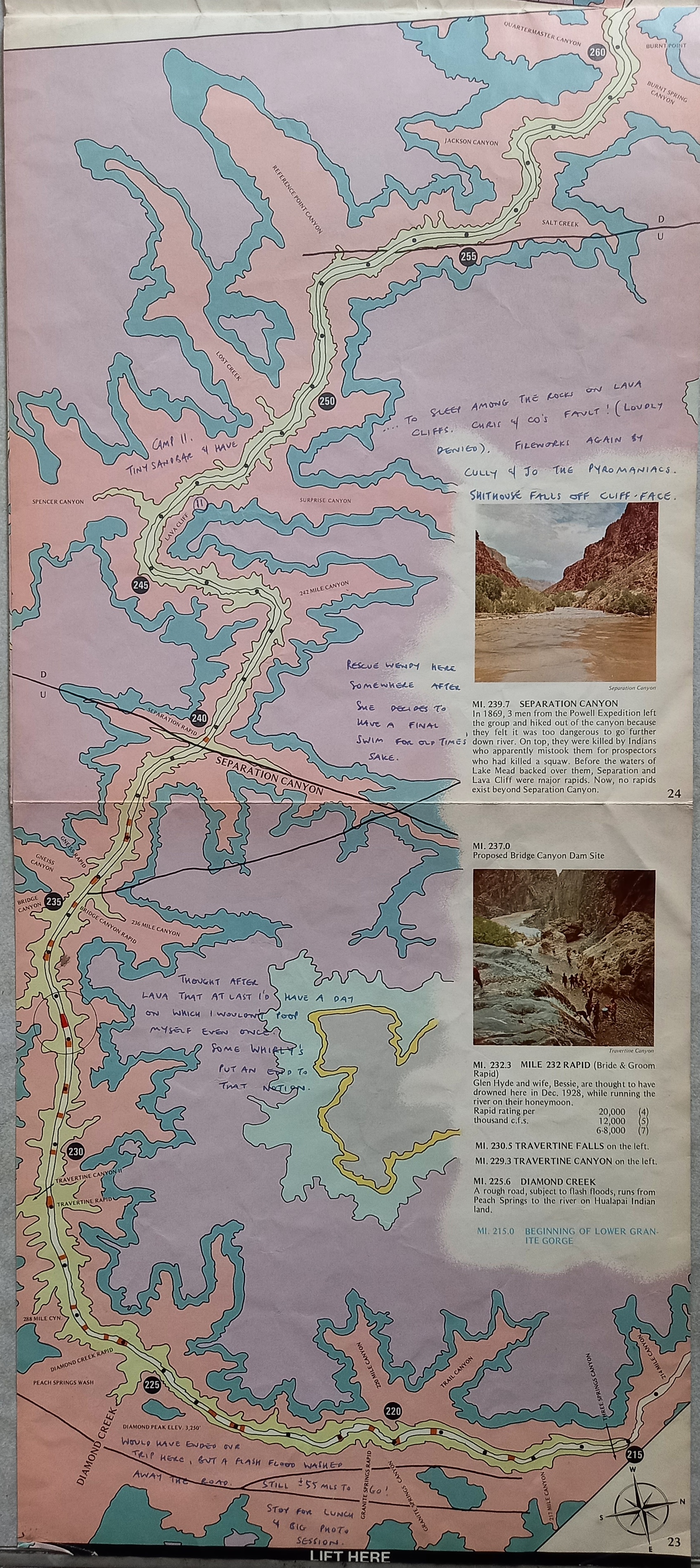
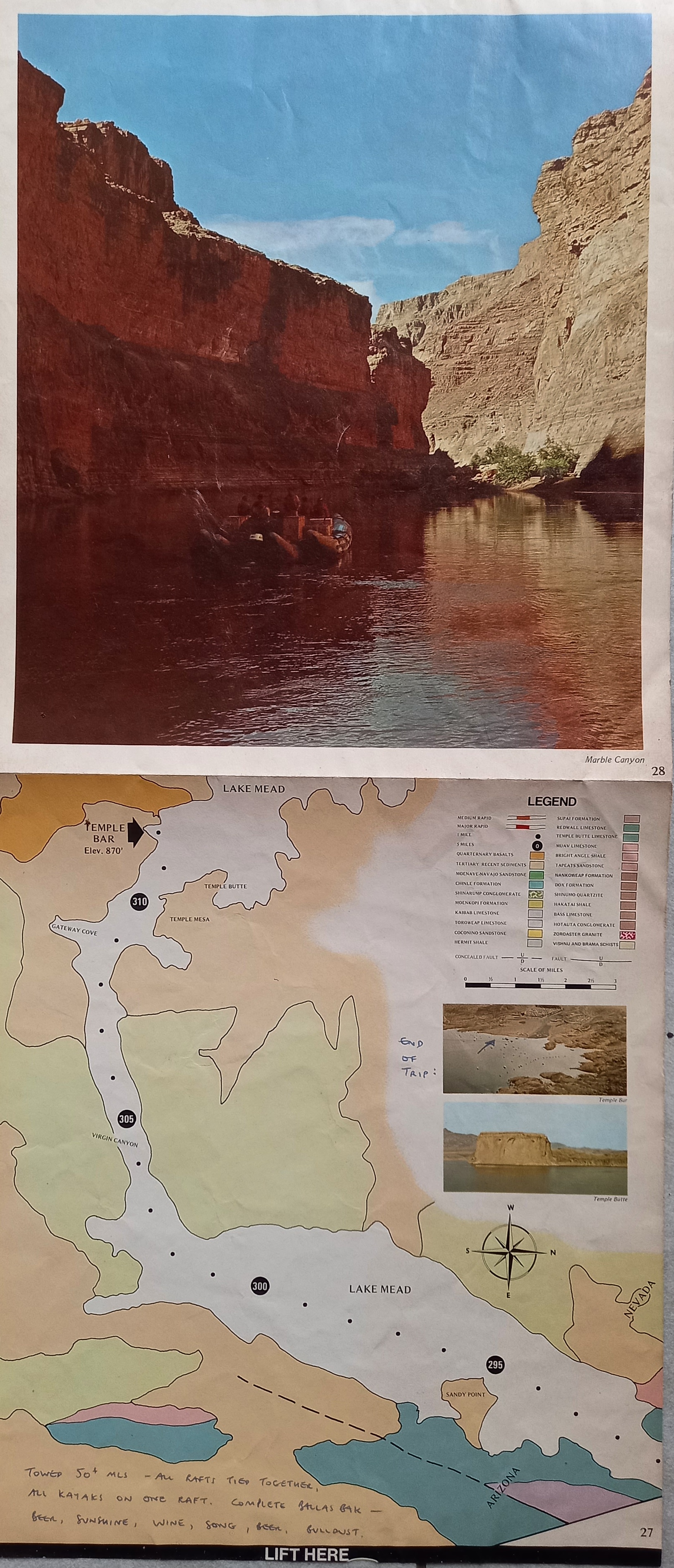
Map reading: I had a lovely large-scale map of the river through the canyon showing all the rapids. We would pore over it, going over the day and plotting our tomorrow. Here Jannie Claassens stands left, Swys du Plessis is prominent in red shorts, I am just visible behind him, Dave Walker wears a cap, Willem van Riet sports a ducktail probly cos of his last swim, Herve de Rauville kneels like a good Catholic, Allie Peter lying down in the background cursing his shoulder, Chris Greeff in the Mainstay cap ponders his next move, Bernie The Jet Garcin has a beer in his hand and a sock in his speedo, Wendy Walwyn is planning her first eskimo roll soon, and Cully Erdman in blue shorts thinks ‘Wwho ARE these okes? and where was that huge rapid Willem is talking about!?’
– internet pic – river at a lower level –– Bernie Garcin – great mate; – – and WHAT a campsite! – nice paddle, too –
Happy daze drifting in the current, lying back gazing up at the cliffs and watching the waterline as century after millenium of geological lines rose up out of the water and each day rose higher and higher above us. Willem the geologist would explain some of it to us. The latest view seems to be that the river is around six million years old, and it has exposed rocks up to two billion years old as it carves downwards, aided also by wind erosion.
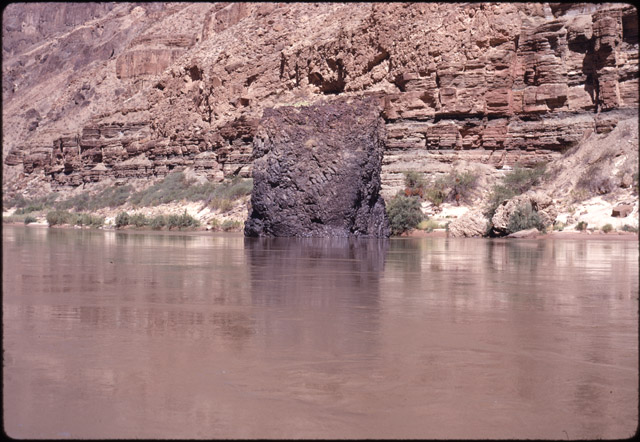
– at 50 000cfs, Vulcan’s Anvil, one mile above Lava, was covered up to where the dark grey meets the brown –
Then every so often you would sit up and listen intently. Then peer ahead with a stretched neck and drift in a quickening current as the roar of the next rapid grew in the canyon air. The river was running at an estimated high of 50 000cfs – that’s about 1650 cumecs, big water. 1984 was a high year. Once you could see where the rapid was, you pulled over and got out to scout it and plot your way through it. It was no use asking Greeff. His stock answer was ‘Down The Middle!’
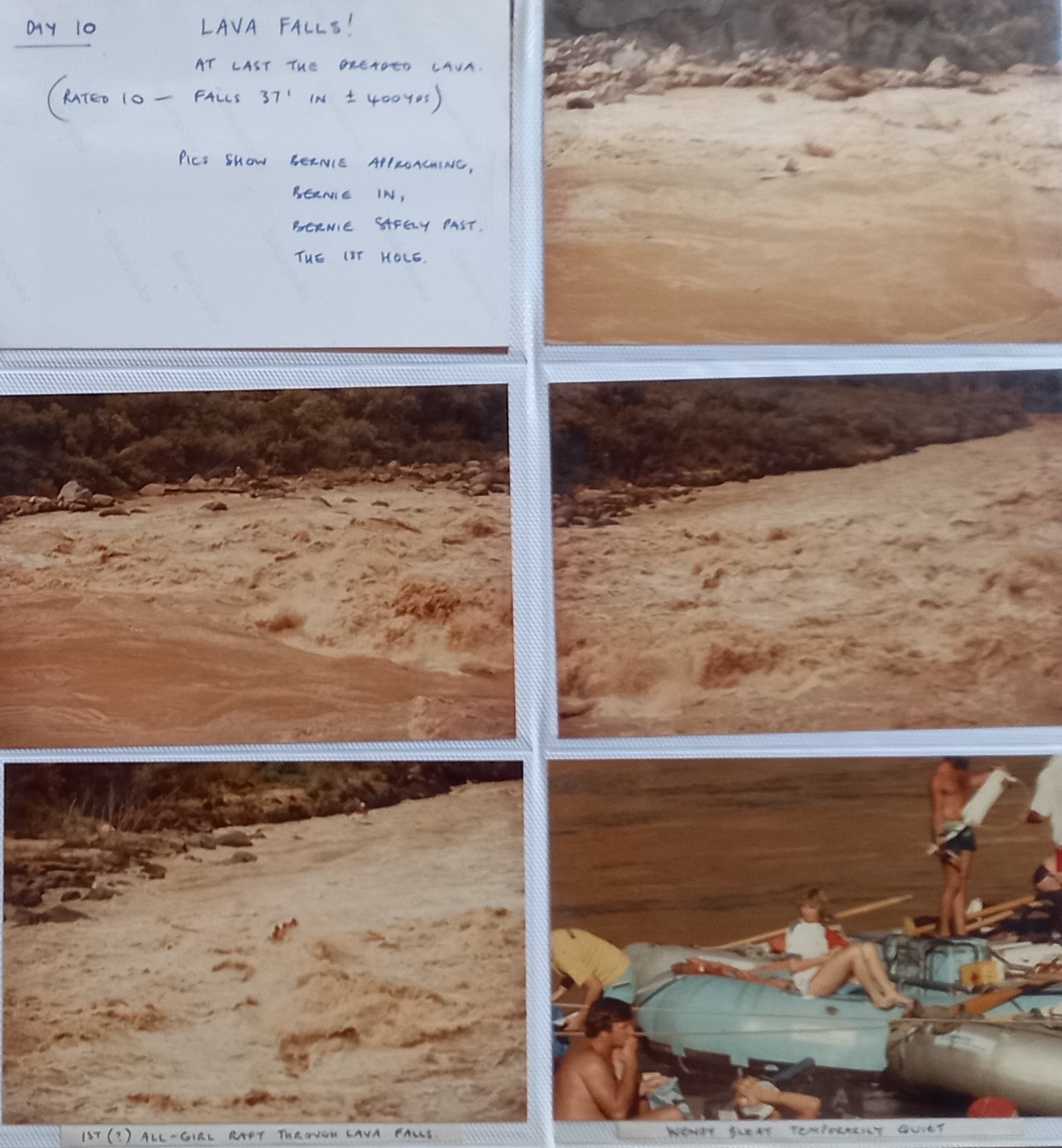
– Lava Falls –
For days before Lava, the bullshit build-up built up: ‘Rain? That’s not rain! That’s the mist from LAVA FALLS!’
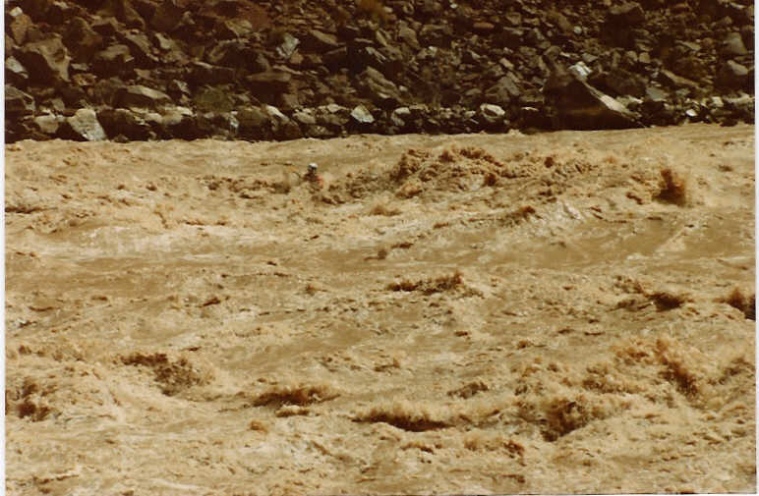
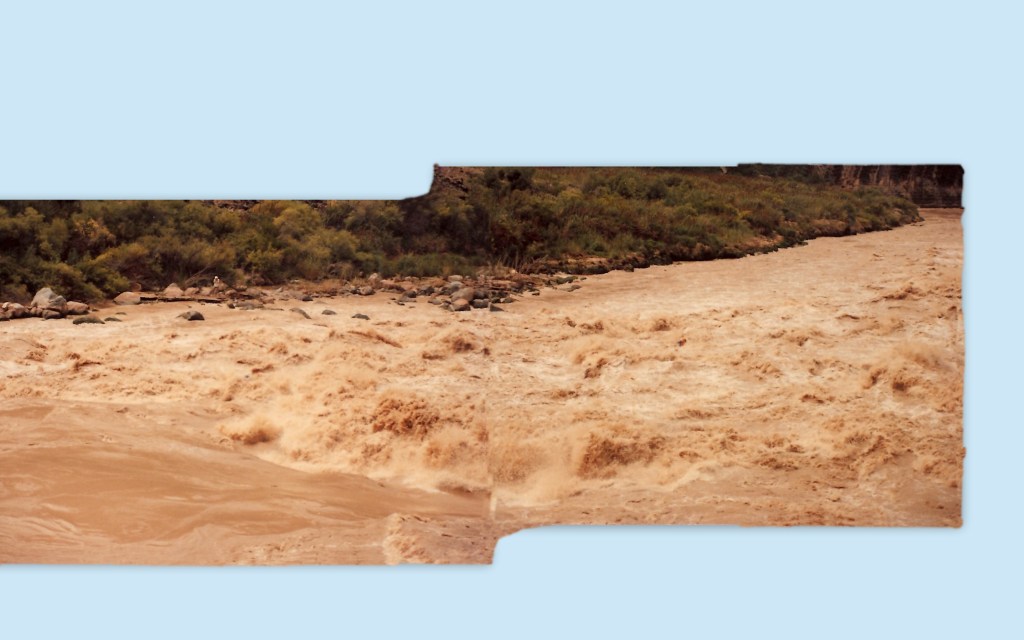
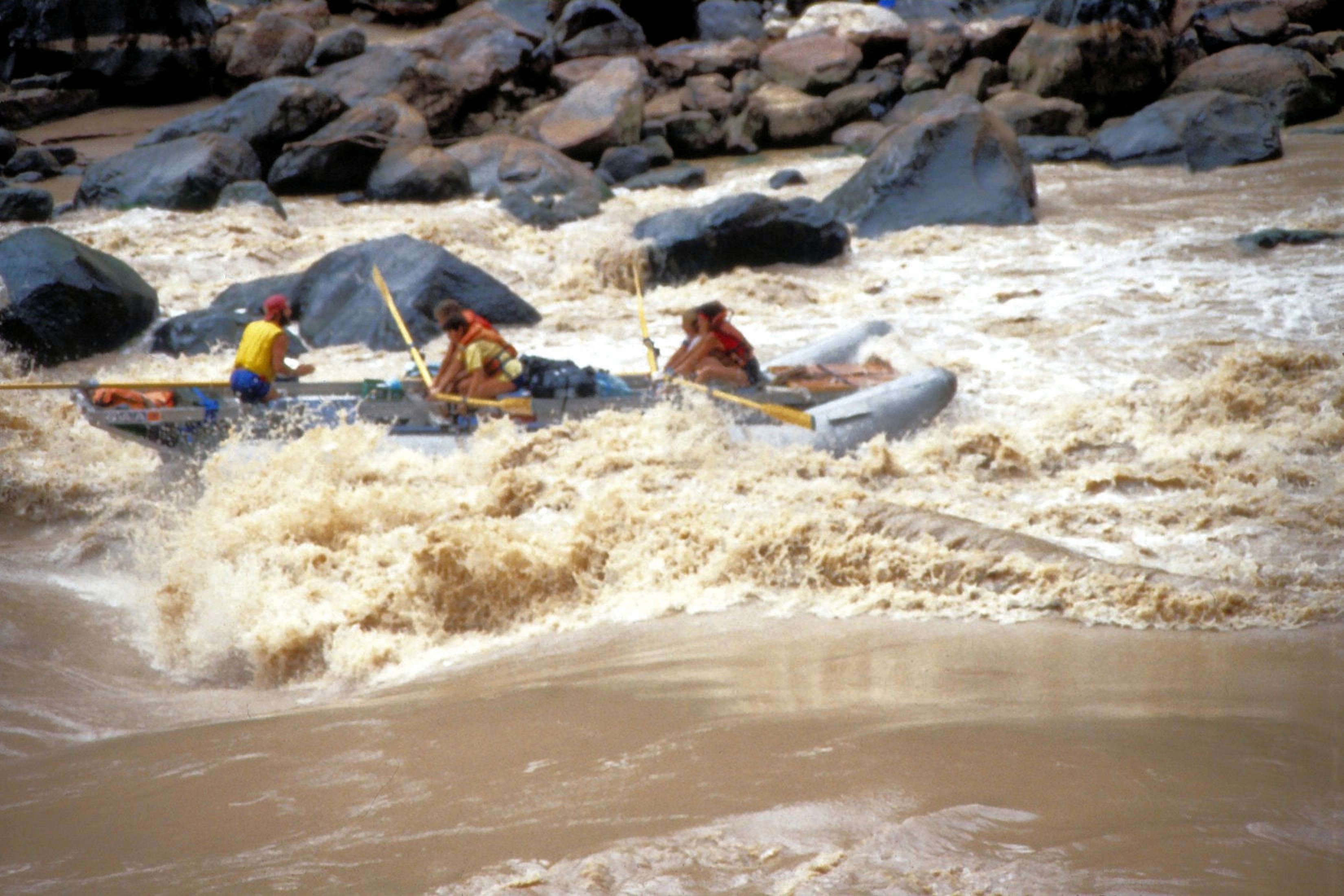
Arriving at Lava we hopped out and checked it out, butterflies no longer flying in formation. After scouting carefully most of us went left; a few went right. One – Ryan – went snorkeling straight into the big hole and got chomped, rinsed and spat out. His blue helmet can be seen in the picture if you have a magnifying glass.
– Lava Falls – there’s a paddler there somewhere –– an all-girl team gets coached down Lava Falls –
And then typical ladies: As we strutted and boasted of derring-do, they quietly commandeered one of the rafts and rowed it ladies-only down Lava! They took one yank with them, just to show him they could . .
– Team Mainstay SAA from South Africa; At the usual take-out before Lake Mead –
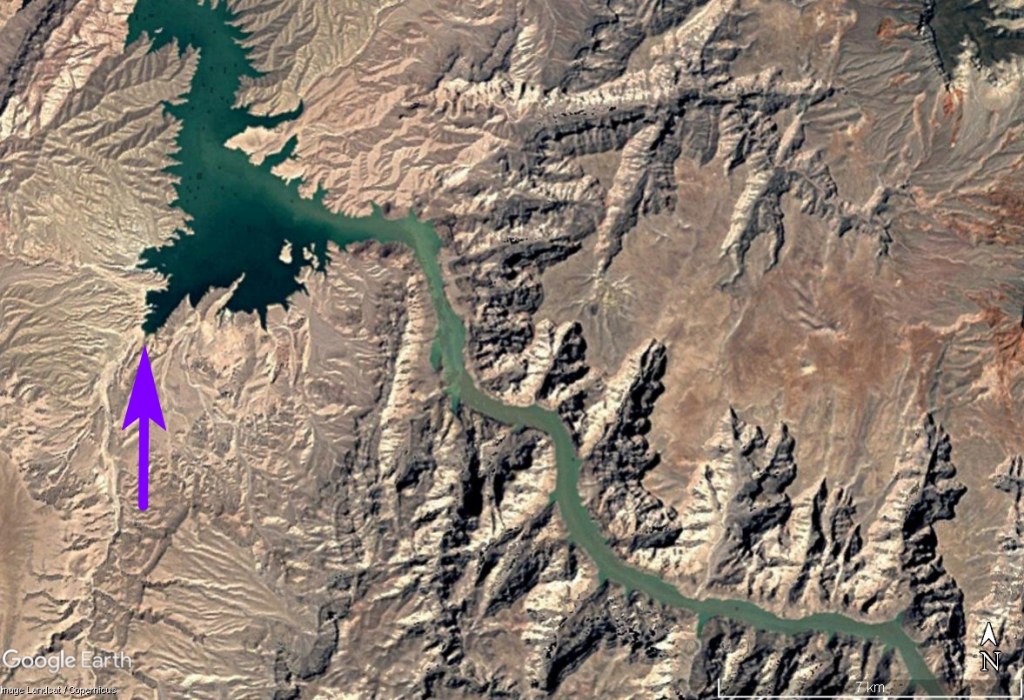
At the usual take-out at Diamond Creek before Lake Mead, we stopped for a rest and some team photos. The high water had washed away the road. We had to keep going. Some miles later we hit the dead waters of Lake Mead. The river ran out of push, tamed by a damn dam. Paddling was over for most of us! We piled our kayaks onto the rafts and lay on them – there were still a few beers that needed polishing. Our five-raft flotilla was tugged out by a motorboat to another take-out point, Pearce Ferry on Lake Mead miles downstream.
– final take-out on the lake at Pearce Ferry – the river bottom right, flowing right to left into the lake –
Downstream? Except of course there was now no longer any ‘stream’ – we were on flat water. Greeff and a few other crazies – including Wendy Walwyn – you know, the types who weren’t issued with handbrakes, brains or limits, paddled the whole flat water way! Holy shit! I drank beer lying on a raft, gazing at the blue Arizona sky.
Too soon, it was over.
~~~oo0oo~~~
Drifting downstream, Dave Walker led the singing:
The canyon burro is a mournful bloke He very seldom gets a poke But when he DOES . . . He . LETS . it soak As he revels in the joys of forni- CA-TION!
and (to the tune of He Ain’t Heavy):
Hy’s nie Swaar nie
Hy’s my Swaer . a . a . aer
~~~oo0oo~~~
We went down the Canyon twice
I always say we did the Canyon twice. Once we would bomb down in our kayaks, crashing through the exhilarating big water; The second time was much hairier, with bigger rapids, higher water and far more danger: That was around the campfire at night when Willem would regale us with tales of his day on the water. ‘Raconteur’ is too mild a word! The word ‘MOERSE’ featured prominently in his epic tales and his long arm would be held high to show you where the crest of the wave sat. And this from a man who bombed ‘blind’ down the Cunene River in 1963.
~~~oo0oo~~~
When? I wanted to know when exactly we were on the water to look up the flow on those days, but no-one knew. Now! Aha! I found an old letter (or Sheila did) written just before we flew to Arizona). I think we paddled – near as dammit – from 18 to 30 July 1984.
– Monday? 16 July in 1984 was a Monday –
Postscript: While we were paddling Chris spoke of attempting to beat the record for the fastest non-stop descent of the Canyon – the 277 mile stretch we had just done from Lee’s Ferry to our eventual take-out at Pearce Ferry.
– The Dory ‘Emerald Mile’ – our 12-day trip in 36 hours non-stop – no thanks –
Only
a handful of boaters have been crazy enough to undertake such a
mission. After all, doing it non-stop means having to shoot Lava
Falls at night! The Riggs brothers made what could be considered the
first speed run in 1951 when they rowed a cataract-style wooden boat
through the canyon in 53 hours; Fletcher Anderson, a pioneering
Southwestern boater, made a 49-hour solo kayak descent in the late
1970s; and then in 1983, just a year before our leisure trip, Kenton
Grua, Rudi Petschek, and Steve Reynolds completed a now-legendary run
on a flood of 70,000 cfs in a wooden dory named the Emerald Mile.
Their record of 36 hours and 38 minutes was the time to beat.
– Ben Orkin – saw little of the canyon –
Nothing came of it – it would have been a very expensive undertaking from South Africa for an obscure record only the small expedition rafting and kayaking fraternity would have known of; and anyway, why do it? But the record is ever-present in some people’s minds. In January 2016 the record was beaten twice. First by ‘Team Beer’: Ben Luck, Matt and Nate Klemas and Ryan Casey in three Piranha Speeders and a Perception Wavehopper, boats much like the ones we used. Then three days later by Ben Orkin, paddling solo in a composite Epic 18X sea kayak, a boat lighter than the models Team Beer had used and with a metre longer waterline. He reduced the time to 34 hours and 2 minutes. The Emerald Mile’s record, which had stood for over three decades, had been broken twice in three days.
I do (sort of) understand the quest for records (sort of), humans always will go for fastest; but for me,
. . floating down in awesome wonder is really the way to do it.
Before the river became crowded and the park service slapped restrictions on trip lengths, private boatmen in the ’70s vied at ‘slow-boating’, or making a trip last as long as possible. The crowning glory of slow-boating has gone down in river history as the Hundred Day Trip. Legendary boatman Regan Dale and his extended family floated away from Lees Ferry and spent a whopping 103 days in the canyon. They hiked every side canyon, spent as long as a week in favorite camps like Nankoweap and Granite Park, baked their own bread and wallowed in the vast silence of stone cathedrals broken only by the rustle of the river. The moon waxed and waned three times while they were there. It was roughly as long as the very first trip down the canyon led by John Wesley Powell in 1869, over a hundred years earlier – and 150 years ago now; and this over 300 miles whereas Powell had done 1000 miles. So the Regan Dale trip really was the slowboating trip supreme. I wonder if there will ever be trips like that again.
Later: A letter from Cully and JoJo – “do come again!” and “boknaai!”
John Lee wrote:
…running Crystal Creek down the left , Lava down the right was all complete childs play when compared to what felix , Cully and Bridgette put me through at Havasu Falls .
The four of us did that looooong hike up that pristine side canyon .
When we reached the aquamarine coloured waters below the falls , the travertine rimmed pools below , I immediately saw the photo-opp.
I had them climb to the rock above the falls from which they launched themselves , simultaneously and spectacularly , into space and fell about forty to fifty foot into the waters below .
Magnificent photos it turned out a long time later …….
It took them about half an hour to talk me , in turn , off that ledge .
That is by far the single most courageous thing I’ve done to date !
My fear of heights is a raging mental all-encompassing melt down …..
Still don’t know how I did it .
Then …..there was the Rattler I very nearly stood on, on the way back …..
Felix Unite wrote:
What memories! For me that GC trip remains one of my life’s highlights/milestones!
Location, action and memories of great friendship and camaraderie – not to mention how much I kakked myself!!!
Thank you all.
~~~oo0oo~~~
Chris Greeff wrote in May 2018:
R.I.P Herve de Rauville, Graeme Pope-Ellis, Swys du Plessis, Johan Claassen and Arthur Egerton ! – Also R.I.P Jose Luis Fonrouge
~~~oo0oo~~~
Our quiet, laid-back fellow kayaker from Argentina
Jose Luis Fonrouge had climbed Mt Everest, we heard. He had done much more:
Fitz Roy: First Alpine Style New Route
By Marcelo Eduardo Espejo
January 16, 1965 two climbers accomplished what is still today considered as one of the most remarkable climbs on the Patagonian spires. Jose Luis Fonrouge and Carlos Comesana reached the summit of Fitz Roy for the second time in history.
They had climbed the virgin super-couloir known as the Supercanaleta. For summit proof, they retrieved a carabiner left there by the 1952’s French expedition and left an Argentinean flag in its place. See route 18 below.
January 14, they went for the Supercanaleta. It took them only three days to summit and climb back in alpine style, fixing 20 pitches on the way. This was a big difference compared to the French expedition, the only ones who had summited Fitzroy before. The French team, led by the European climbing legend Lionel Terray, worked the route for a month and aid-climbed most of the wall to get to the top.
Carlos Comesaña and Jose Fonrouge went on to other amazing climbs – the Poincenot spire, Aconcagua’s South face, Torres del Paine, South face of Cerro Catedral and climbs in the Antarctic Peninsula. In 2001, the saga ended when Jose died in a plane crash.
Journalist and mountaineer Toncek Arko, from Bariloche, said that “Fonrouge animated the last romantic period of Andean Andeanism, when Patagonia was still unexplored and most of the mountains unclimbed.” “Argentina had to wait two decades before other Argentine mountaineers repeated the memorable climbs of José Luis,” said Arko. He recalled that Fonrouge began climbing in Bariloche, when he arrived as part of a group of young backpackers.
Fonrouge also reached the top of Aconcagua (6,989) through the complicated South Wall and in 1971, Fonrouge participated in the second Argentine expedition to Everest.
..
Happiness, always close to danger. At the beginning of the eighties, he saw on television two English climbers descending in a kayak down the Dudkhosi river, which comes down from Everest, and began with this white-water activity, along the Limay, the Traful rivers, El Manso or El Atuel. So at the age of forty he began kayaking, an activity that he developed for seven years and then returned to the mountain, through the production of television programs and documentaries. Together with the journalist Germán Sopeña and the businessman Agostino Rocca, his fellow travelers, he tirelessly toured our Patagonia and the most remote places in the world. This vast trajectory earned him the appointment as director of National Parks, a role he had held for a little more than one month.
His life was always in contact with nature: near the mountain, as a mountaineer, and on his kayak he crossed the most turbulent rivers in the country: “I find parallelism between both activities”, he mentioned on several occasions. “I consider myself a self-taught person,” said Fonrouge, for whom nature was a mystery to be unveiled, which would only be ajar for some and gave them a moment, a state of grace. “That state was given to me when I reached the summit of del Fitz Roy, it is a combination of happiness and extreme danger (…) Yes, I find my balance with the Universe in nature,” he stated years ago in a report. In November 1999 Fonrouge presented his first and only mountain book in Buenos Aires, entitled “Vertical horizons in Patagonia”, in which he recounted his Andean ascents during the fifties and sixties.
..
April 2001 – Shock caused by tragedy: Ten dead in a plane crash: All the passengers lost their lives when the plane in which they were traveling fell over a flooded field, in Roque Pérez, province of Buenos Aires.
The businessman Agostino Rocca, president of the Techint company, the General Secretary of the newspaper La Nación, Germán Sopeña, the director of National Parks José Luis Fonrouge and seven other people died yesterday when the private plane in which they were traveling over a field fell. flooded the town of Roque Pérez. The tragic accident that shocked the entire country occurred at 6.15 am when the Cessna 208 Caravan, registration LV-WSC, with nine passengers and a pilot, crashed on the “El socorro” ranch , in the Tronconi area, about 17 kilometers from Roque Pérez, near Route 205.
..
The death of José Luis Fonrouge, who died in the plane crash registered in Roque Pérez, where his wife and daughter also died, is mourned by the entire mountaineering community of Argentina, which still remembers among the exploits of the mountaineer when in 1965 he reached the summit of Fitz Roy. Born in 1942, Jose Luis Fonrouge was married to María Elena Tezanos Pinto and had three children.
~~~oo0oo~~~
– Jose (foreground) chills after another day paddling with us in 1984 –
In 1968 some climbers shot a movie in Yosemite on climbing El Capitan. They needed another climber. Tompkins suggested Argentine alpinist Jose Luis Fonrouge, who was staying with him and climbing in Yosemite that spring. Although Fonrouge was just twenty-six, three years earlier he’d made the second ascent of Fitz Roy—putting up a new route, alpinestyle, on that fearsome peak. (Fonrouge died in 2001.) When they filmed a screen test of Fonrouge climbing, the rest of the team was unimpressed. “Colliver and McCracken refused to climb with Fonrouge,” says Padula. “They thought he was too cavalier.” “I liked that Fonrouge was from a different place,” adds Tompkins. “It would put some spice into the film. But it didn’t work. He didn’t talk much.” (Sounds like our Jose! Of the few words he spoke in the Canyon, these I remember: He had flipped in Lava and semi-rolled up three times while we watched. I asked him about it and he said, roughly, ‘Every time I looked up it looked crazy, so I thought I’d just stay upside down – it was more peaceful underneath.’)
~~~oo0oo~~~
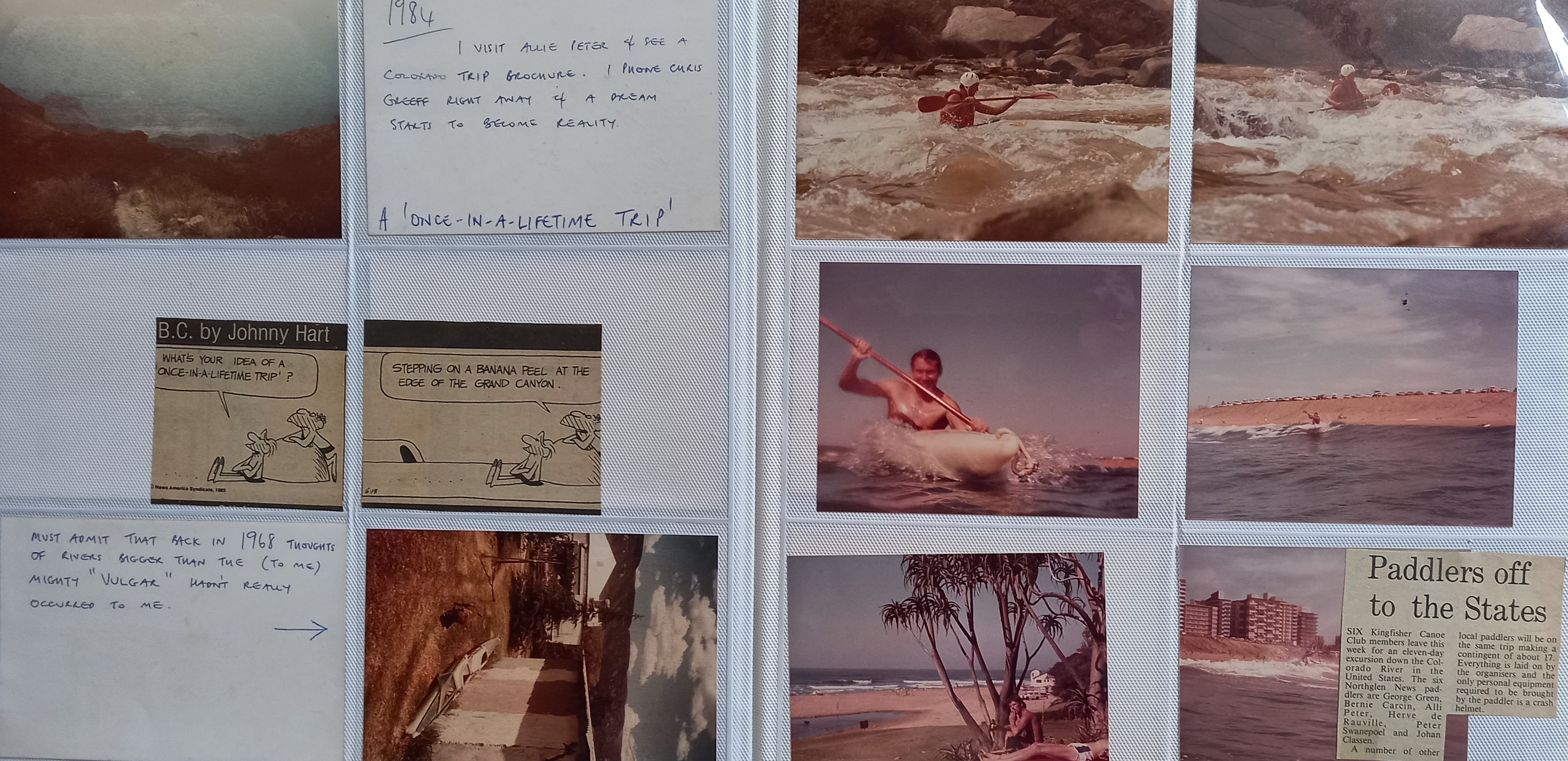
Old-Fashioned Photo Album
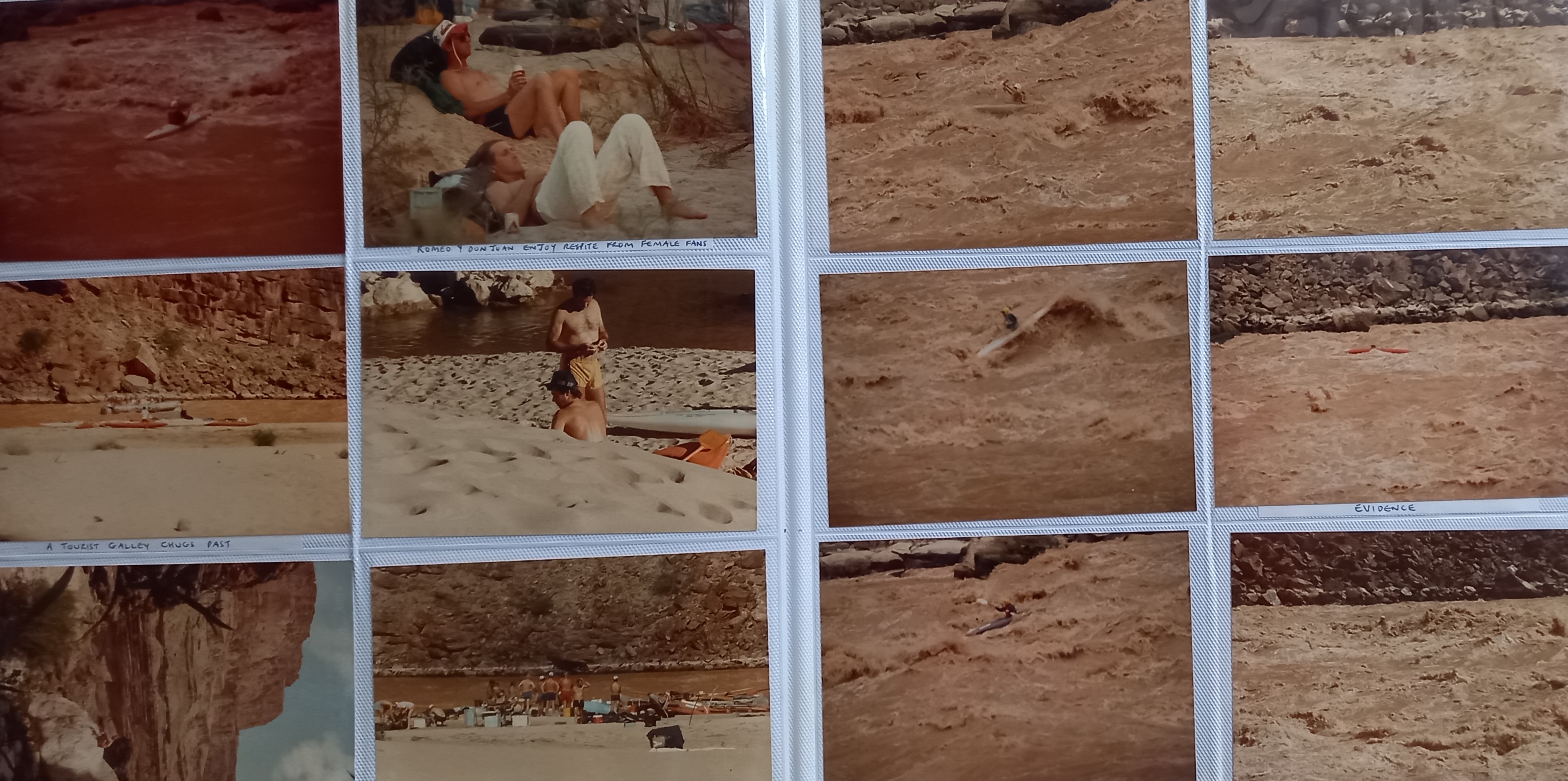
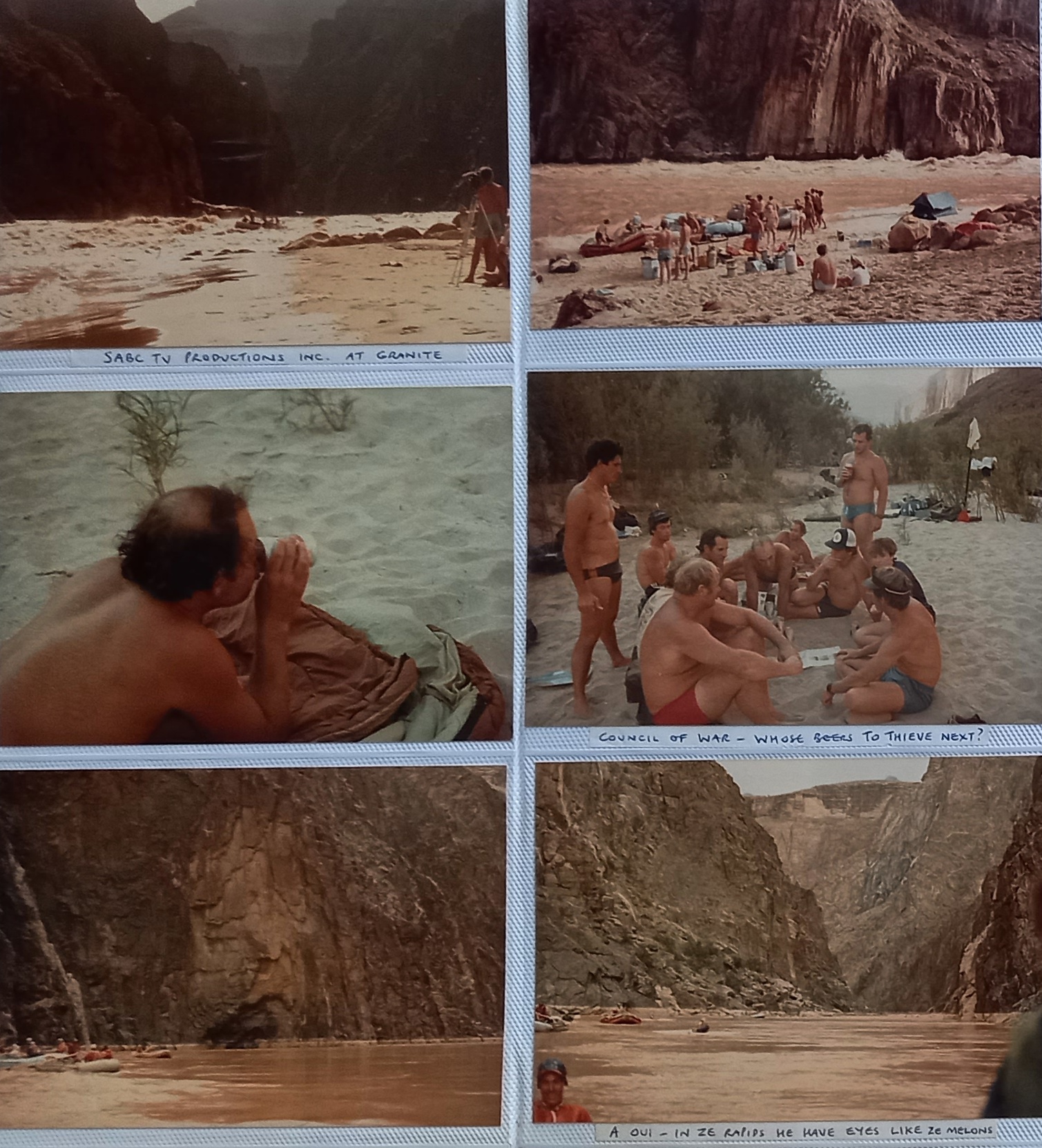
Pics from my photo album – copied and now discarded:
That Map
And here’s my famous map that was such a boon on the trip. Fifteen pages each 30cm long, the map was 4,5m long all told. Lots of detail. Which I then added to!
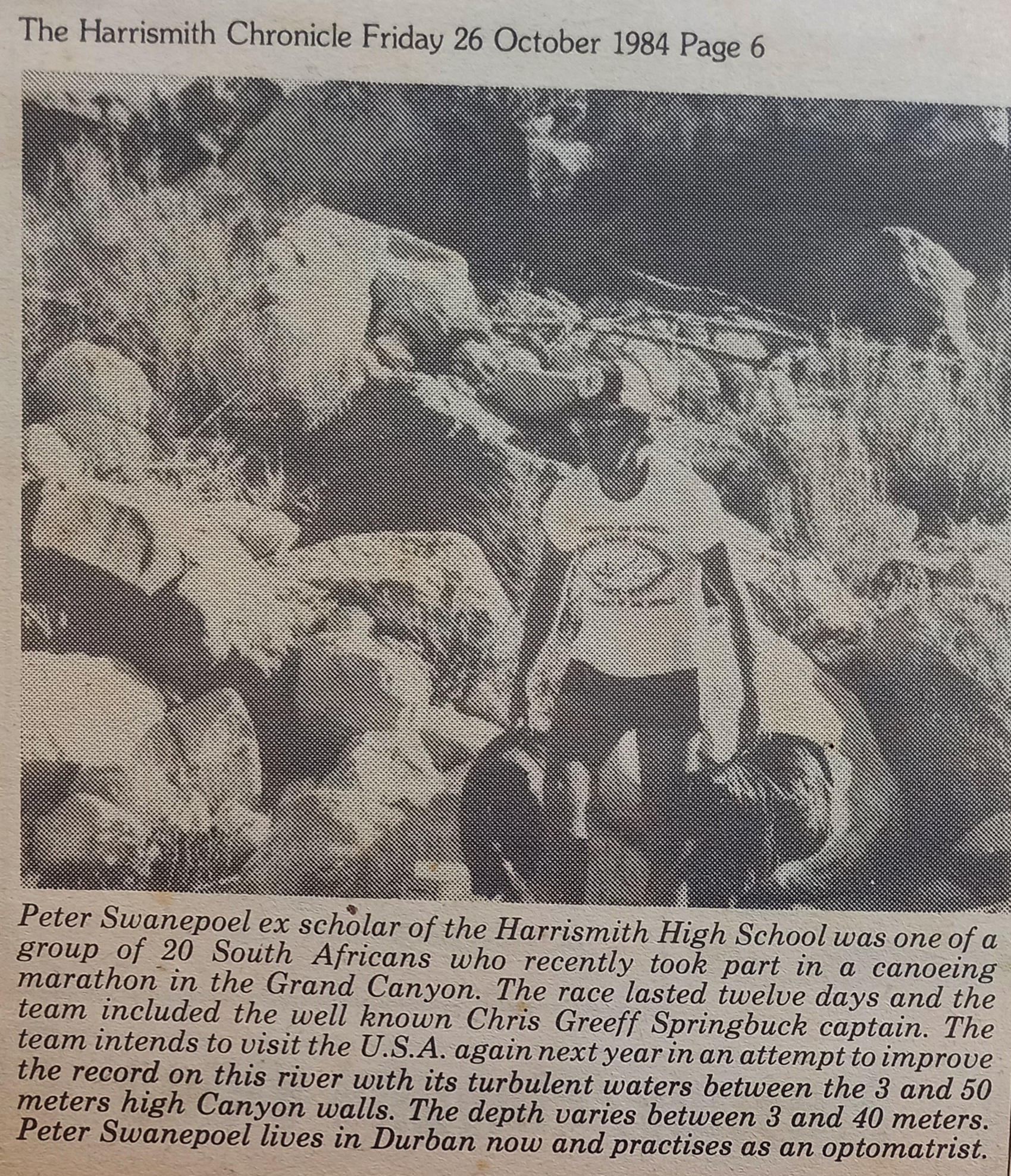
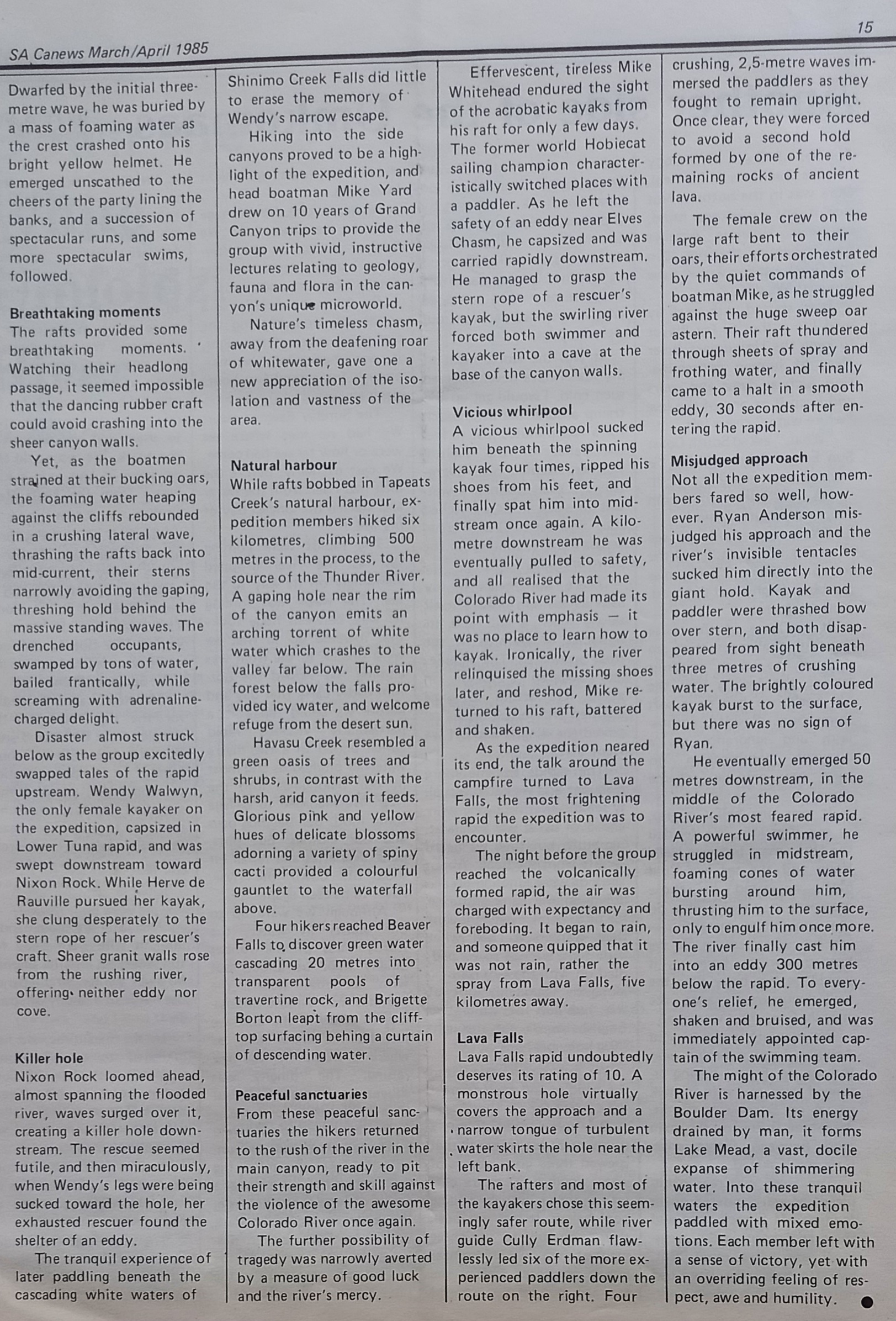
Sundry reports in the SA press afterwards
(all uploaded here as the hardcopies are being tossed)
On Tabbo’s Warden farm ‘Rust.’ Mine host Tabbo is second from right, yet another ale in hand.
– Tony Porrell, Koos Swanepoel, Nev Shave, Charlie Deane, Dirk Odendaal, Ian Fyvie, Rob Spilsbury – Nick Leslie, Doug Wright, John Venning, Mike Curnow, Tabs Fyvie and Guy Kirk – – front: Gillon Thake – son of Doug Wright’s sister, Yomi Thake –
None of those guineas were killed by me (second from left) with my old man’s cheap Russian Baikal shotgun, R139 from Musgraves in Bloem, even though the barrel was smoking. A marksman I am not! I was ‘Rust’-y. The fowls of the air are safe when I’m aiming at them.
Kai Reitz once tried to cure my handicap of not being able to hit a cow’s arse with a banjo. On his farm, The Bend on the Tugela river outside Bergville, he gently lobbed up big sandclods in a ploughed field and I filled the air surrounding them with birdshot. Then they plonked to earth. Thud! Unharmed.
It was for naught – he had to give up.
With the last two shells Kai took the shotgun. I hurled two empty shell cases as hard as I could. Blap! Blap! he hit both of them. Bang went the gun and bang went my chance of using faulty Russian alignment as an excuse.
Bloody guineas better watch out, I’ll bring my mate Kai next time!
~~~~~ooo000ooo~~~~~
As always, Sheila has the details:
This was taken on 1 September 1974, at a shoot at the Fyvies’ farm ‘Rust’ near Warden. According to my 1974 diary, we had had a wonderful party at Nick & Anne Leslie’s farm ‘Heritage’ the night before – “Had delicious supper. Danced. Sat & chatted” – most of us spent the night there, then moved over to Rust the next day, where the guys “shot about 60 fowls.”






















































 Vrystaat Confessions