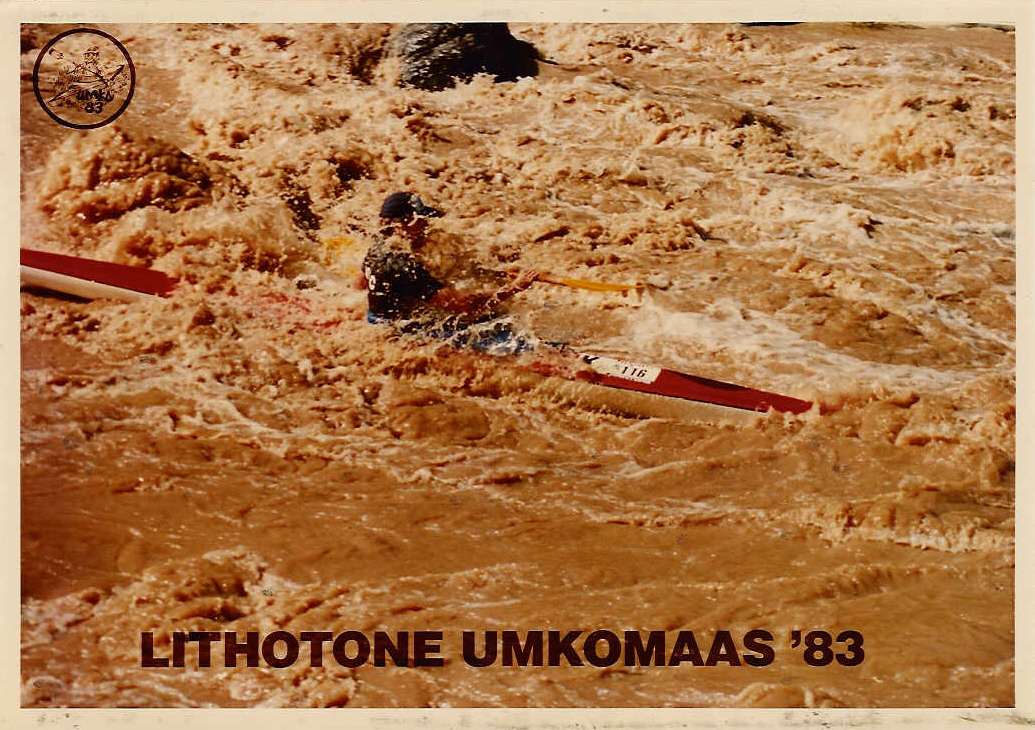
There he goes, no lifejacket, as was the way those days.
. . another guy might be wearing full lifejacket and helmet but he’d be disqualified: wasn’t wearing his club colours! Such was ‘safety’ and ‘decorum’ back when ships were made of wood and men were made of iron!
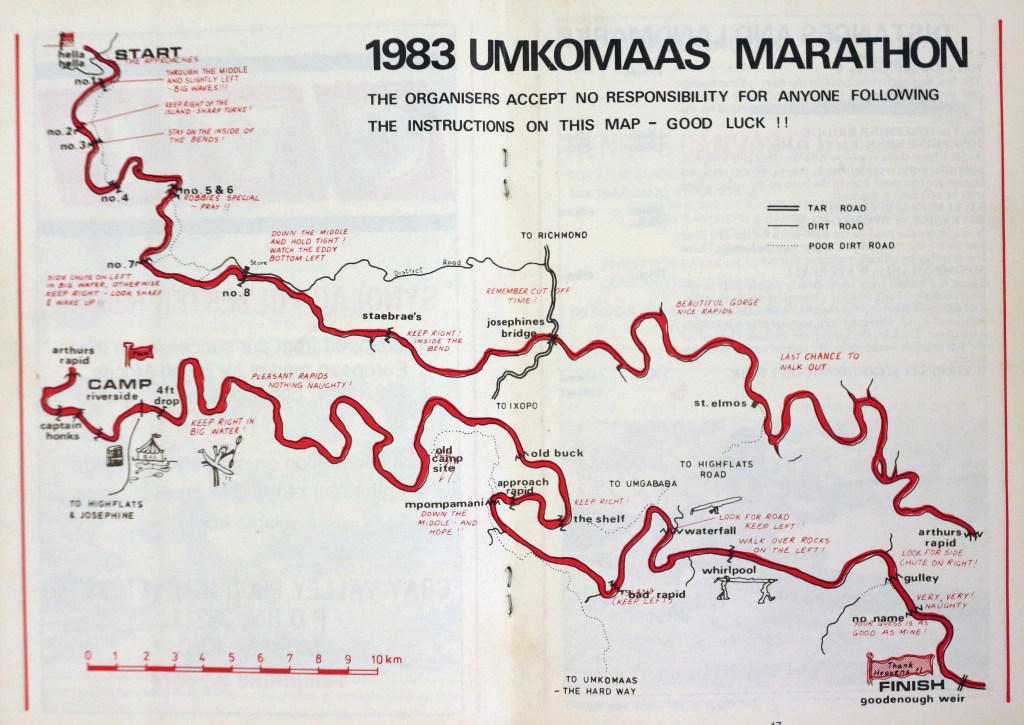
map 4
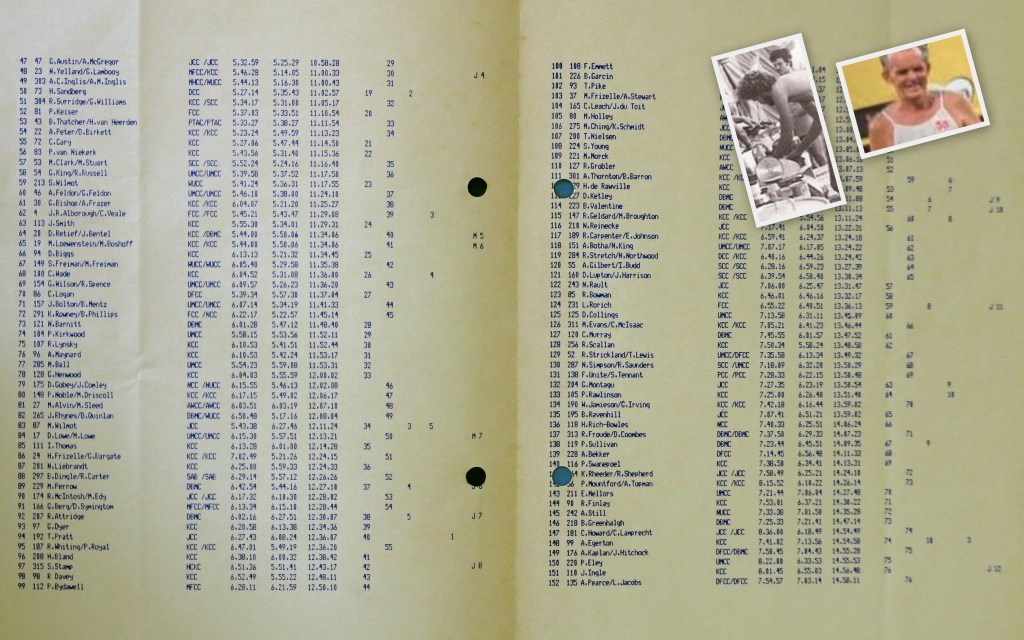
I roared in 140th – looks like 152 finishers, but maybe there was another whole page? Can’t tell – the first page is also missing so we can’t see who won. I know Chris Greeff won the singles. I spent a long time training him in the bar till late at night when the GO TO BED!!s built to a crescendo and we politely thanked Jesus, downed a last beer – and did as we were told. This was Jesus, or Dave Williams, of course, the saintly Umko barman.
– 1983 Umko results with pics of Jesus – when he shaved they started calling him John Cleese –
Hang on, the other page was given the wrong year. Here it is: 1983 results: 162 finishers out of 263 starters. Pope won with Tim Cornish. Chris was 6th and first single.
1983
Notables who finished behind me were Pete the Pom Mountford, Richard Finlay and Toekoe Egerton. They should pull finger.
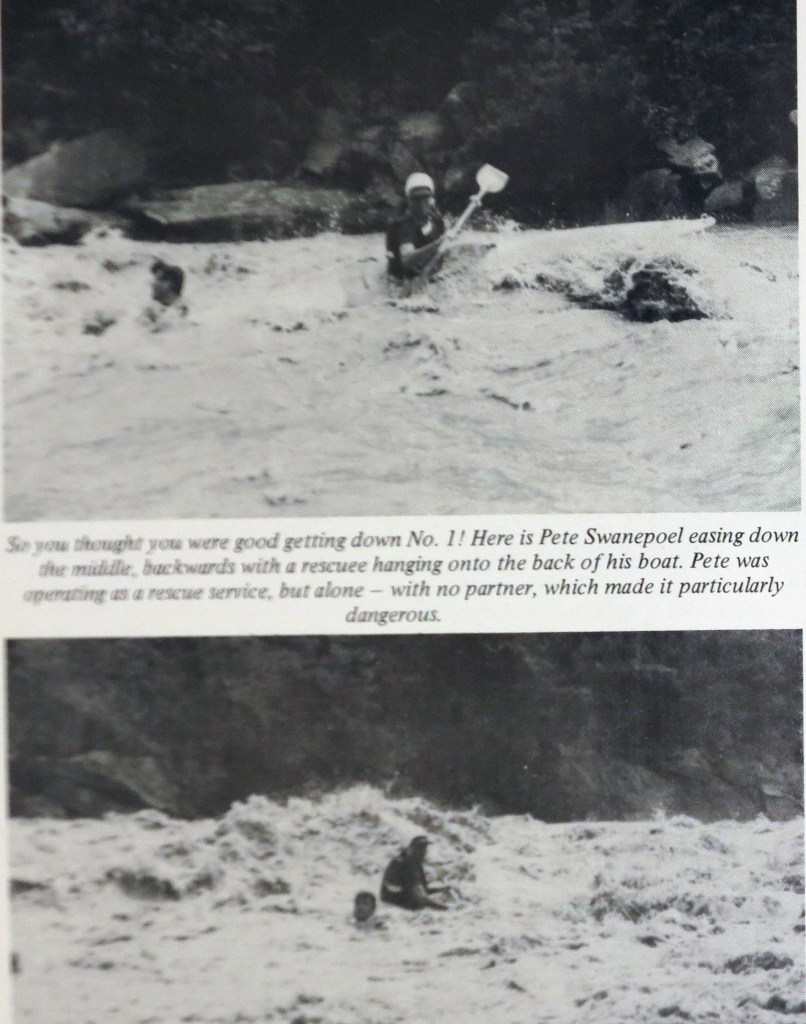
That was my only Umko marathon. For a few years after that I would sweep or pick out human flotsam and fiberglass jetsam at No.1 rapid, staying with Barry and Lyn Porter on their game farm afterwards.
I was born in Harrismith in 1955, as was Mom Mary in 1928, and her Mom Annie in 1893. Annie thought “the queen” of that little island above and left of France was also the queen of South Africa (and for much of her life she was right!).
I attended the plaaslike schools in Harrismith till 1972. A year in the USA in 1973 as a Rotary exchange student in Apache Oklahoma. Studied optometry in Joburg 1974 – 1977. Worked in Hillbrow and Welkom in 1978. Army (Potch and Roberts Heights, now Thaba Tshwane – in between it was Voortrekkerhoogte) in 1979 and in Durban (Hotel Command and Addington Hospital) in 1980.
I stayed in Durban, paddled a few rivers, and then got married in 1988. About then this blog’s era ends and my Life With Aitch started. Post-marriage tales and child-rearing catastrophes are told in Bewilderbeast Droppings.
‘Strue!! – These random, un-chronological and personal memories are true of course. But if you know anything about human memory you’ll know that with one man’s memory comes: Pinch of Salt. Names have been left unchanged to embarrass the friends who led me (happily!) astray. Add your memories – and corrections – and corrections of corrections! – in the comments if you were there.
~~~oo0oo~~~
Note: I go back to my posts to add / amend as I remember things and as people mention things, so the posts evolve. I know (and respect) that some bloggers don’t change once they’ve posted, or add a clear note when they do. That’s good, but as this is a personal blog with the aim of one day editing them all into a hazy memoir, this way works for me. So go’n re-look at some posts you’ve enjoyed before and see how I’ve improved over time (!). It’s just as my friend Greg says: ‘The older we get, the better we were.’
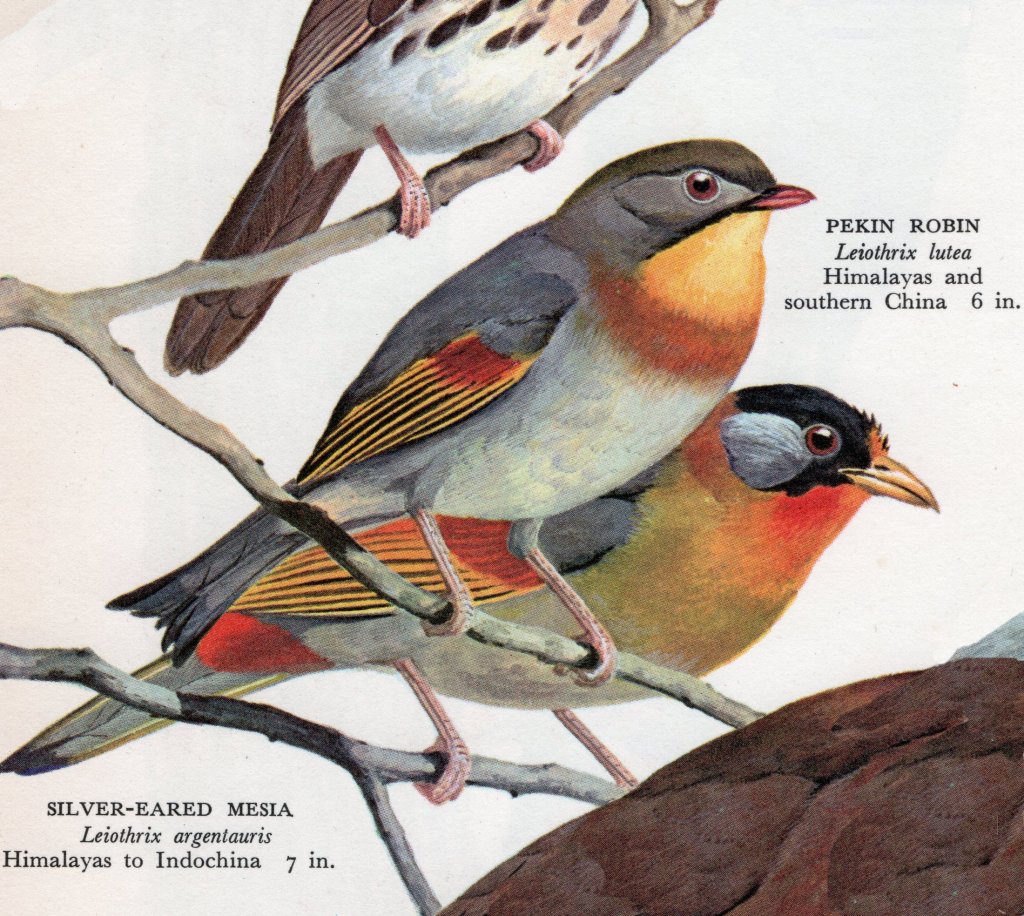
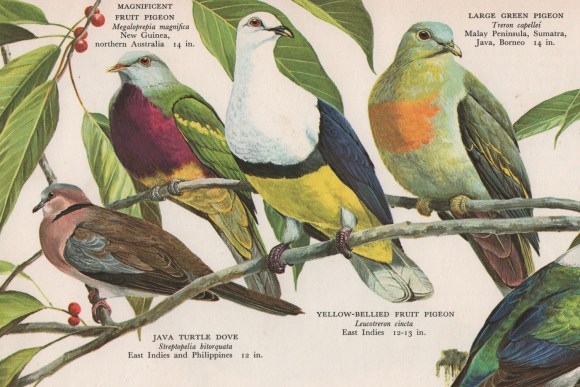
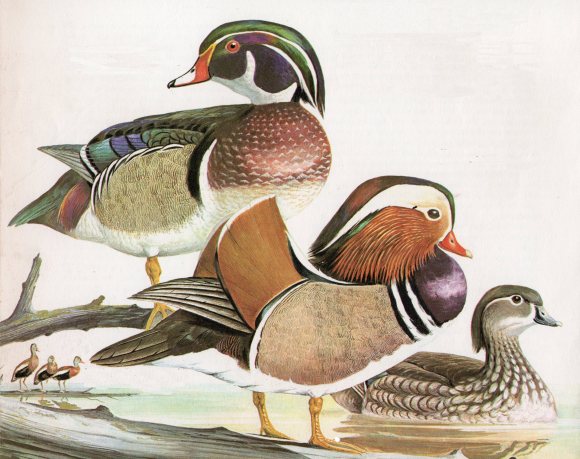
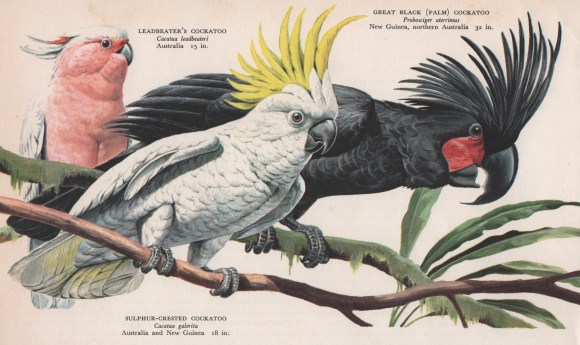
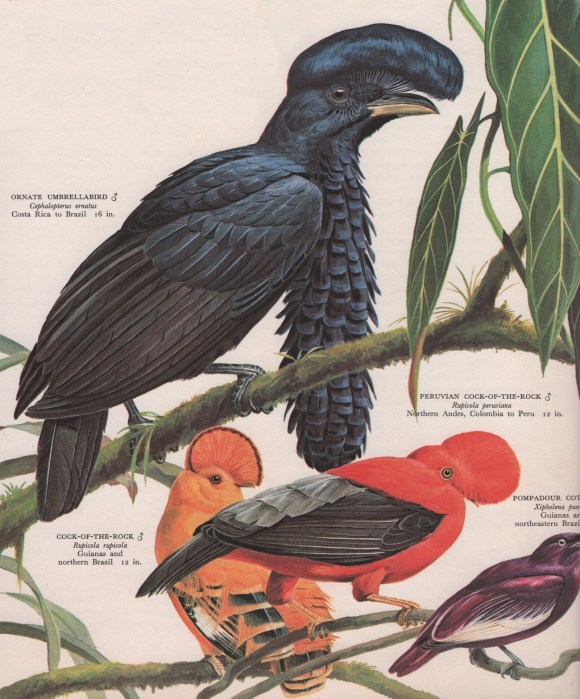
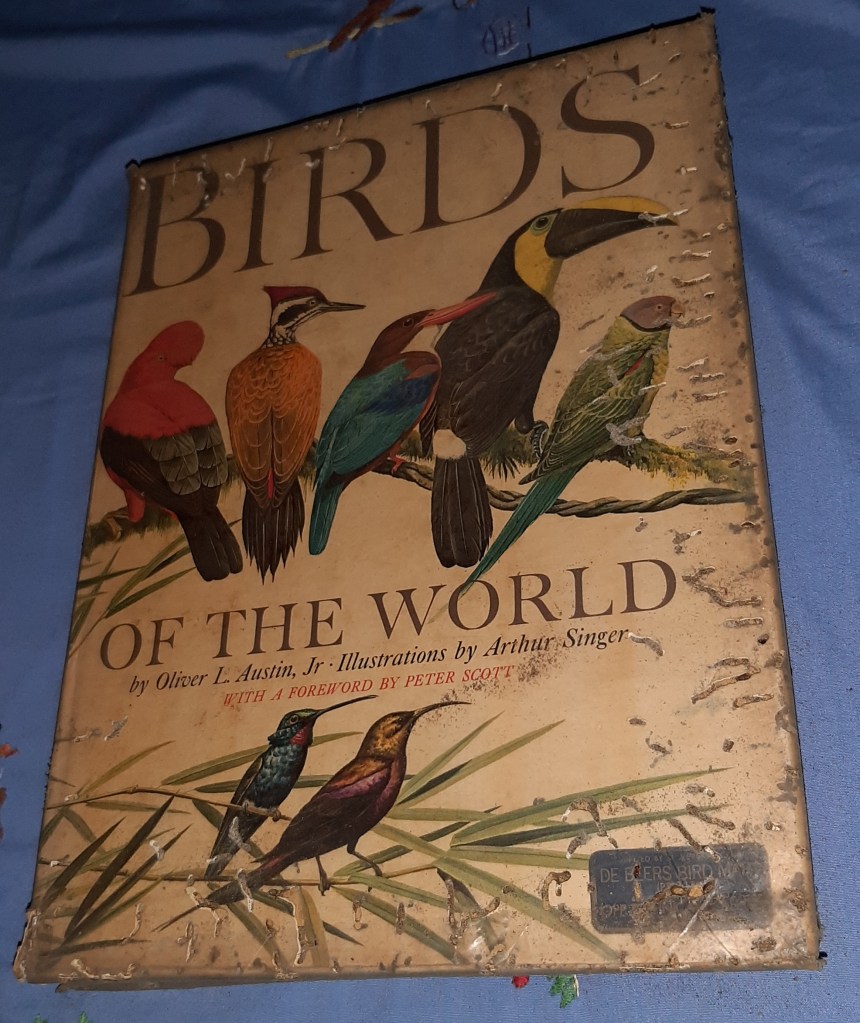
Way back around 1968 a new book appeared at 95 Stuart Street Harrismith. I was fascinated. Nearly as fascinated as I’d been when cousin Jack Grundling was reading Valley Of The Dolls and left it in the big wooden bookshelf in our long, dark, carpeted passage. That novel must have been good, as Mom actually physically took it from me, saying ‘You can’t read that’! Oh? Censorship!
by Oliver Austin, beautifully illustrated by Arthur Singer. I was fascinated by the orange Cock-of-the-Rock on the cover. Fifty years later the book was on my bookshelf in Westville and I was sad recently to discover other bookworms also liked it and had got into it in a big – and deep – way. It was riddled with holes. I copied the pages with the plates I remembered best before turfing it out. Hopefully a whole extended family of borer beetles went with it!
Roberts bird book and this book fuelled a lasting fascination.
~~oo0oo~~
Valley of the Dolls – by Jacqueline Susann was about film stars, their raunchy pecadilloes and their use of ‘dolls’ – amphetamines and barbiturates. Time magazine called it the ‘Dirty Book of the Month,’ probably thinking ‘that’ll kill sales,’ but that and other anti-reviews made people think ‘that sounds interesting,’ and the book was a runaway commercial success, becoming the best selling novel of 1966. I mean, a review saying ‘Dirty Book of the Month’ might have made Mom Mary not buy it, but it likely had cousin Jack head straight for the bookstore! So there it was: From one metropolis to another – New York to Harrismith – in no time.
By the time of Susann’s death in 1974, it was the best selling novel in publishing history, with more than 17 million copies sold. By 2016, the book had sold more than 31 million copies. In 1967, the book was adapted into a film. Like the book, the reviews were scathing, but it was an enormous box-office hit, becoming the sixth most popular film of the year, making $44 million at the box office. Author Jacqueline Susann had a cameo role in it as a news reporter, but she said she hated the film, telling director Robson that it was ‘a piece of shit.’ – wikipedia
~~oo0oo~~
Birds of the world: a survey of the twenty-seven orders and one hundred and fifty-five families, by Oliver L. Austin, (1961); Illustrated by Arthur Singer; Edited by Herbert S. Zim, New York, Golden Press; Many reprints were made and it was eventually published in seven languages over many years. I think ours was the 1968 edition published by Paul Hamlyn;
~~oo0oo~~
bookworms: The damage to books attributed to ‘bookworms’ is usually caused by the larvae of various types of insects including beetles, moths and cockroaches, which may bore or chew through books seeking food. Mine were little brown beetles. Buggers. I’m procrastinating about checking all my other books! Must do it . .
In tiny cages. Cocky the African Grey Parrot and Jacko the Australian Sulphur-crested Cockatoo. We grew up with them and didn’t think anything of parrots in cages. Poor things.
– their cages behind Francois –– Jacko on Jabula – our pedal-car was ‘Happy’ –
But when you see a free-flying one and realise Jacko never flew five metres, never mind five kilometres, it makes ya think. Friend Steve Reed ‘shot’ this one in his neighbour’s tree in Brisbane, and put it on his blog.
Also left-handed, I see – as was Jacko. Cocky was right-handed.
– free-flying in Brisbane –
I commented on Steve’s blog: So amazing to me that this can be a bird that flies free and visits you! We had one in a cage, poor thing. My old man got him from an old lady in Pietermaritzburg in KwaZulu Natal who had had it for – you know – forty years, and then he had it for – you know – forty years. These numbers don’t get reduced. They grow. And we grew up with Jacko. Who suddenly laid an egg and became ‘she,’ but kept her name Jacko. Poor thing.
~~~oo0oo~~~
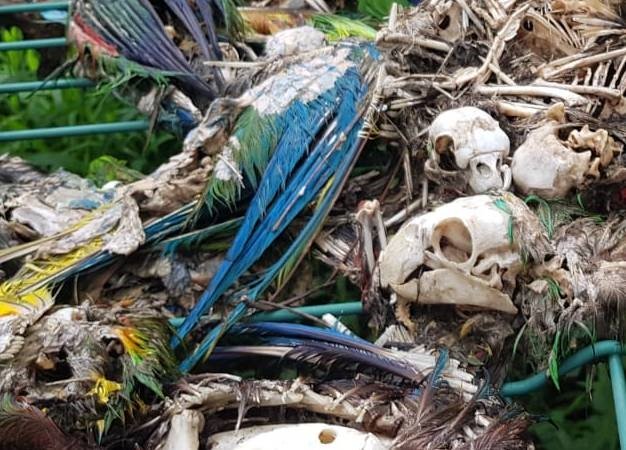
And what happened to them? “Given away” yet again. To a ‘Mnr Boshoff’ in Krugersdorp or Klerksdorp, who ‘trained’ parrots and put on shows where he would demonstrate how Jacko could ‘dance’ and Cocky could ‘talk.’ He was very well-known and that made it a good thing. Except well-known and ‘respected’ bird-cage people aren’t always what they say they are. Here’s what a raid on a parrot breeder found when the South African vice-president of the parrot breeders association’s aviaries in Randburg were raided this week: 150 dead parrots and the live birds in cages in shocking condition! Strange how almost all people who keep wild animals say how they LOVE them, but as far as I’m concerned it’s all Dancing Bears – they’re kept for money, fame, personal ego, etc. For their humans, not for the animals themselves.
~~oo0oo~~
Here they are flocking in the wild:
– thanks kidcyber.com.au –
Mea culpa: While raising kids we let them keep things in cages too! Only fair to admit that! A gerbil, a hamster, a snake.
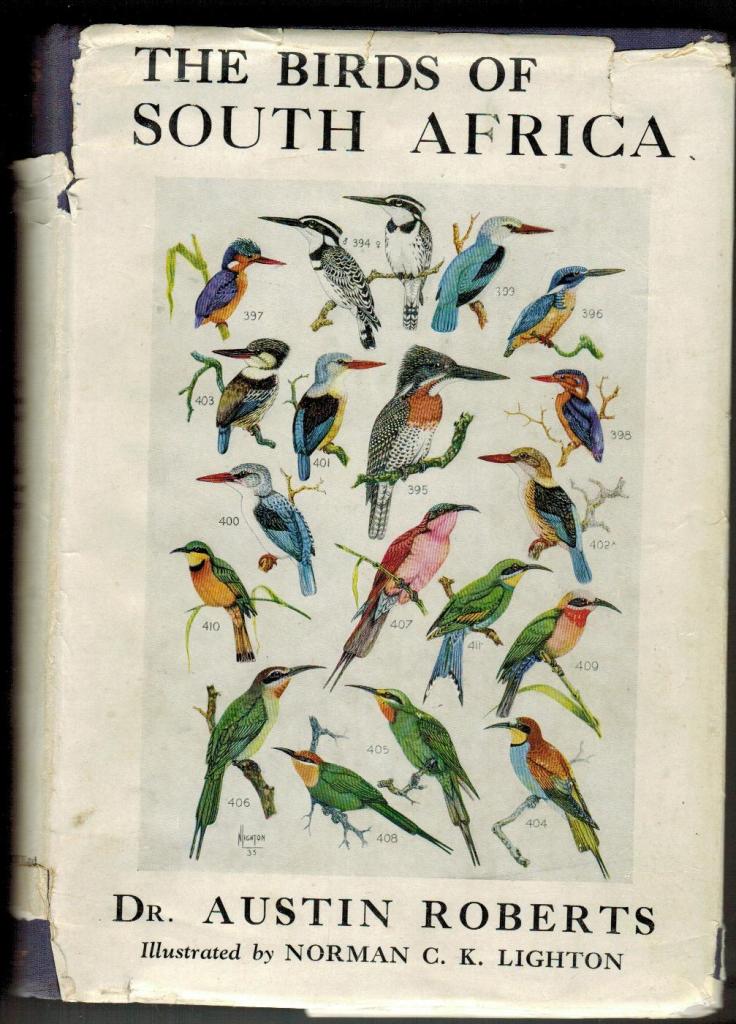
We grew up with Roberts Bird Book in the house. First edition, but about the sixth impression. It still had its dust jacket with the kingfishers and bee-eaters beautifully depicted on it. Mom and Dad still have it – I took this pic at their home in Pietermaritzburg. We also had a newer McLachlan & Liversidge edition of ‘Roberts.’
Here’s the plate I turned to in eager anticipation after hearing a wonderful and startling nocturnal call while camping in the dennebos with Stephen Charles Reed:
~~~oo0oo~~~
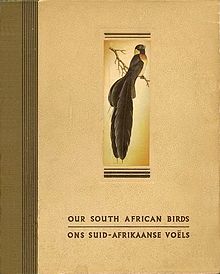
Another bird book on the shelf at 95 Stuart Street. This one you collected cigarette cards. Keep smoking till you have the complete set!
ROBERTS, Austin | Our South African Birds Johannesburg and Cape Town, United Tobaccos Cos, Westminster Tobacco, Policansky Bros 1941; hbk, 25×21 cm, 106pp, colour illus with 150 cigarette cards and five colour frontisp.
~~~oo0oo~~~ Later this beauty arrived. Published in 1961 we got it some years later:
I’ve long been confused about the hartebeest and the tsessebe, which I thought must be closely related.
This weekend we saw a small herd of blesbok on top of Platberg, and a few hartebeest on the slopes of Platberg in the pine forest, so I thought I must look into this.
And its quite complicated!
As always with classification you get ‘lumpers’ who say ‘They’re the same,’ and ‘splitters’ who say ‘No! Look, it’s a different colour.’ I’ve been a lumper by nature meself, needing real DNA differences before I’d want to say something was a completely different species, no matter how different they look. Hunters are often splitters, wanting to say they shot a red bushbuck and a grey bushbuck and a brown bushbuck; or a brindled wildebeest and a Cookson’s wildebeest; or a Burchell’s zebra and a Crawshay’s zebra; and if you have the money they’ll even sell you a ‘Blue,’ a ‘Golden’ and a ‘King’s’ wildebeests – all on the same farm! Then a pure white springbok and a pitch black impala!
DNA has helped a lot – it’s harder for people to ‘invent’ species now. But even now, debate continues and not everyone agrees on all the ‘sub-species vs separate species’ cases!
So let’s start with a family of big well-known mammals – the Bovidae, which evolved 20 million years ago, in the early Miocene. Cloven-hoofed, ruminant mammals, including domestic cattle, sheep and goats. A member of this family is called a bovid; the family Bovidae consists of eight major subfamilies with about 143 species.
The subfamily I’m interested in here, where the hartebeest fits, is called Alcelaphinae, which has four genera:
Genus Beatragus
Hirola, Beatragus hunteri – very rare, found in Kenya and Ethiopia.
Genus Damaliscus
Tsessebe, Damaliscus lunatus
Bontebok, Damaliscus pygargus
2 sub-species
Genus Alcelaphus
Hartebeest, Alcephalus buselaphus
8 sub-species
Genus Connochaetes
Black wildebeest, Connochaetes gnou
Blue wildebeest, Connochaetes taurinus
Things that fascinated me in looking this up:
=The hartebeest has only one species, with eight sub-species (although some splitters will dispute this; some like two species, some like three – adding Liechtenstein’s and Bangweulu Hartebeest as separate species).
=The Tsessebe is closer to the Blesbok than the Hartebeest. Except there’s no blesbok! Those buck we saw on top of Platberg? They’re Blesbok – a sub-species of the Bontebok.
Other antelope
The kudu, nyala, sitatunga, bongo and bushbuck spiral-horned antelope are closer to the cattle, bison and buffalo than they are to other antelope.
The impala is all on its own. Its closest relative being the rare and shy suni.
~~oo0oo~~
Classifying antelope is not easy, and this with only 143 species. Imagine how hard it is to classify the small mammals: – about 2200 species of rodents; and about 1200 bats.
~~oo0oo~~
Mankind!
The northernmost hartebeest – the bubal hartebeest – was found in Morocco and Algeria, north of the Atlas Mountains. The subspecies declined sharply during the course of the 19th century, especially after the French conquest of Algeria, when entire herds were massacred at once by the colonial military. By 1867 it could only be found in the mountain ranges of north-western Africa that are near or within the Sahara desert. In Morocco the last known herd, numbering only 15 animals, was located by a hunter near Outat El Haj in 1917; He shot twelve of them. The last specimen was ‘collected’ in 1920. The bubal hartebeest was finally ‘protected’ under the London Convention of 1933. Too late . . .
Here’s my reliable report from the front line. The heliograph was a bit shaky in the stiff breeze, but I wrote down what I think happened:
A well-drilled, orderly troop of Queen and Empire Poms marched up Platberg. And when they were up they were up **
– when I say ‘marched’ I mean they Four-Wheel-Drove –
They reconnoitered the surrounding area looking for Boer commandos, ready to report any sightings to some grand old Duke, or Lord, or someone. Ridiculously dressed in anti-camouflage bright red tunics, or similar, they stuck out like sore thumbs; But at least they were together and obeying the orders of Field Marshall Lello RSVP. This would not last very long.
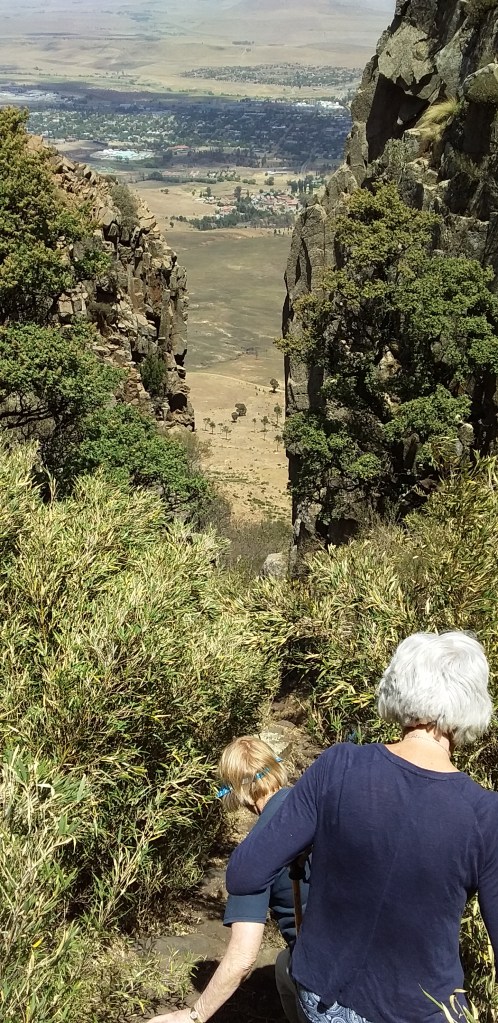
Once on top the cohesion started to wobble and soon a small breakaway happened. Some of the troops began behaving like Boers, thinking they could just go home when they felt like it. Five of them headed off down One Man’s Pass, misled by a trooper who said he had local knowledge, had run up this pass in the past four times and ‘it wasn’t far.’
It was far and it was steep and soon more than just cohesion was wobbling.
The remains of the patrol, now only nineteen strong, headed East back to Flat Rock Pass – or Donkey Pass – where a further split took place with trooper Soutar suddenly developing a deep longing for his ancestral home, Howick. I know, who would want to go to Howick?
Down to fifteen, the remainder headed for the Akkerbos for lunch and booze, where another defection saw four more wander off the beaten track and puncture the one wheel of their Ford Platberg Cape Cart. Field Marshall Lello RSVP set off to rescue them, dispatching sergeant Garth, corporal Nigel and Generaal Leon to rescue the original five deserters. Who of course, didn’t need rescuing as they had the whole thing under control and knew exactly where they were as they had a knowledgeable local guide with them. (Right!)
Back at the Oak Forest – where the princesses Elizabeth and Margaret had been kerfuffling in the bushes with equerry Group Captain Peter Townsend back in 1947 when most of us were busy being born – a laager had been formed and tables laden with provisions, especially booze.
A re-grouping took place and the size of the force stabilised at fifteen, with no wounds or injuries other than some grazes and some wobbly legs and some mild miffedness. (Justified, BTW). The disorderly conduct and the booze, together with the coating of dust and black soot on all the troops made the patrol look less and less like a plundering invading force from a small island, and more and more like good, patriotic, camouflaged local defenders.
Back down at the bottom of the mountain, the numbers swelled to nineteen and confidence grew to such an extent that a decision was made by the now almost completely Boer commando, to attack the blerrie Breetish in their blockhouse situated on the banks of that sparkling brook called the Kak Spruit. A clever encircling movement was made and we attacked the crows nest from above, putting the occupants to flight. Bladdy Poms!
– if you look carefully you can see the pockmarks of our accurate rifle shots*** all over –
So ended another successful campaign by us Boer guerillas. Generaal Leon could heave a sigh of relief and return to his farm after successfully converting a motley band of misled ‘joiners’ and getting them to support the right side at last.
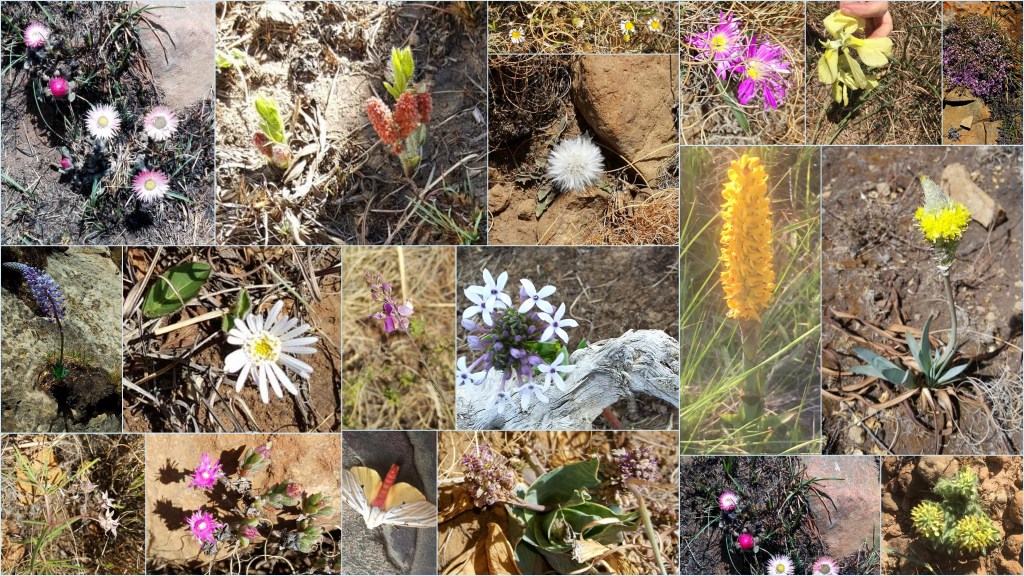
– some Eastern Free State wildflowers –
~~oo0oo~~
PS: I forgot to mention – During the whole campaign there was a westerly breeze which caused some heliograph wobble.
*** Have you ever seen an old sandstone structure without ‘Boer War bullet holes?’ Me, I think those holes are where the iron calipers used to lift the heavy blocks gripped them. Amiright?
We were doing Engels and had to read ‘ode to a something’ and so I wrote my Ode to a Commode, which was way better than John Keats’ effort. Hey, I was an immature, scatological teenager easily amused. In some ways . . . .
I searched for which ode it was and it was ‘Ode on a Grecian Urn’ – ode ON an urn! Now I remember: That’s what set me off giggling. I imagined him sitting on the ‘urn’ see? No? Well, ask a teenager.
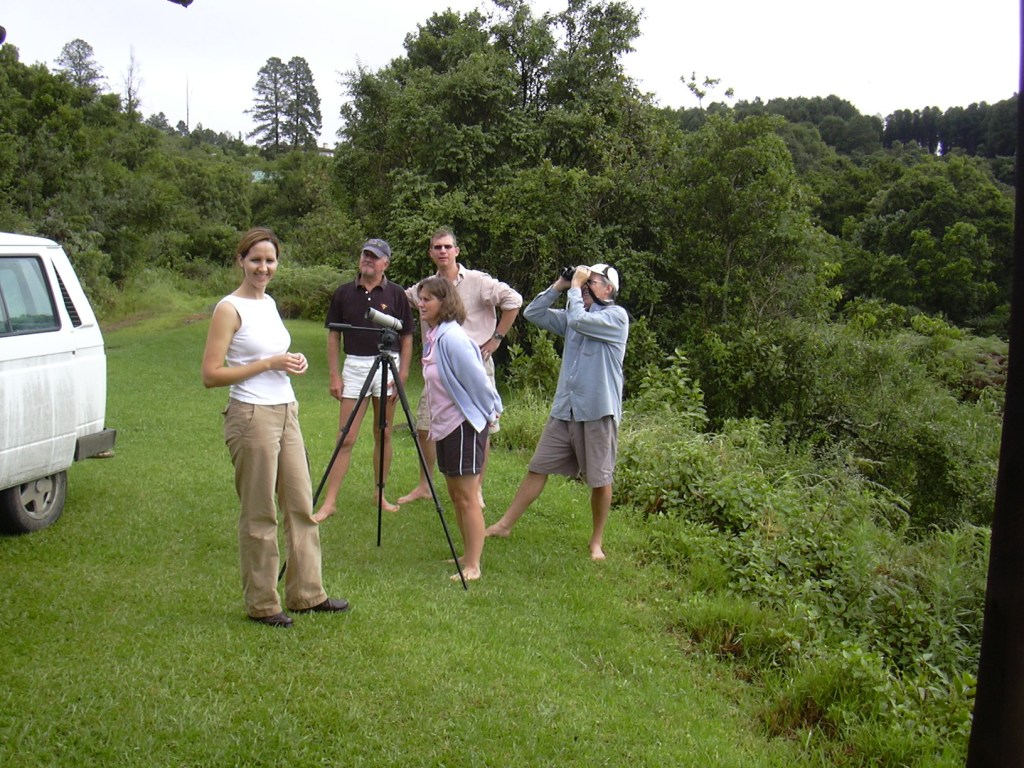
I was thinking about my telescopes and how much joy I’ve had from them; and decided to write an ode to my ‘scope, which reminded me of the above ancient memory.
So: ‘Scopes:
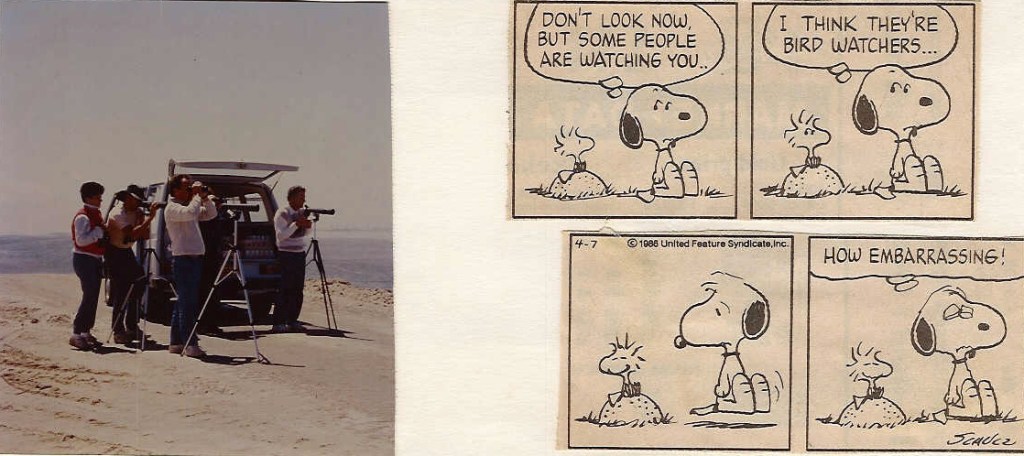
– salt marshes near Walvis Bay, Namibia in 1986 –
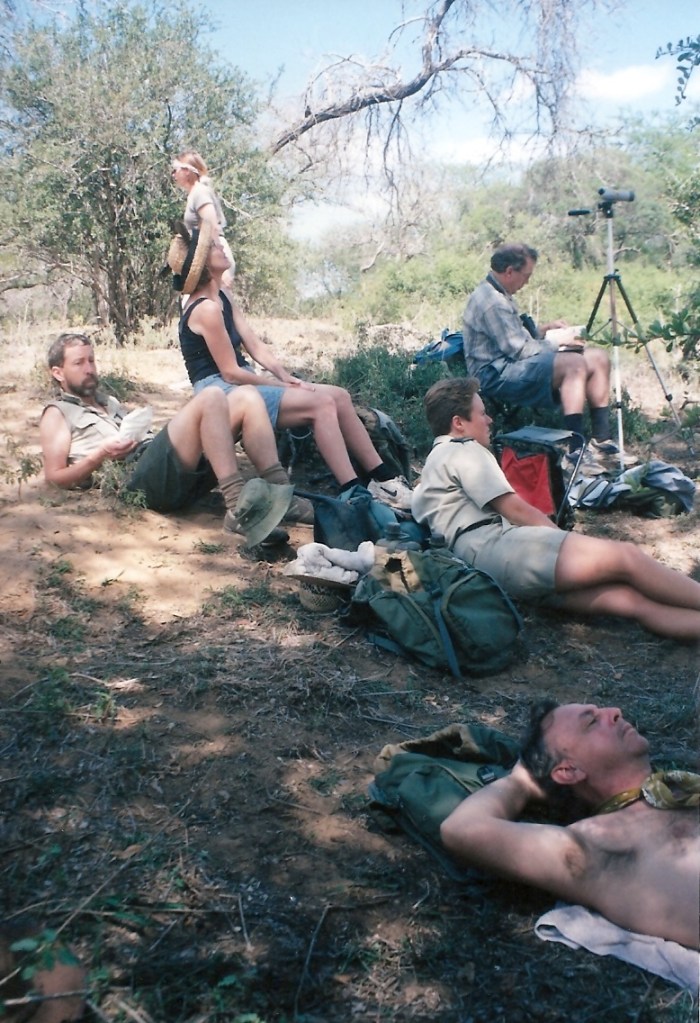
top two: Mfolosi wilderness walk; above: Tsavo East, Kenya –
– showed the crowd a Piet-My-Vrou cuckoo in Mbona, KZN Midlands –– see, Jessie? – Super-Jessie peers – resting her Super-vision to amuse Dad – – the whole old family with two new additions at Mangeni Falls near Isandlwana – – insets: Robbie peering into my scope twice, fifteen years apart –
With a scope you can delight novices; With binocs it’s often, ‘Where? Which tree? Oh hell, it flucked! It flocked off!’ with a scope you can say ‘Look’ and they say ‘Wow!’ I love that.
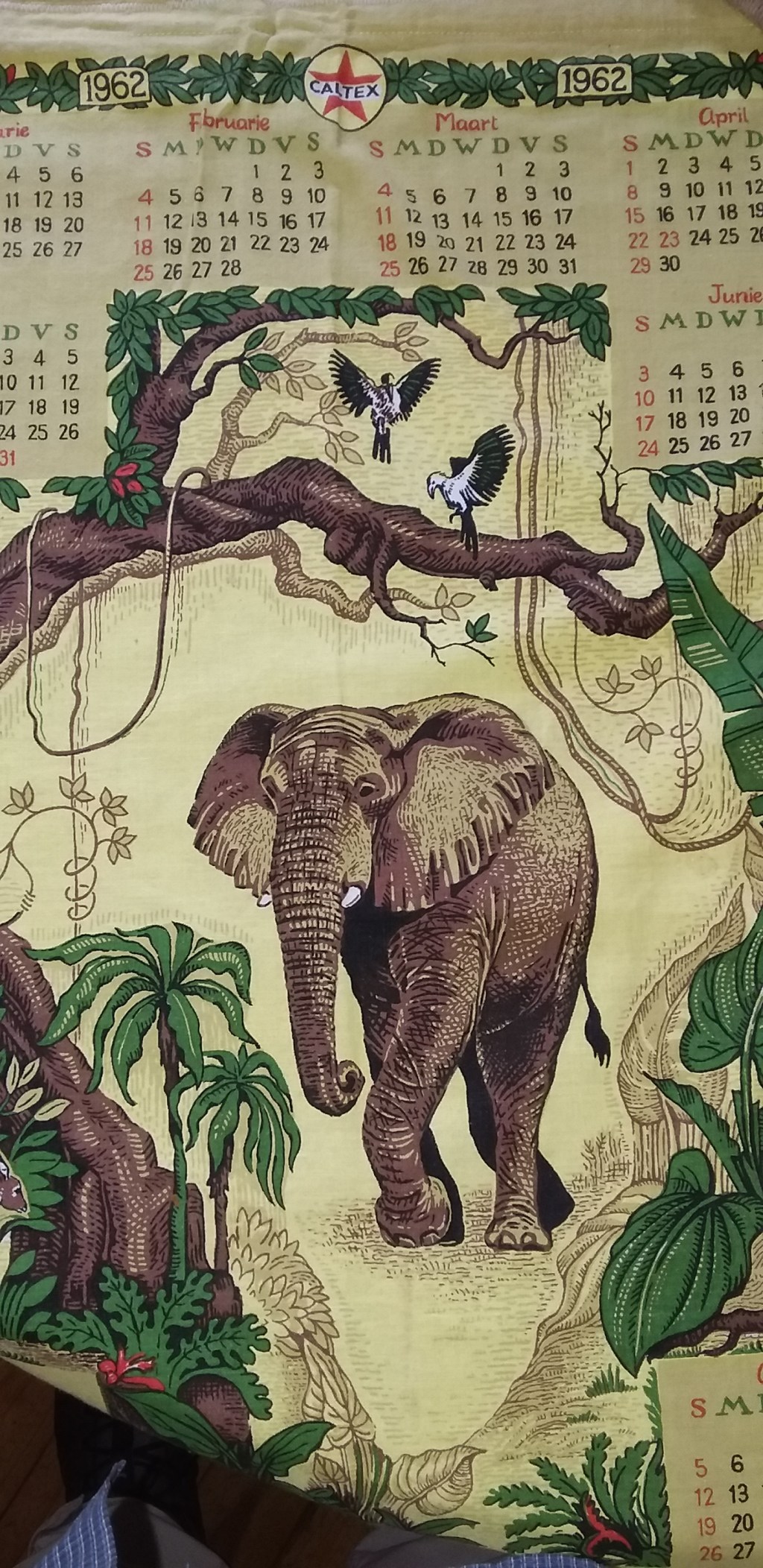
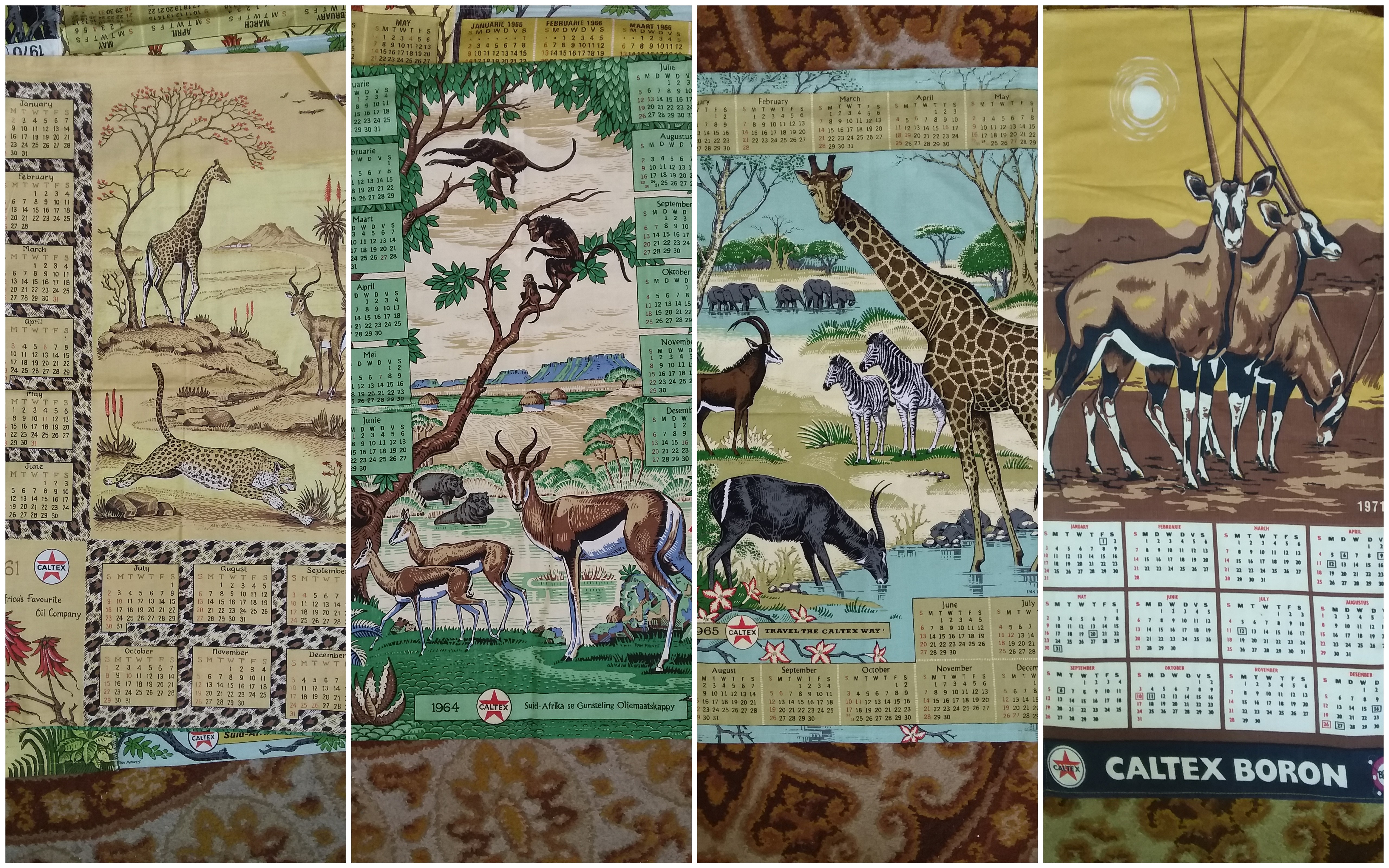
Annie had a Caltex garage; Dad worked for Annie; Louis Schoeman traveled for Caltex. Between 1962 and 1971 Caltex gave cloth wildlife calenders as their gift to their filling station owners.
Dad (now 96) says Louis would ‘forget’ to hand them out and he would insist on seeing what was in his boot. And there, ‘along with the sheep shit’ were the calenders! An inveterate collector, Dad would get ‘his’ share! Right! That’s why he has quite a few duplicates!
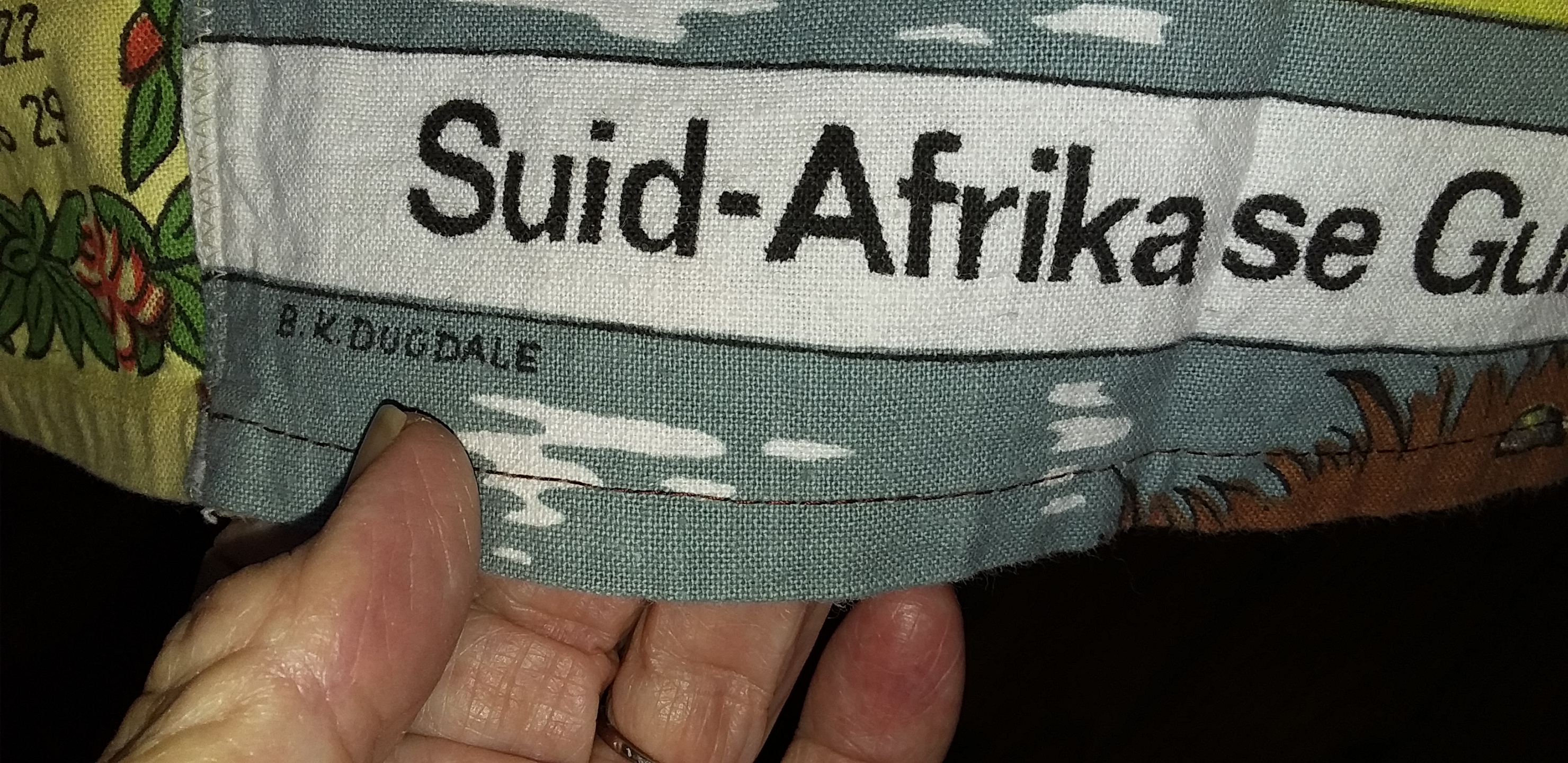
– I could find nothing on the internet about BK Dugdale – Mom’s hand here in pic –
Some have been sewn together to make table cloths. He still has plans for them, can’t get rid of them. He knows someone who will make them into cushion covers. Then he’ll get some cushions . .
~~~oo0oo~~~
He’s had it done: The calendars are now table cloths and cushion covers and he’s very proud of them. Can’t understand why his eldest daughter didn’t rave about them! She doesn’t like them, I dunno why; I like them. Nice and colourful.


























 Vrystaat Confessions