Back in 1963 we joined the du Plessis on a one-week beach and fishing holiday on the Natal north coast – Chaka’s Rock! They were beach regulars, this was one of our two beach holidays that I can remember. (flash: there were three!). Louis Brocket wrote in to remind us that, as Lynn’s boyfriend, he was also there for his first “vakansie-by-die-see“.
Sheila writes: “Found a postcard which Mary Methodist sent to her Mom Annie Bland (1½ cent stamp – remember the brown Afrikaner bull?). Mary wrote ‘We’re enjoying the swimming immensely. Coughs no worse in spite of it. We’re sleeping well and eating very well. The coast is beautiful. This is a picture of the pool where we swim.’ I think the three little Swanies all had whooping cough. Must have been fun for the du Plessis family who shared our holiday!”
It was amazing! The cottage on a hill above the beach, the rocks and seaside cliffs, narrow walkways along the cliffs that the waves would drench at high tide; magic swimming pools set in the rocks. The men were there to fish:
We baljaar’d on the beach and sometimes even ventured into the shallows – just up to safe vrystaat depth. A swimmer I was not, and I still vividly remember a near-death experience I had in the rock pool: a near-metre-high wave knocked me out of Mom’s arms and I was washed away out of her safe grasp! I must have been torn away by up to half a metre from her outstretched hands; little asthmatic me on my own in the vast Indian Ocean for what must have been a long one and a half seconds, four long metres away from dry land! Traumatised. To this day I am wary of the big-dam-that-you-can’t-see-the-other-side-of, and when I have to navigate across any stretches of salty water I use a minimum of a Boeing 707, but preferably a 747.
Well, after all! This was the most threatening Free State water I was used to braving before I met the Indian Ocean: Oh, and also the horse trough.
– and even then I’d lift my broek just in case –
The view from the cottage looking down the asthmatic flight of stairs:
In this next 8mm cine footage, you can see the violent waves inside the rock pools that threatened my frail existence:
vakansie by die see – beach or seaside holiday for naive inland creatures
baljaar – frolic
safe vrystaat depth – about ankle deep; not adult ankle. My ankle
postscript: I tried to keep up the luxury cottage theme but Barbara talked about the big spiders on the walls and yesterday even Dad, who was talking about Joe Geyser, mentioned ‘that ramshackle cottage we stayed in at Chaka’s Rock.’
Dad was saying Joe hardly ever caught a fish. He would be so busy with his pipe, relighting it, refilling it, winding the reel with one hand while fiddling with his pipe with the other. My theory is the fish could smell the tobacco and turned their nose up at his bait. Dad reckons tobacco was never a health hazard to old Joe. Although he was never without his pipe, it was mainly preparation and cleaning, and the amount of actual puffing he did was minimal.
Once he caught a wahoo and brought it back to Harrismith. Griet took one look at it as he walked into her kitchen and bade him sally forth. Some wives had agency. So Joe brought it to Dad and they cut it up and cooked it in our kitchen.
~~oo0oo~~
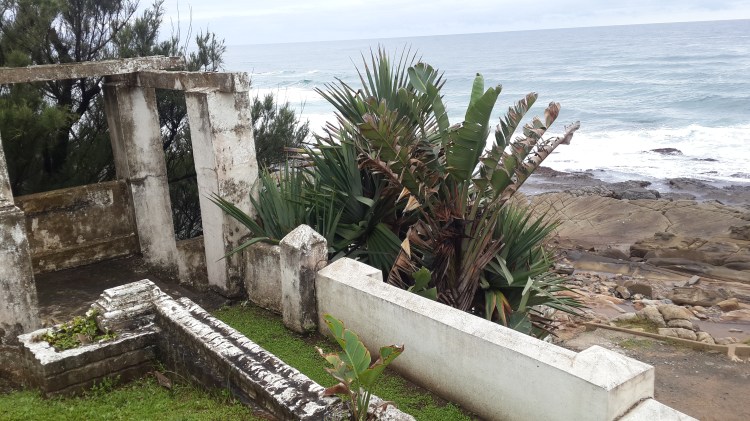
I went back in 2016 and the beach and rocks and the pools still look familiar.
But don’t look back! The green hillslopes have been concreted. When we humans see beautiful sub-tropical coastal forest we say, ‘Stunning! Let’s pour concrete on it!’
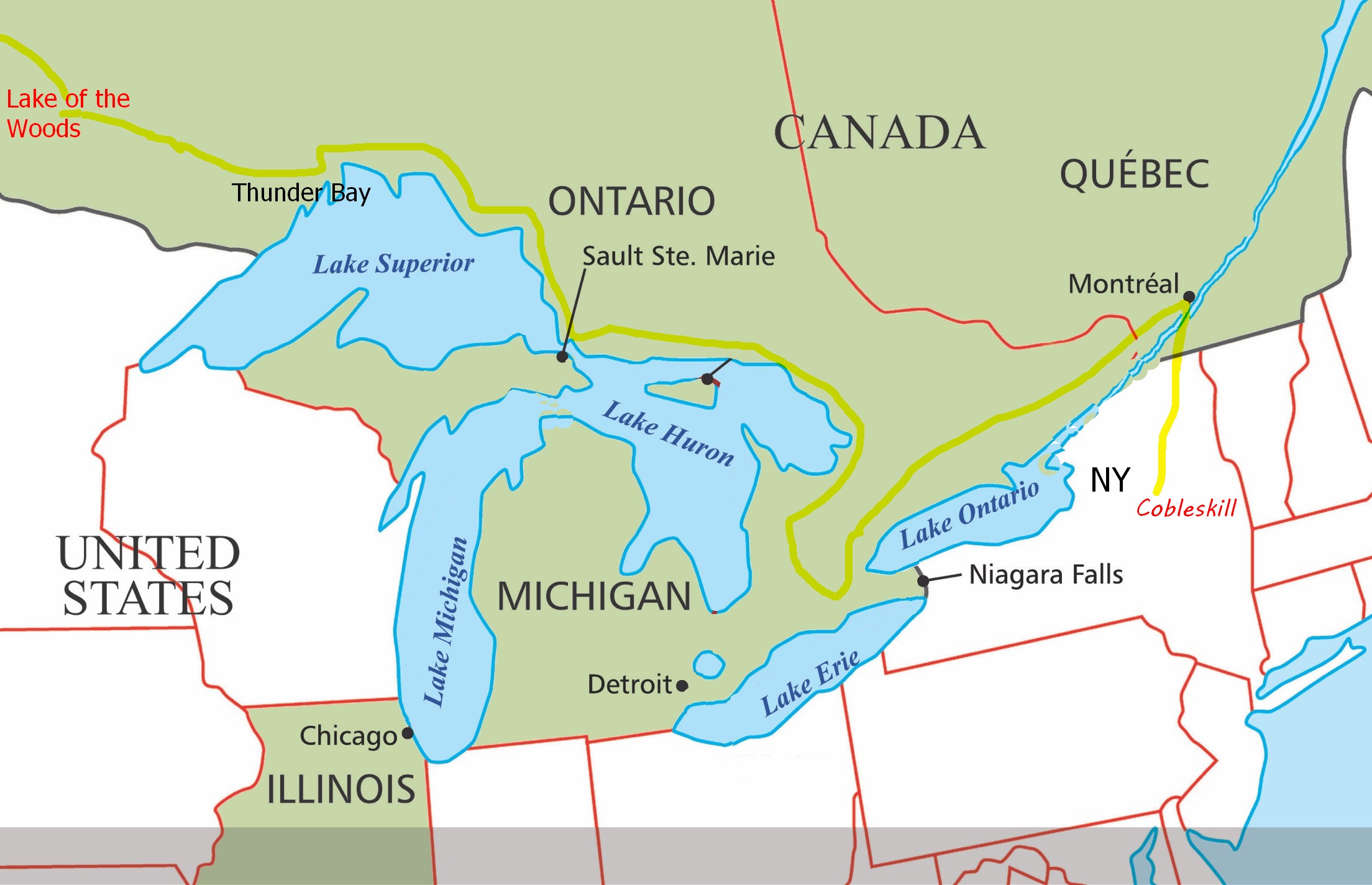
Stage Three (in yellow on the map) of my Great North American Road Trip started in Cobleskill in upstate New York, where Stage Two had ended.
A red VW Bug swept up the drive and out poured three lovely Okies and a handsome longhaired Aussie. Sherry Porter-Steele, owner of the Bug and twins Dottie and Dale Moffett. Sherry had been a favourite young high school teacher of the girls in Ardmore a few years prior, and involved in Rotary exchange student selection. Jonathan Kneebone was an Aussie, a dinkum character, say no more. Liked a beer.
We headed north to the Canadian border. Five laughing, happy peeps in a VW bug. It wasn’t a squeeze at all, we were having so much fun. At the border the man leaned in, asked “All American?” Yeah, we’re American, chimed Sherry, Dottie and Dale. He stepped back and was about to wave us through when Jonathan and I said “Um, no”.
“Australian” said Kneebone and the man made to step back again and wave us through when he registered what I had said.
“Uh, come with me please sir. I need to check your passport,” he said. An hour later we were off again – to Montreal. That’s where you see Dottie sitting on the grass.
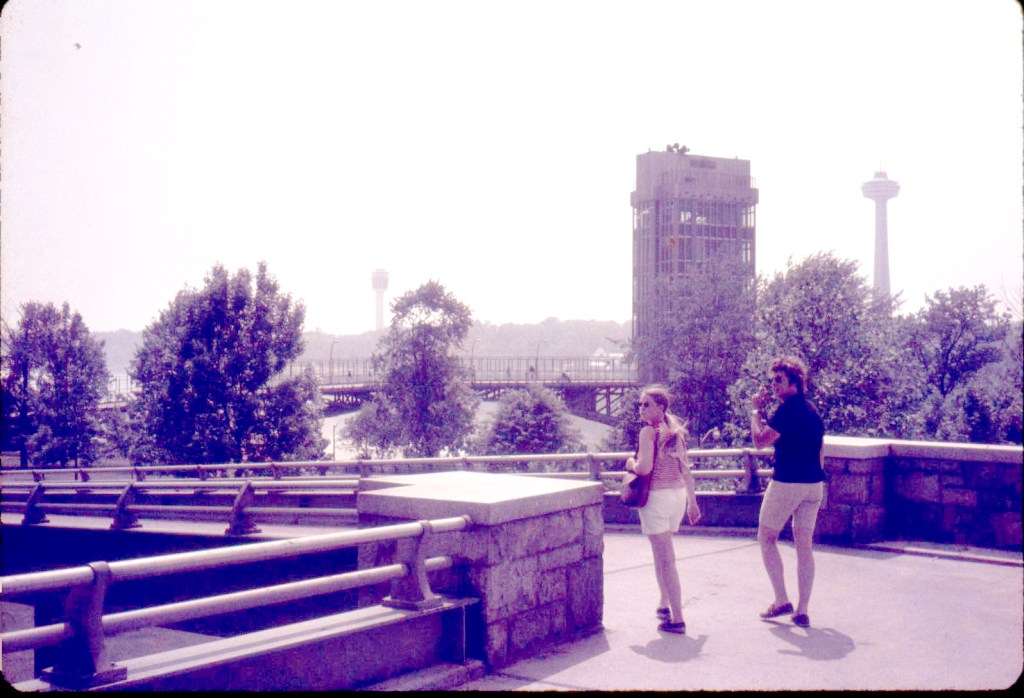
On to Ottawa where we bumped into Indira Ghandi on a state visit to Pierre Trudeau. She chose to arrive while we were staring at some government building or other. That’s the only time I’ve seen a head of state in the flesh ever. And one’s enough.
Somewhere around here I dinged Sherry’s car! “I’ll drive!” I shouted as we headed for the pub. I promptly reversed out the driveway, swung, and BANG! I got out and saw to my great relief – how horrible was this!? – that I’d hit a huge Dodge pickup with a bumper a yard deep; not a scratch on it! We could hop back into the red bug and bug off to the pub. Poor Sherry’s prize red VW wasn’t so lucky. I wrecked her left rear fender and light and I had no money to pay for the damage. DAMN!! Sherry was an absolute star about it, bless her! I still owe you, Sherry Porter-Steele!
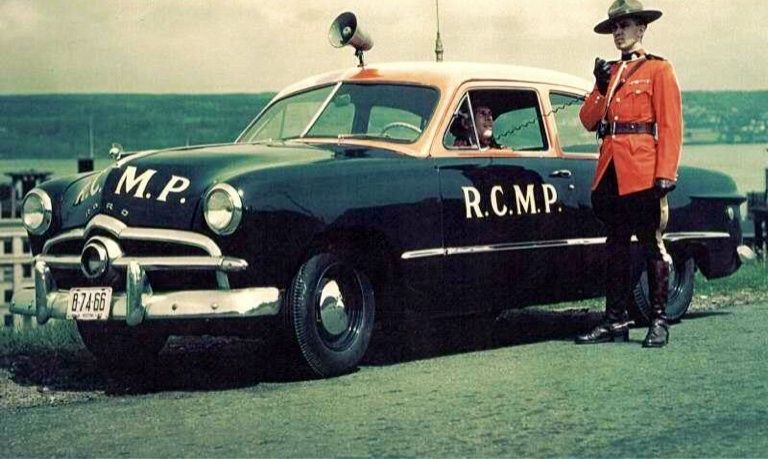
Then Toronto, Waterloo and up around Lake Superior, Sudbury, Sault St Marie, Thunder Bay. What a sight Superior was! Biggest stretch of fresh water imaginable. For a Vrystater, awe-inspiring! We camped en route wherever we could squirrel away for free. Only once were we shoo-ed off and told ‘I’m Sorry, You Can’t Camp Here.’ This by a Mountie with a big hat, so it was worth it! Yes SIR!
Here we used a rock for a mattress. We had just woken up but Kneebone was already being Australian!
– Me, Dottie, Dale & Jonathan Kneebone (can you guess where from?) –
Once we stayed in an old railway station converted to a sort of backpackers, the track ripped up and turned into a beautiful trail through the pines.
Then, suddenly, we needed to go canoeing. When in Canada, canoe! So we hired two boats in Quetico National Park, Lake of the Woods. All names may not be exact or current – these are 45yr-old memories!
– internet pics of the stunning lakes in Lake of the Woods area –
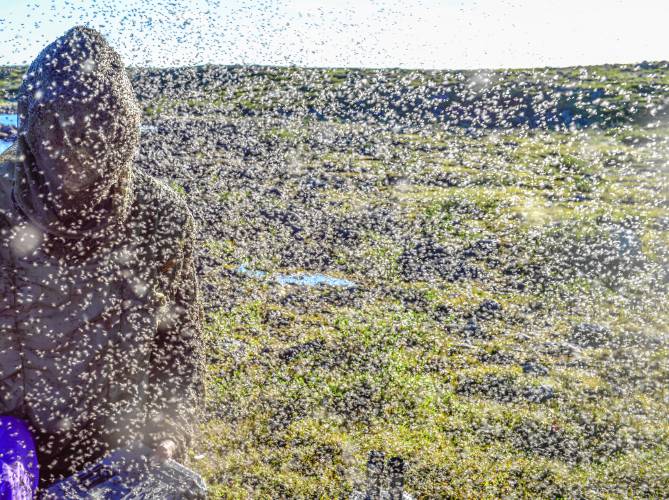
We planned a three-night trip, but after one night we turned back and ran, tails between our legs! We had spent the day trying to dodge dark clouds of midges and no-see-ems, or black flies. When you ran your hand through your hair it came out covered in blood. That night we pitched the tents on an island in a cloud of mozzies. We lined up with our kit, zipped open, dived in and zipped up immediately. So fast that we only had fourteen million mosquitoes in the tent, a fraction of the hordes that were hovering and zeeeee-ing outside!
– internet pics again – we were too busy to take pictures! –
Ama-azing! Canada sure has bugs! But what beautiful country:
As we’d cut our canoe trip short we decided to carry on into Manitoba, but Canada is vast and we realised we might bite off more than time would allow us to chew; so we soon cut back and headed south for the US border at International Falls, into Minnesota, across the Mississippi River where it’s still quite small and headed south for Iowa, where I had to leave the gang.
They dropped me off and buzzed off into the sunset, three lovely ladies and an Aussie, companions with who I had just spent one of the most unforgettable times of my life. That REALLY was special. So uncomplicated and relaxed and unstructured (unless Sherry was planning as we went – she was, come to think of it! I bet you she was!), and free and friendly. Wonderful people.
– the FOUR legs of my road trip – Summer of ’73 –
My host family from Apache Don & Jackie Lehnertz were up there and would be driving me back to Apache via Iowa, Missouri and Kansas on Stage Four. I’m afraid I slept a lot on this leg of the trip!
Jim n Katie Patterson, wonderful host family in Apache, took lovely girlfriend Dottie Moffett and me on a special trip out west in the summer of ’73, driving across the Texas panhandle to New Mexico. Dottie and I went part of the way with the Manars in their beautiful new car towing the newest of the Jeeps.
– crossing the Texas panhandle to New Mexico, the Manar’s Lincoln Continental –
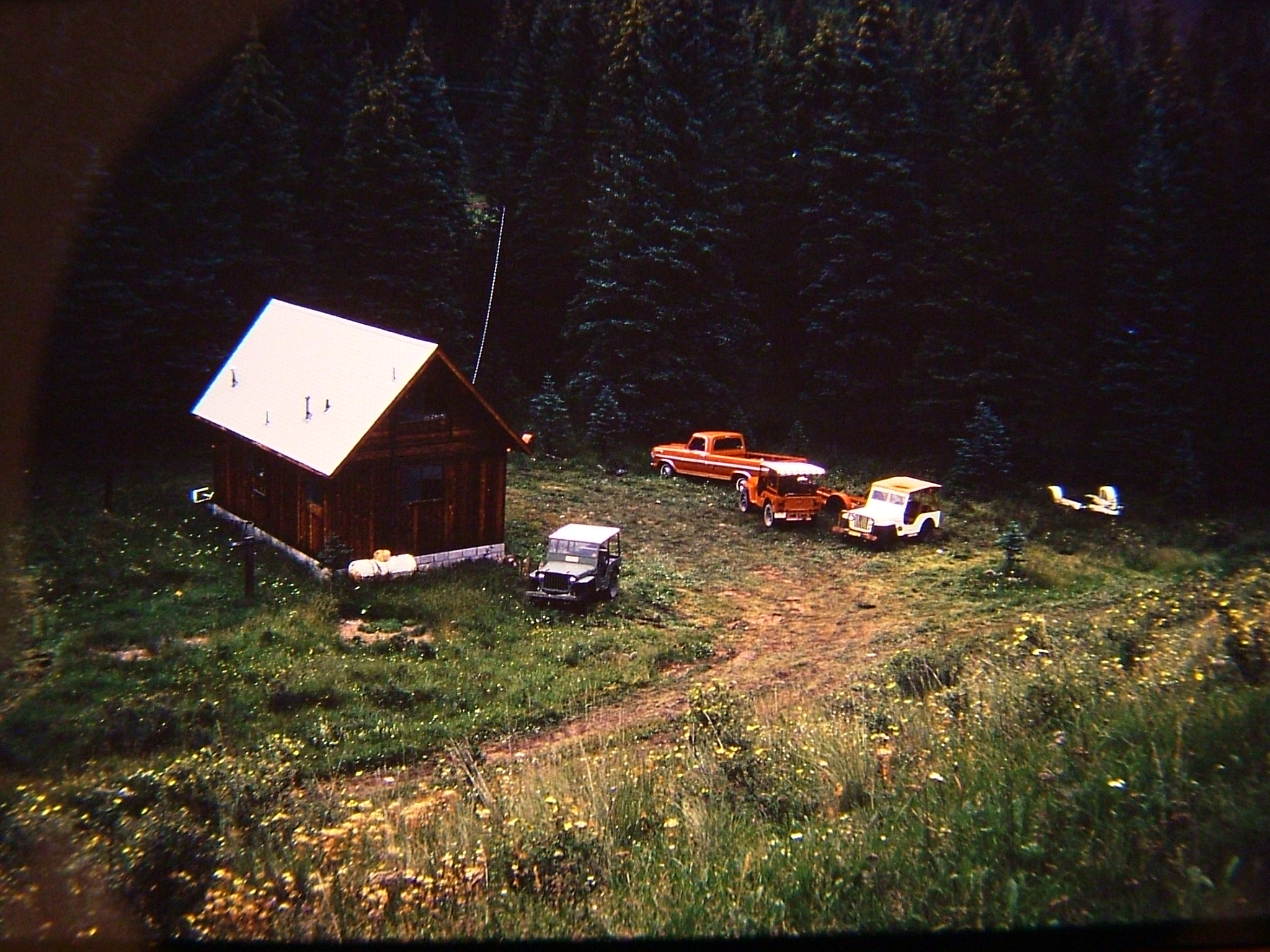
Jim’s Mom Merrell Patterson had a lovely cottage outside Red River in the Sangre de Christo mountains. It could sleep a whole bunch of people if they were good friends! Some of the families did stay elsewhere nearby though, so we weren’t crowded. It was great fun.
– Granma Merrill’s Cottage outside Red River –
Here we stayed with the gang – the wonderful group of Apache friends the Pattersons hung out with: Manars, Hrbaceks, Mindemanns and Paynes.
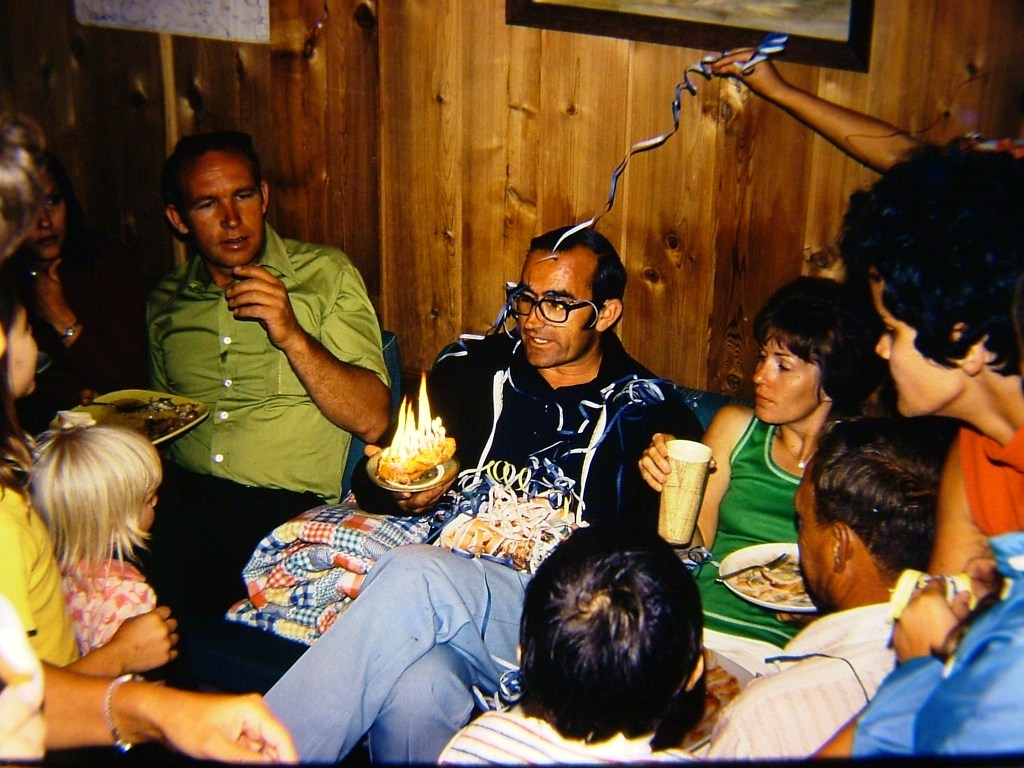
Jim & Mary-KateThat’s what Seagrams will do for candles! Glen’s worried!Peggy, Glen, Jim. Pug, Walter, Katie. Jim blows Seagrams breath– Jim had a birthday – his breath didn’t dowse the candles, it flared them up! –
The Jeeps were perfect for the mountain trails
Hebcoolers on the tailgates – Beer & Bloody MaryOld Red leads the pack in the Sangre de Cristo mountains
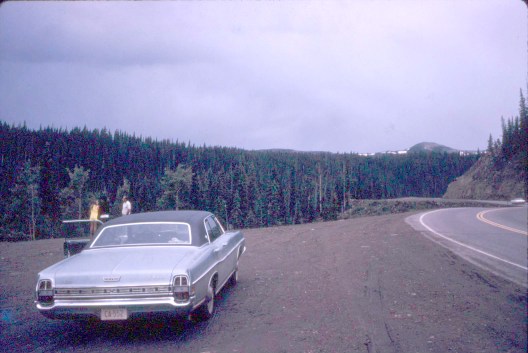
After a terrific stay there, we headed off to Vegas in the Patterson’s Ford LTD via Colorado and Utah
– the LTD, with Dottie Moffett, Katie and Jim Patterson –
Then via Utah, where we visited Bryce Canyon and Zion NP.
In Vegas we stayed at The Stardust on The Strip. I learnt to gamble, I learnt to win. I battled to lose. Dottie was a good luck charm! I kept winning small amounts so kept on and on gambling, determined to lose. Finally as dawn approached we were down by a considerable fortune – $10 – and could go to bed.
We saw Joan Rivers being delightfully rude and Petula Clark warbling away (also Joan warbled a song and Petula told a joke!). I learnt a Vegas rule when I saw Jim slip the doorman a cri$p note to get us a good table!
– internet pic of 1973 Vegas strip scene –
After Vegas we stopped off at The Grand Canyon: We stared down at this awesome sight from the lookout on the south rim. We only had a few hours there, so we’re just look-see tourists. Suddenly I couldn’t stand it! I had to get down there. I told Dottie I was going and she said me too!
We started running down the Bright Angel trail. It’s about 10km to the river. I’ll give us an hour, I thought. The run was easy on a well-maintained track with the only real obstacle being the ‘mule trains’. Only once we had to step off the trail and let a bunch of mules pass. We made sure we were on the upside!
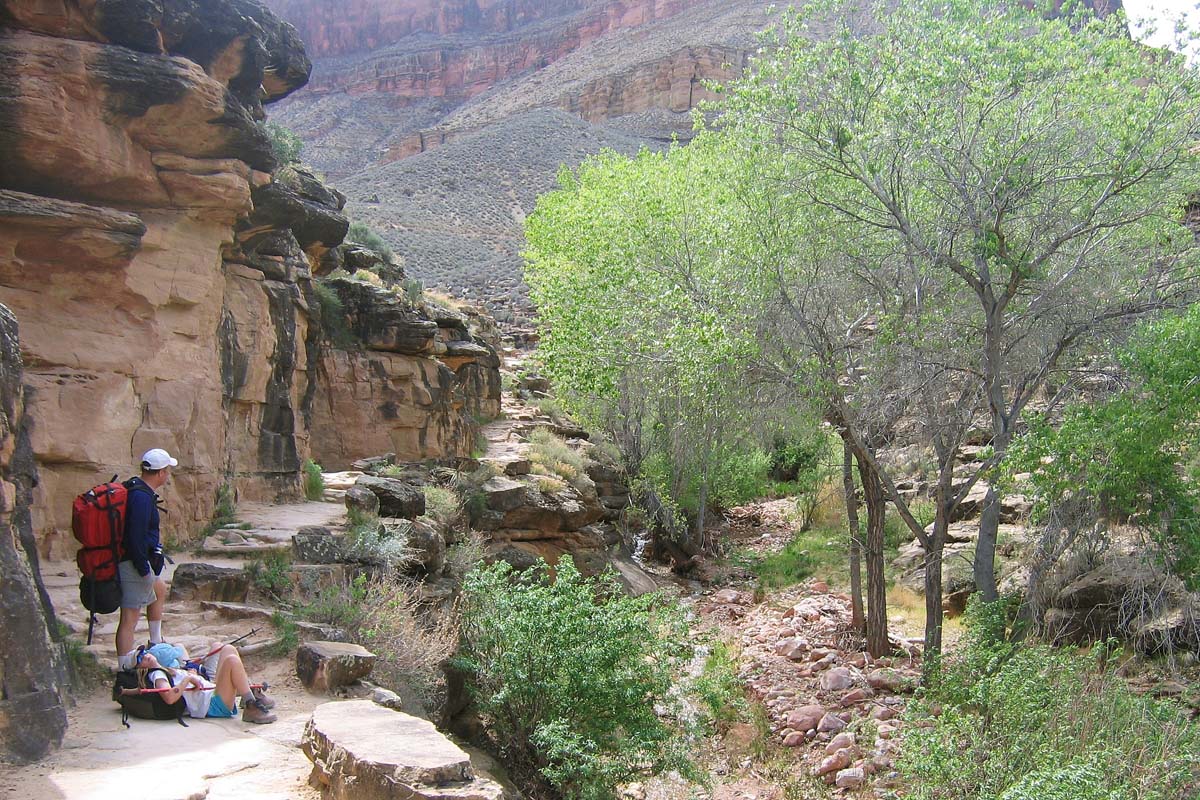
At first it was all open desert trail, but at Indian Gardens I was surprised by the amount of greenery in the canyon. From the rim it looks like all desert, but in the protected gorges there’s green shrubbery and even some tall trees.
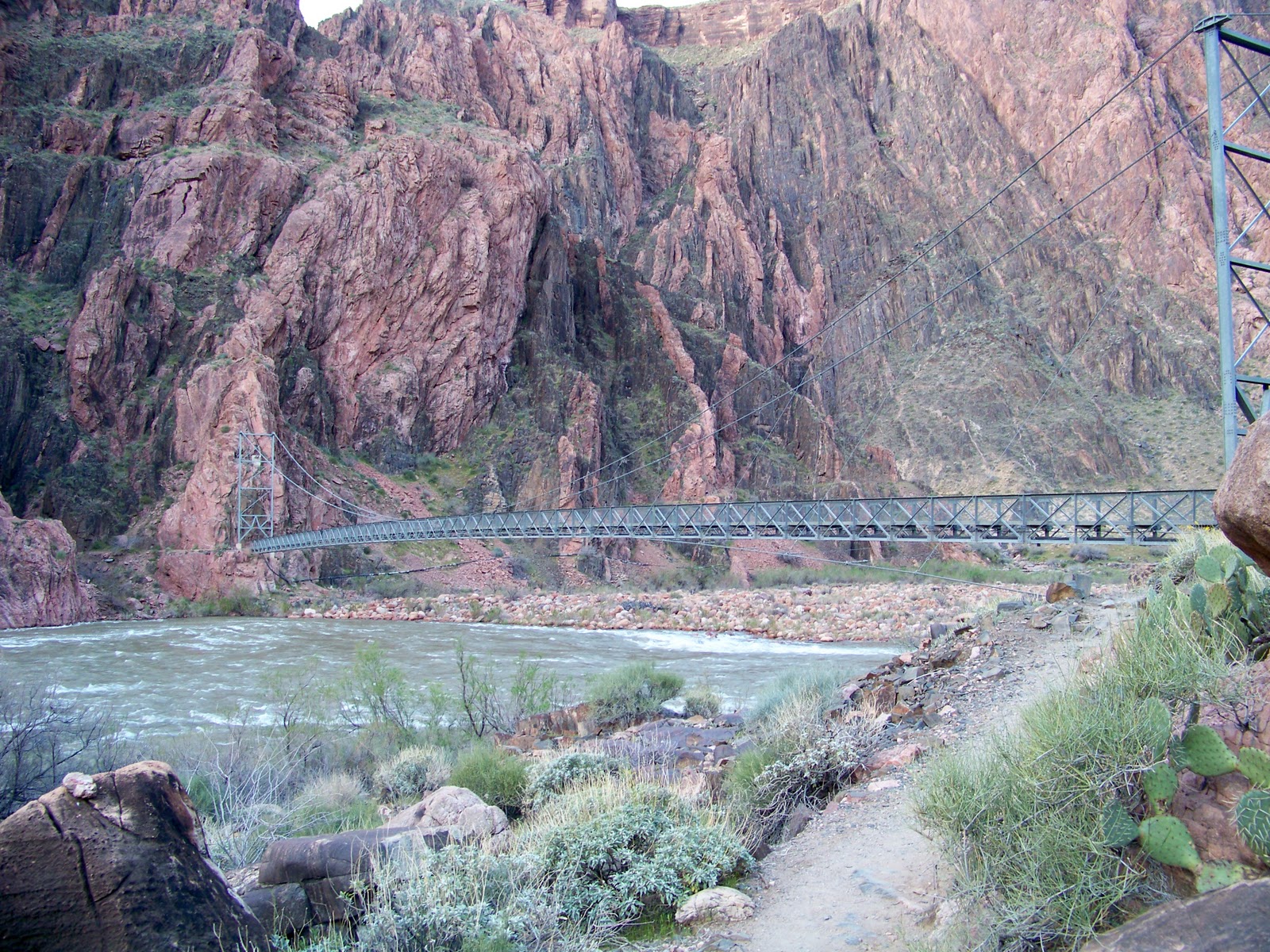
In well under an hour we got to just above the river. I stared in awesome wonder at the swiftly-moving green water. I had never seen such a large volume of water flowing clear like that. Our South African rivers mostly run muddy brown, and I wasn’t expecting clear water. Right then I thought I MUST get onto this river! I’d started kayaking a couple of years before, but if I’d been asked I’d probably have said on a raft, little knowing that in eleven years time I would kayak past that very spot, under that same bridge in 1984 on a flood-level river!
– in 1973 on foot the water looked like this –– our kayak trip in 1984 – these are our supporting rafts –
The hike back out was steep, but hey, we were 18yrs old! Cross-country running had been my favourite obsession the year before, and Dottie was Oklahoma’s No.2 tennis player, so no (or an acceptable amount of) sweat!
Then we headed home, by and large following the new I40 – which replaced the famous old historic Route 66 in places. Flagstaff Arizona, Albuquerque New Mexico, Amarillo Texas, and back to Oklahoma. To Apache and then on to take Dottie home to Ardmore. What a wonderful trip with amazing people!
I learned later:
The name Colorado was for its muddy colour and its clarity is in fact an undesirable artifact because of the Glen Canyon Dam and Lake Powell upstream;
The 10km climb down Bright Angel is about 1000m vertically, and every metre down you’re going back in geological time! Fascinating. When we paddled through we had a paddler who is a geology prof with us, who regaled us with tales of how old each section was.
They tell you Do Not try to hike from the rim to the river and back in one day! Why, we thought?
Jim has hiked the rim to rim hike through the canyon a number of times since – an annual pilgrimage – the last time he did it he was 70!
~~~oo0oo~~~
***most pics off the ‘net – I’ll add my own as I find them!***
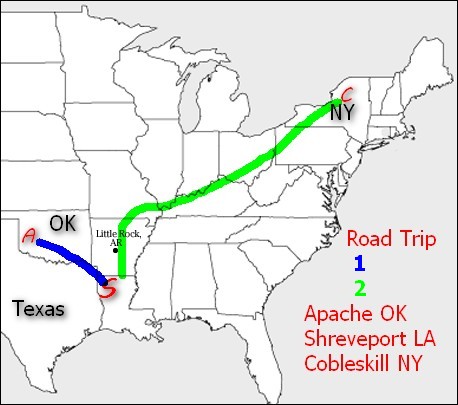
My four-stage 1973 Road Trip North started in Apache Oklahoma. In Stage One Katie Patterson drove us down in her Ford LTD to stay with her folks, Mama and Papa Hays, in Shreveport, Louisiana. There we ‘visited’ as Oklahomans say; We were spoiled – I was a third, older, honorary grandchild! We played golf – I recall smacking the ball into one inch ‘rough’ under big old trees draped in lichen, or old man’s beard; And we ate superbly.
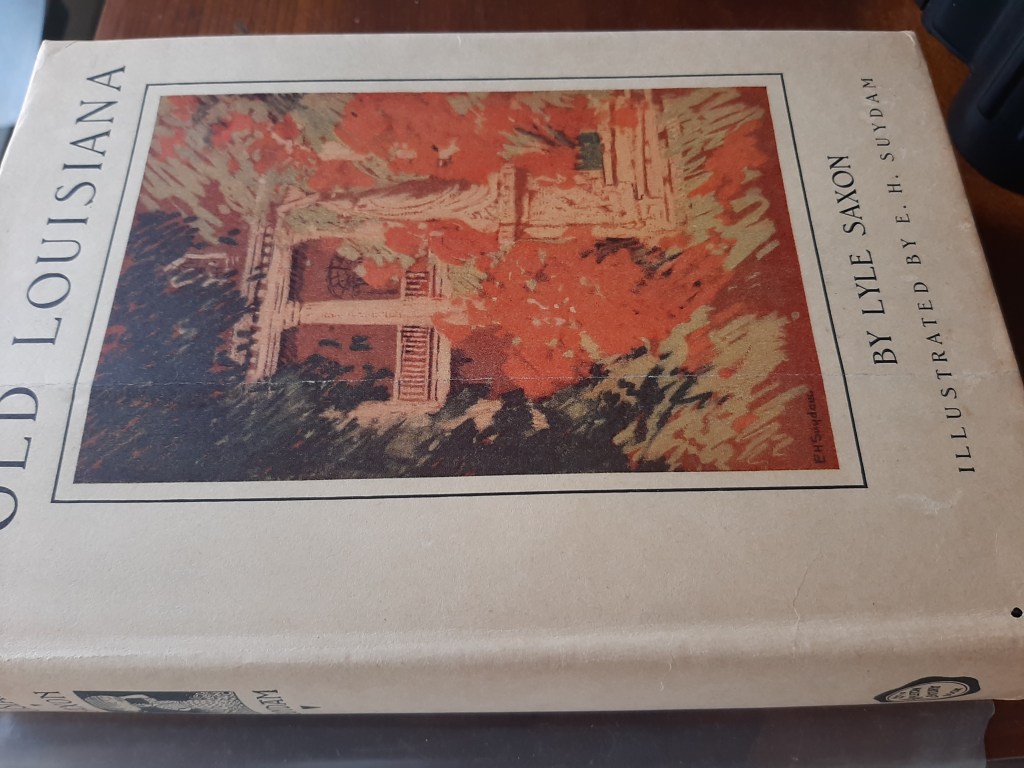
Papa Hays gave me a beautiful old book:
– Ginny, Katie, Mama Hays, Papa Hays, Jimmy, Larry, Mary-Kate – in Shreveport Louisiana –
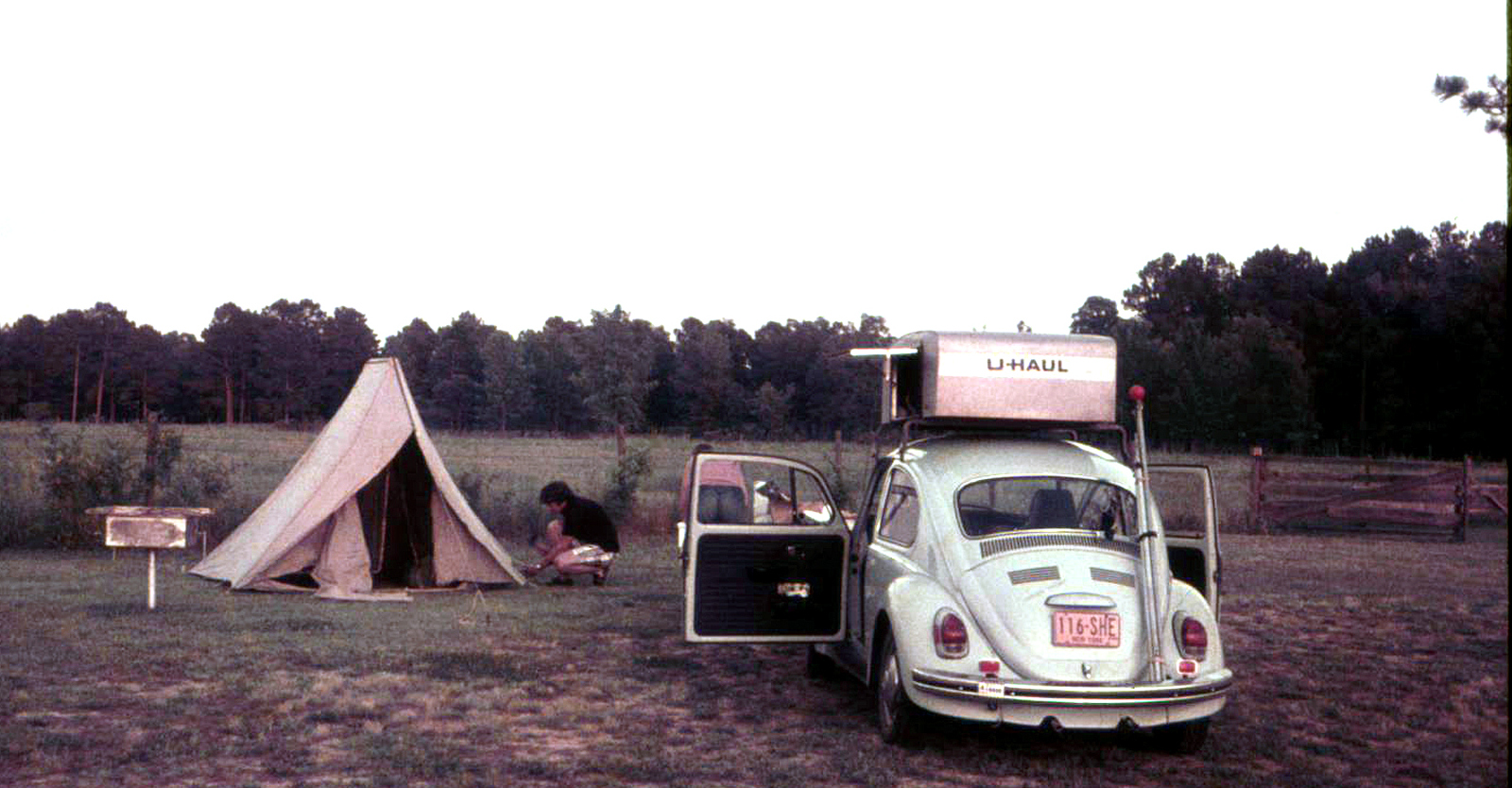
Larry and his sister Ginny joined us, having driven down from Cobleskill NY and we got ready for Stage Two of my Great North American Road Trip: Heading north-east in a light greenish-grey Volkswagen Bug, 116 SHE.
– Larry, his ‘red’ VW and the U-Haul –
Larry and Ginny had packed their camping kit on the back seat; One more passenger meant we now needed a U-Haul carrier on the roof.
I remember surprisingly little about this trip north-east! We left the Red River and crossed the Arkansas River near Little Rock; I remember camping:
– Larry, Boy Scout! –
I remember crossing the mighty Mississippi River in or near St Louis, where the Missouri joins it;
The only thing I remember clearly is hoping my ID would be checked at the door when we went for my very first legal beer at a TGIF bar in Missouri. I had drank beer as a schoolboy in the Vrystaat, led astray by good friends, then as a seventeen yr-old in Oklahoma, in a 21 state, I had drank beer in Louisiana and Arkansas, but I turned 18 in the interim, and now at last I was eighteen in an 18 state! Legal at last!
I held my SA passport ready . . I now know (maybe not, it was more likely June or July by now) it was a Sunday; Richard Nixon was the President; We were listening to Killing Me Softly With His Song, and Tie A Yellow Ribbon Round The Old Oak Tree; and NOW, at last, I would be checked and blessed for the first time . .
But the man at the door just waved me through. ** sigh! ** why have I always looked much older than I am? Nowadays people think I’m a hundred in the shade. Next they’ll be wanting to cancel my liquor licence, take away my drivers licence and mop my dribbling . . .
Oh, well, at least some other world-firsts happened that week: The first cellphone call; The World Trade Center twin towers opened; the first international rugby sevens tournament took place; the last American soldier ignominiously left Vietnam; and Pablo Picasso died.
I also remember getting to Larry’s hometown Cobleskill, a beautiful little town in upstate New York, and meeting his parents. I’d heard about Cobleskill since 1969 when Larry breezed into Harrismith and we spent a fun year making memories and amok; early experiments mixing beer and petrol – which he called gas. Well, we had a gas! Fun times!
That’s a really vague and sketchy recollection of a magic route! Larry doesn’t remember much more. In fact he confidently remembered the VW Bug as being red! ‘Tis not only my memory glands that are dodgy, I’m relieved to tell.
He’s going to ask his sister Virginia. She’ll know more. I know we went here, cos my trusty Olympus trip 35 camera recorded it, but where is it?
– someone will know where this is – Missouri River? Mississippi River? –
~~oo0oo~~
A few days later, another VW Bug arrived, full of gorgeous Oklahomans; and one less-than-glamorous Aussie (where are you, Jonathan Kneebone?) . . . and this Bug was red.
– l to r – gorgeous Oklahomans Dottie Moffett, Sherry Porter-Steele and Dale Moffett –
Subject: Lost in the USA Hey Larry – Help a lost Vrystater who can’t remember where he has been! I know we left Shreveport in your lil greyish-greenish VW Bug and headed up to Little Rock (I guess on highways 49 and then 30) but after that I’ve hit a blank. And I know you took us to some interesting places. Do you remember the route you took? I’d love to hear it. Sort of a trip down Forgettery Lane. Cheers – Koos
Larry:
Forgettery Lane? You’re talking to someone who’s pretty much strolling down Alzheimer’s Avenue! (at least where 40+-year-old memories are concerned). BTW, if we traveled in a VW Beetle, it must have been red.
Fortunately for us both, Ginny tends to be much better in the recall department than I am. I believe we started the trip as a way for me to check out some law schools (which I was sort of seriously considering at the time, but — fortunately — never pursued). She was good enough to volunteer to come along as a companion/navigator, though I’m afraid I was a bit tough on her in that latter capacity, especially when I got freaked out driving in Washington, D.C., where the traffic was a bit intense for a kid from the country and the city center is famously laid out like the spokes of a wheel, as opposed to the more traditional grid pattern. Not what I’d call intuitive.
Thankfully we’re still on speaking terms, which I fear I put in jeopardy there for a while, so I’ll ask her (by means of CC-ing her on this e-mail) for any details she may recall. Unless I traumatized her so badly that she’s repressed the entire experience! Or perhaps it had the opposite effect and seared it into her memory — let’s hope for that. We were just together (in Roanoke) over the Easter holiday; wish I could have asked her about it directly.
That’s a very long way of saying no, I don’t really remember our route — sorry. I’m still hopeful Ginny may be able to save my bacon.
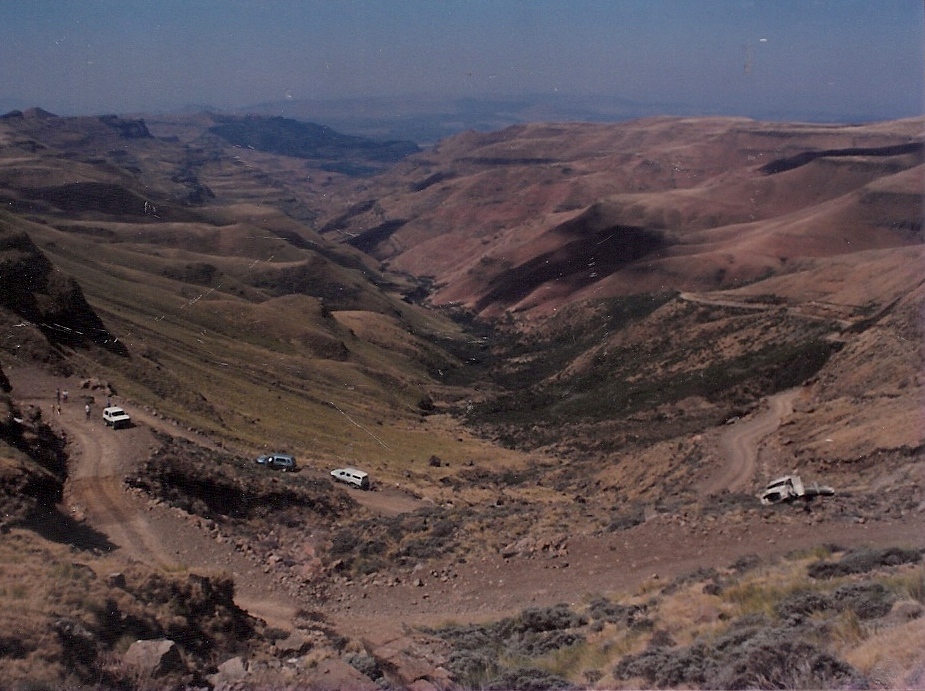
Three modern bakkies and a 1979 Series II Landrover LWB with a Ford V6 3litre engine shoved in – and hand-painted flat white with bright red wheels – ventured up Sani Pass one day. The three very capable bakkies sailed up with ease, boring ease, while Redfoot had to pause for a breather at about three stream crossings to have its radiator topped up and let its heart rate subside.
The three more capable – but less photogenic – bakkies
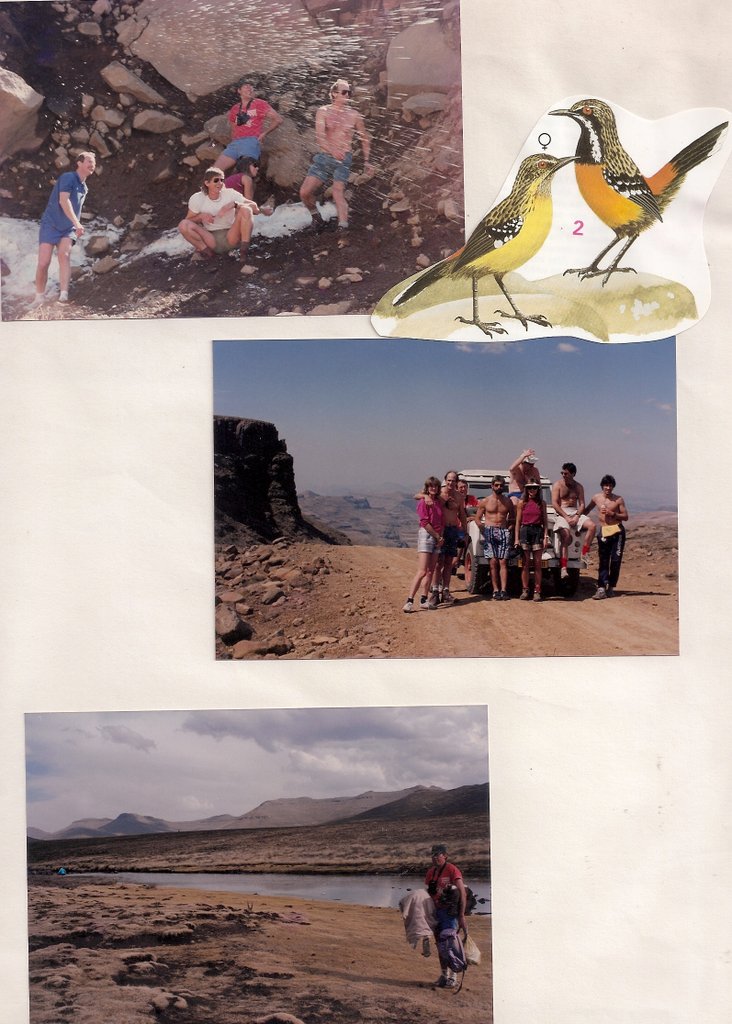
But at photo op time where did everyone pose? On old Redfoot the Landie! Hey, we’re rugged! We battled up this pass!
And on which vehicle did everyone pose for their “We Conquered the Mountain” picture?
See, driving a pickup you look like you’re going to work; but driving a LandRover, you look like you’re going on an expedition! From which you might not return!!
Kingfisher Canoe Club mates all, they naturally battled to behave themselves.
Beautiful rockjumpers on the rocks
Slightly disconcerting on the way down Sani: As Redfoot was catching its breath and airing its brakes halfway down, two nuns breezed past us, chatting gaily, in a 2X4 bakkie. They waved at us. Bitches.
~~oo0oo~~
Aitch found Redfoot. One of her PMB doctors was ‘doing up’ an old Landie, putting a new engine in and it ‘would be like new’ he said. He was a fibbing car salesman but my Need-A-4X4-O-Meter was up and he could have sold me a – Wait! He DID sell me a Landrover!Never thought I’d fall for one of those.
‘Only one previous owner’ he said and that was true: Besides him, only one previous owner – The KwaZulu bantustan homeland Police Force. I only found that out too late but anyway he’d have re-assured me that they treated it with kid gloves and as if it was their own, sticking to the speed limit, never over-loading it and at all times, staying on the tar.
I bought it for R12000 in partnership with my three business partners, 25% each. I assured them they would thank me. I don’t think Lello and Stoute ever used it. Yoell did once. And Prem Singh used it once to take a wedding party to Ladysmith. Soutar used it a few times, but he doesn’t count as he also owned an old white Landrover.
I spent a further R13000 on two more Ford engines and sold it with relief for R5000 hot cash. The Sani trip was the only worthwhile exercise it ever undertook. Come to think of it, I don’t think my Redfooted partners ever did thank me! I don’t know why. I mean, it was a real conversation stopper. You had to say what you wanted before you left, cos on the journey there was no way you could even hear yourself speak, never mind what your victims passengers were saying. There was this slight hole in the aluminium between your knees and the engine compartment and also a slight hole in the aluminium between your heels and the road, so lots of noise rushed in where angels feared to tread.
~~oo0oo~~
You’d think I’d have leanrned about Landies on this trip to Botswana. But nope, that trip was part of the reason I wanted one. I had to burn my own personal fingers.
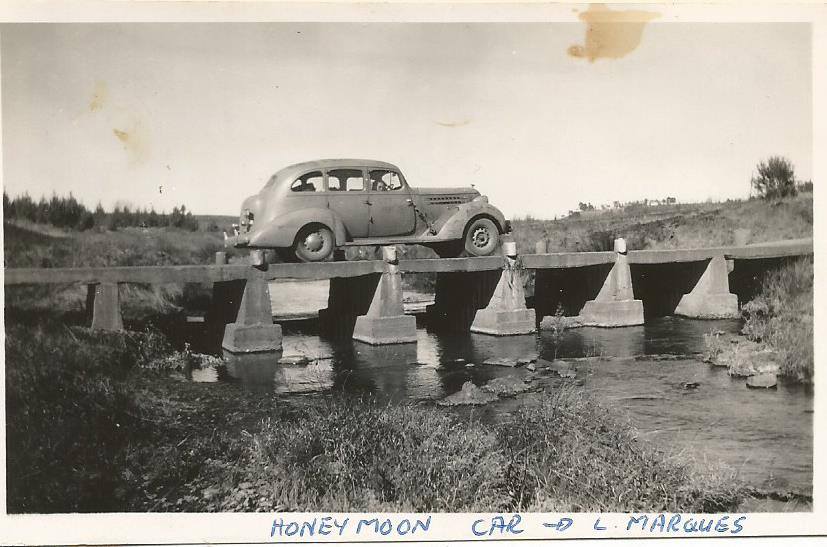
Mom & Dad went to Lourenco Marques in Mocambique for their honeymoon in 1951.
With cars being very scarce after the war, Dad looked around for anything he could afford. He found a Mr Smith selling a fifteen year old Hudson Terraplane 4-door for £100. It came with a spare engine in the boot – and the feeling that it would probably be needed.
– Mary behind the wheel –
On the way after the second day, somewhere in the old Transvaal, they smelt fish – and the smell got worse. They stopped, the ole man opened the bonnet and found a dead fish on the manifold. He said immediately, I know who did this; He’s put it where it will stink, but it won’t cause any harm Only Upsy would do this. Upsy Sorenson. He removed the fish, burning his hand in doing so. Mom says, ‘To think we went to Lourenco Marques in that old thing. Dad says he wouldn’t drive to the gate in it now.’
But it made it to LM – and back. Mom had to put her feet on the seat – the floor got too hot, even with shoes on. While in Lourenco Marques the Hudson started missing, so Dad took it to a garage but the Portuguese owners couldn’t understand him. He tried Italian, which he’d learnt in the war. “Candela?” – Ah! Candela! Yes, they had sparkplugs and they could sort him out.
They stayed in a boarding house a couple blocks back from the seafront. ‘It was cheaper than a hotel’. While there they met with Frank Cabral a big game hunter married to some relative of Mom’s. They swam – Mom remembers the huge beach and the shallow sea with only tiny waves. They had fish for breakfast one morning – a whole fish whose eye gazed balefully at Mom, spoiling her appetite.
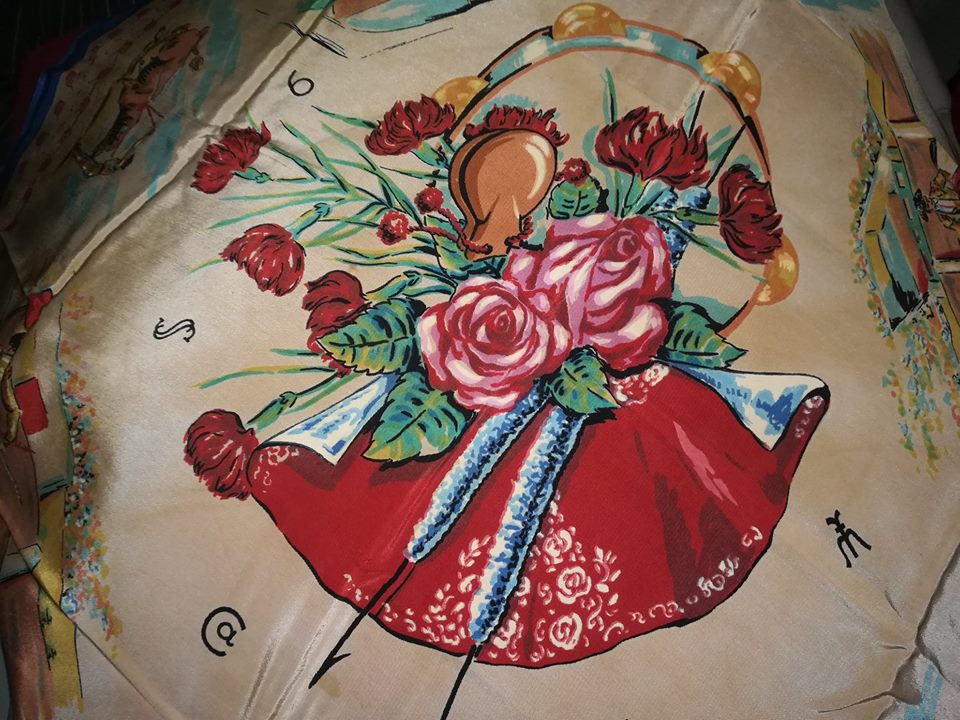
– they went to a bullfight and the matadors signed Mom’s scarf – – detail from the signed matador cloth / scarf –
Outside the zoo Dad bought six parakeets or lovebirds with red faces and a cage for them; as they approached the border he hid it behind the large Hudson cubbyhole – there was plenty of space under the dashboard. So he’s a budgie smuggler.
On the way back they went through Kruger Park and Mom recalls feeling very uncomfortable at how flimsy the reed walls of the park huts at Skukuza seemed when she thought of the wild animals outside! They went to visit an old friend of Dad’s, Rosemary Dyke-Wells, a Boschetto agricultural college old girl who was married to a game ranger there, the son of the famous Harry Wolhuter.
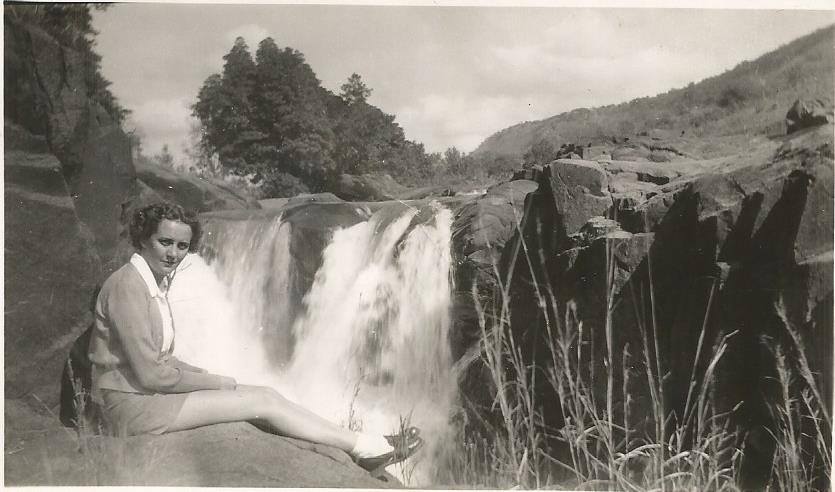
– Montrose Falls in the Lowveld Crocodile River –
~~oo0oo~~
The Kruger Park was opened to tourism in 1927 and after a slow start – only three cars entered the Reserve in that first year – soon turned into a popular destination. Within a decade, 3600 kilometres of roads had been built and several camps established. In 1935, some 26,000 people passed through the gates. By 1950 a research station and rest camp had been developed at Skukuza, transforming Stevenson-Hamilton’s base into the “capital” of Kruger.
Some Kruger Park pics from the later fifties – 1956 to 1958:
…
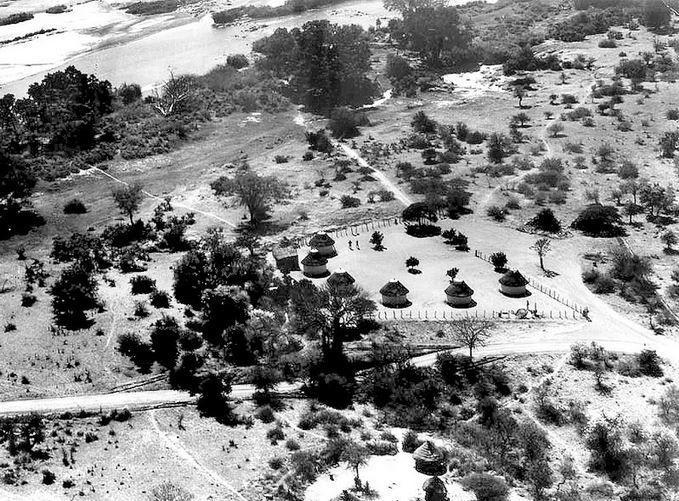
– Skukuza from the air –
~~oo0oo~~
Later back in Harrismith when the clutch packed up, Dad found out the Hudson had a cork clutch. He bought dozens of cork medicine bottle tops from the chemist and hammered them into the angled holes set in concentric circles in the clutchplate, then cut the protruding parts off as level as he could and it worked again.
When it came time to sell it he can’t remember who he sold it to and for how much, but he does remember Pye von During would pay £25 for them and convert them into horse carts.
Years later they came across one at a vintage car show. Dunno when this was, but this year (edited 2023) they had their 72nd wedding anniversary.
1936 Hudson Terraplane
~~oo0oo~~
Soon after this the Post Office moved Dad back to Pietermaritzburg following a back injury. They stayed in the Creamery Hotel – ‘a dive, but cheap’. They moved to the slightly better (but ‘very hot in the afternoon’ – Mom) Windsor Hotel. Mom took a sewing course at ‘the tech’ while pregnant and then, just before first child Barbara was born they moved in with Ouma Swanepoel in Bourke Street in downtown PMB. Mom gave birth at Greys Hospital in mid-summer, 7th January, then came home to Ouma. Mom remembers Ouma’s kindness and the Bourke street home being beautifully cool.
Somewhere before or after, they stayed in Howick, in The Falls Hotel.
~~oo0oo~~
First ‘date’
Annie came to Mom and said ‘Peter Swanepoel has tickets to the Al Debbo concert in the Town Hall, would you like to go?’ He sat between Mom and Annie in the upstairs stalls, and ‘that was the beginning of their romance,’ says Mom.
– Al Debbo around then – 1949 –
~~oo0oo~~
An old LM citizen spotted this post and used the pic of Mom & Dad sitting on the seawall in his bloghere– but first he deftly tidied it and colorised it. It looks terrific! Thanks Antonio!
2021 update: They hit 70yrs marriage – platinum! Well done Ma! You deserve a medal!
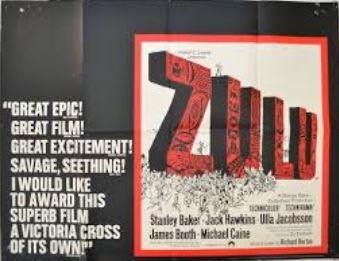
The film ZULU starring Stanley Baker, Michael Caine and Jack Hawkins was one of the biggest box-office hits of all time in England. It ‘premiered’ in 1964 and for the next twelve years it remained in constant cinema circulation before making its first appearance on television. It has since become a Bank holiday television perennial, and remains beloved by the British public. Some pommies watch it every Christmas, year after year. You know, Tell me lies, Tell me sweet little lie-ies.
The film premiered on 22 January 1964, 85 years to the day after the 1879 event it commemorates – the snotklap of Isandlwana (ignored) and the defence of Rorke’s Drift (faked into a glorious victory).
Very few people know though, that it had its REAL, ACTUAL WORLD PREMIERE in our lounge at 95 Stuart Street, Harrismith, Vrystaat in late 1963.Count yourself as one of a very tiny privileged minority who’s “in the know”!
True! If an amateur snippet can count as a premiere. Say it can!
Here’s what happened:
Back in late 1963 my old man showed us a movie he and Mom had filmed with his state-of-the-art 8mm cine Eumig camera.
Whirr whirrr whirr – those of you who watched them will remember the noise of the projector. Also maybe Thuk! Oh shit! Eina! as the film broke and had to be re-threaded in the projector and a finger touched its super-hot bulb. .
Super 8 Sound Projector Eumig Mark S810
..
He and Mom had been to Royal Natal National Park about 50 miles from Harrismith down Oliviershoek Pass to film the filming of the film ZULU.
What I remember seeing in our film was a lot of standing around, some dust and a lot of be-feathered (dead ostriches) and be-leathered (dead leopards) Zulu warriors charging at some umLungus in funny red coats, falling down in a cloud of dust and then getting up laughing, walking back and doing it all over again. And again, And a building burning.
Mom remembers being asked to stop filming, and then once the knobs saw it was just a tiny 8mm camera, being asked to stay politely out of the way. They continued filming the filming.
~~oo0oo~~
snotklap – defeat, but humiliating, embarrassing, obvious, best not spoken of; usually hugely altered in the telling (y’know, ‘there were millions of them and the two of us only had pea-shooters’)
umlungus – pale people; forked tongues
~~oo0oo~~
Thanks to the huge success of the film – which was longer than the seven or so minutes we saw in our lounge – the Battle of Rorke’s Drift has entered British folklore. Of course its main success was due to its ignoring the massive same-day British defeat at Isandlwana and portraying the defence of a hospital as a massive victory, and not mentioning the war crimes that the Poms committed.
New Film about The Film (maybe . . )
Now a New Film is being shot this year (2019/2020) by Henry Coleman which might just include some of the ole man’s 8mm footage! See all about that here.
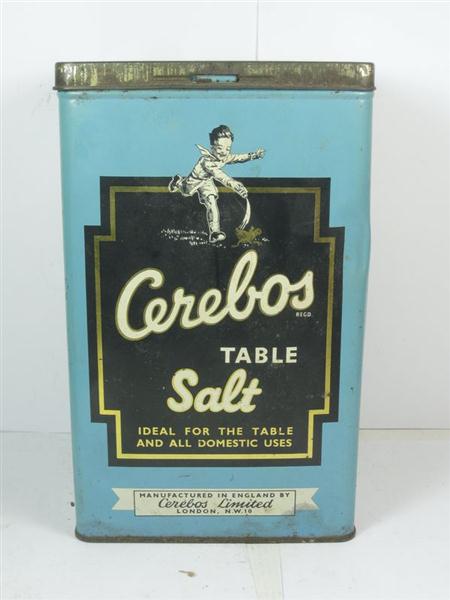
Remember always, though, to take the British ‘jingo’ version of the battle with a very large pinch of cerebos salt.
~~oo0oo~~
The background story of the film Zulu, 54 years on
Firstly, a bit of the Real History. The lesson here is always to be skeptical of ‘official’ histories.
On 22 January 1879, at a remote mission station in Natal, South Africa, 157 men, mainly British soldiers (the number is usually downplayed, sometimes “under 100”) held off wave after wave of attacks by “some 3,000 to 4,000 Zulu warriors” (the number is certainly exaggerated – your son’s rugby opposition was always MUCH bigger than your boys, right?). Remember who wrote about the battle – jingoist reporters for jingoist newspapers in a little country that thought it was a mighty empire. A defeat couldn’t be tolerated. The toffs had to be placated, not least the Queen who had a medal named after her.
Although the Zulus had some old-fashioned muskets and a few modern rifles, most of their warriors were only armed with spears, with hide shields for protection. The Battle of Rorke’s Drift lasted 10 hours (often stated as ‘over 12’), from late afternoon till just before dawn the following morning. By the end of the fighting, around 365 men lay dead. Fifteen (or maybe seventeen) British inside the barricaded buildings they had defended, and around 350 Zulu soldiers outside them. Plus many wounded Zulu men, most of whom were murdered after the battle!
The defences are almost always characterised as ‘biscuit boxes and bags’ and paintings show the British defenders hugely exposed and vulnerable. A photo taken soon after the battle looks very different to those descriptions and paintings. I haven’t seen a painting showing soldiers firing through holes in a stone wall. Is there one?
– Rorke’s Drift battle site soon after –
Historically the battle was a minor incident, which had little influence on the course of the Anglo-Zulu War. It might have – should have – remained a footnote in the history books or an anecdote told at regimental dinners had it not been for:
1. The fact that there had been a truly epic defeatat Isandlwana earlier the same day. This defence of a hospital half-heartedly attacked by men ignoring their leaders order to go home after Isandlwana, needed to be a cover-up; Needed to be hailed as a victory – and then an epic victory. In truth it was actually simply a non-defeat. It bears repeating: The mighty British army was EPICALLY DEFEATED by the Zulu army earlier that day and the British press did NOT like having to admit that. Refused to admit that. Possibly to reinforce the cover-up, the bloke in charge – LORD Chelmsford – wasn’t blamed. Was he even reprimanded for his epic mismanagement and lack of leadership?
2. The crazy number of Victoria Crosses and other awards that were dished out for this ordinary defensive battle – mainly as propaganda figleaves because of the prior resounding defeat earlier that day. Not all those possibly deserving some recognition got VC’s; and some who definitely should not have, did get VC’s. In fact the truth of the battle was far more sordid than the glorious accounts a desperate British government and press wanted to portray. This made-up story and image of valour and nobility in the Anglo-Zulu war of 1879 turned to shame when documents were uncovered which show that Rorke’s Drift was the scene of an atrocity – a war crime, in today’s language – which Britain covered up. In the hours after the battle senior officers and enlisted men of a force sent to relieve the garrison killed hundreds of wounded Zulu prisoners. Some were bayoneted, some hanged and others buried alive in mass graves. More Zulus are estimated to have died in this criminal slaughter than in true combat, but the executions were hushed up to preserve Rorke’s Drift’s image as a bloody but clean fight between two forces which saluted each other’s courage. The Zulu salute in the film was FAKE. Made-up. Never happened. A blatant lie.
3. And then, and especially, this battle became super-famous because many years later a film – ZULU – depicted the defence as a heroic victory. It wrote a story dramatically depicting British heroism, including nothing of the massive defeat earlier the same day, and none of the war crimes committed the next day. It dramatised a new story and has kept it in the public mind ever since. This film of falsities elevated a fake narrative and burnt the lies into the memories of a nation.
~~oo0oo~~
A better depiction of why Rorkes Drift was exaggerated is told here:
Oops, BBC won’t embed the video but you can find it. Also look for better, more honest accounts on history sites. You may have to search. Myths can get embedded. If what you’re reading says ‘Glorious’ keep looking.
~~~oo0oo~~~
The Film:
The story behind the film’s making. Most of this account taken from talks by Sheldon Hall, Sr Lecturer, Stage and Screen Studies Sheffield Hallam University.
The filmmakers
The principal artists responsible for Zulu were hardly Establishment figures. Screenwriter John Prebble was a former Communist Party member who had volunteered to fight in the Spanish Civil War. His co-writer, the American director Cy Endfield, had fled Hollywood in the early 1950s after he was named as a Communist during the McCarthyite witch-hunts. Endfield’s production partner and the film’s main star was Stanley Baker, a life-long supporter of the Labour Party.
All three were committed to progressive causes, but their motives in making Zulu were not political. It is not an anti-imperial diatribe any more than it is a celebration of colonial conquest. Its main purpose was frankly commercial, but Baker also saw the story as a chance to pay tribute to his Welsh homeland. This certainly explains the strong emphasis on the Welshness of the private soldiers – one of the many fictionalised elements of Zulu that have created a myth around the battle.
Filming under Apartheid
Update hot off the press: More drama in 2025! A sort of “cease and desist” letter in my comments from Stanley Baker’s eldest son! See below . .
The producers had to keep their political views in check when they made the decision to shoot the film in South Africa, then in the grip of Apartheid. There were strict, legally enforced guidelines regarding the degree of freedom permitted to the cast and crew. It was impressed upon the 60-odd British visitors that sexual relations with people of other races would result in possible imprisonment, deportation or worse. Warned that miscegenation was a flogging offence, Baker is reported to have asked – in glorious Pom tradition – if he could have the lashes while ‘doing it’. The authorities were not amused.
The main filming location was at the foot of the spectacular Drakensberg Mountains in the Royal Natal National Park, a popular tourist spot distant from any large township. But a number of incidents brought home the realities of the oppressive regime. Chatting to John Marcus, one of several professional black stuntmen employed on the film, assistant editor Jennifer Bates invited him for a drink in the bar/canteen that had been built on site for the crew. Marcus pointed out that he was forbidden by law to mix socially with whites and could not enter.
In his autobiography, Michael Caine recalls an incident in which a black labourer was reprimanded by an Afrikaans foreman with a punch in the face. Baker sacked the foreman on the spot and made clear that such behaviour would not be tolerated. Caine swore never to make another film in South Africa while Apartheid was in force, and kept to his word.
Introducing Michael Caine
Keeping watch over the tightly budgeted film was production supervisor Colin Lesslie. “I am very glad to be able to tell you,” he wrote at one point to the Embassy Pictures’ chief in London, “that in my opinion and from the little he has done so far, Michael Caine as ‘Bromhead’ is very good indeed. When he was cast for the part I couldn’t see it but I think (and hope) I was wrong.” This must have been a common reaction.
Not quite an unknown, the 30-year-old Caine was already making a name for himself on television but was becoming type-cast in working-class Cockney parts. Casting him as a blue-blooded officer in his first major film role represented a considerable risk, but it was one that paid off.
Thousands of ’em?
The soldiers were played by real soldiers – eighty national servicemen borrowed from the South African National Defence Force. And most of the Zulus were real Zulus. A mere 240 Zulu extras were employed for the battle scenes, bussed in from their tribal homes over a hundred miles away. Around 1,000 additional tribesmen were filmed by the second unit in Zululand, but most of these scenes hit the cutting-room floor.
Living in remote rural areas, few if any Zulus had visited a cinema and television would not reach Natal until thirteen years later. The crew rigged up a projector and outdoor screen, and the Zulus’ first sight of a motion picture was a Western. From then on, the “warriors” had a better idea of what they were being asked to do. Responsible for training and rehearsing them were stunt arrangers John Sullivan and Joe Powell. “The Zulus were initially suspicious of us in case we were taking the mickey,” says Powell, now 91. “After a couple of days they realised we weren’t and got into it. After that you couldn’t hold them back.”
Contrary to stories, the Zulus were not paid with gifts of cattle or wristwatches but received wages in Rand. The main corps was paid the equivalent of nine shillings per day each, additional extras eight shillings, and the female dancers slightly less again. Associate producer Basil Keys remarked: “There is no equality of pay for women in the Zulu nation!”
Buthelezi’s tribute
For the opening sequence depicting a mass Zulu wedding, 600 additional background artists were brought in, including nightclub performers from Johannesburg, to play the principal dancers. During breaks in filming, they twisted and jived to modern pop records played over Tannoys, with director Cy Endfield among the crew members joining them.
The small but key role of King Cetshwayo was given to his direct descendant, the present-day Prince Mangosuthu Buthelezi. The wedding dance was choreographed by Buthelezi’s mother, a tribal historian, and supervised by stuntman Simon Sabela, who later became South Africa’s first black film director.
History and politics
Like all films, Zulu is of its time and captures the mood of its time more profoundly than is often realised. A conservative view would see it as a hymn to gung-ho heroism, to flag-waving patriotism and the glory days of the British Empire. In fact, by 1964 the sun was already setting on the empire and undoubtedly Zulu stirred a lot of nostalgia for it. For some, that explains its appeal.
But look again. The knowledge that colonialism was in its dying fall is there in the film. The script is filled with a sense that the soldiers are in a place they don’t belong and don’t want to be. The indigenous people are not disorganised savages but a disciplined army. And the young lieutenant, played by Caine, who had earlier dismissed the enemy as “fuzzies” and the levies on his own side as “cowardly blacks”, now declares himself ashamed at the “butcher’s yard” he has brought about.
A modern awareness of racial representation means that Zulu has undoubtedly “dated”. If the film were to be remade today, as internet rumours continually suggest, it would certainly be done differently. But the absence of individuated black characters doesn’t make it racist. Though told from the British point of view, it shows that viewpoint change from dismissive contempt and naked fear to respect and even admiration. The famous (and entirely fictional) salute the departing Zulu army pays to the garrison survivors is returned with their – and our – gaze of awe and wonder.
Adapted from an article in Cinema Retro No 28 (c) Sheldon Hall 2014
Sheldon Hall is a Senior Lecturer in Stage and Screen Studies at Sheffield Hallam University. See an expanded second edition of his book ‘Zulu: With Some Guts Behind It – The Making of the Epic Movie’ – Tomahawk Press.
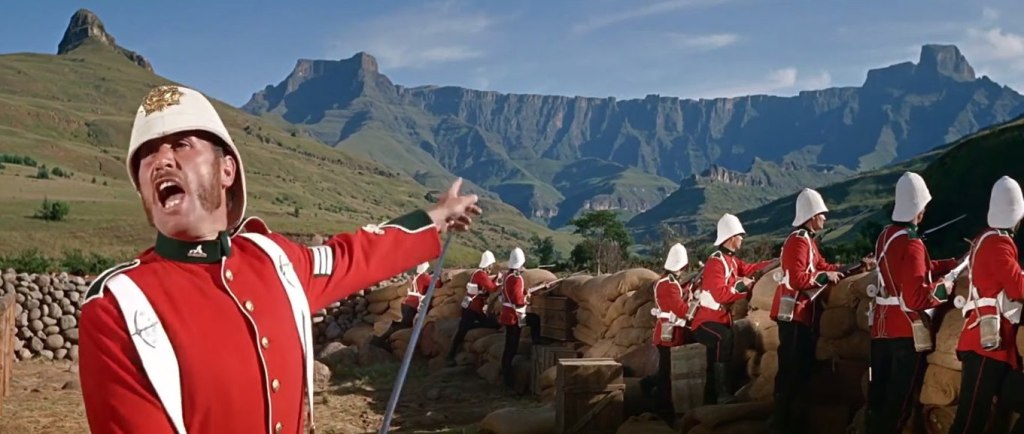
Cy Endfield’s epic military marathon about the Battle of Rorke’s Drift was actually shot 90 miles south-west of Rorke’s Drift in the Royal Natal National Park in the KwaZulu Natal province of South Africa. It had the far more mountainous and picturesque Drakensberg Amphitheatre as backdrop, rather than the low hills like the Oscarberg at the real site of the battle.
Below see the movie backdrop, the Drakensberg Amphitheatre (left) – and the real backdrop, the Oscarberg (right):
2.Many of the Zulu extras had never seen a motion picture
Many of the Zulus who were hired as extras for the film had never seen a motion picture prior to filming and were unsure what to expect. With this in mind, director Cy Endfield and Stanley Baker, who played Lieutenant John Chard, set up a projector in order for them to watch a western, starring Gene Autry. Then the Zulus probably said “Ah, so its all bulldust?” and acted accordingly.
3. The real Lieutenant Gonville Bromhead was extremely deaf…
Played expertly by Michael Caine, this snobbish character was described by Lieutenant Henry Curling, who fought alongside Bromhead at Rorke’s Drift, as “a stupid old fellow, as deaf as a post.” Major Francis Clery, who spent time with Bromhead after Rorke’s Drift, described him as “a capital fellow at everything except soldiering”, while his commanding officer said in private that Bromhead was “hopeless.” Still, political face-saving at the time saw Bromhead awarded the Victoria Cross.
4. Michael Caine initially auditioned for the role of Private Henry Hook
This was Michael Caine’s first major film role and, although he eventually put in an exceptional performance as Lieutenant Gonville Bromhead, he was crippled by nerves and beaten to the role he initially auditioned for, that of Private Henry Hook, by James Booth. Interestingly, Caine was also unable to ride a horse so a member of the filming crew took his place in the scene where he crosses the stream on horseback at the beginning of the film. This explains why the camera pans down on to the horse.
5. Private Henry Hook was badly portrayed in the film
In the film, Private Henry Hook (James Booth) is placed under arrest for insubordination. He is seen lounging around in the shade and trying to pilfer free booze as his comrades prepare for battle in the stifling heat. In reality, Private Hook was an exemplary soldier and teetotal, who was also awarded the Victoria Cross for his gallantry. Hook’s daughter walked out of the film’s premiere in disgust at this inaccurate portrayal.
6. Eleven British soldiers were given a Victoria Cross; Twelve had been nominated
Colour Sergeant Frank Bourne (played by Nigel Green in the film), requested a commission rather than the Victoria Cross. He was duly granted this wish and went on to become a Lieutenant Colonel. When he died in 1945, he was the last surviving British soldier from the battle.
7. Mangosuthu Buthelezi played his great grandfather Zulu King Cetshwayo kaMpande in the movie
Mangosuthu Buthelezi was the chieftain of the Buthelezi clan of the amaZulu when he played the role of Zulu King Cetshwayo kaMpande in 1964. Buthelezi went on to found the Inkatha Freedom Party and was the leader of the former KwaZulu bantustan. He has also held positions in the new, legitimate SA government and parliament. In fact, the Zulus “won back” the whole of the Zulu kingdom in South Africa’s first legitimate elections in 1994.
umLungus – paleface; speak with forked tongue; in Africa as well as America;
~~oo0oo~~
I’ll add a link to the 8mm movie footage the old man took on the film set in the ‘berg as soon as I can. A new movie about the making of the film is in the offing and we have offered this seven minutes of behind-the-scenes footage to Henry Coleman the film-maker. As we have undertaken not to use the footage till after his premiere, we have forfeited a chance to repeat our 1963 scoop!! Darn!
2025: I have finally added our 8mm home movie, as Coleman’s movie seems to be stuck, and Baker is mumbling.
And oops, it’s underwhelming!
– my folks’ amateur clip on-set of the filming of Zulu in 1963 –
~~oo0oo~~
2025 and no sign of Coleman’s movie yet. Recently I received a sort of “cease and desist” in this post’s comments from An Important Figure! See below:
~~oo0oo~~
Please be on notice that Henry Coleman no longer has the permission of the family of Stanley Baker to produce his proposed documentary Zulu and the Zulus nor to use the 16mm behind the scenes film print he holds, which is the property of Diamond Films.
~~oo0oo~~
Upon the downfall of his government the year after the great defeat at Isandlwana, and soon after the death of the Prince Imperial Louis-Napoleon, British Prime Minister Benjamin Disraeli asked In parliament – showing that he and his generals had not bothered to do their homework and learn about these African people – “Who are these Zulus? Who are these remarkable people who defeat our generals, convert our bishops and who on this day have put an end to a great dynasty?”.
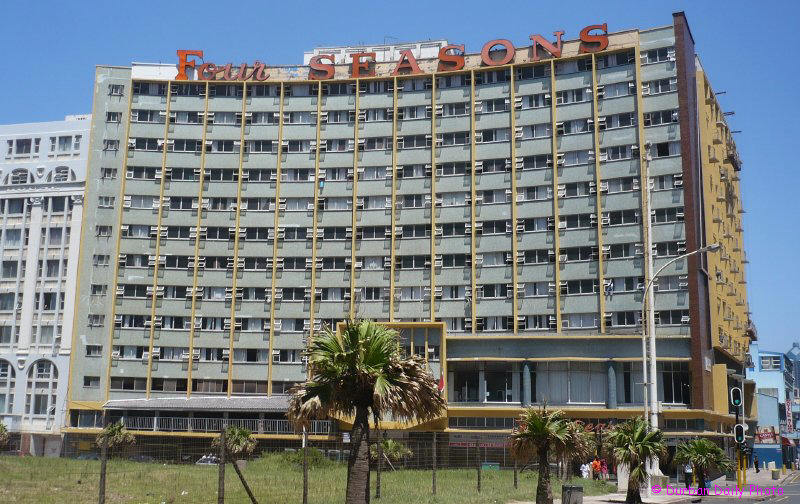
Off they’d go in Mary’s pale blue VW Beetle OHS 155. Off to Durbs-by-the-Sea, the Lonsdale Hotel or the Four Seasons for a whole week!
Might that be Mary’s VW outside the Lonsdale in this picture? Three cars behind the Borgward?
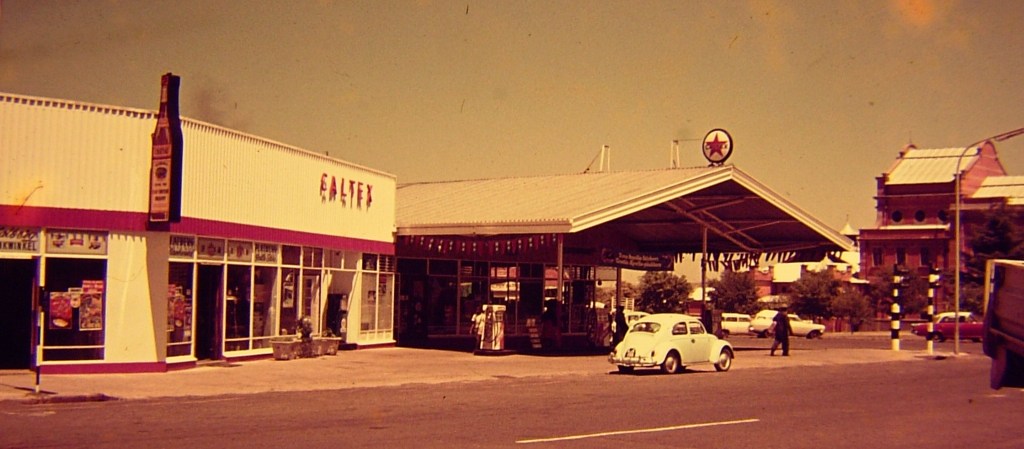
The cost of their stay: R2.95 each per day including meals. Mom thinks Randolph Stiller may have owned the Four Seasons. He and Bebe certainly owned the Central Hotel in Harrismith where Annie stayed, one block away from her Caltex garage in Warden Street. Only the Deborah Retief gardens between her hotel room and her office, but she drove there in her great big old beige Chev Fleetline, OHS 974; one block up to the garage. Mom – ever kind – says her legs were too sore to walk.
In Durban Mom and Annie would visit Annie’s sister Jessie (Bain Bell) and her daughter Lesley (Malcolm-Smith ) in their flat in Finsbury Court in West Street. Lesley worked at Daytons – a supermarket, Mom thinks.
They would all hop into Mom’s car and head off on a drive – to the beach, to the Japanese Gardens; and – always – to visit Annie’s bridesmaid Maggie McPherson who lived in a ‘posh flat up on the Berea. Looked like a bit of Olde England’.
1922 wedding
~~~oo0oo~~~
Many years later – 1980’s – we would go and listen to Joe Parker in the Lonsdale. Beer-soaked, we hosed ourselves, but I don’t think Mom and Annie would have approved!
While we’re getting nostalgic, some names to remember: Gillespie Street; The Italian restaurant Villa d’Este; The Four Seasons Hotel, with its Pink Panther steakhouse; Palm Beach Hotel; Millionaires’ Club; Lonsdale Hotel (Joe Parker being rude); The El Castilian nightclub (remember The Bats?); The Killarney Hotel, where the Monks Inn used to be (“Steak, Egg and Strips” said the sign); Thatcher’s Bar at the former Parkview Hotel.
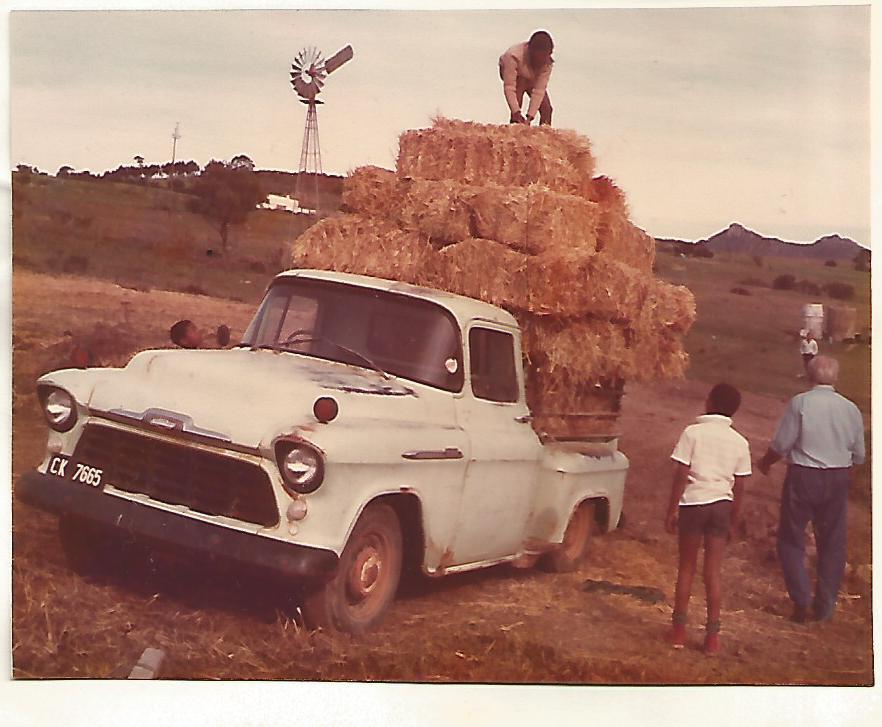
After the 1983 Berg River Canoe Marathon ended in Velddrif, we stopped in at Boet & Anna Swanepoel’s smallholding outside Malmesbury, about 50km north of Cape Town. Boet was Dad’s older brother. Mom and Sheila had seconded me on the race, driving my Cortina to each of the three overnight stops.
I’d forgotten this visit, remembering only an earlier 1977 visit with Larry Wingert, but Sheila had pictures! And there I am, sticking up above Uncle Boet’s head, watching the activity from a safe distance, hands in pockets. Probably too tired and cold to help after the four-day freeze I had just endured? Or lazy? I do know my hands would not have appreciated hoisting hay bales after 240km of holding a wet paddle!
We won’t mention child labour, nor overloading, nor our way of saying “I loaded the Chev with hay” rather than “I had the Chev loaded with hay”, OK?
=======ooo000ooo=======
The bakkie: My research suggests this was a 1955 Chev 3200 ‘Task Force’ 3/4 tonner. Probly with a bit more than that onboard!





































 After the
  Vrystaat Confessions