There’s a Crocodile River in Gauteng, so the river near Nelspruit that flows east into Mocambique and forms the southern boundary of the Kruger National Park has to be called the “Lowveld Croc”.
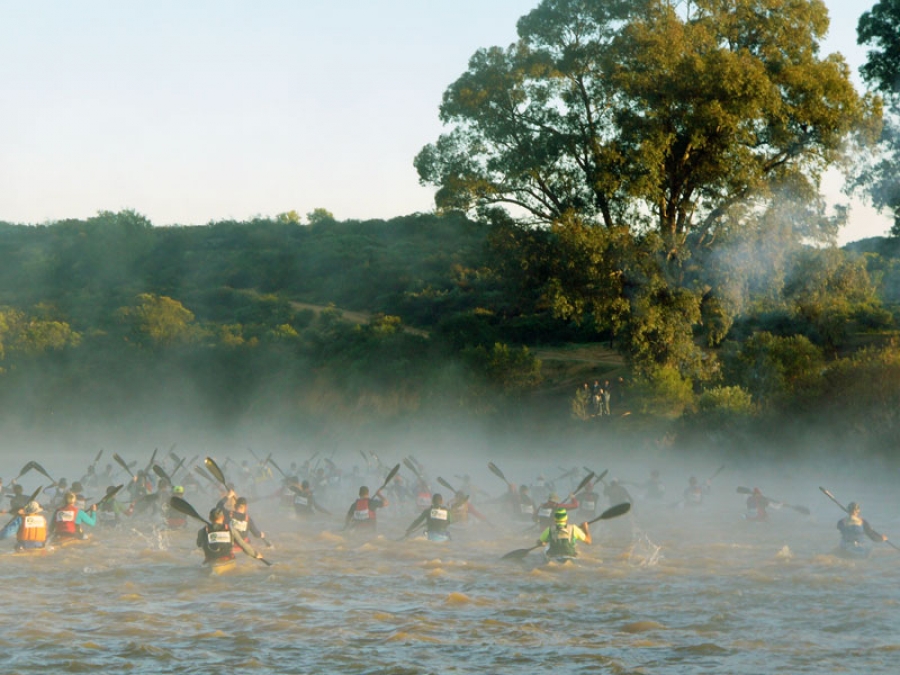
A wonderful canoe (kayak really) race is held annually on this river. The presence of hippopotamuses in the river adds a risk and a thrill to the two-day race. Race organisers engage with local farmers and wildlife people and trip the river in the weeks before the race in order to identify possible hippo hotspots which are then compulsory portages on race days. Sometimes a helicopter is used to do a scouting flight on race day morning, and volunteer paddlers also scout the route by starting ahead of the competing racers.
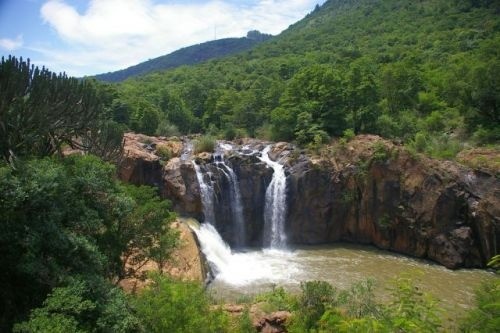
The year I did the race (1983) I remember the route as from above Montrose falls to Mbombela town (formerly Nelspruit). We portaged around the falls.
The hippo were in the last pool before the finish in Nelspruit, so the race was ended a few km short at the last accessible spot before the hippo pool. I see they now start higher up and end the race above Montrose falls.
~~~oo0oo~~~
Here’s video of the 1989 race. The second day here was our first day. We portaged around the Montrose Falls and paddled to Nelspruit (today’s Mbombelo). Actually, just short of town, as hippos in a pool at the usual finish dictated we end a couple km early.
~~~oo0oo~~~
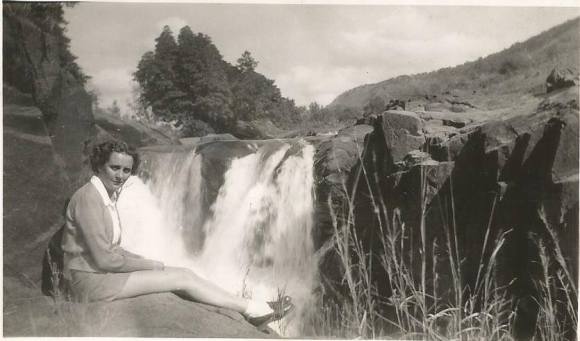
Back in 1951 Mom and Dad had stopped here on honeymoon, on their way to Lourenco Marques:
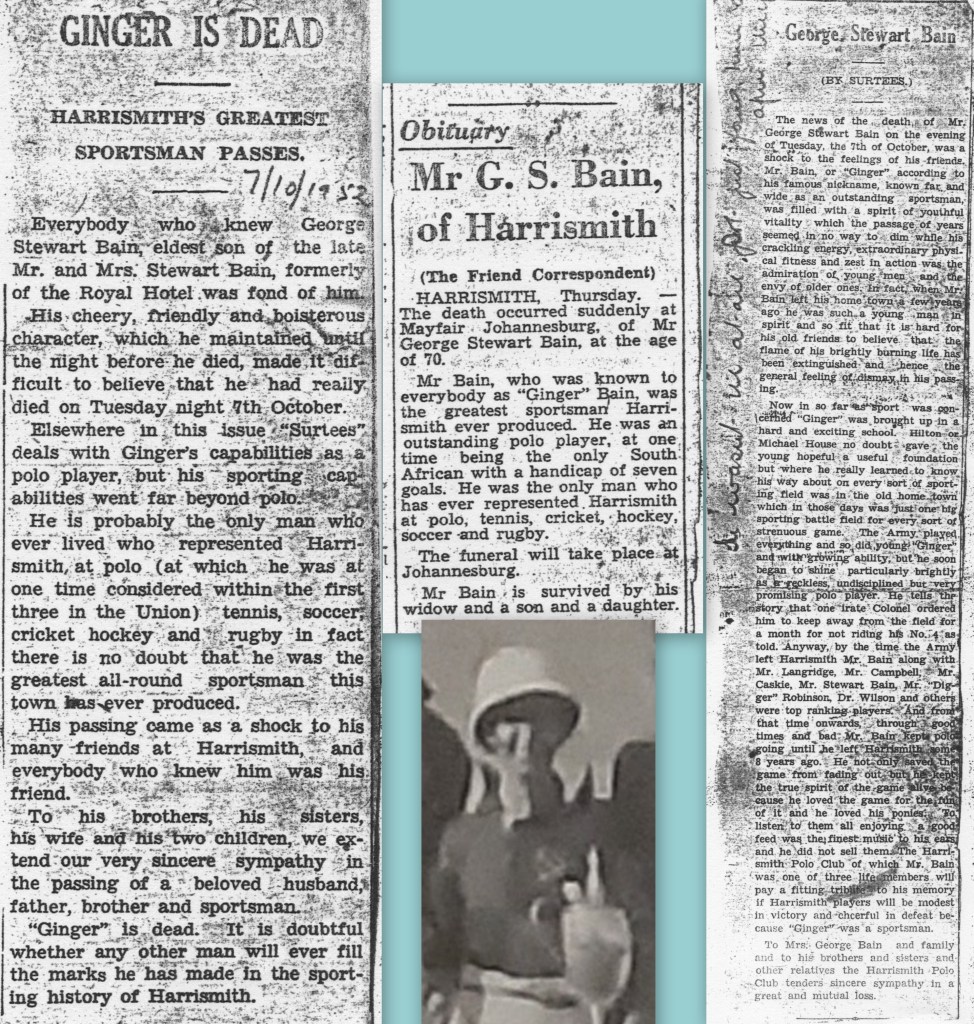
My granny Annie had an older brother Ginger. He was the oldest of the seven ‘Royal Bains’ and a great sportsman. They owned the Royal Hotel and they were ‘Royal’ so as not to be confused with the ‘Central Bains’, who owned the Central Hotel! As fishermen from the tiny hamlet of Wick on the more freezing end of Scotland, they couldn’t really claim the traditional ‘Balmoral Castle’ kind of royalty.
Playing rugby for Hilton, ‘Bain of Harrismith’ became the bane of Michaelhouse in the first rugby game between these two toffee-nosed schools, where vaguely bored and lazy shouts of ‘a bit more pressure in the rear, chaps!’ are heard through the gin fumes surrounding the rugby fields.
Here’s the report on the 1904 derby – the first game between the two schools:
– reprinted in the 1997 Hilton vs Michaelhouse sports day brochure –
Drop goals were four points and tries were three in those distant days. I like that the one side was “smarter with their feet” . . and that being smarter with your feet was better than “pretty passing.”
A century later these rugby genes would shine again as Bain’s great-great-grandson – grandnephew actually – also whipped Michaelhouse.
I’ve included a lovely picture of the Michaelhouse scrum on top.
~~oo0o~~
Rugby in Harrismith was full of Bains and Blands, seven in this team:
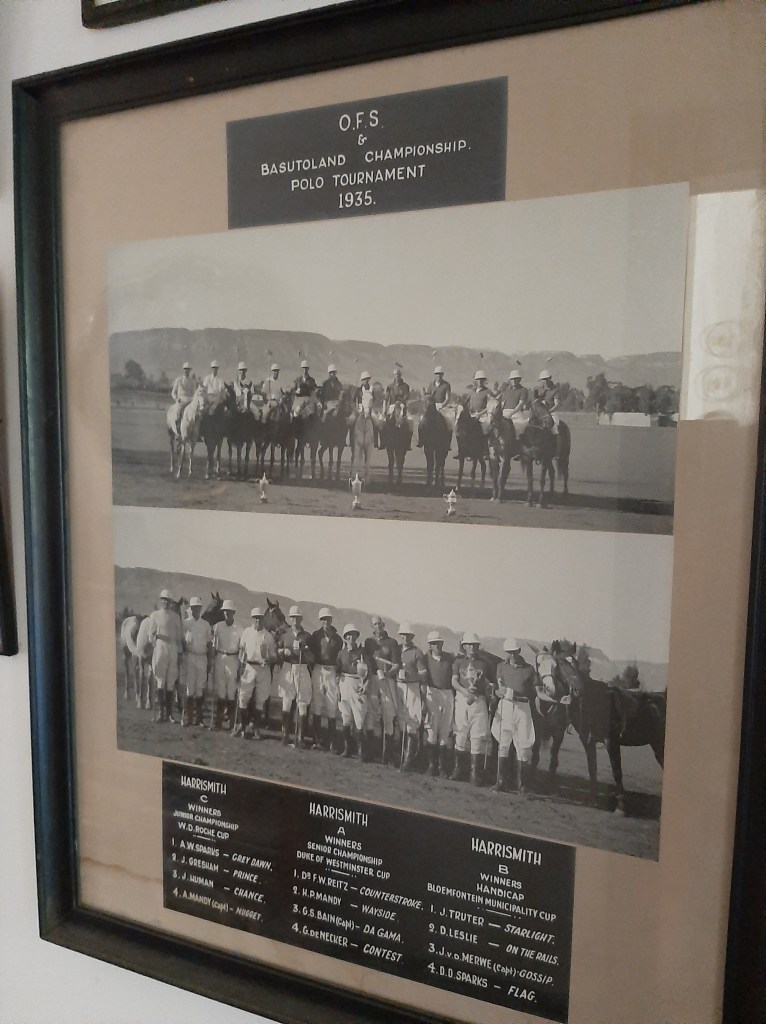
– Ginger also captained the Harrismith A Polo team –
~~oo0oo~~
~~oo0oo~~
Handwritten on the edge of one of these is “He wasn’t ill at all. (illegible) just found him (illegible) “
Dukandlovu rustic camp was underutilised. Parks Board wanted to increase its use and were looking for new ideas. It was a walk-in or cycle-in rustic camp and they were reluctant to open it up to drive-in access, so wanted to try other ideas first.
Rustic, but splendid, it’s a four hut, eight bed camp with basic kitchen facilities and cold water showers. The widows are openings with roll-down reed blinds which keep about half the wind and none of the mozzies out. The beds had mattresses, but bring your own bedding.
It was doomed. So few people want to rough it! Not ‘nowadays’ – always. Since humans first walked upright the majority have chosen the cushiest of whatever’s available. ‘I prefer roughing it’ has always been the weirdness of a few.
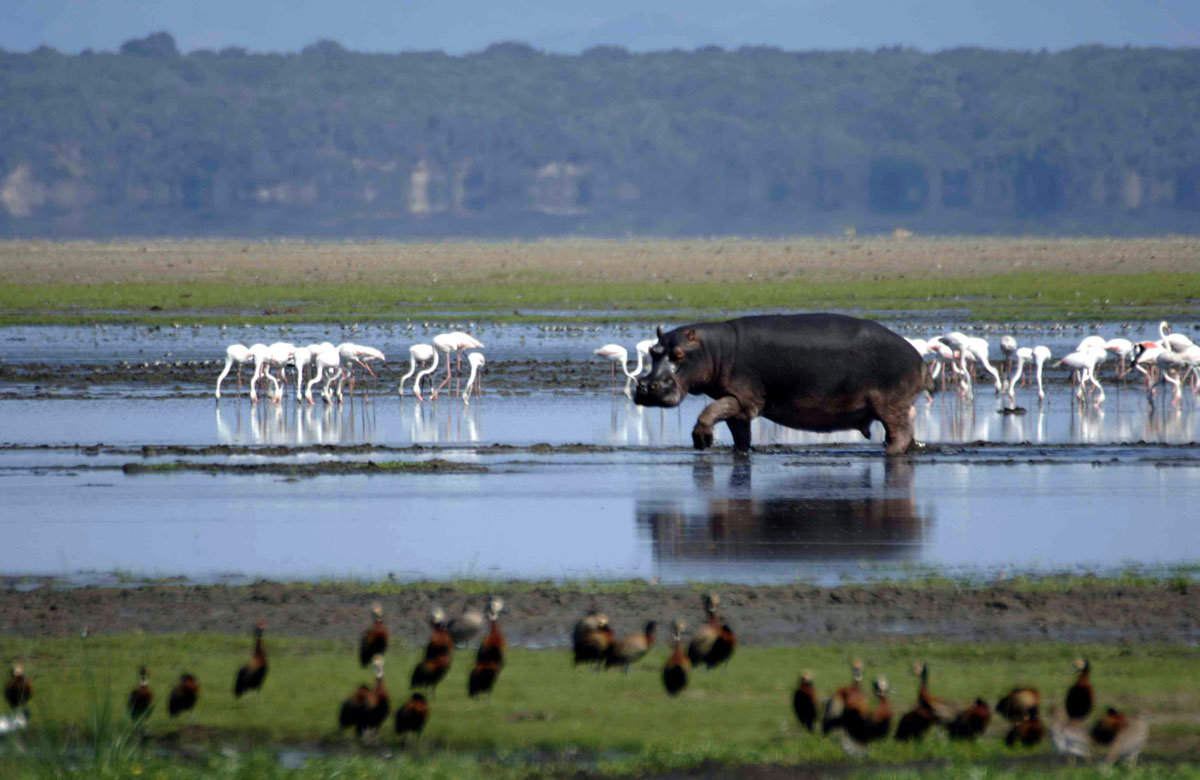
– our pic – the rest are internet pics –
But the rugged few in Parks Board were reluctant to give in too easily, so first they tried us: “Let’s test the feasibility of adding canoeing-in to the access menu!” they said. Robbie Stewart was approached and he took Bernie Garcin and I (and others – who?) to test the waters. Literally. We set off with our plastic kayaks to False Bay, launched them and headed south towards the mouth of the Hluhluwe river on the Western Shores. Right from the outset we could see this wasn’t promising: We touched bottom often. Our draft was mere inches, but the lake was that shallow in places. Great for small worms and other marine creatures and for the wading birds that spear them from above, but not good for paddling. Oh well, we had tried. Not long after this they actually did open it to vehicle access. With a sigh, I’ve no doubt.
After staying a night the rest of the guys went home on the Sunday. I stayed over with Parks Board Rangers Dick Nash and Trevor Strydom. Monday morning I woke, eagerly looking forward to my day of ‘rangering’. What derring-do would we get up to with me as ‘ranger-for-a-day’?
Paperwork at a desk, that’s what. As head ranger, Dick first had a whole bunch of admin to sort out! Not what I’d imagined.
But later we got going on their regular bird count in the wilderness area in the north-east arm of the lake. We set off in their spacious craft with a Hamilton jet propulsion system (an impellor rather than a propellor, it sucks water in the underbelly and spits it out the back). This was fine in clear deep water, but when we nosed up the Mkhuze river we soon sucked up waterweeds and came to a halt. Dick pulled rank and ordered Trevor to jump overboard and remove the weed from under the boat. On the bird count we had seen at least fifty thousand and ten of their distant cousins – crocodiles – so the thought of jumping overboard was not inviting! Anyway, before Trevor could remove his shirt Dick was already under the boat doing it himself. A bit disconcerting when you looked at his hand as he chucked the weed away: He only had two fingers and a thumb. Had a croc taken the other fingers?
Looked like this, but I think this is maybe Kosi?
We got going again in fits and starts and after a few more stops to clear the impeller we turned back to the lake and continued to count birds. And thumb our noses at the crocodiles.
So do go to Dukandlovu, you can drive there now. You wimp.
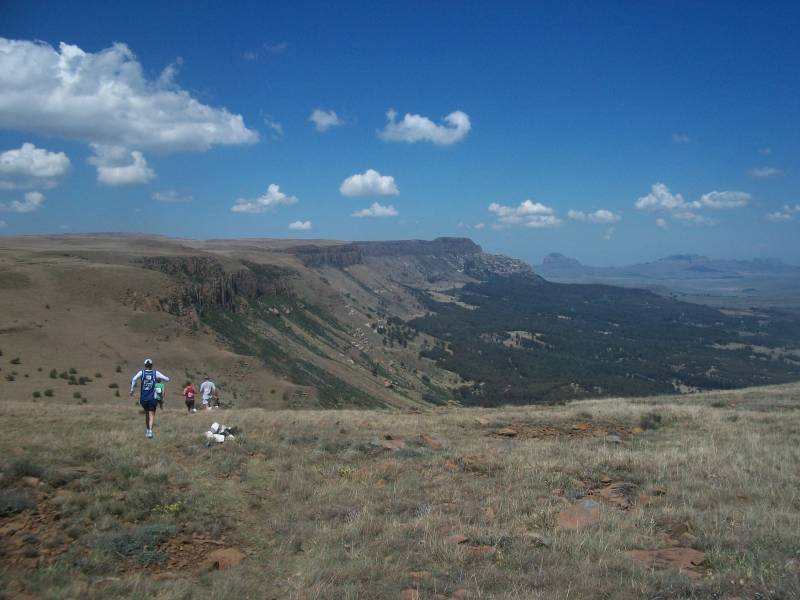
The people of Harrismith dubbed Michael McDermott ‘The Mountain Goat’. The mountain being Platberg.
Or so running e-zine ‘Modern Athlete’ says of SIXTEEN-times winner of our Mountain Race. Apparently we used to write supportive messages for him along the route of the Harrismith Mountain Race, much like supporters do in the Tour De France. Race organisers would set him up in our local hotel with the room number that corresponded with the win he was going for. Michael became a hugely popular and inspirational figure thanks to his sixteen-consecutive-year winning streak in our rugged annual race.
They go on: Michael’s love affair with Harrismith’s imposing Platberg began in 1978, when he was just 13. “I was alone at home and ran 5km to the Harrismith Harriers clubhouse because I wanted to run that day, but no-one was there, so I ran back home. Then they called me up to ask where I was and came to fetch me. So before the race, I already run 10km,” says Michael, who ran the race and finished 32nd. “Nobody believed I had completed the race, though, because I was so small!” he laughs.
In 1980, he finished eighth and qualified for a gold medal, but had to receive it unofficially, behind the tent, as he was still below the minimum 16-year age limit for the race. A year later and now ‘legal,’ he finished fifth, and then in 1982 he posted the first of his sixteen consecutive wins, an amazing record putting him right up there in the crazy stakes with uber-talented athletes Michael McLeod of England (won the Saltwell 10km sixteen years in a row), and Jim Pearson of America (won the Birch Bay marathon sixteen times).
Michael held the record for the short 12.3km course at 50mins 30secs in 1985 and the long 15km course at 1hr 05mins 05secs as the first winner over the new distance in 1996. It came to an end when he ‘stepped skew’ and tore ligaments in his ankle while well in the lead on his way to a 17th straight win in 1998. Michael Miya took over and won the race in a new record time of 1hr 04mins 06secs and became the first black South African winner. While McDermott was really disappointed, it was also “a relief as there wasn’t that pressure to win after that.”
SPRINGBOK
Michael earned Springbok colours in 1988 for cross-country, and was invited to run a number of international mountain running events in the early 1990s. He won the Swiss Alpine Marathon three times, shattering the course record in 1993. He also represented South Africa seven times in the World Mountain Trophy, from 1993 to 1999, with a best placing of fifth in 1993 in France. http://www.modernathlete.co.za
In “our day” Johnny Halberstadt was the King – wonder where he is today? (Koos: In America: Just sold his sports shop in Colorado).
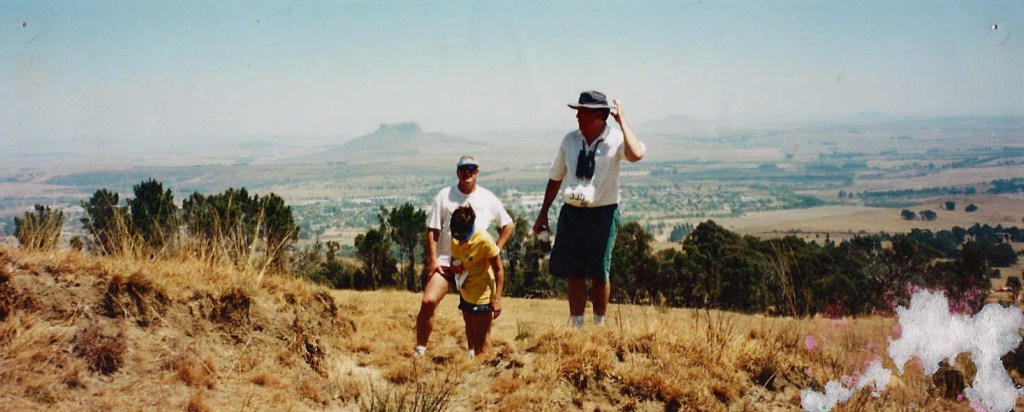
I strolled the race two or three times in the 1990s – never finished in the allotted time, but always walked away with a medal, ’cause I knew Jacqui Wessels (du Toit) who handed out the medals!
Remember the year we did it after “peaking” at Pierre’s home the night before – about 3am. You remarked as you crossed the Start Line (not the Finishing Line) – “I think I’m under-trained”. The hangovers were monumental. As we strolled past the adoring, cheering spectators, one guy was heard to remark “Daai mal ou het sy verkyker om sy nek!” That was you! (Koos: Actually, it was Wimpie Lombard and he said “wadafokmaakjymedarieverkykers?” You’ve forgotten: Afrikaans is always one word).
The year Karin Goss and I did it, (circa 1998) we were so last that even the Coke truck had packed up and left by the time we strolled into Die Groen Paviljoen! We were so busy ‘phoning the whole world from the summit that we forgot to be competitive. Jacqui insisted on giving us medals, but drew the line at Gold – we had to be content with Bronze. Don’t know why she was so strict – there were a few Golds lying in the bottom of the box.
Was Alet de Witt the first lady to compete?
Love – stroller Sheila Swanepoel
———————————————————————————————————————–
Jacquie replied: Sheila, I think you forgot that when we allowed you to go through the finish banner after cut-off time, there was a breathalyser test for the finishers. This you seemed to have forgotten! Legal limits are 0,24 milligrams per 1000 millilitres. Finishers (at sunset) with this reading all get GOLD.
Unfortunately your readings were 0.60 . . . hence the Bronze medal. 😉
All the best (hope you enter the Mountain Race again this Year).
Kind Regards – actual finisher Jacquie Du Toit, ex-Mountain Race high-up official
——————————————————————————————————————-
Kar Goss got excited: Hey Sheils
I think we must do it once more!! Seriously!
What comes after bronze?? And is there a medi-vac chopper available?
Thanks for the interesting article Koos!
Happy Women’s Day everyone.
Love- (Sheila-like stroller) Kar Goss xx
—————————————————————————————————-
JP de Witt reminisced: Sheila, As far I can remember my Mom Alet and Mavis Hutchison did the race around 1969 / 1970. Koos Keyser won it five times 1964-68. Wally Hayward (five-times Comrades winner) won in 1952.
actual finisher JP de Witt
————————————————————————————–
Pikkie Loots committed: Sheila, For what it’s worth – I’m seriously considering doing it this year… if anyone wants to join me, perhaps we can motivate each other 🙂 **(Hushed silence from the sundry assorted 60-somethings – *sound of crickets*)**
And yes, there is a ‘medi-vac’ chopper 🙂 I was running the race in about 1985-ish, when a runner from Welkom dislodged a rock on One-Man’s Pass. The rock fell onto his thigh, cutting and damaging the muscle. Tony Perry, a fellow runner from Newcastle, and I were immediately behind and below the unfortunate gent. With the help of two of his team mates we carried him to the top. Another of his team mates went ahead to tell Doc Mike van Niekerk that we needed a casualty to be taken off the mountain. By the time we got to the top, both Mike and the chopper were ready….
Tony and I missed out on our silver medals by about 10 minutes (silver time was 1 hour 40 minutes). I moved to Cape Town and never ran another mountain race! So I still only have a bronze. [PS! Mike asked the committee to award Tony and I silver medals, but they must have had a shortage that year 🙂 ]
Footnote: Michael McDermott was at school when he joined our running club in Newcastle, in about 1979… there were a few ‘windhonde’ in the club at the time, but pretty soon he was chasing and beating most of them on the shorter runs. There were a few Harrismitters I saw regularly at races: Pieter Oosthuyzen and Koos Rautenbach, I especially remember, as I often chatted to them at races.
Has anyone from Harrismith ever won this besides Volschenk? and btw, I thought it was Koos Keyser who was the big hero winner of our school days? (Koos Swanepoel – not Keyser: True that. Koos Keyser won five times in a row).
PS: Note I said ‘doing’ the mountain race… no commitment to running it at this stage, but that may change on the day 🙂
Love to you all – actual finisher Pikkie Loots
—————————————————-
Pikkie, you must shine up! The year I strolled it with Sheila, Pierre and Ilse we got silver medals. OK, to be fully honest we gave those back to Jacquie and settled for (unearned) bronzes, but we DID briefly hold silver. So shine up, mate. Try harder.
Koos
(and just for the record, I do have four legitimate finishes from pre-rinderpest days – once, I got a medal with a handy bottle opener attached). I ran without binoculars in those days.
They would play England and thrash them at their own game. We would listen to the games, ears glued to the steam-powered radio.
Representing England you had names like Hicks, Lamb, Greig and Smith who sound OK, except they were all born in South Africa. Then you had Tavare, de Freitas, Ramprakash, D’Oliviera and Hussain. All Englishmen.
In the other team you had posh and correct names like Sir Garfield Sobers, Sir Wesley Hall, Charlie Griffith, Sir Andy Roberts, Michael Holding, Colin Croft, Malcolm Marshal, Courtney Walsh, Sir Curtly Ambrose and Ian Bishop.
So Uncle Hec – always quick to spot an anomaly – would refer to them as . . .
Hance Rapid at Mile 76.5 stands sentinel at the Colorado river’s entry into the Granite Gorge. The river drops 30 feet as it passes through a natural constriction formed by the Red Canyon. The dark dike cutting through the red Hakatai Shale is one of the most photographed features in the Canyon.
I found out more about the man the rapid was named after:John Hance (1840 – January 8, 1919) – thought to be the first non-native resident of the Grand Canyon.
He opened the first tourist trail in the canyon before the canyon was a national park, giving tours of the canyon after his ca.1866 attempts at mining asbestos failed. “Captain” John Hance was said to be one of the Grand Canyon’s most colorful characters, and one early visitor declared that “To see the canyon only and not to see Captain John Hance, is to miss half the show.”
Hance delighted in telling canyon stories to visitors, favoring the whopper of a tale over mere facts. With a straight face, Hance told travelers how he had dug the canyon himself, piling the excavated earth down near Flagstaff (thus ‘explaining’ those mysterious then-unexplained dirt piles).
– wikipedia and archive.org –
John Hance died in 1919, the year the Grand Canyon became a National Park, and was the first person buried in what would become the Grand Canyon Pioneer Cemetery.
In May 1891 one Charley Greenlaw wrote this in John Hance’s guestbook: I can cheerfully say that this, the Grand Canon of the Colorado River, is the grandest sight of my life. As I noticed in this little book of Capt. John Hance, a great many people say ‘indescribable.’ I can say nothing more. It is beyond reason to think of describing it in any way. You must see it to appreciate it. A grand sight of this kind and so few people know of it. By accident I formed the acquaintance of two ladies en route to the Grand Canon. I joined them. We have enjoyed our trip; the stage ride from Flagstaff to the Grand Canon is grand. Good horses, competent and accommodating drivers. I have seen the Yosemite, have visited California several different times, in fact seen all the principal points of interest in the United States, but the most wonderful, awe-inspiring piece of Nature’s own work is this, the Grand Canon of the Colorado River.
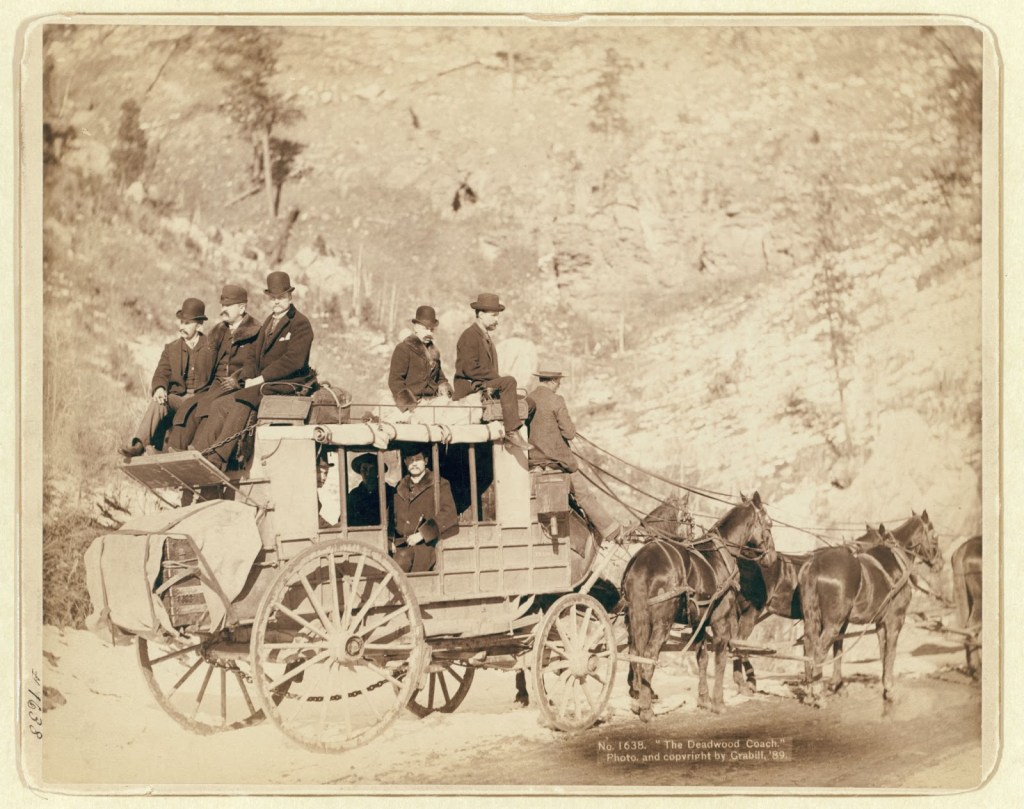
Another Hance guestbook entry by J. Curtis Wasson told of the twelve hour stage coach journey after alighting from the Santa Fe Railroad Company’s train: From Flagstaff at 7 o’clock a.m. our stage-and-six goes out. Arriving at Little Springs Station, where a new relay of six horses is added, we make haste until the half-way station is reached, passing through a fine unbroken forest of Pinus ponderosa, quaking aspen, balsam fir, and spruce. The open forest, the waving grasses, the gorgeously colored mountain flowers, the occasional chirp of the forest songsters, the ice-cold springs traversing our smooth compact road, the peaks, clear-cut and massive, towering up nearly 14,000 feet into the blue above, the low rumbling of our great Concord stage, the sound of two dozen hoofs, the sharp crack of the driver’s whip, the clear, bracing atmosphere, every breath of which seems to stimulate, the indescribably beautiful Painted Desert outstretching for a hundred miles to our right.
– a stage-and-six – high-speed travel –
One fain would linger on scenes like these but we have arrived at Cedar Station, and after partaking of a very refreshing luncheon we are given a new relay of horses and hasten over the desert portion of our ride to Moqui Station, where another relay is provided, which takes us to the hotel at the rim of the Grand canon, where we arrive at 7 o’clock p.m.
Leaving our Concord stage, giving our grips to the porter, not even waiting for “facial ablutions,” we hasten across the yard and up to the rim of the canon, when, looking over — the Chasm of the Creator, the Gulf of God, the Erosion of the Ages, that Erosive Entity, that Awful Abyss, lies in all its awfulness before us, — awful, yet grand; appalling, yet attractive; awe inspiring, yet fascinating in its greetings.
This story will be fuzzy in parts because of the long passage of time. But although some details may be slightly different, ‘strue. So I must tell the tale before those last few grey cells that hold the memory get blitzed by the box wine.
It was on the Berg River Canoe Marathon that Christof Heyns came to tell me was pulling out of the race. Why!? I asked, dismayed. He’d fallen out in the frigid flooded Berg river and lost his glasses. Couldn’t see past his nose, so it was way too dangerous to carry on in the mid-winter Cape cold and the flooding brown water in the gale-force wind that was the 1983 second day.
Hell, no, I said, I’ve got a spare pair, you can use mine.
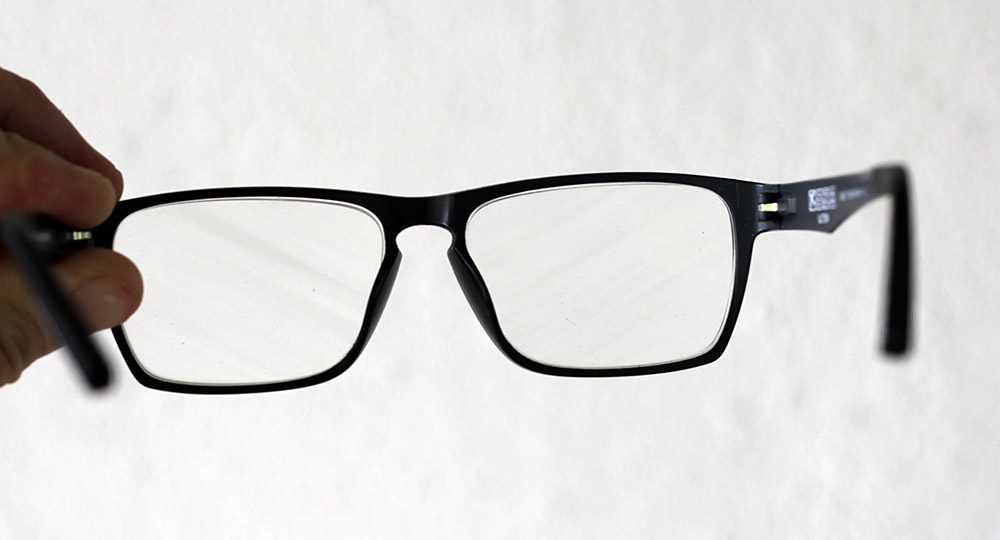
He rolled his eyes and smiled sadly at my ignorance. His eyes were very special, his glasses were very thick and there was no way just any ‘arb’ specs would do, he mansplained patiently. In his defence, he didn’t know I was an optometrist, that I was wearing contact lenses, that I had a spare pair of specs in my luggage and another tied to the rudder cable in my boat; nor could he know that I had a very good idea of what his prescription was from seeing his glasses on his nose both on this race and on a Tugela trip we had been on together earlier. I knew about his eyes better than he knew about my soul (he might have known a bit about that, as his Dad was a very belangrike dominee in the Much Deformed Church – top dog, in fact).
So I said, trust me swaer and went and fetched my spares. He put them on and was amazed. I can see! he shouted like I was Jesus who had just restored his sight. I know, I said.
So he wore the glasses and finished the race and I said keep them till we next meet.
Many months later I saw an article in the SA Canews, the paddling magazine, titled: “My Broer se Bril”. Christof wrote the story of how he had lost hope when some arb oke said “Here, try mine” and he could see! And he could finish the race.
He ended off by saying “Actually they were so good I’m wearing them to this day”. Ja, you bugger, I know, I thought. I could have written an article “How a dominee’s son appropriated my bril,” but I didn’t. I’m way too kind! In his defence, we haven’t seen each other since that race.
. . and today – April 2021 – I heard he died, aged only 62. Damn!
~~~oo0oo~~~
belangrike dominee – important churchman; flock leader; the lord is my shepherd, I am a sheep;
swaer – bro;
my broer se bril – my brother’s spectacles;
mansplain – when a man laboriously, carefully and ‘kindly’ explains something to you that you already know; usually inflicted on women;
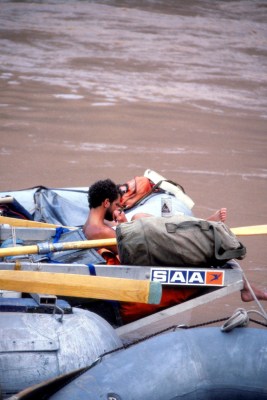
Lee’s Ferry on the right bank of the Colorado River, just above the mouth of the Paria River, at an elevation of 3,170 feet asl is the site of the start for most river trips through the Grand Canyon.
Originally called Lonely Dell by Mormon church-man with 19 wives and 67 children John D Lee, who established the ferry in 1872, it provided the only access across more than 300 miles of river for many years. Actually one of Lee’s 19 wives, Emma ran the ferry for a number of years while he was on the lam – hiding from the law for his leading part in the wicked 1857 Mountain Meadows Massacre.
The massacre near St George, Utah involved a group of emigrants known as the Fancher Party trekking west from Arkansas who were camped at Mountain Meadows in southern Utah preparing for their final push across the Mohave Desert when they were attacked by a group of Mormon Militia who disguised themselves as Native Americans so as to cowardly deflect blame for the attack.
It was a time of great tension between Mormons and the rest of the United States, and the massacred party was most likely attacked because they were not Mormons.
After an initial siege, the treacherous Lee approached the emigrants saying he’d negotiated safe passage for them with protection from their supposed Native American attackers if they surrendered their weapons. The group agreed, whereupon the militia proceeded to kill all but the children under 8 years of age.
One hundred and twenty men, women and children died that day. For almost two decades, the incident was covered up, but in 1874, Lee was brought to trial. Never denying his complicity in the massacre, Lee did insist – probably correctly – that he was acting on orders from high up in the church. He was the only one of about fifty men involved in the massacre to be brought to book. He was convicted and executed by firing squad in 1877.
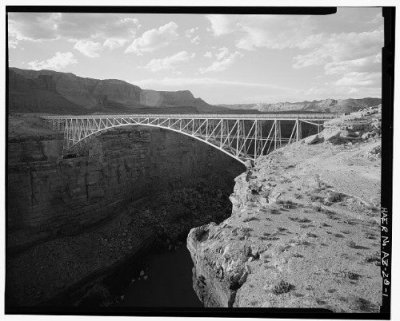
His widow Emma Lee sold the ferry in 1879 for 100 milk cows to the Mormon Church who continued to operate it until 1910 when it was taken over by Coconino County, Arizona. The ferry stayed mostly in use until 1929 when the Navajo Bridge was completed. Ironically, the ferry was used to ship much of the material to build the bridge that put it out of business.
1984: There was only one bridge when we crossed to the right – or ‘north’ (rivers only have left or right banks – think about it) – bank of the river. It was completed in 1929. A larger parallel second bridge was added in 1995. The bridge we crossed is now used for pedestrian sight-seeing.
Now: To make sure there are no misunderstandings, our John Lee on the 1984 trip down the Colorado is a good ou who, at that stage, had zero wives:
That’s what Jacques de Rauville told my business partner when he heard I was going to do the 1983 Berg River Canoe Marathon. He had come across me one evening on the Bay and I’d asked which way to go, it being my first time out there and the lights and the reflections were confusing. “Follow me” said Jacques, and off he went, but within 50m I was 49m behind him. He waited and told me “Left at the third green buoy” or whatever he said. When he passed me again on his way back and I obviously hadn’t made enough headway, he thought whatever he thought that made him tell his optometrist Mike Lello: “Tell Pete Swanie not to attempt the Berg.”
Jacques was probably right, but he was a bit of a fusspot as far as preparations go. I thought. Luckily for me friend and all-round good bugger Chris Logan was also dubious about my fitness, so he took me for a marathon training session on the ‘Toti lagoon one day which got my mind around sitting on a hard seat for hours on end, numbing both my bum and my brain.
Chris was a great taskmaster. We stopped only once – for lunch (chocolate and a coke, it was early Noakes, not Banting Noakes. Also, according to Noakes, It’s not your muscles that limit you; it’s your brain. See, Noakes said my muscles were fine). So Chris selflessly sacrificed a day of his training intensity to stay with and encourage this TapTap Makathini mud-paddler. Before Chris, my training method entailed using the first half of a race for training, then hanging on grimly for the second half, going slower and slower till the finish. Between races, I would focus on recovery, mainly using the tried-and-tested cold beer and couch methodology.
We set off for Cape Town in my white 2,0l GL Cortina, me and Bernie Garcin the paddlers and sister Sheila and mom Mary to drive the car while we paddled. I was feeling invincible from my full day of training.
The night before the first day of the race in Paarl, the race organisers pointed out a shed where we could sleep. Cold hard concrete floor. Winter in the Cape. Luckily I had been warned and had brought along a brand-new inflatable mattress and an electric tyre pump that plugged into my white 2,0l Cortina GL’s cigarette lighter socket. So I plugged in and went for a few beers.
*BANG* I heard in the background as we stood around talking shit and comparing paddling styles and training methods. I wondered vaguely what that was. The bang, as well as ‘training methods.’ A few more beers later we retired to sleep and I thought, “So that’s what that bang was” – a huge rip in my now-useless brand-new no-longer-inflatable mattress, and the little pump still purring and pumping air uselessly into the atmosphere. So I slept on the concrete, good practice for a chill that was going to enter my bones and then my marrow over the next four days.
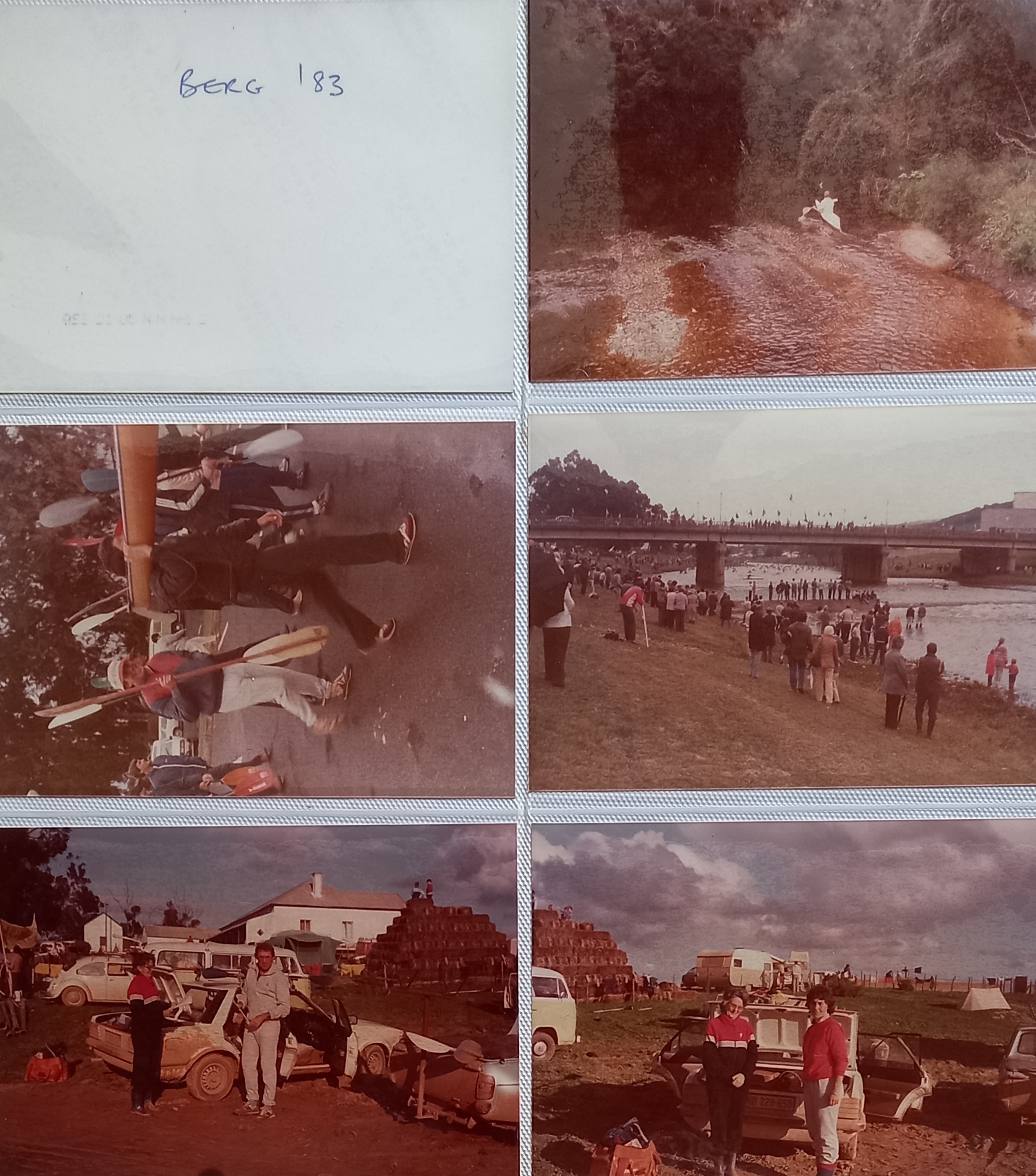
The first day was long, cold, windy and miserable, but the second day on the ’83 Berg made it seem like a balmy breeze. That second day was one of the longest days of my life! As the vrou cries it was the shortest day – those Cape nutters call 49km of ice a short day – but a howling gale and horizontal freezing rain driving right into your teeth made it last forever. Icy waves continuously sloshing over the cockpit rim onto your splashcover. It was the day Gerrie died – Gerrie Rossouw, the first paddler ever to drown on an official race day. I saw him, right near the back of the field where I was and looking even colder than me. He wasn’t wearing a life jacket. It wasn’t macho to wear a life jacket and I admit that I wore my T-shirt over mine to make it less conspicuous and I told myself I was wearing it mainly as a windbreaker. Fools that we were. Kids: Never paddle without a life jacket.
Later in amongst a grove of flooded trees I saw Gerrie’s boat nose-down with the rudder waving in the wind, caught in the underwater branches, and I wondered where he was, as both banks were far away and not easy to reach being tree-lined and the trees underwater. Very worrying, but no way I could do anything heroic in that freezing strong current. I needed to stay afloat, so I paddled on to hear that night that he was missing. His body was only found two days later.
Mom and Sheila second us in the mud
That night a bunch of paddlers pulled out. Fuck this, they said with infinite good sense. Standing in the rain with water pouring down his impressive moustache my mate Greg Jamfomf Bennett made a pact with the elements: He would paddle the next day IF – and only if – the day dawned bright, sunny and windless. He was actually saying Fuck this I’m going home to Durban where ‘winter’ is just an amusing joke, not a serious thing like it is here. He and Allie were then rescued and taken out of the rain to a farmer’s luxury home where about six of them were each given their own room and bathroom! Bloody unfair luxury! This then gave them an advantage and allowed them to narrowly beat me in the race! By just a few hours. Per day.
– me and my lady benefactor –
After devouring a whole chicken each, washed down with KWV wine and sherry supplied by the sponsors, us poor nogschleppers climbed up into the loft on the riverbank and slept on the hard floor. Here I have to confess Greyling Viljoen also slept in the loft and he won the race – which weakens my tale of hardship somewhat.
We braced ourselves for the third – and longest – day . . . which turned into the easiest day as the wind had died and the sun shone brightly on us. ‘The clouds dissolved and the sky turned blue’ – thanks to Jamfomf’s arrangement with the weather gods I spose? So the long day became a really pleasant day which seemed half as long under blue skies – even though it was 70km compared to that LO-ONG 49km second day.
Before the start Capies were seen writhing on the ground, gasping, unable to breathe. They usually breathe by simply facing into the wind and don’t have diaphragm muscles. So a windless day is an unknown phenomenon to those weirdos. At the start, about ten Kingfisher paddlers bunched together in our black T-shirts: Allie Peter, Jacques de Rauville, Herve de Rauville, Bernie Garcin, Dave Gillmer, who else? Greg Bennett was also there, to his own amazement. I hopped on to their wave and within 50m I was 49m behind. I watched the flock of black T-shirts disappear into the distance. I was used to that. Anyway, I have my own race tactics.
By the fourth day I was getting fit. I was building up a head of steam and could have become a threat to the leaders. Or at least to the black T-shirt armada. I could now paddle for quite a while without resting on my paddle and admiring the scenery. I paddled with – OK, behind, on her wave – a lady paddler for a while, focused for once. Busting for a leak, I didn’t want to lose the tug, so eventually let go and relieved myself in my boat. Aah! Bliss! But never again! I had to stop to empty the boat before the finish anyway (the smell! Must be the KWV sherry), so no point in not stopping to have a leak. I caught up to her again and finished with her, as can be seen in the pic.
Not that there will be a next time! Charlie’s Rule of Certifiability states quite clearly “Doing the Berg More Than Once Is Certifiable.” And while Charles Mason may have done fifty Umkos he has done only one Berg. Being a lot more sensible, I have done only one of each.
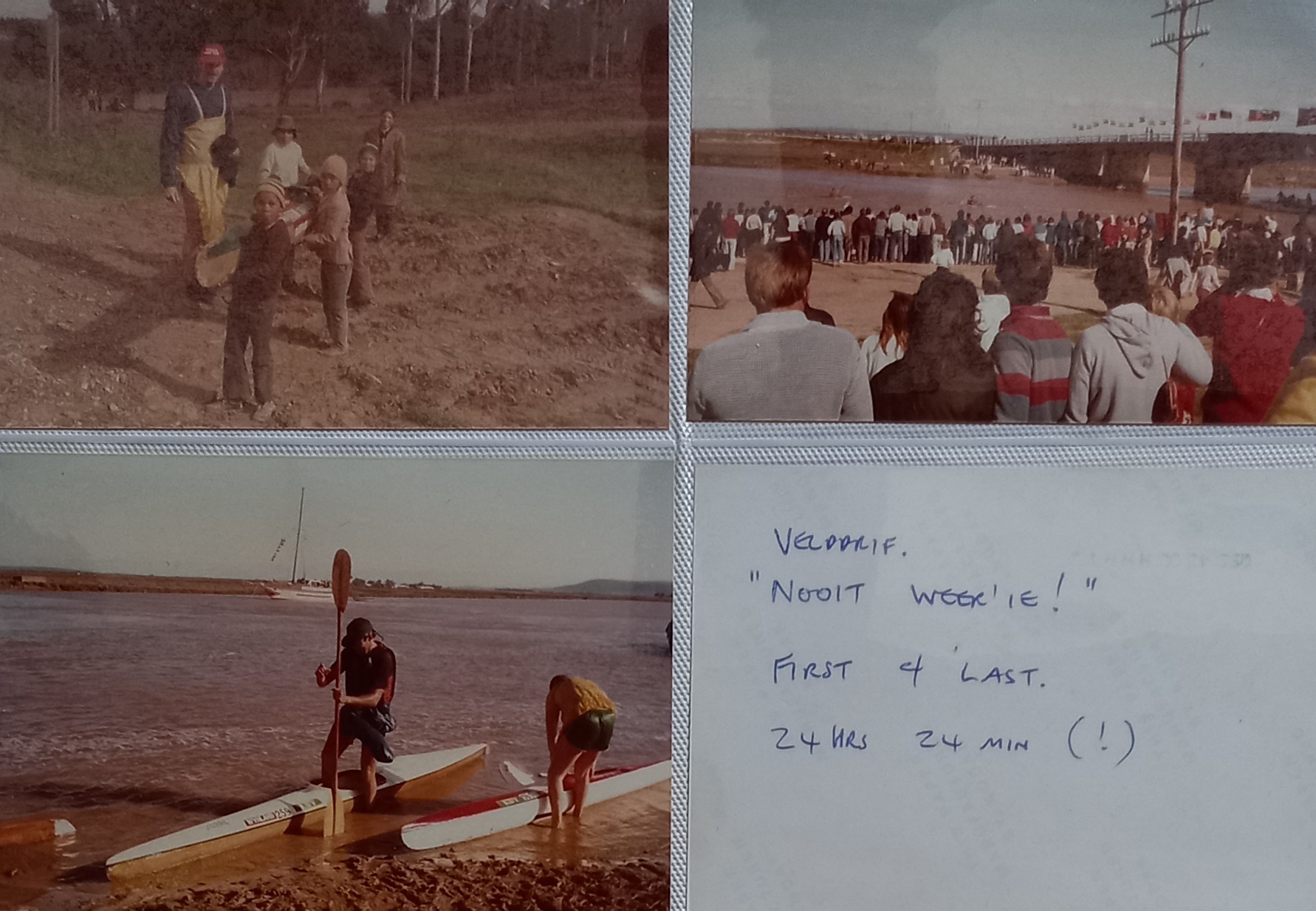
Greyling Viljoen won the race in 16hrs 7mins; I took 24hrs 24mins and probably 24 seconds; 225 maniacs finished the race; I was cold deep into my spinal bone marrow.
The freezing finish at Velddrif at last!
– at this stage when asked, you say, ‘Fine. It was nothing. No problems’ –
The Velddrift Hotel bed that night was bliss with all my clothes on and the bedclothes from both beds piled on top of me. In Cape Town the next day I bought clothes I couldn’t wear again until I went skiing in Austria years later. Brrrr!! Yussis! Nooit! The Berg joins quite high up on my list of ‘Stupid Things I’ve Done’. Top of which is the Comrades Marathon Which is also the only ‘Stupid Thing I’ve Done and Not Even Finished.’
~~oo0oo~~
Some interesting stats and numbers for the Berg River Canoe Marathon
241km from Paarl to Velddrif. Four days of approx 62, 46, 74 and 60km. 46 300 – The estimated number of paddle strokes required to complete the Berg
I thought ours was a really high-water Berg. At 19cumecs it was the 7th highest of the 21 Bergs up to then. But since then the river has often been higher and 1983 is now only the 21st highest of 55 races. The very first race in 1962 was a staggering 342 cumecs! Liewe bliksem! The lowest in 1978 was a mere 1.44 cumecs. You could almost say fokol.
Only twice – in 1965 and 1967 – was the overall winning time more than 21 hours (I took 24hrs, but that’s OK, I didn’t win). The fastest overall time: 13hrs 20mins. Giel doesn’t make mistakes, so I must have the 1983 time wrong.
Five paddlers have completed 40 or more Bergs. Giel van Deventer – Berg Historian, who compiled these facts – has finished the race 45 times! In the book on the Umko canoe marathon I wrote in a draft which I sent to him “the Berg, over 200km long” and he hastened to write to me saying “Pete, it’s 241km long, don’t get it wrong.” I changed it to 241km. (note: Giel went on to do 50 Bergs, then sadly drowned in the Breede river race. Thank goodness though, he did travel to Natal to do ONE UMKO! ).
One of the toughest years was 1971. Only 49% of starters finished – the lowest percentage so far. The oldest finisher of the Berg, Jannie Malherbe was 74 when he did that crazy thing in 2014. He made our Ian Myers in 1983 seem like a spring chicken.
1 401 – The number of paddlers who have completed one Berg only. Us sensible ous. 2 939 – The number of paddlers who came back for at least one more – maniacs!
Andy Birkett won the Berg in 2016. He makes no bones about the fact that the grueling race takes its toll, even on well conditioned paddlers. “Flip, it was tough!” he recalls. “It was cold, putting on beanies and two or three hallies and long pants when you are busy paddling. But that is all part of it.” He speaks of how one needs to discreetly tuck in behind the experienced local elite racers, particularly on the earlier sections of the course where local knowledge through the tree blocks and small channels is important.
~~oo0oo~~
Photo albums are history, so here’s a digital copy of my now discarded hard copy. Thanks to sister Sheila for the pics.
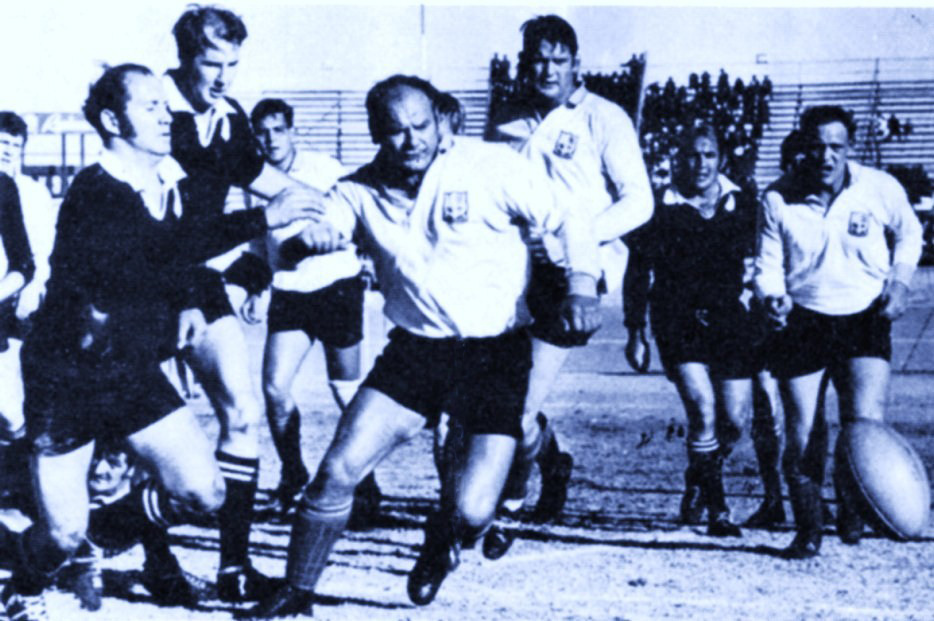
July 1970. The All Blacks were on tour. We had gone to Bethlehem to see them play. Rugby.
Now, surely Bethlehem must be the only town in the world where a big sign at the entrance says not WELCOME, butFAKKELHOF ? I bet the one in Palestine didn’t.
Bryan Williams, the first Maori allowed to play in South Africa (inconveniently handsome and popular, strong and fast) scored two tries in his very first game in an All Black jersey.
Check the Bethlehem news: ‘en daar was rugby ook’ – with more coverage of the pomptroppies than the rugby!
We got klapped 43-9, so the rugby was just an afterthought! You can be sure there’d have been much more rugby coverage had we – Oos Vrystaat – won!
Rugby writer Terry McLean said: (The) Paul Roos XV was, bluntly, a nothing team. Dannhauser and Fourie had good stances as locks in the scrummage. Lyell at No 8 had bags of pace which he used much too little and Burger, a hooker of some note, took a heel from Urlich, though he lost five in the process. But behind the scrum Froneman was an obsessive kicker and Kotze at fullback defended principally by making meaningful gestures from a distance.
And McLook said: I get heart burn (sooibrand) just reading remarks like this; it has always been one of the most irritating and frustrating things for me about South African rugby. As a provincial player you get one opportunity in your life to play against an international team so why would you waste the opportunity by constantly kicking the ball away. Secondly, it totally eludes me why selectors would pick individuals for a team if that individual does nothing else than kicking. If you want to kick a ball go play soccer. Eina!
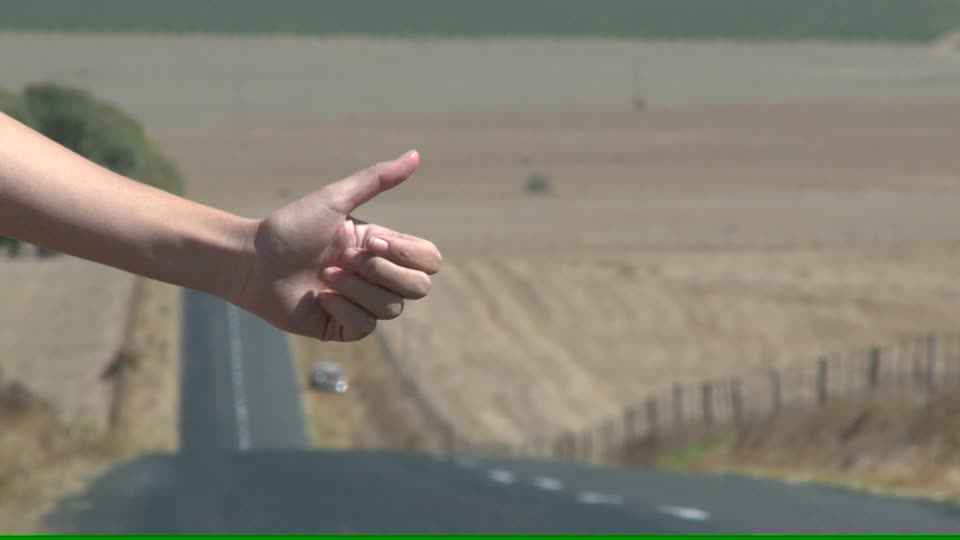
Later the Silver Ferns played Free State (hak Vrystaat) in Bloemfontein and my mate Jean Roux and I decided we needed to go and see that game as well. We hitch-hiked to Bloem, arrived in time and watched the game.
Let’s conveniently forget the score. You know how those All Blacks are.
After the game we realised it was getting dark and cold. We had made zero plans or arrangements, so we made our way to the pulley staasie, the cop shop, told our tale of need and were met with excited enthusiasm and hospitality. NOT. We were actually met with complete indifference and ignored. Eventually one konstabel saw us and asked, ‘Wat maak julle hier?’ and we told our tale again. He said nothing but fetched some keys and beckoned us to follow him. ‘There’s a ladies cell vacant,’ he muttered, letting us in and locking the door behind us.
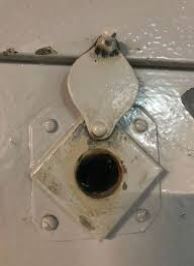
Toilet in the corner with no cistern, no seat and a piece of wire protruding through a hole in the wall: the chain. Four mattresses with dirty grey blankets. Lots of graffiti, mostly scratched into the plaster. Yirr, some vieslike words! We slept tentatively, trying to hover above those mattresses, which were also vieslik, and woke early, eager to hit the road back to Harrismith. After waiting a while we started peering out of the tiny little peephole in the door, hoping someone would walk past. Then we called politely with our lips at the hole but not touching. Eventually we started shouting – to no avail. After what seemed like ages someone came to the door. Thank goodness!
‘Vaddafokgaanhieraan?’ he asked. ‘Please open up and let us out, we have to hitch-hike back to Harrismith,’ we said, eagerly. ‘Dink jy ek is vokken mal?’ came the voice and he walked off. We realised it was probably a new shift and no-one knew about our innocence! They were these ous:
We had to bellow and yell and perform before we eventually could get someone to believe us and let us out.
And then:
~~oo0oo~~
FAKKELHOF – doesn’t sound like welcome; sounds like Go Forth and Multiply; literally ‘Torch Court’
‘en daar was rugby ook’ – oh, there was some rugby (after ooh’ing about all the ancillary pomp)
pomptroppies – drum majorettes; microskirts
klapped – pasted; smacked
Wat maak julle hier? – what are you doing here?
vieslik – disgusting; sis
Vaddafokgaanhieraan? – Can I help you gentlemen?
Dink jy ek is vokken mal? – Do you think I’m gullible, old chap?




















 Vrystaat Confessions