Category: Family

  • The Rajah’s Team

    The Rajah’s Team

    Mom tells of Sparrow Bester’s father coming to our place in Stuart Street – actually, he’d probably have come in the usual way in Hector street as he lived just a block away in Warden Street – to ask to borrow some sheet music. The Besters were a really musical family, says Mom. Sparrow was chosen for The Canaries, nickname of the Free State Jeug Koor.

    Sure, said Mom, What are you looking for? She had a big collection of sheet music kept in a wood and glass cabinet and under the seat of her piano chair. “Rajah’s Team,” said Mnr Bester. Or so Mom heard.

    Mom said no, sorry she didn’t have that and thought to herself, I’ve never even heard of it!

    “Oh,” he said, puzzled that she didn’t seem to know it, “From that new movie Dr Zhivago.

    Ah, said Mary, figuring it out: Lara’s Theme. And she did have it.

    “I thought so,” said Mnr Bester.

    ~~oo0oo~~

    Jeug Koor – Yech Koor we would say jokingly, but actually Youth Choir

    That was ca.1965 and now is 2024 and Mary at 95 still plays Lara’s Theme to “the oldies” at the home.

  • On Getting Up

    On Getting Up

    Stephen Charles R, First Son of the famous Artists Village called Clarens, Vrystaat posted a story on chairs, showing this beautifully-made wooden one, on display in the Auckland Art Gallery.

    I stared at it, fascinated and was moved to comment on his blog: ‘Your first pic, the wooden chair, looks like it could stick to the rear of a person with just the wrong-sized bum, poor thing! He’d get up and walk round with people pointing at him and laughing.’

    We spoke about chairs, both confessing to using what Stefaans called, ‘a small folding campfire stool. Footstool size. Useful for lots of things. I use mine for pumping bicycle tires, weeding and any other chore for which I would otherwise have to crouch. ‘Cause I can’t get up.’

    ‘Haha!’ I replied, ‘I have one in my bakkie for changing n pumping car tyres for that same reason: Fear of being unable to rise and lying on the dirt laughing helplessly at the indignity!’

    This reminded me of two of Mom Mary’s favourite stories. At 95 and following a few TIA’s Mary’s recollection of the olden days is still strong. About yesterday she is not bad, considering, but she recalls tentatively. About some funny incidents fifty years ago, of course, she is crystal clear. These two stories both involve her good friend Hester and falls and Getting Up. Hester was a barrel of laughs, sense of humour deluxe; barrel-shaped and vertically challenged, she could tell stories and laugh like a drain; the butt of her humour often being Hester herself.

    The first story, Mary witnessed herself. They were at Hester and her husband Steve’s home. Steve was also barrel-shaped but had plenty of height as well. Visits to their home – which take note was across the road from the big Dutch Reformed Church. the NGK, the National Party at Prayer – entailed eating mountains of food to fill those barrels, and gallons of drink, followed by song, Mary on the piano. On some days if you listened carefully you could hear hymns being sung from across the road, but they’d be drowned out by the non-hymns sung by these revelers, singing lustily on that day when you’re not meant to be having fun. And now followeth a sermon: People past a certain age who imbibe and who have polished parquet floors, should not scatter rugs on those floors. Especially not rugs which are actually dried skins of dead animals, shot by your husband for biltong. Here endeth the lesson.

    Hester bustled about, slipped on a loose springbok skin and landed flat on her back under her large coffee table laden with food and drink and overflowing ashtrays, all of which were wobbling as her tummy jiggled from hosing herself at her predicament. Trapped and helpless and unable to move except for the wobbling.

    The second story Hester told. She went for a walk, slipped and landed in the gutter outside their home. Thus also opposite that church, remember. She was lying there giggling helplessly when Gerrie the town dandy, out for his constitutional, happened on her. I see him with hat, walking stick and cravat. ‘Kom Hester, laat ek jou help,‘ he offered gallantly. NEE Gerrie, LOS! she protested determinedly. Netnou beland jy ook in die sloot langs my, en wat sal die dominee dan se?

    ~~oo0oo~~

    biltong – dried meat; jerky in the ‘states

    Kom Hester, laat ek jou help – Let me help you up

    NEE Gerrie, LOS! Netnou beland jy ook in die sloot langs my, en wat sal die dominee dan se? -No! Leave me. What if you land in the gutter next to me? What will the dominee say then!?

    dominee – preacherman

    ~~oo0oo~~

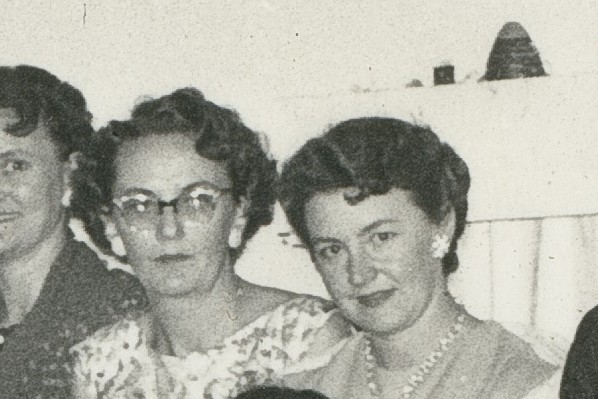
    I must find a picture of dear old Hester. This one is Mary on the right with another great friend Mary Wessels.

  • Riding Shotgun

    Riding Shotgun

    Another re-cycled post to save ink, pixels and perspiration. I tried to reason with these ous, but would they lissen to me?

    ~~oo0oo~~

    My lift from JHB dropped me off at home. The dorp was empty. The city of sin and laughter was somnolent. Soporific even. Where WAS everyone?

    I phoned 2630 pring pring pring. Or was it 2603 priiiiing priiiing priiiing? I forget. Can you fetch me? No, get yourself here quick, we’re going to Warden to scare some guineafowls. Now.

    What could I do? The imported white Ford Econoline 302 cu. inch V8 van was in the garage, I knew where the keys were, and the folks were away. And after all, I’d only be using it to get to Gailian then hop into Tabs’ bakkie and away we’d go. What could possibly go wrong? Oh, and I’d better borrow Dad’s cheap Russian 12-gauge shotgun, too. The R139 one. And take a few beers.

    As I drew up next to the prefab on Gailian, a cry of ‘Perfect! A real shooting brake!‘ went up and six pre-lubricated gentlemen holding shotguns and beers piled in, calling Tommy the diffident short-haired German Pointer in with them. No, guys, hang on, I said feebly . .

    The day at Rust was a blur, but the drive back came into sharp focus. We ‘had to’ pull in to the Warden village pub. The dorpskroeg. I, of course, had suggested we go straight home, but that went down like a lead balloon. A vote wasn’t taken, and I lost, blithely ignored. Overruled. In the pub, the barman took one look at us and refused to serve us. Someone who shall remain nameless but whose surname maybe started with a Gee and ended with a Zee, fetched his shotgun and casually aimed it at the expensive bottles of hooch above the barman’s head whereupon said barman suddenly remembered our order and delivered seven beers pronto. When we decided we’d like to play snooker, same thing: It was a No Way, until a The Simpsons-like character aimed a shotgun at the white ball and the cues were produced with alacrity. And chalk.

    When to my huge relief, we finally got going, the clutchplate G-man, who was riding shotgun on my right (the van was Left-Hand-Drive), sat on the windowsill and two of Warden’s four streetlamps went ‘pop’. There he is, in the window, next to the weapon in question. Tommy’s wondering What.The.Hell!? The guinea is mortally wounded, deceased and bleeding on the van carpet.

    – riding shotgun –

    Now I KNEW I was going to jail forever. Putting my head down and roaring for home I wasn’t stopping again for NOBODY. Except the gentle tickle of a shotgun against my ear persuaded me otherwise and I stopped as instructed with my headlights shining on the Eeram roadsign. A firing squad lined up, three kneeling in front and four standing behind them. This is for Ram, guys, he’s getting married in Bergville next weekend! BLAM!! The ‘Ee’ disappeared, and there was just ‘ram’. In honour of Ram’s wedding. Nor do I believe it. Maybe it was a dream?

    I finally got rid of the miscreants, got home and looked at the van. Holy cow! Dog hair, guineafowl feathers and the mud and the blood and the beer all over the carpets and upholstery of Dad’s white Ford Econoline V8 camper van! 302 cu. inches. I set to work cleaning it. And cleaning it. And scrubbing it. Still, it stank of that mixture. In desperation, I took a jerrycan and spread petrol liberally on the carpet and scrubbed again.

    When the folks got home I made a full – OK, partial – confession: Dad, I spilled some petrol in your van, but I’ve cleaned it all up. Sorry about that!

    ~~oo0oo~~

    • the mud and the blood and the beer – Johnny Cash

    ~~oo0oo~~

  • None Pictures

    None Pictures

    Mom tells me that after I had me tonsils out at about age three, she took me to Kindrochart for some gentle recovery for the poor little tender chap. I clung to her skirts and wouldn’t go to anyone, I wouldn’t even look at, nor speak to, our hosts Mrs Shannon and Betty Stephens. But once, when lovely, friendly Betty – a huge fan of us kids, we called her Betty Brooks – offered to carry me up a hill after I’d run out of poof, I relented / condescended to use her as a pack horse. Mom was leading us up the hill to show me their farm Nuwejaarsvlei, where she was born and lived till she was eight.

    Mom also tells that I told on Ma Shannon! I hastened into the house one day to find Mom, ‘Ma! Shannon’s got none clothes on!’ Mom hastened out to see this sight and there was Ma Shannon in full petticoat and underwear, shoes and socks, looking quite respectable, thank you. She was preparing to have the Milraes for tea, and wanted to pull on her dress at the last minute.

    Apparently Ma Shannon tried hard to get me to call her Nana, but I’d not call her anything but ‘Shannon.’

    On the way back to the big smoke, driving on the gravel road towards Platberg, Mom was telling Betty about a book she was enjoying about a Belgian nun – The Nun’s Story – I had the book in my hands on the back seat and it seems I was disappointed in it, as I piped up, ‘. . and its got none pictures.’

    ~~oo0oo~~

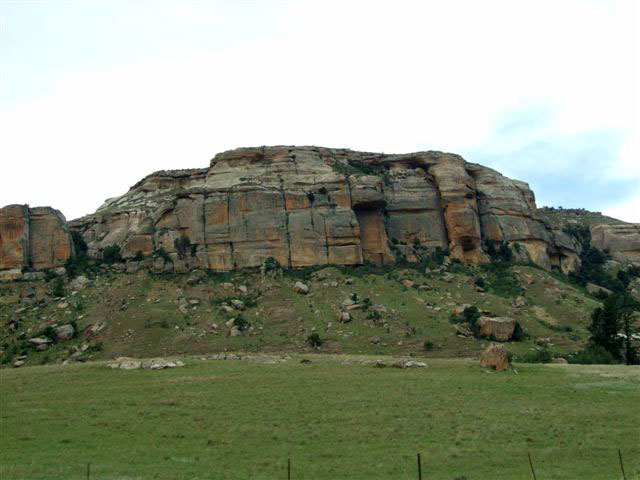
    Pic: Kerkenberg – the old Binghamsberg – from Kindrochart side – from mapio.net

  • Mist or Smoke?

    Mist or Smoke?

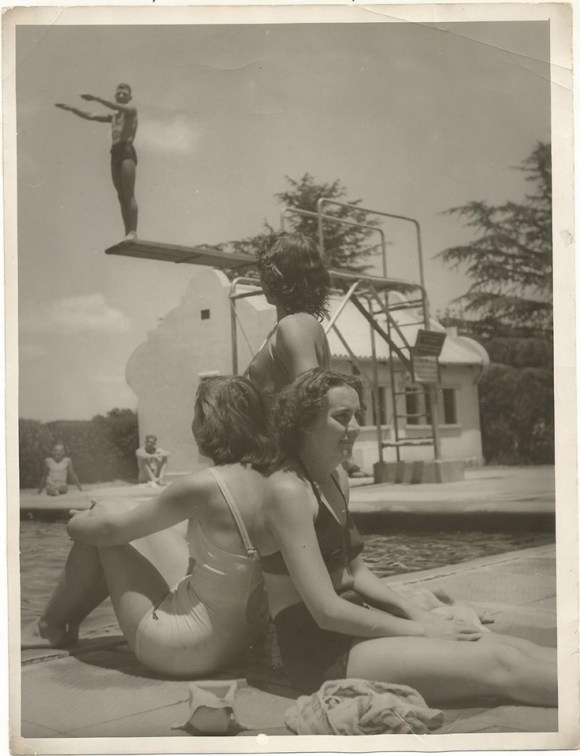
    Mom says they loved swimming. All the boys were at the baths – the Harrismith Municipal Swimming Baths about a kilometre away up the hill past the Town Hall.

    Some days they’d get ready to go – cozzies and towels over their arms, but Granny Bland would be standing on the stoep with her hand on her hip, looking at the mist on the eastern end of Platberg and announce firmly, ‘No, you can NOT go swimming. You can put that in your pipe and smoke it!’

    – Mary and the gang –
  • Culinary Tales 1922 – 2021

    Culinary Tales 1922 – 2021

    Ole man phones at 19.28pm

    Listen, if you want to make it to supper you must come quickly but you’ll have to bring lots of money.

    His nephew Jack who’s ‘a helluva clever bugger, Jack, he’s on a lot of boards and chairman of this, chairman of that. Wonderful bugger, Jack. He still weighs 78kg same as he weighed when he was a fighter jet pilot’ (Jack must be 78yrs old in the shade, so 1kg per annum).

    He brought me some smoked snoek and chips, KILOGRAMS OF IT!

    ..

    He’s on to food – a favourite subject.

    ..

    Oupa worked on the railways.

    Working men took a scoff box to work

    Guys would take sarmies, meat, tea, etc.

    Oupa had a billy can. A blue billy can, the lid was your cup. You know what he used to take in to work for his lunch?

    No. What, Dad?

    Sugar water

    At night he’d drink a big mug of milk and eat bread.

    ..

    Ouma would cook in the kitchen and dish up in the kitchen.

    Six plates. Her and Oupa and four big kids.

    You got your plate of food. Don’t ask for more, there was no more. But we didn’t need more, it was a great big plate; we never went hungry. We had to do without some stuff, like new clothes or shoes, but we never went hungry. There was always a big sack of peanuts in their shells on the floor of the pantry and you could go in and grab a handful.

    ..

    Oupa and Ouma in PMB

    Chickens and muscovy ducks in the backyard.

    Ouma made a little pond in the ‘sump,’ the lowest point in the yard in the far corner. She would fill it up with water, about one brick deep, then throw mielies in the water. The ducks like feeding underwater. They bred prolifically and there were always plenty. A big fat roast duck was a huge treat. Only trouble is there was duck shit all over the yard.

    Chickens they had to slag. The kids. One would hold the beak and feet, stretch it and one would chop off the head with an axe.

    A big game was to then stand it up and let it go and watch it run around, headless.

    ‘One day Oupa caught us doing it and beat the shit out of us.’

    ~~oo0oo~~

  • Early Daze

    Early Daze

    A re-post cos Mom told me some news today (see right at the end):

    My first recollections are of life on the plot outside Harrismith, playing with Enoch and Casaya, childhood companions, kids of Lena and Bennett Mazibuko, who looked after us as Mom and Dad worked in town. The plot was in the shadow of Platberg, and was called Birdhaven, as Dad kept big aviaries. I remember Lena as kind and loving – and strict!

    I lived there from when I was carried home from the maternity home till when I was about five years old, when we moved into town.

    1955 Koos with aviaries
    – those pigeon aviaries – and me –

    I remember suddenly “knowing” it was lunchtime and looking up at the dirt road above the farmyard that led to town. Sure enough, right about then a cloud of dust would appear and Mom and Dad would arrive for their lunch and siesta, having locked up the Platberg bottle store at 1pm sharp. I could see them coming along the road and then sweeping down the long driveway to park near the rondavel at the back near the kitchen door. They would eat lunch, have a short lie-down and leave in time to re-open at 2pm. I now know the trip was exactly 3km door-to-door, thanks to google maps.

    Every day I “just knew” they were coming. I wonder if I actually heard their approach and then “knew”? Or was it an inner clock? Back then they would buzz around in Mom’s Ford Prefect or Dad’s beige Morris Isis. Here’s an old 8mm movie of the old green and black Ford Prefect on the Birdhaven circular driveway – four seconds of action – (most likely older sister Barbara waving out the window):

    birdhaven

    1. Ruins of our house; 2. Dougie Wright, Gould & Ruth Dominy’s place; 3. Jack Levick’s house; 4. The meandering Kak Spruit. None of those houses on the left were there back then.

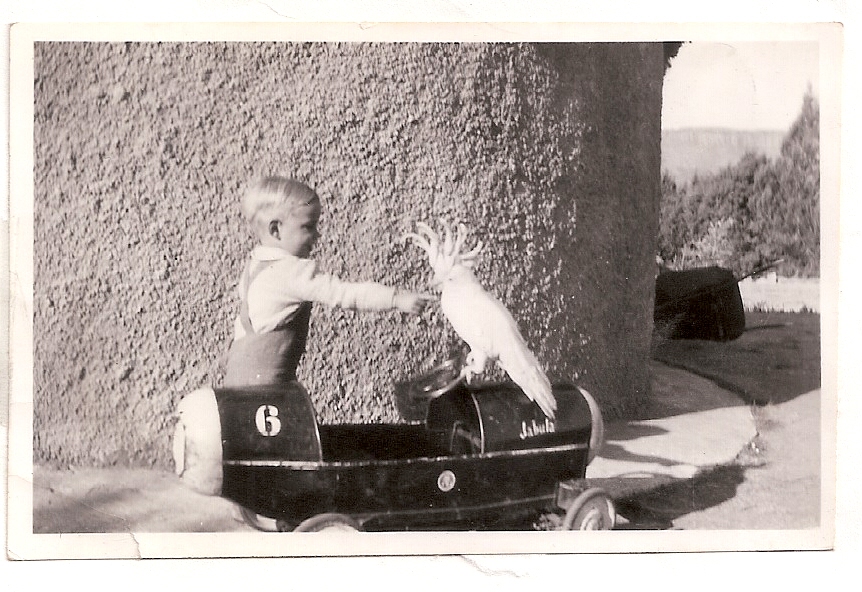
    Our nearest neighbour was Jack Levick and he had a pet crow that mimic’d a few words. We had a white Sulphur-crested Cockatoo Jacko that didn’t, and an African Grey parrot Cocky who could mimic a bit more. Helmeted Guineafowl would visit by day, and a tame-ish Spotted Eagle Owl would visit at night.

    Our next neighbours, nearer to the mountain, were Ruth and Gould Dominy and Ruth’s son Dougie Wright on Glen Khyber. They were about 500m further down the road towards the mountain, across the Kak Spruit over a little bridge. Doug’s cottage was on the left next to the spruit that came down from Khyber Pass and flowed into the bigger spruit; The big house with its sunny glassed-in stoep was a bit further on the right. Ruth and a flock of small dogs would serve Gould his tea in a teacup the size of a big deep soup bowl. I wonder how many sugars he added?

    Jacko the sulphur-crested cockatoo
    – Me and Jacko the sulphur-crested cockatoo outside the rondavel –

    Judas Thabete lived on the property and looked after the garden. I remember him as old, small and bearded. He lived in a hovel of a hut across a donga and a small ploughed field to the west of our house. He had some sort of cart – animal-drawn? self-drawn? Self-drawn, I think.

    Koos
    – Me and Sheila on the front lawn – 1956 –

    Other things I remember are driving out and seeing white storks in the dead bluegum trees outside the gate – those and the eagle owl being the first wild birds I ‘spotted’ in my still-ongoing birding life; The storks brought babies we were told – can’t level with kids. Hope parents are more straight-up with their kids these days. I remember the snake outside the kitchen door;

    1990 Birdhaven Mum & Dad in the Kitchen
    – Scene of the rinkhals leap – this taken thirty years later, in 1990 –

    I don’t remember but have been told, that my mate Donald Coleman, two years older, would walk the kilometre from his home on the edge of town to Birdhaven to visit me. Apparently his Mom Jean would phone my Mom Mary on the party line and ask, “Do you have a little person out there?” if she couldn’t find him. He was a discoverer and a wanderer and a thinker, my mate Donald.

    1955 Barbs Birdhaven tyre Dad.jpg
    – fun on the lawn – and Bruno the Little Switzerland doberman –

    Bruno the doberman came from Little Switzerland on Oliviershoek pass down the Drakensberg into Natal. Leo and Heather Hilcovitz owned and ran it – “very well” according to Dad. Leo came into town once with a few pups in the back of his bakkie. Dobermans. Dad said I Want One! and gave Leo a pocket of potatoes in exchange for our Bruno. He lived to good age and died at 95 Stuart Street after we’d moved to town.

    1990 Birdhaven Mum & Dad on the front veranda
    – 1990 – Mom & Dad sit on the ruins of the stoep –

    ~~~oo0oo~~~

    rondavel – circular building with a conical roof, often thatched;

    spruit – stream; kak spruit: shit stream; maybe it was used as a sewer downstream in town in earlier days?

    stoep – veranda

    donga – dry, eroded watercourse; gulch, arroyo; scene of much play in our youth;

    bakkie – pickup truck

    ~~~oo0oo~~~

    – 1948 Ford Prefect –

    A newsflash the year I was born – check the cars.

    Our Ford Prefect was somewhere between a 1938 and a 1948 – the ‘sit up and beg’ look, before sedans went flat. They were powered by a 4 cylinder engine displacing 1172cc, producing 30 hp. The engine had no water pump or oil filter. Drive was through a 3-speed gearbox, synchromesh in 2nd and 3rd. Top speed nearly 60mph. Maybe with a bit of Downhill Assist?

    ~~oo0oo~~

    Today – 25 Sept 2021 – Mom (who turned 93 a week ago today) tells me Kathy Schoeman bought the old Ford Prefect from her and one day they drove to work to see it lying on its roof in the main street outside the town hall! Kathy had rolled it in the most prominent place possible!

  • Mom Mary 93

    Mom Mary 93

    Written on the day, posted (very) late.

    18 September 1928 plus ninety three years gets you to today. So if you were born then you’ve had around 33 968 sleeps.

    Quite something, Mom! Happy birthday, we feel very lucky to have you with us and be able to listen to your stories, and hear your memories and enjoy your piano playing. Love you lots!

    I listen to the Chopin and Mozart etc you used to play and I say to the expert pianists playing: Huh! You shoulda heard my Mom!

    She recently said she thinks the best piece she played was the duet with Una Elphick in the town hall of Beethoven’s 5th symphony. ‘You know the one,’ Mom says to me: ‘Da Da Da DUM . . Da Da Da DUM . .’

    They practiced separately and when they got together they couldn’t ‘gel,’ it wasn’t working. They tried using a metronome, tick tick you know. No good. Then Una said I’ll count, one two etc. That worked, they clicked and . . ‘best piece we ever played! ‘

    ~~oo0oo~~

  • Sixties Home Movies

    Sixties Home Movies

    We were lucky enough to watch 16mm Charlie Chaplin movies in our lounge at home back in the ‘Sixties.

    Here’s the Chaplin movie I remember the clearest, watching it in our lounge in Stuart Street and collapsing with laughter:

    Charlie Chaplin was one of the most amazingly accomplished individuals to have ever worked in film. He was so much more than just a slapstick comedian as his later films showed. Raised in poverty in England, he grew to be a very wealthy and influential film-maker in Hollywood, with his own studio. Although he became very popular he also had enemies, notably the trumped-up anti-communist McCarthy-ites who gunned for him when he hit the news for his private life scandals.

    This episode of |CineMasters| shows the upbeat side of Chaplin as well as the melancholy. A man so beloved yet ultimately so hated at one point that he left America. A truly remarkable yet depressing story of a director who still remains unmatched in his craft. Just an absolutely amazing career and a gifted individual as well.

    Thank you CineMasters on Vimeo – by Alex Kalogeropoulos

    More home movies from the Sixties.

    ~~oo0oo~~

  • Reflections on 100 Years

    Reflections on 100 Years

    of the Harrismith Methodist Church

    . . on the occasion of the one hundredth anniversary of the second Methodist church building in the town.

    This Centenary date – 1982 – was chosen because the old sandstone church in the pic above was built in 1882. They could have chosen 1973 – one hundred years after Methodists infiltrated the town; Or 1974 – one hundred years after the first church was built. But they chose the building of the lovely church we grew up with as the most significant date.

    So that’s what the Centenary was for, even though the lovely old building had very sadly been demolished in 1966 or 1967; A reluctant decision taken by the ouderlings at the time, as repairing it had been adjudged as too costly. The new church below was built to replace it in 1968.

    History! Excerpts from the Trustees Meeting Minute Book:

    August 1873: Rev Wynn the minister – First Trust Meeting to decide to build a church on the ground given by Free State Volksraad. Presumably church services were being held in homes or other halls at the time?

    This first church cost £460, twelve and sixpence + £451, fifteen and sixpence. Lamps and seats were £44, no sixpences.

    October 1874: Request for a manse. By June 1875 the manse was completed at a cost of £753, fourteen and sixpence.

    Evening of Wednesday 10th January 1877: A Special Meeting in consequence of the Chapel roof having been blown off this afternoon. Me: He moves in mysterious ways. The whole roof was removed and replaced. Was this significant? The Minister was away.

    4th June 1878: The Sabbath School Committee respectfully requests the permission of the Trustees of the Wesleyan property to erect a building to be used as a Sabbath and day school. This committee giving a guarantee that the said building shall be put up free of debt.

    October 17th 1880: Public meeting called to consider advisability of building a public school in Harrismith.

    October 24th 1881: Decided to use present building as school and erect church on Society’s ground opposite. Forty foot by sixty foot (no cubits?). Seating 400 – cost not more than Two Thousand Five Hundred Pounds.

    December 1881: Proceeds of Bazaar Two Hundred Pounds. Site of proposed new Chapel is forty foot from road (not cubits).

    14 June 1882: Laying of Foundation stone of new Chapel. Miss Bayford was at the foundation stone laying.

    ….

    A word from Rev Wilfred Hartley on the occasion of the centenary in 1982

    Harrismith has a very special place in my heart, as it had for my late wife Olive. We arrived as a newly wed couple, and the people took us to their hearts in a rather wonderful way. Two of our children were born there and the ladies took great delight in assisting the lady of the manse.

    We arrived in January 1940 when there was a lot of bitterness created by the Ossewa Brandwag and their cohorts, but we made out and preached the Gospel without bitterness, always seeking to take a positive line. On two occasions we had sailors from British warships staying with us, and how they enjoyed a bit of family life.

    I could tell you a great deal about some of the very unusual characters who lived in Harrismith. (Oh, boy, I wish he had told!). When I meet old friends who were our contemporaries we have a jolly good laugh about “old times.” Took the scandals to his grave. Darn!

    Reminiscences of the Davie family

    1. Mrs Maggie Simpson (eldest sister of Doris Davie)

    Anniversary: Cello, drums, violins played by Alice and Annie Brittan and Dora. Alice learnt millinery with Mrs Urswell; Annie and Dora served at the drapery counter of Brayshaw Store; Cornet played by Beno Sammell. The church was full of Military.

    Sunday School picnic Three wagonloads left at 8am and another at 10am for latecomers. Tent erected at homestead. Mr Bonham the butcher; a Salvationist brought his band to play at start of wagons and came with. (I just love it that those sinful non-Methodists were allowed to ‘come with’!).

    Arthur Putterill was Sunday School Superintendent. His wife and daughter Marion played the organ. John Putterill was also in the choir and took the music for the anniversary. Mr Jack ‘Pompom’ Fife sang in the choir. He was a lay preacher and sometimes helped in the Sunday School. His nickname was “Pompom.” (cos ‘you must have fife and drum’? ).

    2. Mrs Mary Davie

    A handful of people held Church at Grootfontein, Ivy Petty’s farm. UWCTU members Alice and Eliza and Maggie and Nellie Pendelbury came to play tennis on a Wednesday. Maggie could play better, but was “not allowed” – only allowed to collect the balls.

    Aunt Alice and Eliza, Sunday School teachers, (Eliza played the organ too), always called for Maggie. One day Maggie hadn’t been dressed so was left behind. When she discovered it she ran crying all the way and remembers Aunt Alice receiving her, laughing, in a dirty dress and pinny.

    3. Miss Doris Davie

    One Sunday, a man came into church. He sat down and all the children started to titter, because the worthy gentleman had forgotten to take his hat off !

    My niece of four, sporting her brand new shoes, was standing on the pew next to her mom when suddenly she slipped, and if it hadn’t been for the prompt action of her mother, would have landed on her head!

    Another niece, aged three, also standing on the pews, when we started to sing the first hymn, realized she didn’t have a hymn book, so she turned round and took the hymn book out of the hands of the lady behind her!

    One Sunday morning Miss Emma Putterill came hurrying up the aisle and into the choir. In her hurry the dear old lady had forgotten to take her apron off! Gasp! She’d been working on a Sunday!

    Looking back – Mr Tom Moll

    St Paul says: “Forgetting what is behind, looking to what is before, I press on . . “

    But we can’t forget the past altogether, can we? And at times like these it does us good to look back. I am no literary man, so what I am putting down here will be only ramblings, to stir up a few memories perhaps.

    When we first came to Richmond, Natal in ’47 we met up with a Mr Jim Barclay, who had been a policeman at Kromhof (near Mont Pelaan, the then Christina) and he had quite a bit of contact with Harrismith during the rebellion, so we had an interesting chat, and he gave me this little piece of doggerel:

    I always thought that Johburg was, and has been since its birth, 
    Without equivocation, the greatest place on earth.
    I also thought that London was the greatest city known,
    With its many million people, and the Queen upon the throne.
    But now a brother tells me 
    That this is all a myth,
    For the greatest place upon this earth
    Is known as Harrismith !

    Sad to say, after a lapse of thirty eight years, my wife and I have become estranged from Harrismith and its Methodist church, but that bond with the older Harrismith-ites and the warm feeling from them somehow still exists. How can we ever forget the warm humanity, the quips and cranks, but also the true Christianity of people like the Davies, Liddells, Farquhars, Sinks, Fife, McCourt, Cheshire, Hastings, Rapsons, Spilsbury, Putterill, Sharratt …… and many more.

    Now for a more personal note: My grandfather M C J Moll, was the first teacher in Harrismith, and I was related to about half of the population. My mother was a Liddell and my father’s mother a Bignhame !

    My wife (nee Pratherae) and I were both born in Harrismith, in Stuart Street, within a block of each other, christened here by Mr Pendlebury in the old church, which stood on this site. We were reborn here, got married here, our first daughter was born here and christened in the old church.

    Looking back with nostalgia, “revolving many memories.” (reviving?) How can the many children who passed through this Sunday School and Young People’s Guild forget Cliffie Sint as Superintendent, and their annual picnics at The Old Homestead to which they went by ox-wagon. And then comes the day when we came to Harrismith from Natal and saw for the first time this fine little church that had replaced the old sandstone one that had become so “wonky” (expecially the north-east corner that had to be underpinned) that it had to make way for a new building.

    The old order changeth, 
    yielding place to new

    That is true, but how conservative we are at heart, especially us “oldsters?” It gave us quite a wrench to see that our old church had had to be replaced. However, that is the way of the world. In the past this church has been a Bastion for Methodism in the north-east Free State, and we pray that it will continue to be so in the future.

    I wonder if anyone still remembers the day when a Mr Barn, with his dapper little figure, and his neat imperial beard, who fancied himself as a singer and whom we had in this congregation for a few short years during World War II, jumped up out of his pew during the singing of a hymn, and stomped up the aisle, proclaiming in a Stentorian voice: “This is not how it should be sung, put some more life into it!”

    Mr Wilfred Hartley in the pulpit, and Uncle Wright Liddell at the organ, were at first taken aback, but then with a smile they humoured the old fellow. The hymn was speeded up and sung accordingly to his wishes.

    Precious memories – Rev Lloyd Griffiths

    It is a privilege and a joy to respond to your minister’s request for a short article in this your Centenary Year. Congratulations on this most important milestone in the life and witness of Harrismith Methodism!

    Never do we pass the Platberg but memories tug at the heart strings – and a host of dear faces appear before us. We settled into the old manse at 22 Warden Street in January 1943; like two of my predecessors, Tom Elliot and Wilfred Hartley, I took my bride of a few weeks to her first home shortly after ordination in Johannesburg. Now I have just received an invitation as Past President to attend the 100th Conference in the same city! How time flies!

    Besides, our two sons were born in Harrismith, my wife electing to go to the nursing home for the first one at two o’clock in the morning when the thermometer registered 10 degrees Fahrenheit, and the car was standing on blocks, all four tyres having been sent to Ladysmith for retreading! War years those were.

    Hopefully we shall be able to attend your celebrations in a few months time and perhaps recall some of the names of the stalwarts still being with you. Besides the regular services in the main centre there were monthly ones at Swinburne, Witzieshoek, Speedwell, (alternating with Summerslie and Maweni Heights) and a quarterly service at Verkykerskop “where a large number of Afrikaans folk attended.” We even tried a service in the Arbuckle home on the farm Somerby at Aberfeldy!

    Rejoice in the Lord – again I say REJOICE !

    We look forward to meeting up with you again, especially those who may remember us. Warm and affectionate greetings from Thelma and Lloyd Griffiths (Pietermaritzburg).

    Miss Ivy Petty remembers

    Smoke: We arrived for morning service many years ago, a raw cold morning. The door steward remarked, “It’s rather smoky inside.” Well . . we could hardly see across to the pulpit. In those days coal stoves were used to heat the church, but something had gone very wrong to say the least.

    We had a visiting minister to take the service, and our Circuit Steward apologised for all the smoke. A cheerful reply came from a very smoky pulpit: “Don’t worry, it will clear up just now, and I have been in worse predicaments than this.” All the doors were opened but with each gust of wind fresh puffs of smoke came from the two lighted stoves.

    The Choir: The choir stood up to render the anthem; after the first few bars all the lights went out in town. The organ stopped but not the choir, which went on to sing right through the anthem much to the delight of the choir master. In those days the bigger congregation was in the evening so there was always the choir and an anthem.

    Reminiscenses of Mrs Anna Gavin:

    As was the custom the Methodist Church Choir, under the leadership of the Choir Master and Organist, the late Uncle Wright Liddell, attended special services in the homes of the Van den Bosch and Spilsbury families in the country, out near Kerkenberg. This little incident occurred during 1960: This particular Sunday the late Uncle Wright provided transport for the choir in his old car. On the way to the farm one of the ladies had to open a gate. Uncle Wright was so occupied showing his passengers the crops in the lands and the cattle grazing in the fields that he completely forgot to stop the car. There was this lady, wearing high heel shoes, holding on to the open door of the car trying to jump in, the passengers were histerical and unable to tell him to stop the car. After a long struggle she eventually managed to get into the car.

    The moment came when the Choir were to render the Anthem; a kitten crawled under the pedal of the organ; as the late Uncle Wright put his feet onto the pedals the kitten let out a loud “mieuww!” Needless to say that after the first episode the choir were unable to sing for laughing. The anthem was rendered much later during the service.

    A tribute to the late Mr W.G Liddell by Ivy and Anna

    The Centenary celebration of the church would not be complete without mentioning the name of Mr W.G Liddell or “Uncle Wright” as he was affectionately known. Those of us who were privileged to serve with him learned to understand what real dedication to Service To The Master meant.

    He was our organist in our church without a break for sixty three years, never taking a holiday. He played the organ both morning and evening on Sundays; plus Thursday evenings for choir practice, without ever missing one service. He also took upon himself the task of lighting and cleaning the black coal stoves used at the time for heating the church.

    “Uncle Wright” always prepared special music for Christmas, Easter and Harvest Festival services, this usually being a cantata. Each Christmas Eve he organized a lorry, had the old organ placed on it, took the choir on board and set off to sing carols all over town, usually starting at the hospital, never forgetting those confined to their beds. Many interested people followed the lorry in their motor cars, joining in the singing of carols.

    It was ill health towards the end of his life that forced him to give up as organist and also as treasurer of the church, the latter task he also performed for many years with much dedication.

    With the passing of this great man a musical era in our Church came to an end.

    Mrs Mary Swanepoel remembers

    Anecdote 1: Venue: Old Methodist Church; Date: October 1959, Time: 11.30 am; Occasion: Sunday School Anniversary Service

    The pupils were all sitting up front in the choir stalls. It was during the sermon that two teachers noticed that two little girls were getting restless. Black looks didn’t help. They were playing up to giggling. Eventually the three year old sidled up to one of the teachers and asked if she could go to the toilet. As she passed her friend she grabbed her and pulled her along. Thinking the children would slip quietly out the back door, the teachers looked thankfully at one another. “That’s got rid of them,” their eyes seemed to say. Unfortunately their relief was short-lived. The little girls had no intention of slipping out unnoticed. They ran skipping and laughing down the full length of the aisle and out the front door.

    More was to come. Five minutes later the patter of little feet was again heard, this time coming back through the hall, into the church and again down the aisle. They ran shrieking and laughing back to their seats. Two teachers were seen to collapse. Throughout all this disturbance, the minister’s voice continued unperturbed . . .

    The Minister: Rev Justin Michell

    The culprits: His daughter Jenny and her friend, my daughter Sheila Swanepoel

    Anecdote 2: Venue: Methodist Church Hall; Date: +- 1960, Time: 7 pm; Occasion: A social to welcome the new Minister

    It was the good old days before TV when folk still went out at night. Every church in town had sent a representative to welcome our minister. George Davie, as Circuit Steward, was the MC and he was introducing these speakers.

    Mr Cohen was there to represent the Hebrew Community, but when it was his turn to stand up he was nowhere to be seen. Mr Davie looked round puzzled. “Whatever happened to Mr Cohen?” he asked, then added jokingly, “He must’ve thought we were going to take up a collection.”

    Looks of disbelief and horror from the older Methodists. Collapse of the younger ones who didn’t know any better!

    Reflections: Jack Maguire

    We can well remember the attempts in the early ‘Sixties to save the old church building for this great occasion – but alas, this was not possible. The stone had weathered badly and especially around the window sills it had already begun to crumble. The late Maurice Sharratt brought in a consultant. While it was possible to prolong the life of the building, the cost would have been tremendous and the result unacceptable aesthetically, hence the decision to build the present church.

    I recall the many hours spent visiting with Miss Bayford who was then in the hospital and well into her nineties. As a little girl she was present at the foundation stone laying and the opening of the old church in 1882.

    Wright Liddell used to tell many stories of the old days. One of his favourites was the compulsory church parades of British POWs during the Anglo Boer War. The church was full and as the old building was considerably larger, the singing was magnificent. The Minister of the day always allowed opportunity for this special congregation to choose hymns and a regular choice was no. 879 – God save our gracious King – which was always sung with great patriotic pride.

    The old church also sported four big black coal burning heaters – one in each corner of the building. The use of these had to be adjusted according to the wind direction prevailing for the day, and a wrong decision could have your service “smoked out.” By wisdom born out of experience the lighting of those fires was also left to Wright Liddell. He was seldom wrong in the two stoves he chose to light – more often than not it was those on the east side.

    During this period we graduated to Capil (asbestos) heaters – we must have been one of the first in the country – and these were later incorporated into the “new” church. Bob Moore had a lot to do with their installation.

    We retain fond memories of Harrismith and the many lovely friends we made there. We wish you all God’s blessing as you start a new century of witness and service. As we greet you we echo the words, “the best is yet to be.” – Yours sincerely, Jack and Eileen Maguire

    A last word from not so long ago . . by the Circuit Steward

    This happening was about the second or third Sunday morning, our present minister was in the pulpit, during the singing of the first hymn, a sudden and very loud shout came from the pulpit. STOP! STOP! STOP! Nobody had any idea what caused this action, it was really hilarious watching the reactions of the congregation, hymn books fell out of the hands of some, there were faces reflecting fright, amazement and also anger. Others decided it wise to sit down.

    After a pause the minister said that looking at the faces of the congregation he could only see a lot of unhappy and sad looking people. When we sing hymns praising God we must sing joyfully and with smiles on our faces. Needless to say, the singing continued with much more joy and expression.

    Here’s more on us Harrismith Methylated Spirits.

    ~~oo0oo~~

    News of our Methodist ‘branch office’ out at Witsieshoek, from Liz Cronje, daughter of Corrie and Rosalie Cronje and neighbour of Uncle Wright Liddell:

    Liz Groves-Finnie (nee Cronje) writes: This is how I remember the church in the nineteen-fifties and early sixties. It was a happy gathering place for the local English-speaking country folk. Even some Afrikaans speaking people attended services. Services were held once a month and were led by the Methodist minister who drove out from Harrismith.
    When it was a regular monthly service, only the minister came out from Harrismith then Len’s wife, Betty played the organ with vigour and sang with gusto! However, on special occasions, at Christmas, Harvest Festival and Easter, the Harrismith choir and ‘Uncle’ Wright, the organist arrived with the minister. Usually Miss Ivy Petty and sometimes, Mary
    Swanepoel (née Bland) were the soloists. ‘Uncle’ Wright (Wright Greaves Liddell) accompanied them on the organ. He was Robert Jesse Liddell’s son. Uncle Wright was a dedicated Christian who practised his faith in all walks of life and was a friend to everyone.
    He was the organist at the Methodist Church in Harrismith for sixty-three years, never missing a service – twice on Sundays and choir practice on Thursdays. He was much loved and respected. He never married. He died on 12 th January 1967.
    At Harvest Festival, my Dad brought two of his tallest and best mealie stalks with cobs attached and positioned them upright at the front of the church next to the organ. They towered well above head-height. He also gathered fruit from our extensive orchard and vegetables from the garden. Other members of the congregation also contributed their gifts. We sang, “All things bright and beautiful … “

    After the service, the minister took the produce back with him to give to charitable causes, usually the Eliza [Greaves] Liddell Home for the Aged. The home still flourishes today (2024). The land was donated by Uncle Wright
    to the Harrismith Municipality for a home for the aged. At present it is run by the Dutch Reformed Church.

    ~~oo0oo~~