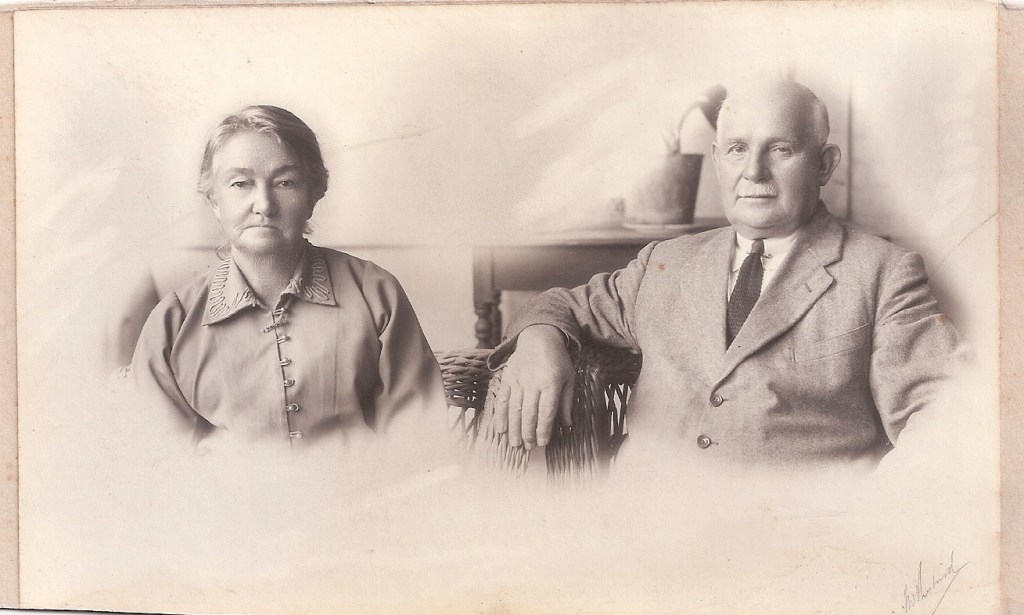
Category: Family

  • The Grand Old Man of Harrismith

    The Grand Old Man of Harrismith

    Stewart Bain was born in Wick, Scotland on 9 September 1854. He and his brother James came to South Africa in 1878, to Durban. They soon got a job building bridges for the railway line extension up the Drakensberg from Ladysmith to Harrismith. How, one wonders, did two herring fishermen convince people they could build bridges? And so they reached the metropolis of Harrismith in the Oranje Vrijstaat, an independent sovereign state at the time. Britain had recognised the independence of the Orange River Sovereignty – before that it had been the Orange River Colony ORC – after losing the first Anglo-Boer War at Majuba. The Vrijstaat officially became independent on 23 February 1854, seven months before Stewart was born, with the signing of the Orange River Convention. This history is important in view of Britain’s and many of Harrismith’s inhabitants’ conduct in the Anglo-Boer War of 1899-1902.

    – sandstone bridge across the Wilge River at Swinburne –

    So they built bridges. I am not sure, but I fondly imagine they built the beautiful sandstone bridge across the Wilge River at Swinburne, where I launched two separate canoe ‘expeditions’ with good friends Fluffy Crawley and Claudio Bellato many decades later.

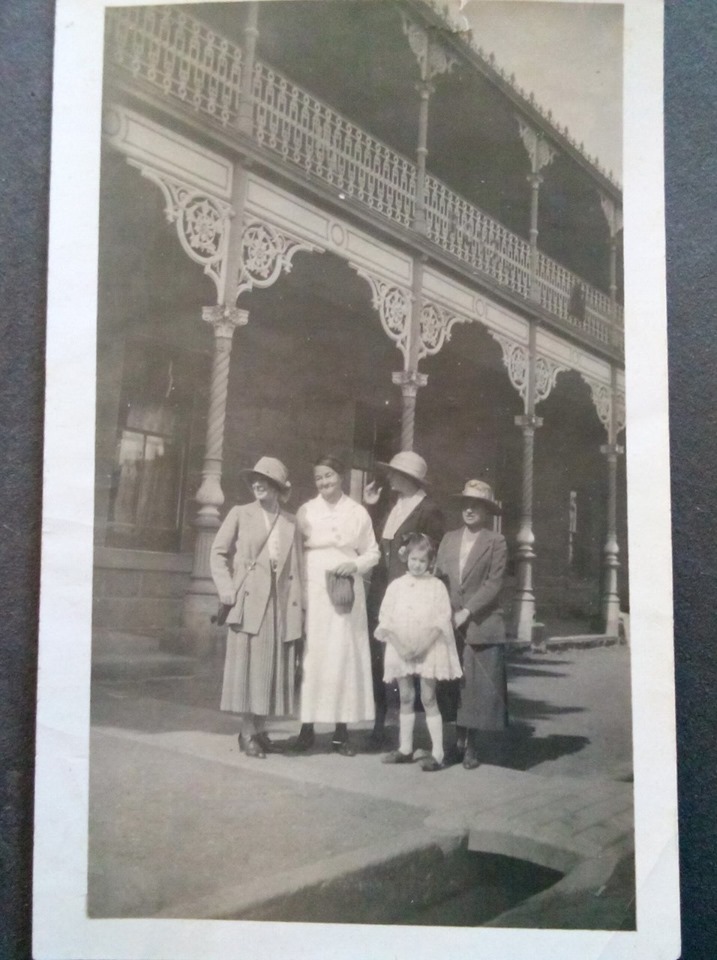
    Settling down in Harrismith after their bridge-building days, Stewart bought the Railway Hotel and changed its name to the Royal – we believe with official ‘royal” permission – while brother James built the Central Hotel uptown, on the central market square.

    Stewart married Janet Burley in Community of Property in Durban, I’m not sure whether that was before moving to Harrismith or after. Janet was born in Hanley, Staffordshire, England in 1859 of David Burley and Caroline Vaughan. They had __ children between 18 __ and 18__ . . . the fifth child in 1893 being our grandma Annie. Annie married Frank Bland and had two daughters, Pat and Mom Mary, Mom Mary remembered the hotel as having two big (‘huge’ says Mom, but she was little back then!) statues at the front door: A lion rampant with a human face, fighting; an antelope rampant on the other side of the door – she thinks a hartebees or a sable or something. Both were rearing up on their hind legs.

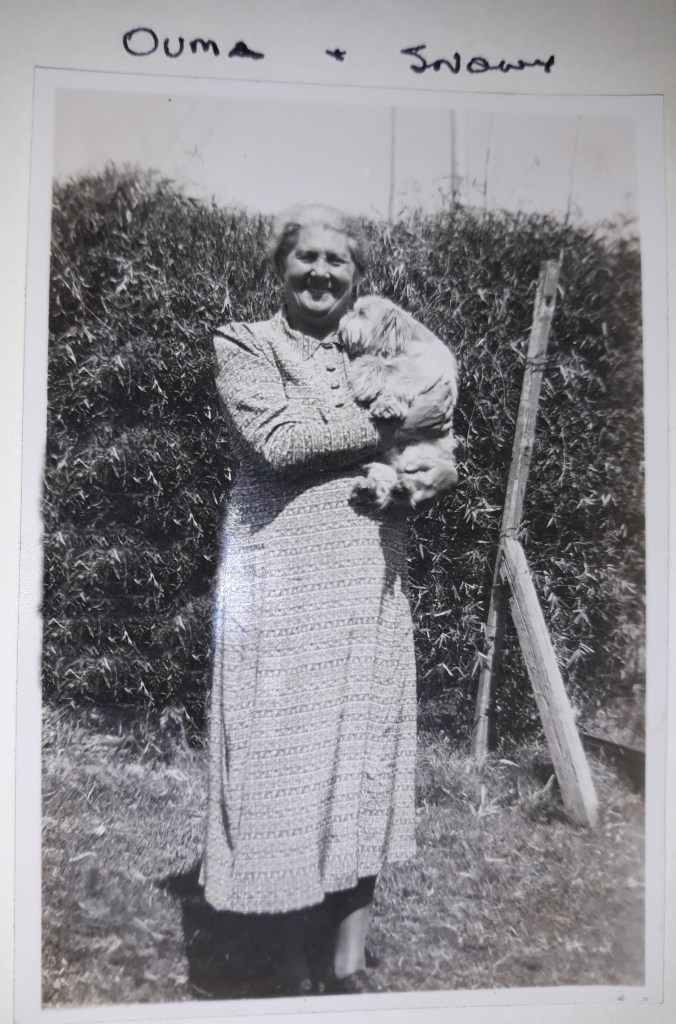
    Stewart became Mayor of the town and ‘reigned with the gold chain’ for years, becoming known – by some – as ‘The Grand Old Man of Harrismith.’ To their grandkids they were always ‘Oupa’ and ‘Ouma’ Bain;

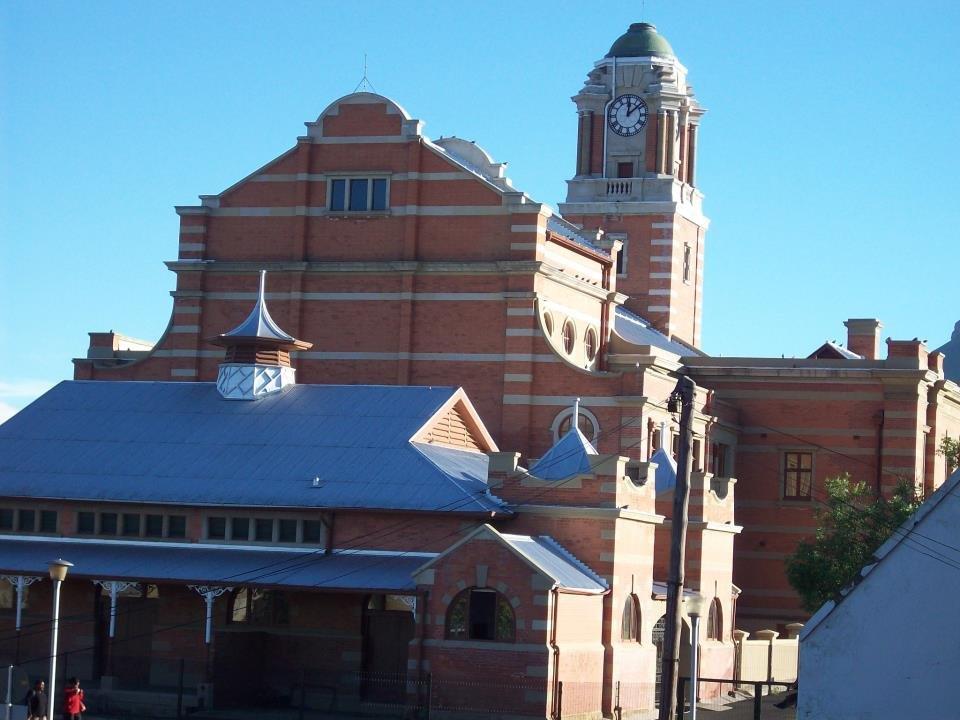
    He pushed for the building of a very smart town hall. Some thought it was way too fancy – and too big – and too expensive – and called it ‘Bain’s Folly.’ Did Stewart have the tender? Was he an early tenderpreneur? Was it an inside job? *

    Here’s a reason someone gave for the “need” for such a grend gebou: ‘The erection of the new Town Hall, officially opened in September 1908, was largely the result of support the troops had given for theatrical performances and concerts in the former building which had proven unsuitable.’ – (found that here: http://samilitaryhistory.org/vol082sw.html)

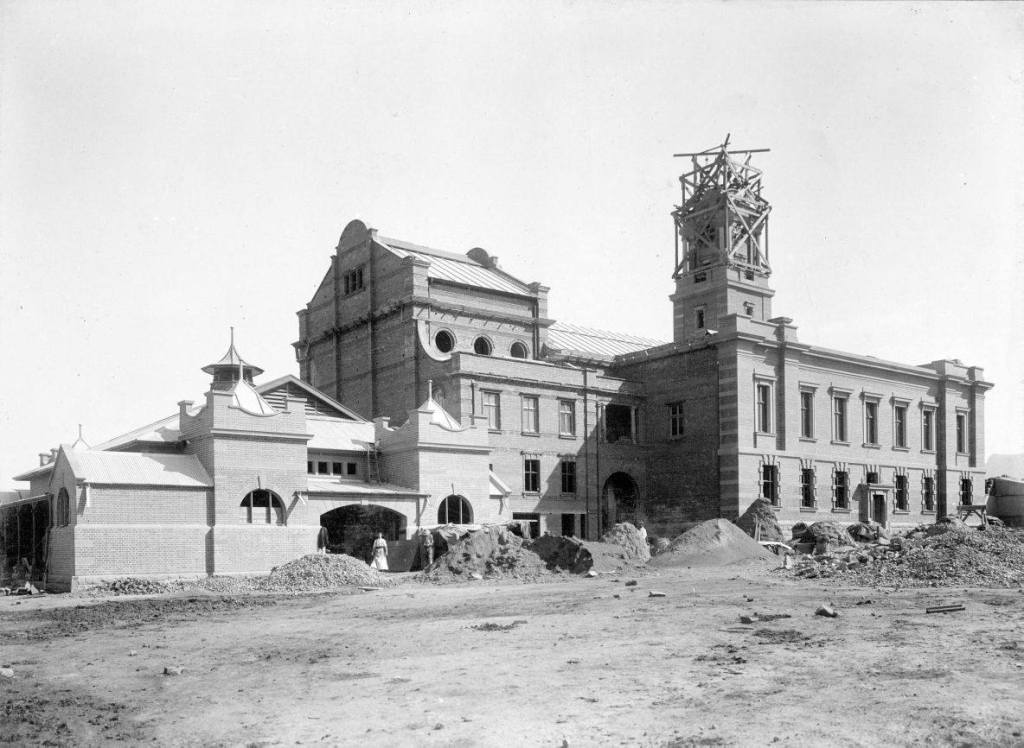
    – ta da! – a palace fit for a dorp –

    Here’s a lovely 3min slide show of the building of Bain’s Folly – completed in 1908 – by Hennie & Sandra Cronje of deoudehuizeyard.com and thanks to Biebie de Vos, Harrismith’s archive and treasures man. Thank goodness for all the stuff that Biebie ** has saved and rescued!

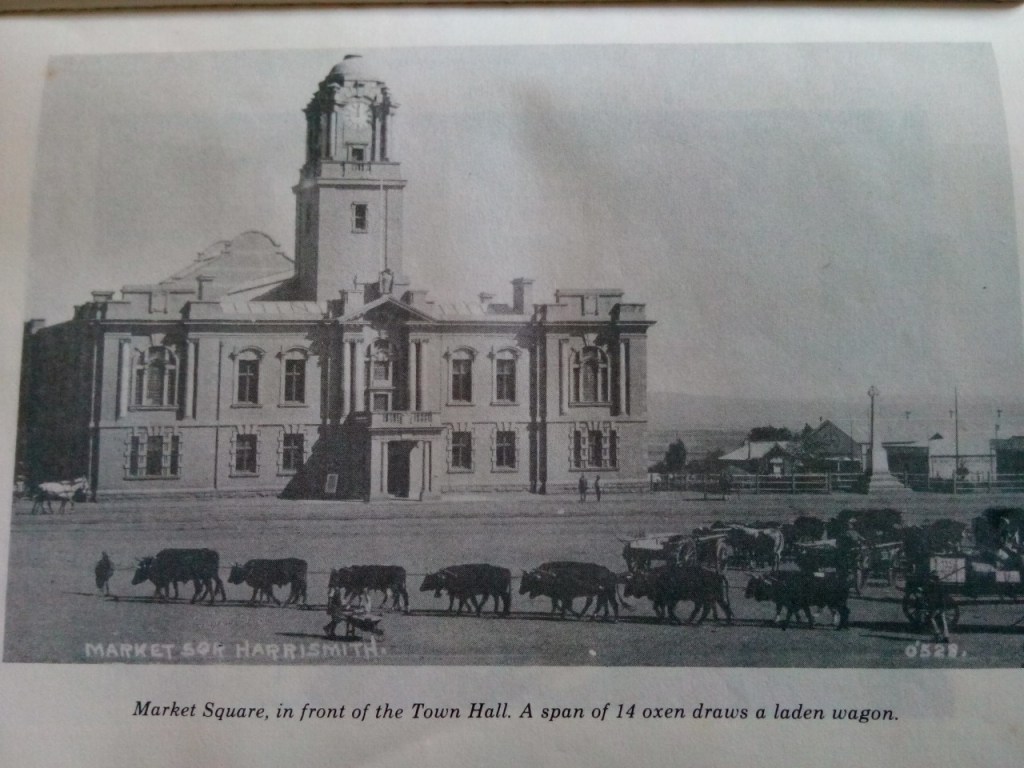
    Here’s that impressive building in a dorp on the vlaktes!

    – the market at the rear of the building soon after completion – 1908 –

    Opskops probably had to be arranged to justify the place, and the occupying British force that remained after the illegal and unjust invasion that was the Anglo-Boer War which saw so many war crimes committed by the British, benefited hugely, their officers dancing nights away with the local lasses.
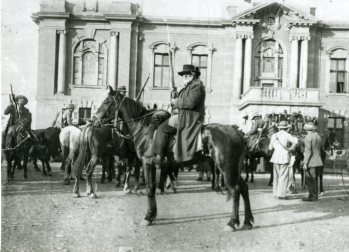
    Janet died on 15 January 1924; Her daughters Jessie & Annie (who was then aged thirty) were with her when she collapsed. They summoned Dr Hoenigsburger (Hoenigsburg?), but Ouma died within minutes. The Harrismith Chronicle article reads in part: ‘Ex-Mayoress’s Death. Sudden demise of Mrs S Bain. The news which stunned the town on Tuesday morning of the painfully sudden death of Mrs Stewart Bain, evoked a feeling of deepest sympathy from all who knew the deceased lady, not only in Harrismith and the district but in places far remote.’

    When the dust settled on the town hall, the townsfolk must have quite liked the result, as when Stewart Bain died in September 1939, the town pulled out all the stops for his funeral; These pictures were taken from the balcony of his Royal Hotel, with ‘his’ Town Hall visible in the background, and ‘his’ mountain behind that. Most Harrismithers and Harrismithians regard Platberg as ‘theirs.’

    Oupa's bible and Grandpa Bain's funeral
    – Oupa Bain’s funeral procession – who paid?! –
    Stewart Bain 1939.jpg

    At one notable local event ca.1949 in this huge hall – an Al Debbo concert! – Stewart’s grand-daughter Mary met her future husband. Maybe that was the Lord Mayor Hizzonner’s intention in building this impressive edifice all along? In 1951 they got married there. Years later Stewart’s great grandaughter Barbara also got married in ‘his’ town hall.

    ~~~oo0oo~~~

    Found this pic of the town hall in Wick and wondered if Stewart got the idea of a bigger, better town hall for his new town from his old town?

    – built in 1828 –

    ~~~oo0oo~~~

    Snippet: Old Mrs Batty was Stewart Bain’s housekeeper at the Royal Hotel. Mum’s cheeky cousin, Janet Bell – later enhanced to Hastings-Bell – asked Mrs Batty one day, “Why do you say ‘somethink and nothink?” Back came the reply, “Cos I aren’t eddacated.” Mrs Batty lived around the corner from the Royal, on the same block, in a little house right on the pavement.

    ~~~oo0oo~~~

    I thought I remembered that, despite every dorp in South Africa seeming to boast a ‘Royal Hotel’ – from whence ‘hier sirrie manne innie Royal Hotel’ – the Harrismith Royal Hotel was one of only two in South Africa that could officially call itself ‘Royal’. Sister Sheila, family Keeper-of-the-Archives, has hereby confirmed that I have a flawless memory. Well, something along those lines:

    Royal Hotel article
    – evidence – or “evidence” – of our close link to royalty –

    ~~~oo0oo~~~

    Couldn’t resist this close-up so enthusiasts can read which cars were around in 1939:
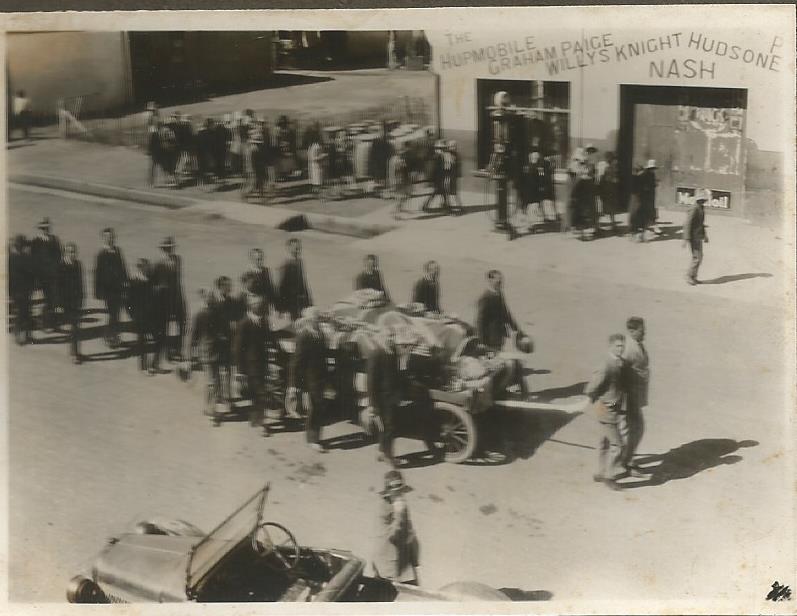
    1939 Sept. Funeral of Stewart Bain Harrismith

    ~~~oo0oo~~~

    Postscript:

    A young post office worker left his little 1935 Morris in that garage in the care of the owner Cathy Reynolds (nee Bain), while he went off to war, ca 1941; When he returned around 1946 it was waiting for him. He then met Mary, second daughter of Annie Bland, nee Annie Watson Bain, Stewart’s fifth child. Their first date was in the Town Hall. Best and luckiest thing that ever happened to him. They got married in the Town Hall in 1951. He was Pieter G Swanepoel, originally from Pietermaritzburg, and my Dad.

    So two women, a Central Bain and a Royal Bain, ran garages in Harrismith.

    ~~~oo0oo~~~

    Click for Details of the 2007 refurbishment of the Town Hall
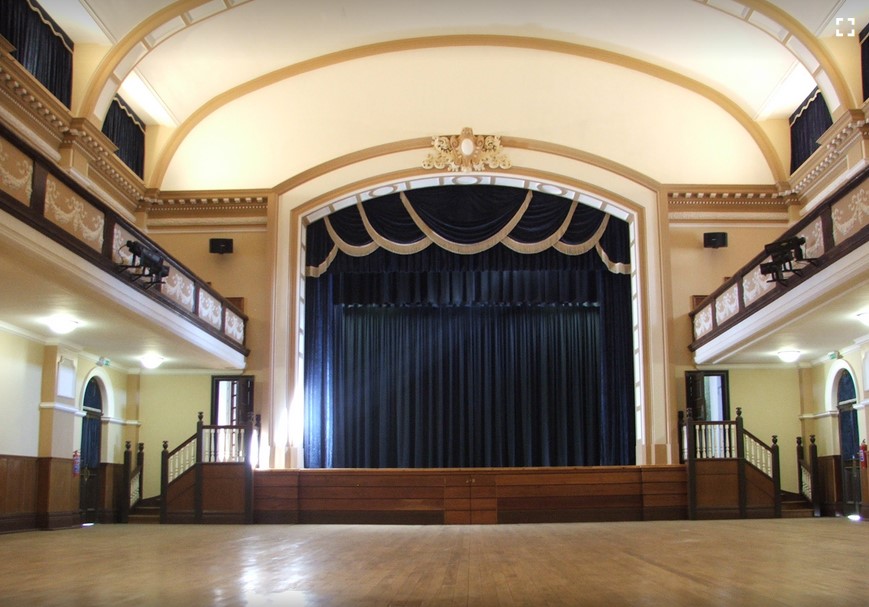
    ~~oo0oo~~

    * Shades of our Moses Mabida stadium in Durban for the 2010 FIFA soccer world cup – ‘Do we need such a big, fancy stadium!?’ I called it the Moses MaFIFA stadium. Call it FIFA Folly, Corruption it almost certainly is. Americans call it a boondoggle.

    ** See where Biebie was born.

    opskops – parties, shindigs, events, pissups, balls, dances, concerts; involve alcohol; kick up your heels

    grend gebou – grand building

    ~~oo0oo~~

    Phone call to Mom May 2025, Talk turned to the Bains, her Oupa Bain and his Royal Hotel. He was Stewart Bain, Mayor of Harrismith.

    The Bain sons went to Hilton. At least two – Ginger and Stewart – came home to work for Oupa, their Dad, and play sport. Never studied after school.

    Dick the Waiter

    Ginger played polo and rugby. Stewart (Smollie) worked in the bar. Smollie was thin and stooped, walked with a shuffle. Getting in and out of his wife Marie’s car was a struggle. Something about his legs couldn’t bend. Like ‘welded straight.’ Arthritis maybe?

    The chef’s name was Kaiser Adam. He wore a white uniform and a tall white hat. The two waiters were Dick and Shabalala – ‘smartly dressed waiters.’ Kaiser and Dick were Indians from Durban. They must have had a lonely life living in Harrismith, unable to go anywhere really. They lived on the large hotel grounds with their families. Shabalala was a local Sotho man. Dick, with his jet black hair and little moustache, was said by local wags to look just like Rhett Butler from the movie Gone With The Wind!

    Koos (me): This is weird, and maybe I’m constructing the memory from tales told at home, but I have a clear memory of sitting at a table in the dining room; being handed a paper menu; then a tiny bit of fish arriving on a large plate followed by a piece of meat and two veg on a large plate, followed by a tiny bit of pudding in a bowl. I do remember the dining room and the big fireplace and the staircase. The bar leading off the front stoep I remember from later years, once we started looking for beer after dark. 

    Big sis Barbara remembers visting the Royal when her good friend and cousin Glenda Taylor used to visit Smollie and Marie Bain.

    ~~oo0oo~~

  • The Bain Family’s Scottish Roots

    The Bain Family’s Scottish Roots

    Katrina (nee Miller) Duncan, from near Oban in Scotland, stumbled across my other blog here and made contact with us. She sounds delightful, but so she would – she’s family!

    She has been researching the Bain family tree and she and my sister Sheila have worked out that we share a Great-Great-Great Grandfather, one Donald Bain, born in Wick on the 14th of April 1777. He married Katherine Bremner and they lived in Sarclet, just south of Wick way up in north-east Scotland. And then I spose they had children and then those had children, and – you know how it goes.

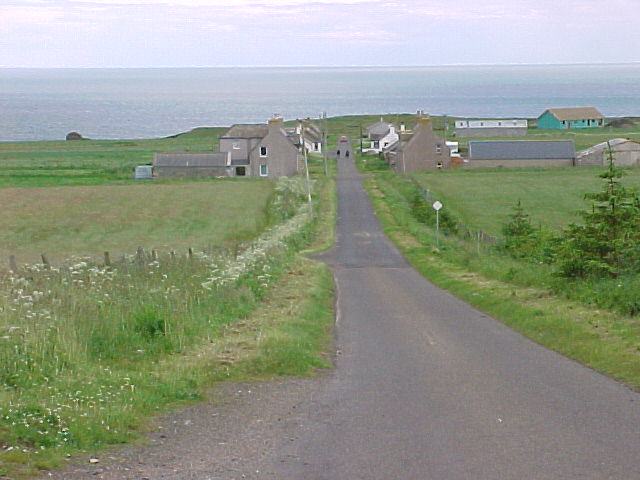
    sarclet, scotland.jpg
    – Sarclet coast –
    sarclet, scotland_2
    – Sarclet village –

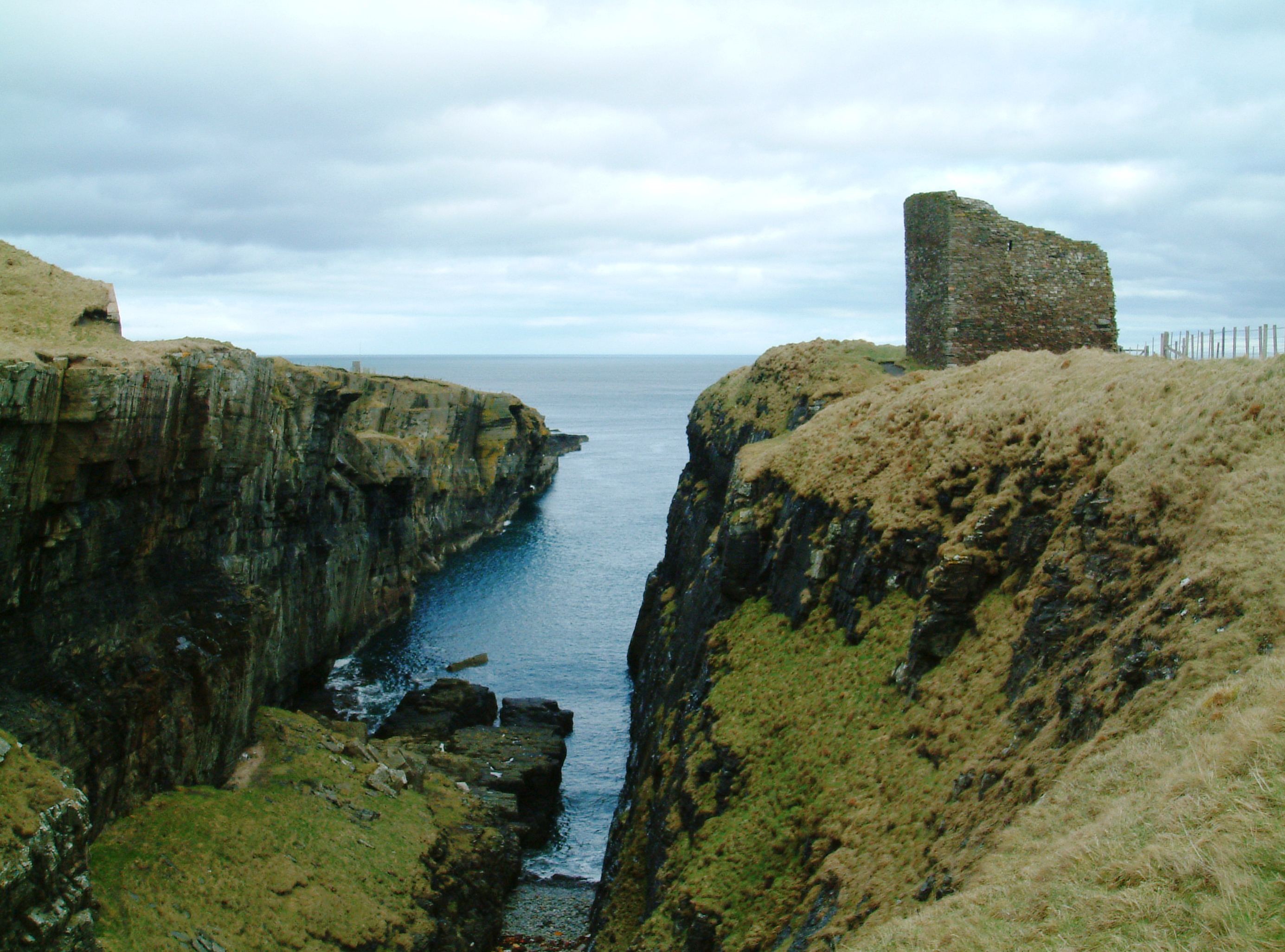
    I reckon if you dipped your toe in that Wick water you’d know why some Bains moved to Africa! Also, they may have been dodging giving the castle a much-needed revamp . . .

    wick castle scotland
    – Wick Castle –

    Stewart Bain was born in 1819 in Caithness, to Donald (42) and Katherine (41). On the 7th of February 1845 Stewart married Christina Watson in his hometown. They had four children during their marriage.

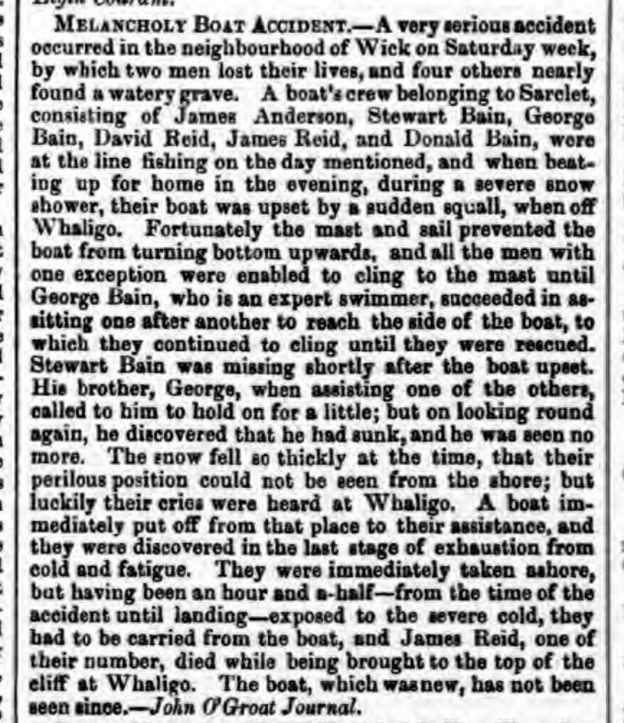
    In 1853 Donald’s sons George and Stewart were out fishing when their boat was swamped and Stewart drowned in the freezing winter sea. He died as a young father aged 34 on 19 February 1853, and was buried in Thrumster, Caithness.

    Katrina found an 1853 newspaper article about the tragedy.

    Stewart Bain drowning 1853.jpg

    It seems Stewart’s father Donald also died that year. The next year, 1854, his brother George and wife Annie (nee Watson) had a son. They named him Stewart.

    This Stewart is the Stewart Bain who came to Harrismith, Orange Free State – the sovereign country Oranje Vrijstaat – in South Africa with his brother James in 1878 and married Janet Burley. They had seven kids: The seven ‘Royal Bains’ of Harrismith, named after their hotel, The Royal Hotel in Station Road. This ‘title’ was to distinguish them from the ‘Central Bains’, not to claim royalty! My grandmother was the fifth of these seven ‘Royal Bains’ – Annie Watson Bain. She got her paternal grandmother’s surname as her second name.

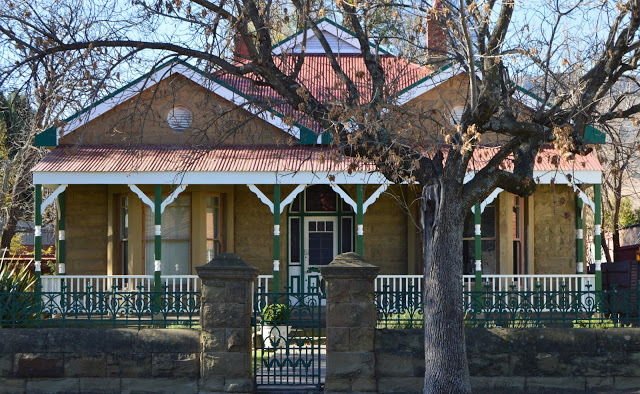
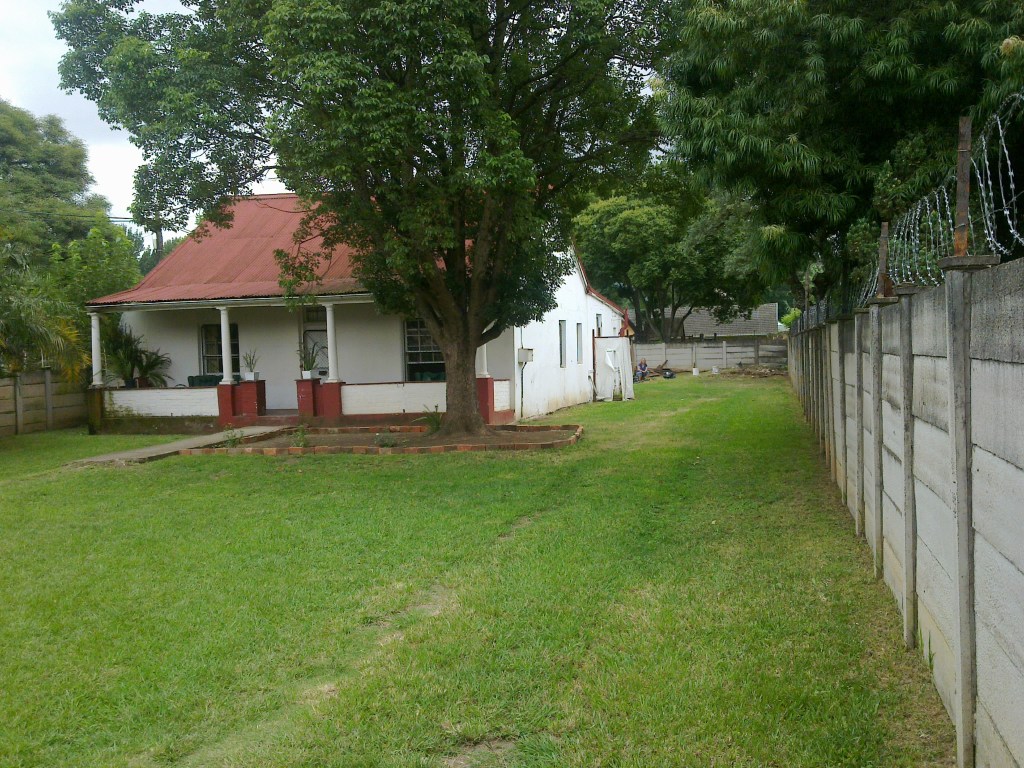
    Stewart and Janet raised their ‘Royal Bain’ brood in this cottage adjacent to their hotel in Station Road, down near the railway line:

    1990 April Royal Hotel Cottage0003

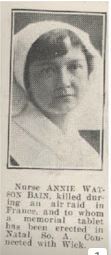
    James Bain, Stewart’s brother and owner of the Central Hotel, called his rather larger home ‘Caithness’. It was in Stuart Street near their hotel in the centre of town. There they raised their brood – eight ‘Central Bains.’ One of them was also named Annie Watson Bain. Her story ended tragically early, in World War 1 in France. Thanks to Katrina we know more about it.

    Caithness, Harrismith
    – Caithness, Harrismith –

    On Katrina’s ancestry web page “Miller Family Tree” the names Annie, Jessie, Stewart, Katherine, Donald etc have been used for generations.

    • Many thanks to katrina duncan for getting in touch!
    • The Scottish Tartan register confirms that there is no ancient Clan Bain tartan. This one – ‘The Bains of Caithness’ – was designed in 1993 for Robert Bain of Caithness.
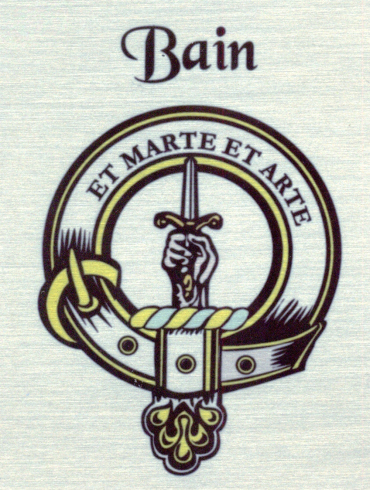
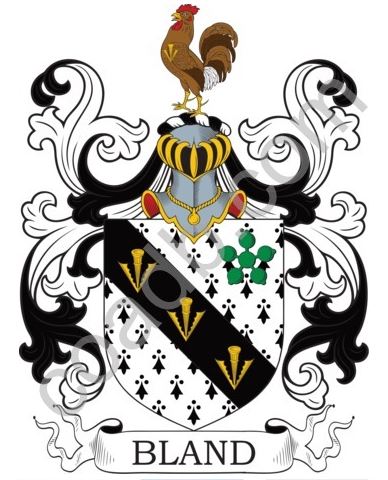
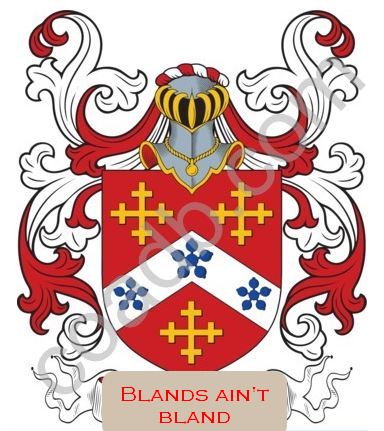
    • There are a few coats of arms; I chose two examples.
    – this is not true – or not very –

    ~~~oo0oo~~~

  • The Two Annie Watson Bains

    The Two Annie Watson Bains

    By the time we knew her she was Annie Bland. Never ‘granny’. Only Annie. She was our dear Mom’s dear Mom.

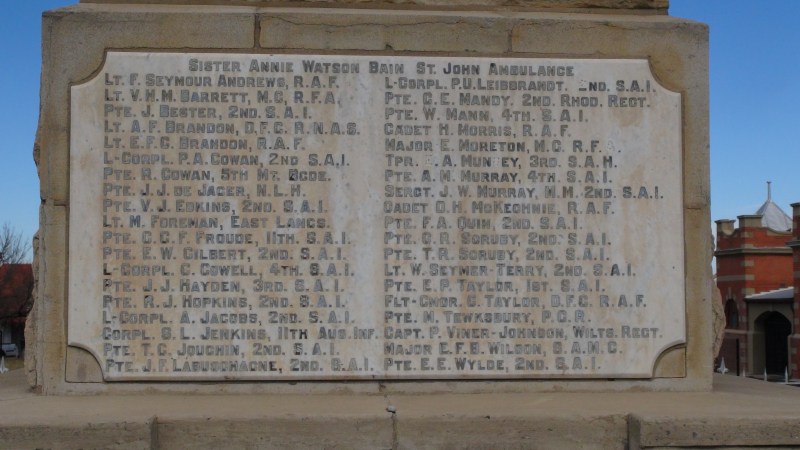
    In fact ‘Annie Watson Bain’ to me was the lady who died in World War 1 and whose name was on one of the monuments outside the Town Hall. She was our Annie’s first cousin, their Dads, brothers Stewart and James Bain, had come out from Scotland together.

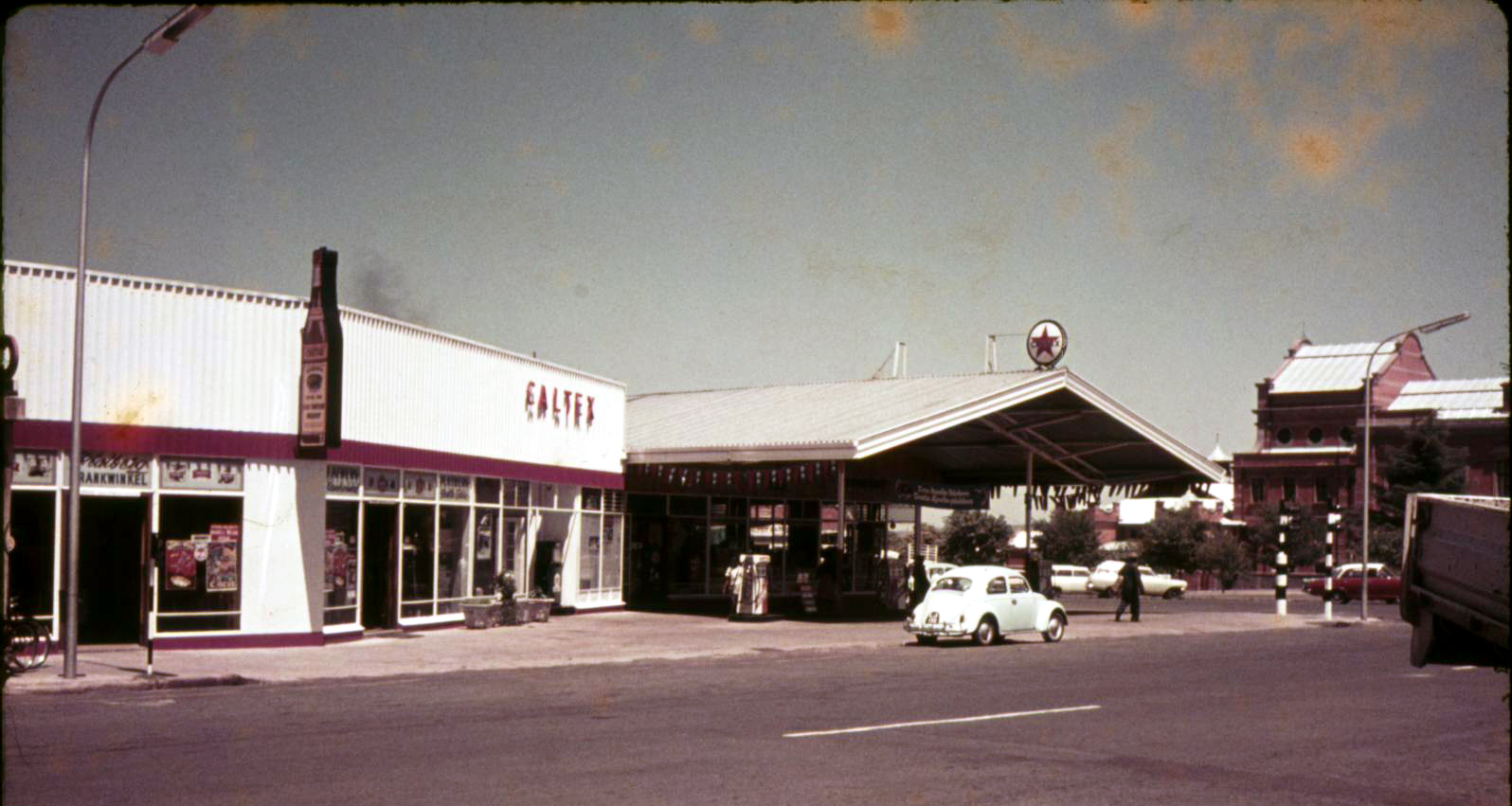
    We never knew our Grandad, Annie’s husband JFA ‘Frank’ Bland. They’d already lost the farms and the racehorses, and they’d moved to town. He had died aged fifty and Annie now owned the ‘Caltex Garage’, as we called it – one of the many petrol filling stations in town. At one time there were seventeen of them! Hers was on ‘Caskie Corner’, opposite our posh Town Hall which her father Stewart Bain had been instrumental in building.

    At the time some called the town hall ‘Bain’s Folly’ as it was such an imposing structure for our modest dorp. I remember exploring inside it with fascination as a kid. High up in the rafters and steel gangways above the stage, with all sorts of ropes and chains hanging down and black curtains behind the red velvet main curtains; the backstage rooms, along the marble-floored passages past the toilets, the museum with the taxidermied animals – a lion, a vulture, what else? The galley above the main hall. I never did get up into the clock tower, come to think of it! Nor onto the outside balcony overlooking Warden Street. I wonder why? Locked doors?

    HS Town Hall
    Harrismith Town Hall Bain's Folly
    Town Hall3

    Annie always spoke with great admiration of her late husband Frank – the granpa we never knew – and told me proudly how she’d never seen his fingernails dirty. This as she looked mildly disapprovingly – probably more disappointedly, she never had a harsh word for me –  at mine. She called me Koosie and the way she pronounced it, it rhymed with ‘wussie’ and ‘pussy’, but don’t say that out loud. And don’t tell anyone. I had been out playing in the mud one Xmas morning with me sisters Barbara and Sheila and cousins Frankie and Jemma and we had arrived back muddy – on WAY more than our fingernails; we were made to wash in the horse trough – and happy, and run into dear ole Annie. I spose the ancient ones were a bit panicked as we still had to get dressed and go to church.

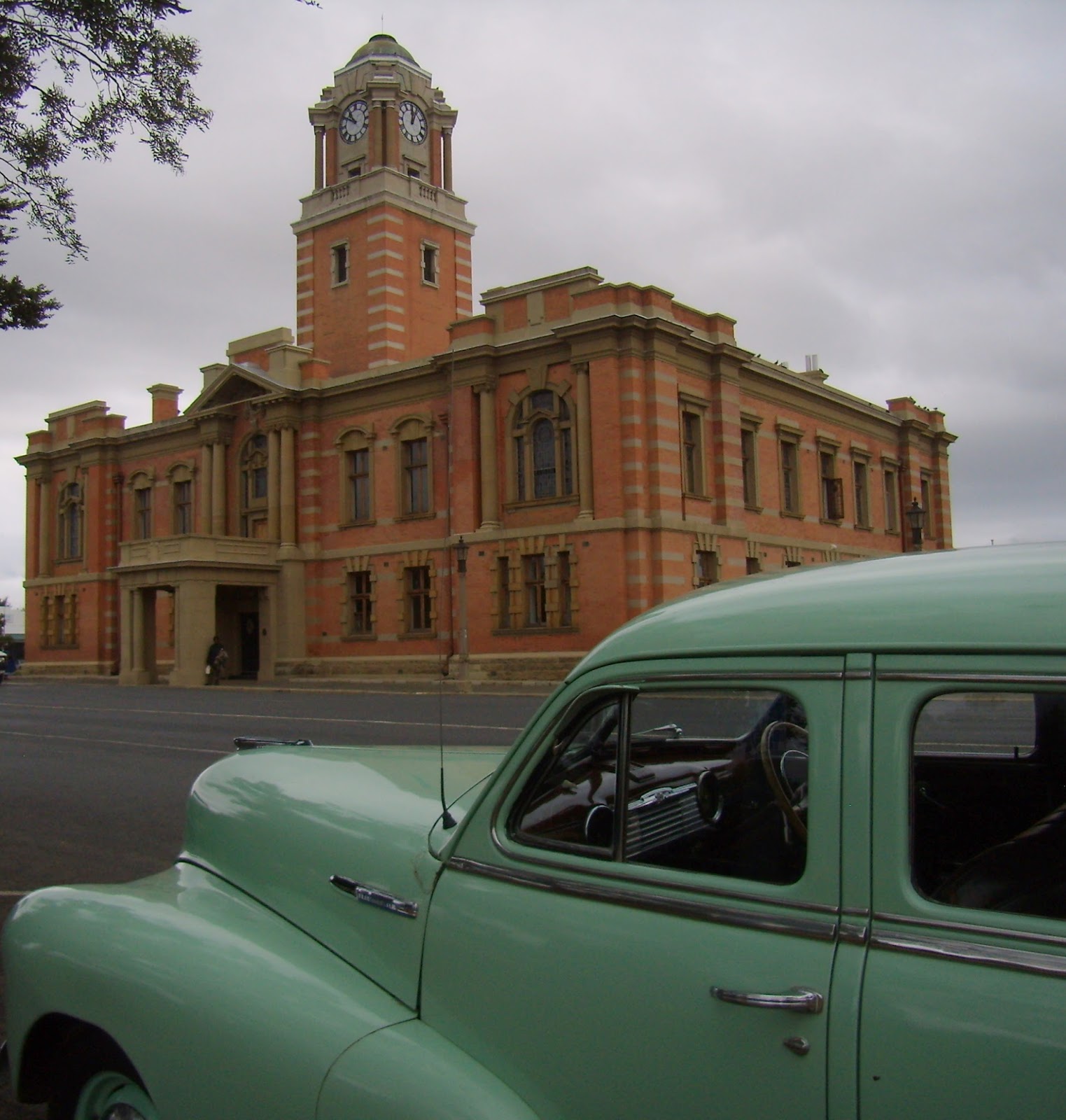
    The car she drove was like this one, except faded beige, and OHS 794:

    A Chevrolet Fleetline, I’d guess a 1948 model. It had a cushion on the seat for her to see over the dash, but under the top rim of the steering wheel.

    It looks better like this. Omigoodness, are our memories actually in sepia tones?

    She was born in 1893, the fifth of seven Bain kids of the ‘Royal Bains’ – meaning the Bains of the Royal Hotel. There were also ‘Central Bains’.

    She went to St Andrews Collegiate School in Harrismith (pic somewhere below) . . . and then to St Anne’s in Pietermaritzburg where she played good hockey ‘if she would learn to keep her place on the field.’ She’s the little one on a chair second from left:

    Annie Bain, ? seated on chair 2nd from left
    – Hmm, looks like St Anne’s in Pietermartizburg was a riot of fun and laughter! –

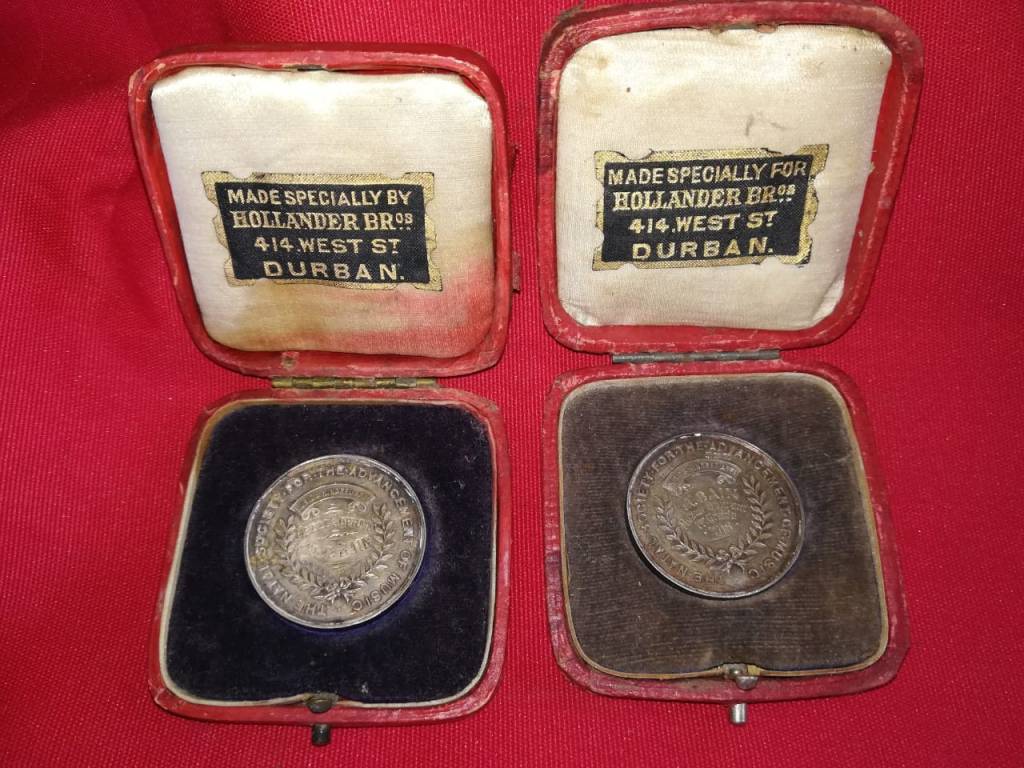
    Medals Annie won for singing in 1915 from The Natal Society for the Advancement of Music. Both say mezzo soprano and one says 1st Grade 1915. (Must tell the kids. THAT’s probly where I got my fine singing voice).

    HS Caltex

    She ran the Caltex forecourt and the workshop at the back, where At Truscott fixed cars. I can still see him tip-toeing, bending over the edge, raised bonnet above him and a lightbulb in a wire cage in his hand, peering through glasses below his bald head. She rented out the adjoining Flamingo Cafe and Platberg Bottle Store premises. At that time she lived in the Central Hotel a short block away across the Deborah Retief Gardens and I do believe she drove to work every day. Maybe drove back for lunch even?

    Sundays were special with Annie as your gran. She’d roll up at our house in the big beige Chev, we’d pile in freshly sanctified, having been to church and Sunday school, and off we’d go on a drive. The back seat was like a large lounge sofa. Sometimes she’d drive to nowhere, sometimes to the park, sometimes cruising the suburbs. OK, the one and only suburb. Usually there’d be a long boring spell parked somewhere like the top of 42nd Hill overlooking the town and watching the traffic. Annie and Glick chatting away on the front seat and us sitting on the back thinking, OK, that’s long enough now. I’m sure they told us the whole history of Harrismith and who lived where and who was who and maybe even who was doing what and with whom. But maybe not, as ‘Anna’ and ‘Glick’ (as they called each other) were discreet gentlefolk. All of which we ignored anyway, so I can’t tell you nothing!

    – our view from the back seat – in sepia –

    Later she got a green Opel and for some reason – maybe after she could no longer drive? – it was parked on our lawn for long spells. I sat in it and changed gears on its column shift about seventy thousand times. Probably why I (like most males in their own opinion) am such a good driver today. It was a Kapitan or Rekord like this, but green and white:

    Annie died in Harrismith in 1983 aged 90. Looked after to the end by her loving daughter Mary. She was ready. ‘All my friends are gone,’ she told me. Her husband Frank had died forty years earlier, and her eldest daughter Pat had died around ten years earlier.

    ~~~oo0oo~~~

    The pic of the Town Hall with the green Chev is thanks to De Oude Huize Yard – do go and see their blog. (Ah! Sandra’s blog is no more! They have left town! Sad). They’re doing great things in the old dorp, keeping us from destroying everything old and replacing it with corrugated iron and plastic.

    ~~~oo0oo~~~

    Also from DeOudeHuizeYard, this information about the building that housed Annie’s school:

    The Dutch Reformed dominee Rev A.A. van der Lingen began his years of service in Harrismith on the 6th May 1875 and remained there until the 12th July 1893.  He and the church ouderlings built a new church on the site of the original building. The cornerstone of the new building was laid on the 25th August 1892.

    – home, military HQ, school, school, boarding house, demolished –

    Around then the Rev van der Lingen ran for President of the Orange Free State. In the hope of impressing the townsfolk and swaying their vote in his favour, he built an impressive house, the first double-story building in Harrismith. The townsfolk seemingly were not impressed though, and he was not elected. Later, with the British occupation of Harrismith in the Anglo-Boer War, the military authorities made the double-story building their headquarters.

    After the cessation of hostilities, Vrede House (Peace House) as it was then known, became St Andrews Collegiate School (1903-1918), then Oakland’s School and finally a boarding house in the 1930’s.

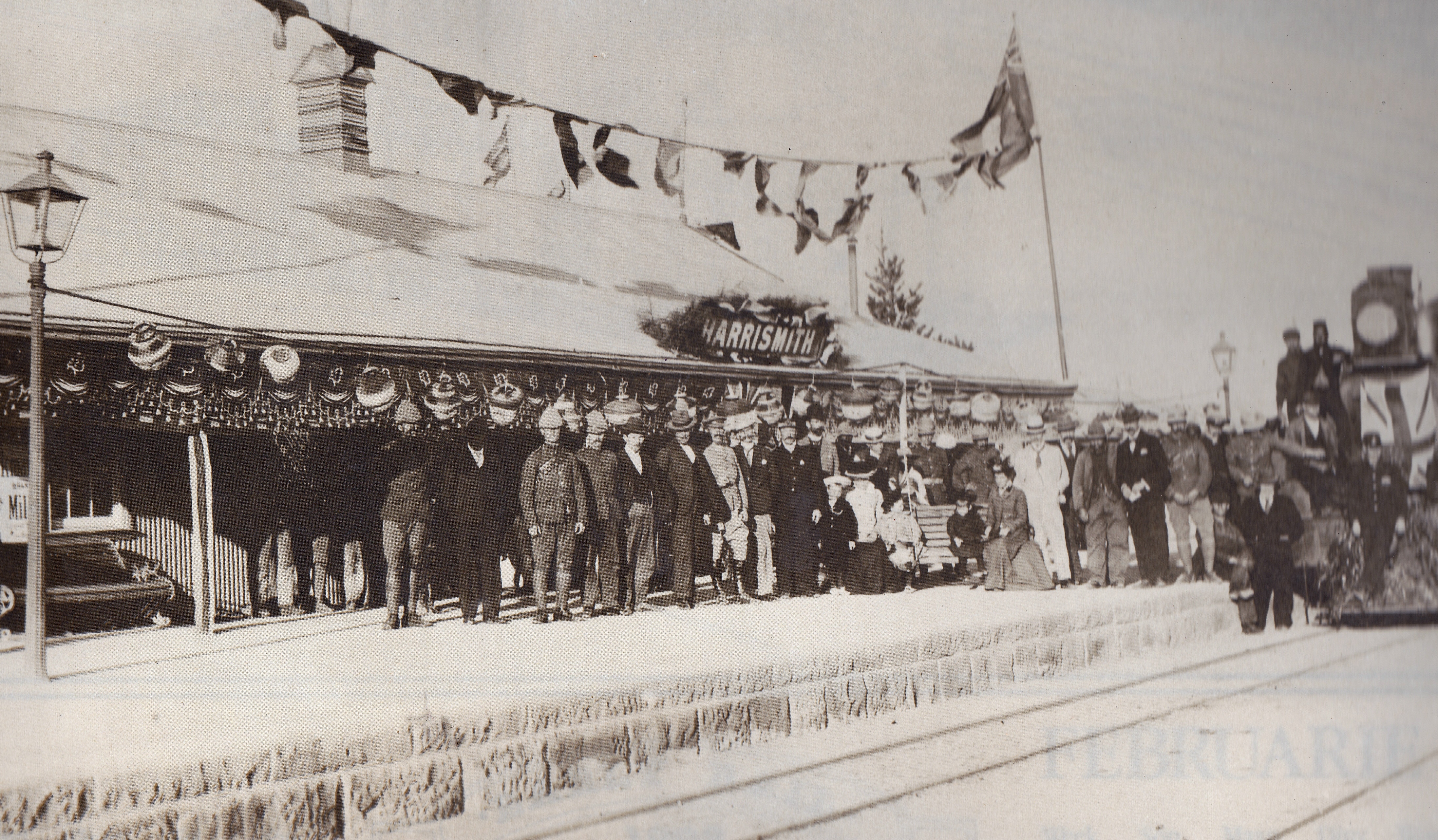
    Five weeks prior to the unveiling of that church cornerstone, on the 14th July 1892, the town had enjoyed a four-day celebration of the momentous arrival of the railroad from Natal. The festival was paid for by a £5 500 donation by the Free State government! Harrismith was now online!

    – Is this when the first train choofed in? Who was there? –

    ~~~oo0oo~~~

    The Other Annie Watson Bain

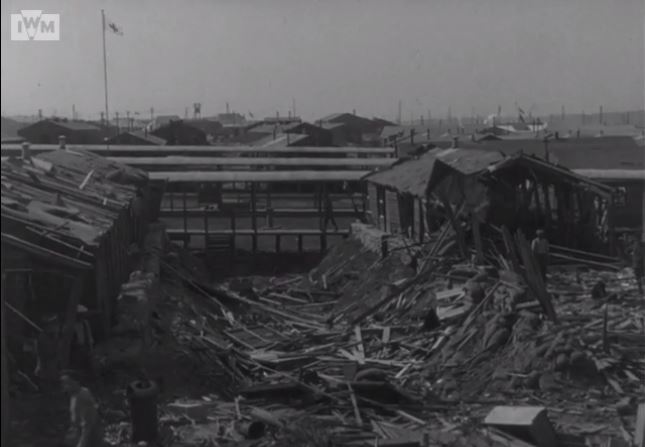
    Here’s some info and pics from the Imperial War Museum (IWM) of the bombing that killed Annie’s namesake, Annie Watson Bain in World War II in France, found by Bain descendant Janis Paterson, raised in Wick, now living in England:

    – hospital at Etaples after bombing 1918 –

    Filmed at a stationary hospital near Etaples, probably 9 Canadian Hospital three days after a bombing raid hit the hospital on the night of 31 May 1918.

    *** – see IWM movie here – ***

    The wooden huts of the hospital show various bomb blasts but little fire damage. Four coffins, covered in Union Jacks, are wheeled on trollies by soldiers.

    A single coffin, also covered with a Union Jack on a wheeled trolley, is followed by a funeral procession of nurses, soldiers with wreaths, and a few civilians. ** this could have been our Annie’s ** The procession arrives at a temporary but extensive cemetery where a burial service is held.

    Stills taken off the IWM movie:

    Seeing the acres of graves – another Harrismithian was buried here or nearby – and knowing about the “War To End All Wars” who would think mankind would go on to fight another World war just twenty years later – and then be at war continually after that up to today 2018 with no end in sight!? – – – Thanks, America! (* sarcasm *)Update: 2021 and America says its getting out of Afghanistan after 20 years. Predictably, those making money out of death are screaming “Too Soon!”

    Janis Paterson, Bain descendant, distant ‘cousin,’ who keeps a photo record here, visited the cemetery in France and found Harrismith’s other Annie’s grave:

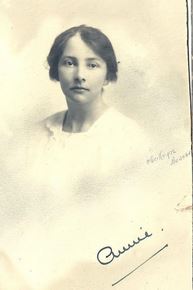
    Our two Annie Watson Bains, first cousins from Harrismith, born of two Scottish brothers, both hoteliers in this small African town in the Oranje Vrij Staat, at that time a free and independent Republic:

    ~~~oo0oo~~~

    Footnote:

    Maybe this Canadian sister attended our Annie in her last hours?

    Edith Campbell, RRC, MM (1871 – 1951) was a Canadian nurse, one of the first to arrive in England in World War 1 to assist in the establishment of a field hospital. She served in both England and France, earning a number of medals, and was twice mentioned in dispatches. First she received the Royal Red Cross, first class, for her actions in England and France, and again for her bravery during enemy air raids at No. 1 Canadian General Hospital in Etaples, France, during which she attended to wounded nurses. For this, she and five other nurses received the Military Medal.

    Her citation read:

    For gallantry and devotion to duty during an enemy air raid. Regardless of personal danger she attended to the wounded sisters and by her personal example inspired the sisters under her charge.

    ~~~oo0oo~~~

    Footnote 2:

    Janis Paterson loves flower arranging and has won cups at local shows. In 2014, one of the floral themes was related to the beginning of WW1.

    Janis’ entry was a tribute to nurses like Annie Watson Bain and won the best in show award. We’re a talented lot, all put together, us Bains! The book in her arrangement “The Roses of No Man’s Land” is about those brave nurses.  She thinks that people often forget what nurses like Annie had to endure. The person escorting the judge told Janis the judge was almost moved to tears.  Isn’t it stunning?:

    ~~~oo0oo~~~

  • Road Trip with Larry RSA

    Road Trip with Larry RSA

    Mom lent us her Cortina. Like this, but OHS:

    cortina 1970

    How brave was that!? The longer I have teenagers of my own the more I admire my Mom and her quiet courage and fortitude back in the ’70’s! The thought of giving my teenage son my car and allowing him to disappear (it would be in a cloud of dust and tyre smoke) on a three week jaunt fills me with querulous whimpering. (I’ll do it, I’ll do it, but only ‘cos Mom did it for me).

    Larry Wingert was an ex-Rotary exchange student to SA from Cobleskill, New York. He and I had been on a previous Road Trip USA in 1973; now he was teaching English in Athens and had flown to Nairobi, then traveled overland down to Joburg where we joined up and hitch-hiked to Harrismith. There, Mom parted with the Cortina keys and we drove to PMB then on to Cape Town. We took ten lazy days in going nowhere slowly style back in 1976.

    Wherever we found a spot – preferably free – we camped in my little orange pup tent. In the Weza Forest we camped for free; In the Tsitsikamma we paid.

    Driving through the Knysna Forest we saw a sign Beware of the Effilumps.

    knysna forest

    So we took the little track that turned off nearby and camped – for free – out of sight of the road in the undergrowth. Maybe we’d see a very rare Kynsna elephant? Not.

    In Cape Town we stayed with Lynne Wade from Vryheid, lovely lass who’d been a Rotary exchange student too. She played the piano for us and I fell deeply in love, then disappeared on yet another beer-fueled mission. Coward. We also visited the delightful Dottie Moffett in her UCT res. She had also been a Rotary exchange student to SA from Ardmore, Oklahoma and was now back in SA doing her undergraduate degree. I was in love with her, too.

    We headed for Malmesbury to visit Uncle Boet and Tannie Anna. Oom Boet was on top form, telling jokes and stories and laughing non-stop. That evening he had to milk the cow, so we accompanied him to the shed. Laughing and talking he would rest his forehead against the cow’s flank every now and then and shake with helpless mirth at yet another tale. Meantime, this was not what the cow was used to. It had finished the grain and usually he was finished milking when she had finished eating. So the cow backed out and knocked him off the stool, flat on his back, bucket and milking stool upturned. He took a kick at the cow, missed and put his back out. Larry and I were hosing ourselves as we helped him up and tried to restore a semblance of order and dignity.

    Back at the house we gave Oom Boet and Aunt Anna a bottle of imported liqueur to say thanks for a lovely stay. It was a rather delicious chocolate-tasting liqueur and it said haselnuss mit ei. It was only a 500ml bottle, so we soon flattened it. It looked something like this:

    haselnuss liquer

    “Ja lekker, maar ag, dis bokkerol, Kosie – Ons kan dit self maak!”

    Ja?

    Larry and I decide to call his bluff. In the village the next day we looked for dark chocolate and hazelnuts, but hey, it’s Malmesbury – we got two slabs of Cadbury’s milk chocolate with nuts.

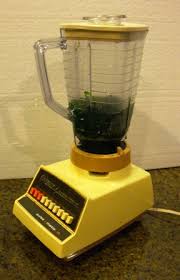
    Oom Boet is bok for the challenge. He dives under the kitchen sink and starts hauling things out. He’s on his hands and knees and his huge bum protrudes like a plumber’s as he yells “Vrou! Waar’s die masjien?” Anna has to step in and find things and do things as he ‘organises’. She finds a vintage blender and – acting under a string of unnecessary instructions – Aunt Anna breaks eggs and separates the yolks, breaks chocolate into small pieces. Boet then bliksems it all into the blender and adds a fat dollop of a clear liquid from a label-less bottle. “Witblits, Kosie!” he says triumphantly. He looks and goois more in, then more. Then a last splash.

    Oom Boet blender_2

    It looked like this, but the goo inside was yellowy-brown, not green. And it had a layer of clear liquid overlaying it nearly to the top.

    He switches the blender to ‘flat-out’ with a flourish and a fine blend of egg yolk, chocolate and powerful-smelling hooch splatters all over the kitchen ceiling, walls and sink. He hadn’t put the lid on! And it was like a V8 blender, that thing.

    Vroulief starts afresh, patient and good-humoured as ever. We mop, we add, he blends, and then it’s ready for tasting at last.

    And undrinkable. That aeroplane fuel strength home-distilled liquor was just too violent. We take tiny little sips, but even Oom Boet has to grudgingly admit his is perhaps not quite as good or as smooth as the imported stuff. We add sugar, more chocolate and more egg yolk, but its only very slightly better, and still undrinkable.

    Ten years later I still had the bottle and despite offering it to many people to sip as a party trick, it was still three-quarters full!

    If we had marketed it we’d have called it Oom Boet se Bokkerol Haselnuss mit Eish!

    I visited Oom Boet and Aunty Anna in a Ford Cortina again in 1983. The top featured pic with the old Chevy pickup was actually taken then by Sheila.

    ~~~oo0oo~~~

    haselnuss mit ei – hazelnuts with egg

    “Ja lekker, maar ag dis bokkerol, Kosie – Ons kan dit self maak!”- Nice, but we could make this stuff ourselves!

    “Vrou! Waar’s die masjien?” – Wife! Where’s the machine?

    bliksems – throws

    witblits – moonshine

    goois – throws

    Oom Boet se Bokkerol Haselnuss mit Eish! – the same stuff except very different

  • Barbara se Ouma woon in Boomstraat

    Barbara se Ouma woon in Boomstraat

    She actually did. My sister Barbara’s granma lived at 131 Boom Street Pietermaritzburg.

    Right across the road was this school. Going to the Afrikaans school would have meant a bus ride, and Oupa was frugal.

    131 Boom St PMB (1)

    And so started the ver-engels-ing of Dad. The rooinek-erisation. Pieter Gerhardus became ‘Peter’.

    ~~oo0oo~~

    *ver-engels – Anglicisation

    *rooinek – Boer word for Poms – anyone from ‘England’ – any of those islands left of France. Literally ‘red necks’ – but not American rednecks. NB: This excluded those Irishmen who fought for the Boers against the plundering, wicked, invading, looting Poms. Even though Irishmen can have very red necks.

    ~~oo0oo~~

    From here (the way I understand it) they all went to Havelock Road Primary; Yanie the oldest went on to matriculate at Girls High; Lizzie the second child went on to Russell High School adjacent to the little school across the road, leaving in Std 8 to go and work; Boet finished Std 6 at Havelock Road and got his first job at Edel’s Shoe Factory, his second in Howick at Dunlop. On the way back one day he crashed his motorbike and injured himself badly. Lizzie arranged a bursary for Dad the youngest to go to Maritzburg College where he left in April in his matric year to join the post office as an apprentice electrician.

    – a pre-school, a primary school and three high schools – click to enlarge –

    ~~~oo0oo~~~

    Some pics of Oupa, and his handwriting in 1971

    Close, but different:

  • Being Bland in Africa (two branches . . )

    Being Bland in Africa (two branches . . )

    This post needs work by someone who knows what they’re on about. This is almost as confusing as the Bible’s begats. Advice: If your name is John, name your son Basil. Or Cyril. Or Percy. Anyway, here goes with what I’ve got:

    Our distant cousin Hugh Bland has been doing some wonderful detective work sniffing out the Bland family history. He’s of the Blands that trekked north, to the lowveld and on to Southern Rhodesia (if it was called that yet?), leaving their cousins behind on a farm at Oliviershoek on the Natal-Free State boundary. Maybe on a farm called Oliviershoek.

    Today Hugh found the grave of Josiah Benjamin Adam Bland.

    Josiah Benjamin Adam Bland was born in 1799 in England. His parents were Reverend John Francis Bland (born 1764 Fordham, Cambridgeshire died 1807) and Elizabeth Adams (born Dunfermline, Scotland. He arrived at the Cape in 1825 on the good ship Nautilus, under the care of the ship’s captain, a Mr Tripe. The voyage cost his family £42.

    He got a job on a wine farm, in the Drakenstein area of Stellenbosch, met his future wife Cecelia there (du Plessis?), married her, packed their belongings in a Cape cart and trekked to Mossel Bay. They found land on the Gourits river and settled there. Their first son, John Francis Adam, was born in 1836, followed by eight more children. John the eldest then married Petronella Johanna ‘Nellie’ de Villiers and had a son, John Francis Adam II. He and Nellie left for inland while the baby JFA the second was just a few months old. They headed for Colesberg, Bloemfontein, Winburg and on to Harrismith, where they settled ‘in a house not far from the centre of town’ – 13 Stuart Street, maybe?

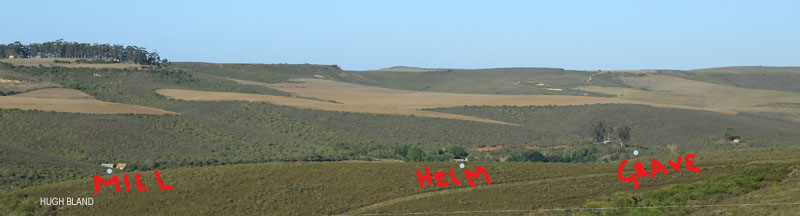
    Back in Mossel Bay, Josiah Benjamin Adam Bland (JBA) became mayor and the main street was called Bland Street. Maybe it still is? He died in 1861. His grave is now hidden in thick bush on a farm in the Wydersrivier district near Riversdal. 

    When Hugh Bland visited die Kaap ca.2010 the farmer very kindly took him to the gravesite. Hugh says you can still read the inscription on the gravestone – it’s indistinct, but there’s no doubt that it’s JBA’s grave. He says it was “quite a moment” for him – JBA was buried there 156 yrs ago and Hugh wondered when a Bland last stood at that grave.

    Hugh put two proteas – which it looks like he skoffel’d out nearby? – on the grave; then laid his shadow down next to his great-great-great grandfather and took this pic:

    JBA Bland's grave
    – Hugh Bland’s shadow next to Josiah Benjamin Adam Bland’s grave –

    Valuable memorabilia from Hugh:

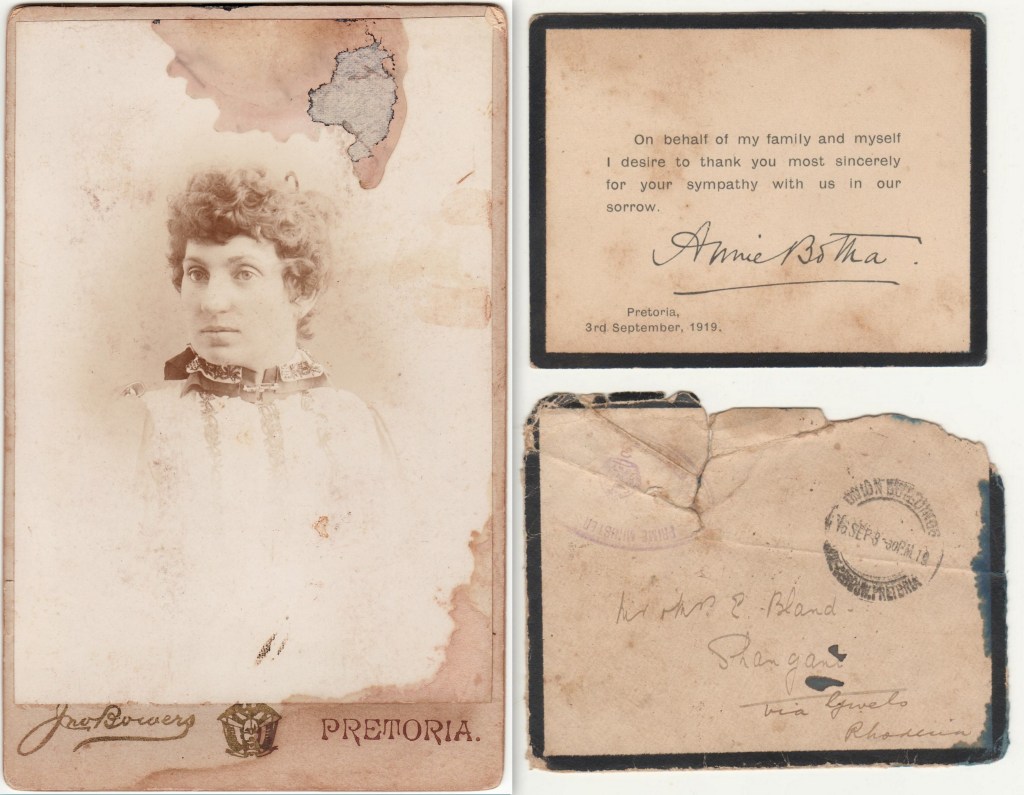
    Prime Minister’s wife’s letter to the Rhodesian Blands

    ~~oo0oo~~

    The Harrismith Branch of the Blands:

    Josiah Benjamin Adam Bland had a daughter, Annie Emmett Bland, who married Louis Botha, Boer war general who became the first President of the Union of South Africa in 1910.

    He also had a son John Francis Adam Bland (JFA), born in 1836.

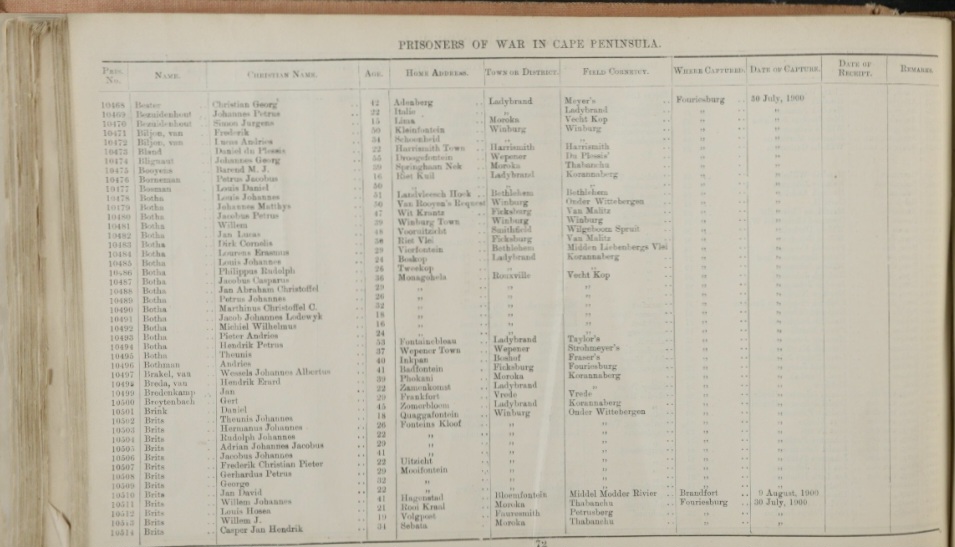
    This JFA I later trekked inland ca.1861 to Harrismith in the Orange River Colony with a small baby – John Francis Adam Bland the Second – JFA II. This started ‘our branch’ of the Blands, The Vrystaat Blands. One of them – I must try and find out who – would end up as a prisoner of war in Ceylon for doing the right thing and fighting for his new homeland against the invading, thieving, plundering British in the Boer war of 1899-1902.

    John Francis Adam Bland II married Mary Caskie, who became the beloved Granny Bland of Harrismith. They had five sons of whom our grandfather Frank was the oldest, again: John Francis Adam; JFA III.

    Hugh found out that JFA the First died on 10 September 1891 aged 55, and is buried in the lost, dusty, verlate metropolis of Senekal, Vrystaat. In Harrismith Granny Bland buried her husband JFA II and four of her five boys, including JFA III. As Sheila said, ‘What a tragic life.’ Poor Granny Bland! She loved her namesake grandaughter Mary, our Mom, and she lived long enough to know us, her great grandkids before she died in 1959. So in that she was Lucky Granny Bland! We knew Bunty, the only child who outlived her, very well. He died in 1974 and joined his father JFA II, his mother, and his four brothers in the propvol family grave in Harrismith.

    JFA III married Annie Watson Bain – our lovely granny Annie Bland. Known as just Annie. They farmed racehorses and clean fingernails on the farm Nuwejaarsvlei on the Nuwejaarspruit outside Harrismith on the road to Witsieshoek, towards the Drakensberg. He died in 1943 while my Mom Mary was still at school. Pat was nursing in the Boksburg-Benoni hospital. Pat also died at age 49 in 1974. Mom Mary then looked after Annie until she died aged ninety in 1983. Mom Mary is still alive and well. She turned ninety in September 2018 (update, 95 in 2023). Nuwejaarsvlei was later submerged under Tugela river water pumped up the Drakensberg to fill the new Sterkfontein dam. Drowning vleis is environmental destruction, BTW!!! Grrrr!

    (I’m hoping sister Sheila will fact-check me here! Also that cousin Hugh will tell us what happened to the misguided Bland branch that didn’t stay in the Vrystaat, but got lost and ended up in Zimbabwe. They lived near Oliviershoek for a while before trekking on. Hugh tells tales of transport riding, ox wagons, meeting Percy Fitzpatrick, farming in Rhodesia and other exaggerations . . . you know how historians are).

    ~~oo0oo~~

    Must add:

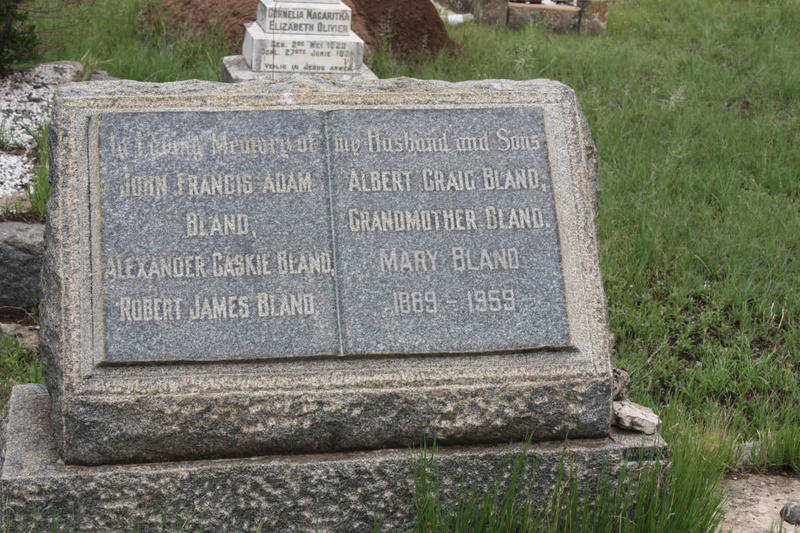
    A Bland grave pic – Harrismith cemetery

    Annie’s oldest daughter Pat Bland – married Bill Cowie, and had two daughters Frankie & Gemma; Bill worked in Blyvooruitsig on the gold mine; We visited them once, and would see them on their way to their wonderful Wild Coast fishing trips. They called Blyvooruitsig ‘Blayfore or Blayfaw, and pronounced Gert as though it didn’t have an ‘r.’

    Mary Bland second and youngest daughter – married Pieter Swanepoel in Harrismith in 1951.

    ~~oo0oo~~

    Bland might sound bland, but hey, the surname is thought to derive from Old English (ge)bland meaning ‘storm’, or ‘commotion.’ Don’t use dictionaries that say, ‘dull, flavorless, or just plain ‘blah.’ Rather use the Merriam-Webster that says it means ‘smooth and soothing in manner or quality;’ or use vocabulary.com that says it means ‘alluring;’ or try ‘flattering’ from the Bland Family History on ancestry.com; That’s better. A new motto for the coat of arms, maybe? Blands ain’t bland.

    ~~oo0oo~~

    Some of the information on Josiah Benjamin Adam Bland first coming to the Cape I got from Sheila’s book And Not To Yield about Susan Bland. Susan was born in Harrismith, had a brother Willie, married a Theo Allison and lived seven miles outside Harrismith – west, I think, near Sarclet? – farming ostriches for a while.

    And Not To Yield by Penelope Matthews, Watermark Press – ISBN 978-0-620-58162-2

    ~~oo0oo~~

    Mom’s more contemporary assessment of her Bland, the Eastern Vrystaat Nuwejaarsvlei branch of the Bland Clan:

    She didn’t know her dear Dad Frank’s father – he died rather young. He farmed on Nuwejaarsvlei and sent his son Frank to Michaelhouse. After high school Frank went straight back to the farm, he didn’t do any further studying or training. Mom thinks her grandfather must have had some money, as he built his wife a rather lovely house in town while still on the farm – 11 or 9 Stuart Street. After Frank lost the farm (maybe because as Annie once told me reproachfully when she saw me covered in mud one Christmas morning at 95 Stuart Street, “You know, I never once saw Frank with dirty fingernails!” I loved and admired my gran Annie but I just knew that day that what me and Sheila and Jemma had done in getting covered in mud at the Kakspruit down Hector Street past the du Plessis’ house that Christmas morning was not a bad thing. We washed off in the horse trough and made it to church that morning, I’m sure looking like spotless sweet little angels. JC and FC both would have nodded approvingly, methinks. I’m sure we got presents later that day, so there’s some proof that the Religion of Father Christmas is an understanding, forgiving one.

    Frank lost the farm – too many racehorses and too few sheep? – and he and Annie, older sis Pat and Mom moved to town into Granny Bland’s home. Frank bought a filling station in Warden Street in town. When he died – early like his father before him – Annie surprised traditionally-minded people in town by carrying on with the Central Service Station. It was near the corner of Retief Street; later she moved it half a block nearer to the Town Hall, to Caskie Corner, probably the prime spot in town, on the corner of Southey Street. In time she rented spaces to the Flamingo Restaurant and Platberg Bottle Store. Between the Flamingo and the VC Cafe in Southey Street was the ramp up to her workshop, where At Truscott fixed cars for her.

    Granny Bland was a Caskie. Maybe she owned Caskie Corner? I asked Mom Mary and she thinks her gran Mary Caskie Bland may well have. And that would be how Annie could move her Caltex filling station and garage to the best corner in town from half a block down Warden Street – and later how Mom Mary could move the bottle store next door to it from round the corner in Southey Street.

    ~~oo0oo~~

    POW register - Bland
    – POW register –
  • Mother Mary Memories

    Mother Mary Memories

    Mr Pretorius was a new teacher in Harrismith. This is back in the ‘forties. One Geography lesson he asked a question and the answer he wanted was the town “Heilbron.”

    Johnny Priest (chosen perhaps because the teacher knew he wouldn’t know?) answered, “The Free State” at which Mr P lifted his eyes to the heavens, rolled them and sighed sarcastically, “Why don’t you just say, The Union of South Africa?” at which Johnny hastened to say, “I meant the Union of South Africa”.

    ~~oo0oo~~

    High school teachers Mr Coetzee taught Afrikaans and Mrs Coetzee taught English. One day in matric she asked Linden Weakley a question. He was slouched low in his chair with his legs stretched in front of him and crossed, his feet almost under her desk. He was a languid chap, Linden. He answered as he was, not moving. “Uncross your legs” she said. So he did. “I mean GET UP!” she said, more sharply this time.

    Once Mom was playing tennis with Linden when their opponent got cramp in a leg. Mom, ever helpful, went to the net to tell him to how to cope and what to do to get rid of it. “Let him keep his cramp” said Linden. “I want to win this match!”.

    ~~oo0oo~~

    Outside toilets

    Toilets were outside, well away from the house, usually at the back border of the yard where the alley ran past, so that the ‘Night Car’, or ‘Honey Cart’, could get to them easily. If you had a big yard it could be a long walk. Mrs de Beer used to say theirs was “Halfway to Warden”!

    “Oh, the embarrasment”, says Mother Mary, “of meeting the Honey Cart at night when walking home from the bioscope!”

    ~~oo0oo~~

    Jack Shannon was dancing with Brenda Longbottom from across the road at Granny Bland’s once. Watching them, Annie said critically, “He can’t dance for toffee.”

    ~~oo0oo~~

    Mom’s doctor in Harrismith was Dr Hoenigsberger, who was married to Janet Caskie, an Australian cousin of Mom’s Granny Bland. They lived in a big brick house similar to Granny Bland’s, just over the road. He was the government doctor (district surgeon) and part of his job was to attend to the inmates in the Harrismith Gaol. On the way back from there one day in his big _____ automobile, he hit the bridge over the Kakspruit and landed up in the spruit below the bridge. He was taken home, a bit shaken.

    Later one of his friend phoned the house and one of his sons (Leo or Max) answered. “Hello, is the doctor in? We want him to come around and play bridge with us” said the voice.

    “No, I think he’s had enough bridge for one day, answered the son.

    ~~oo0oo~~

    Wealthy Casper Badenhorst was apparently very tight with a dollar. Had plenty, spent little. When Harrismith people free-wheeled downhill in their cars they would say “Ons ry nou op Casper se petrol.

    ~~oo0oo~~

    Sr. Mary Bland Boksburg

    After matric Mary went to do nursing at the Boksburg-Benoni hospital. Older sister Pat had gone there three years before, with Janet. Pat was highly regarded by her colleagues and she took Mom to her first ward, ward 10 in the old block to introduce her to the nurse already there, Nurse Groenewald. The ward was on the fourth floor and they got into the old rattle-trap lift but no go – it was out of order. She found out it was often that way.

    So they started off up the stairs at speed. Mom got to the top out of breath. She soon got fitter and learnt to run up  those steps with ease.

    ~~oo0oo~~

    “Ons ry nou op Casper se petrol” – We’re riding on Casper’s petrol – freewheeling

  • Cannot be

    Cannot be

    When I was around six years old Sheila came marching up to me and demanded: –

    “Do you know what Dad’s name is?”

    Well, of course I did! I was the older brother.

    Kleinspan Skool Koos Sheila.jpg

    It’s “Dad”

    “No man, his real name!”

    What did she mean? Oh, of course – I’d heard Mom call him that lots of times.

    “Peter”

    “No. It’s PIETER GERHARDUS!!”

    What rubbish! I’d never heard such foul language! And this from my MUCH younger sister! She was a whole year younger’n me. Which was like: All of living memory!

    Amazingly, investigation and enquiry proved her right!

    ~~~oo0oo~~~
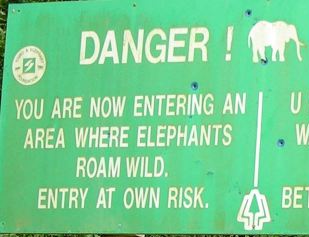
    (this snippet had an interesting sort-of replay years later)

  • Dougie Wright

    Dougie Wright

    . . and over the hills lay long fields of barley and of rye

    and through the fields a road runs by . . .

    Douglas Wright Esq would wax poetical after a few beers, quoting Alfred, Lord Tennyson out on the Vrystaat vlaktes. I spose that’s what happens if you get sent to a soutpiel school in the colonies.

    I see now he was misquoting Tennyson – or maybe I misremember and he was spot on? Anyway, I prefer his version. It’s hardwired in my brain now.

    In my mind’s eye dear ole Dougie is wandering across the veld with a shotgun in the crook of his arm, deerstalker on his head, waxing forth . . . .

    Old Harrismith Warden.jpg
    Fifth from the right wearing a black beret

    The rest, L to R:

    Tony Porrell, Koos Swanepoel, Nev Shave, Charlie Deane, Dirk Odendaal, Ian Fyvie, Rob Spilsbury, Nick Leslie, Doug Wright wearing the black beret, John Venning, Mike Curnow, Tabs Fyvie and Guy Kirk

    ~~~oo0oo~~~
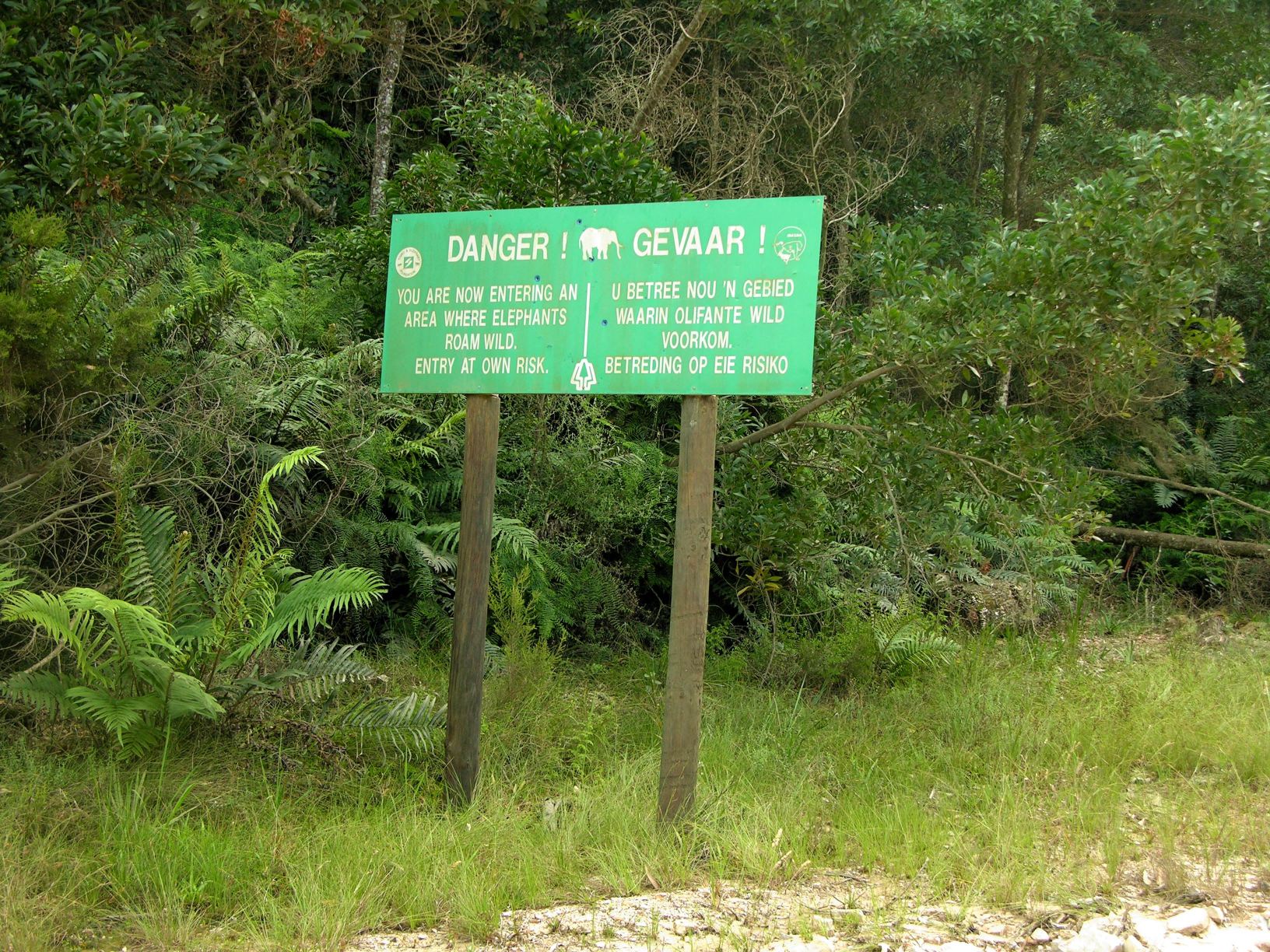
    Other Dougie things I remember:

    • ‘Let’s play Bok Bok Staan Styf! Hoeveel fingers op jou lyf?’
    • We must play pennetjie!’ – urgently suggested after a few beers. We never did.
    • His fox terrier — (name?)
    • His cottage on Glen Khyber, their plot in the shadow of Platberg, away from the big house. It was right on the verdant banks of a little stream that flowed down from Khyber Pass into the beautiful Kak Spruit as it tumbled down from Platberg on its way to the Wilge River. Glen Khyber was below Platberg’s steep, narrow, stony Khyber Pass.

    Sheila remembers:

    • Doug’s story about Tabs Fyvie when Tabs was little: Dougie asked him “Did you have any rain?” and Tabs answered “Not much but they were big drops”.
    • How we used to walk to Glen Khyber from Birdhaven and wake Doug up in his cottage (him probably hung over) and Barbara would show him her whispy ponytail at eye level as he lay in bed and say “Look Doug, my ponytail!”.
    Birdhaven

    1. Birdhaven – the ruins; 2. Glen Khyber – Doug’s cottage the green roof;

    3. Jack Levick’s plot; 4. Kakspruit

    ~~~oo0oo~~~

    soutpiel – English-speaking South African; said to have one foot in SA, the other foot in England, his penis hanging in the sea, so ‘salt penis’

    Bok Bok Staan Styf! Hoeveel fingers op jou lyf? – weird game where you jump on each others’ backs! amiright?

    pennetjie – game where you scratch a hole in the ground and use a stick to prevent your opponent from tossing his stick into the hole; amiright?

    Kak Spruit – Shit Creek; Stream flowing down from the top of Platberg past Dougie’s plot Glen Khyber, then past our plot Birdhaven

  • Theft and Punishment

    Theft and Punishment

    Didn’t steal much as a kid. But I did slug down a bottle of Monis red grapejuice on the quiet in the back storeroom of the Platberg Bottle Store / Drankwinkel working for Mom & Dad one Saturday morning. You can see the door to the storeroom in the pic. Warm, straight out of one of those cardboard boxes all the bottles were packed in.

    DSCF8184
    – Platberg Bottle Store – the dark side – Note that BrandyAle poster – booze “fights the high cost of living”!! –

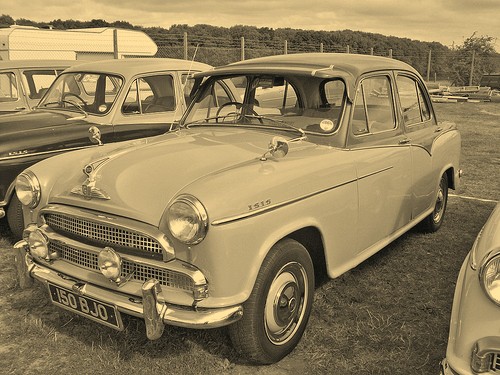
    That afternoon we went for a long drive out Witsieshoek way in the beige 1956 Morris Isis (no, not Islamic State of Iraq & Syria, just Isis, after the river in England that most call the Thames).

    After a while the car door had to be flung open for me to have a hearty grapey chunder out onto the gravel road in the veld. It would have looked like blood, so I imagine a confession then also would have had to take place. Can’t remember.

    I haven’t liked red grape juice since. Communion in the teetotal Methodist church had me being possibly the only sinner rudely reminded of theft and puke every time the shed for you came round. Divine retribution? Communion? Confession? He does seem to move in mysterious ways!

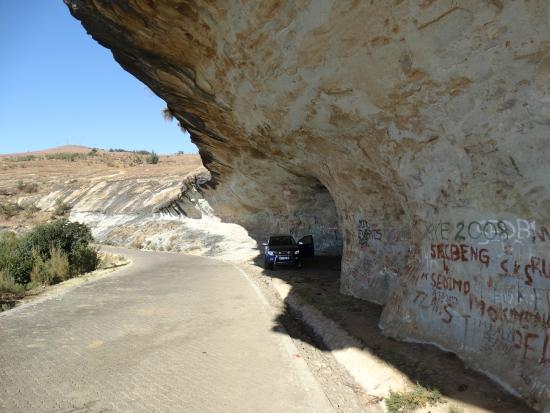
    Here’s the cave on the Witsieshoek road:

    cave-witsieshoek-road

    ~~~oo0oo~~~

    As an aside –

    – just like this one – but no visor – no spotlights – not two-tone –

    The Morris Isis was named after the River Isis – which is actually just the Thames in Oxford, you know how Poms are with names. The Morris Isis was “designed for work in the Dominions, Colonies and Protectorates” . . . “the factory’s output . . . is entirely for export. Great attention was given to providing a low appearance without sacrifice of ground clearance. The all-metal 5-seater saloon body is stated to be practically indestructible and climate-proof.”

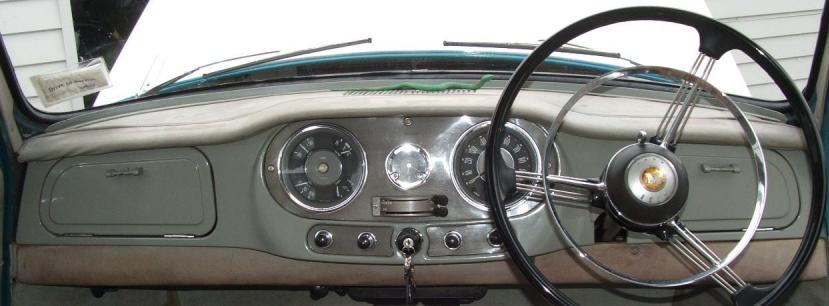
    The 1956 version had the fascinatingly bizarre feature that both the gear lever and the handbrake were on the floor to the right of the driver, wedged in the narrow space between the seat and the driver’s door. When changing gear it looked like you were fiddling for something you’d dropped between your right thigh and the door.

    Morris Isis gear lever

    The Morris Isis Series II was based on the Morris Oxford Series III. The engine power increased to 90 bhp. The manual version had a four-speed box operated by a short gearstick located on the right-hand side of the front bench seat. The handbrake lever was located just behind the gearstick.

    Sales remained weak, and the line ended in 1958. It had a top speed of 90 mph and could accelerate from 0-60 mph in 17.6 seconds. Fuel consumption of 26.2 miles per imperial gallon (10.8 litres/100 km) was recorded. The test car cost UK£1025 including taxes.

    Morris_Isis_II_ad.jpg
    – other wimps don’t want power! they don’t want acceleration! – No, only us Aussies like those things! ‘Cos we’re Aussies! Other guys like going slowly, of course. Marketing people never change. And guys love flattery and BS.
    Morris Isis interior

    ~~oo0oo~~