Blast from the past. Memories can linger now, and be enhanced with the passage of time. Hard copies of dust-collecting mementoes have been discarded in a long overdue house-cleaning.
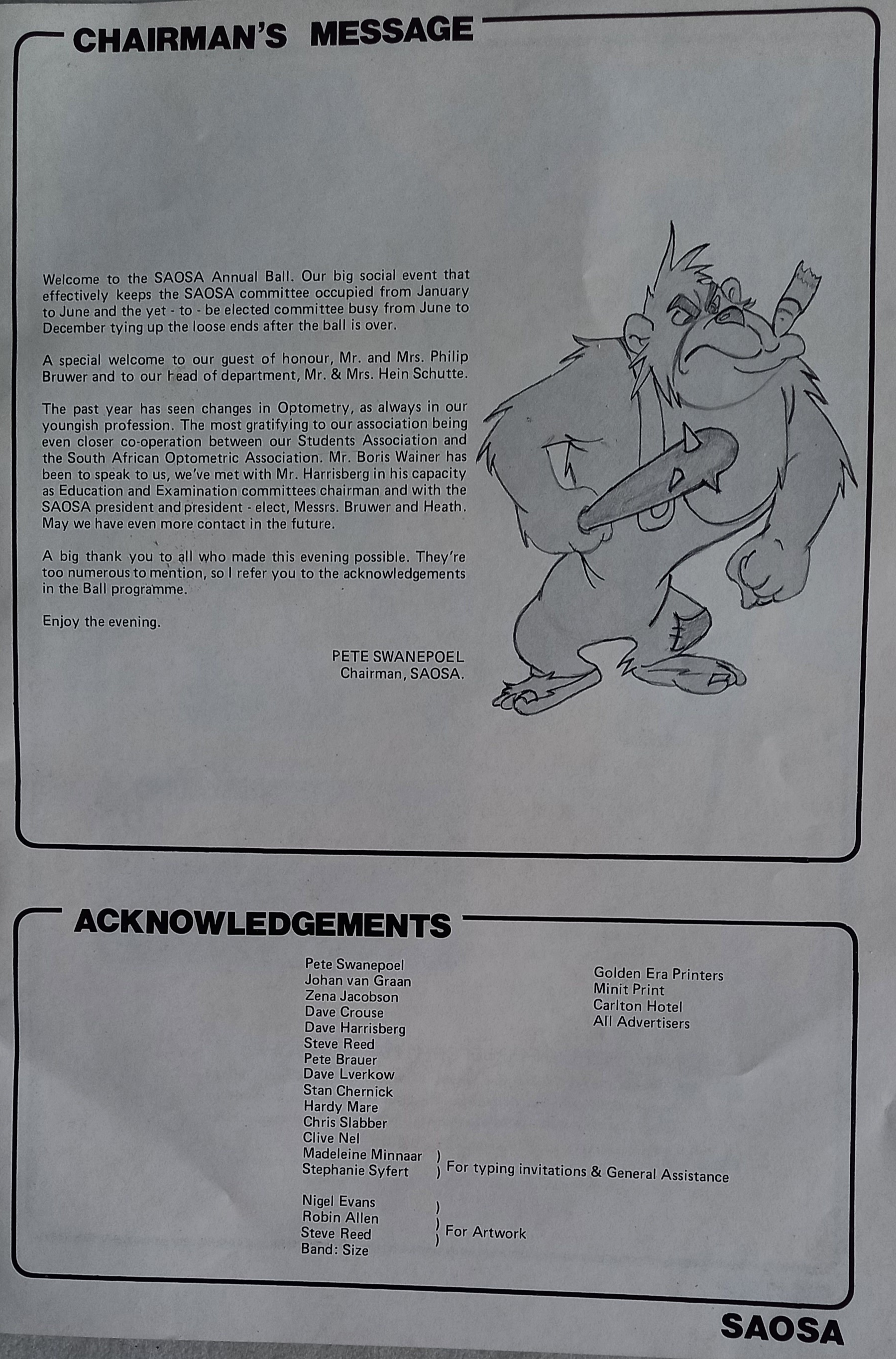
Our final year student ball in 1977 was a lavish, sponsored affair in the ballroom of South Africa’s famous Carlton Hotel in downtown Johannesburg.
– menu Carlton Hotel Johannesburg 1977 –
Rob Allen and Steve Reed’s lovely cartoon drawings enhanced the booklet that served as program and menu.
Now we can get on with the old truism: The Older We Get, The Better We Were!
(I’ve done a similar post! on the park in more recent days – ‘Our era,’ the 1960s. Enjoy both, and take both with a pincha cerebos).
~~oo0oo~~
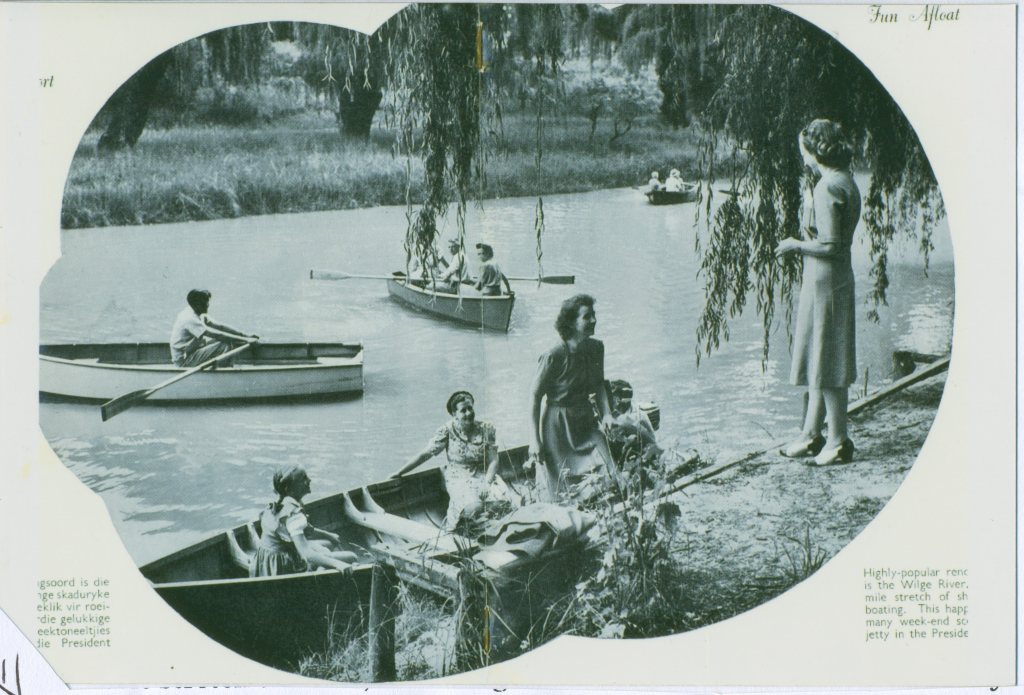
Harrismith’s young town council, established only in 1875, though the town had been going for much longer, decided in 1877 to lay out a large park for its citizens to enjoy on the banks of the Wilge River on the south-west edge of the new dorpie.
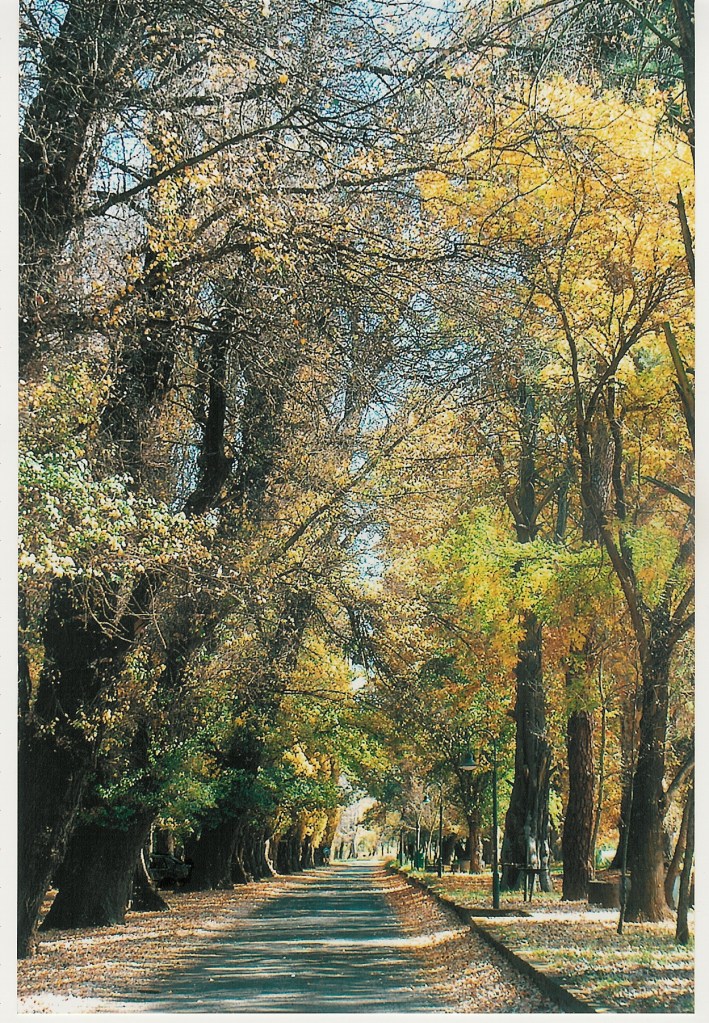
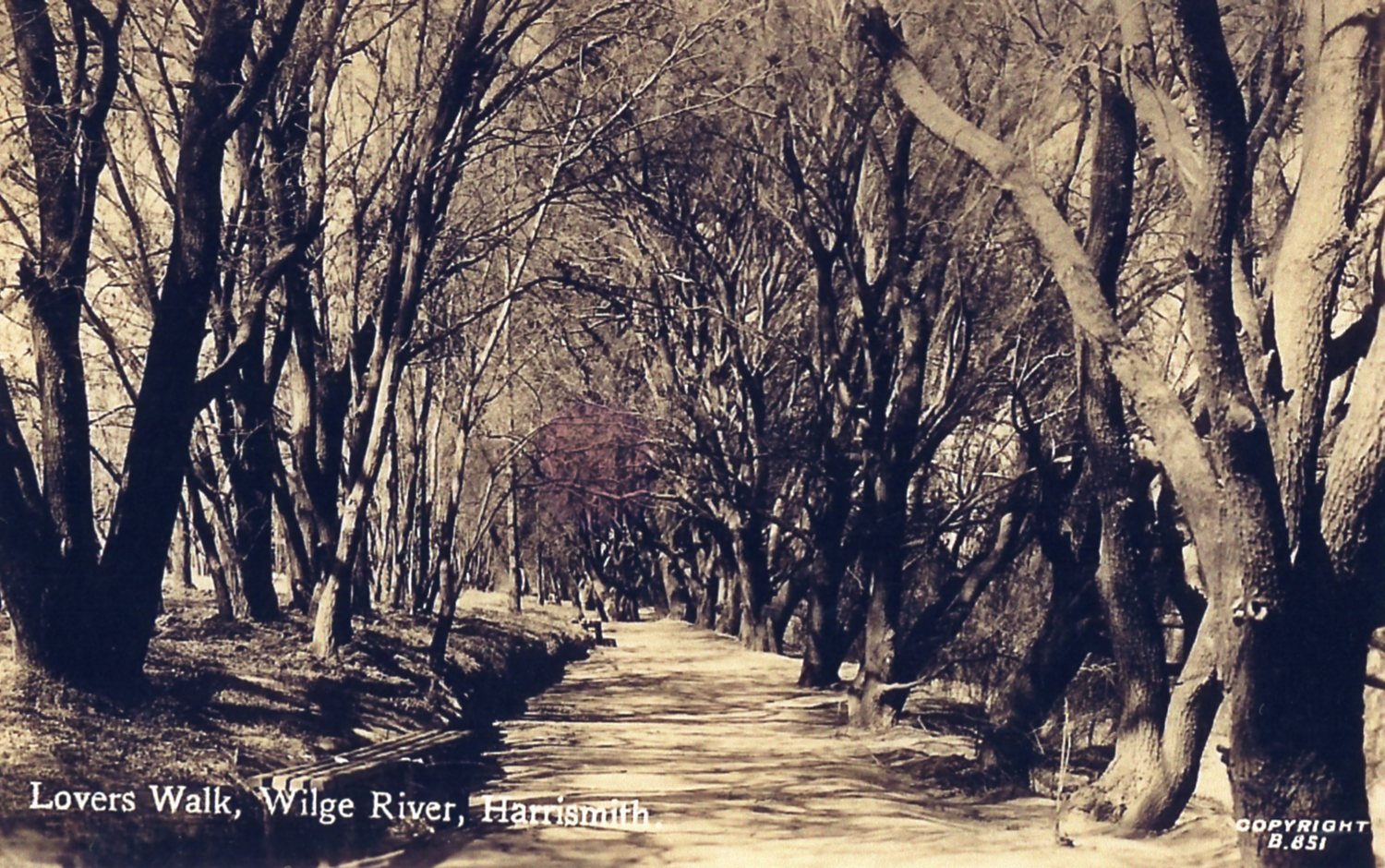
Over the following years – and mainly thanks to the efforts of the Landdrost Warden who came to Harrismith in 1884, and Harrismith’s first Town Clerk A. Milne, the area was laid out with winding roads, walking paths, a “lovers lane of poplar trees” and up to 38 species of other foreign trees, in what was then highveld grassland. Or, as described by park praise-singers: “a bare, crude piece of ground!”
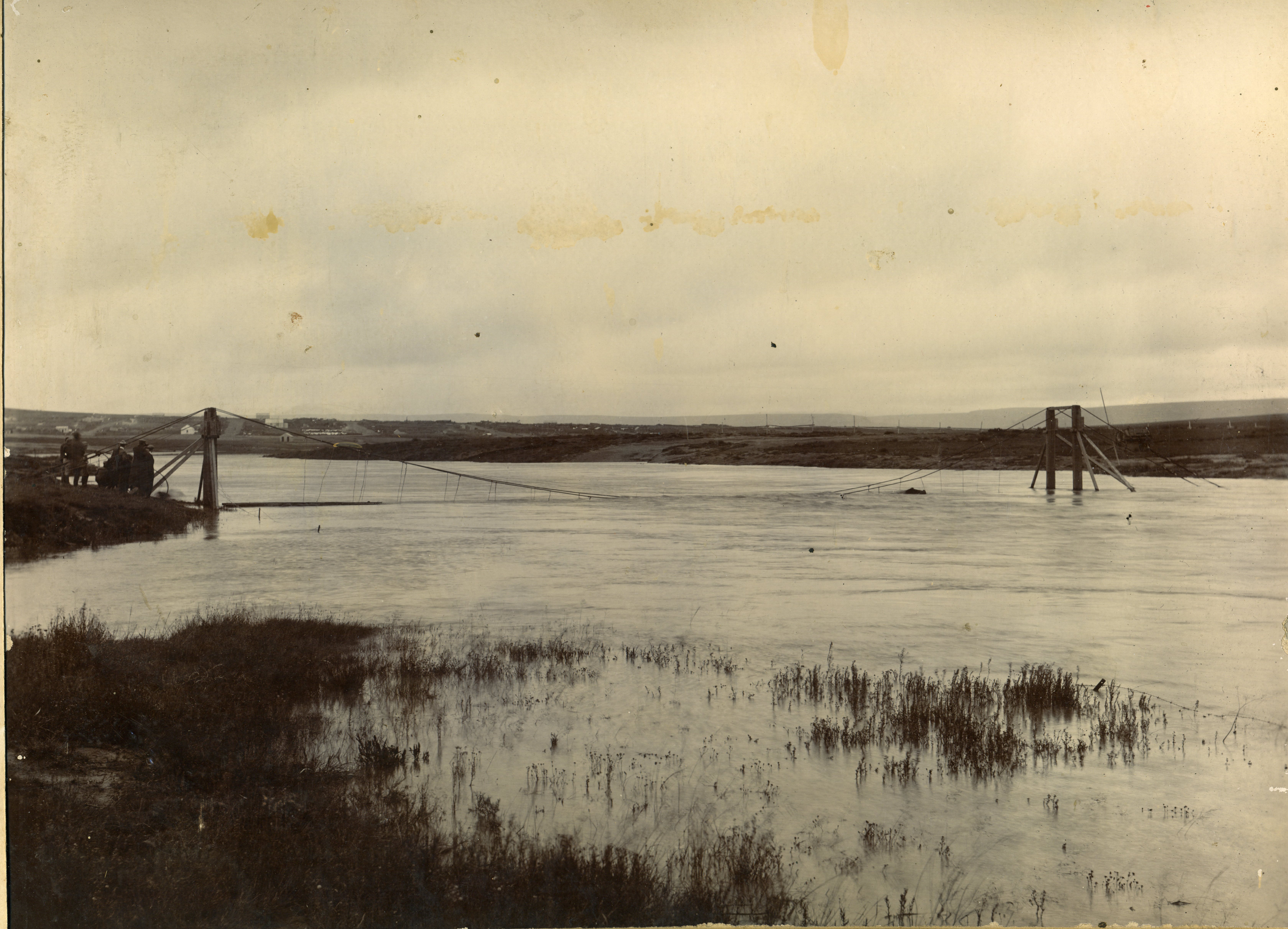
Here we see the Wilge River banks and surrounds just upstream of the park site – near where the ysterbrug, or Hamilton Goold bridge was later built:
– the troops stationed in the town around the time of the Anglo-Boer War erected this suspension bridge –
Tree planting commences. Platberg the backdrop.
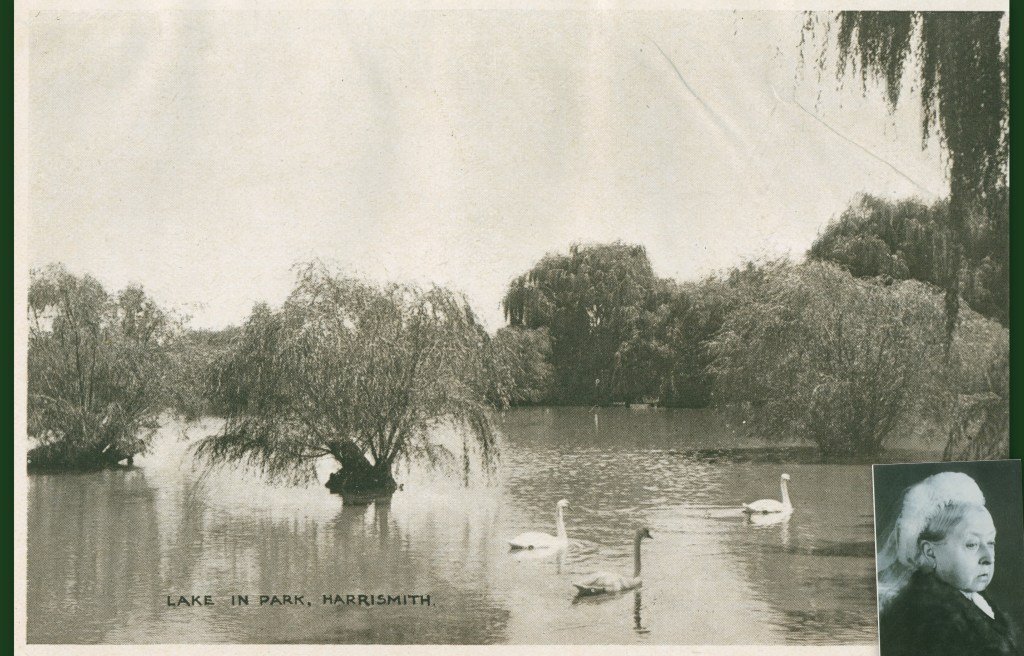
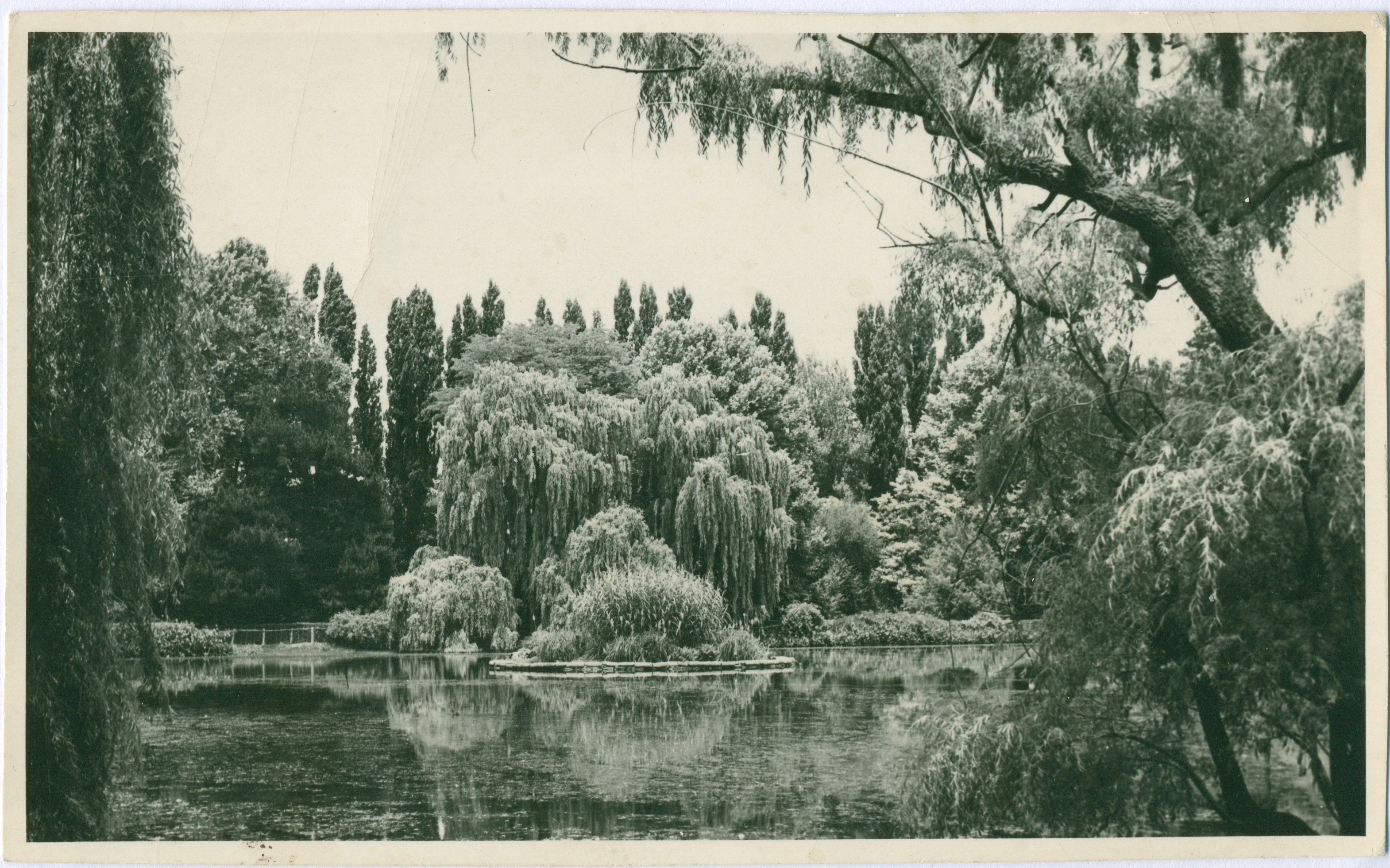
The typical Free State river was narrow and shallow, so an attractive little lake with a central island was built on the right bank (town side) and used for boating. Swans were introduced from London ‘for beauty.’ As for trees, so all local life **sniff** was regarded as inferior to things imported from “home”! Home being a small island to the NW of France. The swans did quite well, settled in and bred, the cygnets being sold for £15 a pair, but not long after, they met their end at the hand of ‘some unidentified vandal with a .22 gun.’ Probably an early indigenous wildlife fan, I’d like to suggest?
As the trees grew, so more and more birds roosted in them, large heronries eventually being established. Predictably people complained and as predictably, the council “did something about it,” shooting the local birds while pontificating against the shooting of the foreign birds! The birds’ carcasses dropped into and frotted in the lake, causing a big stink! In the 60s there were still many cattle egrets in the trees and I recall lots of white poo and some dead babies on the ground beneath their nests.
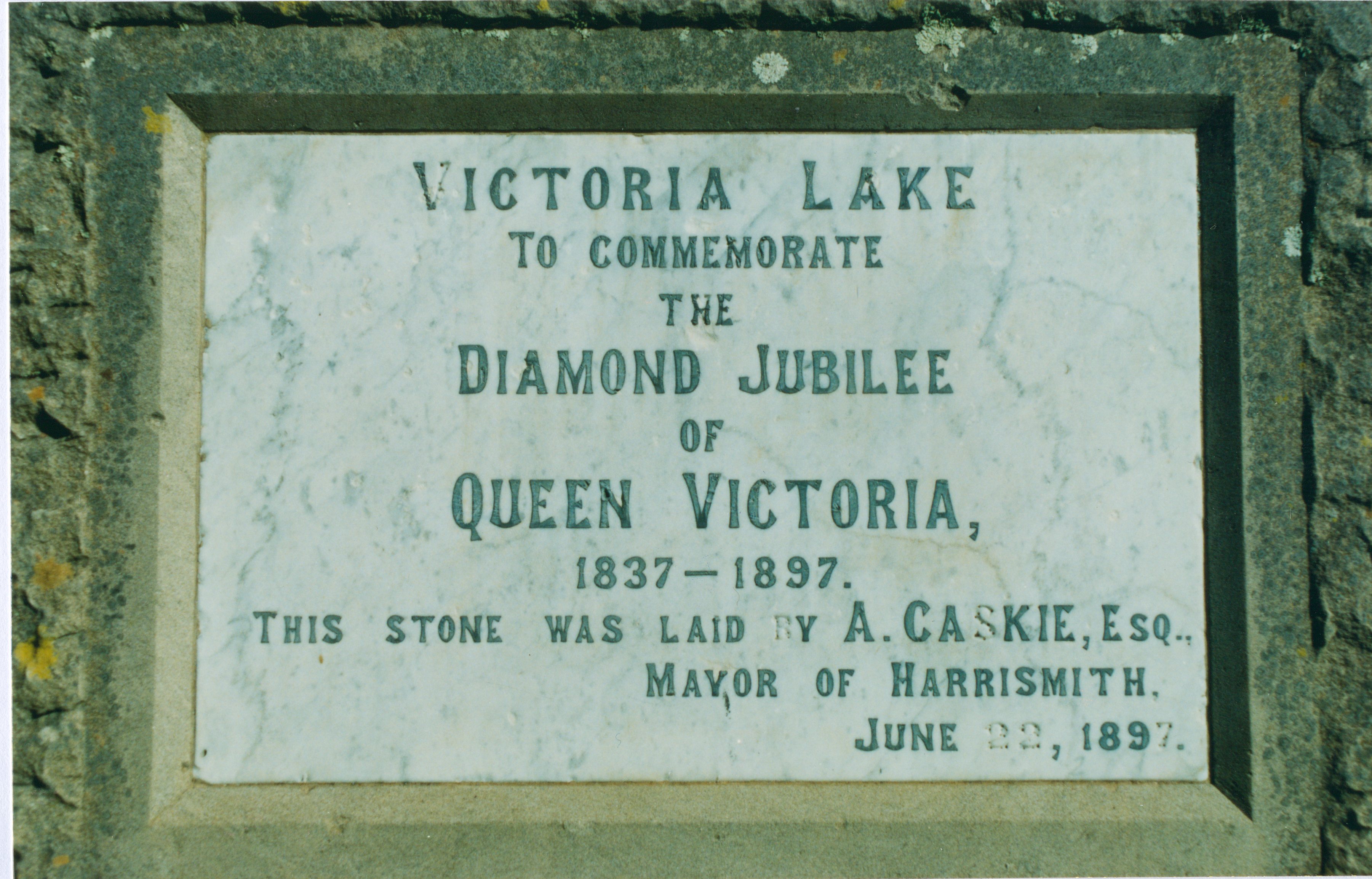
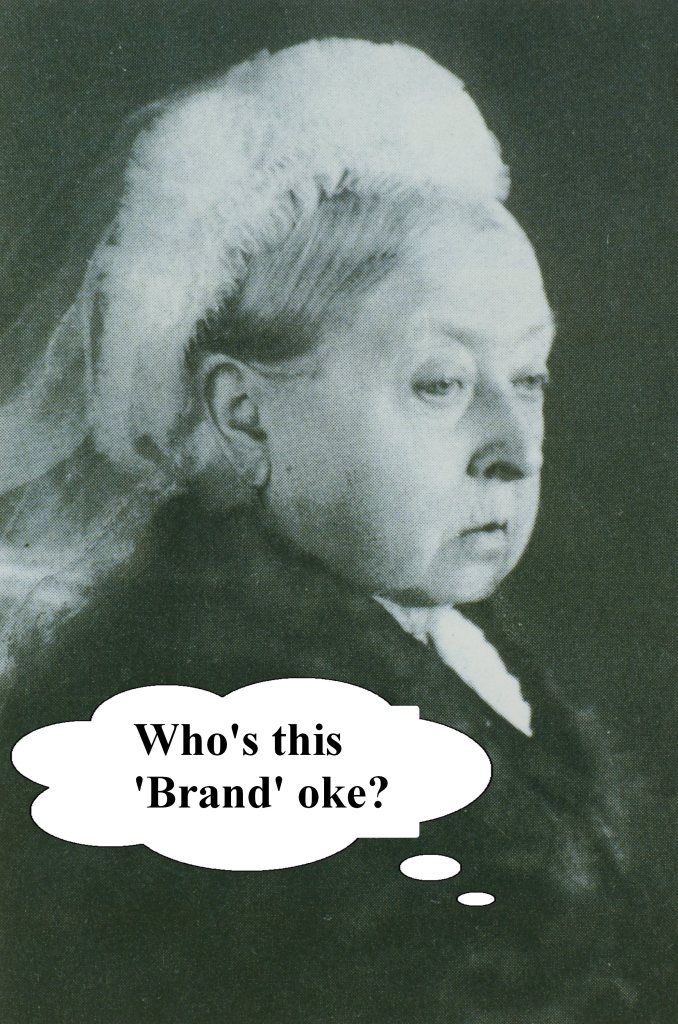
In 1897 the lake was named Victoria Lake in honour of the silver jubilee of the Queen – that’s the queen of England, that little island to the NW of France – along with thousands of other things named “Victoria” that year around the world – much genuflection was expected of the colonies. Also they were probably trying to ease her pain over the royal pasting (or snotklap) we had given her at Majuba.
– they named the lake “Victoria” to arse-creep the queen . . of England – didn’t amuse her, though – never once came to ghoef in it –– more recently – sans swans – we shot them all –
More & more trees would be planted over the years by schoolkids and enthusiasts. Gotta get this place looking more like England, dammit!
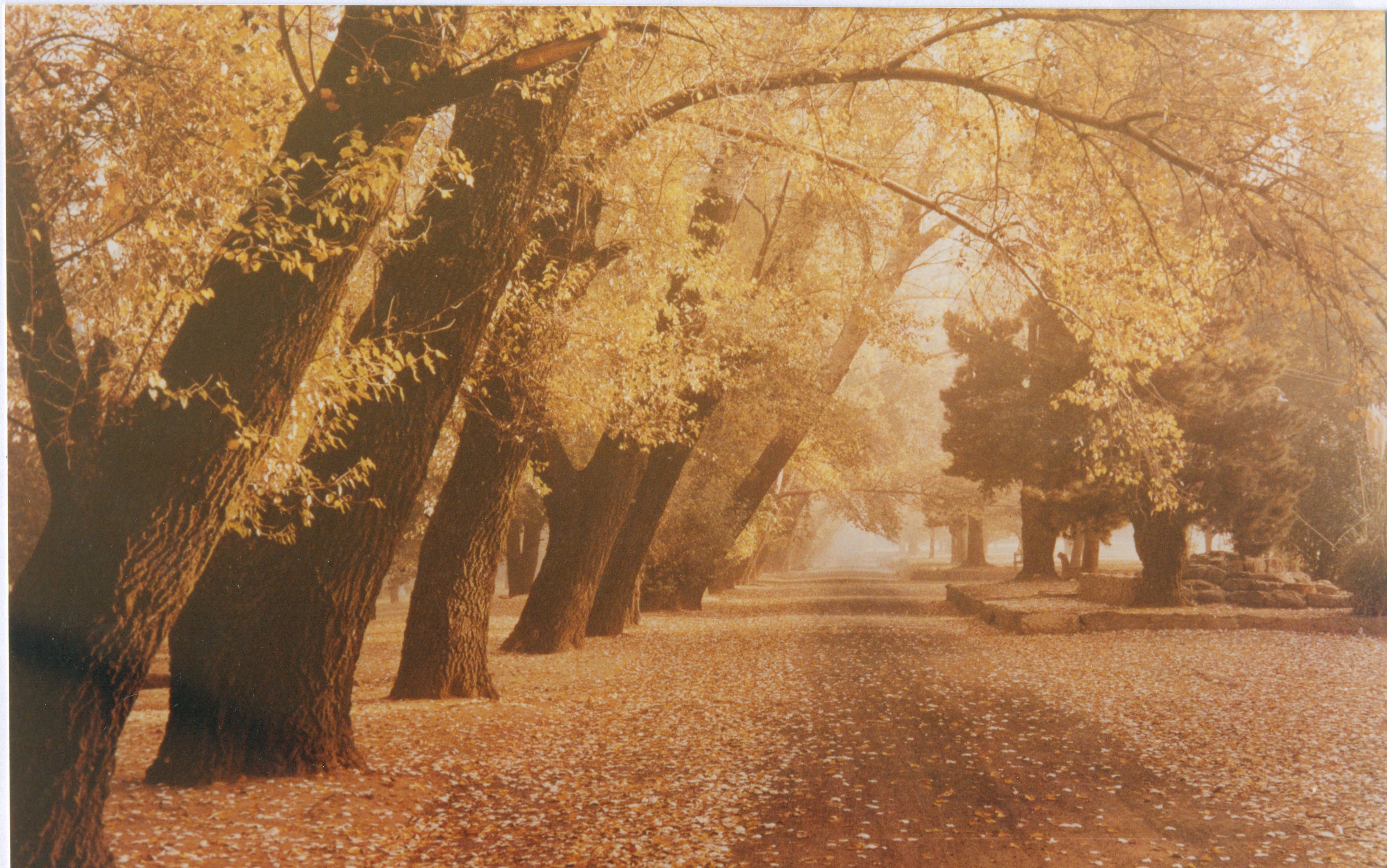
– lovers walk – I remember the poplar trees leaning ominously – were they trying to tell me something about my lovelife? –
The park was officially opened in 1906 by Sir Hamilton Goold Adams, at “a colourful ceremony with troops on parade and a military band in attendance.” Now they were gloating, having given us a revenge pasting in the 1899-1902 Tweede Vryheids Oorlog (Anglo-Boer War).
In 1907 the river was dammed by a weir just downstream of the park, thus creating a wider and deeper river for the full length of the park.
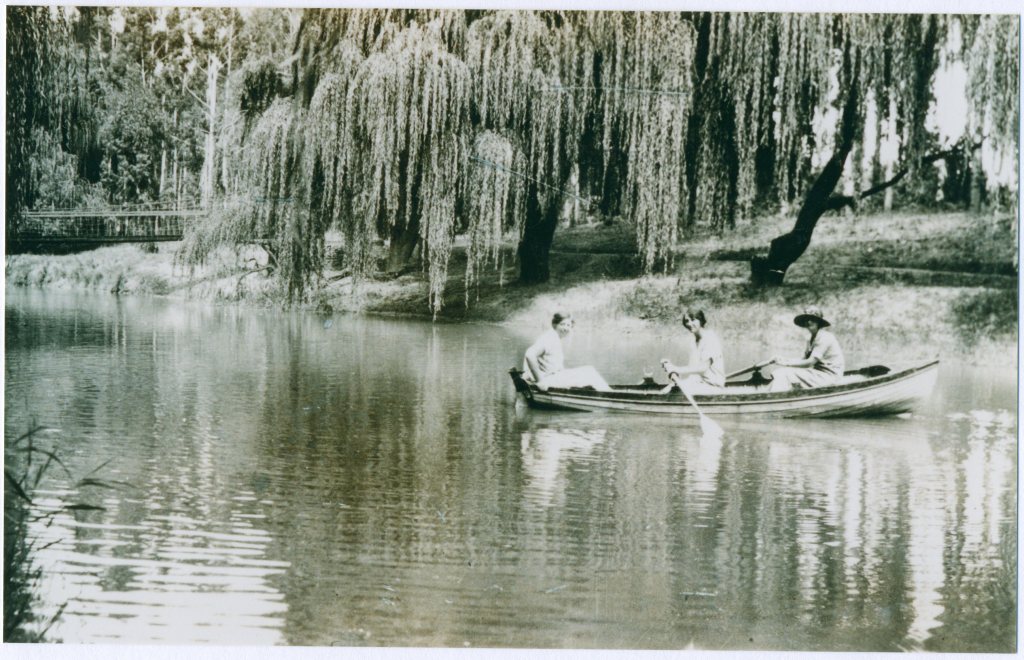
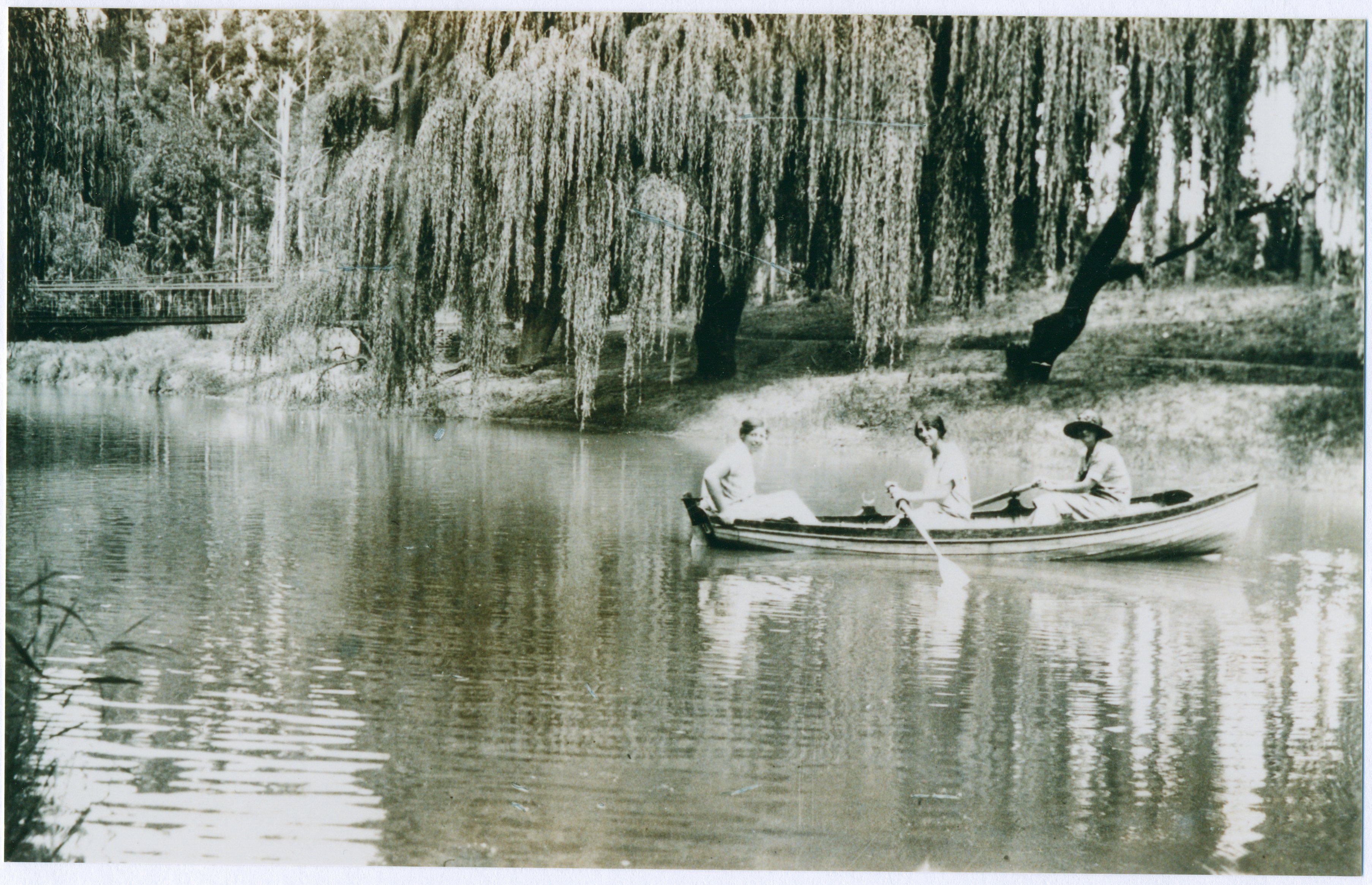
This greatly added to the river’s charm and utility, allowing for swimming, drowning, more boating and bigger boats – even the first motorboat in 1918, owned by Mr E.H Friday. Later a boat house and a landing stage were erected by the Boating Syndicate who advertised ‘Boats for 2 and boats for 4 and boats for all’ in 1922. The Syndicate graduated to a motor launch capable of taking 14 passengers slowly along the river, including full-moon evenings where people would sing the songs of the day, accompanied by “the plaintive sounds of the ukelele”.
On the edge of the park nearest town sportsfields were laid out, starting with a cricket oval and an athletic track, then rugby, soccer, softball and hockey fields; and jukskei lanes. No croquet?
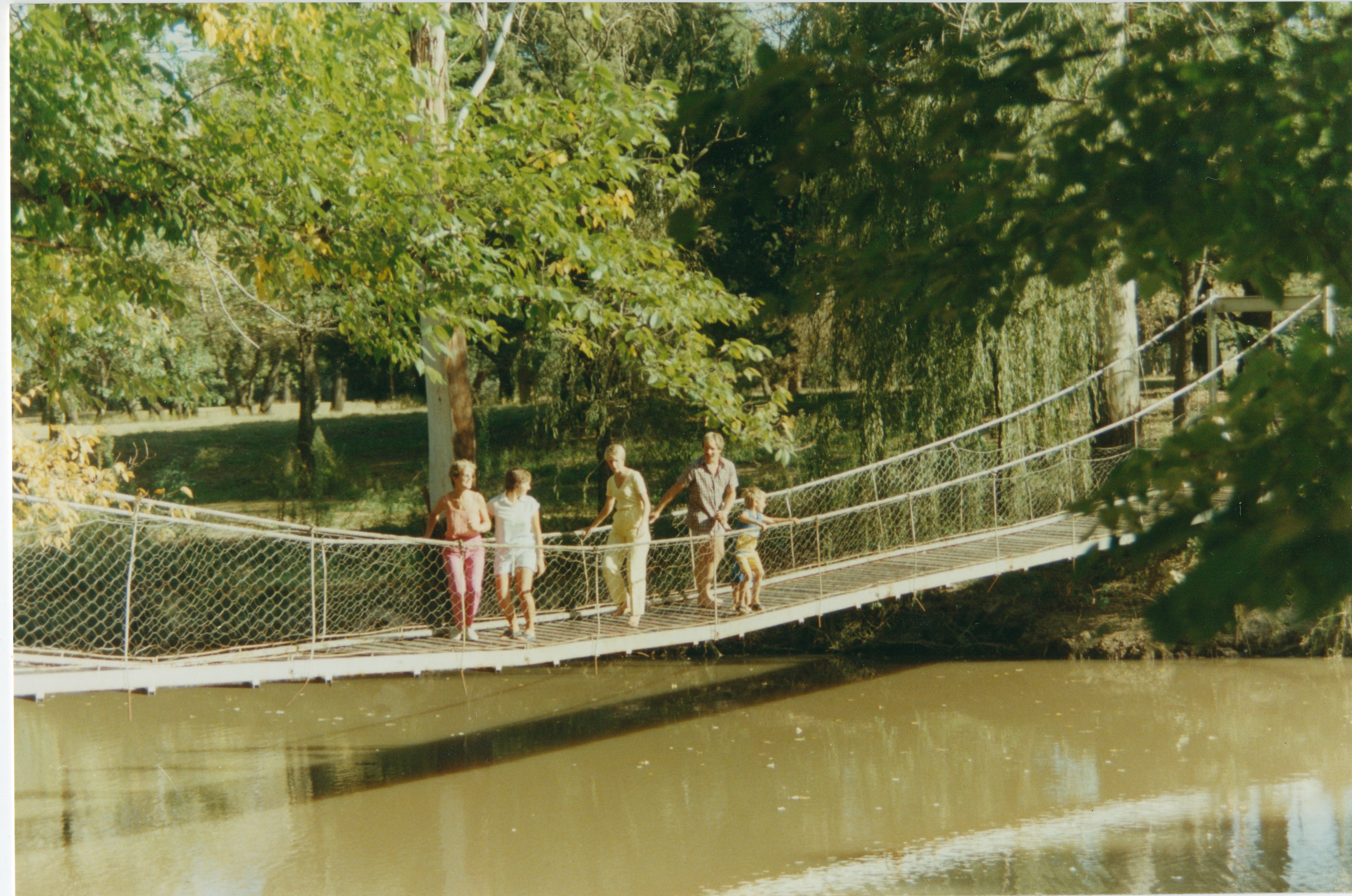
The park was extended across the river and a new suspension bridge about 300 yards downstream replaced the one the military had erected (the thrifty town council using some of the metal from the original in the replacement). In time a caravan park was started, but this was soon moved to the town side of the park.
An impressive entrance – wrought iron gates between sandstone pillars – was erected and named the Warden-Milne gate in honour of those who had done so much to get the park established. Well done, chaps! We enjoyed the fruits of your labour in our youth in the 1960s! OK, not really labour, organisational abilities, nê?
~~oo0oo~~
It’s only thanks to the preservation efforts of Biebie de Vos that we can see these old pics. Thanks, Biebie! Also thanks to SA Watt’s military history articles here and here.
Gallery:
~~oo0oo~~
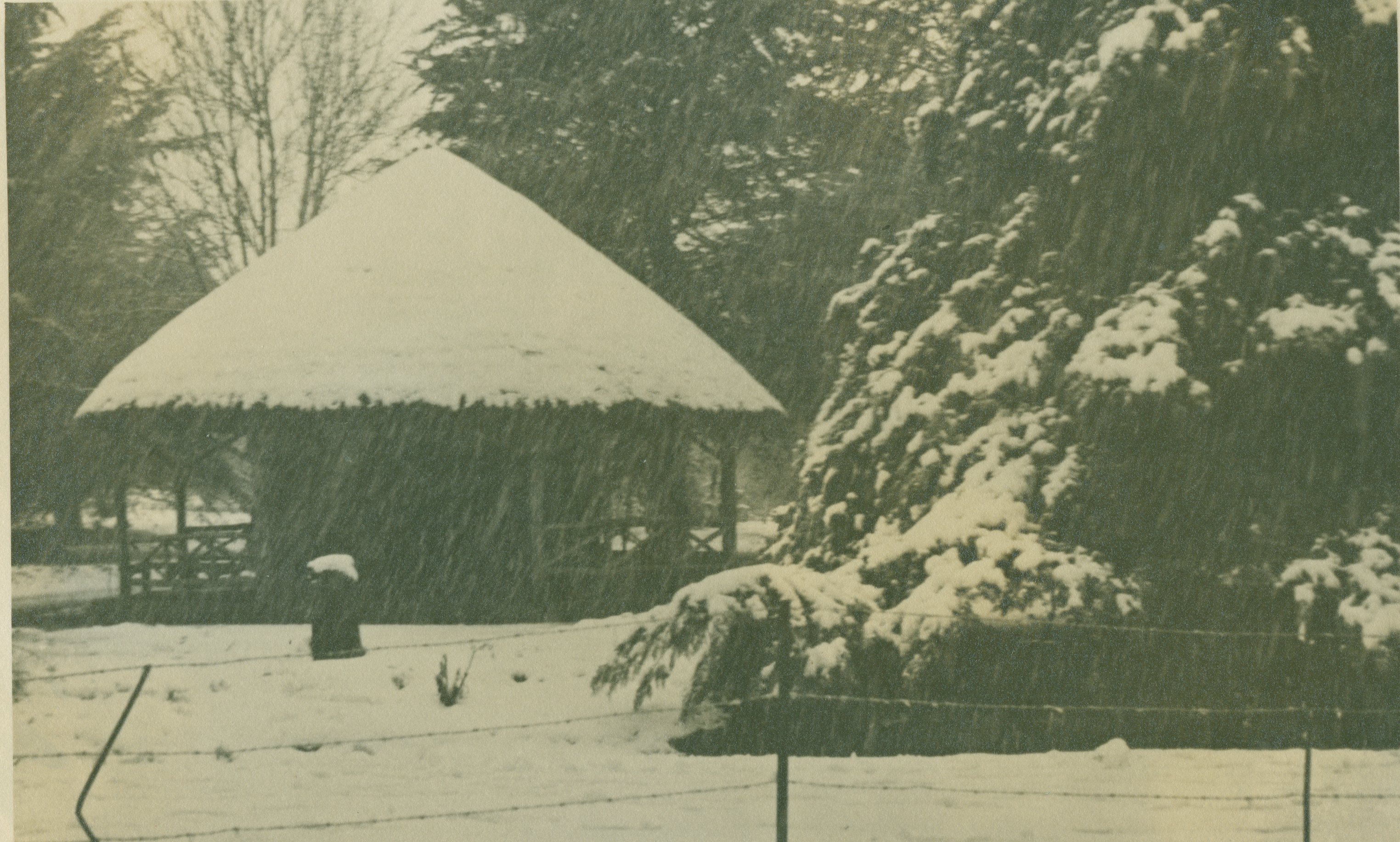
Gotta love marketing! In a brochure extolling the virtues of our lovely dorp, the blurb says – where we would have said Dammit, it’s FREEZING! – “the town enjoys a bracing climate.”
More Gallery:
~~oo0oo~~
Wilge river – Willow river; Interesting name, as the willows are from the northern hemisphere, and were planted later; only after a while would they have become such a feature of this river (and many other South African rivers); Wonder if our river had another name when the town was first settled?
dorpie – village
ysterbrug – iron bridge; for horsedrawn carriages and those newfangled automobiles / motorcars
snotklap – a tight slap that – if timed right – whips the snot out of the klap-ee’s nose and leaves it wrapped round his face ear-to-ear
In high school in 1973 in Oklahoma, I was asked to go to the Model UN to represent another country. I asked to represent SA. Why, I don’t know. I could have learned more by representing a new country I’m sure. The organisers said ‘Sure.’
I think it was in Norman at OU but pinch of salt: Fifty years ago next year! ( Ah, it was, I see. )
We had fun and I did learn a lot. But I have embarrassing recollections of passionately defending 1973 SA when the motion against us was tabled – all the Nats points came bubbling up. Parallel development, Separate but equal, blah blah. Sheeeesh!! The old wanting to win was fierce in my young days. I must have sounded like blerrie Pik Botha without a snor! I think we lost and were defeated. I hope they declared apartheid a crime against humanity – or did that only come later? ( Oh, soon after: November 1973 I see. )
It was very formal and procedural. I remember younger kids called ‘pages’ running up and down the hall passing notes between delegates. One addressed to me said: Good speech. Are you Australian?
They’re still going. Hopefully strong. Being Oklahoma, I bet they catch a fair amount of flak. Especially now with the MAGA disease sweeping that fair state. And an education minister bent on un-educating.
Writing is like a safari.
You start from where you are,
And you meander and explore.
And you learn as you go.
- Koos
~~oo0oo~~
adapted from a quote by E. L. Doctorow, American novelist
He also said:
“If you do it right, you’re coming up out of yourself in a way that’s not entirely governable by your intellect. That’s why the most important lesson I’ve learned is that:
Planning to write is not writing. Outlining a book is not writing. Researching is not writing. Talking to people about what you’re doing, none of that is writing. Writing is writing.”
Maybe now I’ll write. Except he was talking about writing fiction, and I can’t do that. That’s why I changed his quote, which was about autobiographical writing: I think, ‘You Start From Where You Are.’ Doctorow said, ‘You Start From Nothing.’
If you’re writing an olden days blog you run out of material. Only so much happened from when I was born till I met Aitch, which is the timeline of this blog. My ** Born, Bachelorhood and Beer** blog. So there’s recycling. Here’s a post I wrote in 2016, slightly updated:
…
I used to sing beautifully. The teacher who trained the boys choir in Harrismith Laerskool said so. Well, she might have. She was Mej Cronje, and was half the reason ous would volunteer for the choir. To look at her, gorgeous redhead she was.
I was a sopraan ou and we looked down on the alt ous who, though necessary as backup, weren’t in the same league as us squeakers. One directly behind me used to bellow in my ear: ‘Dek jou hol met bouse off hollie! FaLaLaLa La LaLaLaLa.’
One day this delectable and discerning talent spotter, the red-headed Juffrou Ethel Cronje, chose me to sing a solo in the next konsert. Me, the soloist! Move over, Wessel Zietsman! You too, Mario Lanza.
Fame loomed. It was 1965 and even then, the image of a golden buzzer appeared to me in a vision. This thought crossed my mind: Harrismith’s Got Talent!
Then tragedy struck!
My balls dropped.
They handled it very diplomatically. By ignoring it and cancelling practice. The konsert didn’t materialise. Co-incidence? Surely they didn’t cancel a concert just because one boy suffered testicular descent? And by the time the next konsert came around I hadn’t been banished – just discreetly consigned to the back and asked to turn it down.
* * *
Just in case there are people who think Harrismith se Laerskool se Seunskoor was a Mickey Mouse outfit, lemme tellya: WE TOURED ZULULAND. The Vienna Boys Sausages were probably nervous.
We got into the light blue school bus and drove for hours and hours and reached Empangeni far away, where the school hall was stampvol of people who, starved of culture in deepest Zoolooland, listened in raptures as we warbled Whistle While You Work, High on your Heels is a Lonely Goat Turd, PaRumPaPumPum, Edelweiss, Dominique, Dek jou hol, and some volksliedjies which always raised a little ripple of applause as the gehoor thought “Dankie tog, we know vis one“.
If memory serves (and it does, it does, seldom am I the villain or the scapegoat in my recollections) there was a flood and the road to the coastal village of ReetShits Bye was cut off, sparing them the price of a ticket – though those were probably gratis?
Can’t remember driving back, but we must have.
After that epic and ground-breaking (sod-breaking?) tour, warbling faded in importance and rugby took over.
Mej ; Juffrou – Miss; not yet married to Kiewiet Uys; ladies had to be tagged as ‘available,’ guys not
Harrismith Laerskool – the village school
Harrismith se Laerskool se Seunskoor – very much like the famous Vienna Boys Sausages
sopraan ous – high range warblers; not castrati, but can sound like them
alt ous – the other ous
ous – us men
‘Dek Jou Hol’ – literally, cover your ass; listen to the sopraan-ous, they’re the ones. The highballs are on them.
highballs – slang for alcoholic drink in USA; ‘giraffe walked into a bar, said, ‘The Highballs Are On Me’
seunskoor – boys choir
stampvol – sold out, packed, overflowing; like – viral!
volksliedjies – folk songs; songs of ve Chosen People
gehoor – audience, fans, followers; (yes, it was 1965, but we could hear them clicking ‘like’ and ‘follow’)
dankie tog – fanks heavens, sigh of relief
ReetShits Bye – Richards Bay, then still a small fishing village on the warm Indian Ocean, the bay still a natural estuary, not yet dug out for coal ships to pollute
Pa rum pum pum pum – listen to the sopraan-ous, they’re the ones
Mom tells me that after I had me tonsils out at about age three, she took me to Kindrochart for some gentle recovery for the poor little tender chap. I clung to her skirts and wouldn’t go to anyone, I wouldn’t even look at, nor speak to, our hosts Mrs Shannon and Betty Stephens. But once, when lovely, friendly Betty – a huge fan of us kids, we called her Betty Brooks – offered to carry me up a hill after I’d run out of poof, I relented / condescended to use her as a pack horse. Mom was leading us up the hill to show me their farm Nuwejaarsvlei, where she was born and lived till she was eight, and where her beloved Dad Frank used to take her for walks.
Mom also tells that I told on Ma Shannon! I hastened into the house one day to find Mom, ‘Ma! Shannon’s got none clothes on!’ Mom hastened out to see this sight and there was Ma Shannon in full petticoat and underwear, shoes and socks, looking quite respectable, thank you. She was preparing to have the Milraes for tea, and wanted to pull on her dress at the last minute.
Apparently Ma Shannon tried hard to get me to call her Nana, but I’d not call her anything but ‘Shannon.’
On the way back to the big smoke, driving on the gravel road towards Platberg, Mom was telling Betty about a book she was enjoying about a Belgian nun – The Nun’s Story – I had the book in my hands on the back seat and it seems I was disappointed in it, as I piped up, ‘. . and its got none pictures.’
~~oo0oo~~
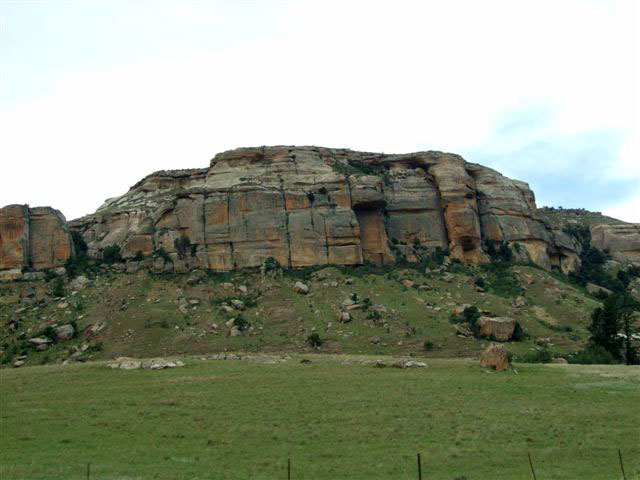
Pic: Kerkenberg – the old Binghamsberg – from Kindrochart side – from mapio.net
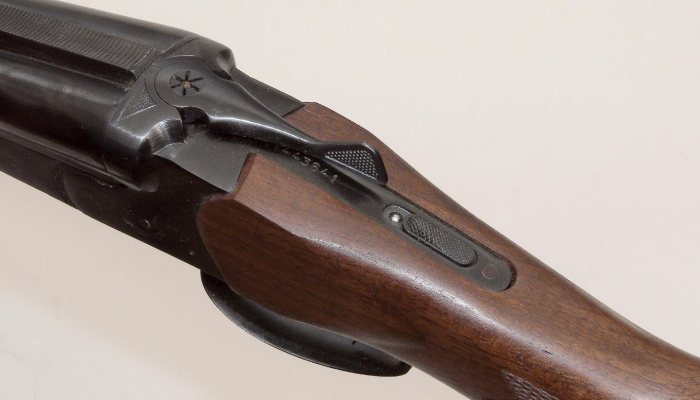
Dad: I bought a Russian 12-gauge shotgun, a Baikal. I paid R139. I got it from Musgrave in Bloemfontein.
Internet comments and reviews are mostly very complimentary about Baikal down-to-earthness, ruggedness and value: The first Baikal shotguns years ago were side-by-sides; They were not very sophisticated; They are more reliable than their price would suggest; You can depend on them; If you’re on a modest budget then a Baikal is a good first buy; etc.
– I used to occasionally use this implement to miss guineafowlca.1977 –– guineafowl shoot on Rust outside Warden ca.1977 – I’m 2nd left – none of those birds were harmed by me in the shooting of this movie –
~~oo0oo~~
Dad: When Harry Mandy went to Japan I asked him to get me a Canon camera and telephoto lens. He got me a FT QL camera bodywith standard 50mm lens, a close-up lens and a 200mm telephoto lens for R140.
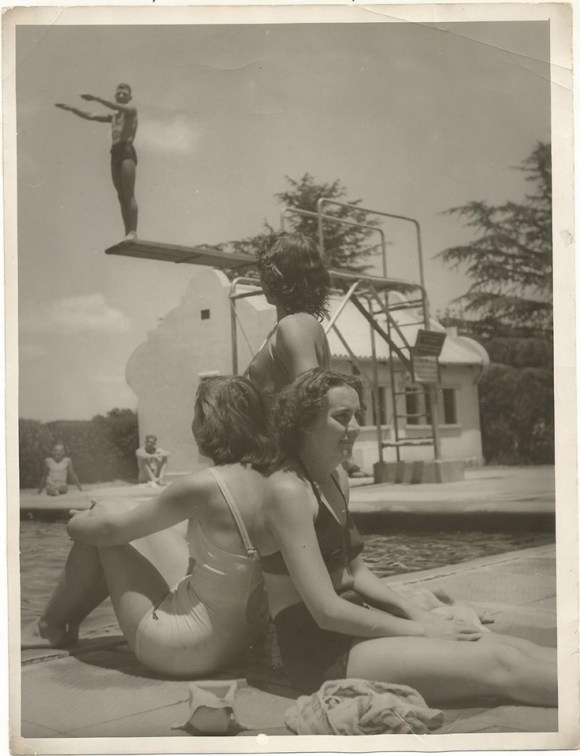
Mom says they loved swimming. All the boys were at the baths – the Harrismith Municipal Swimming Baths about a kilometre away up the hill past the Town Hall.
Some days they’d get ready to go – cozzies and towels over their arms, but Granny Bland would be standing on the stoep with her hand on her hip, looking at the mist on the eastern end of Platberg and announce firmly, ‘No, you can NOT go swimming. You can put that in your pipe and smoke it!’
Listen, if you want to make it to supper you must come quickly but you’ll have to bring lots of money.
He got a visit from his nephew Jack who’s ‘a helluva clever bugger, Jack, he’s on a lot of boards and chairman of this, chairman of that. Wonderful bugger, Jack. He still weighs 78kg same as he weighed when he was a fighter jet pilot’ (Jack must be 78yrs old in the shade, so 1kg per annum).
‘He brought me some smoked snoek and chips, KILOGRAMS OF IT!‘
..
He’s on to food – a favourite subject.
..
Oupa worked on the railways.
Working men took a scoff box to work
Guys would take sarmies, meat, tea, etc.
Oupa had a billy can. A blue billy can, the lid was your cup. You know what he used to take in to work for his lunch?
No. What, Dad?
Sugar water.
At night he’d drink a big mug of milk and eat bread.
..
Ouma would cook in the kitchen and dish up in the kitchen. Six plates. Her and Oupa and four big kids.
You got your plate of food. Don’t ask for more, there was no more. But we didn’t need more, it was a great big plate; we never went hungry. We had to do without some stuff, like new clothes or shoes, but we never went hungry. There was always a big sack of peanuts in their shells on the floor of the pantry and you could go in and grab a handful.
..
Oupa and Ouma in PMB
Chickens and muscovy ducks in the backyard.
Ouma made a little pond in the ‘sump,’ the lowest point in the yard in the far corner. She would fill it up with water, about one brick deep, then throw mielies in the water. The ducks like feeding underwater. They bred prolifically and there were always plenty. A big fat roast duck was a huge treat. Only trouble is there was duck shit all over the yard.
Chickens they had to slag. The kids. One would hold the beak and feet, stretch it and one would chop off the head with an axe.
A big game was to then stand it up and let it go and watch it run around, headless.
‘One day Oupa caught us doing it and beat the shit out of us.’
A re-post cos Mom told me some news today (see right at the end):
My first recollections are of life on the plot outside Harrismith, playing with Enoch and Casaya, childhood companions, kids of Lena and Bennett Mazibuko, who looked after us as Mom and Dad worked in town. The plot was in the shadow of Platberg, and was called Birdhaven, as Dad kept big aviaries. I remember Lena as kind and loving – and strict!
I lived there from when I was carried home from the maternity home till when I was about five years old, when we moved into town.
– those pigeon aviaries – and me –
I remember suddenly “knowing” it was lunchtime and looking up at the dirt road above the farmyard that led to town. Sure enough, right about then a cloud of dust would appear and Mom and Dad would arrive for their lunch and siesta, having locked up the Platberg bottle store at 1pm sharp. I could see them coming along the road and then sweeping down the long driveway to park near the rondavel at the back near the kitchen door. They would eat lunch, have a short lie-down and leave in time to re-open at 2pm. I now know the trip was exactly 3km door-to-door, thanks to google maps.
Every day I “just knew” they were coming. I wonder if I actually heard their approach and then “knew”? Or was it an inner clock? Back then they would buzz around in Mom’s Ford Prefect or Dad’s beige Morris Isis. Here’s an old 8mm movie of the old green and black Ford Prefect on the Birdhaven circular driveway – four seconds of action – (most likely older sister Barbara waving out the window):
1. Ruins of our house; 2. Dougie Wright, Gould & Ruth Dominy’s place; 3. Jack Levick’s house; 4. The meandering Kak Spruit. None of those houses on the left were there back then.
Our nearest neighbour was Jack Levick and he had a pet crow that mimic’d a few words. We had a white Sulphur-crested Cockatoo Jacko that didn’t, and an African Grey parrot Cocky who could mimic a bit more. Helmeted Guineafowl would visit by day, and a tame-ish Spotted Eagle Owl would visit at night.
Our next neighbours, nearer to the mountain, were Ruth and Gould Dominy and Ruth’s son Dougie Wright on Glen Khyber. They were about 500m further down the road towards the mountain, across the Kak Spruit over a little bridge. Doug’s cottage was on the left next to the spruit that came down from Khyber Pass and flowed into the bigger spruit; The big house with its sunny glassed-in stoep was a bit further on the right. Ruth and a flock of small dogs would serve Gould his tea in a teacup the size of a big deep soup bowl. I wonder how many sugars he added?
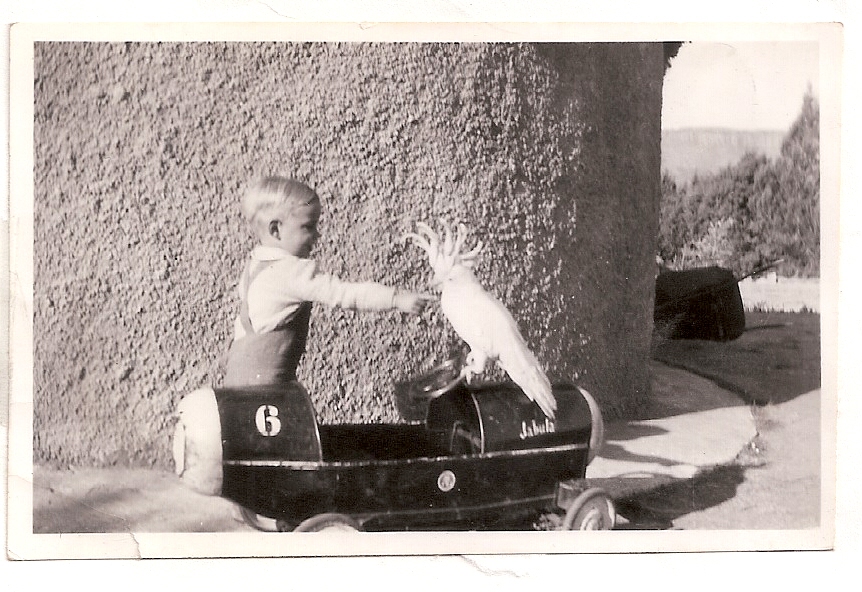
– Me and Jacko the sulphur-crested cockatoo outside the rondavel –
Judas Thabete lived on the property and looked after the garden. I remember him as old, small and bearded. He lived in a hovel of a hut across a donga and a small ploughed field to the west of our house. He had some sort of cart – animal-drawn? self-drawn? Self-drawn, I think.
– Me and Sheila on the front lawn – 1956 –
Other things I remember are driving out and seeing white storks in the dead bluegum trees outside the gate – those and the eagle owl being the first wild birds I ‘spotted’ in my still-ongoing birding life; The storks brought babies we were told – can’t level with kids. Hope parents are more straight-up with their kids these days. I remember the snake outside the kitchen door;
– Scene of the rinkhals leap – this taken thirty years later, in 1990 –
I don’t remember but have been told, that my mate Donald Coleman, two years older, would walk the kilometre from his home on the edge of town to Birdhaven to visit me. Apparently his Mom Jean would phone my Mom Mary on the party line and ask, “Do you have a little person out there?” if she couldn’t find him. He was a discoverer and a wanderer and a thinker, my mate Donald.
– fun on the lawn – and Bruno the Little Switzerland doberman –
Bruno the doberman came from Little Switzerland on Oliviershoek pass down the Drakensberg into Natal. Leo and Heather Hilcovitz owned and ran it – “very well” according to Dad. Leo came into town once with a few pups in the back of his bakkie. Dobermans. Dad said I Want One! and gave Leo a pocket of potatoes in exchange for our Bruno. He lived to good age and died at 95 Stuart Street after we’d moved to town.
– 1990 – Mom & Dad sit on the ruins of the stoep –
~~~oo0oo~~~
rondavel – circular building with a conical roof, often thatched;
spruit – stream; kak spruit: shit stream; maybe it was used as a sewer downstream in town in earlier days?
stoep – veranda
donga – dry, eroded watercourse; gulch, arroyo; scene of much play in our youth;
Our Ford Prefect was somewhere between a 1938 and a 1948 – the ‘sit up and beg’ look, before sedans went flat. They were powered by a 4 cylinder engine displacing 1172cc, producing 30 hp. The engine had no water pump or oil filter. Drive was through a 3-speed gearbox, synchromesh in 2nd and 3rd. Top speed nearly 60mph. Maybe with a bit of Downhill Assist?
~~oo0oo~~
Today – 25 Sept 2021 – Mom (who turned 93 a week ago today) tells me Kathy Schoeman bought the old Ford Prefect from her and one day they drove to work to see it lying on its roof in the main street outside the town hall! Kathy had rolled it in the most prominent place possible!