In 1971 I decided I wanted to do the Dusi. Charlie Ryder (who gave me his boat, a fibreglass Limfy K1 with nylon deck and his left-feather paddle) told me it was tough, I’d better train.
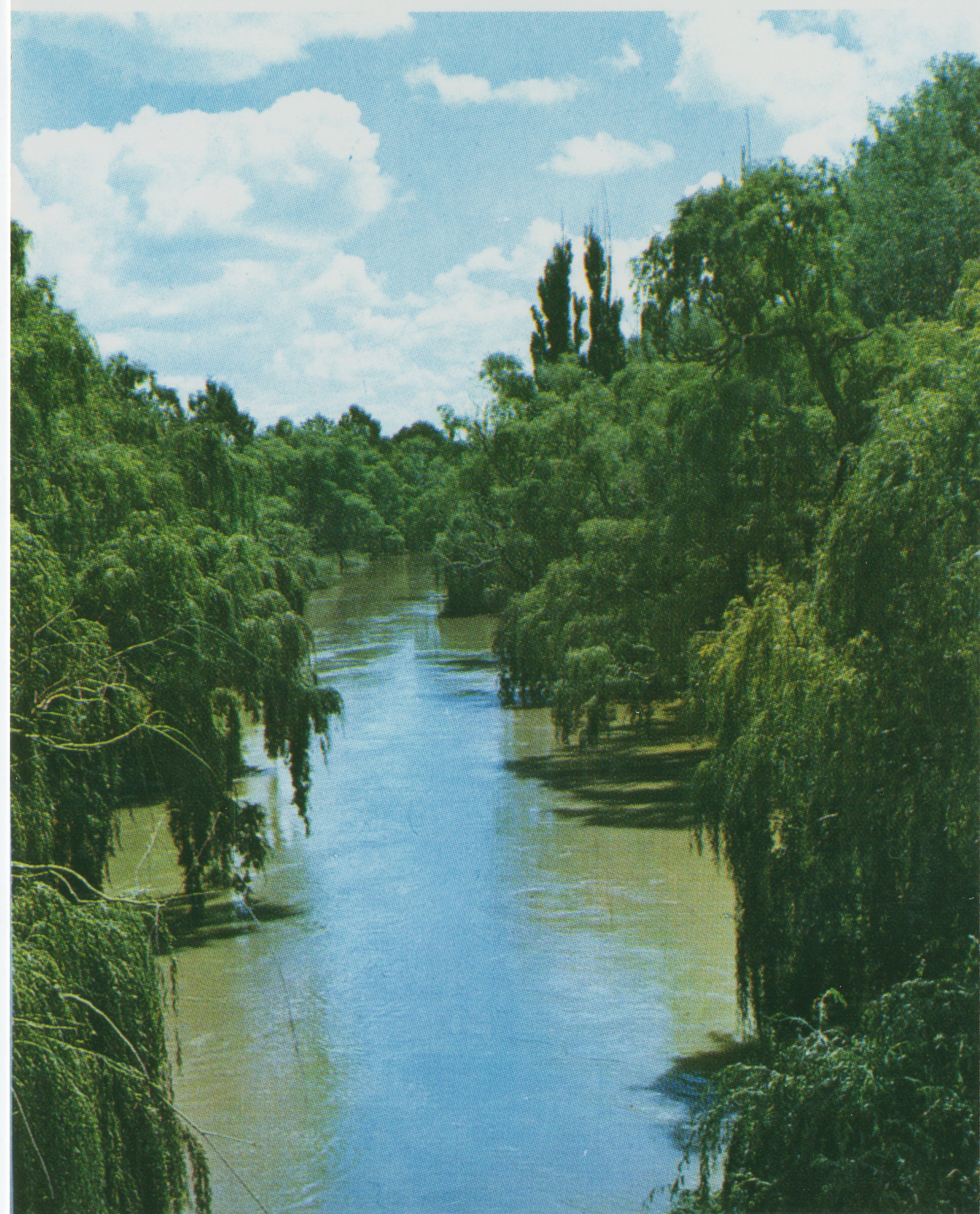
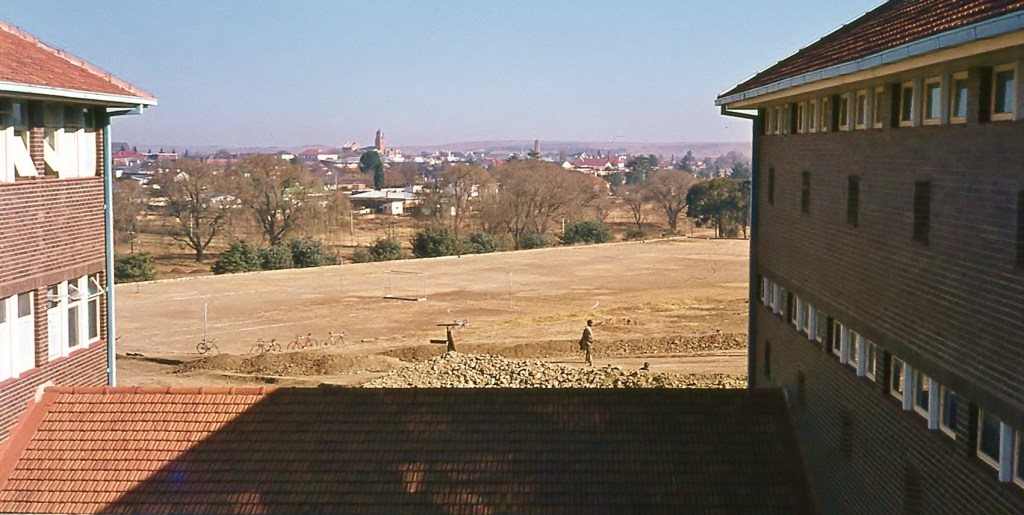
So I did. Every morning a few of us (Louis Wessels, Tuffy, Leon Crawley, who else?) got up at 5am, cycled a mile to the boys hostel and then ran the X-country course. About 3km up a hill past the jail, across, down through a donga/stream bed and back. Probably a 20 minute run. After school I would cycle to the mighty Vulgar River and paddle Charles’ boat (which I left “hidden” under a willow tree) for about a km or two. The cycle back home was uphill.
I’m not even sure I told anyone I was I was aiming to paddle the Dusi! I must have, surely? They knew about the boat anyway.
I have never been as fit in my life, before or since. Running I felt like I could fly. I would run hard, then even harder and still think “I could just carry on like this!”
Today I re-read Graeme Pope-Ellis’ book. The part about his training in 1971.
He ran at 4.30 am for two to two-and-a-half hours; He ran hard. In the afternoon he paddled for two to two-and-a-half hours; He paddled hard. Plus he did half an hour of hard, targeted gym work.
My total training was an hour a day and only parts of the running was done hard. The cycling and paddling were leisurely. To this day, I chant, No pain; No pain!
I didn’t have a clue what “train hard” meant! Talk about chalk and cheese! Quite an eye-opener.
I didn’t do that race in 1972. My boat was stolen shortly before – around New Year. I hitch-hiked to the race and followed it down through the Dusi and Umgeni valleys (with friend Jean Roux), sleeping in the open and bumming rides with paddlers’ seconds. Graeme won the race. His first win. He went on to win it 15 times.
Later I got to know Graeme and many of the guys who dedicated their lives to winning the Dusi. They trained like demons. Some of them did beat Graeme. Occasionally. But usually Graeme did the winning.
Me, I became a tripper! One of the trips was with Graeme and other fast paddlers who geared down and bumbled down the Colorado River through the Grand Canyon in leisurely fashion. My style!
~~~oo0oo~~~
In my first Dusi in 1983 I politely waited for the okes in a hurry to move on over the flat water in Alexander Park and when I go to the weir I paused to tie a shoelace. Jerome Truran (world-class whitewater paddler) was spectating that year. He spotted me and said “Hey Swanie, you do realise this is a race, right?”
Mrs Hawkins circa 1944 with her horse Pie. Mrs Hawkins was the mother of the five spinster Hawkins sisters who lived at Watersmeet at the bottom end of Harrismith. There were also 2 brothers. Only really old Harrismith people will remember this wonderful family. Blanche wrote the “History of Harrismith”. The other sisters had names like Mab, Mary (known as Bloody Bill who nursed “up north” in the Second World War) Vi and Flo. What wonderful names!
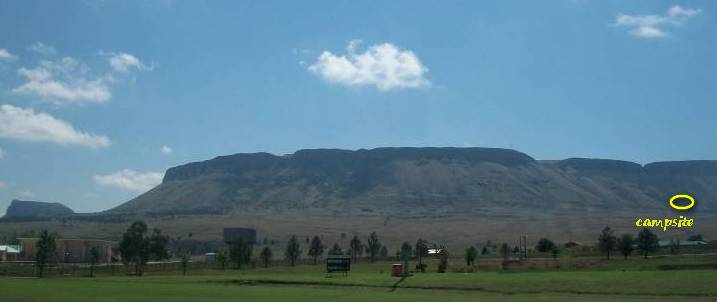
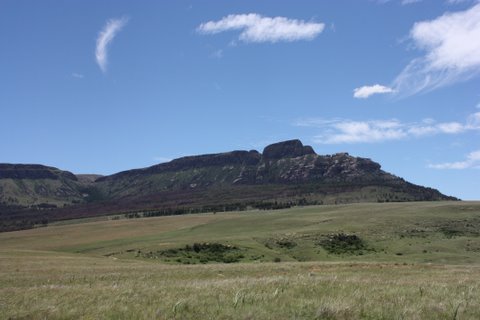
a willow tree in picture, Platberg in the background –
Watersmeet was a plot on the west end of town, covered in willow trees, where the sparkling Platberg water of the Kak Spruit – after flowing through SA’s second-oldest golf course – flows into the Wilge River on its way to the Vaal River and then the Orange River and then finally the Atlantic Ocean.
Barbara wrote:
I always thought there were 6 sisters that spoilt you and I rotten at “Watersmeet”. Those were really the good ‘ol days. I loved aunty Vi and was rather scared of some of them, but they were all fantastic ladies. The horse’s name was Robin Pie and the old lady was Mrs. Eliza Hawkins.
Jill Taylor (grand-daughter of Eliza?) wrote:
Just the 5 aunts – how does Sheila know so much about them?! Flo, Blanche, Mary (Bill), Mab and Vi in age order and then Frank and Len were the two brothers. They were all characters!
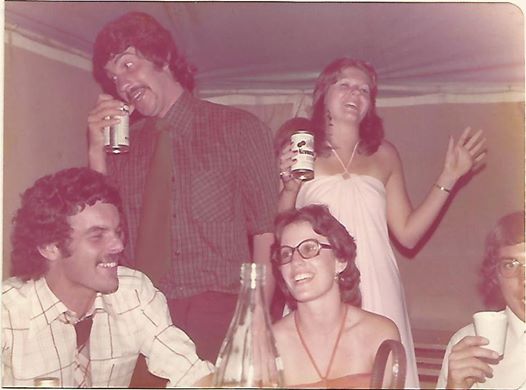
After NTC Rag Ball in 976, we left Pietermaritzburg’s notorious Hotel Insomnia and drove home in Tabs’ red Datsun fastback, famed for having being called a Ferrari by one of the automotively-challenged TC girls, and a Datsun Triple Ess Ess Ess by Geoff Leslie. We had spent a few short hours in the Hotel Insomnia after the ball was over. I seem to recall about a dozen people in a double bed.
Braithwaite was behind the wheel. He had held back slightly as he still had to drive on from Harrismith to Nelspruit where he was needed to dry-clean some Lowvelders’ underpants. Tabs was in the passenger seat, me on the back seat.
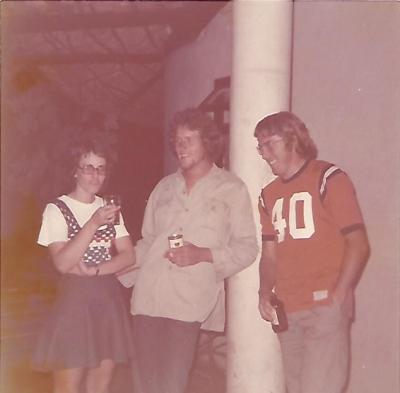
me & Liz Howe, Sheila & Hilton – Tabs in full voice with John Venning –
Under the flat raking solar panel-like back window of that red fastback was most of a case of beer, baking in the sun. After a short hung-over silence Tabs turned to me and asked “How hot are those beers?”
I said “Shall we share one and see?”
He said “Let’s open two and share them and see.”
We happened to finish the case before we got to HY. Thank goodness for Hilton’s driving! It’s a lot easier to divide by two than by three after a few ales.
Tabs & Jilly Shipman sing – Dave Simpson, Lettuce and me sit -all at a very clever stage of these academic proceedings –
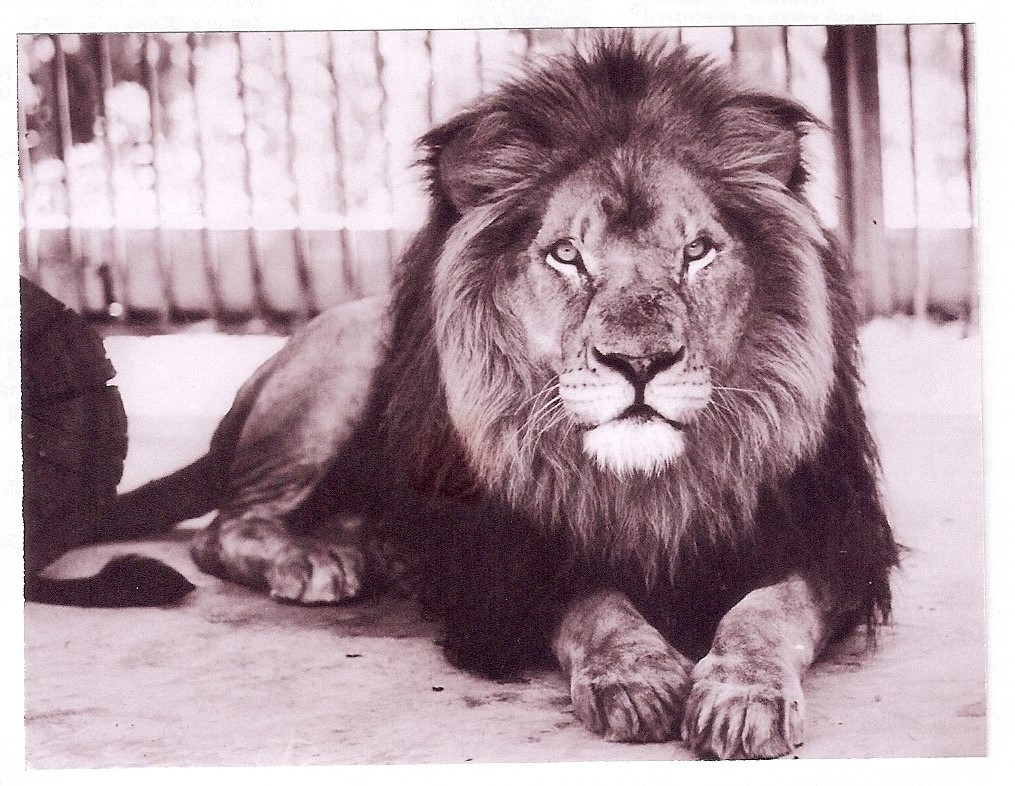
In Harrismith Vrystaat in the sixties you could hear, if you listened carefully, the sound of lions roaring in the evenings and the early mornings. This is true. If you listened you’d hear the uuuuunh uuuuunh uh uh uh uh of a male lion. Here’s how that came about:
The Man
On 1st June 1955 Mr CJ (Bossie) Boshoff was appointed as parkkurator of the now well-established President Brand Park by the Harrismith Municipality. It seems to have been a happy choice, as his entertaining letter about the history of the zoo he established attests. It was written in November 2005, fifty years after he started his new job. He moved to Harrismith to take up the post, which included accommodation in the form of a house in the park he’d be in charge of. This sounds good, but the house was ‘in a state’ due to the previous tenant living in it with etlike groot honde, so the house needed major cleaning and opknap. So much so that Bossie had to stay in the Royal Hotel for a while till the house was livable.
parkkurator – curator of the HS park
etlike groot honde – a few big dogs
opknap – renovate
The Thought
According to Bossie there was a runaway fire on Municipal property in 1958, and after the municipality had been paid insurance money for the damage, Bossie laid his eyes on a pile of fire-damaged treated fence posts, now written off, and he thought: As ek van hierdie pale in in die hande kon kry dan kan ek n kampie in die park aanle waarin n paar wildsbokkies kon loop wat ‘n aantrekking vir die publiek sou wees.
Once he was given the nod by the town council, he chose an area about one hectare in size just above the Victoria lake, and put a fence round it using those burnt poles, then put a road round the fence so people would be able to see his planned wild animals from their cars once he managed to bekom some wildsbokkies.
If I can get my hands on those I could make a fenced paddock and keep a few antelope to attract the (paying) public!
The Animals
According to Bossie, his first inmate was a mak ribbok ooi – a tame mountain reedbuck ewe (‘rooiribbok’) donated by councillor Mike van Deventer. However, as human memories go, according to The Harrismith Chronicle of January 1956 the first inmate was a blesbok ram donated by Hendricus Truter of ‘Sandhurst’. So it seems Bossie’s zoo had an earlier start then he remembers! Such are fifty year old memories!
More animals were offered ‘if they could be caught’ like two fallow deer by Lieb Swiegers. ‘Mes‘ Snyman would be asked to do the catching. After that the park was given a tame aap mannetjie – a male monkey, likely a vervet.
Then the floodgates opened and all sorts of pets were donated to hierdie toevlugsoord! The first of these was a female baboon named Annemarie, so now Bossie needed better cages. Luckily, he says, the town councillor in charge of the park, Pye von During, owned a grofsmit behind the Kerkenberg kerk, and willingly welded iron cages for Bossie.
hierdie toevlugsoord – this sanctuary or refuge!
grofsmit – blacksmith; or engineering works
Bossie’s next tenant was a blesbok ram who he thought was behaving a bit oddly – nie lekker op sy pote nie. On enquiry he discovered it was onder sterk brandewyn kalmering.
Not steady on its feet – it had been given a strong brandy tranquiliser to relocate it!
Then he got a tipiese raasbek boerbok – a typical ‘loudmouth’ goat!
Next he was offered a lioness from one of the Retiefs from Bergville (hy dink dit was Thys). The asking price was fifteen pounds Sterling, and as with all finances, he would need council’s permission and a formal decision to be taken. He went instead to Soekie Helman, as he knew Soekie’s “voice was loud in the council at that time.” He’d got to know Soekie when he stayed in his hotel. Soekie’s decision: “Buy the thing and we’ll argue later.” They did. Bossie soon noticed this five month-old pet was gentle for a while and then would ‘suddenly get serious,’ so he realised a strong cage was needed fast. Two high brick walls were built at right angles, a roof on top and a semicircular front made by councillor and blacksmith Pye von During of strong iron bars was installed from the end of one wall to the other with a sliding door. Inside, a brick shelter was built in the back corner. The roof of that shelter became the lions resting and outlook spot. This was the concrete stage where the male lion we heard in our youth would lie and roar his frustration over the hills of Harrismith.
At this stage Bossie asks impishly: Sien u nou in watter rigting die onskuldige wildskampie besig is om te beweeg?
can you spot where this ‘innocent little animal enclosure’ idea is going?
Now there was a lion cage, and next thing Henrie Retief (Thys se broer) phoned from Bloemfontein to say he had bought a male lion which he was donating to what was now undeniably a zoo (not just a wildskampie) on condition that if ‘something happened to the animal one day’ he would get the pelt! The lion-lioness introduction was – according to Bossie – ‘Love at first sight’!
A lady ‘anderkant Warden’ gave them three small jackals which Bossie fetched and built an enclosure for. The increased enclosures within the overall 1ha camp now necessitated footpaths winding about between them, as most visitors were now on foot, no longer just driving around the perimeter.
Tannie Marie Rodgers donated a spoilt hans – hand-reared – duiker ram which head-butted visitors, his sharp horns sometimes hurting folks. Bossie solved this by putting .303 shell casings on his horns to blunt them!
The male lion grew up and his roars could be hear all over town, ‘to the top of 42nd Hill,’ says Bossie, and certainly at 95 Stuart Street where we lived. The lioness fell pregnant but died in childbirth. The male watched them closely as they removed her body. She was soon replaced by another from Bloem, who was placed in a separate cage for two months so they could grow accustomed to one another, but – alas! says Bossie – when they introduced them the male killed her with one bite! (this happens; and we don’t learn!) Later they got new lions: A male and two females. Bossie said they had to ‘wegmaak’ the original male – kill? sell? Did ou Henrie get his pelt? Wait – The Chronicle of December 1959 says there was talk that ‘a local farmer’ would take the lion in exchange for two blesboks which would be swopped for three lions from Bloem! How common must captive lions have been? The three new lions cost them two blesbok ewes in an exchange! These were donated by Kerneels Retief who hand-caught them himself on his farm Nagwag from his moving bakkie at 45mph to Bossie’s amazement. So, Kerneels probably took the lion, then?
More on pricing game: The zoo later got two wild dogs and a warthog from South West Africa in 1959, swopped for two mahems – crested cranes. In 1965 the Natal Parks Board donated six impala and two warthogs. I wonder which of the warthogs became ‘Justin’ the famous one the Methodist minister Justin Michell would feed and talk to on Sundays after his sermon?
In January 1964 three lion cubs were born. One was killed the same night, the others were removed and raised by Mrs JH Olivier. In 1966 the Chronicle told of two five month-old cubs for sale. These cubs had ‘been involved in a hectic incident’ a while before when two African attendants were tasked to remove them from their mother and she attacked them! Workman’s Compensation, anyone? And was the story suppressed when it happened?
Two porcupines arrived at the zoo, and soon made a nuisance of themselves, chewing the fence posts. One night Bossie’s assistant Machiel Eksteen saw one in the road outside the zoo, caught it with a hessian sack and put it back in the dark enclosure. Only to find three porcupines there in the morning!
Mrs Lindstrom (‘Redge se vrou‘) promised Bossie a python from Pongola and duly delivered it in a hessian sack, saying it was 3m long. Bossie put it in the storeroom on top of the ‘mieliedrom‘. The next morning Tobie (‘the feeder’) said the sack was empty! Of course Tobie was told he was talking nonsense, but he wasn’t. A big search was instigated, the Voortrekkers were even called in but the snake ‘is missing to this day.’ Bossie says, ‘Just as well, as I don’t think he’d have adapted to Harrismith’s cold!’ Um, that doesn’t make things better, Bossie! Another escapee was a civet cat, one of a pair from Ladysmith. But it was found.
Then came their ‘biggest challenge’: A lady phoned. She was oom Kaalkop vd Merwe’s skoondogter (daughter-in-law). Kaalkop was the MP for Heilbron. Did Bossie want two Russian brown bears? They were her children’s pets but had grown too big and they were going for thirty pounds Sterling the pair. The ever-resourceful Bossie got to work: He went to business owners in town and said ‘You owe me one pound.’ Bossie says he badgered ‘Jan van Sandwyk of Harrismith Motors, Rheine Lawrence of the chemist, Redge Lindstrom of the tyres, Jannie du Plessis of the tractors, etc etc’! and by that same afternoon he had his 30 pounds and bought the bears, which, he says, made Bloemfontein zoo, ‘yellow with jealousy!’ Here, he says was a postage stamp-sized zoo in a small dorp that was now known nationwide! Again with the willing help of Pye von during, he made the cage of iron, with a concrete waterhole and some tree stumps, just what zoos of the time thought bears needed.
In 1963 a concerned resident wrote to the Chronicle about the poor condition of some of the animals. Mayor Boet Human and councillor Pye von During were interviewed and basically said ‘all is well.’
Bird Aviary
A large aviary was built. People donated peacocks, guineafowl, fantail pigeons, a tame crow, ‘mahem’ crowned cranes and an ostrich. And tortoises. It became ‘a certain status’ to donate an animal to the zoo, says Bossie – and he ‘appreciated that enormously.’
How to Feed this Menagerie!?
Suddenly food was an issue! How to feed the growing menagerie? They started charging adults a sixpenny entrance fee. Kids were free but had to be accompanied by an adult. Most of the meat for the lions was supplied by generous farmers. He mentions oom Frikkie (probably Varkie?) Badenhorst whose dairy had no use for bull calves and donated these. Mostly it was on a ‘yours if you fetch it’ basis, so Bossie would have to travel all over the district to keep his lions in meat. Farmers would donate their horses once they got too old to ride. The fact that many of these had names, and that they were still ‘on the hoof’ and looking at him when Bossie arrived didn’t make matters any easier for him.
One such was Ou Klinker, a Clydesdale used in the town’s forestry department. Piet Rodgers, the forester, told Bossie he could fetch Ou Klinker – but only when Piet wasn’t there! Bossie says usually when the shot was fired the horse’s legs would just fold and they would drop on the spot, but not old Klinker! When the shot went off he rose ‘like a loaf of bread and fell as stiff as a pole, says Bossie. And then he says ‘dit was baie vleis!’
that Clydesdale was a lot of meat!
The local police also phoned whenever they came across road kill, and the health inspector Fritz Doman would tell him whenever he condemned a pig with measles at the abbatoir. One guy even offered a dog on a chain. But surely Bossie didn’t . . Oh, yes he did! But the lions ‘het nie baie van die vleis gehou nie,’ says Bossie. They did like the pork, however.
didn’t much like the dog meat
Meat Storage
To keep surplus meat cool, Bossie built an old-time ‘evaporation fridge’ of bricks and clinker in chicken mesh, kept wet so the evaporation cooled the interior. It worked ‘uitstekend’ (very well).
The Wheels of Change
Bossie took a job in East London, and without its champion this wonderful eccentric project was in a precarious position. A new town clerk De la Rey arrived and decided Harrismith was too small ‘n dorpie to afford a zoo (wasn’t that exactly the fun thing?) – he must have been a beancounter! According to Bossie the animals were ‘sold to circuses, given away – and Harrismith is the poorer for it.’
Most of this source material comes from Harrismith historian Biebie de Vos. Thank you Biebie! Without you, Harrismith would have been the poorer for it! Much would have been lost if Biebie hadnt saved it.
More Research Needed
But here we need to find out what really happened with the sale? Can Mariette Mandy help? Did the Chronicle report on this? Where’s de la Rey? Where did Patrick Shannon, who ended up with the cheetah, fit into the tale of the Harrismith zoo? I heard he bought it lock, stock n barrel and then sold what he could, kept what he wanted and turned the rest loose! I know that I saw Justin the warthog floating pote in die lug * all bloated up, stone dead and smelly in the Wilge river when I was out canoeing one afternoon (1970 or 1971 if my memory is right, so we can check that timing).
legs sticking up vertically out of the water as I paddled past
~~oo0oo~~
I’d love to get some pics of the zoo from a distance or from outside, plus any of the animals. Who knows the general layout? I can draw a rough plan as I know where warthog corner was, where the lion cage was, and where the entrance gate was; plus the aviaries (and am I right there were vultures?). But other than that I’m a bit vague. Someone will know!
Biebie’s pic of our Harrismith lion. What a magnificent specimen!
~~oo0oo~~
Footnote: Mom remembers a Mr Patterson running the zoo. His one daughter Mary married tall Jack Hunt; the Hunts ran the dry cleaners and were Steve and Jenny de Villiers’ loving grandparents. Another daughter Margaret, married Frank Mandy, Syd’s father.
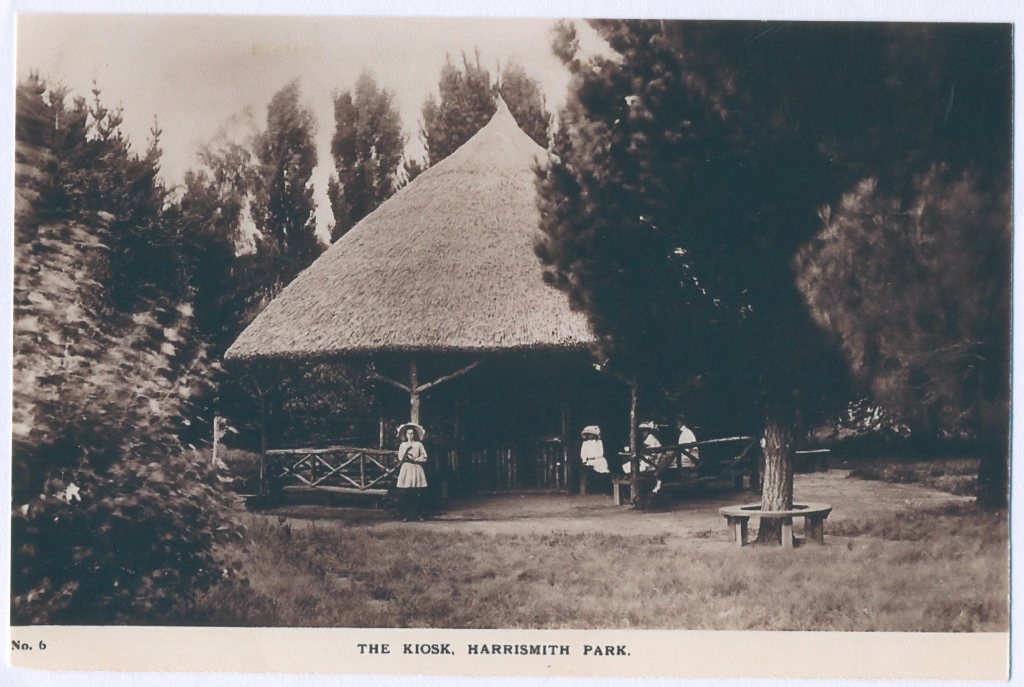
We loved the park down by the riverside. We’d go there on Sundays with Mom or Annie or both – in our light blue VW beetle ca.1959, or in Annie’s beige Chev Fleetline ca.1949. The centre of attraction at first were the swings, but the kiosk was the real place if you could get Mom to buy anything from them. You can read some dodgy history of the establishment of the park here.
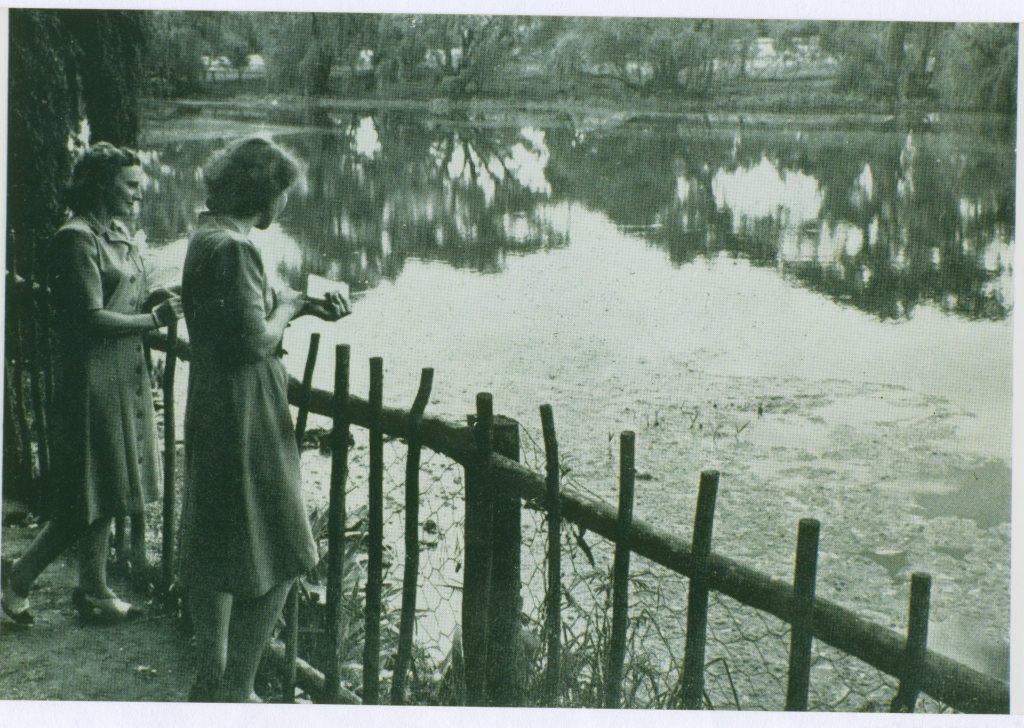
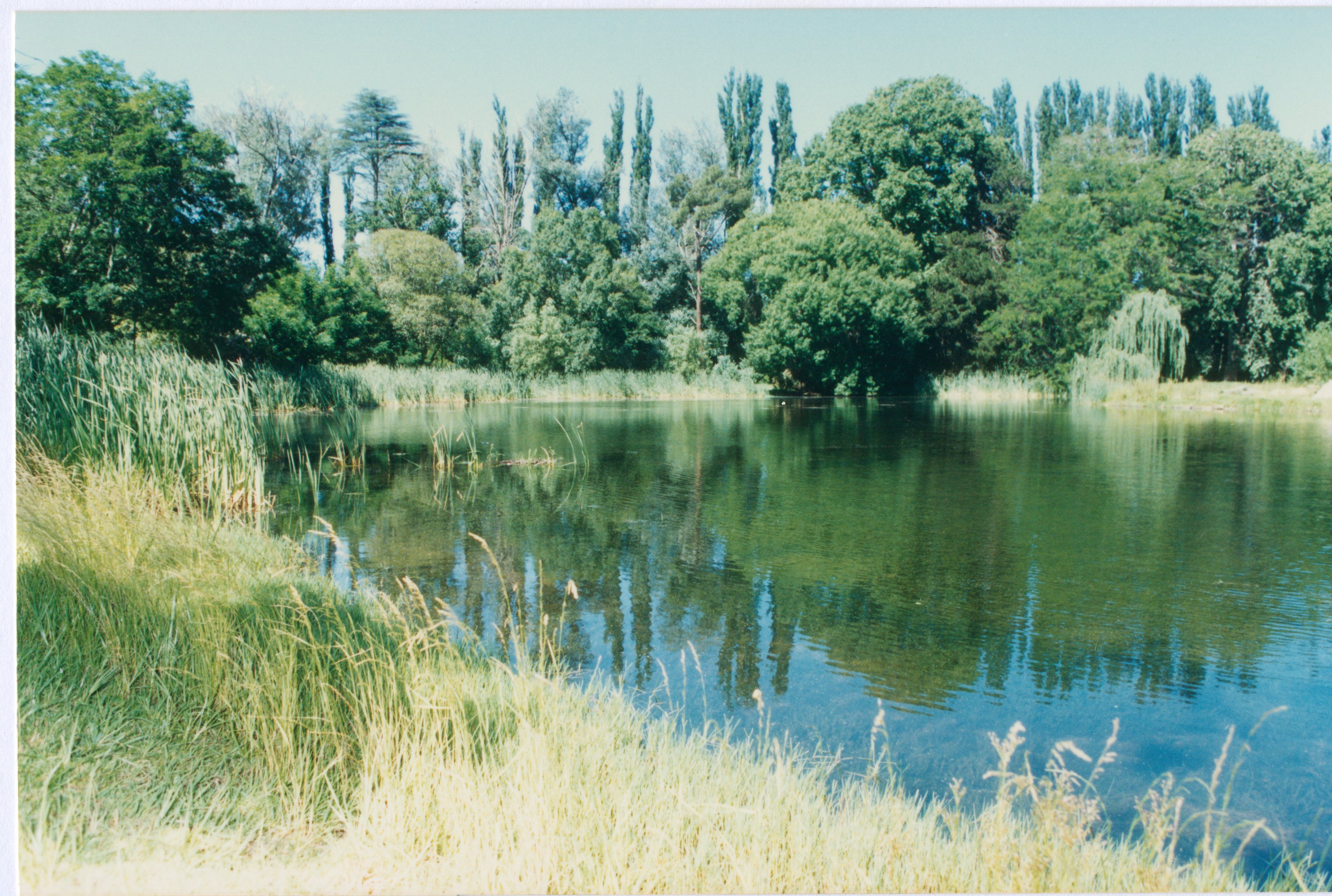
Near the lake there was a cork tree, surrounded by a fence to protect it, as people would pull off the cork bark. The lake had some ducks, I think. I seem to remember feeding them at this fence, which was probly quite old by the 60s when we used to go.
Later the road next to the river became a focus, with its huge leaning trees that I just knew were going to fall down at any time! Then the suspension bridge which was great fun – some wanted to make it sway and some said Hey! Stoppit! Don’t make it sway! When we were even bigger, the swing from the willow tree a couple of hundred metres further down the road. It swung out over the river. Being a bit of a bangbroek, I remember my first swing and successful return to dry land quite clearly. And I remember teacher Bruce Humphries not making it back once and causing quite a splash.
By now another weir had dammed the river much further upstream at Sunnymede, creating a bigger and wider expanse of water, so not much motor boating was done in the park in our time.
In the fifties a zoo was added in the NW corner of the park. That’s a fascinating story in itself!
As time went on we used the park more for its sportsfields – there was a cricket oval, a rugby field surrounded by a 440m cinder athletics track overlooked by a big new concrete pavilion for spectators, a hockey field, a netball field and probably some jukskei sandpits for those stuck in the past.
The park was extended across the river, but the other side was not oft-frequented by us. I remember it mainly as a late night race track and a picnic spot for the annual MOTH picnic.
In our time, a caravan park was started on the town side of the park with a new ablution building.
– view of the Wilge River from a bridge – the suspension bridge or the ysterbrug, not sure-
Victoria Lake
Personal memories of the park were about rugby games, athletic meetings and then later on, cars – cars before we were actually allowed to drive! ‘Borrowed’ cars. Stealthily borrowed late at night from our parents on a no-permission-sought understanding. The best was Steph de Witt’s black Saab. Actually Gerrie Pretorius’ Saab but ours for the night – ‘borrowed!’ We would hurtle around the atletiekbaan at speed , drifting sideways left then sideways right long before ‘drifting’ had a name. One night we hugged the final bend coming into the home straight and there was a moerse big bloekom stump in the headlights right in front of us! Someone must have seen our tracks and thought ‘I’ll put a stop to this!’ or ‘Ek sal hierdie bliksems wys!‘ How Steph missed that huge log I do not know, but we hosed ourselves and roared off. Instead of Yee Ha! we’d say Arrie-ee! (from a joke about camels . . )
On the other side of the river it was in Tim Venning’s light blue Triumph 2000. Actually Dr Dick Venning’s Triumph, but ours for the night – ‘borrowed!’ Tim behind the wheel, laughing his head off as we roared around in a cloud of dust late at night, drifting sideways most of the time.
We were good kids all in all though, of course. Nostalgia makes it ‘naughtiness,’ ‘mischief.’ Nowadays people would slate the ‘Hooliganism Of The Youth Of Today!’ Maybe adults did then? Tut tut, how wrong they were . . and are.
~~oo0oo~~
atletiekbaan – 440 yard athletic track – a cinder track
moerse big bloekom stump – huge ‘blue gum’ eucalyptus log or stump – over half a metre in diameter and three to five metres long. If we’d hit it, the SAAB would have been moertoe
moertoe – varktap
varktap – damaged
Ek sal hierdie bliksems wys! – I’ll show them! Ha! he missed! We were too rats
” . . and over the hills lay long fields of barley and of rye
and through the fields a road runs by . . .“
Douglas Wright Esq would wax poetical after a few beers, quoting Alfred, Lord Tennyson out on the Vrystaat vlaktes. I spose that’s what happens if you get sent to a soutpiel school in the colonies.
I see now he was misquoting Tennyson – or maybe I misremember and he was spot on? Anyway, I prefer his version. It’s hardwired in my brain now.
In my mind’s eye dear ole Dougie is wandering across the veld with a shotgun in the crook of his arm, deerstalker on his head, waxing forth . . . .
Fifth from the right wearing a black beret
The rest, L to R:
Tony Porrell, Koos Swanepoel, Nev Shave, Charlie Deane, Dirk Odendaal, Ian Fyvie, Rob Spilsbury, Nick Leslie, Doug Wright wearing the black beret, John Venning, Mike Curnow, Tabs Fyvie and Guy Kirk
~~~oo0oo~~~
Other Dougie things I remember:
‘Let’s play Bok Bok Staan Styf! Hoeveel fingers op jou lyf?’
‘We must play pennetjie!’ – urgently suggested after a few beers. We never did.
His fox terrier — (name?)
His cottage on Glen Khyber, their plot in the shadow of Platberg, away from the big house. It was right on the verdant banks of a little stream that flowed down from Khyber Pass into the beautiful Kak Spruit as it tumbled down from Platberg on its way to the Wilge River. Glen Khyber was below Platberg’s steep, narrow, stony Khyber Pass.
Sheila remembers:
Doug’s story about Tabs Fyvie when Tabs was little: Dougie asked him “Did you have any rain?” and Tabs answered “Not much but they were big drops”.
How we used to walk to Glen Khyber from Birdhaven and wake Doug up in his cottage (him probably hung over) and Barbara would show him her whispy ponytail at eye level as he lay in bed and say “Look Doug, my ponytail!”.
1. Birdhaven – the ruins; 2. Glen Khyber – Doug’s cottage the green roof;
3. Jack Levick’s plot; 4. Kakspruit
~~~oo0oo~~~
soutpiel – English-speaking South African; said to have one foot in SA, the other foot in England, his penis hanging in the sea, so ‘salt penis’
Bok Bok Staan Styf! Hoeveel fingers op jou lyf? – weird game where you jump on each others’ backs! amiright?
pennetjie – game where you scratch a hole in the ground and use a stick to prevent your opponent from tossing his stick into the hole; amiright?
Kak Spruit – Shit Creek; Stream flowing down from the top of Platberg past Dougie’s plot Glen Khyber, then past our plot Birdhaven
I’ve always wanted to fly. Who hasn’t? But I dislike noise, so while my first flight in a light aeroplane (I think with an Odendaal or a Wessels piloting it?) was great, and my first flight across the Atlantic in a Boeing 707 at seventeen was unforgettable, it was a glider flight that first got me saying “Now THIS is flying!!”
We hopped into the sleek craft, me in front and pilot Blom behind me. Someone attached the long cable to the nose and someone else revved the V8 engine far ahead of us at the end of the runway of the Harrismith aerodrome on top of 42nd Hill. The cable tensed and we started forward, ever-faster. Very soon we rose and climbed steeply. After quite a while Blom must have pulled something as the cable dropped away and we turned, free as a bird, towards the NW cliffs of Platberg.
“OK, you take the stick now, watch the wool” – and I’m the pilot! The wool is a little strand taped to the top of the cockpit glass outside and the trick is always to keep it straight. Even when you turn you keep it flying straight back – or you’re slipping sideways. I watched it carefully as I turned. Dead straight.
“Can you hear anything?” asks Blom from behind me. No, it’s so beautifully quiet, isn’t it great?! I grin. “That’s because you’re going too slowly, we’re about to stall, put the stick down”, he says mildly. Oh. I push the stick forward and the wind noise increases to a gentle whoosh. Beautiful. Soaring up close to those cliffs – so familiar from growing up below them and climbing the mountain, yet so different seeing them from a new angle.
And then, even better, I flew like a bird alone with only a hankie overhead.
This was taken at the sad occasion of Jean Coleman’s funeral yesterday. Jean was Mum’s great friend in Harrismith in the 50’s & 60’s. They lived in Hector Street, opposite the du Plessis’ first home.
Mum says when we still lived on the ‘townlands’ on the way to the waterworks, Jean would often ‘phone and say “Have you got a little visitor?” – once again her son Donald had gone missing *** and she knew exactly where he was – he used to walk all the way to our farm to visit his great mate, Koos. The two were inseparable.
Mary Methodist is Anne’s godmother. The Colemans left Harrismith in about 1964.
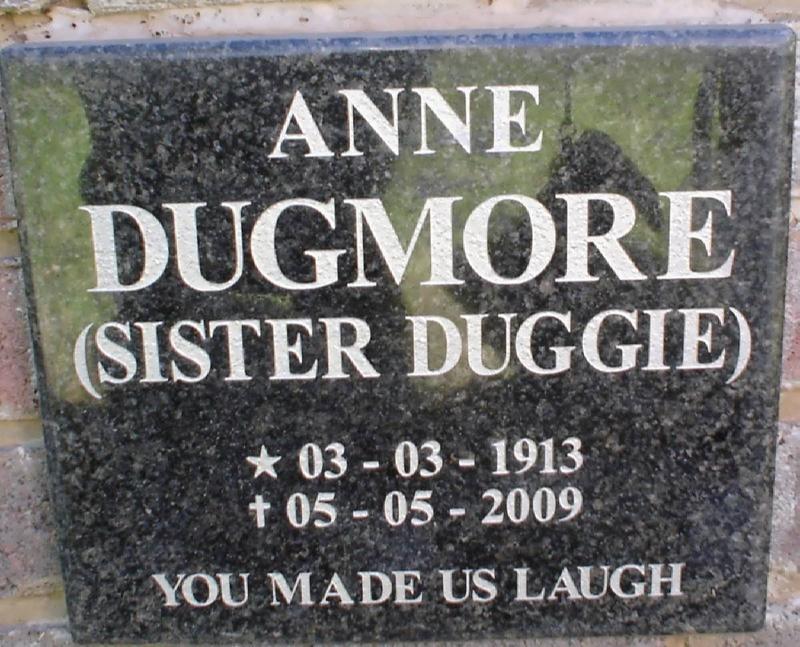
While we were standing around chatting yesterday, Anne suddenly realised that she, her brother Eddie, and George Elphick (whose daughter is engaged to Anne’s son – small world) had all been delivered by Sister Dugmore at the maternity home on Kings Hill.
“So were we!” chorused Koos & Sheila!
So we had to have this pic taken!
– born in the same spot – Eddie Coleman, George Elphick, Anne Coleman Immelman, Sheila & Koos Swanepoel –
Duggie Dugmore’s maternity home – and below what was left of it the last time I visited. )
– Anglo-Boer War doctors house – then Duggie Dugmore’s maternity home – Kings Hill –
More from Sheila:George Elphick is an architect in Durban. His parents John & Una, also left Harrismith in about 1964. They lived in Lotsoff Flats where Una had a grand piano in their tiny sitting room! She was a very talented pianist and used to accompany Mary Methodist, Trudy Else and other singers. We used to have ‘musical evenings’ in our home in Stuart Street – wonder what the neighbours thought? John Elphick, bless his soul, had an enormous reel-to-reel tape on which he would record the proceedings. I have had these tapes put on CD – no Grammy winners here – but just to have this music preserved is so special. I have Mrs Euthemiou singing ‘La Paloma,’ William vd Bosch singing and playing his guitar, Harold Taylor singing ‘Til the sands of the desert grow cold.’ Harold lost his leg at Delville Wood and on tape he tells us that he learnt the song on board ship en route to Alexandria in Egypt, in World War 1. So now you know.
~~~oo0oo~~~
*** Donald once did a big ‘going missing’ on the beach somewhere on the KwaZulu Natal Coast. That time the police were called to help find him. But – as always – he was just exploring. He’d have made it home sooner or later, I’m sure.
We grew up next door to Gould Dominy on a plot outside town. Our plot was Birdhaven, theirs was Glen Khyber. We knew him as Uncle Gould and would watch fascinated as he drank tea out of the biggest teacup you ever saw. Size of a salad bowl. A flock of small dogs would be running around his ankles as he drank, seated on their wide enclosed and sun-filled stoep.
Then he disappeared and re-appeared years later at the hoerskool as religious instruction (‘RI’) teacher. Seems he had been teaching music at some naff school in Bloemfontein all those years. St Andrews or St Somebody. He’d probably deservedly been promoted back to Harrismith.
He had been very fond of me as a boy but he was re-meeting me as a teenager and that was about to change. Or would have had he not been such an amazingly tolerant and loving gentleman.
His classroom was at the back of the school in the row of asbestos prefabs. For the cold Harries winters it had a cast-iron stove that burnt wood or coal in one corner.
We were terrible. We would saunter in while he caught a quick smoke outside, grab his sarmies and scoff them, move the bookmark a hundred pages forward in his copy of The Robe* (that he was considerately reading to us as our “RI” in lieu of bible-punching) and pull up our chairs around the black stove and sit with our backs to him. Maybe to compensate, Katrina would sit right in front of him and give him her full attention. She was a mensch.
Dear old Mr Dominy would come in and start reading while tickling the inner canthus of his eye with a sharp pencil till he couldn’t stand it any longer, would then “gril” and rub his eyes vigorously, flabby cheeks and chins wobbling, and then carry on reading. Every so often he’d mutter “I’m sure we hadn’t got this far?” proving he was the only one listening to the story. Maybe also Katrina. But even the girls, sitting in the normal school benches, wouldn’t comment on the fact that we read ten pages a day but moved on a hundred pages at a time.
Our new classmate ‘Tex’ Grobbelaar, meantime, would also have swiped one of his cigarettes. Rolling up a sheet of paper, he would set light to it in the stove, light the fag and smoke it right there, furtively holding it in the palm of his cupped hand in that ‘ducktail’ way and blowing the smoke into the stove opening.
What a lovely man.
Gould. Not Tex.
Nor the rest of us.
~~~oo0oo~~~
Here’s Ann Euthemiou combing Mr Dominy’s hair on a trip to Kruger Park back in 1968.
*The Robe – a historical novel about the crucifixion of Jesus written by Lloyd C Douglas. The 1942 book reached No. 1 on the New York Times best-seller list.* The 1953 film adaptation featured Richard Burton in an early role. (wikipedia)
~~~oo0oo~~~
hoerskool – house of ill repute; or place of learning if you add an umlaut; s’pose the first could also be a place of learning, right?
gril – shudder, jowels wobbling;
– * which is dodgy; the New York Tines best-seller list is DODGY!
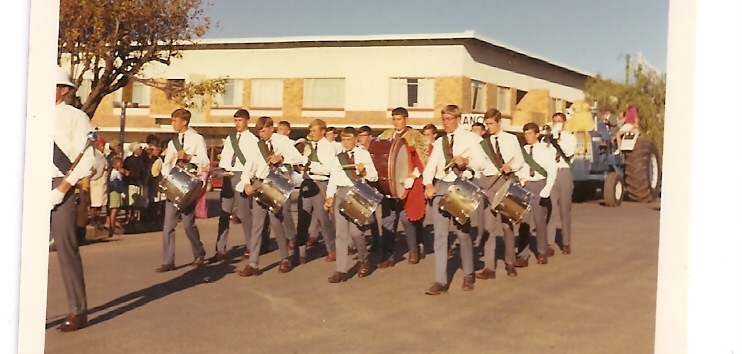
Marching in the cadets was a ballache. Once a week we would arrive at school not clad in grey shirts, grey shorts and grey socks, but in khaki shirts, khaki shorts and khaki socks. It was ‘kadet dag’ or something equally sinister. Softening us up and brainwashing us in the glory and honour of fighting for the vaderland – against okes who had been here longer and thought it was their bladdy vaderland, kan jy dit glo!?
This had to stop, so Lloyd and I decided to try out for the orkes. Still the kadet orkes, and you still had to wear khaki but we thought it might be less onerous. You couldnt march as much cos you were busy trying to blow something or bliksem something. In tjoon. Also, you could shushine your khaki putties for some light relief.
I was assigned a drum to bliksem and drumsticks to bliksem it wif. Zunckel was give a bright brass trompet, slightly battered, to blaas fru.
– actually a bugle –
What was lekker was instead of marching up and down like drones in the school grounds with some kop-toe ou shouting LI-INKS . . . . OM!! we headed off out the gates towards town. There we were, pale Vrystaters going on A Long Walk To Freedom! Often there wasn’t even an onnie with us, and nobody shouting. We marched to the beat of the huge bass drum. Boom Boom Boom. Left Right and all that, rinse and repeat. We would march right into town, once going as far as the post office.
Bonus was you also got to keep an eye on the pomp troppies – seen here on an official outing – we dudes in the marching band in the background, eyes riveted on their swaying parts. So as to keep time nê.
Such freedom couldn’t last. Some parade was coming up and it was time for quality control. Kadet uber-offisier von muziek n kak, Eben Louw, lined us up, got us started on some military propaganda lied and walked slowly from one to the other, listening intently as we parum-parum-pummed away, his moustache bristling. He watched as I bliksem‘d the drum more or less in time, nodded and walked on.
Then he got to Zunckel. He leaned closer, then put his ear right near Lloyd’s trompet. “Blaas, jong!” he muttered. Niks. Not a peep. The Zunck had been faking it, pretending to blow with his cheeks puffed and his right pinky raised impressively. Never had learned how to make that thing squawk.
Back to barracks he went. ‘RTU’ the parabats would say.
~o0o~
Oh no! This post was a dredged-up memory from 45yrs ago. I sent it to my and Lloyd’s big mate Steve Reed in Aussie, who forwarded it to Lloyd’s sister Filly in Zimbabwe where I thought Lloyd would have a chuckle reading it.
blaas boetie, blaas jong – prove you actually know how to blow a trumpet and you’re not just fakin’ it; You’re faking it aren’t you?
kadet dag – toy soldiers day;
vaderland – fake concept designed to get you to do things without asking embarrassing questions;
orkes – brass band with drums n stuff;
kop-toe ou – brainwashed individual;
LI-INKS . . . . OM!! – Military command to get a bunch of people all dressed alike to go somewhere. Instead of saying to sixty people, ‘Listen chaps, please get your arses over to the mess hall. See you there in three minutes’, you line them up in twenty rows of three and start shouting blue murder and generally getting really irritated with each other. Forty minutes later you arrive quite near the mess hall in a cloud of dust and blue air all hot and bothered, the only thing you learnt being one new way to cuss your mother-in-law; Massively inefficient;