There’s a Crocodile River in Gauteng, so the river near Nelspruit that flows east into Mocambique and forms the southern boundary of the Kruger National Park has to be called the “Lowveld Croc”.
A wonderful canoe (kayak really) race is held annually on this river. The presence of hippopotamuses in the river adds a risk and a thrill to the two-day race. Race organisers engage with local farmers and wildlife people and trip the river in the weeks before the race in order to identify possible hippo hotspots which are then compulsory portages on race days. Sometimes a helicopter is used to do a scouting flight on race day morning, and volunteer paddlers also scout the route by starting ahead of the competing racers.
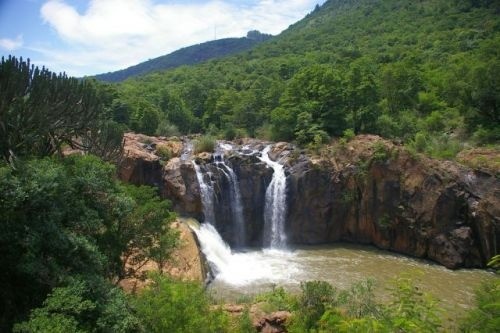
The year I did the race (1983) I remember the route as from above Montrose falls to Mbombela town (formerly Nelspruit). We portaged around the falls.
The hippo were in the last pool before the finish in Nelspruit, so the race was ended a few km short at the last accessible spot before the hippo pool. I see they now start higher up and end the race above Montrose falls.
~~~oo0oo~~~
Here’s video of the 1989 race. The second day here was our first day. We portaged around the Montrose Falls and paddled to Nelspruit (today’s Mbombelo). Actually, just short of town, as hippos in a pool at the usual finish dictated we end a couple km early.
~~~oo0oo~~~
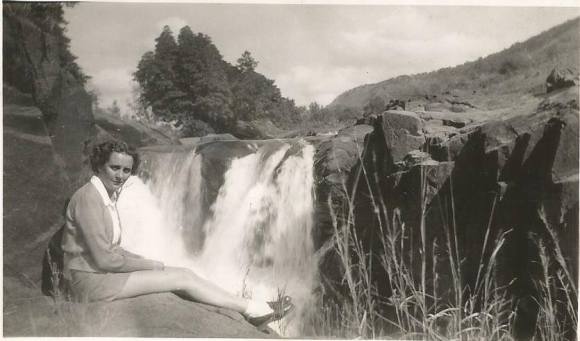
Back in 1951 Mom and Dad had stopped here on honeymoon, on their way to Lourenco Marques:
The original source of info for this post was on https://deoudehuize.blogspot.co.za/ – do go and look, they are doing wonderful heritage conservation things in Harrismith! And they have a cool old car!
Maximilian John Ludwick Weston was a South African aeronautical engineer, pioneer aviator, farmer and soldier – and mystery man. He was probably born on 17 June 1873 in an ox wagon at Fort Marshall south of Vryheid in British Natal (though he invented an entirely different place of birth when it suited him). He married Elizabet Maria Jacoba ‘Lily’ Weston (nee Roux) a direct descendant of Adam Tas. The couple had three children: Kathleen, Anna and Max.
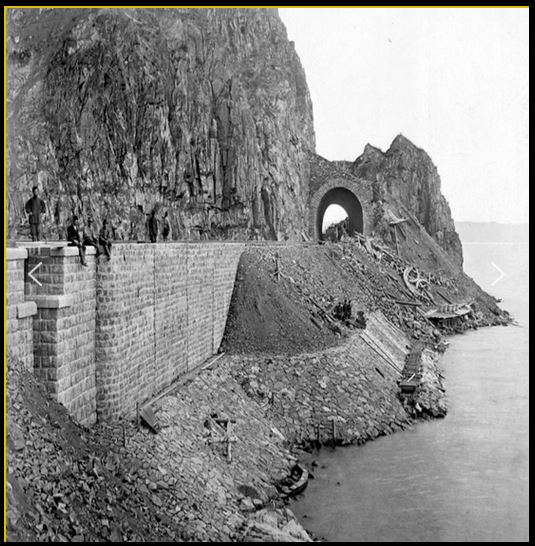
Weston’s early years are . . . interesting. And he may have invented a LOT of his life stories. But some things are verifiable – more or less, and they certainly are interesting! Read more detail here about his time building the railway line around Lake Baikal in Russia!
– was Weston here ca. 1903? –
Weston began the construction of his own aeroplane in 1907 at Brandfort in the Free State. This was the first South African-built aeroplane. He lacked an engine with enough power so he dismantled the aircraft and shipped it to France. In France he fitted a 50hp Gnome rotary engine and flew it successfully in 1910. On 16 June 1911 John made the first flight in Kimberley establishing a South African non-stop flight record of eight-and-a-half minutes in his Weston-Farman biplane.
At the outbreak of World War I Weston was appointed ground officer in charge of landing strips in South West Africa. He prepared an airfield with hangars and workshops at Walvis Bay.
For services rendered to the Greek Ministry of Marine he was made an Honorary Vice-Admiral in the Royal Hellenic Navy. Thus he was often glorified by the title of Admiral. Isn’t that delicious? The land-locked Free State had an Admiral! He appeared to relish the joke and later named his farm “Admiralty Estate”!
In 1918, John Weston took his family on an amazing adventure in this motorhome, a converted Commer truck. From about 1920 for twelve years, he and his family traveled the world.
The ‘Weston Caravan’, as it was called, was an extraordinary example of his tenacity and ingenuity. It doesn’t look like much from the outside and if the truth be told, the interior is enough to give anyone claustrophobia, yet this neat and compact arrangement of luggage and folding beds served them well. According to Weston, the living compartment could be removed from the chassis proper in a mere 10 minutes in order to float it across rivers, while the chassis could drive and/or get pulled across!
This ingenious ‘seven-by-fourteen-foot mansion’ ferried the pioneering Weston family on an overland trip from Cape to Cairo, and on to England, ‘to take the children to school!’
The purpose of Weston’s project was not simply to satisfy his lust for travel but was also an expression of his idealism. “To travel from land to land, to mix with the people of all nations…, to speak to them and hear their views, to study their institutions and their customs, that is his aim”.
It was also a bold experiment in the education of his children: he wanted them to see the world, to be freed from the narrowness and prejudices of those who grow up among never-changing surroundings, who know nothing of life beyond the pale of their dorp or city, the beauties and the grandeur of the earth, or of the nations and races who people it, and adorn (or mar) it with their works. He is preparing them to be citizens of Planet Earth”
On their trip from Cape Town to London they ‘had run-ins with elephants, occasionally had to float their vehicle across rivers on logs, and on occasions entire villages of more than a hundred natives had to dig them out of mud and thick sand and pull them up river banks.’ Weston said, “It can be stated without reservation that the indigenous people encountered on the African continent were all friendly and helpful“.
There were no fuel stations dotted along the route and no easy access to fuel, water or spares shops. Even the kids became handy mechanics. In the Southern Sudan they suffered misfortune when the rains broke later than usual. Weston broke a bone in his foot and the two daughters were also laid up with injuries.
On their trips Weston used to fly the South African blue ensign from a long bamboo pole on “Suid-Afrika” as he called the truck. On the side was painted a disc with the inscription ROUND THE WORLD circling the following:
On his return to South Africa in 1933, Weston bought a farm near the present Sterkfontein dam in the Harrismith district (or was it nearer Bergville?) and called it “Admiralty Estate”. He hoped to keep his kids with him for ever, but would not give them any certainty as to their future on the farm. The youngest two ended up reluctantly leaving to start their own lives, at which he disowned them and never spoke to them again.
One Friday night 21 July 1950 Weston and his wife were in the dining-room when they were attacked by three masked men. Mrs Weston regained conscious three days later in the Harrismith hospital, but John went on his last mission at the age of 78 on 24 July. It was his wish that his funeral should be quiet and simple. His body was cremated and no last word spoken. Lily recovered from the attack although certain permanent injuries persisted. She passed away on 14th April 1967 at the age of 91.
~~~~oo0oo~~~~
Read a fuller story of this amazing man’s astonishing life here. And especially here. where a sleuth has done a fascinating job of trying to unravel the true story of ‘John Weston’! Was he a spy? What was his real name? Where was he born? He wasn’t an admiral; He certainly was no farmer; He had no visible means of support yet often had plenty of money. He would disappear overseas for quite long spells quite frequently, sometimes buying aircraft and shipping them back to South Africa. He DID help build a Russian railway line. He said he personally met Churchill, Roosevelt, Stalin and other notables.
Major D.P. Tidy in a tribute to pioneer SA airmen, wrote about Weston’s oldest child, daughter Anna. he wrote
(Weston) was elected an Associate of the Institution of Electrical Engineers on 5 February 1903 and a Member of the Society of Arts in the same year, in which he also published a slim philosophical handbook in November.
In 1981, his intrepid elder daughter Anna Walker flew with me in a Transall C160Z to the presentation ceremony of the Compton Paterson biplane replica in Kimberley. She gave me a copy of the little book, and was bright and lively at 05h00 when I picked her up from her house in Rosettenville, Johannesburg. She continued thus for the duration of the journey via Waterkloof, Durban, East London, Port Elizabeth, and Cape Town, keeping me enthralled with stories of travels with her father. She has decided views on the origins of the disastrous fire that caused the loss of Weston’s aircraft, and of the identity of those who instigated the murder of her father in the 1950s.
In the little book of her father’s that she gave me he wrote ‘Never allow human conventionality to interfere with the dictates of your conscience; in other words do right and fear not.’ This could be the essence of the thinking of both father and daughter. She was born Anna MacDougal Weston on 6 February 1908, after he had married Miss Lily Roux on 10 August 1906.
Settled at Brandfort in the Orange Free State, he had a well-equipped workshop there in 1909. He himself stated that he built his first aircraft in 1907/1908, presumably on the farm Kalkdam, near Bultfontein.
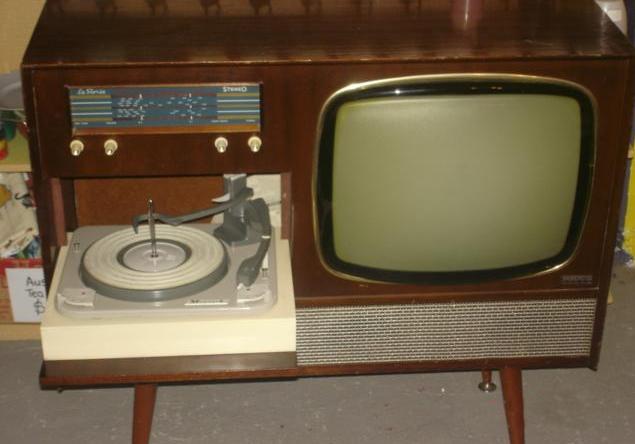
TV, harbinger of kommunisme, arrived in South Africa in 1976. This in spite of the Nationalist Party’s Posts and Telecommunications Minister Albert Hertzog’s determination not to telecommunicate.
Hertzog had vowed that television would come to South Africa over his dead body, denouncing it as ‘a miniature bioscope over which parents would have no control.’ He also argued that ‘imported fillums showing race mixing and advertising would make non-white Africans (or ‘plurals’) dissatisfied with their lot.’ Their God-ordained lot. This new medium was the ‘devil’s own box, for disseminating kommunisme and immorality.’ This, naturally, made people curious. Hetzog was better at marketing than at telecommunications.
The influential Dutch Reformed Church, the National Party at prayer, saw the new medium as ‘degenerate and immoral.’ This, naturally, made people curious. The church was better at marketing than at afskrik. No doubt they had to send a few dominees oorsee to check and make sure it was as bad as vey fought. Dominees can be like that.
Prime Minister Hendrik Verwoerd was also full of wisdom, comparing television to atomic bombs and poison gas, which ‘are modern fings, but that does not mean they are desirable. The goverrinmint has to watch for any dangers to the people, both spiritual and physical.’ That was onse Hennerik, now reduced to a street name.
Very prescient of them all: I mean do we have free speech and human rights now? See! They TOLD you! Not to even mention the scourge of ree-hality TV.
But there was no holding back ve small bioscope. TV came to South Africa irregardless. Stepping over ou Hertzog’s dead body, one must suppose?
Only . . not to Clarens!
Citizens of Clarens had to listen enviously to Bethlehem se mense when they spoke of staring at the test pattern or watching The World At War.Then came The Dingleys and The Villagers, as well as comedy series Biltong and Potroast’s SA vs British comedians shootout, and variety program The Knicky Knacky Knoo Show. Also The Sweeney in Afrikaans, called Blitspatrollie. Things were now getting Crucial in Clarens! The frustrasie mounted.
– Holy, biblical Mt Horeb –
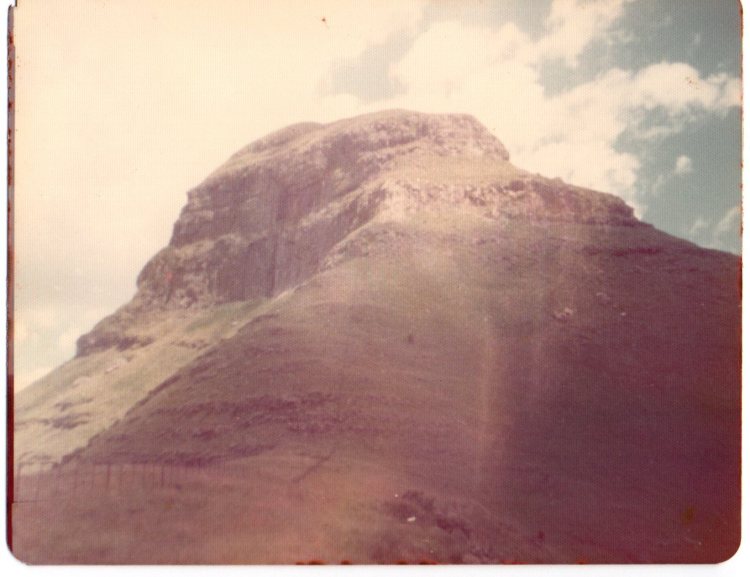
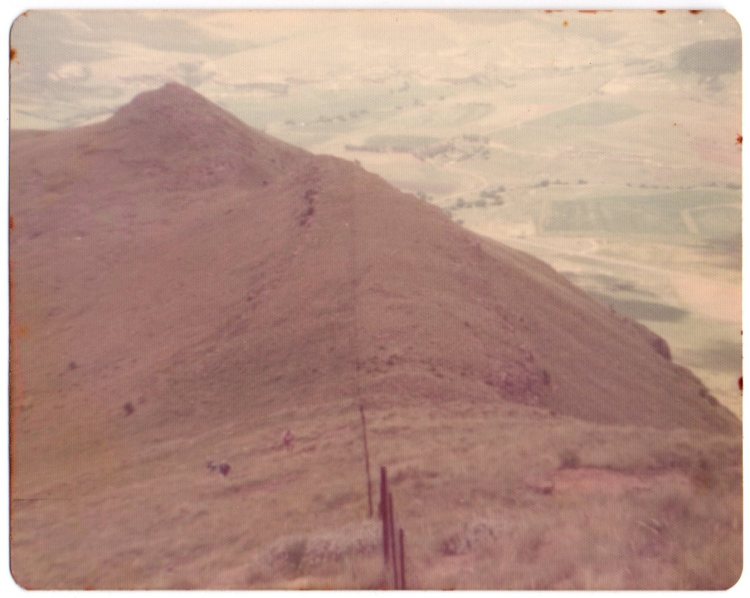
Then: A breakthrough! Someone discovered there was TV reception on the top of Mount Horeb which looms above the dorp! Mount Horeb, where Moses got the Ten Commandments, was about to beam down much breaking of the seventh and tenth commandments – the ones about adultery and coveting your neighbour’s wife’s ass. Yes, Mount Horeb is near Clarens, as is Bethlehem and the River Jordan. They wrote a book about it.
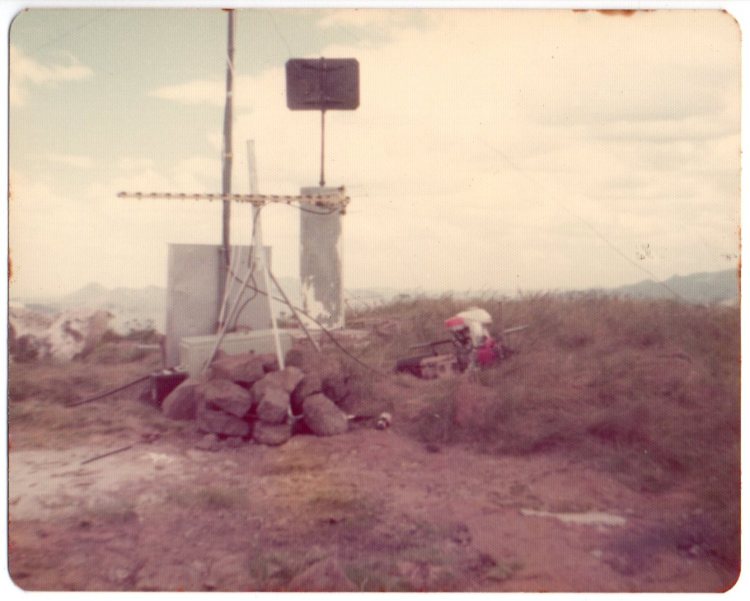
What was needed was a ‘repeater.’ A what? A repeater. Say that again . . You get an aerial to catch the signal, then a repeater, then another aerial aimed down at the dorp and voila (or ‘daar’s hy’): you have TV.
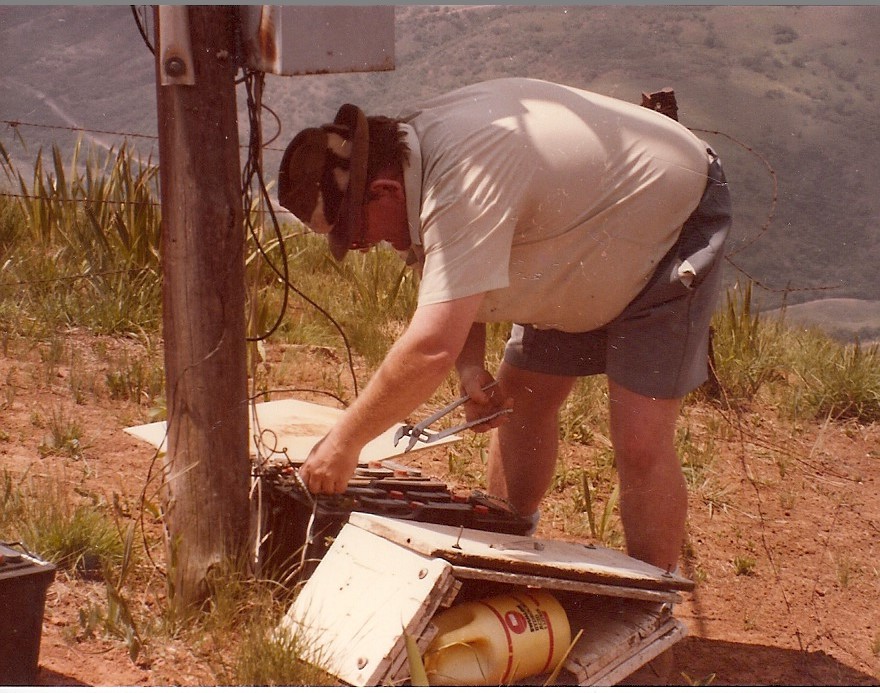
Steve Reed, son of hizzonner, the incumbent Lord Mayor of Clarens at that historic time, writes of the ‘many trips up Mount Horeb: At one stage we enlisted the TV expert from the Bethlehem TV shop – Haas Das. Two-way radios were used to speak to the manne down in the dorp, hunched over the test TV set’:
“Hoe lyk die picture nou? – Over”
“Nee man dis net sneeu. – Over”
“En nou? – Over”
“Dis nog steeds net sneeu. – Over”
“Daar’s hy! Wag! Agge nee, weer net sneeu. – Over”
Ens, ens . . en so voorts = etc. Over.
So that was done, and TV arrived in Clarens to groot vreugde and tidings of great joy. The mense didn’t know it at the time, but they had embarked on learning to speak Engels.
And then it died. Wat de hel gaan aan? Telephone lines buzzed heen en weer. The battery’s flat. What battery? Ja, it has a battery to drive the repeater. The what? The repeater. Wat!?O bliksem. So a roster had to be drawn up for the dorpsmense – The Villagers, see? – to take turns driving and walking up Mount Horeb to change the battery and bring the flat one down to charge it. Daily. Every day. (Moses se Moses, he only went up Mount Horeb once).
– the summit of Mt Horeb – trying a petrol generator here –— Here’s a different home-made repeater aerial; Same battery-changing chore — This one at Hella Hella outside Richmond in KZN —
Then there was Peace on Earth and Goodwill toward Men. Except if men forgot their roster slot. Then there was hell to pay. Later a wind charger was installed so they didn’t have to change the batteries every day. The irrelentless march of progress, voorspoed.
~~oo0oo~~
harbinger – anything that foreshadows a future event; omen; sign; ek het vir julle gese
kommunisme – communism; a vague concept, undefined, but BAD; don’t ask
fillums – motion pictures
devil’s own box – duiwel se eier doos
afskrik – dissuade; ‘don’t look!’ which made people look
goverrinmint – guvmint; Pik Botha discovered the ‘R’ in guvmint, his only achievement as Minister of Foreign Affairs. Although he was minister of foreign affairs for ages, he was actually better at Local Affairs, taking gewillige meisies to farms for frolics around ve braai
gewillige meisies – willing lasses; paid?
Bethelehem se mense – Bethlehem’s TV-enabled people; The Villagers
frustrasie – frustration, impotence, FOMO
dorp – village
daar’s hy – there it is, Suzelle; voila; see ou Jaap’s “away you go” below
manne – the boys
“Hoe lyk die picture nou? – Over” – What’s the picture look like? Over
“Nee man dis net sneeu – Over” – No man, its just snow – Over
“En nou? – Over” – And now? Over
“Daar’s hy! Wag! Ag, nee, weer net sneeu. – Over” – Shit! Over
Ens ens... – etc etc
groot vreugde – tidings of great joy
Wat de hel gaan aan? – WTF; Tell Me Whatsa Happening?
O bliksem – Oh shit
se Moses – like . . . “that was nothing!”
~~~oo0oo~~~
I wanted to know more about how they did this, so I asked –
and got a reply from ou Jaap:
Yes this is no secret, in fact we at the SABC / Sentech, encouraged the use of TV repeaters for the smaller communities, and at one stage there were more privately owned “self- help” TV stations than those we ran for the SABC.
The right way to do this was to purchase a transposer, a combined TV receiver and transmitter that will receive a TV signal on one channel, then re-broadcast the signal on another channel. This could be UHF-UHF or VHF-VHF or VHF-UHF. Then you need a receive antenna and transmit antenna. Install on a high structure, such as a grain silo or mountain top. This transposers was in the order of 1-10 Watts output. This then would receive the distant TV signal from the TX station through a front-end amplifier on one channel before feeding into the transposer, and transmitting it on another channel.
The cheap and dirty, crude way was to get hold of a VCR with AV out, a TV tuner with a AV output, or even a modified TV set. The AV output would then be taken to a TV modulator, which you can buy off the shelf, and then tune it to a suitable channel, and then put the RF into a amplifier that could be home-built or even a commercial distribution (set-back amplifier ) connect it to the antenna and away you go. Equipment could be bought from your local TV spares/ equipment dealer, Ellies Electronics, Space TV, or even your local co-op store. Drawback was that only one channel, normally TV3 (SABC3) could be re-broadcasted like this, any other additional channels would have to have identical set-ups.
According to the law, such self-help stations had to be licensed by the SABC, but many of them did not bother to do so. Obviously the home-brewed equipment was very prone to causing interference as the amplifiers they used was not channelized, with no filtering whatsoever.
In all instances the equipment had to be placed so that the clearest possible signal could be received and the maintenance of such repeaters was obviously the responsibility of that community.
Stephen Charles Reed was the laat lammetjie son of Vincent and Doreen Reed. Vin and Dor. Butch was the big black Labrador in residence.
Vincent was hizzonner, the Lord Mayor of Clarens, so although Stevie was by a long shot not their first son he was the First Son of Clarens. I moved in high circles.
In the holidays I would ring up Oom Lappies Labuschagne at the Harrismith sentrale. I’d say Clarens asseblief; He’d say ‘seker‘ and patch me through to the Clarens telephone exchange – their ‘sentrale‘. The operator lady would answer with a chirpy “Clarr-RINSE”!
Three Four Please. Seemed somehow wrong that their number was 34. I mean, Vincent was the Mayor. Surely it should have been One Please?
Anyway, Three Four Please.
“No, Stevie’s not there, he’s at the Goldblatts, I’ll put you through”.
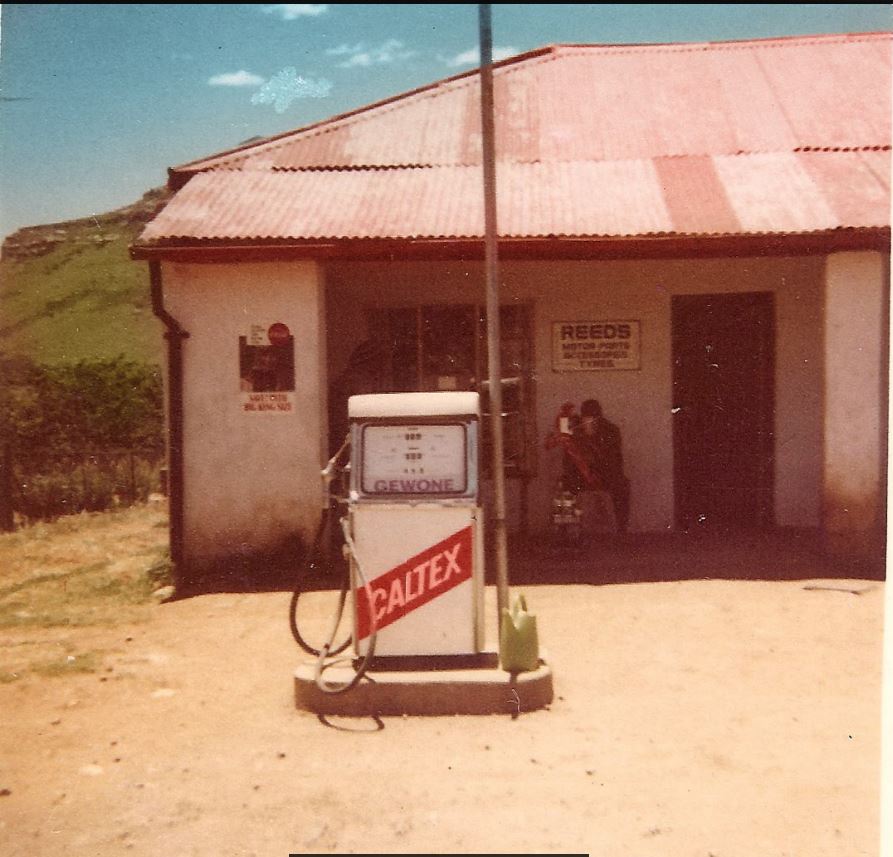
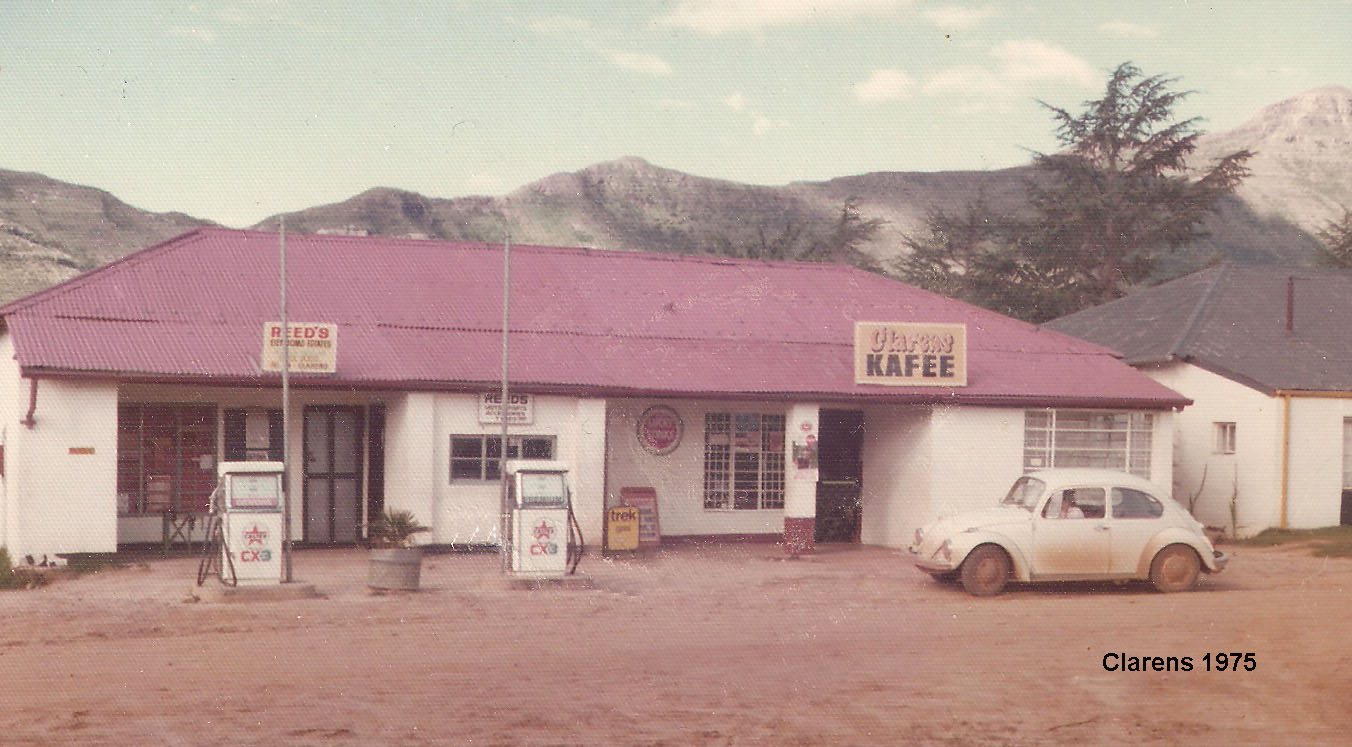
Old Clarens, before the rush. Here’s the Reed’s store and filling station.
~~oo0oo~~
laat lammetjie – afterthought child, unplanned, not to be confused with unwanted
Can’t remember Steve, did your family own the garage? I remember your dad being the mayor though. And I remember the craziest dog I had ever seen called Dennis – a cross between a Labrador and a dachshund or something! I also remember the “centrale” telephone exchange lady, who kept interrupting every three minutes to tell you how long you have been talking, and one day I got irritated, and said something like “aw shut up!” and she scolded me for being so rude! I was mortified!
You should see Clarens now! Although I haven’t been back, it’s the central art and antiques weekend getaway in the country. Quite the arty place, with hotels, B&Bs and coffee shops by the dozen.
~~oo0oo~~
I wrote:
AND – they have a brewery! One of my favourite newer tales of Clarens involves young Rod Stedall. He and Karen bought a stand, built a lovely sandstone cottage, made a good income from it for years, had some lovely holidays there and then sold it for a handsome profit. Boom! I stood and watched as all this happened, thinking “That’s a great idea, I should do something about that,” and doing buggerall.
Rod then bought a house in the bustling metropolis of Memel, thinking that would be the next big Vrystaat thing thanks to their huge vlei and great birdlife. I thought “That’s a great idea, I should do something about that!” Yeah, right.
OK, Memel didn’t happen in Rod’s time here (he offered to sell me the Memel house when he was leaving for Noo Zealand), but guess what: SANRAL are talking of bypassing Harrismith and running the new N3 past Memel. Boom time! It would be a bust for Harrismith, though, so I’m more likely to buy a house there.
~~oo0oo~~
Terry Brauer wrote:
Clarens is one of my favourite getaways in SA. Who’d have thought, Mr Reed?! We stayed in that wonderful home with the Stedalls. Had we not owned San Lameer we’d have considered buying it. Fabulous place. Fabulous hosts.
Pete, join the Brauer Investment Club. Fail. Epic fail every time.
~~oo0oo~~
A brief history: Clarens, South Africa, was established in 1912CE and named after the town of Clarens in Switzerland, established around 200CE, where exiled Paul Kruger, who some think a hero of South African independence from Britain, died in 1904 after fleeing there. He fled there – yes, fled, like ‘ran away’, a coward – after calling my great-great uncle a coward! Koos De la Rey didn’t want the war with Engeland, but when it came he bravely fought the whole war against the thieving, war-crime British to the bitter end. Sabre-rattling Kruger ran away! The swine!
A company wanting to establish a village in the area bought two farms: Leliehoek from Hermanus Steyn in 1910/11 and Naauwpoort from Piet de Villiers, situated near the Titanic rock. The two farms were divided into erven, and these were offered for sale at fifty pounds sterling apiece. And voila! – French for ‘Daar’s Hy!’ -the metropolis of Clarens, Oranje Vrijstaat was born / gestig.
Behind the Crawley’s house in Warden street was an amazing garden. Huge trees and a fascinating big wooden shed, filled with all sorts of interesting stuff. And a fascinating big old green truck with a flat wooden bed parked under one tree.
Everything was big – industrial size. I remember long planks and pipes in shelves with pots and tins and everything. Everything. A robin nested in one of the pots on one of the shelves. I don’t know why I think it was a robin, but I’m sure I saw a bird’s nest there anyway. Leon confirms this memory.
The old Chevy truck was quite unlike any other in town. You couldn’t mistake it. I checked with the old man. He says it said ‘Hastings & Crawley Builders’ and it was a Chev – “1934 or 1935 judging by the grille”.
I remember it looking something like these:
Close. But not quite right, the one on the right is a Studebaker.
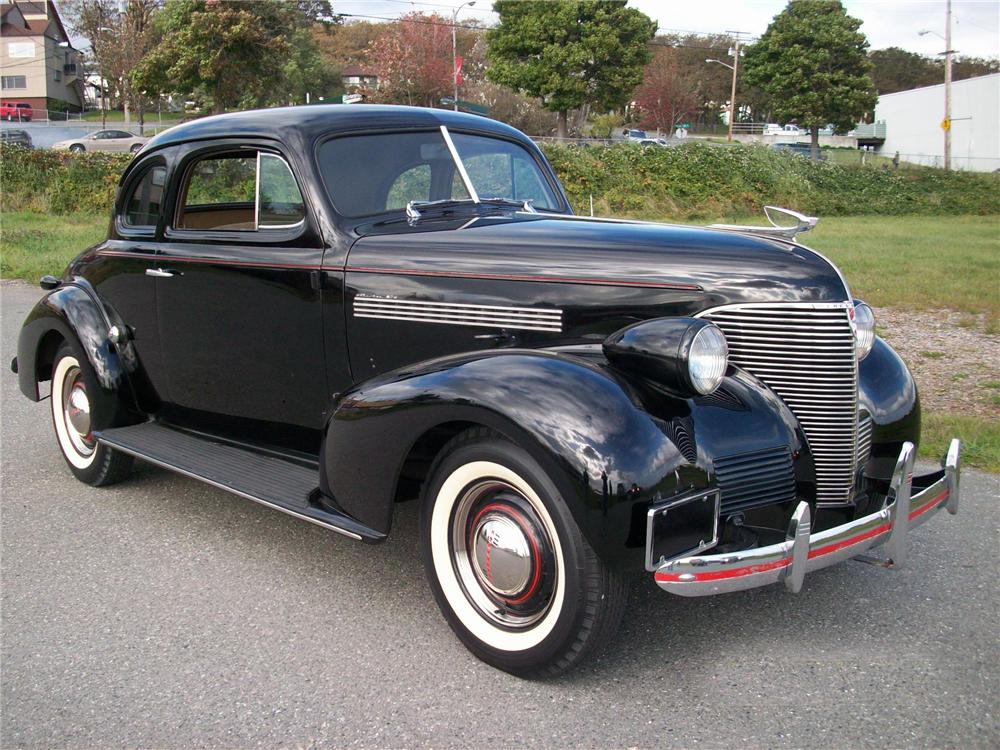
Dad also says he thinks Charlie’s first car was a 1939 2-door Chev he bought from the mayor Sepp de Beer, whose numberplate was OI 1 (we were Oh Eye before we were OHS). That’s all I got from him on the phone. His hearing is a bit ‘Whut?’.
I thought of Abe Sparks as the “Lord Mayor of Swinburne.”
Ever since he went to Texas he wore a stetson, cowboy boots and a string tie with a polished stone clasp. He was a larger than life character, colourful. He and Lulu were always very friendly to me. He drove an old Rolls Royce which I believe he bought from fellow eccentric farmer Petronella van Heerden. Which he converted it into a pickup truck, a bakkie. It looked something like the silver one in the pic. I think a darker colour, though, like the one below. (Oops, this Roller was actually a 1929 Cadillac which Dr Petronella had bought in Cape town! – I should always check my dodgy history with Harrismith’s historian Leon Strachan. He knows things).
I have a clear childhood memory of it parked in Stuart Street near the corner of Retief Street, opposite the Post Office. Near Havenga’s. Near Basil’s Cafe. Near the corner Kovisco Butchery. Opposite Herano Hof. Opposite that Co-Op building. You know where I mean. Uncle Abe staring down at me with a big smile: ‘How are you Koosie?’
Abe owned the Swinburne Hotel which became the Montrose Motel, later bought by Jock Grant; scene of an interestingbrandy-filled nightmany years later.
He and Lulu would throw big parties and the story goes . . yes, the old story goes – Rural Legend Alert! – that one night they decided to cook the mushrooms they had gathered in the veld / garden / woods that day. To be safe they fed some to the dog and asked the kitchen staff to keep an eye on it for the next hour or so. They continued partying up a storm with the grog flowing, then ate supper and carried on jolling until one of the staff came in to say “Baas die hond is dood”.
Panic ensued. They all bundled into cars and rushed off to the Harrismith Hospital twelve miles away, driving fast and furious and well-oiled on the national Durban-Joburg highway, to have their stomachs pumped out – no doubt by one of their mates, whichever doc was on call. Then returning much later to the farm looking chastened, wan and sober.
Next morning Abe asked to see the dog and was shown where it lay dead and mangled. It had been run over by a passing car.
I imagine a pinch of salt was added to the wild mushrooms.
~~oo0oo~~
Baas, die hond is dood – Boss, the dog is dead
~~oo0oo~~
Leon Strachan, Harrismith’s finest author (nine books or more), gentleman, publisher, historian, military buff, farmer, jam bottler, businessman, tour guide and all-round mensch has a much better grip on Abe’s life in Swinburne. His farm Nesshurst is in the same area as many of Abe’s sixteen farms over the years. He tells of pub tales, a Swinburne cricket team made up of eleven Sparkses (one was even selected to play for South Africa!), brandy taken internally and externally, and how the sheer size of Louis Bischoff’s schlong displayed for all to see on the pub counter was one of the few things that ever rendered Abe speechless.
Blafboom 1991, Leon Strachan – ISBN – 1-919740-21-1
~~oo0oo~~
I found a lot of pics of Rolls Royce pickup conversions, but so far none of a Cadillac conversion. So that’s a 1929 sedan in the feature pic.
This guy Nudie reminded me of Uncle Abe: Abe would have wanted his car!
Dad tells me Abe bought the Rolls Royce* from fellow Harrismith farmer and characterNell van Heerden. *Caddy
An old-car-nut Aussie confirms another version of the old sheep farmers / Rollers rural legend thus:‘I can see why the conversion was done. When the Silver Shadow was introduced, it was unpopular with graziers: it could fit only two sheep on the back seat; the Silver Cloud could hold three.’
Stewart Bain was born in Wick, Scotland on 9 September 1854. He and his brother James came to South Africa in 1878, to Durban. They soon got a job building bridges for the railway line extension up the Drakensberg from Ladysmith to Harrismith. How, one wonders, did two herring fishermen convince people they could build bridges? And so they reached the metropolis of Harrismith in the Oranje Vrijstaat, an independent sovereign state at the time. Britain had recognised the independence of the Orange River Sovereignty – before that it had been the Orange River Colony ORC – after losing the first Anglo-Boer War at Majuba. The Vrijstaat officially became independent on 23 February 1854, seven months before Stewart was born, with the signing of the Orange River Convention. This history is important in view of Britain’s and many of Harrismith’s inhabitants’ conduct in the Anglo-Boer War of 1899-1902.
– sandstone bridge across the Wilge River at Swinburne –
So they built bridges. I am not sure, but I fondly imagine they built the beautiful sandstone bridge across the Wilge River at Swinburne, where I launched two separate canoe ‘expeditions’ with good friends Fluffy Crawley and Claudio Bellato many decades later.
Settling down in Harrismith after their bridge-building days, Stewart bought the Railway Hotel and changed its name to the Royal – we believe with official ‘royal” permission – while brother James built the Central Hotel uptown, on the central market square.
It appears here as if some people (!) carried on referring to the Vrijstaat as the ORC, even though it was actually the sovereign nation Oranje Vrijstaat by then!?
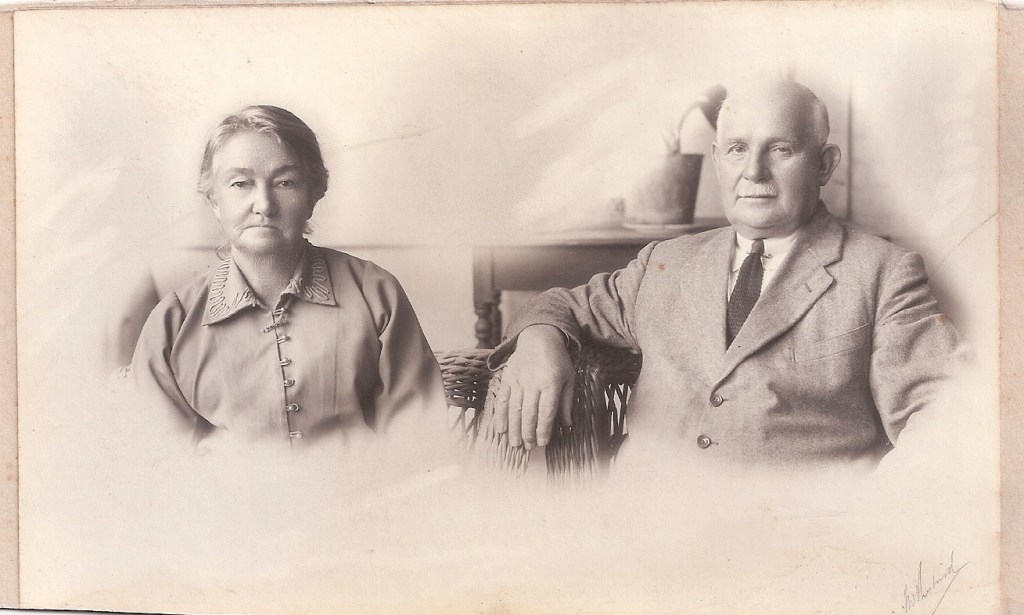
Stewart married Janet Burley in Community of Property in Durban, I’m not sure whether that was before moving to Harrismith or after. Janet was born in Hanley, Staffordshire, England in 1859 of David Burley and Caroline Vaughan. They had __ children between 18 __ and 18__ . . . the fifth child in 1893 being our grandma Annie. Annie married Frank Bland and had two daughters, Pat and Mom Mary, Mom Mary remembered the hotel as having two big (‘huge’ says Mom, but she was little back then!) statues at the front door: A lion rampant with a human face, fighting; an antelope rampant on the other side of the door – she thinks a hartebees or a sable or something. Both were rearing up on their hind legs.
Stewart became Mayor of the town and ‘reigned with the gold chain’ for years, becoming known – by some – as ‘The Grand Old Man of Harrismith.’ To their grandkids they were always ‘Oupa’ and ‘Ouma’ Bain;
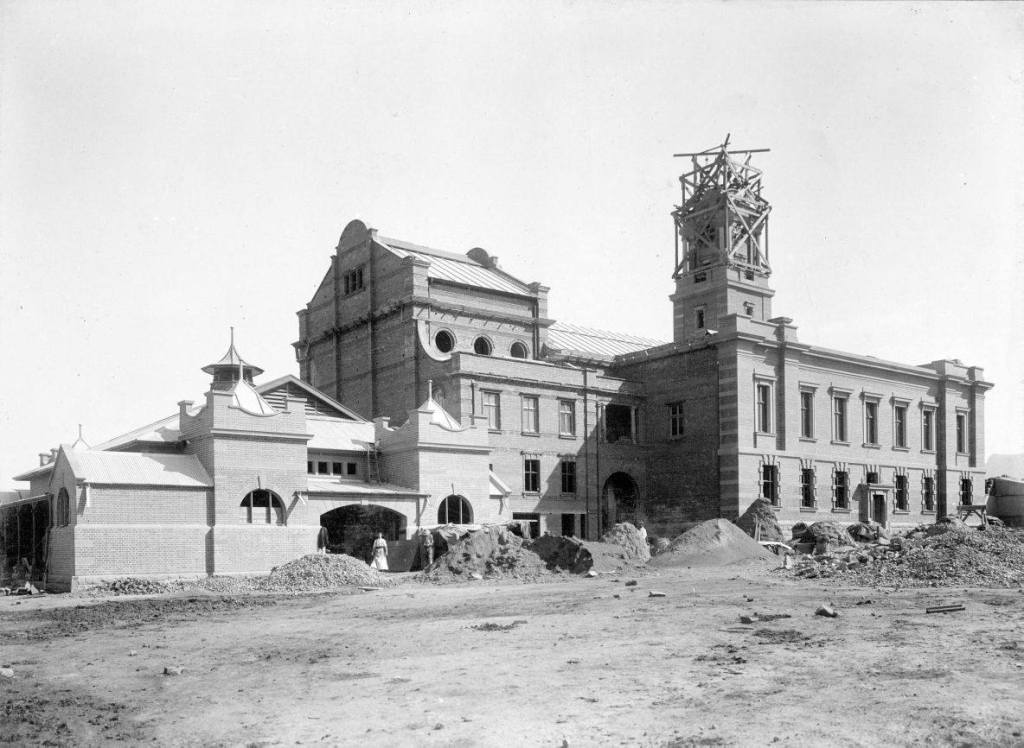
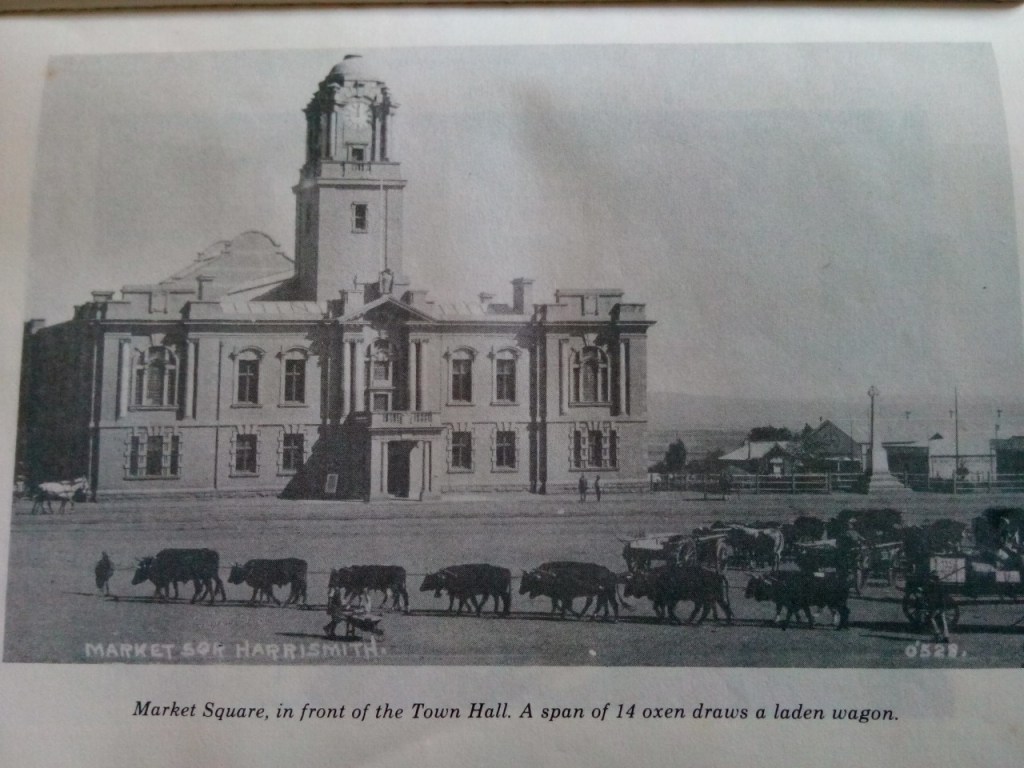
He pushed for the building of a very smart town hall. Some thought it was way too fancy – and too big – and too expensive – and called it ‘Bain’s Folly.’ Did Stewart have the tender? Was he an early tenderpreneur? Was it an inside job? *
Here’s a reason someone gave for the “need” for such a grend gebou: ‘The erection of the new Town Hall, officially opened in September 1908, was largely the result of support the troops had given for theatrical performances and concerts in the former building which had proven unsuitable.’ – (found that here: http://samilitaryhistory.org/vol082sw.html)
– building operations – lots of imported stuff –– ta da! – a palace fit for a dorp –
Here’s a lovely 3min slide show of the building of Bain’s Folly – completed in 1908 – by Hennie & Sandra Cronje of deoudehuizeyard.com and thanks to Biebie de Vos, Harrismith’s archive and treasures man. Thank goodness for all the stuff that Biebie ** has saved and rescued!
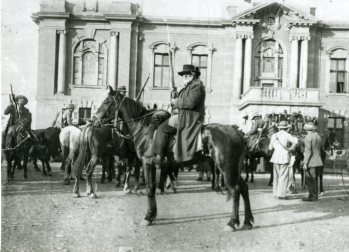
Here’s that impressive building in a dorp on the vlaktes!
– the market at the rear of the building soon after completion – 1908 –
Opskops probably had to be arranged to justify the place, and the occupying British force that remained after the illegal and unjust invasion that was the Anglo-Boer War which saw so many war crimes committed by the British, benefited hugely, their officers dancing nights away with the local lasses.
Janet died on 15 January 1924; Her daughters Jessie & Annie (who was then aged thirty) were with her when she collapsed. They summoned Dr Hoenigsburger (Hoenigsburg?), but Ouma died within minutes. The Harrismith Chronicle article reads in part: ‘Ex-Mayoress’s Death. Sudden demise of Mrs S Bain. The news which stunned the town on Tuesday morning of the painfully sudden death of Mrs Stewart Bain, evoked a feeling of deepest sympathy from all who knew the deceased lady, not only in Harrismith and the district but in places far remote.’
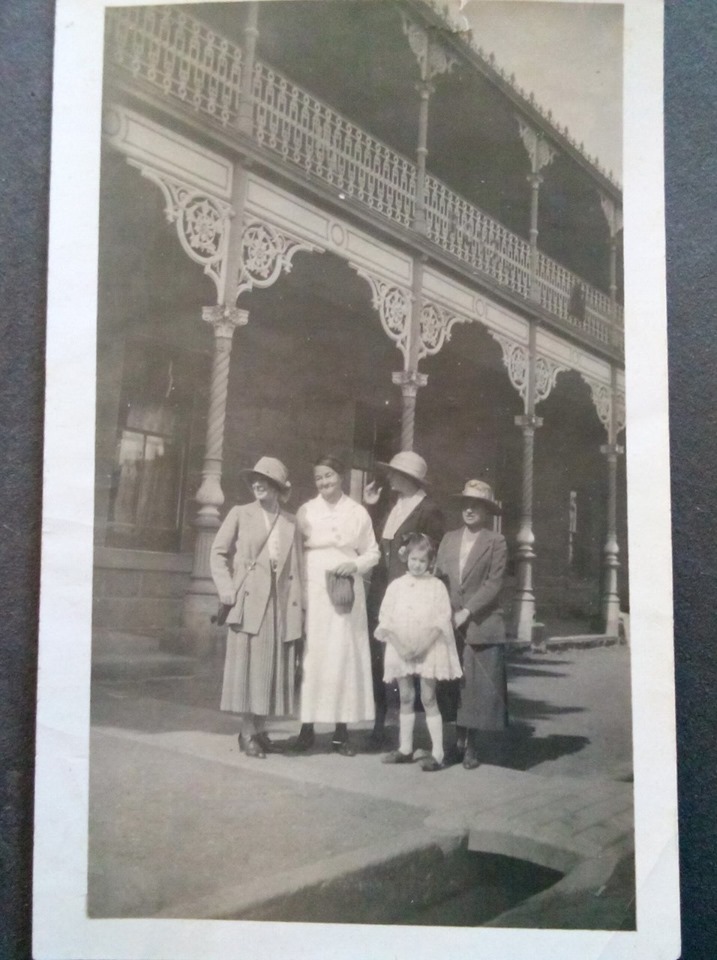
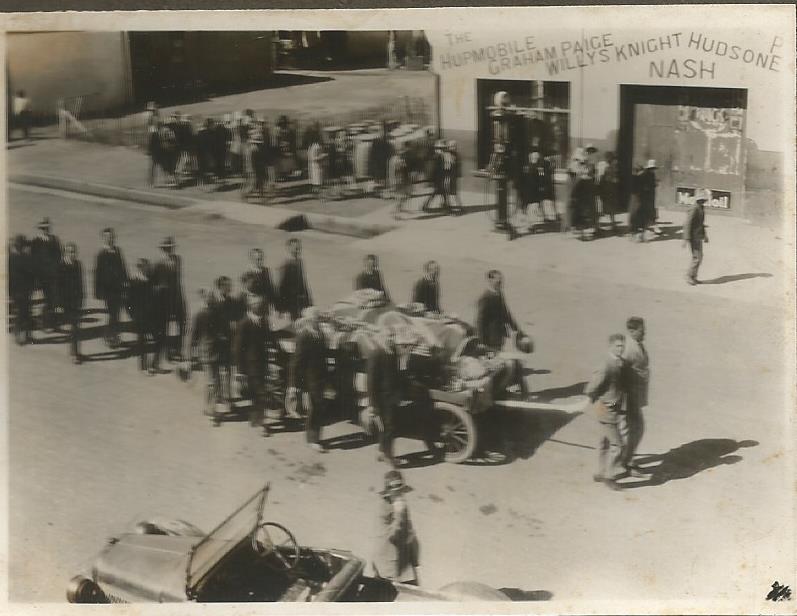
When the dust settled on the town hall, the townsfolk must have quite liked the result, as when Stewart Bain died in September 1939, the town pulled out all the stops for his funeral; These pictures were taken from the balcony of his Royal Hotel, with ‘his’ Town Hall visible in the background, and ‘his’ mountain behind that. Most Harrismithers and Harrismithians regard Platberg as ‘theirs.’
– Oupa Bain’s funeral procession – who paid?! –
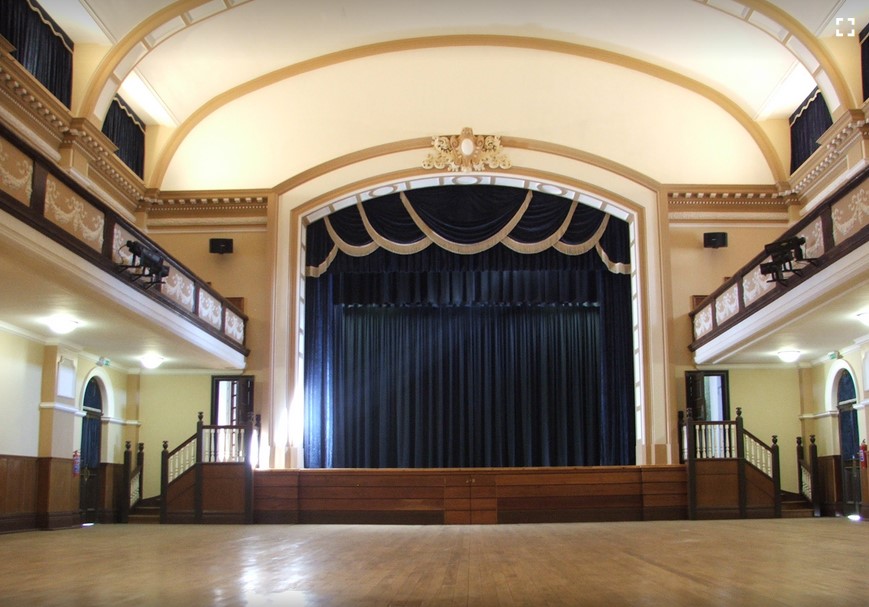
At one notable local event ca.1949 in this huge hall – an Al Debbo concert! – Stewart’s grand-daughter Mary met her future husband. Maybe that was the Lord Mayor Hizzonner’s intention in building this impressive edifice all along? In 1951 they got married there. Years later Stewart’s great grandaughter Barbara also got married in ‘his’ town hall.
~~~oo0oo~~~
Found this pic of the town hall in Wick and wondered if Stewart got the idea of a bigger, better town hall for his new town from his old town?
– built in 1828 –
~~~oo0oo~~~
Snippet: Old Mrs Batty was Stewart Bain’s housekeeper at the Royal Hotel. Mum’s cheeky cousin, Janet Bell – later enhanced to Hastings-Bell – asked Mrs Batty one day, “Why do you say ‘somethink and nothink?” Back came the reply, “Cos I aren’t eddacated.” Mrs Batty lived around the corner from the Royal, on the same block, in a little house right on the pavement.
~~~oo0oo~~~
I thought I remembered that, despite every dorp in South Africa seeming to boast a ‘Royal Hotel’ – from whence ‘hier sirrie manne innie Royal Hotel’ – the Harrismith Royal Hotel was one of only two in South Africa that could officially call itself ‘Royal’. Sister Sheila, family Keeper-of-the-Archives, has hereby confirmed that I have a flawless memory. Well, something along those lines:
– evidence – or “evidence” – of our close link to royalty –
~~~oo0oo~~~
Couldn’t resist this close-up so enthusiasts can read which cars were around in 1939:
~~~oo0oo~~~
Postscript:
A young post office worker left his little 1935 Morris in that garage in the care of the owner Cathy Reynolds (nee Bain), while he went off to war, ca 1941; When he returned around 1946 it was waiting for him. He then met Mary, second daughter of Annie Bland, nee Annie Watson Bain, Stewart’s fifth child. Their first date was in the Town Hall. Best and luckiest thing that ever happened to him. They got married in the Town Hall in 1951. He was Pieter G Swanepoel, originally from Pietermaritzburg, and my Dad.
So two women, a Central Bain and a Royal Bain, ran garages in Harrismith.
* Shades of our Moses Mabida stadium in Durban for the 2010 FIFA soccer world cup – ‘Do we need such a big, fancy stadium!?’ I called it the Moses MaFIFA stadium. Call it FIFA Folly, Corruption it almost certainly is. Americans call it a boondoggle.
opskops – parties, shindigs, events, pissups, balls, dances, concerts; involve alcohol; kick up your heels
grend gebou – grand building
~~oo0oo~~
Phone call to Mom May 2025, Talk turned to the Bains, her Oupa Bain and his Royal Hotel. He was Stewart Bain, Mayor of Harrismith.
The Bain sons went to Hilton. At least two – Ginger and Stewart – came home to work for Oupa, their Dad, and play sport. Never studied after school.
Dick the Waiter
Ginger played polo and rugby. Stewart (Smollie) worked in the bar. Smollie was thin and stooped, walked with a shuffle. Getting in and out of his wife Marie’s car was a struggle. Something about his legs couldn’t bend. Like ‘welded straight.’ Arthritis maybe?
The chef’s name was Kaiser Adam. He wore a white uniform and a tall white hat. The two waiters were Dick and Shabalala – ‘smartly dressed waiters.’ Kaiser and Dick were Indians from Durban. They must have had a lonely life living in Harrismith, unable to go anywhere really. They lived on the large hotel grounds with their families. Shabalala was a local Sotho man. Dick, with his jet black hair and little moustache, was said by local wags to look just like Rhett Butler from the movie Gone With The Wind! …
Koos (me): This is weird, and maybe I’m constructing the memory from tales told at home, but I have a clear memory of sitting at a table in the dining room; being handed a paper menu; then a tiny bit of fish arriving on a large plate followed by a piece of meat and two veg on a large plate, followed by a tiny bit of pudding in a bowl. I do remember the dining room and the big fireplace and the staircase. The bar leading off the front stoep I remember from later years, once we started looking for beer after dark.
Big sis Barbara remembers visting the Royal when her good friend and cousin Glenda Taylor used to visit Smollie and Marie Bain.
My granny Annie had an older brother Ginger. He was the oldest of the seven ‘Royal Bains’ and a great sportsman. They owned the Royal Hotel and they were ‘Royal’ so as not to be confused with the ‘Central Bains’, who owned the Central Hotel! As fishermen from the tiny hamlet of Wick on the more freezing end of Scotland, they couldn’t really claim the traditional ‘Balmoral Castle’ kind of royalty.
Playing rugby for Hilton, ‘Bain of Harrismith’ became the bane of Michaelhouse in the first rugby game between these two toffee-nosed schools, where vaguely bored and lazy shouts of ‘a bit more pressure in the rear, chaps!’ are heard through the gin fumes surrounding the rugby fields.
Here’s the report on the 1904 derby – the first game between the two schools:
– reprinted in the 1997 Hilton vs Michaelhouse sports day brochure –
Drop goals were four points and tries were three in those distant days. I like that the one side was “smarter with their feet” . . and that being smarter with your feet was better than “pretty passing.”
A century later these rugby genes would shine again as Bain’s great-great-grandson – grandnephew actually – also whipped Michaelhouse.
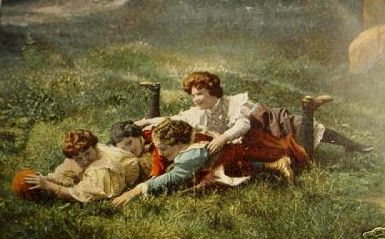
I’ve included a lovely picture of the Michaelhouse scrum on top.
~~oo0o~~
Rugby in Harrismith was full of Bains and Blands, seven in this team:
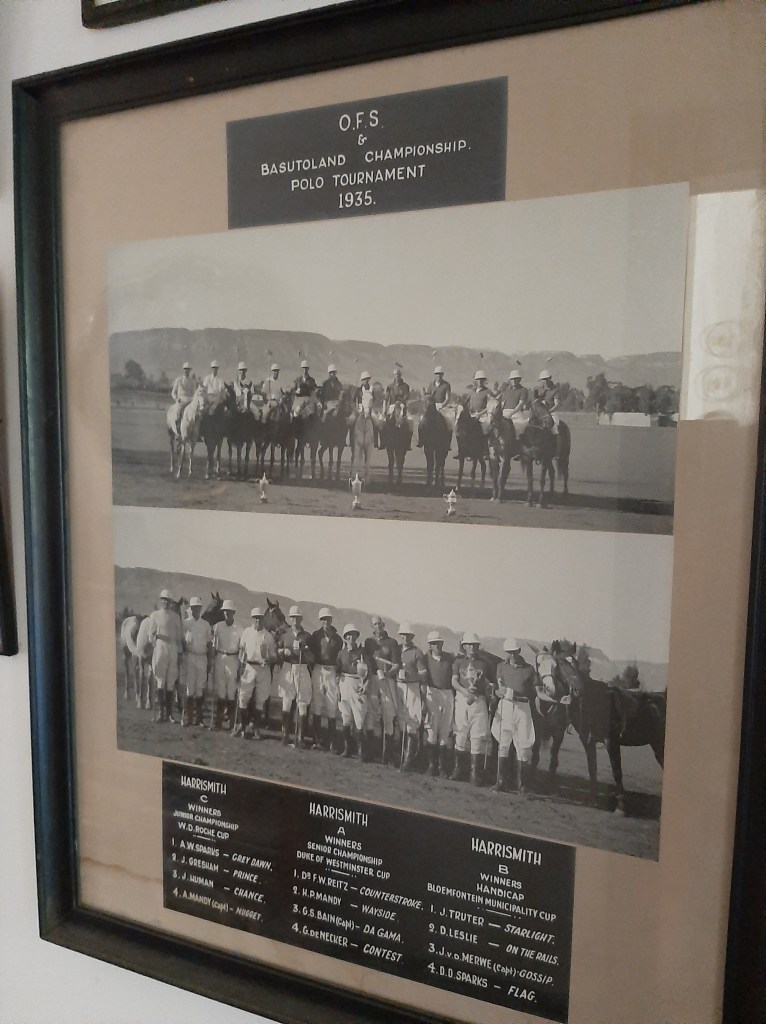
– Ginger also captained the Harrismith A Polo team –
~~oo0oo~~
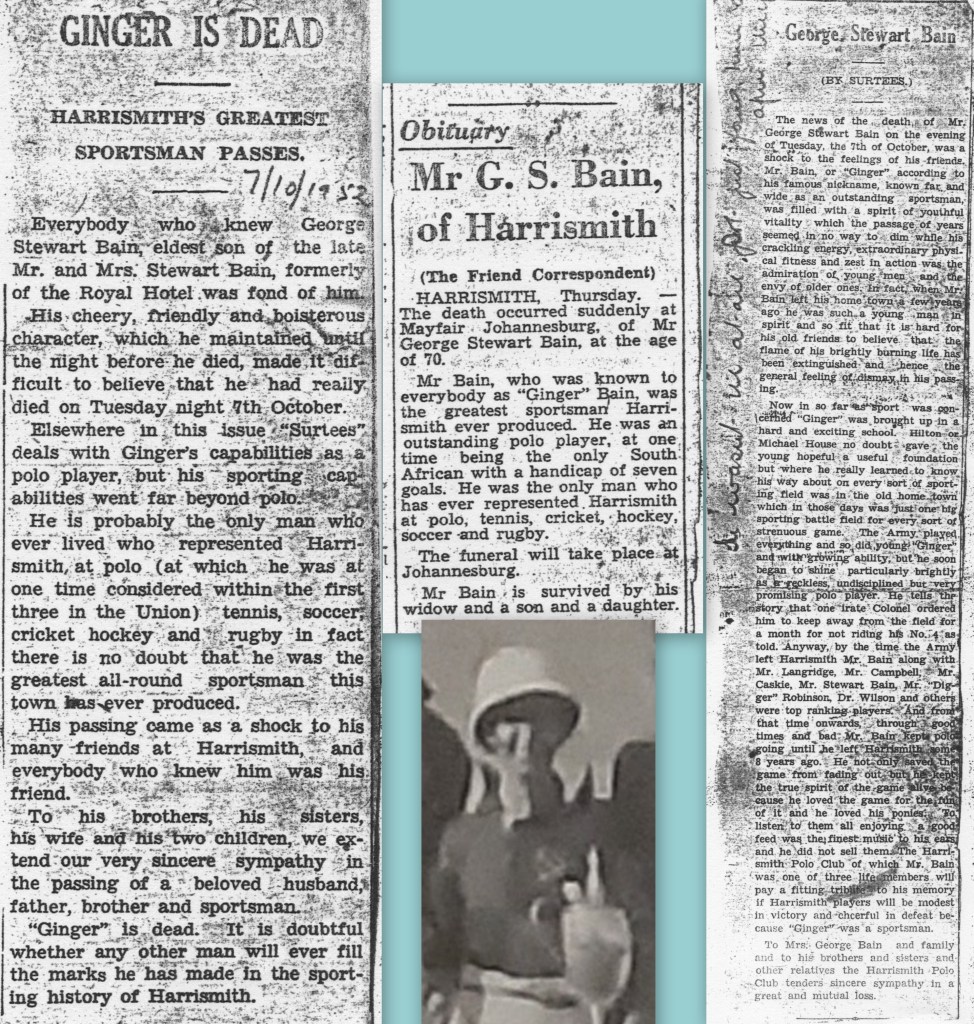
~~oo0oo~~
Handwritten on the edge of one of these is “He wasn’t ill at all. (illegible) just found him (illegible) “
Katrina (nee Miller) Duncan, from near Oban in Scotland, stumbled across my other blog here and made contact with us. She sounds delightful, but so she would – she’s family!
– pick one –
She has been researching the Bain family tree and she and my sister Sheila have worked out that we share a Great-Great-Great Grandfather, one Donald Bain, born in Wick on the 14th of April 1777. He married Katherine Bremner and they lived in Sarclet, just south of Wick way up in north-east Scotland. And then I spose they had children and then those had children, and – you know how it goes.
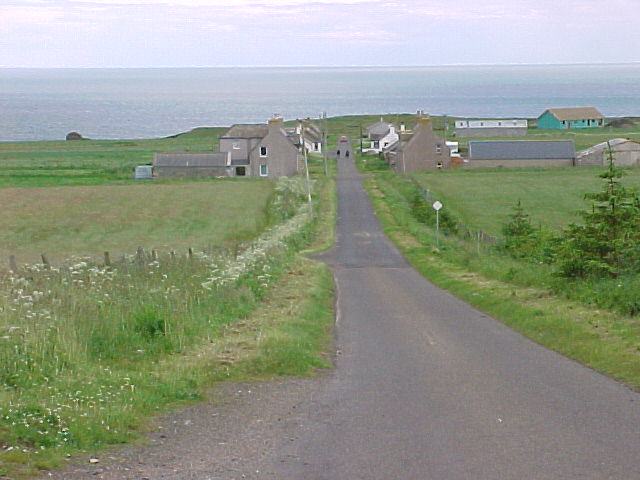
– Sarclet coast –– Sarclet village –
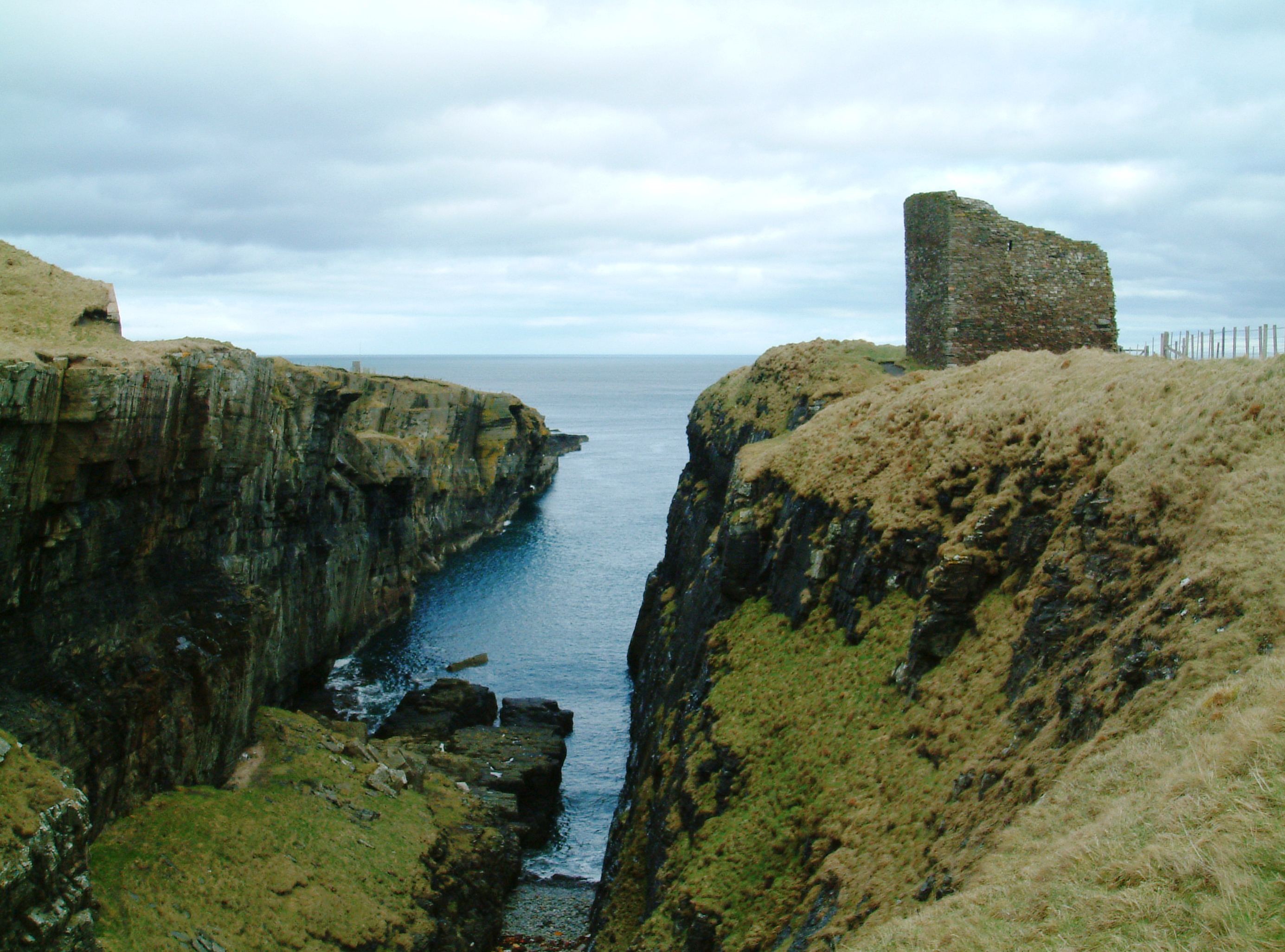
I reckon if you dipped your toe in that Wick water you’d know why some Bains moved to Africa! Also, they may have been dodging giving the castle a much-needed revamp . . .
– Wick Castle –
Stewart Bain was born in 1819 in Caithness, to Donald (42) and Katherine (41). On the 7th of February 1845 Stewart married Christina Watson in his hometown. They had four children during their marriage.
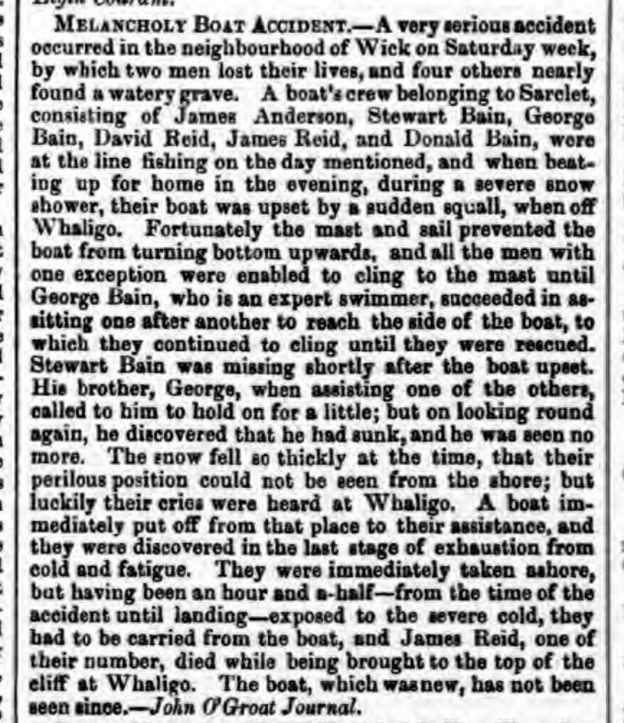
In 1853 Donald’s sons George and Stewart were out fishing when their boat was swamped and Stewart drowned in the freezing winter sea. He died as a young father aged 34 on 19 February 1853, and was buried in Thrumster, Caithness.
Katrina found an 1853 newspaper article about the tragedy.
It seems Stewart’s father Donald also died that year. The next year, 1854, his brother George and wife Annie (nee Watson) had a son. They named him Stewart.
This Stewart is the Stewart Bain who came to Harrismith, Orange Free State – the sovereign country Oranje Vrijstaat – in South Africa with his brother James in 1878 and married Janet Burley. They had seven kids: The seven ‘Royal Bains’ of Harrismith, named after their hotel, The Royal Hotel in Station Road. This ‘title’ was to distinguish them from the ‘Central Bains’, not to claim royalty! My grandmother was the fifth of these seven ‘Royal Bains’ – Annie Watson Bain. She got her paternal grandmother’s surname as her second name.
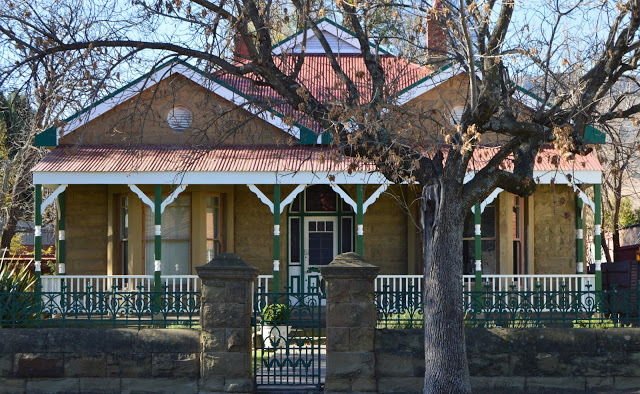
Stewart and Janet raised their ‘Royal Bain’ brood in this cottage adjacent to their hotel in Station Road, down near the railway line:
James Bain, Stewart’s brother and owner of the Central Hotel, called his rather larger home ‘Caithness’. It was in Stuart Street near their hotel in the centre of town. There they raised their brood – eight ‘Central Bains.’ One of them was also named Annie Watson Bain. Her story ended tragically early, in World War 1 in France. Thanks to Katrina we know more about it.
– Caithness, Harrismith –
On Katrina’s ancestry web page “Miller Family Tree” the names Annie, Jessie, Stewart, Katherine, Donald etc have been used for generations.
The Scottish Tartan register confirms that there is no ancient Clan Bain tartan. This one – ‘The Bains of Caithness’ – was designed in 1993 for Robert Bain of Caithness.
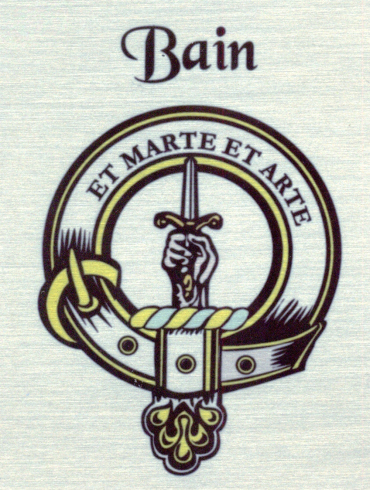
There are a few coats of arms; I chose two examples.
Dukandlovu rustic camp was underutilised. Parks Board wanted to increase its use and were looking for new ideas. It was a walk-in or cycle-in rustic camp and they were reluctant to open it up to drive-in access, so wanted to try other ideas first.
Rustic, but splendid, it’s a four hut, eight bed camp with basic kitchen facilities and cold water showers. The widows are openings with roll-down reed blinds which keep about half the wind and none of the mozzies out. The beds had mattresses, but bring your own bedding.
It was doomed. So few people want to rough it! Not ‘nowadays’ – always. Since humans first walked upright the majority have chosen the cushiest of whatever’s available. ‘I prefer roughing it’ has always been the weirdness of a few.
– our pic – the rest are internet pics –
But the rugged few in Parks Board were reluctant to give in too easily, so first they tried us: “Let’s test the feasibility of adding canoeing-in to the access menu!” they said. Robbie Stewart was approached and he took Bernie Garcin and I (and others – who?) to test the waters. Literally. We set off with our plastic kayaks to False Bay, launched them and headed south towards the mouth of the Hluhluwe river on the Western Shores. Right from the outset we could see this wasn’t promising: We touched bottom often. Our draft was mere inches, but the lake was that shallow in places. Great for small worms and other marine creatures and for the wading birds that spear them from above, but not good for paddling. Oh well, we had tried. Not long after this they actually did open it to vehicle access. With a sigh, I’ve no doubt.
After staying a night the rest of the guys went home on the Sunday. I stayed over with Parks Board Rangers Dick Nash and Trevor Strydom. Monday morning I woke, eagerly looking forward to my day of ‘rangering’. What derring-do would we get up to with me as ‘ranger-for-a-day’?
Paperwork at a desk, that’s what. As head ranger, Dick first had a whole bunch of admin to sort out! Not what I’d imagined.
But later we got going on their regular bird count in the wilderness area in the north-east arm of the lake. We set off in their spacious craft with a Hamilton jet propulsion system (an impellor rather than a propellor, it sucks water in the underbelly and spits it out the back). This was fine in clear deep water, but when we nosed up the Mkhuze river we soon sucked up waterweeds and came to a halt. Dick pulled rank and ordered Trevor to jump overboard and remove the weed from under the boat. On the bird count we had seen at least fifty thousand and ten of their distant cousins – crocodiles – so the thought of jumping overboard was not inviting! Anyway, before Trevor could remove his shirt Dick was already under the boat doing it himself. A bit disconcerting when you looked at his hand as he chucked the weed away: He only had two fingers and a thumb. Had a croc taken the other fingers?
Looked like this, but I think this is maybe Kosi?
We got going again in fits and starts and after a few more stops to clear the impeller we turned back to the lake and continued to count birds. And thumb our noses at the crocodiles.
So do go to Dukandlovu, you can drive there now. You wimp.



























 Vrystaat Confessions