Sheila sent me an old picture of the du Plessis’ beautiful pool in Harrismith. Joan and Jannie built a big one as they had three amazing swimmers in their stable. As far as I know, Lynn, Pierre and Sonja all represented Vrystaat and South Africa (or at least went to ‘Top Ten’ where the ten fastest swimmers in the country all get into one pool and then see who can get out first on the far side in the big final national gala).
Here’s Gary Beaton’s butt, Pierre’s leg and a du Plessis poodle with Platberg in the background. Plus the big wooden fence shielding the pool from Arthur Kennedy’s famous triangular wood and glass house next door.
Which reminded me:
We painted that fence with creosote. Child labour unpaid by Jannie. Pierre, Tuffy and me, topless in our swimming cozzies. It was great fun. When one of us (must have been Pierre, he was usually our chief instigator) ‘mistakenly’ painted another on his bare skin, it was hilarious. Retaliation followed. More hilarity.
And then it started to burn. Really, really burn. Creosote on your skin is unfunny. We ended up in the pool scratching and rubbing and wiser. We’d learnt a chemistry lesson.
Fifty years later they invented the internet and now I know this:
Coal tar creosote is a mixture of hundreds of chemicals in a thick and oily liquid. People need to be trained and certified to use creosote. Creosote is also a pesticide. A pesticide is a substance that kills pests.
Jock Grant was a Harrismith legend. “A legend in his own lunchtime” as they say.
Fresh out of Scotland he joined the golf club and announced to the usual crowd leaning up against the bar in his broad accent that he was taking Afrikaans lessons.
“Jock”, said Jannie du Plessis, “We think you should first take English lessons!”
He started a plumbing business, married lovely local lass Brenda Longbottom and ended up owning the quarry, becoming famous for his loud booms which would rattle the windows of the town at noon, as he dynamited rock on 80th hill on the western edge of town.
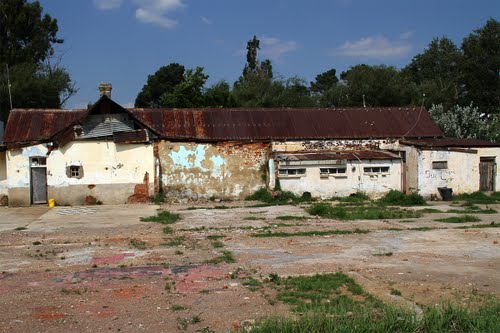
Then he owned Swinburne. Well, the Montrose Motel, anyway. Not much left now:
The entrance was around the corner on the left and as you walked in there was a pianola in the hallway.
———
Ian Fyvie has a story about when Jock went over to visit his family in Scotland. On his return they were playing golf and Ian asked him if he had enjoyed the visit. Jock’s reply was very non-committal and unenthusiastic. Ian said “But you must have enjoyed some part of the trip! What was the highlight of the whole holiday?”
“When I came over 42nd hill and saw the lights of Harrismith!”
—————————————————————
Nick Leslie tells of going for a walk in the veld with Jock and Brenda. Climbing through a barbed wire fence Brenda got her slacks caught. Jock said “Well your name’s not Longbottom for nothing!”
————————————————————–
Dad tells of Jock’s big talk which was most unlike most of their Harrismith friends’ more modest approach. Jock could swagger. He arrived at a party (always there were parties!) smoking his big cigars and between puffs boasted “He wanted *puff* six million *puff* but I said I’ll offer you five million and not a penny more *puff*”. When he left that night Hector Fyvie said in his quiet way “There goes Jock Maximilian”.
————————————
Jock brought his nephew Morris Crombie out from Scotland to join him in his plumbing business. Morris was invited to join Round Table and at his first meeting stood up to announce himself. In his broad Scots accent the lanky Scotsman intoned: “I’m Mawriss Crawmbie – Ploomer” and probably didn’t understand why the whole room collapsed with laughter.
———————
Mom was dancing with Jock at yet another party on Swiss Valley, the Venning’s farm. “Och, its smoky in here, I’m going oot fir a breath a fresh air” said Jock. Mom thought that was rich as he’d been smoking his cigars like a chimney, causing the haze indoors. He was soon back, muttering “I toook one deep breath ootside and I came running back in!” (He was referring, of course, to the famously strong smell of pigshit from the piggery).
Whenever any new guests on the farm referred to the smell the Venning they mentioned it to would look mystified, sniff around cautiously and then pronounce seriously “I smell money”.
Hance Rapid at Mile 76.5 stands sentinel at the Colorado river’s entry into the Granite Gorge. The river drops 30 feet as it passes through a natural constriction formed by the Red Canyon. The dark dike cutting through the red Hakatai Shale is one of the most photographed features in the Canyon.
I found out more about the man the rapid was named after:John Hance (1840 – January 8, 1919) – thought to be the first non-native resident of the Grand Canyon.
He opened the first tourist trail in the canyon before the canyon was a national park, giving tours of the canyon after his ca.1866 attempts at mining asbestos failed. “Captain” John Hance was said to be one of the Grand Canyon’s most colorful characters, and one early visitor declared that “To see the canyon only and not to see Captain John Hance, is to miss half the show.”
Hance delighted in telling canyon stories to visitors, favoring the whopper of a tale over mere facts. With a straight face, Hance told travelers how he had dug the canyon himself, piling the excavated earth down near Flagstaff (thus ‘explaining’ those mysterious then-unexplained dirt piles).
– wikipedia and archive.org –
John Hance died in 1919, the year the Grand Canyon became a National Park, and was the first person buried in what would become the Grand Canyon Pioneer Cemetery.
In May 1891 one Charley Greenlaw wrote this in John Hance’s guestbook: I can cheerfully say that this, the Grand Canon of the Colorado River, is the grandest sight of my life. As I noticed in this little book of Capt. John Hance, a great many people say ‘indescribable.’ I can say nothing more. It is beyond reason to think of describing it in any way. You must see it to appreciate it. A grand sight of this kind and so few people know of it. By accident I formed the acquaintance of two ladies en route to the Grand Canon. I joined them. We have enjoyed our trip; the stage ride from Flagstaff to the Grand Canon is grand. Good horses, competent and accommodating drivers. I have seen the Yosemite, have visited California several different times, in fact seen all the principal points of interest in the United States, but the most wonderful, awe-inspiring piece of Nature’s own work is this, the Grand Canon of the Colorado River.
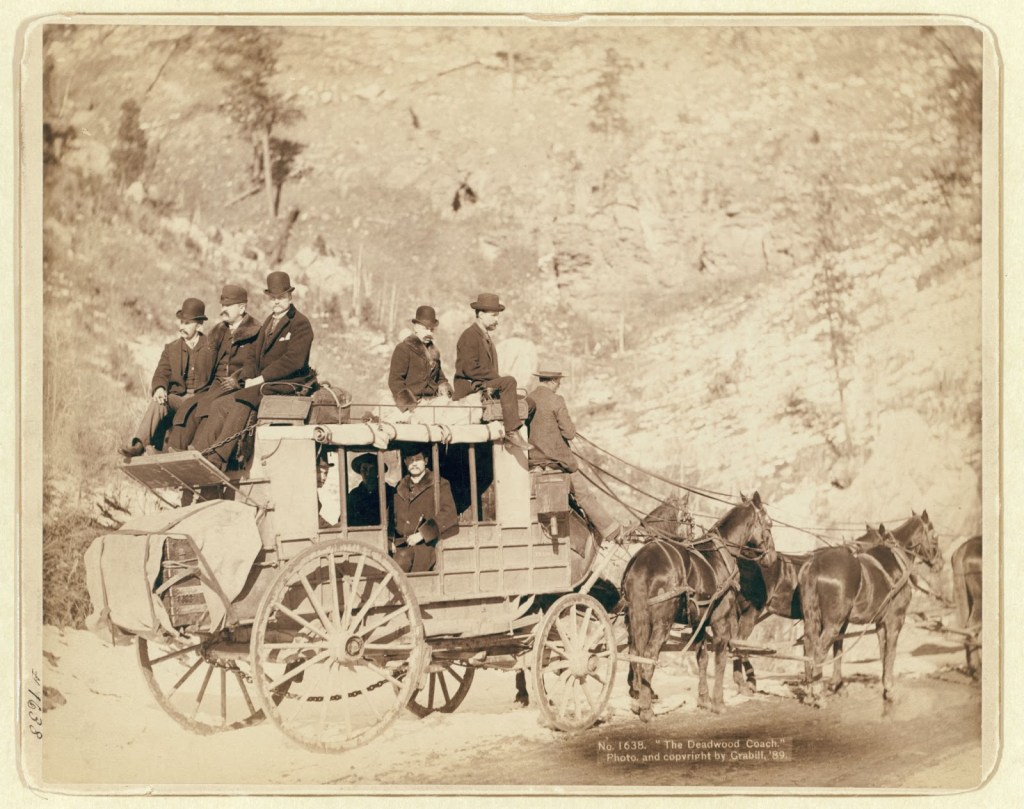
Another Hance guestbook entry by J. Curtis Wasson told of the twelve hour stage coach journey after alighting from the Santa Fe Railroad Company’s train: From Flagstaff at 7 o’clock a.m. our stage-and-six goes out. Arriving at Little Springs Station, where a new relay of six horses is added, we make haste until the half-way station is reached, passing through a fine unbroken forest of Pinus ponderosa, quaking aspen, balsam fir, and spruce. The open forest, the waving grasses, the gorgeously colored mountain flowers, the occasional chirp of the forest songsters, the ice-cold springs traversing our smooth compact road, the peaks, clear-cut and massive, towering up nearly 14,000 feet into the blue above, the low rumbling of our great Concord stage, the sound of two dozen hoofs, the sharp crack of the driver’s whip, the clear, bracing atmosphere, every breath of which seems to stimulate, the indescribably beautiful Painted Desert outstretching for a hundred miles to our right.
– a stage-and-six – high-speed travel –
One fain would linger on scenes like these but we have arrived at Cedar Station, and after partaking of a very refreshing luncheon we are given a new relay of horses and hasten over the desert portion of our ride to Moqui Station, where another relay is provided, which takes us to the hotel at the rim of the Grand canon, where we arrive at 7 o’clock p.m.
Leaving our Concord stage, giving our grips to the porter, not even waiting for “facial ablutions,” we hasten across the yard and up to the rim of the canon, when, looking over — the Chasm of the Creator, the Gulf of God, the Erosion of the Ages, that Erosive Entity, that Awful Abyss, lies in all its awfulness before us, — awful, yet grand; appalling, yet attractive; awe inspiring, yet fascinating in its greetings.
This story will be fuzzy in parts because of the long passage of time. But although some details may be slightly different, ‘strue. So I must tell the tale before those last few grey cells that hold the memory get blitzed by the box wine.
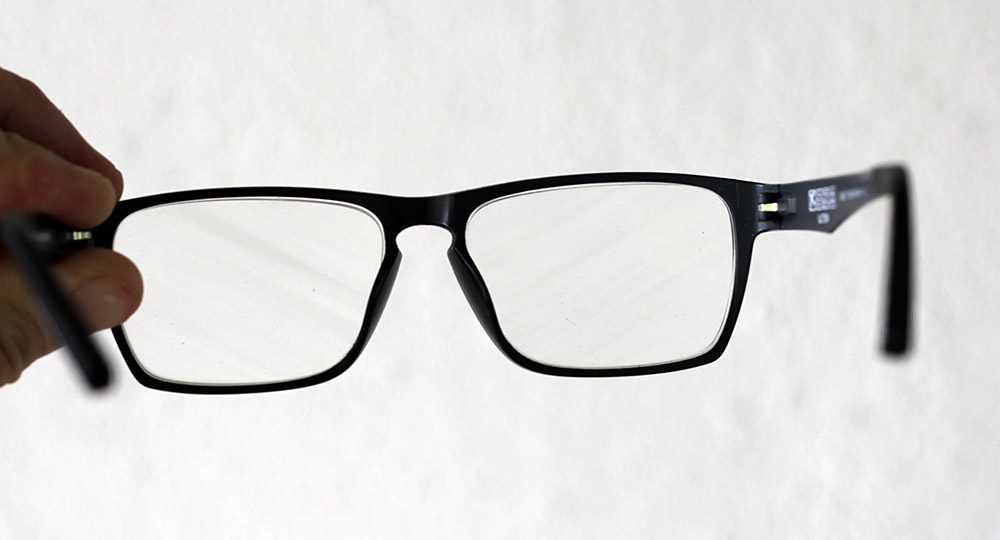
It was on the Berg River Canoe Marathon that Christof Heyns came to tell me was pulling out of the race. Why!? I asked, dismayed. He’d fallen out in the frigid flooded Berg river and lost his glasses. Couldn’t see past his nose, so it was way too dangerous to carry on in the mid-winter Cape cold and the flooding brown water in the gale-force wind that was the 1983 second day.
Hell, no, I said, I’ve got a spare pair, you can use mine.
He rolled his eyes and smiled sadly at my ignorance. His eyes were very special, his glasses were very thick and there was no way just any ‘arb’ specs would do, he mansplained patiently. In his defence, he didn’t know I was an optometrist, that I was wearing contact lenses, that I had a spare pair of specs in my luggage and another tied to the rudder cable in my boat; nor could he know that I had a very good idea of what his prescription was from seeing his glasses on his nose both on this race and on a Tugela trip we had been on together earlier. I knew about his eyes better than he knew about my soul (he might have known a bit about that, as his Dad was a very belangrike dominee in the Much Deformed Church – top dog, in fact).
So I said, trust me swaer and went and fetched my spares. He put them on and was amazed. I can see! he shouted like I was Jesus who had just restored his sight. I know, I said.
So he wore the glasses and finished the race and I said keep them till we next meet.
Many months later I saw an article in the SA Canews, the paddling magazine, titled: “My Broer se Bril”. Christof wrote the story of how he had lost hope when some arb oke said “Here, try mine” and he could see! And he could finish the race.
He ended off by saying “Actually they were so good I’m wearing them to this day”. Ja, you bugger, I know, I thought. I could have written an article “How a dominee’s son appropriated my bril,” but I didn’t. I’m way too kind! In his defence, we haven’t seen each other since that race.
. . and today – April 2021 – I heard he died, aged only 62. Damn!
~~~oo0oo~~~
belangrike dominee – important churchman; flock leader; the lord is my shepherd, I am a sheep;
swaer – bro;
my broer se bril – my brother’s spectacles;
mansplain – when a man laboriously, carefully and ‘kindly’ explains something to you that you already know; usually inflicted on women;
Lee’s Ferry on the right bank of the Colorado River, just above the mouth of the Paria River, at an elevation of 3,170 feet asl is the site of the start for most river trips through the Grand Canyon.
Originally called Lonely Dell by Mormon church-man with 19 wives and 67 children John D Lee, who established the ferry in 1872, it provided the only access across more than 300 miles of river for many years. Actually one of Lee’s 19 wives, Emma ran the ferry for a number of years while he was on the lam – hiding from the law for his leading part in the wicked 1857 Mountain Meadows Massacre.
The massacre near St George, Utah involved a group of emigrants known as the Fancher Party trekking west from Arkansas who were camped at Mountain Meadows in southern Utah preparing for their final push across the Mohave Desert when they were attacked by a group of Mormon Militia who disguised themselves as Native Americans so as to cowardly deflect blame for the attack.
It was a time of great tension between Mormons and the rest of the United States, and the massacred party was most likely attacked because they were not Mormons.
After an initial siege, the treacherous Lee approached the emigrants saying he’d negotiated safe passage for them with protection from their supposed Native American attackers if they surrendered their weapons. The group agreed, whereupon the militia proceeded to kill all but the children under 8 years of age.
One hundred and twenty men, women and children died that day. For almost two decades, the incident was covered up, but in 1874, Lee was brought to trial. Never denying his complicity in the massacre, Lee did insist – probably correctly – that he was acting on orders from high up in the church. He was the only one of about fifty men involved in the massacre to be brought to book. He was convicted and executed by firing squad in 1877.
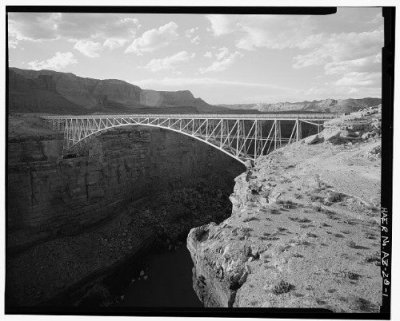
His widow Emma Lee sold the ferry in 1879 for 100 milk cows to the Mormon Church who continued to operate it until 1910 when it was taken over by Coconino County, Arizona. The ferry stayed mostly in use until 1929 when the Navajo Bridge was completed. Ironically, the ferry was used to ship much of the material to build the bridge that put it out of business.
1984: There was only one bridge when we crossed to the right – or ‘north’ (rivers only have left or right banks – think about it) – bank of the river. It was completed in 1929. A larger parallel second bridge was added in 1995. The bridge we crossed is now used for pedestrian sight-seeing.
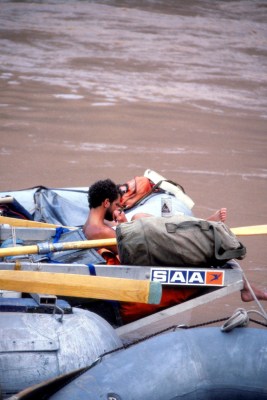
Now: To make sure there are no misunderstandings, our John Lee on the 1984 trip down the Colorado is a good ou who, at that stage, had zero wives:
Dogs accomplish mating by a unique physical way and process. Unlike most other mammals, the dog’s penis has a large bulbous enlargement at the base. When the dog’s penis enters the vagina of the bitch, it must go through a muscular ring or constriction of the external opening of the vagina. The moment the penis is through, the pressure of the tube on the reflex nerve center causes a violent thrust and the dog clings to the bitch with all his strength. The swelling of the bulb prevents the dog from withdrawing his penis.
Dogs remain hung in this manner for on average twenty minutes. The male turns around and faces the opposite direction from the bitch. While the two are hung in this manner, they may get their nails into the dirt and pull with far more than their own weights, stretching the penis amazingly. Do not be alarmed when they pull this way; neither dog is being hurt. As the valve relaxes, the blood leaves the penis, usually from the bulb part first, and allows the enlarged penis to slip out.
They’re usually bound together for about twenty minutes. Quite long. In fact, in animal kingdom terms I think you could almost call it . . ‘True Love.’ Or ‘commitment.’
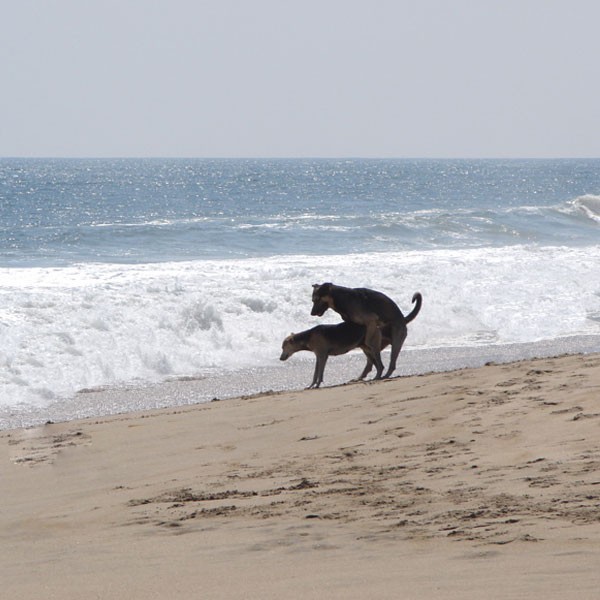
I didn’t know this when I first saw it on the Fyvie’s Gailian farm outside Harrismith in the Free State. Tabs and I were farming with his Dad Hector, who was driving the pickup. We rounded a bend and there they were. I watched in fascination. It did seem a bit like, after the passion, they had turned their backs on each other, avoiding eye contact, and were like:
I can’t believe this; He doesn’t write, he doesn’t call; and him: Will she still respect me in the morning . . . ?
We watched a few seconds and then Uncle Hec in his inimitable quiet, deadpan way, said: “Locked in Holy Matrimony.”
~~oo0oo~~
Another famous dog knot featured our first dog’s famous father: Stan the Man
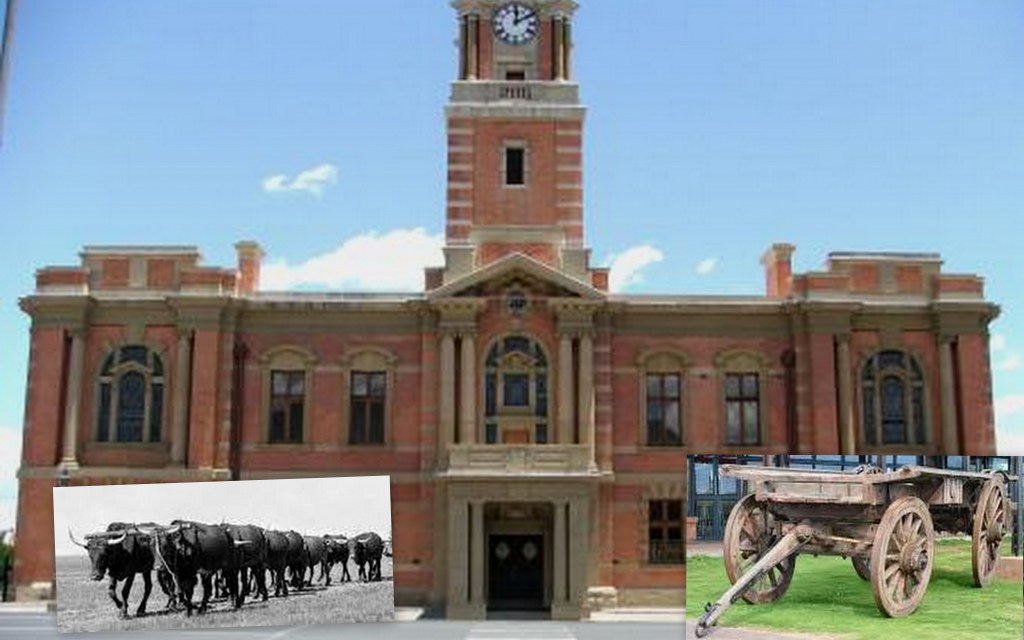
The Harrismith Stadsaal was propvol. Albert Hertzog was coming to speak as leader of his new breakaway party, Die HNP, Die Herstigte Nasionale Party. And the doubtful and the faithful were all there. Plus one Yank.
The doubtful were there to worry about the severe liberalisation evident in the Nat Party lately – I mean, they were considering allowing television, and Engels, and sulke kak! – while the faithful were there to heckle ou Hertzog.
A dapper little dutchman, he gave a rousing speech about the great injustice done to them by the Nats, building up to a rousing “en hulle het ons UITGESKOP!” flinging his arm out in what looked suspiciously like a Nazi salute. Upon which, from the back of the hall rang out a clear “NETJIES!” which brought the house down and quite ruined the dramatic effect.
This as reported to me by the Yank Larry Wingert, Rotary exchange student from Cobleskill New York, who’d gone along to witness democracy, Old-SA-style.
In typical political fashion the verligtes hated their brother verkramptes even more than they hated the old enemy, the Sappe. The Sappe they could say, were just stupid, but these ous were verraaiers!
In the election that followed, the Sappe (United Party – the nickname was from an older party, the South African Party) made gains, the Nats losing seats in parliament for the first time since they came to power in 1948.
But ou Hertzog’s Herstigtes won 0 seats. Zero. That’s roughly equivalent to fokol. Not one, despite appealing to Larry that they were the way forward to the past!
The Nats were still in power, but to put their “power” in perspective, in a country of 22.5 million people, 821 000 people voted for them!
Talk about illegitimate.
~~oo0oo~~
propvol – full – full to bursting
“en hulle het ons UITGESKOP!” – The Nats in power booted out the doubters; Who then formed the “re-established National Party” (Herstigtes); You know, like brothers falling out; famielietwis;
famielietwis – family feud
“NETJIES!” – Well Done! Neat Move!
verligtes – sort of ‘enlightened’ racists; a bit more realist than the verkramptes; would allow TV a mere seven years later;
verkramptes – cramp-ass racists; Keep the world at bay! Send the Indians back to India! Drive the Blacks into the sea! Much longing back to their imaginary ‘good old days’! Fond of re-enactments like this:
verraaiers – people whose opinion differs from yours; people who don’t have your insight; blerrie traitors; andersdenkendes; anderskleuriges; kommuniste; liberales;
We had asbestos heaters on the walls in our Louisa Street residence in Doornfontein, Johannesburg. The res was in the shadow of the not-yet-completed Ponte tower – the 50-story residential cylinder up on the hill that became famous and notorious for varying reasons over the years.
Doories cars – and Ponte
Doories res and view
Late one night we woke up to yelling and cursing. Thick smoke billowed into our room, so we rushed out to see wassup. Glen Barker and Louis Slabbert’s room was on fire! Glen’s clothes, his bedside table, the linoleum floor and the ceiling were ablaze. We soon put it out and, coughing and spluttering, opened up the windows and doors to let the acrid, foul smoke escape.
To the amazement of the non-smokers amongst us, Louis then sat down on his bed, lit a cigarette and inhaled deeply!
How brave was that!? The longer I have teenagers of my own the more I admire my Mom and her quiet courage and fortitude back in the ’70’s! The thought of giving my teenage son my car and allowing him to disappear (it would be in a cloud of dust and tyre smoke) on a three week jaunt fills me with querulous whimpering. (I’ll do it, I’ll do it, but only ‘cos Mom did it for me).
Larry Wingert was an ex-Rotary exchange student to SA from Cobleskill, New York. He and I had been on a previous Road Trip USA in 1973; now he was teaching English in Athens and had flown to Nairobi, then traveled overland down to Joburg where we joined up and hitch-hiked to Harrismith. There, Mom parted with the Cortina keys and we drove to PMB then on to Cape Town. We took ten lazy days in going nowhereslowly style back in 1976.
Wherever we found a spot – preferably free – we camped in my little orange pup tent. In the Weza Forest we camped for free; In the Tsitsikamma we paid.
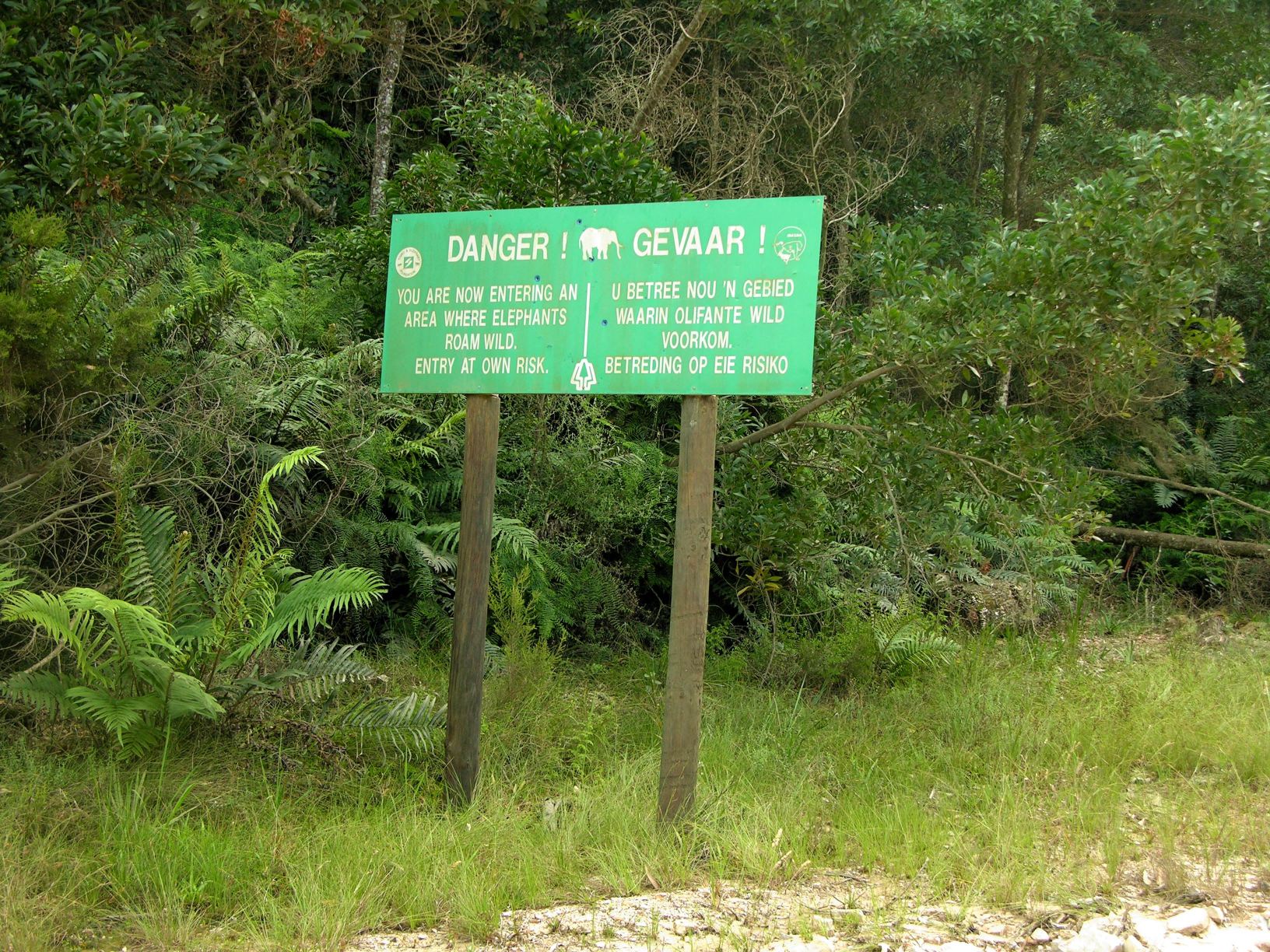
Driving through the Knysna Forest we saw a sign Beware of the Effilumps.
So we took the little track that turned off nearby and camped – for free – out of sight of the road in the undergrowth. Maybe we’d see a very rare Kynsna elephant? Not.
In Cape Town we stayed with Lynne Wade from Vryheid, lovely lass who’d been a Rotary exchange student too. She played the piano for us and I fell deeply in love, then disappeared on yet another beer-fueled mission. Coward. We also visited the delightful Dottie Moffett in her UCT res. She had also been a Rotary exchange student to SA from Ardmore, Oklahoma and was now back in SA doing her undergraduate degree. I was in love with her, too.
We headed for Malmesbury to visit Uncle Boet and Tannie Anna. Oom Boet was on top form, telling jokes and stories and laughing non-stop. That evening he had to milk the cow, so we accompanied him to the shed. Laughing and talking he would rest his forehead against the cow’s flank every now and then and shake with helpless mirth at yet another tale. Meantime, this was not what the cow was used to. It had finished the grain and usually he was finished milking when she had finished eating. So the cow backed out and knocked him off the stool, flat on his back, bucket and milking stool upturned. He took a kick at the cow, missed and put his back out. Larry and I were hosing ourselves as we helped him up and tried to restore a semblance of order and dignity.
Back at the house we gave Oom Boet and Aunt Anna a bottle of imported liqueur to say thanks for a lovely stay. It was a rather delicious chocolate-tasting liqueur and it said haselnuss mit ei. It was only a 500ml bottle, so we soon flattened it. It looked something like this:
“Ja lekker, maar ag, dis bokkerol, Kosie – Ons kan dit self maak!”
Ja?
Larry and I decide to call his bluff. In the village the next day we looked for dark chocolate and hazelnuts, but hey, it’s Malmesbury – we got two slabs of Cadbury’s milk chocolate with nuts.
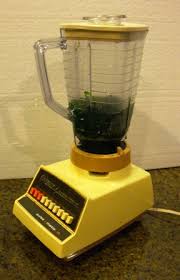
Oom Boet is bok for the challenge. He dives under the kitchen sink and starts hauling things out. He’s on his hands and knees and his huge bum protrudes like a plumber’s as he yells “Vrou! Waar’s die masjien?” Anna has to step in and find things and do things as he ‘organises’. She finds a vintage blender and – acting under a string of unnecessary instructions – Aunt Anna breaks eggs and separates the yolks, breaks chocolate into small pieces. Boet then bliksems it all into the blender and adds a fat dollop of a clear liquid from a label-less bottle. “Witblits, Kosie!” he says triumphantly. He looks and goois more in, then more. Then a last splash.
It looked like this, but the goo inside was yellowy-brown, not green. And it had a layer of clear liquid overlaying it nearly to the top.
He switches the blender to ‘flat-out’ with a flourish and a fine blend of egg yolk, chocolate and powerful-smelling hooch splatters all over the kitchen ceiling, walls and sink. He hadn’t put the lid on! And it was like a V8 blender, that thing.
Vroulief starts afresh, patient and good-humoured as ever. We mop, we add, he blends, and then it’s ready for tasting at last.
And undrinkable. That aeroplane fuel strength home-distilled liquor was just too violent. We take tiny little sips, but even Oom Boet has to grudgingly admit his is perhaps not quite as good or as smooth as the imported stuff. We add sugar, more chocolate and more egg yolk, but its only very slightly better, and still undrinkable.
Ten years later I still had the bottle and despite offering it to many people to sip as a party trick, it was still three-quarters full!
If we had marketed it we’d have called it Oom Boet se Bokkerol Haselnuss mit Eish!
I visited Oom Boet and Aunty Anna in a Ford Cortina again in 1983. The top featured pic with the old Chevy pickup was actually taken then by Sheila.
~~~oo0oo~~~
haselnuss mit ei – hazelnuts with egg
“Ja lekker, maar ag dis bokkerol, Kosie – Ons kan dit self maak!”- Nice, but we could make this stuff ourselves!
“Vrou! Waar’s die masjien?” – Wife! Where’s the machine?
bliksems – throws
witblits – moonshine
goois – throws
Oom Boet se Bokkerol Haselnuss mit Eish! – the same stuff except very different
That’s what Jacques de Rauville told my business partner when he heard I was going to do the 1983 Berg River Canoe Marathon. He had come across me one evening on the Bay and I’d asked which way to go, it being my first time out there and the lights and the reflections were confusing. “Follow me” said Jacques, and off he went, but within 50m I was 49m behind him. He waited and told me “Left at the third green buoy” or whatever he said. When he passed me again on his way back and I obviously hadn’t made enough headway, he thought whatever he thought that made him tell his optometrist Mike Lello: “Tell Pete Swanie not to attempt the Berg.”
Jacques was probably right, but he was a bit of a fusspot as far as preparations go. I thought. Luckily for me friend and all-round good bugger Chris Logan was also dubious about my fitness, so he took me for a marathon training session on the ‘Toti lagoon one day which got my mind around sitting on a hard seat for hours on end, numbing both my bum and my brain.
Chris was a great taskmaster. We stopped only once – for lunch (chocolate and a coke, it was early Noakes, not Banting Noakes. Also, according to Noakes, It’s not your muscles that limit you; it’s your brain. See, Noakes said my muscles were fine). So Chris selflessly sacrificed a day of his training intensity to stay with and encourage this TapTap Makathini mud-paddler. Before Chris, my training method entailed using the first half of a race for training, then hanging on grimly for the second half, going slower and slower till the finish. Between races, I would focus on recovery, mainly using the tried-and-tested cold beer and couch methodology.
We set off for Cape Town in my white 2,0l GL Cortina, me and Bernie Garcin the paddlers and sister Sheila and mom Mary to drive the car while we paddled. I was feeling invincible from my full day of training.
The night before the first day of the race in Paarl, the race organisers pointed out a shed where we could sleep. Cold hard concrete floor. Winter in the Cape. Luckily I had been warned and had brought along a brand-new inflatable mattress and an electric tyre pump that plugged into my white 2,0l Cortina GL’s cigarette lighter socket. So I plugged in and went for a few beers.
*BANG* I heard in the background as we stood around talking shit and comparing paddling styles and training methods. I wondered vaguely what that was. The bang, as well as ‘training methods.’ A few more beers later we retired to sleep and I thought, “So that’s what that bang was” – a huge rip in my now-useless brand-new no-longer-inflatable mattress, and the little pump still purring and pumping air uselessly into the atmosphere. So I slept on the concrete, good practice for a chill that was going to enter my bones and then my marrow over the next four days.
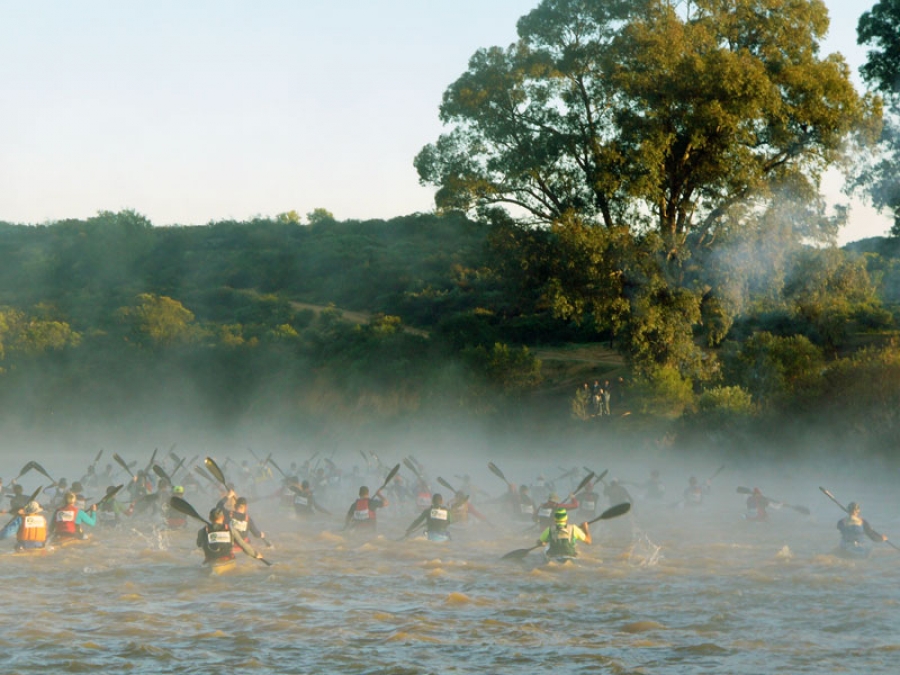
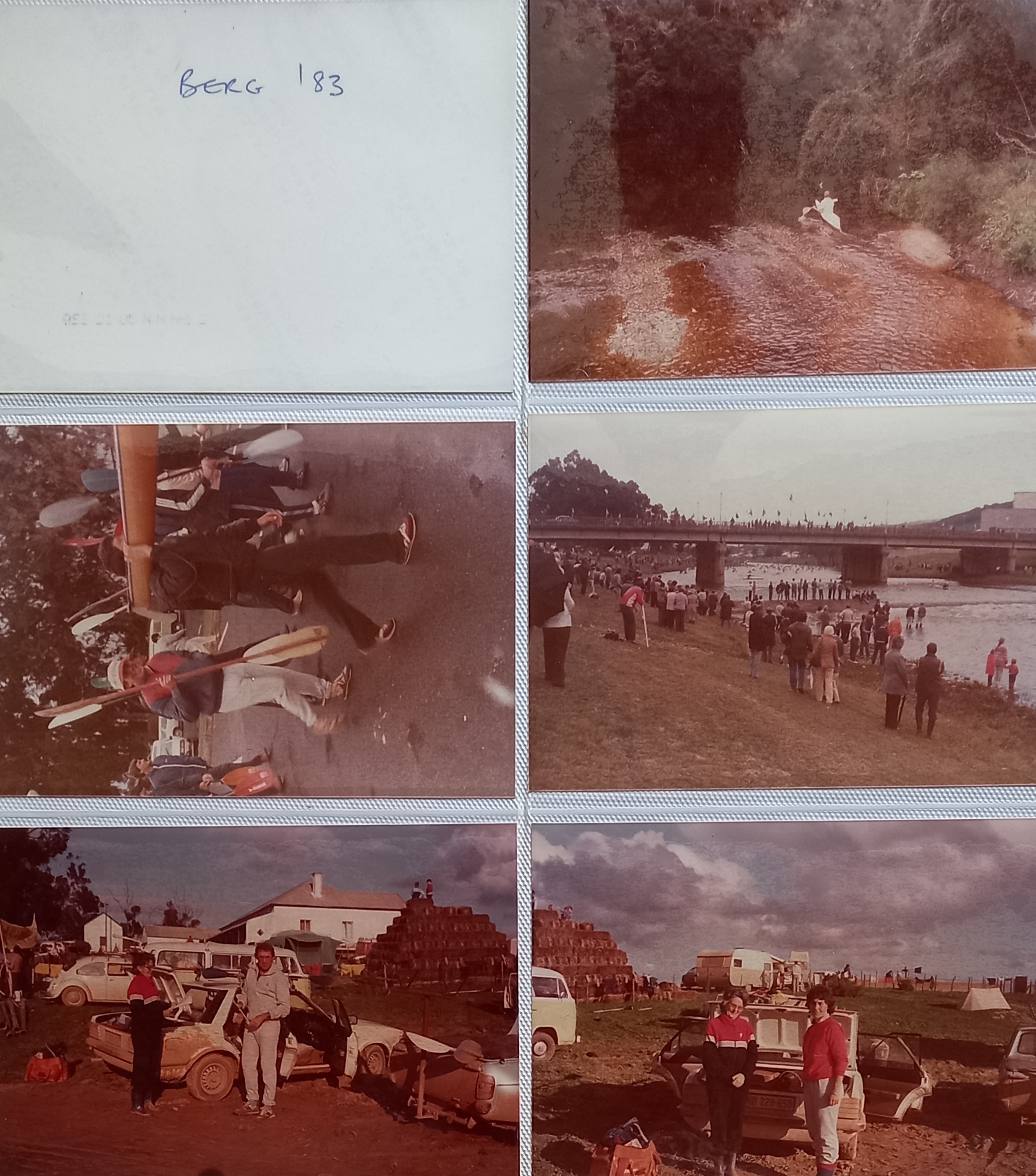
The first day was long, cold, windy and miserable, but the second day on the ’83 Berg made it seem like a balmy breeze. That second day was one of the longest days of my life! As the vrou cries it was the shortest day – those Cape nutters call 49km of ice a short day – but a howling gale and horizontal freezing rain driving right into your teeth made it last forever. Icy waves continuously sloshing over the cockpit rim onto your splashcover. It was the day Gerrie died – Gerrie Rossouw, the first paddler ever to drown on an official race day. I saw him, right near the back of the field where I was and looking even colder than me. He wasn’t wearing a life jacket. It wasn’t macho to wear a life jacket and I admit that I wore my T-shirt over mine to make it less conspicuous and I told myself I was wearing it mainly as a windbreaker. Fools that we were. Kids: Never paddle without a life jacket.
Later in amongst a grove of flooded trees I saw Gerrie’s boat nose-down with the rudder waving in the wind, caught in the underwater branches, and I wondered where he was, as both banks were far away and not easy to reach being tree-lined and the trees underwater. Very worrying, but no way I could do anything heroic in that freezing strong current. I needed to stay afloat, so I paddled on to hear that night that he was missing. His body was only found two days later.
Mom and Sheila second us in the mud
That night a bunch of paddlers pulled out. Fuck this, they said with infinite good sense. Standing in the rain with water pouring down his impressive moustache my mate Greg Jamfomf Bennett made a pact with the elements: He would paddle the next day IF – and only if – the day dawned bright, sunny and windless. He was actually saying Fuck this I’m going home to Durban where ‘winter’ is just an amusing joke, not a serious thing like it is here. He and Allie were then rescued and taken out of the rain to a farmer’s luxury home where about six of them were each given their own room and bathroom! Bloody unfair luxury! This then gave them an advantage and allowed them to narrowly beat me in the race! By just a few hours. Per day.
– me and my lady benefactor –
After devouring a whole chicken each, washed down with KWV wine and sherry supplied by the sponsors, us poor nogschleppers climbed up into the loft on the riverbank and slept on the hard floor. Here I have to confess Greyling Viljoen also slept in the loft and he won the race – which weakens my tale of hardship somewhat.
We braced ourselves for the third – and longest – day . . . which turned into the easiest day as the wind had died and the sun shone brightly on us. ‘The clouds dissolved and the sky turned blue’ – thanks to Jamfomf’s arrangement with the weather gods I spose? So the long day became a really pleasant day which seemed half as long under blue skies – even though it was 70km compared to that LO-ONG 49km second day.
Before the start Capies were seen writhing on the ground, gasping, unable to breathe. They usually breathe by simply facing into the wind and don’t have diaphragm muscles. So a windless day is an unknown phenomenon to those weirdos. At the start, about ten Kingfisher paddlers bunched together in our black T-shirts: Allie Peter, Jacques de Rauville, Herve de Rauville, Bernie Garcin, Dave Gillmer, who else? Greg Bennett was also there, to his own amazement. I hopped on to their wave and within 50m I was 49m behind. I watched the flock of black T-shirts disappear into the distance. I was used to that. Anyway, I have my own race tactics.
By the fourth day I was getting fit. I was building up a head of steam and could have become a threat to the leaders. Or at least to the black T-shirt armada. I could now paddle for quite a while without resting on my paddle and admiring the scenery. I paddled with – OK, behind, on her wave – a lady paddler for a while, focused for once. Busting for a leak, I didn’t want to lose the tug, so eventually let go and relieved myself in my boat. Aah! Bliss! But never again! I had to stop to empty the boat before the finish anyway (the smell! Must be the KWV sherry), so no point in not stopping to have a leak. I caught up to her again and finished with her, as can be seen in the pic.
Not that there will be a next time! Charlie’s Rule of Certifiability states quite clearly “Doing the Berg More Than Once Is Certifiable.” And while Charles Mason may have done fifty Umkos he has done only one Berg. Being a lot more sensible, I have done only one of each.
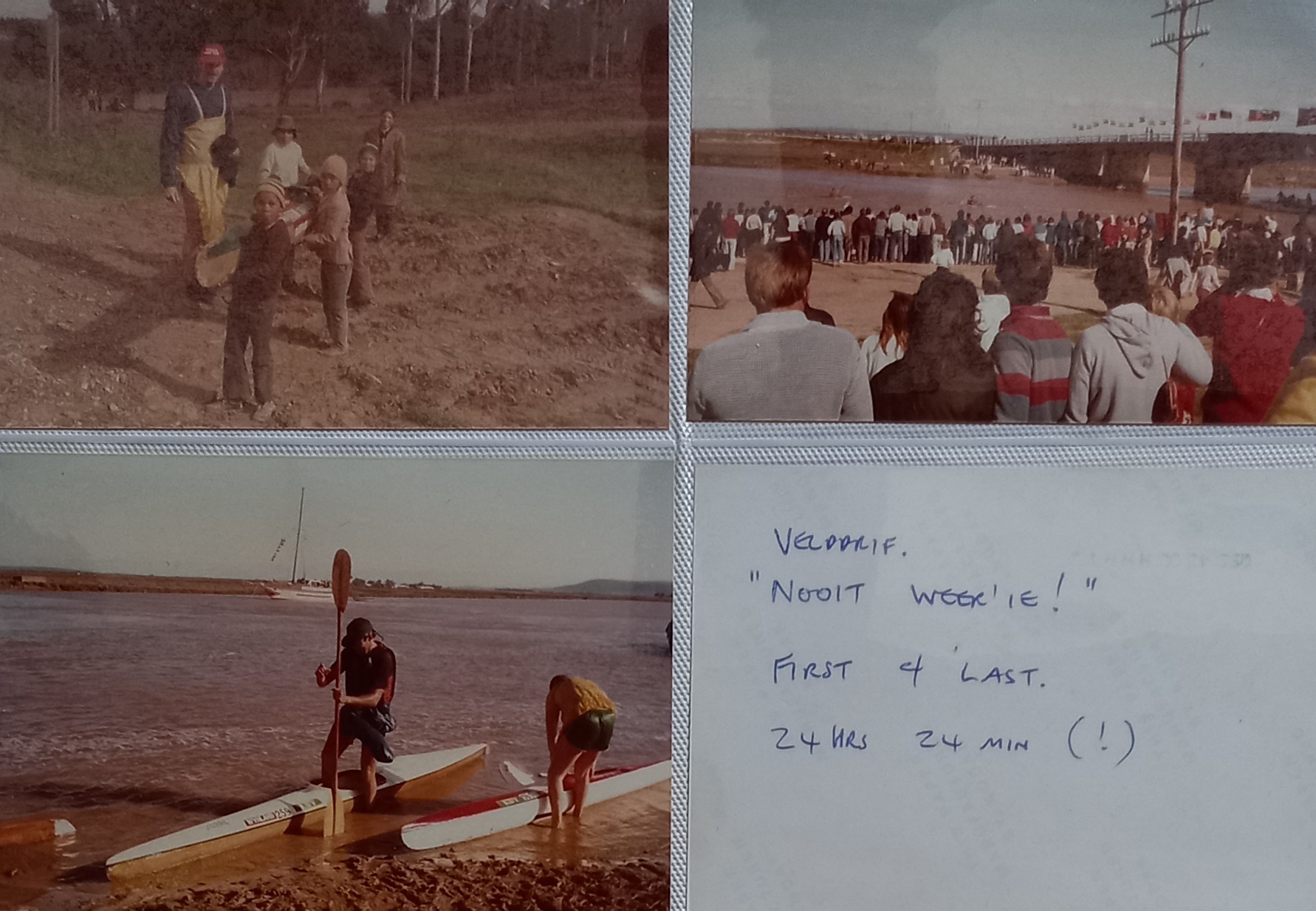
Greyling Viljoen won the race in 16hrs 7mins; I took 24hrs 24mins and probably 24 seconds; 225 maniacs finished the race; I was cold deep into my spinal bone marrow.
The freezing finish at Velddrif at last!
– at this stage when asked, you say, ‘Fine. It was nothing. No problems’ –
The Velddrift Hotel bed that night was bliss with all my clothes on and the bedclothes from both beds piled on top of me. In Cape Town the next day I bought clothes I couldn’t wear again until I went skiing in Austria years later. Brrrr!! Yussis! Nooit! The Berg joins quite high up on my list of ‘Stupid Things I’ve Done’. Top of which is the Comrades Marathon Which is also the only ‘Stupid Thing I’ve Done and Not Even Finished.’
~~oo0oo~~
Some interesting stats and numbers for the Berg River Canoe Marathon
241km from Paarl to Velddrif. Four days of approx 62, 46, 74 and 60km. 46 300 – The estimated number of paddle strokes required to complete the Berg
I thought ours was a really high-water Berg. At 19cumecs it was the 7th highest of the 21 Bergs up to then. But since then the river has often been higher and 1983 is now only the 21st highest of 55 races. The very first race in 1962 was a staggering 342 cumecs! Liewe bliksem! The lowest in 1978 was a mere 1.44 cumecs. You could almost say fokol.
Only twice – in 1965 and 1967 – was the overall winning time more than 21 hours (I took 24hrs, but that’s OK, I didn’t win). The fastest overall time: 13hrs 20mins. Giel doesn’t make mistakes, so I must have the 1983 time wrong.
Five paddlers have completed 40 or more Bergs. Giel van Deventer – Berg Historian, who compiled these facts – has finished the race 45 times! In the book on the Umko canoe marathon I wrote in a draft which I sent to him “the Berg, over 200km long” and he hastened to write to me saying “Pete, it’s 241km long, don’t get it wrong.” I changed it to 241km. (note: Giel went on to do 50 Bergs, then sadly drowned in the Breede river race. Thank goodness though, he did travel to Natal to do ONE UMKO! ).
One of the toughest years was 1971. Only 49% of starters finished – the lowest percentage so far. The oldest finisher of the Berg, Jannie Malherbe was 74 when he did that crazy thing in 2014. He made our Ian Myers in 1983 seem like a spring chicken.
1 401 – The number of paddlers who have completed one Berg only. Us sensible ous. 2 939 – The number of paddlers who came back for at least one more – maniacs!
Andy Birkett won the Berg in 2016. He makes no bones about the fact that the grueling race takes its toll, even on well conditioned paddlers. “Flip, it was tough!” he recalls. “It was cold, putting on beanies and two or three hallies and long pants when you are busy paddling. But that is all part of it.” He speaks of how one needs to discreetly tuck in behind the experienced local elite racers, particularly on the earlier sections of the course where local knowledge through the tree blocks and small channels is important.
~~oo0oo~~
Photo albums are history, so here’s a digital copy of my now discarded hard copy. Thanks to sister Sheila for the pics.
















 Vrystaat Confessions