Six foot four inch Pete Stoute was running the Comrades Marathon, that foolish 89km exercise in torture held annually in KwaZuluNatal, when suddenly he heard a shout from around knee-level: “Yiss, Stoute, hoezit?”
He looked around, nothing. He looked down: There was Skim, short and round as a beachball, choofing alongside. Skim du Preez, kranige scrumhalf of the great Optometry rugby team of 1975.
Skim! What the hell are YOU doing here! he exclaimed. No, Stoute, I thought I must do this thing, seeing I’m a boykie from Dundee, said Skim. – Dundee pronounced “DinDear,” the Afrikaans way – it means ‘steenkool.’ Stoute pronounced ‘stotah,’ the Afrikaans way – it means naughty.
They chatted a few minutes and then Skim said, Oh Well, Be Seeing You and ran off into the distance!! Left the long-legged Stoute in his dust!
~~~oo0oo~~~
As often, one of my dodgy history lessons: Dundee, pronounced DinDear, is the famous site where British army troops, tired of being shot through their red coats and their white helmets, finally wore khaki uniforms for the first time in battle. I wonder if their commander Major-General Sir William Penn Symons KCB still wore his red coat that day, though? He got shot in the stomach and died three days later as a prisoner of war in Dundee.
These Boers would know: The caption says they were ‘watching the fight’ that day! Like a movie!
The British claimed a ‘tactical victory’ in the battle. Here’s the actual scorecard – a lesson whenever you read battle reports. To the Poms, this (as they were informed by their jingo press) amounted to a tactical victory:
British casualties and losses – 41 killed, 185 wounded, 220 captured or missing; Boer casualties and losses – 23 killed, 66 wounded, 20 missing. So – Total count 446 down vs 109 down, but “we won.”
And so the dispatch goes back to Mrs Queen in Blighty (perhaps sent by jingo war correspondent Winston Churchill?): “We won a tactical victory, Ya Majesty.” Maybe he at least added “Um, send reinforcements” – ?
Always remember that one thing all military outfits do without fail . . is lie.
~~~oo0oo~~~
stoute – the Afrikaans pronunciation “stotah” as in kabouter; it means ‘naughty.’
kabouter – Snow White and the seven kabouters
choofing – running like a gazelle
kranige – capable; brave; gallant; dashing
scrumhalf – not only a scrumhalf – see the comments
No – yes
DinDear – Dundee; coal-mining village; not in Scotland
steenkool – coal; or stone coal; you can’t say just ‘kool’ cos that would mean cabbage
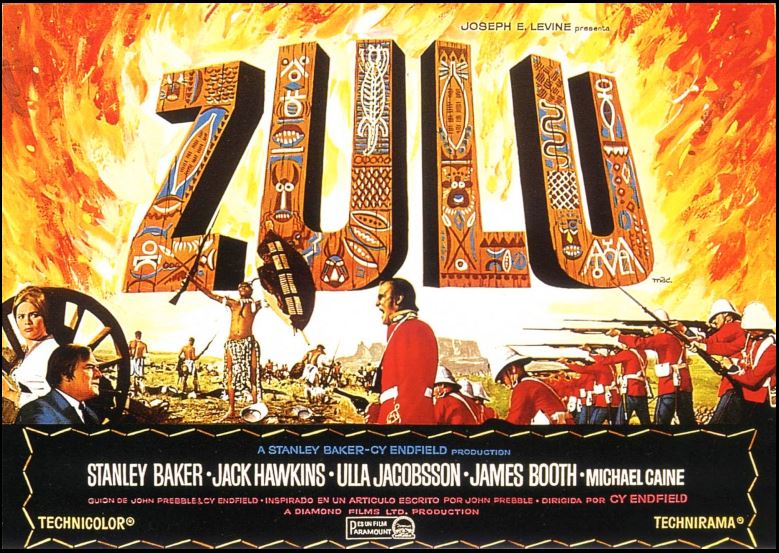
Released in 1964, ‘Zulu’ has become one of most iconic British films ever – directed by Cy Endfield, and starring Stanley Baker, Jack Hawkins and Michael Caine. I joked here that we had held the World Premiere of this famous film in our lounge in Harrismith! Hey! Sorta true!
Now, fifty five years later, a new film, ‘Zulu and the Zulus’ is planned. Scheduled to be a ninety minute feature length documentary to be shot in England and in KwaZuluNatal, South Africa, the film will tell about the making of the classic war film ‘Zulu’, and – un-colonially – also tell the stories of the Zulu people involved in the making of that famous film.
Here’s a trailer of the planned movie:
– ‘Zulu and the Zulus’ promo trailer –
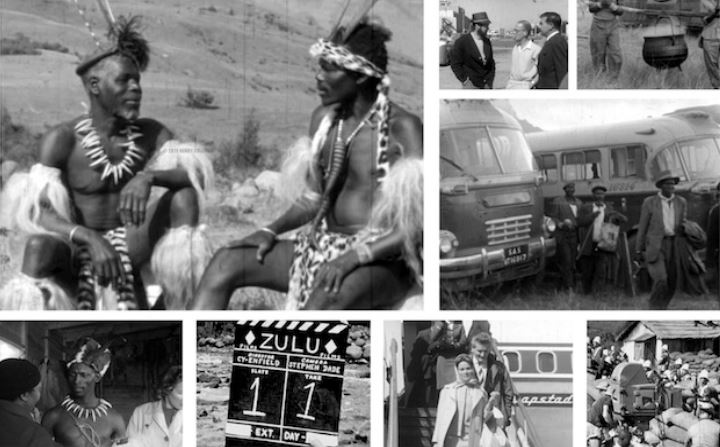
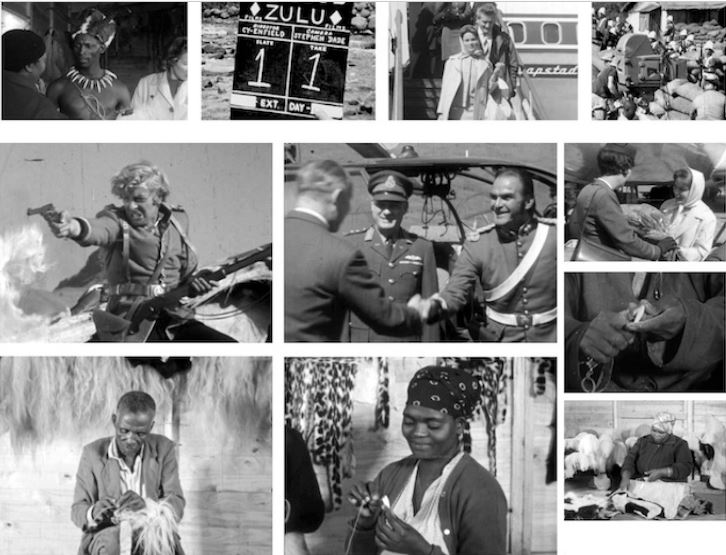
Director Henry Coleman is sole owner of the only print of the making of ‘Zulu’. Shot in Natal in 1963, it contains 26 minutes of unique black & white behind-the-scenes footage showing cast and crew at work and play while making one of the most iconic and loved war films of all time.
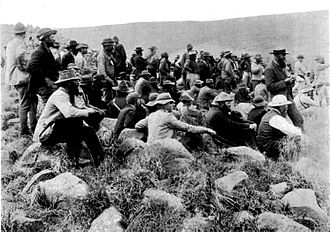
Coleman and Producer Mark Tinkler, will take this Behind the Scenes footage back to KwaZulu Natal, screen it for the Zulu people and talk to them about this historic and well-loved film – Zulus who appeared in the original film as extras. Many rural Zulu people have no access to cinemas, and no electricity in their villages, and so would have not seen the film. The production team will travel out to the remote parts of KwaZulu and screen the film either in huts or on a portable screen outdoors using a generator, DVD player and screen, film the audience watching the film, interview them and draw out their stories on the making of the film in 1963. Some of them saw the film and rushes at special screenings organised by star & Producer Stanley Baker – as seen in this rare still of film extras watching themselves in the rushes:
But many of them have never seen it since, or indeed ever. ‘Zulu and the Zulus’ will examine the making of film to the Zulus, visiting the locations in Natal where the film was shot, a Then and Now sequence. They will also visit the original battle site at Rorkes Drift. It will be a fascinating journey.
It will be a very visual experience, with Zulu warriors watching themselves and their parents playing their ancestors. Chief Mangosuthu Buthelezi, who became a minister in the first legitimate government of South Africa upon liberation in 1994, appeared in ‘Zulu’ as his Great Grandfather, King Cetshwayo ka Mpande. He has agreed to participate in this project and has given us his full support. At the heart of ‘Zulu and the Zulus’ is 26 minutes of never-seen-before ‘making of’ footage. This original 16mm silent footage has been painstakingly restored in a top post-production house in London, and this unique footage not only features the film’s ‘famous’ cast and crew on set, it also includes the building of key sets in KwaZuluNatal as well as costume design, creation and fitting, stunt work, battle scenes and much more. But more importantly, it is an historical record detailing the extent of contribution from the local community in bringing the famous film ‘Zulu’ to life.
We have also found, and gained exclusive access to, another 40 minutes of colour home movie footage shot on set, giving us a unique insight into the production of Zulu.
Seven minutes of these forty minutes of ‘home movie’ footage were taken by Dad with his new Eumig 8mm cine camera when he and Mom went to the set in the Royal Natal National Park back in 1963. Sister Sheila had the film digitised, but I won’t be showing it here as Henry Coleman has asked to use it for his movie. Hopefully some of it will make it onto the big screen!
More from Henry: ‘Zulu and the Zulus’ will tell the behind the scenes story of the classic British Movie ‘ZULU’. We will be interviewing European cast and crew and for the first time, hear the tribal ZULU actors, stuntmen & crew stories from behind the scenes. We hear tales of the making of the film, what it meant to the Zulus, then and now, and the film’s legacy to Zulus today. Everyone knows the film, it’s iconic set pieces, and the lead European actors… but no-one has ever spoken to the hundreds of Zulu warriors who took part in the film, the Zulus of the title. This is a unique opportunity to get the Zulu peoples’ point of view on a classic film named after them, but whose voices we’ve never heard before – there will be stories we’ve never even imagined, illustrated, intercut with the rare footage of the making of Zulu.
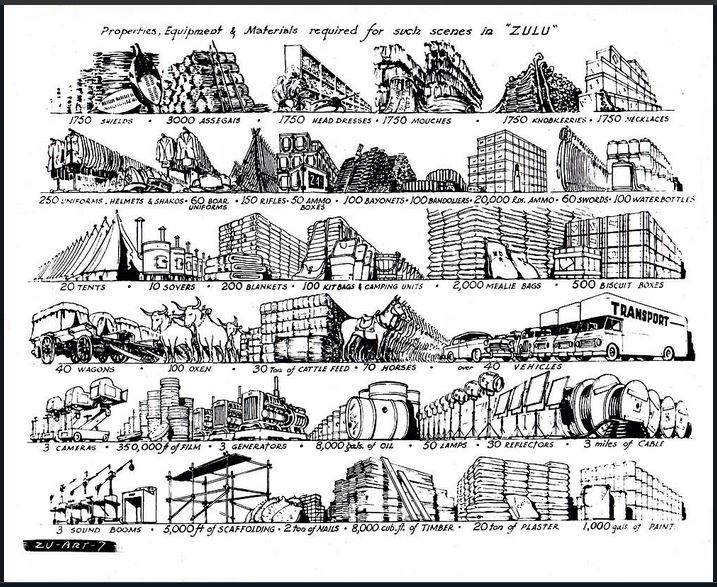
An illustration of props, equipment and ‘stuff’ used on the remote location of the set of Zulu in 1963 (from Henry Coleman’s Zulu and the Zulus twitter feed), giving an indication of the challenging logistics:
I just read a lovely post from an Irish woman who grew up in the sixties. She wrote:“In 1960, we had no fridge, no TV, no car, no central heating – only open fires, water heated by an old ‘pot-bellied’ stove, no electric immersion heater, no automatic washing machine. Chilblains were a fact of life every winter. Stuffed material sausage dogs were at the bottom of many doors to keep the draughts out (and there were many draughts!)”
. . . and those stuffed sausage doorstops got me thinking. So I wrote a bit about what I can remember about “Harrismith’s mild winters” and asked friends to add their sixpence worth! How cold was Harrismith? ——————
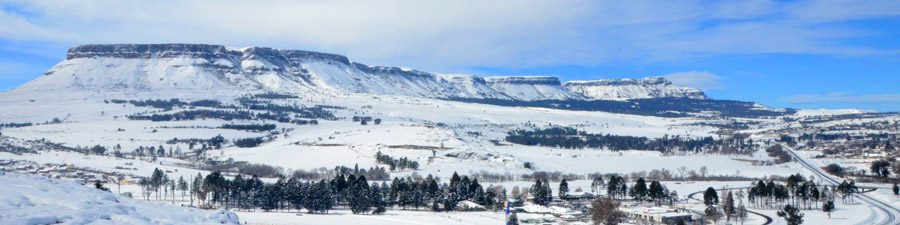
Ceilings had no insulation and the windows were wooden sash or steel frame, single-glazed; Windows would mist over, but you would still try and see if Platberg had its table-cloth on. Always coldest when the east wind blew and put a ‘blanket’ or ‘table cloth’ on the mountain like this:
Weather – that blanket settles on our mountainDoor-stop ‘sausages’ to block the icy breeze whistling under doors – sometimes plain sausages, sometimes made into sausage dogs! Huddling in front of a red-hot bar heater giving a little ring of warmth; Move back a yard and the room was frigid!
The black coal stove in the kitchen was lit through the whole of winter, thank goodness; A cruel boyhood confession: I murdered a few flies at this stove in our kitchen! Tore off their wings and turned them into ‘walks’ then tossed them into the stove to die! Yikes! Here’s an old one, no longer installed, no longer black:
On the beds lots of blankets, no duvets; If you were lucky your Mom would cut the tassles off the Standard Woollen Mills blankets and sew on a strip of smooth silk-like tape that didn’t tickle your nose! I remember some of our old pillows weighing ‘a ton’. Probably a quarter ton of feathers, a quarter ton of live mites, a quarter ton of dead mites and a quarter ton of sweat and snot! Luxury was having flannel ‘winter sheets’ rather than those smooth, thin, cold ordinary cotton sheets.
We were lucky to have hot baths from an electric geyser warming us up. You would wallow in the big old iron bath with ball-and-claw feet, trying to get your scrawny carcass under the shallow water, then start dreading having to get out; Soon, though, the decision would be an easy one, as the water cooled rapidly.
Getting into those long flannel winter jarmies was such a treat. Cosy. Some of ours were hand-made – machine-sewn by Mom.
Leaving for school in the mornings was jersey on, socks pulled up high, gloves on, and off you’d go on yer bike; Riding along Stuart Street your eyes would water and your nose would run, so gloves and sleeves had to do snot duty; When you got there you’d slide your hands off the handle-bar grips as they didn’t want to ‘uncurl’! Your bare knees would be frozen yet somehow you didn’t feel them as much as you felt your toes in your socks and shoes! Funny that. As uncool as it was, sometimes you’d even wear the grey balaclava Mom had knitted for you.
I remember it like this:
Except, it wasn’t really. That’s Europe and maybe their winters are worse!
We had a horse trough in the backyard about 2m long, 40cm wide and 40cm deep. It was concrete grey but later on it got painted Caltex green. A lot of our stuff got painted Caltex green. Thanks, Annie! The water in the trough would freeze solid. The ice would thaw a bit by day and freeze again every night. That was OK, though, we didn’t have horses.
——-ooo000ooo——-
Harry ‘Pikkie’ Loots added his memories:
How about: Frost in the fields, with little wind blown ice crystals making it look like a sprokiesland instead of the grey-yellow vrystaatse vlakte that it was once the frost melted . . .
The little black tube-shaped coal stoves in the classroom where we thawed our hands – remember how it hurt as they ‘defrosted’? . . Newspaper under your mattress to stop the cold coming from below . . Taping up the air vents in the bedroom to stop the cold air from coming in . . Doing homework (occasionally) by the coal stove in the kitchen . . Hot water bottles . .
—— And a couple he remembered from his gran, who lived in Clocolan: She never had – nor apparently ever wanted – an indoor bathroom or toilet, despite her children offering to have one installed for her; The potty under the bed so that you didn’t have to walk to the outhouse in the middle of the night . . And bathing in a tin bath in the middle of the kitchen, filled with water boiled on the coal stove . .
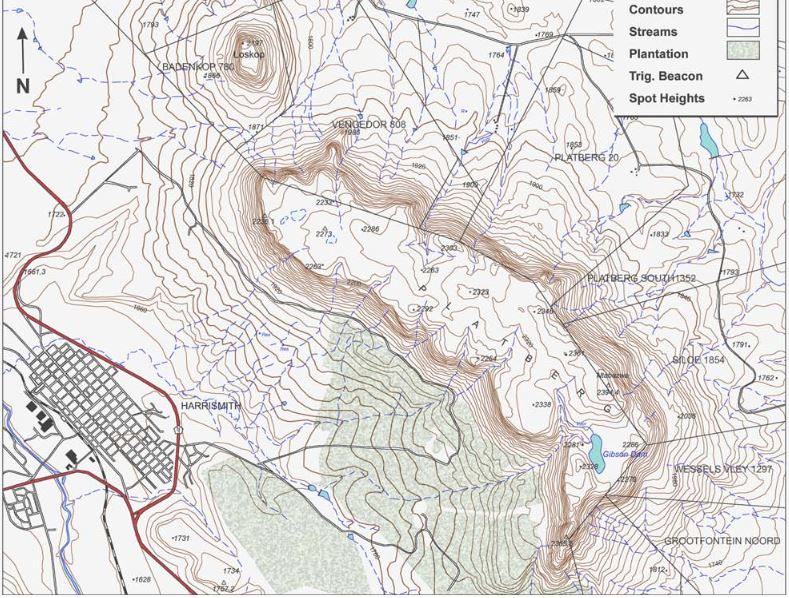
Platberg, overlooking the town of Harrismith in the Free State, is an inselberg that presents a refuge for indigenous plants and animals. And its status is precarious.
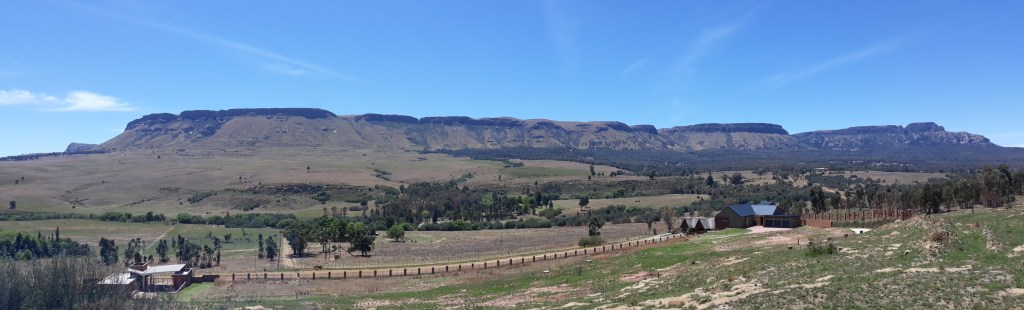
– Platberg behind Bakerskop in the foreground –
‘Little is known about the different taxa of Platberg and hence a detailed floristic and ecological survey was undertaken in 2009 by UNISA’s Robert F. Brand, Leslie R. Brown and Pieter J. du Preez to quantify threats to the native flora and to establish whether links exist with higher-altitude Afro-alpine flora occurring on the Drakensberg. Vegetation surveys provide information on the different plant communities and plant species present and form the basis of any management plan for a specific area. No extensive vegetation surveys had been undertaken on Platberg prior to this study; Only limited opportunistic floristic collections were done: Firstly, in the mid-1960s by Mrs. Jacobs. These vouchers were mounted and authenticated in 2006 and are now housed at the Geo Potts Herbarium, Botany Department, University of the Free State;
Secondly, 50 relevés were sampled between 1975 and 1976 by Professor H.J.T. Venter, Department of Genetics and Plant Sciences, University of the Free State.
Mucina & Rutherford 2006 say: ‘Platberg is the single largest and best preserved high-altitude grassland in the Free State. ‘
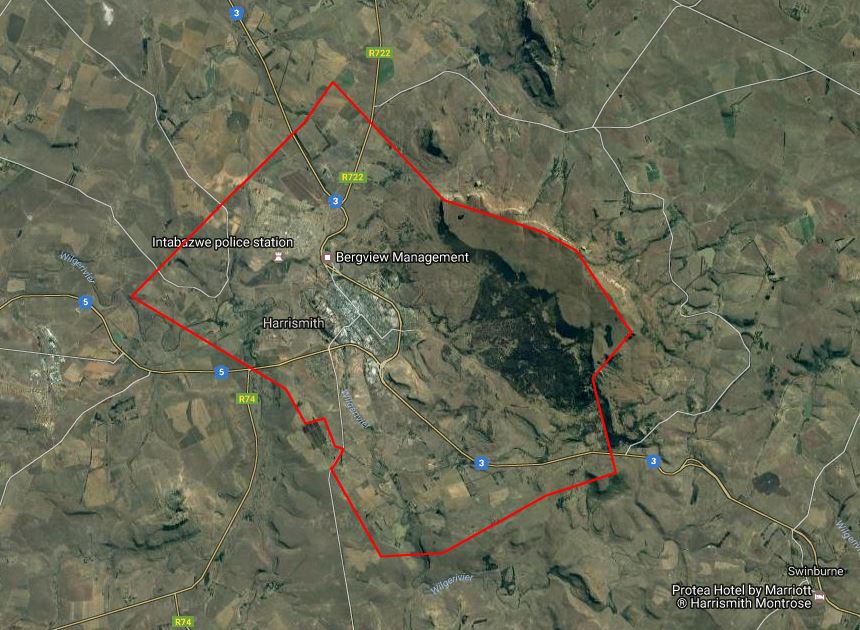
– and I say in 2019: Look how tiny it is! You can hardly see Platberg on this map of all nearby high altitude places. Yet this is our single largest tiny piece of this grassland left!
The authors plead: ‘As an important high-altitude grassland, it is imperative that Platberg be provided with protection legislated on at least a provincial level.’ At present, Platberg is still municipal, with very little protection! – In fact, I think they hire out the grazing for cattle – I hope not, as that really damages the veld and wetlands.
– That tiny island above the ‘th’ in Harrismith = Platberg – – Harrismith townlands –
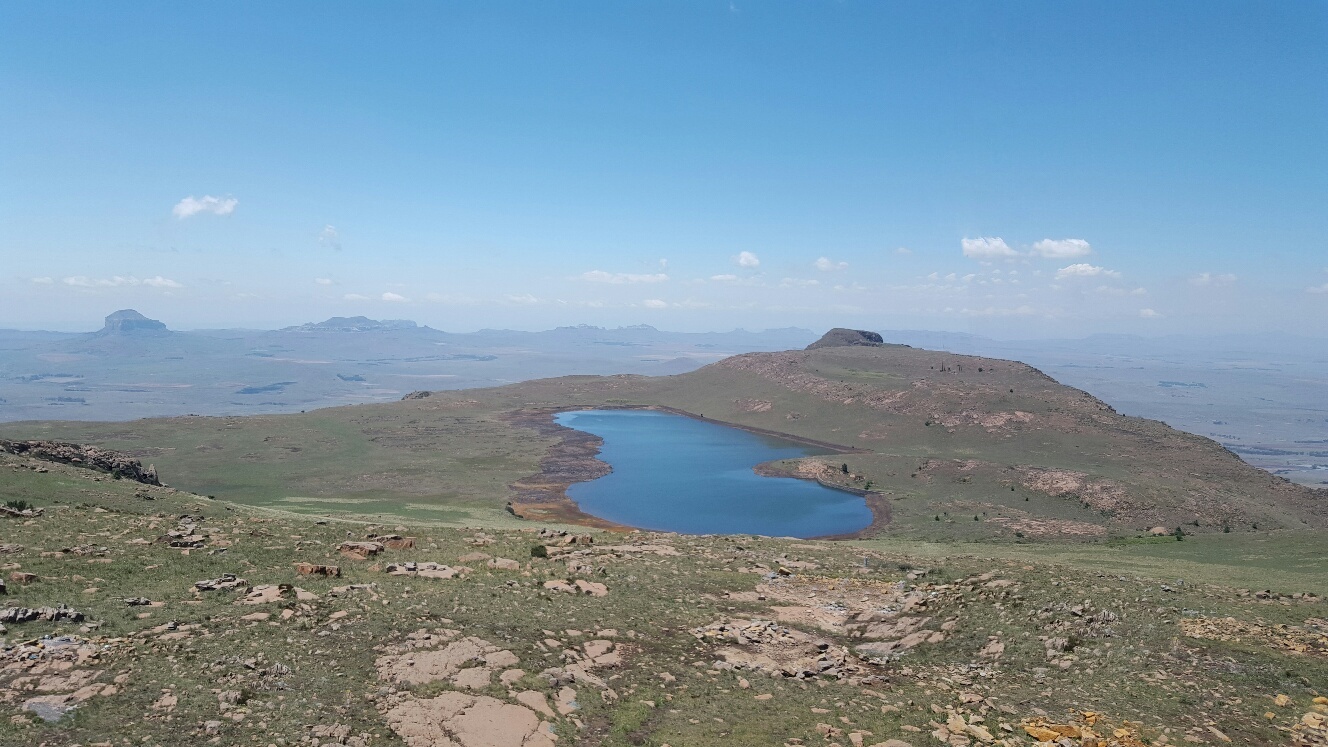
Platberg’s altitude ranges from 1 900m to 2 394m ASL. The surface area covers approximately 3 000ha. The slopes are steep with numerous vegetated gullies and boulder scree slopes below vertical cliffs that are 20m to 45m high. Waterfalls cascade down the southern cliffs after rain. A permanent stream arising from the vleis around, and the vleis drowned by, Gibson Dam on the undulating plateau flows off the escarpment and cascades as a waterfall. From a distance, Platberg appears to have a distinct flat top. However, once on the summit the plateau is found to be undulating, with rolling grass-covered slopes. The vegetation of the plateau is dominated by grassland, with a few rocky ridges, sheet rock and rubble patches, as well as numerous seasonal wetlands and a permanent open playa (pan) – I’ve always called it a tarn – on its far western side. Woody patches of the genera Leucosidea, Buddleja, Kiggelaria, Polygala, Heteromorpha and Rhus shrubs, as well as the indigenous Mountain bamboo Thamnocalamus tessellatus, grow along the base of the cliffs. The shrubland vegetation is concentrated on the cool (town) side of Platberg, on sandstone of the Clarens Formation, in gullies, on scree slopes, mobile boulder beds, and on rocky ridges. Shrubs and trees also occur in a riparian habitat in the south-facing cleft, in which the only road ascends steeply to the summit up Flat Rock Pass. Platberg falls within the Grassland Biome, generally containing short to tall sour grasses. Platberg is a prominent isolated vegetation ‘island’ with affinities to the Drakensberg Grassland Bioregion, embedded in a lower lying matrix of Eastern Free State Sandy Grassland. Platberg also has elements of Fynbos, False Karoo and Succulent Karoo, as well as elements of Temperate and Transitional Forest, specifically Highland Sourveld veld types.
– spot Platberg’s highest point, Ntabazwe 2394m ASL –Looking from highpoint Mtabazwe towards Boobejaanskop eastern tip
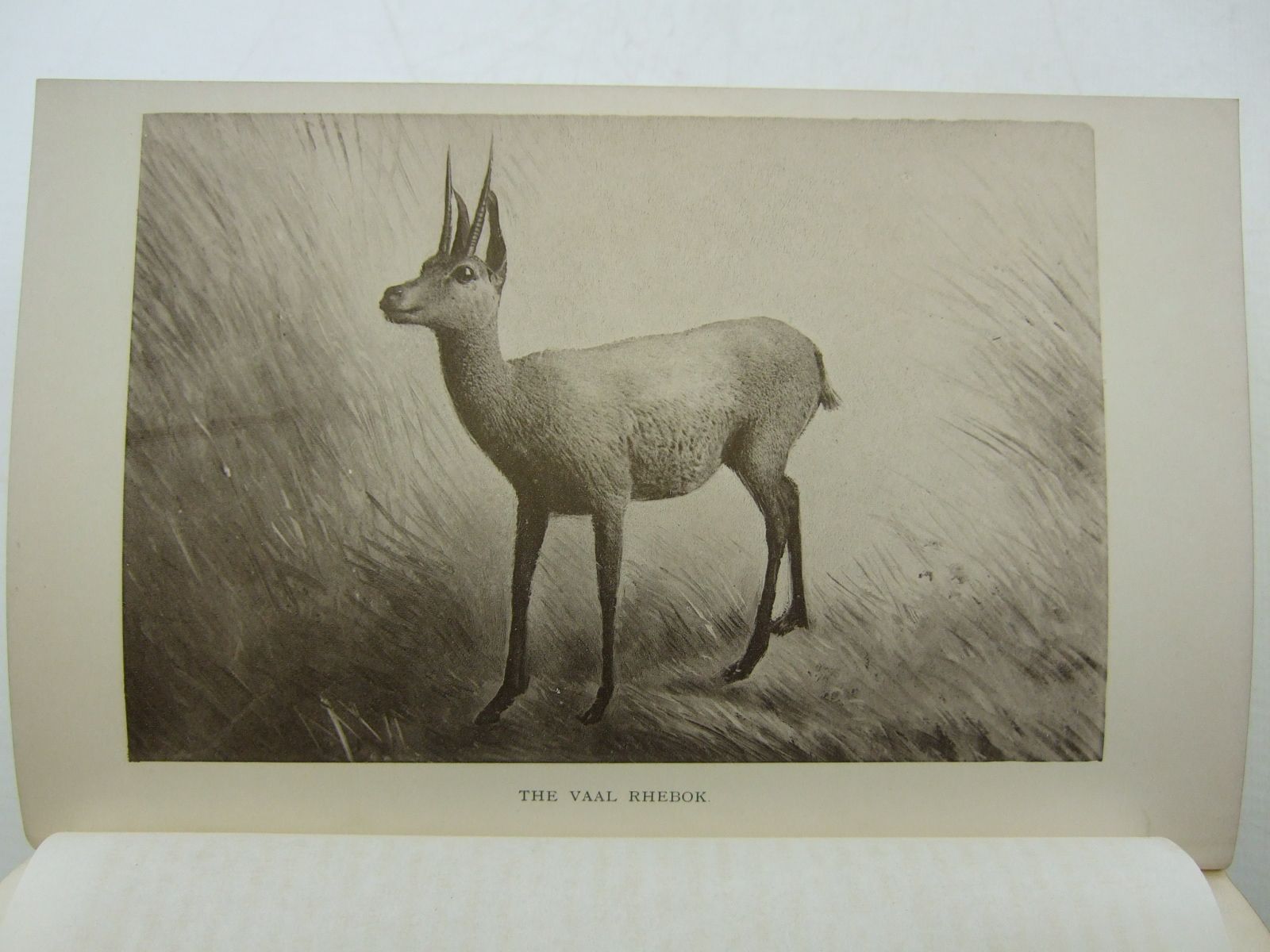
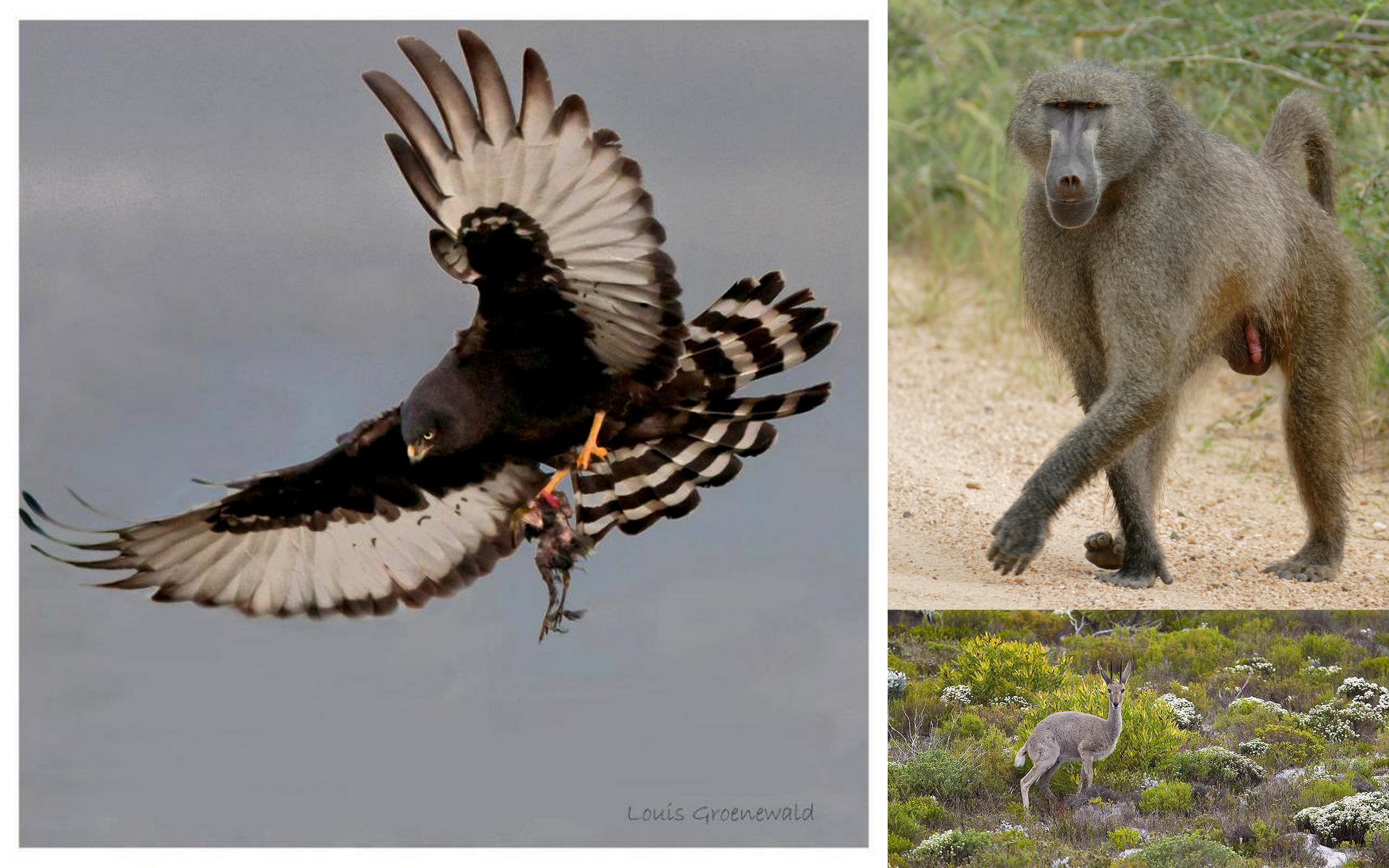
I wonder if there are any grey rhebok left?
Platberg specials– the road up Flat Rock (or Donkey) Pass –
See more of Platberg’s beauty in this amazing post. Damn! Sandra seems to have ended her beautiful blog! Pity!
~~~ooo0oo~~~
inselberg – German for ‘island mountain,’ the word first appeared in English in 1913, apparently because German explorers thought isolated mountains rising from the plains of southern Africa looked like islands in the midst of the ocean. Geologically speaking, an inselberg is a hill of hard volcanic rock that has resisted wind and weather and remained strong and tall as the land around it eroded away. Wikipedia says in South Africa it could also be called a koppie but I think we’d klap anyone who called our Platberg mountain or inselberg a ‘koppie.’
koppie – a smaller thing than Platberg; Just west of Platberg is Loskop; you can call that a koppie, maybe, if you call it a beautiful high koppie with an impressive cliff
relevé – in population ecology, a plot that encloses the minimal area under a species-area curve; right
tarn – tarn is a term derived from tjörn an Old Norse word meaning ‘pond.’ The term’s more specific use as a mountain lake comes from the upland regions of Northern England where tarn is the name given to all ponds. The term retains a broader use since it may refer to any pond or small lake regardless of where it is located or its origin. In the Scandinavian languages the terms tjørn, tärn, tjern, or tjärn are used to refer to small natural lakes that are found closely surrounded with vegetation. Other definitions say a tarn is a post-glacial pond, and Platberg’s is not that, I don’t think. I think it’s fine to keep calling ours the tarn on the western end of Platberg.
~~~oo0oo~~~
Aside: Talking of special high altitude grasslands, who knew of the Korannaberg near the mighty metropolis of Excelsior of dominees-wat-meidenaai fame? It has 767 plant species in its 130km2! It sure looks like a must-visit place! 227 bird species too.
dominees-wat-meidenaai – practicing what you preach against; the old Do as I Say, not as I Do BS that patriarchs try to enforce
The new preacherman at the Christian Church of Apache Oklahoma, looked me up after he’d been in town a while and invited me over to his place. Turns out he was interested in becoming a mission-nary to Africa and wanted to meet one of the real-deal Africans he’d heard and read so much about. Maybe suss out just how much we needed saving?
A HUGE man, six feet and nine inches tall, Ron Elr*ck wore a string tie, a ‘ten gallon’ stetson and cowboy boots, making him damn near eight feet tall fully dressed as he stooped through doors and bent down to shake people’s hands. I met his tiny little wife who was seemingly half his height, and two lil daughters at their house, the church ‘manse’ or ‘vicarage’.
– there’s the house next to the church –
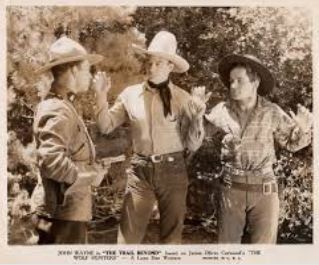
– the actor Mountie in the movie had to be shorter than John Wayne! –
Ron was an ex-Canadian Mountie and a picture on his mantelpiece showed him towering over John Wayne, when Wayne was in Canada to film a movie.
Soon he invited me to join him on a men’s retreat to “God’s Forty Acres” in NE Oklahoma (the yanks are way ahead of Angus Buchan in this “get away from the wife, go camping on a farm, and when you get back tell her you’re the boss, the head of the house, the patriarch – the ‘prophet’” shit. I mean, this was 1973!). I had made it known from my arrival in Apache that I would join anybody and go anywhere to see the state and get out of school – I mean hey! I’d already DONE matric!
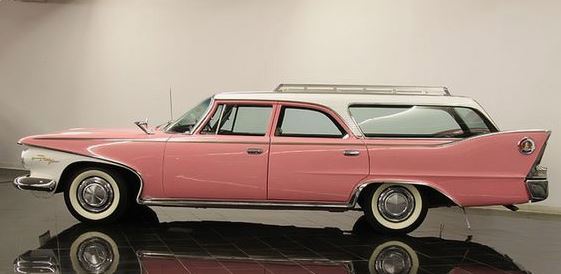
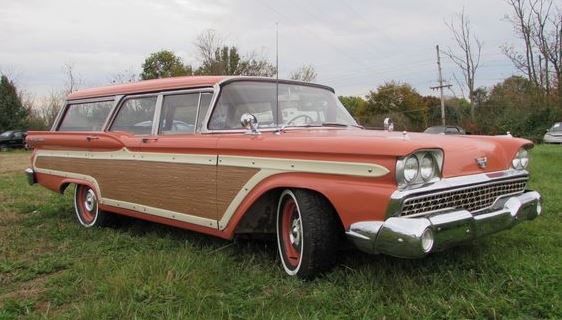
So we hopped into his muddy pink wagon with ‘wood’ panelling down the sides – it looked a bit like these in the pictures. We roared off from Caddo county heading north-east, bypassing Oklahoma City and Tulsa to somewhere near Broken Arrow or Cherokee county – towards the Arkansas border, anyway. Me n Ron driving along with the wind in our hair like Thelma and Louise.
Non-stop monologue on the way. He didn’t need any answers, I just had to nod him yes and he could talk non-stop for hours on end. At the retreat there were hundreds of men and boys just like him, no women. Unless you count them in the background who made and served the food. The men were all fired up for the Lawrd, bellowing the Retreat Song at the drop of a hat:
♫ “In Gahd’s Fordy Yacres . . !!”♫
We musta sang it 400 times in that weekend. If I was God I’d have done some smiting.
We left at last and headed back, wafting along like on a mattress in that long slap wagon, when Ron suddenly needed an answer: Had I ever seen a porno movie? WHAT? I hadn’t? Amazing! Well, jeez, I mean goodness, he felt it as sort of like a DUTY to enlighten me and reveal to me just how evil and degraded these movies could be. So we detoured into Tulsa. Maybe he regarded it as practice for the mission-nary work he was wanting to do among us Africans?
We sat through a skin flick in a seedy movie house. It was the most skin ‘n pubic hair ‘n pelvis ‘n pulsating organs this eighteen year old boykie from the Vrystaat had seen to date so it was, after all, educational. Thin plot, though.
I suppose you could say I got saved and damned all on one weekend.
——-ooo000ooo——-
footnote:
Ron did get to Africa as a mission-nary. He was posted to Jo-hannesburg. Lotsa ‘sinners’ in Jo-hannesburg, I suppose. I’m just not sure they need ‘saving’ by a Canadian Mountie.
Steve Reed sent a picture of old American cars in Aussie .. I wrote:
These lovely old motorised wrecks remind me of Swinburne character Abe Sparks‘ Rolls Royce bakkie. And that reminds me of Nell van Heerden.
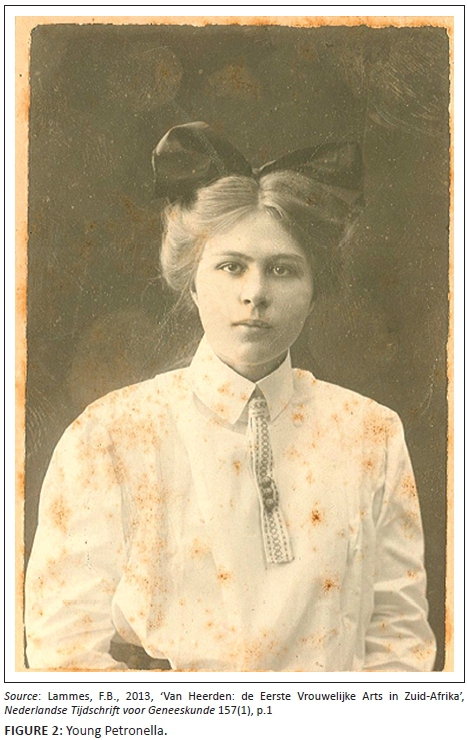
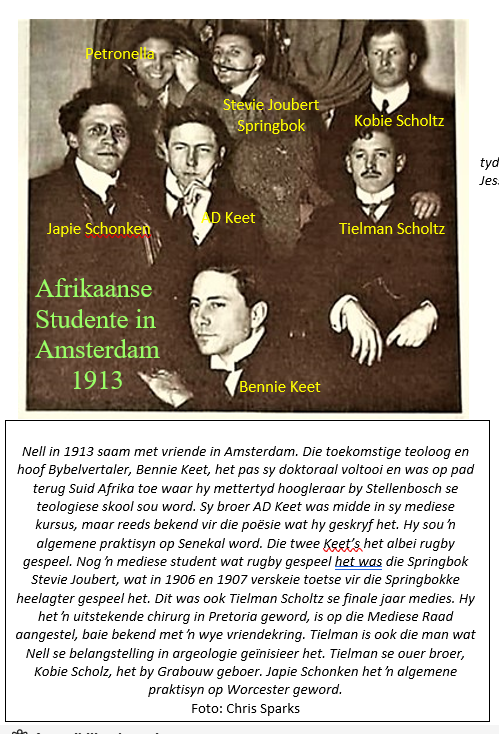
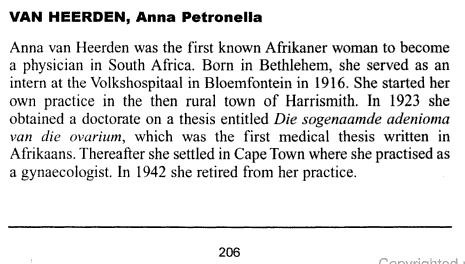
Dr Anna Petronella van Heerden, born 1887 in Bethlehem. She studied at the University of Amsterdam from 1908 to 1915 where she completed her medical degree. Thanks to our Harrismith historian Leon Strachan and Chris Sparks, Abe Sparks’ grandson, here she is with fellow students, a pretty elite group of South Africans of the day:
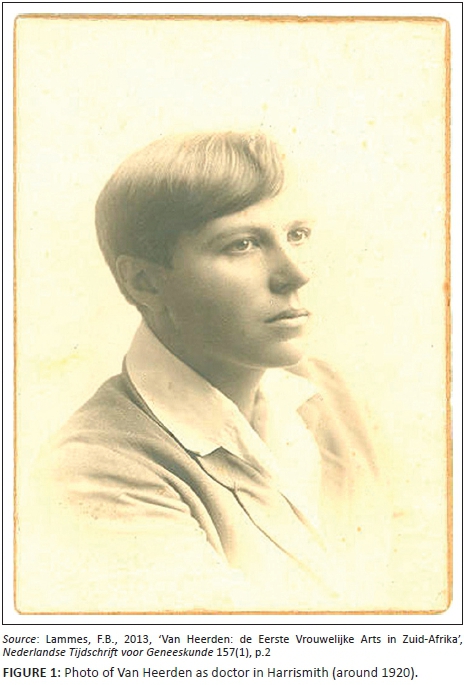
Van Heerden served as an intern at the Volkshuishospitaal in Bloemfontein in 1916 and had her own practice in Harrismith from 1917. She specialised in gynaecology in London from 1921 before returning to Amsterdam to complete her PhD in 1923. She moved to Cape Town where she practiced as a gynaecologist. She retired from her practice in 1942 to go farming in Harrismith.
Apparently she bought the Roller in England, toured the continent in it, then shipped it back to Kaapstad where she ran her specialist practice. Then, I’m guessing, drove it up to Harrismith to go farming. This part about the car is according to my 96 year-old Dad.
EXCEPT! The Roller was a Cadillac! Again Leon Strachan’s research to the rescue. I was just believing what I heard from my ole man. Not Leon, he did the research and found out Nell had ordered a custom 1929 Cadillac from the Cape Town General Motors dealer. Also that after swanning around the Cape in it, she decided to tour America with her life partner Freddie Heseltine, and modified the Caddy as a camper for the trip. An enterprising and indefatigable character. – (note the difference between a historian and a peddler of hearsay: The Rolls Royce bought in London and shipped to SA was actually a Cadillac bought in Cape Town and shipped to the USA and back!)
She gave up practicing medicine and came to Harrismith to farm cattle and was legendary among the boere here.
Before that, she went digging:
Usually dressed in khaki trousers, khaki shirt, sturdy shoes and hoed, she would answer my gran Annie’s, How are you, Nell? query with ‘Fair to bloody’ as she filled up her bakkie with Caltex fuel at Annie’s Central Service Station. She had a live-in girlfriend Freddie Heseltine, who sometimes had to move out to the cottage when Nell had city girlfriends over for lekker wild parties on her farm Grootfontein, behind the mountain. So we were told!
A cattle farmer, she would be seen at the vendusies where if any of the boere made the mistake of saying something, she’d be ready along the lines of “Ja, (Jan, Piet, Koos) ek is n fokken vrou al lyk ek nie so nie!” A true character, salt of the earth, a socialist and a real mensch. Imagine how strong you’d have to be, being ‘anders’ in a milieu where being a Male White Afrikaans Christian made you a baas, made you automatically right, and should have made all women appreciative and in their plek – and NOT at vendusies! And if they must be at vendusies they should serve the tea and koeksisters! The local boere would have known she was well-connected, though – she had served on National Party bodies – and was not to be taken lightly.
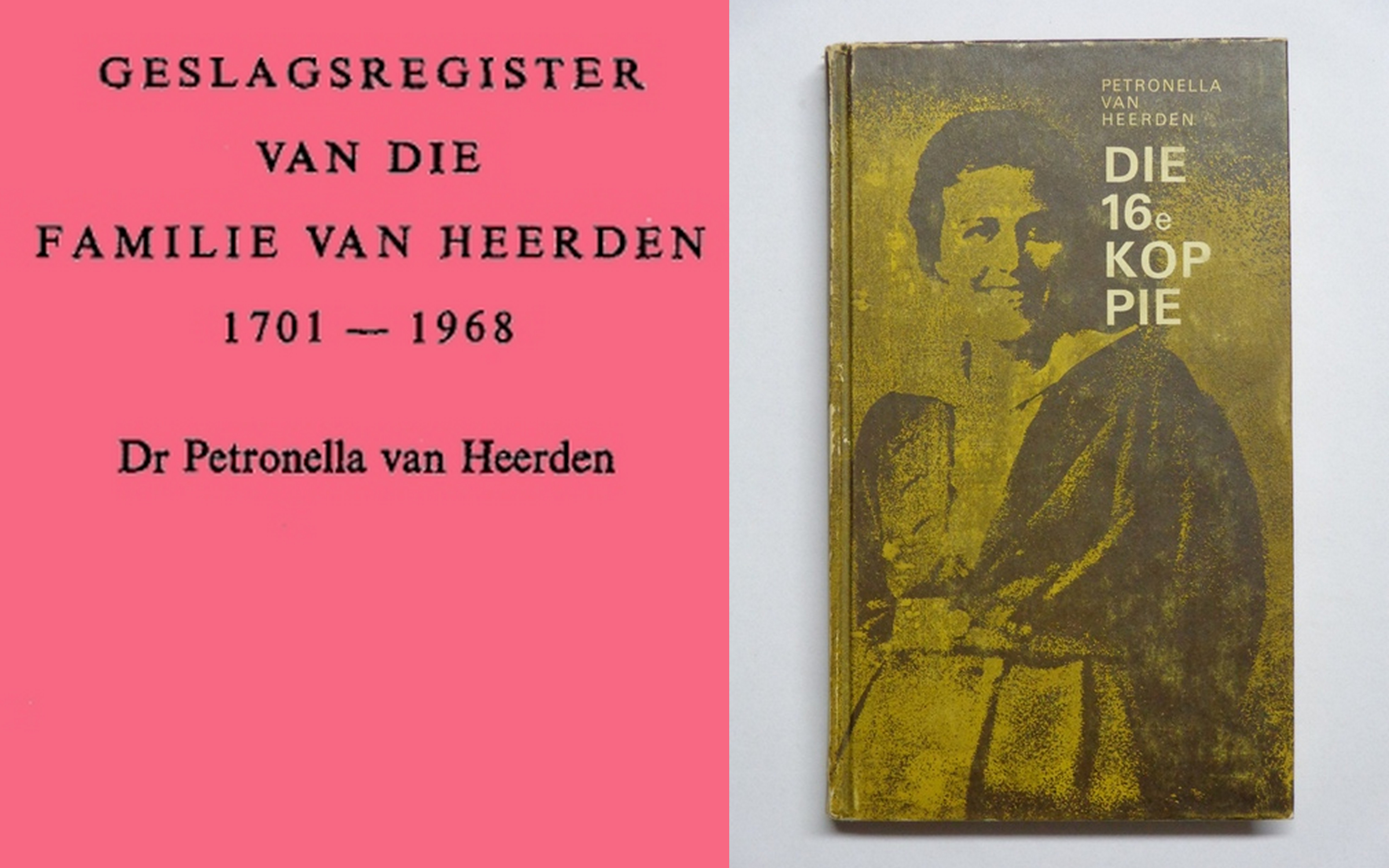
She did genealogy research and wrote two autobiographical books.
Anna Petronella van Heerden (1887–1975), was the first Afrikaans woman to qualify as a medical doctor. Her thesis, which she obtained a doctorate on in 1923, was the first medical thesis written in Afrikaans. She practiced as a gynaecologist, retiring in 1942. She also served in the South African medical corps during World War II.
She campaigned for women’s suffrage in the 1920s, and worked as a farmer after retiring from her medical work. She also published two autobiographical texts, Kerssnuitsels (Candle Snuffings) and Die Sestiende Koppie (the Sixteenth Cup), and other works, including: Waarom Ek ‘n Sosialis Is (1938) (Why I’m a Socialist), and Dames XVII (1969). Her awakening came, she writes in Die Sestiende Koppie, when she found out just how few rights women had, and that they were – she was! – legally classified with children and idiots!
~~~oo0oo~~~
This from Women Marching Into the 21st Century: Wathint’ Abafazi, Wathint’ Imbokodo:
This from “Nationalism, Gender and Sexuality in the Autobiographical Writing of Two Afrikaner Women,” Viljoen L. (2008):
Viljoen investigates questions of nationalism, gender and sexuality in the autobiographical texts of Petronella van Heerden and Elsa Joubert, and makes the point that autobiography, a genre often considered marginal to the literary canon, can be regarded as a site for examining the impact of nationalism on the construction of gendered and sexual identity. Petronella van Heerden (1887-1975) became the first Afrikaner woman to qualify as a medical doctor and published two short autobiographical texts, Kerssnuitsels (‘Candle Snuffings’) and Die Sestiende Koppie (‘the Sixteenth Cup’), in the early 1960s. The article argues that van Heerden’s omission of overt references to her lesbianism can be attributed to the strong, though embattled, position of Afrikaner nationalism at the time her texts were published.
My guess is there would also have been a fair dose of Nell saying ‘its none of your bloody business’ in there as well.
There’s an article about Nell in Journal of Literary Studies. (the link takes you to a summary – they want US$43 to read the whole thing!)
~~~oo0oo~~~
From the National Library of Medicine: Petronella van Heerden (1887-1975) was born in South Africa. She studied medicine in Amsterdam from 1908 to 1915 and then worked as the first female doctor in her native country for 4 years before specialising in gynaecology in London. She then returned to Amsterdam, where she gained a PhD in 1923 on a thesis on endometriosis that was written in Afrikaans. She settled in Cape Town and participated in many political and emancipatory activities alongside her work as a doctor. She wrote two autobiographies.
Nell van Heerden died in 1975, aged 88.
~~~oo0oo~~~
Oh, back to the Rolls Royce Cadillac! I imagine – but I don’t know for sure – that Abe Sparks converted this Rolls Caddy into a bakkie, a pickup, a ute, after buying it from Nell. We always heard stories of how Aussie sheep farmers ‘drove Rolls Royces around their farms, as the running boards were wide enough to carry dead sheep.’ Abe would have liked that, and my guess is he thought ‘Hell, I can do that too.’ Maybe?
~~~oo0oo~~~
Kaapstad – Cape Town
boere – farmers
hoed – hat
vendusies – livestock sales / auctions
“Ja, (Jan, Piet, Koos) ek is n fokken vrou al lyk ek nie so nie!” – Yes, Koos, I am a fuckin woman even if I don’t look like one!
anders – different; anything other than white, straight, conformist and obedient
plek – place; as in ‘know your place’
koeksisters– ‘South African doughnut’; deep-fried, very sweet
bakkie – pickup; ute
Wathint’ Abafazi, Wathint’ Imbokodo: You touch a woman, you touch a rock.
Tributes:
Nell was the first female SA citizen to qualify as a doctor – as far as I can tell. Other women practiced medicine in SA before her, but they were not born here.
Before Nell van Heerden: The first female to practice medicine in South Africa was Margaret Ann Bulkley. She was born in Ireland in 1789. She disguised herself as a man and called herself James Barry from then on. She qualified as a medical doctor in Edinburgh in 1812 and practiced medicine in Cape Town from 1816 to 1828. She effected significant changes, among them improvements to sanitation and water systems, improved conditions for enslaved people, prisoners and the mentally ill, and provision of a sanctuary for the leper population; performed one of the first known successful caesarian sections in which both mother and child survived; the child was christened James Barry Munnik in Barry’s honour, and the name was passed down through the family, leading to Barry’s name being borne by a later Prime Minister of South Africa, JBM Hertzog. Her birth sex only became known to the public and to her military colleagues after her death.
Before Nell:Jane Elizabeth Waterston was born in Inverness in 1843. One of the first women to be trained at the London School of Medicine for Women where she took her medical degree in 1880. She received a medical license from the Irish King and Queen’s College of Physicians. In 1883 she became a physician in Cape Town, where she died in 1932.
Same time as Nell:Mary Gordon b. 1890 in Lithuania, qualified as a doctor at the University of Durham in 1916 and emigrated to Johannesburg that year, taking up a position at the Johannesburg hospital. By 1944 she was registered as a specialist physician. Died 1971 aged 80. (Wits Review Oct 2017 Vol 38)
After Nell: In 1947 Mary Malahlele-Xakana (1916 – 1981) was the first black woman to register as a medical doctor in South Africa. Born in Polokwane, she qualified at Wits.
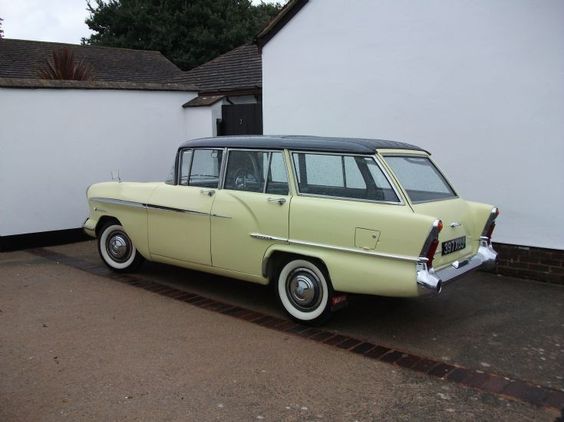
Sometime back in the fifties Mom’s uncle and the family lawyer Bunty Bland needed to go up to Rhodesia – ‘up north’ – to sort out the sale of his sister’s property. His Rhodesian brother-in-law drove down to Harrismith to fetch him. As ever, the finer details of my story should be checked out . . . pinch of salt. The car is probably right, the country – now Zimbabwe – is certainly right, and two of the people – Dad and Bunty – are right, that’s all I know. At first Dad said they drove up in Bunty’s Rover, but I couldn’t find a Rover station wagon. Seems they left ‘that sort of thing’ to Land Rover. I found this Vauxhall Victor station wagon and then Dad remembered it was the bro-in-law’s car and yes, it was a Vauxhall! Memories! Dodgy things.
The reason they took young Pieter Swanepoel, husband of favourite niece Mary, along was to share the driving. He says he ended up driving all the way there and back.
With him he had his new Eumig 8mm cine camera! He took footage of the ruins of the magnificent Great Zimbabwe. Bunty features in his trademark ‘fairisle’ sleeveless jersey . .
Other footage featured the Vauxhall, Bunty again and some fountains . .
Miss Underwood taught Mom Mary to play the piano and taught her very well; she then also taught big sister Barbara to play and taught her quite well, too; in my imagination this set off the following family discussion:
Let’s send little Kosie to her as well! He’s such a delicate little chap. If he also does well Sheila will want to follow and then we’ll have four musicians and we can start a band, maybe name it after some insects and become RICH!
Don’t laugh. This was ca.1959 and John, Paul and George were still The Quarrymen. Ringo hadn’t even joined them. There was a gap in the market.
I was dispatched to her house in Stuart street and suffered some torture of the ‘put this finger here and that one there’ kind; and then worse: ‘Take this home and practice it.’ One lesson, in my rugby kit, then I escaped and ran home, never to return.
When the next lesson time came around Barbara called me to the black bakelite phone in the long passage at 95 Stuart street. “It’s Miss Underwood!”
Yes Miss Underwood; Yes Miss Underwood; Yes Miss Underwood
Miz Zobbs was scathing: Why can’t any of you whistle? Listen to Claudio! HE can whistle. Show them Claudio. It takes a boy fresh from Italy to show you lot how to whistle!
Poor old Claudio Bellato dutifully pursed his lips and tootled some Italian to show us how it was done while probably thinking . . Mama Mia, Dora. You Don’t Pronounce My Name Clawed-ee-oh.
See?! *SNIFF* *SNIFF* You see! shrieked the old duck, sniffing loudly and wobbling alarmingly.
Dora Hobbs, snuff-sniffing tour de force of Harrismith Volkskool could rampage. She would march up and down like a galleon in full sail, never happier than when commanding a choir.
She stopped us in mid-song once to berate us: How many of you can say that!? Huh? How many of you can say you’ve fought and won!? she demanded.
Us ten to twelve year-olds stared at her blankly. What was she on about? Did she think we actually thought about the kak we were singing? Weird.
.We’d been singing:
There was a soldier, A Scottish soldier
Who wandered far away, And soldiered far away
There was none bolder, With good broad shoulder
He’d fought in many a fray, And fought and won
How many of you can say you’ve fought in many a fray? she brayed.
Jeesh!
– foughting and fraying –
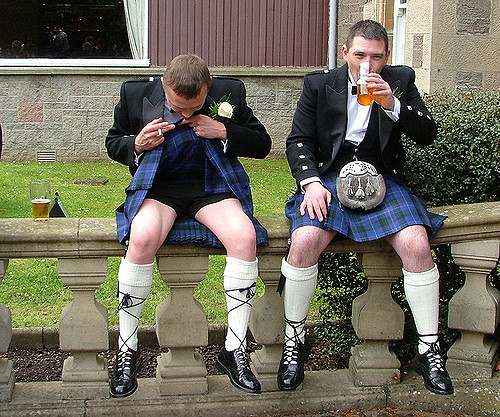
Dripping disdain and snot, with snuff stuck in her nose hairs, her moustache, on her glasses and on her ample bosom, she’d close her eyes, toss her head and mince around on her toes like a bulk ballerina. I think she was living in another world. When she opened her eyes and saw not dashing broad-shouldered soldiers in kilts, sonder underpants, wanting to woo the wee svelte lassie inside her, but instead snivelling pint-sized Vrystaters who would rather have been anywhere else in the dorp other than in “singing,” her mood probably grew dark.
Anyway, she probably didn’t know we fought of something totally different when she said ‘fray’ – and no we hadn’t done that either. Yet.
– Hobbs with a girls choir – the girls probly weren’t asked if they’d fought and fray’d – – nor if they’d fought about fraying –
She could be vicious, too, I’m afraid. She beat Dries and Alvaro mercilessly when they irritated her. Across the shoulders, on the top of their heads, stalking them from where she sat behind us. Face-to-face she would smash the heavy 40cm wooden ruler on their fingertips. She was rooted in Olde English educational methods:
A. Find out what a child cannot do; and then . .
B. Repeatedly demonstrate that he cannot do it;
Stand him up in front of the class and order him to do that thing that you know he cannot do; HUMILIATE HIM; followed sometimes – depending who the child was – by . .
C. a public beating.
A bad show, really, even granting that having Std 1, Std 2 and Std 3 in one class was probably not easy. Still: Not right. 26 kids in a class is far from the most anyone ever taught. She picked on the vulnerable. I suspect she knew none of their parents would challenge her on their behalf. Nor would the headmaster. Others of us never got touched; never even a harsh word.
– tiny Alvaro seated right in front of the formidable Hobbs –
~~~oo0oo~~~
Years later I read a review of what James Joyce had written when his character’s knuckles had been viciously beaten by a sadistic Catholic priest in front of the whole class. I found it now:
Stephen knelt down quickly pressing his beaten hands to his sides. To think of them beaten and swollen with pain all in a moment made him feel so sorry for them as if they were not his own but someone else’s that he felt sorry for.
Stephen – the character in Joyce’s novel A Portrait Of The Artist As A Young Man – reported it to the rector and got at least some satisfaction and admiration for being bold enough to defy convention and make the cruelty known. In Harrismith Volkskool no such justice was done; nor even attempted, to my knowledge; no-one brave enough, me included; no-one believing it was any use to expect any justice or fair play.
~~~oo0oo~~~
volkskool – primary school
fought – thought
fray – battle, skirmish; In Afrikaans: vry, more like woo, or necking, or kiss, make love, first fumblings;
kak – shit
sonder – without; as in sonderbroek: without underpants
Vrystaters – citizens of the Free State; which was anything but
I arrived back in town for the weekend from JHB – 1976 or 1977 – in my shiny new grey and grey 1965 Opel Rekord I’d got from Mom and Dad for my 21st.
Saturday morning I phoned Tabbo. What’s happening in the City of Sin and Laughter? The usual. Nothing. Come on out to the farm. Gailian.
I roared out of Piet Uys street into Stuart street, up Bester street into Warden street on a sunny Saturday morning, heading west with the sun behind me. I pass Annie’s Caltex garage, I pass Stewart Bain’s Town Hall, I pass the beautiful Badenhorst gebou on my left (it’s on the right in the picture). One of our metropolis’ three traffic lights is green so I proceed. I notice a fellow on my left who seems a bit under the weather. He walks forward as if to cross against the red. I move out wide but he then stumbles into a run and I hit the brakes but I also hit him! Shit! I’ve hit a pedestrian! Right in front of the Methodist Church nogal!
I’ve screeched to a halt, horrified, and I hop out. He’s lying about 5m in front of me in the middle of the oncoming lane. His hat is on my bonnet, his carton of sorgum beer is 2m in front of the bonnet, his shoes are 5m past where he’s lying!
Before I can even think where to phone from, Joseph Bronn is there. He saw the whole thing and has already phoned the cops and an ambulance, thank goodness. They’re there in no time and the fellow is taken off to hospital. The cops take names and statements and let us go.
From Gailian I phoned the hospital. Already they know who he is and where he works – on a farm, he’s in town shopping but it seems he decided to do a bit of celebrating too. He seems fine but he’s very drunk so they’re keeping him overnight for observation. The next morning I phone again – he has left already. Don’t worry, he was OK.
Phew! That slow-motion tableau will never be erased. I can see him looking up at me at the last second and hear the thump even today. The car: A small smooth dent in the bonnet, which I never repaired. It would get other dents in time.























 Vrystaat Confessions