Author: bewilderbeast

  • Platberg Pilgrimage

    Platberg Pilgrimage

    Harrismith had the biggest influx of people in its history recently. Well, that would be my guess. I don’t think even the Rhino Rally ever brought in THIS amount of people! I mean those rowwe hard-drinking bliksems fit a maximum of two people on their vehicles . . and often only one cos nobody really understands them.

    – here’s a rhino rally – and a wish –

    . . . whereas I would guess the teetotal Shembes are unlikely to put less than sixty people in a sixty-seater bus? And there were LOTS of those buses in town. The view is the eastern side of town with the Platberg mountain behind you.

    – shembe buses and cars – 95 Stuart Street in the yellow oval – our house 1960 to 1973 –

    In a way they were coming home: The founder of the Shembe church, Isaiah Mloyiswa Mdliwamafa Shembe, was born in 1865 at Ntabamhlophe outside Estcourt in the Drakensberg region of Natal. When he was very young his family fled from Shaka during the Mfecane period to the Harrismith district of the Orange Free State, ending up there as tenants on a farm of ‘an Afrikaner family named the Graabes.’

    Then the stories start: Like many other people of Harrismith he absorbed the local spirits; and like many ‘prophets’ before him, young Shembe ‘died and was resurrected at the age of three when relatives sacrificed a bull before his body could be interred.’ He was ‘visited by God on many occasions.’ He was ‘taught how to pray by God himself.’

    The call of Isaiah Shembe to his life’s vocation can be traced back to an experience at Ntabazwe Mountain in Harrismith. The mountain is also called Platberg in Afrikaans, meaning ‘Flat Mountain;’ and Thabantsho in seSotho, Black Mountain. Earlier he was on a farm (near) Witzieshoek in the Harrismith district; and then he moved to the land on the outskirts of Harrismith, (near) the mountain of Ntabazwe. Here Shembe experienced several revelations as a young boy, and it was through the means of lightning that he ‘received his call.’ As they do.

    When he was told to ‘find a place to pray to God’, he tried the Wesleyan Church that was nearby. However they were not right for him: they didn’t know how to baptise properly. Then came the Boer War and, abandoning his wives, he spent some time on the Rand. He joined a Baptist church there. After he returned to Harrismith the leader of his new church came to his place in 1906 to baptise Shembe. Proper baptism under water, not just a drop of water on your forehead, you Wesleyan Methodists!

    Shembe went to Natal and started accumulating followers. He would send them ahead to new areas to pronounce his arrival as ‘A Man of Heaven Cometh.’ Marketing. As his success and number of followers grew, so did his power. What you eat, what you think, what you wear, what you do, and that favourite of most religious leaders chosen by God: how men are to rule over their women, was all prescribed by the now Great Man. A lot of what you ‘had to do’ happened to make him rich. Hey! Coincidence!

    The legend grew. Shembe must have been highly intelligent and astute, as he told vivid parables, and showed uncanny insights into people’s thoughts. He composed music, writing many moving hymns; he had his sermons reduced to writing and they became scripture, and he provided his followers with a rich liturgical tradition based on modified forms of traditional Zulu dancing. He also often did the dramatic healing trick. You know: Lo! He was lying down; Now he walks!

    In 1913 Shembe visited Nhlangakazi Mountain which now became the movement’s holy mountain. Ntabazwe was too far from his followers. At Nhlangakazi he was told by the Holy Spirit to form his own church. This place later became his place of annual pilgrimage every first Sunday of the year. That too, made money.

    The Shembe Bible is known as the Book of the Birth of the Prophet Shembe. Their holy writings say, ‘On March 10, 1910 it was the arrival of the Prophet Isaiah Shembe at KwaZulu Natal (Durban) from Ntabazwe (Harrismith), as he was instructed  by the Word of God to do so. The Word of God told Shembe that they will meet at KwaZulu (Natal).’  See?

    In the 1930s Shembe commissioned his friend and neighbour, the renowned John Dube, to write his biography. The book uShembe, appeared shortly after his death, and contains much of the essential Shembe lore and hagiography, but Dube was an ordained minister and not a Nazarite, so he does not only present Shembe in flattering terms. Shembe’s bona fides as a prophet are questioned, and his undoubted skill at extracting money from his membership is highlighted. Dube alleged that Shembe was overtaxing rentals; that he was conducting baptism for payment – part of his fundraising for the church; that he was extorting money from members as he paid lobola for young girls whom he married; and that he was corrupt and exploitative. – Tch! and Eish! Just what an ambitious prophet / saviour / manifestation of God doesn’t need: an honest biographer! Shembe’s son and heir, Shembe II, Galilee Shembe forbade his followers to read the book. Hey! You know that book my father asked his friend, uMfundisi Dube to write? Don’t Read It!

    A factor of the huge success of African Independent Churches like the amaNazaretha has been their emphasis on ‘Africa for Africans. ‘ Often implicit, but explicitly verbalised by Shembe, this has been the main cause for the break-away from the mainline or mission – or European – churches. They wanted their own identity. However, discontent has continued to plague these church formations, even after self-governance and independence. Money and power corrupts, and they have splintered into many different internal groups and factions. Succession wrangles in the Shembe Nazaretha Baptist Church have given birth to the current seven factions, six of them headed by Shembe family members. Various battles have raged since 1935 when the original Shembe, Isaiah, died. The latest succession struggle started in 2011.

    So who decides who is divinely anointed to lead the church? Very modernly, it is not God . . not a God . . not a king . . not a council of elders . . not even a new legitimate national democratic government. No! A judge of the courts. The legal system! They’re like, Step aside, this is not a small matter! I have brought my lawyers! The prize is reportedly worth many millions. As with all human endeavours, greed is always a big factor.

    So who went to Harrismith this year? Which faction? I don’t know . . we’d have to ask an insider. I just hope they didn’t ascend the mountain. Fragile Platberg does not need 6000 humans on it. The poor grysbok will skrik.

    See some of Platberg’s beauty in this amazing post. And more lovely pics here.

    ~~oo0oo~~

    hagiography – biography of exaggerated, uncritical praise, usually of a religious person; I had to look that up;

    Pippin Oosthuizens’ THEOLOGY OF THE AMA-NAZARITES WRITTEN AT THE REQUEST OF THE RIGHT REVEREND LONDA NSIKA SHEMBE – BY G. C. OOSTHUIZEN

    Magnus Echtler’s Shembe is the Way: The Nazareth Baptist Church in the Religious Field and in Academic Discourse

    Lucky Dube wrote a song about the Shembe religion –

    ~~oo0oo~~

    update: 2021 and the saga continues. The highest court in the land made a pronouncement in June as to who the legitimate leader of one of the factions was. Now in August another breakaway faction has formed. ‘Don’t you tell me what to do… ‘

  • Article in the Guardian

    Article in the Guardian

    Rorke’s Drift battle was war crime scene

    (I wrote about our family’s small involvement in the filming of the film Zulu and linked to this article. Afraid it’ll go missing, I have pasted the article here).

    This article is more than 22 years old

    Heroic effort marred by brutal aftermath

    Rory Carroll in Johannesburg – Tue 29 Apr 2003

    It is one of the glories of British military history. A garrison of just over 100 men, including sick and wounded, holding out against an army of 3,000 Zulus.

    Wave after wave of warriors with spears and rifles crashed against the makeshift defences at Rorke’s Drift, South Africa, and still the redcoats held firm.

    After a number of unsuccessful attacks in the 11-hour battle, the Zulus were finally forced to withdraw. Queen Victoria and her empire had reason to celebrate. In a way Britain still does: the 1964 film Zulu, starring Michael Caine as one of the officers at Rorke’s Drift, endures as a television favourite.

    More Victoria Crosses (11) were awarded to the troops at Rorke’s Drift than at any other single battle by the British army.

    But that image of valour and nobility in the Anglo-Zulu war of 1879 could now turn to shame. Documents have been uncovered which show that Rorke’s Drift was the scene of an atrocity – a war crime, in today’s language – which Britain covered up.

    In the hours after the battle senior officers and enlisted men of a force sent to relieve the garrison are said to have killed hundreds of wounded Zulu prisoners. Some were bayoneted, some hanged and others buried alive in mass graves.

    More Zulus are estimated to have died in this way than in combat, but the executions were hushed up to preserve Rorke’s Drift’s image as a bloody but clean fight between two forces which saluted the other’s courage.

    Damning testimonies from British soldiers are published in a new book, Zulu Victory, written by two retired British officers, Ron Lock and Peter Quantrill, and published in Britain by Greenhill.

    The letters and manuscripts, stored and forgotten in British and South African museums and archives, show that the British had no mercy for captured opponents after the Zulus set fire to the garrison’s hospital during the battle, then burst in and speared the patients.

    “Altogether we buried 375 dead Zulus, and some wounded were thrown in the grave,” wrote one trooper, William James Clarke. “Seeing the manner in which our wounded had been mutilated after being dragged from the hospital we were very bitter and did not spare wounded Zulus.”

    Horace Smith-Dorrien, a lieutenant who later became a general, wrote that a frame to dry ox-hides became an improvised gallows “for hanging Zulus who were supposed to have behaved treacherously” during the battle.

    Samuel Pitts, a private, told the newspaper the Western Mail in 1914 that the official enemy death toll was too low. “We reckon we had accounted for 875, but the books will tell you 400 or 500.”

    In fact, Lieutenant Colonel John North Crealock’s private journal, discovered in the royal archives at Windsor, reported that “351 dead Zulus were found and 500 wounded”. He did not elaborate on the fate of the wounded and the book’s authors conclude they were probably all killed, since there was no record of taking prisoners or tending wounded.

    The garrison’s heroism was no myth, but the Victorians lionised Rorke’s Drift to compensate for the debacle at nearby Isandhlwana, a British camp where 20,000 Zulus killed over 1,000 soldiers on the same day.

    Taking no prisoners, they disembowelled many of the British and their colonial and native allies.

    A British relief force saw the bodies on its way to Rorke’s Drift, and it was this force which executed the Zulu wounded, not the garrison’s men, who were resting after the battle.

    Six months after Rorke’s Drift, the British government said “several” Zulus had been treated, but made no mention of the hundreds of other wounded Zulus.

    “The British government and public thought it was better to sweep it under the carpet,” Ron Lock said yesterday.

    There is no mention of the atrocity at the museum at Rorke’s Drift, nor monuments marking mass graves.

    Mr Lock, a former inspector with the Kenyan mounted police and a battlefield historian, wrote the book with Peter Quantrill, who is retired from the British army’s Gurkha regiment.

    ~~oo0oo~~

  • Blithe Spirits

    Blithe Spirits

    Durban ca 1980 – I’ve been sent here by the army; I know very little about this Last Outpost of the British Empire, but my friend, fellow Free Stater Steve Reed, has been here almost a year, so he knows everything. And he knows some girls.

    The papers announced that some comet was due to approach Earth and – we extrapolated – threaten our way of life, our partying, our poison of choice – and perhaps even kill us. Or annoy us anyway.

    We determined to protect ourselves and our favourite planet from this unwelcome alien intruder. Steve hired a beach cottage at Blythedale Beach on the Natal north coast and, as I know a lot more about warding off comets than I do about girls, I was happy to tag along with Stefaans and a bunch of his female friends and admirers. Supplied with adequate stocks of various powerful potions and elixirs to be taken internally, we sallied forth. We also bought tinfoil.

    In the self-catering kitchen we found plenty with which to arm and armour ourselves: Colanders, coriander, and pots and pans made good headgear. Braai forks, spatulas, braai tongs and wooden spoons made anti-galactic weapons. We warmed up our IQ’s by imbibing aplenty and so started a rip-roaring single-handed – the other hand was holding cheap and blithe spirits – Defend the Planet Party; which same ended successfully in the wee hours on the beach when a mysterious pale, then ever-brighter, light appeared on the eastern horizon, over the sparkling Indian Ocean.

    Was it perhaps Comet Aarseth-Brewington? Well, if it was, we made it saweth its arseth by our brewing and distillington.

    Actually, it was more likely Comet Tuttle. There it is, below! It came back in 2007 but it knew better than to approach too close:

    Comet_8PTuttle.JPG
    – 37 million km is the closest it dared come this time –

    Of course it was really the Sun, come to burn a hole in our hangovers.

    Only later, after recovering from my overindulgence did I realise another of the planned missions had once again been a complete failure: Snaring any girls. As so often, the booze had won and I’d dipped out. And they were kif . .

    – probably available chicks –

    Ah, well! Hail to thee blithe spirit!

    Bird thou never wert . . our ode to this comet.

    ~~oo0oo~~

  • The Mass Choir Amasses

    The Mass Choir Amasses

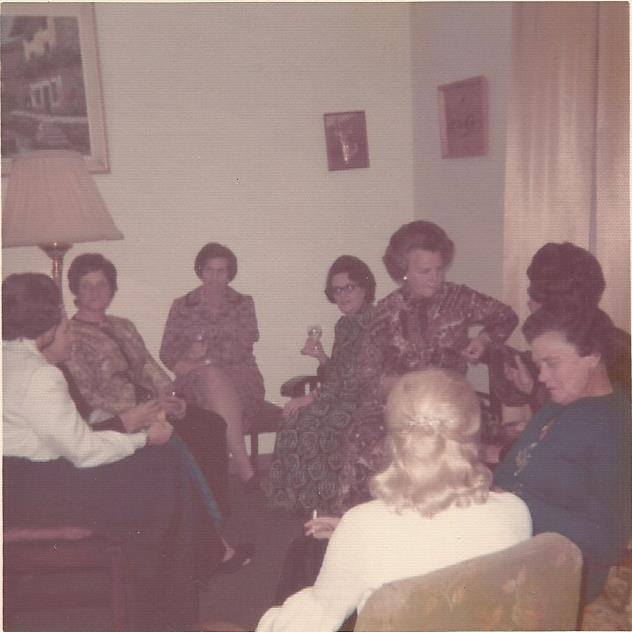
    A large gathering of the Goor Koor – that assembly of happy inebriates led and accompanied by virtual-teetotaller Mary Methodist, our Mom, gathered together – assembled, amassed – on the occasion of Mom’s 45th birthday. Usually there were far fewer of them gathered at any one time, an occasional Lubricated Quartet perhaps, but this was a special occasion in the big loungexat 95 Stuart Street!

    And Sheila – thanks goodness! – took pictures. She was in matric at the time, I was in Oklahoma, Barbara in Pietermaritzburg.

    – Joyce Joubert; Marie Roux peeping out; Isobel Kemp; Stella Fyvie; Mary the birthday girl, wearing specs, grog in hand; Mary Wessels; Martie Dreyer; Baby Mandy; Annemarie van Wyk –

    . . and here – precious picture! – Mary at the keyboard and Hugo Wessels right there, ready to belt out a number! Two very talented people, 45 years old, who were in matric together in 1945. And this fun gathering happened 45 years ago, as Mom is now 90! I think all my stats are right . . .

    – in earlier years my ear would be near the floor right outside that door behind Hugo – listening in fascination –
    – Dina de Kock; Hester Schreiber; Koekie de Bruyn; Hugo Wessels; Hannes van Wyk; Jack Kemp; Pierre Roux; Hector Fyvie; Steve Schreiber; Dad; Bennie Dreyer; Joyce Joubert Isobel Kemp; Stella Fyvie: Anna-Marie van Wyk –

    Wonderful memories of crawling down the long passage to get nearer to the sound of Mom playing the piano; Also of sundry ‘choir members’ over the years, belting out popular songs with high enthusiasm and various degrees of talent. If spotted by any of the choir it would be ‘Hello Kosie!’ – if spotted by Mom or Dad it would be ‘Get back to bed!’

    Also memories of the smell of ash trays! Always plenty of ash trays. Ours were from tyre companies, so they were glass inside miniature Dunlop or Goodyear tyres!

    – I couldnt find one overflowing with butts and ash! –

    ~~~~oo0oo~~~~

    Goor Koor – Dire Choir

    ~~~~oo0oo~~~~

    – 45yrs later here’s Mary, still beautifully at it –

    ~~~~oo0oo~~~~

  • Technicolor Yawns

    Technicolor Yawns

    Now we know why, when you have had a few too many, your lumpy laughter can be so spectacular . . .

    Check out ‘bevshots‘ where some dudes* had a sudden thought – probly while suitably under the affluence of incohol? BevShots® are photographs of alcohol under a microscope.  These high-quality photographs of your favorite beers, wines, cocktails, liquers and mixers were taken after they had been crystallized on a slide and shot under a polarized light microscope. As the light refracts through the beverage crystals, the resulting photos have naturally magnificent colors and composition. Just like we had a naturally magnificent complexion, and erudite verbal composition while it was in our veins on its way to our brains where it belongs. Cheers!

    Irish pale lager

    Australian pale lager

    Tequila

    Feature pic: Irish Stout – aka ‘flokati rug dye

    These quality scientific macro photographs explain why sometimes when you shoot a cat, it turns out to be a whole Bengal Tiger.

    ~~oo0oo~~

    Thanks @lowqualityfacts@mstdn.social

    Improve your vocabulary: Don’t just say ‘vomit,’ be like Shakespeare and use descriptive terms and synonyms: sidewalk pizza; burp cubed; spew; lumpy laughter; technicolor yawn; shoot a cat; chunder; upchuck; barf; vomit; hurl; ralph; brauer; purge; puke; hork; honk; buick; huey; louis; regurgitate; throw up; belch your boerewors; toss your cookies; lose your lunch; toss a pavement pizza; perform peristaltic pyrotechnics; paint the town red . . and yellow-green, orange and pink; calling Ralph on the big white telephone; pray to the porcelain gods; grocery yodel. (Your favourites in the comments, please!)

    Scientific puzzle: Why, no matter what you have eaten, are there always bits of carrot in the mix?

    Hypothesis: They hide in the appendix, waiting for just the right occasion to hu- hu- hu-ppear?

  • Nostalgia

    Nostalgia

    *sigh* Nostalgia just isn’t what it used to be . . .
    (Quote by – Peter De Vries)

    Nothing is more responsible for the good old days than a bad old memory.
    (Quote by – Franklin Pierce Adams)

    Nostalgia: A device that removes the ruts and potholes from memory lane.
    (Quote by – Doug Larson)

    Nostalgia is like a grammar lesson: you find the present tense, but the past perfect!
    (Quote by – Owens Lee Pomeroy)

    Don’t be nostalgic about something until you’re absolutely certain there’s no chance of its coming back! (Quote by – Bill Vaughn)

    If you’re really determined to relive the good old days: SWITCH OFF THE AIRCON!

    Lindy Stiebel, English Prof at UKZN wrote about Victor Stiebel (probably some relation?), who couldn’t wait to leave Natal, became very famous in England, then wrote about his childhood forty years later. My brief takeaway on her discussion on nostalgia was roughly: Nostalgia does not necessarily mean you want to go back.
    ..
    Excerpts:

    While there is certainly affection in the gaze Stiebel casts over his family and his upbringing, the nostalgia is of a reflective kind rather than restorative, in Boym’s terms: ‘[w]hile restorative nostalgia returns and rebuilds one’s homeland with paranoic determination, reflective nostalgia fears return with the same passion.’ Reflective nostalgia has no wish to return home, accepting that the past is the past; instead, an aesthetic distance can be maintained, memories of the past home – because sealed off from the present – can be a source of pleasure.

    Not . . the exile’s or immigrant’s longing for home . . instead nostalgia . . precisely because he wanted to escape from home, not cling to it.

    As Nasta states: ‘[h]ome, it has been said, is not necessarily where one belongs but the place where one starts from.’

    . . finally, his childhood home was a place to run from . .

    See:

    https://www.researchgate.net/publication/352108159_%27A_quintessentially_English_designer%27_from_Durban_Victor_Stiebel%27s_South_African_Childhood_1968

  • Tool Chests

    Tool Chests

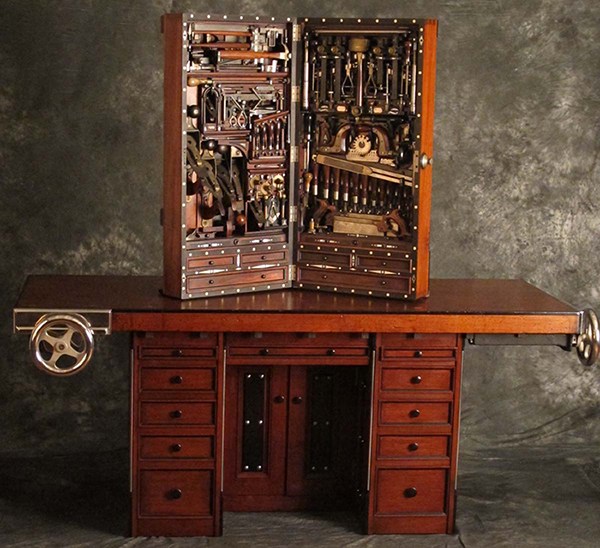
    The Studley Tool Chest: Made out of mahogany, rosewood, walnut, ebony, and mother of pearl.

    Henry O. Studley (1838–1925) was a carpenter, organ and piano maker, who worked for the Smith Organ Co. and later for the Poole Piano Company of Quincy, Massachusetts. He is best known for creating the famous Studley Tool Chest, a wall hanging tool chest that cunningly holds 218 tools in a space that takes up about a metre by half a metre of wall space when closed.

    ~~~~~ooo000ooo~~~~~

    I wrote about this in Feb 2014. I got responses:

    Steve Reed wrote: In his entire married life, Henry Studley only came inside the house at mealtimes and to sleep. Otherwise he was out in the shed. Must have had a bag of a wife.

    ~~~~~ooo000ooo~~~~~

    Me: Or just his pri-horities right ?

    Talking about living in the shed:
    Did I tell you my ole man bought himself a new lathe? Brand-new wood lathe with a 1m gap between the headstock and the tailstock. The headstock can swivel so he can turn bigger bowls – and turn them sitting down. Says he can’t die now for at least three years to justify the purchase and to finish the chisel handles and tables he has in mind . . . ninety one and counting . . .

    Went to visit the other day. Their tenants have left and I found the ole man in the second house on top of a stepladder, muttering that they’d left their curtains up. Bitched good-humouredly when I took over and removed the rest of the curtains: ‘What do you think? I’m too old to climb a stepladder?’ Uh, yes, Dad.

    Now he wants to buy a new kombi – with the old lady’s money! Goat . . .

    ~~~~~ooo000ooo~~~~~

    Peter Brauer wrote: I’m with your old man on this one. Want a job done properly… do it yourself

    ~~~~~ooo000ooo~~~~~

    Me: Want a job done properly, procrastinate till it no longer needs doing . . most peaceful*, cost-effective method I’ve found.

    *under the new regime. Under the old regime this method was NOT peaceful . .

    ~~~~~ooo000ooo~~~~~

    Brauer: I don’t know what procrastinate means, but stuff it, I’ll find out tomorrow.

  • Conquering of the Boers, 2018

    Conquering of the Boers, 2018

    Harrismith is still a lekker dorp thanks to some hard-drinking maniacs that hang out there, bitter-einders clinging to life behind the boerewors curtain.

    See this report – reproduced below – of a highly important, highly competitive Boer War re-enactment golf – or moer-en-soek – tournament last year.

    ~~~~oo0oo~~~~

    Conquering of the Boers

    Her Majesty The Queen

    Buckingham Palace

    London, England

    4th June 2018

    Our dearest and beloved Queen,

    After the marriage of Prince Harry to Ms Megan Markle, I wish to convey further good news to you, and to the rest of your Royal family.

    As your military attaché in Africa, it gives me great pleasure to advise that the Boers have been conquered at the battle of Harrismith which took place on the 2nd & 3rd June 2018. The white flag of surrender was raised by General Hamman, at 13h00 on this historical day for your universal British Empire.

    During my lengthy military career I have never witnessed a display of such loyalty and courage, as shown by your troops in this bloody battle. Your forces received only a few minor scratches and bruises, while the Boer field hospital has called for additional nursing staff, surgeons and even psychiatrists to treat their mentally scarred soldiers. There were no fatalities.

    Your Majesty will also be most pleased to hear that during the cease-fire period, as declared by Chief Justice Lord George Galloway, the British and Boer troops were treated to an elaborate Royal Banquet. At this very grand occasion, the soldiers from both sides mingled and socialized well. In some cases, too well! This developing inter-continental relationship seems to be getting stronger, despite the humiliating defeat dealt out to the Boers.

    On a personal note, please pass on my fondest greetings to my old friend Prince Phillip. I trust he is enjoying his retirement.

    I await your instructions regarding any further military operations required .

    Your loyal Military Attaché,

    Field Marshall Mark Russell VC

    – The Field Marshal tall, left of middle – Venning in jacket and tie next to his ossewa –
    – Jelliman in the mid-background, most of his hair on his upper lip –

    After the 2017 tournament Field Marshall Russell VC’s report to Her Majesty, Mev Queen had been far more tragic . . . and despondent.

    ~~~~~ooo000ooo~~~~~

    lekker – romantic

    bitter-einders – to the bitter end; lager, ale, bitters

    boerewors – sausage; and like laws, you may not want to know how it’s made – based on a quote by: John Godfrey Saxe American poet

    moer-en-soek – golf as prescribed by the Royal and Ancient, which only frowned on women membership for the first 260 years, kindly allowing them in after that cooling-down period

    boere musiek – noise emitted by farm implements called ‘constant screamers’ and ‘pull pianos’

    volkspele – dance in which you can grip your meisie in a dominee-approved manner

    meisie – lass

    dominee – veld pope; village vicar

  • Conquered by the Boers, 2017

    Conquered by the Boers, 2017

    Harrismith is still a lekker dorp thanks to some hard-drinking maniacs that hang out there, bitter-einders clinging to life behind the boerewors curtain.

    Here’s a dispatch to Mev Queen on the result of a highly important, highly competitive Boer War re-enactment golf – or moer-en-soek – tournament in 2017. It did not go well.

    ~~~~oo0oo~~~~

    “Boer War” Defeat – 2017 – Letter to the Queen

    Her Majesty The Queen

    Buckingham Palace,  London, England

    5th June, 2017

    Our Dearest & Beloved Queen,

    It is with deep regret that I inform you that your courageous soldiers have been severely defeated, at the hands of the Boers, at the battle of Harrismith on 3rd & 4th June 2017.

    Although there were no fatalities, the Boer Commando, led by General Wessel Hamman, showed immense bravery, superior marksmanship, and deft field skills in the heat of battle. Your loyal soldiers raised the white flag of surrender at 12 noon on this bloody Sunday.

    The Royal Medical team of nurses, led by Sister Mandy Pollock on Spionkop, are still very busy treating your loyal and wounded troops. The most severe and common treatments, were for the after effects of the toxic Boer medicine ‘Mampoer.’ All your troops are showing signs of making a full recovery. I would recommend that our soldiers be shipped back to London, and returned to Her Majesty’s Military Academy, Sandhurst, for further instruction in the skills of warfare.

    Apart from this humiliating defeat, I have pleasure in advising Her Majesty, that your troops have been well treated by the Boer Commandos, and have enhanced the tattered relationship that existed between the Boer Republic and the British Empire. Our soldiers and their spouses were treated to a Royal Gala dinner, featuring a clash of British & Boer cuisine, expertly prepared by Afrikaner chefs, Anel Bekker & Lizet Du Plessis. Your troops were further entertained by guest speakers. Nick Leslie spoke eloquently about previous battles, and the bravery of both the Boer and British forces. Dr Braam Joubert, from The Orange Free State, added a good deal of humour to this illustrious occasion. It was a grand banquet indeed!

    There was a fly-past, performed by a Royal Airforce squadron of fighter aircraft, led by Flight Commander Sir Gareth Pollock (MBE). The Boers entertained our troops with “Boere Musiek” and “Volkspele” dancers and singers. Our own Captain Venning (OBE), joined in to demonstrate the British version of these Boer dance moves.

    In order to commemorate this battle, and to remind future generations to further develop Anglo Boer relationships in Harrismith, Captain Venning (OBE) has donated a perfectly “in-scale” model of an ox-wagon. I wish to appeal to you to consider rewarding Capt. Venning at Your Majesty’s Birthday Honours ceremony. (with some more alphabets?)

    Other candidates to receive your Majesty’s recognition at this ceremony should include Major Gert van Tonder, who chose to enlist in Her Majesty’s Army, and then donated the battle dress to all the foot soldiers. There were others who have not only enlisted in your forces, but have made considerable contributions to this historical battle. These include Private George Galloway and the Scottish piper, Dr. Martin Reeve, who certainly stirred up the patriotic emotions of your troops. I respectfully recommend that the following be granted British citizenship with immediate effect, Dries Lategan, Steve Niewoudt, Justin van Tonder, and Quintin König. I was going to request that Kobus Bester should also be granted British citizenship, but on second thoughts, your Empire could do without this rascal.

    Many of your troops traveled from the Last Outpost of your Empire (Natal Colony), as well as from the Transvaal Goldfields, in order to fight this battle. They too, should receive your recognition. These include Craig Surmon, Gary Bellars, Andrew Miller, Reggie Jelliman, Richard Butcher, Wayne Warburton, Gavin Scholefield and Chris Smith. I would sincerely appreciate your kind consideration of the above. Mark Bebington also answered your call to take up arms, and should be given Royal recognition.

    I am under the impression that your troops are enjoying the warm sun in Africa, and may wish not to return to your United Kingdom. Perhaps Your Majesty could tempt them to return, with the lure of a “danger-pay” bonus, of a few Pounds Sterling.

    I await your further instructions.

    Your humble military servant,

    Field Marshall Mark Russell VC

    ~~~~oo0oo~~~~

    lekker – respectable

    bitter-einders – to the bitter end; last to leave the pub

    boerewors – secret sausage; used in hide-the-sausage games in bedrooms in the colonies

    moer-en-soek – pointless game administered by the ancient Scots – and the newer Americans, proving that it’s pointless

    ‘Mampoer’ – moonshine liquor; anything distilled illegally; high octane rating

    Mev Queen – that small tannie who wears the funny hats; the one with the rude Greek husband who crashes cars

    tannie – auntie majesty

  • Mix Your Drinks, Add River Water

    Mix Your Drinks, Add River Water

    It was advice from my chairman and as a new, fairly young member, I trusted him implicitly. You add sherry to your beer, said Allie Peter with a knowing nod. When we got to the bottle store in Cradock he spotted me at the till with a dozen Black Labels and a bottle of Old Brown Sherry.

    ‘No, Swanie,’ he came with more advice, given in his local Eastern Cape-inflected accent, ‘Get Ship Sherry. You can get TWO bottles for the price of one Old Brown.’ As a new, fairly young member, I trusted my chairman of the Kingfisher Canoe Club implicitly, so I dutifully swopped my bottle for two Ship Sherries. This decision was going to reverberate . .

    – a good blend, I was told – I notice bevshots haven’t analysed it yet –

    At Gattie’s townhouse (that’s Malcolm Phillips Esq. to you) we stood around with cans of beer in our hands, topping them up with sherry every so often. It worked a treat and was a marvelous idea. I could see my chairman had been around and knew a thing or two. The mix seemed to enhance my paddling knowledge and experience vastly.

    Much later that night I was busy expounding on some finer point of competitive paddling – probably on how one could win the race the next day – when I realised in mid-sentence, with my one finger held high to emphasise that important point I was making, that I was completely alone in Gattie’s lounge. Everyone had buggered off to bed and I had no-one to drink with. I looked around and found a corner, downed the rest of my berry mix and lay down to sleep. It was carpeted, I think.

    Later I remember through a slight haze seeing Gattie asking if his prize bull was being slaughtered, but when he saw it was only me kneeling and hugging the porcelain bowl, he said ‘Oh’ and went back to bed. The porcelain bowl had amplified my sounds of slight distress like a large white telephone, waking him up in his bedroom far down the other end of the house.

    It must have been a good clearing out as I felt fine when we left for the Grassridge Dam and the start of the marathon in Bruce Gillmer’s kombi a few hours later. Dave and Michelle were there and I spose some other hooligan paddlers and I’m sure my boat was on the roofrack. After a few km’s there was an ominous rumble and I knew I had a little lower intestinal challenge; which would have been fine – and some fun – if there hadn’t been a lady – and a real lady she is, too – in the bus.

    I had to warn them. It was soon after a famous nuclear disaster, so I announced ‘We need to stop the bus or there will be a Chernobyl-like disaster on board.’ Bruce was a bit slow to respond, he’s a psychologist, see. So it was only when the waft hit his own personal nostrils that he pulled over smartly and let me release the rest of the powerful vapour at the roadside on the outside if the sliding door. Ah, that was better. With the pressure off I was fine again. I did notice I wasn’t talking so much about winning the race though.

    The grumbling re-occurred on the dam, making that start the roughest I have ever endured. The wind and the waves on Grassridge Dam were worse than any rapids I have ever paddled. I was very glad to carry my boat down to the Fish River – leaving the dam stone last, I’m sure. Paddling river races on dams would be banned, verboten and illegal if I was the Ayatollah of Downriver Paddling.

    – comparatively, this is a mild day on Grassridge Dam –

    The river was plain sailing and the rest of the day a pleasure.

    – higher water than we enjoyed –

    That night I sipped daintily at plain beer. I was beginning the long slow process of learning to think carefully when considering advice freely given by sundry Chairmen of Kingfisher Canoe Club. I’m thinking of Charlie, Alli, Billy. Don’t let their nicknames fool you.

    Day two was short and easy and I probably kept my usual respectful back-of-the-field place.

    ~~oo0oo~~

    See the Fun of the Fish in the Eighties (video)

    ~~oo0oo~~

    The Fish

    The first race in 1982 attracted 77 paddlers in 52 boats. 37 boats finished the race, as the thick willows and many fences on the upper stretches of the river took their toll. It was won by Sunley Uys from Chris Greeff, the first person to shoot Cradock weir in the race.

    In those days, the race was held on a much lower river, 13 cumecs (roughly half of the current level!) and it started with a very long – over 50km – first day. The paddlers left the Grassridge Dam wall and paddled back around the island on the dam before hitting the river, eventually finishing at the Baroda weir, 2,5km below the current overnight stop. The paddlers all camped at Baroda overnight, before racing the shorter 33km second stage into Cradock.

    Stanford Slabbert says of the first race “In those days the paddlers had to lift the fences – yussis! remember the fences! – and the river mats (fences weighed down by reeds and flotsam and jetsam) took out quite a few paddlers. Getting under (or over) them was quite an art”.

    “I recall one double crew”, says Slabbert. “The front paddler bent forward to get under the fence and flicked the fence hoping to get it over his partners head as well. It didn’t. The fence caught his hair and pulled him right out of the boat and they swam!”

    Legends were already being born. Herve ‘Caveman’ de Rauville stunned spectators by pioneering a way to shoot Marlow weir. He managed to reverse his boat into the chute on the extreme left, and took the massive slide back into the river going forward, and made it!

    The field doubled in 1983, as the word of this great race spread. 145 paddlers in 110 boats. It was won on debut by Joburg paddler Niels Verkerk, who recalls, ‘It was a very long first day, especially as the river was not as full as it is now (it was running at 17 cumecs in 1983). Less than half the guys shot Keiths, which was not that bad as the hole at the bottom wasn’t that big.’

    At a medium level, the lines at Soutpansdrift were also different. The weir above Soutpans was always a problem, as there was no chute, no pipes. At the bottom of the rapid, the only line was extreme left, underneath the willow tree – yussis! remember the low-hanging willow trees! – and then a sharp turn at the bottom to avoid hitting the rocks, where the spectators gather like vultures.

    ~~oo0oo~~